EP1746477A2 - Système pour diriger un objet mobile - Google Patents
Système pour diriger un objet mobile Download PDFInfo
- Publication number
- EP1746477A2 EP1746477A2 EP06015156A EP06015156A EP1746477A2 EP 1746477 A2 EP1746477 A2 EP 1746477A2 EP 06015156 A EP06015156 A EP 06015156A EP 06015156 A EP06015156 A EP 06015156A EP 1746477 A2 EP1746477 A2 EP 1746477A2
- Authority
- EP
- European Patent Office
- Prior art keywords
- moving
- directing
- signal
- unit
- controller
- Prior art date
- Legal status (The legal status is an assumption and is not a legal conclusion. Google has not performed a legal analysis and makes no representation as to the accuracy of the status listed.)
- Granted
Links
Images

Classifications
-
- G—PHYSICS
- G05—CONTROLLING; REGULATING
- G05D—SYSTEMS FOR CONTROLLING OR REGULATING NON-ELECTRIC VARIABLES
- G05D1/00—Control of position, course, altitude or attitude of land, water, air or space vehicles, e.g. using automatic pilots
- G05D1/02—Control of position or course in two dimensions
- G05D1/021—Control of position or course in two dimensions specially adapted to land vehicles
- G05D1/0276—Control of position or course in two dimensions specially adapted to land vehicles using signals provided by a source external to the vehicle
-
- G—PHYSICS
- G05—CONTROLLING; REGULATING
- G05D—SYSTEMS FOR CONTROLLING OR REGULATING NON-ELECTRIC VARIABLES
- G05D1/00—Control of position, course, altitude or attitude of land, water, air or space vehicles, e.g. using automatic pilots
- G05D1/20—Control system inputs
- G05D1/24—Arrangements for determining position or orientation
- G05D1/244—Arrangements for determining position or orientation using passive navigation aids external to the vehicle, e.g. markers, reflectors or magnetic means
-
- G—PHYSICS
- G01—MEASURING; TESTING
- G01S—RADIO DIRECTION-FINDING; RADIO NAVIGATION; DETERMINING DISTANCE OR VELOCITY BY USE OF RADIO WAVES; LOCATING OR PRESENCE-DETECTING BY USE OF THE REFLECTION OR RERADIATION OF RADIO WAVES; ANALOGOUS ARRANGEMENTS USING OTHER WAVES
- G01S3/00—Direction-finders for determining the direction from which infrasonic, sonic, ultrasonic or electromagnetic waves, or particle emission, not having a directional significance, are being received
- G01S3/78—Direction-finders for determining the direction from which infrasonic, sonic, ultrasonic or electromagnetic waves, or particle emission, not having a directional significance, are being received using electromagnetic waves other than radio waves
- G01S3/782—Systems for determining direction or deviation from predetermined direction
- G01S3/783—Systems for determining direction or deviation from predetermined direction using amplitude comparison of signals derived from static detectors or detector systems
- G01S3/784—Systems for determining direction or deviation from predetermined direction using amplitude comparison of signals derived from static detectors or detector systems using a mosaic of detectors
-
- G—PHYSICS
- G05—CONTROLLING; REGULATING
- G05D—SYSTEMS FOR CONTROLLING OR REGULATING NON-ELECTRIC VARIABLES
- G05D1/00—Control of position, course, altitude or attitude of land, water, air or space vehicles, e.g. using automatic pilots
- G05D1/02—Control of position or course in two dimensions
- G05D1/021—Control of position or course in two dimensions specially adapted to land vehicles
- G05D1/0212—Control of position or course in two dimensions specially adapted to land vehicles with means for defining a desired trajectory
- G05D1/0225—Control of position or course in two dimensions specially adapted to land vehicles with means for defining a desired trajectory involving docking at a fixed facility, e.g. base station or loading bay
-
- G—PHYSICS
- G05—CONTROLLING; REGULATING
- G05D—SYSTEMS FOR CONTROLLING OR REGULATING NON-ELECTRIC VARIABLES
- G05D1/00—Control of position, course, altitude or attitude of land, water, air or space vehicles, e.g. using automatic pilots
- G05D1/02—Control of position or course in two dimensions
- G05D1/021—Control of position or course in two dimensions specially adapted to land vehicles
- G05D1/0231—Control of position or course in two dimensions specially adapted to land vehicles using optical position detecting means
- G05D1/0234—Control of position or course in two dimensions specially adapted to land vehicles using optical position detecting means using optical markers or beacons
-
- G—PHYSICS
- G05—CONTROLLING; REGULATING
- G05D—SYSTEMS FOR CONTROLLING OR REGULATING NON-ELECTRIC VARIABLES
- G05D1/00—Control of position, course, altitude or attitude of land, water, air or space vehicles, e.g. using automatic pilots
- G05D1/02—Control of position or course in two dimensions
- G05D1/021—Control of position or course in two dimensions specially adapted to land vehicles
- G05D1/0231—Control of position or course in two dimensions specially adapted to land vehicles using optical position detecting means
- G05D1/0242—Control of position or course in two dimensions specially adapted to land vehicles using optical position detecting means using non-visible light signals, e.g. IR or UV signals
-
- G—PHYSICS
- G05—CONTROLLING; REGULATING
- G05D—SYSTEMS FOR CONTROLLING OR REGULATING NON-ELECTRIC VARIABLES
- G05D1/00—Control of position, course, altitude or attitude of land, water, air or space vehicles, e.g. using automatic pilots
- G05D1/20—Control system inputs
- G05D1/24—Arrangements for determining position or orientation
- G05D1/242—Means based on the reflection of waves generated by the vehicle
-
- G—PHYSICS
- G05—CONTROLLING; REGULATING
- G05D—SYSTEMS FOR CONTROLLING OR REGULATING NON-ELECTRIC VARIABLES
- G05D1/00—Control of position, course, altitude or attitude of land, water, air or space vehicles, e.g. using automatic pilots
- G05D1/20—Control system inputs
- G05D1/24—Arrangements for determining position or orientation
- G05D1/247—Arrangements for determining position or orientation using signals provided by artificial sources external to the vehicle, e.g. navigation beacons
-
- G—PHYSICS
- G05—CONTROLLING; REGULATING
- G05D—SYSTEMS FOR CONTROLLING OR REGULATING NON-ELECTRIC VARIABLES
- G05D3/00—Control of position or direction
-
- G—PHYSICS
- G01—MEASURING; TESTING
- G01S—RADIO DIRECTION-FINDING; RADIO NAVIGATION; DETERMINING DISTANCE OR VELOCITY BY USE OF RADIO WAVES; LOCATING OR PRESENCE-DETECTING BY USE OF THE REFLECTION OR RERADIATION OF RADIO WAVES; ANALOGOUS ARRANGEMENTS USING OTHER WAVES
- G01S2201/00—Indexing scheme relating to beacons or beacon systems transmitting signals capable of being detected by non-directional receivers and defining directions, positions, or position lines fixed relatively to the beacon transmitters
- G01S2201/01—Indexing scheme relating to beacons or beacon systems transmitting signals capable of being detected by non-directional receivers and defining directions, positions, or position lines fixed relatively to the beacon transmitters adapted for specific applications or environments
-
- G—PHYSICS
- G01—MEASURING; TESTING
- G01S—RADIO DIRECTION-FINDING; RADIO NAVIGATION; DETERMINING DISTANCE OR VELOCITY BY USE OF RADIO WAVES; LOCATING OR PRESENCE-DETECTING BY USE OF THE REFLECTION OR RERADIATION OF RADIO WAVES; ANALOGOUS ARRANGEMENTS USING OTHER WAVES
- G01S5/00—Position-fixing by co-ordinating two or more direction or position line determinations; Position-fixing by co-ordinating two or more distance determinations
- G01S5/18—Position-fixing by co-ordinating two or more direction or position line determinations; Position-fixing by co-ordinating two or more distance determinations using ultrasonic, sonic or infrasonic waves
- G01S5/30—Determining absolute distances from a plurality of spaced points of known location
-
- G—PHYSICS
- G05—CONTROLLING; REGULATING
- G05D—SYSTEMS FOR CONTROLLING OR REGULATING NON-ELECTRIC VARIABLES
- G05D2105/00—Specific applications of the controlled vehicles
- G05D2105/10—Specific applications of the controlled vehicles for cleaning, vacuuming or polishing
Definitions
- the present invention relates to a system for directing a moving object, and more particularly to a system for directing a moving object such as a mobile robot to a charging device.
- a robot developed for industrial purposes is being widely used to achieve factory automation, and collects data or information on behalf of a human being under an extreme situation, which is unbearable for the human being.
- the human-friendly household mobile robot uses a battery to guarantee mobility at any place. If a voltage charged in the battery is equal to or less than a predetermined voltage, the human-friendly household mobile robot is programmed to automatically return to a charging device, such that the battery is re-charged.
- a representative technique for returning the mobile robot to the charging device is a method for employing output data of an encoder mounted to a moving wheel.
- This technique has a disadvantage in that it cannot compensate for errors caused by a slip or no-load rotation of the wheel, such that it is considered to be an undesirable method.
- FIG. 1 is a conceptual diagram illustrating a conventional system for estimating a relative location of a robot acting as a moving object.
- the system includes a plurality of Beacon modules 100 installed to many places of a room ceiling, such that it estimates a relative location of a mobile robot 200.
- Each Beacon module 100 includes an ultrasound transmitter and a Radio Frequency (RF) receiver.
- RF Radio Frequency
- the Beacon module 100 transmits an ultrasound signal to the mobile robot 200 upon receipt of the request. Therefore, the mobile robot 200 calculates an arrival time of the ultrasound signal emitted from each Beacon 100, such that it can calculate a distance from the mobile robot 200 to each Beacon 100. And, the mobile robot 200 estimates its relative location, such that it can return to the charging device.
- the above-mentioned system for employing the Beacon has a disadvantage in that a plurality of Beacons must be installed to many places of a room ceiling, such that the costs of implementing the system are unavoidably increased due to the use of many Beacons.
- a moving-object directing system for directing a moving object to a target location
- a moving-object directing unit including: a directing signal transmitter for generating a first moving-object directing signal, sequentially transmitting the first moving-object directing signal 360° in all directions, generating a second moving-object directing signal corresponding to directing information for directing the moving object to the target location upon receiving a signal indicating successful reception of the first moving-object directing signal, and transmitting the second moving-object directing signal, and a first RF (Radio Frequency) communication unit for receiving a signal indicating successful reception of the moving-object directing signal; and the moving object including: a second RF communication unit for wirelessly transmitting a signal indicating successful reception of the moving object directing signal to the moving object directing unit, and a controller for controlling operations of a wheel according to directing information of the received moving-object directing signal.
- a moving-object directing unit including: a directing signal transmitter for generating a first moving-object directing
- the moving-object directing system can direct a moving object (e.g., a mobile robot) to a target location on the basis of moving-object directing information, which is transmitted in real time from a moving-object directing unit (i.e., a charging device), such that a low-priced system capable of moving the moving object to the target location without using additional modules such as Beacons can be implemented.
- a moving object e.g., a mobile robot
- a moving-object directing unit i.e., a charging device
- a term "moving object" is indicative of a mobile robot such as a cleaning- or household- robot.
- the mobile robot is movable by wheels, but may be an exemplary mobile robot based on joint mechanism as necessary.
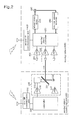
- FIG. 2 is a block diagram illustrating a system for directing a moving object according to a preferred embodiment of the present invention.
- the moving object directing system mainly includes a moving object directing unit 300 and a moving object 400.
- the moving object directing unit 300 basically includes directing signal transmission units 320 and 330 and a first RF communication unit 310.
- the directing signal transmission units 320 and 330 generate a first signal for directing the moving object 400, and output the first signal to the moving object 400.
- the directing signal transmission units 320 and 330 Upon receiving a response signal indicating successful reception of the first signal from the moving object 400, the directing signal transmission units 320 and 330 generate a second signal for directing the moving object 400 to direct the moving object 400 to a target location (e.g., a docking location of a charging device), and output the second signal to the moving object 400.
- a target location e.g., a docking location of a charging device
- the first RF communication unit 310 receives a signal indicating successful reception of the second signal for directing the moving object 400.
- the moving object directing unit 300 may be implemented with an additional module independent of the charging device.
- the moving object directing unit 300 may be integrated with the charging device required for charging the battery of the moving object 400.
- the moving object directing unit 300 includes the first RF communication unit 310 for communicating with the moving object 400 to inform the moving object 400 of the successful reception of the moving object directing signal.
- the moving object directing unit 300 further includes moving-object directing signal generators 332 and 333 acting as transmitters of the directing signal, a reflective mirror 334, a mirror rotation unit 335, and a controller 320.
- the moving-object directing signal generators 332 and 333 generate moving-object directing signals according to a control signal of the controller 320, and output the moving-object directing signals.
- the moving-object directing signal generators 332 and 333 can be implemented with an amplifier 332 for amplifying a signal and an infrared transmitter equipped with an infrared LED (Light Emitting Diode) 333. Therefore, the above-mentioned moving-object directing signal corresponds to an infrared beam for directing the moving object, and includes specific information required for directing the moving object. A detailed description of the moving-object directing signal will be described at a later time.
- the reflective mirror 334 reflects the moving-object directing signals generated from the moving object directing signal generators 332 and 333, and rotates by a rotation unit 335 (i.e., a motor) driven by the controller 320 by 360 degrees (i.e., 360°).
- a rotation unit 335 i.e., a motor driven by the controller 320 by 360 degrees (i.e., 360°).
- the moving object directing signals generated from the moving object directing signal generators 332 and 333 may be emitted 360° in all directions by the reflective mirror 334 and the rotation unit 335.
- the controller 320 controls operations of the moving-object directing unit 300 on the basis of control program data stored in an internal memory. For example, the controller 320 controls the moving object directing signal generation and a rotation angle of the reflective mirror 334, generates moving-object directing signals, and sequentially outputs the moving-object directing signals 360° in all directions.
- the controller 320 Upon receiving a signal indicating successful reception of the moving object directing signal from the first RF communication unit 310, the controller 320 stops the swing of the reflective mirror 334, and generates a moving-object directing signal corresponding to a rotation angle of the reflective mirror 334, such that it performs tracking the moving object 400 until reaching the target location.
- the above-mentioned reflective-mirror rotation angle information may be equal to moving-object directing information.
- the above-mentioned reflective-mirror rotation angle information may be defined as an offset angle of the moving object 400 on the basis of the target location (e.g., a docking location of the charging device).
- the moving object 400 receives the moving-object directing signal from the moving-object directing unit 300, and moves to a target location according to the moving-object directing information contained in the received signal.
- the moving object 400 includes a receiver 460 for receiving the moving object directing signal, as shown in FIG. 2.
- the receiver 460 can be implemented with an infrared receiver including both an infrared light-receiving unit 461 and an amplifier 462 for signal amplification.
- a plurality of receivers 460 may be used to enhance a receiving rate of the moving-object directing signal and a tracking performance as necessary.
- the controller 420 of the moving object 420 controls the wheel driving to receive the moving-object directing signal via a center infrared receiver from among the infrared receivers.
- the moving object 400 further includes a second RF communication unit 410 to communicate with the moving-object directing unit 300.
- the controller 420 of the moving object 400 can transmit a signal indicating successful reception of the moving-object directing signal to the moving-object directing unit 300 via the second RF communication unit 410.
- the controller 420 of the moving object 400 controls overall operations of the moving object 400 on the basis of control program data stored in the internal memory. For example, upon receiving the moving-object directing signal from the receiver 420, the controller 420 transmits a signal indicating successful reception of the moving-object directing signal to the moving-object directing unit 300 via the second RF communication unit 410, and controls the wheel driving according to directing information contained in the moving object directing signal transmitted from the moving-object directing unit 300.
- the moving object 400 further includes a sensor unit composed of a plurality of sensors capable of detecting a cliff (or drop), pressure, and an obstacle in the same manner as in a general cleaning robot. And, the moving object 400 further includes a wheel-motor drive 430, a wheel motor 440, and a rotation-amount detector 450, such that it can move by operations of the above-mentioned components 430, 440, and 450.
- the wheel-motor drive 430 drives a wheel motor M upon receiving a drive control signal from the controller 420.
- the rotation-amount detector 450 acting as an encoder connected to left and right wheels detects an amount of rotation of the left and right wheels, calculates rotation number data corresponding to the detected rotation amount, and transmits the calculated rotation number data to the controller 420.
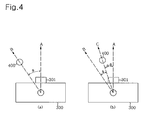
- FIG. 4 is a conceptual diagram illustrating operations of a system for directing a moving object according to the present invention.
- a reference number 300 is indicative of a charging device acting as a moving-object directing unit.
- a charging port 301 is located at the center of a lateral side of the charging device.
- a moving-object directing signal generator, a reflective mirror, and a reflective-mirror rotation unit are placed on the charging device, such that the moving-object directing signal may be emitted 360° in all directions.
- the docking location and the moving-object directing signal generator are located at an A axis.
- the A axis may be set to a target location of the moving object 400.
- the moving-object directing unit 300 must firstly detect the location of the moving object 400.
- the controller 320 of the moving-object directing 300 generates a control code capable of firstly generating the moving-object directing signal, and outputs the control code to the moving-object directing generators 332 and 333.
- the moving-object directing generators 332 and 333 generate the moving-object directing signal according to the control code, and forwardly transmit the moving-object directing signal via the reflective mirror 334.
- the controller 320 If the controller 320 does not receive the signal indicating successful reception of the moving-object directing signal via the first RF communication unit 310 after transmitting the moving-object directing signal, the controller 320 rotates the reflective mirror 334 by a predetermined angle by controlling the reflective-mirror rotation unit 335, and at the same time moves the reflective mirror 334. If the controller 320 re-generates a control code capable of generating the moving-object directing signal, a moving-object directing signal corresponding to the control code is emitted in another direction different from a previous direction.
- the controller 320 controls the moving-object directing signal generation simultaneously with rotating the reflective mirror 334, the moving-object directing signal is emitted 360° in all directions.
- the controller 420 of the moving object 400 receives a moving object directing signal via the receiver 460 such as an infrared receiver, it transmits specific information indicating successful reception of the moving- object directing signal to the moving-object directing unit 300 via the second RF communication unit 410.
- a moving object directing signal via the receiver 460 such as an infrared receiver, it transmits specific information indicating successful reception of the moving- object directing signal to the moving-object directing unit 300 via the second RF communication unit 410.
- the controller 320 of the moving-object directing unit 300 receives a signal indicating successful reception of the moving-object directing signal via the first RF communication unit 310, while sequentially rotating the reflective mirror 334 and at the same time transmitting the moving object directing signal 360° in all directions, it is determined that the controller 320 of the moving-object directing unit 300 has detected the location of the moving object 400, such that it stops rotation of the reflective mirror 334.
- the controller 320 If the location of the moving object 400 has been completely detected as described above, the controller 320 generates a control code corresponding to rotation angle information of the reflective mirror 334, and outputs the control code to the moving-object directing signal generators 332 and 333, such that the moving-object directing signal corresponding to the rotation angle information of the reflective mirror 334 can be transmitted to the receiver 460 of the moving object 400.
- the controller 420 of the moving object 400 receives the moving-object directing signal via the receiver 460, demodulates the received moving-object directing signal, acquires rotation angle information of the reflective mirror, and controls the wheel driving according to the acquired rotation angle information, such that it can access the target location.
- the controller 420 of the moving object 400 acquires the reflective-mirror rotation angle information value ⁇ .
- the controller 420 of the moving object 400 moves to a direction for reducing the reflective-mirror rotation angle information value ⁇ , as shown in FIG. 4(b).
- the controller 320 of the moving-object directing unit 300 can estimate a moving direction and a moving distance of the moving object 400. If the controller 320 rotates the reflective mirror 334 in the estimated direction to re-transmit the moving-object directing signal, and re-transmits the reflective-mirror rotation angle information according to the presence or absence of the received moving-object directing signal, the moving object 400 can reach the target location A by repetition of the above-mentioned operations of the controller 320.
- the controller 320 of the moving-object directing unit 300 continuously transmits the moving object directing signal on the condition that the reflective mirror 334 is fixed at a specific location.
- the controller 420 of the moving object 400 controls the wheel driving to receive the moving-object directing signal via the receiver located at the center part from among several receivers 460, the moving object 400 can be rapidly and correctly directed to the charging port 301 along the A axis serving as the target location.
- the moving object directing system can easily direct the moving object 400 to the target location such as the charging device without using several communication modules such as Beacons.
- the moving object directing system sequentially rotates the reflective mirror 334 and transmits the moving-object directing signal 360° in all directions
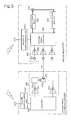
- the moving-object directing system may also be implemented by rotation of the infrared LED 333 corresponding to the moving object directing signal generator as shown in FIG. 3.
- the moving object directing signal generated from the infrared LED 333 can be rotated-outputted 360° in all directions according to the rotation of the motor.
- FIG. 3 is a block diagram illustrating a system for directing a moving object according to another preferred embodiment of the present invention.
- the moving-object directing unit 300 of FIG. 3 receives a signal indicating successful reception of the moving-object directing signal via the first RF communication unit 310, it generates a moving-object directing signal corresponding to the rotation angle information of the moving-object directing signal generator 335.
- the moving object 400 having received the moving-object directing signal corresponding to the rotation angle information of the moving-object directing signal generator 335, can be directed to the target location A in the same manner as in FIG. 2, and can also be directed to the charging port 301 along the target location A.
- the moving-object directing system can direct a moving object (e.g., a mobile robot) to a target location on the basis of moving-object directing information, which is transmitted in real time from a moving-object directing unit (i.e., a charging device), such that a low-priced system capable of moving the moving object to the target location without using additional modules such as Beacons can be implemented.
- a moving object e.g., a mobile robot
- a moving-object directing unit i.e., a charging device
- the moving-object directing system corrects a moving locus of the moving object in real time, such that the moving object can be rapidly directed to the target location.
Landscapes
- Engineering & Computer Science (AREA)
- Physics & Mathematics (AREA)
- General Physics & Mathematics (AREA)
- Radar, Positioning & Navigation (AREA)
- Remote Sensing (AREA)
- Automation & Control Theory (AREA)
- Aviation & Aerospace Engineering (AREA)
- Electromagnetism (AREA)
- Control Of Position, Course, Altitude, Or Attitude Of Moving Bodies (AREA)
- Toys (AREA)
Applications Claiming Priority (1)
| Application Number | Priority Date | Filing Date | Title |
|---|---|---|---|
| KR1020050066971A KR100704485B1 (ko) | 2005-07-22 | 2005-07-22 | 이동체 인도 시스템 |
Publications (3)
| Publication Number | Publication Date |
|---|---|
| EP1746477A2 true EP1746477A2 (fr) | 2007-01-24 |
| EP1746477A3 EP1746477A3 (fr) | 2010-08-04 |
| EP1746477B1 EP1746477B1 (fr) | 2011-09-14 |
Family
ID=37199034
Family Applications (1)
| Application Number | Title | Priority Date | Filing Date |
|---|---|---|---|
| EP06015156A Ceased EP1746477B1 (fr) | 2005-07-22 | 2006-07-20 | Système pour guider un objet mobile |
Country Status (5)
| Country | Link |
|---|---|
| US (1) | US7365512B2 (fr) |
| EP (1) | EP1746477B1 (fr) |
| KR (1) | KR100704485B1 (fr) |
| CN (1) | CN100474196C (fr) |
| RU (1) | RU2323465C1 (fr) |
Cited By (5)
| Publication number | Priority date | Publication date | Assignee | Title |
|---|---|---|---|---|
| RU2601284C1 (ru) * | 2015-08-25 | 2016-10-27 | Виктор Андреевич Павлов | Способ адаптивной спектральной селекции целей |
| WO2017114571A1 (fr) * | 2015-12-30 | 2017-07-06 | Telecom Italia S.P.A. | Système et procédé d'accueil pour charger un robot mobile |
| AT15526U1 (de) * | 2016-06-07 | 2017-11-15 | Tridonic Gmbh & Co Kg | Sensoranordnung für die optimierte Navigation eines Reinigungsroboters |
| EP3254593A1 (fr) * | 2016-06-07 | 2017-12-13 | Tridonic GmbH & Co. KG | Système de capteur pour la navigation optimisée d'une unité de robot mobile |
| GB2597656A (en) * | 2020-07-21 | 2022-02-09 | Nokia Technologies Oy | Apparatus, methods and computer programs for locating mobile devices |
Families Citing this family (4)
| Publication number | Priority date | Publication date | Assignee | Title |
|---|---|---|---|---|
| CN101847011B (zh) * | 2010-03-31 | 2012-06-13 | 深圳市银星智能科技股份有限公司 | 一种用于移动机器人的便携式区域定位覆盖方法 |
| CN104117987B (zh) * | 2013-04-26 | 2017-05-10 | 恩斯迈电子(深圳)有限公司 | 移动机器人 |
| DE102013209024A1 (de) * | 2013-05-15 | 2014-11-20 | Robert Bosch Gmbh | Verfahren zur Erfassung von Objekten durch adaptives Beamforming |
| KR102879441B1 (ko) * | 2020-10-07 | 2025-11-03 | 삼성전자주식회사 | 로봇, 충전 스테이션 및 이를 포함하는 로봇 충전 시스템 |
Citations (5)
| Publication number | Priority date | Publication date | Assignee | Title |
|---|---|---|---|---|
| US4679152A (en) | 1985-02-20 | 1987-07-07 | Heath Company | Navigation system and method for a mobile robot |
| GB2357337A (en) | 1999-09-29 | 2001-06-20 | Vi & T Group Inc | Automated object following system |
| US20040178767A1 (en) | 2003-03-14 | 2004-09-16 | Lg Electronics Inc. | Automatic charging system and method of robot cleaner |
| US20050021178A1 (en) | 2003-07-23 | 2005-01-27 | Se-Wan Kim | Method and apparatus for detecting position of mobile robot |
| US20050137748A1 (en) | 2003-12-22 | 2005-06-23 | Se-Wan Kim | Apparatus and method for detecting position of mobile robot |
Family Cites Families (13)
| Publication number | Priority date | Publication date | Assignee | Title |
|---|---|---|---|---|
| US4964265A (en) * | 1989-09-11 | 1990-10-23 | Young Carl W | Remotely controlled lawn mower |
| RU2042169C1 (ru) * | 1991-03-05 | 1995-08-20 | Институт кибернетики им.В.М.Глушкова АН Украины | Устройство для управления положением объекта |
| BE1008470A3 (fr) * | 1994-07-04 | 1996-05-07 | Colens Andre | Dispositif et systeme automatique de depoussierage de sol et engin y adapte. |
| US5711388A (en) * | 1995-07-20 | 1998-01-27 | Golfpro International, Inc. | Robotic golf caddy apparatus and method |
| US5646630A (en) * | 1996-05-20 | 1997-07-08 | Trimble Navigation Limited | Network of equivalent ground transmitters |
| CA2318079C (fr) * | 1998-01-28 | 2007-04-10 | O.M.G. S.R.L. | Chariot automatique de transport de clubs de golf ou d'autres objets et accessoires |
| JP2003515210A (ja) * | 1999-11-18 | 2003-04-22 | ザ プロクター アンド ギャンブル カンパニー | 家庭用清掃ロボット |
| US6496754B2 (en) * | 2000-11-17 | 2002-12-17 | Samsung Kwangju Electronics Co., Ltd. | Mobile robot and course adjusting method thereof |
| KR100420171B1 (ko) * | 2001-08-07 | 2004-03-02 | 삼성광주전자 주식회사 | 로봇 청소기와 그 시스템 및 제어방법 |
| US6640164B1 (en) * | 2001-08-28 | 2003-10-28 | Itt Manufacturing Enterprises, Inc. | Methods and systems for remote control of self-propelled vehicles |
| RU2250486C2 (ru) * | 2002-12-11 | 2005-04-20 | Войсковая часть 75360 | Вертолетный комплекс управления дистанционно пилотируемым летательным аппаратом |
| KR100946935B1 (ko) * | 2003-06-02 | 2010-03-09 | 삼성전자주식회사 | 이동체의 위치검출장치 |
| US7332890B2 (en) * | 2004-01-21 | 2008-02-19 | Irobot Corporation | Autonomous robot auto-docking and energy management systems and methods |
-
2005
- 2005-07-22 KR KR1020050066971A patent/KR100704485B1/ko not_active Expired - Fee Related
-
2006
- 2006-07-20 EP EP06015156A patent/EP1746477B1/fr not_active Ceased
- 2006-07-20 US US11/489,510 patent/US7365512B2/en not_active Expired - Fee Related
- 2006-07-21 RU RU2006126758/02A patent/RU2323465C1/ru not_active IP Right Cessation
- 2006-07-21 CN CNB2006101078085A patent/CN100474196C/zh not_active Expired - Fee Related
Patent Citations (5)
| Publication number | Priority date | Publication date | Assignee | Title |
|---|---|---|---|---|
| US4679152A (en) | 1985-02-20 | 1987-07-07 | Heath Company | Navigation system and method for a mobile robot |
| GB2357337A (en) | 1999-09-29 | 2001-06-20 | Vi & T Group Inc | Automated object following system |
| US20040178767A1 (en) | 2003-03-14 | 2004-09-16 | Lg Electronics Inc. | Automatic charging system and method of robot cleaner |
| US20050021178A1 (en) | 2003-07-23 | 2005-01-27 | Se-Wan Kim | Method and apparatus for detecting position of mobile robot |
| US20050137748A1 (en) | 2003-12-22 | 2005-06-23 | Se-Wan Kim | Apparatus and method for detecting position of mobile robot |
Cited By (7)
| Publication number | Priority date | Publication date | Assignee | Title |
|---|---|---|---|---|
| RU2601284C1 (ru) * | 2015-08-25 | 2016-10-27 | Виктор Андреевич Павлов | Способ адаптивной спектральной селекции целей |
| WO2017114571A1 (fr) * | 2015-12-30 | 2017-07-06 | Telecom Italia S.P.A. | Système et procédé d'accueil pour charger un robot mobile |
| US10775803B2 (en) | 2015-12-30 | 2020-09-15 | Telecom Italia S.P.A. | Docking system and method for charging a mobile robot |
| AT15526U1 (de) * | 2016-06-07 | 2017-11-15 | Tridonic Gmbh & Co Kg | Sensoranordnung für die optimierte Navigation eines Reinigungsroboters |
| EP3254593A1 (fr) * | 2016-06-07 | 2017-12-13 | Tridonic GmbH & Co. KG | Système de capteur pour la navigation optimisée d'une unité de robot mobile |
| GB2597656A (en) * | 2020-07-21 | 2022-02-09 | Nokia Technologies Oy | Apparatus, methods and computer programs for locating mobile devices |
| US12596171B2 (en) | 2020-07-21 | 2026-04-07 | Nokia Technologies Oy | Apparatuses, methods and computer programs for locating mobile devices by using photoacoustically-generated audio signals |
Also Published As
| Publication number | Publication date |
|---|---|
| US7365512B2 (en) | 2008-04-29 |
| KR100704485B1 (ko) | 2007-04-10 |
| CN1900868A (zh) | 2007-01-24 |
| US20070018081A1 (en) | 2007-01-25 |
| RU2006126758A (ru) | 2008-01-27 |
| RU2323465C1 (ru) | 2008-04-27 |
| EP1746477B1 (fr) | 2011-09-14 |
| KR20070012117A (ko) | 2007-01-25 |
| CN100474196C (zh) | 2009-04-01 |
| EP1746477A3 (fr) | 2010-08-04 |
Similar Documents
| Publication | Publication Date | Title |
|---|---|---|
| US6504610B1 (en) | Method and system for positioning an autonomous mobile unit for docking | |
| JP6973393B2 (ja) | 移動体誘導システム、移動体、誘導装置およびコンピュータプログラム | |
| RU2419104C2 (ru) | Способ и система для определения относительного местоположения подвижных транспортных средств | |
| KR101303911B1 (ko) | 추종 로봇 | |
| US8949012B2 (en) | Automated multi-vehicle position, orientation and identification system and method | |
| US7860608B2 (en) | Method and apparatus for generating and tracing cleaning trajectory of home cleaning robot | |
| KR100645814B1 (ko) | 이동로봇의 자동충전 복귀 시스템 및 그 복귀 방법 | |
| US20060136096A1 (en) | Navigational control system for a robotic device | |
| JP2007213180A (ja) | 移動体システム | |
| WO2018003814A1 (fr) | Système de guidage de corps mobile, corps mobile, dispositif de guidage et programme informatique | |
| EP1746477B1 (fr) | Système pour guider un objet mobile | |
| WO2020003304A1 (fr) | Système informatisé pour guider un robot mobile vers une station d'accueil et son procédé d'utilisation | |
| CN101109630A (zh) | 测量距离的信标、使用其的定位系统和测量距离的方法 | |
| EP2673653B1 (fr) | Système de localisation pour déterminer la position d'un objet | |
| ES2855102T3 (es) | Dispositivo y procedimiento para la determinación de la posición | |
| US20040210346A1 (en) | Method and apparatus for allowing mobile robot to return to docking station | |
| DK2639790T3 (en) | Driverless vehicle with at least one ultrasonic sensor and method for its operation | |
| WO2019054206A1 (fr) | Système de guidage de corps mobile | |
| KR100845528B1 (ko) | 이방성 초음파센서를 이용한 이동로봇의 주행 중 장애물회피와 자동충전을 위한 접속장치 및 방법 | |
| JP3867334B2 (ja) | 建築用自律移動ロボット | |
| Seki et al. | Autonomous/semi-autonomous navigation system of a wheelchair by active ultrasonic beacons | |
| KR20070012119A (ko) | 이동로봇의 자동 충전대 복귀 시스템 및 그 방법 | |
| CN107831759B (zh) | 具有自动束缚功能的运送系统 | |
| KR100757061B1 (ko) | 이동체 인도기와 그를 포함하는 시스템 | |
| KR100858276B1 (ko) | 위치 파악용 신호 발생장치 |
Legal Events
| Date | Code | Title | Description |
|---|---|---|---|
| PUAI | Public reference made under article 153(3) epc to a published international application that has entered the european phase |
Free format text: ORIGINAL CODE: 0009012 |
|
| 17P | Request for examination filed |
Effective date: 20060818 |
|
| AK | Designated contracting states |
Kind code of ref document: A2 Designated state(s): AT BE BG CH CY CZ DE DK EE ES FI FR GB GR HU IE IS IT LI LT LU LV MC NL PL PT RO SE SI SK TR |
|
| AX | Request for extension of the european patent |
Extension state: AL BA HR MK YU |
|
| PUAL | Search report despatched |
Free format text: ORIGINAL CODE: 0009013 |
|
| AK | Designated contracting states |
Kind code of ref document: A3 Designated state(s): AT BE BG CH CY CZ DE DK EE ES FI FR GB GR HU IE IS IT LI LT LU LV MC NL PL PT RO SE SI SK TR |
|
| AX | Request for extension of the european patent |
Extension state: AL BA HR MK RS |
|
| RIC1 | Information provided on ipc code assigned before grant |
Ipc: G01S 3/782 20060101ALI20100629BHEP Ipc: G05D 1/02 20060101AFI20061107BHEP |
|
| GRAP | Despatch of communication of intention to grant a patent |
Free format text: ORIGINAL CODE: EPIDOSNIGR1 |
|
| AKX | Designation fees paid |
Designated state(s): DE GB |
|
| RIC1 | Information provided on ipc code assigned before grant |
Ipc: G01S 3/782 20060101ALI20110310BHEP Ipc: G05D 1/02 20060101AFI20110310BHEP |
|
| RTI1 | Title (correction) |
Free format text: SYSTEM FOR DIRECTING A MOVING OBJECT |
|
| GRAS | Grant fee paid |
Free format text: ORIGINAL CODE: EPIDOSNIGR3 |
|
| GRAA | (expected) grant |
Free format text: ORIGINAL CODE: 0009210 |
|
| AK | Designated contracting states |
Kind code of ref document: B1 Designated state(s): DE GB |
|
| REG | Reference to a national code |
Ref country code: GB Ref legal event code: FG4D |
|
| REG | Reference to a national code |
Ref country code: DE Ref legal event code: R096 Ref document number: 602006024332 Country of ref document: DE Effective date: 20111110 |
|
| PLBE | No opposition filed within time limit |
Free format text: ORIGINAL CODE: 0009261 |
|
| STAA | Information on the status of an ep patent application or granted ep patent |
Free format text: STATUS: NO OPPOSITION FILED WITHIN TIME LIMIT |
|
| 26N | No opposition filed |
Effective date: 20120615 |
|
| REG | Reference to a national code |
Ref country code: DE Ref legal event code: R097 Ref document number: 602006024332 Country of ref document: DE Effective date: 20120615 |
|
| PGFP | Annual fee paid to national office [announced via postgrant information from national office to epo] |
Ref country code: DE Payment date: 20180605 Year of fee payment: 13 Ref country code: GB Payment date: 20180606 Year of fee payment: 13 |
|
| REG | Reference to a national code |
Ref country code: DE Ref legal event code: R119 Ref document number: 602006024332 Country of ref document: DE |
|
| GBPC | Gb: european patent ceased through non-payment of renewal fee |
Effective date: 20190720 |
|
| PG25 | Lapsed in a contracting state [announced via postgrant information from national office to epo] |
Ref country code: DE Free format text: LAPSE BECAUSE OF NON-PAYMENT OF DUE FEES Effective date: 20200201 Ref country code: GB Free format text: LAPSE BECAUSE OF NON-PAYMENT OF DUE FEES Effective date: 20190720 |