EP1746831A2 - Procédé pour la transmission chiffrée d'information sur un canal de télévision. - Google Patents
Procédé pour la transmission chiffrée d'information sur un canal de télévision. Download PDFInfo
- Publication number
- EP1746831A2 EP1746831A2 EP06013781A EP06013781A EP1746831A2 EP 1746831 A2 EP1746831 A2 EP 1746831A2 EP 06013781 A EP06013781 A EP 06013781A EP 06013781 A EP06013781 A EP 06013781A EP 1746831 A2 EP1746831 A2 EP 1746831A2
- Authority
- EP
- European Patent Office
- Prior art keywords
- information
- television
- inf
- graphic
- encrypted
- Prior art date
- Legal status (The legal status is an assumption and is not a legal conclusion. Google has not performed a legal analysis and makes no representation as to the accuracy of the status listed.)
- Withdrawn
Links
Images

Classifications
-
- H—ELECTRICITY
- H04—ELECTRIC COMMUNICATION TECHNIQUE
- H04N—PICTORIAL COMMUNICATION, e.g. TELEVISION
- H04N7/00—Television systems
- H04N7/08—Systems for the simultaneous or sequential transmission of more than one television signal, e.g. additional information signals, the signals occupying wholly or partially the same frequency band, e.g. by time division
- H04N7/087—Systems for the simultaneous or sequential transmission of more than one television signal, e.g. additional information signals, the signals occupying wholly or partially the same frequency band, e.g. by time division with signal insertion during the vertical blanking interval only
- H04N7/088—Systems for the simultaneous or sequential transmission of more than one television signal, e.g. additional information signals, the signals occupying wholly or partially the same frequency band, e.g. by time division with signal insertion during the vertical blanking interval only the inserted signal being digital
- H04N7/0882—Systems for the simultaneous or sequential transmission of more than one television signal, e.g. additional information signals, the signals occupying wholly or partially the same frequency band, e.g. by time division with signal insertion during the vertical blanking interval only the inserted signal being digital for the transmission of character code signals, e.g. for teletext
-
- H—ELECTRICITY
- H04—ELECTRIC COMMUNICATION TECHNIQUE
- H04N—PICTORIAL COMMUNICATION, e.g. TELEVISION
- H04N21/00—Selective content distribution, e.g. interactive television or video on demand [VOD]
- H04N21/40—Client devices specifically adapted for the reception of or interaction with content, e.g. set-top-box [STB]; Operations thereof
- H04N21/43—Processing of content or additional data, e.g. demultiplexing additional data from a digital video stream; Elementary client operations, e.g. monitoring of home network or synchronising decoder's clock; Client middleware
- H04N21/431—Generation of visual interfaces for content selection or interaction; Content or additional data rendering
-
- H—ELECTRICITY
- H04—ELECTRIC COMMUNICATION TECHNIQUE
- H04N—PICTORIAL COMMUNICATION, e.g. TELEVISION
- H04N21/00—Selective content distribution, e.g. interactive television or video on demand [VOD]
- H04N21/40—Client devices specifically adapted for the reception of or interaction with content, e.g. set-top-box [STB]; Operations thereof
- H04N21/43—Processing of content or additional data, e.g. demultiplexing additional data from a digital video stream; Elementary client operations, e.g. monitoring of home network or synchronising decoder's clock; Client middleware
- H04N21/435—Processing of additional data, e.g. decrypting of additional data, reconstructing software from modules extracted from the transport stream
-
- H—ELECTRICITY
- H04—ELECTRIC COMMUNICATION TECHNIQUE
- H04N—PICTORIAL COMMUNICATION, e.g. TELEVISION
- H04N21/00—Selective content distribution, e.g. interactive television or video on demand [VOD]
- H04N21/40—Client devices specifically adapted for the reception of or interaction with content, e.g. set-top-box [STB]; Operations thereof
- H04N21/43—Processing of content or additional data, e.g. demultiplexing additional data from a digital video stream; Elementary client operations, e.g. monitoring of home network or synchronising decoder's clock; Client middleware
- H04N21/435—Processing of additional data, e.g. decrypting of additional data, reconstructing software from modules extracted from the transport stream
- H04N21/4353—Processing of additional data, e.g. decrypting of additional data, reconstructing software from modules extracted from the transport stream involving decryption of additional data
-
- H—ELECTRICITY
- H04—ELECTRIC COMMUNICATION TECHNIQUE
- H04N—PICTORIAL COMMUNICATION, e.g. TELEVISION
- H04N21/00—Selective content distribution, e.g. interactive television or video on demand [VOD]
- H04N21/40—Client devices specifically adapted for the reception of or interaction with content, e.g. set-top-box [STB]; Operations thereof
- H04N21/47—End-user applications
-
- H—ELECTRICITY
- H04—ELECTRIC COMMUNICATION TECHNIQUE
- H04N—PICTORIAL COMMUNICATION, e.g. TELEVISION
- H04N21/00—Selective content distribution, e.g. interactive television or video on demand [VOD]
- H04N21/40—Client devices specifically adapted for the reception of or interaction with content, e.g. set-top-box [STB]; Operations thereof
- H04N21/47—End-user applications
- H04N21/488—Data services, e.g. news ticker
- H04N21/4888—Data services, e.g. news ticker for displaying teletext characters
-
- H—ELECTRICITY
- H04—ELECTRIC COMMUNICATION TECHNIQUE
- H04N—PICTORIAL COMMUNICATION, e.g. TELEVISION
- H04N21/00—Selective content distribution, e.g. interactive television or video on demand [VOD]
- H04N21/60—Network structure or processes for video distribution between server and client or between remote clients; Control signalling between clients, server and network components; Transmission of management data between server and client, e.g. sending from server to client commands for recording incoming content stream; Communication details between server and client
- H04N21/63—Control signaling related to video distribution between client, server and network components; Network processes for video distribution between server and clients or between remote clients, e.g. transmitting basic layer and enhancement layers over different transmission paths, setting up a peer-to-peer communication via Internet between remote STB's; Communication protocols; Addressing
- H04N21/631—Multimode Transmission, e.g. transmitting basic layers and enhancement layers of the content over different transmission paths or transmitting with different error corrections, different keys or with different transmission protocols
-
- H—ELECTRICITY
- H04—ELECTRIC COMMUNICATION TECHNIQUE
- H04N—PICTORIAL COMMUNICATION, e.g. TELEVISION
- H04N21/00—Selective content distribution, e.g. interactive television or video on demand [VOD]
- H04N21/80—Generation or processing of content or additional data by content creator independently of the distribution process; Content per se
- H04N21/81—Monomedia components thereof
- H04N21/8126—Monomedia components thereof involving additional data, e.g. news, sports, stocks, weather forecasts
-
- H—ELECTRICITY
- H04—ELECTRIC COMMUNICATION TECHNIQUE
- H04N—PICTORIAL COMMUNICATION, e.g. TELEVISION
- H04N7/00—Television systems
- H04N7/16—Analogue secrecy systems; Analogue subscription systems
- H04N7/167—Systems rendering the television signal unintelligible and subsequently intelligible
- H04N7/1675—Providing digital key or authorisation information for generation or regeneration of the scrambling sequence
Definitions
- the invention relates to a method for the encrypted transmission of information over a television channel.
- the invention further relates to a method for decrypting an encrypted information transmitted over a television channel.
- the invention further relates to a device for forwarding encrypted transmitted over a television channel and received in a television and decrypted information.
- set-top boxes which are upstream of a television and receive encrypted television signals that are decrypted in the set-top box and performed in decrypted form to the television signal input of the TV.
- a disadvantage of these known devices is that the user must purchase or rent them as an additional device, needs the parking space near the television, the cabling required to connect to the TV and a power connection, and set up and operated by the user , In many cases, it is also undesirable or unnecessary to encrypt the entire television signal to be transmitted, but rather one would like to send additional information with the television program, whereby only this additional information should be encrypted.
- the present invention solves the problems described by a method for the encrypted transmission of information over a television channel with the features of claim 1 and by a method for decrypting one according to the encryption method according to the invention transmitted via a television channel information.
- Advantageous embodiments of the invention are set forth in the subclaims.
- the present invention can be used in a variety of ways. It can be implemented immediately, in particular, without additional hardware on the side, since it finds its way onto the receiving side with a conventional television set designed for teletext reception. Thus, the invention of more than 2/3 of the television viewer is directly usable.
- the implementation of the invention is carried out on the transmitter side, wherein in the implementation essentially on existing systems for fading graphics in television images and for generating teletext pages can be set up, whose function is extended according to the invention.
- the invention thus provides a central, transmitter-side logic and administration.
- the invention can also be used in a timely manner, that is, encrypted information can be transmitted at any time and without any appreciable delay.
- the encryption method according to the invention also largely excludes misuse and manipulation of the information transmitted encrypted.
- the partial graphic displayed in the television picture does not lead to any appreciable impairment of the TV program, since it can be placed unobtrusively on a screen edge. It is only incidentally mentioned that in most TV programs for a long time also channel identifiers are displayed, which disturb the viewers in any way.
- the displayed according to the invention sub-graphics can be placed much less noticeable in the television picture as a station identification.
- information that is not originally a graphic e.g. digital numbers or letters, prepared as graphics prior to graphic decomposition.
- the teletext page is configured as a transparent base page, in which the second sub-graphic is inserted.
- the encrypted information is transmitted continuously with the television signal. Rather, it is sufficient or is in some applications even desired that the first subgraph be faded into the television picture only at intervals, eg at regular intervals, or at the beginning, in the middle and / or at the end of a television program, or at certain times.
- the teletext page is provided with a page number under which it can be called on the TV, which is made known only to authorized users.
- the present invention has many uses. In principle, it serves to transmit information as graphics in encrypted form, making it largely tamper-proof to an authorized group of users. For example, by means of the inventive transmission of the two sub-graphics, which have only an information content in overlay, on two different communication channels (TV picture and Teletextseite) controlled by the television station usage control possible, which determines whether and when a viewer is watching a particular television program. Because on the one hand, the decrypted content of the information is only at that time for the user on the screen recognizable on which the first sub-graphic is displayed in the TV picture and on the other hand, a manual intervention by the TV viewer must be done in addition to the same teletext page, in which contains the second subgraph, for superposition to call.
- TV picture and Teletextseite controlled by the television station usage control possible
- the teletext page resulting from the television picture and the teletext page simultaneously overlaid on the screen it may be, for example, a digit sequence which the viewer has subsequently to dial as a telephone number or to input into another correspondingly suitable device.
- a device may be a mobile phone or a computer, but also a device described below, specially designed for the present invention.
- the device according to the invention for forwarding information encrypted via a television channel and received and decrypted in a television includes input means for inputting the information, eg a keyboard Memory for buffering the information and data communication means for transmitting the information over a data communication network.
- the transmission of the input information can thus take place with a time delay, ie the device does not have to be permanently connected to the data communication network.
- a timer for generating a time stamp is preferably provided, which is temporarily stored together with the information in the memory.
- FIG. 1 shows a flowchart of the encryption and decryption method according to the invention
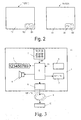
- FIG. 2 shows schematically a television picture generated during encryption and a teletext page
- FIG. 3 shows a block diagram of a device according to the invention for forwarding decrypted information.
- step S1 the input of the information INF to be encrypted takes place in step S1, wherein the term "input" is to be understood in general and the information INF is read from a memory, for example.
- the information INF comprises the number 357. If the information INF is not already in a suitable graphic format, it is converted into a graphic in step S2.
- step S3 the decomposition of the (graphic) information INF into two sub-graphics TG1 and TG2, which, taken alone, have no information content from which the information INF could be determined.
- the first sub-graphic TG1 is superimposed in a predetermined image area B1 of a television picture TV in step S5 (see also the left-hand part of FIG. 2, which represents the combined television picture TV (TG1)).
- the second sub-graphic TG2 is inserted into a teletext page TX specially generated for this purpose (see right-hand part of FIG. 2), in a teletext area B2 which corresponds exactly to the picture area B1 of the television picture TV (TG1) in its position, in which the first sub-graphic TG1 is displayed.
- Both the television picture TV (TG1) and the teletext page TX (TG2) are connected via a TV channel K1 transmitted and are receivable on a TV, not shown.
- the television picture TV (TG1) with the partial graphic TG1 displayed is displayed on a television screen (step S6). So that the information INF can be decrypted by a viewer, this viewer must retrieve the teletext page TX (TG2) with the partial graphic TG2 displayed (step S7). If this is not possible, either because the page is not available or because the viewer does not know the correct number of the teletext page TX (TG2), then the decryption fails ("Stop" in the flow chart). However, if the teletext page TX (TG2) is retrievable as desired, it will be displayed on the TV screen by being superimposed on the TV picture TV (TG1).
- the base teletext page TX thus has (or is completely transparent) a transparent area in which the partial graphic TG2 is inserted. If now the teletext page TX (TG2) is called, it superimposes the television picture TV (TG1), but since at least a part of the teletext page TX (TG2) is transparent, it does not hide the TV picture TV (TG1), but superimpose it only the two sub-graphics TG1 and TG2 and complement each other to the information INF (step S9), which is visually perceived by the viewer so that the original information INF appears unencrypted in their graphical representation.
- Characteristic of the method according to the invention is that a viewer who only follows the TV program, ie sees only the television pictures TV (TG1), can not conclude from these television pictures TV (TG1) on the original information INF. Neither can the information INF be reconstructed from the sole viewing of the teletext page TX (TG2) (without superimposition of the TV picture, or at a different time than that at which the first subgraph TG1 is broadcast with the TV picture TV) ,
- the proposed encryption method is largely tamper-proof, since optical encryption would mean that automatic decryption (that is, for example, by a computer) would only be possible with a layperson who was generally not able to do so. It is therefore largely ensured that only one person can perceive the information in a decrypted manner.
- the unencrypted content of the information INF is recognizable only at the precise time at which the partial graphic TG1 is displayed in the television picture TV1 (TG1), and on the other hand the interaction of the TV viewer is required to call the corresponding teletext page TX (TG2) ,
- INF may be, for example, a number of digits, which the viewer has to choose in a row as a telephone number or in another, correspondingly suitable, device has to enter.
- Such a device may be a mobile phone or a computer, but preferably the device according to the invention described below for forwarding the received information INF to an evaluation point, such as e.g. a phone server, his.
- an evaluation point such as e.g. a phone server, his.
- the processor 4 controls all functions of the device 1.
- the processor 4 fetches a time stamp TS from the timer 6 and stores the information INF in association with the time stamp TS in the memory 7 , It should be noted that a plurality of information INF can be stored in the memory 7. By temporarily storing the information INF in the memory 7, it can be transmitted at a later time via the data communication means 8 and the data communication network 9 to the evaluation point 10, for example, as a DTFM tone sequence via telephone, if the data communication network 9 is designed as a telephone network. Alternatively or additionally, a transmission of the information INF with the time stamp TS via the Internet or via SMS is provided.
Landscapes
- Engineering & Computer Science (AREA)
- Multimedia (AREA)
- Signal Processing (AREA)
- Theoretical Computer Science (AREA)
- Computer Security & Cryptography (AREA)
- Television Systems (AREA)
- Two-Way Televisions, Distribution Of Moving Picture Or The Like (AREA)
Applications Claiming Priority (1)
| Application Number | Priority Date | Filing Date | Title |
|---|---|---|---|
| AT0112005A AT502072B1 (de) | 2005-07-04 | 2005-07-04 | Verfahren zur verschlüsselten übertragung von information über einen fernsehkanal |
Publications (2)
| Publication Number | Publication Date |
|---|---|
| EP1746831A2 true EP1746831A2 (fr) | 2007-01-24 |
| EP1746831A3 EP1746831A3 (fr) | 2008-06-18 |
Family
ID=37496729
Family Applications (1)
| Application Number | Title | Priority Date | Filing Date |
|---|---|---|---|
| EP06013781A Withdrawn EP1746831A3 (fr) | 2005-07-04 | 2006-07-04 | Procédé pour la transmission chiffrée d'information sur un canal de télévision. |
Country Status (2)
| Country | Link |
|---|---|
| EP (1) | EP1746831A3 (fr) |
| AT (1) | AT502072B1 (fr) |
Family Cites Families (6)
| Publication number | Priority date | Publication date | Assignee | Title |
|---|---|---|---|---|
| GB2185664B (en) * | 1986-01-17 | 1989-10-25 | Philips Electronic Associated | Teletext transmission systems |
| EP0243312B1 (fr) * | 1986-04-18 | 1995-07-19 | Nagra Plus S.A. | Décodeur pour un système de télévision à péage |
| EP0754389B1 (fr) * | 1995-02-02 | 2000-04-05 | Philips Electronics N.V. | Fusion d'une mosaique video et d'un teletexte |
| DE19530707A1 (de) * | 1995-08-21 | 1997-02-27 | Springer Ag Verlag Axel | Verfahren für den Zugriff auf Video-, Audio- und Textinformationen |
| EP1276319A1 (fr) * | 2001-07-13 | 2003-01-15 | Tv-Lab S.p.a. | Méthode et système avancé pour télévision interactive |
| WO2003067797A1 (fr) * | 2002-02-07 | 2003-08-14 | Koninklijke Philips Electronics N.V. | Procede de communication de messages visuels proteges et dispositif associe |
-
2005
- 2005-07-04 AT AT0112005A patent/AT502072B1/de not_active IP Right Cessation
-
2006
- 2006-07-04 EP EP06013781A patent/EP1746831A3/fr not_active Withdrawn
Also Published As
| Publication number | Publication date |
|---|---|
| AT502072B1 (de) | 2007-05-15 |
| AT502072A1 (de) | 2007-01-15 |
| EP1746831A3 (fr) | 2008-06-18 |
Similar Documents
| Publication | Publication Date | Title |
|---|---|---|
| DE69614211T2 (de) | Gerät zur Erfassung und Anzeige von zusätzlichen Programmen | |
| DE69630756T2 (de) | Fernsehempfänger mit Überlagerung Fernsehbilds mit Text und/oder graphischen Mustern | |
| DE69736568T2 (de) | Rundfunk- und Kommunikationsempfängervorrichtung | |
| DE69838890T2 (de) | Senden und Empfang von Daten | |
| DE3688855T2 (de) | Satellitenübertragungssystem mit Direktübertragung. | |
| DE2627703C2 (de) | Fernsehanordnung mit einer Sendestation und einer Empfangsstation | |
| DE69228085T2 (de) | Virtuelle Kanäle für ein Multiplexanalogkomponentenfernsehsystem (MAC) | |
| DE60002158T2 (de) | System zur lieferung von video-auf-anfrage | |
| DE3750724T2 (de) | Verfahren und vorrichtung zur übertragung von video, audio, teletext und daten zu gruppen von decodierern in einem übertragungssystem. | |
| DE69935342T2 (de) | Sicheres Informationsverteilungssystem unter Verwendung von Segmentverschlüsselung | |
| DE3751410T2 (de) | Decoder für ein Fernsehgebührensystem. | |
| DE3325858C2 (de) | Verfahren zum Steuern der simultanen allgemeinen Aussendung verschlüsselter digitaler Informationssignale und Empfänger für solche Signale | |
| DE69422199T2 (de) | Verfahren und gerät zum übertragen und empfangen von verschlüsselten signalen | |
| DE69022565T2 (de) | Einrichtung zur verständlichen Abfrage der Art von Zugangsrechten für einen Gebühren-Fernseher und/oder -Radio-Dienst. | |
| DE69106033T2 (de) | Verfahren und Vorrichtung zur Verwürfelung-Entwürfelung digitaler Bilddaten. | |
| DE69818321T2 (de) | Verfahren und Gerät zur Bereitstellung einer elektronischen Programmübersicht | |
| DE69635920T2 (de) | Fernsehempfänger mit einem Dekoder für Multiplex-Texte | |
| EP1276320B1 (fr) | Méthode pour rendre inidentifiable et pour restorer le contenu d'une image | |
| DE69607858T2 (de) | Kino- bildverteilungsnetz mit hdtv-signalen | |
| AT502072B1 (de) | Verfahren zur verschlüsselten übertragung von information über einen fernsehkanal | |
| DE69607919T2 (de) | Verfahren und vorrichtung zur übertragung von videotextseiten | |
| DE69903517T2 (de) | Digitale verarbeitung von grafischen bildern in einem dekodierer | |
| DE60224294T2 (de) | Verfahren, durch das ein verbraucher mit einem dienstanbieter in wechselwirkung treten kann | |
| DE2734714B1 (de) | Vorrichtung zur bildlichen Darstellung von Texten und Graphiken auf Bildschirmen von Fernsehgeraeten in Verbindung mit dem oeffentlichen Fernsprechnetz | |
| DE60019802T2 (de) | System und gerät zur erzeugung von nachrichten in mehreren sprachen für die verteilung an set-top-endgeräte in einem rundfunkfernsehsystem |
Legal Events
| Date | Code | Title | Description |
|---|---|---|---|
| PUAI | Public reference made under article 153(3) epc to a published international application that has entered the european phase |
Free format text: ORIGINAL CODE: 0009012 |
|
| AK | Designated contracting states |
Kind code of ref document: A2 Designated state(s): AT BE BG CH CY CZ DE DK EE ES FI FR GB GR HU IE IS IT LI LT LU LV MC NL PL PT RO SE SI SK TR |
|
| AX | Request for extension of the european patent |
Extension state: AL BA HR MK YU |
|
| PUAL | Search report despatched |
Free format text: ORIGINAL CODE: 0009013 |
|
| AK | Designated contracting states |
Kind code of ref document: A3 Designated state(s): AT BE BG CH CY CZ DE DK EE ES FI FR GB GR HU IE IS IT LI LT LU LV MC NL PL PT RO SE SI SK TR |
|
| AX | Request for extension of the european patent |
Extension state: AL BA HR MK RS |
|
| RIC1 | Information provided on ipc code assigned before grant |
Ipc: H04K 1/02 20060101ALI20080513BHEP Ipc: H04N 7/08 20060101ALI20080513BHEP Ipc: H04N 5/445 20060101ALI20080513BHEP Ipc: H04N 7/167 20060101ALI20080513BHEP Ipc: H04N 7/16 20060101AFI20061215BHEP |
|
| AKX | Designation fees paid | ||
| REG | Reference to a national code |
Ref country code: DE Ref legal event code: 8566 |
|
| STAA | Information on the status of an ep patent application or granted ep patent |
Free format text: STATUS: THE APPLICATION IS DEEMED TO BE WITHDRAWN |
|
| 18D | Application deemed to be withdrawn |
Effective date: 20081219 |