EP1748340A2 - Dispositif microfluide et procédé pour régler le pH d'un fluide - Google Patents
Dispositif microfluide et procédé pour régler le pH d'un fluide Download PDFInfo
- Publication number
- EP1748340A2 EP1748340A2 EP06009850A EP06009850A EP1748340A2 EP 1748340 A2 EP1748340 A2 EP 1748340A2 EP 06009850 A EP06009850 A EP 06009850A EP 06009850 A EP06009850 A EP 06009850A EP 1748340 A2 EP1748340 A2 EP 1748340A2
- Authority
- EP
- European Patent Office
- Prior art keywords
- chamber
- electrode
- ion exchange
- exchange membrane
- microfluidic device
- Prior art date
- Legal status (The legal status is an assumption and is not a legal conclusion. Google has not performed a legal analysis and makes no representation as to the accuracy of the status listed.)
- Granted
Links
Images


Classifications
-
- G—PHYSICS
- G05—CONTROLLING; REGULATING
- G05D—SYSTEMS FOR CONTROLLING OR REGULATING NON-ELECTRIC VARIABLES
- G05D21/00—Control of chemical or physico-chemical variables, e.g. pH value
- G05D21/02—Control of chemical or physico-chemical variables, e.g. pH value characterised by the use of electric means
-
- G—PHYSICS
- G01—MEASURING; TESTING
- G01N—INVESTIGATING OR ANALYSING MATERIALS BY DETERMINING THEIR CHEMICAL OR PHYSICAL PROPERTIES
- G01N27/00—Investigating or analysing materials by the use of electric, electrochemical, or magnetic means
Definitions
- the present invention relates to a microfluidic device for electrically regulating the pH of a fluid therein and a method of regulating the pH of a fluid in a microfluidic device using the same.
- Microfluidic devices are devices in which an inlet, an outlet, a reaction chamber, etc., are interconnected through microchannels. Such devices are widely known in the field and are used in micro-analytic devices, such as a lab-on-a-chip (LOC).
- LOC lab-on-a-chip
- a micropump for inducing the flow of fluid a micromixer for mixing fluids, a microfilter for filtering a fluid, etc.
- a microfilter for filtering a fluid, etc.
- a microfluidic device used as a biological analytic device performs a series of biological analytic processes including cytolysis, nucleic acid amplification and separation, for example, a polymerase chain reaction (PCR), and protein separation and detection.
- a conventional pH regulating process involved in such biological analysis processes includes adding or removing an acidic solution, a neutral solution, or a buffer solution.
- problems associated with dilution, mixing and the flow of a substance in a microchannel may arise because a small amount of a sample is used.
- the added pH-adjusting material may inhibit subsequent biological analysis processes. In this case, the pH-adjusting material has to be removed.
- a microfluidic device includes an electrode and a chamber in which water can be electrolyzed.
- water is electrolyzed.
- the pH can be regulated by hydrogen ions generated by the anode and hydroxide ions generated by the cathode.
- negatively charged biological molecules such as nucleic acids are absorbed into the positive electrode, the absorbed molecules generally become unstable and the efficiency of the process can deteriorate.
- the inventors of the present invention found a method of regulating the pH in a microfluidic device using electrolysis of water and preventing materials such as nucleic acids from being absorbed into the positive electrode to which a voltage is applied, and thus increasing the efficiency of the process by increasing the stability of the nucleic acids, etc.
- the present invention provides a microfluidic device capable of regulating the pH of a fluid through electrolysis and increasing the stability of a biological molecule absorbed by a positive electrode to which a voltage is applied.
- the present invention also provides a method of regulating the pH of a fluid in the microfluidic device through electrolysis and increasing the stability of the biological molecule absorbed by a positive electrode to which a voltage is applied using the microfluidic device.
- a microfluidic device for electrically regulating the pH of a fluid comprising:
- a method of electrically regulating the pH of a fluid in the microfluidic device of the present invention comprising:
- a method of electrically regulating the pH of a fluid in a microfluidic device of the present invention comprising:
- a microfluidic device for electrically regulating the pH of a fluid includes: a first chamber including a first electrode; a second chamber including a second electrode; a third chamber including a third electrode; a metal ion exchange membrane between the first and second chambers; and a hydrogen ion exchange membrane between the first or second chamber and the third chamber.
- the first, second and third chambers are chambers capable of containing materials such as a fluid, and may be microchambers containing materials having the volume of the microunit or less.
- the chambers are interconnected to various chambers through microchannels.
- the chambers can be interconnected to a receiving chamber accommodating biological samples such as cells, a pretreatment chamber pre-treating the samples, an amplification chamber amplifying nucleic acids, a chamber separating the nucleic acids and a chamber detecting the nucleic acids.
- the microfluidic device can be a lab-on-a-chip (LOC) electrically regulating the pH of the fluid.
- LOC lab-on-a-chip
- the metal ion exchange membrane is interposed between the first and second chambers. Additionally, the hydrogen ion exchange membrane is interposed between the first or second chamber and the third chamber.
- the metal ion exchange membrane and/or the hydrogen ion exchange membrane may form the entirety or a part of the membrane interposed between the chambers . Accordingly, a portion of the first and second chambers may be composed of the metal ion exchange membrane and a portion of the third chamber may be composed of the hydrogen ion exchange membrane.
- the metal ion exchange membrane may be an alkali metal ion exchange membrane.
- the metal ion may be Li + , Na + , K + , Ca 2+ , Mg 2+ or Al 3+ etc., but is not limited thereto.
- the metal ion exchange membrane may be a sodium ion exchange membrane, for example a membrane composed of NafionTM(Nafion Company).
- the metal ion exchange membrane may contain a functional group having -SO 3 M or -COOM, or -SO 3 M and -COOM on its surface, wherein M is a metal, for example, an alkali metal.
- the structure of the metal ion exchange membrane is not limited thereto.
- the hydrogen ion exchange membrane may contain a functional group having -SO 3 M or -COOM, or -SO 3 M and -COOM on its surface.
- the structure of the hydrogen ion exchange membrane is not limited thereto.
- the electrodes in the chambers may include conventional materials known in the field such as platinum, gold, copper and palladium.
- the electrode may be formed on a side wall of the chamber, but its position is not limited thereto.
- the first electrode of the first chamber and the second electrode of the second chamber may face each other with a predetermined angle therebetween, and the metal ion exchange membrane is disposed between the first and second electrodes.
- the first electrode of the first chamber or the second electrode of the second chamber and the third electrode of the third chamber may face each other with a predetermined angle therebetween, and the metal ion exchange membrane and/or the hydrogen ion exchange membrane is disposed between the first or second electrode and the third electrode.
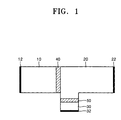
- FIG. 1 is a schematic diagram of a microfluidic device according to an embodiment of the present invention.
- the microfluidic device includes a first chamber 10 with a first electrode 12 and a metal ion exchange membrane 40 on opposite sides thereof, a second chamber 20 with a second electrode 22 and the metal ion exchange membrane 40 on opposite sides thereof, and a third chamber with a third electrode 32 and a hydrogen ion exchange membrane 50 on opposite sides thereof.
- pH regulation according to a method of the present invention is achieved through the following process.
- a voltage is applied between the first and second electrodes, for example a positive voltage is applied to the first electrode and a negative voltage is applied to the second electrode.
- electrolysis of water is induced in the first and second chambers so that the first chamber solution becomes acidic and the second chamber solution becomes alkaline.
- a voltage is applied between the first and third electrodes, for example a negative voltage is applied to the first electrode and a positive electrode is applied to the third electrode.
- the pH of the first and second chambers can be regulated. The regulation of the pH may depend on the direction, magnitude and period of time of the applied voltage.
- a method of electrically regulating the pH of a fluid in a microfluidic device includes: injecting a solution containing an ion having a lower standard oxidation potential than water into the first chamber; injecting a solution containing an ion having a lower standard reduction potential than water into the second chamber; and applying a voltage between the first electrode of the first chamber or the second electrode of the second chamber and the third electrode of the third chamber, thereby regulating the pH of a solution in the first or second chamber.
- a method of electrically regulating the pH of a fluid in a microfluidic device includes: injecting a solution containing an ion having a lower standard oxidation potential than water into the first chamber; injecting a solution containing an ion having a lower standard reduction potential than water into the second chamber; applying a voltage between the first electrode of the first chamber and the second electrode of the second chamber to induce electrolysis of water in the first and second chambers; and applying a voltage between the first electrode of the first chamber or the second electrode of the second chamber and the third electrode of the third chamber, wherein the voltage applied to the first or second electrode is opposite to the previously applied voltage, thereby regulating the pH of a solution in the second or first chamber.
- the regulation of the pH may depend on the direction, magnitude and period of time of the applied voltage.
- the ion having a lower standard oxidation potential than water may contain at least one ionic compound among NO 3 - , F - , SO 4 2- , PO 4 3- , and CO 3 2- etc., but the ionic compound is not limited thereto.
- the ion having a lower standard reduction potential than water may contain at least on ionic compound among Li + , Na + , K + , Ca 2+ , Mg 2+ and Al 3+ , etc.
- FIG. 2 illustrates a process of electrically regulating the pH of a fluid in a microfluidic device using the microfluidic device according to an embodiment of the present invention.
- a solution containing Na 2 SO 4 is added to the first chamber 10, the second chamber 20, and the third chamber 30.
- a positive voltage is applied to the first electrode 12 and a negative voltage is applied to the second electrode 22 to induce electrolysis in the first chamber 10 and the second chamber 20.
- the ions generated by the electrolysis cannot pass through the metal ion exchange membrane 40.
- oxygen gas and hydrogen ions are generated in the first chamber 10 as a result of the electrolysis of water, and accordingly the solution becomes acidic
- hydrogen gas and hydroxide ions are generated in the second chamber 20 as a result of the electrolysis of water, and accordingly the solution becomes alkaline.
- the increased concentration of the hydroxide ions can be used for the lysis of biological samples such as cells.
- the change in the pH of the solutions of the first chamber 10 and the second chamber 20 through the electrolysis of water can be regulated by applying an appropriate voltage between the first electrode 12 and the third electrode 32.
- the pH is regulated through the electrolysis performed in the first and second chamber solutions and additional electrolysis performed by applying a voltage between the first and third electrodes.
- the electrolysis in the first and second chamber solutions is not necessarily needed.
- the pH of the first and second chambers can be regulated through the electrolysis of water when solutions injected into the first and second chambers have predetermined pH levels and a voltage is applied between the first and third chambers.
- Example 1 pH regulation based on the electrolysis of water using hydrogen ion exchange membrane
- Electrolysis was performed using a sodium ion exchange membrane and a hydrogen ion exchange membrane to identify pH regulation of each chamber.
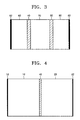
- FIG. 3 is a schematic diagram of a microfluidic device used in Example 1 according to an embodiment of the present invention.
- the microfluidic device included: a first chamber 60 with a first electrode 62 and a sodium ion exchange membrane 40 at opposite ends thereof; a second chamber 70 with the sodium ion exchange membrane 40 and a hydrogen ion exchange membrane 50 at opposite ends thereof; and a third chamber 80 with the hydrogen ion exchange membrane 50 and a second electrode at opposite ends thereof.
- the sodium ion exchange membrane 40 and hydrogen ion exchange membrane 50 were composed of NafionTM, and respectively included a functional group of -SO 3 Na and -SO 3 H on their surfaces.
- the size of each of the membranes was 2 mm x 2.5 mm.
- the volume of each chamber of the microfluidic device in FIG. 3 was 10 ⁇ l.
- Each of the first and second electrodes 62 and 82 had an area of 2 mm x 2.5 mm and were composed of platinum.
- the first chamber was filled with 10 ⁇ l of an aqueous solution (pH 6.0) containing 55 mM Na 2 SO 4 and then the second and third chambers were filled with 10 ⁇ l of the aqueous solution (pH 6.0) containing 55 mM Na 2 SO 4 .
- Some hydrogen ions on the hydrogen ion exchange membrane were substituted by sodium ions and the hydrogen ion exchange membrane was washed with 55 mM Na 2 SO 4 to adjust the pH to 3.0.
- a micro pH electrode manufactured by Orion and a pH test paper was used for the pH measurement.
- a positive voltage was applied to the first electrode 62 and a negative voltage was applied to the second electrode 82.
- the pH of the chambers was measured after 5 V was applied for 50 seconds.
- the measured pH of the first chamber 60, the second chamber 70 and the third chamber 80 were respectively 1, 6 and 13 (refer to Table 1).
- the solution in the second chamber 70 is assumed to have become alkaline since the hydrogen ions balanced by the hydrogen ion exchange membrane 50 between the second chamber 70 and the third chamber 80 were removed through the reaction with the hydroxide ions in the third chamber 80. Additionally, a pH of 13 in the third chamber 80 was sufficient for alkaline lysis. Thus, when a sample including cells or a virus was injected into the third chamber 80 and a voltage was applied as described above, contents such as nucleic acids could be extracted from the cells or the virus as a result of the lysis. However, some biological molecules such as nucleic acids can be destroyed when exposed to pH 13 for more than a predetermined period of time. Therefore, the pH needs to be regulated to a desired level through the following processes.
- a method of applying a voltage which is opposite to the voltage previously applied to the electrodes can be considered. That is, when a negative voltage was applied to the first electrode 62 and a positive voltage was applied to the second electrode 82, the solution in the first chamber was alkaline and the solution in the third chamber was acidic. As a result, a desired pH can be achieved. However, since a positive voltage was applied to the second electrode 82 of the third chamber 80, anionic materials such as nucleic acids were absorbed by the second electrode 82. The absorbed anionic materials may have unstable structures and thereby inhibit subsequent experiments.
- the pH of the chambers was measured using a micro pH electrode manufactured by Orion and a pH test paper after 10 V was applied for 20 seconds.
- the measured pH of the first, second and third chambers were respectively 13, 2.5 and 1 (refer to Table 2).
- the hydrogen ion exchange membrane between the second and third chambers prevented anionic materials such as nucleic acids from adhering to the second electrode 82 and regulated the pH of the second chamber from 13 to 2.5.
- a nucleic acid separation method including binding nucleic acids to a solid ion exchange material having a positive charge in an acidic pH, changing the pH to alkaline and eluting the nucleic acids can be performed without further adjustment of the pH.
- Example 2 influence of pH regulation based on the electrolysis of water using hydrogen ion exchange membrane on stability of nucleic acids
- the amount of DNA was measured after real-time PCR was performed using primers of SEQ ID NOS: 1 and 2 using 10 ⁇ l of the obtained second chamber solution as a template. DNA was quantified by obtaining a crossing point (Cp) value through the quantitative PCR and using the difference between the Cp values.
- Cp crossing point
- the stability of DNA was identified after comparing the amount of DNA remaining after the pH regulation with the initial amount of DNA. As a result, it was found that the stability of DNA was 91% when 7 V was applied for 30 seconds.
- the DNA stability was identified by measuring the remaining amount of DNA in each chamber after a voltage was applied across the first and second chambers including nucleic acids for a predetermined period of time.
- a device including only sodium ion exchange membranes was used as a control.
- FIG. 4 illustrates a microfluidic device including only sodium ion exchange membranes regulating pH through electrolysis.
- the device includes: a first chamber 10 with a first electrode 12 and sodium ion exchange membrane 40 at opposite ends thereof; and a second chamber 20 with a second electrode 22 and the sodium ion exchange membrane 40 at opposite ends thereof.
- the sodium ion exchange membrane 40 is interposed between the first and second chambers.
- the sodium ion exchange membrane was composed of NafionTM with a size of and 2 mm x 2.5 mm and including a functional group of -SO 3 Na on its surface.
- the volume of each chamber of the microfluidic device in FIG. 4 was 10 ⁇ l.
- Each of the first and second electrodes 12 and 22 had an area of 2 mm x 2.5 mm and was composed of platinum.
- FIG. 5 is a graph of the DNA stability when DNA is included in the first chamber comprising the cathode electrode, that is, the negative electrode, of the microfluidic device without the hydrogen ion exchange membrane, and the pH is regulated using electrolysis.
- FIG. 6 is a graph of the DNA stability when DNA is included in the second chamber comprising the anode electrode, that is, the positive electrode, of the microfluidic device without the hydrogen ion exchange membrane, and the pH is regulated using electrolysis.
- the DNA stability of the first chamber comprising the positive electrode was remarkably lower than the DNA stability of the second chamber comprising the negative electrode. Specifically, when 7 V was applied for 30 seconds with the negative voltage applied to the first electrode and the positive voltage applied to the second electrode, the stability of the second chamber DNA was about 15%. This is substantially lower than the DNA stability of 91 % measured after 7 V was applied for 30 seconds using the microfluidic device having the hydrogen ion exchange membrane of an embodiment of the present invention.
- the decreased stability is assumed to have been caused by the absorption of nucleic acids by the positive electrode when the positive voltage is applied to the electrode in the chamber including the nucleic acids.
- the stability of nucleic acids can be remarkably increased by interposing the hydrogen ion exchange membrane between the chambers when the positive voltage is applied to the electrode disposed in the chamber including the nucleic acids.
- the pH of the microfluidic device can be rapidly regulated and the stability of nucleic acids can be maintained.
- the pH of a solution in the microfluidic device can be rapidly regulated and the stability of nucleic acids can be maintained.
Landscapes
- Physics & Mathematics (AREA)
- General Physics & Mathematics (AREA)
- Engineering & Computer Science (AREA)
- Automation & Control Theory (AREA)
- Chemical & Material Sciences (AREA)
- Chemical Kinetics & Catalysis (AREA)
- Electrochemistry (AREA)
- Health & Medical Sciences (AREA)
- Life Sciences & Earth Sciences (AREA)
- Analytical Chemistry (AREA)
- Biochemistry (AREA)
- General Health & Medical Sciences (AREA)
- Immunology (AREA)
- Pathology (AREA)
- Apparatus Associated With Microorganisms And Enzymes (AREA)
- Sampling And Sample Adjustment (AREA)
- Automatic Analysis And Handling Materials Therefor (AREA)
- Water Treatment By Electricity Or Magnetism (AREA)
- Physical Or Chemical Processes And Apparatus (AREA)
Applications Claiming Priority (1)
| Application Number | Priority Date | Filing Date | Title |
|---|---|---|---|
| KR1020050053553A KR100647328B1 (ko) | 2005-06-21 | 2005-06-21 | 미세유동 장치 내의 유체의 pH를 전기적으로 조절하기위한 미세유동 장치 및 그를 이용하여 pH를 조절하는방법 |
Publications (3)
| Publication Number | Publication Date |
|---|---|
| EP1748340A2 true EP1748340A2 (fr) | 2007-01-31 |
| EP1748340A3 EP1748340A3 (fr) | 2007-09-19 |
| EP1748340B1 EP1748340B1 (fr) | 2011-07-06 |
Family
ID=36957446
Family Applications (1)
| Application Number | Title | Priority Date | Filing Date |
|---|---|---|---|
| EP06009850A Ceased EP1748340B1 (fr) | 2005-06-21 | 2006-05-12 | Dispositif microfluide et procédé pour régler le pH d'un fluide |
Country Status (4)
| Country | Link |
|---|---|
| US (1) | US8293095B2 (fr) |
| EP (1) | EP1748340B1 (fr) |
| JP (1) | JP4313379B2 (fr) |
| KR (1) | KR100647328B1 (fr) |
Cited By (7)
| Publication number | Priority date | Publication date | Assignee | Title |
|---|---|---|---|---|
| EP2773959A4 (fr) * | 2011-11-04 | 2015-07-22 | Bio Rad Laboratories | Fractionnement de protéines en fonction de leur point isoélectrique |
| US9234875B2 (en) | 2011-11-04 | 2016-01-12 | Bio-Rad Laboratories, Inc. | Simultaneous purification of cell components |
| US9321012B2 (en) | 2012-04-04 | 2016-04-26 | Bio-Rad Laboratories, Inc. | Electronic protein fractionation |
| US9658195B2 (en) | 2012-02-15 | 2017-05-23 | Bio-Rad Laboratories, Inc. | Electronic control of pH and ionic strength |
| US9766207B2 (en) | 2011-11-04 | 2017-09-19 | Bio-Rad Laboratories, Inc. | Affinity methods and compositions employing electronic control of pH |
| US10532356B2 (en) | 2017-11-09 | 2020-01-14 | International Business Machines Corporation | pH control for analyte detection |
| CN114276407A (zh) * | 2021-12-29 | 2022-04-05 | 浙江旅游职业学院 | 一种采用ph偏移技术从骨或壳内提取蛋白质的设备及方法 |
Families Citing this family (4)
| Publication number | Priority date | Publication date | Assignee | Title |
|---|---|---|---|---|
| KR100738085B1 (ko) * | 2005-12-21 | 2007-07-12 | 삼성전자주식회사 | 유체의 pH를 전기화학적으로 조절하기 위한 미세유동장치및 그를 이용하여 pH를 조절하는 방법 |
| TWI345058B (en) * | 2007-07-30 | 2011-07-11 | Benq Materials Corp | Micro flow device and method for generating a fluid with ph gradient |
| JP6827047B2 (ja) * | 2015-08-07 | 2021-02-10 | フラウンホーファー・ユー・エス・エイ・インコーポレイテッドFraunhofer Usa, Inc. | 導電性ダイヤモンド電極で微量金属を検出するための装置および方法 |
| US11298698B2 (en) * | 2018-03-15 | 2022-04-12 | Kryptos Biotechnologies, Inc. | Method and system for performing heat assisted biochemical reactions |
Family Cites Families (11)
| Publication number | Priority date | Publication date | Assignee | Title |
|---|---|---|---|---|
| US4049519A (en) * | 1976-10-06 | 1977-09-20 | Walter John Sloan | Carbonate reduction |
| JPS5362637A (en) | 1976-11-12 | 1978-06-05 | Matsushita Electric Industrial Co Ltd | Automatic controlling method and device for ph of culture solution |
| JPS62272150A (ja) | 1986-05-20 | 1987-11-26 | Fujitsu Ltd | 水素イオン濃度調節方法 |
| US5304430A (en) * | 1993-02-22 | 1994-04-19 | Hughes Aircraft Company | Acid-base concentration cell for electric power generation |
| JP3181796B2 (ja) | 1994-10-28 | 2001-07-03 | 日本電気株式会社 | 電解水製造装置 |
| AU7563296A (en) | 1995-11-14 | 1997-06-05 | Gunter Fuhr | Device and process for adjusting ion concentrations |
| US20020166592A1 (en) | 2001-02-09 | 2002-11-14 | Shaorong Liu | Apparatus and method for small-volume fluid manipulation and transportation |
| JP2005283193A (ja) | 2004-03-29 | 2005-10-13 | Citizen Watch Co Ltd | 光学測定装置 |
| US7488596B2 (en) | 2004-12-17 | 2009-02-10 | Samsung Electronics Co., Ltd. | Microfluidic device comprising electrolysis device for cell lysis and method for electrochemically lysing cells using the same |
| KR100590573B1 (ko) | 2004-12-17 | 2006-06-19 | 삼성전자주식회사 | 전기분해 장치를 포함하는 미세유동장치를 이용한 pH조절 방법 |
| JP3984992B2 (ja) | 2004-12-22 | 2007-10-03 | エア・ウォーター株式会社 | 溶液のpH制御方法および装置 |
-
2005
- 2005-06-21 KR KR1020050053553A patent/KR100647328B1/ko not_active Expired - Fee Related
-
2006
- 2006-05-12 EP EP06009850A patent/EP1748340B1/fr not_active Ceased
- 2006-06-21 JP JP2006171923A patent/JP4313379B2/ja not_active Expired - Fee Related
- 2006-06-21 US US11/472,182 patent/US8293095B2/en not_active Expired - Fee Related
Cited By (10)
| Publication number | Priority date | Publication date | Assignee | Title |
|---|---|---|---|---|
| EP2773959A4 (fr) * | 2011-11-04 | 2015-07-22 | Bio Rad Laboratories | Fractionnement de protéines en fonction de leur point isoélectrique |
| US9234875B2 (en) | 2011-11-04 | 2016-01-12 | Bio-Rad Laboratories, Inc. | Simultaneous purification of cell components |
| US9766207B2 (en) | 2011-11-04 | 2017-09-19 | Bio-Rad Laboratories, Inc. | Affinity methods and compositions employing electronic control of pH |
| US9658195B2 (en) | 2012-02-15 | 2017-05-23 | Bio-Rad Laboratories, Inc. | Electronic control of pH and ionic strength |
| US9321012B2 (en) | 2012-04-04 | 2016-04-26 | Bio-Rad Laboratories, Inc. | Electronic protein fractionation |
| US10532356B2 (en) | 2017-11-09 | 2020-01-14 | International Business Machines Corporation | pH control for analyte detection |
| US11161115B2 (en) | 2017-11-09 | 2021-11-02 | International Business Machines Corporation | PH control for analyte detection |
| US11161114B2 (en) | 2017-11-09 | 2021-11-02 | International Business Machines Corporation | Ph control for analyte detection |
| CN114276407A (zh) * | 2021-12-29 | 2022-04-05 | 浙江旅游职业学院 | 一种采用ph偏移技术从骨或壳内提取蛋白质的设备及方法 |
| CN114276407B (zh) * | 2021-12-29 | 2023-08-15 | 浙江旅游职业学院 | 一种采用ph偏移技术从骨或壳内提取蛋白质的设备及方法 |
Also Published As
| Publication number | Publication date |
|---|---|
| US20070068813A1 (en) | 2007-03-29 |
| EP1748340B1 (fr) | 2011-07-06 |
| JP4313379B2 (ja) | 2009-08-12 |
| EP1748340A3 (fr) | 2007-09-19 |
| KR100647328B1 (ko) | 2006-11-23 |
| JP2007003526A (ja) | 2007-01-11 |
| US8293095B2 (en) | 2012-10-23 |
Similar Documents
| Publication | Publication Date | Title |
|---|---|---|
| US7598064B2 (en) | Microfluidic device comprising electrolysis device for cell lysis and method for electrochemically lysing cells using the same | |
| EP1748340B1 (fr) | Dispositif microfluide et procédé pour régler le pH d'un fluide | |
| US20120103832A1 (en) | MICROFLUIDIC DEVICE FOR ELECTROCHEMICALLY REGULATING pH OF FLUID THEREIN AND METHOD OF REGULATING pH OF FLUID USING THE MICROFLUIDIC DEVICE | |
| KR100590573B1 (ko) | 전기분해 장치를 포함하는 미세유동장치를 이용한 pH조절 방법 | |
| CN100371433C (zh) | 包括用于细胞裂解的电解装置的微流体器件及利用它电化学裂解细胞的方法 | |
| US8398843B2 (en) | Microfluidic device for electrochemically regulating the pH of a fluid therein using semiconductor doped with impurity and method of regulating the pH of a fluid in a microfluidic device using the same | |
| US7771573B2 (en) | Microfluidic device for electrochemically regulating pH of fluid therein and method of regulating pH of fluid using the microfluidic device | |
| EP1804035B1 (fr) | Dispositif microfluidique pour la régulation électrochimique du pH d'un fluide et procédé de régulation du pH d'un fluide à l'aide du dispositif microfluidique | |
| US20240301394A1 (en) | Devices and methods for electrophoretic extraction of nucleic acids from biological samples | |
| EP1918017A1 (fr) | Appareil à électrodialyse et procédé d'électrodialyse l'utilisant | |
| US20070281307A1 (en) | Method of amplifying nucleic acid from blood | |
| Hanna et al. | Free and membrane-bound ribosomes: I. Separation by two-dimensional gel electrophoresis of proteins from rat liver monosomes | |
| US7700357B2 (en) | Method for treating small volumes with electrical current |
Legal Events
| Date | Code | Title | Description |
|---|---|---|---|
| PUAI | Public reference made under article 153(3) epc to a published international application that has entered the european phase |
Free format text: ORIGINAL CODE: 0009012 |
|
| 17P | Request for examination filed |
Effective date: 20060512 |
|
| AK | Designated contracting states |
Kind code of ref document: A2 Designated state(s): AT BE BG CH CY CZ DE DK EE ES FI FR GB GR HU IE IS IT LI LT LU LV MC NL PL PT RO SE SI SK TR |
|
| AX | Request for extension of the european patent |
Extension state: AL BA HR MK YU |
|
| PUAL | Search report despatched |
Free format text: ORIGINAL CODE: 0009013 |
|
| AK | Designated contracting states |
Kind code of ref document: A3 Designated state(s): AT BE BG CH CY CZ DE DK EE ES FI FR GB GR HU IE IS IT LI LT LU LV MC NL PL PT RO SE SI SK TR |
|
| AX | Request for extension of the european patent |
Extension state: AL BA HR MK YU |
|
| 17Q | First examination report despatched |
Effective date: 20071119 |
|
| AKX | Designation fees paid |
Designated state(s): DE FR GB |
|
| GRAP | Despatch of communication of intention to grant a patent |
Free format text: ORIGINAL CODE: EPIDOSNIGR1 |
|
| GRAS | Grant fee paid |
Free format text: ORIGINAL CODE: EPIDOSNIGR3 |
|
| GRAA | (expected) grant |
Free format text: ORIGINAL CODE: 0009210 |
|
| AK | Designated contracting states |
Kind code of ref document: B1 Designated state(s): DE FR GB |
|
| REG | Reference to a national code |
Ref country code: GB Ref legal event code: FG4D |
|
| REG | Reference to a national code |
Ref country code: DE Ref legal event code: R096 Ref document number: 602006022864 Country of ref document: DE Effective date: 20110901 |
|
| PLBE | No opposition filed within time limit |
Free format text: ORIGINAL CODE: 0009261 |
|
| STAA | Information on the status of an ep patent application or granted ep patent |
Free format text: STATUS: NO OPPOSITION FILED WITHIN TIME LIMIT |
|
| 26N | No opposition filed |
Effective date: 20120411 |
|
| REG | Reference to a national code |
Ref country code: DE Ref legal event code: R097 Ref document number: 602006022864 Country of ref document: DE Effective date: 20120411 |
|
| REG | Reference to a national code |
Ref country code: FR Ref legal event code: PLFP Year of fee payment: 11 |
|
| REG | Reference to a national code |
Ref country code: FR Ref legal event code: PLFP Year of fee payment: 12 |
|
| REG | Reference to a national code |
Ref country code: FR Ref legal event code: PLFP Year of fee payment: 13 |
|
| PGFP | Annual fee paid to national office [announced via postgrant information from national office to epo] |
Ref country code: DE Payment date: 20190430 Year of fee payment: 14 |
|
| PGFP | Annual fee paid to national office [announced via postgrant information from national office to epo] |
Ref country code: FR Payment date: 20190429 Year of fee payment: 14 |
|
| PGFP | Annual fee paid to national office [announced via postgrant information from national office to epo] |
Ref country code: GB Payment date: 20190508 Year of fee payment: 14 |
|
| REG | Reference to a national code |
Ref country code: DE Ref legal event code: R119 Ref document number: 602006022864 Country of ref document: DE |
|
| GBPC | Gb: european patent ceased through non-payment of renewal fee |
Effective date: 20200512 |
|
| PG25 | Lapsed in a contracting state [announced via postgrant information from national office to epo] |
Ref country code: GB Free format text: LAPSE BECAUSE OF NON-PAYMENT OF DUE FEES Effective date: 20200512 Ref country code: FR Free format text: LAPSE BECAUSE OF NON-PAYMENT OF DUE FEES Effective date: 20200531 |
|
| PG25 | Lapsed in a contracting state [announced via postgrant information from national office to epo] |
Ref country code: DE Free format text: LAPSE BECAUSE OF NON-PAYMENT OF DUE FEES Effective date: 20201201 |
|
| P01 | Opt-out of the competence of the unified patent court (upc) registered |
Effective date: 20230520 |