EP1748342A1 - Systeme informatisé de victime sacrificielle pour detecter les virus dans les reseaux informatiques - Google Patents
Systeme informatisé de victime sacrificielle pour detecter les virus dans les reseaux informatiques Download PDFInfo
- Publication number
- EP1748342A1 EP1748342A1 EP05016547A EP05016547A EP1748342A1 EP 1748342 A1 EP1748342 A1 EP 1748342A1 EP 05016547 A EP05016547 A EP 05016547A EP 05016547 A EP05016547 A EP 05016547A EP 1748342 A1 EP1748342 A1 EP 1748342A1
- Authority
- EP
- European Patent Office
- Prior art keywords
- forwarder
- mainpot
- data packet
- virus attack
- reporting
- Prior art date
- Legal status (The legal status is an assumption and is not a legal conclusion. Google has not performed a legal analysis and makes no representation as to the accuracy of the status listed.)
- Withdrawn
Links
Images

Classifications
-
- H—ELECTRICITY
- H04—ELECTRIC COMMUNICATION TECHNIQUE
- H04L—TRANSMISSION OF DIGITAL INFORMATION, e.g. TELEGRAPHIC COMMUNICATION
- H04L63/00—Network architectures or network communication protocols for network security
- H04L63/14—Network architectures or network communication protocols for network security for detecting or protecting against malicious traffic
- H04L63/1441—Countermeasures against malicious traffic
- H04L63/145—Countermeasures against malicious traffic the attack involving the propagation of malware through the network, e.g. viruses, trojans or worms
-
- G—PHYSICS
- G06—COMPUTING OR CALCULATING; COUNTING
- G06F—ELECTRIC DIGITAL DATA PROCESSING
- G06F21/00—Security arrangements for protecting computers, components thereof, programs or data against unauthorised activity
- G06F21/50—Monitoring users, programs or devices to maintain the integrity of platforms, e.g. of processors, firmware or operating systems
- G06F21/55—Detecting local intrusion or implementing counter-measures
- G06F21/552—Detecting local intrusion or implementing counter-measures involving long-term monitoring or reporting
-
- G—PHYSICS
- G06—COMPUTING OR CALCULATING; COUNTING
- G06F—ELECTRIC DIGITAL DATA PROCESSING
- G06F21/00—Security arrangements for protecting computers, components thereof, programs or data against unauthorised activity
- G06F21/50—Monitoring users, programs or devices to maintain the integrity of platforms, e.g. of processors, firmware or operating systems
- G06F21/55—Detecting local intrusion or implementing counter-measures
- G06F21/56—Computer malware detection or handling, e.g. anti-virus arrangements
- G06F21/566—Dynamic detection, i.e. detection performed at run-time, e.g. emulation, suspicious activities
-
- H—ELECTRICITY
- H04—ELECTRIC COMMUNICATION TECHNIQUE
- H04L—TRANSMISSION OF DIGITAL INFORMATION, e.g. TELEGRAPHIC COMMUNICATION
- H04L63/00—Network architectures or network communication protocols for network security
- H04L63/14—Network architectures or network communication protocols for network security for detecting or protecting against malicious traffic
- H04L63/1408—Network architectures or network communication protocols for network security for detecting or protecting against malicious traffic by monitoring network traffic
- H04L63/1416—Event detection, e.g. attack signature detection
-
- H—ELECTRICITY
- H04—ELECTRIC COMMUNICATION TECHNIQUE
- H04L—TRANSMISSION OF DIGITAL INFORMATION, e.g. TELEGRAPHIC COMMUNICATION
- H04L63/00—Network architectures or network communication protocols for network security
- H04L63/14—Network architectures or network communication protocols for network security for detecting or protecting against malicious traffic
- H04L63/1441—Countermeasures against malicious traffic
- H04L63/1491—Countermeasures against malicious traffic using deception as countermeasure, e.g. honeypots, honeynets, decoys or entrapment
Definitions
- the invention refers to a honeypot computer system for detecting viruses in computer networks. It is to be seen against the following background. Over the last few years worms and bots and other computer infections, which are summarized as "viruses" for the terminology of this application, in particular became a penetrating widespread threat. Antivirus companies have developed better and better heuristic detection processes against these pests but some are still slipping through. Therefore, the common method of adding signatures as soon as a new variant shows up is still very important. At a time when more than 40 new bot variants appear each day, it is important to have a binary sample for analysis in house.
- a "traditional” honeypot that captures the latest variants of viruses is a quite efficient technique.
- a slight disadvantage is that most of the attacks are from the same subnet and after a while, one is aware of all bots around and less new variants are discovered.
- For increased efficiency one has to set up more and more honeypots in different locations, especially different subnets. Usually this leads to a large amount of administrative effort, which implies fine-tuning on the honey pots behaviour each time a new technique or exploit is discovered to infect a machine.
- a honeypot machine should at least respond as a regular machine on most ports. Even better would be to create a honeypot that is able to simulate more than just a machine including some standard services. Furthermore, it should be possible to simulate a Mydoom backdoor or a vulnerability such as the one Opaserv uses, for instance.
- WinpkFilter see http://www. ntkernel.com
- WinpkFilter a packet-filtering framework that gives the full control on each packet arriving and leaving a machine.
- this could be categorized as a low interaction honeypot, especially designed to capture binaries of worms and nothing more than that.
- the first version of such low interaction honeypot was able to simulate the vulnerability MS04-011 (see http://www.microsoft.com/technet/security/bulletin/MS04-011.mspx) that was used a lot by Korgo at that time and the famous DCOM RPC vulnerability MS03-026 (see http://www.microsoft. com/technet/security/bulletin/MS03-026.mspx) that was first used by Lovsan - alias Blaster. Only by simulating these two vulnerabilities, the honeypot was able to capture 11.190 working binaries within three weeks in August 2004. A significant number was infected with the file infector virus W32/Parite. These were just various infected worms that merely carried the old file infector along.
- a mailing routine was added to collect all the samples on a central server.
- the binary was shipped along with the original IP and port, timestamp, original filename and the whole infection log, which could help to determine bugs in the program as well as transmission errors or ideas for further implementations.
- a couple of error checks were made, it was decided if it had to be forwarded to a virus analysing lab for further analysis and statistics were built.
- a honeypot computer system for detecting viruses in computer networks comprising
- the invention allows to design a system with as many traps as possible. Although it should be possible to collect and watch infection processes at one single point, the solution was further to split the Honeypot into two parts generating a "distributed honeynet". One is called “Forwarder” and the other "Mainpot”, which have certain specified complementary functions as can be derived from the description of the preferred embodiment.
- FIG. 1 represents part of a computer network 1 like the internet comprising a vast number of connected computers.
- Reference numeral 2 designates a computer which is programmed to be a virus attack source trying to spread a virus over the internet by contacting computers connected to the according network 1.
- Forwarders two of which are designated by reference numerala 3.1 and 3.2, respectively.
- These Forwarders 3.1, 3.2 communicate with the other computers in the network 1 via data packets 4 containing data and being configured under the common communication protocols like ethernet, IP and TCP.
- Data packets 4 are received from the Forwarders 3.1, 3.2 via the network 1 from other computers, like the virus attack source computer 2.
- the answer data packets 5 are sent from one computer to the other and thus also from the Forwarders 3.1, 3.2 to the virus attack source computer 2.
- the answer packets 5 are "specially designed " as will be explained below.
- each Forwarder 3.1, 3.2 can connect and send data packets 7 and receive data packets 8 from the Mainpot 6.
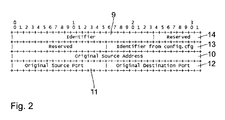
- these data packets 7, 8 are added by a special report protocol HBP comprising specified parameters concerning the virus attack data packet 4 and an identifier 9 (see FIG. 2) which is unique for each Forwarder 3.1, 3.2.
- HBP special report protocol
- the Mainpot 6 can securely detect from which Forwarder 3.1, 3.2 a certain data packet 7 was sent, as is further explained below.
- Each Forwarder 3.1, 3.2 will redirect the traffic to a certain IP address and a certain port that can be configured using a configuration file along with the installation process.
- the traffic arriving on certain ports at the Forwarder side is not just a simple redirect using NAT ( see http://en. wikipedia.org/wiki/ Network_Address_Translation).
- NAT see http://en. wikipedia.org/wiki/ Network_Address_Translation.
- the new protocol HBP is 16 bytes long and contains data such as an identifier 9, original IP 10, original source 11 and destination port 12, number 13 from configuration file and some free bytes 14 reserved for further ideas.
- the identifier 9 helps the Mainpot 6 to distinguish if the packet really comes from a Forwarder 3.1, 3.2, if it was just a port scan or any other data arriving on that port.
- the number 13 set in the configuration file could be any from 1 to 65535 and uses two Bytes in the protocol. This number has to be set manually during the Forwarders 3.1, 3.2 first installation process.
- the purpose of this is to have the possibility to recognize each Forwarder 3.1, 3.2 even if the IP address changes. It makes sense to know which ISP and location are used, as the ISP might implement port filtering on common malware ports from one day to another and one won't receive anything and might wonder why. Other important data is the original source and destination port 11, 12. It is necessary to ship this data along, as the Mainpot 6 has to know how to react when constructing an answer packet. The original IP address 10 is shipped in order to provide statistics.
- the original IP address 10, original source 11 and destination port 12 are needed later when a Forwarder 3.1, 3.2 has to strip down the protocol and construct the final answer packet. This is actually the same thing the Mainpot 6 does in a first step when a new packet arrives. Using the original ports and addresses the packet is reconstructed as it arrives on the Forwarder side. It is then saved to a log file including IP + TCP + Data and even the ethernet layer is saved there. The purpose of the saved packets is described below.
- the Mainpot 6 searches its database for the type of data that the answer packet should contain. If it was successful, which means that this was already implemented it constructs the answer packet. Finally, the HBP protocol header is stripped up again and sent to a Forwarder 3.1, 3.2. This has the simple task to replace the original IP and the ports and to recalculate the checksums before sending the answer packet to the attacker. Depending on the connection and location, the delay between the Forwarder 3.1, 3.2 to the Mainpot 6 is around 200ms. The time both Honeypot parts need to construct the packet is less than 10ms, which means that most of the time is spent on the road.
- every incoming packet including all layers is saved to a log file. Not only the incoming but also the outgoing packets are stored there.
- the infection log is actually saved in a folder with the name of the original source IP address combined with the timestamp of the first communication. The timeframe when this is valid is only a couple of minutes long. The reason is that, at least in Germany, an IP address is different every time one connects to the internet. A new connection attempt at some point later will result in the creation of another folder, in order not to append the previous infection log with data that should be kept separately. Of course, it could be a reinfection attempt from the same machine but also a different machine using this IP for now.
- the infection log is important when it comes to unsuccessful infections. These could have many reasons, such as a broken internet connection, the machine where the worm is running was turned off during the transfer and so on.
- a binary - probably from another source - would help a lot as one can simply create a full infection trace using Ethereal and implement all necessary communication in one single step. Without a binary to analyse in the virus lab, this is the only way to go further and finally capture the binary.
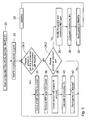
- the Forwarder 3.1, 3.2 waits for an incoming packet on either the port that was chosen to communicate with the Mainpot 6 but also on the ports where an "attack" is expected.
- the checksums and the internet header length (IHL) are calculated by the Forwarder 3.1, 3.2.
- the packet thus generated by the Forwarder 3.1, 3.2 saving the original "attacker's" IP address and port are saved in the HBP protocol layer of this packet.
- the Mainpot 6 strips down the HBP protocol and reconstructs the packet as it arrived on the Forwarder. Now as the Mainpot 6 has the original packet it decides its further steps. This means it constructs an answer packet. The Mainpot 6 remembers now the IP and port that the Forwarder 3.1, 3.2 used and sends the answer packet there. Of course, this packet was stripped up with the HBP protocol layer in order to make sure that the Forwarder knows whom to send that packet to.
- the Forwarder 3.1, 3.2 checks if the HBP identifier is present.
- the HBP protocol layer is removed from the packet.
- the Forwarder 3.1, 3.2 creates answer data packets with the original IP address and port of the "attacker".
- the Forwarder 3.1, 3.2 calculates the checksums and the internet header length IHL to complete the answer packet.
- the completed answer data packet is sent to the "attacker" which assumes that this packet comes directly from the Forwarder 3.1, 3.2 and does never realise that the packets are redirected to a central point where the answer packets are constructed.
Landscapes
- Engineering & Computer Science (AREA)
- Computer Security & Cryptography (AREA)
- Computer Hardware Design (AREA)
- General Engineering & Computer Science (AREA)
- Theoretical Computer Science (AREA)
- Software Systems (AREA)
- Signal Processing (AREA)
- Computer Networks & Wireless Communication (AREA)
- Computing Systems (AREA)
- Health & Medical Sciences (AREA)
- General Health & Medical Sciences (AREA)
- Virology (AREA)
- Physics & Mathematics (AREA)
- General Physics & Mathematics (AREA)
- Data Exchanges In Wide-Area Networks (AREA)
Priority Applications (1)
| Application Number | Priority Date | Filing Date | Title |
|---|---|---|---|
| EP05016547A EP1748342A1 (fr) | 2005-07-29 | 2005-07-29 | Systeme informatisé de victime sacrificielle pour detecter les virus dans les reseaux informatiques |
Applications Claiming Priority (1)
| Application Number | Priority Date | Filing Date | Title |
|---|---|---|---|
| EP05016547A EP1748342A1 (fr) | 2005-07-29 | 2005-07-29 | Systeme informatisé de victime sacrificielle pour detecter les virus dans les reseaux informatiques |
Publications (1)
| Publication Number | Publication Date |
|---|---|
| EP1748342A1 true EP1748342A1 (fr) | 2007-01-31 |
Family
ID=35406992
Family Applications (1)
| Application Number | Title | Priority Date | Filing Date |
|---|---|---|---|
| EP05016547A Withdrawn EP1748342A1 (fr) | 2005-07-29 | 2005-07-29 | Systeme informatisé de victime sacrificielle pour detecter les virus dans les reseaux informatiques |
Country Status (1)
| Country | Link |
|---|---|
| EP (1) | EP1748342A1 (fr) |
Cited By (6)
| Publication number | Priority date | Publication date | Assignee | Title |
|---|---|---|---|---|
| DE102007017400A1 (de) * | 2007-04-13 | 2008-10-16 | Wilhelm, Andreas | Verfahren zur Filterung von unerwünschten E-Mails |
| RU2506638C2 (ru) * | 2011-06-28 | 2014-02-10 | Закрытое акционерное общество "Лаборатория Касперского" | Система и способ аппаратного обнаружения и лечения неизвестного вредоносного программного обеспечения, установленного на персональном компьютере |
| CN103581104A (zh) * | 2012-07-18 | 2014-02-12 | 江苏中科慧创信息安全技术有限公司 | 一种基于行为捕捉的主动诱捕方法 |
| CN103685171A (zh) * | 2012-09-10 | 2014-03-26 | 江苏中科慧创信息安全技术有限公司 | 保护账号系统的攻击控制方法 |
| CN103716289A (zh) * | 2012-10-08 | 2014-04-09 | 江苏中科慧创信息安全技术有限公司 | 保护服务系统的攻击控制方法 |
| CN108769071A (zh) * | 2018-07-02 | 2018-11-06 | 腾讯科技(深圳)有限公司 | 攻击信息处理方法、装置和物联网蜜罐系统 |
Citations (3)
| Publication number | Priority date | Publication date | Assignee | Title |
|---|---|---|---|---|
| EP1244264A2 (fr) * | 2001-02-14 | 2002-09-25 | Mitsubishi Denki Kabushiki Kaisha | Dispositif et procédé de traitement de données d'accès illégal |
| WO2002098100A1 (fr) * | 2001-05-31 | 2002-12-05 | Preventon Technologies Limited | Systemes de controle d'acces |
| US20040172557A1 (en) * | 2002-08-20 | 2004-09-02 | Masayuki Nakae | Attack defending system and attack defending method |
-
2005
- 2005-07-29 EP EP05016547A patent/EP1748342A1/fr not_active Withdrawn
Patent Citations (3)
| Publication number | Priority date | Publication date | Assignee | Title |
|---|---|---|---|---|
| EP1244264A2 (fr) * | 2001-02-14 | 2002-09-25 | Mitsubishi Denki Kabushiki Kaisha | Dispositif et procédé de traitement de données d'accès illégal |
| WO2002098100A1 (fr) * | 2001-05-31 | 2002-12-05 | Preventon Technologies Limited | Systemes de controle d'acces |
| US20040172557A1 (en) * | 2002-08-20 | 2004-09-02 | Masayuki Nakae | Attack defending system and attack defending method |
Non-Patent Citations (3)
| Title |
|---|
| CEDRIC BLANCHER, FRANC VEYSSET: "Honeypot farms", EUROSEC 2004, March 2004 (2004-03-01), XP002357676, Retrieved from the Internet <URL:www.honeynet.org> [retrieved on 20051206] * |
| F, POUGET, M.DACIER, V.H. PHAM: "Leurre.com : On the advantages of deploying a large scaledistributed honeypot platform", PROC OF THE E-CRIME AND COMPUTER CONFERENCE ECCE'2005, March 2005 (2005-03-01), Monaco, XP002357678, Retrieved from the Internet <URL:http://www.honeynet.org/papers/individual/ECCE_pouget_dacier_pham.pdf> [retrieved on 20051206] * |
| TEAM RSTACK.ORG: "Honeypots against Worms 101", BLACK HAT ASIA 2003, 2003, XP002357677, Retrieved from the Internet <URL:http://blackhat.com/presentations/bh-asia-03/bh-asia-03-oudot/slides/bh-asia-03-oudot.pdf> [retrieved on 20051206] * |
Cited By (7)
| Publication number | Priority date | Publication date | Assignee | Title |
|---|---|---|---|---|
| DE102007017400A1 (de) * | 2007-04-13 | 2008-10-16 | Wilhelm, Andreas | Verfahren zur Filterung von unerwünschten E-Mails |
| RU2506638C2 (ru) * | 2011-06-28 | 2014-02-10 | Закрытое акционерное общество "Лаборатория Касперского" | Система и способ аппаратного обнаружения и лечения неизвестного вредоносного программного обеспечения, установленного на персональном компьютере |
| US8863289B2 (en) | 2011-06-28 | 2014-10-14 | Kaspersky Lab Zao | Portable security device and methods for detection and treatment of malware |
| CN103581104A (zh) * | 2012-07-18 | 2014-02-12 | 江苏中科慧创信息安全技术有限公司 | 一种基于行为捕捉的主动诱捕方法 |
| CN103685171A (zh) * | 2012-09-10 | 2014-03-26 | 江苏中科慧创信息安全技术有限公司 | 保护账号系统的攻击控制方法 |
| CN103716289A (zh) * | 2012-10-08 | 2014-04-09 | 江苏中科慧创信息安全技术有限公司 | 保护服务系统的攻击控制方法 |
| CN108769071A (zh) * | 2018-07-02 | 2018-11-06 | 腾讯科技(深圳)有限公司 | 攻击信息处理方法、装置和物联网蜜罐系统 |
Similar Documents
| Publication | Publication Date | Title |
|---|---|---|
| US10277614B2 (en) | Information processing apparatus, method for determining activity and computer-readable medium | |
| CN111756712B (zh) | 一种基于虚拟网络设备伪造ip地址防攻击的方法 | |
| US10929538B2 (en) | Network security protection method and apparatus | |
| CN110266650B (zh) | Conpot工控蜜罐的识别方法 | |
| US8245298B2 (en) | Port scanning method and device, port scanning detection method and device, port scanning system, computer program and computer program product | |
| US10999304B2 (en) | Bind shell attack detection | |
| EP3297248A1 (fr) | Système et procédé de génération de règles pour un système de rétroaction de détection d'attaques | |
| EP1734718A2 (fr) | Procédé réalisé par ordinateur avec mécanisme de réponse en temps réel pour trouver des virus dans le transfert de données dans un flux de données | |
| US10038763B2 (en) | Method and apparatus for detecting network protocols | |
| CN110061998B (zh) | 一种攻击防御方法及装置 | |
| RU2679219C1 (ru) | СПОСОБ ЗАЩИТЫ СЕРВЕРА УСЛУГ ОТ DDoS АТАК | |
| CN111526132A (zh) | 攻击转移方法、装置、设备及计算机可读存储介质 | |
| Data | The defense against arp spoofing attack using semi-static arp cache table | |
| CN103685279B (zh) | 基于自适应的网络端口快速扫描方法 | |
| CN109413104A (zh) | 一种无状态tcp网络扫描方法 | |
| CN115174243A (zh) | 恶意ip地址的封堵处理方法、装置、设备及存储介质 | |
| CN108667829B (zh) | 一种网络攻击的防护方法、装置及存储介质 | |
| EP1748342A1 (fr) | Systeme informatisé de victime sacrificielle pour detecter les virus dans les reseaux informatiques | |
| CN101141396B (zh) | 报文处理方法和网络设备 | |
| Syed et al. | Analysis of dynamic host control protocol implementation to assess DoS attacks | |
| US7773540B1 (en) | Methods, system and apparatus preventing network and device identification | |
| US20250016220A1 (en) | Method and apparatus for processing security service, device, storage medium, and program product | |
| Prigent et al. | IpMorph: fingerprinting spoofing unification | |
| CN113965343B (zh) | 一种基于局域网的终端设备隔离方法及装置 | |
| CN116318801B (zh) | 一种soho路由器数据修改方法 |
Legal Events
| Date | Code | Title | Description |
|---|---|---|---|
| PUAI | Public reference made under article 153(3) epc to a published international application that has entered the european phase |
Free format text: ORIGINAL CODE: 0009012 |
|
| AK | Designated contracting states |
Kind code of ref document: A1 Designated state(s): AT BE BG CH CY CZ DE DK EE ES FI FR GB GR HU IE IS IT LI LT LU LV MC NL PL PT RO SE SI SK TR |
|
| AX | Request for extension of the european patent |
Extension state: AL BA HR MK YU |
|
| AKX | Designation fees paid | ||
| STAA | Information on the status of an ep patent application or granted ep patent |
Free format text: STATUS: THE APPLICATION IS DEEMED TO BE WITHDRAWN |
|
| 18D | Application deemed to be withdrawn |
Effective date: 20070801 |
|
| REG | Reference to a national code |
Ref country code: DE Ref legal event code: 8566 |