EP1749829A1 - JNK inhibitors - Google Patents
JNK inhibitors Download PDFInfo
- Publication number
- EP1749829A1 EP1749829A1 EP06254089A EP06254089A EP1749829A1 EP 1749829 A1 EP1749829 A1 EP 1749829A1 EP 06254089 A EP06254089 A EP 06254089A EP 06254089 A EP06254089 A EP 06254089A EP 1749829 A1 EP1749829 A1 EP 1749829A1
- Authority
- EP
- European Patent Office
- Prior art keywords
- mmol
- compound
- alkyl
- disorder
- disease
- Prior art date
- Legal status (The legal status is an assumption and is not a legal conclusion. Google has not performed a legal analysis and makes no representation as to the accuracy of the status listed.)
- Granted
Links
- 239000012825 JNK inhibitor Substances 0.000 title description 2
- 150000001875 compounds Chemical class 0.000 claims abstract description 148
- 108010055717 JNK Mitogen-Activated Protein Kinases Proteins 0.000 claims abstract description 39
- 230000006907 apoptotic process Effects 0.000 claims abstract description 21
- 208000015122 neurodegenerative disease Diseases 0.000 claims abstract description 21
- 230000002265 prevention Effects 0.000 claims abstract description 10
- 239000003814 drug Substances 0.000 claims abstract description 8
- 206010061218 Inflammation Diseases 0.000 claims abstract description 6
- 230000004054 inflammatory process Effects 0.000 claims abstract description 6
- 238000000034 method Methods 0.000 claims description 165
- 239000000203 mixture Substances 0.000 claims description 127
- 125000000623 heterocyclic group Chemical group 0.000 claims description 46
- WYURNTSHIVDZCO-UHFFFAOYSA-N Tetrahydrofuran Chemical compound C1CCOC1 WYURNTSHIVDZCO-UHFFFAOYSA-N 0.000 claims description 40
- 125000004169 (C1-C6) alkyl group Chemical group 0.000 claims description 35
- 102000019145 JUN kinase activity proteins Human genes 0.000 claims description 34
- 125000004432 carbon atom Chemical group C* 0.000 claims description 33
- 125000000217 alkyl group Chemical group 0.000 claims description 32
- 208000037265 diseases, disorders, signs and symptoms Diseases 0.000 claims description 31
- 101000628949 Homo sapiens Mitogen-activated protein kinase 10 Proteins 0.000 claims description 28
- 102100026931 Mitogen-activated protein kinase 10 Human genes 0.000 claims description 28
- 125000003118 aryl group Chemical group 0.000 claims description 28
- 208000035475 disorder Diseases 0.000 claims description 26
- 229910052739 hydrogen Inorganic materials 0.000 claims description 19
- 239000001257 hydrogen Substances 0.000 claims description 19
- 125000004435 hydrogen atom Chemical group [H]* 0.000 claims description 19
- RAXXELZNTBOGNW-UHFFFAOYSA-N imidazole Natural products C1=CNC=N1 RAXXELZNTBOGNW-UHFFFAOYSA-N 0.000 claims description 18
- 230000008569 process Effects 0.000 claims description 18
- 150000003852 triazoles Chemical class 0.000 claims description 18
- 125000005842 heteroatom Chemical group 0.000 claims description 17
- 229910052757 nitrogen Inorganic materials 0.000 claims description 16
- 229910052717 sulfur Inorganic materials 0.000 claims description 16
- 238000003556 assay Methods 0.000 claims description 15
- 230000000694 effects Effects 0.000 claims description 15
- CTAPFRYPJLPFDF-UHFFFAOYSA-N isoxazole Chemical compound C=1C=NOC=1 CTAPFRYPJLPFDF-UHFFFAOYSA-N 0.000 claims description 15
- WTKZEGDFNFYCGP-UHFFFAOYSA-N Pyrazole Chemical compound C=1C=NNC=1 WTKZEGDFNFYCGP-UHFFFAOYSA-N 0.000 claims description 14
- 229910052760 oxygen Inorganic materials 0.000 claims description 14
- 229910052799 carbon Inorganic materials 0.000 claims description 13
- 206010012289 Dementia Diseases 0.000 claims description 12
- 125000003342 alkenyl group Chemical group 0.000 claims description 12
- 201000005518 mononeuropathy Diseases 0.000 claims description 12
- WCPAKWJPBJAGKN-UHFFFAOYSA-N oxadiazole Chemical compound C1=CON=N1 WCPAKWJPBJAGKN-UHFFFAOYSA-N 0.000 claims description 12
- YLQBMQCUIZJEEH-UHFFFAOYSA-N Furan Chemical compound C=1C=COC=1 YLQBMQCUIZJEEH-UHFFFAOYSA-N 0.000 claims description 11
- 206010021143 Hypoxia Diseases 0.000 claims description 11
- ZCQWOFVYLHDMMC-UHFFFAOYSA-N Oxazole Chemical compound C1=COC=N1 ZCQWOFVYLHDMMC-UHFFFAOYSA-N 0.000 claims description 11
- FZWLAAWBMGSTSO-UHFFFAOYSA-N Thiazole Chemical compound C1=CSC=N1 FZWLAAWBMGSTSO-UHFFFAOYSA-N 0.000 claims description 11
- 230000007954 hypoxia Effects 0.000 claims description 11
- 230000001154 acute effect Effects 0.000 claims description 10
- 230000001404 mediated effect Effects 0.000 claims description 10
- 238000002821 scintillation proximity assay Methods 0.000 claims description 10
- 239000013543 active substance Substances 0.000 claims description 9
- 238000004519 manufacturing process Methods 0.000 claims description 9
- KAESVJOAVNADME-UHFFFAOYSA-N Pyrrole Chemical compound C=1C=CNC=1 KAESVJOAVNADME-UHFFFAOYSA-N 0.000 claims description 8
- YTPLMLYBLZKORZ-UHFFFAOYSA-N Thiophene Chemical compound C=1C=CSC=1 YTPLMLYBLZKORZ-UHFFFAOYSA-N 0.000 claims description 8
- 229910052736 halogen Inorganic materials 0.000 claims description 8
- 150000002367 halogens Chemical class 0.000 claims description 8
- 230000002401 inhibitory effect Effects 0.000 claims description 8
- 230000016273 neuron death Effects 0.000 claims description 8
- 208000024827 Alzheimer disease Diseases 0.000 claims description 7
- 239000003937 drug carrier Substances 0.000 claims description 7
- 230000004770 neurodegeneration Effects 0.000 claims description 7
- 230000009223 neuronal apoptosis Effects 0.000 claims description 6
- 125000004433 nitrogen atom Chemical group N* 0.000 claims description 6
- 208000033808 peripheral neuropathy Diseases 0.000 claims description 6
- 125000001997 phenyl group Chemical group [H]C1=C([H])C([H])=C(*)C([H])=C1[H] 0.000 claims description 6
- 208000023275 Autoimmune disease Diseases 0.000 claims description 5
- 208000035473 Communicable disease Diseases 0.000 claims description 5
- 206010020751 Hypersensitivity Diseases 0.000 claims description 5
- 125000000304 alkynyl group Chemical group 0.000 claims description 5
- 230000007815 allergy Effects 0.000 claims description 5
- 125000000753 cycloalkyl group Chemical group 0.000 claims description 5
- 206010012601 diabetes mellitus Diseases 0.000 claims description 5
- 239000003085 diluting agent Substances 0.000 claims description 5
- 201000010099 disease Diseases 0.000 claims description 5
- 125000005843 halogen group Chemical group 0.000 claims description 5
- 125000004356 hydroxy functional group Chemical group O* 0.000 claims description 5
- 208000015181 infectious disease Diseases 0.000 claims description 5
- 239000000651 prodrug Substances 0.000 claims description 5
- 229940002612 prodrug Drugs 0.000 claims description 5
- 125000000008 (C1-C10) alkyl group Chemical group 0.000 claims description 4
- 125000004178 (C1-C4) alkyl group Chemical group 0.000 claims description 4
- 125000006376 (C3-C10) cycloalkyl group Chemical group 0.000 claims description 4
- 206010008748 Chorea Diseases 0.000 claims description 4
- WHUUTDBJXJRKMK-VKHMYHEASA-N L-glutamic acid Chemical compound OC(=O)[C@@H](N)CCC(O)=O WHUUTDBJXJRKMK-VKHMYHEASA-N 0.000 claims description 4
- 208000002193 Pain Diseases 0.000 claims description 4
- 229940121363 anti-inflammatory agent Drugs 0.000 claims description 4
- 239000002260 anti-inflammatory agent Substances 0.000 claims description 4
- 230000001363 autoimmune Effects 0.000 claims description 4
- 125000003178 carboxy group Chemical group [H]OC(*)=O 0.000 claims description 4
- 229930195712 glutamate Natural products 0.000 claims description 4
- ZLTPDFXIESTBQG-UHFFFAOYSA-N isothiazole Chemical compound C=1C=NSC=1 ZLTPDFXIESTBQG-UHFFFAOYSA-N 0.000 claims description 4
- 150000003180 prostaglandins Chemical class 0.000 claims description 4
- 150000003536 tetrazoles Chemical class 0.000 claims description 4
- 229930192474 thiophene Natural products 0.000 claims description 4
- KWIVRAVCZJXOQC-UHFFFAOYSA-N 3h-oxathiazole Chemical compound N1SOC=C1 KWIVRAVCZJXOQC-UHFFFAOYSA-N 0.000 claims description 3
- 208000020084 Bone disease Diseases 0.000 claims description 3
- 201000006474 Brain Ischemia Diseases 0.000 claims description 3
- 206010007572 Cardiac hypertrophy Diseases 0.000 claims description 3
- 208000006029 Cardiomegaly Diseases 0.000 claims description 3
- 206010008120 Cerebral ischaemia Diseases 0.000 claims description 3
- 206010010904 Convulsion Diseases 0.000 claims description 3
- 238000002965 ELISA Methods 0.000 claims description 3
- WRYCSMQKUKOKBP-UHFFFAOYSA-N Imidazolidine Chemical compound C1CNCN1 WRYCSMQKUKOKBP-UHFFFAOYSA-N 0.000 claims description 3
- 208000016604 Lyme disease Diseases 0.000 claims description 3
- 206010028980 Neoplasm Diseases 0.000 claims description 3
- 208000018737 Parkinson disease Diseases 0.000 claims description 3
- 206010036105 Polyneuropathy Diseases 0.000 claims description 3
- 206010063837 Reperfusion injury Diseases 0.000 claims description 3
- 108090000190 Thrombin Proteins 0.000 claims description 3
- 208000026935 allergic disease Diseases 0.000 claims description 3
- 230000002491 angiogenic effect Effects 0.000 claims description 3
- 238000010171 animal model Methods 0.000 claims description 3
- 201000011510 cancer Diseases 0.000 claims description 3
- 206010008118 cerebral infarction Diseases 0.000 claims description 3
- 230000001066 destructive effect Effects 0.000 claims description 3
- 206010020718 hyperplasia Diseases 0.000 claims description 3
- MTNDZQHUAFNZQY-UHFFFAOYSA-N imidazoline Chemical compound C1CN=CN1 MTNDZQHUAFNZQY-UHFFFAOYSA-N 0.000 claims description 3
- 208000027866 inflammatory disease Diseases 0.000 claims description 3
- 230000002757 inflammatory effect Effects 0.000 claims description 3
- 208000012947 ischemia reperfusion injury Diseases 0.000 claims description 3
- 208000010125 myocardial infarction Diseases 0.000 claims description 3
- 210000000056 organ Anatomy 0.000 claims description 3
- GMQOZFVOGGIFIX-UHFFFAOYSA-N oxathiazolidine Chemical compound C1COSN1 GMQOZFVOGGIFIX-UHFFFAOYSA-N 0.000 claims description 3
- 230000007824 polyneuropathy Effects 0.000 claims description 3
- 230000002062 proliferating effect Effects 0.000 claims description 3
- USPWKWBDZOARPV-UHFFFAOYSA-N pyrazolidine Chemical compound C1CNNC1 USPWKWBDZOARPV-UHFFFAOYSA-N 0.000 claims description 3
- DNXIASIHZYFFRO-UHFFFAOYSA-N pyrazoline Chemical compound C1CN=NC1 DNXIASIHZYFFRO-UHFFFAOYSA-N 0.000 claims description 3
- 238000011160 research Methods 0.000 claims description 3
- 208000010110 spontaneous platelet aggregation Diseases 0.000 claims description 3
- 238000006467 substitution reaction Methods 0.000 claims description 3
- 229960004072 thrombin Drugs 0.000 claims description 3
- 230000002792 vascular Effects 0.000 claims description 3
- 125000000027 (C1-C10) alkoxy group Chemical group 0.000 claims description 2
- 125000006717 (C3-C10) cycloalkenyl group Chemical group 0.000 claims description 2
- 125000006714 (C3-C10) heterocyclyl group Chemical group 0.000 claims description 2
- 206010059245 Angiopathy Diseases 0.000 claims description 2
- 208000037157 Azotemia Diseases 0.000 claims description 2
- 125000006374 C2-C10 alkenyl group Chemical group 0.000 claims description 2
- 206010008909 Chronic Hepatitis Diseases 0.000 claims description 2
- 208000000094 Chronic Pain Diseases 0.000 claims description 2
- 208000000668 Chronic Pancreatitis Diseases 0.000 claims description 2
- 206010009900 Colitis ulcerative Diseases 0.000 claims description 2
- 102000008186 Collagen Human genes 0.000 claims description 2
- 108010035532 Collagen Proteins 0.000 claims description 2
- 208000011231 Crohn disease Diseases 0.000 claims description 2
- 208000016192 Demyelinating disease Diseases 0.000 claims description 2
- 206010012438 Dermatitis atopic Diseases 0.000 claims description 2
- 208000009329 Graft vs Host Disease Diseases 0.000 claims description 2
- 208000035895 Guillain-Barré syndrome Diseases 0.000 claims description 2
- 206010019196 Head injury Diseases 0.000 claims description 2
- 206010019755 Hepatitis chronic active Diseases 0.000 claims description 2
- 208000023105 Huntington disease Diseases 0.000 claims description 2
- 208000013016 Hypoglycemia Diseases 0.000 claims description 2
- 201000009906 Meningitis Diseases 0.000 claims description 2
- 206010049567 Miller Fisher syndrome Diseases 0.000 claims description 2
- 206010029333 Neurosis Diseases 0.000 claims description 2
- 206010029350 Neurotoxicity Diseases 0.000 claims description 2
- 206010033645 Pancreatitis Diseases 0.000 claims description 2
- 206010033647 Pancreatitis acute Diseases 0.000 claims description 2
- 206010033649 Pancreatitis chronic Diseases 0.000 claims description 2
- 201000004681 Psoriasis Diseases 0.000 claims description 2
- 206010039710 Scleroderma Diseases 0.000 claims description 2
- 208000027522 Sydenham chorea Diseases 0.000 claims description 2
- 206010043781 Thyroiditis chronic Diseases 0.000 claims description 2
- 206010044221 Toxic encephalopathy Diseases 0.000 claims description 2
- 201000006704 Ulcerative Colitis Diseases 0.000 claims description 2
- 208000005298 acute pain Diseases 0.000 claims description 2
- 201000003229 acute pancreatitis Diseases 0.000 claims description 2
- 206010002026 amyotrophic lateral sclerosis Diseases 0.000 claims description 2
- 208000007502 anemia Diseases 0.000 claims description 2
- 208000006673 asthma Diseases 0.000 claims description 2
- 201000008937 atopic dermatitis Diseases 0.000 claims description 2
- 201000005000 autoimmune gastritis Diseases 0.000 claims description 2
- 206010006451 bronchitis Diseases 0.000 claims description 2
- 208000013677 cerebrovascular dementia Diseases 0.000 claims description 2
- 229920001436 collagen Polymers 0.000 claims description 2
- 208000016097 disease of metabolism Diseases 0.000 claims description 2
- 206010015037 epilepsy Diseases 0.000 claims description 2
- 208000024908 graft versus host disease Diseases 0.000 claims description 2
- 230000002218 hypoglycaemic effect Effects 0.000 claims description 2
- 208000014674 injury Diseases 0.000 claims description 2
- 208000036546 leukodystrophy Diseases 0.000 claims description 2
- 208000030159 metabolic disease Diseases 0.000 claims description 2
- 201000006417 multiple sclerosis Diseases 0.000 claims description 2
- 206010028417 myasthenia gravis Diseases 0.000 claims description 2
- 208000015238 neurotic disease Diseases 0.000 claims description 2
- 230000007135 neurotoxicity Effects 0.000 claims description 2
- 231100000228 neurotoxicity Toxicity 0.000 claims description 2
- 125000004043 oxo group Chemical group O=* 0.000 claims description 2
- 239000000546 pharmaceutical excipient Substances 0.000 claims description 2
- 206010039073 rheumatoid arthritis Diseases 0.000 claims description 2
- 201000000306 sarcoidosis Diseases 0.000 claims description 2
- 210000000278 spinal cord Anatomy 0.000 claims description 2
- 201000000596 systemic lupus erythematosus Diseases 0.000 claims description 2
- LMBFAGIMSUYTBN-MPZNNTNKSA-N teixobactin Chemical compound C([C@H](C(=O)N[C@@H]([C@@H](C)CC)C(=O)N[C@@H](CO)C(=O)N[C@H](CCC(N)=O)C(=O)N[C@H]([C@@H](C)CC)C(=O)N[C@@H]([C@@H](C)CC)C(=O)N[C@@H](CO)C(=O)N[C@H]1C(N[C@@H](C)C(=O)N[C@@H](C[C@@H]2NC(=N)NC2)C(=O)N[C@H](C(=O)O[C@H]1C)[C@@H](C)CC)=O)NC)C1=CC=CC=C1 LMBFAGIMSUYTBN-MPZNNTNKSA-N 0.000 claims description 2
- VLLMWSRANPNYQX-UHFFFAOYSA-N thiadiazole Chemical compound C1=CSN=N1.C1=CSN=N1 VLLMWSRANPNYQX-UHFFFAOYSA-N 0.000 claims description 2
- 206010043554 thrombocytopenia Diseases 0.000 claims description 2
- 231100000419 toxicity Toxicity 0.000 claims description 2
- 230000001988 toxicity Effects 0.000 claims description 2
- 230000008733 trauma Effects 0.000 claims description 2
- 230000000472 traumatic effect Effects 0.000 claims description 2
- 208000009852 uremia Diseases 0.000 claims description 2
- 208000019553 vascular disease Diseases 0.000 claims description 2
- 230000005764 inhibitory process Effects 0.000 abstract description 6
- HEDRZPFGACZZDS-MICDWDOJSA-N Trichloro(2H)methane Chemical compound [2H]C(Cl)(Cl)Cl HEDRZPFGACZZDS-MICDWDOJSA-N 0.000 description 186
- YMWUJEATGCHHMB-UHFFFAOYSA-N Dichloromethane Chemical compound ClCCl YMWUJEATGCHHMB-UHFFFAOYSA-N 0.000 description 118
- XEKOWRVHYACXOJ-UHFFFAOYSA-N Ethyl acetate Chemical compound CCOC(C)=O XEKOWRVHYACXOJ-UHFFFAOYSA-N 0.000 description 102
- OKKJLVBELUTLKV-UHFFFAOYSA-N Methanol Chemical compound OC OKKJLVBELUTLKV-UHFFFAOYSA-N 0.000 description 102
- LFQSCWFLJHTTHZ-UHFFFAOYSA-N Ethanol Chemical compound CCO LFQSCWFLJHTTHZ-UHFFFAOYSA-N 0.000 description 101
- 238000005160 1H NMR spectroscopy Methods 0.000 description 98
- QTBSBXVTEAMEQO-UHFFFAOYSA-N Acetic acid Chemical compound CC(O)=O QTBSBXVTEAMEQO-UHFFFAOYSA-N 0.000 description 84
- CSNNHWWHGAXBCP-UHFFFAOYSA-L Magnesium sulfate Chemical compound [Mg+2].[O-][S+2]([O-])([O-])[O-] CSNNHWWHGAXBCP-UHFFFAOYSA-L 0.000 description 84
- 239000000243 solution Substances 0.000 description 79
- VLKZOEOYAKHREP-UHFFFAOYSA-N n-Hexane Chemical compound CCCCCC VLKZOEOYAKHREP-UHFFFAOYSA-N 0.000 description 78
- 230000015572 biosynthetic process Effects 0.000 description 72
- 238000006243 chemical reaction Methods 0.000 description 70
- 238000003786 synthesis reaction Methods 0.000 description 70
- 239000007787 solid Substances 0.000 description 69
- 239000003480 eluent Substances 0.000 description 65
- HEMHJVSKTPXQMS-UHFFFAOYSA-M Sodium hydroxide Chemical compound [OH-].[Na+] HEMHJVSKTPXQMS-UHFFFAOYSA-M 0.000 description 63
- ZMXDDKWLCZADIW-UHFFFAOYSA-N N,N-Dimethylformamide Chemical compound CN(C)C=O ZMXDDKWLCZADIW-UHFFFAOYSA-N 0.000 description 60
- CSCPPACGZOOCGX-UHFFFAOYSA-N Acetone Chemical class CC(C)=O CSCPPACGZOOCGX-UHFFFAOYSA-N 0.000 description 48
- UIIMBOGNXHQVGW-UHFFFAOYSA-M Sodium bicarbonate Chemical compound [Na+].OC([O-])=O UIIMBOGNXHQVGW-UHFFFAOYSA-M 0.000 description 48
- -1 alkyl radicals Chemical class 0.000 description 42
- 229910052943 magnesium sulfate Inorganic materials 0.000 description 42
- 239000011541 reaction mixture Substances 0.000 description 41
- OKKJLVBELUTLKV-MZCSYVLQSA-N Deuterated methanol Chemical compound [2H]OC([2H])([2H])[2H] OKKJLVBELUTLKV-MZCSYVLQSA-N 0.000 description 40
- 239000003921 oil Substances 0.000 description 40
- 235000019198 oils Nutrition 0.000 description 40
- 238000002360 preparation method Methods 0.000 description 37
- BWHMMNNQKKPAPP-UHFFFAOYSA-L potassium carbonate Chemical compound [K+].[K+].[O-]C([O-])=O BWHMMNNQKKPAPP-UHFFFAOYSA-L 0.000 description 34
- VEXZGXHMUGYJMC-UHFFFAOYSA-N Hydrochloric acid Chemical compound Cl VEXZGXHMUGYJMC-UHFFFAOYSA-N 0.000 description 33
- KDLHZDBZIXYQEI-UHFFFAOYSA-N Palladium Chemical compound [Pd] KDLHZDBZIXYQEI-UHFFFAOYSA-N 0.000 description 33
- YXFVVABEGXRONW-UHFFFAOYSA-N Toluene Chemical compound CC1=CC=CC=C1 YXFVVABEGXRONW-UHFFFAOYSA-N 0.000 description 33
- 239000003112 inhibitor Substances 0.000 description 32
- 150000002576 ketones Chemical class 0.000 description 31
- 239000010410 layer Substances 0.000 description 31
- 229920006395 saturated elastomer Polymers 0.000 description 31
- ZMANZCXQSJIPKH-UHFFFAOYSA-N Triethylamine Chemical compound CCN(CC)CC ZMANZCXQSJIPKH-UHFFFAOYSA-N 0.000 description 30
- 238000012746 preparative thin layer chromatography Methods 0.000 description 30
- 238000010992 reflux Methods 0.000 description 30
- XLYOFNOQVPJJNP-UHFFFAOYSA-N water Substances O XLYOFNOQVPJJNP-UHFFFAOYSA-N 0.000 description 29
- 238000004895 liquid chromatography mass spectrometry Methods 0.000 description 28
- 238000003756 stirring Methods 0.000 description 27
- MVXVYAKCVDQRLW-UHFFFAOYSA-N 1h-pyrrolo[2,3-b]pyridine Chemical compound C1=CN=C2NC=CC2=C1 MVXVYAKCVDQRLW-UHFFFAOYSA-N 0.000 description 25
- 229910000030 sodium bicarbonate Inorganic materials 0.000 description 24
- 239000000284 extract Substances 0.000 description 23
- 238000010438 heat treatment Methods 0.000 description 23
- 239000006196 drop Substances 0.000 description 22
- 0 **c1cc(c(*)c[n]2)c2nc1 Chemical compound **c1cc(c(*)c[n]2)c2nc1 0.000 description 21
- JUJWROOIHBZHMG-UHFFFAOYSA-N Pyridine Chemical compound C1=CC=NC=C1 JUJWROOIHBZHMG-UHFFFAOYSA-N 0.000 description 21
- OPQARKPSCNTWTJ-UHFFFAOYSA-L copper(ii) acetate Chemical compound [Cu+2].CC([O-])=O.CC([O-])=O OPQARKPSCNTWTJ-UHFFFAOYSA-L 0.000 description 21
- SIKJAQJRHWYJAI-UHFFFAOYSA-N Indole Chemical compound C1=CC=C2NC=CC2=C1 SIKJAQJRHWYJAI-UHFFFAOYSA-N 0.000 description 20
- CEIPQQODRKXDSB-UHFFFAOYSA-N ethyl 3-(6-hydroxynaphthalen-2-yl)-1H-indazole-5-carboximidate dihydrochloride Chemical compound Cl.Cl.C1=C(O)C=CC2=CC(C3=NNC4=CC=C(C=C43)C(=N)OCC)=CC=C21 CEIPQQODRKXDSB-UHFFFAOYSA-N 0.000 description 20
- HPALAKNZSZLMCH-UHFFFAOYSA-M sodium;chloride;hydrate Chemical compound O.[Na+].[Cl-] HPALAKNZSZLMCH-UHFFFAOYSA-M 0.000 description 20
- 150000002148 esters Chemical class 0.000 description 19
- 150000003839 salts Chemical class 0.000 description 19
- CDBYLPFSWZWCQE-UHFFFAOYSA-L Sodium Carbonate Chemical compound [Na+].[Na+].[O-]C([O-])=O CDBYLPFSWZWCQE-UHFFFAOYSA-L 0.000 description 18
- 239000002253 acid Substances 0.000 description 18
- 150000001408 amides Chemical class 0.000 description 18
- 239000003054 catalyst Substances 0.000 description 18
- KWGKDLIKAYFUFQ-UHFFFAOYSA-M lithium chloride Chemical compound [Li+].[Cl-] KWGKDLIKAYFUFQ-UHFFFAOYSA-M 0.000 description 18
- 150000002825 nitriles Chemical class 0.000 description 18
- 229910000027 potassium carbonate Inorganic materials 0.000 description 17
- 238000000746 purification Methods 0.000 description 17
- 238000010898 silica gel chromatography Methods 0.000 description 17
- 239000002585 base Substances 0.000 description 16
- 239000000047 product Substances 0.000 description 16
- 239000012267 brine Substances 0.000 description 15
- 239000000843 powder Substances 0.000 description 15
- DPKBAXPHAYBPRL-UHFFFAOYSA-M tetrabutylazanium;iodide Chemical compound [I-].CCCC[N+](CCCC)(CCCC)CCCC DPKBAXPHAYBPRL-UHFFFAOYSA-M 0.000 description 14
- 101000950669 Homo sapiens Mitogen-activated protein kinase 9 Proteins 0.000 description 13
- 102100037809 Mitogen-activated protein kinase 9 Human genes 0.000 description 13
- PBCJIPOGFJYBJE-UHFFFAOYSA-N acetonitrile;hydrate Chemical compound O.CC#N PBCJIPOGFJYBJE-UHFFFAOYSA-N 0.000 description 13
- 229910052763 palladium Inorganic materials 0.000 description 13
- 239000008346 aqueous phase Substances 0.000 description 12
- MHAJPDPJQMAIIY-UHFFFAOYSA-N Hydrogen peroxide Chemical compound OO MHAJPDPJQMAIIY-UHFFFAOYSA-N 0.000 description 11
- VYPSYNLAJGMNEJ-UHFFFAOYSA-N Silicium dioxide Chemical compound O=[Si]=O VYPSYNLAJGMNEJ-UHFFFAOYSA-N 0.000 description 11
- BAXOFTOLAUCFNW-UHFFFAOYSA-N 1H-indazole Chemical compound C1=CC=C2C=NNC2=C1 BAXOFTOLAUCFNW-UHFFFAOYSA-N 0.000 description 10
- WEVYAHXRMPXWCK-UHFFFAOYSA-N Acetonitrile Chemical compound CC#N WEVYAHXRMPXWCK-UHFFFAOYSA-N 0.000 description 10
- 101000950695 Homo sapiens Mitogen-activated protein kinase 8 Proteins 0.000 description 10
- 102100037808 Mitogen-activated protein kinase 8 Human genes 0.000 description 10
- YNAVUWVOSKDBBP-UHFFFAOYSA-N Morpholine Chemical compound C1COCCN1 YNAVUWVOSKDBBP-UHFFFAOYSA-N 0.000 description 10
- NQRYJNQNLNOLGT-UHFFFAOYSA-N Piperidine Chemical compound C1CCNCC1 NQRYJNQNLNOLGT-UHFFFAOYSA-N 0.000 description 10
- UCKMPCXJQFINFW-UHFFFAOYSA-N Sulphide Chemical compound [S-2] UCKMPCXJQFINFW-UHFFFAOYSA-N 0.000 description 10
- ZADPBFCGQRWHPN-UHFFFAOYSA-N boronic acid Chemical compound OBO ZADPBFCGQRWHPN-UHFFFAOYSA-N 0.000 description 10
- 229910052740 iodine Inorganic materials 0.000 description 10
- UMJSCPRVCHMLSP-UHFFFAOYSA-N pyridine Natural products COC1=CC=CN=C1 UMJSCPRVCHMLSP-UHFFFAOYSA-N 0.000 description 10
- IAZDPXIOMUYVGZ-UHFFFAOYSA-N Dimethylsulphoxide Chemical compound CS(C)=O IAZDPXIOMUYVGZ-UHFFFAOYSA-N 0.000 description 9
- 229960000583 acetic acid Drugs 0.000 description 9
- 150000001299 aldehydes Chemical class 0.000 description 9
- 150000001412 amines Chemical class 0.000 description 9
- 235000019441 ethanol Nutrition 0.000 description 9
- AEOCXXJPGCBFJA-UHFFFAOYSA-N ethionamide Chemical compound CCC1=CC(C(N)=S)=CC=N1 AEOCXXJPGCBFJA-UHFFFAOYSA-N 0.000 description 9
- 239000006260 foam Substances 0.000 description 9
- 125000001072 heteroaryl group Chemical group 0.000 description 9
- 239000000543 intermediate Substances 0.000 description 9
- 229910000029 sodium carbonate Inorganic materials 0.000 description 9
- 239000000725 suspension Substances 0.000 description 9
- RMVRSNDYEFQCLF-UHFFFAOYSA-N thiophenol Chemical compound SC1=CC=CC=C1 RMVRSNDYEFQCLF-UHFFFAOYSA-N 0.000 description 9
- IJGRMHOSHXDMSA-UHFFFAOYSA-N Atomic nitrogen Chemical compound N#N IJGRMHOSHXDMSA-UHFFFAOYSA-N 0.000 description 8
- CPELXLSAUQHCOX-UHFFFAOYSA-M Bromide Chemical compound [Br-] CPELXLSAUQHCOX-UHFFFAOYSA-M 0.000 description 8
- IAZDPXIOMUYVGZ-WFGJKAKNSA-N Dimethyl sulfoxide Chemical compound [2H]C([2H])([2H])S(=O)C([2H])([2H])[2H] IAZDPXIOMUYVGZ-WFGJKAKNSA-N 0.000 description 8
- 101001050288 Homo sapiens Transcription factor Jun Proteins 0.000 description 8
- JRNVZBWKYDBUCA-UHFFFAOYSA-N N-chlorosuccinimide Chemical compound ClN1C(=O)CCC1=O JRNVZBWKYDBUCA-UHFFFAOYSA-N 0.000 description 8
- GLUUGHFHXGJENI-UHFFFAOYSA-N Piperazine Chemical compound C1CNCCN1 GLUUGHFHXGJENI-UHFFFAOYSA-N 0.000 description 8
- CZPWVGJYEJSRLH-UHFFFAOYSA-N Pyrimidine Chemical compound C1=CN=CN=C1 CZPWVGJYEJSRLH-UHFFFAOYSA-N 0.000 description 8
- 102100023132 Transcription factor Jun Human genes 0.000 description 8
- 238000010511 deprotection reaction Methods 0.000 description 8
- 238000010828 elution Methods 0.000 description 8
- PZOUSPYUWWUPPK-UHFFFAOYSA-N indole Natural products CC1=CC=CC2=C1C=CN2 PZOUSPYUWWUPPK-UHFFFAOYSA-N 0.000 description 8
- RKJUIXBNRJVNHR-UHFFFAOYSA-N indolenine Natural products C1=CC=C2CC=NC2=C1 RKJUIXBNRJVNHR-UHFFFAOYSA-N 0.000 description 8
- NVRUNNXKDBECGD-UHFFFAOYSA-N 3-iodo-5-phenylsulfanyl-1h-pyrrolo[2,3-b]pyridine Chemical compound C1=C2C(I)=CNC2=NC=C1SC1=CC=CC=C1 NVRUNNXKDBECGD-UHFFFAOYSA-N 0.000 description 7
- LPTVWZSQAIDCEB-UHFFFAOYSA-N 5-bromo-1h-pyrrolo[2,3-b]pyridine Chemical compound BrC1=CN=C2NC=CC2=C1 LPTVWZSQAIDCEB-UHFFFAOYSA-N 0.000 description 7
- OAKJQQAXSVQMHS-UHFFFAOYSA-N Hydrazine Chemical compound NN OAKJQQAXSVQMHS-UHFFFAOYSA-N 0.000 description 7
- 235000019502 Orange oil Nutrition 0.000 description 7
- CSKNSYBAZOQPLR-UHFFFAOYSA-N benzenesulfonyl chloride Chemical compound ClS(=O)(=O)C1=CC=CC=C1 CSKNSYBAZOQPLR-UHFFFAOYSA-N 0.000 description 7
- 239000002775 capsule Substances 0.000 description 7
- 238000009833 condensation Methods 0.000 description 7
- 230000005494 condensation Effects 0.000 description 7
- YNHIGQDRGKUECZ-UHFFFAOYSA-N dichloropalladium;triphenylphosphanium Chemical compound Cl[Pd]Cl.C1=CC=CC=C1[PH+](C=1C=CC=CC=1)C1=CC=CC=C1.C1=CC=CC=C1[PH+](C=1C=CC=CC=1)C1=CC=CC=C1 YNHIGQDRGKUECZ-UHFFFAOYSA-N 0.000 description 7
- 150000004820 halides Chemical group 0.000 description 7
- 150000007857 hydrazones Chemical class 0.000 description 7
- 238000002955 isolation Methods 0.000 description 7
- 239000002808 molecular sieve Substances 0.000 description 7
- 210000002569 neuron Anatomy 0.000 description 7
- 239000010502 orange oil Substances 0.000 description 7
- 150000002923 oximes Chemical class 0.000 description 7
- 230000004224 protection Effects 0.000 description 7
- 230000035484 reaction time Effects 0.000 description 7
- URGAHOPLAPQHLN-UHFFFAOYSA-N sodium aluminosilicate Chemical compound [Na+].[Al+3].[O-][Si]([O-])=O.[O-][Si]([O-])=O URGAHOPLAPQHLN-UHFFFAOYSA-N 0.000 description 7
- 239000002904 solvent Substances 0.000 description 7
- 239000003826 tablet Substances 0.000 description 7
- FCEHBMOGCRZNNI-UHFFFAOYSA-N 1-benzothiophene Chemical compound C1=CC=C2SC=CC2=C1 FCEHBMOGCRZNNI-UHFFFAOYSA-N 0.000 description 6
- HZAGREPMAASIKR-UHFFFAOYSA-N 2-bromo-1-(5-bromo-1h-pyrrolo[2,3-b]pyridin-3-yl)ethanone Chemical compound C1=C(Br)C=C2C(C(=O)CBr)=CNC2=N1 HZAGREPMAASIKR-UHFFFAOYSA-N 0.000 description 6
- OQMFVESTGUZXPP-UHFFFAOYSA-N 5-butylsulfonyl-3-(1h-pyrazol-4-yl)-1h-pyrrolo[2,3-b]pyridine Chemical compound C12=CC(S(=O)(=O)CCCC)=CN=C2NC=C1C=1C=NNC=1 OQMFVESTGUZXPP-UHFFFAOYSA-N 0.000 description 6
- QDVMTDLOWNMWRP-UHFFFAOYSA-N 5-phenylsulfanyl-1h-pyrrolo[2,3-b]pyridine Chemical compound C=1N=C2NC=CC2=CC=1SC1=CC=CC=C1 QDVMTDLOWNMWRP-UHFFFAOYSA-N 0.000 description 6
- OKTJSMMVPCPJKN-UHFFFAOYSA-N Carbon Chemical compound [C] OKTJSMMVPCPJKN-UHFFFAOYSA-N 0.000 description 6
- JGFZNNIVVJXRND-UHFFFAOYSA-N N,N-Diisopropylethylamine (DIPEA) Chemical compound CCN(C(C)C)C(C)C JGFZNNIVVJXRND-UHFFFAOYSA-N 0.000 description 6
- 239000012826 P38 inhibitor Substances 0.000 description 6
- 150000007513 acids Chemical class 0.000 description 6
- 150000001336 alkenes Chemical class 0.000 description 6
- 150000001409 amidines Chemical class 0.000 description 6
- 239000003795 chemical substances by application Substances 0.000 description 6
- 239000012043 crude product Substances 0.000 description 6
- 235000019439 ethyl acetate Nutrition 0.000 description 6
- 239000000706 filtrate Substances 0.000 description 6
- MFRIHAYPQRLWNB-UHFFFAOYSA-N sodium tert-butoxide Chemical compound [Na+].CC(C)(C)[O-] MFRIHAYPQRLWNB-UHFFFAOYSA-N 0.000 description 6
- 150000003462 sulfoxides Chemical class 0.000 description 6
- BHVDJCNFBVHJAH-UHFFFAOYSA-N tert-butyl n-[3-(furan-3-yl)-1h-pyrrolo[2,3-b]pyridin-5-yl]carbamate Chemical compound C12=CC(NC(=O)OC(C)(C)C)=CN=C2NC=C1C=1C=COC=1 BHVDJCNFBVHJAH-UHFFFAOYSA-N 0.000 description 6
- OPLCWLUHSNZZOY-UHFFFAOYSA-N 2-[[5-(cyclopropylmethoxy)-3-(1-methylpyrazol-4-yl)pyrrolo[2,3-b]pyridin-1-yl]methoxy]ethyl-trimethylsilane Chemical compound C1=NN(C)C=C1C(C1=C2)=CN(COCC[Si](C)(C)C)C1=NC=C2OCC1CC1 OPLCWLUHSNZZOY-UHFFFAOYSA-N 0.000 description 5
- XRSFYCNJAPIQPI-UHFFFAOYSA-N 3-(1-methylpyrazol-4-yl)-1h-pyrrolo[2,3-b]pyridin-5-amine Chemical compound C1=NN(C)C=C1C1=CNC2=NC=C(N)C=C12 XRSFYCNJAPIQPI-UHFFFAOYSA-N 0.000 description 5
- XFFWMKITAFBNDP-UHFFFAOYSA-N 4-[[3-(2-methyl-1,3-dihydropyrazol-4-yl)-1-(2-trimethylsilylethoxymethyl)pyrrolo[2,3-b]pyridin-5-yl]methyl]cyclohexan-1-one Chemical compound N1N(C)CC(C=2C3=CC(CC4CCC(=O)CC4)=CN=C3N(COCC[Si](C)(C)C)C=2)=C1 XFFWMKITAFBNDP-UHFFFAOYSA-N 0.000 description 5
- HHGUWGKVLYROIJ-UHFFFAOYSA-N 5-(2,3-dihydroindol-1-ylmethyl)-3-(1-methylpyrazol-4-yl)-1h-pyrrolo[2,3-b]pyridine Chemical compound C1=NN(C)C=C1C(C1=C2)=CNC1=NC=C2CN1C2=CC=CC=C2CC1 HHGUWGKVLYROIJ-UHFFFAOYSA-N 0.000 description 5
- JRUGVPKSWNZLGZ-UHFFFAOYSA-N 5-(2-methylpropyl)-3-(1-methylpyrazol-4-yl)-1h-pyrrolo[2,3-b]pyridine Chemical compound C12=CC(CC(C)C)=CN=C2NC=C1C=1C=NN(C)C=1 JRUGVPKSWNZLGZ-UHFFFAOYSA-N 0.000 description 5
- ZCYVEMRRCGMTRW-UHFFFAOYSA-N 7553-56-2 Chemical compound [I] ZCYVEMRRCGMTRW-UHFFFAOYSA-N 0.000 description 5
- 108091000080 Phosphotransferase Proteins 0.000 description 5
- DKGAVHZHDRPRBM-UHFFFAOYSA-N Tert-Butanol Chemical compound CC(C)(C)O DKGAVHZHDRPRBM-UHFFFAOYSA-N 0.000 description 5
- 150000001540 azides Chemical class 0.000 description 5
- 229910052794 bromium Inorganic materials 0.000 description 5
- 230000030833 cell death Effects 0.000 description 5
- 229910052801 chlorine Inorganic materials 0.000 description 5
- 125000000392 cycloalkenyl group Chemical group 0.000 description 5
- SYXUWNNZZWFIPS-UHFFFAOYSA-N ethyl 4-[1-(benzenesulfonyl)-5-bromopyrrolo[2,3-b]pyridin-3-yl]-1,3-thiazole-2-carboxylate Chemical compound S1C(C(=O)OCC)=NC(C=2C3=CC(Br)=CN=C3N(C=2)S(=O)(=O)C=2C=CC=CC=2)=C1 SYXUWNNZZWFIPS-UHFFFAOYSA-N 0.000 description 5
- 239000012362 glacial acetic acid Substances 0.000 description 5
- 239000011630 iodine Substances 0.000 description 5
- 102000020233 phosphotransferase Human genes 0.000 description 5
- 125000006239 protecting group Chemical group 0.000 description 5
- VBHWRGDMSDXZJI-UHFFFAOYSA-N 1-(benzenesulfonyl)-5-(2-methylprop-1-enyl)-3-(1-methylpyrazol-4-yl)pyrrolo[2,3-b]pyridine Chemical compound C12=CC(C=C(C)C)=CN=C2N(S(=O)(=O)C=2C=CC=CC=2)C=C1C=1C=NN(C)C=1 VBHWRGDMSDXZJI-UHFFFAOYSA-N 0.000 description 4
- WPSAKSDTTPIWID-UHFFFAOYSA-N 1-(benzenesulfonyl)-5-(2-methylpropyl)-3-(1-methylpyrazol-4-yl)pyrrolo[2,3-b]pyridine Chemical compound C12=CC(CC(C)C)=CN=C2N(S(=O)(=O)C=2C=CC=CC=2)C=C1C=1C=NN(C)C=1 WPSAKSDTTPIWID-UHFFFAOYSA-N 0.000 description 4
- DNRXNNOWXTVRQG-UHFFFAOYSA-N 1-(benzenesulfonyl)-5-(cyclohexylidenemethyl)-3-(1-methylpyrazol-4-yl)pyrrolo[2,3-b]pyridine Chemical compound C1=NN(C)C=C1C(C1=C2)=CN(S(=O)(=O)C=3C=CC=CC=3)C1=NC=C2C=C1CCCCC1 DNRXNNOWXTVRQG-UHFFFAOYSA-N 0.000 description 4
- PKCPSPWPJQAIQW-UHFFFAOYSA-N 1-(benzenesulfonyl)-5-(cyclohexylmethyl)-3-(1-methylpyrazol-4-yl)pyrrolo[2,3-b]pyridine Chemical compound C1=NN(C)C=C1C(C1=C2)=CN(S(=O)(=O)C=3C=CC=CC=3)C1=NC=C2CC1CCCCC1 PKCPSPWPJQAIQW-UHFFFAOYSA-N 0.000 description 4
- RLHLVLXPLTWQHJ-UHFFFAOYSA-N 1-(benzenesulfonyl)-5-(cyclopenten-1-ylmethyl)-3-(1-methylpyrazol-4-yl)pyrrolo[2,3-b]pyridine Chemical compound C1=NN(C)C=C1C(C1=C2)=CN(S(=O)(=O)C=3C=CC=CC=3)C1=NC=C2CC1=CCCC1 RLHLVLXPLTWQHJ-UHFFFAOYSA-N 0.000 description 4
- ISFKVUKMLAXWBB-UHFFFAOYSA-N 1-(benzenesulfonyl)-5-bromo-3-(1-tritylpyrazol-4-yl)pyrrolo[2,3-b]pyridine Chemical compound C12=CC(Br)=CN=C2N(S(=O)(=O)C=2C=CC=CC=2)C=C1C(=C1)C=NN1C(C=1C=CC=CC=1)(C=1C=CC=CC=1)C1=CC=CC=C1 ISFKVUKMLAXWBB-UHFFFAOYSA-N 0.000 description 4
- MQPDWEBLAWVMTH-UHFFFAOYSA-N 2,3-dihydroindol-1-yl-[3-(1-methylpyrazol-4-yl)-1h-pyrrolo[2,3-b]pyridin-5-yl]methanone Chemical compound C1=NN(C)C=C1C1=CNC2=NC=C(C(=O)N3C4=CC=CC=C4CC3)C=C12 MQPDWEBLAWVMTH-UHFFFAOYSA-N 0.000 description 4
- TWBXRZAWSIRCSB-UHFFFAOYSA-N 2-(3-bromo-1h-pyrrolo[2,3-b]pyridin-5-yl)isoindole-1,3-dione Chemical compound O=C1C2=CC=CC=C2C(=O)N1C1=CN=C2NC=C(Br)C2=C1 TWBXRZAWSIRCSB-UHFFFAOYSA-N 0.000 description 4
- UUZFNHOUBKXATE-UHFFFAOYSA-N 2-[1-(benzenesulfonyl)-3-bromopyrrolo[2,3-b]pyridin-5-yl]isoindole-1,3-dione Chemical compound C12=NC=C(N3C(C4=CC=CC=C4C3=O)=O)C=C2C(Br)=CN1S(=O)(=O)C1=CC=CC=C1 UUZFNHOUBKXATE-UHFFFAOYSA-N 0.000 description 4
- AJOWHQAQLFPWQV-UHFFFAOYSA-N 2-[[1-(benzenesulfonyl)-3-(1,3-thiazol-5-yl)pyrrolo[2,3-b]pyridin-5-yl]carbamoyl]benzoic acid Chemical compound OC(=O)C1=CC=CC=C1C(=O)NC1=CN=C(N(C=C2C=3SC=NC=3)S(=O)(=O)C=3C=CC=CC=3)C2=C1 AJOWHQAQLFPWQV-UHFFFAOYSA-N 0.000 description 4
- XPSLPQRUJXXKEJ-UHFFFAOYSA-N 2-[[3-(1,3-thiazol-5-yl)-1h-pyrrolo[2,3-b]pyridin-5-yl]carbamoyl]benzoic acid Chemical compound OC(=O)C1=CC=CC=C1C(=O)NC1=CN=C(NC=C2C=3SC=NC=3)C2=C1 XPSLPQRUJXXKEJ-UHFFFAOYSA-N 0.000 description 4
- FSIQJPGHYCJLOF-UHFFFAOYSA-N 2-[[5-(1,4-dioxaspiro[4.5]decan-8-ylidenemethyl)-3-(2-methyl-1,3-dihydropyrazol-4-yl)pyrrolo[2,3-b]pyridin-1-yl]methoxy]ethyl-trimethylsilane Chemical compound N1N(C)CC(C=2C3=CC(C=C4CCC5(CC4)OCCO5)=CN=C3N(COCC[Si](C)(C)C)C=2)=C1 FSIQJPGHYCJLOF-UHFFFAOYSA-N 0.000 description 4
- CRQLPZJEFALLID-UHFFFAOYSA-N 2-[[5-(1,4-dioxaspiro[4.5]decan-8-ylmethyl)-3-(2-methyl-1,3-dihydropyrazol-4-yl)pyrrolo[2,3-b]pyridin-1-yl]methoxy]ethyl-trimethylsilane Chemical compound N1N(C)CC(C=2C3=CC(CC4CCC5(CC4)OCCO5)=CN=C3N(COCC[Si](C)(C)C)C=2)=C1 CRQLPZJEFALLID-UHFFFAOYSA-N 0.000 description 4
- OSUXGQGEJYSSEI-UHFFFAOYSA-N 2-[[5-(cyclohexylmethoxy)-3-(1-methylpyrazol-4-yl)pyrrolo[2,3-b]pyridin-1-yl]methoxy]ethyl-trimethylsilane Chemical compound C1=NN(C)C=C1C(C1=C2)=CN(COCC[Si](C)(C)C)C1=NC=C2OCC1CCCCC1 OSUXGQGEJYSSEI-UHFFFAOYSA-N 0.000 description 4
- FWJRSOGVYOIVOC-UHFFFAOYSA-N 2-methylprop-1-enylboronic acid Chemical compound CC(C)=CB(O)O FWJRSOGVYOIVOC-UHFFFAOYSA-N 0.000 description 4
- VHYFNPMBLIVWCW-UHFFFAOYSA-N 4-Dimethylaminopyridine Chemical compound CN(C)C1=CC=NC=C1 VHYFNPMBLIVWCW-UHFFFAOYSA-N 0.000 description 4
- OXEFMKCXSMYGTD-UHFFFAOYSA-N 4-[1-(benzenesulfonyl)-3-(1-methylpyrazol-4-yl)pyrrolo[2,3-b]pyridin-5-yl]butan-1-ol Chemical compound C1=NN(C)C=C1C1=CN(S(=O)(=O)C=2C=CC=CC=2)C2=NC=C(CCCCO)C=C12 OXEFMKCXSMYGTD-UHFFFAOYSA-N 0.000 description 4
- IRQFBSPLJQBYJI-UHFFFAOYSA-N 4-[1-(benzenesulfonyl)-5-(2-methylprop-1-enyl)pyrrolo[2,3-b]pyridin-3-yl]-2-(1-methylpiperidin-4-yl)-1,3-thiazole Chemical compound C1CN(C)CCC1C1=NC(C=2C3=CC(C=C(C)C)=CN=C3N(C=2)S(=O)(=O)C=2C=CC=CC=2)=CS1 IRQFBSPLJQBYJI-UHFFFAOYSA-N 0.000 description 4
- UMXMLQHCFJGZRN-UHFFFAOYSA-N 4-[1-(benzenesulfonyl)-5-(2-methylpropyl)pyrrolo[2,3-b]pyridin-3-yl]-2-(1-methylpiperidin-4-yl)-1,3-thiazole Chemical compound C12=CC(CC(C)C)=CN=C2N(S(=O)(=O)C=2C=CC=CC=2)C=C1C(N=1)=CSC=1C1CCN(C)CC1 UMXMLQHCFJGZRN-UHFFFAOYSA-N 0.000 description 4
- QHECYTXLMLJDSA-UHFFFAOYSA-N 4-[1-(benzenesulfonyl)-5-bromopyrrolo[2,3-b]pyridin-3-yl]-2-(1-methylpiperidin-4-yl)-1,3-thiazole Chemical compound C1CN(C)CCC1C1=NC(C=2C3=CC(Br)=CN=C3N(C=2)S(=O)(=O)C=2C=CC=CC=2)=CS1 QHECYTXLMLJDSA-UHFFFAOYSA-N 0.000 description 4
- JTAXLPLCRATTDI-UHFFFAOYSA-N 4-[2-[4-[1-(benzenesulfonyl)-5-(2-methylprop-1-enyl)pyrrolo[2,3-b]pyridin-3-yl]pyrazol-1-yl]ethyl]morpholine Chemical compound C12=CC(C=C(C)C)=CN=C2N(S(=O)(=O)C=2C=CC=CC=2)C=C1C(=C1)C=NN1CCN1CCOCC1 JTAXLPLCRATTDI-UHFFFAOYSA-N 0.000 description 4
- ZVDQXKPBQCPLTQ-UHFFFAOYSA-N 4-[3-(1-methylpyrazol-4-yl)-1h-pyrrolo[2,3-b]pyridin-5-yl]butan-1-ol Chemical compound C1=NN(C)C=C1C1=CNC2=NC=C(CCCCO)C=C12 ZVDQXKPBQCPLTQ-UHFFFAOYSA-N 0.000 description 4
- KGIKNJCCZMOVHF-UHFFFAOYSA-N 4-fluoro-n-[3-(1-methylpyrazol-4-yl)-1h-pyrrolo[2,3-b]pyridin-5-yl]benzamide Chemical compound C1=NN(C)C=C1C(C1=C2)=CNC1=NC=C2NC(=O)C1=CC=C(F)C=C1 KGIKNJCCZMOVHF-UHFFFAOYSA-N 0.000 description 4
- SDSYXDYIUMGFRI-UHFFFAOYSA-N 5-(cyclohexylmethyl)-3-(1-methylpyrazol-4-yl)-1h-pyrrolo[2,3-b]pyridine Chemical compound C1=NN(C)C=C1C(C1=C2)=CNC1=NC=C2CC1CCCCC1 SDSYXDYIUMGFRI-UHFFFAOYSA-N 0.000 description 4
- OEUXDNLHSOMJFL-UHFFFAOYSA-N 5-(cyclopenten-1-ylmethyl)-3-(1-methylpyrazol-4-yl)-1h-pyrrolo[2,3-b]pyridine Chemical compound C1=NN(C)C=C1C(C1=C2)=CNC1=NC=C2CC1=CCCC1 OEUXDNLHSOMJFL-UHFFFAOYSA-N 0.000 description 4
- CFZTXPXAASPUTO-UHFFFAOYSA-N 5-(indol-1-ylmethyl)-3-(1-methylpyrazol-4-yl)-1h-pyrrolo[2,3-b]pyridine Chemical compound C1=NN(C)C=C1C(C1=C2)=CNC1=NC=C2CN1C2=CC=CC=C2C=C1 CFZTXPXAASPUTO-UHFFFAOYSA-N 0.000 description 4
- YOMZOQCYHKDKRP-UHFFFAOYSA-N 5-benzyl-3-(1-methylpyrazol-4-yl)-1h-pyrrolo[2,3-b]pyridine Chemical compound C1=NN(C)C=C1C(C1=C2)=CNC1=NC=C2CC1=CC=CC=C1 YOMZOQCYHKDKRP-UHFFFAOYSA-N 0.000 description 4
- FXHNUCNXEULPFZ-UHFFFAOYSA-N 8-(bromomethylidene)-1,4-dioxaspiro[4.5]decane Chemical compound C1CC(=CBr)CCC21OCCO2 FXHNUCNXEULPFZ-UHFFFAOYSA-N 0.000 description 4
- QGZKDVFQNNGYKY-UHFFFAOYSA-N Ammonia Chemical compound N QGZKDVFQNNGYKY-UHFFFAOYSA-N 0.000 description 4
- PEDCQBHIVMGVHV-UHFFFAOYSA-N Glycerine Chemical compound OCC(O)CO PEDCQBHIVMGVHV-UHFFFAOYSA-N 0.000 description 4
- 241000699670 Mus sp. Species 0.000 description 4
- FFDGPVCHZBVARC-UHFFFAOYSA-N N,N-dimethylglycine Chemical compound CN(C)CC(O)=O FFDGPVCHZBVARC-UHFFFAOYSA-N 0.000 description 4
- PCLIMKBDDGJMGD-UHFFFAOYSA-N N-bromosuccinimide Chemical compound BrN1C(=O)CCC1=O PCLIMKBDDGJMGD-UHFFFAOYSA-N 0.000 description 4
- YNHIGQDRGKUECZ-UHFFFAOYSA-L PdCl2(PPh3)2 Substances [Cl-].[Cl-].[Pd+2].C1=CC=CC=C1P(C=1C=CC=CC=1)C1=CC=CC=C1.C1=CC=CC=C1P(C=1C=CC=CC=1)C1=CC=CC=C1 YNHIGQDRGKUECZ-UHFFFAOYSA-L 0.000 description 4
- SMWDFEZZVXVKRB-UHFFFAOYSA-N Quinoline Chemical compound N1=CC=CC2=CC=CC=C21 SMWDFEZZVXVKRB-UHFFFAOYSA-N 0.000 description 4
- 241000700159 Rattus Species 0.000 description 4
- IUWWCUUEFXZUDL-UHFFFAOYSA-N [4-[5-(2-methylpropyl)-1h-pyrrolo[2,3-b]pyridin-3-yl]-1,3-thiazol-2-yl]-piperidin-1-ylmethanone Chemical compound C12=CC(CC(C)C)=CN=C2NC=C1C(N=1)=CSC=1C(=O)N1CCCCC1 IUWWCUUEFXZUDL-UHFFFAOYSA-N 0.000 description 4
- 235000011054 acetic acid Nutrition 0.000 description 4
- 230000002378 acidificating effect Effects 0.000 description 4
- DZBUGLKDJFMEHC-UHFFFAOYSA-N acridine Chemical compound C1=CC=CC2=CC3=CC=CC=C3N=C21 DZBUGLKDJFMEHC-UHFFFAOYSA-N 0.000 description 4
- IOJUPLGTWVMSFF-UHFFFAOYSA-N benzothiazole Chemical compound C1=CC=C2SC=NC2=C1 IOJUPLGTWVMSFF-UHFFFAOYSA-N 0.000 description 4
- ILAHWRKJUDSMFH-UHFFFAOYSA-N boron tribromide Chemical compound BrB(Br)Br ILAHWRKJUDSMFH-UHFFFAOYSA-N 0.000 description 4
- 244000309464 bull Species 0.000 description 4
- 210000004027 cell Anatomy 0.000 description 4
- 125000004122 cyclic group Chemical group 0.000 description 4
- MKRTXPORKIRPDG-UHFFFAOYSA-N diphenylphosphoryl azide Chemical compound C=1C=CC=CC=1P(=O)(N=[N+]=[N-])C1=CC=CC=C1 MKRTXPORKIRPDG-UHFFFAOYSA-N 0.000 description 4
- IGEJQGCNEMQNAL-UHFFFAOYSA-N ethyl 4-(5-bromo-1h-pyrrolo[2,3-b]pyridin-3-yl)-1,3-thiazole-2-carboxylate Chemical compound S1C(C(=O)OCC)=NC(C=2C3=CC(Br)=CN=C3NC=2)=C1 IGEJQGCNEMQNAL-UHFFFAOYSA-N 0.000 description 4
- JXBJWSYWGOLMSR-UHFFFAOYSA-N ethyl 4-[1-(benzenesulfonyl)-5-(2-methylprop-1-enyl)pyrrolo[2,3-b]pyridin-3-yl]-1,3-thiazole-2-carboxylate Chemical compound S1C(C(=O)OCC)=NC(C=2C3=CC(C=C(C)C)=CN=C3N(C=2)S(=O)(=O)C=2C=CC=CC=2)=C1 JXBJWSYWGOLMSR-UHFFFAOYSA-N 0.000 description 4
- 125000001495 ethyl group Chemical group [H]C([H])([H])C([H])([H])* 0.000 description 4
- 238000009472 formulation Methods 0.000 description 4
- 229920000159 gelatin Polymers 0.000 description 4
- 235000019322 gelatine Nutrition 0.000 description 4
- 125000001475 halogen functional group Chemical group 0.000 description 4
- 230000026030 halogenation Effects 0.000 description 4
- 238000005658 halogenation reaction Methods 0.000 description 4
- 238000001727 in vivo Methods 0.000 description 4
- 239000007924 injection Substances 0.000 description 4
- 238000002347 injection Methods 0.000 description 4
- AWJUIBRHMBBTKR-UHFFFAOYSA-N isoquinoline Chemical compound C1=NC=CC2=CC=CC=C21 AWJUIBRHMBBTKR-UHFFFAOYSA-N 0.000 description 4
- 150000002540 isothiocyanates Chemical class 0.000 description 4
- 150000002545 isoxazoles Chemical class 0.000 description 4
- HQKMJHAJHXVSDF-UHFFFAOYSA-L magnesium stearate Chemical compound [Mg+2].CCCCCCCCCCCCCCCCCC([O-])=O.CCCCCCCCCCCCCCCCCC([O-])=O HQKMJHAJHXVSDF-UHFFFAOYSA-L 0.000 description 4
- 229910052751 metal Inorganic materials 0.000 description 4
- 239000002184 metal Substances 0.000 description 4
- 125000002496 methyl group Chemical group [H]C([H])([H])* 0.000 description 4
- PDAWFUGOEJYZMX-UHFFFAOYSA-N n,n-dimethyl-4-[[3-(2-methyl-1,3-dihydropyrazol-4-yl)-1h-pyrrolo[2,3-b]pyridin-5-yl]methyl]cyclohexan-1-amine Chemical compound C1CC(N(C)C)CCC1CC1=CN=C(NC=C2C=3CN(C)NC=3)C2=C1 PDAWFUGOEJYZMX-UHFFFAOYSA-N 0.000 description 4
- JRZJOMJEPLMPRA-UHFFFAOYSA-N olefin Natural products CCCCCCCC=C JRZJOMJEPLMPRA-UHFFFAOYSA-N 0.000 description 4
- 150000007530 organic bases Chemical class 0.000 description 4
- 239000012044 organic layer Substances 0.000 description 4
- 150000002916 oxazoles Chemical class 0.000 description 4
- 230000003647 oxidation Effects 0.000 description 4
- 238000007254 oxidation reaction Methods 0.000 description 4
- NFHFRUOZVGFOOS-UHFFFAOYSA-N palladium;triphenylphosphane Chemical compound [Pd].C1=CC=CC=C1P(C=1C=CC=CC=1)C1=CC=CC=C1.C1=CC=CC=C1P(C=1C=CC=CC=1)C1=CC=CC=C1.C1=CC=CC=C1P(C=1C=CC=CC=1)C1=CC=CC=C1.C1=CC=CC=C1P(C=1C=CC=CC=1)C1=CC=CC=C1 NFHFRUOZVGFOOS-UHFFFAOYSA-N 0.000 description 4
- 230000037361 pathway Effects 0.000 description 4
- 230000026731 phosphorylation Effects 0.000 description 4
- 238000006366 phosphorylation reaction Methods 0.000 description 4
- 239000002243 precursor Substances 0.000 description 4
- 150000003141 primary amines Chemical class 0.000 description 4
- 108090000623 proteins and genes Proteins 0.000 description 4
- 238000007363 ring formation reaction Methods 0.000 description 4
- 239000000758 substrate Substances 0.000 description 4
- YCKLATGVQKGQFP-UHFFFAOYSA-N tert-butyl n-[3-(1-tritylpyrazol-4-yl)-1h-pyrrolo[2,3-b]pyridin-5-yl]carbamate Chemical compound C12=CC(NC(=O)OC(C)(C)C)=CN=C2NC=C1C(=C1)C=NN1C(C=1C=CC=CC=1)(C=1C=CC=CC=1)C1=CC=CC=C1 YCKLATGVQKGQFP-UHFFFAOYSA-N 0.000 description 4
- YDJXDYKQMRNUSA-UHFFFAOYSA-N tri(propan-2-yl)silane Chemical compound CC(C)[SiH](C(C)C)C(C)C YDJXDYKQMRNUSA-UHFFFAOYSA-N 0.000 description 4
- LWIHDJKSTIGBAC-UHFFFAOYSA-K tripotassium phosphate Chemical compound [K+].[K+].[K+].[O-]P([O-])([O-])=O LWIHDJKSTIGBAC-UHFFFAOYSA-K 0.000 description 4
- 238000010626 work up procedure Methods 0.000 description 4
- RYHBNJHYFVUHQT-UHFFFAOYSA-N 1,4-Dioxane Chemical compound C1COCCO1 RYHBNJHYFVUHQT-UHFFFAOYSA-N 0.000 description 3
- YUBZNZAJWBORLZ-UHFFFAOYSA-N 1-(benzenesulfonyl)-5-benzyl-3-(1-methylpyrazol-4-yl)pyrrolo[2,3-b]pyridine Chemical compound C1=NN(C)C=C1C(C1=C2)=CN(S(=O)(=O)C=3C=CC=CC=3)C1=NC=C2CC1=CC=CC=C1 YUBZNZAJWBORLZ-UHFFFAOYSA-N 0.000 description 3
- ZRNHRONVJOXTGA-UHFFFAOYSA-N 2-(1-methylpiperidin-4-yl)-4-[5-(2-methylpropyl)-1h-pyrrolo[2,3-b]pyridin-3-yl]-1,3-thiazole Chemical compound C12=CC(CC(C)C)=CN=C2NC=C1C(N=1)=CSC=1C1CCN(C)CC1 ZRNHRONVJOXTGA-UHFFFAOYSA-N 0.000 description 3
- JKMHFZQWWAIEOD-UHFFFAOYSA-N 2-[4-(2-hydroxyethyl)piperazin-1-yl]ethanesulfonic acid Chemical compound OCC[NH+]1CCN(CCS([O-])(=O)=O)CC1 JKMHFZQWWAIEOD-UHFFFAOYSA-N 0.000 description 3
- DBMGDVQJFVOWDN-UHFFFAOYSA-N 3-(1h-pyrazol-4-yl)-1h-pyrrolo[2,3-b]pyridin-5-amine Chemical compound C12=CC(N)=CN=C2NC=C1C=1C=NNC=1 DBMGDVQJFVOWDN-UHFFFAOYSA-N 0.000 description 3
- XZOOBQFSQFGLBM-UHFFFAOYSA-N 4-[2-[4-[1-(benzenesulfonyl)-5-(2-methylpropyl)pyrrolo[2,3-b]pyridin-3-yl]pyrazol-1-yl]ethyl]morpholine Chemical compound C12=CC(CC(C)C)=CN=C2N(S(=O)(=O)C=2C=CC=CC=2)C=C1C(=C1)C=NN1CCN1CCOCC1 XZOOBQFSQFGLBM-UHFFFAOYSA-N 0.000 description 3
- BBDXLBZABJWTGO-UHFFFAOYSA-N 4-[2-[4-[5-(2-methylpropyl)-1h-pyrrolo[2,3-b]pyridin-3-yl]pyrazol-1-yl]ethyl]morpholine Chemical compound C12=CC(CC(C)C)=CN=C2NC=C1C(=C1)C=NN1CCN1CCOCC1 BBDXLBZABJWTGO-UHFFFAOYSA-N 0.000 description 3
- GLCVFPTVGKKMPT-UHFFFAOYSA-N 4-[[3-(2-methyl-1,3-dihydropyrazol-4-yl)-1h-pyrrolo[2,3-b]pyridin-5-yl]methyl]cyclohexan-1-ol Chemical compound N1N(C)CC(C=2C3=CC(CC4CCC(O)CC4)=CN=C3NC=2)=C1 GLCVFPTVGKKMPT-UHFFFAOYSA-N 0.000 description 3
- HSLUTYCBCJAQSL-UHFFFAOYSA-N 4-[[3-(2-methyl-1,3-dihydropyrazol-4-yl)-1h-pyrrolo[2,3-b]pyridin-5-yl]methyl]cyclohexan-1-one Chemical compound N1N(C)CC(C=2C3=CC(CC4CCC(=O)CC4)=CN=C3NC=2)=C1 HSLUTYCBCJAQSL-UHFFFAOYSA-N 0.000 description 3
- ZLYLWGXEHPDRSD-UHFFFAOYSA-N 4-fluoro-n-[3-(furan-3-yl)-1h-pyrrolo[2,3-b]pyridin-5-yl]benzamide Chemical compound C1=CC(F)=CC=C1C(=O)NC1=CN=C(NC=C2C3=COC=C3)C2=C1 ZLYLWGXEHPDRSD-UHFFFAOYSA-N 0.000 description 3
- CKSMUTJBQPNSCG-UHFFFAOYSA-N 5-butylsulfanyl-1h-pyrrolo[2,3-b]pyridine Chemical compound CCCCSC1=CN=C2NC=CC2=C1 CKSMUTJBQPNSCG-UHFFFAOYSA-N 0.000 description 3
- WWUVOGHYARGDCX-UHFFFAOYSA-N 5-butylsulfinyl-3-(1h-pyrazol-4-yl)-1h-pyrrolo[2,3-b]pyridine Chemical compound C12=CC(S(=O)CCCC)=CN=C2NC=C1C=1C=NNC=1 WWUVOGHYARGDCX-UHFFFAOYSA-N 0.000 description 3
- 229940098747 AMPA receptor antagonist Drugs 0.000 description 3
- 239000000775 AMPA receptor antagonist Substances 0.000 description 3
- 229940127291 Calcium channel antagonist Drugs 0.000 description 3
- 229910021595 Copper(I) iodide Inorganic materials 0.000 description 3
- XFXPMWWXUTWYJX-UHFFFAOYSA-N Cyanide Chemical group N#[C-] XFXPMWWXUTWYJX-UHFFFAOYSA-N 0.000 description 3
- LYCAIKOWRPUZTN-UHFFFAOYSA-N Ethylene glycol Chemical compound OCCO LYCAIKOWRPUZTN-UHFFFAOYSA-N 0.000 description 3
- WSFSSNUMVMOOMR-UHFFFAOYSA-N Formaldehyde Chemical compound O=C WSFSSNUMVMOOMR-UHFFFAOYSA-N 0.000 description 3
- AVXURJPOCDRRFD-UHFFFAOYSA-N Hydroxylamine Chemical compound ON AVXURJPOCDRRFD-UHFFFAOYSA-N 0.000 description 3
- AFVFQIVMOAPDHO-UHFFFAOYSA-N Methanesulfonic acid Chemical compound CS(O)(=O)=O AFVFQIVMOAPDHO-UHFFFAOYSA-N 0.000 description 3
- 108010025020 Nerve Growth Factor Proteins 0.000 description 3
- MUBZPKHOEPUJKR-UHFFFAOYSA-N Oxalic acid Chemical compound OC(=O)C(O)=O MUBZPKHOEPUJKR-UHFFFAOYSA-N 0.000 description 3
- PCNDJXKNXGMECE-UHFFFAOYSA-N Phenazine Natural products C1=CC=CC2=NC3=CC=CC=C3N=C21 PCNDJXKNXGMECE-UHFFFAOYSA-N 0.000 description 3
- RWRDLPDLKQPQOW-UHFFFAOYSA-N Pyrrolidine Chemical compound C1CCNC1 RWRDLPDLKQPQOW-UHFFFAOYSA-N 0.000 description 3
- WQDUMFSSJAZKTM-UHFFFAOYSA-N Sodium methoxide Chemical compound [Na+].[O-]C WQDUMFSSJAZKTM-UHFFFAOYSA-N 0.000 description 3
- NINIDFKCEFEMDL-UHFFFAOYSA-N Sulfur Chemical compound [S] NINIDFKCEFEMDL-UHFFFAOYSA-N 0.000 description 3
- 208000030886 Traumatic Brain injury Diseases 0.000 description 3
- DTQVDTLACAAQTR-UHFFFAOYSA-N Trifluoroacetic acid Chemical compound OC(=O)C(F)(F)F DTQVDTLACAAQTR-UHFFFAOYSA-N 0.000 description 3
- 150000008065 acid anhydrides Chemical class 0.000 description 3
- 239000004480 active ingredient Substances 0.000 description 3
- 239000000443 aerosol Substances 0.000 description 3
- DZHSAHHDTRWUTF-SIQRNXPUSA-N amyloid-beta polypeptide 42 Chemical compound C([C@@H](C(=O)N[C@@H](C)C(=O)N[C@@H](CCC(O)=O)C(=O)N[C@@H](CC(O)=O)C(=O)N[C@H](C(=O)NCC(=O)N[C@@H](CO)C(=O)N[C@@H](CC(N)=O)C(=O)N[C@@H](CCCCN)C(=O)NCC(=O)N[C@@H](C)C(=O)N[C@H](C(=O)N[C@@H]([C@@H](C)CC)C(=O)NCC(=O)N[C@@H](CC(C)C)C(=O)N[C@@H](CCSC)C(=O)N[C@@H](C(C)C)C(=O)NCC(=O)NCC(=O)N[C@@H](C(C)C)C(=O)N[C@@H](C(C)C)C(=O)N[C@@H]([C@@H](C)CC)C(=O)N[C@@H](C)C(O)=O)[C@@H](C)CC)C(C)C)NC(=O)[C@H](CC=1C=CC=CC=1)NC(=O)[C@@H](NC(=O)[C@H](CC(C)C)NC(=O)[C@H](CCCCN)NC(=O)[C@H](CCC(N)=O)NC(=O)[C@H](CC=1N=CNC=1)NC(=O)[C@H](CC=1N=CNC=1)NC(=O)[C@@H](NC(=O)[C@H](CCC(O)=O)NC(=O)[C@H](CC=1C=CC(O)=CC=1)NC(=O)CNC(=O)[C@H](CO)NC(=O)[C@H](CC(O)=O)NC(=O)[C@H](CC=1N=CNC=1)NC(=O)[C@H](CCCNC(N)=N)NC(=O)[C@H](CC=1C=CC=CC=1)NC(=O)[C@H](CCC(O)=O)NC(=O)[C@H](C)NC(=O)[C@@H](N)CC(O)=O)C(C)C)C(C)C)C1=CC=CC=C1 DZHSAHHDTRWUTF-SIQRNXPUSA-N 0.000 description 3
- 150000008064 anhydrides Chemical class 0.000 description 3
- 230000001028 anti-proliverative effect Effects 0.000 description 3
- 239000002246 antineoplastic agent Substances 0.000 description 3
- XSCHRSMBECNVNS-UHFFFAOYSA-N benzopyrazine Natural products N1=CC=NC2=CC=CC=C21 XSCHRSMBECNVNS-UHFFFAOYSA-N 0.000 description 3
- 125000005620 boronic acid group Chemical class 0.000 description 3
- 210000004556 brain Anatomy 0.000 description 3
- 239000000480 calcium channel blocker Substances 0.000 description 3
- 125000004452 carbocyclyl group Chemical group 0.000 description 3
- 150000001721 carbon Chemical group 0.000 description 3
- 239000000969 carrier Substances 0.000 description 3
- KRKNYBCHXYNGOX-UHFFFAOYSA-N citric acid Chemical compound OC(=O)CC(O)(C(O)=O)CC(O)=O KRKNYBCHXYNGOX-UHFFFAOYSA-N 0.000 description 3
- 238000005859 coupling reaction Methods 0.000 description 3
- 229940127089 cytotoxic agent Drugs 0.000 description 3
- RKCXYSVIFLQKRK-UHFFFAOYSA-N ethyl 4-[1-(benzenesulfonyl)-5-(2-methylpropyl)pyrrolo[2,3-b]pyridin-3-yl]-1,3-thiazole-2-carboxylate Chemical compound S1C(C(=O)OCC)=NC(C=2C3=CC(CC(C)C)=CN=C3N(C=2)S(=O)(=O)C=2C=CC=CC=2)=C1 RKCXYSVIFLQKRK-UHFFFAOYSA-N 0.000 description 3
- 239000003825 glutamate receptor antagonist Substances 0.000 description 3
- 150000002429 hydrazines Chemical class 0.000 description 3
- XMBWDFGMSWQBCA-UHFFFAOYSA-N hydrogen iodide Chemical compound I XMBWDFGMSWQBCA-UHFFFAOYSA-N 0.000 description 3
- SHFJWMWCIHQNCP-UHFFFAOYSA-M hydron;tetrabutylazanium;sulfate Chemical compound OS([O-])(=O)=O.CCCC[N+](CCCC)(CCCC)CCCC SHFJWMWCIHQNCP-UHFFFAOYSA-M 0.000 description 3
- 150000003949 imides Chemical class 0.000 description 3
- 238000000338 in vitro Methods 0.000 description 3
- 150000002475 indoles Chemical class 0.000 description 3
- 239000007788 liquid Substances 0.000 description 3
- 230000004048 modification Effects 0.000 description 3
- 238000012986 modification Methods 0.000 description 3
- 210000000653 nervous system Anatomy 0.000 description 3
- 150000007978 oxazole derivatives Chemical class 0.000 description 3
- YJVFFLUZDVXJQI-UHFFFAOYSA-L palladium(ii) acetate Chemical compound [Pd+2].CC([O-])=O.CC([O-])=O YJVFFLUZDVXJQI-UHFFFAOYSA-L 0.000 description 3
- 229920000136 polysorbate Polymers 0.000 description 3
- 125000002924 primary amino group Chemical group [H]N([H])* 0.000 description 3
- SUVIGLJNEAMWEG-UHFFFAOYSA-N propane-1-thiol Chemical compound CCCS SUVIGLJNEAMWEG-UHFFFAOYSA-N 0.000 description 3
- 150000003217 pyrazoles Chemical class 0.000 description 3
- 150000003254 radicals Chemical class 0.000 description 3
- 125000001424 substituent group Chemical group 0.000 description 3
- 150000003457 sulfones Chemical class 0.000 description 3
- 230000004083 survival effect Effects 0.000 description 3
- USMAGTDWAVIOOG-UHFFFAOYSA-N tert-butyl 4-[4-(5-bromo-1h-pyrrolo[2,3-b]pyridin-3-yl)-1,3-thiazol-2-yl]piperidine-1-carboxylate Chemical compound C1CN(C(=O)OC(C)(C)C)CCC1C1=NC(C=2C3=CC(Br)=CN=C3NC=2)=CS1 USMAGTDWAVIOOG-UHFFFAOYSA-N 0.000 description 3
- BDRNOZBEIRIFGE-UHFFFAOYSA-N tert-butyl 4-[4-[1-(benzenesulfonyl)-5-bromopyrrolo[2,3-b]pyridin-3-yl]-1,3-thiazol-2-yl]piperidine-1-carboxylate Chemical compound C1CN(C(=O)OC(C)(C)C)CCC1C1=NC(C=2C3=CC(Br)=CN=C3N(C=2)S(=O)(=O)C=2C=CC=CC=2)=CS1 BDRNOZBEIRIFGE-UHFFFAOYSA-N 0.000 description 3
- WKNYQAUJVSMBOS-UHFFFAOYSA-N tert-butyl n-[3-(1h-pyrazol-4-yl)-1h-pyrrolo[2,3-b]pyridin-5-yl]carbamate Chemical compound C12=CC(NC(=O)OC(C)(C)C)=CN=C2NC=C1C=1C=NNC=1 WKNYQAUJVSMBOS-UHFFFAOYSA-N 0.000 description 3
- 150000003512 tertiary amines Chemical class 0.000 description 3
- 229910052718 tin Inorganic materials 0.000 description 3
- JOXIMZWYDAKGHI-UHFFFAOYSA-N toluene-4-sulfonic acid Chemical compound CC1=CC=C(S(O)(=O)=O)C=C1 JOXIMZWYDAKGHI-UHFFFAOYSA-N 0.000 description 3
- 230000009466 transformation Effects 0.000 description 3
- 230000009529 traumatic brain injury Effects 0.000 description 3
- ITMCEJHCFYSIIV-UHFFFAOYSA-M triflate Chemical compound [O-]S(=O)(=O)C(F)(F)F ITMCEJHCFYSIIV-UHFFFAOYSA-M 0.000 description 3
- RIOQSEWOXXDEQQ-UHFFFAOYSA-N triphenylphosphine Chemical compound C1=CC=CC=C1P(C=1C=CC=CC=1)C1=CC=CC=C1 RIOQSEWOXXDEQQ-UHFFFAOYSA-N 0.000 description 3
- JYEUMXHLPRZUAT-UHFFFAOYSA-N 1,2,3-triazine Chemical compound C1=CN=NN=C1 JYEUMXHLPRZUAT-UHFFFAOYSA-N 0.000 description 2
- BVOMRRWJQOJMPA-UHFFFAOYSA-N 1,2,3-trithiane Chemical compound C1CSSSC1 BVOMRRWJQOJMPA-UHFFFAOYSA-N 0.000 description 2
- BCMCBBGGLRIHSE-UHFFFAOYSA-N 1,3-benzoxazole Chemical compound C1=CC=C2OC=NC2=C1 BCMCBBGGLRIHSE-UHFFFAOYSA-N 0.000 description 2
- VKRKCBWIVLSRBJ-UHFFFAOYSA-N 1,4-dioxaspiro[4.5]decan-8-one Chemical compound C1CC(=O)CCC21OCCO2 VKRKCBWIVLSRBJ-UHFFFAOYSA-N 0.000 description 2
- WJFKNYWRSNBZNX-UHFFFAOYSA-N 10H-phenothiazine Chemical compound C1=CC=C2NC3=CC=CC=C3SC2=C1 WJFKNYWRSNBZNX-UHFFFAOYSA-N 0.000 description 2
- TZMSYXZUNZXBOL-UHFFFAOYSA-N 10H-phenoxazine Chemical compound C1=CC=C2NC3=CC=CC=C3OC2=C1 TZMSYXZUNZXBOL-UHFFFAOYSA-N 0.000 description 2
- HYZJCKYKOHLVJF-UHFFFAOYSA-N 1H-benzimidazole Chemical compound C1=CC=C2NC=NC2=C1 HYZJCKYKOHLVJF-UHFFFAOYSA-N 0.000 description 2
- HZNVUJQVZSTENZ-UHFFFAOYSA-N 2,3-dichloro-5,6-dicyano-1,4-benzoquinone Chemical compound ClC1=C(Cl)C(=O)C(C#N)=C(C#N)C1=O HZNVUJQVZSTENZ-UHFFFAOYSA-N 0.000 description 2
- VEPOHXYIFQMVHW-XOZOLZJESA-N 2,3-dihydroxybutanedioic acid (2S,3S)-3,4-dimethyl-2-phenylmorpholine Chemical compound OC(C(O)C(O)=O)C(O)=O.C[C@H]1[C@@H](OCCN1C)c1ccccc1 VEPOHXYIFQMVHW-XOZOLZJESA-N 0.000 description 2
- NGNBDVOYPDDBFK-UHFFFAOYSA-N 2-[2,4-di(pentan-2-yl)phenoxy]acetyl chloride Chemical compound CCCC(C)C1=CC=C(OCC(Cl)=O)C(C(C)CCC)=C1 NGNBDVOYPDDBFK-UHFFFAOYSA-N 0.000 description 2
- VHMICKWLTGFITH-UHFFFAOYSA-N 2H-isoindole Chemical compound C1=CC=CC2=CNC=C21 VHMICKWLTGFITH-UHFFFAOYSA-N 0.000 description 2
- ONJRTQUWKRDCTA-UHFFFAOYSA-N 2h-thiochromene Chemical compound C1=CC=C2C=CCSC2=C1 ONJRTQUWKRDCTA-UHFFFAOYSA-N 0.000 description 2
- PIGSPSUHNOSSRM-UHFFFAOYSA-N 3-(1-methylpyrazol-4-yl)-5-phenoxy-1h-pyrrolo[2,3-b]pyridine Chemical compound C1=NN(C)C=C1C(C1=C2)=CNC1=NC=C2OC1=CC=CC=C1 PIGSPSUHNOSSRM-UHFFFAOYSA-N 0.000 description 2
- WNSPYEDVIDAMHA-UHFFFAOYSA-N 3-(1-methylpyrazol-4-yl)-5-phenylmethoxy-1h-pyrrolo[2,3-b]pyridine Chemical compound C1=NN(C)C=C1C(C1=C2)=CNC1=NC=C2OCC1=CC=CC=C1 WNSPYEDVIDAMHA-UHFFFAOYSA-N 0.000 description 2
- 229960000549 4-dimethylaminophenol Drugs 0.000 description 2
- CZKLEJHVLCMVQR-UHFFFAOYSA-N 4-fluorobenzoyl chloride Chemical compound FC1=CC=C(C(Cl)=O)C=C1 CZKLEJHVLCMVQR-UHFFFAOYSA-N 0.000 description 2
- GDRVFDDBLLKWRI-UHFFFAOYSA-N 4H-quinolizine Chemical compound C1=CC=CN2CC=CC=C21 GDRVFDDBLLKWRI-UHFFFAOYSA-N 0.000 description 2
- HHJKXAFIMVORKW-UHFFFAOYSA-N 5-(2-methylphenoxy)-3-(1-methylpyrazol-4-yl)-1h-pyrrolo[2,3-b]pyridine Chemical compound CC1=CC=CC=C1OC1=CN=C(NC=C2C3=CN(C)N=C3)C2=C1 HHJKXAFIMVORKW-UHFFFAOYSA-N 0.000 description 2
- RBKGZDQLIBQRBG-UHFFFAOYSA-N 5-butylsulfanyl-3-(1h-pyrazol-4-yl)-1h-pyrrolo[2,3-b]pyridine Chemical compound C12=CC(SCCCC)=CN=C2NC=C1C=1C=NNC=1 RBKGZDQLIBQRBG-UHFFFAOYSA-N 0.000 description 2
- KDCGOANMDULRCW-UHFFFAOYSA-N 7H-purine Chemical compound N1=CNC2=NC=NC2=C1 KDCGOANMDULRCW-UHFFFAOYSA-N 0.000 description 2
- UJOBWOGCFQCDNV-UHFFFAOYSA-N 9H-carbazole Chemical compound C1=CC=C2C3=CC=CC=C3NC2=C1 UJOBWOGCFQCDNV-UHFFFAOYSA-N 0.000 description 2
- GUBGYTABKSRVRQ-XLOQQCSPSA-N Alpha-Lactose Chemical compound O[C@@H]1[C@@H](O)[C@@H](O)[C@@H](CO)O[C@H]1O[C@@H]1[C@@H](CO)O[C@H](O)[C@H](O)[C@H]1O GUBGYTABKSRVRQ-XLOQQCSPSA-N 0.000 description 2
- NLXLAEXVIDQMFP-UHFFFAOYSA-N Ammonia chloride Chemical compound [NH4+].[Cl-] NLXLAEXVIDQMFP-UHFFFAOYSA-N 0.000 description 2
- 101710137189 Amyloid-beta A4 protein Proteins 0.000 description 2
- 101710151993 Amyloid-beta precursor protein Proteins 0.000 description 2
- 102100022704 Amyloid-beta precursor protein Human genes 0.000 description 2
- 229910015845 BBr3 Inorganic materials 0.000 description 2
- BNOGBKBFBLJELL-UHFFFAOYSA-O C(C1CCCCC1)c1cc(c(C2=C[NH2+]N=C2)c[nH]2)c2nc1 Chemical compound C(C1CCCCC1)c1cc(c(C2=C[NH2+]N=C2)c[nH]2)c2nc1 BNOGBKBFBLJELL-UHFFFAOYSA-O 0.000 description 2
- RYGMFSIKBFXOCR-UHFFFAOYSA-N Copper Chemical compound [Cu] RYGMFSIKBFXOCR-UHFFFAOYSA-N 0.000 description 2
- 229910021589 Copper(I) bromide Inorganic materials 0.000 description 2
- 108090000695 Cytokines Proteins 0.000 description 2
- 102000004127 Cytokines Human genes 0.000 description 2
- RTZKZFJDLAIYFH-UHFFFAOYSA-N Diethyl ether Chemical compound CCOCC RTZKZFJDLAIYFH-UHFFFAOYSA-N 0.000 description 2
- ROSDSFDQCJNGOL-UHFFFAOYSA-N Dimethylamine Chemical compound CNC ROSDSFDQCJNGOL-UHFFFAOYSA-N 0.000 description 2
- VZCYOOQTPOCHFL-OWOJBTEDSA-N Fumaric acid Chemical compound OC(=O)\C=C\C(O)=O VZCYOOQTPOCHFL-OWOJBTEDSA-N 0.000 description 2
- 108010010803 Gelatin Proteins 0.000 description 2
- 239000001828 Gelatine Substances 0.000 description 2
- ZRALSGWEFCBTJO-UHFFFAOYSA-N Guanidine Chemical compound NC(N)=N ZRALSGWEFCBTJO-UHFFFAOYSA-N 0.000 description 2
- 239000007995 HEPES buffer Substances 0.000 description 2
- XEEYBQQBJWHFJM-UHFFFAOYSA-N Iron Chemical compound [Fe] XEEYBQQBJWHFJM-UHFFFAOYSA-N 0.000 description 2
- GUBGYTABKSRVRQ-QKKXKWKRSA-N Lactose Natural products OC[C@H]1O[C@@H](O[C@H]2[C@H](O)[C@@H](O)C(O)O[C@@H]2CO)[C@H](O)[C@@H](O)[C@H]1O GUBGYTABKSRVRQ-QKKXKWKRSA-N 0.000 description 2
- WHXSMMKQMYFTQS-UHFFFAOYSA-N Lithium Chemical compound [Li] WHXSMMKQMYFTQS-UHFFFAOYSA-N 0.000 description 2
- 108010075654 MAP Kinase Kinase Kinase 1 Proteins 0.000 description 2
- 102000043136 MAP kinase family Human genes 0.000 description 2
- 108091054455 MAP kinase family Proteins 0.000 description 2
- TWRXJAOTZQYOKJ-UHFFFAOYSA-L Magnesium chloride Chemical compound [Mg+2].[Cl-].[Cl-] TWRXJAOTZQYOKJ-UHFFFAOYSA-L 0.000 description 2
- BAVYZALUXZFZLV-UHFFFAOYSA-N Methylamine Chemical compound NC BAVYZALUXZFZLV-UHFFFAOYSA-N 0.000 description 2
- 102100033115 Mitogen-activated protein kinase kinase kinase 1 Human genes 0.000 description 2
- PXHVJJICTQNCMI-UHFFFAOYSA-N Nickel Chemical compound [Ni] PXHVJJICTQNCMI-UHFFFAOYSA-N 0.000 description 2
- 239000002202 Polyethylene glycol Substances 0.000 description 2
- 108010016131 Proto-Oncogene Proteins c-jun Proteins 0.000 description 2
- 102000000427 Proto-Oncogene Proteins c-jun Human genes 0.000 description 2
- KYQCOXFCLRTKLS-UHFFFAOYSA-N Pyrazine Chemical compound C1=CN=CC=N1 KYQCOXFCLRTKLS-UHFFFAOYSA-N 0.000 description 2
- 229910006024 SO2Cl2 Inorganic materials 0.000 description 2
- 229920002472 Starch Polymers 0.000 description 2
- 208000006011 Stroke Diseases 0.000 description 2
- 229930006000 Sucrose Natural products 0.000 description 2
- CZMRCDWAGMRECN-UGDNZRGBSA-N Sucrose Chemical compound O[C@H]1[C@H](O)[C@@H](CO)O[C@@]1(CO)O[C@@H]1[C@H](O)[C@@H](O)[C@H](O)[C@@H](CO)O1 CZMRCDWAGMRECN-UGDNZRGBSA-N 0.000 description 2
- QAOWNCQODCNURD-UHFFFAOYSA-N Sulfuric acid Chemical compound OS(O)(=O)=O QAOWNCQODCNURD-UHFFFAOYSA-N 0.000 description 2
- DPOPAJRDYZGTIR-UHFFFAOYSA-N Tetrazine Chemical compound C1=CN=NN=N1 DPOPAJRDYZGTIR-UHFFFAOYSA-N 0.000 description 2
- JZFICWYCTCCINF-UHFFFAOYSA-N Thiadiazin Chemical compound S=C1SC(C)NC(C)N1CCN1C(=S)SC(C)NC1C JZFICWYCTCCINF-UHFFFAOYSA-N 0.000 description 2
- WGLPBDUCMAPZCE-UHFFFAOYSA-N Trioxochromium Chemical compound O=[Cr](=O)=O WGLPBDUCMAPZCE-UHFFFAOYSA-N 0.000 description 2
- 150000001241 acetals Chemical class 0.000 description 2
- 150000001266 acyl halides Chemical class 0.000 description 2
- 230000010933 acylation Effects 0.000 description 2
- 238000005917 acylation reaction Methods 0.000 description 2
- 239000004479 aerosol dispenser Substances 0.000 description 2
- VLSMHEGGTFMBBZ-UHFFFAOYSA-N alpha-Kainic acid Natural products CC(=C)C1CNC(C(O)=O)C1CC(O)=O VLSMHEGGTFMBBZ-UHFFFAOYSA-N 0.000 description 2
- VSCWAEJMTAWNJL-UHFFFAOYSA-K aluminium trichloride Chemical compound Cl[Al](Cl)Cl VSCWAEJMTAWNJL-UHFFFAOYSA-K 0.000 description 2
- 229910021529 ammonia Inorganic materials 0.000 description 2
- 238000013459 approach Methods 0.000 description 2
- 150000001502 aryl halides Chemical class 0.000 description 2
- 239000011324 bead Substances 0.000 description 2
- 230000009286 beneficial effect Effects 0.000 description 2
- RFRXIWQYSOIBDI-UHFFFAOYSA-N benzarone Chemical compound CCC=1OC2=CC=CC=C2C=1C(=O)C1=CC=C(O)C=C1 RFRXIWQYSOIBDI-UHFFFAOYSA-N 0.000 description 2
- WPYMKLBDIGXBTP-UHFFFAOYSA-N benzoic acid Chemical compound OC(=O)C1=CC=CC=C1 WPYMKLBDIGXBTP-UHFFFAOYSA-N 0.000 description 2
- HBWDWGMBZIFBQE-UHFFFAOYSA-N benzylboronic acid Chemical compound OB(O)CC1=CC=CC=C1 HBWDWGMBZIFBQE-UHFFFAOYSA-N 0.000 description 2
- 238000006664 bond formation reaction Methods 0.000 description 2
- 230000031709 bromination Effects 0.000 description 2
- 238000005893 bromination reaction Methods 0.000 description 2
- 125000003917 carbamoyl group Chemical group [H]N([H])C(*)=O 0.000 description 2
- 239000011203 carbon fibre reinforced carbon Substances 0.000 description 2
- 150000004649 carbonic acid derivatives Chemical class 0.000 description 2
- 235000010980 cellulose Nutrition 0.000 description 2
- 229920002678 cellulose Polymers 0.000 description 2
- 239000003153 chemical reaction reagent Substances 0.000 description 2
- 239000012320 chlorinating reagent Substances 0.000 description 2
- 230000001684 chronic effect Effects 0.000 description 2
- 229910052802 copper Inorganic materials 0.000 description 2
- 239000010949 copper Substances 0.000 description 2
- BERDEBHAJNAUOM-UHFFFAOYSA-N copper(I) oxide Inorganic materials [Cu]O[Cu] BERDEBHAJNAUOM-UHFFFAOYSA-N 0.000 description 2
- XTVVROIMIGLXTD-UHFFFAOYSA-N copper(II) nitrate Chemical compound [Cu+2].[O-][N+]([O-])=O.[O-][N+]([O-])=O XTVVROIMIGLXTD-UHFFFAOYSA-N 0.000 description 2
- QTMDXZNDVAMKGV-UHFFFAOYSA-L copper(ii) bromide Chemical compound [Cu+2].[Br-].[Br-] QTMDXZNDVAMKGV-UHFFFAOYSA-L 0.000 description 2
- 230000008878 coupling Effects 0.000 description 2
- 238000010168 coupling process Methods 0.000 description 2
- KRFJLUBVMFXRPN-UHFFFAOYSA-N cuprous oxide Chemical compound [O-2].[Cu+].[Cu+] KRFJLUBVMFXRPN-UHFFFAOYSA-N 0.000 description 2
- 150000003997 cyclic ketones Chemical class 0.000 description 2
- 125000000113 cyclohexyl group Chemical group [H]C1([H])C([H])([H])C([H])([H])C([H])(*)C([H])([H])C1([H])[H] 0.000 description 2
- NXQGGXCHGDYOHB-UHFFFAOYSA-L cyclopenta-1,4-dien-1-yl(diphenyl)phosphane;dichloropalladium;iron(2+) Chemical compound [Fe+2].Cl[Pd]Cl.[CH-]1C=CC(P(C=2C=CC=CC=2)C=2C=CC=CC=2)=C1.[CH-]1C=CC(P(C=2C=CC=CC=2)C=2C=CC=CC=2)=C1 NXQGGXCHGDYOHB-UHFFFAOYSA-L 0.000 description 2
- 230000006378 damage Effects 0.000 description 2
- 230000034994 death Effects 0.000 description 2
- 230000003247 decreasing effect Effects 0.000 description 2
- 238000010790 dilution Methods 0.000 description 2
- 239000012895 dilution Substances 0.000 description 2
- 108700003601 dimethylglycine Proteins 0.000 description 2
- 239000006185 dispersion Substances 0.000 description 2
- CNXMDTWQWLGCPE-UHFFFAOYSA-N ditert-butyl-(2-phenylphenyl)phosphane Chemical compound CC(C)(C)P(C(C)(C)C)C1=CC=CC=C1C1=CC=CC=C1 CNXMDTWQWLGCPE-UHFFFAOYSA-N 0.000 description 2
- 239000002552 dosage form Substances 0.000 description 2
- MHYCRLGKOZWVEF-UHFFFAOYSA-N ethyl acetate;hydrate Chemical compound O.CCOC(C)=O MHYCRLGKOZWVEF-UHFFFAOYSA-N 0.000 description 2
- 238000001914 filtration Methods 0.000 description 2
- 229910052731 fluorine Inorganic materials 0.000 description 2
- 235000013305 food Nutrition 0.000 description 2
- 239000012458 free base Substances 0.000 description 2
- 239000000499 gel Substances 0.000 description 2
- 239000008273 gelatin Substances 0.000 description 2
- 235000011852 gelatine desserts Nutrition 0.000 description 2
- RWSXRVCMGQZWBV-WDSKDSINSA-N glutathione Chemical compound OC(=O)[C@@H](N)CCC(=O)N[C@@H](CS)C(=O)NCC(O)=O RWSXRVCMGQZWBV-WDSKDSINSA-N 0.000 description 2
- 235000011187 glycerol Nutrition 0.000 description 2
- 239000008187 granular material Substances 0.000 description 2
- 150000002460 imidazoles Chemical class 0.000 description 2
- 238000000126 in silico method Methods 0.000 description 2
- 238000000099 in vitro assay Methods 0.000 description 2
- PSCMQHVBLHHWTO-UHFFFAOYSA-K indium(iii) chloride Chemical compound Cl[In](Cl)Cl PSCMQHVBLHHWTO-UHFFFAOYSA-K 0.000 description 2
- 150000007529 inorganic bases Chemical class 0.000 description 2
- 238000009434 installation Methods 0.000 description 2
- GWVMLCQWXVFZCN-UHFFFAOYSA-N isoindoline Chemical compound C1=CC=C2CNCC2=C1 GWVMLCQWXVFZCN-UHFFFAOYSA-N 0.000 description 2
- VLSMHEGGTFMBBZ-OOZYFLPDSA-N kainic acid Chemical compound CC(=C)[C@H]1CN[C@H](C(O)=O)[C@H]1CC(O)=O VLSMHEGGTFMBBZ-OOZYFLPDSA-N 0.000 description 2
- 229950006874 kainic acid Drugs 0.000 description 2
- JVTAAEKCZFNVCJ-UHFFFAOYSA-N lactic acid Chemical compound CC(O)C(O)=O JVTAAEKCZFNVCJ-UHFFFAOYSA-N 0.000 description 2
- 239000008101 lactose Substances 0.000 description 2
- 229910052744 lithium Inorganic materials 0.000 description 2
- 239000007937 lozenge Substances 0.000 description 2
- UEGPKNKPLBYCNK-UHFFFAOYSA-L magnesium acetate Chemical compound [Mg+2].CC([O-])=O.CC([O-])=O UEGPKNKPLBYCNK-UHFFFAOYSA-L 0.000 description 2
- 235000019359 magnesium stearate Nutrition 0.000 description 2
- NFJPEKRRHIYYES-UHFFFAOYSA-N methylidenecyclopentane Chemical compound C=C1CCCC1 NFJPEKRRHIYYES-UHFFFAOYSA-N 0.000 description 2
- RITKPUZIVQVIPN-UHFFFAOYSA-N n,n-dimethyl-3-[[3-(1-methylpyrazol-4-yl)-1h-pyrrolo[2,3-b]pyridin-5-yl]sulfanyl]aniline Chemical compound CN(C)C1=CC=CC(SC=2C=C3C(C4=CN(C)N=C4)=CNC3=NC=2)=C1 RITKPUZIVQVIPN-UHFFFAOYSA-N 0.000 description 2
- 229940078490 n,n-dimethylglycine Drugs 0.000 description 2
- 230000002018 overexpression Effects 0.000 description 2
- 239000007800 oxidant agent Substances 0.000 description 2
- 102000002574 p38 Mitogen-Activated Protein Kinases Human genes 0.000 description 2
- 239000012071 phase Substances 0.000 description 2
- 229950000688 phenothiazine Drugs 0.000 description 2
- HXITXNWTGFUOAU-UHFFFAOYSA-N phenylboronic acid Chemical compound OB(O)C1=CC=CC=C1 HXITXNWTGFUOAU-UHFFFAOYSA-N 0.000 description 2
- XYFCBTPGUUZFHI-UHFFFAOYSA-N phosphine group Chemical group P XYFCBTPGUUZFHI-UHFFFAOYSA-N 0.000 description 2
- XHXFXVLFKHQFAL-UHFFFAOYSA-N phosphoryl trichloride Chemical compound ClP(Cl)(Cl)=O XHXFXVLFKHQFAL-UHFFFAOYSA-N 0.000 description 2
- IVDFJHOHABJVEH-UHFFFAOYSA-N pinacol Chemical compound CC(C)(O)C(C)(C)O IVDFJHOHABJVEH-UHFFFAOYSA-N 0.000 description 2
- 229920001223 polyethylene glycol Polymers 0.000 description 2
- 229910000160 potassium phosphate Inorganic materials 0.000 description 2
- 235000011009 potassium phosphates Nutrition 0.000 description 2
- 239000002244 precipitate Substances 0.000 description 2
- 230000000770 proinflammatory effect Effects 0.000 description 2
- 125000003226 pyrazolyl group Chemical group 0.000 description 2
- PBMFSQRYOILNGV-UHFFFAOYSA-N pyridazine Chemical compound C1=CC=NN=C1 PBMFSQRYOILNGV-UHFFFAOYSA-N 0.000 description 2
- YGSDEFSMJLZEOE-UHFFFAOYSA-N salicylic acid Chemical compound OC(=O)C1=CC=CC=C1O YGSDEFSMJLZEOE-UHFFFAOYSA-N 0.000 description 2
- 230000035939 shock Effects 0.000 description 2
- 239000000741 silica gel Substances 0.000 description 2
- 229910002027 silica gel Inorganic materials 0.000 description 2
- 229960001866 silicon dioxide Drugs 0.000 description 2
- NDVLTYZPCACLMA-UHFFFAOYSA-N silver oxide Chemical compound [O-2].[Ag+].[Ag+] NDVLTYZPCACLMA-UHFFFAOYSA-N 0.000 description 2
- 239000011734 sodium Substances 0.000 description 2
- LPXPTNMVRIOKMN-UHFFFAOYSA-M sodium nitrite Chemical compound [Na+].[O-]N=O LPXPTNMVRIOKMN-UHFFFAOYSA-M 0.000 description 2
- AKHNMLFCWUSKQB-UHFFFAOYSA-L sodium thiosulfate Chemical compound [Na+].[Na+].[O-]S([O-])(=O)=S AKHNMLFCWUSKQB-UHFFFAOYSA-L 0.000 description 2
- 241000894007 species Species 0.000 description 2
- 238000010561 standard procedure Methods 0.000 description 2
- 239000008107 starch Substances 0.000 description 2
- 235000019698 starch Nutrition 0.000 description 2
- 239000007858 starting material Substances 0.000 description 2
- 239000012258 stirred mixture Substances 0.000 description 2
- 239000005720 sucrose Substances 0.000 description 2
- 235000000346 sugar Nutrition 0.000 description 2
- 229940124530 sulfonamide Drugs 0.000 description 2
- 150000003456 sulfonamides Chemical class 0.000 description 2
- YBBRCQOCSYXUOC-UHFFFAOYSA-N sulfuryl dichloride Chemical compound ClS(Cl)(=O)=O YBBRCQOCSYXUOC-UHFFFAOYSA-N 0.000 description 2
- 230000002889 sympathetic effect Effects 0.000 description 2
- IXZDIALLLMRYOU-UHFFFAOYSA-N tert-butyl hypochlorite Chemical compound CC(C)(C)OCl IXZDIALLLMRYOU-UHFFFAOYSA-N 0.000 description 2
- FPGGTKZVZWFYPV-UHFFFAOYSA-M tetrabutylammonium fluoride Chemical compound [F-].CCCC[N+](CCCC)(CCCC)CCCC FPGGTKZVZWFYPV-UHFFFAOYSA-M 0.000 description 2
- 150000003557 thiazoles Chemical class 0.000 description 2
- 150000003573 thiols Chemical class 0.000 description 2
- BRNULMACUQOKMR-UHFFFAOYSA-N thiomorpholine Chemical compound C1CSCCN1 BRNULMACUQOKMR-UHFFFAOYSA-N 0.000 description 2
- IBBLKSWSCDAPIF-UHFFFAOYSA-N thiopyran Chemical compound S1C=CC=C=C1 IBBLKSWSCDAPIF-UHFFFAOYSA-N 0.000 description 2
- CFOAUYCPAUGDFF-UHFFFAOYSA-N tosmic Chemical compound CC1=CC=C(S(=O)(=O)C[N+]#[C-])C=C1 CFOAUYCPAUGDFF-UHFFFAOYSA-N 0.000 description 2
- VZCYOOQTPOCHFL-UHFFFAOYSA-N trans-butenedioic acid Natural products OC(=O)C=CC(O)=O VZCYOOQTPOCHFL-UHFFFAOYSA-N 0.000 description 2
- 238000000844 transformation Methods 0.000 description 2
- JKNHZOAONLKYQL-UHFFFAOYSA-K tribromoindigane Chemical compound Br[In](Br)Br JKNHZOAONLKYQL-UHFFFAOYSA-K 0.000 description 2
- GETQZCLCWQTVFV-UHFFFAOYSA-N trimethylamine Chemical compound CN(C)C GETQZCLCWQTVFV-UHFFFAOYSA-N 0.000 description 2
- COIOYMYWGDAQPM-UHFFFAOYSA-N tris(2-methylphenyl)phosphane Chemical compound CC1=CC=CC=C1P(C=1C(=CC=CC=1)C)C1=CC=CC=C1C COIOYMYWGDAQPM-UHFFFAOYSA-N 0.000 description 2
- 238000011144 upstream manufacturing Methods 0.000 description 2
- QBYIENPQHBMVBV-HFEGYEGKSA-N (2R)-2-hydroxy-2-phenylacetic acid Chemical compound O[C@@H](C(O)=O)c1ccccc1.O[C@@H](C(O)=O)c1ccccc1 QBYIENPQHBMVBV-HFEGYEGKSA-N 0.000 description 1
- LDDMACCNBZAMSG-BDVNFPICSA-N (2r,3r,4s,5r)-3,4,5,6-tetrahydroxy-2-(methylamino)hexanal Chemical compound CN[C@@H](C=O)[C@@H](O)[C@H](O)[C@H](O)CO LDDMACCNBZAMSG-BDVNFPICSA-N 0.000 description 1
- SNLOIIPRZGMRAB-QMMMGPOBSA-N (2s)-2-azaniumyl-3-(1h-pyrrolo[2,3-b]pyridin-3-yl)propanoate Chemical compound C1=CC=C2C(C[C@H]([NH3+])C([O-])=O)=CNC2=N1 SNLOIIPRZGMRAB-QMMMGPOBSA-N 0.000 description 1
- IVOJLNSQLGMYAO-AWEZNQCLSA-N (3s)-3-[[6-[[(3-methylsulfonylphenyl)sulfonylamino]methyl]pyridine-3-carbonyl]amino]-4-oxobutanoic acid Chemical compound CS(=O)(=O)C1=CC=CC(S(=O)(=O)NCC=2N=CC(=CC=2)C(=O)N[C@@H](CC(O)=O)C=O)=C1 IVOJLNSQLGMYAO-AWEZNQCLSA-N 0.000 description 1
- PQNSMYHJDHIPKV-ZDUSSCGKSA-N (3s)-3-[[6-[[(4-hydroxyphenyl)sulfonylamino]methyl]pyridine-3-carbonyl]amino]-4-oxobutanoic acid Chemical compound N1=CC(C(=O)N[C@@H](CC(=O)O)C=O)=CC=C1CNS(=O)(=O)C1=CC=C(O)C=C1 PQNSMYHJDHIPKV-ZDUSSCGKSA-N 0.000 description 1
- YSLPNYJYCBRIOX-HNNXBMFYSA-N (3s)-3-[[6-[[[3-(methanesulfonamido)phenyl]sulfonylamino]methyl]pyridine-3-carbonyl]amino]-4-oxobutanoic acid Chemical compound CS(=O)(=O)NC1=CC=CC(S(=O)(=O)NCC=2N=CC(=CC=2)C(=O)N[C@@H](CC(O)=O)C=O)=C1 YSLPNYJYCBRIOX-HNNXBMFYSA-N 0.000 description 1
- UMHYHMWMJNTZIX-HNNXBMFYSA-N (3s)-3-[[6-[[[4-(methanesulfonamido)phenyl]sulfonylamino]methyl]pyridine-3-carbonyl]amino]-4-oxobutanoic acid Chemical compound C1=CC(NS(=O)(=O)C)=CC=C1S(=O)(=O)NCC1=CC=C(C(=O)N[C@@H](CC(O)=O)C=O)C=N1 UMHYHMWMJNTZIX-HNNXBMFYSA-N 0.000 description 1
- USVOMZAPZHSFMM-FQEVSTJZSA-N (3s)-5-[(2-chlorophenyl)methylsulfanyl]-4-oxo-3-[[5-[[[3-(5-oxo-2h-1,2,4-oxadiazol-3-yl)phenyl]sulfonylamino]methyl]thiophene-2-carbonyl]amino]pentanoic acid Chemical compound N([C@@H](CC(=O)O)C(=O)CSCC=1C(=CC=CC=1)Cl)C(=O)C(S1)=CC=C1CNS(=O)(=O)C(C=1)=CC=CC=1C1=NC(=O)ON1 USVOMZAPZHSFMM-FQEVSTJZSA-N 0.000 description 1
- BJEPYKJPYRNKOW-REOHCLBHSA-N (S)-malic acid Chemical compound OC(=O)[C@@H](O)CC(O)=O BJEPYKJPYRNKOW-REOHCLBHSA-N 0.000 description 1
- 102000040650 (ribonucleotides)n+m Human genes 0.000 description 1
- 108091032973 (ribonucleotides)n+m Proteins 0.000 description 1
- KZPYGQFFRCFCPP-UHFFFAOYSA-N 1,1'-bis(diphenylphosphino)ferrocene Chemical compound [Fe+2].C1=CC=C[C-]1P(C=1C=CC=CC=1)C1=CC=CC=C1.C1=CC=C[C-]1P(C=1C=CC=CC=1)C1=CC=CC=C1 KZPYGQFFRCFCPP-UHFFFAOYSA-N 0.000 description 1
- CXWGKAYMVASWDQ-UHFFFAOYSA-N 1,2-dithiane Chemical compound C1CCSSC1 CXWGKAYMVASWDQ-UHFFFAOYSA-N 0.000 description 1
- WNXJIVFYUVYPPR-UHFFFAOYSA-N 1,3-dioxolane Chemical compound C1COCO1 WNXJIVFYUVYPPR-UHFFFAOYSA-N 0.000 description 1
- IMLSAISZLJGWPP-UHFFFAOYSA-N 1,3-dithiolane Chemical compound C1CSCS1 IMLSAISZLJGWPP-UHFFFAOYSA-N 0.000 description 1
- WMKGGPCROCCUDY-UHFFFAOYSA-N 1,5-diphenylpenta-1,4-dien-3-one Chemical compound C=1C=CC=CC=1C=CC(=O)C=CC1=CC=CC=C1 WMKGGPCROCCUDY-UHFFFAOYSA-N 0.000 description 1
- XASFIJCEMNQLQI-UHFFFAOYSA-N 1-(benzenesulfonyl)-3-iodo-5-methoxypyrrolo[2,3-b]pyridine Chemical compound C1=C(I)C2=CC(OC)=CN=C2N1S(=O)(=O)C1=CC=CC=C1 XASFIJCEMNQLQI-UHFFFAOYSA-N 0.000 description 1
- PBWKZZBBKXFPFB-UHFFFAOYSA-N 1-(benzenesulfonyl)-3-iodo-5-phenylsulfanylpyrrolo[2,3-b]pyridine Chemical compound C1=C2C(I)=CN(S(=O)(=O)C=3C=CC=CC=3)C2=NC=C1SC1=CC=CC=C1 PBWKZZBBKXFPFB-UHFFFAOYSA-N 0.000 description 1
- BJMUWELQXUYEHL-UHFFFAOYSA-N 1-(benzenesulfonyl)-5-butylsulfanyl-3-(1-tritylpyrazol-4-yl)pyrrolo[2,3-b]pyridine Chemical compound C12=CC(SCCCC)=CN=C2N(S(=O)(=O)C=2C=CC=CC=2)C=C1C(=C1)C=NN1C(C=1C=CC=CC=1)(C=1C=CC=CC=1)C1=CC=CC=C1 BJMUWELQXUYEHL-UHFFFAOYSA-N 0.000 description 1
- MTQOFOPRUTWJOD-UHFFFAOYSA-N 1-(benzenesulfonyl)-5-butylsulfanyl-3-(1h-pyrazol-4-yl)pyrrolo[2,3-b]pyridine Chemical compound C12=CC(SCCCC)=CN=C2N(S(=O)(=O)C=2C=CC=CC=2)C=C1C=1C=NNC=1 MTQOFOPRUTWJOD-UHFFFAOYSA-N 0.000 description 1
- RCVOPGUMXPGYCI-UHFFFAOYSA-N 1-(benzenesulfonyl)-5-butylsulfanyl-3-iodopyrrolo[2,3-b]pyridine Chemical compound C1=C(I)C2=CC(SCCCC)=CN=C2N1S(=O)(=O)C1=CC=CC=C1 RCVOPGUMXPGYCI-UHFFFAOYSA-N 0.000 description 1
- RYQJTACUHKYWRY-UHFFFAOYSA-N 1-(benzenesulfonyl)-5-methoxy-3-(1-tritylpyrazol-4-yl)pyrrolo[2,3-b]pyridine Chemical compound C12=CC(OC)=CN=C2N(S(=O)(=O)C=2C=CC=CC=2)C=C1C(=C1)C=NN1C(C=1C=CC=CC=1)(C=1C=CC=CC=1)C1=CC=CC=C1 RYQJTACUHKYWRY-UHFFFAOYSA-N 0.000 description 1
- LAWSNXZIOVPDRM-UHFFFAOYSA-N 1-(benzenesulfonyl)-5-methoxy-3-(1h-pyrazol-4-yl)pyrrolo[2,3-b]pyridine Chemical compound C12=CC(OC)=CN=C2N(S(=O)(=O)C=2C=CC=CC=2)C=C1C=1C=NNC=1 LAWSNXZIOVPDRM-UHFFFAOYSA-N 0.000 description 1
- QKDMIWNUUHQIJF-UHFFFAOYSA-N 1-(benzenesulfonyl)-5-phenylsulfanyl-3-(1-tritylpyrazol-4-yl)pyrrolo[2,3-b]pyridine Chemical compound C1=C(C2=CN(N=C2)C(C=2C=CC=CC=2)(C=2C=CC=CC=2)C=2C=CC=CC=2)C2=CC(SC=3C=CC=CC=3)=CN=C2N1S(=O)(=O)C1=CC=CC=C1 QKDMIWNUUHQIJF-UHFFFAOYSA-N 0.000 description 1
- KARCAPIURIJJNU-UHFFFAOYSA-N 1-(benzenesulfonyl)-5-phenylsulfanyl-3-(1h-pyrazol-4-yl)pyrrolo[2,3-b]pyridine Chemical compound C1=C(C2=CNN=C2)C2=CC(SC=3C=CC=CC=3)=CN=C2N1S(=O)(=O)C1=CC=CC=C1 KARCAPIURIJJNU-UHFFFAOYSA-N 0.000 description 1
- PVOAHINGSUIXLS-UHFFFAOYSA-N 1-Methylpiperazine Chemical compound CN1CCNCC1 PVOAHINGSUIXLS-UHFFFAOYSA-N 0.000 description 1
- YZUPZGFPHUVJKC-UHFFFAOYSA-N 1-bromo-2-methoxyethane Chemical compound COCCBr YZUPZGFPHUVJKC-UHFFFAOYSA-N 0.000 description 1
- MPPPKRYCTPRNTB-UHFFFAOYSA-N 1-bromobutane Chemical compound CCCCBr MPPPKRYCTPRNTB-UHFFFAOYSA-N 0.000 description 1
- MNDIARAMWBIKFW-UHFFFAOYSA-N 1-bromohexane Chemical compound CCCCCCBr MNDIARAMWBIKFW-UHFFFAOYSA-N 0.000 description 1
- YZWKKMVJZFACSU-UHFFFAOYSA-N 1-bromopentane Chemical compound CCCCCBr YZWKKMVJZFACSU-UHFFFAOYSA-N 0.000 description 1
- CYNYIHKIEHGYOZ-UHFFFAOYSA-N 1-bromopropane Chemical compound CCCBr CYNYIHKIEHGYOZ-UHFFFAOYSA-N 0.000 description 1
- PLRACCBDVIHHLZ-UHFFFAOYSA-N 1-methyl-4-phenyl-1,2,3,6-tetrahydropyridine Chemical compound C1N(C)CCC(C=2C=CC=CC=2)=C1 PLRACCBDVIHHLZ-UHFFFAOYSA-N 0.000 description 1
- ROHGINRQAFHUPY-UHFFFAOYSA-N 1-n,1-n'-dimethylcyclohexane-1,1-diamine Chemical compound CNC1(NC)CCCCC1 ROHGINRQAFHUPY-UHFFFAOYSA-N 0.000 description 1
- IIZPXYDJLKNOIY-JXPKJXOSSA-N 1-palmitoyl-2-arachidonoyl-sn-glycero-3-phosphocholine Chemical compound CCCCCCCCCCCCCCCC(=O)OC[C@H](COP([O-])(=O)OCC[N+](C)(C)C)OC(=O)CCC\C=C/C\C=C/C\C=C/C\C=C/CCCCC IIZPXYDJLKNOIY-JXPKJXOSSA-N 0.000 description 1
- HGUFODBRKLSHSI-UHFFFAOYSA-N 2,3,7,8-tetrachloro-dibenzo-p-dioxin Chemical compound O1C2=CC(Cl)=C(Cl)C=C2OC2=C1C=C(Cl)C(Cl)=C2 HGUFODBRKLSHSI-UHFFFAOYSA-N 0.000 description 1
- HSXFBWYRPDSCBI-UHFFFAOYSA-N 2-(1h-pyrrolo[2,3-b]pyridin-5-yl)isoindole-1,3-dione Chemical compound N1=C2NC=CC2=CC(N2C(C3=CC=CC=C3C2=O)=O)=C1 HSXFBWYRPDSCBI-UHFFFAOYSA-N 0.000 description 1
- BPXKZEMBEZGUAH-UHFFFAOYSA-N 2-(chloromethoxy)ethyl-trimethylsilane Chemical compound C[Si](C)(C)CCOCCl BPXKZEMBEZGUAH-UHFFFAOYSA-N 0.000 description 1
- VEUMANXWQDHAJV-UHFFFAOYSA-N 2-[2-[(2-hydroxyphenyl)methylideneamino]ethyliminomethyl]phenol Chemical compound OC1=CC=CC=C1C=NCCN=CC1=CC=CC=C1O VEUMANXWQDHAJV-UHFFFAOYSA-N 0.000 description 1
- ZCEBHCBXLBFBBP-UHFFFAOYSA-N 2-[[5-(2-methoxyethoxy)-3-(1-methylpyrazol-4-yl)pyrrolo[2,3-b]pyridin-1-yl]methoxy]ethyl-trimethylsilane Chemical compound C12=CC(OCCOC)=CN=C2N(COCC[Si](C)(C)C)C=C1C=1C=NN(C)C=1 ZCEBHCBXLBFBBP-UHFFFAOYSA-N 0.000 description 1
- KFMVIZXKIIUWPZ-UHFFFAOYSA-N 2-[[5-(4-fluorophenoxy)-3-(1-methylpyrazol-4-yl)pyrrolo[2,3-b]pyridin-1-yl]methoxy]ethyl-trimethylsilane Chemical compound C1=NN(C)C=C1C(C1=C2)=CN(COCC[Si](C)(C)C)C1=NC=C2OC1=CC=C(F)C=C1 KFMVIZXKIIUWPZ-UHFFFAOYSA-N 0.000 description 1
- ZZXPWUCVXSMOBQ-UHFFFAOYSA-N 2-[[5-bromo-3-(1-tritylpyrazol-4-yl)pyrrolo[2,3-b]pyridin-1-yl]methoxy]ethyl-trimethylsilane Chemical compound C12=CC(Br)=CN=C2N(COCC[Si](C)(C)C)C=C1C(=C1)C=NN1C(C=1C=CC=CC=1)(C=1C=CC=CC=1)C1=CC=CC=C1 ZZXPWUCVXSMOBQ-UHFFFAOYSA-N 0.000 description 1
- XMTBSZGBNCZUKS-UHFFFAOYSA-N 2-[[5-butoxy-3-(1-methylpyrazol-4-yl)pyrrolo[2,3-b]pyridin-1-yl]methoxy]ethyl-trimethylsilane Chemical compound C12=CC(OCCCC)=CN=C2N(COCC[Si](C)(C)C)C=C1C=1C=NN(C)C=1 XMTBSZGBNCZUKS-UHFFFAOYSA-N 0.000 description 1
- ACFWLTNLDVEKNT-UHFFFAOYSA-N 2-[[5-cyclopentyloxy-3-(1-methylpyrazol-4-yl)pyrrolo[2,3-b]pyridin-1-yl]methoxy]ethyl-trimethylsilane Chemical compound C1=NN(C)C=C1C(C1=C2)=CN(COCC[Si](C)(C)C)C1=NC=C2OC1CCCC1 ACFWLTNLDVEKNT-UHFFFAOYSA-N 0.000 description 1
- VGIQKGXDCGQKTD-UHFFFAOYSA-N 2-[[5-ethoxy-3-(1-methylpyrazol-4-yl)pyrrolo[2,3-b]pyridin-1-yl]methoxy]ethyl-trimethylsilane Chemical compound C12=CC(OCC)=CN=C2N(COCC[Si](C)(C)C)C=C1C=1C=NN(C)C=1 VGIQKGXDCGQKTD-UHFFFAOYSA-N 0.000 description 1
- VNPBWKXFIZMDPN-UHFFFAOYSA-N 2-[[5-hexoxy-3-(1-methylpyrazol-4-yl)pyrrolo[2,3-b]pyridin-1-yl]methoxy]ethyl-trimethylsilane Chemical compound C12=CC(OCCCCCC)=CN=C2N(COCC[Si](C)(C)C)C=C1C=1C=NN(C)C=1 VNPBWKXFIZMDPN-UHFFFAOYSA-N 0.000 description 1
- LSTRKXWIZZZYAS-UHFFFAOYSA-N 2-bromoacetyl bromide Chemical compound BrCC(Br)=O LSTRKXWIZZZYAS-UHFFFAOYSA-N 0.000 description 1
- CAVJKGGSMMOKJX-UHFFFAOYSA-N 2-cyclohexylfuran Chemical compound C1CCCCC1C1=CC=CO1 CAVJKGGSMMOKJX-UHFFFAOYSA-N 0.000 description 1
- BMIBJCFFZPYJHF-UHFFFAOYSA-N 2-methoxy-5-methyl-3-(4,4,5,5-tetramethyl-1,3,2-dioxaborolan-2-yl)pyridine Chemical compound COC1=NC=C(C)C=C1B1OC(C)(C)C(C)(C)O1 BMIBJCFFZPYJHF-UHFFFAOYSA-N 0.000 description 1
- WLJVXDMOQOGPHL-PPJXEINESA-N 2-phenylacetic acid Chemical compound O[14C](=O)CC1=CC=CC=C1 WLJVXDMOQOGPHL-PPJXEINESA-N 0.000 description 1
- WMPPDTMATNBGJN-UHFFFAOYSA-N 2-phenylethylbromide Chemical compound BrCCC1=CC=CC=C1 WMPPDTMATNBGJN-UHFFFAOYSA-N 0.000 description 1
- RSEBUVRVKCANEP-UHFFFAOYSA-N 2-pyrroline Chemical compound C1CC=CN1 RSEBUVRVKCANEP-UHFFFAOYSA-N 0.000 description 1
- MGADZUXDNSDTHW-UHFFFAOYSA-N 2H-pyran Chemical compound C1OC=CC=C1 MGADZUXDNSDTHW-UHFFFAOYSA-N 0.000 description 1
- QMEQBOSUJUOXMX-UHFFFAOYSA-N 2h-oxadiazine Chemical compound N1OC=CC=N1 QMEQBOSUJUOXMX-UHFFFAOYSA-N 0.000 description 1
- BCHZICNRHXRCHY-UHFFFAOYSA-N 2h-oxazine Chemical compound N1OC=CC=C1 BCHZICNRHXRCHY-UHFFFAOYSA-N 0.000 description 1
- AGIJRRREJXSQJR-UHFFFAOYSA-N 2h-thiazine Chemical compound N1SC=CC=C1 AGIJRRREJXSQJR-UHFFFAOYSA-N 0.000 description 1
- FTWNLUIAYLZJKP-UHFFFAOYSA-N 3-(1-methylpyrazol-4-yl)-1-(2-trimethylsilylethoxymethyl)pyrrolo[2,3-b]pyridin-5-ol Chemical compound C1=NN(C)C=C1C1=CN(COCC[Si](C)(C)C)C2=NC=C(O)C=C12 FTWNLUIAYLZJKP-UHFFFAOYSA-N 0.000 description 1
- SVFOWXXRNUSSFL-UHFFFAOYSA-N 3-(1-methylpyrazol-4-yl)-5-(2-phenylethoxy)-1h-pyrrolo[2,3-b]pyridine Chemical compound C1=NN(C)C=C1C(C1=C2)=CNC1=NC=C2OCCC1=CC=CC=C1 SVFOWXXRNUSSFL-UHFFFAOYSA-N 0.000 description 1
- GSGJITUXOALEGI-UHFFFAOYSA-N 3-(1-methylpyrazol-4-yl)-5-pentoxy-1h-pyrrolo[2,3-b]pyridine Chemical compound C12=CC(OCCCCC)=CN=C2NC=C1C=1C=NN(C)C=1 GSGJITUXOALEGI-UHFFFAOYSA-N 0.000 description 1
- GSMYMXXULOLNGT-UHFFFAOYSA-N 3-(1-methylpyrazol-4-yl)-5-phenylsulfanyl-1h-pyrrolo[2,3-b]pyridine Chemical compound C1=NN(C)C=C1C(C1=C2)=CNC1=NC=C2SC1=CC=CC=C1 GSMYMXXULOLNGT-UHFFFAOYSA-N 0.000 description 1
- QMCSHLUVZBHFJF-UHFFFAOYSA-N 3-(1-methylpyrazol-4-yl)-5-prop-2-ynoxy-1h-pyrrolo[2,3-b]pyridine Chemical compound C1=NN(C)C=C1C1=CNC2=NC=C(OCC#C)C=C12 QMCSHLUVZBHFJF-UHFFFAOYSA-N 0.000 description 1
- BQRHDOCYNPLYKY-UHFFFAOYSA-N 3-(1-methylpyrazol-4-yl)-5-propoxy-1h-pyrrolo[2,3-b]pyridine Chemical compound C12=CC(OCCC)=CN=C2NC=C1C=1C=NN(C)C=1 BQRHDOCYNPLYKY-UHFFFAOYSA-N 0.000 description 1
- XNIUZFLWZRJKQT-UHFFFAOYSA-N 3-(1h-pyrazol-4-yl)-1h-pyrrolo[2,3-b]pyridin-5-ol Chemical compound C12=CC(O)=CN=C2NC=C1C=1C=NNC=1 XNIUZFLWZRJKQT-UHFFFAOYSA-N 0.000 description 1
- XYWGNQJVOOIWCL-UHFFFAOYSA-N 3-(dimethylamino)benzenethiol Chemical compound CN(C)C1=CC=CC(S)=C1 XYWGNQJVOOIWCL-UHFFFAOYSA-N 0.000 description 1
- BETOWGJYBIIACY-UHFFFAOYSA-N 3-(furan-3-yl)-1h-pyrrolo[2,3-b]pyridin-5-amine Chemical compound C12=CC(N)=CN=C2NC=C1C=1C=COC=1 BETOWGJYBIIACY-UHFFFAOYSA-N 0.000 description 1
- COJKGQYRABHIPO-UHFFFAOYSA-N 3-bromoprop-1-yne;toluene Chemical compound BrCC#C.CC1=CC=CC=C1 COJKGQYRABHIPO-UHFFFAOYSA-N 0.000 description 1
- FKIMIWSUCKEXLD-UHFFFAOYSA-N 3-iodo-5-methoxy-1h-pyrrolo[2,3-b]pyridine Chemical compound COC1=CN=C2NC=C(I)C2=C1 FKIMIWSUCKEXLD-UHFFFAOYSA-N 0.000 description 1
- 125000003349 3-pyridyl group Chemical group N1=C([H])C([*])=C([H])C([H])=C1[H] 0.000 description 1
- UNTNRNUQVKDIPV-UHFFFAOYSA-N 3h-dithiazole Chemical compound N1SSC=C1 UNTNRNUQVKDIPV-UHFFFAOYSA-N 0.000 description 1
- LBUNNMJLXWQQBY-UHFFFAOYSA-N 4-fluorophenylboronic acid Chemical compound OB(O)C1=CC=C(F)C=C1 LBUNNMJLXWQQBY-UHFFFAOYSA-N 0.000 description 1
- OOGNDEQJYITONZ-UHFFFAOYSA-N 5-(2-methoxyethoxy)-3-(1-methylpyrazol-4-yl)-1h-pyrrolo[2,3-b]pyridine Chemical compound C12=CC(OCCOC)=CN=C2NC=C1C=1C=NN(C)C=1 OOGNDEQJYITONZ-UHFFFAOYSA-N 0.000 description 1
- CFYIOCKWZDXHOI-UHFFFAOYSA-N 5-(3-methylphenoxy)-3-(1-methylpyrazol-4-yl)-1h-pyrrolo[2,3-b]pyridine Chemical compound CC1=CC=CC(OC=2C=C3C(C4=CN(C)N=C4)=CNC3=NC=2)=C1 CFYIOCKWZDXHOI-UHFFFAOYSA-N 0.000 description 1
- ONPMHGOJEZIHAS-UHFFFAOYSA-N 5-(4-fluorophenoxy)-3-(1-methylpyrazol-4-yl)-1h-pyrrolo[2,3-b]pyridine Chemical compound C1=NN(C)C=C1C(C1=C2)=CNC1=NC=C2OC1=CC=C(F)C=C1 ONPMHGOJEZIHAS-UHFFFAOYSA-N 0.000 description 1
- FRQQXEILUVBLGP-UHFFFAOYSA-N 5-(4-methylphenoxy)-3-(1-methylpyrazol-4-yl)-1h-pyrrolo[2,3-b]pyridine Chemical compound C1=CC(C)=CC=C1OC1=CN=C(NC=C2C3=CN(C)N=C3)C2=C1 FRQQXEILUVBLGP-UHFFFAOYSA-N 0.000 description 1
- ZMSMLZXVPHIYSO-UHFFFAOYSA-N 5-(benzenesulfinyl)-3-(1h-pyrazol-4-yl)-1h-pyrrolo[2,3-b]pyridine Chemical compound C=1N=C2NC=C(C3=CNN=C3)C2=CC=1S(=O)C1=CC=CC=C1 ZMSMLZXVPHIYSO-UHFFFAOYSA-N 0.000 description 1
- PLKNIILJVRJYDR-UHFFFAOYSA-N 5-(cyclohexylmethoxy)-3-(1-methylpyrazol-4-yl)-1h-pyrrolo[2,3-b]pyridine Chemical compound C1=NN(C)C=C1C(C1=C2)=CNC1=NC=C2OCC1CCCCC1 PLKNIILJVRJYDR-UHFFFAOYSA-N 0.000 description 1
- GRWSNOPAZJUENM-UHFFFAOYSA-N 5-(cyclopropylmethoxy)-3-(1-methylpyrazol-4-yl)-1h-pyrrolo[2,3-b]pyridine Chemical compound C1=NN(C)C=C1C(C1=C2)=CNC1=NC=C2OCC1CC1 GRWSNOPAZJUENM-UHFFFAOYSA-N 0.000 description 1
- JGXZGZMNOPMQIM-UHFFFAOYSA-N 5-butoxy-3-(1-methylpyrazol-4-yl)-1h-pyrrolo[2,3-b]pyridine Chemical compound C12=CC(OCCCC)=CN=C2NC=C1C=1C=NN(C)C=1 JGXZGZMNOPMQIM-UHFFFAOYSA-N 0.000 description 1
- RPCHMKFKWSRPMD-UHFFFAOYSA-N 5-butylsulfanyl-3-iodo-1h-pyrrolo[2,3-b]pyridine Chemical compound CCCCSC1=CN=C2NC=C(I)C2=C1 RPCHMKFKWSRPMD-UHFFFAOYSA-N 0.000 description 1
- NKOCBVHPNGNKNT-UHFFFAOYSA-N 5-cyclopentyloxy-3-(1-methylpyrazol-4-yl)-1h-pyrrolo[2,3-b]pyridine Chemical compound C1=NN(C)C=C1C(C1=C2)=CNC1=NC=C2OC1CCCC1 NKOCBVHPNGNKNT-UHFFFAOYSA-N 0.000 description 1
- VGXIMOIYIUSSED-UHFFFAOYSA-N 5-ethoxy-3-(1-methylpyrazol-4-yl)-1h-pyrrolo[2,3-b]pyridine Chemical compound C12=CC(OCC)=CN=C2NC=C1C=1C=NN(C)C=1 VGXIMOIYIUSSED-UHFFFAOYSA-N 0.000 description 1
- WWYQIOQJKOPNJJ-UHFFFAOYSA-N 5-hexoxy-3-(1-methylpyrazol-4-yl)-1h-pyrrolo[2,3-b]pyridine Chemical compound C12=CC(OCCCCCC)=CN=C2NC=C1C=1C=NN(C)C=1 WWYQIOQJKOPNJJ-UHFFFAOYSA-N 0.000 description 1
- AFUFCCUQHGSNAN-UHFFFAOYSA-N 5-methoxy-1h-pyrrolo[2,3-b]pyridine Chemical compound COC1=CN=C2NC=CC2=C1 AFUFCCUQHGSNAN-UHFFFAOYSA-N 0.000 description 1
- CQGKDBLFSYIJOC-UHFFFAOYSA-N 5-methoxy-3-(1h-pyrazol-4-yl)-1h-pyrrolo[2,3-b]pyridine Chemical compound C12=CC(OC)=CN=C2NC=C1C=1C=NNC=1 CQGKDBLFSYIJOC-UHFFFAOYSA-N 0.000 description 1
- GMBSYNZMHQVXCS-UHFFFAOYSA-N 5-phenylsulfanyl-3-(1h-pyrazol-4-yl)-1h-pyrrolo[2,3-b]pyridine Chemical compound C=1N=C2NC=C(C3=CNN=C3)C2=CC=1SC1=CC=CC=C1 GMBSYNZMHQVXCS-UHFFFAOYSA-N 0.000 description 1
- GEDJUAKXFJRZSG-UHFFFAOYSA-N 7-[3-[(3-acetylphenoxy)methyl]-1,5-dimethylpyrazol-4-yl]-3-(3-naphthalen-1-yloxypropyl)-1H-indole-2-carboxylic acid Chemical compound CC(=O)c1cccc(OCc2nn(C)c(C)c2-c2cccc3c(CCCOc4cccc5ccccc45)c([nH]c23)C(O)=O)c1 GEDJUAKXFJRZSG-UHFFFAOYSA-N 0.000 description 1
- WSYVVXHNGMBHFS-UHFFFAOYSA-N 7-[3-[(4-boronophenoxy)methyl]-1,5-dimethylpyrazolidin-4-yl]-3-(3-naphthalen-1-yloxypropyl)-2,3-dihydro-1H-indole-2-carboxylic acid Chemical compound CC1C(C(COc2ccc(cc2)B(O)O)NN1C)c1cccc2C(CCCOc3cccc4ccccc34)C(Nc12)C(O)=O WSYVVXHNGMBHFS-UHFFFAOYSA-N 0.000 description 1
- 108091006112 ATPases Proteins 0.000 description 1
- 102000057290 Adenosine Triphosphatases Human genes 0.000 description 1
- 102000002260 Alkaline Phosphatase Human genes 0.000 description 1
- 108020004774 Alkaline Phosphatase Proteins 0.000 description 1
- USFZMSVCRYTOJT-UHFFFAOYSA-N Ammonium acetate Chemical compound N.CC(O)=O USFZMSVCRYTOJT-UHFFFAOYSA-N 0.000 description 1
- 239000005695 Ammonium acetate Substances 0.000 description 1
- VHUUQVKOLVNVRT-UHFFFAOYSA-N Ammonium hydroxide Chemical compound [NH4+].[OH-] VHUUQVKOLVNVRT-UHFFFAOYSA-N 0.000 description 1
- 102100021569 Apoptosis regulator Bcl-2 Human genes 0.000 description 1
- 235000003911 Arachis Nutrition 0.000 description 1
- 244000105624 Arachis hypogaea Species 0.000 description 1
- 239000004475 Arginine Substances 0.000 description 1
- BHELIUBJHYAEDK-OAIUPTLZSA-N Aspoxicillin Chemical compound C1([C@H](C(=O)N[C@@H]2C(N3[C@H](C(C)(C)S[C@@H]32)C(O)=O)=O)NC(=O)[C@H](N)CC(=O)NC)=CC=C(O)C=C1 BHELIUBJHYAEDK-OAIUPTLZSA-N 0.000 description 1
- 241000416162 Astragalus gummifer Species 0.000 description 1
- 239000005711 Benzoic acid Substances 0.000 description 1
- BVKZGUZCCUSVTD-UHFFFAOYSA-M Bicarbonate Chemical class OC([O-])=O BVKZGUZCCUSVTD-UHFFFAOYSA-M 0.000 description 1
- 238000006443 Buchwald-Hartwig cross coupling reaction Methods 0.000 description 1
- OXBXCTNPWMBGHR-UHFFFAOYSA-O C(c1cnc2[nH]cc(C3=C[NH2+]N=C3)c2c1)[n]1c(C=CCC2)c2cc1 Chemical compound C(c1cnc2[nH]cc(C3=C[NH2+]N=C3)c2c1)[n]1c(C=CCC2)c2cc1 OXBXCTNPWMBGHR-UHFFFAOYSA-O 0.000 description 1
- WZQOVZJEWJVWIZ-UHFFFAOYSA-N CC(C)(C(C)(C)O1)OB1S1OC(C)(C)C(C)(C)O1 Chemical compound CC(C)(C(C)(C)O1)OB1S1OC(C)(C)C(C)(C)O1 WZQOVZJEWJVWIZ-UHFFFAOYSA-N 0.000 description 1
- JAXXDXZCCXNJFV-UHFFFAOYSA-N CC(C)Cc1cc(c(-c2c[s]c(C(N3CCOCC3)=O)n2)c[nH]2)c2nc1 Chemical compound CC(C)Cc1cc(c(-c2c[s]c(C(N3CCOCC3)=O)n2)c[nH]2)c2nc1 JAXXDXZCCXNJFV-UHFFFAOYSA-N 0.000 description 1
- POBRBHZUVCKSFF-UHFFFAOYSA-O CCCCS(c1cnc2[nH]cc(C(C=N)=C[NH3+])c2c1)=O Chemical compound CCCCS(c1cnc2[nH]cc(C(C=N)=C[NH3+])c2c1)=O POBRBHZUVCKSFF-UHFFFAOYSA-O 0.000 description 1
- ABDOZDUPNNAZHA-VHAFBJRWSA-O CCCC[S+](c1cc(c(/C(/C=N)=C/N)c[nH]2)c2nc1)(O)=O Chemical compound CCCC[S+](c1cc(c(/C(/C=N)=C/N)c[nH]2)c2nc1)(O)=O ABDOZDUPNNAZHA-VHAFBJRWSA-O 0.000 description 1
- JOVITHOFWQCUDZ-UHFFFAOYSA-O COc1cnc2[nH]cc(C(C=N)=C[NH3+])c2c1 Chemical compound COc1cnc2[nH]cc(C(C=N)=C[NH3+])c2c1 JOVITHOFWQCUDZ-UHFFFAOYSA-O 0.000 description 1
- OYPRJOBELJOOCE-UHFFFAOYSA-N Calcium Chemical compound [Ca] OYPRJOBELJOOCE-UHFFFAOYSA-N 0.000 description 1
- 239000004215 Carbon black (E152) Substances 0.000 description 1
- 102000003952 Caspase 3 Human genes 0.000 description 1
- 108090000397 Caspase 3 Proteins 0.000 description 1
- 229940123169 Caspase inhibitor Drugs 0.000 description 1
- 238000006964 Chan-Lam coupling reaction Methods 0.000 description 1
- 229910021591 Copper(I) chloride Inorganic materials 0.000 description 1
- 229910021590 Copper(II) bromide Inorganic materials 0.000 description 1
- 229910021592 Copper(II) chloride Inorganic materials 0.000 description 1
- JPVYNHNXODAKFH-UHFFFAOYSA-N Cu2+ Chemical class [Cu+2] JPVYNHNXODAKFH-UHFFFAOYSA-N 0.000 description 1
- 238000006969 Curtius rearrangement reaction Methods 0.000 description 1
- 102100023033 Cyclic AMP-dependent transcription factor ATF-2 Human genes 0.000 description 1
- 238000010485 C−C bond formation reaction Methods 0.000 description 1
- FBPFZTCFMRRESA-KVTDHHQDSA-N D-Mannitol Chemical compound OC[C@@H](O)[C@@H](O)[C@H](O)[C@H](O)CO FBPFZTCFMRRESA-KVTDHHQDSA-N 0.000 description 1
- 239000012623 DNA damaging agent Substances 0.000 description 1
- FEWJPZIEWOKRBE-JCYAYHJZSA-N Dextrotartaric acid Chemical compound OC(=O)[C@H](O)[C@@H](O)C(O)=O FEWJPZIEWOKRBE-JCYAYHJZSA-N 0.000 description 1
- 102100023274 Dual specificity mitogen-activated protein kinase kinase 4 Human genes 0.000 description 1
- 101710146518 Dual specificity mitogen-activated protein kinase kinase 4 Proteins 0.000 description 1
- 102100023332 Dual specificity mitogen-activated protein kinase kinase 7 Human genes 0.000 description 1
- KCXVZYZYPLLWCC-UHFFFAOYSA-N EDTA Chemical compound OC(=O)CN(CC(O)=O)CCN(CC(O)=O)CC(O)=O KCXVZYZYPLLWCC-UHFFFAOYSA-N 0.000 description 1
- 241000792859 Enema Species 0.000 description 1
- VGGSQFUCUMXWEO-UHFFFAOYSA-N Ethene Chemical compound C=C VGGSQFUCUMXWEO-UHFFFAOYSA-N 0.000 description 1
- 239000005977 Ethylene Substances 0.000 description 1
- PIICEJLVQHRZGT-UHFFFAOYSA-N Ethylenediamine Chemical compound NCCN PIICEJLVQHRZGT-UHFFFAOYSA-N 0.000 description 1
- 238000005727 Friedel-Crafts reaction Methods 0.000 description 1
- WQZGKKKJIJFFOK-GASJEMHNSA-N Glucose Natural products OC[C@H]1OC(O)[C@H](O)[C@@H](O)[C@@H]1O WQZGKKKJIJFFOK-GASJEMHNSA-N 0.000 description 1
- 102100022758 Glutamate receptor ionotropic, kainate 2 Human genes 0.000 description 1
- 101710112360 Glutamate receptor ionotropic, kainate 2 Proteins 0.000 description 1
- 108010024636 Glutathione Proteins 0.000 description 1
- 208000031886 HIV Infections Diseases 0.000 description 1
- 208000037357 HIV infectious disease Diseases 0.000 description 1
- 238000006716 Hiyama reaction Methods 0.000 description 1
- 101000971171 Homo sapiens Apoptosis regulator Bcl-2 Proteins 0.000 description 1
- 101000974934 Homo sapiens Cyclic AMP-dependent transcription factor ATF-2 Proteins 0.000 description 1
- 101000624594 Homo sapiens Dual specificity mitogen-activated protein kinase kinase 7 Proteins 0.000 description 1
- 101000997829 Homo sapiens Glial cell line-derived neurotrophic factor Proteins 0.000 description 1
- CPELXLSAUQHCOX-UHFFFAOYSA-N Hydrogen bromide Chemical class Br CPELXLSAUQHCOX-UHFFFAOYSA-N 0.000 description 1
- DGAQECJNVWCQMB-PUAWFVPOSA-M Ilexoside XXIX Chemical compound C[C@@H]1CC[C@@]2(CC[C@@]3(C(=CC[C@H]4[C@]3(CC[C@@H]5[C@@]4(CC[C@@H](C5(C)C)OS(=O)(=O)[O-])C)C)[C@@H]2[C@]1(C)O)C)C(=O)O[C@H]6[C@@H]([C@H]([C@@H]([C@H](O6)CO)O)O)O.[Na+] DGAQECJNVWCQMB-PUAWFVPOSA-M 0.000 description 1
- 206010061216 Infarction Diseases 0.000 description 1
- QIVBCDIJIAJPQS-VIFPVBQESA-N L-tryptophane Chemical compound C1=CC=C2C(C[C@H](N)C(O)=O)=CNC2=C1 QIVBCDIJIAJPQS-VIFPVBQESA-N 0.000 description 1
- 235000010643 Leucaena leucocephala Nutrition 0.000 description 1
- 240000007472 Leucaena leucocephala Species 0.000 description 1
- 241000337544 Limnoriidae Species 0.000 description 1
- KDXKERNSBIXSRK-UHFFFAOYSA-N Lysine Natural products NCCCCC(N)C(O)=O KDXKERNSBIXSRK-UHFFFAOYSA-N 0.000 description 1
- 239000004472 Lysine Substances 0.000 description 1
- 239000006091 Macor Substances 0.000 description 1
- FYYHWMGAXLPEAU-UHFFFAOYSA-N Magnesium Chemical compound [Mg] FYYHWMGAXLPEAU-UHFFFAOYSA-N 0.000 description 1
- 229930195725 Mannitol Natural products 0.000 description 1
- 229920000168 Microcrystalline cellulose Polymers 0.000 description 1
- 208000026072 Motor neurone disease Diseases 0.000 description 1
- 241000699660 Mus musculus Species 0.000 description 1
- 101001135571 Mus musculus Tyrosine-protein phosphatase non-receptor type 2 Proteins 0.000 description 1
- 150000007945 N-acyl ureas Chemical class 0.000 description 1
- CHJJGSNFBQVOTG-UHFFFAOYSA-N N-methyl-guanidine Natural products CNC(N)=N CHJJGSNFBQVOTG-UHFFFAOYSA-N 0.000 description 1
- 229910020889 NaBH3 Inorganic materials 0.000 description 1
- 229910019093 NaOCl Inorganic materials 0.000 description 1
- UFWIBTONFRDIAS-UHFFFAOYSA-N Naphthalene Chemical compound C1=CC=CC2=CC=CC=C21 UFWIBTONFRDIAS-UHFFFAOYSA-N 0.000 description 1
- 241000283973 Oryctolagus cuniculus Species 0.000 description 1
- 229910019213 POCl3 Inorganic materials 0.000 description 1
- 241001474977 Palla Species 0.000 description 1
- 229910002666 PdCl2 Inorganic materials 0.000 description 1
- 101150003085 Pdcl gene Proteins 0.000 description 1
- ZLMJMSJWJFRBEC-UHFFFAOYSA-N Potassium Chemical compound [K] ZLMJMSJWJFRBEC-UHFFFAOYSA-N 0.000 description 1
- OFOBLEOULBTSOW-UHFFFAOYSA-N Propanedioic acid Natural products OC(=O)CC(O)=O OFOBLEOULBTSOW-UHFFFAOYSA-N 0.000 description 1
- 102000001708 Protein Isoforms Human genes 0.000 description 1
- 108010029485 Protein Isoforms Proteins 0.000 description 1
- 102000001253 Protein Kinase Human genes 0.000 description 1
- 108010090931 Proto-Oncogene Proteins c-bcl-2 Proteins 0.000 description 1
- 102000013535 Proto-Oncogene Proteins c-bcl-2 Human genes 0.000 description 1
- 229910019020 PtO2 Inorganic materials 0.000 description 1
- IWYDHOAUDWTVEP-UHFFFAOYSA-N R-2-phenyl-2-hydroxyacetic acid Natural products OC(=O)C(O)C1=CC=CC=C1 IWYDHOAUDWTVEP-UHFFFAOYSA-N 0.000 description 1
- 125000000066 S-methyl group Chemical group [H]C([H])([H])S* 0.000 description 1
- 101000650578 Salmonella phage P22 Regulatory protein C3 Proteins 0.000 description 1
- 238000007118 Schöllkopf procedure reaction Methods 0.000 description 1
- 229910018162 SeO2 Inorganic materials 0.000 description 1
- BLRPTPMANUNPDV-UHFFFAOYSA-N Silane Chemical compound [SiH4] BLRPTPMANUNPDV-UHFFFAOYSA-N 0.000 description 1
- 208000021386 Sjogren Syndrome Diseases 0.000 description 1
- 101150113275 Smn gene Proteins 0.000 description 1
- 238000006619 Stille reaction Methods 0.000 description 1
- KDYFGRWQOYBRFD-UHFFFAOYSA-N Succinic acid Natural products OC(=O)CCC(O)=O KDYFGRWQOYBRFD-UHFFFAOYSA-N 0.000 description 1
- QAOWNCQODCNURD-UHFFFAOYSA-L Sulfate Chemical compound [O-]S([O-])(=O)=O QAOWNCQODCNURD-UHFFFAOYSA-L 0.000 description 1
- 102100021947 Survival motor neuron protein Human genes 0.000 description 1
- 238000006069 Suzuki reaction reaction Methods 0.000 description 1
- 238000006859 Swern oxidation reaction Methods 0.000 description 1
- FEWJPZIEWOKRBE-UHFFFAOYSA-N Tartaric acid Natural products [H+].[H+].[O-]C(=O)C(O)C(O)C([O-])=O FEWJPZIEWOKRBE-UHFFFAOYSA-N 0.000 description 1
- 229910003074 TiCl4 Inorganic materials 0.000 description 1
- ATJFFYVFTNAWJD-UHFFFAOYSA-N Tin Chemical compound [Sn] ATJFFYVFTNAWJD-UHFFFAOYSA-N 0.000 description 1
- 229920001615 Tragacanth Polymers 0.000 description 1
- GSEJCLTVZPLZKY-UHFFFAOYSA-N Triethanolamine Chemical compound OCCN(CCO)CCO GSEJCLTVZPLZKY-UHFFFAOYSA-N 0.000 description 1
- 101001040920 Triticum aestivum Alpha-amylase inhibitor 0.28 Proteins 0.000 description 1
- QIVBCDIJIAJPQS-UHFFFAOYSA-N Tryptophan Natural products C1=CC=C2C(CC(N)C(O)=O)=CNC2=C1 QIVBCDIJIAJPQS-UHFFFAOYSA-N 0.000 description 1
- 108060008682 Tumor Necrosis Factor Proteins 0.000 description 1
- 102000000852 Tumor Necrosis Factor-alpha Human genes 0.000 description 1
- 238000007301 Vedej hydroxylation reaction Methods 0.000 description 1
- HCHKCACWOHOZIP-UHFFFAOYSA-N Zinc Chemical compound [Zn] HCHKCACWOHOZIP-UHFFFAOYSA-N 0.000 description 1
- 238000002835 absorbance Methods 0.000 description 1
- DHKHKXVYLBGOIT-UHFFFAOYSA-N acetaldehyde Diethyl Acetal Natural products CCOC(C)OCC DHKHKXVYLBGOIT-UHFFFAOYSA-N 0.000 description 1
- RBYGDVHOECIAFC-UHFFFAOYSA-L acetonitrile;palladium(2+);dichloride Chemical compound [Cl-].[Cl-].[Pd+2].CC#N.CC#N RBYGDVHOECIAFC-UHFFFAOYSA-L 0.000 description 1
- 238000005903 acid hydrolysis reaction Methods 0.000 description 1
- 230000004913 activation Effects 0.000 description 1
- YKIOKAURTKXMSB-UHFFFAOYSA-N adams's catalyst Chemical compound O=[Pt]=O YKIOKAURTKXMSB-UHFFFAOYSA-N 0.000 description 1
- 230000001476 alcoholic effect Effects 0.000 description 1
- 238000005882 aldol condensation reaction Methods 0.000 description 1
- 150000001345 alkine derivatives Chemical class 0.000 description 1
- 150000004703 alkoxides Chemical class 0.000 description 1
- 125000002877 alkyl aryl group Chemical group 0.000 description 1
- 125000004448 alkyl carbonyl group Chemical group 0.000 description 1
- BHELZAPQIKSEDF-UHFFFAOYSA-N allyl bromide Chemical compound BrCC=C BHELZAPQIKSEDF-UHFFFAOYSA-N 0.000 description 1
- HSFWRNGVRCDJHI-UHFFFAOYSA-N alpha-acetylene Natural products C#C HSFWRNGVRCDJHI-UHFFFAOYSA-N 0.000 description 1
- BJEPYKJPYRNKOW-UHFFFAOYSA-N alpha-hydroxysuccinic acid Natural products OC(=O)C(O)CC(O)=O BJEPYKJPYRNKOW-UHFFFAOYSA-N 0.000 description 1
- 239000004411 aluminium Substances 0.000 description 1
- 229910052782 aluminium Inorganic materials 0.000 description 1
- XAGFODPZIPBFFR-UHFFFAOYSA-N aluminium Chemical compound [Al] XAGFODPZIPBFFR-UHFFFAOYSA-N 0.000 description 1
- 238000010976 amide bond formation reaction Methods 0.000 description 1
- 150000001413 amino acids Chemical class 0.000 description 1
- 229940043376 ammonium acetate Drugs 0.000 description 1
- 235000019257 ammonium acetate Nutrition 0.000 description 1
- 239000000908 ammonium hydroxide Substances 0.000 description 1
- 239000003708 ampul Substances 0.000 description 1
- 206010002022 amyloidosis Diseases 0.000 description 1
- 125000002178 anthracenyl group Chemical group C1(=CC=CC2=CC3=CC=CC=C3C=C12)* 0.000 description 1
- 230000002424 anti-apoptotic effect Effects 0.000 description 1
- 239000000010 aprotic solvent Substances 0.000 description 1
- 239000008365 aqueous carrier Substances 0.000 description 1
- 239000007864 aqueous solution Substances 0.000 description 1
- 239000003125 aqueous solvent Substances 0.000 description 1
- ODKSFYDXXFIFQN-UHFFFAOYSA-N arginine Natural products OC(=O)C(N)CCCNC(N)=N ODKSFYDXXFIFQN-UHFFFAOYSA-N 0.000 description 1
- 150000004982 aromatic amines Chemical class 0.000 description 1
- 150000001543 aryl boronic acids Chemical class 0.000 description 1
- 239000012298 atmosphere Substances 0.000 description 1
- 125000005334 azaindolyl group Chemical group N1N=C(C2=CC=CC=C12)* 0.000 description 1
- 150000007514 bases Chemical class 0.000 description 1
- 108700000707 bcl-2-Associated X Proteins 0.000 description 1
- 102000055102 bcl-2-Associated X Human genes 0.000 description 1
- 230000008901 benefit Effects 0.000 description 1
- UPABQMWFWCMOFV-UHFFFAOYSA-N benethamine Chemical compound C=1C=CC=CC=1CNCCC1=CC=CC=C1 UPABQMWFWCMOFV-UHFFFAOYSA-N 0.000 description 1
- 229940077388 benzenesulfonate Drugs 0.000 description 1
- SRSXLGNVWSONIS-UHFFFAOYSA-M benzenesulfonate Chemical compound [O-]S(=O)(=O)C1=CC=CC=C1 SRSXLGNVWSONIS-UHFFFAOYSA-M 0.000 description 1
- SRSXLGNVWSONIS-UHFFFAOYSA-N benzenesulfonic acid Chemical compound OS(=O)(=O)C1=CC=CC=C1 SRSXLGNVWSONIS-UHFFFAOYSA-N 0.000 description 1
- 229940092714 benzenesulfonic acid Drugs 0.000 description 1
- 235000010233 benzoic acid Nutrition 0.000 description 1
- 229960004365 benzoic acid Drugs 0.000 description 1
- AGEZXYOZHKGVCM-UHFFFAOYSA-N benzyl bromide Chemical compound BrCC1=CC=CC=C1 AGEZXYOZHKGVCM-UHFFFAOYSA-N 0.000 description 1
- 125000001797 benzyl group Chemical group [H]C1=C([H])C([H])=C(C([H])=C1[H])C([H])([H])* 0.000 description 1
- WQZGKKKJIJFFOK-VFUOTHLCSA-N beta-D-glucose Chemical compound OC[C@H]1O[C@@H](O)[C@H](O)[C@@H](O)[C@@H]1O WQZGKKKJIJFFOK-VFUOTHLCSA-N 0.000 description 1
- 230000004071 biological effect Effects 0.000 description 1
- IPWKHHSGDUIRAH-UHFFFAOYSA-N bis(pinacolato)diboron Chemical compound O1C(C)(C)C(C)(C)OB1B1OC(C)(C)C(C)(C)O1 IPWKHHSGDUIRAH-UHFFFAOYSA-N 0.000 description 1
- BRTFVKHPEHKBQF-UHFFFAOYSA-N bromocyclopentane Chemical compound BrC1CCCC1 BRTFVKHPEHKBQF-UHFFFAOYSA-N 0.000 description 1
- RDHPKYGYEGBMSE-UHFFFAOYSA-N bromoethane Chemical compound CCBr RDHPKYGYEGBMSE-UHFFFAOYSA-N 0.000 description 1
- YFTMLUSIDVFTKU-UHFFFAOYSA-M bromomethyl(triphenyl)phosphanium;bromide Chemical compound [Br-].C=1C=CC=CC=1[P+](C=1C=CC=CC=1)(CBr)C1=CC=CC=C1 YFTMLUSIDVFTKU-UHFFFAOYSA-M 0.000 description 1
- UUWSLBWDFJMSFP-UHFFFAOYSA-N bromomethylcyclohexane Chemical compound BrCC1CCCCC1 UUWSLBWDFJMSFP-UHFFFAOYSA-N 0.000 description 1
- AEILLAXRDHDKDY-UHFFFAOYSA-N bromomethylcyclopropane Chemical compound BrCC1CC1 AEILLAXRDHDKDY-UHFFFAOYSA-N 0.000 description 1
- KDYFGRWQOYBRFD-NUQCWPJISA-N butanedioic acid Chemical compound O[14C](=O)CC[14C](O)=O KDYFGRWQOYBRFD-NUQCWPJISA-N 0.000 description 1
- 239000011575 calcium Substances 0.000 description 1
- 229910052791 calcium Inorganic materials 0.000 description 1
- 150000004657 carbamic acid derivatives Chemical class 0.000 description 1
- BVKZGUZCCUSVTD-UHFFFAOYSA-N carbonic acid Chemical compound OC(O)=O BVKZGUZCCUSVTD-UHFFFAOYSA-N 0.000 description 1
- 125000006297 carbonyl amino group Chemical group [H]N([*:2])C([*:1])=O 0.000 description 1
- 150000001732 carboxylic acid derivatives Chemical class 0.000 description 1
- 230000015556 catabolic process Effects 0.000 description 1
- 238000010531 catalytic reduction reaction Methods 0.000 description 1
- 238000004113 cell culture Methods 0.000 description 1
- 230000036755 cellular response Effects 0.000 description 1
- 239000001913 cellulose Substances 0.000 description 1
- 230000002490 cerebral effect Effects 0.000 description 1
- 238000005660 chlorination reaction Methods 0.000 description 1
- 150000001805 chlorine compounds Chemical class 0.000 description 1
- IJOOHPMOJXWVHK-UHFFFAOYSA-N chlorotrimethylsilane Chemical compound C[Si](C)(C)Cl IJOOHPMOJXWVHK-UHFFFAOYSA-N 0.000 description 1
- OEYIOHPDSNJKLS-UHFFFAOYSA-N choline Chemical compound C[N+](C)(C)CCO OEYIOHPDSNJKLS-UHFFFAOYSA-N 0.000 description 1
- 229960001231 choline Drugs 0.000 description 1
- WCZVZNOTHYJIEI-UHFFFAOYSA-N cinnoline Chemical compound N1=NC=CC2=CC=CC=C21 WCZVZNOTHYJIEI-UHFFFAOYSA-N 0.000 description 1
- 235000015165 citric acid Nutrition 0.000 description 1
- 239000011248 coating agent Substances 0.000 description 1
- 238000000576 coating method Methods 0.000 description 1
- 229940110456 cocoa butter Drugs 0.000 description 1
- 235000019868 cocoa butter Nutrition 0.000 description 1
- 229910052681 coesite Inorganic materials 0.000 description 1
- 238000004040 coloring Methods 0.000 description 1
- 239000012141 concentrate Substances 0.000 description 1
- 235000008504 concentrate Nutrition 0.000 description 1
- 238000006482 condensation reaction Methods 0.000 description 1
- 238000011340 continuous therapy Methods 0.000 description 1
- 238000007796 conventional method Methods 0.000 description 1
- 238000001816 cooling Methods 0.000 description 1
- OXBLHERUFWYNTN-UHFFFAOYSA-M copper(I) chloride Chemical compound [Cu]Cl OXBLHERUFWYNTN-UHFFFAOYSA-M 0.000 description 1
- ORTQZVOHEJQUHG-UHFFFAOYSA-L copper(II) chloride Chemical compound Cl[Cu]Cl ORTQZVOHEJQUHG-UHFFFAOYSA-L 0.000 description 1
- NKNDPYCGAZPOFS-UHFFFAOYSA-M copper(i) bromide Chemical compound Br[Cu] NKNDPYCGAZPOFS-UHFFFAOYSA-M 0.000 description 1
- LSXDOTMGLUJQCM-UHFFFAOYSA-M copper(i) iodide Chemical compound I[Cu] LSXDOTMGLUJQCM-UHFFFAOYSA-M 0.000 description 1
- 210000003618 cortical neuron Anatomy 0.000 description 1
- 229910052906 cristobalite Inorganic materials 0.000 description 1
- 239000013078 crystal Substances 0.000 description 1
- 230000001186 cumulative effect Effects 0.000 description 1
- 125000001316 cycloalkyl alkyl group Chemical group 0.000 description 1
- 125000001047 cyclobutenyl group Chemical group C1(=CCC1)* 0.000 description 1
- 125000001995 cyclobutyl group Chemical group [H]C1([H])C([H])([H])C([H])(*)C1([H])[H] 0.000 description 1
- 125000000596 cyclohexenyl group Chemical group C1(=CCCCC1)* 0.000 description 1
- SNRCKKQHDUIRIY-UHFFFAOYSA-L cyclopenta-1,4-dien-1-yl(diphenyl)phosphane;dichloromethane;dichloropalladium;iron(2+) Chemical compound [Fe+2].ClCCl.Cl[Pd]Cl.C1=C[CH-]C(P(C=2C=CC=CC=2)C=2C=CC=CC=2)=C1.C1=C[CH-]C(P(C=2C=CC=CC=2)C=2C=CC=CC=2)=C1 SNRCKKQHDUIRIY-UHFFFAOYSA-L 0.000 description 1
- 125000002433 cyclopentenyl group Chemical group C1(=CCCC1)* 0.000 description 1
- 125000001511 cyclopentyl group Chemical group [H]C1([H])C([H])([H])C([H])([H])C([H])(*)C1([H])[H] 0.000 description 1
- 125000000298 cyclopropenyl group Chemical group [H]C1=C([H])C1([H])* 0.000 description 1
- 125000001559 cyclopropyl group Chemical group [H]C1([H])C([H])([H])C1([H])* 0.000 description 1
- 239000007857 degradation product Substances 0.000 description 1
- 238000006731 degradation reaction Methods 0.000 description 1
- 230000002939 deleterious effect Effects 0.000 description 1
- 239000003599 detergent Substances 0.000 description 1
- 238000011161 development Methods 0.000 description 1
- XXTZHYXQVWRADW-UHFFFAOYSA-N diazomethanone Chemical compound [N]N=C=O XXTZHYXQVWRADW-UHFFFAOYSA-N 0.000 description 1
- CGWFOWZGURYLHA-UHFFFAOYSA-L dichlorotitanium;propan-2-ol Chemical compound Cl[Ti]Cl.CC(C)O.CC(C)O CGWFOWZGURYLHA-UHFFFAOYSA-L 0.000 description 1
- SWSQBOPZIKWTGO-UHFFFAOYSA-N dimethylaminoamidine Natural products CN(C)C(N)=N SWSQBOPZIKWTGO-UHFFFAOYSA-N 0.000 description 1
- KAKKHKRHCKCAGH-UHFFFAOYSA-L disodium;(4-nitrophenyl) phosphate;hexahydrate Chemical compound O.O.O.O.O.O.[Na+].[Na+].[O-][N+](=O)C1=CC=C(OP([O-])([O-])=O)C=C1 KAKKHKRHCKCAGH-UHFFFAOYSA-L 0.000 description 1
- LOZWAPSEEHRYPG-UHFFFAOYSA-N dithiane Natural products C1CSCCS1 LOZWAPSEEHRYPG-UHFFFAOYSA-N 0.000 description 1
- MNQDKWZEUULFPX-UHFFFAOYSA-M dithiazanine iodide Chemical compound [I-].S1C2=CC=CC=C2[N+](CC)=C1C=CC=CC=C1N(CC)C2=CC=CC=C2S1 MNQDKWZEUULFPX-UHFFFAOYSA-M 0.000 description 1
- 229940079593 drug Drugs 0.000 description 1
- 238000001035 drying Methods 0.000 description 1
- 239000003995 emulsifying agent Substances 0.000 description 1
- 239000000839 emulsion Substances 0.000 description 1
- 238000005538 encapsulation Methods 0.000 description 1
- 239000007920 enema Substances 0.000 description 1
- 229940079360 enema for constipation Drugs 0.000 description 1
- 230000006353 environmental stress Effects 0.000 description 1
- 150000002118 epoxides Chemical class 0.000 description 1
- 125000003700 epoxy group Chemical group 0.000 description 1
- 125000001033 ether group Chemical group 0.000 description 1
- 150000002170 ethers Chemical class 0.000 description 1
- 125000003754 ethoxycarbonyl group Chemical group C(=O)(OCC)* 0.000 description 1
- IPZUWRHWRSVBLX-UHFFFAOYSA-N ethyl 2-[[3-(1-methylpyrazol-4-yl)-1h-pyrrolo[2,3-b]pyridin-5-yl]oxy]acetate Chemical compound C12=CC(OCC(=O)OCC)=CN=C2NC=C1C=1C=NN(C)C=1 IPZUWRHWRSVBLX-UHFFFAOYSA-N 0.000 description 1
- PQJJJMRNHATNKG-UHFFFAOYSA-N ethyl bromoacetate Chemical compound CCOC(=O)CBr PQJJJMRNHATNKG-UHFFFAOYSA-N 0.000 description 1
- 125000004494 ethyl ester group Chemical group 0.000 description 1
- 125000002534 ethynyl group Chemical group [H]C#C* 0.000 description 1
- 238000001704 evaporation Methods 0.000 description 1
- 230000008020 evaporation Effects 0.000 description 1
- 230000003492 excitotoxic effect Effects 0.000 description 1
- 231100000063 excitotoxicity Toxicity 0.000 description 1
- 238000002474 experimental method Methods 0.000 description 1
- 238000000605 extraction Methods 0.000 description 1
- 239000001530 fumaric acid Substances 0.000 description 1
- 235000011087 fumaric acid Nutrition 0.000 description 1
- 235000013376 functional food Nutrition 0.000 description 1
- 230000014509 gene expression Effects 0.000 description 1
- 238000007429 general method Methods 0.000 description 1
- 239000008103 glucose Substances 0.000 description 1
- 235000001727 glucose Nutrition 0.000 description 1
- 229960003180 glutathione Drugs 0.000 description 1
- SCMLRESZJCKCTC-KMYQRJGFSA-N gtpl8173 Chemical compound C12=CC=C(CSCC)C=C2C2=C(CNC3=O)C3=C3C4=CC(CSCC)=CC=C4N4C3=C2N1[C@]1(C)[C@@](O)(C(=O)OC)C[C@H]4O1 SCMLRESZJCKCTC-KMYQRJGFSA-N 0.000 description 1
- 229940093915 gynecological organic acid Drugs 0.000 description 1
- 125000001188 haloalkyl group Chemical group 0.000 description 1
- 230000002140 halogenating effect Effects 0.000 description 1
- 230000000971 hippocampal effect Effects 0.000 description 1
- 230000006801 homologous recombination Effects 0.000 description 1
- 238000002744 homologous recombination Methods 0.000 description 1
- 208000033519 human immunodeficiency virus infectious disease Diseases 0.000 description 1
- 150000004677 hydrates Chemical class 0.000 description 1
- 125000000717 hydrazino group Chemical group [H]N([*])N([H])[H] 0.000 description 1
- 229930195733 hydrocarbon Natural products 0.000 description 1
- 150000002430 hydrocarbons Chemical class 0.000 description 1
- 229910000037 hydrogen sulfide Inorganic materials 0.000 description 1
- 150000004679 hydroxides Chemical class 0.000 description 1
- 150000002463 imidates Chemical class 0.000 description 1
- 125000003037 imidazol-2-yl group Chemical group [H]N1C([*])=NC([H])=C1[H] 0.000 description 1
- 125000002883 imidazolyl group Chemical group 0.000 description 1
- 238000012606 in vitro cell culture Methods 0.000 description 1
- 230000002779 inactivation Effects 0.000 description 1
- 238000011534 incubation Methods 0.000 description 1
- HOBCFUWDNJPFHB-UHFFFAOYSA-N indolizine Chemical compound C1=CC=CN2C=CC=C21 HOBCFUWDNJPFHB-UHFFFAOYSA-N 0.000 description 1
- 125000001041 indolyl group Chemical group 0.000 description 1
- 230000007574 infarction Effects 0.000 description 1
- 230000028709 inflammatory response Effects 0.000 description 1
- 229910052500 inorganic mineral Inorganic materials 0.000 description 1
- 229940079865 intestinal antiinfectives imidazole derivative Drugs 0.000 description 1
- 238000007918 intramuscular administration Methods 0.000 description 1
- 238000001990 intravenous administration Methods 0.000 description 1
- 150000004694 iodide salts Chemical class 0.000 description 1
- 229910052742 iron Inorganic materials 0.000 description 1
- 208000028867 ischemia Diseases 0.000 description 1
- 125000000959 isobutyl group Chemical group [H]C([H])([H])C([H])(C([H])([H])[H])C([H])([H])* 0.000 description 1
- 239000012948 isocyanate Substances 0.000 description 1
- 150000002513 isocyanates Chemical class 0.000 description 1
- 125000001449 isopropyl group Chemical group [H]C([H])([H])C([H])(*)C([H])([H])[H] 0.000 description 1
- 238000011813 knockout mouse model Methods 0.000 description 1
- 239000004310 lactic acid Substances 0.000 description 1
- 235000014655 lactic acid Nutrition 0.000 description 1
- CFHGBZLNZZVTAY-UHFFFAOYSA-N lawesson's reagent Chemical compound C1=CC(OC)=CC=C1P1(=S)SP(=S)(C=2C=CC(OC)=CC=2)S1 CFHGBZLNZZVTAY-UHFFFAOYSA-N 0.000 description 1
- 239000000787 lecithin Substances 0.000 description 1
- 235000010445 lecithin Nutrition 0.000 description 1
- 229940067606 lecithin Drugs 0.000 description 1
- 230000000670 limiting effect Effects 0.000 description 1
- 239000012669 liquid formulation Substances 0.000 description 1
- YNESATAKKCNGOF-UHFFFAOYSA-N lithium bis(trimethylsilyl)amide Chemical compound [Li+].C[Si](C)(C)[N-][Si](C)(C)C YNESATAKKCNGOF-UHFFFAOYSA-N 0.000 description 1
- DLEDOFVPSDKWEF-UHFFFAOYSA-N lithium butane Chemical compound [Li+].CCC[CH2-] DLEDOFVPSDKWEF-UHFFFAOYSA-N 0.000 description 1
- MHCFAGZWMAWTNR-UHFFFAOYSA-M lithium perchlorate Chemical compound [Li+].[O-]Cl(=O)(=O)=O MHCFAGZWMAWTNR-UHFFFAOYSA-M 0.000 description 1
- 229910001486 lithium perchlorate Inorganic materials 0.000 description 1
- IHLVCKWPAMTVTG-UHFFFAOYSA-N lithium;carbanide Chemical compound [Li+].[CH3-] IHLVCKWPAMTVTG-UHFFFAOYSA-N 0.000 description 1
- 230000004777 loss-of-function mutation Effects 0.000 description 1
- 239000011777 magnesium Substances 0.000 description 1
- 229910052749 magnesium Inorganic materials 0.000 description 1
- 239000011654 magnesium acetate Substances 0.000 description 1
- 235000011285 magnesium acetate Nutrition 0.000 description 1
- 229940069446 magnesium acetate Drugs 0.000 description 1
- ZLNQQNXFFQJAID-UHFFFAOYSA-L magnesium carbonate Chemical compound [Mg+2].[O-]C([O-])=O ZLNQQNXFFQJAID-UHFFFAOYSA-L 0.000 description 1
- 239000001095 magnesium carbonate Substances 0.000 description 1
- 229910000021 magnesium carbonate Inorganic materials 0.000 description 1
- 235000014380 magnesium carbonate Nutrition 0.000 description 1
- 229910001629 magnesium chloride Inorganic materials 0.000 description 1
- NXPHGHWWQRMDIA-UHFFFAOYSA-M magnesium;carbanide;bromide Chemical compound [CH3-].[Mg+2].[Br-] NXPHGHWWQRMDIA-UHFFFAOYSA-M 0.000 description 1
- FRIJBUGBVQZNTB-UHFFFAOYSA-M magnesium;ethane;bromide Chemical compound [Mg+2].[Br-].[CH2-]C FRIJBUGBVQZNTB-UHFFFAOYSA-M 0.000 description 1
- VZCYOOQTPOCHFL-UPHRSURJSA-N maleic acid Chemical compound OC(=O)\C=C/C(O)=O VZCYOOQTPOCHFL-UPHRSURJSA-N 0.000 description 1
- 239000011976 maleic acid Substances 0.000 description 1
- 229940098895 maleic acid Drugs 0.000 description 1
- 239000001630 malic acid Substances 0.000 description 1
- 235000011090 malic acid Nutrition 0.000 description 1
- 229960002510 mandelic acid Drugs 0.000 description 1
- 239000000594 mannitol Substances 0.000 description 1
- 235000010355 mannitol Nutrition 0.000 description 1
- 239000000463 material Substances 0.000 description 1
- 230000007246 mechanism Effects 0.000 description 1
- 230000004060 metabolic process Effects 0.000 description 1
- 150000002739 metals Chemical class 0.000 description 1
- VNWKTOKETHGBQD-UHFFFAOYSA-N methane Natural products C VNWKTOKETHGBQD-UHFFFAOYSA-N 0.000 description 1
- 229940098779 methanesulfonic acid Drugs 0.000 description 1
- ZBTJIGYQHKGUPC-UHFFFAOYSA-N methyl 2-[3-(1-methylpyrazol-4-yl)-1-(2-trimethylsilylethoxymethyl)pyrrolo[2,3-b]pyridin-5-yl]oxyacetate Chemical compound C12=CC(OCC(=O)OC)=CN=C2N(COCC[Si](C)(C)C)C=C1C=1C=NN(C)C=1 ZBTJIGYQHKGUPC-UHFFFAOYSA-N 0.000 description 1
- 150000004702 methyl esters Chemical class 0.000 description 1
- YULMNMJFAZWLLN-UHFFFAOYSA-N methylenecyclohexane Chemical compound C=C1CCCCC1 YULMNMJFAZWLLN-UHFFFAOYSA-N 0.000 description 1
- WPHGSKGZRAQSGP-UHFFFAOYSA-N methylenecyclohexane Natural products C1CCCC2CC21 WPHGSKGZRAQSGP-UHFFFAOYSA-N 0.000 description 1
- 239000008108 microcrystalline cellulose Substances 0.000 description 1
- 235000019813 microcrystalline cellulose Nutrition 0.000 description 1
- 229940016286 microcrystalline cellulose Drugs 0.000 description 1
- 235000010755 mineral Nutrition 0.000 description 1
- 239000011707 mineral Substances 0.000 description 1
- 239000002480 mineral oil Substances 0.000 description 1
- 235000010446 mineral oil Nutrition 0.000 description 1
- 230000004660 morphological change Effects 0.000 description 1
- 239000012452 mother liquor Substances 0.000 description 1
- 210000002161 motor neuron Anatomy 0.000 description 1
- 208000005264 motor neuron disease Diseases 0.000 description 1
- SQKJMJFEXPWFOS-UHFFFAOYSA-N n,n-dimethyl-3-[3-(1-methylpyrazol-4-yl)-1-(2-trimethylsilylethoxy)pyrrolo[2,3-b]pyridin-5-yl]sulfanylaniline Chemical compound CN(C)C1=CC=CC(SC=2C=C3C(C4=CN(C)N=C4)=CN(OCC[Si](C)(C)C)C3=NC=2)=C1 SQKJMJFEXPWFOS-UHFFFAOYSA-N 0.000 description 1
- QDPSIFQXVWWVIM-UHFFFAOYSA-N n,n-dimethyl-4-[3-(1-methylpyrazol-4-yl)-1-(2-trimethylsilylethoxymethyl)pyrrolo[2,3-b]pyridin-5-yl]oxyaniline Chemical compound C1=CC(N(C)C)=CC=C1OC1=CN=C(N(COCC[Si](C)(C)C)C=C2C3=CN(C)N=C3)C2=C1 QDPSIFQXVWWVIM-UHFFFAOYSA-N 0.000 description 1
- FPRBQFUKYAFSOM-UHFFFAOYSA-N n,n-dimethyl-4-[[3-(1-methylpyrazol-4-yl)-1h-pyrrolo[2,3-b]pyridin-5-yl]oxy]aniline Chemical compound C1=CC(N(C)C)=CC=C1OC1=CN=C(NC=C2C3=CN(C)N=C3)C2=C1 FPRBQFUKYAFSOM-UHFFFAOYSA-N 0.000 description 1
- MZRVEZGGRBJDDB-UHFFFAOYSA-N n-Butyllithium Substances [Li]CCCC MZRVEZGGRBJDDB-UHFFFAOYSA-N 0.000 description 1
- 125000004108 n-butyl group Chemical group [H]C([H])([H])C([H])([H])C([H])([H])C([H])([H])* 0.000 description 1
- 125000003136 n-heptyl group Chemical group [H]C([H])([H])C([H])([H])C([H])([H])C([H])([H])C([H])([H])C([H])([H])C([H])([H])* 0.000 description 1
- 125000001280 n-hexyl group Chemical group C(CCCCC)* 0.000 description 1
- 125000004123 n-propyl group Chemical group [H]C([H])([H])C([H])([H])C([H])([H])* 0.000 description 1
- 239000013642 negative control Substances 0.000 description 1
- 230000000626 neurodegenerative effect Effects 0.000 description 1
- 230000007137 neurofibrillary pathology Effects 0.000 description 1
- 230000004112 neuroprotection Effects 0.000 description 1
- 230000007935 neutral effect Effects 0.000 description 1
- 229910052759 nickel Inorganic materials 0.000 description 1
- 239000012299 nitrogen atmosphere Substances 0.000 description 1
- VPCDQGACGWYTMC-UHFFFAOYSA-N nitrosyl chloride Chemical compound ClN=O VPCDQGACGWYTMC-UHFFFAOYSA-N 0.000 description 1
- 235000019392 nitrosyl chloride Nutrition 0.000 description 1
- 231100000252 nontoxic Toxicity 0.000 description 1
- 230000003000 nontoxic effect Effects 0.000 description 1
- 108020004707 nucleic acids Proteins 0.000 description 1
- 102000039446 nucleic acids Human genes 0.000 description 1
- 239000002777 nucleoside Substances 0.000 description 1
- 125000003835 nucleoside group Chemical group 0.000 description 1
- 239000002773 nucleotide Substances 0.000 description 1
- ZEJPMRKECMRICL-UHFFFAOYSA-N o-ethyl 2-amino-2-oxoethanethioate Chemical compound CCOC(=S)C(N)=O ZEJPMRKECMRICL-UHFFFAOYSA-N 0.000 description 1
- 239000002674 ointment Substances 0.000 description 1
- 238000006772 olefination reaction Methods 0.000 description 1
- 150000007524 organic acids Chemical class 0.000 description 1
- 235000005985 organic acids Nutrition 0.000 description 1
- 239000012074 organic phase Substances 0.000 description 1
- 230000003204 osmotic effect Effects 0.000 description 1
- 150000004866 oxadiazoles Chemical class 0.000 description 1
- 235000006408 oxalic acid Nutrition 0.000 description 1
- 125000002971 oxazolyl group Chemical group 0.000 description 1
- 238000007243 oxidative cyclization reaction Methods 0.000 description 1
- 230000001590 oxidative effect Effects 0.000 description 1
- PIBWKRNGBLPSSY-UHFFFAOYSA-L palladium(II) chloride Chemical compound Cl[Pd]Cl PIBWKRNGBLPSSY-UHFFFAOYSA-L 0.000 description 1
- FJKROLUGYXJWQN-UHFFFAOYSA-N papa-hydroxy-benzoic acid Natural products OC(=O)C1=CC=C(O)C=C1 FJKROLUGYXJWQN-UHFFFAOYSA-N 0.000 description 1
- WYMSBXTXOHUIGT-UHFFFAOYSA-N paraoxon Chemical compound CCOP(=O)(OCC)OC1=CC=C([N+]([O-])=O)C=C1 WYMSBXTXOHUIGT-UHFFFAOYSA-N 0.000 description 1
- 235000010603 pastilles Nutrition 0.000 description 1
- 230000001575 pathological effect Effects 0.000 description 1
- 230000007170 pathology Effects 0.000 description 1
- 239000008188 pellet Substances 0.000 description 1
- 238000001050 pharmacotherapy Methods 0.000 description 1
- ZAEQTGTVGUJEFV-UHFFFAOYSA-N phenylmethanesulfonate;pyridin-1-ium Chemical compound C1=CC=[NH+]C=C1.[O-]S(=O)(=O)CC1=CC=CC=C1 ZAEQTGTVGUJEFV-UHFFFAOYSA-N 0.000 description 1
- 125000003170 phenylsulfonyl group Chemical group C1(=CC=CC=C1)S(=O)(=O)* 0.000 description 1
- 239000008363 phosphate buffer Substances 0.000 description 1
- 229910000073 phosphorus hydride Inorganic materials 0.000 description 1
- LFSXCDWNBUNEEM-UHFFFAOYSA-N phthalazine Chemical compound C1=NN=CC2=CC=CC=C21 LFSXCDWNBUNEEM-UHFFFAOYSA-N 0.000 description 1
- XKJCHHZQLQNZHY-UHFFFAOYSA-N phthalimide Chemical compound C1=CC=C2C(=O)NC(=O)C2=C1 XKJCHHZQLQNZHY-UHFFFAOYSA-N 0.000 description 1
- 230000004962 physiological condition Effects 0.000 description 1
- 201000006292 polyarteritis nodosa Diseases 0.000 description 1
- 239000001267 polyvinylpyrrolidone Substances 0.000 description 1
- 229920000036 polyvinylpyrrolidone Polymers 0.000 description 1
- 235000013855 polyvinylpyrrolidone Nutrition 0.000 description 1
- 230000029279 positive regulation of transcription, DNA-dependent Effects 0.000 description 1
- 239000011591 potassium Substances 0.000 description 1
- 229910052700 potassium Inorganic materials 0.000 description 1
- SCVFZCLFOSHCOH-UHFFFAOYSA-M potassium acetate Chemical compound [K+].CC([O-])=O SCVFZCLFOSHCOH-UHFFFAOYSA-M 0.000 description 1
- 239000003755 preservative agent Substances 0.000 description 1
- 230000002335 preservative effect Effects 0.000 description 1
- 150000003139 primary aliphatic amines Chemical class 0.000 description 1
- 230000002035 prolonged effect Effects 0.000 description 1
- 239000003380 propellant Substances 0.000 description 1
- 125000004805 propylene group Chemical group [H]C([H])([H])C([H])([*:1])C([H])([H])[*:2] 0.000 description 1
- 102000004169 proteins and genes Human genes 0.000 description 1
- 238000000425 proton nuclear magnetic resonance spectrum Methods 0.000 description 1
- CPNGPNLZQNNVQM-UHFFFAOYSA-N pteridine Chemical compound N1=CN=CC2=NC=CN=C21 CPNGPNLZQNNVQM-UHFFFAOYSA-N 0.000 description 1
- 229940083082 pyrimidine derivative acting on arteriolar smooth muscle Drugs 0.000 description 1
- 150000003230 pyrimidines Chemical class 0.000 description 1
- 150000003233 pyrroles Chemical class 0.000 description 1
- ZVJHJDDKYZXRJI-UHFFFAOYSA-N pyrroline Natural products C1CC=NC1 ZVJHJDDKYZXRJI-UHFFFAOYSA-N 0.000 description 1
- JWVCLYRUEFBMGU-UHFFFAOYSA-N quinazoline Chemical compound N1=CN=CC2=CC=CC=C21 JWVCLYRUEFBMGU-UHFFFAOYSA-N 0.000 description 1
- 230000005855 radiation Effects 0.000 description 1
- 238000000163 radioactive labelling Methods 0.000 description 1
- 239000002287 radioligand Substances 0.000 description 1
- 230000009257 reactivity Effects 0.000 description 1
- 230000009467 reduction Effects 0.000 description 1
- 238000006722 reduction reaction Methods 0.000 description 1
- 230000002829 reductive effect Effects 0.000 description 1
- 230000001105 regulatory effect Effects 0.000 description 1
- 230000004044 response Effects 0.000 description 1
- 230000002441 reversible effect Effects 0.000 description 1
- ORIHZIZPTZTNCU-YVMONPNESA-N salicylaldoxime Chemical compound O\N=C/C1=CC=CC=C1O ORIHZIZPTZTNCU-YVMONPNESA-N 0.000 description 1
- 229960004889 salicylic acid Drugs 0.000 description 1
- 125000002914 sec-butyl group Chemical group [H]C([H])([H])C([H])([H])C([H])(*)C([H])([H])[H] 0.000 description 1
- JPJALAQPGMAKDF-UHFFFAOYSA-N selenium dioxide Chemical compound O=[Se]=O JPJALAQPGMAKDF-UHFFFAOYSA-N 0.000 description 1
- DUIOPKIIICUYRZ-UHFFFAOYSA-N semicarbazide Chemical compound NNC(N)=O DUIOPKIIICUYRZ-UHFFFAOYSA-N 0.000 description 1
- 239000008159 sesame oil Substances 0.000 description 1
- 235000011803 sesame oil Nutrition 0.000 description 1
- 230000019491 signal transduction Effects 0.000 description 1
- 229910000077 silane Inorganic materials 0.000 description 1
- 150000004760 silicates Chemical class 0.000 description 1
- 239000000377 silicon dioxide Substances 0.000 description 1
- 229910001923 silver oxide Inorganic materials 0.000 description 1
- 229910000108 silver(I,III) oxide Inorganic materials 0.000 description 1
- 229910052708 sodium Inorganic materials 0.000 description 1
- WRIKHQLVHPKCJU-UHFFFAOYSA-N sodium bis(trimethylsilyl)amide Chemical compound C[Si](C)(C)N([Na])[Si](C)(C)C WRIKHQLVHPKCJU-UHFFFAOYSA-N 0.000 description 1
- HYHCSLBZRBJJCH-UHFFFAOYSA-M sodium hydrosulfide Chemical compound [Na+].[SH-] HYHCSLBZRBJJCH-UHFFFAOYSA-M 0.000 description 1
- SUKJFIGYRHOWBL-UHFFFAOYSA-N sodium hypochlorite Chemical compound [Na+].Cl[O-] SUKJFIGYRHOWBL-UHFFFAOYSA-N 0.000 description 1
- ILJOYZVVZZFIKA-UHFFFAOYSA-M sodium;1,1-dioxo-1,2-benzothiazol-3-olate;hydrate Chemical compound O.[Na+].C1=CC=C2C(=O)[N-]S(=O)(=O)C2=C1 ILJOYZVVZZFIKA-UHFFFAOYSA-M 0.000 description 1
- 239000012453 solvate Substances 0.000 description 1
- 238000003797 solvolysis reaction Methods 0.000 description 1
- 208000002320 spinal muscular atrophy Diseases 0.000 description 1
- 230000002269 spontaneous effect Effects 0.000 description 1
- KXCAEQNNTZANTK-UHFFFAOYSA-N stannane Chemical compound [SnH4] KXCAEQNNTZANTK-UHFFFAOYSA-N 0.000 description 1
- 229910000080 stannane Inorganic materials 0.000 description 1
- 229910052682 stishovite Inorganic materials 0.000 description 1
- 239000012089 stop solution Substances 0.000 description 1
- 230000035882 stress Effects 0.000 description 1
- 238000007920 subcutaneous administration Methods 0.000 description 1
- 239000011593 sulfur Substances 0.000 description 1
- 229910021653 sulphate ion Inorganic materials 0.000 description 1
- 239000000829 suppository Substances 0.000 description 1
- 239000002511 suppository base Substances 0.000 description 1
- 239000000375 suspending agent Substances 0.000 description 1
- 238000010189 synthetic method Methods 0.000 description 1
- 239000006188 syrup Substances 0.000 description 1
- 235000020357 syrup Nutrition 0.000 description 1
- 239000000454 talc Substances 0.000 description 1
- 235000012222 talc Nutrition 0.000 description 1
- 229910052623 talc Inorganic materials 0.000 description 1
- 239000011975 tartaric acid Substances 0.000 description 1
- 235000002906 tartaric acid Nutrition 0.000 description 1
- SCGQNJHAAYUQOO-UHFFFAOYSA-N tert-butyl 4-carbamothioylpiperidine-1-carboxylate Chemical compound CC(C)(C)OC(=O)N1CCC(C(N)=S)CC1 SCGQNJHAAYUQOO-UHFFFAOYSA-N 0.000 description 1
- RUVQFDKLCOQQDF-UHFFFAOYSA-N tert-butyl-(5-butylsulfanylpyrrolo[2,3-b]pyridin-1-yl)-dimethylsilane Chemical compound CCCCSC1=CN=C2N([Si](C)(C)C(C)(C)C)C=CC2=C1 RUVQFDKLCOQQDF-UHFFFAOYSA-N 0.000 description 1
- CIHOLLKRGTVIJN-UHFFFAOYSA-N tert‐butyl hydroperoxide Chemical compound CC(C)(C)OO CIHOLLKRGTVIJN-UHFFFAOYSA-N 0.000 description 1
- 238000012360 testing method Methods 0.000 description 1
- 210000001550 testis Anatomy 0.000 description 1
- ISXOBTBCNRIIQO-UHFFFAOYSA-N tetrahydrothiophene 1-oxide Chemical compound O=S1CCCC1 ISXOBTBCNRIIQO-UHFFFAOYSA-N 0.000 description 1
- 230000001225 therapeutic effect Effects 0.000 description 1
- YGNGABUJMXJPIJ-UHFFFAOYSA-N thiatriazole Chemical compound C1=NN=NS1 YGNGABUJMXJPIJ-UHFFFAOYSA-N 0.000 description 1
- 238000004809 thin layer chromatography Methods 0.000 description 1
- 125000004149 thio group Chemical group *S* 0.000 description 1
- YUKQRDCYNOVPGJ-UHFFFAOYSA-N thioacetamide Chemical compound CC(N)=S YUKQRDCYNOVPGJ-UHFFFAOYSA-N 0.000 description 1
- DLFVBJFMPXGRIB-UHFFFAOYSA-N thioacetamide Natural products CC(N)=O DLFVBJFMPXGRIB-UHFFFAOYSA-N 0.000 description 1
- 150000007944 thiolates Chemical class 0.000 description 1
- 210000001519 tissue Anatomy 0.000 description 1
- XJDNKRIXUMDJCW-UHFFFAOYSA-J titanium tetrachloride Chemical compound Cl[Ti](Cl)(Cl)Cl XJDNKRIXUMDJCW-UHFFFAOYSA-J 0.000 description 1
- 231100000167 toxic agent Toxicity 0.000 description 1
- 239000003440 toxic substance Substances 0.000 description 1
- 239000000196 tragacanth Substances 0.000 description 1
- 235000010487 tragacanth Nutrition 0.000 description 1
- 229940116362 tragacanth Drugs 0.000 description 1
- 230000002103 transcriptional effect Effects 0.000 description 1
- 238000005809 transesterification reaction Methods 0.000 description 1
- 238000011830 transgenic mouse model Methods 0.000 description 1
- 230000001052 transient effect Effects 0.000 description 1
- 125000005270 trialkylamine group Chemical group 0.000 description 1
- TUQOTMZNTHZOKS-UHFFFAOYSA-N tributylphosphine Chemical compound CCCCP(CCCC)CCCC TUQOTMZNTHZOKS-UHFFFAOYSA-N 0.000 description 1
- ZBZJXHCVGLJWFG-UHFFFAOYSA-N trichloromethyl(.) Chemical compound Cl[C](Cl)Cl ZBZJXHCVGLJWFG-UHFFFAOYSA-N 0.000 description 1
- 229910052905 tridymite Inorganic materials 0.000 description 1
- 125000002827 triflate group Chemical group FC(S(=O)(=O)O*)(F)F 0.000 description 1
- YMNPSJIBINJTBT-UHFFFAOYSA-N trimethyl(1,3-thiazol-5-yl)stannane Chemical compound C[Sn](C)(C)C1=CN=CS1 YMNPSJIBINJTBT-UHFFFAOYSA-N 0.000 description 1
- CQJVBTWGGJRYPJ-UHFFFAOYSA-N trimethyl-[2-[[3-(1-methylpyrazol-4-yl)-5-(2-phenylethoxy)pyrrolo[2,3-b]pyridin-1-yl]methoxy]ethyl]silane Chemical compound C1=NN(C)C=C1C(C1=C2)=CN(COCC[Si](C)(C)C)C1=NC=C2OCCC1=CC=CC=C1 CQJVBTWGGJRYPJ-UHFFFAOYSA-N 0.000 description 1
- SJXNMYNUMSOZDL-UHFFFAOYSA-N trimethyl-[2-[[3-(1-methylpyrazol-4-yl)-5-(4,4,5,5-tetramethyl-1,3,2-dioxaborolan-2-yl)pyrrolo[2,3-b]pyridin-1-yl]methoxy]ethyl]silane Chemical compound C1=NN(C)C=C1C1=CN(COCC[Si](C)(C)C)C2=NC=C(B3OC(C)(C)C(C)(C)O3)C=C12 SJXNMYNUMSOZDL-UHFFFAOYSA-N 0.000 description 1
- FTODSORWWNGASK-UHFFFAOYSA-N trimethyl-[2-[[3-(1-methylpyrazol-4-yl)-5-pentoxypyrrolo[2,3-b]pyridin-1-yl]methoxy]ethyl]silane Chemical compound C12=CC(OCCCCC)=CN=C2N(COCC[Si](C)(C)C)C=C1C=1C=NN(C)C=1 FTODSORWWNGASK-UHFFFAOYSA-N 0.000 description 1
- HBDLLPSFYGZGPR-UHFFFAOYSA-N trimethyl-[2-[[3-(1-methylpyrazol-4-yl)-5-phenoxypyrrolo[2,3-b]pyridin-1-yl]methoxy]ethyl]silane Chemical compound C1=NN(C)C=C1C(C1=C2)=CN(COCC[Si](C)(C)C)C1=NC=C2OC1=CC=CC=C1 HBDLLPSFYGZGPR-UHFFFAOYSA-N 0.000 description 1
- QSHHSLVKZUFQPT-UHFFFAOYSA-N trimethyl-[2-[[3-(1-methylpyrazol-4-yl)-5-phenylmethoxypyrrolo[2,3-b]pyridin-1-yl]methoxy]ethyl]silane Chemical compound C1=NN(C)C=C1C(C1=C2)=CN(COCC[Si](C)(C)C)C1=NC=C2OCC1=CC=CC=C1 QSHHSLVKZUFQPT-UHFFFAOYSA-N 0.000 description 1
- MVXFNOCBPACHDX-UHFFFAOYSA-N trimethyl-[2-[[3-(1-methylpyrazol-4-yl)-5-phenylsulfanylpyrrolo[2,3-b]pyridin-1-yl]methoxy]ethyl]silane Chemical compound C1=NN(C)C=C1C(C1=C2)=CN(COCC[Si](C)(C)C)C1=NC=C2SC1=CC=CC=C1 MVXFNOCBPACHDX-UHFFFAOYSA-N 0.000 description 1
- UHRZRAAMECJLLF-UHFFFAOYSA-N trimethyl-[2-[[3-(1-methylpyrazol-4-yl)-5-prop-2-ynoxypyrrolo[2,3-b]pyridin-1-yl]methoxy]ethyl]silane Chemical compound C1=NN(C)C=C1C1=CN(COCC[Si](C)(C)C)C2=NC=C(OCC#C)C=C12 UHRZRAAMECJLLF-UHFFFAOYSA-N 0.000 description 1
- GLPUBGYHEQNSPN-UHFFFAOYSA-N trimethyl-[2-[[3-(1-methylpyrazol-4-yl)-5-propoxypyrrolo[2,3-b]pyridin-1-yl]methoxy]ethyl]silane Chemical compound C12=CC(OCCC)=CN=C2N(COCC[Si](C)(C)C)C=C1C=1C=NN(C)C=1 GLPUBGYHEQNSPN-UHFFFAOYSA-N 0.000 description 1
- WHKRIUMWKMGUFY-UHFFFAOYSA-N trimethyl-[2-[[3-(1-methylpyrazol-4-yl)-5-propylsulfanylpyrrolo[2,3-b]pyridin-1-yl]methoxy]ethyl]silane Chemical compound C12=CC(SCCC)=CN=C2N(COCC[Si](C)(C)C)C=C1C=1C=NN(C)C=1 WHKRIUMWKMGUFY-UHFFFAOYSA-N 0.000 description 1
- MXFCSLCHWPBCQG-UHFFFAOYSA-N trimethyl-[2-[[5-(2-methylphenoxy)-3-(1-methylpyrazol-4-yl)pyrrolo[2,3-b]pyridin-1-yl]methoxy]ethyl]silane Chemical compound CC1=CC=CC=C1OC1=CN=C(N(COCC[Si](C)(C)C)C=C2C3=CN(C)N=C3)C2=C1 MXFCSLCHWPBCQG-UHFFFAOYSA-N 0.000 description 1
- HNUCMCVMQBRCOR-UHFFFAOYSA-N trimethyl-[2-[[5-(3-methylphenoxy)-3-(1-methylpyrazol-4-yl)pyrrolo[2,3-b]pyridin-1-yl]methoxy]ethyl]silane Chemical compound CC1=CC=CC(OC=2C=C3C(C4=CN(C)N=C4)=CN(COCC[Si](C)(C)C)C3=NC=2)=C1 HNUCMCVMQBRCOR-UHFFFAOYSA-N 0.000 description 1
- PLAIPAKGYVZEIA-UHFFFAOYSA-N trimethyl-[2-[[5-(4-methylphenoxy)-3-(1-methylpyrazol-4-yl)pyrrolo[2,3-b]pyridin-1-yl]methoxy]ethyl]silane Chemical compound C1=CC(C)=CC=C1OC1=CN=C(N(COCC[Si](C)(C)C)C=C2C3=CN(C)N=C3)C2=C1 PLAIPAKGYVZEIA-UHFFFAOYSA-N 0.000 description 1
- LENZDBCJOHFCAS-UHFFFAOYSA-N tris Chemical compound OCC(N)(CO)CO LENZDBCJOHFCAS-UHFFFAOYSA-N 0.000 description 1
- 238000001665 trituration Methods 0.000 description 1
- 125000002221 trityl group Chemical group [H]C1=C([H])C([H])=C([H])C([H])=C1C([*])(C1=C(C(=C(C(=C1[H])[H])[H])[H])[H])C1=C([H])C([H])=C([H])C([H])=C1[H] 0.000 description 1
- 230000035899 viability Effects 0.000 description 1
- 238000005406 washing Methods 0.000 description 1
- 229910052725 zinc Inorganic materials 0.000 description 1
- 239000011701 zinc Substances 0.000 description 1
Classifications
-
- C—CHEMISTRY; METALLURGY
- C07—ORGANIC CHEMISTRY
- C07D—HETEROCYCLIC COMPOUNDS
- C07D471/00—Heterocyclic compounds containing nitrogen atoms as the only ring hetero atoms in the condensed system, at least one ring being a six-membered ring with one nitrogen atom, not provided for by groups C07D451/00 - C07D463/00
- C07D471/02—Heterocyclic compounds containing nitrogen atoms as the only ring hetero atoms in the condensed system, at least one ring being a six-membered ring with one nitrogen atom, not provided for by groups C07D451/00 - C07D463/00 in which the condensed system contains two hetero rings
- C07D471/04—Ortho-condensed systems
-
- A—HUMAN NECESSITIES
- A61—MEDICAL OR VETERINARY SCIENCE; HYGIENE
- A61P—SPECIFIC THERAPEUTIC ACTIVITY OF CHEMICAL COMPOUNDS OR MEDICINAL PREPARATIONS
- A61P25/00—Drugs for disorders of the nervous system
- A61P25/28—Drugs for disorders of the nervous system for treating neurodegenerative disorders of the central nervous system, e.g. nootropic agents, cognition enhancers, drugs for treating Alzheimer's disease or other forms of dementia
Definitions
- the present invention relates to novel compounds, their use in the inhibition of c-Jun N-terminal kinases, their use in medicine and particularly in the prevention and/or treatment of neurodegenerative disorders related to apoptosis and/or inflammation.
- the invention also provides processes for manufacture of said compounds, compositions containing them and processes for manufacturing such compositions.
- JNKs c-Jun N-terminal kinases
- MAPK mitogen-activated protein kinase
- JNKs are involved in response to various stimuli, including proinflammatory cytokines and environmental stress. JNKs, and JNK3 in particular, play an important role during apoptotic death of cells and therefore have been implicated in various disorders including stroke, traumatic brain injury and other neurodegenerative diseases such as Parkinson's disease, Alzheimer's disease and others. Since JNK activity is a physiological regulator of AP-1 transcriptional activity, JNK inhibitors are expected to reduce inflammatory response.
- Apoptosis is a form of cell death in which the cell actively participates in its own destruction in a process involving a characteristic series of biochemical and morphological changes, which are regulated by specific cell death genes.
- the apoptotic cell death is a process that has been observed in the developing mammalian nervous system.
- the inactivation by homologous recombination of genes that encode proteins that promote apoptosis, such as the caspase-3 or the Bax protein prevents developmental neuronal cell death.
- the destruction of genes that encode cell death suppressors such as Bcl-x, leads to enhanced neuronal cell death.
- apoptosis plays an important role in the pathology of acute and chronic neurodegenerative diseases.
- neuronal apoptosis is an important pathological feature of stroke, traumatic brain injury and other neurodegenerative diseases. Therefore, pharmacotherapy using inhibitors of neuronal apoptosis may provide a therapeutic benefit in neurodegenerative conditions.
- Antibodies specific for c-Jun protected NGF-deprived rat sympathetic neurones from apoptosis. Analogous neuroprotection due to expression of a c-Jun dominant negative mutant has been demonstrated, whereas overexpression of wild type c-Jun protein was sufficient to induce apoptosis in the presence of NGF. Estus and co-workers recently showed that an increase in c-Jun RNA levels occurs in cortical neurones undergoing apoptosis after treatment with ⁇ -amyloid peptide. It has also been shown that c-Jun is required for apoptosis in cerebellar granule neurones deprived of survival signals.
- JNKs c-Jun is activated by JNKs, which phosphorylate its transcriptional activation domain.
- JNKs In humans there are three JNK genes: JNK1, JNK2 and JNK3.
- the RNAs encoding JNK1 and JNK2 are expressed in many tissues, including the brain, but JNK3 is restricted to the nervous system and to a smaller extent the heart and testes.
- JNKs are strongly activated in cellular responses to various stresses such as UV radiation, heat shock, osmotic shock, DNA-damaging agents, and proinflammatory cytokines such as TNF ⁇ , IL-1 ⁇ and others.
- Upstream regulators of the JNK pathway include kinases such as SEK1, MKK7 and MEKK1.
- Jun kinase activity is required for neuronal apoptosis in vitro.
- Overexpression of MEKK1 in sympathetic neurones increased c-Jun protein levels and phosphorylation and induced apoptosis in the presence of NGF indicating that activation of the Jun kinase pathway can trigger neuronal cell death.
- Jun kinase pathway has been shown to be necessary for the death of differentiated PC12 cells deprived of NGF. Furthermore, compound CEP-1347, which inhibits the c-Jun pathway (upstream of Jun kinase), protects motor neurones against cell death induced by survival factor withdrawal.
- JNK3 homozygous (-/-) knockout mice epileptic seizures and death of hippocampal CA3 neurones induced by injection of kainic acid is blocked. This indicates that JNK3 is involved in certain forms of neuronal cell death in vivo. It is also a critical component of GluR6-mediated excitotoxicity. Furthermore, JNK3 (-/-) mice appear to develop normally and are viable suggesting that JNK3 is not essential for development or viability.
- JNK3 Strong nuclear JNK3 immunoreactivity in the brain CA1 neurones of patients with acute hypoxia suggests that JNK3 is involved in hypoxia-related neurodegeneration. Transient hypoxia may also trigger apoptosis through JNK signaling pathway in developing brain neurones.
- JNK3 immunoreactivity is colocalized with Alzheimer disease-affected neurones. Moreover JNK3 is related to neurofibrillary pathology of Alzheimer disease. In particular, JNK3 induces robust phosphorylation of amyloid precursor protein (APP) thus affecting its metabolism in disease state.
- APP amyloid precursor protein
- the present inventors have provided compounds, which are inhibitors of c-Jun N-terminal kinases.
- the first aspect of the invention therefore relates to a compound of formula (I) as illustrated below: wherein X is O, S, C(R 4 ) 2 , SO, SO 2 , NR 3 , NR 3 -C(O)- or NR 3 -C(O)-O-; R 1 is hydrogen, C 1-10 alkyl, C 2-10 alkenyl, C 2-10 alkynyl, C 3-10 aryl, C 3-10 cycloalkyl, C 3-10 cycloalkenyl or C 3-10 heterocyclyl; said R 1 group being optionally substituted with one or more of C 1-6 alkyl, C 1-10 alkoxy, C 3-10 cycloalkyl, halo, hydroxy, oxo, CO 2 R 5 , C 3-10 aryl, C 3-10 -heterocyclyl, C 1-6 alkylC 3-10 aryl, NR 6 2 and wherein the C 3-10 heterocyclyl group can be further optionally substituted with C
- R 1 is preferably an unbranched alkyl group having 2, 3, 4, 5 or 6 carbon atoms, an unbranched alkenyl or alkynyl group having 2, 3, 4, 5 or 6 carbon atoms, or a C 5 or C 6 cycloalkyl or a C 3-10 aryl group.
- R 1 can be an aryl or heterocyclyl group having 3, 4, 5, 6, 7, 8, 9 or 10 members, preferably an optionally substituted five or six membered aryl or heteroaryl group wherein the aryl or heterocyclyl group is optionally fused to one or more unsaturated rings.
- the group R 1 is preferably substituted with one or more of C 1-6 alkyl or a halo group.
- the C 3-10 heterocyclyl group is preferably a group wherein the R 8 group is a C4 or C5-alkyl or alkenyl group, preferably an alkyl group which with the nitrogen atom, forms a five or six-membered ring.
- the alkyl or alkenyl group of R 8 can optionally be interrupted with one or more heteroatoms selected from 0, S or NR 9 wherein R 9 is hydrogen or a C 1-6 alkyl group preferably methyl or ethyl.
- the alkyl or alkenyl group and/or the heteroatoms can be substituted with C 1-6 alkyl.
- the heterocyclyl group is preferably unsaturated and is preferably one or more of piperidine, morpholine and piperazine optionally substituted at the nitrogen atom with a C 1-6 alkyl group.
- R 1 is preferably selected from optionally substituted phenyl, acridine, benzimidazole, benzofuran, benzothiophene, benzoxazole, benzothiazole, cyclohexyl furan, imidazole, indole, indoline, isoindole, isoindoline, isoquinoline, isoxazole, isothiazole, morpholine, napthaline, oxazole, phenazine, phenothiazine, phenoxazine, piperazine, piperidine, pyrazole, pyridazine, pyridine, pyrrole, quinoline, quinolizine, tetrahydrofuran, tetrazine, tetrazole, thiophene, thiazole, thiomorpholine, thianaphthalene, thiopyran, triazine, triazole or trithiane.
- R 1 is phenyl or optionally substituted phenyl.
- R 1 can be optionally substituted at any position on the aryl, heterocyclyl or optional fused ring.
- Substitution can occur at the ortho, meta or para positions relative to the pyridine ring.
- R 1 is a six-membered ring
- subsitution is preferably at the ortho and/or para positions, more preferably at the para position.
- R 1 is a five membered ring
- the aryl group is preferably substituted at the ortho or para position.
- R 1 is preferably substituted at the ortho or para position with one or more of halogen, or C 1-4 alkyl.
- R 2 is preferably a 5-membered heterocycle comprising one or more heteroatoms selected from O, S or N.
- R 2 can be optionally substituted with one or more of C 1-6 alkyl, CO 2 H, C 3-8 heterocyclyl, C 1-6 alkylC 3-8 heterocyclyl or CO-C 3-8 heterocyclyl.
- one or more of said heteroatoms in R 2 can be optionally substituted with C 1-6 alkyl,
- the R 2 group may be optionally substituted with an alkyl group having 1, 2, 3, 4, 5 or 6 carbon atoms. In particular the optional substitution can occur at one or more of O, S or N in the heterocycle.
- the R 2 group can be substituted with a group CONR 7 R 7 , wherein each R 7 can independently be a C 1-6 alkyl group, preferably methyl or ethyl.
- the R2 group can be substituted with a group wherein R 7 is a C4 or C5-alkyl or alkenyl group, preferably an alkyl group which, with the nitrogen atom, forms a five or six-membered ring.
- the alkyl or alkenyl group of R 8 can optionally be interrupted with one or more heteroatoms selected from O, S or NR 10 wherein R 10 is hydrogen or a C 1-6 alkyl, preferably methyl or ethyl.
- R 10 is hydrogen or a C 1-6 alkyl, preferably methyl or ethyl.
- the alkyl or alkenyl group and/or the heteroatoms can be substituted with C 1-6 alkyl.
- the heterocyclyl group is preferably unsaturated and is one or more of piperidine, morpholine and piperazine optionally substituted at an available nitrogen atom with a C 1-6 alkyl group.
- R 2 is a 5-membered heterocycle comprising two or more heteroatoms selected from O, S or N.
- R 2 may be a 5-membered heterocycle selected from, furan, imidazole, imidazoline, imidazolidine, isoxazole, isothiazole, oxazole, oxadiazole, oxathiazole, oxathiazolidine, pyrazole, pyrazoline, pyrazolidine, pyrrole, tetrahydrofuran, tetrazole, thiophene, thiadiazine, thiazole or triazole.
- X is selected from O, S, C(R 4 ) 2 , SO, SO 2 , NR 3 , NR 3 -C(O) or NR 3 -C(O)-O wherein R 3 is preferably hydrogen or C 1-4 alkyl, more preferably an alkyl group having 1, 2 or 3 carbon atoms and R 4 is preferably hydrogen or C 1-4 alkyl, more preferably an alkyl group having 1, 2 or 3 carbon atoms.
- X is O, S, CH 2 , SO, SO 2 , NH, NH-C(O)- or NH-C(O)-O.
- the first aspect of the invention includes compound of formula II wherein R 1 is C 3-8 aryl or C 1-10 alkyl optionally substituted with one or more of halo or CO 2 R 5 ; wherein R 5 is hydrogen or C 1-6 alkyl, R 3 is hydrogen or C 1-6 alkyl, and R 2 is a 3-8 membered heterocyclyl optionally substituted with one or more of C 1-6 alkyl.
- R 1 is a branched alkyl having 3, 4, 5 or 6 carbon atoms.
- a group as defined above contains two or more radicals eg the radical R 6 as for example in the groups NR 6 R 6 , the two or more radicals such as R 6 may be the same or different.
- alkyl relates to both straight chain and branched alkyl radicals of 1 to 10 carbon atoms, preferably 1 to 8 carbon atoms and most preferably 1 to 4 carbon atoms including but not limited to methyl, ethyl, n-propyl, isopropyl, n-butyl, sec-butyl, isobutyl, tert-butyl n-pentyl, n-hexyl, n-heptyl, n-octyl.
- the alkyl radical can have 1, 2, 3, 4, 5, 6, 7, 8, 9 or 10 carbon atoms.
- cycloalkyl relates to cycloalkyl radicals of 3 to 12 carbon atoms, preferably 4 to 8 carbon atoms, and most preferably 5 to 6 carbon atoms including but not limited to cyclopropyl, cyclobutyl, CH 2 -cyclopropyl, CH 2 -cyclobutyl, cyclopentyl or cyclohexyl. Cycloalkyl groups may be optionally substituted or fused to one or more carbocyclyl or heterocyclyl group.
- the cycloalkyl radical can have 3, 4, 5, 6, 7, 8, 9 or 10 carbon atoms.
- cycloalkyl also encompasses cycloalkyl-alkyl groups, preferably C 4-8 cycloalkyl-C 1-6 alkyl groups. Particular examples of such groups include -CH 2 -cyclopropyl, -CH 2 -cyclobutyl, -CH 2 -cyclopentyl, -CH 2 -cyclohexyl.
- Haloalkyl relates to an alkyl radical preferably having 1 to 8 carbon atoms, preferably 1 to 4 carbon atoms substituted with one or more halide atoms for example CH 2 CH 2 Br, CF 3 or CCl 3 .
- alkenyl means a straight chain or branched alkylenyl radical of 2 to 10 carbon atoms, preferably 2 to 6 carbon atoms and most preferably 2 to 4 carbon atoms, and containing one or more carbon-carbon double bonds and includes but is not limited to ethylene, n-propyl-1-ene, n-propyl-2-ene, isopropylene, etc.
- the alkenyl radical can have 2, 3, 4, 5, 6, 7, 8, 9 or 10 carbon atoms.
- cycloalkenyl relates to cycloalkenyl radicals of 3-12 carbon atoms, preferably 4 to 8 carbon atoms and most preferably 5 to 6 carbon atoms having 1 to 6 double bonds.
- the cycloalkenyl group has 1, 2 or 3 double bonds.
- Cycloalkenyl groups include but are not limited to cyclopropenyl, cyclobutenyl, -CH 2 -cyclopropenyl, -CH 2 -cyclobutenyl, cyclopentenyl, or cyclohexenyl. Cycloalkenyl groups may be optionally substituted or fused to one or more carbocyclyl or heterocyclyl group.
- the cycloalkenyl radical can have 3, 4, 5, 6, 7, 8, 9 or 10 carbon atoms.
- cycloalkenyl also encompasses cycloalkenyl-alkyl or cycloalkenyl-alkenyl groups, preferably C 4-8 cycloalkenyl-C 1-6 alkyl or C 4-8 cycloalkenyl-C 2-6 alkenyl groups.
- alkynyl means a straight chain or branched alkynyl radical of 2 to 12 carbon atoms, preferably 2 to 6 carbon atoms and most preferably 2 to 4 carbon atoms, and containing one or more carbon-carbon triple bonds and includes but is not limited to ethynyl, 2-methylethynyl etc.
- the alkynyl radical can have 2, 3, 4, 5, 6, 7, 8, 9 or 10 carbon atoms.
- Aryl means an aromatic 3 to 10 membered hydrocarbon preferably a 6 to 10 membered ring system containing one ring or being fused to one or more saturated or unsaturated rings including but not limited to phenyl, napthyl, anthracenyl or phenanthracenyl.
- Heterocyclyl means a 3 to 10 membered ring system preferably a 6 to 10 membered ring system containing one or more heteroatoms selected from N, O or S and includes heteroaryl.
- Heteroaryl means an aromatic 3 to 10 membered aryl preferably a 6 to 10 membered ring system containing one or more heteroatoms selected from N, O or S and containing one ring or being fused to one or more saturated or unsaturated rings.
- the heterocyclyl system can contain one ring or may be fused to one or more saturated or unsaturated rings; the heterocyclyl can be fully saturated, partially saturated or unsaturated and includes but is not limited to heteroaryl and heterocarbocyclyl.
- carbocyclyl or heterocyclyl groups include but are not limited to cyclohexyl, phenyl, acridine, benzimidazole, benzofuran, benzothiophene, benzoxazole, benzothiazole, carbazole, cinnoline, dioxin, dioxane, dioxolane, dithiane, dithiazine, dithiazole, dithiolane, furan, imidazole, imidazoline, imidazolidine, indole, indoline, indolizine, indazole, isoindole, isoindoline, isoquinoline, isoxazole, isothiazole, morpholine, napthyridine, oxazole, oxadiazole, oxathiazole, oxathiazolidine, oxazine, oxadiazine, phenazine, phenothiazin
- Halogen means F, Cl, Br or I, preferably F.
- the compounds of the first aspect may be provided as a salt, preferably as a pharmaceutically acceptable salt of compounds of formula (I).
- pharmaceutically acceptable salts of these compounds include those derived from organic acids such as acetic acid, malic acid, tartaric acid, citric acid, lactic acid, oxalic acid, succinic acid, fumaric acid; maleic acid, benzoic acid, salicylic acid, phenylacetic acid, mandelic acid, methanesulfonic acid, benzenesulfonic acid and p-toluenesulfonic acid, mineral acids such as hydrochloric and sulfuric acid and the like, giving methanesulfonate, benzenesulfonate, p-toluenesulfonate, hydrochloride and sulphate, and the like, respectively or those derived from bases such as organic and inorganic bases.
- suitable inorganic bases for the formation of salts of compounds for this invention include the hydroxides, carbonates, and bicarbonates of ammonia, lithium, sodium, calcium, potassium, aluminium, iron, magnesium, zinc and the like. Salts can also be formed with suitable organic bases.
- bases suitable for the formation of pharmaceutically acceptable base addition salts with compounds of the present invention include organic bases, which are nontoxic and strong enough to form salts.
- Such organic bases are already well known in the art and may include amino acids such as arginine and lysine, mono-, di-, or trihydroxyalkylamines such as mono-, di-, and triethanolamine, choline, mono-, di-, and trialkylamines, such as methylamine, dimethylamine, and trimethylamine, guanidine; N-methylglucosamine; N-methylpiperazine; morpholine; ethylenediamine; N-benzylphenethylamine; tris(hydroxymethyl) aminomethane; and the like.
- amino acids such as arginine and lysine, mono-, di-, or trihydroxyalkylamines such as mono-, di-, and triethanolamine, choline, mono-, di-, and trialkylamines, such as methylamine, dimethylamine, and trimethylamine, guanidine; N-methylglucosamine; N-methylpiperazine; morpholine; ethylenediamine; N-benzy
- Salts may be prepared in a conventional manner using methods well known in the art. Acid addition salts of said basic compounds may be prepared by dissolving the free base compounds according to the first aspect of the invention in aqueous or aqueous alcohol solution or other suitable solvents containing the required acid. Where a compound of the invention contains an acidic function, a base salt of said compound may be prepared by reacting said compound with a suitable base. The acid or base salt may separate directly or can be obtained by concentrating the solution e.g. by evaporation. The compounds of this invention may also exist in solvated or hydrated forms.
- the invention also extends to a prodrug of the aforementioned compounds such as an ester or amide thereof.
- a prodrug is any compound that may be converted under physiological conditions or by solvolysis to any of the compounds of the invention or to a pharmaceutically acceptable salt of the compounds of the invention.
- a prodrug may be inactive when administered to a subject but is converted in vivo to an active compound of the invention.
- the compounds of the invention may contain one or more asymmetric carbon atoms and may exist in racemic and optically active forms.
- the compounds of the invention may exist in trans or cis form.
- the first aspect of the invention covers all of these compounds.
- the compound of the invention may exist in one or more crystalline forms.
- the invention therefore relates to a single crystal form of a compound of the invention or a mixture of one or more forms.
- the second aspect of the invention provides a process for the preparation of a compound of the first aspect of the invention.
- the compounds of the first aspect of the invention may be prepared by methods known to those skilled in the art for analogous compounds, as illustrated by the general schemes and procedures below and with reference to the examples.
- the compound of the first aspect may be provided by the introduction of a group X-R 1 into a compound of formula (X), wherein Y 1 is a halogen selected from F, Cl, Br or I.
- Introduction of the group X-R 1 may be catalysed by a catalyst such as a palladium or copper catalyst, as set out in the examples below.
- the group XR 1 can be introduced by the initial introduction of the group X, followed by the introduction of the group R 1
- a compound of the invention may be provided by the introduction of the group R 2 into a compound of formula (V) wherein Y 2 is a halogen or a metal.
- the group R 2 can be introduced directly into a compound of formula (XXXII) for example wherein the group R 2 is introduced as a cyclic ketone.
- R 1 , XR 1 and/or R 2 can be introduced into the compounds of the invention as discussed above.
- a precursor moiety may be introduced into the compounds of the invention. The precursor moiety can then undergo one or more conversions to obtain R 1 , XR 1 or R 2 .
- precursor moieties include a boronic ester, CO 2 H, CN, C(NH)O-alkyl, COMe, COH, NH 2 , NH-NH 2 , CONH 2 , COCHN 2 , CO 2 -alkyl, CHNOH, COCH 2 N 3 , C(NH)O-alkyl, CSNH 2 , CONCS, CONHC(S)-NH 2 , and/or C(NH)NH 2 .
- a boronic ester CO 2 H, CN, C(NH)O-alkyl, COMe, COH, NH 2 , NH-NH 2 , CONH 2 , COCHN 2 , CO 2 -alkyl, CHNOH, COCH 2 N 3 , C(NH)O-alkyl, CSNH 2 , CONCS, CONHC(S)-NH 2 , and/or C(NH)NH 2 .
- a compound of formula (V) can be produced from a compound of formula (XXXII) by the addition of a group Y 2 as defined above
- the compound of formula (XXXII) can be produced from a compound of formula (III) by the introduction of a group XR 1 .
- the compound of formula (XXXII) can also be produced by the introduction of the group X followed by the introduction of the group R 1 , or by the introduction of a precursor of the group XR 1 or R 1 .
- the second aspect of the invention provides compounds of general formula (V), (X) and/or (XXXII) wherein the groups R 1 , R 2 and X are as defined for the first aspect of the invention.
- the NH functionality in the azaindole may require protection. Protection and deprotection of functionalities as necessary, in particular the NH functionality in the azaindole group can be carried out using protecting groups, methods of protection and methods of deprotection well known to persons skilled in the art and/or as set out in the examples.
- the present invention encompasses processes using protected intermediate compounds and including protection and deprotection steps.
- the invention further encompasses protected intermediate compounds used in the processes described above and with reference to the examples, in particular to protected versions of compounds of general formula (V), (X) and/or (XXXII).
- the third aspect of the invention provides a composition comprising a compound according to the first aspect of the invention in combination with a pharmaceutically acceptable carrier, diluent or excipient.
- composition may also comprise one or more additional active agent, such as an anti-inflammatory agent (for example a p38 inhibitor, glutamate receptor antagonist, or a calcium channel antagonist), AMPA receptor antagonist, a chemotherapeutic agent and/or an antiproliferative agent.
- an anti-inflammatory agent for example a p38 inhibitor, glutamate receptor antagonist, or a calcium channel antagonist
- AMPA receptor antagonist for example a p38 inhibitor, glutamate receptor antagonist, or a calcium channel antagonist
- chemotherapeutic agent for example a chemotherapeutic agent and/or an antiproliferative agent.
- Suitable carriers and/or diluents are well known in the art and include pharmaceutical grade starch, mannitol, lactose, magnesium stearate, sodium saccharin, talcum, cellulose, glucose, sucrose, (or other sugar), magnesium carbonate, gelatin, oil, alcohol, detergents, emulsifiers or water (preferably sterile).
- the composition may be a mixed preparation of a composition or may be a combined preparation for simultaneous, separate or sequential use (including administration).
- composition according to the invention for use in the aforementioned indications may be administered by any convenient method, for example by oral (including by inhalation), parenteral, mucosal (e.g. buccal, sublingual, nasal), rectal or transdermal administration and the compositions adapted accordingly.
- composition can be formulated as liquids or solids, for example solutions, syrups, suspensions or emulsions, tablets, capsules and lozenges.
- a liquid formulation will generally consist of a suspension or solution of the compound or physiologically acceptable salt in a suitable aqueous or non-aqueous liquid carrier(s) for example water, ethanol, glycerine, polyethylene glycol or oil.
- a suitable aqueous or non-aqueous liquid carrier(s) for example water, ethanol, glycerine, polyethylene glycol or oil.
- the formulation may also contain a suspending agent, preservative, flavouring or colouring agent.
- a composition in the form of a tablet can be prepared using any suitable pharmaceutical carrier(s) routinely used for preparing solid formulations.
- suitable pharmaceutical carrier(s) include magnesium stearate, starch, lactose, sucrose and microcrystalline cellulose.
- a composition in the form of a capsule can be prepared using routine encapsulation procedures.
- powders, granules or pellets containing the active ingredient can be prepared using standard carriers and then filled into a hard gelatine capsule; alternatively, a dispersion or suspension can be prepared using any suitable pharmaceutical carrier(s), for example aqueous gums, celluloses, silicates or oils and the dispersion or suspension then filled into a soft gelatine capsule.
- compositions for oral administration may be designed to protect the active ingredient against degradation as it passes through the alimentary tract, for example by an outer coating of the formulation on a tablet or capsule.
- Typical parenteral compositions consist of a solution or suspension of the compound or physiologically acceptable salt in a sterile aqueous or non-aqueous carrier or parenterally acceptable oil, for example polyethylene glycol, polyvinyl pyrrolidone, lecithin, arachis oil or sesame oil.
- a sterile aqueous or non-aqueous carrier or parenterally acceptable oil for example polyethylene glycol, polyvinyl pyrrolidone, lecithin, arachis oil or sesame oil.
- the solution can be lyophilised and then reconstituted with a suitable solvent just prior to administration.
- compositions for nasal or oral administration may conveniently be formulated as aerosols, drops, gels and powders.
- Aerosol formulations typically comprise a solution or fine suspension of the active substance in a physiologically acceptable aqueous or non-aqueous solvent and are usually presented in single or multidose quantities in sterile form in a sealed container, which can take the form of a cartridge or refill for use with an atomising device.
- the sealed container may be a unitary dispensing device such as a single dose nasal inhaler or an aerosol dispenser fitted with a metering valve, which is intended for disposal once the contents of the container have been exhausted.
- the dosage form comprises an aerosol dispenser, it will contain a pharmaceutically acceptable propellant.
- the aerosol dosage forms can also take the form of a pump-atomiser.
- compositions suitable for buccal or sublingual administration include tablets, lozenges and pastilles, wherein the active ingredient is formulated with a carrier such as sugar and acacia, tragacanth, or gelatin and glycerin.
- a carrier such as sugar and acacia, tragacanth, or gelatin and glycerin.
- compositions for rectal or vaginal administration are conveniently in the form of suppositories (containing a conventional suppository base such as cocoa butter), pessaries, vaginal tabs, foams or enemas.
- compositions suitable for transdermal administration include ointments, gels, patches and injections including powder injections.
- composition is in unit dose form such as a tablet, capsule or ampoule.
- the fourth aspect of the invention provides a process for the manufacture of a composition according to the second aspect of the invention.
- the manufacture can be carried out by standard techniques well known in the art and comprises combining a compound according to the first aspect of the invention and the pharmaceutically acceptable carrier or diluent and optionally one or more additional active agents.
- the composition may be in any form including a tablet, a liquid, a capsule, and a powder or in the form of a food product, e.g. a functional food. In the latter case the food product itself may act as the pharmaceutically acceptable carrier.
- the fifth aspect of the present invention relates to a compound of the first aspect, or a composition of the third aspect, for use in medicine.
- the compounds of the present invention are inhibitors of JNK, such as JNK1, JNK2, or JNK3.
- the compounds of the present invention are inhibitors of JNK3.
- the compounds of the present invention inhibit JNK3 selectively (i.e. the compounds of the invention preferably show greater activity against JNK3 than JNK1 and 2).
- an inhibitor is any compound, which reduces or prevents the activity of the JNK enzyme.
- this aspect provides a compound of the first aspect, or a composition of the second aspect of the present invention, for the prevention or treatment of a JNK-mediated disorder.
- the compounds of the first aspect of the invention may thus be used for the inhibition of JNK, more preferably for the inhibition of JNK3.
- JNK-mediated disorder is any disease or deleterious condition in which JNK plays a role.
- Examples include neurodegenerative disorder (including dementia), inflammatory disease, an apoptosis disorder (i.e. a disorder linked to apoptosis) particularly neuronal apoptosis, autoimmune disease, destructive bone disorder, proliferative disorder, cancer, infectious disease, allergy, ischemia reperfusion injury, heart attack, angiogenic disorder, organ hypoxia, vascular hyperplasia, cardiac hypertrophy, thrombin induced platelet aggregation and a prostaglandin endoperoxidase synthase-2 condition (i.e. any condition associated with prostaglandin endoperoxidase synthase-2).
- the compounds of the present invention may be used for any of these JNK-mediated disorders.
- the compounds of the present invention are particularly useful for the prevention or treatment of a neurodegenerative disorder.
- the neurodegenerative disorder is an apoptosis neurodegenerative disorder and/or an inflammation neurodegenerative disorder (i.e. the neurodegenerative disorder results from apoptosis and/or inflammation).
- neurodegenerative disorders are: dementia; Alzheimer's disease; Parkinson's disease; Amyotrophic Lateral Sclerosis; Huntington's disease; senile chorea; Sydenham's chorea; hypoglycemia; head and spinal cord trauma including traumatic head injury; acute and chronic pain; epilepsy and seizures; olivopontocerebellar dementia; neuronal cell death; hypoxia-related neurodegeneration; acute hypoxia; glutamate toxicity including glutamate neurotoxicity; cerebral ischemia; dementia in a meningitis patient and/or dementia in a neurosis patient; cerebrovascular dementia; or dementia in an HIV-infected patient.
- the neurodegenerative disorder may be a peripheral neuropathy, including mononeuropathy, multiple mononeuropathy or polyneuropathy.
- peripheral neuropathy may be found in diabetes mellitus, Lyme disease or uremia; peripheral neuropathy for example peripheral neuropathy caused by a toxic agent; demyelinating disease such as acute or chronic inflammatory polyneuropathy, leukodystrophies, or Guillain-Barré syndrome; multiple mononeuropathy secondary to a collagen vascular disorder (e.g. polyarteritis nodosa, SLE, Sjögren's syndrome); multiple mononeuropathy secondary to sarcoidosis; multiple mononeuropathy secondary to a metabolic disease (e.g. diabetes or amyloidosis); or multiple mononeuropathy secondary to an infectious disease (e.g Lyme disease or HIV infection).
- demyelinating disease such as acute or chronic inflammatory polyneuropathy, leukodystrophies, or Guillain-Barré syndrome
- demyelinating disease such as acute or chronic
- the compounds of the invention can also be used to prevent or treat disorders resulting from inflammation. These include, for example, inflammatory bowel disorder, bronchitis, asthma, acute pancreatitis, chronic pancreatitis, allergies of various types, and possibly Alzheimer's disease.
- Autoimmune diseases which may also be treated or prevented by the compounds of the present invention include rheumatoid arthritis, systemic lupus erythematosus, glumerulonephritis, scleroderma, chronic thyroiditis, Graves's disease, autoimmune gastritis, diabetes, autoimmune haemolytis anaemia, autoimmune neutropaenia, thrombocytopenia, atopic dermatitis, chronic active hepatitis, myasthenia gravis, multiple sclerosis, ulcerative colitis, Crohn's disease, psoriasis or graft vs host disease.
- a compound of the present invention may be administered simultaneously, subsequently or sequentially with one or more other active agent, such as an anti-inflammatory agent e.g. p38 inhibitor, AMPA receptor antagonist, glutamate receptor antagonist, calcium channel antagonist, a chemotherapeutic agent or an antiproliferative agent.
- an anti-inflammatory agent e.g. p38 inhibitor, AMPA receptor antagonist, glutamate receptor antagonist, calcium channel antagonist, a chemotherapeutic agent or an antiproliferative agent.
- a p38 inhibitor may be administered to a patient prior to administering a compound of the present invention.
- the compounds of the invention will normally be administered in a daily dosage regimen (for an adult patient) of, for example, an oral dose of between 1 mg and 2000 mg, preferably between 30 mg and 1000 mg, e.g. between 10 and 250 mg or an intravenous, subcutaneous, or intramuscular dose of between 0.1 mg and 100 mg, preferably between 0.1 mg and 50 mg, e.g. between 1 and 25 mg of the compound of the formula (I) or a physiologically acceptable salt thereof calculated as the free base, the compound being administered 1 to 4 times per day.
- the compounds will be administered for a period of continuous therapy, for example for a week or more.
- the sixth aspect of the invention relates to a method of treating or preventing a JNK-mediated disorder in an individual, which method comprises administering to said individual a compound of the first aspect or a composition of the third aspect.
- the active compound is preferably administered in a cumulative effective amount.
- the individual may be in need of the treatment or prevention.
- Any of the JNK-mediated disorders listed above in relation to the fourth aspect may be the subject of treatment or prevention according to the fifth aspect.
- One or more other active agent may be administered to the individual simultaneously, subsequently or sequentially to administering the compound.
- the other active agent may be an anti-inflammatory agent such as a p38 inhibitor, glutamate receptor antagonist, AMPA receptor antagonist, calcium channel antagonist, a chemotherapeutic agent or an antiproliferative agent, but is preferably p38 inhibitor for acute treatment.
- an anti-inflammatory agent such as a p38 inhibitor, glutamate receptor antagonist, AMPA receptor antagonist, calcium channel antagonist, a chemotherapeutic agent or an antiproliferative agent, but is preferably p38 inhibitor for acute treatment.
- the seventh aspect of the present invention provides the use of a compound of the first aspect in the manufacture of a medicament for the prevention or treatment of a JNK-mediated disorder.
- the medicament may be used for treatment or prevention of any of the JNK-mediated disorders listed above in relation to the fourth aspect.
- the compound of the present invention may be administered simultaneously, subsequently or sequentially with one or more other active agent, preferably a p38 inhibitor for acute treatment.
- an assay for determining the activity of the compounds of the present invention comprising providing a system for assaying the activity and assaying the activity of the compound.
- the assay is for the JNK inhibiting activity of the compound, more preferably it is for the JNK3-specific inhibiting activity of the compounds.
- the compounds of the invention may be assayed in vitro, in vivo, in silico, or in a primary cell culture or a cell line. In vitro assays include assays that determine inhibition of either the kinase activity or ATPase activity of activated JNK.
- in vitro assays may quantitate the ability of a compound to bind JNK and may be measured either by radiolabelling the compound prior to binding, then isolating the inhibitor/JNK complex and determining the amount of the radiolabel bound or by running a competition experiment where new inhibitors are incubated with JNK bound to known radioligands.
- An example of an assay, which may be used, is Scintillation Proximity Assay (SPA), preferably using radiolabelled ATP.
- ELISA ELISA. Any type or isoform of JNK may be used in these assays.
- a method of inhibiting the activity or function of a JNK, particularly JNK3, which method comprises exposing a JNK to a compound or a composition of the first or second aspect of the present invention.
- the method may be performed in a research model, in vitro, in silico, or in vivo such as in an animal model.
- a suitable animal model may be a kainic acid model in rat or mice, traumatic brain injury model in rat, or MPTP in mice.
- Intermediate (IV) can also be prepared from protected bromide (VIII) (preparation disclosed in WO2004/078757 ). Halogen-metal exchange followed by the addition of sulfur to the heteroaryllithium species and subsequent reaction between thiolate and R 1 -Br affords protected sulfide (IX).
- the C(5)-alky(aryl)thio group can be introduced after the C(3) substituent has already been installed. This can be achieved in one step process leading to intermediate (VII) (Method 3a) using 5-halo derivative (X) (preparation disclosed in WO2004/078756 ) and following the protocol by Deng et al. (Synlett 2004, 7, 1254 ).
- Boronate (XI) can be converted into the relevant hydroxy derivative (XII) following a modified protocol developed for boronic acids by Simon et al. (J. Org. Chem. 2001, 66, 633 ). It involves acting with hydrogen peroxide solution in acetic acid on boronic ester (XI) at room temperature. Hydroxy derivative (XII) thus obtained can then be reacted with boronic acid R 1 -B(OH) 2 to produce ether (XIII).
- Various bases can be used in the reaction, for instance tBuONa, K 2 CO 3 , Et 3 N, etc.
- the reaction is usually carried out at elevated temperature, e.g. 60-100 °C in solvent such as toluene.
- suitable acylating agent such as acid chloride, acid anhydride, or equivalent.
- G is a phenylsulfonyl group
- Another route to introduce the C(5)-N bond is based on the modified Curtius rearrangement using the relevant carboxylic acid and diphenylphosphoryl azide (DPPA) ( Shioiri et al. J. Am. Chem. Soc. 1972, 94, 6203 ; Anquetin et al. Bioorg. Med Chem. Lett. 2004, 14, 2773 ).
- DPPA diphenylphosphoryl azide
- Such method is particularly suitable for attaching rings R 2 through an endocyclic sp 2 carbon atom, which is present in aromatic, heteroaromatic or partially unsaturated rings.
- boronic acids and esters R 2 -M are commercially available or can be prepared by methods known in the art ( Li et al. J. Org. Chem. 2002, 67, 5394-5397 ; Hall, Dennis G. (ed.) Boronic Acids. Preparation and Applications in Organic Synthesis and Medicine, Wiley VCH, 2005 ). Partially saturated boronic acids and esters prepared as taught by Renaud and Ouellet (J. Am. Chem. Soc. 1998, 120, 7995 ) are particularly useful intermediates with regard to installation of partially saturated rings at C(3) of the 7-azaindole system.
- reaction with R 2 -M is a Suzuki reaction which can be carried out according to Suzuki Pure Appl. Chem. 1991, 63, 419 or Littke J. Am. Chem. Soc. 2000, 122, 4020 .
- reaction with R 2 -M is a Stille reaction, which can be carried out according to Stille Angew. Chem., Int.ed, Engl. 1986, 25, 508 ; Mitchell Synthesis, 1992, 803 , or Littke et al. J. Am. Chem. Soc. 2002, 124,6343 .
- PdCl( ⁇ 3 -C 3 H 5 ] 2 Pd 2 (dba) 3
- Pd(dba) 2 (dba dibenzylidenacetone)
- Pd/P(t-Bu) 3 A variety of coupling conditions for halogenated heterocycles have been reviewed by Schröter et al. Tetrahedron 2005, 61, 2245 .
- the C-C bond formation between (hetero)aromatic systems can also be catalyzed by catalysts containing other metals such as copper and nickel ( Hassan et al
- R 2 by means of an appropriate palladium catalyzed C-C bond-forming reaction can also be carried out in a reverse manner using metalloorganic species (XXX) and halide or triflate R 2 -Y 1 under similar conditions to those used in Method 11.
- metalloorganic species XXX
- halide or triflate R 2 -Y 1 under similar conditions to those used in Method 11.
- the relevant derivatives R 2 -OTfl containing partially unsaturated rings can be prepared from ketones ( Comins and Dehghani Tetrahedron Letters 1992, 33, 6299 ).
- This reaction is carried out at elevated temperature in the presence of base such as KOH.
- This process can be carried out under the conditions known to those skilled in the art by stirring a solution of (XXXI) in a suitable solvent such as MeOH or AcOH in an atmosphere of H 2 and in the presence of a catalyst such as Pd, Pd(OH) 2 , or PtO 2 , as illustrated for the relevant indole-based systems by Fonquerna et al. (Bioorg. Med. Chem. Lett. 2005, 15, 1165 ).
- Saturated rings can be introduced directly at the C(3) carbon atom by the reaction between the relevant epoxide and (XXXII).
- This transformation can be carried out under a variety of conditions.
- the reaction can be promoted by bases such as EtMgBr or MeMgBr following the conditions developed by Heath-Brown and Philpott (J. Chem. Soc. 1965, 7165 ) and Macor and Ryan (Heterocycles 1990, 31, 1497 ) for the indole system. It can also be catalyzed by silica gel and occur under high pressure as shown by Kotsuki et al. (J. Org. Chem. 1996, 61, 984 ).
- Other possible catalysts for opening the epoxide ring include TiCl 4 , InCl 3 , InBr 3 , LiClO 4 , and [Cr(salen)]SbF 6 .
- Heterocyclic rings at C(3) can also be formed by the means of cyclization ( Gilchrist J. Chem. Soc. Perkin Trans 1 2001, 2491 ). Preparation of pyrroles via cyclization is known (e.g. Haubmann et al. Bioorg. Med. Chem. Lett. 1999, 9, 3143 ). The following are methods applicable to heterocycles containing two or more heteroatoms:
- the imidazole ring can be constructed following the method of Matthews et al. ( Synthesis 1986 , 336).
- Imidazole derivatives (XXXIX) are accessible ( Li et al. Org. Synth. 2004, 81, 105 ) by condensation of amidines (XL) [prepared from nitriles (XXXV) according to Boeré et al.. J. Organomet. Chem. 1987, 331, 161 ; Thurkauf et al. J. Med. Chem. 1995, 38, 2251 ], with ⁇ -halo ketones (XLI).
- ⁇ -halo ketones are available by halogenation of ketones (XLIII).
- Iodine can be introduced using I 2 /mCPBA ( Sha et al. J. Org. Chem. 1987, 52, 3919 ), I 2 /CrO 3 /Me 3 SiCl ( Aizpurua et al. Tetrahedron 1985, 41, 2903 ), I 2 /PCC ( Scettri et al. Synth. Commun. 1982, 12, 11270 , I 2 /CH 3 COOAg ( Rubottom and Mott J. Org. Chem. 1979, 44, 1731 ), I 2 /Cu(NO 3 ) 2 ( Dalla Cort J. Org. Chem. 1991, 56, 6708 ) and NaI/N-chlorosuccinimide ( Vankar and Kumaravel Tetrahedron Lett. 1984, 25, 233 ..
- LiHMDS lithium hexamethyldisilylamide
- tertiary amine e.g. i -Pr 2 Net; Kraus et al. J. Org. Chem. 1990, 55, 1624 .
- ketone functionality at C(3) of the 7-azaindole system to provide ketone (XLIII) can be carried out by methods known in the art. These include reacting 3-halo-7-azaindole (XXVIII) (prepared as (V) in Method 1) with ⁇ -ethoxyvinyl)trialkyltin (XLII) ( Cheney and Paquette J. Org. Chem. 1989, 54, 3334 ) in the presence of palladium catalyst such as PdCl 2 (PPh 3 ) 2 followed by acid-catalyzed hydrolysis ( Molina et al. Tetrahedron Lett. 2002, 43, 1005 ). Direct introduction of the ketone functionality at C(3) of the 7-azaindole system was demonstrated by Yeung et al. (Tetrahedron Lett. 2002, 43, 5793 ) via Friedel-Crafts methodology.
- XXVIII 3-halo-7-azaindole
- XLII ⁇ -eth
- Ketone (XLIII) may also serve as a starting material for the preparation of pyrazole (XLVII).
- Standard condensation of ketone (XLIII) with aldehyde R 12 CHO affords hydroxyketone (XLV), which can be oxidized by methods known in the art, e.g. Swern oxidation, to ⁇ , ⁇ -dicarbonyl system (XLVI).
- Compound (XLVIII) is available from aldehyde (XLIX; preparation of analogous systems disclosed in WO2004101565 ) using Horner-type olefination ( Willette Adv. Heterocycl. Chem. 1968, 9, 27 ) or base-catalyzed aldol condensation with methylketones ( Pailer et al. Monatsh. Chem. 1979, 110, 589 ).
- This reaction is carried out in the presence of tertiary amine such as i -Pr 2 NEt and with Pd(PPh 3 ) 2 Cl 2 or Pd(OAc) 2 PPh 3 as catalyst.
- tertiary amine such as i -Pr 2 NEt
- Pd(PPh 3 ) 2 Cl 2 or Pd(OAc) 2 PPh 3 as catalyst.
- Pyrazole derivative (L) in which the pyrazole ring is linked to the 7-azaindole C(3) via endocyclic nitrogen could be synthesized by modification of method leading to (XLVII) (see above) and using hydrazine derivative (LI).
- This hydrazine can be prepared in a standard way ( Hiremath et al. Indian J. Chem., Sect. B 1980, 19, 767 ) from the relevant amine (LII). Preparation of 3-amino-substituted 7-azaindoles is known in the art ( Herbert and Wibberley J. Chem. Soc. C 1969, 1505 ).
- Oxazole derivatives (LIII) are available via the reaction between amide (LV) and ⁇ -haloketone (LIV) using the method of Kelly and Lang (J. Org. Chem. 1996, 61, 4623 ).
- the ⁇ -haloketone (LIV) can be prepared in a way analogous to that described for (XLI) (see above, Method 16).
- Diazoketones (LXI) can be synthesized from the relevant methyl ketones (XLIII) ( Moody et al. J. Chem. Soc., Perkin Trans. 1 1997, 2413 ).
- the oxazole ring may also be formed by oxidative cyclization as demonstrated by Oikawa et al. (Heterocycles 1979, 12, 1457 ).
- Derivative (LXIII) can be prepared from 7-azatryptophan (commercially available) following the approach presented for tryptophan by Nishida et al. (Tetrahedron Lett. 1998, 39, 5983 ).
- XLIX aldehyde
- LIX oxazole
- MeC 6 H 4 SO 2 CH 2 NC commercially available
- base such as MeONa ( Haubmann et al. Bioorg. Med. Chem. Lett. 1999, 9, 3143 ) or DBU ( Dhar et al. Bioorg. Med. Chem. Lett. 2002, 12, 3305 ).
- Another method utilizing reactivity of the isocyanide group is based on the Schöllkopf reaction of ester (LXV) (preparation of analogous esters was disclosed in WO2003082868 ) with LiCH 2 NC by analogy to the synthesis by Vedejs and Barda (Org. Lett. 2000, 2, 1033 ) of oxazoles linked to the indole system.
- LXV Schöllkopf reaction of ester
- Isoxazole derivatives are available by condensation of unsaturated ketone (XLVIII) with hydroxylamine, following the method used by Roeder and Pigulla (Arch Pharm (Weinheim, Ger) 1978, 311, 817 ) for an analogous indole system.
- the regioisomeric isoxazole (LXVII) can be made by condensation of salt (LXVIII) with hydroxylamine according to the method of Hasan et al. (J. Prakt. Chem. 1990, 332, 666 ).
- LXIX Disubstituted isoxazoles
- Kidwai and Sapra Org. Prep. Proced. Int. 2001, 33, 381
- aldehyde XLIX
- LXX isoxazole regioisomer
- Suitable halogenating agents include NBS ( Baruah, et al. Heterocycles 1988, 27, 1127 ) and NaOCl ( Jedlovska et al. Collect. Czech. Chem. Commun. 1990, 55, 2481 ).
- Oxime (LXXI) can be prepared in standard way from the corresponding aldehyde (XLIX).
- the reaction between and halogenated oxime occurs in the presence of base such as Et 3 N.
- LXXV monosubstituted isoxazole
- LXXVI ketone
- XLIII methylketone
- thiazole (LXXVII) is available by condensation of thioamide (LXXVIII) with ⁇ -haloketone (LIV) ( Schwarz Org. Synth. 1955, III, 332 ; Gu et al. Bioorg. Med. Chem. Lett. 1999, 9, 569 ).
- aldehyde (LXXIX) may be applied ( Thompson et al. Bioorg. Med. Chem. Lett. 1994, 4, 2441 ).
- Alkylcarbonyl groups R 14 C(O) can be installed ⁇ to the sulphur atom by converting thioamide (LXXVIII) into amidine (LXXXI) followed by reaction with ⁇ -haloketone R 14 C(O)CH 2 Y 1 ( Thompson et al. Bioorg. Med. Chem. Lett. 1994, 4, 2441 ).
- Thioamide (LXXVIII) used in these reactions can be readily prepared from amide (LV) using methods known in the art, such as acting on (LV) with the Lawesson's reagent. Alternatively, it can be formed from nitrile (XXXV) and H 2 S under basic conditions ( Bhattacharya et al. J. Chem. Soc., Perkin Trans. I 1995, 1543 ; Krawczyk et al. J. Med. Chem. 1995, 38, 4115 ), nitrile (XXXV) and thioacetamide under acidic conditions ( Gu et al. Bioorg. Med. Chem. Lett.
- nitrile (XXXV) and sodium hydrogen sulfide and magnesium chloride in dimethylformamide (DMF) Manaka and Sato Synth. Commun. 2005, 35, 761
- nitrile (XXXV) and the (Me 3 Si) 2 S/MeONa system Lin et al. Synthesis 1992, 1219 ; Qiao et al. Org. Lett. 2001, 3, 3655 )
- the BOC and PhCH 2 OC(O) protections can then be removed under appropriate conditions such as TFA/ i -Pr 3 SiH and H 2 /Pd-C, respectively.
- N-Substituted triazole (XCI) is available in three steps from hydrazide (LXXXIX) following the method developed by Gautun and Carlsen (Molecules 2001, 6, 969 ).
- XCII heteroatom-substituted triazoles
- Imides (XCIV) can readily be prepared from the relevant acids (LVII) by sequential formation of acid isothiocyanate (XCIV) and subsequent reaction with alcohol, amine or amide ( Whitfield and Papadopoulos Synthesis 1985, 423 ).
- Triazoles are also available by ring interconversion from oxadiazole (XCVII) ( Buscemi et al J. Org. Chem. 2003, 68, 605-608 )
- Nitrile (XCIX) is first converted into amide oxime (C), salt of which is then reacted with ester R 12 COOR 11 .
- Oxime (LXXI) may also serve as a substrate to prepare oxadiazole (XCVIII) ( Corsaro et al. J. Chem. Res. Synop. 1989, 246 ).
- Chlorination to produce (CI) can be carried out using Cl 2 ( Rajagopalan and Advani J. Org. Chem. 1965, 30, 3369 ), NaNO 2 /HCl ( Kocevar et al. Synth. Commun. 1988, 18, 1427 ), N-chlorosuccinimide ( Bedford et al. J. Med. Chem. 1986, 29, 2174 ), t -BuOCl ( Peake and Strickland Synth. Commun. 1986, 16, 763 ), and NOCl ( Iwakura et al. Bull. Chem. Soc. Jpn. 1968, 41, 2954 ).
- pyridine is used as base.
- isoxazole regioisomer (XCVII) can be formed from imidate (XXXVI) and hydrazone (LXXXVIII) ( Reynaud et al. J. Heterocycl. Chem. 1992, 29, 991 ; Swain et al. J. Med. Chem. 1991, 34, 140 ).
- CVI Pyrimidine regioisomer
- CVIII highly functionalized ketone
- Heteroaromatic rings can also be attached to the C(3) carbon of 7-azaindole system via endocyclic nitrogen atom using C-N couplings.
- Iodide 13 was synthesized following the method described for preparation of 3 using: 12 (1.00 g, 4.85 mmol), DMF (12.1 mL), KOH (897 mg, 16.0 mmol), iodine (1.35 mg, 5.33 mmol). Reaction time: 40 min. Obtained: 13 as tan solid (1.29 g, 80%).
- Sulfonamide 14 was synthesized following the method described for preparation of 4 using: 13 (1.20 g, 3.61 mmol), PhSO 2 Cl (691 ⁇ L, 5.42 mmol), n -BU 4 NHSO 4 (159 mg, 0.47 mmol), 50% aq. NaOH (686 ⁇ L), CH 2 Cl 2 (23 mL). Reaction time: 0.5 h. Obtained 14 as a red oil (2.24 g, 131 %).
- Pyrazole derivative 15 was synthesized following the method described for preparation of 6 using 14 (2.24 g, 3.62 mmol), 5 (1.92 g, 5.43 mmol), PdCl 2 (PPh 3 ) 2 (254 mg, 0.362 mmol), LiCl (460 mg, 10.9 mmol), 1.0 M aq Na 2 CO 3 (9.0 mL, 9.05 mmol), in ethanol (17 mL) and toluene (17 mL). Reaction time: 2 h reflux. Extractive workup afforded crude 15 as an orange oil (3.83 g, 162%), which was used in the next step without purification.
- Inhibitor 17 was synthesized following the method described for preparation of 8 using 16 (0.50 g, 1.21 mmol), ethanol (23 mL), 10% aq. NaOH (11.2 mL). Reaction time: 1 h at 90 °C.
- Sulfone 19 could be prepared selectively when oxidation of 17 was performed in a way analogous to that used for 9 using 17 (20 mg, 0.073 mmol), 30% aqueous solution of hydrogen peroxide (37.5 ⁇ L, 0.37 mmol) and glacial acetic acid (239 ⁇ L). After stirring for 22 h, more 30% aqueous H 2 O 2 (37.5 ⁇ L, 0.37 mmol) was added and stirring continued for 45 h to give 19 as a white solid (13 mg, 58%). The 1 H NMR spectrum of this product was identical with that of the product described earlier.
- PhSO 2 Cl (24 mg, 0.136 mmol) was added dropwise over a period of 3 min. to a stirred soultion of 42 (31mg, 0.090 mmol) and pyridine (11.4 mg, 0.144 mmol) in CH 2 Cl 2 . The mixture was stirred at r.t. overnight. Additional portion of PhSO 2 Cl (24 mg, 0.136 mmol) was added, followed by DMAP (3 mg, 0.025 mmol). After additional stirring for 1.5 h, the mixture was partitioned between saturated aqueous NaHCO 3 :CH 2 Cl 2 . The aqueous layer was extracted with CH 2 Cl 2 . The combined organic solutions were washed with brine, dried (MgSO 4 ) and concentrated.
- Inhibitor 51 was synthesized following the method described for preparation of 47 using acid 50 (414 mg, 0.88 mmol; prepared in analogous way to 46 ). Yield 476 mg (quant).
- Inhibitor 52 was synthesized following the method described for preparation of 48 using 51 (326 mg, 0.60 mmol). The crude reaction mixture was neutralised with saturated aqueous NaHCO 3 and extracted with AcOEt. Combined organic extracts were dried (MgSO 4 ), concentrated and purified by means of LCMS (column LUNA 10 ⁇ C18(2) 00G-4253-V0 250x50 mm) using water ⁇ MeCN (0.1% AcOH) as eluent (in gradient; flow 80 mL/min) to afford 52 (25.62 mg, 14%).
- Inhibitor 53 was synthesized following the method described for preparation of 48 using 51 (150 mg, 0.28 mmol). The reaction mixture was concentrated to dryness in vacuum and separated by means of LCMS (column LUNA 10 ⁇ C18(2) 00G-4253-V0 250x50 mm) using water - MeCN (0.1% AcOH) as eluent (in gradient; flow 80 mL/min) to afford 53 (6.07 mg, 11%).
- Solid NaHCO 3 was then added to adjust the pH of the aqueous layer from 1 to 3. The layers were separated, and the organic layer washed with saturated aqueous NaHCO 3 (150 mL) and brine (150 mL). Solvent was then removed in vacuo to afford a yellow solid (8.32 g), which was further purified by trituration with MeOH (100 mL) to afford 70 as an off-white powder (7.16 g, 22.5 mmol, 67%).
- reaction mixture was filtered and purified by preparative LCMS (column LUNA 10 ⁇ C18(2) 00G-4253-V0 250x50 mm) using water ⁇ acetonitrile (0.1% AcOH) as eluent (in gradient; flow 80 mL/min) to afford 83 as a white solid (42 mg, 0.11 mmol, 57%).
- reaction mixture was heated to 90°C for 6 h, then evaporated and purified by preparative LCMS (column LUNA 10 ⁇ C18(2) 00G-4253-V0 250x50 mm) using water - acetonitrile (0.1% AcOH) as eluent (in gradient; flow 80 mL/min) to afford two compounds. Eluting first, 89 (22 mg, 65 ⁇ mol, 33%), a white powder, as a 1:1 mixture of diastereomers.
- JNK2/3 SPA 30 ⁇ l (JNK2/3 SPA) or 50 ⁇ l (JNK1 SPA) of substrate solution (25 mM HEPES pH 7.5, 10mM magnesium acetate with 3.33 ⁇ M ATP (JNK2/3) or 2 ⁇ M ATP (JNK1), approximately 7.5 kBq [ ⁇ - 33 P] ATP, GST-c-Jun, in water) is added to each well.
- substrate solution 25 mM HEPES pH 7.5, 10mM magnesium acetate with 3.33 ⁇ M ATP (JNK2/3) or 2 ⁇ M ATP (JNK1), approximately 7.5 kBq [ ⁇ - 33 P] ATP, GST-c-Jun, in water
- 50 ⁇ l (JNK2/3 SPA) or 30 ⁇ l (JNK1 SPA) of kinase solution JNK in 25 mM HEPES pH 7.5, 10mM Mg Acetate
- Active p38 kinase 100 ng; Upstate was added to 2 ⁇ g GST-ATF2 substrate (NEB) in 250 mM Hepes pH 7.5/100 mM MgAc/50 ⁇ M ATP (final) in the presence or absence of compounds in 50 ⁇ l.
- the mixture was incubated at 30°C for 1 hour, and then diluted with 200 ⁇ l PBS-Tween (0.05 %). From this, duplicate volumes of 100 ⁇ l were added to a Reacti-Bind glutathione coated plate (Pierce) and incubated for 1 hour.
- IC 50 values are calculated as the concentration of the compound being tested at which the phosphorylation of ATF2 is decreased to 50% of the control value.
- Example IC 50 values for the compounds of this invention are given in Table 1. Table 1. IC 50 values for selected compounds against JNK3.
- Compound JNK3 IC 50 (nM) Compound JNK3 IC 50 (nM) ⁇ 500 ⁇ 200 ⁇ 1000 ⁇ 200 ⁇ 200 ⁇ 1000 ⁇ 500 ⁇ 1000 ⁇ 500 ⁇ 500 ⁇ 2000 ⁇ 1000 ⁇ 500 ⁇ 500 ⁇ 2000 ⁇ 500 ⁇ 200 ⁇ 1000 ⁇ 500 ⁇ 2000 ⁇ 500 ⁇ 2000 ⁇ 500 ⁇ 500 ⁇ 500 ⁇ 100 ⁇ 100 ⁇ 200 ⁇ 500 ⁇ 1000 ⁇ 1000 ⁇ 100 ⁇ 500 ⁇ 200 ⁇ 500 ⁇ 1000 ⁇ 200 ⁇ 100 ⁇ 100 ⁇ 200 ⁇ 500 ⁇ 1000 ⁇ 100 ⁇ 100 ⁇ 200 ⁇ 500 ⁇ 1000 ⁇ 100 ⁇ 200 ⁇ 500 ⁇ 1000 ⁇ 100 ⁇ 200 ⁇ 500 ⁇ 1000 ⁇ 100 ⁇ 200 ⁇ 500 ⁇ 1000 ⁇ 200 ⁇ 200 ⁇ 500 ⁇ 1000 ⁇ 200 ⁇ 200 ⁇ 500 ⁇ 200 ⁇ 500 ⁇ 200 ⁇ 500 ⁇ 200 ⁇ 500 ⁇ 200 ⁇ 500 ⁇ 200 ⁇ 500 ⁇
Landscapes
- Organic Chemistry (AREA)
- Chemical & Material Sciences (AREA)
- Health & Medical Sciences (AREA)
- Neurosurgery (AREA)
- Engineering & Computer Science (AREA)
- Bioinformatics & Cheminformatics (AREA)
- Biomedical Technology (AREA)
- Neurology (AREA)
- Chemical Kinetics & Catalysis (AREA)
- Life Sciences & Earth Sciences (AREA)
- Hospice & Palliative Care (AREA)
- General Chemical & Material Sciences (AREA)
- Medicinal Chemistry (AREA)
- Nuclear Medicine, Radiotherapy & Molecular Imaging (AREA)
- Pharmacology & Pharmacy (AREA)
- Psychiatry (AREA)
- Animal Behavior & Ethology (AREA)
- General Health & Medical Sciences (AREA)
- Public Health (AREA)
- Veterinary Medicine (AREA)
- Pharmaceuticals Containing Other Organic And Inorganic Compounds (AREA)
- Acyclic And Carbocyclic Compounds In Medicinal Compositions (AREA)
- Structures Of Non-Positive Displacement Pumps (AREA)
Abstract
Description
- The present invention relates to novel compounds, their use in the inhibition of c-Jun N-terminal kinases, their use in medicine and particularly in the prevention and/or treatment of neurodegenerative disorders related to apoptosis and/or inflammation. The invention also provides processes for manufacture of said compounds, compositions containing them and processes for manufacturing such compositions.
- c-Jun N-terminal kinases (hereinafter referred to as "JNKs") are members of the mitogen-activated protein kinase (MAPK) family. JNKs are involved in response to various stimuli, including proinflammatory cytokines and environmental stress. JNKs, and JNK3 in particular, play an important role during apoptotic death of cells and therefore have been implicated in various disorders including stroke, traumatic brain injury and other neurodegenerative diseases such as Parkinson's disease, Alzheimer's disease and others. Since JNK activity is a physiological regulator of AP-1 transcriptional activity, JNK inhibitors are expected to reduce inflammatory response.
- Apoptosis is a form of cell death in which the cell actively participates in its own destruction in a process involving a characteristic series of biochemical and morphological changes, which are regulated by specific cell death genes. The apoptotic cell death is a process that has been observed in the developing mammalian nervous system. In mice, the inactivation by homologous recombination of genes that encode proteins that promote apoptosis, such as the caspase-3 or the Bax protein, prevents developmental neuronal cell death. The destruction of genes that encode cell death suppressors such as Bcl-x, leads to enhanced neuronal cell death. There is increasing evidence that apoptosis plays an important role in the pathology of acute and chronic neurodegenerative diseases. For example, in transgenic mice overexpressing the anti-apoptotic Bcl-2 protein in the nervous system there is a decrease in infarct volume following cerebral ischemia. Similarly, injection of the caspase inhibitor BAF reduces neuronal cell death following hypoxia/ischaemia in neonatal rats. Another example is spinal muscular atrophy (a motor neuron disease) where loss of function mutations in the SMN gene is associated with the disease. Recent data has shown that the wild type SMN protein binds to Bcl-2 and cooperates with it to inhibit apoptosis. These results suggest that inhibitors of neuronal apoptosis could be beneficial in the treatment of human neurodegenerative diseases. There is increasing evidence that neuronal apoptosis is an important pathological feature of stroke, traumatic brain injury and other neurodegenerative diseases. Therefore, pharmacotherapy using inhibitors of neuronal apoptosis may provide a therapeutic benefit in neurodegenerative conditions.
- A number of groups have studied the mechanisms of neuronal cell death using in vitro cell culture systems and the results suggest that in some systems the transcription factor c-Jun is activated by the removal of survival signals and promotes cell death.
- Antibodies specific for c-Jun protected NGF-deprived rat sympathetic neurones from apoptosis. Analogous neuroprotection due to expression of a c-Jun dominant negative mutant has been demonstrated, whereas overexpression of wild type c-Jun protein was sufficient to induce apoptosis in the presence of NGF. Estus and co-workers recently showed that an increase in c-Jun RNA levels occurs in cortical neurones undergoing apoptosis after treatment with β-amyloid peptide. It has also been shown that c-Jun is required for apoptosis in cerebellar granule neurones deprived of survival signals.
- c-Jun is activated by JNKs, which phosphorylate its transcriptional activation domain. In humans there are three JNK genes: JNK1, JNK2 and JNK3. The RNAs encoding JNK1 and JNK2 are expressed in many tissues, including the brain, but JNK3 is restricted to the nervous system and to a smaller extent the heart and testes.
- JNKs are strongly activated in cellular responses to various stresses such as UV radiation, heat shock, osmotic shock, DNA-damaging agents, and proinflammatory cytokines such as TNFα, IL-1β and others. Upstream regulators of the JNK pathway include kinases such as SEK1, MKK7 and MEKK1. There is evidence that Jun kinase activity is required for neuronal apoptosis in vitro. Overexpression of MEKK1 in sympathetic neurones increased c-Jun protein levels and phosphorylation and induced apoptosis in the presence of NGF indicating that activation of the Jun kinase pathway can trigger neuronal cell death. The Jun kinase pathway has been shown to be necessary for the death of differentiated PC12 cells deprived of NGF. Furthermore, compound CEP-1347, which inhibits the c-Jun pathway (upstream of Jun kinase), protects motor neurones against cell death induced by survival factor withdrawal.
- In JNK3 homozygous (-/-) knockout mice, epileptic seizures and death of hippocampal CA3 neurones induced by injection of kainic acid is blocked. This indicates that JNK3 is involved in certain forms of neuronal cell death in vivo. It is also a critical component of GluR6-mediated excitotoxicity. Furthermore, JNK3 (-/-) mice appear to develop normally and are viable suggesting that JNK3 is not essential for development or viability.
- Strong nuclear JNK3 immunoreactivity in the brain CA1 neurones of patients with acute hypoxia suggests that JNK3 is involved in hypoxia-related neurodegeneration. Transient hypoxia may also trigger apoptosis through JNK signaling pathway in developing brain neurones.
- Furthermore, JNK3 immunoreactivity is colocalized with Alzheimer disease-affected neurones. Moreover JNK3 is related to neurofibrillary pathology of Alzheimer disease. In particular, JNK3 induces robust phosphorylation of amyloid precursor protein (APP) thus affecting its metabolism in disease state.
- The present inventors have provided compounds, which are inhibitors of c-Jun N-terminal kinases.
- The first aspect of the invention therefore relates to a compound of formula (I) as illustrated below:

R1 is hydrogen, C1-10 alkyl, C2-10 alkenyl, C2-10 alkynyl, C3-10 aryl, C3-10 cycloalkyl, C3-10cycloalkenyl or C3-10 heterocyclyl;
said R1 group being optionally substituted with one or more of C1-6 alkyl, C1-10 alkoxy, C3-10 cycloalkyl, halo, hydroxy, oxo, CO2R5, C3-10aryl, C3-10-heterocyclyl, C1-6alkylC3-10 aryl, NR6 2 and wherein the C3-10 heterocyclyl group can be further optionally substituted with C1-6 alkyl;
and R2 is a 3-10 membered heterocyclyl;
said R2 group being optionally substituted with one or more of C1-6 alkyl, CO2H C3-10heterocyclyl, CO-C3-10heterocyclyl, C1-6alkylC3-10heterocyclyl and wherein the heterocyclyl group can be further optionally substituted with a C1-6 alkyl group;
wherein R3 is hydrogen or C1-6 alkyl;
R4 is hydrogen or C1-6 alkyl;
R5 is hydrogen or C1-6 alkyl; and
R6 is hydrogen or C1-6 alkyl.
and the pharmaceutically acceptable salts, and other pharmaceutically acceptable biohydrolyzable derivatives thereof, including esters, amides, carbamates, carbonates, ureides, solvates, hydrates, affinity reagents or prodrugs thereof. - R1 is preferably an unbranched alkyl group having 2, 3, 4, 5 or 6 carbon atoms, an unbranched alkenyl or alkynyl group having 2, 3, 4, 5 or 6 carbon atoms, or a C5 or C6 cycloalkyl or a C3-10aryl group. R1 can be an aryl or heterocyclyl group having 3, 4, 5, 6, 7, 8, 9 or 10 members, preferably an optionally substituted five or six membered aryl or heteroaryl group wherein the aryl or heterocyclyl group is optionally fused to one or more unsaturated rings. The group R1 is preferably substituted with one or more of C1-6 alkyl or a halo group. When R1 is substituted with a C3-10heterocyclyl group, the C3-10heterocyclyl group is preferably a group

- R1 is preferably selected from optionally substituted phenyl, acridine, benzimidazole, benzofuran, benzothiophene, benzoxazole, benzothiazole, cyclohexyl furan, imidazole, indole, indoline, isoindole, isoindoline, isoquinoline, isoxazole, isothiazole, morpholine, napthaline, oxazole, phenazine, phenothiazine, phenoxazine, piperazine, piperidine, pyrazole, pyridazine, pyridine, pyrrole, quinoline, quinolizine, tetrahydrofuran, tetrazine, tetrazole, thiophene, thiazole, thiomorpholine, thianaphthalene, thiopyran, triazine, triazole or trithiane.
- More preferably R1 is phenyl or optionally substituted phenyl.
- As discussed above, R1 can be optionally substituted at any position on the aryl, heterocyclyl or optional fused ring.
- Substitution can occur at the ortho, meta or para positions relative to the pyridine ring. When R1 is a six-membered ring, subsitution is preferably at the ortho and/or para positions, more preferably at the para position.
- When R1 is a five membered ring, the aryl group is preferably substituted at the ortho or para position. R1 is preferably substituted at the ortho or para position with one or more of halogen, or C1-4 alkyl.
- R2 is preferably a 5-membered heterocycle comprising one or more heteroatoms selected from O, S or N. R2 can be optionally substituted with one or more of C1-6 alkyl, CO2H, C3-8 heterocyclyl, C1-6alkylC3-8 heterocyclyl or CO-C3-8 heterocyclyl. In particular, one or more of said heteroatoms in R2 can be optionally substituted with C1-6alkyl,
- The R2 group may be optionally substituted with an alkyl group having 1, 2, 3, 4, 5 or 6 carbon atoms. In particular the optional substitution can occur at one or more of O, S or N in the heterocycle. The R2 group can be substituted with a group CONR7R7, wherein each R7 can independently be a C1-6 alkyl group, preferably methyl or ethyl. Alternatively, the R2 group can be substituted with a group

- More preferably, R2 is a 5-membered heterocycle comprising two or more heteroatoms selected from O, S or N. R2 may be a 5-membered heterocycle selected from, furan, imidazole, imidazoline, imidazolidine, isoxazole, isothiazole, oxazole, oxadiazole, oxathiazole, oxathiazolidine, pyrazole, pyrazoline, pyrazolidine, pyrrole, tetrahydrofuran, tetrazole, thiophene, thiadiazine, thiazole or triazole.
- X is selected from O, S, C(R4)2, SO, SO2, NR3, NR3-C(O) or NR3-C(O)-O wherein R3 is preferably hydrogen or C1-4 alkyl, more preferably an alkyl group having 1, 2 or 3 carbon atoms and R4 is preferably hydrogen or C1-4 alkyl, more preferably an alkyl group having 1, 2 or 3 carbon atoms.
- Preferably X is O, S, CH2, SO, SO2, NH, NH-C(O)- or NH-C(O)-O.
- In particular, the first aspect of the invention includes compound of formula II

wherein R5 is hydrogen or C1-6 alkyl,
R3 is hydrogen or C1-6alkyl,
and R2 is a 3-8 membered heterocyclyl optionally substituted with one or more of C1-6 alkyl. - Preferably R1 is a branched alkyl having 3, 4, 5 or 6 carbon atoms.
- For the avoidance of doubt when a group as defined above contains two or more radicals eg the radical R6 as for example in the groups NR6R6, the two or more radicals such as R6 may be the same or different.
- For the purposes of this invention, alkyl relates to both straight chain and branched alkyl radicals of 1 to 10 carbon atoms, preferably 1 to 8 carbon atoms and most preferably 1 to 4 carbon atoms including but not limited to methyl, ethyl, n-propyl, isopropyl, n-butyl, sec-butyl, isobutyl, tert-butyl n-pentyl, n-hexyl, n-heptyl, n-octyl. The alkyl radical can have 1, 2, 3, 4, 5, 6, 7, 8, 9 or 10 carbon atoms. The term cycloalkyl relates to cycloalkyl radicals of 3 to 12 carbon atoms, preferably 4 to 8 carbon atoms, and most preferably 5 to 6 carbon atoms including but not limited to cyclopropyl, cyclobutyl, CH2-cyclopropyl, CH2-cyclobutyl, cyclopentyl or cyclohexyl. Cycloalkyl groups may be optionally substituted or fused to one or more carbocyclyl or heterocyclyl group. The cycloalkyl radical can have 3, 4, 5, 6, 7, 8, 9 or 10 carbon atoms. The term cycloalkyl also encompasses cycloalkyl-alkyl groups, preferably C4-8cycloalkyl-C1-6alkyl groups. Particular examples of such groups include -CH2-cyclopropyl, -CH2-cyclobutyl, -CH2-cyclopentyl, -CH2-cyclohexyl. Haloalkyl relates to an alkyl radical preferably having 1 to 8 carbon atoms, preferably 1 to 4 carbon atoms substituted with one or more halide atoms for example CH2CH2Br, CF3 or CCl3.
- The term "alkenyl" means a straight chain or branched alkylenyl radical of 2 to 10 carbon atoms, preferably 2 to 6 carbon atoms and most preferably 2 to 4 carbon atoms, and containing one or more carbon-carbon double bonds and includes but is not limited to ethylene, n-propyl-1-ene, n-propyl-2-ene, isopropylene, etc. The alkenyl radical can have 2, 3, 4, 5, 6, 7, 8, 9 or 10 carbon atoms. The term "cycloalkenyl" relates to cycloalkenyl radicals of 3-12 carbon atoms, preferably 4 to 8 carbon atoms and most preferably 5 to 6 carbon atoms having 1 to 6 double bonds. Preferably the cycloalkenyl group has 1, 2 or 3 double bonds. Cycloalkenyl groups include but are not limited to cyclopropenyl, cyclobutenyl, -CH2-cyclopropenyl, -CH2-cyclobutenyl, cyclopentenyl, or cyclohexenyl. Cycloalkenyl groups may be optionally substituted or fused to one or more carbocyclyl or heterocyclyl group. The cycloalkenyl radical can have 3, 4, 5, 6, 7, 8, 9 or 10 carbon atoms. The term cycloalkenyl also encompasses cycloalkenyl-alkyl or cycloalkenyl-alkenyl groups, preferably C4-8 cycloalkenyl-C1-6alkyl or C4-8cycloalkenyl-C2-6alkenyl groups. The term "alkynyl" means a straight chain or branched alkynyl radical of 2 to 12 carbon atoms, preferably 2 to 6 carbon atoms and most preferably 2 to 4 carbon atoms, and containing one or more carbon-carbon triple bonds and includes but is not limited to ethynyl, 2-methylethynyl etc. The alkynyl radical can have 2, 3, 4, 5, 6, 7, 8, 9 or 10 carbon atoms.
- "Aryl" means an aromatic 3 to 10 membered hydrocarbon preferably a 6 to 10 membered ring system containing one ring or being fused to one or more saturated or unsaturated rings including but not limited to phenyl, napthyl, anthracenyl or phenanthracenyl.
- "Heterocyclyl" means a 3 to 10 membered ring system preferably a 6 to 10 membered ring system containing one or more heteroatoms selected from N, O or S and includes heteroaryl. "Heteroaryl" means an aromatic 3 to 10 membered aryl preferably a 6 to 10 membered ring system containing one or more heteroatoms selected from N, O or S and containing one ring or being fused to one or more saturated or unsaturated rings. The heterocyclyl system can contain one ring or may be fused to one or more saturated or unsaturated rings; the heterocyclyl can be fully saturated, partially saturated or unsaturated and includes but is not limited to heteroaryl and heterocarbocyclyl. Examples of carbocyclyl or heterocyclyl groups include but are not limited to cyclohexyl, phenyl, acridine, benzimidazole, benzofuran, benzothiophene, benzoxazole, benzothiazole, carbazole, cinnoline, dioxin, dioxane, dioxolane, dithiane, dithiazine, dithiazole, dithiolane, furan, imidazole, imidazoline, imidazolidine, indole, indoline, indolizine, indazole, isoindole, isoindoline, isoquinoline, isoxazole, isothiazole, morpholine, napthyridine, oxazole, oxadiazole, oxathiazole, oxathiazolidine, oxazine, oxadiazine, phenazine, phenothiazine, phenoxazine, phthalazine, piperazine, piperidine, pteridine, purine, pyran, pyrazine, pyrazole, pyrazoline, pyrazolidine, pyridazine, pyridine, pyrimidine, pyrrole, pyrrolidine, pyrroline, quinoline, quinoxaline, quinazoline, quinolizine, tetrahydrofuran, tetrazine, tetrazole, thiophene, thiadiazine, thiadiazole, thiatriazole, thiazine, thiazole, thiomorpholine, thianaphthalene, thiopyran, triazine, triazole, and trithiane.
- Halogen means F, Cl, Br or I, preferably F.
- Representative compounds according to the first aspect of the invention are illustrated below;






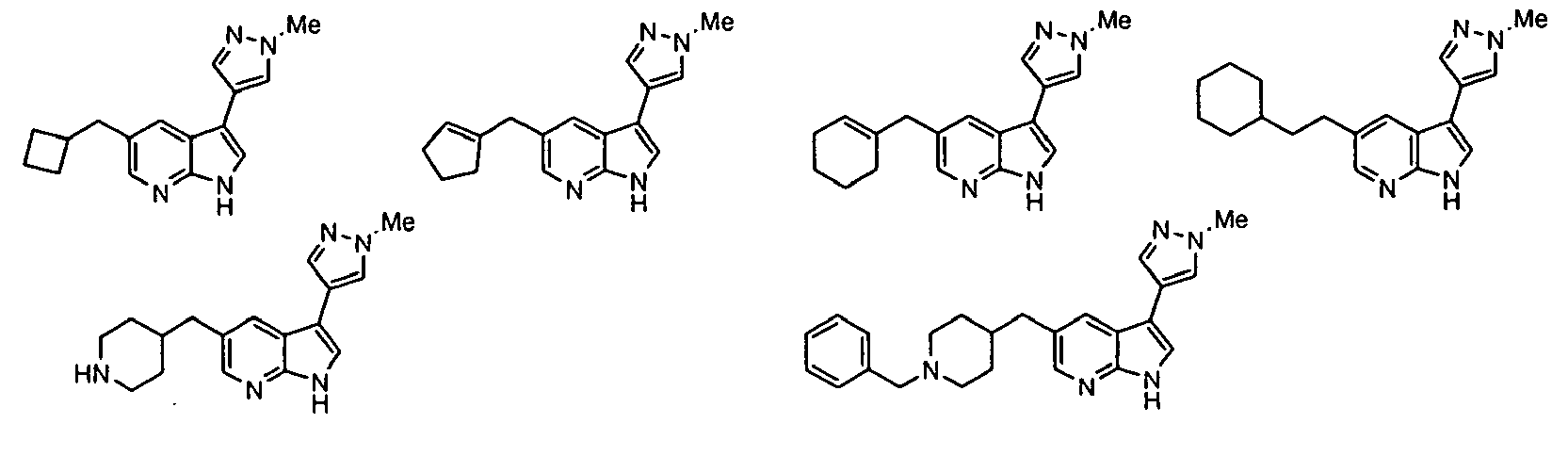
- The compounds of the first aspect may be provided as a salt, preferably as a pharmaceutically acceptable salt of compounds of formula (I). Examples of pharmaceutically acceptable salts of these compounds include those derived from organic acids such as acetic acid, malic acid, tartaric acid, citric acid, lactic acid, oxalic acid, succinic acid, fumaric acid; maleic acid, benzoic acid, salicylic acid, phenylacetic acid, mandelic acid, methanesulfonic acid, benzenesulfonic acid and p-toluenesulfonic acid, mineral acids such as hydrochloric and sulfuric acid and the like, giving methanesulfonate, benzenesulfonate, p-toluenesulfonate, hydrochloride and sulphate, and the like, respectively or those derived from bases such as organic and inorganic bases. Examples of suitable inorganic bases for the formation of salts of compounds for this invention include the hydroxides, carbonates, and bicarbonates of ammonia, lithium, sodium, calcium, potassium, aluminium, iron, magnesium, zinc and the like. Salts can also be formed with suitable organic bases. Such bases suitable for the formation of pharmaceutically acceptable base addition salts with compounds of the present invention include organic bases, which are nontoxic and strong enough to form salts. Such organic bases are already well known in the art and may include amino acids such as arginine and lysine, mono-, di-, or trihydroxyalkylamines such as mono-, di-, and triethanolamine, choline, mono-, di-, and trialkylamines, such as methylamine, dimethylamine, and trimethylamine, guanidine; N-methylglucosamine; N-methylpiperazine; morpholine; ethylenediamine; N-benzylphenethylamine; tris(hydroxymethyl) aminomethane; and the like.
- Salts may be prepared in a conventional manner using methods well known in the art. Acid addition salts of said basic compounds may be prepared by dissolving the free base compounds according to the first aspect of the invention in aqueous or aqueous alcohol solution or other suitable solvents containing the required acid. Where a compound of the invention contains an acidic function, a base salt of said compound may be prepared by reacting said compound with a suitable base. The acid or base salt may separate directly or can be obtained by concentrating the solution e.g. by evaporation. The compounds of this invention may also exist in solvated or hydrated forms.
- The invention also extends to a prodrug of the aforementioned compounds such as an ester or amide thereof. A prodrug is any compound that may be converted under physiological conditions or by solvolysis to any of the compounds of the invention or to a pharmaceutically acceptable salt of the compounds of the invention. A prodrug may be inactive when administered to a subject but is converted in vivo to an active compound of the invention.
- The compounds of the invention may contain one or more asymmetric carbon atoms and may exist in racemic and optically active forms. The compounds of the invention may exist in trans or cis form. The first aspect of the invention covers all of these compounds.
- The compound of the invention may exist in one or more crystalline forms. The invention therefore relates to a single crystal form of a compound of the invention or a mixture of one or more forms.
- The second aspect of the invention provides a process for the preparation of a compound of the first aspect of the invention. The compounds of the first aspect of the invention may be prepared by methods known to those skilled in the art for analogous compounds, as illustrated by the general schemes and procedures below and with reference to the examples.
- In particular, the compound of the first aspect may be provided by the introduction of a group X-R1 into a compound of formula (X), wherein Y1 is a halogen selected from F, Cl, Br or I.
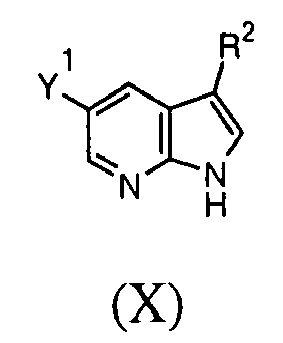
- Introduction of the group X-R1 may be catalysed by a catalyst such as a palladium or copper catalyst, as set out in the examples below.
- Alternatively, the group XR1 can be introduced by the initial introduction of the group X,


- Alternatively, a compound of the invention may be provided by the introduction of the group R2 into a compound of formula (V) wherein Y2 is a halogen or a metal.

- The group R2 can be introduced directly into a compound of formula (XXXII)

- The groups R1, XR1 and/or R2 can be introduced into the compounds of the invention as discussed above. Alternatively, a precursor moiety may be introduced into the compounds of the invention. The precursor moiety can then undergo one or more conversions to obtain R1, XR1 or R2. Examples of such precursor moieties include a boronic ester, CO2H, CN, C(NH)O-alkyl, COMe, COH, NH2, NH-NH2, CONH2, COCHN2, CO2-alkyl, CHNOH, COCH2N3, C(NH)O-alkyl, CSNH2, CONCS, CONHC(S)-NH2, and/or C(NH)NH2.
- A compound of formula (V) can be produced from a compound of formula (XXXII) by the addition of a group Y2 as defined above

- The compound of formula (XXXII) can be produced from a compound of formula (III)
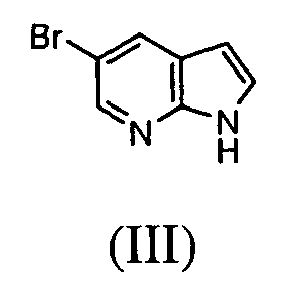
- Detailed processes for the production of the compounds of the first aspect are set out in the examples. The reaction conditions set out for the specific reactions in the examples can be applied to the general reaction schemes set out above. The present invention encompasses the processes for the production of the compounds of the first aspect and the intermediate compounds used in the processes. In particular, the second aspect of the invention provides compounds of general formula (V), (X) and/or (XXXII) wherein the groups R1, R2 and X are as defined for the first aspect of the invention.
- The skilled person will appreciate that it may be necessary to protect various functionalities in the compounds of the invention or the intermediate compounds during the processes set out above. In particular, the NH functionality in the azaindole may require protection. Protection and deprotection of functionalities as necessary, in particular the NH functionality in the azaindole group can be carried out using protecting groups, methods of protection and methods of deprotection well known to persons skilled in the art and/or as set out in the examples. The present invention encompasses processes using protected intermediate compounds and including protection and deprotection steps. The invention further encompasses protected intermediate compounds used in the processes described above and with reference to the examples, in particular to protected versions of compounds of general formula (V), (X) and/or (XXXII).
- The third aspect of the invention provides a composition comprising a compound according to the first aspect of the invention in combination with a pharmaceutically acceptable carrier, diluent or excipient.
- The composition may also comprise one or more additional active agent, such as an anti-inflammatory agent (for example a p38 inhibitor, glutamate receptor antagonist, or a calcium channel antagonist), AMPA receptor antagonist, a chemotherapeutic agent and/or an antiproliferative agent.
- Suitable carriers and/or diluents are well known in the art and include pharmaceutical grade starch, mannitol, lactose, magnesium stearate, sodium saccharin, talcum, cellulose, glucose, sucrose, (or other sugar), magnesium carbonate, gelatin, oil, alcohol, detergents, emulsifiers or water (preferably sterile). The composition may be a mixed preparation of a composition or may be a combined preparation for simultaneous, separate or sequential use (including administration).
- The composition according to the invention for use in the aforementioned indications may be administered by any convenient method, for example by oral (including by inhalation), parenteral, mucosal (e.g. buccal, sublingual, nasal), rectal or transdermal administration and the compositions adapted accordingly.
- For oral administration, the composition can be formulated as liquids or solids, for example solutions, syrups, suspensions or emulsions, tablets, capsules and lozenges.
- A liquid formulation will generally consist of a suspension or solution of the compound or physiologically acceptable salt in a suitable aqueous or non-aqueous liquid carrier(s) for example water, ethanol, glycerine, polyethylene glycol or oil. The formulation may also contain a suspending agent, preservative, flavouring or colouring agent.
- A composition in the form of a tablet can be prepared using any suitable pharmaceutical carrier(s) routinely used for preparing solid formulations. Examples of such carriers include magnesium stearate, starch, lactose, sucrose and microcrystalline cellulose.
- A composition in the form of a capsule can be prepared using routine encapsulation procedures. For example, powders, granules or pellets containing the active ingredient can be prepared using standard carriers and then filled into a hard gelatine capsule; alternatively, a dispersion or suspension can be prepared using any suitable pharmaceutical carrier(s), for example aqueous gums, celluloses, silicates or oils and the dispersion or suspension then filled into a soft gelatine capsule.
- Compositions for oral administration may be designed to protect the active ingredient against degradation as it passes through the alimentary tract, for example by an outer coating of the formulation on a tablet or capsule.
- Typical parenteral compositions consist of a solution or suspension of the compound or physiologically acceptable salt in a sterile aqueous or non-aqueous carrier or parenterally acceptable oil, for example polyethylene glycol, polyvinyl pyrrolidone, lecithin, arachis oil or sesame oil. Alternatively, the solution can be lyophilised and then reconstituted with a suitable solvent just prior to administration.
- Compositions for nasal or oral administration may conveniently be formulated as aerosols, drops, gels and powders. Aerosol formulations typically comprise a solution or fine suspension of the active substance in a physiologically acceptable aqueous or non-aqueous solvent and are usually presented in single or multidose quantities in sterile form in a sealed container, which can take the form of a cartridge or refill for use with an atomising device. Alternatively the sealed container may be a unitary dispensing device such as a single dose nasal inhaler or an aerosol dispenser fitted with a metering valve, which is intended for disposal once the contents of the container have been exhausted. Where the dosage form comprises an aerosol dispenser, it will contain a pharmaceutically acceptable propellant. The aerosol dosage forms can also take the form of a pump-atomiser.
- Compositions suitable for buccal or sublingual administration include tablets, lozenges and pastilles, wherein the active ingredient is formulated with a carrier such as sugar and acacia, tragacanth, or gelatin and glycerin.
- Compositions for rectal or vaginal administration are conveniently in the form of suppositories (containing a conventional suppository base such as cocoa butter), pessaries, vaginal tabs, foams or enemas.
- Compositions suitable for transdermal administration include ointments, gels, patches and injections including powder injections.
- Conveniently the composition is in unit dose form such as a tablet, capsule or ampoule.
- The fourth aspect of the invention provides a process for the manufacture of a composition according to the second aspect of the invention. The manufacture can be carried out by standard techniques well known in the art and comprises combining a compound according to the first aspect of the invention and the pharmaceutically acceptable carrier or diluent and optionally one or more additional active agents. The composition may be in any form including a tablet, a liquid, a capsule, and a powder or in the form of a food product, e.g. a functional food. In the latter case the food product itself may act as the pharmaceutically acceptable carrier.
- The fifth aspect of the present invention relates to a compound of the first aspect, or a composition of the third aspect, for use in medicine.
- The compounds of the present invention are inhibitors of JNK, such as JNK1, JNK2, or JNK3. In particular, the compounds of the present invention are inhibitors of JNK3. Preferably, the compounds of the present invention inhibit JNK3 selectively (i.e. the compounds of the invention preferably show greater activity against JNK3 than JNK1 and 2). For the purpose of this invention, an inhibitor is any compound, which reduces or prevents the activity of the JNK enzyme.
- The compounds are therefore useful for conditions for which inhibition of JNK activity is beneficial. Thus, preferably, this aspect provides a compound of the first aspect, or a composition of the second aspect of the present invention, for the prevention or treatment of a JNK-mediated disorder. The compounds of the first aspect of the invention may thus be used for the inhibition of JNK, more preferably for the inhibition of JNK3.
- A "JNK-mediated disorder" is any disease or deleterious condition in which JNK plays a role. Examples include neurodegenerative disorder (including dementia), inflammatory disease, an apoptosis disorder (i.e. a disorder linked to apoptosis) particularly neuronal apoptosis, autoimmune disease, destructive bone disorder, proliferative disorder, cancer, infectious disease, allergy, ischemia reperfusion injury, heart attack, angiogenic disorder, organ hypoxia, vascular hyperplasia, cardiac hypertrophy, thrombin induced platelet aggregation and a prostaglandin endoperoxidase synthase-2 condition (i.e. any condition associated with prostaglandin endoperoxidase synthase-2). The compounds of the present invention may be used for any of these JNK-mediated disorders.
- The compounds of the present invention are particularly useful for the prevention or treatment of a neurodegenerative disorder. In particular, the neurodegenerative disorder is an apoptosis neurodegenerative disorder and/or an inflammation neurodegenerative disorder (i.e. the neurodegenerative disorder results from apoptosis and/or inflammation). Examples of neurodegenerative disorders are: dementia; Alzheimer's disease; Parkinson's disease; Amyotrophic Lateral Sclerosis; Huntington's disease; senile chorea; Sydenham's chorea; hypoglycemia; head and spinal cord trauma including traumatic head injury; acute and chronic pain; epilepsy and seizures; olivopontocerebellar dementia; neuronal cell death; hypoxia-related neurodegeneration; acute hypoxia; glutamate toxicity including glutamate neurotoxicity; cerebral ischemia; dementia in a meningitis patient and/or dementia in a neurosis patient; cerebrovascular dementia; or dementia in an HIV-infected patient.
- The neurodegenerative disorder may be a peripheral neuropathy, including mononeuropathy, multiple mononeuropathy or polyneuropathy. Examples of peripheral neuropathy may be found in diabetes mellitus, Lyme disease or uremia; peripheral neuropathy for example peripheral neuropathy caused by a toxic agent; demyelinating disease such as acute or chronic inflammatory polyneuropathy, leukodystrophies, or Guillain-Barré syndrome; multiple mononeuropathy secondary to a collagen vascular disorder (e.g. polyarteritis nodosa, SLE, Sjögren's syndrome); multiple mononeuropathy secondary to sarcoidosis; multiple mononeuropathy secondary to a metabolic disease (e.g. diabetes or amyloidosis); or multiple mononeuropathy secondary to an infectious disease (e.g Lyme disease or HIV infection).
- The compounds of the invention can also be used to prevent or treat disorders resulting from inflammation. These include, for example, inflammatory bowel disorder, bronchitis, asthma, acute pancreatitis, chronic pancreatitis, allergies of various types, and possibly Alzheimer's disease. Autoimmune diseases which may also be treated or prevented by the compounds of the present invention include rheumatoid arthritis, systemic lupus erythematosus, glumerulonephritis, scleroderma, chronic thyroiditis, Graves's disease, autoimmune gastritis, diabetes, autoimmune haemolytis anaemia, autoimmune neutropaenia, thrombocytopenia, atopic dermatitis, chronic active hepatitis, myasthenia gravis, multiple sclerosis, ulcerative colitis, Crohn's disease, psoriasis or graft vs host disease.
- A compound of the present invention may be administered simultaneously, subsequently or sequentially with one or more other active agent, such as an anti-inflammatory agent e.g. p38 inhibitor, AMPA receptor antagonist, glutamate receptor antagonist, calcium channel antagonist, a chemotherapeutic agent or an antiproliferative agent. For example, for acute treatment, a p38 inhibitor may be administered to a patient prior to administering a compound of the present invention.
- The compounds of the invention will normally be administered in a daily dosage regimen (for an adult patient) of, for example, an oral dose of between 1 mg and 2000 mg, preferably between 30 mg and 1000 mg, e.g. between 10 and 250 mg or an intravenous, subcutaneous, or intramuscular dose of between 0.1 mg and 100 mg, preferably between 0.1 mg and 50 mg, e.g. between 1 and 25 mg of the compound of the formula (I) or a physiologically acceptable salt thereof calculated as the free base, the compound being administered 1 to 4 times per day. Suitably the compounds will be administered for a period of continuous therapy, for example for a week or more.
- The sixth aspect of the invention relates to a method of treating or preventing a JNK-mediated disorder in an individual, which method comprises administering to said individual a compound of the first aspect or a composition of the third aspect. The active compound is preferably administered in a cumulative effective amount. The individual may be in need of the treatment or prevention. Any of the JNK-mediated disorders listed above in relation to the fourth aspect may be the subject of treatment or prevention according to the fifth aspect. One or more other active agent may be administered to the individual simultaneously, subsequently or sequentially to administering the compound. The other active agent may be an anti-inflammatory agent such as a p38 inhibitor, glutamate receptor antagonist, AMPA receptor antagonist, calcium channel antagonist, a chemotherapeutic agent or an antiproliferative agent, but is preferably p38 inhibitor for acute treatment.
- The seventh aspect of the present invention provides the use of a compound of the first aspect in the manufacture of a medicament for the prevention or treatment of a JNK-mediated disorder. The medicament may be used for treatment or prevention of any of the JNK-mediated disorders listed above in relation to the fourth aspect. Again, the compound of the present invention may be administered simultaneously, subsequently or sequentially with one or more other active agent, preferably a p38 inhibitor for acute treatment.
- In the eighth aspect of the invention, there is provided an assay for determining the activity of the compounds of the present invention, comprising providing a system for assaying the activity and assaying the activity of the compound. Preferably the assay is for the JNK inhibiting activity of the compound, more preferably it is for the JNK3-specific inhibiting activity of the compounds. The compounds of the invention may be assayed in vitro, in vivo, in silico, or in a primary cell culture or a cell line. In vitro assays include assays that determine inhibition of either the kinase activity or ATPase activity of activated JNK. Alternatively, in vitro assays may quantitate the ability of a compound to bind JNK and may be measured either by radiolabelling the compound prior to binding, then isolating the inhibitor/JNK complex and determining the amount of the radiolabel bound or by running a competition experiment where new inhibitors are incubated with JNK bound to known radioligands. An example of an assay, which may be used, is Scintillation Proximity Assay (SPA), preferably using radiolabelled ATP. Another example is ELISA. Any type or isoform of JNK may be used in these assays.
- In the ninth aspect, there is provided a method of inhibiting the activity or function of a JNK, particularly JNK3, which method comprises exposing a JNK to a compound or a composition of the first or second aspect of the present invention. The method may be performed in a research model, in vitro, in silico, or in vivo such as in an animal model. A suitable animal model may be a kainic acid model in rat or mice, traumatic brain injury model in rat, or MPTP in mice.
- All features of each of the aspects apply to all other aspects mutatis mutandis.
- The invention will now be illustrated by the following non-limiting examples.
- 5-Bromo-7-azaindole (III) (preparation disclosed in
WO2004/078757 ) is reacted with thiol R1-SH in the presence of palladium catalyst such as (PPh3)4Pd and a base such as t-BuONa to afford sulphide (IV) (Migita et al. Bull. Chem. Soc. Jpn, 1980, 53, 1385; Kondo and Mitsudo Chem. Rev. 2000, 100, 3205). The reaction is carried out under nitrogen atmosphere at elevated temperatures such as 80-100 °C, e.g. by refluxing a solution of the reagents in ethanol for an extended time such as 12 to 24 h.
- Sulfide (IV) is then converted into 3-halo derivative (V) by reaction with halogen Y2 such as iodine in the presence of a strong base, e.g. KOH in appropriate solvent such as DMF by analogy to the protocol developed for analogous indoles by Bocchi and Palla (Synthesis 1982, 1096). Standard protection of nitrogen is followed by installation of R2 using one of the processes described in Methods 11-24. Subsequent removal of protecting group affords compound (I) where X=S. This compound can be oxidized in standard way with an oxidizing agent such as e.g. hydrogen peroxide or Oxone® to give sulfoxide (I), X=S(O). Prolonged oxidation and/or using an excess of oxidant leads to sulfone (I), X=SO2.
- Intermediate (IV) can also be prepared from protected bromide (VIII) (preparation disclosed in
WO2004/078757 ). Halogen-metal exchange followed by the addition of sulfur to the heteroaryllithium species and subsequent reaction between thiolate and R1-Br affords protected sulfide (IX).
- Deprotection of (IX) using methods known in the art produces (IV), which can be converted into (I), X=S, S(O), SO2 as shown in Method 1.
- Alternatively, the C(5)-alky(aryl)thio group can be introduced after the C(3) substituent has already been installed. This can be achieved in one step process leading to intermediate (VII) (Method 3a) using 5-halo derivative (X) (preparation disclosed in
WO2004/078756 ) and following the protocol by Deng et al. (Synlett 2004, 7, 1254).
- Intermediate (VII) can also be synthesized from (X) in a two-step process (Method 3b). 5-Halo-7-azaindole (X) is converted into pinacol boronic ester (XI) using boronation protocol disclosed in
WO2004/078757 . Boronic ester (XI) is then reacted with appropriate thiol following the method by Herradura et al. (Org. Lett. 2000, 2, 2019) to give (VII). Deprotection of (VII) as described in Method 1 affords (I) X=S. - Compounds (I) with X=O can be prepared using Methods 4 and 5.
- Boronate (XI) can be converted into the relevant hydroxy derivative (XII) following a modified protocol developed for boronic acids by Simon et al. (J. Org. Chem. 2001, 66, 633). It involves acting with hydrogen peroxide solution in acetic acid on boronic ester (XI) at room temperature. Hydroxy derivative (XII) thus obtained can then be reacted with boronic acid R1-B(OH)2 to produce ether (XIII).

- Alternatively, for alkyl-type R1 groups, hydroxy derivative (XII) can be alkylated with R1-Y (Y=halogen) under basic conditions developed by Engler et al. (J. Org. Chem. 1996, 61, 9297). Final removal of protecting group G under standard conditions affords (I), X=O.
- The ether functionality can be introduced directly at C(5) of the 7-azaindole system by using 5-bromo-7-azaindole (III) and following the protocol by Larraya et al. (Eur. J. Med. Chem. 2004, 39, 515). This reaction involves heating a mixture of (III), an alkoxide R1-OM' (M'=metal such as e.g. Na), and CuBr in an aprotic solvent such as DMF.
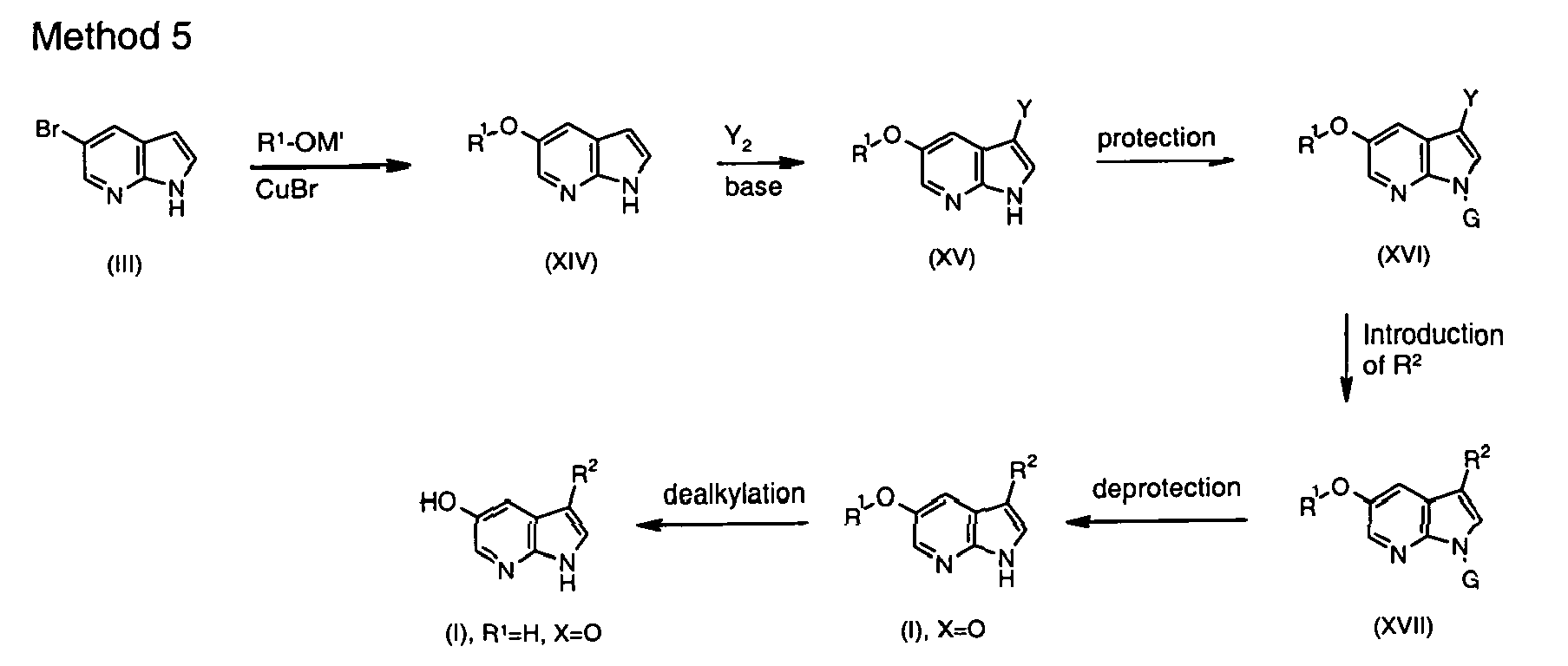
- Further transformations leading to (I), X=O are analogous to those shown in Method 1.
- Compounds (I) with X=C can be prepared using Method 6.
- It has been recognized in literature (Viaude et al. Tetrahedron, 1997, 53, 5159) that introduction of X=CH2 at C(5) in good yield is difficult as degradation products are observed and yield is only about 20%. This yield can be more than doubled by using Ag(I)-promoted Suzuki-Miaura coupling reaction (Zou et al. Tetrahedron Lett. 2001, 42, 7213).

- This reaction involves 7-azaindole derivative (X), the relevant benzylboronic acid R1-C(R4)2-B(OH)2, silver oxide, potassium carbonate and a palladium catalyst such as Pd(dppf)Cl2. Reaction is carried at elevated temperature (about 80 °C) over a period of 6-18 hours. Final deprotection of product (XVIII) affords (I), X=CR4R4.
- Compounds (I) with X=N can be prepared using Methods 7-10.
- Formation of a bond between nitrogen (X=N) and carbon atom C(5) of the 7-azaindole system can be performed using Chan-Lam coupling reaction involving (hetero)aryl boronic acid (Quach and Batey Org. Lett. 2003, 5, 4397; Chan et al. Tetrahedron Lett. 2003, 44, 3863) and NH-containing substrate, which is catalyzed by copper (II) salts, for instance copper (II) acetate.

- Thus, boronate (XIX) (preparation disclosed in
WO2004/078757 ) can be converted into C(5)-N derivative (XX). Further transformations analogous to those shown in Method 1 lead to inhibitor (I) with X=NR3-, NR3-C(O)- or NR3-C(O)O-. - Another alternative is offered by Buchwald-Hartwig methodology (Wolfe et al. Acc Chem Res 1998, 31, 805; Zim and Buchwald Org. Lett. 2003, 5, 2413) where haloarenes can be coupled with amines using a variety of palladium catalysts such as Pd(dba)2, PdCl2/P(o-tolyl)3, etc.
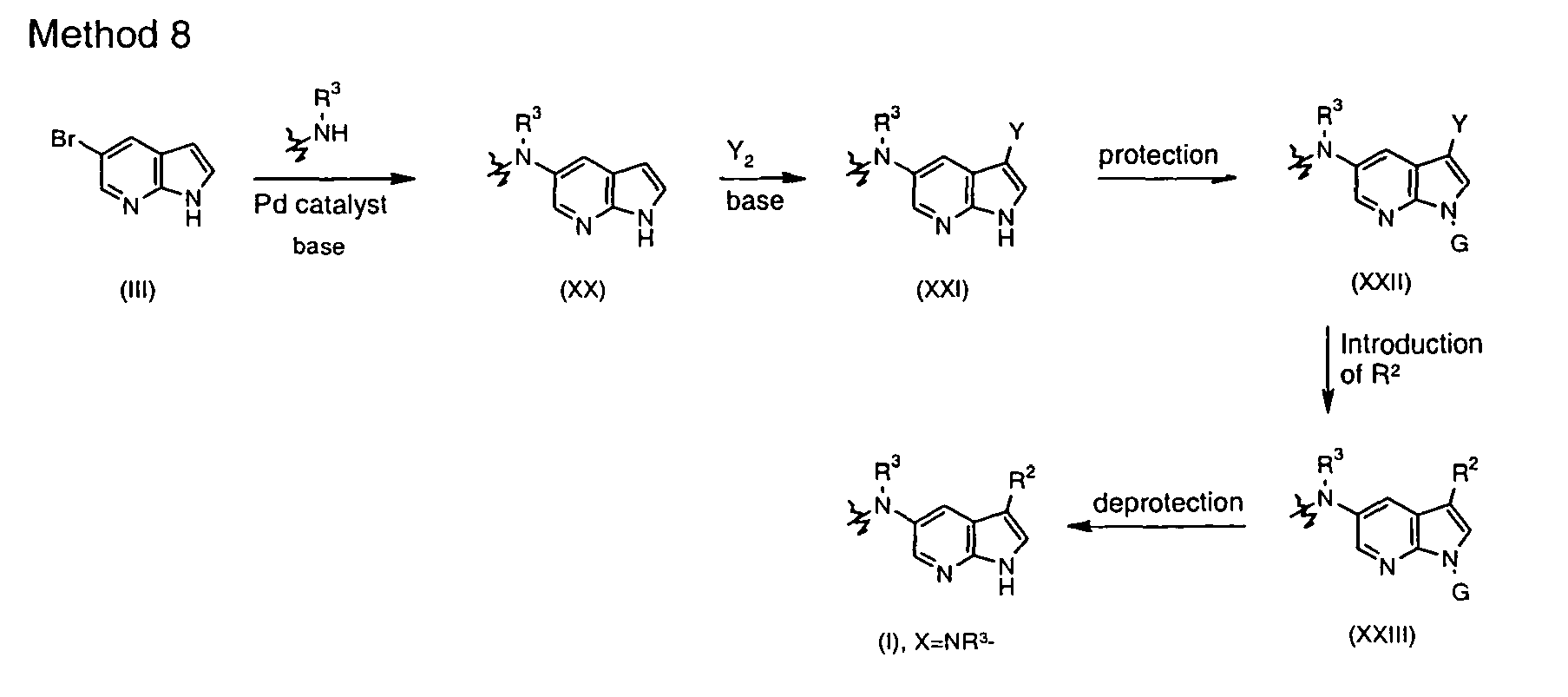
- Various bases can be used in the reaction, for instance tBuONa, K2CO3, Et3N, etc. The reaction is usually carried out at elevated temperature, e.g. 60-100 °C in solvent such as toluene.
- Direct synthesis of primary aryl amines, which are useful for preparation of inhibitors (I) where X= NH-C(O)- or NH-C(O)O- was carried out by the direct conversion of aryl halides into primary amines under mild conditions as developed by Lang et al. (Tetrahedron Lett. 2001, 42, 3251).

- The primary amine (XXIV) can be converted into (I), X=NHC(O)- or X=NHC(O)O- by deprotection of (XXIV) and acylation of (XXV) with suitable acylating agent such as acid chloride, acid anhydride, or equivalent. In particular, where G is a phenylsulfonyl group, its removal occurs spontaneously prior to the acylation step. Thus, a skilled person will appreciate that the actual synthetic sequence to prepare compound (I) will depend on the type of protecting group G used.
- Another route to introduce the C(5)-N bond is based on the modified Curtius rearrangement using the relevant carboxylic acid and diphenylphosphoryl azide (DPPA) (Shioiri et al. J. Am. Chem. Soc. 1972, 94, 6203; Anquetin et al. Bioorg. Med Chem. Lett. 2004, 14, 2773).

- This reaction between acid (XXVI), DPPA, t-BuOH and Et3N is carried out at elevated temperature (reflux). This procotol can be modified by reacting an intermediate isocyanate with t-BuOH in the presence of CuCl (Kapferer and Vasella Helv. Chim. Acta 2004, 87, 2764). Amine (XXV) can then be acylated as shown in Method 9.
- Substituent R2 can be introduced using an appropriate palladium catalyzed C-C bond-forming reaction between (XXVIII) and appropriate boronic acid or ester, stannane or silane R2-M (M=B, Sn, Si respectively) as taught in
WO2004/78756 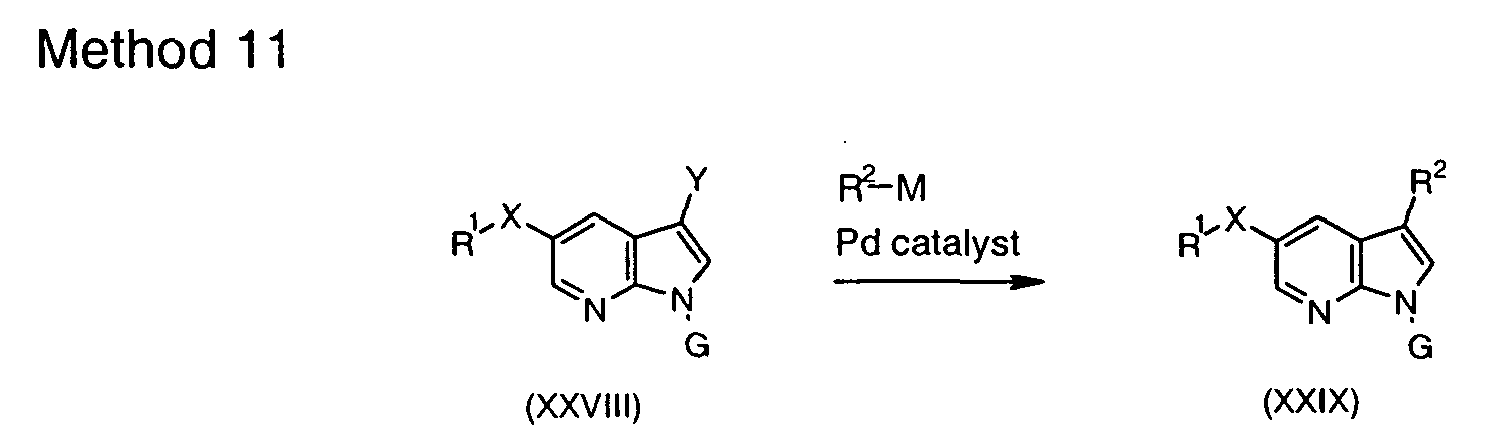
- Such method is particularly suitable for attaching rings R2 through an endocyclic sp2 carbon atom, which is present in aromatic, heteroaromatic or partially unsaturated rings.
- Many boronic acids and esters R2-M (M=B) are commercially available or can be prepared by methods known in the art (Li et al. J. Org. Chem. 2002, 67, 5394-5397; Hall, Dennis G. (ed.) Boronic Acids. Preparation and Applications in Organic Synthesis and Medicine, Wiley VCH, 2005). Partially saturated boronic acids and esters prepared as taught by Renaud and Ouellet (J. Am. Chem. Soc. 1998, 120, 7995) are particularly useful intermediates with regard to installation of partially saturated rings at C(3) of the 7-azaindole system. Unsaturated and (hetero)aromatic stannanes are available using known methods (Pereyre et al. Tin in Organic Synthesis; Butterworth: London, 1987; Lee and Dai Tetrahedron 1997, 53, 859 and references therein; Smith et al. Chem. Rev. 2000, 100, 3257; Evans et al. J. Am. Chem. Soc., 1998, 120, 5921). Synthetic procedures to prepare siloxanes and silacyclobutanes R2-M (M=Si) have been described by Denmark and Choi (J. Am. Chem. Soc. 1999, 121, 5821).
- The reaction with R2-M (M=B) is a Suzuki reaction which can be carried out according to Suzuki Pure Appl. Chem. 1991, 63, 419 or Littke J. Am. Chem. Soc. 2000, 122, 4020.
- It will be appreciated that the reaction with R2-M (M=Sn) is a Stille reaction, which can be carried out according to Stille Angew. Chem., Int.ed, Engl. 1986, 25, 508; Mitchell Synthesis, 1992, 803, or Littke et al. J. Am. Chem. Soc. 2002, 124,6343.
- The reaction with R2-M (M=Si) is a Hiyama reaction which can be carried out according to Hatanaka et al. J. Org. Chem. 1988, 53, 918, Hatanaka et al. Synlett, 1991, 845, Tamao et al. Tetrahedron Lett. 1989, 30, 6051 or Denmark et al. Org. Lett. 2000, 2, 565, ibid. 2491.
- Suitable catalysts for the purpose of this invention include (PPh3)2PdCl2, (PPh3)4Pd, Pd(OAc)2, [PdCl(η3-C3H5]2, Pd2(dba)3, Pd(dba)2 (dba = dibenzylidenacetone), Pd/P(t-Bu)3. A variety of coupling conditions for halogenated heterocycles have been reviewed by Schröter et al. Tetrahedron 2005, 61, 2245. The C-C bond formation between (hetero)aromatic systems can also be catalyzed by catalysts containing other metals such as copper and nickel (Hassan et al. Chem. Rev. 2002, 102, 1359).
- Introduction of R2 by means of an appropriate palladium catalyzed C-C bond-forming reaction can also be carried out in a reverse manner using metalloorganic species (XXX) and halide or triflate R2-Y1 under similar conditions to those used in Method 11.

- While halides R2-Y1 (Y1=I, Br, Cl) are available commercially, the relevant derivatives R2-OTfl containing partially unsaturated rings can be prepared from ketones (Comins and Dehghani Tetrahedron Letters 1992, 33, 6299).
- Methods for introduction of M=B, Sn, Si at the C(3) position of the 7-azaindole system have been disclosed in
WO2004078756 and by Alvarez et al. (Synthesis 1999, 4, 615). Analogous reactions on the indole skeleton have also been described for M=Sn by Amat et al. (J. Org. Chem. 1994, 59, 10) and Hodson et al. (Tetrahedron 1994, 50, 1899), and for M=B by Kawasaki et al. (J. Chem. Soc. Chem. Commun. 1994, 18, 2085) and Claridge et al. Tetrahedron 1997, 53, 4035. - Compounds (XXXI) with partially saturated rings are accessible using Methods 11 and 12. An alternative protocol involves the reaction of the relevant N-unprotected 7-azaindole (XXXII) with cyclic ketone under basic conditions as described by Fonquerna et al. (Bioorg. Med. Chem. Lett. 2005, 15, 1165).

- This reaction is carried out at elevated temperature in the presence of base such as KOH.
- Introduction of saturated rings at the C(3) of the azaindole system to produce (XXXIII) can be achieved by catalytic reduction of compounds (XXXI) containing partially saturated rings.

- This process can be carried out under the conditions known to those skilled in the art by stirring a solution of (XXXI) in a suitable solvent such as MeOH or AcOH in an atmosphere of H2 and in the presence of a catalyst such as Pd, Pd(OH)2, or PtO2, as illustrated for the relevant indole-based systems by Fonquerna et al. (Bioorg. Med. Chem. Lett. 2005, 15, 1165).
- Saturated rings can be introduced directly at the C(3) carbon atom by the reaction between the relevant epoxide and (XXXII).

- This transformation can be carried out under a variety of conditions. The reaction can be promoted by bases such as EtMgBr or MeMgBr following the conditions developed by Heath-Brown and Philpott (J. Chem. Soc. 1965, 7165) and Macor and Ryan (Heterocycles 1990, 31, 1497) for the indole system. It can also be catalyzed by silica gel and occur under high pressure as shown by Kotsuki et al. (J. Org. Chem. 1996, 61, 984). Other possible catalysts for opening the epoxide ring include TiCl4, InCl3, InBr3, LiClO4, and [Cr(salen)]SbF6.
- Heterocyclic rings at C(3), can also be formed by the means of cyclization (Gilchrist J. Chem. Soc. Perkin Trans 1 2001, 2491). Preparation of pyrroles via cyclization is known (e.g. Haubmann et al. Bioorg. Med. Chem. Lett. 1999, 9, 3143). The following are methods applicable to heterocycles containing two or more heteroatoms:
- The imidazole ring can be constructed following the method of Matthews et al. (Synthesis 1986, 336).

- Nitrile (XXXV) which can be produce according to methods disclosed in
WO2004101565 , is first converted to imidate (XXXVI) using the Pinner method (Nielson, D. G. In The Chemistry of Amidines and Imidates; S. Patai Ed.: John Wiley and Sons: New York, 1975, p 443) by reacting (XXXV) with alcohol R13OH (R13 = alkyl group, preferably Me, Et) in the presence of anhydrous acid such as HCl. Imidate (XXXVI) is then reacted with acetal H2NCH(R12)CH2CH(OR11)2 (R11 = alkyl group, preferably Me, Et; R12 = the relevant substituent such as H, alkyl, COOR14; R14 = alkyl) to give amidine (XXXVII), which cyclizes under acidic condition to afford imidazol-2-yl derivative (XXXVIII). In particular, the use of substituted acetals (R12 ≠ H) has been demonstrated by Franchetti et al. (Bioorg. Med. Chem. Lett. 2001, 11, 67). - Imidazole derivatives (XXXIX) are accessible (Li et al. Org. Synth. 2004, 81, 105) by condensation of amidines (XL) [prepared from nitriles (XXXV) according to Boeré et al.. J. Organomet. Chem. 1987, 331, 161; Thurkauf et al. J. Med. Chem. 1995, 38, 2251], with α-halo ketones (XLI).

- The relevant α-halo ketones (XLI) are available by halogenation of ketones (XLIII). In particular Y'=Br can be introduced by direct bromination (Gaudry and Marquet Org. Synth. 1988, VI, 193) or by using PhNMe3Br3 (Javed and Kahlon J. Heterocycl. Chem. 2002, 39, 627), pyridine HBr3 (Zaidlewicz et al. Heterocycles 2001, 55, 569) or CuBr2 (Gu et al. Bioorg. Med. Chem. Lett. 1999, 9, 569). The relevant iodides (Y'=I) are available following the protocols of Jereb et al. (Synthesis 2003, 6, 853) or Lee and Jin (Synth. Commun. 1999, 29, 2769) or Bekaert et al (Tetrahedron Lett. 2000, 41, 2903) by using the I2/SeO2 system. Chlorides can be synthesized using SO2Cl2 as chlorinating agent (Lopez et al. Farmaco 2000, 55, 40).
- Regiospecific halogenation of an unsymmetrical ketone (XLIII) to afford (XLI) (Y'=Cl, Br, I) can also be executed stepwise by generating silyl enol ether (XLIV) followed by its halogenation. Chlorinating agents include t-BuOCl (Dubac et al. Synth. Commun. 1991, 21, 11), SO2Cl2 (Olah et al. J. Org. Chem. 1984, 49, 2032), CH3Li/N-chlorosuccinimide (Denmark and Dapper J. Org. Chem. 1984, 49, 798). CuCl2 (Ito et al. J. Org. Chem. 1980, 45, 2022), Ph3PCl2/(TMSO)2 (Shibata et al. Bull. Chem. Soc. Jpn. 1991, 64, 3749), and TiCl2(Oi-Pr)2/t-BuOOH (Krohn et al. J. Prakt. Chem. 1999, 341, 62). Bromination can be conducted with Br2 (Blanco et al. Synthesis 1976, 194), PhNMe3Br3 (Baldwin et al. J. Org. Chem. 2001, 66, 2588) and N-bromosuccinimide (Paquette et al. Tetrahedron Lett. 1985, 26, 1611). Iodine can be introduced using I2/mCPBA (Sha et al. J. Org. Chem. 1987, 52, 3919), I2/CrO3/Me3SiCl (Aizpurua et al. Tetrahedron 1985, 41, 2903), I2/PCC (Scettri et al. Synth. Commun. 1982, 12, 11270, I2/CH3COOAg (Rubottom and Mott J. Org. Chem. 1979, 44, 1731), I2/Cu(NO3)2 (Dalla Cort J. Org. Chem. 1991, 56, 6708) and NaI/N-chlorosuccinimide (Vankar and Kumaravel Tetrahedron Lett. 1984, 25, 233..

- Silyl enol ether (XLIV) needed for this reaction may be formed from ketone (XLIII) using methods known in the art by acting on (XLIII) with silyl halide or triflate (R13)3SiY2 (Y2 = Cl, Br, I, OSO2CF3) and base such as lithium hexamethyldisilylamide (LiHMDS; Baldwin et al. J. Org. Chem. 2001, 66, 2588), or tertiary amine (e.g. i-Pr2Net; Kraus et al. J. Org. Chem. 1990, 55, 1624).
- Introduction of the ketone functionality at C(3) of the 7-azaindole system to provide ketone (XLIII) can be carried out by methods known in the art. These include reacting 3-halo-7-azaindole (XXVIII) (prepared as (V) in Method 1) with α-ethoxyvinyl)trialkyltin (XLII) (Cheney and Paquette J. Org. Chem. 1989, 54, 3334) in the presence of palladium catalyst such as PdCl2(PPh3)2 followed by acid-catalyzed hydrolysis (Molina et al. Tetrahedron Lett. 2002, 43, 1005). Direct introduction of the ketone functionality at C(3) of the 7-azaindole system was demonstrated by Yeung et al. (Tetrahedron Lett. 2002, 43, 5793) via Friedel-Crafts methodology.
- Ketone (XLIII) may also serve as a starting material for the preparation of pyrazole (XLVII).

- Standard condensation of ketone (XLIII) with aldehyde R12CHO affords hydroxyketone (XLV), which can be oxidized by methods known in the art, e.g. Swern oxidation, to α,γ-dicarbonyl system (XLVI). Reaction of (XLVI) with hydrazine R14NHNH2 affords pyrazole (XLVII) (R14=H; Shoji et al. Chem. Pharm. Bull. 1973, 21, 2639; R14=Ph; Bendaas et al. J. Heterocycl. Chem. 1999, 36, 1291). Regioselective character of this condensation for R14=Me was demonstrated by Timmermans et al. (J. Heterocycl. Chem. 1972, 9, 1373). Similarly, the use of semicarbazide H2NNHC(O)NH2 leads to amide (XLVII), R14=C(O)NH2 (Kumari, et al. Indian J. Chem., Sect. B 1996, 35, 846). Pyrazole derivatives (XLVII) where R12=OH can be obtained from esters (XLVI) (R12=OMe) (Samanta et al. J. Chem. Res., Synop. 1995, 11, 429).
- Pyrazole (XLVII) can also be prepared from the relevant α,β-unsaturated compound (XLVIII) following the method developed for the indole-based systems by Dandia et al. (R12=p-F-C6H4; Indian J. Chem., Sect B.: Org. Chem. Incl. Med. Chem. 1993, 32, 1288).

- Compound (XLVIII) is available from aldehyde (XLIX; preparation of analogous systems disclosed in
WO2004101565 ) using Horner-type olefination (Willette Adv. Heterocycl. Chem. 1968, 9, 27) or base-catalyzed aldol condensation with methylketones (Pailer et al. Monatsh. Chem. 1979, 110, 589). - Compound (XLVIII) can also be prepared from the relevant halide (XXVIII) (Y=Br; Brown and Kerr Tetrahedron Lett. 2001, 42, 983) or triflate (Y=CF3SO3; Gribble and Conway Synth. Commun. 1992, 22, 2129) using Heck methodology.

- This reaction is carried out in the presence of tertiary amine such as i-Pr2NEt and with Pd(PPh3)2Cl2 or Pd(OAc)2PPh3 as catalyst.
- Pyrazole (XLVII) is available from ketone (XLIII) in two steps, as shown below (Speake et al. Bioorg. Med. Chem. Lett. 2003, 13, 1183).

- Pyrazole derivative (L) in which the pyrazole ring is linked to the 7-azaindole C(3) via endocyclic nitrogen could be synthesized by modification of method leading to (XLVII) (see above) and using hydrazine derivative (LI).

- This hydrazine can be prepared in a standard way (Hiremath et al. Indian J. Chem., Sect. B 1980, 19, 767) from the relevant amine (LII). Preparation of 3-amino-substituted 7-azaindoles is known in the art (Herbert and Wibberley J. Chem. Soc. C 1969, 1505).
- Oxazole derivatives (LIII) are available via the reaction between amide (LV) and α-haloketone (LIV) using the method of Kelly and Lang (J. Org. Chem. 1996, 61, 4623).

- The α-haloketone (LIV) can be prepared in a way analogous to that described for (XLI) (see above, Method 16). Amide (LV) can readily be synthesized from the relevant acid (LVII) via mixed anhydride (LVI) (R11 = alkyl) using standard procedure known to those skilled in the art (preparation of analogous acids and amides was disclosed in
WO2003082868 ). - Reversal of functionalities allows synthesis of oxazoles (LVIII) following the procedure by Kelly and Lang (J. Org. Chem. 1996, 61, 4623) as shown below (R12=alkyl, alkenyl). Compounds with R12=NH2 can be prepared following the method used for the indole series by Bansal et al (Indian J. Chem., Sect. B: Org. Chem. Incl. Med. Chem. 2000, 39, 357).

- The reaction between α-haloketone (XLI) (preparation described above, Method 16) and amide R12C(O)NH2 is usually carried out at elevated temperature in neutral solvent such as tetrahydrofuran. A large variety of amides R12C(O)NH2 are available commercially or can be prepared using methods known to those skilled in the art.
- The remaining regioisomeric oxazole (LIX) (R12=alkyl, aryl) may be synthesized from α-haloketone (XLI) following the method of Molina et al. (Synthesis 1993, 54). The azide (LX) is reacted with acyl halide R12C(O)Y2 (Y2=halogen) in the presence of tertiary phosphine such as tributylphosphine.
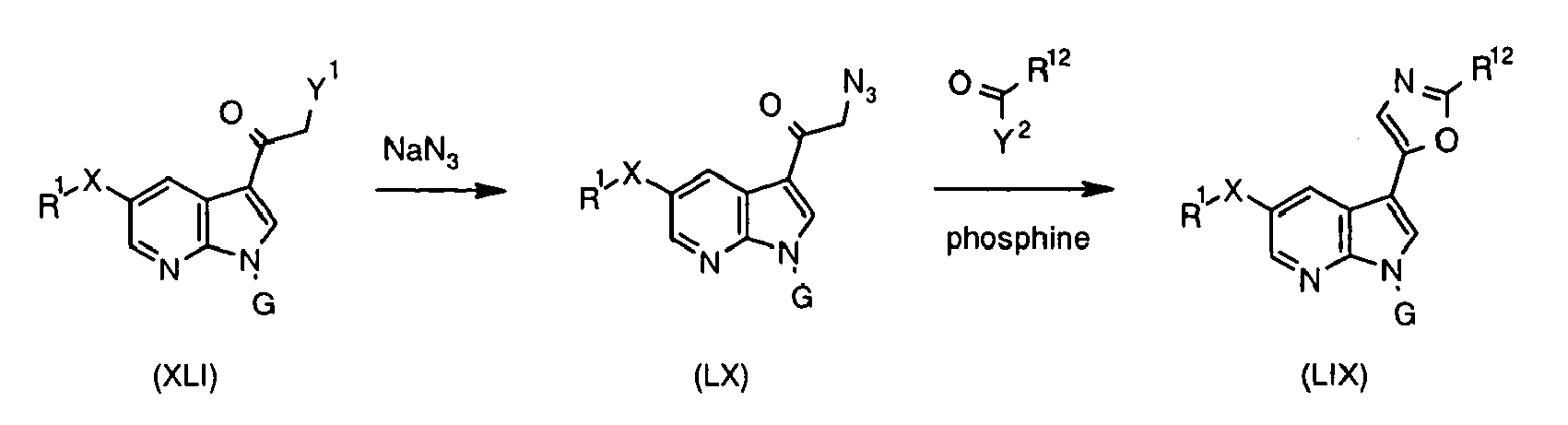
- Reacting azide (LX) in the above reaction with the relevant isothiocyanide R14-NCS (R14=alkyl aryl, heteroaryl) instead of acyl halide R12C(O)Y2 leads to oxazole derivatives (LIX) where R12=NHR14 (Dhar et al. Bioorg. Med. Chem. Lett. 2002, 12, 3305).
- An alternative cyclization (Doyle and Moody Synthesis 1994, 1021) utilizes diazoketone (LXI), nitrile R12CN and Rh2(NHCOCF3)4 as catalyst.

- Diazoketones (LXI) can be synthesized from the relevant methyl ketones (XLIII) (Moody et al. J. Chem. Soc., Perkin Trans. 1 1997, 2413).
- The oxazole ring may also be formed by oxidative cyclization as demonstrated by Oikawa et al. (Heterocycles 1979, 12, 1457).

- Derivative (LXIII) can be prepared from 7-azatryptophan (commercially available) following the approach presented for tryptophan by Nishida et al. (Tetrahedron Lett. 1998, 39, 5983).
- The TOSMIC methodology offers a convenient way to convert aldehyde (XLIX) into oxazole (LIX) (R12=H) using tosylmethyl isocyanide MeC6H4SO2CH2NC (commercially available) and base such as MeONa (Haubmann et al. Bioorg. Med. Chem. Lett. 1999, 9, 3143) or DBU (Dhar et al. Bioorg. Med. Chem. Lett. 2002, 12, 3305).

- Another method utilizing reactivity of the isocyanide group is based on the Schöllkopf reaction of ester (LXV) (preparation of analogous esters was disclosed in
WO2003082868 ) with LiCH2NC by analogy to the synthesis by Vedejs and Barda (Org. Lett. 2000, 2, 1033) of oxazoles linked to the indole system.
- The isocyanide (LXIV) may undergo spontaneous cyclization to afford (LIX) (R12=H). In some cases this process may need to be catalyzed by mild acid such as pyridinium toluenesulfonate.
- Isoxazole derivatives (LXVI) are available by condensation of unsaturated ketone (XLVIII) with hydroxylamine, following the method used by Roeder and Pigulla (Arch Pharm (Weinheim, Ger) 1978, 311, 817) for an analogous indole system.

- The regioisomeric isoxazole (LXVII) can be made by condensation of salt (LXVIII) with hydroxylamine according to the method of Hasan et al. (J. Prakt. Chem. 1990, 332, 666).

- Disubstituted isoxazoles (LXIX) can be synthesized following the method by Kidwai and Sapra (Org. Prep. Proced. Int. 2001, 33, 381) using aldehyde (XLIX) as starting material.

- The remaining isoxazole regioisomer (LXX) is available from the relevant oxime (LXXI) by halogenation followed by the reaction with alkyne R12-C≡CH (R12=alkyl, aryl). Suitable halogenating agents include NBS (Baruah, et al. Heterocycles 1988, 27, 1127) and NaOCl (Jedlovska et al. Collect. Czech. Chem. Commun. 1990, 55, 2481). Oxime (LXXI) can be prepared in standard way from the corresponding aldehyde (XLIX).

- The reaction between and halogenated oxime occurs in the presence of base such as Et3N.
- Propargyloxime (LXXIII) (R14=alkyl, aryl) [available from α-haloketone (XLI) following conventional methods, e.g. Cory et al. Helv. Chim. Acta 1977, 60, 2294; Ben-Basset et al. J. Med. Chem. 1976, 19, 928; Hassner and Alexanian J. Org. Chem. 1079, 44, 3861] can be cyclized under mild basic conditions to afford isoxazole (LXXII) (Short and Ziegler Tetrahedron Lett. 1993, 34, 75).
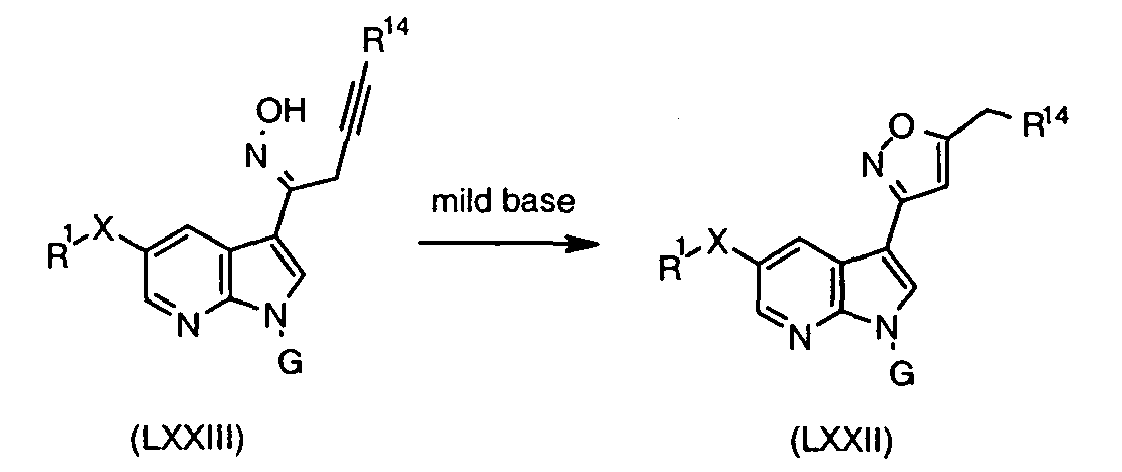
- Isoxazole (LXX) (R12=H) can be synthesized from ketone (LXXIV) and hydroxylamine (Spry and Bhala Heterocycles 1986, 24, 1799).

- Similarly, monosubstituted isoxazole (LXXV) is available from ketone (LXXVI), which can be prepared from methylketone (XLIII) (El-Taweel and Elnagdi J. Heterocycl. Chem. 2001, 38, 981).

- Methods for synthesis of thiazoles are analogous to those used for oxazoles (cf Method 18). Thus, thiazole (LXXVII) is available by condensation of thioamide (LXXVIII) with α-haloketone (LIV) (Schwarz Org. Synth. 1955, III, 332; Gu et al. Bioorg. Med. Chem. Lett. 1999, 9, 569).
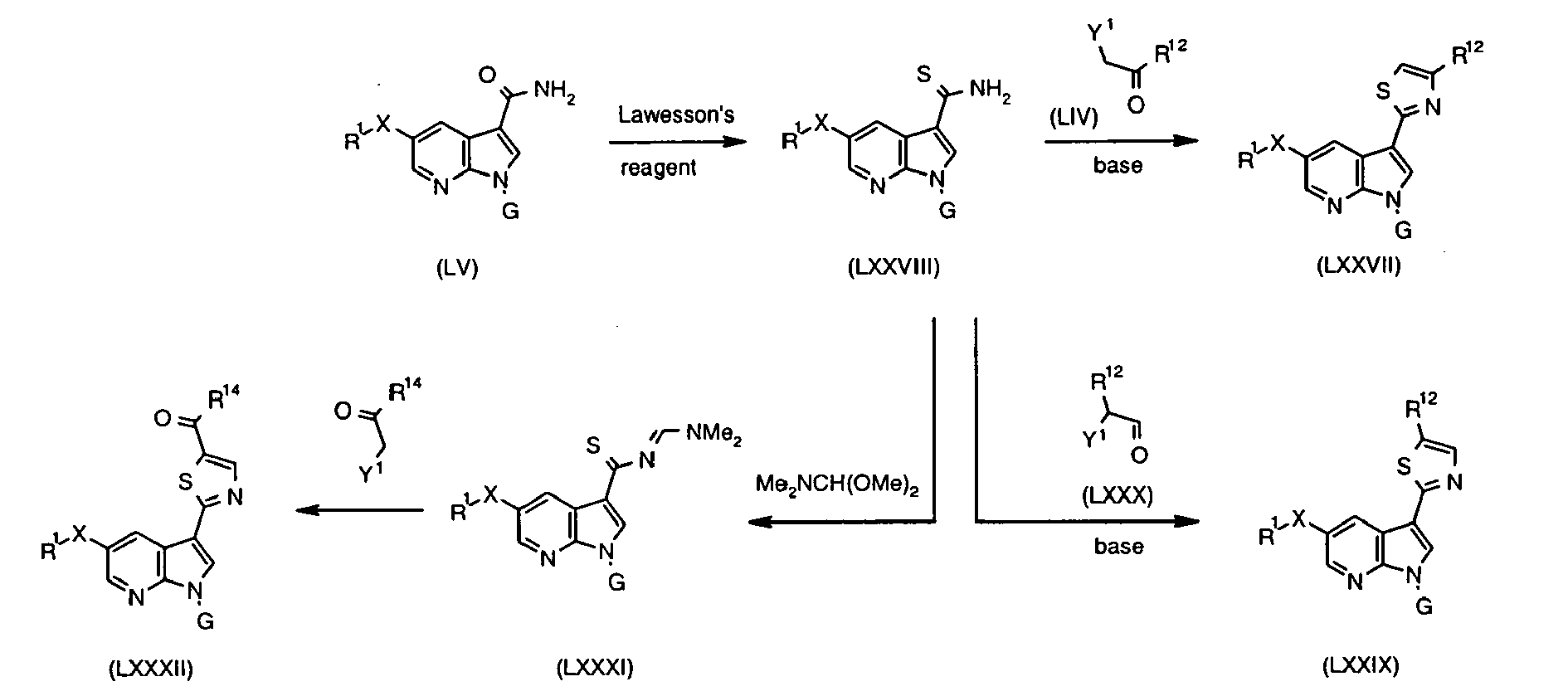
- In order to prepare differently substituted thiazole (LXXIX), aldehyde (LXXX) may be applied (Thompson et al. Bioorg. Med. Chem. Lett. 1994, 4, 2441). Alkylcarbonyl groups R14C(O) can be installed α to the sulphur atom by converting thioamide (LXXVIII) into amidine (LXXXI) followed by reaction with α-haloketone R14C(O)CH2Y1 (Thompson et al. Bioorg. Med. Chem. Lett. 1994, 4, 2441). Thioamide (LXXVIII) used in these reactions can be readily prepared from amide (LV) using methods known in the art, such as acting on (LV) with the Lawesson's reagent. Alternatively, it can be formed from nitrile (XXXV) and H2S under basic conditions (Bhattacharya et al. J. Chem. Soc., Perkin Trans. I 1995, 1543; Krawczyk et al. J. Med. Chem. 1995, 38, 4115), nitrile (XXXV) and thioacetamide under acidic conditions (Gu et al. Bioorg. Med. Chem. Lett. 1999, 9, 569), nitrile (XXXV) and sodium hydrogen sulfide and magnesium chloride in dimethylformamide (DMF) (Manaka and Sato Synth. Commun. 2005, 35, 761), or nitrile (XXXV) and the (Me3Si)2S/MeONa system (Lin et al. Synthesis 1992, 1219; Qiao et al. Org. Lett. 2001, 3, 3655)
- Isomeric thiazole (LXXXIII) can be synthesized from α-haloketone (XLI) (Y1=Cl, Zawistoski J. Heterocycl. Chem. 1990, 27, 519; Y1=Br, Di Fabio and Pentassuglia Synth. Commun. 1998, 28, 51).

- Reaction works for R12=NH2 (Hayashi et al. Heterocycles 1999, 51, 1233; Bansal et al. Indian J. Chem., Sect. B: Org. Chem. Incl. Med. Chem. 2000, 39, 357), R12=NH-Aryl (Di Fabio and Pentassuglia Synth. Commun. 1998, 28, 51) R12=(substituted)alkyl (Zawistoski J. Heterocycl. Chem. 1990, 27, 519) and R12=aryl (Baldwin et al. J. Org. Chem. 2001, 66, 2588). Opposite regiochemistry of this reaction (Y1=Cl, R12=Me, NH2) to produce (LXXXIV) has also been suggested (Arya et al. Indian J. Chem., Sect. B 1977, 15, 473).

- Based on the precedent in the indole series (Saleh Nucleosides, Nucleotides Nucleic Acids 2002, 21, 401), thiazole (LXXXV) is available from isothiocyanate R14NCS (R14=alkyl, heterocyclyl) and α-aminoketone (LXXXVI), which in turn can be prepared by reduction of azide (LX) under acidic conditions (Jiang and Gu Heterocycles 2000, 53, 1559).

- Triazoles (LXXXVII) (R12=H, alkyl, aryl, heteroaryl) are available from the relevant imidate (XXXVI) (see Method 16) and hydrazide (LXXXVIII) (Kelarev et al. Khim. Geterotsikl. Soedin. 1993, 189).

- This reaction is carried out in the presence of tertiary amine such as Et3N. The reacting functionalities can also be be reversed as shown below:

- The reaction tolerates a wide range of functionalities incorporated into imidate (XC) (Y=O): R12=(hetero)aryl (Omodei-Sale et al. J. Med. Chem. 1983, 26, 1187), R12=COOEt (McKillop et al.. Tetrahedron Lett. 1982, 23, 3357), and R12=alkyl (Hunter and Neilson J. Chem. Soc. Perkin Trans. 1: Org. Bio-Org. Chem. 1988, 1439).
- The required hydrazide (LXXXIX) can be prepared from the relevant ester (LXV) (G=H, protecting group) by acting with hydrazine. Alternatively, hydrazine derivative such as BOC-NHNH2 or PhCH2OC(O)NHNH2 is coupled with acid (LVII) (G=H, protection) under usual conditions for amide bond formation. The BOC and PhCH2OC(O) protections can then be removed under appropriate conditions such as TFA/i-Pr3SiH and H2/Pd-C, respectively.
- An alternative way to convert hydrazide (LXXXIX) into (LXXXVII) involves three component condensation reaction of (LXXXIX), thioimidate (XC) (Y=S), and ammonium acetate on the surface of silica gel under microwave irradiation as shown below (Rostamizadeh et al. Synth. Commun. 2003, 33, 113).

- Hydrazide (LXXXIX) can also be reacted with thioamide R12C(S)NH2 to afford triazole (LXXXVII) (Dumaitre and Dodic Eur. Pat. Appl. 1995 ,
EP 636626 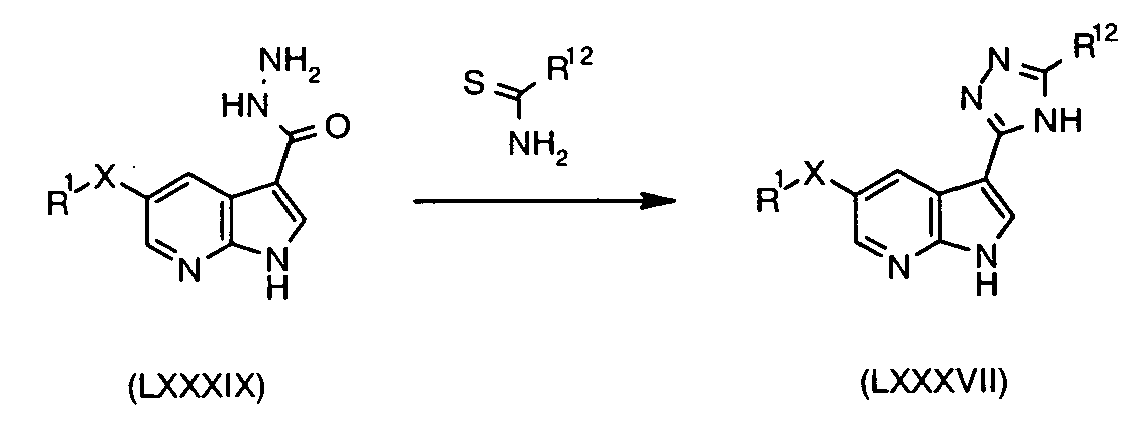
- Preparation of a compound where R12=H is achieved by the reversal of the functionalities as shown below, and using thioamide (LXXVIII) (G=H) (Vanek et al. Collect. Czech. Chem. Commun. 1984, 49, 2492).

- N-Substituted triazole (XCI) is available in three steps from hydrazide (LXXXIX) following the method developed by Gautun and Carlsen (Molecules 2001, 6, 969).

- In the last step alcoholic solution of ammonia (R14=H) or a primary aliphatic amine R14NH2 can be used.
- A variety of heteroatom-substituted triazoles (XCII) are available by condensation of imides (XCIII) with hydrazine.

- Thus, R15=OR13 (R13=alkyl; Whitfield and Papadopoulos Synthesis 1985, 423), R15=amino (Whitfield and Papadopoulos J. Heterocyclic Chem. 1981, 18, 1197), R15=NC(S)- (Saczewski and Foks Synthesis 1986, 751), R15=NH-aryl (Okajima and Okada J. Heterocyclic Chem. 1991, 28, 177). Imides (XCIV) can readily be prepared from the relevant acids (LVII) by sequential formation of acid isothiocyanate (XCIV) and subsequent reaction with alcohol, amine or amide (Whitfield and Papadopoulos Synthesis 1985, 423). A modification of this method (R15=amino) using S-methyl derivative (XCV) has recently been described by Chen et al. (Bioorg. Med. Chem. Lett. 2001, 11, 3165).

- Substituted triazoles (LXXXVIII) (R12= H, alkyl) can be prepared from amide (LV) (Speake et al. Bioorg. Med. Chem. Lett. 2003, 13, 1183).

- Triazoles are also available by ring interconversion from oxadiazole (XCVII) (Buscemi et al J. Org. Chem. 2003, 68, 605-608)

- Additional methods to create heteroatom-substituted triazoles have been described by Akbarzadeh et al. (Bioorg. Med. Chem. 2003, 11, 769),
- Oxadiazoles (XCVIII) (R12=H, alkyl, aryl, heteroaryl) can be prepared from nitrile (XCIX) (available using methods disclosed in
WO2004101565 ) following the protocol used for the analogous indole system by Swain et al. (J. Med. Chem. 1991, 34, 140).
- Nitrile (XCIX) is first converted into amide oxime (C), salt of which is then reacted with ester R12COOR11. The last step may alternatively involve acid anhydride (R12CO)2O, mixed anhydride, acid chloride R12COCl or imidate R12C(=NH)OR11 (Shvekhgeimer et al. Khim. Geterotsikl. Soedin. 1984, 1609).
- Oxime (LXXI) may also serve as a substrate to prepare oxadiazole (XCVIII) (Corsaro et al. J. Chem. Res. Synop. 1989, 246).

- Chlorination to produce (CI) can be carried out using Cl2 (Rajagopalan and Advani J. Org. Chem. 1965, 30, 3369), NaNO2/HCl (Kocevar et al. Synth. Commun. 1988, 18, 1427), N-chlorosuccinimide (Bedford et al. J. Med. Chem. 1986, 29, 2174), t-BuOCl (Peake and Strickland Synth. Commun. 1986, 16, 763), and NOCl (Iwakura et al. Bull. Chem. Soc. Jpn. 1968, 41, 2954).
- Reversal of functionalities in the approaches presented above allows synthesis of regiosiomeric oxadiazole (CII), as shown below.
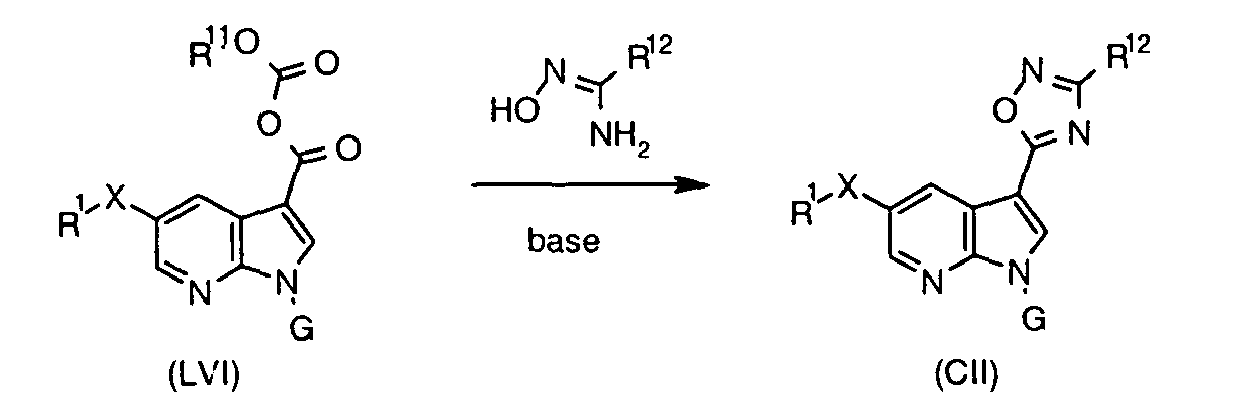
- Usually, pyridine is used as base.
- Isoxazole regioisomer (XCVII) can be synthesized from hydrazone (LXXXIX) and imidate (XC) (Y=O) (Kelarev et al. Chem. Heterocycl. Comp. (New York) 2000, 36, 207).

- Instead of imidate (XC) (Y=O), the relevant acid anhydride, amide (Kovalenko et al. Molecules 2000, 5, 1146) or acid followed by treatment with POCl3 can be used (Monge Vega et al. Bol. Soc. Quim. Peru 1983, 49, 120). Alternatively, orthoformate R12C(OR11)3 may be applied (R12=H; Hiremath et al. Indian J. Chem., Sect. B: Org. Chem. Incl. Med. Chem. 1980, 19B, 1031).
- Similarly, after reversal of reacting functionalities isoxazole regioisomer (XCVII) can be formed from imidate (XXXVI) and hydrazone (LXXXVIII) (Reynaud et al. J. Heterocycl. Chem. 1992, 29, 991; Swain et al. J. Med. Chem. 1991, 34, 140).

- Pyrimidine (CIII) can be obtained from ketone (LXXVI) and imidate (XC) (R11Y=R12=NH2; Molina et al. Tetrahedron Lett. 2002, 43, 1005).

- Instead of ketone (LXXVI), ketone (CIV) can be used (R11Y=H2N, R12=aryl, S-alkyl; Taboada et al. J. Carbohyd. Chem. 2004, 23, 325). It is prepared by oxidation of alcohol (CV) (preparation of analogous systems was disclosed in
WO2004101565 ).
- Pyrimidine regioisomer (CVI) is available by modification of the methods presented above. Thus, imidate (CVII) treated with α,β-unsaturated ketone (CVIII) in the presence of base affords pyrimidine (CVI) (R14= NHC(O)Ph; Bratusek et al ARKIVOC 2003, 5, 77, R12=heterocycle; El-Taweel et al. J. Heterocycl. Chem. 2001, 38, 981).

- Use of highly functionalized ketone (CVIII) allows preparation of variously substituted pyrimidine derivatives (Westman and Lundin Synthesis 2003, 1025; Chhabria and Shishoo Heterocycles 1999, 51, 2723).
- Heteroaromatic rings can also be attached to the C(3) carbon of 7-azaindole system via endocyclic nitrogen atom using C-N couplings.

- Thus, (CIX) containing the pyrazolyl group can be prepared using (CX)=pyrazol or imidazole, Y=I and CuI as well as trans-N,N'-dimethylcyclohexanediamine as catalyst (Enguehard et al. J. Org. Chem. 2003, 68, 5614). Different set of conditions (Y=Br, Cu2O and salicylaldoxime as catalyst) was proposed by Cristau et al. Eur. J. Org. Chem. 2004, 695).
-

-

- A mixture of 5-bromo-7-azaindole (1) (0.5 g, 2.54 mmol; preparation disclosed in
WO2004/078757 ), benzenethiol (274 µL, 2.66 mmol), sodium t-butoxide (488 mg, 5.07 mmol) and Pd(PPh3)4 (235 mg, 0.20 mmol) in EtOH (25 mL) was heated at reflux for 19 h. More benzenethiol (274 µL, 2.66 mmol), sodium t-butoxide (488 mg, 5.07 mmol) and Pd(PPh3)4 (235 mg, 0.20 mmol) were added and reflux continued for a further 24 h. The reaction mixture was filtered, concentrated, and the residue was extracted with CH2Cl2:hexane=1:1 (v/v). The extract was concentrated and purified by preparative LCMS (column LUNA 10 µ C18(2) 00G-4253-V0 250x50 mm) using water ― acetonitrile (0.1% AcOH) as eluent (in gradient; flow 80 mL/min) to afford 2 as a white solid (142 mg, 25%); 1H NMR (400 MHz, CDCl3) δ 6.53 (dd, J = 3.5, 2.0 Hz, 1H), 7.10-7.30 (m, 5H), 7.41 (dd, J = 5.9, 2.5 Hz, 1H), 8.16 (dd, J = 2.0, 0.6 Hz, 1H), 8.48 (d, J = 2.0 Hz, 1H), 10.00-10.20 (bs, NH). -

- To a solution of 2 (135 mg, 0.60 mmol) in DMF (1.5 mL) was added solid KOH (124 mg, 2.21 mmol) and the reaction mixture stirred for 20 min. Iodine (167 mg, 0.66 mmol) was then added and the stirring continued for 40 min. A mixture of water (8.8 mL) and sat. aq. Na2S2O3 (1.3 mL) was added rapidly, and the resulting solid filtered off, washed with water (2x) and dried in vacuum to give iodide 3 as a creamy solid (205 mg, 98%); 1H NMR (400 MHz, CDCl3 + 2 drops CD3OD) δ 7.10-7.30 (m, 5H), 7.45 (s, 1H), 7.94 (d, J = 2.0 Hz, 1H), 8.35 (d, J = 1.9 Hz, 1H).
-

- A mixture of 3 (200 mg, 0.57 mmol), benzenesulfonyl chloride (109 µL, 0.85 mmol), n-BuNHSO4 (25 mg, 0.074 mmol) and 50% aqueous NaOH (108 µL) in CH2Cl2 (3.5 mL) were stirred for 0.5 h. The mixture was partitioned between sat. aq. NaHCO3/CH2Cl2. The organic layer was separated and the aqueous phase extracted with CH2Cl2. The combined organic solutions were dried (MgSO4) and concentrated to give 4 as an orange oil (336 mg, 120 %).
-

- A mixture of iodide 4 (280 mg, 0.57 mmol), boronic acid 5 (302 mg, 0.85 mmol), PdCl2(PPh3)2 (39.9 mg, 0.057 mmol), LiCl (72.3 mg, 1.71 mmol), 1.0 M aq. Na2CO3 (1.4 mL, 1.4 mmol), EtOH (2.7 mL) and toluene (2.7 mL) were heated at reflux for 0.5 h. The mixture was cooled, partitioned between brine/AcOEt, the layers separated and the aqueous phase extracted with more AcOEt (3 x), dried (MgSO4) and concentrated. The residue was separated by means of silicagel chromatography (SGC) using AcOEt:hexane as eluent in gradient up to 85:15 (v/v) to give 6 as a light orange foam (353 mg, 92%); 1H NMR (400 MHz, CDCl3) δ 7.10-7.40 (m, 20H), 7.49 (t, J = 8.1 Hz, 2H), 7.59 (m, 2H), 7.75 (s, 1H), 7.86 (d, J = 0.8 Hz, 1H), 7.89 (d, J = 2.1 Hz, 1H), 8.19 (m, 2H), 8.46 (d, J = 2.0 Hz, 1H).
-

- A mixture of 6 (346 mg, 0.51 mmol), CH2Cl2 (4.4 mL), CF3COOH (410 µL), H2O (41 µL) and i-Pr3SiH (207 µL) were stirred for 0.5 h then added dropwise to a stirred mixture of CH2Cl2/sat. aq. NaHCO3. The layers were separated and the aqueous phase extracted with more CH2Cl2 (3x), dried (MgSO4) and concentrated. The residue was separated by means of silicagel chromatography (SGC) using AcOEt:hexane as eluent in gradient up to 65:35 (v/v) to give 7 as a white solid (160 mg, 72%); 1H NMR (400 MHz, CDCl3 + 6 drops CD3OD) δ 7.10-7.28 (m, 5H), 7.47 (t, J = 7.7 Hz, 2H), 7.56 (t, J = 7.5 Hz, 1H), 7.75 (s, 2H), 7.78 (s, 1H), 8.01 (d, J = 2.1 Hz, 1H), 8.13 (d, J = 1.4 Hz, 1H), 8.16 (s, 1H), 8.42 (d, J = 2.0 Hz, 1H).
-

- A mixture of 7 (130 mg, 0.30 mmol) and 10% aq. sodium hydroxide (2.8 mL) in EtOH (5.8 mL) were heated at 90 °C for 1 h. The solution was cooled, partitioned between CH2Cl2/brine, the layers separated and the aqueous phase extracted with more CH2Cl2 (3x). The combined organic extracts were dried (MgSO4), concentrated and the residue purified by preparative LCMS (column LUNA 10 µ C18(2) 00G-4253-V0 250x50 mm) using water ― acetonitrile (0.1% AcOH) as eluent (in gradient; flow 80 mL/min) to give 8 as a white solid (52 mg, 59%); 1H NMR (400 MHz, CDCl3 + 6 drops CD3OD) δ 7.13 (m, 3H), 7.22 (m, 2H), 7.47 (s, 1H), 7.80 (s, 2H), 8.27 (d, J = 2.0 Hz, 1H), 8.38 (d, J = 2.0 Hz, 1H).
-

- A mixture of sulfide 8 (20 mg, 0.068 mmol) and 30% aqueous H2O2 (10.5 µL, 0.103 mmol) in glacial acetic acid (224 µL) was stirred for 72 h then purified by preparative LCMS (column LUNA 10 µ C18(2) 00G-4253-V0 250x50 mm) using water ― acetonitrile (0.1% AcOH) as eluent (in gradient; flow 80 mL/min) to give sulfoxide 9 as a white solid (13.6 mg, 64%); 1H NMR (400 MHz, CDCl3 + 6 drops CD3OD) δ 7.35-7.50 (m, 4H), 7.60 (m, 2H), 7.78 (s, 2H), 8.35 (d, J = 2.0 Hz, 1H), 8.40 (d, J = 2.0 Hz, 1H).
-

-

- To n-BuLi (13.5 mL, 33.7 mmol, 2.5M in THF) in THF (50 mL), cooled to -78 °C, was added a solution of 10 (5.00 g, 16.1 mmol; preparation disclosed in
WO2004/078757 ) in THF (25 mL) dropwise. When the addition was complete the reaction mixture was stirred at -78 °C for 10 min. Solid dry elemental sulfur (618 mg, 2.41 mmol S8) was added and stirring continued at -78 °C for 2 h. Elemental iodine (4.28 g, 16.9 mmol) was added and the reaction mixture stirred at -78 °C for 1.5 h, and at room temperature for 1h. It was then partitioned between AcOEt/brine, the layers were separated and the aqueous phase extracted with more AcOEt (2x). The combined organic extracts were dried (MgSO4) and concentrated to give crude 11 as a brown oil (5.38 g). This mixture of several compounds was directly used in the next step. -

- The crude mixture containing 11 (5.38 g) was treated with MeOH (48 mL) and 10% aq. HCl (97 mL) for 0.5 h. The acid was neutralised by dropwise addition of sat. aqueous NaHCO3. The resulting solid was filtered off, washed with water (3x), dried in vacuum and extracted with CH2Cl2. The extracts were concentrated to afford a dark red oil, which was purified by SGC with CH2Cl2:MeOH as eluent (gradient elution up to 99:1, v/v) to give 12 as a brown oil (1.23 g, 37% over 2 steps); 1H NMR (400 MHz, CDCl3) δ 0.90 (t, J = 7.3 Hz, 3H), 1.35-1.50 (m, 2H), 1.52-1.65 (m, 2H), 2.87 (t, J = 7.4 Hz, 2H), 6.49 (dd, J = 3.5, 1.8 Hz, 1H), 7.41 (dd, J = 3.4, 2.3 Hz, 1H), 8.10 (d, J = 2.0 Hz, 1H), 8.43 (d, J = 2.0 Hz, 1H), 10.90-11.10 (bs, NH).
-

- Iodide 13 was synthesized following the method described for preparation of 3 using: 12 (1.00 g, 4.85 mmol), DMF (12.1 mL), KOH (897 mg, 16.0 mmol), iodine (1.35 mg, 5.33 mmol). Reaction time: 40 min. Obtained: 13 as tan solid (1.29 g, 80%).
-

- Sulfonamide 14 was synthesized following the method described for preparation of 4 using: 13 (1.20 g, 3.61 mmol), PhSO2Cl (691 µL, 5.42 mmol), n-BU4NHSO4 (159 mg, 0.47 mmol), 50% aq. NaOH (686 µL), CH2Cl2 (23 mL). Reaction time: 0.5 h. Obtained 14 as a red oil (2.24 g, 131 %).
-
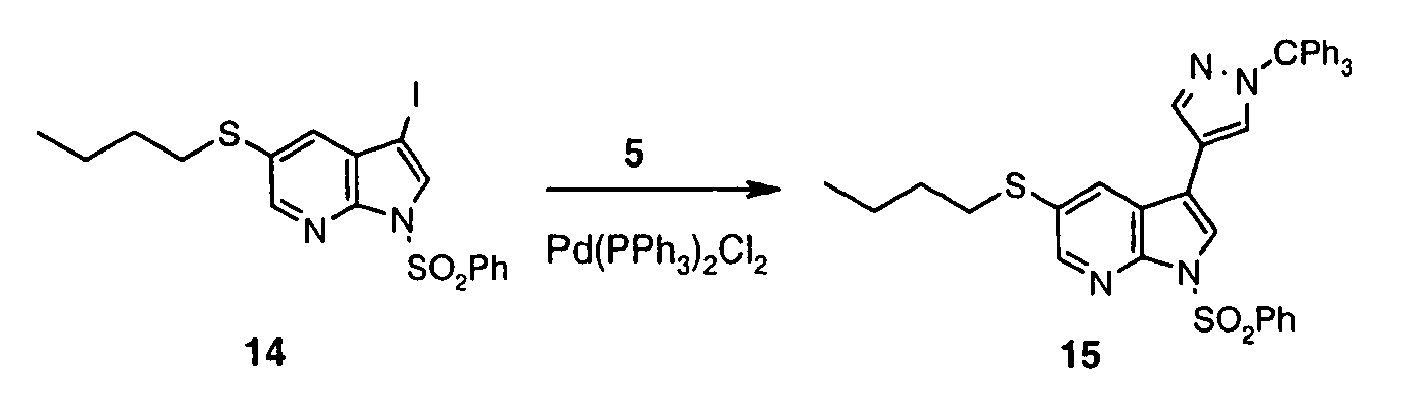
- Pyrazole derivative 15 was synthesized following the method described for preparation of 6 using 14 (2.24 g, 3.62 mmol), 5 (1.92 g, 5.43 mmol), PdCl2(PPh3)2 (254 mg, 0.362 mmol), LiCl (460 mg, 10.9 mmol), 1.0 M aq Na2CO3 (9.0 mL, 9.05 mmol), in ethanol (17 mL) and toluene (17 mL). Reaction time: 2 h reflux. Extractive workup afforded crude 15 as an orange oil (3.83 g, 162%), which was used in the next step without purification.
-
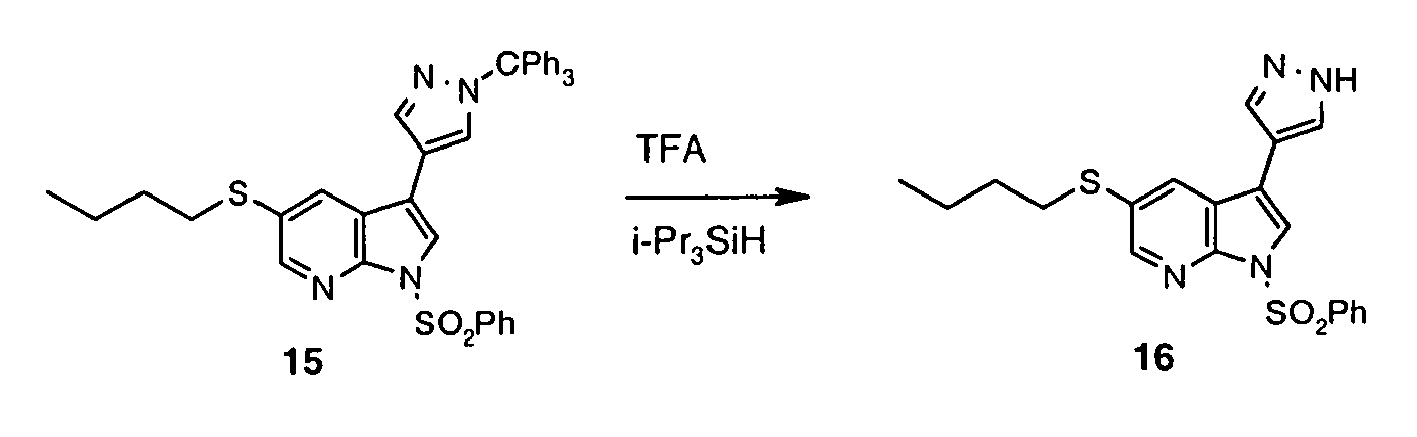
- Removal of trityl group leading to 16 was performed by analogy to the method described for preparation of 7 using 15 (3.80 g, crude), CF3COOH (2.9 mL), H2O (288 µL), i-Pr3SiH (1.46 mL) in CH2Cl2 (31 mL). Reaction time: 40 min. Purification by SGC using CH2Cl2:MeOH (gradient elution up to 98:2, v/v) afforded 16 as brown foam (1.14 g, 76%); 1H NMR (400 MHz, CDCl3) δ 0.89 (t, J = 7.3 Hz, 3H), 1.41 (sextet, J = 7.5 Hz, 2H), 1.58 (quintet, J = 7.6 Hz, 2H), 2.89 (t, J = 7.4 Hz, 2H), 7.45-7.75 (m, 3H), 7.82 (s, 1H), 7.89 (s, 2H), 8.02 (d, J = 2.1 Hz, 1H), 8.22 (m, 2H), 8.51 (d, J = 2.2 Hz, 1H).
-

- Inhibitor 17 was synthesized following the method described for preparation of 8 using 16 (0.50 g, 1.21 mmol), ethanol (23 mL), 10% aq. NaOH (11.2 mL). Reaction time: 1 h at 90 °C. Purification by SGC using CH2Cl2:MeOH (gradient elution up to 97:3, v/v) gave 17 as an orange foam (116 mg, 35%); 1H NMR (400 MHz, CDCl3) δ 0.87 (t, J = 7.3 Hz, 3H), 1.39 (sextet, J = 7.4 Hz, 2H), 1.55 (quintet, J = 7.4 Hz, 2H), 2.84 (t, J = 7.4 Hz, 2H), 7.42 (s, 1H), 7.83 (s, 2H), 8.19 (d, J = 2.0 Hz, 1H), 8.36 (dd, J = 2.0, 0.3 Hz, 1H).
-
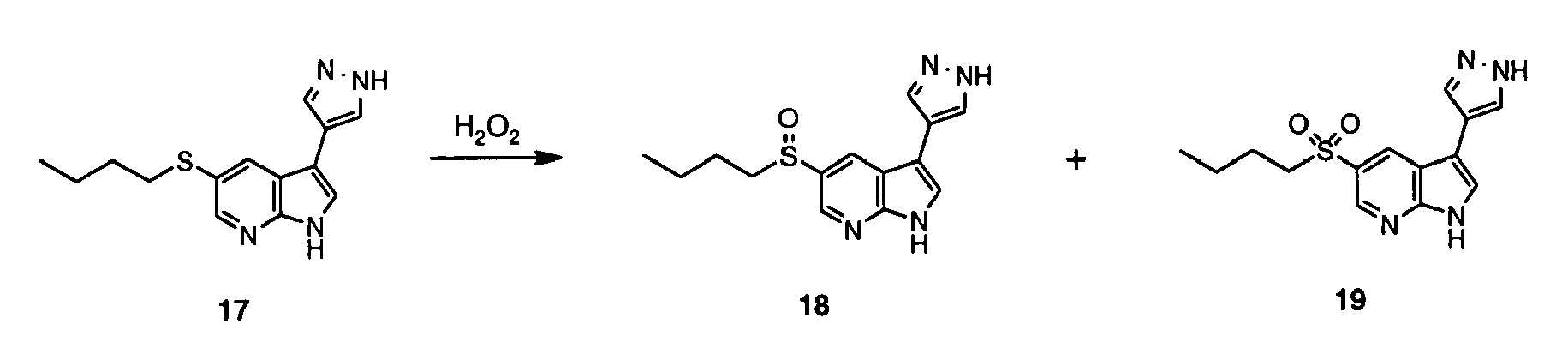
- Oxidation of 17 was performed in a way analogous to that used for 9 using 17 (20 mg, 0.073 mmol), 30% aqueous H2O2 (11.3 µL, 0.11 mmol) and glacial acetic acid (239 µL). Reaction time: 72 h. Obtained:
- Sulfoxide 18 as a white solid (7.1 mg, 33%); 1H NMR (400 MHz, CDCl3 + 3 drops CD3OD) δ 0.89 (t, J = 7.3 Hz, 3H), 1.35-1.50 (m, 2H), 1.53-1.73 (m, 2H), 2.85 (m, 1H), 2.99 (m, 1H), 7.53 (s, 1H), 7.87 (s, 2H), 8.41 (d, J = 2.0 Hz, 1H), 8.44 (d, J = 2.0 Hz, 1H).
- Sulfone 19 as a white solid (2.1 mg, 9%); 1H NMR (400 MHz, CDCl3 + 6 drops CD3OD) δ 0.84 (t, J = 7.3 Hz, 3H), 1.36 (sextet, J = 7.4 Hz, 2H), 1.67 (m, 2H), 7.55 (s, 1H), 7.82 (s, 2H), 8.51 (d, J = 2.1 Hz, 1H), 8.71 (d, J = 2.1 Hz, 1H).
- Sulfone 19 could be prepared selectively when oxidation of 17 was performed in a way analogous to that used for 9 using 17 (20 mg, 0.073 mmol), 30% aqueous solution of hydrogen peroxide (37.5 µL, 0.37 mmol) and glacial acetic acid (239 µL). After stirring for 22 h, more 30% aqueous H2O2 (37.5 µL, 0.37 mmol) was added and stirring continued for 45 h to give 19 as a white solid (13 mg, 58%). The 1H NMR spectrum of this product was identical with that of the product described earlier.
- An alternative method of synthesis of example inhibitor 8

-

- A mixture of 20 (1.50 g, 2.32 mmol; preparation disclosed in
WO2004/078756 ) and 10% aq. NaOH (22 mL) in EtOH (45 mL) were heated at 100 °C for 8 h. The reaction mixture was cooled, poured onto a mixture of brine (100 mL) and AcOEt (50 mL). The aqueous layer was extracted with AcOEt (4 x 50 mL), and the combined organic extracts washed with brine (50 mL), dried (MgSO4) and concentrated. The aqueous layer was then extracted with 3% MeOH in CH2Cl2 (3 x 50 mL), and the combined organic extracts concentrated without drying. The residual solid was washed with 30% AcOEt in hexane (5x) to give 21 as an orange solid (0.96 g, 82%). -

- To a solution of 21 (0.5 g, 0.99 mmol) in DMF (2.5 mL) was added NaH (60% w/w in mineral oil, 59.4 mg, 1.48 mmol) portionwise. Then the reaction mixture was stirred for 0.5 h. SEM-Cl (263 µL, 1.48 mmol) was then added and the reaction mixture stirred overnight. It was poured cautiously onto a stirred mixture of ethyl acetate (20 mL)/sat. aq. NH4Cl (20 mL) and the layers separated. The aqueous layer was extracted with AcOEt (2 x 30 mL), the combined organic extracts dried (MgSO4) and concentrated. The residue was purified by SGC using AcOEt:hexane (gradient elution up to 8:92, v/v) to give 22 as a white foam (345 mg, 55%); 1H NMR (400 MHz, CDCl3) δ 0.002 (9H, s), 0.97 (t, J = 8.3 Hz, 2H), 3.58 (t, J = 8.3 Hz, 2H), 5.69 (s, 2H), 7.30 (m, 6H), 7.40 (m, 9H), 7.46 (s, 1H), 7.65 (s, 1H), 7.98 (d, J = 0.7 Hz, 1H), 8.06 (d, J = 2.1 Hz, 1H), 8.41 (d, J = 2.2 Hz, 1H).
-

- A mixture of 22 (50 mg, 0.079 mmol), benzenethiol (13.0 mg, 0.118 mmol), copper (I) iodide (3.0 mg, 0.016 mmol), N,N-dimethylglycine (1.62 mg, 0.016 mmol) and potassium phosphate (41.8 mg, 0.197 mmol) in DMF (0.5 mL) were heated at 120 °C for 69 h. The reaction mixture was cooled and partitioned between AcOEt/brine, the layers separated and the aqueous phase extracted with more AcOEt (2x). The combined organic extracts were dried (MgSO4) and concentrated. The resulting crude residue containing 23 was used for the subsequent deprotection step.
-
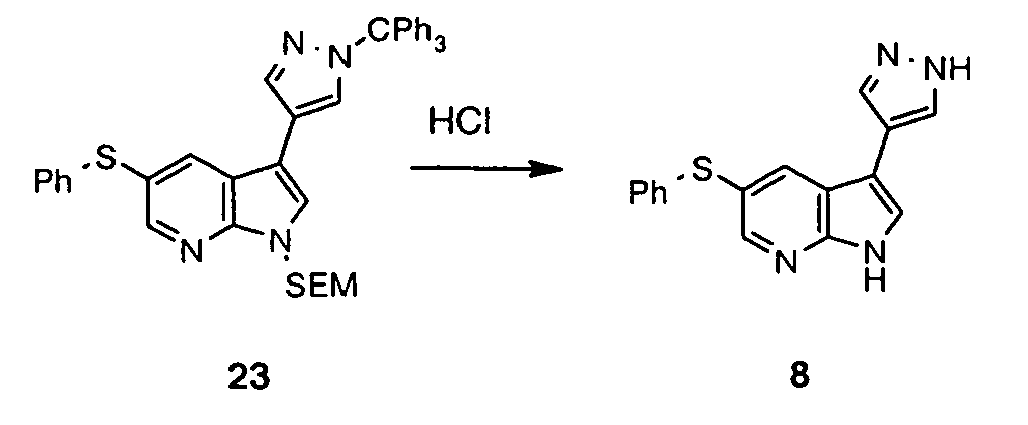
- The crude 23 from the previous reaction was heated at 90 °C in EtOH (0.5 mL) and 10% aq. HCl (0.5 mL) for 3 h 10 min. The reaction mixture was cooled, saturated aqueous NaHCO3 was added dropwise to neutralise the acid, and the mixture was extracted with AcOEt (4x). The combined organic extracts were dried (MgSO4), concentrated and the residue purified by preparative TLC (PTLC) using 10% MeOH in CH2Cl2 as eluent to give 8 as a white solid (8.9 mg, 39% over 2 steps). 1H NMR of this compound was identical with 8 synthesised above.
-

-
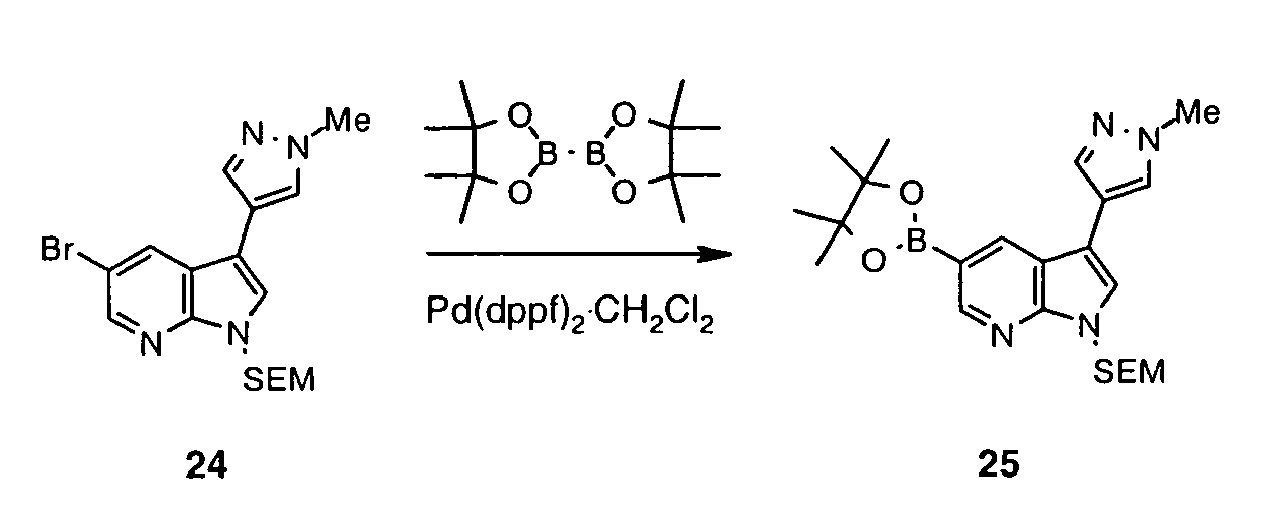
- A mixture of 24 (0.5 g, 1.23 mmol; synthesized in analogous way to 22), bis(pinacolato)diboron (468 mg, 1.84 mmol), AcOK (361 mg, 3.68 mmol) and PdCl2(dppf)2CH2Cl2 (35.1 mg, 0.043 mmol) in DMF (7.8 mL) were heated at 80 °C for 31 h. It was then cooled, partitioned between AcOEt/brine, the layers separated and the aqueous phase extracted with more AcOEt (2x). The combined organic extracts were dried (MgSO4), concentrated and purified by SGC using hexane:AcOEt (gradient elution up to 70:30 v/v) to give boronic ester 25 as a light orange oil (339 mg, 61 %); 1H NMR (400 MHz, CDCl3) δ - 0.062 (s, 9H), 0.92 (m, 2H), 1.39 (s, 12H), 3.55 (m, 2H), 4.01 (s, 3H), 5.72 (s, 2H), 7.41 (s, 1H), 7.71 (s, 1H), 7.78 (d, J = 0.7 Hz, 1H), 8.45 (d, J = 1.5 Hz, 1H), 8.73 (d, J = 1.5 Hz, 1H).
-

- A mixture of 25 (60 mg, 0.132 mmol), n-propanethiol (21.1 mg, 0.264 mmol), copper (II) acetate (36 mg, 0.198 mmol), pyridine (32 µL, 0.396 mmol) and 4A molecular sieves (50 mg) in DMF (1.5 mL) were heated at 110 °C for 25 h. More n-propanethiol (21.1 mg, 0.264 mmol), copper (II) acetate (36 mg, 0.198 mmol) and pyridine (32 µL, 0.396 mmol) were added and heating continued for 20.5 h. More n-propanethiol (21.1 mg, 0.264 mmol), copper (II) acetate (36 mg, 0.198 mmol), pyridine (32 µL, 0.396 mmol) and 4A sieves were added again and the heating continued at 130 °C overnight. The reaction mixture was cooled, diluted with AcOEt, filtered and washed with brine. The aqueous layer was extracted with AcOEt (2x), and the combined organic extracts dried (MgSO4) and concentrated. The residue was purified by preparative LCMS (column LUNA 10 µ C18(2) 00G-4253-V0 250x50 mm) using water ― acetonitrile (0.1% AcOH) as eluent (in gradient; flow 80 mL/min) to give 26 as an orange oil (6.7 mg, 13%); 1H NMR (400 MHz, CDCl3) δ -0.056 (s, 9H), 0.93 (t, J = 8.3 Hz, 2H), 1.00 (t, J = 7.3 Hz, 3H), 1.61 (sextet, J = 7.4 Hz, 2H), 2.84 (t, J = 7.3 Hz, 2H), 3.57 (t, J = 8.3 Hz, 2H), 4.00 (s, 3H), 5.68 (s, 2H), 7.43 (s, 1H), 7.64 (s, 1H), 7.76 (s, 1H), 8.15 (d, J = 2.0 Hz, 1 H), 8.45 (d, J = 2.0 Hz, 1H).
-
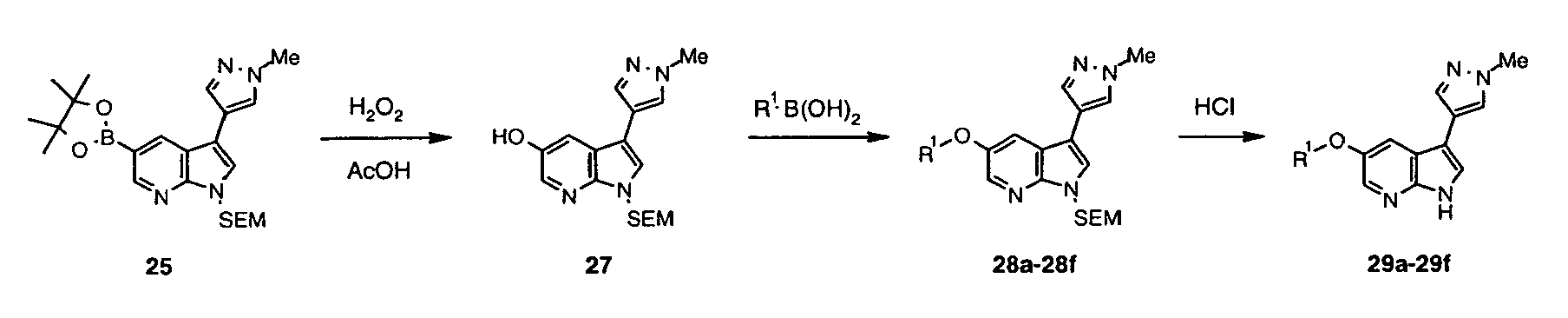
-

- A mixture of 25 (1.00 g, 2.20 mmol), glacial acetic acid (5.0 mL), H2O (5.0 mL) and 30% aq. H2O2 (370 µL, 3.30 mmol) were stirred for 8 h and partitioned between AcOEt/brine. The layers were separated, the aqueous phase extracted with more AcOEt and the combined organic extracts dried (MgSO4) and concentrated to give 27 as a creamy white solid (731 mg, 96%); 1H NMR (400 MHz, CDCl3) δ -0.058 (s, 9H), 0.92 (t, J = 8.3 Hz, 2H), 3.58 (t, J = 8.3 Hz, 2H), 4.01 (s, 3H), 2.01 (s, 2H), 7.37 (s, 1H), 7.56 (s, 1H), 7.66 (d, J = 2.3 Hz, 1H), 7.95 (s, 1H), 8.17 (d, J = 2.2 Hz, 1H), 9.00-9.60 (bs, OH).
-

- General procedure: A mixture of 27 (50 mg, 0.145 mmol), phenylboronic acid (35.6 mg, 0.29 mmol), copper (II) acetate (26.4 mg, 0.145 mmol), Et3N (102 µL, 0.726 mmol) and activated 4A molecular sieves in CH2Cl2 (1.5 mL) were stirred for 65 h. The reaction mixture was filtered and the filtrate concentrated. The residue was purified by PTLC using AcOEt:hexane=60:40 (v/v) as eluent to give 28a as a clear oil (34 mg, 56%); 1H NMR (400 MHz, CDCl3) δ -0.0373 (s, 9H), 0.95 (t, J = 8.3 Hz, 2H), 3.60 (t, J = 8.3 Hz, 2H), 3.95 (s, 3H), 5.69 (s, 2H), 6.98 (d, J = 7.9 Hz, 2H), 7.07 (t, J = 7.4 Hz, 1H), 7.32 (t, J = 8.0 Hz, 2H), 7.48 (s, 1H), 7.57 (s, 1H), 7.71 (s, 1H), 7.73 (d, J = 2.5 Hz, 1H), 8.23 (d, J = 2.5 Hz, 1H).
- According to the general procedure using: 27 (50 mg, 0.145 mmol), ortho-methylphenylboronic acid (39 mg, 0.29 mmol), copper (II) acetate (26.4 mg, 0.145 mmol), Et3N (102 µL, 0.726 mmol) and activated 4A molecular sieves in CH2Cl2 (1.5 mL) were stirred for 47 h. The crude 28b was used for preparation of 29b.
- According to the general procedure using: 27 (50 mg, 0.145 mmol), meta-methylphenylboronic acid (39 mg, 0.29 mmol), copper (II) acetate (26.4 mg, 0.145 mmol), Et3N (102 µL, 0.726 mmol) and activated 4A molecular sieves in CH2Cl2 (1.5 mL) were stirred for 47 h. The crude 28c was used for preparation of 29c.
- According to the general procedure using: 27 (50 mg, 0.145 mmol), para-methylphenylboronic acid (39 mg, 0.29 mmol), copper (II) acetate (26.4 mg, 0.145 mmol), Et3N (102 µL, 0.726 mmol) and activated 4A molecular sieves in CH2Cl2 (1.5 mL) were stirred for 47 h. The crude 28d was used for preparation of 29d.
- According to the general procedure using: 27 (50 mg, 0.145 mmol), para-fluorophenylboronic acid (40.6 mg, 0.29 mmol), copper (II) acetate (26.4 mg, 0.145 mmol), Et3N (102 µL, 0.726 mmol) and activated 4A molecular sieves in CH2Cl2 (1.5 mL) were stirred for 17 h. The crude 28e was used for preparation of 29e.
- According to the general procedure using: 27 (50 mg, 0.145 mmol), para-(dimethylamino)phenylboronic acid (47.9 mg, 0.29 mmol), copper (II) acetate (26.4 mg, 0.145 mmol), Et3N (102 µL, 0.726 mmol) and activated 4A molecular sieves in CH2Cl2 (1.5 mL) were stirred for 18 h. The crude 28f was used for preparation of 29f.
-

- Following the method used for conversion of 23 into 8, synthesis of 29a was carried out using: 28a (33 mg, 78 µmol), EtOH (1.0 mL) and 10% aq. HCl (1.0 mL) with heating at 90 °C for 17 h. Isolation by PTLC using CH2Cl2:MeOH=19:1 (v/v) as eluent gave 29a as a white solid (17.2 mg, 75%); 1H NMR (400 MHz, CDCl3 + 2 drops CD3OD) δ 3.93 (s, 3H), 6.96 (m, 2H), 7.06 (m, 1H), 7.31 (m, 2H), 7.45 (s, 1H), 7.58 (s, 1H), 7.68 (s, 1H), 7.77 (d, J = 2.5 Hz, 1H), 8.12 (d, J = 2.5 Hz, 1H).
- Following the method used for conversion of 23 into 8, synthesis of 29b was carried out using: 28b (crude), EtOH (1.0 mL) and 10% aq. HCl (1.0 mL) with heating at 90 °C for 16 h. Isolation by PTLC using AcOEt as eluent gave 29b as a white solid (15 mg, 34%); 1H NMR (400 MHz, CDCl3) δ 2.39 (s, 3H), 3.96 (s, 3H), 6.78 (d, J = 6.78 Hz, 1H), 7.03 (t, J = 7.1 Hz, 1H), 7.13 (t, J = 7.0 Hz, 1H), 7.28 (d, J = 8.6 Hz, 1H), 7.47 (d, J = 2.3 Hz, 1H), 7.57 (s, 1H), 7.70 (d, J = 2.4 Hz, 1H), 7.71 (s, 1H), 8.20 (d, J = 2.4 Hz, 1H), 10.50 (bs, NH).
- Following the method used for conversion of 23 into 8, synthesis of 29c was carried out using: 28c (crude), EtOH (1.0 mL) and 10% aq. HCl (1.0 mL) with heating at 90 °C for 16 h. Isolation by PTLC using AcOEt as eluent gave 29c as a white solid (15 mg, 34%); 1H NMR (400 MHz, CDCl3) δ 2.33 (s, 3H), 3.97 (s, 3H), 6.80 (m, 2H), 6.90 (d, J = 7.5 Hz, 1H), 7.21 (t, J = 8.1 Hz, 1H), 7.50 (d, J = 2.2 Hz, 1H), 7.59 (s, 1H), 7.73 (s, 1H), 7.80 (d, J = 2.2 Hz, 1H), 8.23 (d, J = 2.3 Hz, 1H), 10.63 (bs, NH).
- Following the method used for conversion of 23 into 8, synthesis of 29d was carried out using: 28d (crude), EtOH (1.0 mL) and 10% aq. HCl (1.0 mL) with heating at 90 °C for 16 h. Isolation by PTLC using AcOEt as eluent gave 29d as a white solid (18.1 mg, 41%); 1H NMR (400 MHz, CDCl3) δ 2.34 (s, 3H), 3.96 (s, 3H), 6.91 (d, J = 8.5 Hz, 2H), 7.13 (d, J = 8.4 Hz, 2H), 7.48 (d, J = 2.4 Hz, 1H), 7.56 (s, 1H), 7.71 (s, 1H), 7.77 (d, J = 2.4 Hz, 1H), 8.23 (d, J = 2.5 Hz, 1H), 10.62 (bs, NH).
- Following the method used for conversion of 23 into 8, synthesis of 29e was carried out using: 28e (crude), EtOH (1.0 mL) and 10% aq. HCl (1.0 mL) with heating at 90 °C for 17 h. Isolation by PTLC using AcOEt as eluent gave 29e as a white solid (18 mg, 40%); 1H NMR (400 MHz, CDCl3) δ 3.97 (s, 3H), 6.50-7.10 (m, 4H), 7.49 (d, J = 2.4 Hz, 1H), 7.57 (s, 1H), 7.72 (s, 1H), 7.75 (d, J = 2.4 Hz, 1H), 8.21 (d, J = 2.4 Hz, 1H), 10.62 (bs, NH).
- Following the method used for conversion of 23 into 8, synthesis of 29f was carried out using: 28f (crude), EtOH (1.0 mL) and 10% aq. HCl (1.0 mL) with heating at 90 °C for 20 h. Isolation by PTLC using AcOEt as eluent gave 29f as a white solid (10.1 mg, 58%); 1H NMR (400 MHz, CDCl3) δ 2.93 (s, 6H), 3.96 (s, 3H), 6.74 (m, 2H), 6.97 (m, 2H), 7.43 (d, J = 2.5 Hz, 1H), 7.56 (d, J = 0.3 Hz, 1H), 7.69 (d, J = 2.5 Hz, 1H), 7.70 (d, J = 0.7 Hz, 1H), 8.20 (d, J = 2.5 Hz, 1H), 9.99 (bs, NH).
-

- General procedure: A mixture of 27 (60 mg, 0.174 mmol), benzyl bromide (124 µL, 1.05 mmol), K2CO3 (241 mg, 1.74 mmol) and n-Bu4NI (6.4 mg, 17 µmol) in acetone (4.0 mL) were heated at reflux for 22.5 h. The reaction mixture was cooled, filtered and the filtrate concentrated. The residue was purified by PTLC using AcOEt:hexane=6:4 (v/v) as eluent to give 28g as a light orange oil (24.3 mg, 32%); 1H NMR (400 MHz, CDCl3) δ -0.054 (s, 9H), 0.93 (t, J = 8.3 Hz, 2H), 3.56 (t, J = 8.3 Hz, 2H), 3.99 (s, 3H), 5.16 (s, 2H), 5.65 (s, 2H), 7.30-7.45 (m, 4H), 7.49 (d, J = 7.1 Hz, 2H), 7.56 (s, 1H), 7.58 (d, J = 2.7 Hz, 1H), 7.77 (s, 1H), 8.21 (d, J = 2.6 Hz, 1H).
- According to the general procedure using: 27 (60 mg, 0.174 mmol), bromoethane (114 mg, 1.05 mmol), K2CO3 (241 mg, 1.74 mmol) and n-Bu4NI (6.4 mg, 17 µmol) in acetone (4.0 mL) were heated at reflux for 18 h. Purification by PTLC using AcOEt:hexane=6:4 (v/v) as eluent gave 28h as a clear oil (39 mg, 60%).
- According to the general procedure using: 27 (60 mg, 0.174 mmol), 1-bromopropane (129 mg, 1.74 mmol), K2CO3 (241 mg, 1.74 mmol) and n-Bu4NI (6.4 mg, 17 µmol) in acetone (4.0 mL) were heated at reflux for 18 h. Purification by PTLC using AcOEt:hexane=6:4 (v/v) as eluent gave 28i as a clear oil (40 mg, 59%).
- According to the general procedure using: 27 (60 mg, 0.174 mmol), 1-bromobutane (143 mg, 1.05 mmol), K2CO3 (241 mg, 1.74 mmol) and n-Bu4NI (6.4 mg, 17 µmol) in acetone (4.0 mL) were heated at reflux for 22.5 h. Purification by PTLC using AcOEt:hexane=6:4 (v/v) as eluent gave 28j as a clear oil (48.7 mg, 70%).
- According to the general procedure using: 27 (60 mg, 0.174 mmol), 1-bromopentane(129 µL, 1.05 mmol), K2CO3 (241 mg, 1.74 mmol) and n-Bu4NI (6.4 mg, 17 µmol) in acetone (4.0 mL) were heated at reflux overnight. Purification by PTLC using AcOEt:hexane=6:4 (v/v) as eluent gave 28k as a clear oil (38 mg, 51 %).
- According to the general procedure using: 27 (60 mg, 0.174 mmol), 1-bromohexane (117 µL, 1.74 mmol), K2CO3 (241 mg, 1.74 mmol) and n-Bu4NI (6.4 mg, 17 µmol) in acetone (4.0 mL) were heated at reflux overnight. Purification by PTLC using AcOEt:hexane=6:4 (v/v) as eluent gave 28l as a clear oil (36 mg, 48%).
- According to the general procedure using: 27 (60 mg, 0.174 mmol), 80% wt in toluene propargyl bromide (116 µL, 1.05 mmol), K2CO3 (241 mg, 1.74 mmol) and n-Bu4NI (6.4 mg, 17 µmol) in acetone (4.0 mL) were heated at reflux for 16 h and the product 28m used crude for the next step.
- According to the general procedure using: 27 (60 mg, 0.174 mmol), 1-bromo-2-methoxyethane (98 µL, 1.05 mmol), K2CO3 (241 mg, 1.74 mmol) and n-Bu4NI (6.4 mg, 17 µmol) in acetone (4.0 mL) were heated at reflux for 16 h and the product 28n used crude for the next step.
- According to the general procedure using: 27 (60 mg, 0.174 mmol), 1-bromoprop-2-ene (90 µL, 1.05 mmol), K2CO3 (241 mg, 1.74 mmol) and n-Bu4NI (6.4 mg, 17 µmol) in acetone (4.0 mL) were heated at reflux for 17 h and the product 28o used crude for the next step.
- According to the general procedure using: 27 (60 mg, 0.174 mmol), Bromoacetic acid ethyl ester (99 µL, 1.05 mmol), K2CO3 (241 mg, 1.74 mmol) and n-Bu4NI (6.4 mg, 17 µmol) in acetone (4.0 mL) were heated at reflux for 18 h and the product 28p used crude for the next step.
- According to the general procedure using: 27 (60 mg, 0.174 mmol), bromocyclopentane (112 µL, 1.05 mmol), K2CO3 (241 mg, 1.74 mmol) and n-Bu4NI (6.4 mg, 17 µmol) in acetone (4.0 mL) were heated at reflux for 20 h and the product 28q used crude for the next step.
- According to the general procedure using: 27 (60 mg, 0.174 mmol), (2-bromoethyl)-benzene (143 µL, 1.05 mmol), K2CO3 (241 mg, 1.74 mmol) and n-Bu4NI (6.4 mg, 17 µmol) in acetone (4.0 mL) were heated at reflux overnight. Standard workup and purification by PTLC using AcOEt:hexane=6:4 (v/v) as eluent gave 28r as a clear oil (39 mg, 50%).
- According to the general procedure using: 27 (60 mg, 0.174 mmol), (bromomethyl)cyclopropane (101 µL, 1.05 mmol), K2CO3 (241 mg, 1.74 mmol) and n-Bu4NI (6.4 mg, 17 µmol) in acetone (4.0 mL) were heated at reflux overnight. Standard workup and purification by PTLC using 5% MeOH in CH2Cl2 gave 28s as a clear oil (41mg, 59%); 1H NMR (400 MHz, CDCl3) δ - 0.066 (s, 9H), 0.38 (q, J = 4.68 Hz, 2H), 0.68 (m, 2H), 0.91 (m, 2H), 1.31 (m, 1H), 3.55 (t, J = 8.3 Hz, 2H), 3.89 (d, J = 7.0 Hz, 2H),3.98 (s, 3H), 5.64 (s, 2H), 7.36 (s, 1H), 7.51 (d, J = 2.6 Hz, 1H), 7.58 (s, 1H), 7.74 (d, J = 0.3 Hz, 1H), 8.16 (d, J = 2.6 Hz, 1H).
- According to the general procedure using: 27 (60 mg, 0.174 mmol), (bromomethyl)cyclohexane (146 µL, 1.05 mmol), K2CO3 (241 mg, 1.74 mmol) and n-Bu4NI (6.4 mg, 17 µmol) in acetone (4.0 mL) were heated at reflux for 24 h. Standard workup and purification by PTLC using 80% AcOEt in hexane gave 28t as a clear oil (40mg, 52%); 1H NMR (400 MHz, CDCl3) δ -0.059 (s, 9H), 0.93 (t, J = 8.2 Hz, 2H), 1.09 (dq, J = 12.2 Hz, J = 3.3 Hz, 2H), 1.17-1.40 (m, 2H), 1.65-1.95 (m, 7H), 3.56 (t, J = 8.3 Hz, 2H), 3.84 (d, J = 6.3 Hz, 2H), 3.99 (s, 3H), 5.64 (s, 2H), 7.38 (s, 1H), 7.49 (d, J = 2.6 Hz, 1H), 7.59 (s, 1H), 7.75 (d, J = 0.3 Hz, 1H), 8.13 (d, J = 2.6 Hz, 1H).
- Following the method used for conversion of 23 into 8, synthesis of 29g was carried out using 28g (24 mg, 55 µmol), EtOH (0.5 mL), 10% aq. HCl (0.5 mL) and heating for 19.5 h to give 29g as a white solid (6.0 mg, 36%); 1H NMR (400 MHz, CDCl3) δ 3.99 (s, 3H), 5.17 (s, 2H), 7.36 (m, 2H), 7.42 (t, J = 7.3 Hz, 2H), 7.50 (d, J = 7.2 Hz, 2H), 7.56 (s, 1H), 7.62 (d, J = 2.6 Hz, 1H), 7.72 (s, 1H), 8.20 (d, J = 2.6 Hz, 1H), 9.38 (bs, NH).
- Following the method used for conversion of 23 into 8, synthesis of 29h was carried out using 28h (38 mg, 0.102 mmol), EtOH (1.0 mL), 10% aq. HCl (1.0 mL) and heating for 17 h to give 29h as a white solid (16 mg, 65%); 1H NMR (400 MHz, CDCl3 + 6 drops CD3OD) δ 1.41 (t, J = 7.0 Hz, 3H), 3.92 (s, 3H), 4.08 (q, J = 7.0 Hz, 2H), 7.32 (s, 1H), 7.52 (d, J = 2.6 Hz, 1H), 7.56 (s, 1H), 7.67 (s, 1H), 7.99 (d, J = 2.7 Hz, 1H).
- Following the method used for conversion of 23 into 8, synthesis of 29i was carried out using 28i (39 mg, 0.101 mmol), EtOH (1.0 mL), 10% aq. HCl (1.0 mL) and heating for 17 h to give 29i as a white solid (19 mg, 73%); 1H NMR (400 MHz, CDCl3 + 6 drops CD3OD) δ 1.03 (t, J = 7.4 Hz, 3H), 1.80 (sextet, J = 7.1 Hz, 2H), 3.93 (s, 3H), 3.98 (t, J = 6.6 Hz, 2H), 7.32 (s, 1H), 7.52 (d, J = 2.5 Hz, 1H), 7.56 (s, 1H), 7.67 (s, 1H), 8.00 (bs, 1H).
- Following the method used for conversion of 23 into 8, synthesis of 29j was carried out using 28j (48 mg, 0.12 mmol), EtOH (1.0 mL), 10% aq. HCl (1.0 mL) and heating for 20.5 h to give 29j as a white solid (25 mg, 77%); 1H NMR (400 MHz, CDCl3) δ 1.01 (t, J = 7.4 Hz, 3H), 1.54 (sextet, J = 7.5 Hz, 2H), 1.83 (quintet, J = 7.0 Hz, 2H), 4.00 (s, 3H), 4.07 (t, J = 6.5 Hz, 2H), 7.38 (d, J = 2.5 Hz, 1H), 7.55 (d, J = 2.5 Hz, 1H), 7.60 (s, 1H), 7.75 (s, 1H), 8.13 (d, J = 2.6 Hz, 1H), 9.59 (bs, NH).
- Following the method used for conversion of 23 into 8, synthesis of 29k was carried out using 28k (38 mg, 92 µmol), EtOH (1.0 mL), 10% aq. HCl (1.0 mL) and heating for 16 h to give 29k as a white solid (21 mg, 81%); 1H NMR (400 MHz, CDCl3) δ 0.96 (t, J = 7.2 Hz, 3H), 1.30-1.60 (m, 4H), 1.85 (quintet, J = 7.0 Hz, 2H), 4.00 (s, 3H), 4.06 (t, J = 6.6 Hz, 2H), 7.40 (d, J = 2.5 Hz, 1H), 7.56 (d, J = 2.6 Hz, 1H), 7.60 (s, 1H), 7.76 (s, 1H), 8.14 (d, J = 2.6 Hz, 1H), 10.28 (bs, NH).
- Following the method used for conversion of 23 into 8, synthesis of 29l was carried out using 28l (36 mg, 84 µmol), EtOH (1.0 mL), 10% aq. HCl (1.0 mL) and heating for 16 h to give 29l as a white solid (21 mg, 84%); 1H NMR (400 MHz, CDCl3) δ 0.92 (t, J = 7.1 Hz, 3H), 1.30-1.45 (m, 4H), 1.51 (m, 2H), 1.83 (quintet, J = 7.1 Hz, 2H), 3.99 (s, 3H), 4.06 (t, J = 6.5 Hz, 2H), 7.39 (d, J = 2.4 Hz, 1H), 7.55 (d, J = 2.6 Hz, 1H), 7.59 (s, 1H), 7.75 (s, 1H), 8.13 (d, J = 2.6 Hz, 1H), 10.18 (bs, NH).
- Following the method used for conversion of 23 into 8, synthesis of 29m was carried out using 28m (crude), EtOH (1.0 mL), 10% aq. HCl (1.0 mL) and heating for 16 h to give 29m as a white solid (21 mg, 48%); 1H NMR (400 MHz, CDCl3 + 6 drops CD3OD) δ 2.56 (t, J = 2.2 Hz, 1H), 3.92 (s, 3H), 4.73 (d, J = 2.3 Hz, 2H), 7.34 (s, 1H), 7.56 (s, 1H), 7.66 (d, J = 2.6 Hz, 1H), 7.67 (s, 1H), 8.04 (d, J = 2.6 Hz, 1H).
- Following the method used for conversion of 23 into 8, synthesis of 29n was carried out using 28n (crude), EtOH (1.0 mL), 10% aq. HCl (1.0 mL) and heating for 16 h to give 29n as a white solid (16.7 mg, 35%); 1H NMR (400 MHz, CDCl3) δ 3.50 (s, 3H), 3.81 (t, J = 4.6 Hz, 2H), 3.99 (s, 3H), 4.23 (t, J = 4.6 Hz, 2H), 7.40 (d, J = 2.4 Hz, 1H), 7.59 (s, 1H), 7.62 (d, J = 2.6 Hz, 1H), 7.75 (s, 1H), 8.18 (d, J = 2.6 Hz, 1H), 10.23 (bs, NH).
- Following the method used for conversion of 23 into 8, synthesis of 29o was carried out using 28o (crude), EtOH (1.0 mL), 10% aq. HCl (1.0 mL) and heating for 16 h to give 29o as a white solid (17.1 mg, 39%); 1H NMR (400 MHz, CDCl3) δ 3.99 (s, 3H), 4.64 (dt, J = 5.3, 1.4 Hz, 2H), 5.34 (dq, J = 10.5, 0.9 Hz, 1H), 5.48 (dq, J = 17.2, 1.5 Hz, 1H), 6.05-6.20 (m, 1H), 7.41 (d, J = 2.4 Hz, 1H), 7.59 (s, 2H), 7.75 (s, 1H), 8.17 (d, J = 2.6 Hz, 1H), 10.31 (bs, NH).
- Following the method used for conversion of 23 into 8, synthesis of 29p was carried out using 28p (crude), EtOH (1.0 mL), 10% aq. HCl (1.0 mL) and heating for 16 h to give 29p as an orange oil (7.3 mg, 14%). Note: due to transesterification the methyl ester was converted into the ethyl ester; 1H NMR (400 MHz, CDCl3) δ 1.32 (t, J = 7.1 Hz, 3H), 4.00 (s, 3H), 4.30 (q, J = 7.1 Hz, 2H), 4.72 (s, 2H), 7.41 (d, J = 2.4 H, 1H), 7.59 (s, 1H), 7.61 (d, J = 2.6 Hz, 1H), 7.23 (s, 1H), 8.20 (d, J = 2.6 Hz, 1H), 9.67 (bs, NH).
- Following the method used for conversion of 23 into 8, synthesis of 29q was carried out using 28q (crude), EtOH (1.0 mL), 10% aq. HCl (1.0 mL) and heating for 16 h to give 29q as a white solid (20.8 mg, 42%); 1H NMR (400 MHz, CDCl3) δ 1.55-1.75 (m, 2H), 1.80-2.00 (m, 6H), 3.99 (s, 3H), 4.83 (quintet, J = 4.1 Hz, 1H), 7.40 (d, J = 1.8 Hz, 1H), 7.57 (d, J = 2.2 Hz, 1H), 7.59 (s, 1H), 7.75 (s, 1H), 8.10 (d, J = 2.3 Hz, 1H), 10.38 (bs, NH).
- Following the method used for conversion of 23 into 8, synthesis of 29r was carried out using 28r (39 mg, 87 µmol), EtOH (1.0 mL), 10% aq. HCl (1.0 mL) and heating for 20 h to give 29r as a white solid (18.5 mg, 67%); 1H NMR (400 MHz, CDCl3 + 6 drops CD3OD) δ 3.08 (t, J = 7.0 Hz, 2H), 3.91 (s, 3H), 4.21 (t, J = 7.1 Hz, 2H), 7.20-7.35 (m, 6H), 7.47 (d, J = 2.6 Hz, 1H), 7.53 (s, 1H), 7.65 (d, J = 0.6 Hz, 1H), 7.97 (d, J = 2.6 Hz, 1H).
-
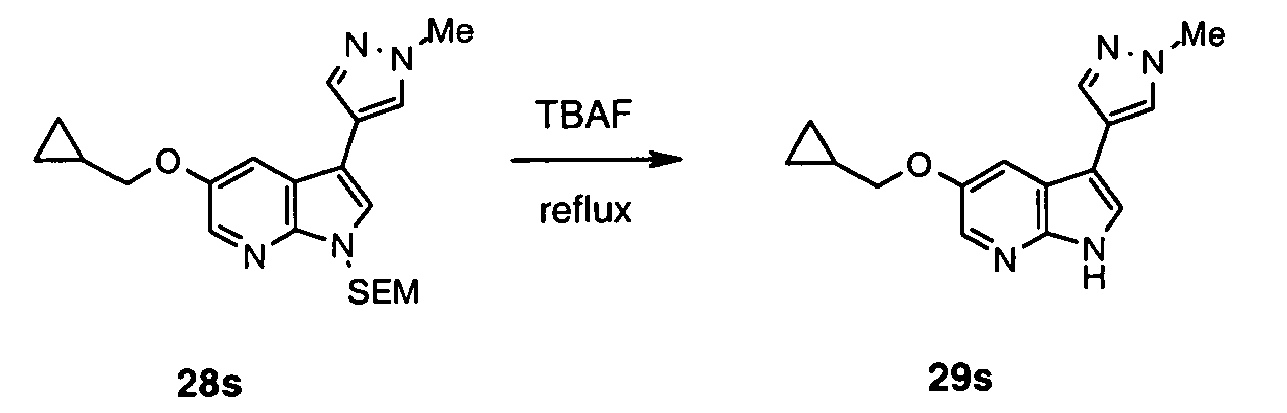
- A mixture of 28s (40 mg, 0.10 mmol) and 1.0 M TBAF in THF (3 mL) was heated at reflux for 7 h. The reaction mixture was then cooled, poured onto a mixture of AcOEt and saturated aqueous NaHCO3. The layers were separated, the aqueous phase extracted with more AcOEt (2 x) then the combined organic extracts dried (MgSO4) and concentrated. The residue was purified by PTLC using 5% MeOH in CH2Cl2 as eluent) to give 29s as a white solid (25.0 mg, 62%); 1H NMR (400 MHz, CDCl3) δ 0.40 (q, J = 4.7 Hz, 2H), 0.69 (m, 2H), 1.33 (m, 1H), 3.91 (d, J = 7.0 Hz, 2H), 4.00 (s, 3H), 7.36 (d, J = 2.5 Hz, 1H), 7.56 (d, J = 2.5 Hz, 1H), 7.60 (s, 1H), 7.75 (s, 1H), 8.15 (d, J = 2.6 Hz, 1H), 9.14 (bs, NH).
- Following the method used for conversion of 28s into 29s, synthesis of 29t was carried out using 28t (38 mg, 0.086 mmol), 1.0 M TBAF in THF (2 mL) with heating at reflux for 7 h. The product was purified by preparative LCMS (column LUNA 10 µ C18(2) 00G-4253-V0 250x50 mm) using water - MeCN (0.1% AcOH) as eluent (in gradient; flow 80 mL/min) to 29t as a white solid (10.6 mg, 40%); 1H NMR (400 MHz, CDCl3) δ 1.12 (dq, J = 15.1 Hz, J = 3.3 Hz, 2H), 1.18-1.40 (m, 4H), 1.68-2.00 (m, 5H), 3.86 (d, J = 6.3 Hz, 2H), 4.00 (s, 3H), 7.39 (d, J = 2.48 Hz, 1H), 7.54 (d, J = 2.6 Hz, 1H), 7.60 (s, 1H), 7.76 (d, J = 0.6 Hz, 1H), 8.13 (d, J = 2.6 Hz, 1H), 9.84 (bs, NH); m/z (Cl+) 311.1(MH+).
-

-

- To 5-bromo-7-azaindole 1 (0.98 g, 5.0 mmol) in DMF (32 mL) was added 25% (w/w) MeONa (48 mL, 210 mmol) followed by copper (I) bromide (1.43 g, 10.0 mmol), and the reaction mixture was heated at 140 °C for 2.5. It was then cooled and concentrated to remove DMF. Water (100 mL) was added followed by saturated aqueous NaHCO3 (20 mL). The mixture was extracted with AcOEt (3x), the combined organic extracts dried (MgSO4) and concentrated. The solid residue was purified by SGC using AcOEt:hexane (gradient elution up to 30:70) to give 30 as a green solid (0.58 g, 78%); 1H NMR (400 MHz, CDCl3) δ 3.90 (s, 3H), 6.45 (d, J = 2.3 Hz, 1H), 7.33 (d, J = 2.8 Hz, 1H), 7.48 (d, J = 2.2 Hz, 1H), 8.00-8.20 (bs, 1H); 10.60-10.80 (bs, NH).
-

- Following the method used for conversion of 2 into 3, synthesis of 31 was carried out using 30 (0.50 g, 3.37 mmol), DMF (8.4 mL), KOH (701 mg, 12.5 mmol), I2 (942 mg, 3.71 mmol) with stirring for 40 min. to give 31 as a creamy solid (850 mg, 92%); 1H NMR (400 MHz, CDCl3) δ 3.94 (s, 3H), 7.23 (d, J = 2.6 Hz, 1H), 7.46 (d, J = 2.2 Hz, 1H), 8.10 (d, J = 2.6 Hz, 1H), 9.40-9.60 (bs, NH).
-

- Following the method used for conversion of 3 into 4, synthesis of 32 was carried out using 31 (700 mg, 2.55 mmol), PhSO2Cl (489 µL, 3.83 mmol), n-Bu4NHSO4 (113 mg, 0.33 mmol) and 50% aq. NaOH (485 µL) in CH2Cl2 (16 mL) with stirring for 1 h 15 min. The concentrated residue was washed with a small amount of methanol (3x) to give 32 as a white solid (833 mg, 79%); 1H NMR (400 MHz, CDCl3) δ 3.89 (s, 3H), 7.10 (d, J = 2.7 Hz, 1H), 7.48 (t, J = 2.5 Hz, 2H), 7.60 (tt, J = 7.4, 1.3 Hz, 1H), 7.83 (d, J = 0.4 Hz, 1H), 8.14 (m, 2H).
-

- Following the method used for conversion of 4 into 6, synthesis of 33 was carried out using 32 (260 mg, 0.63 mmol), 5 (333 mg, 0.94 mmol), PdCl2(PPh3)2 (44 mg, 0.063 mmol), LiCl (80 mg, 1.88 mmol), 1M aq. Na2CO3 (1.57 mL, 1.57 mmol) in EtOH (2.9 mL) and toluene (2.9 mL). Reaction time: 0.5 h at reflux. The crude product was used in the subsequent reaction.
-

- Following the method used for conversion of 6 into 7, synthesis of 34 was carried out using 33 (crude), TFA (501 µM), H2O (50 µL) and i-Pr3SiH (254 µL) in CH2Cl2 (5.3 mL) with stirring for 0.5 h. Isolation of product by means of SGC using CH2Cl2:MeOH as eluent (gradient elution uop to 97:3, v/v) afforded 34 as a brown solid (176 mg, 79%); 1H NMR (400 MHz, CDCl3 + 6 drops CD3OD) δ 3.82 (s, 3H), 7.38 (d, J = 2.7 Hz, 1H), 7.43 (t, J = 7.3 Hz, 2H), 7.52 (tt, J = 7.5, 1.3 Hz, 1H), 7.70 (s, 1H), 7.77 (s, 2H), 8.08 (m, 2H), 8.12 (d, J = 2.7 Hz, 1H).
-

- Following the method used for conversion of 7 into 8, synthesis of 35 was carried out using 34 (150 mg, 0.42 mmol), EtOH (8.2 mL), 10% aq. NaOH (3.9 mL) with heating at 90 °C for 4 h 20 min. TLC showed unreacted 34 so more 10% aq. NaOH (3.9 mL) was added and the reaction continued for 1 h. Extraction was performed using CH2Cl2 (1x) then 3% MeOH in CH2Cl2 (3x) and the residue purified by preparative LCMS (column LUNA 10 µ C18(2) 00G-4253-V0 250x50 mm) using water ― MeCN (0.1% AcOH) as eluent (in gradient; flow 80 mL/min) to give 35 as a white solid (31.7 mg, 35%); 1H NMR (400 MHz, CDCl3 + 8 drops CD3OD) δ 3.84 (s, 3H), 7.34 (s, 1H), 7.51 (d, J = 2.7 Hz, 1H), 7.74 (s, 2H), 7.95 (d, J = 2.7 Hz, 1H).
-

- To a suspension of 35 (25 mg, 0.12 mmol) in CH2Cl2 (2.0 mL), cooled to 0°C, was added a 1M solution of BBr3 (467 µL, 0.48 mmol) in CH2Cl2 and the reaction mixture stirred for 2 h at room temperature. More CH2Cl2 (2.0 mL) and BBr3 (467 µL) was added at r.t. and the stirring continued for 65 h. The reaction mixture was partitioned between AcOEt and saturated aqueous NaHCO3 and the layers separated. The aqueous phase was extracted with more AcOEt (4x), the combined organic extracts dried (MgSO4) and concentrated. The residue was purified by preparative LCMS (column LUNA 10 µ C18(2) 00G-4253-V0 250x50 mm) using water ― MeCN (0.1% AcOH) as eluent (in gradient; flow 80 mL/min) to give 36 as a white solid (9.1 mg, 39%); 1H NMR (400 MHz, DMSO-d6 ) δ 7.49 (d, J = 2.5 Hz, 1H), 7.57 (d, J = 2.5 Hz, 1H), 7.86 (d, J = 2.5 Hz, 1H), 7.90 (s, 2H), 9.05-9.20 (bs, 1H), 11.32 (bs, NH).
-
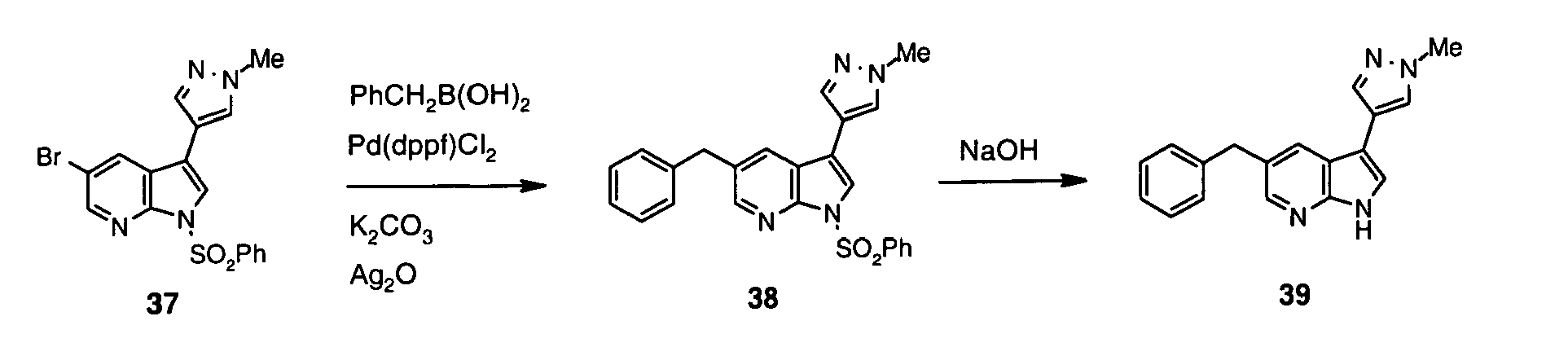
-

- Bromide 37 (80 mg, 0.19 mmol; prepared in analogous way to 20), benzyl boronic acid (29 mg, 0.21 mmol), Ag2O (111 mg, 0.48 mmol), K2CO3 (80 mg, 0.58 mmol), [1,1' -bis(diphenylphosphino)ferrocene]dichloropalladium(II) complex with CH2Cl2 (1:1) (16 mg, 0.019 mmol) in THF (2.5 mL) were heated at 80 °C for 17.5 h. The mixture was allowed to cool to r.t., diluted with AcOEt and a solution of 30% H2O2 and 10% NaOH (1:1, v/v) and partitioned. The aqueous layer was extracted with AcOEt (3x). The combined organic extracts were dried (MgSO4), filtered and concentrated. The crude residue was purified by LCMS (column LUNA 10 µ C18(2) 00G-4253-V0 250x50 mm) using water - MeCN (0.1% AcOH) as eluent (in gradient; flow 80 mL/min) to afford 38 (36 mg, 44%). 1H NMR (400 MHz; CDCl3) δ 3.97 (s, 3H), 4.07 (s, 2H), 7.15-7.22 (m, 3H), 7.26-7.30 (m, 2H), 7.46-7.51 (m, 2H), 7.55-7.59 (m, 2H), 7.70 (d, J = 0.73 Hz, 1H), 7.73-7.75 (m, 2H), 8.18-8.22 (m, 2H), 8.35 (d, J= 2.0 Hz, 1H).
MS (CI) m/z 429 (MH+). -

- A mixture of benzyl derivative 38 (36 mg, 0.08 mmol) and 10% NaOH solution (0.80 mL) in EtOH (2.5 mL) was heated at 90 °C. After 1 h the mixture was cooled to r.t., diluted with AcOEt and saturated brine and partitioned. The aqueous layer was extracted with AcOEt (3x). The combined organic extracts were dried (MgSO4), concentrated and the residue was purified by LCMS (column LUNA 10 µ C18(2) 00G-4253-V0 250x50 mm) using water - MeCN (0.1% AcOH) as eluent (in gradient; flow 80 mL/min) to afford 39 (17 mg, 70%). 1H NMR (400 MHz; CDCl3) δ 3.97 (s, 3H), 4.12 (s, 2H), 7.19-7.36 (m, 6H), 7.58 (s, 1H), 7.71 (s, 1H), 7.86 (brs, 1H), 8.24 (m, 1H), 8.79 (brs, 1H).
MS (CI) m/z 289 (MH+). -

-

- A mixture of boronic ester 40 (3.80 g, 15.6 mmol; preparation disclosed in
WO2004/078757 ), phtalimide (0.951 g, 15.6 mmol), Cu(OAc)2 (1.56 g, 8.59 mmol) and Et3N (2.11 g, 20.8 mmol) in CH2Cl2 (152 mL) was stirred at r.t. for 5 d. The mixture was then concentrated, dissolved in DMF and separated by LCMS (column LUNA 10 µ C18(2) 00G-4253-V0 250x50 mm) using water - MeCN (0.1% AcOH) as eluent (in gradient; flow 80 mL/min) to afford 41 (205 mg, 5%). 1H NMR (400 MHz; CDCl3) δ 6.58 (dd, J = 2.0, 3.5 Hz, 1H), 7.39 (dd, J = 2.5, 3.5 Hz, 1H), 7.80-7.84 (m, 2H), 7.96-8.01(m, 3H), 8.34 (d, J = 2.2 Hz, 1H), 8.98 (bs, 1H). MS (ES) m/z 305 (MH++MeCN). -

- A solution of Br2 (30.2 mg, 0.189 mmol) in CH2Cl2 (2.0 mL) was added dropwise over a period of 4 min. to a stirred and cooled (0 °C) solution of 41 (50 mg, 0.189 mmol) and pyridine (18.0 mg, 0.23 mmol) in CH2Cl2 (2 mL). After additional stirring at 0 °C for 26 min. the reaction mixture was treated with a 1:1 (v/v) solution of saturated aqueous NaHCO3 and saturated aqueous Na2S2O3. Stirring continued for 30 min at 0 °C and the organic phase was separated. The aqueous layer was extracted with CH2Cl2. The combined organic solutions were dried (MgSO4), concentrated and the residue was separated by LCMS (column LUNA 10 µ C18(2) 00G-4253-V0 250x50 mm) using water ― MeCN (0.1 % AcOH) as eluent (in gradient; flow 80 mL/min) to afford 42 (64.7 mg, quant.). 1H NMR (400 MHz; CDCl3 + 3 drops of CD3OD) δ 7.40 (s, 1H), 7.81 (dd, J = 3.1, 5.4 Hz, 2H), 7.94 (d, J = 2.3 Hz, 1H), 7.96 (dd, J = 5.5, 3.1 Hz, 2H), 8.29 (d, J = 2.3 Hz, 1H); MS (ES) m/z 383 (MH++MeCN).
-

- PhSO2Cl (24 mg, 0.136 mmol) was added dropwise over a period of 3 min. to a stirred soultion of 42 (31mg, 0.090 mmol) and pyridine (11.4 mg, 0.144 mmol) in CH2Cl2. The mixture was stirred at r.t. overnight. Additional portion of PhSO2Cl (24 mg, 0.136 mmol) was added, followed by DMAP (3 mg, 0.025 mmol). After additional stirring for 1.5 h, the mixture was partitioned between saturated aqueous NaHCO3:CH2Cl2. The aqueous layer was extracted with CH2Cl2. The combined organic solutions were washed with brine, dried (MgSO4) and concentrated. Purification by PTLC using AcOEt:hexane=1:1 (v/v) as eluent afforded 43 as orange powder (15 mg, 35%). 1H NMR (400 MHz; CDCl3) δ 7.55 (tt, J = 6.6, 1.6 Hz, 2H), 7.62 (tt, J = 5.3, 2.0 Hz, 1H), 7.84 (dd, J = 5.4, 3.0 Hz, 2H), 7.88 (s, 1H), 7.92 (d, J = 2.3 Hz, 1H), 7.98 (dd, J = 5.4, 3.0 Hz, 2H), 8.23 (dd, J = 4.0, 1.3 Hz, 2H), 8.55 (d, J = 1.9 Hz, 1H).
-

- A mixture of bromide 43 (50 mg, 0.104 mmol), 5-(trimethylstannyl)thiazole (51.1 mg, 0.21 mmol), PdCl2(MeCN)2 (2.67 mg, 10 µmol), and P(o-tolyl)3 (6.27 mg, 21 µmol) in toluene (5 mL) was heated in darkness at 85 °C overnight and then refluxed for 2 d. The mixture was concentrated and the product isolated by LCMS (column LUNA 10 µ C18(2) 00G-4253-V0 250x50 mm) using water - MeCN (0.1% AcOH) as eluent (in gradient; flow 80 mL/min) to afford 44 (20 mg, 38%). 1H NMR (400 MHz; CDCl3 + 3 drops of CD3OD) δ 7.30 (dd, J = 4.5, 2.0 Hz, 2H), 7.35 (t, J = 7.4 Hz, 2H), 7.44-7.50 (m, 2H), 7.61-7.63 (m, 1H), 7.80 (s, 1H), 7.98 (d, J = 1.4 Hz, 1H), 8.00 (s, 2H), 8.42 (d, J = 2.3 Hz, 1H), 8.59 (d, J = 2.3 Hz, 1H), 8.70 (s, 1H). MS (ES) m/z 505 (MH+).
-
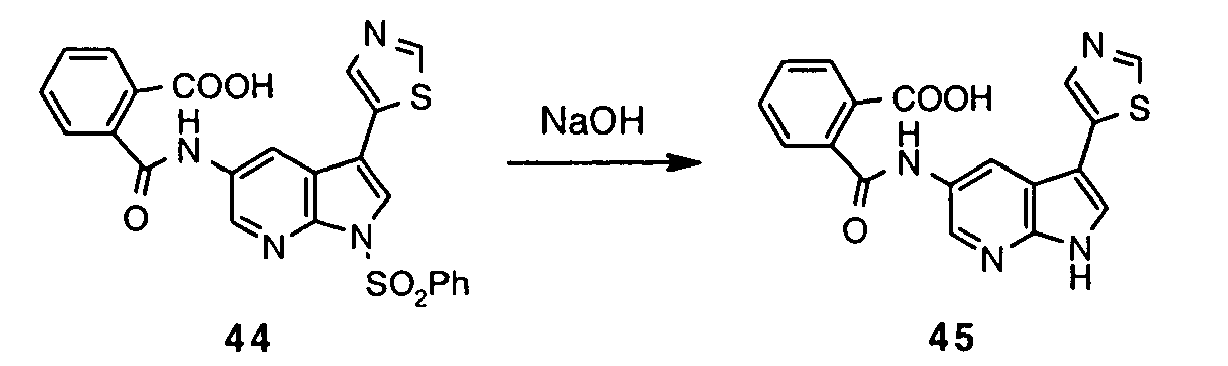
- Sulfonamide 44 (20 mg, 40 µmol), 10% aqueous NaOH solution (0.36 mL, 0.9 mmol) in EtOH (1.0 mL) was refluxed for 30 min. The mixture was cooled, concentrated, treated with glacial acetic acid (0.72 mL, 12 mmol), and concentrated again. The residue was separated by LCMS (column LUNA 10 µ C18(2) 00G-4253-V0 250x50 mm) using water - MeCN (0.1% AcOH) as eluent (in gradient; flow 80 mL/min) to afford 45 (3.88 mg, 27%). 1H NMR (400 MHz; CDCl3 + 3 drops of CD3OD) δ 7.36 (dd, J = 7.5, 2.5 Hz, 1H), 7.57 (s, 2H), 7.78 (s, 1H), 8.02 (d, J = 2.0 Hz, 1H), 8.15 (d, J = 1.8 Hz, 1H), 8.20 (d, J = 1.9 Hz, 1H), 8.39 (d, J = 2.1 Hz, 1H), 8.50 (s, 1H); MS (ES) m/z 406.3 (MH++MeCN).
-

-

- A mixture of acid 46 (200 mg, 088 mmol; preparation disclosed in
WO2005085244 ), DPPA (254.28 mg, 0.92 mmol) and Et3N (93.5 mg, 0.92 mmol) in 2-methylpropan-2-ol (20.6 mL) was stirred at r.t. for 30 min. and gradually raised to 100 °C over a period of 2 h. After additional 6 h stirring at 100 °C the mixture was cooled, concentrated in vacuum, and dissolved in AcOEt-water. The aqueous layer was extracted with AcOEt. Combined organic solutions were washed with saturated aqueous NaHCO3, brine, dried (MgSO4) and concentrated. The residue was separated by PTLC using CH2Cl2:MeOH=19:1 (v/v) as eluent to afford 47 (97.29 mg, 37%). 1H NMR (400 MHz; CDCl3) δ 1.56 (s, 9H), 6.62 (bs, 1H), 6.68 (dd, J = 1.8, 0.9 Hz, 1H). 7.26 (s, 1H), 7.42 (d, J = 2.4 Hz, 1H), 7.51 (dd, J = 3.3, 1.5 Hz, 1H), 7.79 (s, 1H), 8.23 (d, J = 2.2 Hz, 1H), 8.25 (bs, NH); MS (ES) m/z 341 (MH++MeCN). -

- 4.0 M aqueous HCl (0.83 mL, 3.32 mmol) was added to a suspension of 47 (90 mg, 0.30 mmol) in MeOH (0.17 mL) and the mixture was stirred at r.t. overnight. Concentrated aqueous HCl (0.2 mL, 2.2 mmol) was added and stirring continued for 5 h. The mixture was concentrated to dryness in vacuum and separated by means of LCMS (column LUNA 10 µ C18(2) 00G-4253-V0 250x50 mm) using water - MeCN (0.1% AcOH) as eluent (in gradient; flow 80 mL/min) to afford 48 (41.64 mg, 70%). 1H NMR (400 MHz; CDCl3 + 3 drops of CD3OD) δ 6.61 (dd, J = 1.8, 0.8 Hz, 1H), 7.32 (s, 1H), 7.43 (d, J = 2.5 Hz, 1H), 7.45 (dd, J = 3.3, 1.7 Hz, 1H), 7.68 (dd, J = 2.3, 1.0 Hz, 1H), 7.80 (d, J = 2.5 Hz, 1H); MS (ES) m/z 241 (MH++MeCN).
-
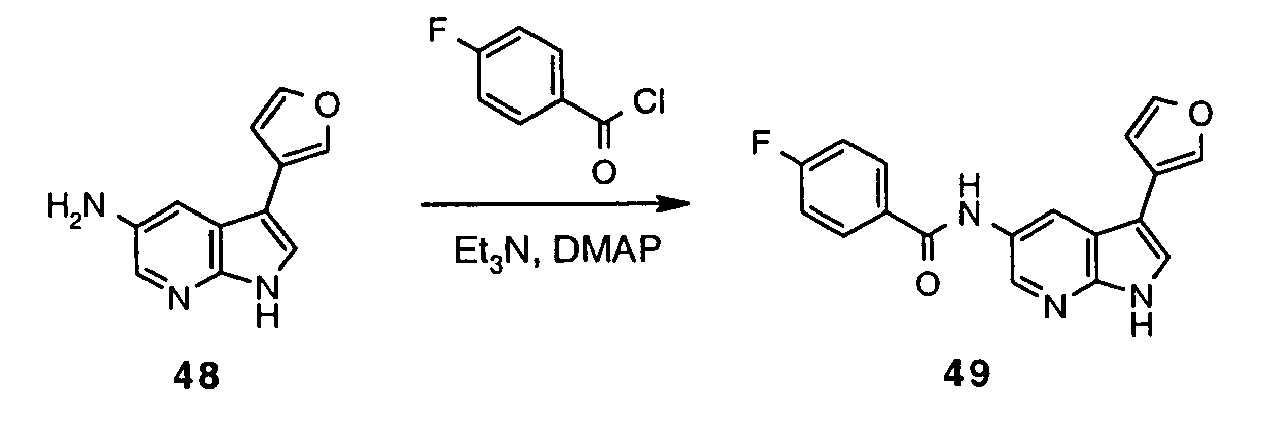
- 4-Fluorobenzoyl chloride (29.7 mg, 0.19 mmol) was added to a solution of amine 48 (25 mg, 0.125 mmol), DMAP (1.53 mg, 12.5 µmol) and Et3N (12.6 mg, 0.125 mmol) in DMF (0.6 mL). The mixture was stirred at r.t. overnight, concentrated and separated by means of LCMS (column LUNA 10 µ C18(2) 00G-4253-V0 250x50 mm) using water ― MeCN (0.1% AcOH) as eluent (in gradient; flow 80 mL/min) to afford 49 (2.13 mg, 5%). 1H NMR (400 MHz; CDCl3 + 3 drops of CD3OD) δ 6.45 (dd, J = 1.9, 0.9 Hz, 1H), 6.91 (t, J = 1.8 Hz, 2H), 7.22 (s, 1H), 7.23 (t, J = 1.7 Hz, 1H), 7.56 (m, 1H), 7.73-7.76 (m, 2H), 8.15 (d, J = 2.1 Hz, 1H), 8.25 (d, J = 2.3 Hz, 1H) ; MS (ES) m/z 363 (MH++MeCN).
-

-
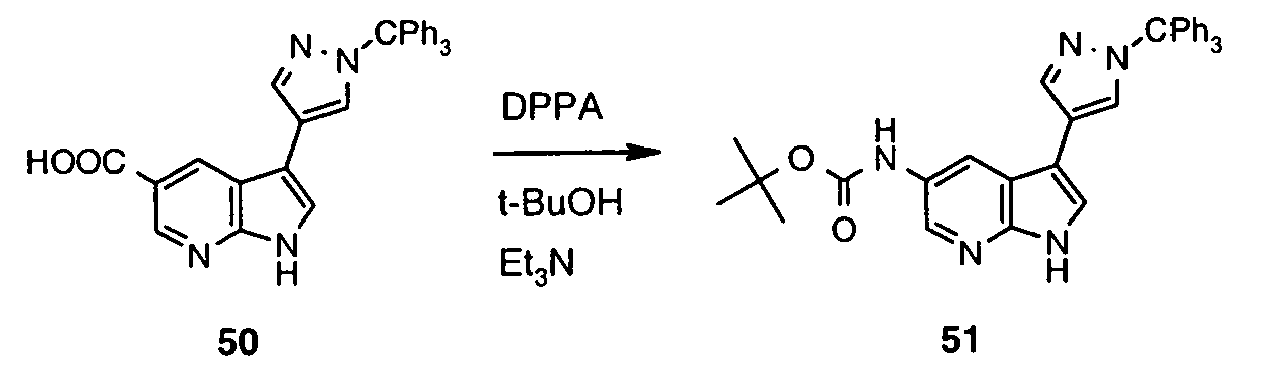
- Inhibitor 51 was synthesized following the method described for preparation of 47 using acid 50 (414 mg, 0.88 mmol; prepared in analogous way to 46). Yield 476 mg (quant).
-

- Inhibitor 52 was synthesized following the method described for preparation of 48 using 51 (326 mg, 0.60 mmol). The crude reaction mixture was neutralised with saturated aqueous NaHCO3 and extracted with AcOEt. Combined organic extracts were dried (MgSO4), concentrated and purified by means of LCMS (column LUNA 10 µ C18(2) 00G-4253-V0 250x50 mm) using water ― MeCN (0.1% AcOH) as eluent (in gradient; flow 80 mL/min) to afford 52 (25.62 mg, 14%). 1H NMR (400 MHz; CDCl3 + 3 drops of CD3OD) δ 1.54 (s, 9H), 7.54 (s, 1H), 7.93 (s, 2H) 8.18 (d, J = 2.1 Hz, 1H), 8.31 (d, J = 2.1 Hz, 1H); MS (ES) m/z 341 (MH++MeCN).
-
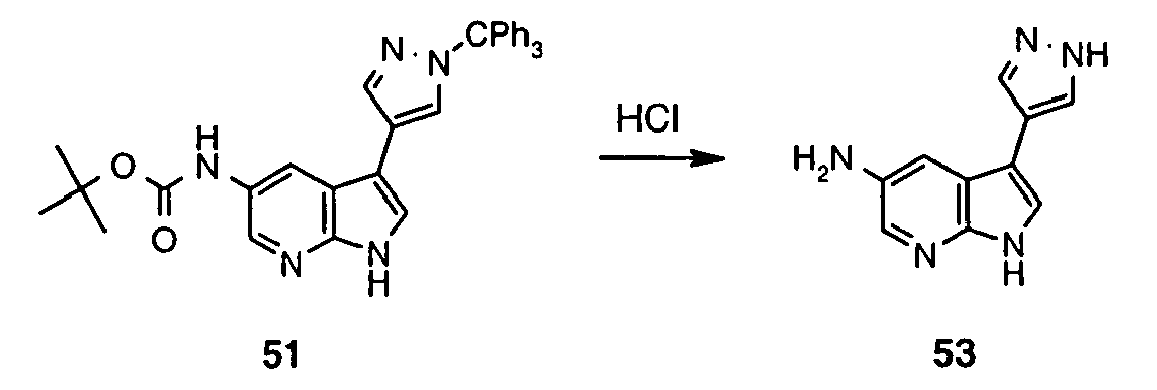
- Inhibitor 53 was synthesized following the method described for preparation of 48 using 51 (150 mg, 0.28 mmol). The reaction mixture was concentrated to dryness in vacuum and separated by means of LCMS (column LUNA 10 µ C18(2) 00G-4253-V0 250x50 mm) using water - MeCN (0.1% AcOH) as eluent (in gradient; flow 80 mL/min) to afford 53 (6.07 mg, 11%). 1H NMR (400 MHz; CDCl3 + 3 drops of CD3OD) δ 7.26 (s, 1H), 7.66 (s, 2H), 8.54 (d, J = 1.9 Hz, 1H), 8.68 (d, J = 1.9 Hz, 1H); MS (ES) m/z 241 (MH++MeCN).
-

-

- A mixture of 37 (100 mg, 0.24 mmol), Cu2O (5.0 mg, 35 µmol), and aqueous ammonium hydroxide (3 mL) in ethylene glycol (2.5 mL) was heated in a sealed tube at 100 °C for a period of 23 h. The mixture was cooled and partitioned between water-AcOEt. The aqueous layer was extracted with AcOEt. Combined organic solutions were dried (MgSO4), concentrated and the residue was purified by means of LCMS (column LUNA 10 µ C18(2) 00G-4253-V0 250x50 mm) using water - MeCN (0.1% AcOH) as eluent (in gradient; flow 80 mL/min) to afford 54 (20.0 mg, 39%). 1H NMR (400 MHz; DMSO-d6 ) δ 3.80 (s, 3H), 7.43 (s, 1H), 7.58 (dd, J = 6.0, 1.7 Hz, 2H), 7.70 (m, 1H), 7.93 (m, 1H); MS (ES) m/z 254 (MH++MeCN).
-
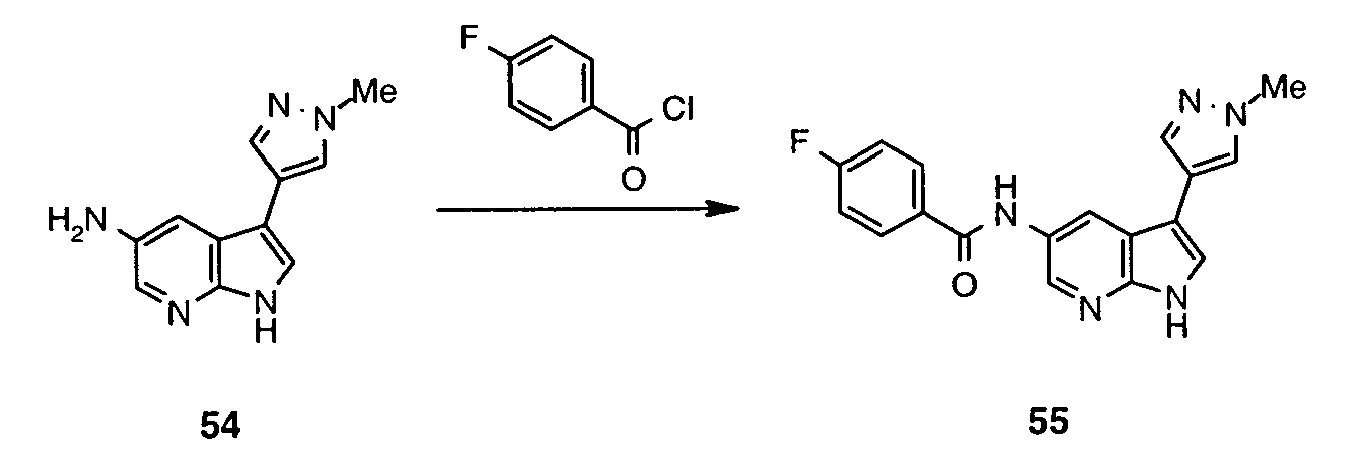
- 4-Fluorobenzoyl chloride (100 µL, 0.84 mmol) was added to a solution of 54 (20.0 mg, 93.7 µmol) in pyridine (2 mL). The mixture was stirred at r.t. overnight, concentrated and separated by means of LCMS (column LUNA 10 µ C18(2) 00G-4253-V0 250x50 mm) using water ― MeCN (0.1% AcOH) as eluent (in gradient; flow 80 mL/min) to afford 55 (3.99 mg, 13%). 1H NMR (400 MHz; DMSO-d6 ) δ 3.87 (s, 3H), 7.38 (t, J = 8.8 Hz, 2H), 7.66 (s, 1H), 7.75 (s, 1H), 8.00 (s, 1H), 8.08 (dd, J = 8.7, 5.4 Hz, 2H), 8.48 (dd, J = 7.0, 2.2 Hz, 2H); MS (ES) m/z 377 (MH++MeCN).
-

-
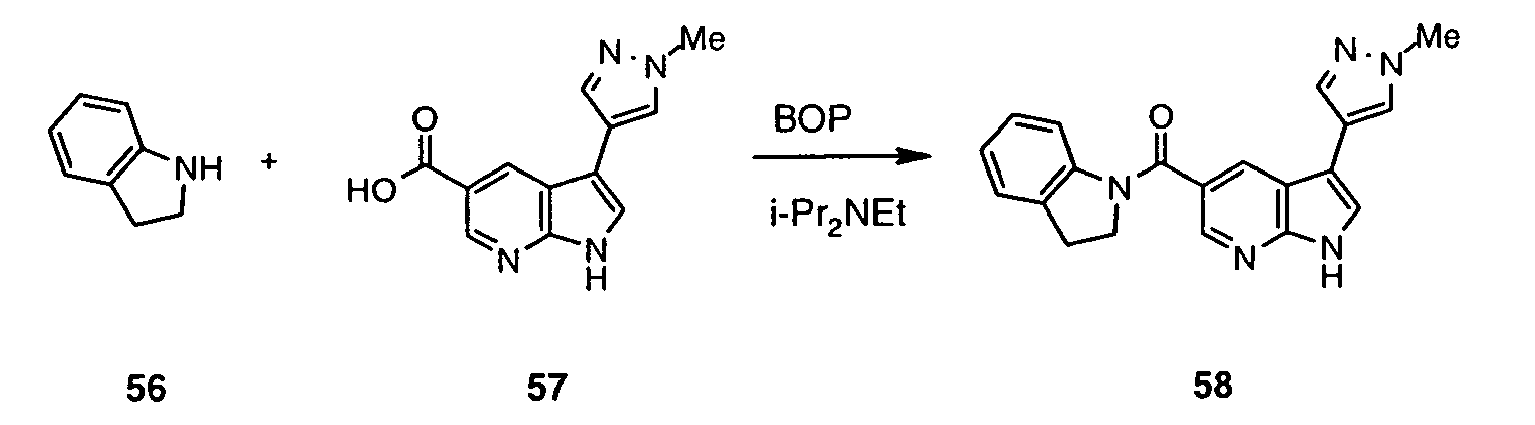
- A mixture of indoline (56) (184 µL, 1.64 mmol), acid 57 (200 mg, 0.826 mmol; prepared in analogous way to 46), benzotriazole-1-yl-oxy-tris-(dimethylamino)-phosphonium hexafluorophosphate (BOP, 473 mg, 1.07 mmol) and i-Pr2NEt (288 µL, 1.65 mmol) in DMF (4 mL) was stirred at r.t. overnight. The product was isolated by means of preparative LCMS (column LUNA 10 µ C18(2) 00G-4253-V0 250x50 mm) using water - acetonitrile (0.1% AcOH) as eluent (in gradient; flow 80 mL/min) to give 58 as a white solid (126.9 mg, 45%); 1H NMR (400 MHz, CDCl3) δ 3.18 (t, J = 8.2 Hz, 2H), 3.99 (s, 3H), 4.21 (t, J = 8.2 Hz, 2H), 7.06 (t, J = 6.7 Hz, 1H), 7.15 (br s, 1H), 7.24-7.30 (m, 2H), 7.49 (d, J = 2.2 Hz, 1H), 7.67 (s, 1H), 7.75 (d, J = 0.4 Hz, 1H), 8.35 (d, J = 1.9 Hz), 8.60 (d, J= 1.9 Hz), 9.16 (bs, 1H).
-

- A mixture of 1.0 M BH3 in THF (1.0 mL, 1.0 mmol) and amide 58 (80.7 mg, 0.235 mmol) in THF (2.0 mL) was refluxed under N2 for 20 min. The reaction mixture was cooled to r.t., quenched with MeOH (5 mL) and concentrated. The residual solid was treated with 10% aqueous HCl (2.0 mL) and MeOH (2.0 mL). After 1 h stirring at r.t. the mixture was concentrated, basified with NaHCO3 and extracted with AcOEt (3x10 mL). Combined extracts were dried (MgSO4), concentrated and purified by means of preparative LCMS (column LUNA 10 µ C18(2) 00G-4253-V0 250x50 mm) using water ― acetonitrile (0.1 % AcOH) as eluent (in gradient; flow 80 mL/min) to give 59 as a white solid (14.0 mg, 18%); 1H NMR (400 MHz, CDCl3) δ 2.97 (t, J = 8.3 Hz, 2H), 3.30 (t, J = 8.3 Hz, 2H), 3.98 (s, 3H), 4.40 (s, 2H), 6.66 (d, J = 7.8 Hz, 1H), 6.72 (td, J = 7.4, 0.8 Hz, 1H), 7.08-7.15 (m, 2H), 7.43 (d, J = 1.6 Hz, 1H), 7.61 (s, 1H), 7.75 (s, 1H), 8.08 (d, J = 1.8 Hz, 1H), 8.38 (d, J = 1.8 Hz, 1H), 9.90 (bs, 1H).
-

- 2,3-Dichloro-5,6-dicyano-1,4-benzoquinone (25 mg, 0.11 mmol) was added in small portions over a period of 0.5 h to a stirred solution of 59 (11.0 mg, 33.4 µmol) in CH2Cl2 (1.8 mL) - 0.2 M aqueous phosphate buffer (pH 7.0) solution (0.05 mL). When the addition was completed, the mixture was stirred for additional 0.5 h and then treated with saturated aqueous NaHCO3 (2 mL). Stirring continued for 1 h. The organic layer was separated and the aqueous phase extracted with CH2Cl2 (5x2 mL). Combined organic solutions were washed with brine, dried (MgSO4), concentrated and the residue was purified by means of PTLC using AcOEt as eluent to afford 60 (2.9 mg, 26%) as grey solid; 1H NMR (400 MHz, CDCl3) δ 3.95 (s, 3H), 5.46 (s, 2H), 6.56 (dd, J = 3.2, 0.7 Hz, 1H), 7.12 (td, J = 7.5, 1.0 Hz, 1H), 7.16 (d, J = 3.2, 1H), 7.20 (td, J = 7.5, 1.2 Hz, 1H), 7.37 (d, J = 2.4 Hz, 1H), 7.39 (dd, J = 8.2, 0.7 Hz, 1 H), 7.47 (s, 1H), 7.66 (s, 1H), 7.66 (dd, J = 7.8, 0.7 Hz, 1H), 7.82 (d, J = 1.9 Hz, 1H), 8.28 (d, J = 1.9 Hz, 1H), 8.86 (bs, 1H).
-

-

- A mixture of bromide 37 (280 mg, 0.67 mmol), 2,2-dimethylethenylboronic acid (101 mg, 1.01 mmol), LiCl (84 mg, 2.02 mmol), (PPh3)2PdCl2 (24 mg, 0.03 mmol), 1.0 M aqueous Na2CO3 (1.68 mL, 1.68 mmol), in toluene (8 mL) - EtOH (8 mL) was stirred in an oil bath (105 °C) for 96 h. The reaction mixture was then cooled to r.t., diluted with AcOEt and saturated brine and partitioned. The aqueous layer was extracted with AcOEt (2x). The combined organic solutions were dried (MgSO4) and concentrated. The residual oil was purified by means of PTLC plates using AcOEt:hexane=1:1 (v/v) as eluent to afford the olefin 61 (118 mg, 45%) as an oil; 1H NMR (400 MHz; CDCl3) δ 1.88 (d, J = 1.0 Hz, 3H), 1.94 (d, J = 1.0 Hz, 3H), 3.96 (s, 3H), 6.37 (s, 1H), 7.39-7.46 (m, 3H), 7.49-7.54 (m, 1H), 7.59 (s, 1H), 7.63-7.68 (m, 2H), 7.75 (s, 1H), 7.90 (d, J = 1.8 Hz, 1H), 8.23 (d, J = 1.8 Hz, 1H).
-

- A mixture of olefin 61 (118 mg, 3.00 mmol) and moist Pd(OH)2 on carbon (96 mg of catalyst containing 20% wt Pd) in MeOH (6 mL) was stirred vigorously under H2 for 93 h. The catalyst was removed by filtration through a pad of Celite. The pad was washed sequentially with MeOH, CH2Cl2 and AcOH and the combined filtrates were concentrated to afford azaindole 62 as brown oil that was used directly without purification in the next step. 1H NMR (400 MHz; CDCl3) δ 0.90 (s, 3H), 0.91 (s, 3H), 1.87 (m, 1H), 2.58 (d, J = 7.2 Hz, 2H), 3.96 (s, 3H), 7.34 (s, 1H), 7.41-7.46 (m, 2H), 7.50-7.55 (m, 1H), 7.59 (s, 1H), 7.62-7.67 (m, 2H), 7.73 (s, 1H), 7.86 (d, J = 1.8 Hz, 1H), 7.99 (d, J = 1.8 Hz, 1H).
-

- To crude azaindole 62 (118 mg) in EtOH (6 mL) was added 10% NaOH (1 mL) and the mixture was stirred in an oil bath (90 °C) for 4.5 h. The mixture was then cooled to r.t., diluted with AcOEt and saturated brine and partitioned. The aqueous layer was extracted with AcOEt (3x). The combined organic solutions were dried (MgSO4), filtered and concentrated. The residual yellow oil was partially purified by means of PTLC employing AcOEt as eluent to afford a semi-pure azaindole 63 (74 mg). A fraction (14 mg) of this material was further purified by means of preparative LCMS (column LUNA 10 µ C18(2) 00G-4253-V0 250x50 mm) using water - acetonitrile (0.1% AcOH) as eluent (in gradient; flow 80 mL/min) to give the desired azaindole 63 (5.6 mg, 25%); 1H NMR (400 MHz; CDCl3) δ 0.92 (s, 3H), 0.94 (s, 3H), 1.90 (m, 1H), 2.59 (d, J = 7.2 Hz, 2H), 3.98 (s, 3H), 7.36 (d, J = 2.1 Hz, 1H), 7.60 (s, 1H), 7.74 (d, J = 0.6 Hz, 1H), 7.81 (d, J = 1.8 Hz, 1H), 8.14 (d, J = 1.8 Hz, 1H), 9.62 (br s, 1H); MS (CI) m/z 255 (MH+).
-
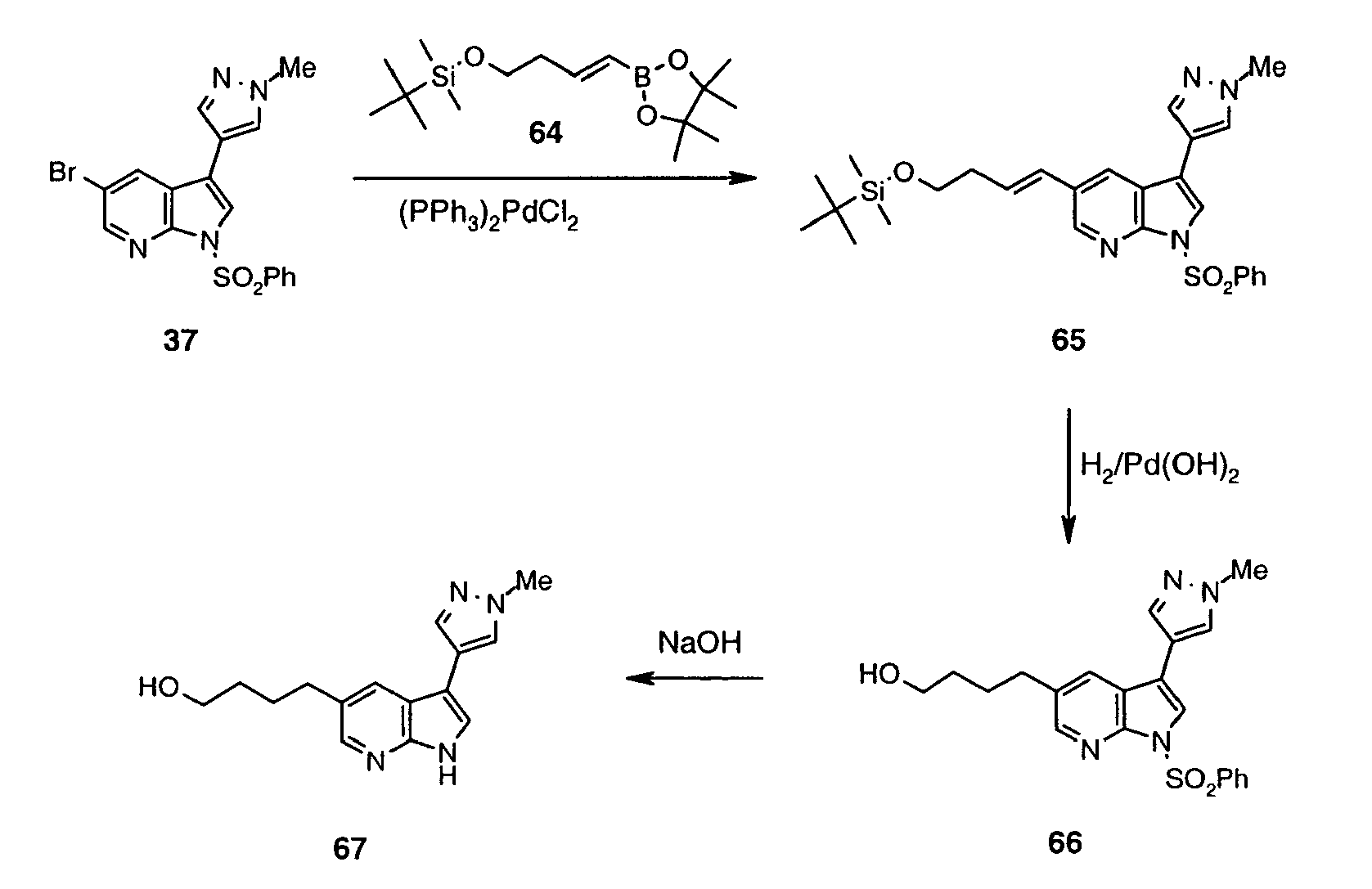
-

- A mixture of bromide 37 (280 mg, 0.67 mmol), boronic pinacol ester 64 (314 mg, 1.01 mmol), LiCl (84 mg, 2.02 mmol), (PPh3)2PdCl2 (24 mg, 0.03 mmol), 1.0 M aqueous Na2CO3 (1.68 mL, 1.68 mmol), in toluene (8 mL) - EtOH (8 mL) was stirred in an oil bath (105 °C) for 5.5 h. The reaction mixture was then cooled to r.t., diluted with AcOEt and saturated brine and partitioned. The aqueous layer was extracted with AcOEt (2x). The combined organic solutions were dried (MgSO4) and concentrated. The residual oil was purified by means of PTLC plates using AcOEt:hexane=1:1 (v/v) as eluent to afford the olefin 65 (198 mg, 56%) as an oil; 1H NMR (400 MHz; CDCl3) δ 0.04 (s, 6H), 0.87 (s, 9H), 2.43 (dq, J = 6.6, 1.0 Hz, 2H), 3.72 (t, J = 6.6 Hz, 2H), 3.96 (s, 3H), 6.26 (d, J = 16.4 Hz, 1H), 6.49 (d, J = 16.4 Hz, 1H), 7.43-7.47 (m, 2H), 7.52-7.56 (m, 1H), 7.62 (s, 1H), 7.72 (d, J = 10.2 Hz, 2H), 7.87 (d, J = 1.9 Hz, 1H), 8.15-8.17 (m, 2H), 8.41 (d, J = 1.9 Hz, 1H).
-

- A mixture of olefin 65 (198 mg, 0.38 mmol) and moist Pd(OH)2 on carbon (96 mg of catalyst containing 20% wt Pd) in MeOH (6 mL) was stirred vigorously under H2 for 43 h. The catalyst was removed by filtration through a pad of Celite. The pad was washed sequentially with MeOH, CH2Cl2 and AcOH and the combined filtrates were concentrated to afford azaindole 66 as brown oil that was used directly without purification in the next step; 1H NMR (400 MHz; CDCl3) δ 1.55-1.76 (m, 4H), 2.71 (t, J = 7.7 Hz, 2H), 3.64 (t, J = 6.4 Hz, 2H), 3.97 (s, 3H), 7.43-7.47 (m, 2H), 7.52-7.56 (m, 1H), 7.64 (s, 1H), 7.71 (s, 1H), 7.73-7.75 (m, 2H), 8.16-8.18 (m, 2H), 8.27 (d, J = 1.9 Hz, 1H).
-

- To crude azaindole 66 (76 mg, 0.19 mmol) in EtOH (6 mL) was added 10% NaOH (1 mL) and the mixture was stirred in an oil bath (90 °C) for 2 h. The mixture was then cooled to r.t., diluted with AcOEt and saturated brine and partitioned. The aqueous layer was extracted with AcOEt (3x). The combined organic solutions were dried (MgSO4), filtered and concentrated. The residual yellow oil was purified by means of PTLC employing AcOEt as eluent to afford the azaindole 67 (16 mg, 31%); 1H NMR (400 MHz; CDCl3) δ 1.61-1.80 (m, 8H), 2.77 (t, J = 7.6 Hz, 2H), 3.67 (t, J = 6.6 Hz, 2H), 3.97 (s, 3H), 7.34 (d, J = 1.9 Hz, 1H), 7.61(s, 1H), 7.73 (d, J = 0.6 Hz, 1H), 7.85 (d, J = 1.8 Hz, 1H), 8.17 (d, J = 1.8 Hz, 1H), 9.29 (br s, 1H).
-

-
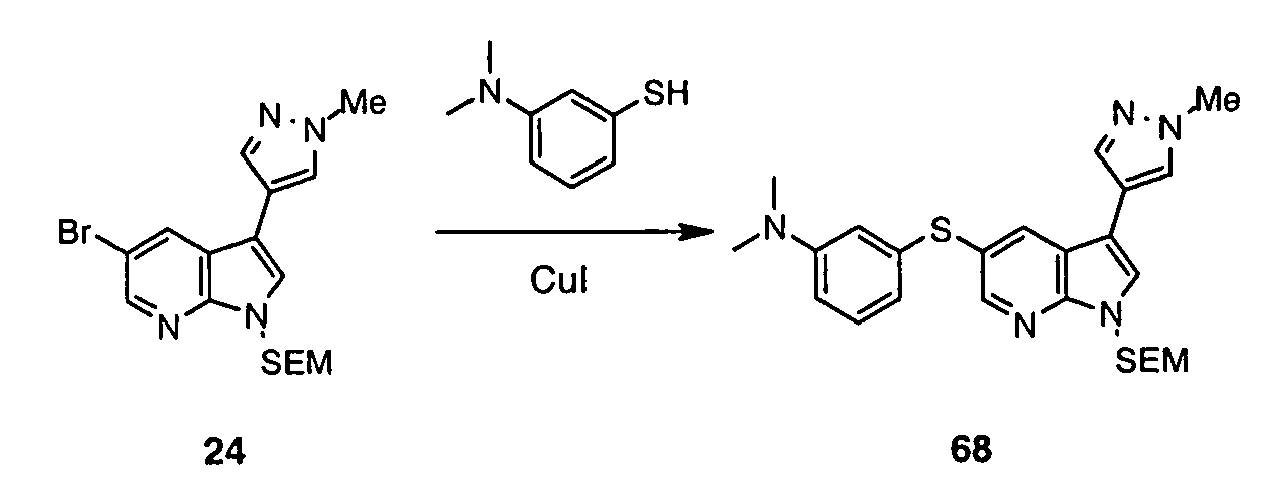
- A mixture of bromide 24 (100 mg, 0.245 mmol), 3-(dimethylamino)benzenethiol (94 mg, 0.613 mmol), CuI (9.3 mg, 0.049 mmol), N,N-dimethylglycine (5.1 mg, 0.049 mmol), potassium phosphate (156 mg, 0.736 mmol) and DMF (1.0 mL) was heated to 160 °C using microwave irradiation for 0.5 h then at 180 °C for 1h. The reaction mixture was cooled and partitioned between AcOEt/brine, the layers separated and the aqueous phase extracted with more AcOEt (2x). The combined organic extracts were dried (MgSO4) and concentrated. The resulting crude residue containing 68 was purified by PTLC using 80% ethyl acetate in hexane as eluent to afford pure 68 as an orange oil (78 mg, 66%); 1H NMR (400 MHz, CDCl3) δ -0.055 (s, 9H), 0.95 (t, J = 8.2 Hz, 2H), 2.87 (s, 6H), 3.58 (t, J = 8.2 Hz, 2H), 3.95 (s, 3H), 5.68 (s, 2H), 6.43 (d, J = 7.6 Hz, 1H), 6.51 (tt, J = 8.3, 2.0 Hz, 1H), 6.62 (s, 1H), 7.06 (t, J = 8.0 Hz, 1H), 7.45 (s, 1H), 7.61 (s, 1H), 7.76 (s, 1H), 8.22 (d, J = 1.7 Hz, 1H), 8.48 (d, J = 1.6 Hz, 1H).
-
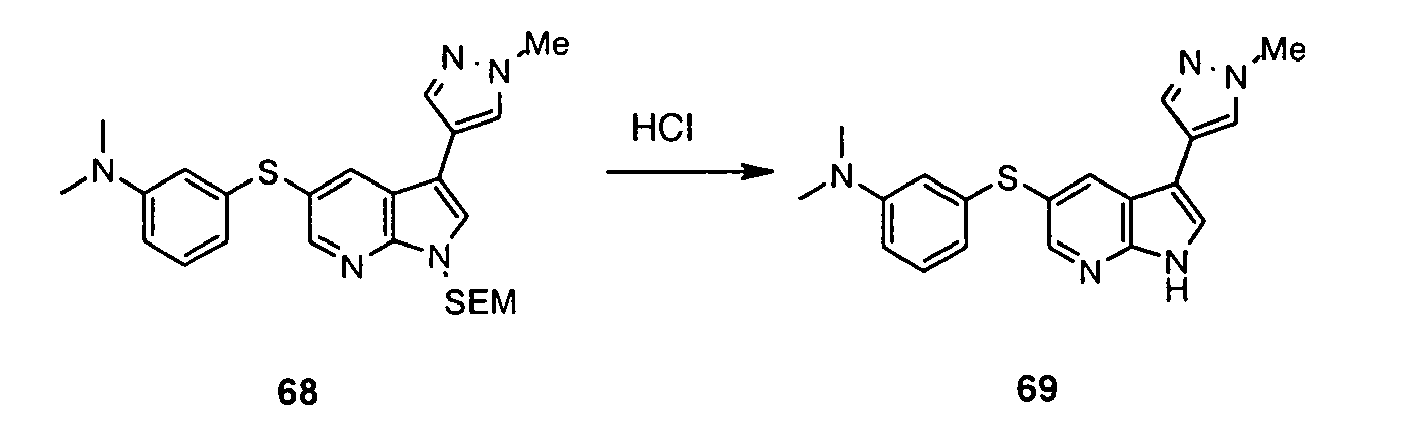
- A mixture of 68 (78 mg, 0.163 mmol), 10% aq. HCl (1.0 mL), EtOH (1.0 mL) was heated at 90 °C for 14 h. Purification by PTLC using AcOEt as eluent gave 69 as a white solid (22.8 mg, 40%); 1H NMR (400 MHz, CDCl3) δ 2.70 (s, 6H), 3.79 (s, 3H), 7.26 (m, 1H), 6.34 (ddd, J = 8.3 , 2.5, 0.7 Hz, 1H), 6.44 (t, J = 2.1 Hz, 1H), 6.91 (t, J = 8.0 Hz, 1H), 7.26 (s, 1H), 7.45 (s, 1H), 7.55 (d, J = 0.7 Hz, 1H), 8.10 (d, J = 2.0 Hz, 1H), 8.28 (d, J = 1.9 Hz, 1H).
-

-

- To a stirred solution of 1 (6.65 g, 33.8 mmol) in anh. CS2 (125 mL) was added AlCl3 (15.60 g, 117.0 mmol) in a single portion. The reaction vessel was equipped with a reflux condenser, the temperature was brought to 50°C, and bromoacetyl bromide (3.00 mL, 6.95 g, 34.4 mmol) was added dropwise over 10 min. After stirring at 50°C for a further 1 h, the reaction mixture was cooled to 0°C, and 100 mL water was added (very cautiously at first). Once effervescence had ceased, AcOEt (300 mL) and THF (100 mL) were added. Solid NaHCO3 was then added to adjust the pH of the aqueous layer from 1 to 3. The layers were separated, and the organic layer washed with saturated aqueous NaHCO3 (150 mL) and brine (150 mL). Solvent was then removed in vacuo to afford a yellow solid (8.32 g), which was further purified by trituration with MeOH (100 mL) to afford 70 as an off-white powder (7.16 g, 22.5 mmol, 67%). 1H NMR (400 MHz, CDCl3) δ 4.31 (s, 2H), 8.10 (d, J = 3.1 Hz, 1 H), 8.48 (d, J = 2.2 Hz, 1H), 8.83 (d, J = 0.4, 2.2 Hz, 1H), 9.34 (br s, 1H).
-

- To a solution of 70 (1.71 g, 5.38 mmol) in THF (20 mL) was added 1-Boc-4-aminothiocarbonyl piperidine (1.31 g, 5.36 mmol) and the solution was allowed to stir at r.t. for 3 h. The reaction mixture was then poured onto saturated aqueous NaHCO3 (50 mL) and extracted with AcOEt (2 x 50 mL). The combined organic portions were then evaporated to afford 71 (2.58 g, 5.41 mmol, 100%) as a white powder. 1H NMR (400 MHz, CDCl3) δ 1.43 (s, 9H), 1.64-1.84 (m, 4H), 2.07-2.17 (m, 2H), 2.81-2.94 (m, 2H), 3.13-3.24 (m, 1H), 7.17 (s, 1H), 7.74 (d, J = 2.4 Hz, 1 H), 8.32 (d, J = 2.1 Hz, 1H), 8.48 (d, J = 2.1 Hz, 1H), 8.97 (br s, 1H).
-

- To a vigorously stirred solution of 2 and n-Bu4NHSO4 (120 mg, cat.) in CH2Cl2 (15 mL) was added 50% aqueous NaOH (0.5 mL), followed by the dropwise addition of PhSO2Cl (0.50 mL, 690 mg, 3.90 mmol). The reaction mixture was allowed to stir overnight, diluted with AcOEt (100 mL), and washed with saturated aqueous NaHCO3 (3 x 25 mL). The organic layer was dried (MgSO4) and concentrated to afford a pale yellow solid (840 mg). On standing overnight, a precipitate appeared in the aqueous layer, which was filtered to afford a white powder (710 mg). The two solids were combined to afford 72 as an off-white solid (1.55 g, 2.57 mmol, 96%). 1H NMR (400 MHz, CDCl3) δ 1.51 (s, 9H), 1.79 and 1.84 (2 x dd, 2 x J = 4.4, 12.6 Hz, 2 x 1H), 2.19 (br d, J = 12.6 Hz, 2H), 2.95 (br t, J = 12.3 Hz, 2H), 3.25 (tt, J = 3.8, 11.6 Hz, 1H), 4.26 (br s, 2H), 7.37 (s, 1H), 7.52 (t, J = 7.8 Hz, 2H), 7.62 (t, J = 7.5 Hz, 1H), 8.17 (s, 1H), 8.22 (d, J = 7.8 Hz, 1H), 8.52 & 8.54 (2 x d, 2 x J = 2.4 Hz, 1H).
-

- To a stirred solution of 3 (1.55 g, 2.57 mmol) in CH2Cl2 (10 mL) was added CF3COOH (5 mL). After 1 h, the solution was concentrated to dryness and THF (5 mL) was added. To the resulting suspension was added formaldehyde (40% aq., 1 mL, excess), acetic acid (3 drops, cat.) and NaBH(OAc)3 (800 mg, 3.77 mmol). The reaction mixture was allowed to stir overnight, and was then quenched by the addition of 1.0 N aqueous HCl (10 mL, 10 mmol). The mixture was then neutralised with 1.0 N aqueous NaOH (10 mL) and extracted with AcOEt (3 x 50 mL). The organic portions were combined, dried over MgSO4 and concentrated to afford 74 as a pale yellow solid (840 mg, 1.62 mmol, 63%). 1H NMR (400 MHz, CDCl3) δ 1.85-2.00 (m, 2H), 2.07-2.23 (m, 4H), 2.33 (s, 3H), 2.93-3.07 (m, 3H), 7.27 (s, 1H), 7.42 (t, J = 7.7 Hz, 2H), 7.52 (t, J = 7.4 Hz, 1H), 8.06 (s, 1H), 8.12 (d, J = 7.7 Hz, 1H), 8.41 & 8.45 (2 x d, 2 x J = 2.0 Hz, 1H).
-

- To a stirred solution of 74 (202 mg, 0.39 mmol), isobutenyl boronic acid (50 mg, 0.50 mmol) and (PPh3)2PdCl2 (30 mg, 43 µmol) in toluene:EtOH 1:1 (3 mL) was added LiCl (50 mg, 1.19 mmol) and 1.0 M aq. Na2CO3 (0.75 mL, 0.75 mmol). The mixture was heated to reflux (bath temperature 110°C) and stirred for 1.5 h. Saturated aqueous NaHCO3 (25 mL) was added, and the mixture was extracted with AcOEt (2 x 40 mL). The combined organic solutions were dried (MgSO4) and concentrated to afford a brown solid (255 mg). The crude product was purified by SGC with 5%MeOH in CH2Cl2 as eluent to afford 75 as an off-white powder (166 mg, 0.34 mmol, 86%). 1H NMR (400 MHz, CDCl3) δ 1.88 (s, 3H), 1.96 (s, 3H), 1.92-2.04 (m, 2H), 2.11-2.25 (m, 2H), 2.37 (s, 3H), 2.97-3.11 (m, 3H), 6.33 (1H, s, 1H), 7.34 (s, 1H), 7.48 (t, J = 7.5 Hz, 2H), 7.54-7.60 (m, 1H), 8.14 (s, 1H), 8.20-8.25 (m, 3H), 8.36 (d, J = 2.0 Hz, 1H).
-

- To a solution of 75 (166 mg, 0.34 mmol) in MeOH (10 mL) was added 20% Pd(OH)2 on carbon (50 mg, cat.), and the reaction mixture was stirred vigorously under H2 for 72 h. The mixture was then filtered through Celite, which was then washed with MeOH (100 mL). The filtrate was concentrated to afford 76 as a foam (155 mg, 0.31 mmol, 93 %). 1H NMR (400 MHz, CDCl3) δ 0.93 (d, J = 6.6 Hz, 2H), 1.85-1.97 (m, 1H), 2.06-2.18 (m, 2H), 2.26-2.47 (m, 4H), 2.48 (s, 3H), 2.60 (d, J = 7.3 Hz, 2H), 3.10-3.21 (m, 3H), 7.37 (s, 1H), 7.45-7.61 (m, 3H), 8.08 (d, J = 2.0 Hz, 1H), 8.15 (s, 1H), 8.21-8.26 (m, 2H), 8.29 (d, J = 2.0 Hz, 1H).
-

- To a stirred solution of 76 (155 mg, 0.31 mmol) in EtOH (4 mL) was added 10% aqueous NaOH (2 mL) and the reaction was heated at reflux for 1.5 h. The mixture was then cooled. Saturated aqueous NaHCO3 (25 mL) was added, and the solution was extracted with AcOEt (2 x 40 mL) The combined organic extracts were dried (MgSO4) and concentrated to afford a brown solid, which was purified by preparative LCMS (column LUNA 10 µ C18(2) 00G-4253-V0 250x50 mm) using water - acetonitrile (0.1% AcOH) as eluent (in gradient; flow 80 mL/min) to afford 77 as a white solid (54 mg, 0.15 mmol, 49%). 1H NMR (400 MHz, CDCl3) δ 0.96 (d, J = 6.6 Hz, 2H), 1.94 (nonet, J = 6.7 Hz, 1H), 2.07-2.19 (m, 2H), 2.25-2.35 (m, 2H), 2.41-2.52 (m, 5H), 2.64 (d, J = 7.1 Hz, 2H), 3.14-3.24 (m, 3H), 7.26 (s, 1H), 7.83 (s, 1H), 8.10 (d, J = 1.9 Hz, 1H), 8.18 (d, J = 1.9 Hz, 1H), 10.90 (br s, 1H). MS (CI) m/z 355 (MH+).
-

-

- To a stirred solution of 70 (4.97 g, 15.6 mmol) in dioxane (55 mL) was added ethyl thiooxamate (2.29 g, 17.2 mmol). The reaction mixture was stirred vigorously at 95°C for 18 h. The hot reaction mixture was filtered and the collected product was washed with cold dioxane (25 mL) to afford the hydrobromide salt of 78 as a yellow powder (6.08 g, 14.0 mmol, 90%). 1H NMR (400 MHz, CDCl3) δ 1.48 (t, J = 7.1 Hz, 3H), 4.52 (q, J = 7.1 Hz, 2H), 7.77 (s, 1H), 8.05 (s, 1H), 8.43 (d, J = 1.8 Hz, 1 H), 9.21 (s, 1H).
-

- To a stirred solution of 78 (6.08 g, 14.0 mmol) in CH2Cl2 (75 mL) was added n-Bu4NHSO4 (100 mg, cat.) and 50% aqueous NaOH (2 mL). PhSO2Cl (2.50 mL, 19.5 mmol) was then added dropwise, and the reaction stirred at r.t. for 1.5 h. The mixture was then diluted with EtOAc (400 mL) and acetone (20 mL), washed with brine (2 x 100 mL) and concentrated to give a yellow solid (6.02 g). The crude product was recystallized from CH2Cl2/hexane to afford pure 79 as a yellow solid (2.33 g). More product was obtained from the mother liquor by SGC using hexane:CH2Cl2:EtOAc (2:1:1, v/v/v) as eluent. Total yield of 79 4.40 g, 8.94 mmol, 57%. 1H NMR (400 MHz, CDCl3) δ 1.51 (t, J = 7.2 Hz, 3H), 4.55 (q, J = 7.1 Hz, 2H), 7.53 (t, J = 7.8 Hz, 2H), 7.63 (t, J = 7.5 Hz, 1H), 7.74 (s, 1H), 8.24 (d, J = 7.8 Hz, 1 H), 8.30 (s, 1H), 8.54 (d, J = 2.1 Hz, 1 H), 8.56 (d, J = 2.1 Hz, 1 H).
-

- To a stirred solution of 79 (683 mg, 1.55 mmol), isobutenyl boronic acid (180 mg, 1.81 mmol) and (PPh3)2PdCl2 (100 mg, 142 µmol) in toluene:EtOH 1:1 (10 mL) was added LiCl(160 mg, 3.81 mmol) and 1.0 M aqueous Na2CO3 (2.5 mL). The mixture was heated to reflux (bath temperature 110°C) and stirred for 1.5 h. Saturated aqueous NaHCO3 (50 mL) was added, and the mixture was extracted with EtOAc (2 x 75 mL). The combined organic solutions were dried (MgSO4) and concentrated to afford a brown solid (922 mg). The crude product was isolated by means of SGC using hexane:EtOAc:CH2Cl2=2:1:1 (v/v/v) as eluent to afford 80 as a foam (548 mg, 1.32 mmol, 85%). 1H NMR (400 MHz, CDCl3) δ 1.40 (t, J = 7.2 Hz, 3H), 1.80 (d, J = 1.1 Hz, 3H), 1.86 (d, J = 1.1 Hz, 3H), 4.43 (q, J = 7.1 Hz, 2H), 6.24 (s, 1H), 7.40 (t, J = 7.8 Hz, 2H), 7.49 (t, J = 7.4 Hz, 1H), 7.63 (s, 1H), 8.13-8.17 (m, 3H)), 8.18 (s, 1H), 8.28 (d, J = 1.9 Hz, 1H).
-
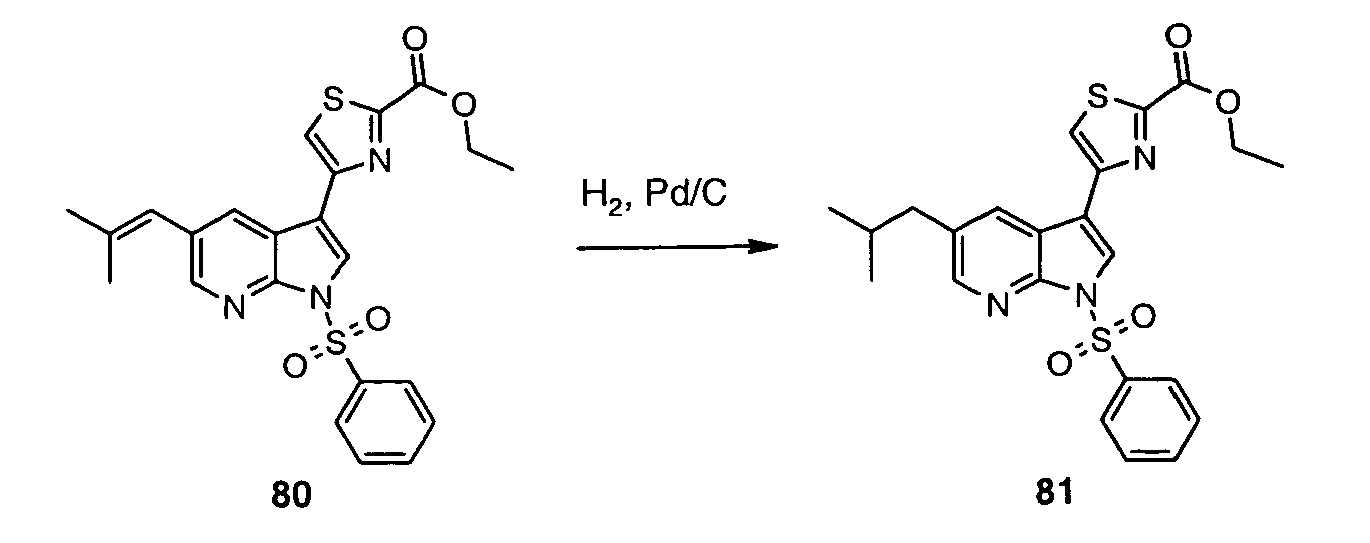
- To a solution of 80 (548 mg, 1.32 mmol) in MeOH:CH2Cl2=3:1 (v/v; 20 mL) was added 20% Pd(OH)2 on carbon (100 mg, cat.), and the reaction mixture was stirred vigorously under H2 for 72 h. The mixture was then filtered through Celite, which was then washed with MeOH:CH2Cl2=1:1 (v/v; 100 mL). The solutions were combined and concentrated to afford 81 as a foam (412 mg, 0.99 mmol, 75%). 1H NMR (400 MHz, CDCl3) δ 0.84 (d, J = 6.6 Hz, 2H), 1.40 (t, J = 7.1 Hz, 3H), 1.82 (nonet, J = 6.7 Hz, 1H), 2.51 (d, J = 7.2 Hz, 2H), 4.45 (q, J = 7.1 Hz, 2H),), 7.41 (t, J = 7.8 Hz, 2H), 7.48 (t, J = 7.6 Hz, 1H), 7.66 (s, 1H), 8.03 (d, J = 1.8 Hz, 1H), 8.15 (d, J = 7.5 Hz, 1H), 8.20 (s, 1H), 8.22 (d, J = 1.9 Hz, 1H).
-

- To a stirred solution of 81 (412 mg, 0.99 mmol) in EtOH (10 mL) was added 10% aqueous NaOH (5 mL) and the reaction mixture heated to reflux. After 2 h, the solution was cooled to r.t., and the mixture concentrated to 5 mL under reduced pressure. Acetic acid was then added dropwise with stirring until a precipitate appeared, which was filtered off and dried to afford 82 (267 mg, 0.89 mmol, 90%) as a yellow powder. 1H NMR (400 MHz, DMSO-d6) δ 0.91 (d, J = 6.6 Hz, 2H), 1.92 (nonet, J = 6.6 Hz, 1H), 2.60 (d, J = 7.2 Hz, 2H), 7.69 (s, 1H), 7.95 (s, 1H), 8.08 (d, J = 1.9 Hz, 1H), 8.27 (s, 1H), 11.73 (s, 1H).
-

- To a stirred solution of 82 (60 mg, 0.20 mmol) in DMF (1 mL) was added N,N-diisopropylethylamine (50 mg, 0.39 mmol), piperidine (40 mg, 0.47 mmol) and (benzotriazol-1-yloxy)tripyrrolidinophosphonium hexafluorophosphate (PyBOP; 180 mg, 0.35 mmol). After stirring for 1 h, the reaction mixture was filtered and purified by preparative LCMS (column LUNA 10 µ C18(2) 00G-4253-V0 250x50 mm) using water ― acetonitrile (0.1% AcOH) as eluent (in gradient; flow 80 mL/min) to afford 83 as a white solid (42 mg, 0.11 mmol, 57%). 1H NMR (400 MHz, CDCl3) δ 0.89 (d, J = 6.6 Hz, 2H), 1.63-1.76 (m, 6H), 1.86 (nonet, J = 6.6 Hz, 1H), 2.56 (d, J = 7.2 Hz, 2H), 3.69-3.75 (m, 2H), 4.32-4.39 (m, 2H), 7.45 (s, 1H), 7.70 (d, J = 2.6 Hz, 1H), 8.11 (d, J = 1.6 Hz, 1H), 8.13 (d, J = 1.6 Hz, 1H), 9.26 (s, 1H). MS (CI) m/z 369 (MH+).
-
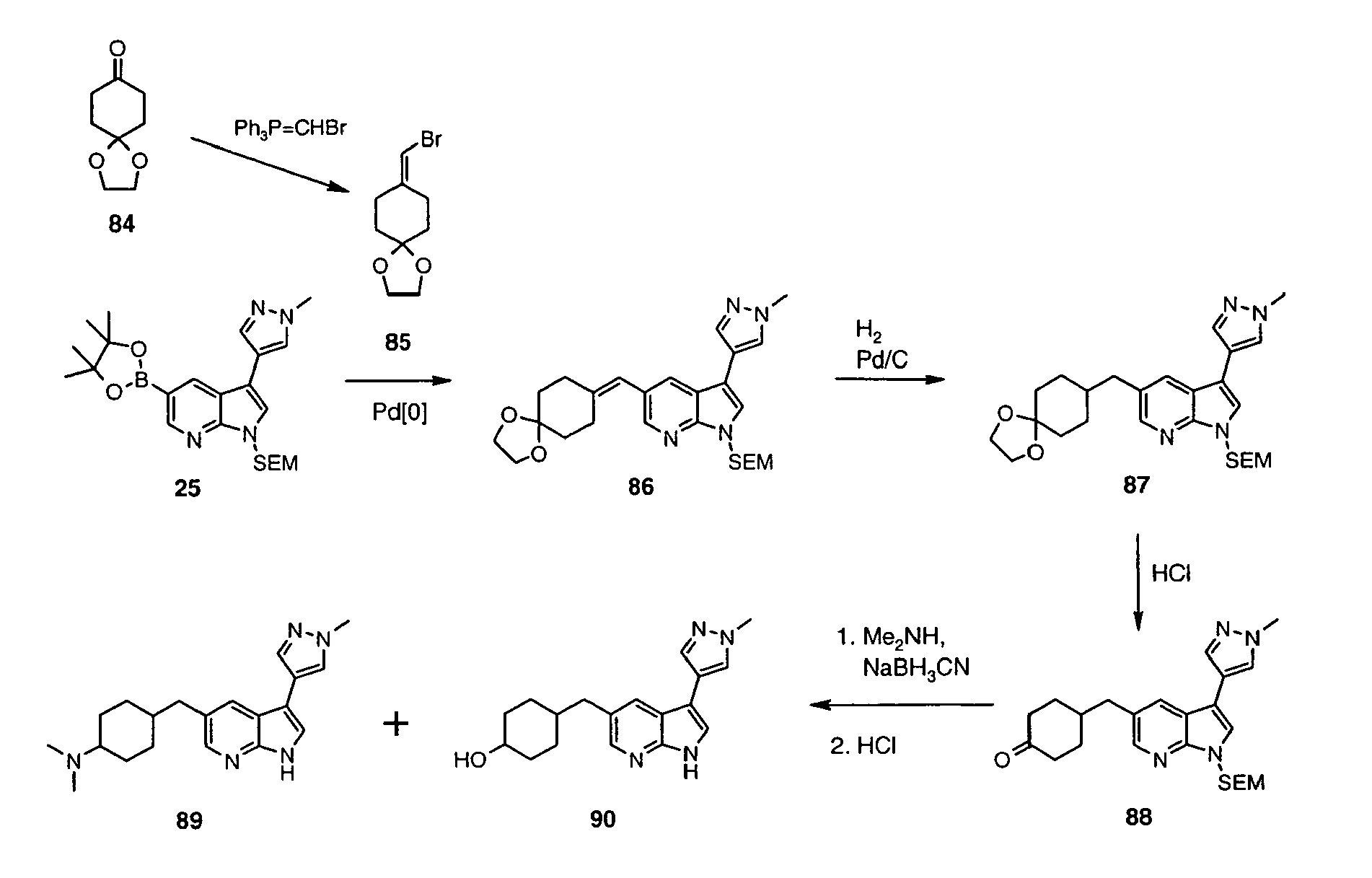
-

- 1.0 N solution of sodium hexamethyldisilazide (10.8 mL, 1N in THF, 10.8 mmol) was added dropwise to a cooled (-60°C) solution of bromomethyltriphenylphosphonium bromide (4.71 g, 10.8 mmol) in anhydrous THF (30 mL). After stirring for a further 1 h, 1,4-cyclohexanedione monoethylene acetal (84) (1.40 g, 8.96 mmol) in THF (5 mL) was added over 1 min. The cooling bath was then removed and the reaction mixture allowed to warm to r.t. and stir for a further 1 h. Hexane (50 mL) was then added, and the resulting solution was filtered through a short plug of SiO2. The filtrate was concentrated to afford yellow oil (2.21 g). Purification by means of SGC with AcOEt:hexane=9:1 (v/v) as eluent afforded 85 as a clear oil (1.32 g, 5.67 mmol, 63%). 1H NMR (400 MHz, CDCl3) δ 1.62 (t, J = 6.8 Hz, 3H), 1.65 (t, J = 7.4 Hz, 3H), 2.27 (ddd, J = 1.0, 5.3, 7.3 Hz, 2H), 2.42 (ddd, J = 1.0, 5.8, 7.6 Hz, 2H), 3.89-3.92 (m, 4H), 5.85 (pentet, J = 1.0 Hz, 1H).
-

- To a stirred solution of 85 (1.50 g, 6.44 mmol), 25 (1.94 g, 4.36 mmol) and (PPh3)2PdCl2 (300 mg, 0.43 mmol) in toluene:EtOH=1:1 (v/v, 20 mL) was added LiCl (650 mg, 14.9 mmol) and 1.0 M aqueous Na2CO3 (5 mL). The mixture was heated to refluxed (bath temperature 110°C) and stirred for 2.5 h. Saturated aqueous NaHCO3 (100 mL) was added, and the mixture was extracted with AcOEt (2 x 150 mL). The combined organic solutions were dried (MgSO4) and concentrated to afford a yellow oil (3.46 g). The crude product was purified by SGC using AcOEt:hexane=1:1 (v/v) as eluent to afford 86 as an oil (389 mg, 0.81 mmol, 19%). 1H NMR (400 MHz, CDCl3) δ 0.00 (s, 9H), 0.99 (t, J = 8.3 Hz, 2H), 1.76 (t, J = 6.5 Hz, 2H), 1.89 (t, J = 6.5 Hz, 2H), 2.55 (t, J = 6.5 Hz, 2H), 2.61 (t, J = 6.5 Hz, 2H), 3.63 (t, J = 8.3 Hz, 2H), 4.00-4.10 (m, 7H), 5.74 (s, 2H), 6.48 (s, 1H), 7.47 (s, 1H), 7.68 (s, 1H), 7.81 (s, 1H), 7.90 (d, J = 1.8 Hz, 1H), 8.29 (d, J = 1.8 Hz, 1H).
-

- To a solution of 86 (389 mg, 0.81 mmol) in MeOH (15 mL) was added 20% Pd(OH)2 on carbon (50 mg, cat.), and the reaction mixture was stirred vigorously under H2 for 48 h. The mixture was then filtered through Celite, which was then washed with MeOH:CH2Cl2=1:1 (v/v; 200 mL). The solutions were combined and concentrated to afford 87 as a clear oil (307 mg, 0.64 mmol, 79 %). 1H NMR (400 MHz, CDCl3) δ 0.00 (s, 9H), 0.99 (t, J = 8.1 Hz, 2H), 1.34-1.46 (m, 2H), 1.56 (dt, J = 13.9, 4.8 Hz, 2H), 1.61-2.12 (m, 5H), 2.74 (d, J = 7.1 Hz, 2H), 3.64 (t, J = 8.3 Hz, 2H), 4.00 (s, 4H), 4.07 (s, 3H), 5.76 (s, 2H), 7.47 (s, 1H), 7.70 (s, 1H), 7.82 (s, 1H), 7.88 (s, 1H), 8.23 (d, J = 1.8 Hz, 1H).
-
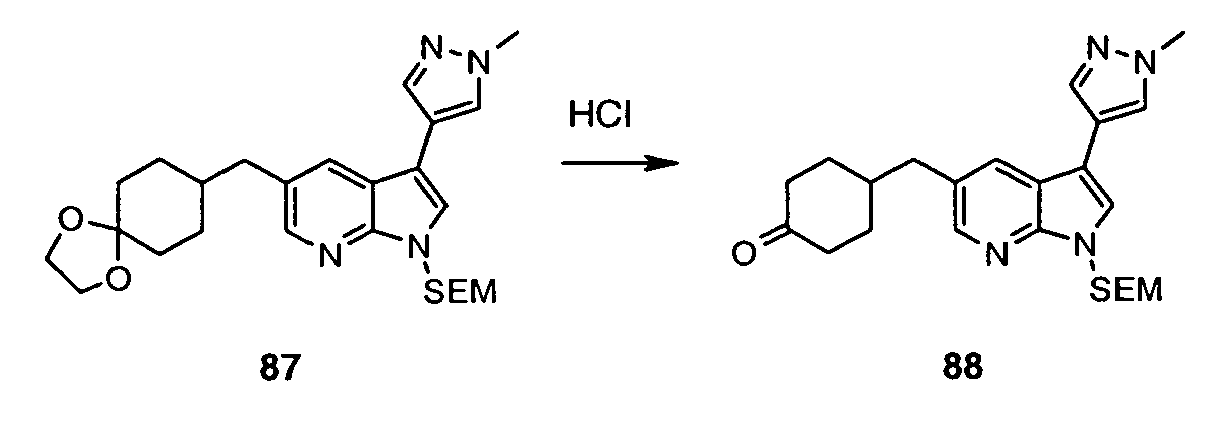
- To a solution of 87 (307 mg, 0.64 mmol) in THF (20 mL) was added 6.0 N aq. HCl solution (7 mL) and the reaction mixture was allowed to stir at r.t. for 1 h. Water (50 mL) was then added, and the mixture extracted with AcOEt (2 x 75 mL). The combined organic solutions were dried (MgSO4) and concentrated to afford 88 as a clear oil (261 mg, 0.59 mmol, 93%). 1H NMR (400 MHz, CDCl3) δ 0.00 (s, 9H), 0.99 (t, J = 8.2 Hz, 2H), 1.49-1.62 (m, 2H), 2.07-2.16 (m, 2H), 2.31-2.49 (m, 5H), 2.82 (d, J = 6.7 Hz, 2H), 3.65 (t, J = 8.3 Hz, 2H), 4.07 (s, 3H), 5.77 (s, 2H), 7.49 (s, 1H), 7.69 (s, 1H), 7.83 (s, 1H), 7.92 (s, 1H), 8.27 (s, 1H).
-

- To a solution of 88 (89 mg, 0.20mol) in MeOH (2 mL) was added Me2NHHCl (100 mg, 1.23 mmol), and the solution was allowed to stir for 10 min. NaBH3CN (30 mg, 0.48 mmol) was then added, and stirring was continued for 22 h. The reaction was then quenched by the addition of saturated aqueous NaHCO3 (25 mL) and extracted with AcOEt (2 x 25 mL). The combined organic solutions were (MgSO4) and concentrated to afford an oil (84 mg). The oil was dissolved in EtOH (2 mL) and 10% aq. HCl (2 mL) was added. The reaction mixture was heated to 90°C for 6 h, then evaporated and purified by preparative LCMS (column LUNA 10 µ C18(2) 00G-4253-V0 250x50 mm) using water - acetonitrile (0.1% AcOH) as eluent (in gradient; flow 80 mL/min) to afford two compounds. Eluting first, 89 (22 mg, 65 µmol, 33%), a white powder, as a 1:1 mixture of diastereomers. 1H NMR (400 MHz, CDCl3) δ 1.05-2.15 (m, 9H), 2.55-2.90 (m, 3H), 3.98 (s, 3H), 7.35 (s, 1H), 7.60 (s, 0.5H), 7.65 (s, 0.5H), 7.70-7.74 (m, 1H), 7.80 (d, J = 1.8 Hz, 0.5H), 7.86 (d, J = 1.8 Hz, 0.5H), 8.01 (d, J = 1.8 Hz, 0.5H), 8.05, (d, J = 1.8 Hz, 0.5H), 10.01 (br s, 0.5H), 10.05 (br s, 0.5H). MS (CI) m/z 338 (MH+). Further elution afforded 90, a white powder (8 mg, 26 µmol, 13%) as an unassigned 4:1 mixture of diastereoisomers. 1H NMR (400 MHz, CDCl3) δ 1.01-2.00 (m, 9H), 2.67 (d, J = 7.1 Hz, 1.6H), 2.73 (d, J = 7.1 Hz, 0.4H) 3.51-3.61 (m, 1H), 4.00 (s, 3H), 7.45 (s, 0.8H), 7.46 (s, 0.2H), 7.63 (s, 0.1H), 7.74 (s, 1H), 8.03 (s, 0.8H), 8.06 (s, 1H), 8.06 (s, 0.2H). MS (CI) m/z 311 (MH+).
-
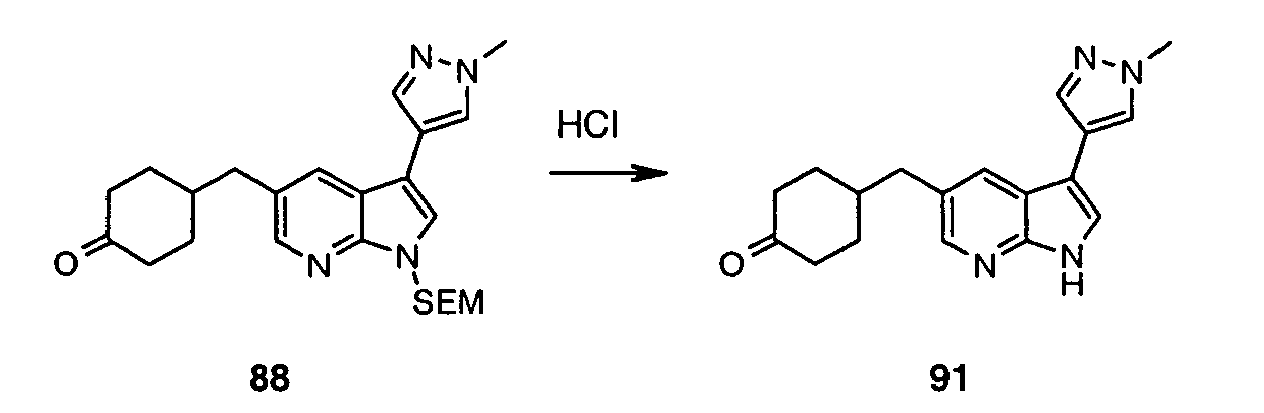
- To a solution of 88 (19 mg, 42 µmol) in EtOH (1 mL) was added 10% aq. HCl (1 mL) and the reaction mixture heated to reflux (bath temperature 90°C) for 18 h. The solution was then concentrated and the residue purified by preparative LCMS (column LUNA 10 µ C18(2) 00G-4253-V0 250x50 mm) using water - acetonitrile (0.1% AcOH) as eluent (in gradient; flow 80 mL/min) to afford 91 (8 mg, 26 µmol, 62%) as a white powder. 1H NMR (400 MHz, CDCl3) δ 1.49-1.63 (m, 2H), 2.04-2.19 (m, 3H), 2.31-2.50 (m, 4H), 2.92 (d, J = 6.9 Hz, 2H), 4.06 (s, 3H), 7.67 (s, 1H), 7.68 (s, 1H), 7.85 (s, 1H), 8.24 (s, 1H), 8.38 (s, 1H), 12.35 (br s, 1H). MS (CI) m/z 309 (MH+).
-

-

- Bromide 92 (158 mg, 0.31 mmol; prepared in analogous way to 20), isobutenyl boronic acid (40 mg, 0.40 mmol) and (PPh3)2PdCl2 (30 mg, 43 µmol) in toluene:EtOH 1:1 (2 mL) was added LiCl (50 mg, 1.18 mmol) and 1.0 M aq. Na2CO3 solution (0.5 mL). The mixture was refluxed (bath temperature 115°C) for 3 h. Saturated aqueous NaHCO3 (50 mL) was added, and the mixture was extracted with AcOEt (2 x 75 mL). The combined organic solutions were dried (MgSO4) and concentrated to afford a brown solid (175 mg). The crude product was purified by SGC using MeOH:CH2Cl2:AcOEt=2:49:49 (v/v) as eluent to afford 93 as an off-white powder (99 mg, 0.20 mmol, 66%). 1H NMR (400 MHz, CDCl3) δ 1.87 (s, 3H), 1.96 (s, 3H), 2.53 (t, J = 4.6 Hz, 4H), 2.88 (t, J = 6.6 Hz, 2H), 3.73 (t, J = 4.6 Hz, 4H), 4.33 (t, J = 6.6 Hz, 2H), 6.32 (1H, s, 1H), 7.51 (t, J = 7.8 Hz, 2H), 7.60 (t, J = 7.5 Hz, 1H), 7.77 (s, 2H), 7.78 (s, 1H), 7.80 (d, J = 1.9 Hz, 1H), 8.23 (d, J = 7.6 Hz, 2H), 8.37 (d, J = 1.9 Hz, 1H).
-

- To a solution of 93 (80 mg, 0.18 mmol) in MeOH (4 mL) was added 20% Pd(OH)2 on C (30 mg, cat.), and the reaction mixture was stirred vigorously under H2 for 24 h. The mixture was then filtered through Celite, which was then washed with MeOH:CH2Cl2=1:1 (v/v; 50 mL). The solutions were combined and concentrated to afford 94 as a foam (66 mg, 0.15 mmol, 82 %). 1H NMR (400 MHz, CDCl3) δ 0.84 (d, J = 6.6 Hz, 2H), 1.40 (t, J = 7.1 Hz, 3H), 1.80 (nonet, J = 6.7 Hz, 1H), 2.50 (d, J = 7.3 Hz, 2H), 2.49-2.60 (m, 4H), 2.84-3.06 (m, 2H), 3.63-3.76 (m, 4H), 4.29-4.46 (m, 2H), 7.42 (t, J = 7.6 Hz, 2H), 7.50 (t, J = 7.4 Hz, 1H), 7.66 (d, J = 2.0 Hz, 1H), 7.68 (s, 1H), 7.71 (s, 1H), 7.76 (s, 1H), 8.03 (d, J = 1.8 Hz, 1H), 8.14 (d, J = 7.6 Hz, 1H), 8.20 (d, J = 1.9 Hz, 1H).
-
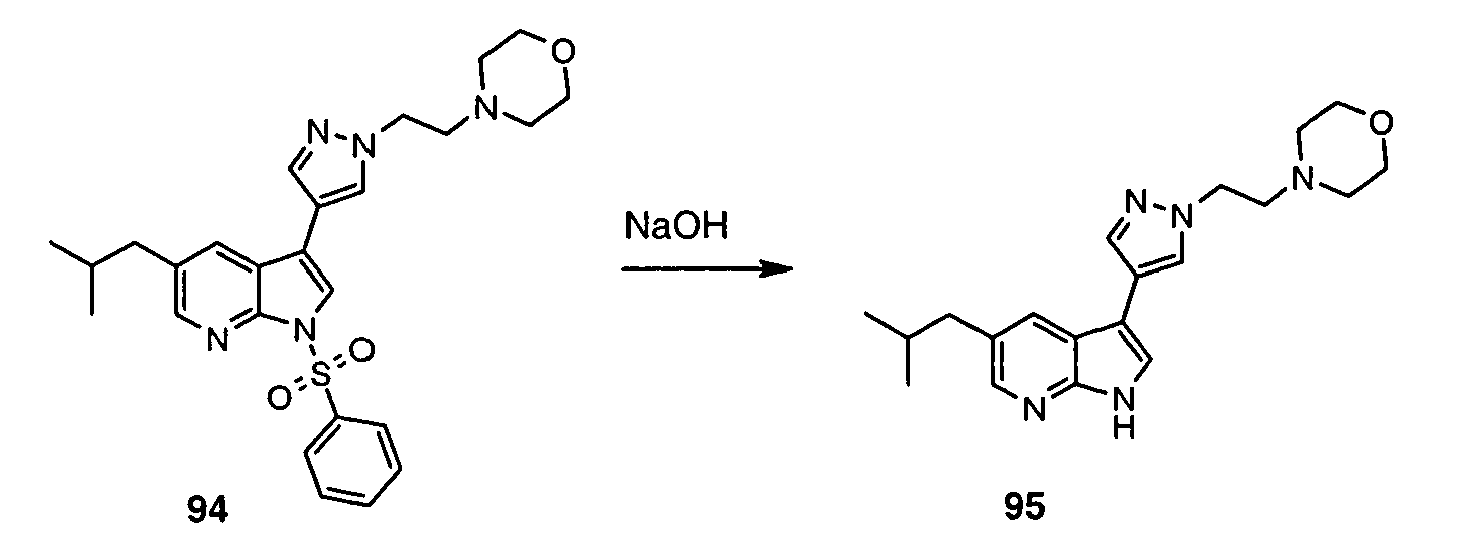
- To a stirred solution of 94 (66 mg, 0.15 mmol) in EtOH (2 mL) was added 10% aq. NaOH (1 mL) and the reaction mixture heated to reflux for 2 h. The mixture was then cooled, AcOEt (50 mL) added, and the solution was washed with saturated aqueous NaHCO3 (2 x 25 mL). The organic portion was dried (MgSO4) and concentrated to afford 25 as an off-white solid (44 mg, 0.12 mmol, 83%). 1H NMR (400 MHz, CDCl3) δ 0.88 (d, J = 6.6 Hz, 2H), 1.85 (nonet, J = 6.7 Hz, 1H), 2.46 (t, J = 4.5 Hz, 4H), 2.55 (d, J = 7.2 Hz, 2H), 2.81 (t, J = 6.7 Hz, 2H), 3.66 (t, J = 4.6 Hz, 4H), 4.26 (t, J = 6.6 Hz, 2H), 7.32 (d, J = 2.2 Hz, 1H), 7.68 (s, 1H), 7.70 (s, 1H), 7.76 (d, J = 1.7 Hz, 1H), 8.10 (d, J = 1.8 Hz, 1H), 9.52 (br s, 1H).
-
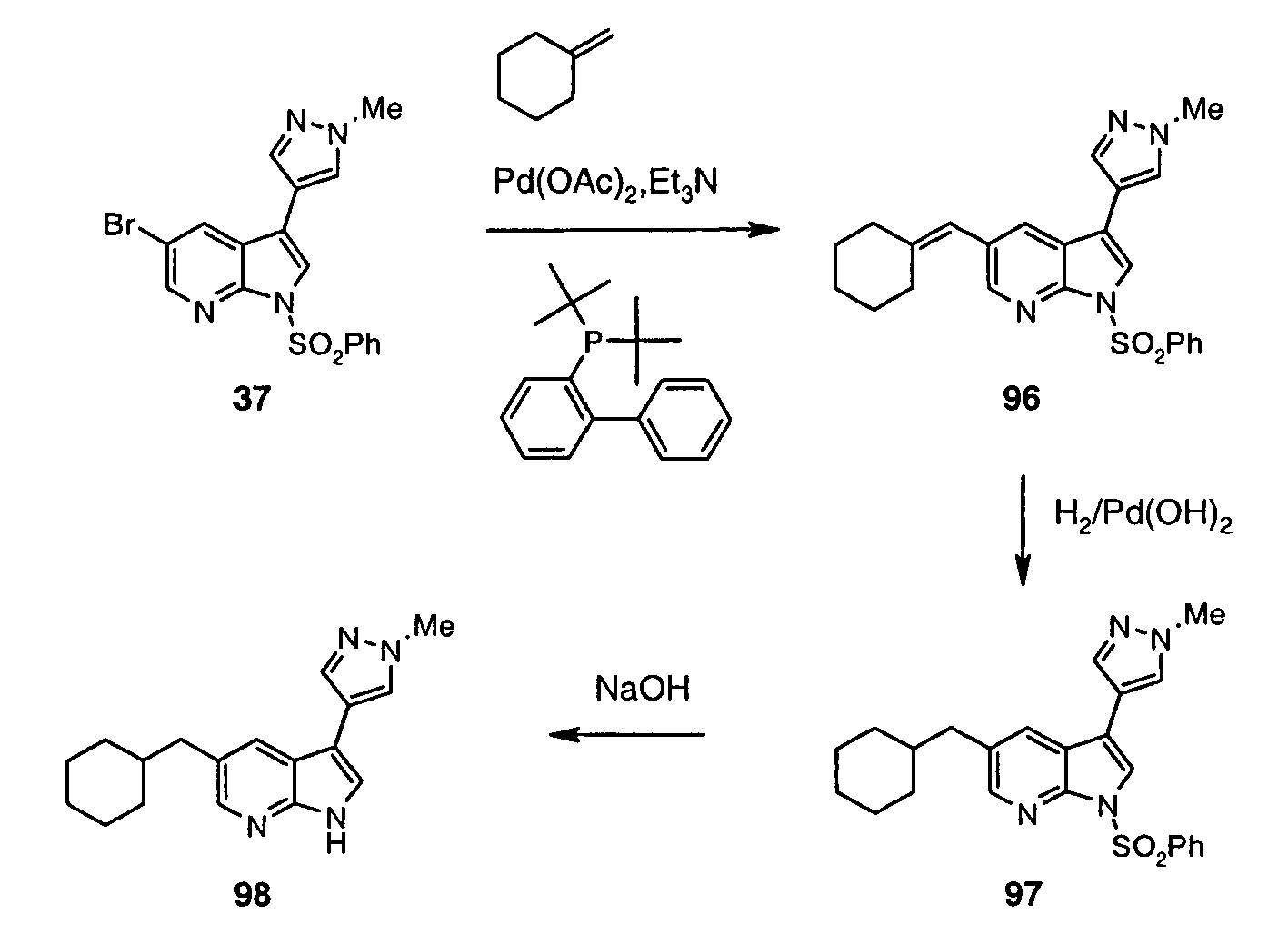
-

- A mixture of 37 (100 mg, 0.24 mmol), methylenecyclohexane (23.1 mg, 0.48 mmol), Pd(OAc)2 (5.39 mg, 0.024 mmol), biphenyl-2-yldi-tert-butylphosphine (14.3 mg, 0.048 mmol) and Et3N (121.4 mg, 1.2 mmol) in DMF (2 mL) was irradiated in a microwave (120 °C, 80 W) in a sealed tube for 5 min. The mixture was filtered and the product was isolated by reverse-phase LCMS (column LUNA 10 µ C18(2) 00G-4253-V0 250x50 mm) using water - acetonitrile (0.1% AcOH) as eluent (in gradient; flow 80 mL/min) to afford 96 (32 mg, 31 %) as a solid; 1H NMR (400 MHz; CDCl3) δ 1.34-1.43 (m, 2H), 1.43-1.56 (m, 4H), 2.11-2.23 (m, 4H), 3.85 (s, 3H), 6.10 (s, 1H), 7.32-7.38 (m, 2H), 7.40-7.46 (m, 1H), 7.49 (s, 1H), 7.59 (s, 1H), 7.60-7.62 (m, 2H), 8.05-8.09 (m, 2H), 8.17-8.19 (d, J = 2.09 Hz, 1H). MS (CI) m/z 433 (MH+).
-

- A mixture of 96 (32 mg, 0.073 mmol) and Pd(OH)2 (1.0 mg, 7.3 µmol) in MeOH (2.0 mL) was stirred under H2 at r.t. for 30.5 h. The mixture was filtered through Celite and concentrated to afford 97, which was used in the next step without purification.
-
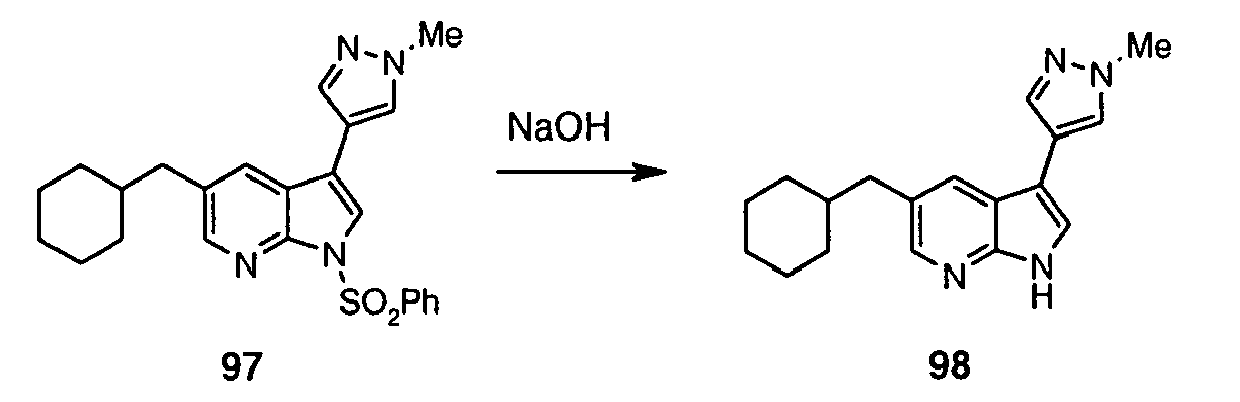
- A mixture of 97 (25 mg, 0.0575 mmol) and 10% aq. NaOH (0.32 mL) in EtOH (2 mL) was refluxed (oil bath temperature 105 °C) for 30 min., cooled to r.t. and partitioned between water:AcOEt. The aqueous layer was extracted with AcOEt. The extract was dried (MgSO4), concentrated and separated by means of PTLC using AcOEt as eluent to afford desired inhibitor 98 (2.23 mg, 11 % over 2 steps) as a solid. 1H NMR (400 MHz; CDCl3) δ 0.86-0.97 (m, 2H), 1.05-1.26 (m, 4H), 1.53-1.73 (m, 5H), 2.54 (d, J = 7.1 Hz, 2H), 3.93 (s, 3H), 7.29 (d, J = 2.3 Hz, 1H), 7.55 (s, 1H), 7.69 (d, J = 0.5 Hz, 1H), 7.74 (d, J = 1.9 Hz, 1H), 8.07 (d, J = 1.8 Hz. 1H). 9.31 (bs, 1NH): MS (CI) m/z 295 (MH+).
-

-

- A mixture of 37 (100 mg, 0.24 mmol), methylenecyclopentane (19.72 mg, 0.48 mmol), Pd(OAc)2 (5.39 mg, 0.024 mmol), biphenyl-2-yldi-tert-butylphosphine (14.3 mg, 0.048 mmol) and Et3N (121.4 mg, 1.2 mmol) in DMF (2 mL) was irradiated in a microwave (110 °C, 80 W) in a sealed tube for 19 h. The mixture was partitioned between AcOEt (10 mL) saturated aqueous NH4Cl. The aqueous layer was extracted with AcOEt. The combined organic solutions were dried (MgSO4), concentrated and the product was isolated by reverse-phase LCMS (column LUNA 10 µ C18(2) 00G-4253-V0 250x50 mm) using water - acetonitrile (0.1 % AcOH) as eluent (in gradient; flow 80 mL/min) to afford 99 (22.70 mg, 23%) as a solid. 1H NMR (400 MHz; CDCl3) δ 1.86-1.91 (m, 2H), 2.17-2.25 (m, 2H), 2.27-2.35 (m, 2H), 3.46-3.50 (m, 2H), 4.01 (s, 3H), 5.30-5.37 (m, 1H), 7.48-7.55 (m, 1H), 7.56-7.61 (m, 1H), 7.65 (s, 1H), 7.52-7.83 (m, 3H), 8.21-8.23 (m, 2H), 8.23-8.25 (m, 1H), 8.32 (d, J = 2.1 Hz, 1H). MS (CI) m/z 419 (MH+).
-

- A mixture of 99 (22.70 mg, 0.054 mmol) and 10% aq. NaOH (0.60 mL) in EtOH (1.43 mL) was refluxed (oil bath temperature 105 °C) for 30 min., cooled to r.t. and partitioned between water:AcOEt. The aqueous layer was extracted with AcOEt. The extract was dried (MgSO4), concentrated and separated by means of PTLC using AcOEt as eluent to afford desired inhibitor 100 (4.29 mg, 44%) as a solid. 1H NMR (400 MHz; CDCl3) δ 1.77-1.84 (m, 2H), 2.12-2.21 (m, 2H), 2.21-2.28 (m, 2H), 3.42-3.46 (m, 2H), 3.92 (s, 3H), 5.25-5.29 (m, 1H), 7.30 (d, J = 2.5 Hz, 1H), 7.55 (s, 1H), 7.68 (s, 1H), 7.87 (d, J = 1.7 Hz, 1H), 8.12 (d, J = 1.8 Hz, 1H), 9.16 (bs, 1NH). MS (CI) m/z 279 (MH+).
- 1. Compound is dissolved in DMSO to a convenient concentration and this is diluted in 10% DMSO to a five times concentrate of the desired starting concentration (frequently 1:100).
2. 10 µl of 500 mM EDTA is added to alternative wells of the Opti-plate row, which will receive kinase reaction plus DMSO. This creates the negative control.
3. For the JNK2 and JNK3 assay, compounds are prepared in six 2-fold dilutions with water and each concentration is tested in duplicate. For the JNK1 assay compounds are prepared in four 5-fold dilutions with water which are tested in triplicate. Controls are treated identically.
4. 20 µl per well of each compound concentration is transferred to an Opti-plate, in duplicate.
5. 30 µl (JNK2/3 SPA) or 50 µl (JNK1 SPA) of substrate solution (25 mM HEPES pH 7.5, 10mM magnesium acetate with 3.33µM ATP (JNK2/3) or 2µM ATP (JNK1), approximately 7.5 kBq [γ-33P] ATP, GST-c-Jun, in water) is added to each well.
6. 50 µl (JNK2/3 SPA) or 30 µl (JNK1 SPA) of kinase solution (JNK in 25 mM HEPES pH 7.5, 10mM Mg Acetate) is added to each well.Kinase Kinase per well (µg) GST-c-Jun per well (µg) JNK1 0.25 1 JNK2 0.2 1.2 JNK3 0.16 1.2
8. 100 µl of bead/stop solution is added to each well (5 mg/ml glutathione-PVT-SPA beads, 40 mM ATP in PBS).
9. Plates are sealed and incubated for 30 minutes at room temperature, centrifuged for 10 minutes at 2500g and counted.
10. The IC50 values are calculated as the concentration of the compound being tested at which the phosphorylation of c-Jun is decreased to 50% of the control value. Example IC50 values for the compounds of this invention are given in Table 1. - Active p38 kinase (100 ng; Upstate) was added to 2 µg GST-ATF2 substrate (NEB) in 250 mM Hepes pH 7.5/100 mM MgAc/50 µM ATP (final) in the presence or absence of compounds in 50µl. The mixture was incubated at 30°C for 1 hour, and then diluted with 200 µl PBS-Tween (0.05 %). From this, duplicate volumes of 100 µl were added to a Reacti-Bind glutathione coated plate (Pierce) and incubated for 1 hour. After washing 3 times with PBS-Tween (0.05 %), rabbit anti-phospho-ATF2 (Thr71) antibody (NEB) was added at 1:500, and incubated for another hour at room temperature. After 3 additional washes with PBS-Tween (0.05 %), 100 µl of anti-rabbit IgG alkaline phosphatase-conjugated secondary antibody (Sigma) was added at 1:1000, the reaction was incubated for a further hour, washed 3 times, and then phosphatase substrate (Sigma) was added (100 µl per well; 3 tablets in 5 ml water). After incubation in the dark at 37°C for 1 hour, the reaction mixture was transferred to a clear 96 well plate, and the absorbance at 405 nm was read. The IC50 values are calculated as the concentration of the compound being tested at which the phosphorylation of ATF2 is decreased to 50% of the control value. Example IC50 values for the compounds of this invention are given in Table 1.
Table 1. IC50 values for selected compounds against JNK3. Compound JNK3 IC50 (nM) Compound JNK3 IC50 (nM) 
<500 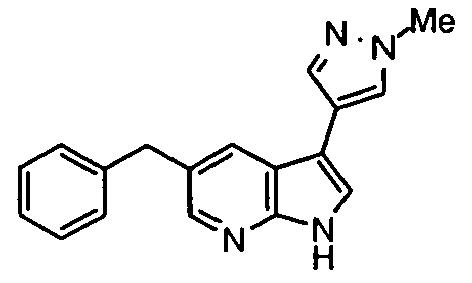
<200 
<1000 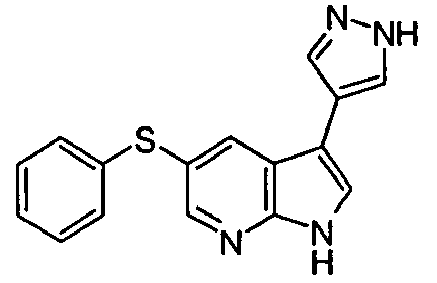
<200 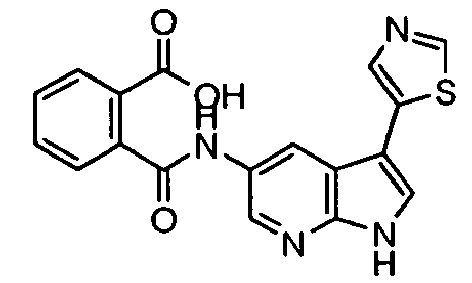
<200 
<1000 
<500 
<1000 
<500 
<500 
<500 
<2000 
<1000 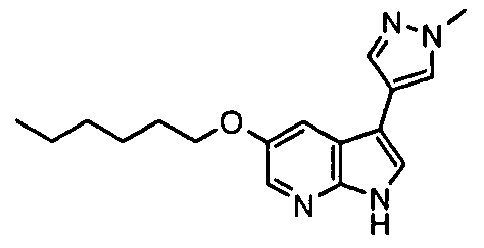
<500 
<500 
<200 
<500 
<500 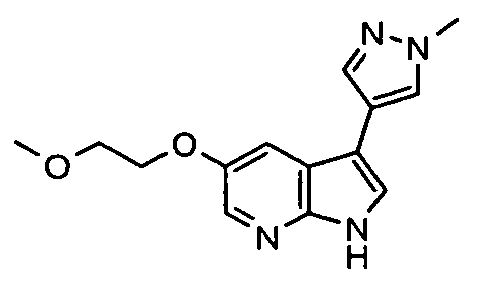
<2000 
<500 
<200 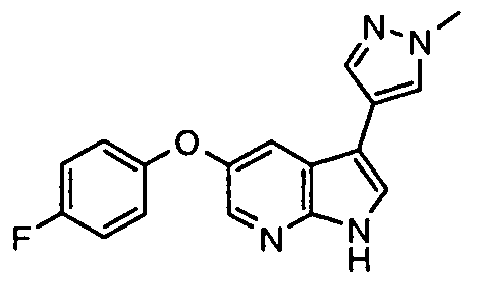
<1000 
<500 
<2000 
<500 
<500 
<500 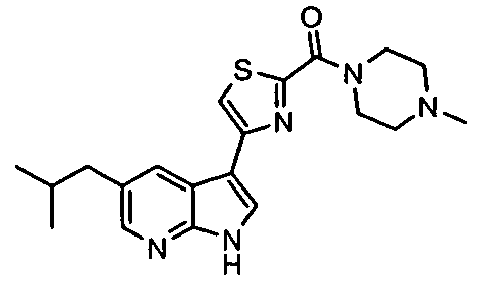
<100 
<100 
<200 
<500 
<1000 
<1000 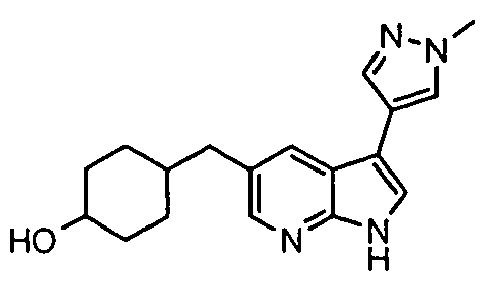
<100 
<500 
<200 
<500 
<1000 
<200 
<100 
<100 
<100 
<200 
<500 
<1000 
<100 
<200 
<500 
<500 
<1000 
<200 
<200 
<500 
<200 
<500 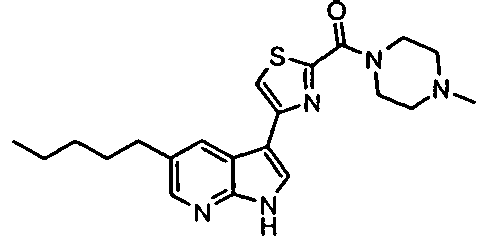
<200 
<200 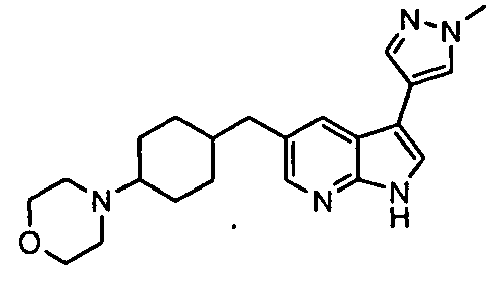
<200 
<200 
<200 
<500 
<100 
<100 
<100 
<200 
<200 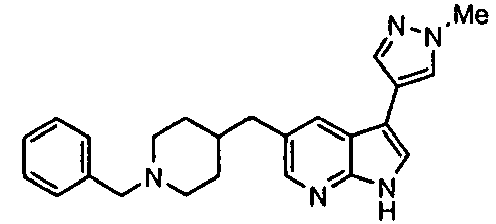
<200
Claims (36)
- A compound of formula (I):

R1 is hydrogen, C1-10 alkyl, C2-10 alkenyl, C2-10 alkynyl, C3-10 aryl, C3-10 cycloalkyl, C3-10 cycloalkenyl or C3-10 heterocyclyl;
said R1 group being optionally substituted with one or more of C1-6 alkyl, C1-10 alkoxy, C3-10 cycloalkyl, halo, hydroxy, oxo, CO2R5, C3-10aryl, C3-10heterocyclyl, C1-6alkylC3-10 aryl, NR6 2 and wherein the C3-10 heterocyclyl group can be further optionally substituted with C1-6 alkyl;
and R2 is a 3-10 membered heterocyclyl;
said R2 group being optionally substituted with one or more of C1-6 alkyl, CO2H, C3-10heterocyclyl, CO-C3-10heterocyclyl, C1-6alkylC3-10heterocyclyl and wherein the heterocyclyl group can be further optionally substituted with a C1-6 alkyl group;
wherein R3 is hydrogen or C1-6 alkyl;
R4 is hydrogen or C1-6 alkyl;
R5 is hydrogen or C1-6 alkyl; and
R6 is hydrogen or C1-6 alkyl. - A compound as claimed in claim 1 wherein R1 is an unbranched alkyl group having 2, 3, 4, 5 or 6 carbon atoms.
- A compound as claimed in claim 1 wherein R1 is an unbranched alkenyl or alkynyl group having 2, 3, 4, 5 or 6 carbon atoms.
- A compound as claimed in claim 1 wherein R1 is a C5 or C6 cycloalkyl or aryl group optionally substituted with one or more of C1-4 alkyl or a halogen.
- A compound as claimed in claim 4 wherein the aryl group is substituted at the ortho or para position.
- A compound as claimed in claim 4 or claim 5 wherein R1 is phenyl.
- A compound as claimed in any one of claims 1 to 6 wherein R2 is a 5-membered heterocycle comprising one or more heteroatoms selected from O, S or N,
- A compound as claimed in any one of claims 1 to 7 wherein R2 is a 5-membered heterocycle comprising two or more heteroatoms selected from O, S or N.
- A compound as claimed in claim 7 or claim 8 wherein one or more of the heteroatoms of R2 is substituted with C1-6alkyl.
- A compound as claimed in any one of claims 1 to 9 wherein R2 is a 5-membered heterocycle selected from, furan, imidazole, imidazoline, imidazolidine, isoxazole, isothiazole, oxazole, oxadiazole, oxathiazole, oxathiazolidine, pyrazole, pyrazoline, pyrazolidine, pyrrole, tetrahydrofuran, tetrazole, thiophene, thiadiazole, thiazole or triazole;
wherein said heterocycle is optionally substituted with an alkyl group having 1, 2, 3, 4, 5 or 6 carbon atoms. - A compound as claimed in claim 10 wherein said optional substitution occurs at one or more of O, S or N in the heterocycle.
- A compoundas claimed in any one of claims 7 to 10 wherein R2 is substituted with a group

- A compound of formula II

wherein R4 is hydrogen or C1-6 alkyl,
R3 is hydrogen or C1-6 alkyl,
and R2 is a 3-8 membered heterocyclyl optionally substituted with one or more of C1-6 alkyl. - A compound as claimed in claim 13 wherein R1 is a branched alkyl having 3, 4, 5 or 6 carbon atoms.
- A compound as claimed in any one of claims 1 to 14 selected from


- A prodrug of a compound as defined in any of claims 1-15.
- A composition comprising a compound as defined in any of claims 1-15 in combination with a pharmaceutically acceptable carrier, diluent or excipient.
- A composition as claimed in claim 17 further comprising one or more other active agent.
- A composition as claimed in claim 18 wherein said other active agent is an anti-inflammatory agent.
- A process for the manufacture of a composition as defined in any of claims 17-19, comprising combining a compound as defined in any of claims 1-15, with the pharmaceutically acceptable carrier or diluent.
- A compound as defined in any of claims 1-15, or a composition as defined in any of claims 17-19, for use in medicine.
- A compound as defined in any of claims 1-15, or a composition as defined in any of claims 17-19, for inhibiting JNK.
- A compound as claimed in claim 22 for selectively inhibiting JNK3.
- A compound as defined in any of claims 1-15, or a composition as defined in any of claims 17-19, for use in the prevention or treatment of a JNK-mediated disorder.
- A compound or a composition as claimed in claim 24, wherein the disorder is a neurodegenerative disorder, dementia, inflammatory disease, an apoptosis disorder, autoimmune disease, destructive bone disorder, proliferative disorder, cancer, infectious disease, allergy, ischemia reperfusion injury, heart attack, angiogenic disorder, organ hypoxia, vascular hyperplasia, cardiac hypertrophy, thrombin induced platelet aggregation and/or a prostaglandin endoperoxidase synthase-2 condition.
- A compound or composition as claimed in claim 25, wherein the neurodegenerative disorder is an apoptosis neurodegenerative disorder and/or an inflammation neurodegenerative disorder.
- A compound or composition as claimed in claim 25 or 26, wherein the neurodegenerative disorder is: dementia; Alzheimer's disease; Parkinson's disease; Amyotrophic Lateral Sclerosis; Huntington's disease; senile chorea; Sydenham's chorea; hypoglycemia; head and spinal cord trauma; traumatic head injury; acute and chronic pain; epilepsy and seizures; olivopontocerebellar dementia; neuronal cell death; hypoxia-related neurodegeneration; acute hypoxia; glutamate toxicity; glutamate neurotoxicity; cerebral ischemia; dementia in a meningitis patient and/or dementia in a neurosis patient; cerebrovascular dementia; or dementia in an HIV-infected patient or wherein the neurodegenerative disorder is a peripheral neuropathy, including mononeuropathy, multiple mononeuropathy or polyneuropathy, such as may be found in diabetes mellitus, Lyme disease or uremia; peripheral neuropathy; demyelinating disease, leukodystrophies or Guillain-Barré syndrome; multiple mononeuropathy secondary to a collagen vascular disorder; multiple mononeuropathy secondary to sarcoidosis; multiple mononeuropathy secondary to a metabolic disease; or multiple mononeuropathy secondary to an infectious disease.
- A compound or composition as claimed in claim 25, wherein the disorder is inflammatory bowel disorder; bronchitis; asthma; acute pancreatitis; chronic pancreatitis; allergies of various types; Alzheimer's disease; autoimmune disease such as rheumatoid arthritis, systemic lupus erythematosus, glumerulonephritis, scleroderma, chronic thyroiditis, Graves's disease, autoimmune gastritis, diabetes, autoimmune haemolytis anaemia, autoimmune neutropaenia, thrombocytopenia, atopic dermatitis, chronic active hepatitis, myasthenia gravis, multiple sclerosis, ulcerative colitis, Crohn's disease, psoriasis or graft vs host disease.
- Use of a compound as defined in claim 1-15 in the manufacture of a medicament for the prevention or treatment of a JNK-mediated disorder, wherein the disorder is a neurodegenerative disorder, inflammatory disease, an apoptosis disorder, particularly neuronal apoptosis, autoimmune disease, destructive bone disorder, proliferative disorder, cancer, infectious disease, allergy, ischemia reperfusion injury, heart attack, angiogenic disorder, organ hypoxia, vascular hyperplasia, cardiac hypertrophy, thrombin induced platelet aggregation and/or a prostaglandin endoperoxidase synthase-2 condition.
- An assay for determining the activity of the compounds as defined in any of claims 1-16, comprising providing a system for assaying the activity and assaying the activity of a compound as defined in any of claims 1-16.
- An assay as claimed in claim 30 wherein the assay is for the JNK inhibiting activity of the compound.
- An assay as claimed in claim 31 wherein the assay is for the JNK3-specific inhibiting activity of the compound.
- An assay as claimed in claim 30, 31 or 32, wherein the assay is a Scintillation Proximity Assay (SPA) using radiolabelled ATP, or is an ELISA.
- A method of inhibiting the activity or function of a JNK, particularly JNK3, which method comprises exposing a JNK to a compound as defined in any of claims 1-15 or a composition as defined in any of claims 17-28.
- A method as claimed in claim 34, which is performed in a research model.
- A method as claimed in claim 35 wherein the research model is an animal model.
Applications Claiming Priority (1)
| Application Number | Priority Date | Filing Date | Title |
|---|---|---|---|
| GBGB0516156.7A GB0516156D0 (en) | 2005-08-05 | 2005-08-05 | JNK inhibitors |
Publications (2)
| Publication Number | Publication Date |
|---|---|
| EP1749829A1 true EP1749829A1 (en) | 2007-02-07 |
| EP1749829B1 EP1749829B1 (en) | 2010-11-03 |
Family
ID=34984169
Family Applications (1)
| Application Number | Title | Priority Date | Filing Date |
|---|---|---|---|
| EP06254089A Active EP1749829B1 (en) | 2005-08-05 | 2006-08-03 | JNK inhibitors |
Country Status (6)
| Country | Link |
|---|---|
| US (2) | US7645769B2 (en) |
| EP (1) | EP1749829B1 (en) |
| AT (1) | ATE486870T1 (en) |
| DE (1) | DE602006017930D1 (en) |
| ES (1) | ES2355738T3 (en) |
| GB (1) | GB0516156D0 (en) |
Cited By (21)
| Publication number | Priority date | Publication date | Assignee | Title |
|---|---|---|---|---|
| WO2008079909A1 (en) * | 2006-12-21 | 2008-07-03 | Plexxikon, Inc. | Pyrrolo [2,3-b] pyridines as kinase modulators |
| US7405302B2 (en) * | 2005-10-11 | 2008-07-29 | Amira Pharmaceuticals, Inc. | 5-lipoxygenase-activating protein (FLAP) inhibitors |
| WO2010015803A1 (en) * | 2008-08-05 | 2010-02-11 | Eisai R & D Management Co. Ltd | Diazaindole derivatives and their use in the inhibition of c-jun n-terminal kinase |
| DE102008038221A1 (en) | 2008-08-18 | 2010-02-25 | Merck Patent Gmbh | 7-azaindole derivatives |
| US7977359B2 (en) | 2005-11-04 | 2011-07-12 | Amira Pharmaceuticals, Inc. | 5-lipdxygenase-activating protein (FLAP) inhibitors |
| EP2370448A2 (en) * | 2008-11-17 | 2011-10-05 | Universite De Nice-Sophia Antipolis | Process for preparing boronic acids and esters in the presence of magnesium metal |
| US8399666B2 (en) | 2005-11-04 | 2013-03-19 | Panmira Pharmaceuticals, Llc | 5-lipoxygenase-activating protein (FLAP) inhibitors |
| US8546431B2 (en) | 2008-10-01 | 2013-10-01 | Panmira Pharmaceuticals, Llc | 5-lipoxygenase-activating protein (FLAP) inhibitors |
| US8697730B2 (en) | 2007-10-26 | 2014-04-15 | Panmira Pharmaceuticals, Llc | 5-lipoxygenase activating protein (FLAP) inhibitor |
| US8741920B2 (en) | 2009-08-03 | 2014-06-03 | Hoffmann-La Roche, Inc. | Process for the manufacture of pharmaceutically active compounds |
| US8772495B2 (en) | 2008-05-23 | 2014-07-08 | Panmira Pharmaceuticals, Llc | 5-lipoxygenase-activating protein inhibitor |
| US8841295B2 (en) | 2005-11-04 | 2014-09-23 | Panmira Pharmaceuticals, Llc | 5-lipoxygenase-activating protein (FLAP) inhibitors |
| JP2016515592A (en) * | 2013-04-02 | 2016-05-30 | エフ.ホフマン−ラ ロシュ アーゲーF. Hoffmann−La Roche Aktiengesellschaft | Inhibitor of breton tyrosine kinase |
| JP2016535097A (en) * | 2013-11-08 | 2016-11-10 | アイティーオス セラペウティクス | 4- (Indol-3-yl) -pyrazole derivatives, pharmaceutical compositions and methods for use |
| US9624213B2 (en) | 2011-02-07 | 2017-04-18 | Plexxikon Inc. | Compounds and methods for kinase modulation, and indications therefor |
| US9663517B2 (en) | 2009-04-03 | 2017-05-30 | Plexxikon Inc. | Compositions and uses thereof |
| US9695169B2 (en) | 2012-05-31 | 2017-07-04 | Plexxikon Inc. | Synthesis of heterocyclic compounds |
| CN107434807A (en) * | 2017-09-20 | 2017-12-05 | 上海泓博智源医药股份有限公司 | A kind of preparation method of the azaindole of 5 hydroxyl 7 |
| US9844539B2 (en) | 2007-07-17 | 2017-12-19 | Plexxikon Inc. | Compounds and methods for kinase modulation, and indications therefor |
| CN111099625A (en) * | 2018-10-25 | 2020-05-05 | 中国石油化工股份有限公司 | Molecular sieve SCM-24, its synthesis method and use |
| US20220144827A1 (en) * | 2018-11-13 | 2022-05-12 | Shanghai Ennovabio Pharmaceuticals Co., Ltd. | Five-and-six-membered heterocyclic compound and use thereof as protein receptor kinase inhibitor |
Families Citing this family (28)
| Publication number | Priority date | Publication date | Assignee | Title |
|---|---|---|---|---|
| DE60316542T2 (en) * | 2002-03-28 | 2008-07-03 | Eisai R&D Management Co., Ltd. | 7-AZAINDOLE AS INHIBITORS C-JUN N-TERMINAL KINASES FOR THE TREATMENT OF NEURODEGENERATIVE DISORDER |
| GB0305142D0 (en) * | 2003-03-06 | 2003-04-09 | Eisai London Res Lab Ltd | Synthesis |
| US7612086B2 (en) * | 2003-05-16 | 2009-11-03 | Eisai R & D Management Co. Ltd. | JNK inhibitors |
| CN1925855B (en) | 2003-12-19 | 2010-06-16 | 普莱希科公司 | Compounds and methods for developing Ret modulators |
| GB0405055D0 (en) * | 2004-03-05 | 2004-04-07 | Eisai London Res Lab Ltd | JNK inhibitors |
| US7498342B2 (en) | 2004-06-17 | 2009-03-03 | Plexxikon, Inc. | Compounds modulating c-kit activity |
| US7846941B2 (en) | 2005-05-17 | 2010-12-07 | Plexxikon, Inc. | Compounds modulating c-kit and c-fms activity and uses therefor |
| UA95244C2 (en) | 2005-06-22 | 2011-07-25 | Плексикон, Инк. | Compounds and methods for kinase modulation, and indications therefor |
| GB0516156D0 (en) * | 2005-08-05 | 2005-09-14 | Eisai London Res Lab Ltd | JNK inhibitors |
| WO2007136790A2 (en) * | 2006-05-18 | 2007-11-29 | Mannkind Corporation | Intracellular kinase inhibitors |
| WO2008063888A2 (en) | 2006-11-22 | 2008-05-29 | Plexxikon, Inc. | Compounds modulating c-fms and/or c-kit activity and uses therefor |
| JP2010514695A (en) | 2006-12-21 | 2010-05-06 | プレキシコン,インコーポレーテッド | Compounds and methods for kinase regulation and indications therefor |
| PE20121126A1 (en) | 2006-12-21 | 2012-08-24 | Plexxikon Inc | PIRROLO [2,3-B] PYRIDINES COMPOUNDS AS KINASE MODULATORS |
| GB0702265D0 (en) * | 2007-02-06 | 2007-03-14 | Eisai London Res Lab Ltd | 7-Azaindole derivatives |
| UA101004C2 (en) * | 2007-12-13 | 2013-02-25 | Теракос, Инк. | Derivatives of benzylphenylcyclohexane and use thereof |
| CN103910702A (en) * | 2008-08-22 | 2014-07-09 | 泰拉科斯有限公司 | Processes For The Preparation Of Sglt2 Inhibitors |
| LT3141252T (en) | 2009-06-17 | 2018-11-12 | Vertex Pharmaceuticals Inc. | Inhibitors of influenza viruses replication |
| CN106220623A (en) | 2009-11-06 | 2016-12-14 | 普莱希科公司 | Compounds and methods for and indication thereof for kinases regulation |
| WO2011153712A1 (en) | 2010-06-12 | 2011-12-15 | Theracos, Inc. | Crystalline form of benzylbenzene sglt2 inhibitor |
| RU2013132681A (en) | 2010-12-16 | 2015-01-27 | Вертекс Фармасьютикалз Инкорпорейтед | INFLUENZA VIRUS REPLICATION INHIBITORS |
| AR085279A1 (en) | 2011-02-21 | 2013-09-18 | Plexxikon Inc | SOLID FORMS OF {3- [5- (4-CHLORINE-PHENYL) -1H-PIRROLO [2,3-B] PIRIDINA-3-CARBONIL] -2,4-DIFLUOR-PHENIL} -AMIDE OF PROPANE ACID-1- SULFONIC |
| UA118010C2 (en) | 2011-08-01 | 2018-11-12 | Вертекс Фармасьютікалз Інкорпорейтед | INFLUENCES OF INFLUENZA VIRUS REPLICATION |
| WO2013152476A1 (en) | 2012-04-10 | 2013-10-17 | Theracos, Inc. | Process for the preparation of benzylbenzene sglt2 inhibitors |
| CN105611920B (en) | 2013-10-12 | 2021-07-16 | 泰拉科斯萨普有限责任公司 | Preparation of hydroxy-diphenylmethane derivatives |
| JP6618901B2 (en) | 2013-11-13 | 2019-12-11 | バーテックス ファーマシューティカルズ インコーポレイテッドVertex Pharmaceuticals Incorporated | Methods for preparing inhibitors of influenza virus replication |
| LT3068776T (en) | 2013-11-13 | 2019-08-12 | Vertex Pharmaceuticals Incorporated | Inhibitors of influenza viruses replication |
| EP3294735B8 (en) | 2015-05-13 | 2022-01-05 | Vertex Pharmaceuticals Incorporated | Inhibitors of influenza viruses replication |
| EP3294717B1 (en) | 2015-05-13 | 2020-07-29 | Vertex Pharmaceuticals Inc. | Methods of preparing inhibitors of influenza viruses replication |
Citations (8)
| Publication number | Priority date | Publication date | Assignee | Title |
|---|---|---|---|---|
| EP0636626A1 (en) | 1993-07-20 | 1995-02-01 | Laboratoires Glaxo Sa | Pyrazolopyrimidine Derivatives |
| WO2002010137A2 (en) * | 2000-07-31 | 2002-02-07 | Signal Pharmaceuticals, Inc. | Indazole derivatives as jnk inhibitors |
| WO2003082868A1 (en) | 2002-03-28 | 2003-10-09 | Eisai Co., Ltd. | 7-azaindoles as inhibitors of c-jun n-terminal kinases for the treatment of neurodegenerative disorders |
| WO2003082869A1 (en) * | 2002-03-28 | 2003-10-09 | Eisai Co., Ltd. | Azaindoles as inhibitors of c-jun n-terminal kinases |
| WO2004078756A2 (en) | 2003-03-06 | 2004-09-16 | Eisai Co., Ltd. | Jnk inhibitors |
| WO2004078757A2 (en) | 2003-03-06 | 2004-09-16 | Eisai Co., Ltd. | Synthesis of 5-substituted 7-azaindoles and 7-azaidonines |
| WO2004101565A2 (en) | 2003-05-16 | 2004-11-25 | Eisai Co., Ltd. | Jnk inhibitors |
| WO2005085244A1 (en) | 2004-03-05 | 2005-09-15 | Eisai London Research Laboratories Limited | 3,5-disubstituted 1h-pzrrolo [2,3-b] pyridines as jnk inhibitors |
Family Cites Families (28)
| Publication number | Priority date | Publication date | Assignee | Title |
|---|---|---|---|---|
| US4719218A (en) * | 1985-12-12 | 1988-01-12 | Smithkline Beckman Corporation | Pyrrolo[1,2-a]imidazole and pyrrolo[1,2-a]pyridine derivatives and their use as 5-lipoxygenase pathway inhibitor |
| GB9026926D0 (en) | 1990-12-12 | 1991-01-30 | Smith Kline French Lab | Novel process |
| ZA919797B (en) | 1990-12-13 | 1992-10-28 | Smithkline Beecham Corp | Bicyclo-5,6-dihydro-7h-pyrrolo-1,20-imidazol-7-ols and 7-ones |
| SE9100920D0 (en) | 1991-03-27 | 1991-03-27 | Astra Ab | NEW ACTIVE COMPOUNDS |
| JP3119758B2 (en) | 1993-02-24 | 2000-12-25 | 日清製粉株式会社 | 7-Azaindole derivative and antiulcer drug containing the same as active ingredient |
| FR2732969B1 (en) * | 1995-04-14 | 1997-05-16 | Adir | NOVEL PYRIDINIC COMPOUNDS, PROCESS FOR THEIR PREPARATION AND THE PHARMACEUTICAL COMPOSITIONS CONTAINING THEM |
| WO1998047899A1 (en) | 1997-04-24 | 1998-10-29 | Ortho-Mcneil Corporation, Inc. | Substituted pyrrolopyridines useful in the treatment of inflammatory diseases |
| GB9721437D0 (en) | 1997-10-10 | 1997-12-10 | Glaxo Group Ltd | Heteroaromatic compounds and their use in medicine |
| BR9812944A (en) | 1997-10-20 | 2000-08-08 | Hoffmann La Roche | Bicyclic kinase inhibitors |
| WO1999051233A1 (en) | 1998-04-02 | 1999-10-14 | Merck & Co., Inc. | Antagonists of gonadotropin releasing hormone |
| EP1124823A1 (en) | 1998-10-30 | 2001-08-22 | Merck & Co., Inc. | Thrombin inhibitors |
| WO2000026211A1 (en) | 1998-10-30 | 2000-05-11 | Merck & Co., Inc. | Thrombin inhibitors |
| KR20010108024A (en) | 1998-12-17 | 2001-12-07 | 프리돌린 클라우스너, 롤란드 비. 보레르 | 4,5-pyrazinoxindoles as protein kinase inhibitors |
| CN1136217C (en) | 1998-12-17 | 2004-01-28 | 霍夫曼-拉罗奇有限公司 | 4-Aryloxindoles as JNK protein kinase inhibitors |
| US6265403B1 (en) | 1999-01-20 | 2001-07-24 | Merck & Co., Inc. | Angiogenesis inhibitors |
| GB9904933D0 (en) | 1999-03-04 | 1999-04-28 | Glaxo Group Ltd | Compounds |
| DE60041763D1 (en) | 1999-04-23 | 2009-04-23 | Vertex Pharma | INHIBITORS OF C-JUN N-TERMINAL KINASEN (JNK) |
| US6239132B1 (en) | 1999-04-23 | 2001-05-29 | Merck & Co., Inc. | Thrombin inhibitors |
| KR20080028516A (en) | 1999-08-19 | 2008-03-31 | 시그널 파머슈티컬스 인크 | Pyrazoloanthrone and derivatives thereof as jnk inhibitors and their compositions |
| US6642375B2 (en) * | 1999-12-07 | 2003-11-04 | Fuji Photo Film Co., Ltd. | Fluorescent substances |
| WO2001047922A2 (en) | 1999-12-24 | 2001-07-05 | Aventis Pharma Limited | Azaindoles |
| DE60132975T2 (en) | 2000-01-06 | 2009-02-26 | Merck Frosst Canada Inc., Kirkland | NEW SUBSTANCES AND COMPOUNDS AS PROTEASE INHIBITORS |
| PE20020506A1 (en) | 2000-08-22 | 2002-07-09 | Glaxo Group Ltd | PIRAZOLE DERIVATIVES FUSED AS PROTEIN KINASE INHIBITORS |
| GB0108770D0 (en) * | 2001-04-06 | 2001-05-30 | Eisai London Res Lab Ltd | Inhibitors |
| WO2003028724A1 (en) | 2001-10-04 | 2003-04-10 | Smithkline Beecham Corporation | Chk1 kinase inhibitors |
| SE0202463D0 (en) | 2002-08-14 | 2002-08-14 | Astrazeneca Ab | Novel compounds |
| JP4858973B2 (en) * | 2004-03-04 | 2012-01-18 | 独立行政法人産業技術総合研究所 | Method for producing cyclic carbonates |
| GB0516156D0 (en) * | 2005-08-05 | 2005-09-14 | Eisai London Res Lab Ltd | JNK inhibitors |
-
2005
- 2005-08-05 GB GBGB0516156.7A patent/GB0516156D0/en not_active Ceased
-
2006
- 2006-08-03 EP EP06254089A patent/EP1749829B1/en active Active
- 2006-08-03 AT AT06254089T patent/ATE486870T1/en not_active IP Right Cessation
- 2006-08-03 DE DE602006017930T patent/DE602006017930D1/en active Active
- 2006-08-03 ES ES06254089T patent/ES2355738T3/en active Active
- 2006-08-04 US US11/499,334 patent/US7645769B2/en not_active Expired - Fee Related
-
2009
- 2009-10-06 US US12/573,950 patent/US20100035878A1/en not_active Abandoned
Patent Citations (8)
| Publication number | Priority date | Publication date | Assignee | Title |
|---|---|---|---|---|
| EP0636626A1 (en) | 1993-07-20 | 1995-02-01 | Laboratoires Glaxo Sa | Pyrazolopyrimidine Derivatives |
| WO2002010137A2 (en) * | 2000-07-31 | 2002-02-07 | Signal Pharmaceuticals, Inc. | Indazole derivatives as jnk inhibitors |
| WO2003082868A1 (en) | 2002-03-28 | 2003-10-09 | Eisai Co., Ltd. | 7-azaindoles as inhibitors of c-jun n-terminal kinases for the treatment of neurodegenerative disorders |
| WO2003082869A1 (en) * | 2002-03-28 | 2003-10-09 | Eisai Co., Ltd. | Azaindoles as inhibitors of c-jun n-terminal kinases |
| WO2004078756A2 (en) | 2003-03-06 | 2004-09-16 | Eisai Co., Ltd. | Jnk inhibitors |
| WO2004078757A2 (en) | 2003-03-06 | 2004-09-16 | Eisai Co., Ltd. | Synthesis of 5-substituted 7-azaindoles and 7-azaidonines |
| WO2004101565A2 (en) | 2003-05-16 | 2004-11-25 | Eisai Co., Ltd. | Jnk inhibitors |
| WO2005085244A1 (en) | 2004-03-05 | 2005-09-15 | Eisai London Research Laboratories Limited | 3,5-disubstituted 1h-pzrrolo [2,3-b] pyridines as jnk inhibitors |
Non-Patent Citations (165)
| Title |
|---|
| "BORONIC ACIDS. PREPARATION AND APPLICATIONS IN ORGANIC SYNTHESIS AND MEDICINE", 2005, WILEY VCH |
| AIZPURUA, TETRAHEDRON, vol. 41, 1985, pages 2903 |
| AKBARZADEH, BIOORG. MED. CHEM., vol. 11, 2003, pages 7 69 |
| ALVAREZ, SYNTHESIS, vol. 4, 1999, pages 615 |
| AMAT, J. ORG. CHEM., vol. 59, 1994, pages 10 |
| ANQUETIN, BIOORG. MED CHEM. LETT., vol. 14, 2004, pages 2773 |
| ARYA, INDIAN J. CHEM., SECT. B, vol. 15, 1977, pages 473 |
| BALDWIN, J. ORG. CHEM., vol. 66, 2001, pages 2588 |
| BANSAL, INDIAN J. CHEM., SECT. B: ORG. CHEM. INCL. MED. CHEM., vol. 39, 2000, pages 357 |
| BARUAH, HETEROCYCLES, vol. 27, 1988, pages 1127 |
| BEDFORD, J. MED. CHEM., vol. 29, 1986, pages 2174 |
| BEKAERT, TETRAHEDRON LETT., vol. 41, 2000, pages 2903 |
| BEN-BASSET, J. MED. CHEM., vol. 19, 1976, pages 928 |
| BENDAAS, J. HETEROCYCL. CHEM., vol. 36, 1999, pages 1291 |
| BHATTACHARYA, J. CHEM. SOC., PERKIN TRANS., vol. I, 1995, pages 1543 |
| BLANCO, SYNTHESIS, 1976, pages 194 |
| BOCCHI; PALLA, SYNTHESIS, 1982, pages 1096 |
| BOERÉ, J. ORGANOMET. CHEM., vol. 331, 1987, pages 161 |
| BRATUSEK, ARKIVOC, vol. 5, 2003, pages 77 |
| BROWN; KERR, TETRAHEDRON LETT., vol. 42, 2001, pages 983 |
| BUSCEMI, J. ORG. CHEM., vol. 68, 2003, pages 605 - 608 |
| CHAN, TETRAHEDRON LETT., vol. 44, 2003, pages 3863 |
| CHEN, BIOORG. MED. CHEM. LETT., vol. 11, 2001, pages 31 65 |
| CHENEY; PAQUETTE, J. ORG. CHEM., vol. 54, 1989, pages 3334 |
| CHHABRIA; SHISHOO, HETEROCYCLES, vol. 51, 1999, pages 2723 |
| CLARIDGE, TETRAHEDRON, vol. 53, 1997, pages 4035 |
| COMINS; DEHGHANI, TETRAHEDRON LETTERS, vol. 33, 1992, pages 6299 |
| CORSARO, J. CHEM. RES. SYNOP., 1989, pages 246 |
| CORY, HELV. CHIM. ACTA, vol. 60, 1977, pages 2294 |
| CRISTAU, EUR. J. ORG. CHEM., 2004, pages 695 |
| DALLA CORT, J. ORG. CHEM., vol. 56, 1991, pages 6708 |
| DENG, SYNLETT, vol. 7, 2004, pages 1254 |
| DENMARK, ORG. LETT., vol. 2, 2000, pages 565 |
| DENMARK; CHOI, J. AM. CHEM. SOC., vol. 121, 1999, pages 5821 |
| DENMARK; DAPPER, J. ORG. CHEM., vol. 49, 1984, pages 798 |
| DHAR, BIOORG. MED. CHEM. LETT., vol. 12, 2002, pages 3 305 |
| DI FABIO; PENTASSUGLIA, SYNTH. COMMUN., vol. 28, 1998, pages 51 |
| DOYLE; MOODY, SYNTHESIS, 1994, pages 1021 |
| DUBAC, SYNTH. COMMUN., vol. 21, 1991, pages 11 |
| DUMAITRE; DODIC, EUR. PAT. APPL., 1995 |
| EL-TAWEEL, J. HETEROCYCL. CHEM., vol. 38, 2001, pages 981 |
| EL-TAWEEL; ELNAGDI, J. HETEROCYCL. CHEM., vol. 38, 2001, pages 981 |
| ENGLER, J. ORG. CHEM., vol. 61, 1996, pages 9297 |
| ENGUEHARD, J. ORG. CHEM, vol. 68, 2003, pages 5614 |
| EVANS, J. AM. CHEM. SOC., vol. 120, 1998, pages 5921 |
| FONQUERNA, BIOORG. MED. CHEM. LETT., vol. 15, 2005, pages 1165 |
| FRANCHETTI, BIOORG. MED. CHEM. LETT., vol. 11, 2001, pages 6 7 |
| GAUDRY; MARQUET, ORG. SYNTH., vol. VI, 1988, pages 193 |
| GAUTUN; CARLSEN, MOLECULES, vol. 6, 2001, pages 9 69 |
| GILCHRIST, J. CHEM. SOC. PERKIN TRANS, vol. 1, 2001, pages 2491 |
| GRIBBLE; CONWAY, SYNTH. COMMUN., vol. 22, 1992, pages 2129 |
| GU, BIOORG. MED. CHEM. LETT., vol. 9, 1999, pages 5 69 |
| GU, BIOORG. MED. CHEM. LETT., vol. 9, 1999, pages 569 |
| H AYASHI, HETEROCYCLES, vol. 51, 1999, pages 1233 |
| HASAN, J. PRAKT. CHEM., vol. 332, 1990, pages 666 |
| HASSAN, CHEM. REV., vol. 102, 2002, pages 1359 |
| HASSNER; ALEXANIAN, J. ORG. CHEM., vol. 44, pages 3861 |
| HATANAKA, J. ORG. CHEM., vol. 53, 1988, pages 918 |
| HATANAKA, SYNLETT, vol. 845, 1991 |
| HAUBMANN, BIOORG. MED. CHEM. LETT., vol. 9, 1999, pages 31 43 |
| HAUBMANN, BIOORG. MED. CHEM. LETT., vol. 9, 1999, pages 3143 |
| HEATH-BROWN; PHILPOTT, J. CHEM. SOC., 1965, pages 7165 |
| HERBERT; WIBBERLEY, J. CHEM. SOC. C, 1969, pages 1505 |
| HERRADURA, ORG. LETT., vol. 2, 2000, pages 2019 |
| HIREMATH, INDIAN J. CHEM., SECT. B, vol. 19, 1980, pages 767 |
| HIREMATH, INDIAN J. CHEM., SECT. B: ORG. CHEM. INCL. MED. CHEM., vol. 19B, 1980, pages 1031 |
| HODSON, TETRAHEDRON, vol. 50, 1994, pages 1899 |
| HUNTER; NEILSON, J. CHEM. SOC. PERKIN TRANS. 1: ORG. BIO-ORG. CHEM., 1988, pages 1439 |
| INDIAN J. CHEM., SECT B. : ORG. CHEM. INCL. MED. CHEM., vol. 32, 1993, pages 1288 |
| ITO, J. ORG. CHEM., vol. 45, 1980, pages 2022 |
| IWAKURA, BULL. CHEM. SOC. JPN., vol. 41, 1968, pages 2954 |
| J. AM. CHEM. SOC., vol. 122, 2000, pages 4020 |
| JAVED; KAHLON, J. HETEROCYCL. CHEM., vol. 39, 2002, pages 627 |
| JEDLOVSKA, COLLECT. CZECH . CHEM. COMMUN., vol. 55, 1990, pages 2481 |
| JEREB, SYNTHESIS, vol. 6, 2003, pages 8 53 |
| JIANG; GU, HETEROCYCLES, vol. 53, 2000, pages 1559 |
| KAPFERER; VASELLA, HELV. CHIM. ACTA, vol. 87, 2004, pages 2764 |
| KAWASAKI, J. CHEM. SOC. CHEM. COMMUN., vol. 18, 1994, pages 2085 |
| KELAREV, CHEM. HETEROCYCL. COMP. (NEW YORK, vol. 36, 2000, pages 207 |
| KELAREV, KHIM. GETEROTSIKL. SOEDIN., 1993, pages 189 |
| KELLY; LANG, J. ORG. CHEM., vol. 61, 1996, pages 4623 |
| KIDWAI; SAPRA, ORG. PREP. PROCED. INT., vol. 33, 2001, pages 381 |
| KOCEVAR, SYNTH. COMMUN., vol. 18, 1988, pages 1427 |
| KONDO; MITSUDO, CHEM. REV., vol. 100, 2000, pages 3205 |
| KOTSUKI, J. ORG. CHEM., vol. 61, 1996, pages 984 |
| KOVALENKO, MOLECULES, vol. 5, 2000, pages 1146 |
| KRAUS, J. ORG. CHEM., vol. 55, 1990, pages 1624 |
| KRAWCZYK, J. MED. CHEM., vol. 38, 1995, pages 4115 |
| KROHN, J. PRAKT. CHEM., vol. 341, 1999, pages 62 |
| KUMARI, INDIAN J. CHEM., SECT. B, vol. 35, 1996, pages 846 |
| LANG, TETRAHEDRON LETT., vol. 42, 2001, pages 3251 |
| LARRAYA, EUR. J. MED. CHEM., vol. 39, 2004, pages 515 |
| LEE; DAI, TETRAHEDRON, vol. 53, 1997, pages 859 |
| LEE; JIN, SYNTH. COMMUN., vol. 29, 1999, pages 2769 |
| LI, J. ORG. CHEM., vol. 67, 2002, pages 5394 - 5397 |
| LI, ORG. SYNTH., vol. 81, 2004, pages 105 |
| LIN, SYNTHESIS, 1992, pages 1219 |
| LITTKE, J. AM. CHEM. SOC., vol. 124, 2002, pages 6343 |
| LOPEZ, FARMACO, vol. 55, 2000, pages 40 |
| MACOR; RYAN, HETEROCYCLES, vol. 31, 1990, pages 1497 |
| MANAKA; SATO, SYNTH. COMMUN., vol. 35, 2005, pages 761 |
| MCKILLOP, TETRAHEDRON LETT., vol. 23, 1982, pages 3357 |
| MIGITA, BULL. CHEM. SOC. JPN, vol. 53, 1980, pages 1385 |
| MITCHELL, SYNTHESIS, vol. 803, 1992 |
| MOLINA, SYNTHESIS, 1993, pages 54 |
| MOLINA, TETRAHEDRON LETT., vol. 43, 2002, pages 1005 |
| MONGE VEGA, BOL. SOC. QUIM. PERU, vol. 49, 1983, pages 120 |
| MOODY, J. CHEM. SOC., PERKIN TRANS., vol. 1, 1997, pages 2413 |
| NIELSON, D. G.: "THE CHEMISTRY OF AMIDINES AND IMIDATES", 1975, JOHN WILEY AND SONS, pages: 443 |
| NISHIDA, TETRAHEDRON LETT., vol. 39, 1998, pages 5983 |
| OIKAWA, HETEROCYCLES, vol. 12, 1979, pages 14 57 |
| OKAJIMA; OKADA, J. HETEROCYCLIC CHEM., vol. 28, 1991, pages 177 |
| OLAH, J. ORG. CHEM., vol. 49, 1984, pages 2032 |
| OMODEI-SALE, J. MED. CHEM., vol. 26, 1983, pages 1187 |
| PAILER, MONATSH. CHEM., vol. 110, 1979, pages 589 |
| PAQUETTE, TETRAHEDRON LETT., vol. 26, 1985, pages 1611 |
| PEAKE; STRICKLAND, SYNTH. COMMUN., vol. 16, 1986, pages 763 |
| PEREYRE: "TIN IN ORGANIC SYNTHESIS", 1987, BUTTERWORTH |
| QIAO, ORG. LETT., vol. 3, 2001, pages 3655 |
| QUACH; BATEY, ORG. LETT., vol. 5, 2003, pages 4397 |
| RAJAGOPALAN; ADVANI, J. ORG. CHEM., vol. 30, 1965, pages 3369 |
| RENAUD; OUELLET, J. AM. CHEM. SOC., vol. 120, 1998, pages 7995 |
| RESNICK L ET AL: "Targeting JNK3 for the treatment of neurodegenerative disorders", DDT - DRUG DISCOVERY TODAY, ELSEVIER SCIENCE LTD, GB, vol. 9, no. 21, 1 November 2004 (2004-11-01), pages 932 - 939, XP004610030, ISSN: 1359-6446 * |
| REYNAUD, J. HETEROCYCL. CHEM., vol. 29, 1992, pages 991 |
| ROEDER; PIGULLA, ARCH PHARM (WEINHEIM, GER, vol. 311, 1978, pages 817 |
| ROSTAMIZADEH, SYNTH. COMMUN., vol. 33, 2003, pages 113 |
| RUBOTTOM; MOTT, J. ORG. CHEM., vol. 44, 1979, pages 1731 |
| SACZEWSKI; FOKS, SYNTHESIS, 1986, pages 751 |
| SALEH, NUCLEOSIDES, NUCLEOTIDES NUCLEIC ACIDS, vol. 21, 2002, pages 401 |
| SAMANTA, J. CHEM. RES., SYNOP., vol. 11, 1995, pages 4 29 |
| SCETTRI, SYNTH. COMMUN., vol. 12, 1982, pages 11 270 |
| SCHRÖTER, TETRAHEDRON, vol. 61, 2005, pages 224 5 |
| SCHWARZ, ORG. SYNTH., vol. III, 1955, pages 332 |
| SHA, J. ORG. CHEM., vol. 52, 1987, pages 3919 |
| SHIBATA, BULL. CHEM. SOC. JPN., vol. 64, 1991, pages 3749 |
| SHIOIRI, J. AM. CHEM. SOC., vol. 94, 1972, pages 6203 |
| SHOJI, CHEM. PHARM. BULL., vol. 21, 1973, pages 2639 |
| SHORT; ZIEGLER, TETRAHEDRON LETT., vol. 34, 1993, pages 75 |
| SHVEKHGEIMER, KHIM. GETEROTSIKL. SOEDIN., 1984, pages 1609 |
| SIMON, J. ORG. CHEM., vol. 66, 2001, pages 633 |
| SMITH, CHEM. REV., vol. 100, 2000, pages 3257 |
| SPEAKE, BIOORG. MED. CHEM. LETT., vol. 13, 2003, pages 1183 |
| SPR Y; BHALA, HETEROCYCLES, vol. 24, 1986, pages 1799 |
| STILLE, ANGEW. CHEM. , INT.ED, ENGL., vol. 25, 1986, pages 508 |
| SUZUKI, PURE APPL. CHEM., vol. 63, 1991, pages 419 |
| SWAIN, J. MED. CHEM., vol. 34, 1991, pages 140 |
| TABOADA, J. CARBOHYD. CHEM., vol. 23, 2004, pages 325 |
| TAMAO, TETRAHEDRON LETT., vol. 30, 1989, pages 6051 |
| THOMPSON, BIOORG. MED. CHEM. LETT., vol. 4, 1994, pages 24 41 |
| THURKAUF, J. MED. CHEM., vol. 38, 1995, pages 2251 |
| TIMMERMANS, J. HETEROCYCL. CHEM., vol. 9, 1972, pages 1373 |
| VANEK, COLLECT. CZECH . CHEM. COMMUN., vol. 49, 1984, pages 2492 |
| VANKAR; KUMARAVEL, TETRAHEDRON LETT., vol. 25, 1984, pages 233 |
| VEDEJS; BARDA, ORG. LETT., vol. 2, 2000, pages 1033 |
| VIAUDE, TETRAHEDRON, vol. 53, 1997, pages 5159 |
| WESTMAN; LUNDIN, SYNTHESIS, 2003, pages 1025 |
| WHITFIELD; PAPADOPOULOS, J. HETEROCYCLIC CHEM., vol. 18, 1981, pages 1197 |
| WHITFIELD; PAPADOPOULOS, SYNTHESIS, 1985, pages 423 |
| WILLETTE, ADV. HETEROCYCL. CHEM., vol. 9, 1968, pages 27 |
| WOLFE, ACC CHEM RES, vol. 31, 1998, pages 805 |
| YEUNG, TETRAHEDRON LETT., vol. 43, 2002, pages 5793 |
| ZAIDLEWICZ, HETEROCYCLES, vol. 55, 2001, pages 569 |
| ZAWISTOSKI, J. HETEROCYCL. CHEM., vol. 27, 1990, pages 519 |
| ZIM; BUCHWALD, ORG. LETT., vol. 5, 2003, pages 24 13 |
| ZOU, TETRAHEDRON LETT., vol. 42, 2001, pages 7213 |
Cited By (29)
| Publication number | Priority date | Publication date | Assignee | Title |
|---|---|---|---|---|
| US7405302B2 (en) * | 2005-10-11 | 2008-07-29 | Amira Pharmaceuticals, Inc. | 5-lipoxygenase-activating protein (FLAP) inhibitors |
| US7795274B2 (en) | 2005-10-11 | 2010-09-14 | Amira Pharmaceuticals Inc. | 5-lipoxygenase-activating protein (FLAP) inhibitors |
| US8399666B2 (en) | 2005-11-04 | 2013-03-19 | Panmira Pharmaceuticals, Llc | 5-lipoxygenase-activating protein (FLAP) inhibitors |
| US8841295B2 (en) | 2005-11-04 | 2014-09-23 | Panmira Pharmaceuticals, Llc | 5-lipoxygenase-activating protein (FLAP) inhibitors |
| US7977359B2 (en) | 2005-11-04 | 2011-07-12 | Amira Pharmaceuticals, Inc. | 5-lipdxygenase-activating protein (FLAP) inhibitors |
| US8710081B2 (en) | 2005-11-04 | 2014-04-29 | Panmira Pharmaceuticals, Llc | 5-lipoxygenase-activating protein (FLAP) inhibitors |
| WO2008079909A1 (en) * | 2006-12-21 | 2008-07-03 | Plexxikon, Inc. | Pyrrolo [2,3-b] pyridines as kinase modulators |
| US9844539B2 (en) | 2007-07-17 | 2017-12-19 | Plexxikon Inc. | Compounds and methods for kinase modulation, and indications therefor |
| US10426760B2 (en) | 2007-07-17 | 2019-10-01 | Plexxikon Inc. | Compounds and methods for kinase modulation, and indications therefor |
| US8697730B2 (en) | 2007-10-26 | 2014-04-15 | Panmira Pharmaceuticals, Llc | 5-lipoxygenase activating protein (FLAP) inhibitor |
| US8772495B2 (en) | 2008-05-23 | 2014-07-08 | Panmira Pharmaceuticals, Llc | 5-lipoxygenase-activating protein inhibitor |
| WO2010015803A1 (en) * | 2008-08-05 | 2010-02-11 | Eisai R & D Management Co. Ltd | Diazaindole derivatives and their use in the inhibition of c-jun n-terminal kinase |
| DE102008038221A1 (en) | 2008-08-18 | 2010-02-25 | Merck Patent Gmbh | 7-azaindole derivatives |
| US8546431B2 (en) | 2008-10-01 | 2013-10-01 | Panmira Pharmaceuticals, Llc | 5-lipoxygenase-activating protein (FLAP) inhibitors |
| EP2370448A2 (en) * | 2008-11-17 | 2011-10-05 | Universite De Nice-Sophia Antipolis | Process for preparing boronic acids and esters in the presence of magnesium metal |
| US9663517B2 (en) | 2009-04-03 | 2017-05-30 | Plexxikon Inc. | Compositions and uses thereof |
| US8741920B2 (en) | 2009-08-03 | 2014-06-03 | Hoffmann-La Roche, Inc. | Process for the manufacture of pharmaceutically active compounds |
| US9624213B2 (en) | 2011-02-07 | 2017-04-18 | Plexxikon Inc. | Compounds and methods for kinase modulation, and indications therefor |
| US12076322B2 (en) | 2011-02-07 | 2024-09-03 | Plexxikon Inc. | Compounds and methods for kinase modulation, and indications therefor |
| US11337976B2 (en) | 2011-02-07 | 2022-05-24 | Plexxikon Inc. | Compounds and methods for kinase modulation, and indications therefor |
| US9695169B2 (en) | 2012-05-31 | 2017-07-04 | Plexxikon Inc. | Synthesis of heterocyclic compounds |
| JP2016515592A (en) * | 2013-04-02 | 2016-05-30 | エフ.ホフマン−ラ ロシュ アーゲーF. Hoffmann−La Roche Aktiengesellschaft | Inhibitor of breton tyrosine kinase |
| US9617260B2 (en) | 2013-04-02 | 2017-04-11 | Hoffmann-La Roche Inc. | Inhibitors of bruton's tyrosine kinase |
| JP2016535097A (en) * | 2013-11-08 | 2016-11-10 | アイティーオス セラペウティクス | 4- (Indol-3-yl) -pyrazole derivatives, pharmaceutical compositions and methods for use |
| CN107434807A (en) * | 2017-09-20 | 2017-12-05 | 上海泓博智源医药股份有限公司 | A kind of preparation method of the azaindole of 5 hydroxyl 7 |
| CN111099625A (en) * | 2018-10-25 | 2020-05-05 | 中国石油化工股份有限公司 | Molecular sieve SCM-24, its synthesis method and use |
| CN111099625B (en) * | 2018-10-25 | 2021-10-01 | 中国石油化工股份有限公司 | Molecular sieve SCM-24, its synthesis method and use |
| US20220144827A1 (en) * | 2018-11-13 | 2022-05-12 | Shanghai Ennovabio Pharmaceuticals Co., Ltd. | Five-and-six-membered heterocyclic compound and use thereof as protein receptor kinase inhibitor |
| US12391687B2 (en) * | 2018-11-13 | 2025-08-19 | Shanghai Ennovabio Pharmaceuticals Co., Ltd. | Five-and-six-membered heterocyclic compound and use thereof as protein receptor kinase inhibitor |
Also Published As
| Publication number | Publication date |
|---|---|
| DE602006017930D1 (en) | 2010-12-16 |
| US7645769B2 (en) | 2010-01-12 |
| GB0516156D0 (en) | 2005-09-14 |
| ES2355738T3 (en) | 2011-03-30 |
| US20100035878A1 (en) | 2010-02-11 |
| EP1749829B1 (en) | 2010-11-03 |
| ATE486870T1 (en) | 2010-11-15 |
| US20070072896A1 (en) | 2007-03-29 |
Similar Documents
| Publication | Publication Date | Title |
|---|---|---|
| EP1749829B1 (en) | JNK inhibitors | |
| US7432375B2 (en) | JNK inhibitors | |
| EP1720871B1 (en) | 3,5-disubstituted 1h-pyrrolo [2,3-b] pyridines as jnk inhibitors | |
| US8664219B2 (en) | Aminopyrimidines useful as inhibitors of protein kinases | |
| CN102884062B (en) | Aminopyrimidine Kinase Inhibitors | |
| TWI567079B (en) | Novel substituted indole derivatives as gamma secretase modulators | |
| AU2008273017C1 (en) | Heterocyclic compounds useful as Raf kinase inhibitors | |
| EP3122346B1 (en) | Trka kinase inhibitors, compositions and methods thereof | |
| US20120040951A1 (en) | Heteroaryl compounds useful as raf kinase inhibitors | |
| US8163768B2 (en) | 1,4-dihydropyridine-fused heterocycles, process for preparing the same, use and compositions containing them | |
| US20240083903A1 (en) | Aryl ether compounds as tead modulators | |
| CN116730995A (en) | Hydrazide compound, preparation method and application thereof | |
| JP2009515865A (en) | Tetracyclic indole derivatives as antiviral agents | |
| JP2010510216A (en) | Compounds useful as inhibitors of protein kinases | |
| EP2078009A1 (en) | New fluorene derivatives, compositions containing the same and use thereof as inhibitors of the protein chaperone hsp 90 | |
| EP2406261B1 (en) | 10-amino-1,2,3,4-tetrahydropyrido[2,1-a]isoindol-6(10bh)-one derivatives, method for preparing same, and therapeutic uses thereof | |
| EP2225240B1 (en) | Derivatives of 6-heterocyclic-imidazo[1,2-a]pyridine-2-carboxamides, preparation thereof and therapeutic application thereof | |
| EP1940840B1 (en) | 6-heteroarylpyridoindolone derivatives, their preparation and therapeutic use thereof | |
| HK1124315A (en) | 1,4-dihydropyridine-fused heterocycles, process for preparing the same, use and compositions containing them | |
| HK1139667A (en) | Aminopyrimidines useful as inhibitors of protein kinases | |
| HK1137013A (en) | Compounds useful as protein kinase inhibitors |
Legal Events
| Date | Code | Title | Description |
|---|---|---|---|
| PUAI | Public reference made under article 153(3) epc to a published international application that has entered the european phase |
Free format text: ORIGINAL CODE: 0009012 |
|
| AK | Designated contracting states |
Kind code of ref document: A1 Designated state(s): AT BE BG CH CY CZ DE DK EE ES FI FR GB GR HU IE IS IT LI LT LU LV MC NL PL PT RO SE SI SK TR |
|
| AX | Request for extension of the european patent |
Extension state: AL BA HR MK YU |
|
| 17P | Request for examination filed |
Effective date: 20070605 |
|
| 17Q | First examination report despatched |
Effective date: 20070712 |
|
| AKX | Designation fees paid |
Designated state(s): AT BE BG CH CY CZ DE DK EE ES FI FR GB GR HU IE IS IT LI LT LU LV MC NL PL PT RO SE SI SK TR |
|
| AXX | Extension fees paid |
Extension state: AL Payment date: 20060816 Extension state: MK Payment date: 20060816 Extension state: HR Payment date: 20060816 Extension state: YU Payment date: 20060816 Extension state: BA Payment date: 20060816 |
|
| RAX | Requested extension states of the european patent have changed |
Extension state: HR Payment date: 20060816 Extension state: BA Payment date: 20060816 Extension state: RS Payment date: 20060816 Extension state: AL Payment date: 20060816 Extension state: MK Payment date: 20060816 |
|
| RAP1 | Party data changed (applicant data changed or rights of an application transferred) |
Owner name: EISAI R&D MANAGEMENT CO., LTD. |
|
| GRAP | Despatch of communication of intention to grant a patent |
Free format text: ORIGINAL CODE: EPIDOSNIGR1 |
|
| GRAS | Grant fee paid |
Free format text: ORIGINAL CODE: EPIDOSNIGR3 |
|
| GRAA | (expected) grant |
Free format text: ORIGINAL CODE: 0009210 |
|
| AK | Designated contracting states |
Kind code of ref document: B1 Designated state(s): AT BE BG CH CY CZ DE DK EE ES FI FR GB GR HU IE IS IT LI LT LU LV MC NL PL PT RO SE SI SK TR |
|
| AX | Request for extension of the european patent |
Extension state: AL BA HR MK RS |
|
| REG | Reference to a national code |
Ref country code: GB Ref legal event code: FG4D |
|
| REG | Reference to a national code |
Ref country code: CH Ref legal event code: EP |
|
| REG | Reference to a national code |
Ref country code: IE Ref legal event code: FG4D |
|
| REF | Corresponds to: |
Ref document number: 602006017930 Country of ref document: DE Date of ref document: 20101216 Kind code of ref document: P |
|
| REG | Reference to a national code |
Ref country code: CH Ref legal event code: NV Representative=s name: KIRKER & CIE S.A. |
|
| REG | Reference to a national code |
Ref country code: NL Ref legal event code: T3 |
|
| REG | Reference to a national code |
Ref country code: ES Ref legal event code: FG2A Ref document number: 2355738 Country of ref document: ES Kind code of ref document: T3 Effective date: 20110330 |
|
| LTIE | Lt: invalidation of european patent or patent extension |
Effective date: 20101103 |
|
| PG25 | Lapsed in a contracting state [announced via postgrant information from national office to epo] |
Ref country code: LT Free format text: LAPSE BECAUSE OF FAILURE TO SUBMIT A TRANSLATION OF THE DESCRIPTION OR TO PAY THE FEE WITHIN THE PRESCRIBED TIME-LIMIT Effective date: 20101103 |
|
| PG25 | Lapsed in a contracting state [announced via postgrant information from national office to epo] |
Ref country code: PT Free format text: LAPSE BECAUSE OF FAILURE TO SUBMIT A TRANSLATION OF THE DESCRIPTION OR TO PAY THE FEE WITHIN THE PRESCRIBED TIME-LIMIT Effective date: 20110303 Ref country code: LV Free format text: LAPSE BECAUSE OF FAILURE TO SUBMIT A TRANSLATION OF THE DESCRIPTION OR TO PAY THE FEE WITHIN THE PRESCRIBED TIME-LIMIT Effective date: 20101103 Ref country code: FI Free format text: LAPSE BECAUSE OF FAILURE TO SUBMIT A TRANSLATION OF THE DESCRIPTION OR TO PAY THE FEE WITHIN THE PRESCRIBED TIME-LIMIT Effective date: 20101103 Ref country code: SE Free format text: LAPSE BECAUSE OF FAILURE TO SUBMIT A TRANSLATION OF THE DESCRIPTION OR TO PAY THE FEE WITHIN THE PRESCRIBED TIME-LIMIT Effective date: 20101103 Ref country code: SI Free format text: LAPSE BECAUSE OF FAILURE TO SUBMIT A TRANSLATION OF THE DESCRIPTION OR TO PAY THE FEE WITHIN THE PRESCRIBED TIME-LIMIT Effective date: 20101103 Ref country code: IS Free format text: LAPSE BECAUSE OF FAILURE TO SUBMIT A TRANSLATION OF THE DESCRIPTION OR TO PAY THE FEE WITHIN THE PRESCRIBED TIME-LIMIT Effective date: 20110303 Ref country code: AT Free format text: LAPSE BECAUSE OF FAILURE TO SUBMIT A TRANSLATION OF THE DESCRIPTION OR TO PAY THE FEE WITHIN THE PRESCRIBED TIME-LIMIT Effective date: 20101103 Ref country code: BG Free format text: LAPSE BECAUSE OF FAILURE TO SUBMIT A TRANSLATION OF THE DESCRIPTION OR TO PAY THE FEE WITHIN THE PRESCRIBED TIME-LIMIT Effective date: 20110203 |
|
| PG25 | Lapsed in a contracting state [announced via postgrant information from national office to epo] |
Ref country code: GR Free format text: LAPSE BECAUSE OF FAILURE TO SUBMIT A TRANSLATION OF THE DESCRIPTION OR TO PAY THE FEE WITHIN THE PRESCRIBED TIME-LIMIT Effective date: 20110204 |
|
| PG25 | Lapsed in a contracting state [announced via postgrant information from national office to epo] |
Ref country code: EE Free format text: LAPSE BECAUSE OF FAILURE TO SUBMIT A TRANSLATION OF THE DESCRIPTION OR TO PAY THE FEE WITHIN THE PRESCRIBED TIME-LIMIT Effective date: 20101103 Ref country code: BE Free format text: LAPSE BECAUSE OF FAILURE TO SUBMIT A TRANSLATION OF THE DESCRIPTION OR TO PAY THE FEE WITHIN THE PRESCRIBED TIME-LIMIT Effective date: 20101103 Ref country code: CZ Free format text: LAPSE BECAUSE OF FAILURE TO SUBMIT A TRANSLATION OF THE DESCRIPTION OR TO PAY THE FEE WITHIN THE PRESCRIBED TIME-LIMIT Effective date: 20101103 |
|
| PG25 | Lapsed in a contracting state [announced via postgrant information from national office to epo] |
Ref country code: SK Free format text: LAPSE BECAUSE OF FAILURE TO SUBMIT A TRANSLATION OF THE DESCRIPTION OR TO PAY THE FEE WITHIN THE PRESCRIBED TIME-LIMIT Effective date: 20101103 Ref country code: DK Free format text: LAPSE BECAUSE OF FAILURE TO SUBMIT A TRANSLATION OF THE DESCRIPTION OR TO PAY THE FEE WITHIN THE PRESCRIBED TIME-LIMIT Effective date: 20101103 Ref country code: PL Free format text: LAPSE BECAUSE OF FAILURE TO SUBMIT A TRANSLATION OF THE DESCRIPTION OR TO PAY THE FEE WITHIN THE PRESCRIBED TIME-LIMIT Effective date: 20101103 Ref country code: RO Free format text: LAPSE BECAUSE OF FAILURE TO SUBMIT A TRANSLATION OF THE DESCRIPTION OR TO PAY THE FEE WITHIN THE PRESCRIBED TIME-LIMIT Effective date: 20101103 |
|
| PLBE | No opposition filed within time limit |
Free format text: ORIGINAL CODE: 0009261 |
|
| STAA | Information on the status of an ep patent application or granted ep patent |
Free format text: STATUS: NO OPPOSITION FILED WITHIN TIME LIMIT |
|
| 26N | No opposition filed |
Effective date: 20110804 |
|
| REG | Reference to a national code |
Ref country code: DE Ref legal event code: R097 Ref document number: 602006017930 Country of ref document: DE Effective date: 20110804 |
|
| PG25 | Lapsed in a contracting state [announced via postgrant information from national office to epo] |
Ref country code: MC Free format text: LAPSE BECAUSE OF NON-PAYMENT OF DUE FEES Effective date: 20110831 |
|
| PG25 | Lapsed in a contracting state [announced via postgrant information from national office to epo] |
Ref country code: CY Free format text: LAPSE BECAUSE OF EXPIRATION OF PROTECTION Effective date: 20101103 |
|
| PG25 | Lapsed in a contracting state [announced via postgrant information from national office to epo] |
Ref country code: TR Free format text: LAPSE BECAUSE OF FAILURE TO SUBMIT A TRANSLATION OF THE DESCRIPTION OR TO PAY THE FEE WITHIN THE PRESCRIBED TIME-LIMIT Effective date: 20101103 |
|
| PG25 | Lapsed in a contracting state [announced via postgrant information from national office to epo] |
Ref country code: HU Free format text: LAPSE BECAUSE OF FAILURE TO SUBMIT A TRANSLATION OF THE DESCRIPTION OR TO PAY THE FEE WITHIN THE PRESCRIBED TIME-LIMIT Effective date: 20101103 |
|
| REG | Reference to a national code |
Ref country code: FR Ref legal event code: PLFP Year of fee payment: 11 |
|
| REG | Reference to a national code |
Ref country code: FR Ref legal event code: PLFP Year of fee payment: 12 |
|
| REG | Reference to a national code |
Ref country code: DE Ref legal event code: R082 Ref document number: 602006017930 Country of ref document: DE Representative=s name: RAUSCH WANISCHECK-BERGMANN BRINKMANN PARTNERSC, DE |
|
| REG | Reference to a national code |
Ref country code: FR Ref legal event code: PLFP Year of fee payment: 13 |
|
| PGFP | Annual fee paid to national office [announced via postgrant information from national office to epo] |
Ref country code: LU Payment date: 20180827 Year of fee payment: 13 |
|
| PGFP | Annual fee paid to national office [announced via postgrant information from national office to epo] |
Ref country code: FR Payment date: 20180827 Year of fee payment: 13 Ref country code: IT Payment date: 20180822 Year of fee payment: 13 Ref country code: NL Payment date: 20180826 Year of fee payment: 13 Ref country code: DE Payment date: 20180829 Year of fee payment: 13 Ref country code: ES Payment date: 20180904 Year of fee payment: 13 Ref country code: IE Payment date: 20180827 Year of fee payment: 13 |
|
| PGFP | Annual fee paid to national office [announced via postgrant information from national office to epo] |
Ref country code: GB Payment date: 20180828 Year of fee payment: 13 Ref country code: CH Payment date: 20180905 Year of fee payment: 13 |
|
| REG | Reference to a national code |
Ref country code: DE Ref legal event code: R119 Ref document number: 602006017930 Country of ref document: DE |
|
| REG | Reference to a national code |
Ref country code: NL Ref legal event code: MM Effective date: 20190901 |
|
| GBPC | Gb: european patent ceased through non-payment of renewal fee |
Effective date: 20190803 |
|
| PG25 | Lapsed in a contracting state [announced via postgrant information from national office to epo] |
Ref country code: LI Free format text: LAPSE BECAUSE OF NON-PAYMENT OF DUE FEES Effective date: 20190831 Ref country code: CH Free format text: LAPSE BECAUSE OF NON-PAYMENT OF DUE FEES Effective date: 20190831 Ref country code: LU Free format text: LAPSE BECAUSE OF NON-PAYMENT OF DUE FEES Effective date: 20190803 |
|
| PG25 | Lapsed in a contracting state [announced via postgrant information from national office to epo] |
Ref country code: IE Free format text: LAPSE BECAUSE OF NON-PAYMENT OF DUE FEES Effective date: 20190803 Ref country code: FR Free format text: LAPSE BECAUSE OF NON-PAYMENT OF DUE FEES Effective date: 20190831 Ref country code: NL Free format text: LAPSE BECAUSE OF NON-PAYMENT OF DUE FEES Effective date: 20190901 Ref country code: DE Free format text: LAPSE BECAUSE OF NON-PAYMENT OF DUE FEES Effective date: 20200303 |
|
| PG25 | Lapsed in a contracting state [announced via postgrant information from national office to epo] |
Ref country code: GB Free format text: LAPSE BECAUSE OF NON-PAYMENT OF DUE FEES Effective date: 20190803 Ref country code: IT Free format text: LAPSE BECAUSE OF NON-PAYMENT OF DUE FEES Effective date: 20190803 |
|
| REG | Reference to a national code |
Ref country code: ES Ref legal event code: FD2A Effective date: 20210105 |
|
| PG25 | Lapsed in a contracting state [announced via postgrant information from national office to epo] |
Ref country code: ES Free format text: LAPSE BECAUSE OF NON-PAYMENT OF DUE FEES Effective date: 20190804 |