EP1750223A2 - Système pour l'échange rapide des véhicules et/ou des marchandises entre routes - Google Patents
Système pour l'échange rapide des véhicules et/ou des marchandises entre routes Download PDFInfo
- Publication number
- EP1750223A2 EP1750223A2 EP06118422A EP06118422A EP1750223A2 EP 1750223 A2 EP1750223 A2 EP 1750223A2 EP 06118422 A EP06118422 A EP 06118422A EP 06118422 A EP06118422 A EP 06118422A EP 1750223 A2 EP1750223 A2 EP 1750223A2
- Authority
- EP
- European Patent Office
- Prior art keywords
- rapid
- vehicles
- interchange
- road
- vehicle
- Prior art date
- Legal status (The legal status is an assumption and is not a legal conclusion. Google has not performed a legal analysis and makes no representation as to the accuracy of the status listed.)
- Ceased
Links
Images




Classifications
-
- G—PHYSICS
- G06—COMPUTING OR CALCULATING; COUNTING
- G06Q—INFORMATION AND COMMUNICATION TECHNOLOGY [ICT] SPECIALLY ADAPTED FOR ADMINISTRATIVE, COMMERCIAL, FINANCIAL, MANAGERIAL OR SUPERVISORY PURPOSES; SYSTEMS OR METHODS SPECIALLY ADAPTED FOR ADMINISTRATIVE, COMMERCIAL, FINANCIAL, MANAGERIAL OR SUPERVISORY PURPOSES, NOT OTHERWISE PROVIDED FOR
- G06Q10/00—Administration; Management
Definitions
- This invention relates to a system for the rapid interchange of vehicles and/or goods between road/rail networks.
- the invention relates to a system for the rapid interchange of vehicles and/or goods between road/motorway and rail networks that can improve road conditions by alleviating the chronic congestion on road networks that currently constitutes a serious traffic problem.
- the system according to the invention is intended as a "modal distribution" project and has for an object to shift a part of the traffic burden from one transport mode to other transport modes: specifically, from a road/motorway to a railway.
- the invention is applicable, in general, to the road traffic sector and, in particular, to the sector of rapid interchange between road/rail networks, especially the en route interchange of road vehicles between a road or motorway and a railway.
- road-rail interchange systems that may be defined as “rapid” are applied mainly to "heavy vehicles” (trucks, tractor-trailers, etc.) but are structured on predetermined routes and use specific technologies whose main limitation is that of not allowing the vehicles - even single vehicles - to be loaded and unloaded at intermediate stations.
- the first is based on the technology known as "Modalohr” which uses wagons with lowered deck that can rotate by 45° to facilitate loading and unloading of heavy vehicles.
- the second example is based on the technology known as "Hupac", where the vehicles are loaded onto the train wagons one after the other in a row and then unloaded in the same way at destination.
- This technology is used on some routes between Italy and Northern Europe and constitutes a sort of "rolling highway” that makes it possible for heavy road vehicles to travel across countries with particularly strict environmental protection regulations.
- vehicles can be loaded on the train only at the terminal where the train starts and unloaded at the destination terminal, without any possibility of boarding or disembarking at any station between the two terminals.
- This lack of flexibility makes it impossible to meet potential market demand at intermediate points along the rail route.
- Modalohr system can handle only tractor-trailers, that is to say, vehicles where the trailer can be detached from the tractor. The two parts cannot be loaded together and, instead, must travel separately.
- This invention proposes a rapid road-rail interchange system that allows vehicles travelling on road/motorway networks to change mode of transport quickly and easily and that can overcome or at least reduce the above mentioned drawbacks.
- the invention proposes an interchange system that is simple to implement and that can significantly alleviate the burden of heavy vehicle traffic on roads and motorways.
- the system according to the invention can significantly reduce the emission of pollutants, in particular CO, into the atmosphere.
- the system according to the invention may be defined as "rapid" for a number of reasons, including the fact that it is densely distributed, highly accessible and based on an efficient management system for the control and monitoring of reservations and access.
- the system according to the invention uses a rapid side loading system and, unlike traditional systems, uses a train that allows vehicles to get on or off the wagons at any stop in much the same way as passengers get on or off a train or urban rail car.
- the numeral 10 denotes the system management centre comprising a central computer designed to process requests received from any road vehicle, wherever located, whether travelling or stationary, and to meet all requirements enabling the vehicle to access the system.
- system according to this invention is based on the rapid interchange, including that of information, between road and rail networks, in other terms, on the following factors:
- This system may be used to transport any type of vehicle - be it a car, truck, tractor-trailer or other type of vehicle - and the driver, for safety, travels on a dedicated rail car offering a full set of passenger facilities and services.
- the system according to the invention uses a set of rapid interchange facilities, also referred to as RIF for short, labelled 11 in Figure 3, and consisting of areas where the interchange between the road (or motorway) and the railway occurs.
- RIF rapid interchange facilities
- the rapid interchange facilities must be densely distributed in the geographical area served and must be highly accessible.
- being densely distributed in the geographical area served means the facilities must not be more than 70-100 km from each other along a railway line, whilst high accessibility must be guaranteed by dedicated roads or rail links bringing the two modes of transport physically closer together. For example, consider the interchange between a motorway and a railway.
- a first important condition is the proximity to a motorway exit at a point of access to the railway network.
- Rapid interchange facilities must be able to "fuse" the two modes of transport and must not interrupt the continuity of a journey.
- the motorway exit might have a branch leading directly to a rapid interchange facility before reaching the motorway toll station so that payment of the toll (for example, automatically through the "Telepass" system) would take place only after the vehicle is unloaded at destination, or after the driver has decided to leave the motorway-railway system.
- the rapid interchange facility has an access gate where routine checks are carried out on the vehicle and on travel documents. As shown in Figure 6, the checks include:
- vehicle dimensions and clearances can be checked by a laser or image recognition system, whilst the weight can be checked using a piezoelectric system or other system embedded in the road.
- Reservations and tickets can be processed automatically by any of a number of different systems: Telepass, proximity cards, credit cards and number plate recognition systems are just some examples of those that might be used.
- the vehicle After crossing the gate and passing the check points, the vehicle is directed towards the loading bay by means of variable message panels.
- the loading bay which is parallel to the railway line, lifts and operates the side loading platform 13 in such a way as to load the vehicle 14 onto the rail wagon.
- Vehicle departure waiting times are estimated to be less than 15 minutes.
- the rapid interchange system according to this invention is based on a special railway system which uses existing or technologically adapted railway networks with trains that may run:
- the aim of the rapid interchange system is to use mainly rail networks with a high railway capacity, where the theoretical daily throughput of trains is still high but has not yet reached the saturation point.
- the vehicle loading/unloading technology uses low-deck railway wagons loaded from the side and bays equipped with side loading/unloading platforms.
- the purpose is to speed up operations at the rapid interchange facility.
- Current handling technologies which are undergoing rapid development, might also be specifically developed based on a system of rollers located at ground level, parallel to the railway line, and on the rail wagon deck.
- the vehicle to be loaded enters the loading bay where the platform, once the train has been suitably positioned, starts moving the rollers in such a way as to shift the vehicle sideways onto the rail wagon deck.
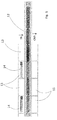
- FIG 7 schematically illustrates the two stages of the vehicle loading/unloading technology which uses low-deck railway wagons, equipped with side loading/unloading rollers, and bays with side loading/unloading platforms.
- the purpose is to speed up operations at the RIF.
- Current handling technologies which are undergoing rapid development, might also be specifically developed based on a system of rollers located at ground level, parallel to the railway line, and on the rail wagon deck.
- stage 1 the vehicle to be loaded enters the loading bay where the platform, once the train has been suitably positioned, starts moving the rollers in such a way as to shift the vehicle sideways until, during stage 2, it is fully loaded onto the rail wagon deck.
- the continuity between the platform and the wagon deck is guaranteed by an appropriate bridge that moves automatically into position and is equipped with self-propelling rollers. The procedure is reversed to unload the vehicle.
- the management and monitoring system consists of the management centre 10 which can process requests received from any road vehicle, wherever located, whether travelling or stationary.
- the availability request may be made through any of a number of well-known technologies such as, for example, telephone (fixed or mobile), Internet, latest generation satellite navigators, Telepass or other dedicated equipment, wherever located..
- the reservation request may be made by the driver or any other person authorised to arrange the vehicle's journeys.
- FIG 1 schematically illustrates how the management and monitoring system works.
- the management centre 10 communicates directly with GPS location systems which are in turn linked to line services. It also communicates directly with the systems that process the availability requests received from vehicles.
- the management system makes a record of the request, that is to say, it:
- Figures 2 and 3 illustrate other aspects of the management system and it may be noticed how the management and monitoring centre can calculate the positions in space and time of both the requesting party and of the trains that can potentially meet the request.
- the system checks that the train is correctly positioned in such a way that each loading bay is exactly aligned with a single rail wagon.
- the requesting party's vehicle is loaded at the agreed rapid interchange facility, where the system assigns to the first vehicle to arrive the first free loading bay in the train's travel direction;
- Unloading is compulsory at the reserved destination unless another request is made to check whether the wagon occupied is still available and normal access formalities are completed during the journey.
- FIG. 4 shows a block diagram representing the management system according to the invention.
- the rapid interchange and management system has several advantages.
- the advantages may be summed up as follows:
- This embodiment provides a Motorway-Railway interchange service for heavy vehicles and goods carrying vehicles in general.
- the rapid interchange system according to the invention proposes a new transport entity with the aim of optimizing supply and demand in the field of mobility using modes of transport which have until now been in competition with each other.
- the traffic route in this embodiment of the invention runs East-West across the central Po plain in northern Italy taking advantage of the interconnection and interchange opportunities offered by other motorway and rail routes.
- this route approximately 700 km long, could be served, for example, by 13 rapid interchange points whose location would be determined according to the following criteria:
- the preliminary estimate of demand is based on data from several different sources, including the Motorway Company, ANAS (Italian National Road Works Company), Associations of Transporters and ISTAT (Italian Central Statistics Institute).
- the estimated s/d (supply/demand) matrix applies to motorway traffic only, with vehicles divided according to class.
- the users potentially attracted to the rapid interchange system belong to the last two distance brackets, that is say, in figures, from 720,000 to 1,100,000 heavy vehicles a year.
- Supposing the system according to the invention is used to meet a quarter of this potential demand, which is approximately 6% of the total, we have quantities varying between 180,000 and 276,000 heavy vehicles a year.
- a 750 m long train whose length is in any case limited by the characteristics of the network, can carry approximately 25 vehicles simultaneously.
- one of the main aims of the system proposed by this invention is to shift a part of the heavy vehicle traffic burden from road to rail.
- One typical environmental indicator is that of CO emissions whose reduction can be estimated by making a few aggregate assumptions.
- the reduction of CO emissions under the hypothesized conditions is approximately 30%. To this aspect must be added a corresponding reduction in fuel consumption of the vehicles that remain on the road. Further, a lighter burden of heavy vehicles on roads speeds up road traffic in general, reducing queues and accident risks.
- the system according to the invention may be implemented on any route and its validity is unlimited in time.
- the proposed technologies and methods are in no way restrictive and in fact, improving them would increase its efficacy.
- the rapid interchange system according to the invention will spread quickly because the overall cost of mobility sustained by users (in terms of time and money) is climbing steeply, as is the value that drivers now assign to the time taken to reach a destination. Under present conditions, it is estimated that the rapid interchange system according to the invention is attractive for journeys of more than 300 km. However, as technology improves and reduces system access and egress times, while road congestion continues to increase, it is easy to imagine that the system can become attractive for shorter distances, too.
- the rapid interchange facilities are preferably quite densely distributed, that is to say, less than 70 km from each other.
- the use of the system according to the invention might even be made compulsory along certain routes. Compulsory use might, for example, be very effective during periods of peak holiday traffic when vehicle queues become seemingly endless.
Landscapes
- Business, Economics & Management (AREA)
- Engineering & Computer Science (AREA)
- Economics (AREA)
- Entrepreneurship & Innovation (AREA)
- Human Resources & Organizations (AREA)
- Marketing (AREA)
- Operations Research (AREA)
- Quality & Reliability (AREA)
- Strategic Management (AREA)
- Tourism & Hospitality (AREA)
- Physics & Mathematics (AREA)
- General Business, Economics & Management (AREA)
- General Physics & Mathematics (AREA)
- Theoretical Computer Science (AREA)
- Traffic Control Systems (AREA)
- Train Traffic Observation, Control, And Security (AREA)
- Management, Administration, Business Operations System, And Electronic Commerce (AREA)
Applications Claiming Priority (1)
| Application Number | Priority Date | Filing Date | Title |
|---|---|---|---|
| ITVR20050099 ITVR20050099A1 (it) | 2005-08-05 | 2005-08-05 | Sistema per l'interscambio rapido di veicoli e-o merci tra reti viarie |
Publications (3)
| Publication Number | Publication Date |
|---|---|
| EP1750223A2 true EP1750223A2 (fr) | 2007-02-07 |
| EP1750223A3 EP1750223A3 (fr) | 2008-01-16 |
| EP1750223A9 EP1750223A9 (fr) | 2008-10-01 |
Family
ID=37461347
Family Applications (1)
| Application Number | Title | Priority Date | Filing Date |
|---|---|---|---|
| EP06118422A Ceased EP1750223A3 (fr) | 2005-08-05 | 2006-08-03 | Système pour l'échange rapide des véhicules et/ou des marchandises entre routes |
Country Status (2)
| Country | Link |
|---|---|
| EP (1) | EP1750223A3 (fr) |
| IT (1) | ITVR20050099A1 (fr) |
Cited By (4)
| Publication number | Priority date | Publication date | Assignee | Title |
|---|---|---|---|---|
| FR2952013A1 (fr) * | 2009-11-02 | 2011-05-06 | Alain Renier | Wagons automoteurs autoguides |
| RU2449370C1 (ru) * | 2008-06-25 | 2012-04-27 | Навитайм Джапэн Ко., Лтд | Устройство поиска маршрута и способ поиска маршрута |
| CN116542476A (zh) * | 2023-05-09 | 2023-08-04 | 重庆赛迪奇智人工智能科技有限公司 | 一种铁水运输车辆的调度方法、装置、设备及存储介质 |
| CN120218723A (zh) * | 2025-03-12 | 2025-06-27 | 江苏闪码光机电科技有限公司 | 一种基于铁路散粮的取样车箱管理系统 |
Families Citing this family (1)
| Publication number | Priority date | Publication date | Assignee | Title |
|---|---|---|---|---|
| CN108343273A (zh) * | 2018-04-24 | 2018-07-31 | 郑培奎 | 高速公路出入收费口外的多功能业态科学配置区 |
Citations (3)
| Publication number | Priority date | Publication date | Assignee | Title |
|---|---|---|---|---|
| DE3607307A1 (de) * | 1986-03-06 | 1987-09-24 | Juergen Rocholl | Umladesystem strasse - schiene oder umgekehrt |
| US5421687A (en) * | 1994-02-16 | 1995-06-06 | Robert W. Wayman | Self loading-unloading container train and power control unit |
| WO2004005103A1 (fr) * | 2002-07-04 | 2004-01-15 | Weidemann Hans-Juergen | Procede de chargement et de dechargement de wagons de chemin de fer et dispositif, chassis de wagon et superstructure de wagon pour mettre ledit procede en oeuvre |
-
2005
- 2005-08-05 IT ITVR20050099 patent/ITVR20050099A1/it unknown
-
2006
- 2006-08-03 EP EP06118422A patent/EP1750223A3/fr not_active Ceased
Patent Citations (3)
| Publication number | Priority date | Publication date | Assignee | Title |
|---|---|---|---|---|
| DE3607307A1 (de) * | 1986-03-06 | 1987-09-24 | Juergen Rocholl | Umladesystem strasse - schiene oder umgekehrt |
| US5421687A (en) * | 1994-02-16 | 1995-06-06 | Robert W. Wayman | Self loading-unloading container train and power control unit |
| WO2004005103A1 (fr) * | 2002-07-04 | 2004-01-15 | Weidemann Hans-Juergen | Procede de chargement et de dechargement de wagons de chemin de fer et dispositif, chassis de wagon et superstructure de wagon pour mettre ledit procede en oeuvre |
Cited By (5)
| Publication number | Priority date | Publication date | Assignee | Title |
|---|---|---|---|---|
| RU2449370C1 (ru) * | 2008-06-25 | 2012-04-27 | Навитайм Джапэн Ко., Лтд | Устройство поиска маршрута и способ поиска маршрута |
| FR2952013A1 (fr) * | 2009-11-02 | 2011-05-06 | Alain Renier | Wagons automoteurs autoguides |
| CN116542476A (zh) * | 2023-05-09 | 2023-08-04 | 重庆赛迪奇智人工智能科技有限公司 | 一种铁水运输车辆的调度方法、装置、设备及存储介质 |
| CN116542476B (zh) * | 2023-05-09 | 2023-11-28 | 重庆赛迪奇智人工智能科技有限公司 | 一种铁水运输车辆的调度方法、装置、设备及存储介质 |
| CN120218723A (zh) * | 2025-03-12 | 2025-06-27 | 江苏闪码光机电科技有限公司 | 一种基于铁路散粮的取样车箱管理系统 |
Also Published As
| Publication number | Publication date |
|---|---|
| EP1750223A9 (fr) | 2008-10-01 |
| EP1750223A3 (fr) | 2008-01-16 |
| ITVR20050099A1 (it) | 2007-02-06 |
Similar Documents
| Publication | Publication Date | Title |
|---|---|---|
| Daganzo et al. | Public transportation systems: Principles of system design, operations planning and real-time control | |
| Kikuta et al. | New subway-integrated city logistics szystem | |
| France | Italy | |
| Bertaud | Clearing the air in Atlanta: transit and smart growth or conventional economics? | |
| EP1750223A2 (fr) | Système pour l'échange rapide des véhicules et/ou des marchandises entre routes | |
| Bacero et al. | Truckers’ perceptions on truck regulations and policies in a developing country: A case study of Metro Manila, Philippines | |
| Munawar | Sustainable urban public transport planning in Indonesia, case studies in Yogyakarta and Jakarta | |
| Khasnabis et al. | Signal preemption as a priority treatment tool for transit demand management | |
| Transit | Bus rapid transit shows promise | |
| Basbas et al. | ENVIRONMENTAL, IMPACTS OF BUS TRAFFIC IN THE | |
| Meng et al. | Research on the scale of transportation connecting facilities in comprehensive transportation hubs | |
| Streeter | The French Train a Grande Vitesse | |
| Proper | Intelligent transportation systems benefits: 1999 update | |
| Poole Jr et al. | Virtual exclusive busways | |
| Cambridge Systematics et al. | Characteristics of urban transportation systems | |
| Hedges | Urban Goods Movements: An Overview | |
| Gülhan | A model proposal for determining heavy vehicle parking capacities in rural areas: a case study of Izmir | |
| Martinez | Calculation of Benefits of Advanced Integrated Rail Service: Application of Intelligent Transportation Systems to the Developing City of Lima, Peru | |
| Cooper | Prospects for a Mass Movement to Public Transit | |
| Tennyson | Potential and Cost of Commuter or Regional Rail Service | |
| Rubin et al. | Better transportation alternatives for Los Angeles | |
| Hoel | Urban transportation in North America 4. para‐transit | |
| Ieda | Managing Transport Supply and Demand: From Passengers to Freight | |
| Tennyson | Value of light rail transit as a major capital investment | |
| Deakin | Opportunities and constraints for advanced highway technologies: A speculative analysis |
Legal Events
| Date | Code | Title | Description |
|---|---|---|---|
| PUAI | Public reference made under article 153(3) epc to a published international application that has entered the european phase |
Free format text: ORIGINAL CODE: 0009012 |
|
| AK | Designated contracting states |
Kind code of ref document: A2 Designated state(s): AT BE BG CH CY CZ DE DK EE ES FI FR GB GR HU IE IS IT LI LT LU LV MC NL PL PT RO SE SI SK TR |
|
| AX | Request for extension of the european patent |
Extension state: AL BA HR MK YU |
|
| PUAL | Search report despatched |
Free format text: ORIGINAL CODE: 0009013 |
|
| AK | Designated contracting states |
Kind code of ref document: A3 Designated state(s): AT BE BG CH CY CZ DE DK EE ES FI FR GB GR HU IE IS IT LI LT LU LV MC NL PL PT RO SE SI SK TR |
|
| AX | Request for extension of the european patent |
Extension state: AL BA HR MK YU |
|
| 17P | Request for examination filed |
Effective date: 20080714 |
|
| RAP1 | Party data changed (applicant data changed or rights of an application transferred) |
Owner name: STUDIO ING. DE BEAUMONT INGEGNERIA DEI TRASPORTI S |
|
| AKX | Designation fees paid |
Designated state(s): AT BE BG CH CY CZ DE DK EE ES FI FR GB GR HU IE IS IT LI LT LU LV MC NL PL PT RO SE SI SK TR |
|
| 17Q | First examination report despatched |
Effective date: 20080925 |
|
| STAA | Information on the status of an ep patent application or granted ep patent |
Free format text: STATUS: THE APPLICATION HAS BEEN REFUSED |
|
| 18R | Application refused |
Effective date: 20141205 |