EP1751885B1 - Procede d'economie d'energie pour des applications de radiomessagerie par multidiffusion 802.11 - Google Patents
Procede d'economie d'energie pour des applications de radiomessagerie par multidiffusion 802.11 Download PDFInfo
- Publication number
- EP1751885B1 EP1751885B1 EP05757524.3A EP05757524A EP1751885B1 EP 1751885 B1 EP1751885 B1 EP 1751885B1 EP 05757524 A EP05757524 A EP 05757524A EP 1751885 B1 EP1751885 B1 EP 1751885B1
- Authority
- EP
- European Patent Office
- Prior art keywords
- multicast
- client
- access point
- power
- save
- Prior art date
- Legal status (The legal status is an assumption and is not a legal conclusion. Google has not performed a legal analysis and makes no representation as to the accuracy of the status listed.)
- Expired - Lifetime
Links
Images


Classifications
-
- H—ELECTRICITY
- H04—ELECTRIC COMMUNICATION TECHNIQUE
- H04W—WIRELESS COMMUNICATION NETWORKS
- H04W4/00—Services specially adapted for wireless communication networks; Facilities therefor
- H04W4/06—Selective distribution of broadcast services, e.g. multimedia broadcast multicast service [MBMS]; Services to user groups; One-way selective calling services
-
- H—ELECTRICITY
- H04—ELECTRIC COMMUNICATION TECHNIQUE
- H04W—WIRELESS COMMUNICATION NETWORKS
- H04W52/00—Power management, e.g. Transmission Power Control [TPC] or power classes
- H04W52/02—Power saving arrangements
- H04W52/0209—Power saving arrangements in terminal devices
- H04W52/0212—Power saving arrangements in terminal devices managed by the network, e.g. network or access point is leader and terminal is follower
- H04W52/0216—Power saving arrangements in terminal devices managed by the network, e.g. network or access point is leader and terminal is follower using a pre-established activity schedule, e.g. traffic indication frame
-
- H—ELECTRICITY
- H04—ELECTRIC COMMUNICATION TECHNIQUE
- H04W—WIRELESS COMMUNICATION NETWORKS
- H04W72/00—Local resource management
- H04W72/30—Resource management for broadcast services
-
- H—ELECTRICITY
- H04—ELECTRIC COMMUNICATION TECHNIQUE
- H04W—WIRELESS COMMUNICATION NETWORKS
- H04W88/00—Devices specially adapted for wireless communication networks, e.g. terminals, base stations or access point devices
- H04W88/08—Access point devices
-
- Y—GENERAL TAGGING OF NEW TECHNOLOGICAL DEVELOPMENTS; GENERAL TAGGING OF CROSS-SECTIONAL TECHNOLOGIES SPANNING OVER SEVERAL SECTIONS OF THE IPC; TECHNICAL SUBJECTS COVERED BY FORMER USPC CROSS-REFERENCE ART COLLECTIONS [XRACs] AND DIGESTS
- Y02—TECHNOLOGIES OR APPLICATIONS FOR MITIGATION OR ADAPTATION AGAINST CLIMATE CHANGE
- Y02D—CLIMATE CHANGE MITIGATION TECHNOLOGIES IN INFORMATION AND COMMUNICATION TECHNOLOGIES [ICT], I.E. INFORMATION AND COMMUNICATION TECHNOLOGIES AIMING AT THE REDUCTION OF THEIR OWN ENERGY USE
- Y02D30/00—Reducing energy consumption in communication networks
- Y02D30/70—Reducing energy consumption in communication networks in wireless communication networks
Definitions
- the present invention relates generally to wireless broadcast transmissions and more particularly to a method for power consumption by an IEEE 802.11 client station containing both a Voice-over-Internet Protocol and an Internet Protocol paging application.
- VoIP Voice-over-Internet Protocol
- ARP Address Resolution Protocol
- IP Multicast IP Multicast
- Multicast is a technique that allows data, including data encapsulated in packet form, to be simultaneously transmitted to a selected set of destinations.
- identical data is simultaneously transmitted to a selected set of destinations in a network, without obtaining acknowledgement that the transmission was received by the recipient devices.
- Multicast transmissions are also capable of being sent to a multicast address, which is typically a routing address that is used to address, i.e., designate, simultaneously all the computers in a group and usually identifies a group of computers that share a common protocol, as opposed to a group of computers that share a common network.
- a multicast address typically a routing address that is used to address, i.e., designate, simultaneously all the computers in a group and usually identifies a group of computers that share a common protocol, as opposed to a group of computers that share a common network.
- broadcast operation is the transmission of signals that may be simultaneously received by stations that typically make no acknowledgement of the receipt of the transmission.
- Address Resolution Protocol is a communications protocol used to map a selected Internet Protocol (IP) address to a preset Media Access Control (MAC) address.
- IP Internet Protocol
- MAC Media Access Control
- ARP matches higher-level IP addresses to the physical addresses of the destination host. It uses a lookup table (called an ARP cache) to perform the translation.
- ARP cache When the address is not found in the ARP cache, a broadcast is sent out on the network with a special format called the ARP request. If one of the machines on the network recognizes its own IP address in the request, it sends an ARP reply back to the requesting host.
- the reply contains the physical hardware (MAC) address of the receiving host.
- the requesting host stores this address in its ARP cache so that all subsequent datagrams to this destination IP address can be translated to a physical address.
- a Traffic Indication Message may be found in an 802.11 Beacon Frame which is transmitted from an 802.11 access point (AP).
- a TIM is used by access points to tell power-save client devices that one or more unicast packets are waiting for them.
- a TIM consists of an array of bit flags, with one bit flag for each client associated with the AP.
- An AP sets a station's TIM bit to "1" if it has one or more frames buffered for the client.
- An AP sends Beacons at fixed intervals. If an 802.11 power-save station only needs to receive unicast frames, it can wake up to receive a Beacon, check its TIM bit, and immediately return to a "sleep" mode if the TIM bit is set to "0".
- DTIM Delivery Traffic Indication Message
- a power-save station associated with an AP then the AP buffers broadcast and multicast frames and sends the buffered frames to associated stations immediately following a DTIM Beacon. If a power-save station must receive broadcast or multicast frames, then it must wake up for each DTIM Beacon transmission and it must stay awake until the last broadcast/multicast frame is transmitted, following the DTIM Beacon.
- Proxy ARP refers to a method wherein an AP sends an ARP Reply, on behalf of an associated station, when the AP receives and ARP Request directed to the associated station. Proxy ARP enables a power-save station to sleep during the broadcast/multicast period, following a DTIM Beacon, if it does not need to receive any of other multicast or broadcast frames.
- proxy ARP 802.11 VoIP phone applications have been met with limited success. Such uses of the proxy ARP has enabled the VoIP phone to sleep, or operate in power-save protocol mode, during lengthy broadcast/multicast transmissions. However, this mechanism, by itself, is not usable for an 802.11 VoIP/Paging device insofar as the paging application requires the phone to remain active following the DTIM to receive other multicast transmissions.
- a problem associated with an 802.11 client device supporting both VoIP and paging applications is that the radio power consumption in an 802.11 VoIP phone is much higher than the radio power consumption in a cellular telephone.
- the greater drain on energy has limited the application of both VOIP and paging into a single device.
- Power-save stations must stay awake, for the duration of the multicast delivery period, to receive multicast transmissions. As a result, broadcast/multicast transmissions can reduce battery life in power-save stations.
- a beacon signal may indicate that data is available for transmission to a particular station (from another station), in which case that particular station then broadcasts a message to indicate that it is awake and can receive messages.
- a beacon signal also indicates whether a broadcast period is in progress, and time to elapse until a next possible broadcast period will commence; if the Control Point has previously received and stored any broadcast messages it will re-broadcast them during the next following broadcast period and the remaining stations will react by remaining in active mode for the duration of that period.
- the present innovation addresses the above-noted deficiencies and others, and teaches a system and method for facilitating power-savings in an IEEE 802.11 VoIP/Paging device.
- a power-save system for wireless data transmission.
- the access point stores a list of IP multicast addresses for each associated station, wherein each address in the list corresponds to an IP multicast group.
- the access point also maintains a set of IP multicast groups, wherein each multicast group in the set is identified by an IP multicast address.
- At least one station associated with the access point is a member of each of the multicast groups in the access point's set of multicast groups.
- Each multicast group is classified as either "active" or "power-save”.
- An access point classifies a multicast group as "active” if all stations in the multicast group are operating in active mode; otherwise, the AP classifies a multicast group as "power-save” if at least one station in the multicast group is operating in power-save mode.
- an access point transmits multicast packets, which are destined to an active multicast group, immediately; an access point buffers multicast packets, which are destined to a power-save multicast group, until the next delivery traffic indication message (DTIM) Beacon; and an AP does not transmit multicast packets, which are not destined to an active or power-save multicast group.
- DTIM delivery traffic indication message
- the access point includes a multicast traffic indication message (MTIM) element in each transmitted DTIM Beacon.
- the MTIM element comprises a list of zero or more entries.
- the MTIM element identifies power-save IP multicast groups, for which downlink multicast frames are buffered in the access point.
- a power-save station is a member of an IP multicast group identified by an entry in the MTIM element, the station must remain active to receive all power-save multicast transmissions sent following the DTIM Beacon.
- the MTIM element is comprised of a list of zero or more IP multicast addresses.
- the MTIM element is comprised of a list of zero or more multicast MAC addresses, where each MAC address corresponds to an IP multicast address.
- the multicast MAC address is suitably generated by concatenating a 3-byte hex 01005E prefix with the low-order 3-bytes of the multicast IP address.
- the MTIM element is comprised of a list stations that must stay awake, following a DTIM Beacon transmission, to receive multicast transmissions.
- the list of stations in the MTIM element can be structured as an array of bit flags, where each MTIM bit flag corresponds to the association identifier of a station and the AP sets the MTIM bit flag for a station to '1' if the station is participating in a multicast group where multicast frames are buffered for transmission following a DTIM Beacon.
- the MTIM element notifies the station in an IP multicast group to stay active following the transmission of the delivery traffic indication message to receive downlink multicast frames buffered for the IP multicast group. Still yet another aspect of the present system is the MTIM element notifies the associated station that the access point supports the MTIM method and enables the associated station to selectively ignore useless multicast transmissions.
- a further aspect of the present system is the combination of the multicast traffic indication message element with an existing Proxy ARP mechanism, to provide an effective power-save solution for combined VoIP/Paging applications.
- a power-save system for wireless data streaming includes an access point that provides a wireless data link to at least one associated client. The access point is placed in wired data communication with a data network. The access point includes memory that stores an IP address and MAC address for each associated client station. The access point further includes memory that stores a list of enabled IP multicast addresses and a MAC address for each associated client station. The system also includes registration means adapted for registering each associated client with the access point.
- the system includes means adapted for registering IP group membership information of each associated client with the network infrastructure.
- the system incorporates a receiver associated with the access point, the receiver including means adapted for receiving a data stream from the selected data network.
- the system further includes means adapted for selectively notifying each associated client station of the data stream according to the relationship data.
- the access point then forwards the data stream from the access point to each notified associated client.
- the system also includes link maintenance means adapted for communicating link data between the access point and the associated client.
- the link data represents an ongoing, active wireless data streaming link between the access point and the associated client.
- the data stream includes VoIP and paging data.
- the link maintenance means further includes a system adapted for communicating pending multicast transmissions to client stations.
- the access point includes means adapted for determining membership of each associated station in a streaming multicast data group.
- a power-save method on a selected network comprising an access point adapted to provide wireless data link to at least one associated client, the access point adapted to be placed in wired data communication with the selected network.
- the access point stores, in an associated memory, an IP address and a MAC address corresponding to each associated client.
- the access point stores, in an associated memory, a list of multicast addresses and a MAC address corresponding to each associated client.
- Each client is registered with the access point.
- Relationship data associating a MAC address, an IP address, and a list of multicast addresses, for each registered client is stored in the memory.
- the access point receives a data stream from the selected data network.
- the access point then selectively notifies each associated client of the data stream according to the relationship data.
- the access point signals a client when it has one or more pending multicast transmissions, wherein the destination multicast address is in the client's list of multicast addresses.
- the client then stays awake to receive the multicast transmissions.
- a data stream includes VoIP and paging data.
- an access point determines membership of each associated station in a streaming multicast data group.
- the computer readable medium includes an access point adapted to provide a wireless data link to at least one associated client, wherein the access point is placed in wired data communication with a selected data network.
- the computer-readable medium also includes means adapted for storing at least one of IP address data and MAC address data for each associated client in a memory associated with the access point.
- the computer-readable medium also includes means adapted for storing a list of multicast address and a MAC address for each associated power-save client in a memory associated with the access point.
- the computer-readable medium further includes registration means adapted for registering one associated client with the access point.
- the access point includes means adapted for storing, in the memory, relationship data associating a MAC address and IP address for each registered client.
- the access point includes means adapted for storing, in the memory, relationship data associating a MAC address and a list of IP multicast addresses for each registered client.
- the computer readable medium teaches means adapted for receiving, on a receiver associated with the access point, a data stream from the selected data network.
- the computer readable medium also teaches means adapted for selectively notifying each associated client station of the data stream according to the relationship data.
- the computer readable medium further includes link maintenance means adapted for communicating link data between the access point and the associated client, wherein the link data represents an ongoing, active wireless data streaming link between the access point and the associated client.
- a data stream includes VoIP and paging data.
- Another advantage of the present computer readable medium is in the teaching of a system for communicating link open information to the associated client.
- Yet another advantage of the present system is a teaching, wherein an access point determines membership of each associated station in a streaming multicast data group.
- An access point stores, in an associated memory, an IP address and a MAC address corresponding to each associated client.
- An access point also stores, in an associated memory, a list of IP addresses and a MAC address corresponding to associated clients.
- Each client is registered with the access point.
- Relationship data associating a MAC address and an IP address for each registered client is stored in the memory.
- Relationship data associating a list of multicast addresses and a MAC address for registered clients is also stored in the memory.
- the access point receives a data stream from the selected data network. The access point then selectively notifies each associated station of the data stream according to the relationship data.
- a data stream includes VoIP and paging data.
- an access point determines membership of each associated station in a streaming data group.
- Still yet another advantage of the present system is the teaching of classification of the streaming data group into either a power-save or active group.
- a power-save method for a network with an access point and an associated power-save client The access point buffers wireless data that includes a unicast frame and a multicast frame.
- Aperiodic scheduled beacon message is transmitted with a unicast indication element and a multicast indication element.
- the unicast element instructs a client to remain awake to receive a buffered unicast frame, which includes a destination MAC address.
- the multicast element instructs a client to remain awake following the beacon to receive a buffered multicast frame, which includes a destination multicast address designating a multicast group of which the client is a member.
- At least one beacon message is designated as a multicast delivery beacon.
- the buffered multicast frame is transmitted following the designated multicast beacon.
- the multicast element contains a list of entries, each entry corresponding to either a multicast MAC address, multicast IP address, or client identifier.
- a power-save station is suitably configured to eliminate the need to stay awake to receive all power-save multicast/broadcast frames sent by its parent AP following a DTIM beacon.
- the present system and method has two primary components:
- FIG. 1 illustrates a simplified system diagram of a typical network 100 in accordance with the present system and method.
- the network 100 includes wireless stations 105-130 suitably configured and connected to access services and receive multicast transmission on the network 100 via an access point 135.
- the wireless stations 105-130 are capable of transmitting and/or receiving data packets via a wireless network such as any one of numerous wireless devices, including, but not limited to, a laptop/notebook portable computer having a Cardbus network adapter suitable for wireless communication with a wired network, an electronic tablet having a suitable wireless network adapter, a handheld device or personal digital assistant containing a suitable wireless network adapter for communicating to a wired network or the like.
- the Basic Service Set (BSS) 140 of the access point 135 is shown.
- Wireless stations 105-130 are suitably configured to communicate with the access point 135 so long as they remain in the BSS 140. In other words, as members of the BSS 140, wireless stations 105-130 are physically located within the access point 135 wireless communication coverage area.
- a backbone 145 is used to connect the access point 135 and a network server 150 via a physical wired connection 155.
- the backbone is a wired network connection such as Ethernet.
- the network server 150 is used together with the access point 135 to authenticate wireless stations 105-130. While the aforementioned network 100 illustrates a single access point and six wireless stations, one of skill in the art can readily appreciate that a network may comprise any number of access points and any number or type of wireless stations.
- wireless stations 105-130 may change with respect to each other and to the access point 135. However, provided the wireless stations 105-130 remain within the coverage area of the BSS 140, they will remain members of the BSS 140 of the access point 135.
- an IP multicast stream 160 is received by the system 100 from a remote location. It will be appreciated by one of ordinary skill in the art that a location of the sender (s) of the multicast stream 160 is not particularly relevant to the present system. In other words, the present system and method is configured to operate as well with a local sender as with an extremely distant sender.
- the wireless stations 105, 110 and 115 are suitably configured into a multicast group 165.
- wireless stations 120, 125 and 130 are suitably configured into a second multicast group 160.
- the generation of multicast groups is accomplished in accordance with the above-referenced related U. S. patent application.
- the wireless stations 105,115, and 125 are configured to subscribe to the multicast stream IP multicast stream 160 and are in active mode. Conversely, wireless stations 110, 120 and 130 shown are in sleep or power-save mode. As illustrated, wireless stations 110, 120 and 130 are not subscribers to the multicast stream IP multicast stream 160.
- the access point 135 upon receipt of the IP multicast stream 160 by the access point 135, the access point 135 determines the mode, power-save or active, of all stations contained within the BSS 140.
- the access point 135 is suitably configured to determine the mode of all stations in the individual multicast groups 165, 170.
- Wireless stations 110, 120 and 130 are in power-save mode while all remaining stations 105,115 and 125 are operating in active mode.
- the access point 135 would automatically batch and queue all incoming multicast packets 160 until the next Delivery Traffic Indication Message (DTIM) beacon is sent to the BSS 140.
- DTIM Delivery Traffic Indication Message
- the system is suitably configured to establish multicast groups 165, 170 in order to streamline delivery of multicast messages.
- each individual group would adopt the characteristics of the BSS of earlier implementations.
- a Proxy ARP server is suitably configured to respond to address resolution requests targeted to an associated client station.
- ARP matches higher-level IP addresses to the physical (i.e, Media Access Control, or MAC) addresses of the destination host.
- MAC Media Access Control
- ARP request When an IP address is not found in the ARP cache, a broadcast is sent out on the network with a special format called an ARP request.
- ARP reply When one of the machines on the network recognizes its own IP address in the request, it sends an ARP reply back to the requesting host.
- the reply contains the physical hardware address of the receiving host.
- the requesting host stores this address in its ARP cache so that all subsequent datagrams to this destination IP address can be translated to a physical address.
- Proxy ARP enables an access point to respond to the ARP request for an associated station in power-save protocol operation.
- Figure 2 shows, via steps 205-235, the method wherein the Proxy ARP server learns the associated client station address.
- the Proxy ARP server in the access point determines whether it already has the address for the associated or associating client.
- the Proxy ARP server determines at step 205 that the client address is known, the Proxy ARP server identifies IP/MAC address bindings for the associated station at step 225.
- IP/MAC address bindings enable the Proxy ARP server to properly function in accordance with the subject method. It will be appreciated that any one of the 802.11 client stations 105-130 will not need to receive broadcast ARP requests when the Proxy ARP server in the parent access point 135 is already aware of that client's IP address.
- the Proxy ARP server determines, at step 205, that the Proxy ARP server does not know the client address, the Proxy ARP server then proceeds to step 210, wherein it is determined that the client has not sent any IP packets or previously responded, through the access point, to an ARP request.
- a negative determination at step 210 prompts the Proxy ARP server, at step 230, to snoop IP and/or ARP packets sent by the client to gain knowledge of the client address.
- the access point 135 automatically determines the IP address of a client 105, by snooping IP and ARP packets sent by that client 105.
- the Proxy ARP server proceeds to store the address in the IP/MAC address bindings for associated stations at step 225.
- the Proxy ARP server progresses to step 215, wherein the Proxy ARP server determines that the client station has roamed from a previous access point to the current access point. Upon such a determination, the Proxy ARP server proceeds to step 220, wherein the IP address associated with the client station is transferred from the old access point to the new access point via a context transfer protocol. The IP address of any or all of the wireless clients 105-120 are transferred from the old access point 135 to the new access point, via the context transfer protocol when the wireless client or clients 105-120 roam from the current BSS 140. Once the IP address has been transferred, the Proxy ARP server proceeds to store the IP/MAC address bindings at step 225.
- the Proxy ARP server gathers the client station IP address, at step 235, through the registration process with the parent access point by including an IP address element in an association or re-association message. For example, upon roaming from BSS 140 into a new access point's (not shown) BSS (not shown), wireless clients 105-120 register their corresponding IP addresses with their new parent access point by including an IP address in their association or re-association request messages.
- the Proxy ARP server proceeds to store the IP/MAC address bindings at step 225.
- the access point receives a broadcast ARP request on its Ethernet port at step 240.
- the access point searches its IP/MAC address bindings for an IP address that matches the target IP address embedded within the body of the ARP request.
- the access point Upon the determination, at step 250, that the access point cannot find a match for the target IP address in the IP/MAC address bindings it stores, the access point then discards the ARP request at step 255.
- the access point determines whether a Proxy ARP server is responding to the ARP request for the target IP address at step 260.
- the Proxy ARP server transmits an ARP reply message with the MAC address corresponding to the target IP address, on its Ethernet link, at step 265.
- the Proxy ARP server determines that it is not responding to the ARP request for an associated client station, the Proxy ARP server translates the destination broadcast MAC address in the ARP Request to the unicast MAC address that corresponds to the target IP address at step 270.
- the resulting unicast ARP request frame is subsequently forwarded, at step 275, to the target station as any other (e.g. power-save) unicast message.
- the target station Upon receipt of the unicast ARP request, the target station generates an ARP Reply.
- the Proxy ARP server within the access point 135 is configured to translate the broadcast MAC address contained within the ARP request into a unicast MAC address corresponding to the target IP address in order to transmit the message to station 105.
- a power-save 802.11 station is not required to remain in an active state to receive multicast/broadcast transmissions if i) the Proxy ARP server within the access point is generating proxy ARP replies for the client; ii) the client does not have any other pending multicast messages, and iii) the client is aware of the proxy ARP service.
- the access point is suitably configured to "advertise" that the access point is providing the service via a Proxy ARP flag contained within a proprietary 802.11 information element.
- the proprietary information element is suitably included in an 802.11 Beacon and/or association or re-association response messages.
- a power-save VoIP station in standby mode, must wake up periodically to receive beacons, even if it does not need to receive multicast/broadcast frames.
- a Beacon TIM bit which corresponds to the station's Association ID (AID)
- AID station's Association ID
- the above Proxy ARP method is useful for a VoIP client station that receives unicast transmissions.
- a purely VoIP operating station greatly benefits from the lower power-consumption when using the Proxy ARP method described above.
- the client station is both a VoIP station, as well as a paging station, the above method results in missed multicasts for the paging application. For instance, if a dual-application station does not stay awake to receive power-save broadcast/multicast transmission, it will miss IP multicast frames directed to the Paging Application.
- This section describes the present system and method whereby an access point uses a Multicast Traffic Indication Message (MTIM) to indicate that it has pending IP multicast frames buffered for stations in respective power-save multicast groups.
- MTIM Multicast Traffic Indication Message
- IP multicast group such as IP groups 165 and 170 of Figure 1
- IP groups 165 and 170 of Figure 1 are identifiable by and associated with a single IP multicast address.
- IP multicast applications are identifiable by and associated with IP multicast addresses.
- IP multicast addresses exists in most configurations and applications.
- the access point observes Internet Group Management Protocol (IGMP) Membership messages from associated stations to determine membership in IP multicast groups.
- IGMP Internet Group Management Protocol
- the new access point transmits an IGMP general query to solicit membership reports, thereby identifying in which IP multicast groups the roaming station subscribes.
- group membership information is stored, e.g., cached, in the network infrastructure and transferred to the new parent access point when a station roams using a context transfer protocol.
- the parent access point 135 IGMP Membership Report Messages, sent by associated stations 105-120 to determine each station's membership in a specific IP multicast group, i.e, groups 165 and 170. It will be understood by those skilled in the art that the use of two multicast groups is for exemplary purposes only and the subject invention is not limited solely to two groups.
- the access point 135 is suitably capable of sending an IGMP general query to solicit membership reports when a station (e.g. 105-120) roams from its home BSS 140.
- the access point identifies stations corresponding to IP multicast group registration.
- the system identifies specific multicast groups and their corresponding member stations.
- the access point then classifies each multicast group having an associated station as to the type, such as active or power-save, of the identified multicast groups at step 315.
- the access point 135 classifies each IP multicast group 165, 170 as active or power-save.
- a multicast group is classified as active if all stations in the group are operating in 802.11 active mode. Otherwise, an IP multicast group is classified as power-save; e.g. if at least 1 client or station in the group is operating in 802.11 power-save mode.
- the IEEE 802.11 specification defines the mechanics of an access point to determine the active/power-save mode of associated stations.
- Each multicast group having an associated station is then identified by the access point as to type and number of associated stations at step 320.
- the type and station count of each IP multicast group having an associated station is stored by the access point.
- the access point 135 stores the type, active or power-save, and station count for each IP multicast group 165, 170.
- the access point 135 stores a list of IP multicast addresses for each associated station 105-120.
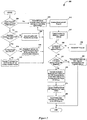
- the access point determines, at step 325 if the corresponding multicast group station count is '0'. If a determination that the station count is '0' is made at step 325, the access point realizes that it has no associated stations in the pre-identified multicast group, for example as a result of disassociation of a station, and discards the subject multicast message, or downlink IP multicast frames, at step 330. It will be appreciated that the station count for each multicast group may be incremented or decremented when any of the stations 105-120, in a multicast group 165 and 170 associates, disassociates, joins a multicast group, leaves a multicast group, or changes its power-save state.
- the access point determines, at step 330, if the target multicast group has all stations in a constantly active mode. When the access point determines all associated stations in the target IP multicast group are in active mode, the access point immediately forwards the IP multicast/broadcast traffic at step 340 to the target IP multicast group. In operation, the access point 135 immediately sends an IP multicast packet destined to an active multicast group 165, without waiting for a DTIM beacon. If at step 335, the access point determines that at least one station in the target IP multicast group is operating in power-save, the access point will buffer and queue the multicast/broadcast traffic at step 345. Thus, the access point 135 buffers a multicast packet destined to a power-save multicast group 170, until the next DTIM beacon.
- step 350 the access point determines if a Delivery Traffic Indication Message is due to be sent. If the time has not yet come for a DTIM Beacon to be sent, the access point returns to buffering and queuing incoming IP multicast packets at step 345. When a DTIM Beacon is due to be transmitted by the access point at step 350, the access point transmits, at step 355, a DTIM Beacon including a MTIM element.
- the access point 135 includes a unique MTIM information element in each DTIM Beacon.
- the MTIM functions to notify stations 120-130, in a power-save IP multicast group 170, to stay awake following a DTIM beacon in order to receive downlink multicast frames buffered for the respective group 170.
- the MTIM is also functioning to notify stations 105-120 that the access point 135 supports the MTIM method, thus prompting stations 105-120 to selectively skip useless power-save multicast/broadcast transmissions.
- the MTIM element consists of a list of zero or more entries.
- the MTIM entries are capable of two alternative implementations. First, the MTIM lists pending multicast addresses for which downlink multicast frames are buffered in the access point 135. Thus, the stations, upon waking to receive the DTIM/MTIM Beacon, review the list of pending addresses to determine if any of the pending addresses correspond to an IP multicast address. Alternatively, the MTIM lists only those stations for which downlink multicast frames are buffered in the access point 135. Thus, the station, upon receipt of the DTIM/MTIM Beacon, reviews the list of stations to determine if the station has pending multicast messages.
- an MTIM is structured exactly as an 802.11 TIM.
- An MTIM consists of an array of bit flags, where each bit flag corresponds to the Association Identifier (AID) of an associated station.
- An access point sets an MTIM bit for a station to "1" if the station is a member of a multicast group and the access point has frames buffered for that multicast group.
- a VoIP/Paging station, 105-120 configured to support the Proxy ARP and MTIM mechanisms, wakes for each DTIM beacon. Moreover, such a station 105-120 returns to sleep (e.g. power-save) immediately without receiving useless downlink multicast/broadcast frames, if the station's TIM bit is representative of an "OFF" state, and the station is not a member of a multicast group (e.g. 165, 170) identified by an entry in the MTIM.
- sleep e.g. power-save
- an MTIM entry is configured as an IP multicast address or the corresponding multicast MAC address.
- a multicast MAC address for an IP multicast group, is generated by concatenating a 3-byte hex 01005E prefix with the low-order 3 bytes of the multicast IP address. Therefore, a station is capable of deriving the MAC address from the IP address.
- Multicast MAC addresses are explicitly enabled on client LAN interface cards (e.g. Ethernet or 802.11), it will further be appreciated that a management interface exists for a client station to determine multicast group membership.
- access point programming and methodology including logic and data structures, used to support the MTIM mechanism are suitably identical to those needed to support active IP multicast groups, as discussed in the above-identified related United States patent application.
- the AID 0 bit in the standard 802.11 TIM does not distinguish between broadcast and multicast, so, with an MTIM present, the AID 0 bit indicates to the MTIM-aware client to monitor the MTIM for further information. In the event that an actual broadcast is intended, the AID 0 bit in the MTIM should be set to indicate the broadcast. Such an indication would result in all MTIM-aware clients remaining awake to receive the necessary broadcast. Setting the AID 0 bit in the MTIM is preferable to just setting the all per-client MTIM bits, since the AID 0 bit is insensitive to any transient IP multicast membership changes made by the client.
- step 360 a determination is made that the station is a member of an IP multicast group identified by an entry in the MTIM.
- the station remains in an active state, at step 375, to receive the buffered IP multicast/broadcast traffic that the access point has queued for transmittal.
- the station verifies that the traffic indication message bit corresponding to that station is set to 'OFF' at step 365.
- the traffic indication message bit is set to 'OFF', the station returns to power-save protocol operation at step 370.
- the station In the event that the traffic indication bit is not set to 'OFF' at step 365, the station remains awake at step 375 to receive the buffered IP multicast traffic.
- the station realizes it is not an intended recipient, the traffic is discarded and the station will return to power-save protocol operation.
Landscapes
- Engineering & Computer Science (AREA)
- Computer Networks & Wireless Communication (AREA)
- Signal Processing (AREA)
- Multimedia (AREA)
- Mobile Radio Communication Systems (AREA)
- Small-Scale Networks (AREA)
Claims (17)
- Procédé d'économie d'énergie pour un réseau ayant au moins un point d'accès et au moins un client d'économie d'énergie associé comportant les étapes consistant à :mettre en mémoire tampon (345), au niveau du point d'accès, des données sans fil comprenant au moins l'une parmi une trame de monodiffusion et une trame de multidiffusion ;transmettre (355) un message à balise ordonnancé de manière périodique sur au moins une liaison sans fil, le message à balise comprenant un élément d'indication de monodiffusion et un élément d'indication de multidiffusion ;désigner au moins un message à balise comme étant une balise de livraison de multidiffusion ;transmettre la trame de multidiffusion mise en mémoire tampon après ladite au moins une balise de livraison de multidiffusion désignée ;examiner au moins un rapport d'appartenance à protocole de gestion de groupe Internet ;déterminer (310), à partir dudit au moins un rapport d'appartenance à protocole de gestion de groupe Internet, une appartenance à un groupe de multidiffusion pour chaque client associé ; etclassifier (315) chaque groupe de multidiffusion :dans lequel un groupe de multidiffusion est désactivé quand aucun client associé n'est membre,dans lequel un groupe de multidiffusion est actif quand tous les clients membres associés sont en mode actif, etdans lequel un groupe de multidiffusion est à économie d'énergie quand au moins un client membre associé est en mode d'économie d'énergie.
- Procédé selon la revendication 1, dans lequel un élément d'indication de monodiffusion comprend un indicateur de monodiffusion, l'indicateur de monodiffusion donne au client l'ordre de rester en éveil pour recevoir au moins une trame de monodiffusion mise en mémoire tampon dans le point d'accès ; et
l'élément d'indication de multidiffusion comprend un indicateur de multidiffusion, l'indicateur de multidiffusion donne au client l'ordre de rester en éveil, suite à une transmission de balise, pour recevoir au moins une trame de multidiffusion. - Procédé selon la revendication 2, dans lequel la trame de monodiffusion comprend une adresse MAC (média access control - contrôle d'accès au support) de destination identifiant le client, et dans lequel la trame de multidiffusion comprend une adresse de multidiffusion de destination désignant un groupe de multidiffusion dont le client est membre.
- Procédé selon la revendication 3, dans lequel l'élément d'indication de multidiffusion comporte par ailleurs une liste ayant une pluralité d'entrées.
- Procédé selon la revendication 4, dans lequel chaque entrée dans la liste correspond à une adresse MAC de multidiffusion.
- Procédé selon la revendication 4, dans lequel chaque entrée dans la liste correspond à une adresse IP (Internet protocol - protocole Internet) de multidiffusion.
- Procédé selon la revendication 4, dans lequel chaque entrée dans la liste correspond à un identifiant de client, dans lequel l'identifiant de client identifie le client destiné à recevoir la trame de multidiffusion suite à la balise de transmission.
- Procédé selon la revendication 7, dans lequel l'élément d'indication de multidiffusion est structuré sous la forme d'un élément TIM (traffic indication message - message d'indication de trafic) 802.11 standard comprenant un réseau de fanions à bits.
- Procédé selon la revendication 8, dans lequel chaque fanion à bits du réseau de fanions à bits correspond à un identifiant d'association 16 bits 802.11.
- Procédé selon la revendication 9, comportant par ailleurs les étapes consistant à :régler l'un des fanions à bits dans le réseau de fanions à bits sur 0, dans lequel le réglage de 0 indique à un client ayant l'identifiant d'association 16 bits correspondant de repasser à un mode d'économie d'énergie ; etrégler l'un des fanions à bits dans le réseau de fanions à bits sur 1, dans lequel le réglage de 1 indique à un client ayant l'identifiant d'association 16 bits correspondant de rester actif pour recevoir la transmission de multidiffusion.
- Procédé selon la revendication 9, comportant par ailleurs l'étape consistant à régler un fanion à bits spécial dans le réseau de fanions à bits sur 1, dans lequel le réglage de 1 indique à tous les clients associés de rester actifs pour recevoir une transmission de multidiffusion.
- Procédé selon la revendication 1, comportant par ailleurs l'étape consistant à exploiter un service à protocole de résolution d'adresse mandataire, dans lequel le client d'économie d'énergie n'a pas besoin de rester en éveil suite à la transmission de balise de multidiffusion pour recevoir un message à protocole de résolution d'adresse de diffusion.
- Procédé selon la revendication 1, dans lequel l'élément d'indication de multidiffusion comprend une entrée spéciale, l'entrée spéciale indiquant que tous les clients associés doivent rester en éveil suite à la livraison du message à balise.
- Procédé selon la revendication 1, comportant par ailleurs l'étape consistant à omettre, dans le message à balise, l'élément d'indication de multidiffusion, dans lequel l'omission indique à tous les clients de rester dans un mode actif.
- Procédé selon la revendication 1, comportant par ailleurs les étapes consistant à :supprimer les trames de multidiffusion qui sont destinées au groupe de multidiffusion désactivé ;transmettre immédiatement les trames de multidiffusion qui sont destinées au groupe de multidiffusion actif ; etmettre en mémoire tampon les trames de multidiffusion destinées au groupe de multidiffusion d'économie d'énergie à des fins de transmission suite à une transmission de balise.
- Procédé selon la revendication 15, dans lequel l'élément d'indication de multidiffusion comprend des informations indiquant que des trames sont mises en mémoire tampon pour le groupe de multidiffusion d'économie d'énergie.
- Système d'économie d'énergie à des fins de transmission de données en continu sans fil, comportant :un point d'accès adapté pour mettre en ouvre une liaison de données sans fil avec au moins un client d'économie d'énergie associé ;un moyen, au niveau du point d'accès, configuré pour effectuer toutes les étapes d'un procédé selon l'une quelconque des revendications précédentes.
Applications Claiming Priority (2)
| Application Number | Priority Date | Filing Date | Title |
|---|---|---|---|
| US10/844,303 US7424007B2 (en) | 2004-05-12 | 2004-05-12 | Power-save method for 802.11 multicast paging applications |
| PCT/US2005/016306 WO2005114882A2 (fr) | 2004-05-12 | 2005-05-10 | Procede d'economie d'energie pour des applications de radiomessagerie par multidiffusion 802.11 |
Publications (3)
| Publication Number | Publication Date |
|---|---|
| EP1751885A2 EP1751885A2 (fr) | 2007-02-14 |
| EP1751885A4 EP1751885A4 (fr) | 2008-03-19 |
| EP1751885B1 true EP1751885B1 (fr) | 2017-02-15 |
Family
ID=35309312
Family Applications (1)
| Application Number | Title | Priority Date | Filing Date |
|---|---|---|---|
| EP05757524.3A Expired - Lifetime EP1751885B1 (fr) | 2004-05-12 | 2005-05-10 | Procede d'economie d'energie pour des applications de radiomessagerie par multidiffusion 802.11 |
Country Status (5)
| Country | Link |
|---|---|
| US (2) | US7424007B2 (fr) |
| EP (1) | EP1751885B1 (fr) |
| CN (1) | CN1947357B (fr) |
| CA (1) | CA2565534A1 (fr) |
| WO (1) | WO2005114882A2 (fr) |
Families Citing this family (143)
| Publication number | Priority date | Publication date | Assignee | Title |
|---|---|---|---|---|
| US9112579B2 (en) * | 1998-11-03 | 2015-08-18 | Gilat Satellite Networks Ltd. | Switching VSAT transmitter with smart stand-by mode |
| US7301914B2 (en) * | 2004-06-15 | 2007-11-27 | Motorola, Inc. | Method and apparatus for sending a multicast message |
| US7730152B2 (en) * | 2004-06-28 | 2010-06-01 | Broadcom Corporation | Wireless input control of multiple computing devices |
| RU2392770C2 (ru) * | 2004-08-16 | 2010-06-20 | Квэлкомм Инкорпорейтед | Способы и устройство для управления членством в группе при групповом обмене |
| US8009601B2 (en) * | 2004-10-27 | 2011-08-30 | Intel Corporation | Power saving when using aggregated packets |
| US20060182120A1 (en) * | 2005-02-16 | 2006-08-17 | Alcatel | IP to VPLS interworking |
| US7733835B2 (en) * | 2005-07-20 | 2010-06-08 | Interdigital Technology Corporation | Method and system for reducing power consumption of a wireless transmit/receive unit |
| US20070041353A1 (en) * | 2005-08-18 | 2007-02-22 | Mcmaster University | Time Management in a Wireless Access Point |
| JP4481912B2 (ja) * | 2005-10-06 | 2010-06-16 | キヤノン株式会社 | ネットワークデバイスおよびネットワークシステムおよびネットワークデバイスの省電力制御方法およびプログラム |
| TWI277325B (en) * | 2005-10-28 | 2007-03-21 | Ind Tech Res Inst | Packet transmitting method of wireless network |
| US8000304B2 (en) * | 2005-12-12 | 2011-08-16 | Motorola Mobility, Inc. | System and method for determining a forward channel rate for wirelessly communicating information to a wireless communication device |
| US7558587B2 (en) * | 2005-12-12 | 2009-07-07 | Motorola, Inc. | System and method for dynamically selecting wireless information communication modes for a wireless communication device |
| KR20080086900A (ko) * | 2005-12-20 | 2008-09-26 | 코넥스안트 시스템스, 인코퍼레이티드 | 추가 전력 절감 멀티-폴 표시 |
| ATE391390T1 (de) * | 2006-02-10 | 2008-04-15 | Research In Motion Ltd | Verfahren und system zur einsparung von batterieenergie in drahtlosen geräten operierend in einem lokalen drahtlosen netzwerk |
| US7751396B2 (en) * | 2006-02-28 | 2010-07-06 | Nokia Corporation | Multicast address signaling for power save delivery in a wireless network |
| AP2008004599A0 (en) * | 2006-02-28 | 2008-10-31 | Nokia Corp | Multicast group address signaling using MAC header for power save delivery in a wireless network |
| US7916687B2 (en) * | 2006-03-03 | 2011-03-29 | Qualcomm Incorporated | Standby time improvements |
| US8880104B2 (en) * | 2006-03-03 | 2014-11-04 | Qualcomm Incorporated | Standby time improvements for stations in a wireless network |
| US8433374B2 (en) | 2006-04-27 | 2013-04-30 | Qualcomm Incorporated | Method and system for selecting a sleep interval to improve battery life |
| EP1850560B1 (fr) * | 2006-04-28 | 2010-01-20 | Research In Motion Limited | Procédés, produit de logiciel d'ordinateur, dispositif mobile de communication et système permettant la réduction de consommation d'énergie dans des dispositifs mobile utilisant la conversion de messages de diffusion aux messages de monodiffusion |
| US7953457B2 (en) * | 2006-04-28 | 2011-05-31 | Research In Motion Limited | Methods and apparatus for reducing power consumption for mobile devices using broadcast-to-unicast message conversion |
| US20070274246A1 (en) * | 2006-05-26 | 2007-11-29 | Stephens Adrian P | Reliable multicast in a network having a power saving protocol |
| US7899396B2 (en) * | 2006-06-02 | 2011-03-01 | Qulacomm Incorporated | Efficient operation for co-located WLAN and Bluetooth |
| EP1868354A1 (fr) * | 2006-06-12 | 2007-12-19 | Research In Motion Limited | Système et procédé pour le traitement des requêtes de protocol de resolution d'adresse (ARP) |
| US20070286209A1 (en) * | 2006-06-12 | 2007-12-13 | Research In Motion Limited | System and method for handling address resolution protocol requests |
| US20070291681A1 (en) * | 2006-06-16 | 2007-12-20 | Nokia Corporation | Method and apparatus for providing information about each group address that has data waiting for delivery in node, point or terminal in a WLAN |
| TWI316374B (en) * | 2006-07-21 | 2009-10-21 | Hon Hai Prec Ind Co Ltd | System and method for saving power of station |
| US20080123577A1 (en) * | 2006-11-07 | 2008-05-29 | Mikko Jaakkola | Method and apparatus for providing power save management |
| US7995507B2 (en) * | 2006-12-04 | 2011-08-09 | Samsung Electronics Co., Ltd. | System and method for wireless communication of uncompressed video having power saving capability |
| CN101222388B (zh) | 2007-01-12 | 2013-01-16 | 华为技术有限公司 | 一种确定接入点存在广播/多播缓存帧的方法和系统 |
| US9319225B2 (en) * | 2007-01-16 | 2016-04-19 | Microsoft Technology Licensing, Llc | Remote device waking using a multicast packet |
| WO2008104095A1 (fr) * | 2007-02-27 | 2008-09-04 | Thomson Licensing | Procédé et appareil pour une gestion de puissance dans un réseau local sans fil |
| US7885217B2 (en) * | 2007-03-22 | 2011-02-08 | Aruba Networks, Inc. | System and method for extending battery life |
| US8102790B1 (en) * | 2007-04-13 | 2012-01-24 | Cisco Technology, Inc. | Saving power in a wireless network in the presence of multicast or broadcast data |
| US20080267168A1 (en) * | 2007-04-27 | 2008-10-30 | Zhijun Cai | Slow Adaptation of Modulation and Coding for Packet Transmission |
| US8064390B2 (en) * | 2007-04-27 | 2011-11-22 | Research In Motion Limited | Uplink scheduling and resource allocation with fast indication |
| KR101515202B1 (ko) | 2007-06-04 | 2015-05-04 | 소니 주식회사 | 통신시스템, 통신장치 및 통신방법과 컴퓨터·프로그램 |
| US20080310356A1 (en) * | 2007-06-15 | 2008-12-18 | Zhijun Cai | System and Method for Large Packet Delivery During Semi-Persistently Allocated Session |
| US8432818B2 (en) * | 2007-06-15 | 2013-04-30 | Research In Motion Limited | System and method for link adaptation overhead reduction |
| JP5044696B2 (ja) | 2007-06-15 | 2012-10-10 | リサーチ イン モーション リミテッド | 半永続および動的スケジューリングならびに不連続受信制御のためのシステムおよび方法 |
| US7848271B2 (en) * | 2007-06-26 | 2010-12-07 | Research In Motion Limited | System and method for conserving power for a wireless device while maintaining a connection to a network |
| EP2009940B1 (fr) * | 2007-06-26 | 2012-12-26 | Research In Motion Limited | Système et procédé pour économiser l'énergie dans un dispositif sans fil tout en gardant une connexion à un réseau |
| US8155054B2 (en) * | 2007-07-30 | 2012-04-10 | Aruba Networks, Inc. | Supporting idle stations in wireless distribution systems |
| US20090040957A1 (en) * | 2007-08-10 | 2009-02-12 | Thomas Anschutz | Prepositioning Data For Wireless Applications |
| WO2009021314A1 (fr) * | 2007-08-14 | 2009-02-19 | Research In Motion Limited | Système et procédé de traitement de grands paquets ip durant une session voip |
| EP2408237B1 (fr) | 2007-08-20 | 2015-12-16 | BlackBerry Limited | Réception discontinue avec l'état d'éveil prolongé |
| US8218468B2 (en) * | 2007-09-12 | 2012-07-10 | Broadcom Corporation | Method and system for multicast retry in a communication network |
| EP2413637B1 (fr) * | 2007-09-14 | 2013-01-23 | Research In Motion Limited | Système et procédé de détermination de début de commande de réception discontinue |
| US8027291B2 (en) * | 2007-09-27 | 2011-09-27 | Wireless Technology Solutions Llc | Method and apparatus for transmitting transport channels over a physical channel of a cellular communication system |
| MX2010002566A (es) * | 2007-10-10 | 2010-04-21 | Nokia Corp | Aparato, procedimiento y producto de programa informatico que brinda gestion mejorada de la potencia en redes inalambricas. |
| EP2048823A1 (fr) * | 2007-10-12 | 2009-04-15 | Thomson Licensing | Procédé et appareil pour la gestion de la puissance dans un système de communication |
| US8099550B1 (en) * | 2007-12-31 | 2012-01-17 | Emc Corporation | System and method for single instance storage |
| US8099549B1 (en) * | 2007-12-31 | 2012-01-17 | Emc Corporation | System and method for erasure encoding |
| US8929369B1 (en) | 2007-12-31 | 2015-01-06 | Emc Corporation | System and method for striping / mirroring data |
| US7843866B1 (en) * | 2007-12-31 | 2010-11-30 | Emc Corporation | System and method for mirroring data |
| KR101498022B1 (ko) * | 2008-01-03 | 2015-03-03 | 엘지전자 주식회사 | 이동 통신 시스템에서 페이징 메시지 전송 방법 및 페이징메시지 수신 방법 |
| US8264994B2 (en) * | 2008-02-29 | 2012-09-11 | Futurewei Technologies, Inc. | Method for supporting paging and deep sleep with multiple radio interfaces |
| TWI395976B (zh) * | 2008-06-13 | 2013-05-11 | Teco Image Sys Co Ltd | 掃描模組之光源投射裝置及其光源排列方法 |
| WO2010016225A1 (fr) * | 2008-08-04 | 2010-02-11 | セイコーインスツル株式会社 | Dispositif de génération de trame, dispositif de réception, système d'émission/réception de données, procédé de génération de trame et procédé de réception |
| JPWO2010016531A1 (ja) * | 2008-08-05 | 2012-01-26 | セイコーインスツル株式会社 | フレーム生成装置、受信装置、データ送受信システム、フレーム生成方法および受信方法 |
| JP2010062846A (ja) * | 2008-09-03 | 2010-03-18 | Ntt Docomo Inc | 無線通信制御方法、無線通信基地局、無線通信端末および無線通信システム |
| JP5107189B2 (ja) * | 2008-09-09 | 2012-12-26 | 株式会社エヌ・ティ・ティ・ドコモ | 無線通信基地局、無線通信端末、無線通信システム及び無線通信方法 |
| JP5017218B2 (ja) * | 2008-09-12 | 2012-09-05 | アラクサラネットワークス株式会社 | パケット転送装置 |
| JP2010081367A (ja) * | 2008-09-26 | 2010-04-08 | Ntt Docomo Inc | 無線通信システム、無線通信端末、無線通信基地局及び無線通信方法 |
| US20100081459A1 (en) * | 2008-09-30 | 2010-04-01 | Peter Bosch | Wireless communication system for distributing paging messages and method thereof |
| US8488501B2 (en) | 2009-01-30 | 2013-07-16 | Microsoft Corporation | Network assisted power management |
| US9065685B2 (en) * | 2009-02-13 | 2015-06-23 | Cisco Technology, Inc. | Network switch employing a proxy to facilitate power savings in a telephone network |
| US8867355B2 (en) * | 2009-07-14 | 2014-10-21 | Broadcom Corporation | MoCA multicast handling |
| US8391240B2 (en) * | 2009-12-29 | 2013-03-05 | Symbol Technologies, Inc. | Updating an IGMP membership report when a wireless client device roams across IP subnets |
| WO2011123007A1 (fr) * | 2010-04-01 | 2011-10-06 | Telefonaktiebolaget L M Ericsson (Publ) | Procédé et nœud de réseau à utiliser dans une communication de niveau liaison dans un réseau de communications de données |
| CN101835102B (zh) * | 2010-05-19 | 2013-07-03 | 迈普通信技术股份有限公司 | 一种用于无线局域网的队列管理方法以及无线接入设备 |
| US8630195B2 (en) | 2010-07-26 | 2014-01-14 | Intel Corporation | Method and devices for multiple station sounding in a wireless local area network |
| US8533312B2 (en) * | 2010-08-05 | 2013-09-10 | Citrix Systems, Inc. | Systems and methods for server initiated connection management in a multi-core system |
| US8553605B2 (en) * | 2010-09-10 | 2013-10-08 | Qualcomm Incorporated | Packet identification for power saving in wireless communication networks |
| KR20120041902A (ko) * | 2010-10-22 | 2012-05-03 | 삼성전자주식회사 | 광대역 무선통신 시스템에서 멀티캐스트 데이터를 전송하기 위한 방법 및 장치 |
| US20120147800A1 (en) * | 2010-12-10 | 2012-06-14 | Minyoung Park | Power management in a wireless network having stations with different power capabilities |
| US8644211B2 (en) * | 2010-12-16 | 2014-02-04 | Palo Alto Research Center Incorporated | Energy-efficient content retrieval in content-centric networks |
| CA2732181C (fr) * | 2011-02-18 | 2017-08-29 | Ruggedcom Inc. | Systeme et methode wimax autonome |
| CN103597883B (zh) | 2011-04-18 | 2017-12-26 | 马维尔国际贸易有限公司 | 减少无线通信系统中的功率消耗 |
| US9380559B2 (en) | 2011-05-08 | 2016-06-28 | Lg Electronics Inc. | Method and apparatus for transmitting multicast data to M2M devices in a wireless access system |
| US9788348B2 (en) | 2011-05-10 | 2017-10-10 | Google Technology Holdings LLC | Method and apparatus for providing wireless service to a collective of remote units by a wireless local area network |
| US20120311183A1 (en) * | 2011-06-01 | 2012-12-06 | Kutch Patrick G | Circuitry to maintain correlation between sets of addresses |
| CN102905252B (zh) * | 2011-07-26 | 2018-01-16 | 中兴通讯股份有限公司 | 无线局域网中标识分配方法及装置 |
| US8837513B2 (en) | 2011-09-07 | 2014-09-16 | Blackberry Limited | Scheduling and power saving with unscheduled service periods in a wireless system |
| US9155027B1 (en) | 2011-11-23 | 2015-10-06 | Marvell International Ltd. | 802.11 enhanced distributed channel access |
| JP5809758B2 (ja) * | 2011-11-24 | 2015-11-11 | エルジー エレクトロニクス インコーポレイティド | 無線lanシステムにおけるグルーピングに基づくデータ送受信方法及びそれをサポートする装置 |
| CN103166740B (zh) * | 2011-12-19 | 2016-05-25 | 华为技术有限公司 | 一种流量指示图的编码方式及信标帧 |
| US20130223306A1 (en) * | 2012-02-23 | 2013-08-29 | Nokia Corporation | Buffered Frames Indication Enhancement To Enable Power Savings |
| US9386423B2 (en) | 2012-03-02 | 2016-07-05 | Qualcomm Incorporated | Apparatus and methods for access identifier based multicast communication |
| TWI471034B (zh) * | 2012-03-06 | 2015-01-21 | Accton Technology Corp | 群播群組的傳輸方法及應用其之無線網路裝置 |
| US9735855B2 (en) | 2012-04-18 | 2017-08-15 | Marvell World Trade Ltd. | Method and apparatus for relaying communication between an access point and a station in a wireless network |
| US9445349B1 (en) | 2012-04-18 | 2016-09-13 | Marvell International Ltd. | 802.11ah duty cycle based channel access priorities |
| US8879458B2 (en) * | 2012-04-23 | 2014-11-04 | Hewlett-Packard Development Company, L.P. | Transmission in a network with active and sleeping clients |
| US9408044B2 (en) * | 2012-04-30 | 2016-08-02 | Aruba Networks, Inc. | Video multicast optimization |
| US20130332599A1 (en) * | 2012-06-10 | 2013-12-12 | Apple Inc. | Neighbor discovery offload in mobile devices |
| CN108668348B (zh) | 2012-06-13 | 2021-08-27 | 韩国电子通信研究院 | 无线局域网系统的方法和基站 |
| WO2013187710A1 (fr) | 2012-06-13 | 2013-12-19 | 한국전자통신연구원 | Procédé pour changer un mode de fonctionnement d'un système lan sans fil, et système lan sans fil correspondant |
| US9237481B2 (en) * | 2012-07-09 | 2016-01-12 | Intel Corporation | Methods and arrangements for traffic indication map segmentation in wireless networks |
| US8934390B2 (en) * | 2012-09-28 | 2015-01-13 | Stmicroelectronics, Inc. | Enhancement of low power medium access STAs |
| US9853756B2 (en) | 2012-11-07 | 2017-12-26 | Qualcomm Incorporated | Multicast over wireless network with the assistance of power-efficient peer group discovery |
| KR101996681B1 (ko) * | 2013-02-01 | 2019-07-05 | 한국전자통신연구원 | 스테이션들의 유형에 기초하여 연결 아이디를 할당하는 액세스 포인트 및 그 액세스 포인트의 동작 방법 |
| US9179336B2 (en) | 2013-02-19 | 2015-11-03 | Mimosa Networks, Inc. | WiFi management interface for microwave radio and reset to factory defaults |
| US9930592B2 (en) | 2013-02-19 | 2018-03-27 | Mimosa Networks, Inc. | Systems and methods for directing mobile device connectivity |
| US9130305B2 (en) | 2013-03-06 | 2015-09-08 | Mimosa Networks, Inc. | Waterproof apparatus for cables and cable interfaces |
| WO2014138292A1 (fr) | 2013-03-06 | 2014-09-12 | Mimosa Networks, Inc. | Enceinte pour radio, antenne à réflecteur parabolique, et blindages de lobe secondaire |
| US10742275B2 (en) | 2013-03-07 | 2020-08-11 | Mimosa Networks, Inc. | Quad-sector antenna using circular polarization |
| US9191081B2 (en) | 2013-03-08 | 2015-11-17 | Mimosa Networks, Inc. | System and method for dual-band backhaul radio |
| US10104543B2 (en) * | 2013-03-11 | 2018-10-16 | Time Warner Cable Enterprises Llc | Protection against illegitimate link termination in a wireless network |
| US9295103B2 (en) | 2013-05-30 | 2016-03-22 | Mimosa Networks, Inc. | Wireless access points providing hybrid 802.11 and scheduled priority access communications |
| US10938110B2 (en) | 2013-06-28 | 2021-03-02 | Mimosa Networks, Inc. | Ellipticity reduction in circularly polarized array antennas |
| WO2015093877A1 (fr) | 2013-12-18 | 2015-06-25 | Lg Electronics Inc. | Procédé et appareil pour la transmission sans fil dans le cas de communication de type machine |
| US9001689B1 (en) | 2014-01-24 | 2015-04-07 | Mimosa Networks, Inc. | Channel optimization in half duplex communications systems |
| US9961612B2 (en) | 2014-02-20 | 2018-05-01 | Lg Electronics Inc. | Method and device for sharing multicast address for NAN device in wireless communication system |
| US9780892B2 (en) | 2014-03-05 | 2017-10-03 | Mimosa Networks, Inc. | System and method for aligning a radio using an automated audio guide |
| US9998246B2 (en) | 2014-03-13 | 2018-06-12 | Mimosa Networks, Inc. | Simultaneous transmission on shared channel |
| US9462549B2 (en) * | 2014-03-28 | 2016-10-04 | Intel Corporation | Systems and methods for optimizing power consumption associated with processing group addressed messages |
| US10958332B2 (en) | 2014-09-08 | 2021-03-23 | Mimosa Networks, Inc. | Wi-Fi hotspot repeater |
| USD752566S1 (en) | 2014-09-12 | 2016-03-29 | Mimosa Networks, Inc. | Wireless repeater |
| US10820314B2 (en) | 2014-12-12 | 2020-10-27 | Qualcomm Incorporated | Traffic advertisement in neighbor aware network (NAN) data path |
| US9949236B2 (en) * | 2014-12-12 | 2018-04-17 | Qualcomm Incorporated | Traffic advertisement in neighbor aware network (NAN) data path |
| US10827484B2 (en) | 2014-12-12 | 2020-11-03 | Qualcomm Incorporated | Traffic advertisement in neighbor aware network (NAN) data path |
| JP6464768B2 (ja) * | 2015-01-21 | 2019-02-06 | 富士ゼロックス株式会社 | 応答装置及びプログラム |
| EP3269183B1 (fr) | 2015-03-12 | 2023-09-06 | Ademco Inc. | Système de communication sur un réseau |
| CN108370322B (zh) * | 2015-12-09 | 2022-02-18 | Idac控股公司 | 信息中心网络内的锚定因特网协议多播服务 |
| US10749263B2 (en) | 2016-01-11 | 2020-08-18 | Mimosa Networks, Inc. | Printed circuit board mounted antenna and waveguide interface |
| WO2018009020A1 (fr) * | 2016-07-08 | 2018-01-11 | 엘지전자 주식회사 | Procédé de gestion de puissance dans un système lan sans fil et terminal sans fil utilisant ledit procédé |
| US11251539B2 (en) | 2016-07-29 | 2022-02-15 | Airspan Ip Holdco Llc | Multi-band access point antenna array |
| US10750432B2 (en) * | 2016-10-25 | 2020-08-18 | Blackberry Limited | Group-addressed transmission of information relating to an access network |
| CN109548120B (zh) * | 2017-09-22 | 2022-02-11 | 珠海市魅族科技有限公司 | 无线局域网的通信方法、装置、站点设备和接入点设备 |
| US10459412B2 (en) | 2017-09-27 | 2019-10-29 | Ademco Inc. | Convergence structure for control and data analytics systems |
| US10798530B2 (en) * | 2017-12-11 | 2020-10-06 | Mediatek Singapore Pte. Ltd. | Optimization of broadcast and multicast frame delivery in power-save mode |
| US10511074B2 (en) | 2018-01-05 | 2019-12-17 | Mimosa Networks, Inc. | Higher signal isolation solutions for printed circuit board mounted antenna and waveguide interface |
| EP4213096B1 (fr) | 2018-01-18 | 2026-04-22 | Malikie Innovations Limited | Procédés et dispositifs pour le codage entropique de nuages de points |
| WO2019168800A1 (fr) | 2018-03-02 | 2019-09-06 | Mimosa Networks, Inc. | Système d'antenne à polarisation orthogonale omnidirectionnelle pour applications mimo |
| CN110662292B (zh) * | 2018-06-29 | 2023-04-07 | 慧与发展有限责任合伙企业 | 传输多播帧 |
| CN109039910B (zh) * | 2018-07-26 | 2020-11-20 | 新华三技术有限公司 | 一种报文转发方法及装置 |
| US11039374B2 (en) | 2018-09-07 | 2021-06-15 | Blackberry Limited | Indicating support for a broadcast service |
| KR20200029201A (ko) * | 2018-09-10 | 2020-03-18 | 현대자동차주식회사 | 차량 간 통신 방법 및 이를 이용하는 장치 |
| US11289821B2 (en) | 2018-09-11 | 2022-03-29 | Air Span Ip Holdco Llc | Sector antenna systems and methods for providing high gain and high side-lobe rejection |
| CN109309524B (zh) * | 2018-09-25 | 2021-06-08 | 中国人民解放军空军工程大学 | 一种基于ieee802.11的低轨道卫星至同步轨道数据中继卫星的接入方法 |
| US12082076B2 (en) * | 2019-01-08 | 2024-09-03 | Malikie Innovations Limited | Controlling transmission of group-addressed data |
| US10841525B1 (en) * | 2019-08-23 | 2020-11-17 | Omnivision Technologies, Inc. | Image data readout circuit with shared data bus |
| US20230188951A1 (en) * | 2021-12-13 | 2023-06-15 | Maxlinear, Inc. | Multicast communication improvements |
Family Cites Families (26)
| Publication number | Priority date | Publication date | Assignee | Title |
|---|---|---|---|---|
| US6374311B1 (en) * | 1991-10-01 | 2002-04-16 | Intermec Ip Corp. | Communication network having a plurality of bridging nodes which transmit a beacon to terminal nodes in power saving state that it has messages awaiting delivery |
| US5394436A (en) * | 1991-10-01 | 1995-02-28 | Norand Corporation | Radio frequency local area network |
| GB9721008D0 (en) * | 1997-10-03 | 1997-12-03 | Hewlett Packard Co | Power management method foruse in a wireless local area network (LAN) |
| US6934752B1 (en) * | 2000-03-23 | 2005-08-23 | Sharewave, Inc. | Quality of service extensions for multimedia applications in wireless computer networks |
| US7301946B2 (en) * | 2000-11-22 | 2007-11-27 | Cisco Technology, Inc. | System and method for grouping multiple VLANs into a single 802.11 IP multicast domain |
| EP1342339A2 (fr) * | 2000-12-08 | 2003-09-10 | Telefonaktiebolaget LM Ericsson (publ) | Procede d'economie d'energie |
| US7085808B2 (en) * | 2001-06-07 | 2006-08-01 | Nokia Corporation | Method for distinguishing clients in a communication system, a communication system; and a communication device |
| US6674738B1 (en) * | 2001-09-17 | 2004-01-06 | Networks Associates Technology, Inc. | Decoding and detailed analysis of captured frames in an IEEE 802.11 wireless LAN |
| GB0130801D0 (en) * | 2001-12-22 | 2002-02-06 | Koninkl Philips Electronics Nv | Mobile device power saving |
| US6862456B2 (en) * | 2002-03-01 | 2005-03-01 | Cognio, Inc. | Systems and methods for improving range for multicast wireless communication |
| GB0205236D0 (en) * | 2002-03-06 | 2002-04-17 | Koninkl Philips Electronics Nv | Radio apparatus system and method of operation |
| US7113498B2 (en) * | 2002-06-05 | 2006-09-26 | Broadcom Corporation | Virtual switch |
| US8787988B2 (en) * | 2003-01-29 | 2014-07-22 | Intellectual Ventures I Llc | Power management for wireless direct link |
| US6791962B2 (en) * | 2002-06-12 | 2004-09-14 | Globespan Virata, Inc. | Direct link protocol in wireless local area networks |
| US20040133896A1 (en) * | 2002-12-20 | 2004-07-08 | Sony Corporation And Sony Electronics, Inc. | Network device application interface |
| UA84285C2 (ru) * | 2003-03-05 | 2008-10-10 | Конинклийке Филипс Электроникс Н.В. | Пакетная синхронизация с отложенным подтверждением в беспроводных сетях |
| US7660578B2 (en) * | 2003-05-02 | 2010-02-09 | Nokia Corporation | Method for saving power in a wireless terminal and a terminal |
| US6934299B2 (en) * | 2003-06-06 | 2005-08-23 | Motorola, Inc. | Beacon packet having traffic indicator flag |
| US7551948B2 (en) | 2003-07-24 | 2009-06-23 | Cisco Technology, Inc. | Uniform power save method for 802.11e stations |
| US7324468B2 (en) * | 2003-09-10 | 2008-01-29 | Broadcom Corporation | System and method for medium access control in a power-save network |
| US20050118624A1 (en) * | 2003-10-03 | 2005-06-02 | Cumbre Inc. | Fluorescent probes for ribosomes and method of use |
| US7631100B2 (en) * | 2003-10-07 | 2009-12-08 | Microsoft Corporation | Supporting point-to-point intracluster communications between replicated cluster nodes |
| KR100607798B1 (ko) * | 2003-12-31 | 2006-08-02 | 동부일렉트로닉스 주식회사 | 반도체 소자의 실리사이드 형성방법 |
| US7281144B2 (en) * | 2004-02-17 | 2007-10-09 | Intel Corporation | Power management in communication devices |
| US7489648B2 (en) * | 2004-03-11 | 2009-02-10 | Cisco Technology, Inc. | Optimizing 802.11 power-save for VLAN |
| US20050249227A1 (en) * | 2004-05-07 | 2005-11-10 | Wang Huai Y | Method for indicating buffer status in a WLAN access point |
-
2004
- 2004-05-12 US US10/844,303 patent/US7424007B2/en not_active Expired - Lifetime
-
2005
- 2005-05-10 WO PCT/US2005/016306 patent/WO2005114882A2/fr not_active Ceased
- 2005-05-10 CA CA002565534A patent/CA2565534A1/fr not_active Abandoned
- 2005-05-10 EP EP05757524.3A patent/EP1751885B1/fr not_active Expired - Lifetime
- 2005-05-10 CN CN2005800128733A patent/CN1947357B/zh not_active Expired - Lifetime
-
2008
- 2008-09-09 US US12/206,815 patent/US8068447B2/en not_active Expired - Lifetime
Non-Patent Citations (1)
| Title |
|---|
| None * |
Also Published As
| Publication number | Publication date |
|---|---|
| US7424007B2 (en) | 2008-09-09 |
| CA2565534A1 (fr) | 2005-12-01 |
| US20050254444A1 (en) | 2005-11-17 |
| CN1947357A (zh) | 2007-04-11 |
| US8068447B2 (en) | 2011-11-29 |
| US20090052362A1 (en) | 2009-02-26 |
| WO2005114882A3 (fr) | 2006-10-19 |
| CN1947357B (zh) | 2010-05-12 |
| WO2005114882A2 (fr) | 2005-12-01 |
| EP1751885A4 (fr) | 2008-03-19 |
| EP1751885A2 (fr) | 2007-02-14 |
Similar Documents
| Publication | Publication Date | Title |
|---|---|---|
| US7424007B2 (en) | Power-save method for 802.11 multicast paging applications | |
| EP1361702B1 (fr) | Réseau hiérarchique sans fil et procédé associé pour l'acheminement de paquets IP à des stations mobiles | |
| US8295216B2 (en) | Broadcast and multicast transmission techniques for powersave devices in wireless networks | |
| US8705488B2 (en) | Method for supporting idle mode in wireless local area network system | |
| US9059861B2 (en) | System and method for extending battery life | |
| US7433669B2 (en) | Method and system for performing data transmission process of an access point (AP) supporting power management of wireless local area network (WLAN) clients, and AP for performing the same | |
| CN101222388B (zh) | 一种确定接入点存在广播/多播缓存帧的方法和系统 | |
| US7110767B2 (en) | Packet based mobile communications system with multicast paging of standby mobiles | |
| EP1912378B1 (fr) | Système de réseau local sans fil WLAN et procédé de communication sans fil | |
| US20080144559A1 (en) | Optimizing 802.11 power-save for ip multicast groups | |
| US20070077960A1 (en) | Mobile device power management | |
| PT2346208E (pt) | Controlo de acesso a uma rede sem fios | |
| WO2007117890A1 (fr) | Dispositif et procede pour optimiser le debit dans un reseau sans fil | |
| US20030158938A1 (en) | Methods of performing mobile IP registration in a wireless communication system | |
| CN100505661C (zh) | 用于控制与网络内移动站的通信的方法 | |
| TWI385957B (zh) | 無線網路中之無線網路系統及通訊方法 | |
| WO2007052974A1 (fr) | Procede de gestion d'energie pour un terminal mobile de reseau local sans fil | |
| CN103139083B (zh) | 一种在泛在传感器网络中的基于网络的组播方法和装置 | |
| CN101094510A (zh) | 向移动通信系统分发寻呼请求的设备及方法 | |
| Liebsch et al. | Utilization of the IEEE802. 11 power save mode with IP paging | |
| EP1519515A1 (fr) | Réseau d'accès radio avec capacité de demande d'appel | |
| CN101742485B (zh) | 一种发送数据的方法和装置 | |
| Liebsch et al. | Paging and power saving in IEEE 802.11-enabled networks: A simulative study | |
| David et al. | User-Activity Dependent Paging Scheme in a Multi-Cell Campus Wireless LAN Environment |
Legal Events
| Date | Code | Title | Description |
|---|---|---|---|
| PUAI | Public reference made under article 153(3) epc to a published international application that has entered the european phase |
Free format text: ORIGINAL CODE: 0009012 |
|
| 17P | Request for examination filed |
Effective date: 20061211 |
|
| AK | Designated contracting states |
Kind code of ref document: A2 Designated state(s): AT BE BG CH CY CZ DE DK EE ES FI FR GB GR HU IE IS IT LI LT LU MC NL PL PT RO SE SI SK TR |
|
| AX | Request for extension of the european patent |
Extension state: AL BA HR LV MK YU |
|
| DAX | Request for extension of the european patent (deleted) | ||
| A4 | Supplementary search report drawn up and despatched |
Effective date: 20080220 |
|
| 17Q | First examination report despatched |
Effective date: 20150728 |
|
| REG | Reference to a national code |
Ref country code: DE Ref legal event code: R079 Ref document number: 602005051320 Country of ref document: DE Free format text: PREVIOUS MAIN CLASS: H04B0007140000 Ipc: H04W0052020000 |
|
| RIC1 | Information provided on ipc code assigned before grant |
Ipc: H04W 88/08 20090101ALN20160714BHEP Ipc: H04W 52/02 20090101AFI20160714BHEP |
|
| GRAP | Despatch of communication of intention to grant a patent |
Free format text: ORIGINAL CODE: EPIDOSNIGR1 |
|
| INTG | Intention to grant announced |
Effective date: 20160905 |
|
| GRAS | Grant fee paid |
Free format text: ORIGINAL CODE: EPIDOSNIGR3 |
|
| GRAA | (expected) grant |
Free format text: ORIGINAL CODE: 0009210 |
|
| AK | Designated contracting states |
Kind code of ref document: B1 Designated state(s): AT BE BG CH CY CZ DE DK EE ES FI FR GB GR HU IE IS IT LI LT LU MC NL PL PT RO SE SI SK TR |
|
| REG | Reference to a national code |
Ref country code: CH Ref legal event code: EP Ref country code: GB Ref legal event code: FG4D |
|
| REG | Reference to a national code |
Ref country code: IE Ref legal event code: FG4D |
|
| REG | Reference to a national code |
Ref country code: AT Ref legal event code: REF Ref document number: 868520 Country of ref document: AT Kind code of ref document: T Effective date: 20170315 |
|
| REG | Reference to a national code |
Ref country code: DE Ref legal event code: R096 Ref document number: 602005051320 Country of ref document: DE |
|
| REG | Reference to a national code |
Ref country code: FR Ref legal event code: PLFP Year of fee payment: 13 |
|
| REG | Reference to a national code |
Ref country code: NL Ref legal event code: MP Effective date: 20170215 |
|
| REG | Reference to a national code |
Ref country code: LT Ref legal event code: MG4D |
|
| REG | Reference to a national code |
Ref country code: AT Ref legal event code: MK05 Ref document number: 868520 Country of ref document: AT Kind code of ref document: T Effective date: 20170215 |
|
| PG25 | Lapsed in a contracting state [announced via postgrant information from national office to epo] |
Ref country code: FI Free format text: LAPSE BECAUSE OF FAILURE TO SUBMIT A TRANSLATION OF THE DESCRIPTION OR TO PAY THE FEE WITHIN THE PRESCRIBED TIME-LIMIT Effective date: 20170215 Ref country code: GR Free format text: LAPSE BECAUSE OF FAILURE TO SUBMIT A TRANSLATION OF THE DESCRIPTION OR TO PAY THE FEE WITHIN THE PRESCRIBED TIME-LIMIT Effective date: 20170516 Ref country code: LT Free format text: LAPSE BECAUSE OF FAILURE TO SUBMIT A TRANSLATION OF THE DESCRIPTION OR TO PAY THE FEE WITHIN THE PRESCRIBED TIME-LIMIT Effective date: 20170215 |
|
| PG25 | Lapsed in a contracting state [announced via postgrant information from national office to epo] |
Ref country code: PT Free format text: LAPSE BECAUSE OF FAILURE TO SUBMIT A TRANSLATION OF THE DESCRIPTION OR TO PAY THE FEE WITHIN THE PRESCRIBED TIME-LIMIT Effective date: 20170615 Ref country code: SE Free format text: LAPSE BECAUSE OF FAILURE TO SUBMIT A TRANSLATION OF THE DESCRIPTION OR TO PAY THE FEE WITHIN THE PRESCRIBED TIME-LIMIT Effective date: 20170215 Ref country code: LU Free format text: LAPSE BECAUSE OF NON-PAYMENT OF DUE FEES Effective date: 20170531 Ref country code: BG Free format text: LAPSE BECAUSE OF FAILURE TO SUBMIT A TRANSLATION OF THE DESCRIPTION OR TO PAY THE FEE WITHIN THE PRESCRIBED TIME-LIMIT Effective date: 20170515 Ref country code: ES Free format text: LAPSE BECAUSE OF FAILURE TO SUBMIT A TRANSLATION OF THE DESCRIPTION OR TO PAY THE FEE WITHIN THE PRESCRIBED TIME-LIMIT Effective date: 20170215 Ref country code: AT Free format text: LAPSE BECAUSE OF FAILURE TO SUBMIT A TRANSLATION OF THE DESCRIPTION OR TO PAY THE FEE WITHIN THE PRESCRIBED TIME-LIMIT Effective date: 20170215 Ref country code: NL Free format text: LAPSE BECAUSE OF FAILURE TO SUBMIT A TRANSLATION OF THE DESCRIPTION OR TO PAY THE FEE WITHIN THE PRESCRIBED TIME-LIMIT Effective date: 20170215 |
|
| PG25 | Lapsed in a contracting state [announced via postgrant information from national office to epo] |
Ref country code: SK Free format text: LAPSE BECAUSE OF FAILURE TO SUBMIT A TRANSLATION OF THE DESCRIPTION OR TO PAY THE FEE WITHIN THE PRESCRIBED TIME-LIMIT Effective date: 20170215 Ref country code: IT Free format text: LAPSE BECAUSE OF FAILURE TO SUBMIT A TRANSLATION OF THE DESCRIPTION OR TO PAY THE FEE WITHIN THE PRESCRIBED TIME-LIMIT Effective date: 20170215 Ref country code: EE Free format text: LAPSE BECAUSE OF FAILURE TO SUBMIT A TRANSLATION OF THE DESCRIPTION OR TO PAY THE FEE WITHIN THE PRESCRIBED TIME-LIMIT Effective date: 20170215 Ref country code: RO Free format text: LAPSE BECAUSE OF FAILURE TO SUBMIT A TRANSLATION OF THE DESCRIPTION OR TO PAY THE FEE WITHIN THE PRESCRIBED TIME-LIMIT Effective date: 20170215 Ref country code: CZ Free format text: LAPSE BECAUSE OF FAILURE TO SUBMIT A TRANSLATION OF THE DESCRIPTION OR TO PAY THE FEE WITHIN THE PRESCRIBED TIME-LIMIT Effective date: 20170215 |
|
| REG | Reference to a national code |
Ref country code: DE Ref legal event code: R097 Ref document number: 602005051320 Country of ref document: DE |
|
| PG25 | Lapsed in a contracting state [announced via postgrant information from national office to epo] |
Ref country code: DK Free format text: LAPSE BECAUSE OF FAILURE TO SUBMIT A TRANSLATION OF THE DESCRIPTION OR TO PAY THE FEE WITHIN THE PRESCRIBED TIME-LIMIT Effective date: 20170215 Ref country code: PL Free format text: LAPSE BECAUSE OF FAILURE TO SUBMIT A TRANSLATION OF THE DESCRIPTION OR TO PAY THE FEE WITHIN THE PRESCRIBED TIME-LIMIT Effective date: 20170215 |
|
| PLBE | No opposition filed within time limit |
Free format text: ORIGINAL CODE: 0009261 |
|
| STAA | Information on the status of an ep patent application or granted ep patent |
Free format text: STATUS: NO OPPOSITION FILED WITHIN TIME LIMIT |
|
| REG | Reference to a national code |
Ref country code: CH Ref legal event code: PL |
|
| 26N | No opposition filed |
Effective date: 20171116 |
|
| PG25 | Lapsed in a contracting state [announced via postgrant information from national office to epo] |
Ref country code: MC Free format text: LAPSE BECAUSE OF FAILURE TO SUBMIT A TRANSLATION OF THE DESCRIPTION OR TO PAY THE FEE WITHIN THE PRESCRIBED TIME-LIMIT Effective date: 20170215 |
|
| REG | Reference to a national code |
Ref country code: IE Ref legal event code: MM4A |
|
| PG25 | Lapsed in a contracting state [announced via postgrant information from national office to epo] |
Ref country code: SI Free format text: LAPSE BECAUSE OF FAILURE TO SUBMIT A TRANSLATION OF THE DESCRIPTION OR TO PAY THE FEE WITHIN THE PRESCRIBED TIME-LIMIT Effective date: 20170215 Ref country code: CH Free format text: LAPSE BECAUSE OF NON-PAYMENT OF DUE FEES Effective date: 20170531 Ref country code: LI Free format text: LAPSE BECAUSE OF NON-PAYMENT OF DUE FEES Effective date: 20170531 |
|
| PG25 | Lapsed in a contracting state [announced via postgrant information from national office to epo] |
Ref country code: LU Free format text: LAPSE BECAUSE OF NON-PAYMENT OF DUE FEES Effective date: 20170510 |
|
| REG | Reference to a national code |
Ref country code: BE Ref legal event code: MM Effective date: 20170531 |
|
| PG25 | Lapsed in a contracting state [announced via postgrant information from national office to epo] |
Ref country code: IE Free format text: LAPSE BECAUSE OF NON-PAYMENT OF DUE FEES Effective date: 20170510 |
|
| REG | Reference to a national code |
Ref country code: FR Ref legal event code: PLFP Year of fee payment: 14 |
|
| PG25 | Lapsed in a contracting state [announced via postgrant information from national office to epo] |
Ref country code: BE Free format text: LAPSE BECAUSE OF NON-PAYMENT OF DUE FEES Effective date: 20170531 |
|
| PG25 | Lapsed in a contracting state [announced via postgrant information from national office to epo] |
Ref country code: HU Free format text: LAPSE BECAUSE OF FAILURE TO SUBMIT A TRANSLATION OF THE DESCRIPTION OR TO PAY THE FEE WITHIN THE PRESCRIBED TIME-LIMIT; INVALID AB INITIO Effective date: 20050510 |
|
| PG25 | Lapsed in a contracting state [announced via postgrant information from national office to epo] |
Ref country code: CY Free format text: LAPSE BECAUSE OF NON-PAYMENT OF DUE FEES Effective date: 20170215 |
|
| PG25 | Lapsed in a contracting state [announced via postgrant information from national office to epo] |
Ref country code: TR Free format text: LAPSE BECAUSE OF FAILURE TO SUBMIT A TRANSLATION OF THE DESCRIPTION OR TO PAY THE FEE WITHIN THE PRESCRIBED TIME-LIMIT Effective date: 20170215 |
|
| PG25 | Lapsed in a contracting state [announced via postgrant information from national office to epo] |
Ref country code: IS Free format text: LAPSE BECAUSE OF FAILURE TO SUBMIT A TRANSLATION OF THE DESCRIPTION OR TO PAY THE FEE WITHIN THE PRESCRIBED TIME-LIMIT Effective date: 20170615 |
|
| REG | Reference to a national code |
Ref country code: DE Ref legal event code: R082 Ref document number: 602005051320 Country of ref document: DE Representative=s name: MATHYS & SQUIRE GBR, DE Ref country code: DE Ref legal event code: R082 Ref document number: 602005051320 Country of ref document: DE Representative=s name: MATHYS & SQUIRE EUROPE PATENTANWAELTE PARTNERS, DE |
|
| P01 | Opt-out of the competence of the unified patent court (upc) registered |
Effective date: 20230525 |
|
| PGFP | Annual fee paid to national office [announced via postgrant information from national office to epo] |
Ref country code: GB Payment date: 20240522 Year of fee payment: 20 |
|
| PGFP | Annual fee paid to national office [announced via postgrant information from national office to epo] |
Ref country code: DE Payment date: 20240430 Year of fee payment: 20 |
|
| PGFP | Annual fee paid to national office [announced via postgrant information from national office to epo] |
Ref country code: FR Payment date: 20240524 Year of fee payment: 20 |
|
| REG | Reference to a national code |
Ref country code: DE Ref legal event code: R071 Ref document number: 602005051320 Country of ref document: DE |
|
| REG | Reference to a national code |
Ref country code: GB Ref legal event code: PE20 Expiry date: 20250509 |
|
| PG25 | Lapsed in a contracting state [announced via postgrant information from national office to epo] |
Ref country code: GB Free format text: LAPSE BECAUSE OF EXPIRATION OF PROTECTION Effective date: 20250509 |