EP1752573A2 - Rembourrage pour siège de véhicule - Google Patents
Rembourrage pour siège de véhicule Download PDFInfo
- Publication number
- EP1752573A2 EP1752573A2 EP06016303A EP06016303A EP1752573A2 EP 1752573 A2 EP1752573 A2 EP 1752573A2 EP 06016303 A EP06016303 A EP 06016303A EP 06016303 A EP06016303 A EP 06016303A EP 1752573 A2 EP1752573 A2 EP 1752573A2
- Authority
- EP
- European Patent Office
- Prior art keywords
- upholstery
- padding
- foam
- fibers
- textile surface
- Prior art date
- Legal status (The legal status is an assumption and is not a legal conclusion. Google has not performed a legal analysis and makes no representation as to the accuracy of the status listed.)
- Granted
Links
Images

Classifications
-
- A—HUMAN NECESSITIES
- A47—FURNITURE; DOMESTIC ARTICLES OR APPLIANCES; COFFEE MILLS; SPICE MILLS; SUCTION CLEANERS IN GENERAL
- A47C—CHAIRS; SOFAS; BEDS
- A47C5/00—Chairs of special materials
- A47C5/04—Metal chairs, e.g. tubular
- A47C5/06—Special adaptation of seat upholstery or fabric for attachment to tubular chairs
-
- A—HUMAN NECESSITIES
- A47—FURNITURE; DOMESTIC ARTICLES OR APPLIANCES; COFFEE MILLS; SPICE MILLS; SUCTION CLEANERS IN GENERAL
- A47C—CHAIRS; SOFAS; BEDS
- A47C31/00—Details or accessories for chairs, beds, or the like, not provided for in other groups of this subclass, e.g. upholstery fasteners, mattress protectors, stretching devices for mattress nets
- A47C31/006—Use of three-dimensional fabrics
-
- B—PERFORMING OPERATIONS; TRANSPORTING
- B60—VEHICLES IN GENERAL
- B60N—SEATS SPECIALLY ADAPTED FOR VEHICLES; VEHICLE PASSENGER ACCOMMODATION NOT OTHERWISE PROVIDED FOR
- B60N2/00—Seats specially adapted for vehicles; Arrangement or mounting of seats in vehicles
- B60N2/70—Upholstery springs ; Upholstery
-
- B—PERFORMING OPERATIONS; TRANSPORTING
- B64—AIRCRAFT; AVIATION; COSMONAUTICS
- B64D—EQUIPMENT FOR FITTING IN OR TO AIRCRAFT; FLIGHT SUITS; PARACHUTES; ARRANGEMENT OR MOUNTING OF POWER PLANTS OR PROPULSION TRANSMISSIONS IN AIRCRAFT
- B64D11/00—Passenger or crew accommodation; Flight-deck installations not otherwise provided for
- B64D11/06—Arrangements of seats, or adaptations or details specially adapted for aircraft seats
- B64D11/0647—Seats characterised by special upholstery or cushioning features
-
- B—PERFORMING OPERATIONS; TRANSPORTING
- B64—AIRCRAFT; AVIATION; COSMONAUTICS
- B64D—EQUIPMENT FOR FITTING IN OR TO AIRCRAFT; FLIGHT SUITS; PARACHUTES; ARRANGEMENT OR MOUNTING OF POWER PLANTS OR PROPULSION TRANSMISSIONS IN AIRCRAFT
- B64D11/00—Passenger or crew accommodation; Flight-deck installations not otherwise provided for
- B64D11/06—Arrangements of seats, or adaptations or details specially adapted for aircraft seats
- B64D11/0649—Seats characterised by special features for reducing weight
-
- D—TEXTILES; PAPER
- D04—BRAIDING; LACE-MAKING; KNITTING; TRIMMINGS; NON-WOVEN FABRICS
- D04B—KNITTING
- D04B21/00—Warp knitting processes for the production of fabrics or articles not dependent on the use of particular machines; Fabrics or articles defined by such processes
- D04B21/20—Warp knitting processes for the production of fabrics or articles not dependent on the use of particular machines; Fabrics or articles defined by such processes specially adapted for knitting articles of particular configuration
-
- D—TEXTILES; PAPER
- D10—INDEXING SCHEME ASSOCIATED WITH SUBLASSES OF SECTION D, RELATING TO TEXTILES
- D10B—INDEXING SCHEME ASSOCIATED WITH SUBLASSES OF SECTION D, RELATING TO TEXTILES
- D10B2403/00—Details of fabric structure established in the fabric forming process
- D10B2403/02—Cross-sectional features
- D10B2403/024—Fabric incorporating additional compounds
- D10B2403/0243—Fabric incorporating additional compounds enhancing functional properties
-
- D—TEXTILES; PAPER
- D10—INDEXING SCHEME ASSOCIATED WITH SUBLASSES OF SECTION D, RELATING TO TEXTILES
- D10B—INDEXING SCHEME ASSOCIATED WITH SUBLASSES OF SECTION D, RELATING TO TEXTILES
- D10B2505/00—Industrial
- D10B2505/08—Upholstery, mattresses
-
- Y—GENERAL TAGGING OF NEW TECHNOLOGICAL DEVELOPMENTS; GENERAL TAGGING OF CROSS-SECTIONAL TECHNOLOGIES SPANNING OVER SEVERAL SECTIONS OF THE IPC; TECHNICAL SUBJECTS COVERED BY FORMER USPC CROSS-REFERENCE ART COLLECTIONS [XRACs] AND DIGESTS
- Y10—TECHNICAL SUBJECTS COVERED BY FORMER USPC
- Y10T—TECHNICAL SUBJECTS COVERED BY FORMER US CLASSIFICATION
- Y10T442/00—Fabric [woven, knitted, or nonwoven textile or cloth, etc.]
- Y10T442/40—Knit fabric [i.e., knit strand or strip material]
-
- Y—GENERAL TAGGING OF NEW TECHNOLOGICAL DEVELOPMENTS; GENERAL TAGGING OF CROSS-SECTIONAL TECHNOLOGIES SPANNING OVER SEVERAL SECTIONS OF THE IPC; TECHNICAL SUBJECTS COVERED BY FORMER USPC CROSS-REFERENCE ART COLLECTIONS [XRACs] AND DIGESTS
- Y10—TECHNICAL SUBJECTS COVERED BY FORMER USPC
- Y10T—TECHNICAL SUBJECTS COVERED BY FORMER US CLASSIFICATION
- Y10T442/00—Fabric [woven, knitted, or nonwoven textile or cloth, etc.]
- Y10T442/40—Knit fabric [i.e., knit strand or strip material]
- Y10T442/469—Including a foamed layer or component
Definitions
- the invention relates to a padding for a passenger seat, in particular an aircraft seat, comprising at least one layer which is formed by a textile surface of threads and / or fibers forming these threads, wherein the textile surface at least partially by a spacer fabric of at least two mutually distanced layers and pile threads extending therebetween are formed and the textile surface is at least partially connectable to a support frame.
- Textile surfaces for furniture such as armchairs, backrests, seating and reclining surfaces are made of DE 201 18 250 U1 or the AT 004 727 U1 known.
- the textile surface produced by knitting machines is clamped between at least two frame parts.
- the textile surfaces are knit completely in the required shape for the sake of simplicity.
- the textile surface on knitting edges which have a narrower mesh size than the intermediate surfaces of the textile surface.
- the knitting edges have the shape of a knitted hose, the hose edges can be pulled over rod-shaped frame parts of the furniture or retractable in retaining grooves of the frame parts.
- As threads for the knitted textile elastic plastic fibers such as Trevira CS 167F 64 X1 are used.
- This padding has at least one pile thread knit, in which an adjusting device is arranged on at least one edge. This makes it possible to expose the pile thread knit to a different pretension and thus to achieve a different hardness depending on the state of tension.
- the pile thread knit is self-supporting, wherein loops or a hose are knitted directly on the pile thread knit in the edge region.
- the pile thread knit is characterized by a good air permeability, so that no heat accumulation and no storage of moisture in this arises. These properties can be further assisted if the pile thread knit is at least partially made of a hydrophobic and / or hydrophilic material.
- the movement of the body also causes the air to move between the two cover layers, so that additional mechanical ventilation of the upholstery may be completely eliminated.
- the pile thread knit be at least partially made of an antistatic or electromagnetic radiation shielding material.
- UV resistant and fast drying materials can also be used.
- spacer knit is from the GB 2 009 266 A become known, in which the spacer fabric is used as a support for furniture or seats.
- This spacer fabric which is used as a support, can additionally be covered by a cover, whereby a good ventilation can take place below it.
- the threads for the cover layers are made of nylon monofilaments and the pile thread made of polypropylene. Furthermore, the threads may have different cross sections and also be formed from film strips.
- the spacer fabric is simply washable or non-inflammable.
- a spacer textile material of variable thickness, as well as a manufacturing method thereto, is known from EP 0 617 152 B1 known.
- This spacer fabric is made on a knitting machine and has upper and lower cover layers made of knitted material.
- the cover layers are connected to one another by at least one pile thread structure, wherein the cover layers and the pile thread structure consist of knitwear or material comprising knitwear and woven fabric parts.
- the spacer textile material has a three-dimensional shape, which passes through variation of the pile thread length, the pile thread density and / or the pile thread material, as well as on the increase and decrease of stitches.
- the thickness of the spacer material is varied by changing the pile thread length.
- Flat structures, such as patterns, structural variations and / or color variations, are formed on the cover layers.
- the material of a pile thread is chosen such that it reacts to chemical or physical influences reversible, partially reversible or irreversible.
- Suitable starting materials are all thread materials which can be processed on the knitting machines, such as mono-, multifilaments and multi-component filaments.
- natural and synthetic fibers, but also wires or mineral material, such as glass or stone fibers are suitable as a base material.
- the thread material may further be wound, sheathed, wound and / or coated on the surface. If the pile thread is made of a relatively stiff material, for example a monofilament, and the cover layers are made of a material which shortens at elevated temperature, heating of the cover layer can result in a contraction of the cover layers, but the pile thread material remains substantially unchanged.
- a well-known seat with a foam plastic upholstery - acc WO 87/06894 Alder the same applicant - consists of a foam plastic with a support body made of an open-cell, elastic plastic foam with a first density and a flame retardant layer of an open-cell, provided with flame retardant elastic foam plastic with a second to the first different density.
- the plastic foam and the flame retardant layer are connected to one another, in particular by a foaming process, and are surrounded by a flame-resistant covering material.
- These cushions have proven themselves very well in practice, but it has been shown that especially in extreme weather conditions or under different climatic conditions, the seating comfort of the seats for the intended use in vehicles was not sufficient.
- seats for public transport are already known - according to DE 85 06 816 U - which have a seat cushion, which is covered with a seat cover, wherein the seat cover and the seat cushion consists of a flame retardant and low smoke material.
- the procedure is such that a glass fiber mat is arranged between the non-inflammable seat cover and the seat cushion, which is usually made of plastic foam, which is intended to prevent the seat cover from burning through in the direction of the seat cushion.
- the flame is generated from the ground and the plastic foam of the seat cushion tends to burn with heavy smoke, making the public transport in case of fire in no time so swamped that an orientation for inmates little more is possible.
- a fire-retardant plate is disposed below the seat cushion in the support frame of the seat. This requires the use of a special profile for holding the seat cushion and an additional expense due to the arrangement of the fire-retardant plate. Also in this embodiment, the seat ventilation could not satisfy.
- Such a known vehicle seat - according to EP 0 190 064 A1 - consists of several layers of needled nonwoven, which are enveloped by a flame-resistant fabric. Between the cover fabric and the individual layers of needle felt are arranged to reduce damage by vandal reinforcing mats made of metal or glass fibers. By bonding the individual layers and the multiple layers of this vandal protective layer sufficient ventilation is hardly achievable in the known vehicle seat.
- the one-piece support body made of a flame retardant, formed in one piece mold part, the surface of which is coated with a flame retardant and then with a flame-resistant fabric .
- seat cushions especially for aircraft seats, are from the DE 42 09 468 A1 as well as the DE 44 38 018 A1 have become known in which the support body of the seat cushion is formed from at least two mutually different components which are connected to each other, in particular releasably.
- a component forms a support element and another Component an attachment element.
- the support element may in turn be formed of several parts, wherein arranged at least over a portion of the thickness of the support element and / or the attachment element between a front and / or a rear end edge of the supporting and / or attachment element and about a central region thereof, an additional insert part is.
- the present invention has for its object to provide a padding for a passenger seat, which is the extraordinary burdens in transport, especially in aircraft seats, meet and where a good seating comfort for the user over longer periods of use can be achieved.
- This object of the invention is achieved in that the textile surface is at least partially associated with at least one functional element.
- the resulting from the features of the characterizing part of claim 1 surprising advantage is that by the assignment of at least one functional element, the support formed by the textile surface can be equipped or improved with a variety of properties.
- the spacer knit an easy manufacture and mounting on the support frame is possible.
- a force absorbing or abtragendes component of the upholstery is already created by the textile surface, which allows for the least weight sufficient strength, and also good ventilation and thus a good removal of heat introduced by a user of the upholstery.
- a further advantage is an embodiment according to claim 3, as a more individualized design of the textile surface is possible and even better combination options for the design of seating comfort and achievable carrying capacity or strengths is possible.
- an individual adaptation of the padding to the needs of the user for different purposes of the upholstery is possible.
- it can also be achieved by a controlled air exchange within the threads of the textile surface.
- the spacer fabric of the textile surface can be equipped at least in areas for a variety of conditions.
- the properties can be influenced or changed in addition to the choice of the material for the threads or fibers to form the spacer knit.
- the strict regulations in the field of public transport can be taken into account and so, for example, when using otherwise combustible threads or fibers, these flame retardancy even at a flame load train.
- materials can be used which improve the seating comfort and the seat climate and subsequently comply with the strict regulations.
- Fibers or filaments of lesser elasticity are selected from staple fibers according to claim 18, whereby very good flame retardant properties of the fabric are achieved and these fabrics are also used for use in heat-exposed applications can, while still ensuring high security and sufficient comfort for the user. It also proves advantageous that the ignition temperature of the materials just mentioned is very high. In addition, the materials mentioned are given a permanent flame retardancy and they are not nachglimmend.
- an embodiment according to claim 19 proves advantageous, since in addition to the higher strength and significantly higher stiffness of the knitted fabric can be achieved by the use of carbon fibers, the specific gravity can be kept low.
- the carbon fibers are therefore particularly suitable for a light but also somewhat stiffer construction of the knitwear.
- the properties of the individual fibers can be combined with each other in an advantageous manner.
- the fire-retardant property of the aramid and / or para-marmer fabric is favorably exhibited by the properties of carbon or metal fibers which have high strength at a low specific gravity with the properties of the elastomeric fibers, namely the ability to expand and return to their original starting position combined together.
- Another advantage is an embodiment according to claim 22, since this can be dispensed with the arrangement of additional lines for the forwarding of signals. In addition, heating of the upholstery, at least in some areas of the same, can take place as a result.
- a further customization of the padding can be done to a variety of conditions. This can be done to improve the seating comfort, as well as to protect the textile surface from the user side.
- a stepwise support of the, acting on the padding weight can be done.
- a first support can thus be taken over by the textile surface and, in a further consequence, the support is provided by the functional element arranged at a distance from the textile surface.
- differently shaped textile surfaces can be formed to form the padding.
- the sitting comfort on the side facing the user can be improved and the layer of the textile surface for transmitting higher loads can be formed on the side facing away from the user.
- the seat is easily adaptable to a wide variety of requirements and moreover still information, such as the seat occupancy or the like, can be determined simply by the pilot or the escort staff.
- the embodiment of claim 38 or 39 allows the comfort even better. Furthermore, the support behavior can be adapted quickly and individually to the respective user of the upholstery.
- the padding can be easily adapted to a wide variety of requirements. Furthermore, the hardness as well as the counterpressure exerted on the user by the padding can also be distributed better in terms of area.
- the embodiment according to claim 41 enables universal adaptation possibilities of the padding on the most diverse conditions of use. Depending on the intended use, the required properties of the upholstery can be easily met and the sitting behavior can be favorably influenced by the various possible combinations of the different foams.
- the development according to claim 42 or 43 ensures that due to the favorable combination of density to hardness of the plastic foam, an optimal ratio between the total weight of the component and the available mass, which is available in case of fire for burning available. In addition, while maintaining the necessary compression hardness still a good seating comfort for a user is achieved, whereby a pleasant seat climate is maintained at long-lasting seat loads.
- the burning behavior of the plastic foam is additionally favorably influenced by the use of flame retardants.
- a further advantage is an embodiment according to claim 58 or 59, since due to the amount of flame retardant added an optimization of the component in terms of weight achieved to Abbrandwiderstand can be done optimally.
- a passenger seat 1 comprising a backrest 2, a seat part 3 and a support frame 4 is shown in simplified form.
- the backrest 2 and the seat part 3 further include a padding 5, which is respectively supported on a support frame 6 shown in simplified form.
- the passenger seat 1 shown here can be, for example, an aircraft seat, a seat in public means of transport, such as, for example, the railroad or bus, the subway or else a seat in an automobile. It should be mentioned that the passenger seat shown here is shown only schematically simplified, the structure of the padding 5 will be described in more detail in the following figures.
- the one or more support frame 6 itself may be connected in a variety of known ways with the support frame 4, wherein the sake of clarity has been omitted on a detailed presentation.
- the support frame 4 and the support frame or 6 may also have any other shape depending on the application.
- the support of the lower leg or foot area it would also be possible for the support of the lower leg or foot area to provide necessary elements, which have also not been shown here in detail. These elements can be provided with the padding 5.
- For mutual positional adjustment of the backrest 2 and the seat part 3 also various known from the prior art elements can be used with which, for example, the inclination of the backrest 2 with respect to the seat part 3 is formed relatively displaced. But it can also be provided armrests or armrests, which have also not been shown here in detail.
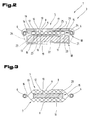
- the padding 5 for the seat part 3 is simplified in section, wherein it should be mentioned that the different embodiments of the padding 5 described below can also be used for the backrest 2 or the support of the lower leg or foot area ,
- the padding 5 comprises at least one layer 7 of a textile surface 8, which is formed from spun threads 9 to 11 as so-called spacer knit or pile thread knit.
- This spacing or pile thread knit is in turn formed from at least two mutually distanced layers 12, 13 and pile threads extending therebetween.
- the pile threads can be formed by one of the previously described threads 9 to 11.
- the layer 12 of the textile surface 8 faces a user of the passenger seat 1, not shown here, and may also be referred to as the upper belt.
- the other thereof averted layer 13 is also referred to as bottom flange.
- Such spacing or pile thread knits can be produced, for example, on knitting machines, double-loop looms and knitting machines.
- the pile threads - for example, the thread 11 - the two layers 12, 13 in the vertical direction to each other.
- flat, 21 ⁇ 2 and / or 3-dimensional structures of the textile surface 8 can be produced.
- a more detailed description of the production of such spacer or pile yarns is dispensed with, since this is already known from the general state of the art.
- This textile surface 8 shown here forms at least one layer 7 of the padding 5, wherein the textile surface 8 is at least partially connected to the support frame 6.
- this has at least partially knitting edges 14 on the outer periphery.
- the knitting edge 14 can be designed to receive the support frame 6, which is designed here as a tube, for example. In the course of assembly of the textile surface 8 then this can be pushed with their tubular knitting edges 14 on the or the support frame 6 and so easily the padding 5 are made.
- pins are provided on the support frame 6 as holding elements, in which the knitting edge 14 is hung with its openings and thus also a holder of the textile surface 8 on the support frame 6 can be achieved.
- These holding elements in the form of pins or hooks can be arranged, for example, in the region of the underside or rear side of the backrest 2 or of the seat part 3 in order to minimize or prevent the risk of injury or even hanging.
- the textile surface 8 is integrally molded in the required shape in its entirety or in the required three-dimensional spatial form, thereby also the knitted edges 14 are mitumutzt.
- at least one layer 7 of the padding 5 created which is completely finished in their shape and dimension and so no further rework, such as the sewing of fasteners, loops or the like. Necessary.
- the textile surface 8 it is possible in the context of the production of the textile surface 8 to create a design moderate design of the user-facing side of the padding 5. This can be done, for example, in the course of the manufacturing process by knitting patterns formed by means of differently dyed threads, for example in the form of logos, pictures, seat numbers or the like. This creates the opportunity to individually customize the appearance of the padding 5 to the respective operator or owner of the airline, the railway line, the bus company or the car manufacturer.
- the textile surface 8 it is possible to suspend the textile surface 8 with means not shown here of a different, aligned parallel to the textile surface 8 bias or make them variable, so as to better tune the hardness of the respective user of the passenger seat 1 and more individual.
- a material component in its low component is created, which can be cleaned, replaced or replaced without much effort.
- the textile surface despite the high forces to be absorbed, a low weight, creating a high savings potential in the constant transport volume or weight. This can further costs for ongoing operation can be saved.
- this textile surface 8 Due to the diverse possibilities of producing the textile surface 8, it is possible that this textile surface 8 has a different thickness and associated vertical distance between the two layers 12 and 13 over its surface area. This makes it possible, for example, to achieve a harder and stronger textile surface 8 in the higher-loaded seating area than in that area which faces the thighs. Thus, even with prolonged sitting in the course of long-haul flights, the risk of thrombosis-induced embolisms can be reduced or avoided.
- the individual threads 9 to 11 shown in a simplified manner may in turn be formed by a plurality of fibers, which are combined to form one of the threads 9 to 11.
- the individual threads 9 to 11 or fibers of an organic and / or inorganic and / or metallic material may be formed and each other also have a different elasticity and / or hardness and / or dimension.
- the threads 9 to 11 or fibers from the group of materials comprising glass, coal, aramids, metal, steel, ceramic, plastic, carbon, cotton, hemp and animal hair can be selected.
- the fibers may further be formed by elastomeric fibers of polyurethane, polyetheramide, polyetheresteramide, polyolefin components, polyester components or a mixture thereof.
- the elastomeric fibers may consist of Elastan®, Lycra® or other commercially available elastomeric fibers or a bicomponent fiber.
- the fibers or filaments 9-11 may be made from staple fibers selected from a group comprising aramid and / or para-aramid fibers such as Kevlar® (poly (p-phenylene terephthalamide), Nomex® (aramid from m-phenylenediamine and isophthalic acid), Twaron® , Technora, teijinconex, phenol-formaldehyde fibers such as kynol, polyamide / polyimide fibers such as kermel, polybenzimidazole fibers or mixtures of fibers thereof.Also, the aramid and / or para-aramid fibers may be selected from carbon (Beltron®, Zefstat, Negastate, Resistat), steel It is also possible, however, for the aramid and / or para-aramid fiber
- At least individual threads 9 to 11 or fibers of the textile surface 8 of the spacer knitted fabric are flame-retardant and / or electrically conductive. But it would also be possible that at least individual threads 9 to 11 or fibers of the textile surface 8 of the spacer knitted fabric are provided with a coating and / or an impregnation.
- Coating and / or impregnation for example, nanoparticles, paints, surface finishes, etc. can be used. It is also advantageous if the coating and / or the impregnation is flame-retardant.
- the textile surface 8 of the spacer knitted fabric can be formed to increase the strength at least in regions by a so-called V-belt knit 15, as shown in simplified lines in dashed lines.
- V-belt knitted fabric 15 can be integrated into the spacer fabric for forming the textile surface 8 and extend both transversely to the padding and in the direction of the depth thereof.
- the padding 5 optionally comprises, at least in regions, an at least single-layer protective layer 16, which may be formed, for example, by a flame-retardant fabric 17.
- the protective layer 16 may be disposed at least in that region of the padding 5 facing the user.
- the protective view 16 preferably spans the textile surface 8 and comprises the support frame 6 at least in certain areas and can be fastened or held there by means of a connecting device 18, such as a Velcro strip arrangement or the like, shown in simplified form.
- a connecting device 18 such as a Velcro strip arrangement or the like
- the textile surface 8 for receiving and supporting the user acting on these forces can be formed and the protective layer 16 assumes a covering and protective effect of the textile surface 8. This can be done in a simple way cleaning and replacement if necessary simply.
- the protective layer 16 is formed in multiple layers, it may also be formed by a plastic foam, which is preferably impregnated with liquid flame retardant.
- the padding 5 may comprise, at least in some areas, at least one functional element 19 which is associated with the textile surface 8.
- the functional elements 19 are designed in the form of at least one foam element 20, which is arranged on a side of the textile surface 8 facing away from the user.
- the foam element 20 may be arranged at a distance from the textile surface 8 in order to allow a deformation of the textile surface and only with a greater deformation, the textile surface comes into contact with the foam element 20 and this takes over the further support.
- a support or Auflagerung the foam element 20 can be done on a non-illustrated component of the support frame 4.
- foam element 20 may at least partially surrounded by its own protective layer 16 or be wrapped.
- the foam element 20 with the protective layer 16 is completely enveloped or enclosed, whereby damage and excessive dirt entering the foam scaffold is avoided.
- At least one support device 21 is inserted or embedded in the foam element 20.
- This support device 21 may for example be formed by a spring core, in particular stainless steel, as shown in the right part of Fig. 2.
- this could also be formed by a further foam element 23 of a plastic foam, with respect to the first foam element 20 has a higher Has hardness and is schematically indicated in the left part of the foam element 20.
- the foam element 20, 23 may be formed from the group of foams comprising PUR plastic foam with preferably open-cell foam structure, plastic foam with viscoelastic behavior, open-celled polyurethane-based ester-based foam with viscoelastic behavior, polyimide foam, polyether foam, silicone or a silicone elastomer foam.
- the foam element 20, 23 may have a density or density between 30 kg / m 3 and 100 kg / m 3 , preferably between 40 kg / m 3 and 70 kg / m 3 .
- the foam element 20, 23 may further have a hardness between 120 N and 450 N, preferably between 180 N and 220 N, with a compression hardness of 1 kPa to 15 kPa at an indentation depth of 40%.
- the foam element 20, 23 can also have a hardness of between 800 N and 4000 N and a compression hardness of between 30 kPa and 100 kPa at 40% impression depth.
- hardnesses between 150 N and 550 N, preferably of 400 N are possible.
- the compression hardness of the foam element 20, 23, in particular of the PUR plastic foam but can also be between 1 kPa to 20 kPa, preferably between 5 kPa and 10 kPa, at 40% depth of impression.
- the foam element 20, 23 is formed, for example, by an open-cell PUR plastic ester-based foam having a viscoelastic behavior, then this can have a density or density between 50 kg / m 3 and 80 kg / m 3 , preferably between 60 kg / m 3 and 70 kg / m 3 , with a compression hardness between 6 kPa and 25 kPa at 40% indentation depth.
- compression hardnesses between 11 kPa and 25 kPa, preferably between 15 kPa and 20 kPa, at 40% depth of impression are also possible.
- At least one flameproofing agent can be added to the foam element 20, 23 and / or the foam element 20, 23 can be impregnated with this flameproofing agent. On a representation of the same was omitted for the sake of clarity.
- the flame retardant may be powdery.
- the flame retardant may be a hydrate or a hydroxide, in particular an aluminum hydroxide or a hydrate of a zinc salt.
- the flame retardant may have nitrogen oxides releasing components when the temperature increases and z. B. be formed by melamine, Amoniumpolyphosphat and so on. Irrespective of this, however, it would also be possible for the flame retardant to increase in volume when the temperature increases and, for example, to increase in volume. formed by carbon, graphite.
- the amount of powdered flame retardant added to the foam element 20, 23 may be between 15 parts by weight and 50 parts by weight, preferably between 20 parts by weight and 40 parts by weight, of the foam element 20, 23.
- halogens releasing ingredients and z. B. be formed by organic phosphoric acid compounds, which are preferably liquid.
- the amount added may be between 1 part by weight and 20 parts by weight, preferably between 5 parts by weight and 12 parts by weight, of the foam element 20, 23.
- At least one of the functional elements 19 can be integrated in the textile surface 8, at least in some areas.
- the one or more functional elements 19 are arranged or embedded between the layers 12, 13.
- a connection to the pile threads is at least partially possible.
- individual sections of the functional element or elements 19 can project through the layers 12, 13 and thus protrude from the textile surface.
- at least one receiving space 24 is formed between the layers 12, 13 within the textile surface 8 of the spacer knit, which is or is designed to receive at least one functional element 19. If the receiving space 24 provided within the textile surface 8 is dimensioned accordingly, a pneumatic cushion 25 can be used as the functional element 19.
- This air cushion 25 is covered by the layers 12, 13 of the textile surface 8, wherein in this area, the arrangement of pile threads is omitted.
- the air cushion 5 may be formed variable in its volume and / or its hardness.
- the functional element 19 can also be formed by a temperature control element, not shown here in detail. If, for example, a resistance wire or a heating wire is used as the tempering element, it can be introduced into the same during the production of the textile surface 8 as well as subsequently. Upon application of electrical energy and a flow, the heating wire is heated and delivers this generated heat to the user. As a result, a favorable and comfortable seat climate can be created. If the material of individual threads 9 to 11 of the textile surface 8 selected accordingly, they can already form the tempering. But it would also be possible to form the tempering by a hose for receiving and / or delivery of a tempering medium. The state of the tempering medium used can be selected both gaseous and liquid or a combination thereof and be formed for example by air, water or other non-flammable flowing or flowable elements,
- the functional element 19 can also be provided, for example, by an active or passive component, a sensor, a piezo element, a Peltier element, a memory element, a transmitting element, an actuator, a display element, a light guide, a visible radiation emitting element, an integrated element Circuit, a switch, a plug, a transponder can be formed.
- an active or passive component a sensor, a piezo element, a Peltier element, a memory element, a transmitting element, an actuator, a display element, a light guide, a visible radiation emitting element, an integrated element Circuit, a switch, a plug, a transponder can be formed.
- This multiplicity of previously mentioned functional elements is given only by way of example, and these can be combined with one another as desired. But it would also be possible multiple arrangements.
- these functional elements 19 can also be operatively connected to a control or evaluation device.
- values determined by a sensor can be forwarded to the control or evaluation device via a line connection, not shown,
- the functional element 19 is formed by the foam element 20 arranged on the side of the textile surface 8 facing away from the user
- the protective layer 16 arranged in the area of the user facing upper side of the upholstery 5 can extend as far as a side of the foam element 20 facing away from the user this is indicated in the right part of Fig. 2 in dashed lines.
- the connecting device 18 may be provided.
- FIG. 2 shows in simplified form in dash-dotted lines in the lower left-hand part of FIG. 2 that at least one further layer 26 is assigned to the foam element 20 designed as a functional element 19 on the side facing away from the user.
- This further layer 26 may be assigned to the foam element 20 on the underside thereof, that is to say on the side remote from the user, in a continuous manner and extend as far as the support frame 6 or frames and be held thereon. If this layer 26 is dimensioned sufficiently strong and firm, this can on the one hand serve as a protective layer for the foam element 20 and on the other hand form a supporting or supporting function for the foam element 20. It would be possible that the functional element 19, in particular the foam element 20, is connected to the further layer 26.
- a further functional element 19 may also be arranged as a foam element 20 on the side of the textile surface 8 facing the user, ie in the region of the seat surface.
- This further functional element 19 may be provided at least in regions or even over the entire surface. In this case, the most widely combined qualities and hardnesses of the foam can be used to allow the greatest possible freedom from complaints and, above all, long sitting on the upholstery 5.
- This functional element 19 in the form of the foam element 20 can be provided not only directly in the heavily loaded seating area but also in that area of the upholstery 5 which faces the thigh of the user.
- the foam element 20 can also be provided over the front edge of the padding 5, that is to say that area which faces the knees of a user.
- the formed as a functional element 19 foam element 20 or the foam elements 20 but can also have seen in the direction perpendicular to the textile surface 8 have a different thickness or thickness, optionally overlap each other, so as to form, for example, a better support function or a preforming of the seat.
- FIG. 3 shows another possible embodiment of the upholstery 5, which may be independent of itself, wherein the same reference numerals or component designations are used again for the same parts as in the preceding FIGS. 1 and 2.
- reference numerals or component designations are used again for the same parts as in the preceding FIGS. 1 and 2.
- the padding 5 comprises at least two layers 7 of textile surfaces 8 of the spacer knitted fabric.
- the arrangement of several layers 7 of the textile surface 8 can serve to be able to transmit higher forces or to better adjust the individual layers 7 to individual applications. If, in addition, even different qualities are used in the threads 9 to 11 used, for example, the layer 7 averted here by the user can be thermally treated so as to achieve, for example, a partial melting or fusing of the individual threads 9 to 11, in this way to achieve better shielding for the user-facing layer 7.
- the foam element 20 is selected as the functional element 19, but any other combinations with the functional elements 19 described above are also possible.
Landscapes
- Engineering & Computer Science (AREA)
- Aviation & Aerospace Engineering (AREA)
- Textile Engineering (AREA)
- Transportation (AREA)
- Mechanical Engineering (AREA)
- Knitting Of Fabric (AREA)
- Chair Legs, Seat Parts, And Backrests (AREA)
- Laminated Bodies (AREA)
- Seats For Vehicles (AREA)
- Vehicle Waterproofing, Decoration, And Sanitation Devices (AREA)
- Organic Low-Molecular-Weight Compounds And Preparation Thereof (AREA)
- Compositions Of Macromolecular Compounds (AREA)
Applications Claiming Priority (1)
| Application Number | Priority Date | Filing Date | Title |
|---|---|---|---|
| AT0133005A AT502289B1 (de) | 2005-08-08 | 2005-08-08 | Polsterung für einen fahrgastsitz |
Publications (4)
| Publication Number | Publication Date |
|---|---|
| EP1752573A2 true EP1752573A2 (fr) | 2007-02-14 |
| EP1752573A3 EP1752573A3 (fr) | 2007-06-06 |
| EP1752573B1 EP1752573B1 (fr) | 2010-03-10 |
| EP1752573B8 EP1752573B8 (fr) | 2010-07-14 |
Family
ID=37188864
Family Applications (1)
| Application Number | Title | Priority Date | Filing Date |
|---|---|---|---|
| EP20060016303 Active EP1752573B8 (fr) | 2005-08-08 | 2006-08-04 | Rembourrage pour siège de véhicule |
Country Status (4)
| Country | Link |
|---|---|
| US (1) | US7607730B2 (fr) |
| EP (1) | EP1752573B8 (fr) |
| AT (2) | AT502289B1 (fr) |
| DE (1) | DE502006006375D1 (fr) |
Cited By (6)
| Publication number | Priority date | Publication date | Assignee | Title |
|---|---|---|---|---|
| WO2011143680A1 (fr) | 2010-05-17 | 2011-11-24 | Greiner Purtec Gmbh | Ensemble support pour siège passager et siège passager |
| EP2411244A1 (fr) * | 2009-03-27 | 2012-02-01 | Recaro Aircraft Seating GmbH & Co. KG | Dispositif pour siège passager comprenant un ensemble de support de toile tendue |
| WO2013096985A2 (fr) | 2011-12-30 | 2013-07-04 | Greiner Purtec Gmbh | Module d'appui pour siège passager et siège passager équipé de ce module |
| FR3001711A1 (fr) * | 2013-02-07 | 2014-08-08 | Expliseat | Siege de vehicule comportant une zone deformable en cas de choc |
| CN110424095A (zh) * | 2019-08-15 | 2019-11-08 | 江南大学 | 一种高纤维体积含量的经编间隔织物的制备方法 |
| US12522362B2 (en) | 2022-03-17 | 2026-01-13 | B/E Aerospace, Inc. | Hybrid bottom seat cushion |
Families Citing this family (19)
| Publication number | Priority date | Publication date | Assignee | Title |
|---|---|---|---|---|
| GB2455008B (en) * | 2006-06-12 | 2011-02-02 | Concrete Canvas Ltd | Impregnated fabric |
| EP2213777A1 (fr) | 2009-01-29 | 2010-08-04 | Concrete Canvas Limited | Tissu imprégné |
| US8550564B1 (en) * | 2010-04-01 | 2013-10-08 | The Boeing Company | Composite seat pan structure for a lightweight aircraft seat assembly |
| DE102010018822B4 (de) | 2010-04-29 | 2016-03-24 | Grammer Aktiengesellschaft | Witterungsbeständiger Sitz für Freizeitfahrzeuge |
| US10167635B2 (en) | 2011-11-01 | 2019-01-01 | Cortex Composites, Inc. | Nonwoven cementitious composite for In-Situ hydration |
| US9187902B2 (en) | 2011-11-01 | 2015-11-17 | Cortex Composites, Llc | Nonwoven cementitious composite for in-situ hydration |
| US10221569B2 (en) | 2011-11-01 | 2019-03-05 | Cortex Composites, Inc. | Cementitious composite constituent relationships |
| EP2708409B1 (fr) * | 2012-09-14 | 2015-07-01 | Grupo Antolin-Ingenieria, S.A. | Ensemble coussin auto-porté pour une partie intérieure de véhicule |
| DE102013205664B4 (de) * | 2013-03-28 | 2017-11-02 | Lufthansa Technik Ag | Matratze für Luftfahrzeuge |
| US9580175B2 (en) * | 2013-04-04 | 2017-02-28 | Franklin Products, Inc. | Aircraft seat back assembly |
| AU2016349494A1 (en) | 2015-11-05 | 2018-05-17 | Cortex Composites, Inc. | Cementitious composite mat |
| US9789796B1 (en) * | 2016-04-13 | 2017-10-17 | GM Global Technology Operations LLC | Seat with a cylindrical ventilation fan |
| US10808336B2 (en) | 2018-05-31 | 2020-10-20 | GM Global Technology Operations LLC | Vehicle seat trim covers with knitted attachment structures formed with heat-activated yarns |
| US10532675B2 (en) * | 2018-05-31 | 2020-01-14 | GM Global Technology Operations LLC | Vehicle seat trim cover with integrally knitted attachment features |
| US10843600B2 (en) | 2018-07-12 | 2020-11-24 | GM Global Technology Operations LLC | Vehicle seat trim covers including integrally-knit backing materials and methods of manufacturing vehicle seat trim covers |
| DE102019203979A1 (de) | 2019-03-22 | 2020-09-24 | Greiner Aerospace Gmbh | Sitzkissen für einen Flugzeugsitz mit integrierter Sensorelektronik |
| WO2020232161A1 (fr) | 2019-05-14 | 2020-11-19 | Ige, Llc | Système de support comprenant des couches de tissu d'espacement et matériau de détente de pression non viscoélastique, et procédé de mesure de propriétés de pression de distribution de pression et d'un système de support |
| EP4005437A1 (fr) * | 2020-11-30 | 2022-06-01 | DV8 ID S.r.l. | Artefact tricoté comportant des fils thermorétractables crochetés « en anglais » |
| US11827363B2 (en) | 2022-03-17 | 2023-11-28 | B/E Aerospace, Inc. | Composite seat bottom diaphragm |
Family Cites Families (24)
| Publication number | Priority date | Publication date | Assignee | Title |
|---|---|---|---|---|
| SE413070B (sv) | 1977-11-30 | 1980-04-14 | Eiser Ab | Textilt sitt- och liggunderlag |
| FR2576200B1 (fr) | 1985-01-21 | 1987-04-03 | Sofanor Sa | Revetement anti-vandalisme pour sieges |
| DE8506816U1 (de) | 1985-03-08 | 1985-07-25 | Hamburger Hochbahn Ag, 2000 Hamburg | Sitz für den öffentlichen Personenverkehr |
| ATE59345T1 (de) | 1986-05-09 | 1991-01-15 | Greiner Schaumstoffwerk | Sitz, insbesondere fuer oeffentliche verkehrsmittel. |
| DE3853082D1 (de) * | 1987-06-02 | 1995-03-23 | Greiner & Soehne C A | Sitz mit einem Polster aus Schaumkunststoff. |
| US5013089A (en) * | 1989-09-15 | 1991-05-07 | General Motors Corporation | Thin profile integrated suspension and seat trim cover |
| JPH04215710A (ja) * | 1990-12-13 | 1992-08-06 | Mitsubishi Motors Corp | 通気性シート |
| AT399488B (de) | 1991-04-22 | 1995-05-26 | Greiner & Soehne C A | Sitzpolster, insbesondere flugzeugsitz |
| DE4239068C2 (de) * | 1992-11-20 | 1996-03-14 | Peter Rickerl | Abstandsgewirke zur Aufpolsterung |
| EP0617152B1 (fr) | 1993-02-22 | 1999-08-25 | Recaro GmbH & Co. | Tissu "face-à-face" à épaisseur variable, procédé de fabrication et applications |
| DE4317883A1 (de) * | 1993-05-28 | 1994-12-01 | Peter Rickerl | Abstandsgewirke zur Aufpolsterung |
| AT400700B (de) | 1993-11-03 | 1996-02-26 | Greiner & Soehne C A | Fahrzeugsitz mit einem sitzpolster, insbesondere flugzeugsitz |
| DE19530928C2 (de) * | 1995-08-23 | 1998-12-03 | Mayer Textilmaschf | Aus Wirkware bestehendes Verbundteil |
| US6065809A (en) * | 1997-01-21 | 2000-05-23 | Hoger; Knut | Upholstery element and manufacturing process thereof |
| DE19735060C2 (de) * | 1997-08-13 | 2002-10-02 | Gertex Textil Gmbh | Koffer- und Laderaumabdeckung für Kraftfahrzeuge, etc. |
| DE19805178C2 (de) * | 1998-02-10 | 2000-07-13 | Daimler Chrysler Ag | Polster für Sitzteil und/oder Rückenlehne eines Fahrzeugsitzes |
| DE19847334A1 (de) * | 1998-10-09 | 2000-04-13 | Keiper Recaro Gmbh Co | Anordnung zur Befestigung eines zweilagigen Gestricks an einem Träger |
| JP2000300393A (ja) * | 1999-04-22 | 2000-10-31 | Okamoto Ind Inc | クッション構造体 |
| DE10013492B4 (de) * | 2000-03-20 | 2009-01-15 | Cetex Institut für Textil- und Verarbeitungsmaschinen gemeinnützige GmbH | Fahrzeugsitz |
| AT4727U1 (de) | 2000-10-20 | 2001-11-26 | Kobleder Strickmode Gmbh & Co | Textilflächen für möbel |
| DE20118250U1 (de) | 2000-10-20 | 2002-03-28 | Kobleder Strickmode Gmbh & Co., St. Martin Im Innkreis | Textilflächen für Möbel |
| DE10110329A1 (de) * | 2001-03-03 | 2002-09-12 | Bayerische Motoren Werke Ag | Textilien |
| DE20302364U1 (de) | 2003-02-14 | 2003-04-17 | Kobleder Strickmode Gmbh & Co., St. Martin Im Innkreis | Polsterung für Möbel |
| AT412863B (de) * | 2004-01-29 | 2005-08-25 | Hoerbiger Automatisierungstech | Fluidbefüllbarer, volumsveränderlicher körper |
-
2005
- 2005-08-08 AT AT0133005A patent/AT502289B1/de not_active IP Right Cessation
-
2006
- 2006-08-04 EP EP20060016303 patent/EP1752573B8/fr active Active
- 2006-08-04 US US11/499,324 patent/US7607730B2/en active Active
- 2006-08-04 DE DE200650006375 patent/DE502006006375D1/de active Active
- 2006-08-04 AT AT06016303T patent/ATE460523T1/de active
Cited By (8)
| Publication number | Priority date | Publication date | Assignee | Title |
|---|---|---|---|---|
| EP2411244A1 (fr) * | 2009-03-27 | 2012-02-01 | Recaro Aircraft Seating GmbH & Co. KG | Dispositif pour siège passager comprenant un ensemble de support de toile tendue |
| WO2011143680A1 (fr) | 2010-05-17 | 2011-11-24 | Greiner Purtec Gmbh | Ensemble support pour siège passager et siège passager |
| WO2013096985A2 (fr) | 2011-12-30 | 2013-07-04 | Greiner Purtec Gmbh | Module d'appui pour siège passager et siège passager équipé de ce module |
| FR3001711A1 (fr) * | 2013-02-07 | 2014-08-08 | Expliseat | Siege de vehicule comportant une zone deformable en cas de choc |
| WO2014122173A1 (fr) * | 2013-02-07 | 2014-08-14 | Expliseat | Siege de vehicule comportant une zone deformable en cas de choc |
| US9764843B2 (en) | 2013-02-07 | 2017-09-19 | Expliseat | Vehicle seat comprising an area that is deformable in the event of an impact |
| CN110424095A (zh) * | 2019-08-15 | 2019-11-08 | 江南大学 | 一种高纤维体积含量的经编间隔织物的制备方法 |
| US12522362B2 (en) | 2022-03-17 | 2026-01-13 | B/E Aerospace, Inc. | Hybrid bottom seat cushion |
Also Published As
| Publication number | Publication date |
|---|---|
| EP1752573A3 (fr) | 2007-06-06 |
| ATE460523T1 (de) | 2010-03-15 |
| US7607730B2 (en) | 2009-10-27 |
| AT502289B1 (de) | 2010-11-15 |
| DE502006006375D1 (de) | 2010-04-22 |
| AT502289A1 (de) | 2007-02-15 |
| EP1752573B8 (fr) | 2010-07-14 |
| US20070123129A1 (en) | 2007-05-31 |
| EP1752573B1 (fr) | 2010-03-10 |
Similar Documents
| Publication | Publication Date | Title |
|---|---|---|
| EP1752573B1 (fr) | Rembourrage pour siège de véhicule | |
| AT400700B (de) | Fahrzeugsitz mit einem sitzpolster, insbesondere flugzeugsitz | |
| AT509326B1 (de) | Stützbaugruppe für fahrgastsitz sowie fahrgastsitz | |
| EP0609715B1 (fr) | Siège de véhicule, notamment pour un avion | |
| AT399488B (de) | Sitzpolster, insbesondere flugzeugsitz | |
| EP0438186B1 (fr) | Siège avec rembourrage en matière synthétique mousse | |
| EP2137027B1 (fr) | Siège, notamment pour moyens de transports publics | |
| AT505212B1 (de) | Sitz, insbesondere für öffentliche verkehrsmittel | |
| DE102009057072A1 (de) | Polster mit Belüftung für einen Fahrzeugsitz | |
| EP3600872B1 (fr) | Tissu ignifuge pour sièges de véhicules, notammment pour sièges d'avion | |
| EP1842458A2 (fr) | Corps rembourré de mousse , en particulier pour sièges de véhicule automobile | |
| DE112019003402B4 (de) | Lasttragende oberfläche mit einem bewegungsenergie-verwaltenden gewebe | |
| WO2013096985A2 (fr) | Module d'appui pour siège passager et siège passager équipé de ce module | |
| EP0830973B1 (fr) | Elément de rembourrage de siège, tel qu'élément de support et/ou élément rapporté | |
| DE102012013597A1 (de) | Sitzanlage, insbesondere Fahrzeugsitz, für einen Kraftwagen | |
| DE102006001225A1 (de) | Klimatisiertes Polsterteil, insbesondere für einen "passiven Klimasitz" | |
| EP1700783A1 (fr) | Matelas résistant au feu, pour usage à bord d'un aéronef | |
| DE102006061004B4 (de) | Bezug für eine Matratze | |
| WO2006060833A1 (fr) | Rembourrage de siege, notamment de siege d'avion | |
| DE202005020712U1 (de) | Mehrschichtiger Polsterstoff |
Legal Events
| Date | Code | Title | Description |
|---|---|---|---|
| PUAI | Public reference made under article 153(3) epc to a published international application that has entered the european phase |
Free format text: ORIGINAL CODE: 0009012 |
|
| AK | Designated contracting states |
Kind code of ref document: A2 Designated state(s): AT BE BG CH CY CZ DE DK EE ES FI FR GB GR HU IE IS IT LI LT LU LV MC NL PL PT RO SE SI SK TR |
|
| AX | Request for extension of the european patent |
Extension state: AL BA HR MK YU |
|
| PUAL | Search report despatched |
Free format text: ORIGINAL CODE: 0009013 |
|
| AK | Designated contracting states |
Kind code of ref document: A3 Designated state(s): AT BE BG CH CY CZ DE DK EE ES FI FR GB GR HU IE IS IT LI LT LU LV MC NL PL PT RO SE SI SK TR |
|
| AX | Request for extension of the european patent |
Extension state: AL BA HR MK YU |
|
| 17P | Request for examination filed |
Effective date: 20071022 |
|
| AKX | Designation fees paid |
Designated state(s): AT BE BG CH CY CZ DE DK EE ES FI FR GB GR HU IE IS IT LI LT LU LV MC NL PL PT RO SE SI SK TR |
|
| AXX | Extension fees paid |
Extension state: BA Payment date: 20071022 Extension state: MK Payment date: 20071022 Extension state: YU Payment date: 20071022 Extension state: HR Payment date: 20071022 Extension state: AL Payment date: 20071022 |
|
| RAX | Requested extension states of the european patent have changed |
Extension state: MK Payment date: 20071022 Extension state: AL Payment date: 20071022 Extension state: RS Payment date: 20071022 Extension state: BA Payment date: 20071022 Extension state: HR Payment date: 20071022 |
|
| GRAP | Despatch of communication of intention to grant a patent |
Free format text: ORIGINAL CODE: EPIDOSNIGR1 |
|
| GRAS | Grant fee paid |
Free format text: ORIGINAL CODE: EPIDOSNIGR3 |
|
| GRAA | (expected) grant |
Free format text: ORIGINAL CODE: 0009210 |
|
| AK | Designated contracting states |
Kind code of ref document: B1 Designated state(s): AT BE BG CH CY CZ DE DK EE ES FI FR GB GR HU IE IS IT LI LT LU LV MC NL PL PT RO SE SI SK TR |
|
| AX | Request for extension of the european patent |
Extension state: AL BA HR MK RS |
|
| REG | Reference to a national code |
Ref country code: GB Ref legal event code: FG4D Free format text: NOT ENGLISH |
|
| REG | Reference to a national code |
Ref country code: CH Ref legal event code: EP |
|
| REG | Reference to a national code |
Ref country code: IE Ref legal event code: FG4D |
|
| REF | Corresponds to: |
Ref document number: 502006006375 Country of ref document: DE Date of ref document: 20100422 Kind code of ref document: P |
|
| REG | Reference to a national code |
Ref country code: NL Ref legal event code: VDEP Effective date: 20100310 |
|
| PG25 | Lapsed in a contracting state [announced via postgrant information from national office to epo] |
Ref country code: LT Free format text: LAPSE BECAUSE OF FAILURE TO SUBMIT A TRANSLATION OF THE DESCRIPTION OR TO PAY THE FEE WITHIN THE PRESCRIBED TIME-LIMIT Effective date: 20100310 |
|
| LTIE | Lt: invalidation of european patent or patent extension |
Effective date: 20100310 |
|
| PG25 | Lapsed in a contracting state [announced via postgrant information from national office to epo] |
Ref country code: SI Free format text: LAPSE BECAUSE OF FAILURE TO SUBMIT A TRANSLATION OF THE DESCRIPTION OR TO PAY THE FEE WITHIN THE PRESCRIBED TIME-LIMIT Effective date: 20100310 Ref country code: FI Free format text: LAPSE BECAUSE OF FAILURE TO SUBMIT A TRANSLATION OF THE DESCRIPTION OR TO PAY THE FEE WITHIN THE PRESCRIBED TIME-LIMIT Effective date: 20100310 Ref country code: PL Free format text: LAPSE BECAUSE OF FAILURE TO SUBMIT A TRANSLATION OF THE DESCRIPTION OR TO PAY THE FEE WITHIN THE PRESCRIBED TIME-LIMIT Effective date: 20100310 Ref country code: LV Free format text: LAPSE BECAUSE OF FAILURE TO SUBMIT A TRANSLATION OF THE DESCRIPTION OR TO PAY THE FEE WITHIN THE PRESCRIBED TIME-LIMIT Effective date: 20100310 |
|
| REG | Reference to a national code |
Ref country code: IE Ref legal event code: FD4D |
|
| PG25 | Lapsed in a contracting state [announced via postgrant information from national office to epo] |
Ref country code: GR Free format text: LAPSE BECAUSE OF FAILURE TO SUBMIT A TRANSLATION OF THE DESCRIPTION OR TO PAY THE FEE WITHIN THE PRESCRIBED TIME-LIMIT Effective date: 20100611 Ref country code: EE Free format text: LAPSE BECAUSE OF FAILURE TO SUBMIT A TRANSLATION OF THE DESCRIPTION OR TO PAY THE FEE WITHIN THE PRESCRIBED TIME-LIMIT Effective date: 20100310 Ref country code: CY Free format text: LAPSE BECAUSE OF FAILURE TO SUBMIT A TRANSLATION OF THE DESCRIPTION OR TO PAY THE FEE WITHIN THE PRESCRIBED TIME-LIMIT Effective date: 20100310 Ref country code: ES Free format text: LAPSE BECAUSE OF FAILURE TO SUBMIT A TRANSLATION OF THE DESCRIPTION OR TO PAY THE FEE WITHIN THE PRESCRIBED TIME-LIMIT Effective date: 20100621 Ref country code: NL Free format text: LAPSE BECAUSE OF FAILURE TO SUBMIT A TRANSLATION OF THE DESCRIPTION OR TO PAY THE FEE WITHIN THE PRESCRIBED TIME-LIMIT Effective date: 20100310 Ref country code: RO Free format text: LAPSE BECAUSE OF FAILURE TO SUBMIT A TRANSLATION OF THE DESCRIPTION OR TO PAY THE FEE WITHIN THE PRESCRIBED TIME-LIMIT Effective date: 20100310 Ref country code: SE Free format text: LAPSE BECAUSE OF FAILURE TO SUBMIT A TRANSLATION OF THE DESCRIPTION OR TO PAY THE FEE WITHIN THE PRESCRIBED TIME-LIMIT Effective date: 20100310 |
|
| PG25 | Lapsed in a contracting state [announced via postgrant information from national office to epo] |
Ref country code: SK Free format text: LAPSE BECAUSE OF FAILURE TO SUBMIT A TRANSLATION OF THE DESCRIPTION OR TO PAY THE FEE WITHIN THE PRESCRIBED TIME-LIMIT Effective date: 20100310 Ref country code: IS Free format text: LAPSE BECAUSE OF FAILURE TO SUBMIT A TRANSLATION OF THE DESCRIPTION OR TO PAY THE FEE WITHIN THE PRESCRIBED TIME-LIMIT Effective date: 20100710 Ref country code: CZ Free format text: LAPSE BECAUSE OF FAILURE TO SUBMIT A TRANSLATION OF THE DESCRIPTION OR TO PAY THE FEE WITHIN THE PRESCRIBED TIME-LIMIT Effective date: 20100310 Ref country code: BG Free format text: LAPSE BECAUSE OF FAILURE TO SUBMIT A TRANSLATION OF THE DESCRIPTION OR TO PAY THE FEE WITHIN THE PRESCRIBED TIME-LIMIT Effective date: 20100610 |
|
| PLBE | No opposition filed within time limit |
Free format text: ORIGINAL CODE: 0009261 |
|
| STAA | Information on the status of an ep patent application or granted ep patent |
Free format text: STATUS: NO OPPOSITION FILED WITHIN TIME LIMIT |
|
| PG25 | Lapsed in a contracting state [announced via postgrant information from national office to epo] |
Ref country code: PT Free format text: LAPSE BECAUSE OF FAILURE TO SUBMIT A TRANSLATION OF THE DESCRIPTION OR TO PAY THE FEE WITHIN THE PRESCRIBED TIME-LIMIT Effective date: 20100712 Ref country code: IE Free format text: LAPSE BECAUSE OF FAILURE TO SUBMIT A TRANSLATION OF THE DESCRIPTION OR TO PAY THE FEE WITHIN THE PRESCRIBED TIME-LIMIT Effective date: 20100310 Ref country code: DK Free format text: LAPSE BECAUSE OF FAILURE TO SUBMIT A TRANSLATION OF THE DESCRIPTION OR TO PAY THE FEE WITHIN THE PRESCRIBED TIME-LIMIT Effective date: 20100310 |
|
| 26N | No opposition filed |
Effective date: 20101213 |
|
| BERE | Be: lapsed |
Owner name: GREINER PURTEC GMBH Effective date: 20100831 |
|
| PG25 | Lapsed in a contracting state [announced via postgrant information from national office to epo] |
Ref country code: MC Free format text: LAPSE BECAUSE OF NON-PAYMENT OF DUE FEES Effective date: 20100831 Ref country code: IT Free format text: LAPSE BECAUSE OF FAILURE TO SUBMIT A TRANSLATION OF THE DESCRIPTION OR TO PAY THE FEE WITHIN THE PRESCRIBED TIME-LIMIT Effective date: 20100310 |
|
| REG | Reference to a national code |
Ref country code: CH Ref legal event code: PL |
|
| PG25 | Lapsed in a contracting state [announced via postgrant information from national office to epo] |
Ref country code: LI Free format text: LAPSE BECAUSE OF NON-PAYMENT OF DUE FEES Effective date: 20100831 Ref country code: CH Free format text: LAPSE BECAUSE OF NON-PAYMENT OF DUE FEES Effective date: 20100831 |
|
| REG | Reference to a national code |
Ref country code: FR Ref legal event code: ST Effective date: 20110502 |
|
| PG25 | Lapsed in a contracting state [announced via postgrant information from national office to epo] |
Ref country code: BE Free format text: LAPSE BECAUSE OF NON-PAYMENT OF DUE FEES Effective date: 20100831 Ref country code: FR Free format text: LAPSE BECAUSE OF NON-PAYMENT OF DUE FEES Effective date: 20100831 |
|
| PG25 | Lapsed in a contracting state [announced via postgrant information from national office to epo] |
Ref country code: LU Free format text: LAPSE BECAUSE OF NON-PAYMENT OF DUE FEES Effective date: 20100804 Ref country code: HU Free format text: LAPSE BECAUSE OF FAILURE TO SUBMIT A TRANSLATION OF THE DESCRIPTION OR TO PAY THE FEE WITHIN THE PRESCRIBED TIME-LIMIT Effective date: 20100911 |
|
| PG25 | Lapsed in a contracting state [announced via postgrant information from national office to epo] |
Ref country code: TR Free format text: LAPSE BECAUSE OF FAILURE TO SUBMIT A TRANSLATION OF THE DESCRIPTION OR TO PAY THE FEE WITHIN THE PRESCRIBED TIME-LIMIT Effective date: 20100310 |
|
| PGFP | Annual fee paid to national office [announced via postgrant information from national office to epo] |
Ref country code: AT Payment date: 20120117 Year of fee payment: 6 |
|
| REG | Reference to a national code |
Ref country code: AT Ref legal event code: MM01 Ref document number: 460523 Country of ref document: AT Kind code of ref document: T Effective date: 20120804 |
|
| PG25 | Lapsed in a contracting state [announced via postgrant information from national office to epo] |
Ref country code: AT Free format text: LAPSE BECAUSE OF NON-PAYMENT OF DUE FEES Effective date: 20120804 |
|
| REG | Reference to a national code |
Ref country code: DE Ref legal event code: R082 Ref document number: 502006006375 Country of ref document: DE Representative=s name: CREMER & CREMER, DE |
|
| REG | Reference to a national code |
Ref country code: GB Ref legal event code: 732E Free format text: REGISTERED BETWEEN 20140731 AND 20140806 |
|
| REG | Reference to a national code |
Ref country code: DE Ref legal event code: R081 Ref document number: 502006006375 Country of ref document: DE Owner name: GREINER AEROSPACE GMBH, AT Free format text: FORMER OWNER: GREINER PURTEC GMBH, KREMSMUENSTER, AT Effective date: 20140826 Ref country code: DE Ref legal event code: R082 Ref document number: 502006006375 Country of ref document: DE Representative=s name: CREMER & CREMER, DE Effective date: 20140826 |
|
| REG | Reference to a national code |
Ref country code: DE Ref legal event code: R082 Ref document number: 502006006375 Country of ref document: DE Representative=s name: ABP BURGER RECHTSANWALTSGESELLSCHAFT MBH, DE |
|
| PGFP | Annual fee paid to national office [announced via postgrant information from national office to epo] |
Ref country code: GB Payment date: 20220704 Year of fee payment: 17 Ref country code: DE Payment date: 20220627 Year of fee payment: 17 |
|
| REG | Reference to a national code |
Ref country code: DE Ref legal event code: R081 Ref document number: 502006006375 Country of ref document: DE Owner name: NEVEON AUSTRIA GMBH, AT Free format text: FORMER OWNER: GREINER AEROSPACE GMBH, KREMSMUENSTER, AT |
|
| REG | Reference to a national code |
Ref country code: GB Ref legal event code: 732E Free format text: REGISTERED BETWEEN 20230330 AND 20230405 |
|
| P01 | Opt-out of the competence of the unified patent court (upc) registered |
Effective date: 20230629 |
|
| REG | Reference to a national code |
Ref country code: DE Ref legal event code: R119 Ref document number: 502006006375 Country of ref document: DE |
|
| GBPC | Gb: european patent ceased through non-payment of renewal fee |
Effective date: 20230804 |
|
| PG25 | Lapsed in a contracting state [announced via postgrant information from national office to epo] |
Ref country code: GB Free format text: LAPSE BECAUSE OF NON-PAYMENT OF DUE FEES Effective date: 20230804 |
|
| PG25 | Lapsed in a contracting state [announced via postgrant information from national office to epo] |
Ref country code: GB Free format text: LAPSE BECAUSE OF NON-PAYMENT OF DUE FEES Effective date: 20230804 Ref country code: DE Free format text: LAPSE BECAUSE OF NON-PAYMENT OF DUE FEES Effective date: 20240301 |