EP1753175B2 - Verfahren zur realisierung eines virtuellen privaten netzes - Google Patents
Verfahren zur realisierung eines virtuellen privaten netzes Download PDFInfo
- Publication number
- EP1753175B2 EP1753175B2 EP05757338.8A EP05757338A EP1753175B2 EP 1753175 B2 EP1753175 B2 EP 1753175B2 EP 05757338 A EP05757338 A EP 05757338A EP 1753175 B2 EP1753175 B2 EP 1753175B2
- Authority
- EP
- European Patent Office
- Prior art keywords
- message
- static
- address
- label
- vrf
- Prior art date
- Legal status (The legal status is an assumption and is not a legal conclusion. Google has not performed a legal analysis and makes no representation as to the accuracy of the status listed.)
- Expired - Lifetime
Links
Images

Classifications
-
- H—ELECTRICITY
- H04—ELECTRIC COMMUNICATION TECHNIQUE
- H04L—TRANSMISSION OF DIGITAL INFORMATION, e.g. TELEGRAPHIC COMMUNICATION
- H04L45/00—Routing or path finding of packets in data switching networks
-
- H—ELECTRICITY
- H04—ELECTRIC COMMUNICATION TECHNIQUE
- H04L—TRANSMISSION OF DIGITAL INFORMATION, e.g. TELEGRAPHIC COMMUNICATION
- H04L12/00—Data switching networks
- H04L12/28—Data switching networks characterised by path configuration, e.g. LAN [Local Area Networks] or WAN [Wide Area Networks]
- H04L12/46—Interconnection of networks
- H04L12/4641—Virtual LANs, VLANs, e.g. virtual private networks [VPN]
- H04L12/4645—Details on frame tagging
-
- H—ELECTRICITY
- H04—ELECTRIC COMMUNICATION TECHNIQUE
- H04L—TRANSMISSION OF DIGITAL INFORMATION, e.g. TELEGRAPHIC COMMUNICATION
- H04L45/00—Routing or path finding of packets in data switching networks
- H04L45/50—Routing or path finding of packets in data switching networks using label swapping, e.g. multi-protocol label switch [MPLS]
-
- H—ELECTRICITY
- H04—ELECTRIC COMMUNICATION TECHNIQUE
- H04L—TRANSMISSION OF DIGITAL INFORMATION, e.g. TELEGRAPHIC COMMUNICATION
- H04L63/00—Network architectures or network communication protocols for network security
- H04L63/02—Network architectures or network communication protocols for network security for separating internal from external traffic, e.g. firewalls
- H04L63/0272—Virtual private networks
Definitions
- the present invention relates to a Virtual Private Network (VPN) technology, and more particularly, to a method for implementing a VPN based on the Multi-Protocol Label Switching (MPLS) protocol.
- VPN Virtual Private Network
- MPLS Multi-Protocol Label Switching
- a VPN of the Border Gateway Protocol (BGP) / Multi-Protocol Label Switching (MPLS) was proposed in 1999 and has formed the Request for Comments (RFC) standard 2547.
- BGP Border Gateway Protocol
- MPLS Multi-Protocol Label Switching
- a BGP/MPLS VPN model includes three parts: a Customer Edge (CE) device, a backbone network Provider Edge (PE) router, and a backbone network Provider (P) router.
- the CE device is a component of a customer network and has an interface connecting to an operator network directly, which is usually a router and can not perceive the existence of the VPN
- the PE router is an edge device of the operator network connecting to a CE of a customer directly, and in the MPLS network, all the processing related to the VPN are completed on the PE router
- the P router is located at the operator network as a backbone router, not connecting to the CE router directly, and needs to possess the basic MPLS signaling and forwarding capacities.
- CE and PE are the boundaries of the two management scopes. Routing information can be switched between the CE and the PE by using the External BGP (E-BGP), Interior Gateway Protocol (IGP), or static routes. It is not necessary for the CE to support the MPLS protocol or to be able to perceive the VPN. Inside the VPN, routing information is switched between the PEs based on the Multi-Protocol Border Gateway Protocol (MP-BGP).
- MP-BGP Multi-Protocol Border Gateway Protocol
- the BGP/MPLS VPN defined by RFC 2547 is hereinafter described in detail.
- VRF VPN Routing/Forwarding instance
- a BGP/MPLS VPN is composed of multiple customer sites. Multiple VRFs are saved in one PE. Each VRF corresponds to one customer site, and the content of a VRF mainly includes: an IP (Internet Protocol) route table, a label forwarding table, and a series of interface information and management information using the label forwarding table. Wherein, the interface information and management information includes: a Route Distinguisher (RD), a route filtering policy, a member interface list, etc.
- RD Route Distinguisher
- a VRF of a customer site in the VPN actually integrates the VPN member relationship and routing rules of the customer site. Message forwarding information is saved in the IP route table and the label forwarding table of each VRF. The system maintains an independent set of the routing table and label forwarding table for each VRF, thereby preventing data from leaking out of the VPN and keeping data outside of the VPN from entering.
- VPN-IPv4 VPN-Internet Protocol version 4
- a VPN- IPv4 address contains 12 bytes, beginning with an 8-byte RD and ending with a 4-byte IPv4 address.
- the operator can distribute an RD independently, however, they need to make their private Autonomous System (AS) number as one part of the RD to ensure the global uniqueness of each RD.
- the VPN- IPv4 address, the RD of which is zero, is synonymous with the globally unique IPv4 address. After such processing, even the 4-byte IPv4 address contained in the VPN-IPv4 address overlaps, the VPN-IPv4 address can still keep its global uniqueness.
- the route, which the PE router receives from the CE router is an IPv4 route, so the route needs to be introduced to the VRF route table so that an RD can be attached to the route.
- all routes from the same customer site can be configured with an identical RD.
- VPN-Target attributes ultimately determine the VPN division in the whole network.
- the MPLS/BGP VPN has no explicit VPN label, therefore, it mainly depends on the VPN-Target attribute to determine the routes of which site one site can receive and by which site the routes of the site can be received.
- Export VPN-Targets the route received from a site
- Import VPN-Targets By matching the Route Target attributes carried in the route, it is possible to obtain the member relationship of the VPN.
- matching Route Target attributes may also be used for filtering the routing information received by the PE router, that is, when routing information enters the PE router, if there are identical items between the Export Route Targets set and the Import Route Targets set, the route will be accepted; and if there is no identical items between the Export Route Targets set and the Import Route Targets set, the route will be refused.
- the first layer label i.e., the outer layer label switched inside the backbone network
- LSP Label Switched Path
- the second layer label i.e., an inner label, used when a message is transmitted from the PEER PE to the CE, indicates which site the message should arrive at, or more particularly, which CE the message should arrive at, and according to the layer label, it is possible to find out the interface that is for forwarding the message to the customer. If both the source site and destination site of the VPN message connect to the same PE, the problem of how the message reaches the PEER PE will no longer exist, and the problem that should be solved is only how to arrive at the CE connecting to the destination site.
- LSP Label Switched Path
- Routing information is transmitted between the CE and PE through the IGP or EBGP.
- the PE obtains the route table of the VPN and saves it in an independent VRF.
- Various PEs adopt the IGP to ensure the connectivity of the operator network, transfer VPN construction information and routes through the Internal BGP (IBGP), and complete updating their own VRFs respectively. And then, the PE updates the route table of a CE directly connecting to the PE by switching routes with the CE, thereby accomplishing the route switching among a variety of CEs.
- two PE routers exchange routing information of the VPN by running the MBGP protocol and matches the Export Route Targets and Import Route Targets configured on each VRF to determine the route introduction of the VRF and which VRF, other than the VRF, the routes of the VRF should be distributed to.
- the corresponding VRFs can own the routes needed, which contains a label, so that a logical VPN relationship can be formed to guarantee a reachable route layer.
- the outer layer label can ensure that a message reaches the right PEER PE router, i.e., the router corresponding to the next-hop address of the VPN route. After the message arrives at the PEER PE router, it may be forwarded from the designated VPN interface according to the layer label carried in the message, or uploaded to the router directly. Wherein, the layer label is a part of the VPN route distributed through the MBGP. It should be noted that, it is also possible to adopt other tunnel techniques to ensure the message arriving at the right PEER PE router, for instance, the Generic Route Encapsulation (GRE) protocol tunnel and IP Security Protocol (IPsec) tunnel etc.
- GRE Generic Route Encapsulation
- IPsec IP Security Protocol
- EP 1 392 033 A1 provides an expandable 3-layer PP VPN that consumes fewer resources and requires little configuration. It is to solve the problem that PE devices, in the BGP/MPLS VPN architecture, may be the bottleneck in large-scale deployments because they have to converge routes from a plurality of VPNs. And the objective is achieved by a hierachical PE (HoPE) which is formed by multiple PE devices.
- HoPE hierachical PE
- the present invention is to provide a method for implementing VPN in order to transmit VPN routes between two PE devices without running the MBGP protocol, and realize the inter-access of the VRFs on the two PE routers without the Route Target matching relationship.
- the present invention discloses a method for implementing Virtual Private Networking (VPN), including:
- the above solution may further include: transferring VPN routing information among the PEs via the multi-protocol extension border gateway protocol.
- the VPN routing information may be the information contained in the one or more static routes configured in the second PE.
- when searching out a static route containing the destination address in the message may further include: if the static route is searched out, continuing the procedure; otherwise, terminating the procedure.
- the tunnel may be an LSP, a Generic Routing Encapsulation tunnel, or an Internet Protocol Secure Tunnel.
- a system for implementing Virtual Private Networking VPN includes:
- the address of the first PE may be the public address of the first PE.
- the address of the network entity may be the network segment address of the network entity.
- each configured static route includes a label of the destination VRF, and its next-hop address is a public address of the PE where the destination VRF is located; when a message matches the one or more static routes, inserting the label contained in the matched static route into the message as an inner label, finding a tunnel based on the next-hop address, and sending the message to the PE where the destination VRF is located; and the PE forwarding the received message to the VRF corresponding to the inner label.
- This method for implementing VPN by configuring labels and static routes can be applied independently or with the MBGP-based VPN implementation schemes.
- the VRFs of two PE routers that have no VPN matching relationship i.e., their import/export Route Targets not matching to each other, may support inter-access, and the access relationship of the VRFs of the two PE routers can be adjusted conveniently and dynamically as required practically, which largely improves the flexibility of network configuration.
- the method of the embodiments of the present invention includes: configuring a static label for a VRF in a PE; when it is to run the MBGP protocol between two PEs, the static label being carried by a VPN route of the VRF when the VPN route is being advertised outwards; and if a message is being forwarded, the label can globally identify which VPN the message will be transmitted to.
- a static route arriving at the network entity is configured.
- the destination of the static route can be a default route or any network segment of a CE device connected with the PE configured with the static label, and the destination address of the static route is the address of the network entity at which it should arrive.
- the next-hop of the static route mentioned above is not the address of a P device of the PE but the public address of a destination side PE the customer desires to access; besides, the above-mentioned static route can be configured with a label, wherein, the label is the static label of the VRF on the destination side PE the customer desires to access.
- the PE where the static route is configured can send a message to a tunnel needed to reach the next-hop PE through the configured next-hop address, and via the tunnel, the message may further reach the next-hop PE, i.e., the destination side PE.
- the tunnel may be an LSP, a Generic Routing Encapsulation (GRE), an IPsec (IP Security), or any other tunnel.
- This embodiment for implementing VPN by configuring labels and static routes can be realized independently or combined with an MBGP-based method for implementing VPN. That is to say, during the message forwarding, VPN can be implemented based on the matching relationship of the Export Route Targets and Import Route Targets, by using either the static routes configured or the VPN routes delivered via the MBGP.
- a preferred embodiment of the present invention is to adopt the MBGP to establish most of the VPNs, and using the method of static routes to configure the minority of the VPNs, with special requirements, such as a temporary VPN.
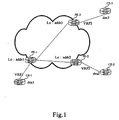
- the established VPN is to realize the inter-access between the network entity connected with CE-1 device and those connected with CE-3 device, as well as the inter-access between the network entity connecting with CE-1 device and those connecting with CE-2 device.
- the network entity mentioned is generally a user terminal device.
- the public address of PE-1 is addr1, CE-1 connected with PE-1 corresponds to VRF1, and the network segment address of the network entity connected with CE-1 is dest1; the public address of PE-2 is addr2, CE-2 connected with PE-2 corresponds to VRF2, and the network segment address of the network entity connected with CE-2 is dest2; and the public address of PE-3 is addr3, CE-3 connected with PE-3 corresponds to VRF3, and the network segment address of the network entity connected with CE-3 is dest3.
- the process includes the following steps:
- PE-3 configure a static label, L3, for VRF3 which corresponds to CE-3 device; and in PE-2, configure a static label, L2, for VRF2 which corresponds to CE-2 device.
- the destination address of one static route is the network segment address of the network entity connected with CE-2 device, dest2, the next-hop address is the public address of PE-2, addr2, and the label is the static label of VRF2, L2; and the destination address of the other static route is the network segment address of the network entity connected with CE-3 device, dest3, the next-hop address is the public address of PE-3, addr3, and the label is L3.
- the above configuration will enable the network entity connected with CE-1 to access the network entities connected with CE-2 and CE-3.
- PE-2 and PE-3 respectively, a static route reaching dest1, the network segment address of the network entity connected with CE-1 which connects PE-1, in order to implement the access of the network entity at CE-2 and CE-3 to the network entity at CE-1, no more details of which will be described hereinafter.
- PE-1 may be equipped with tunnels reaching addr2 and addr3, and similarly, both PE-2 and PE-3 may be equipped with tunnels reaching addr1.
- Step 202 CE-1 forwards to PE-1 the message from the network entity which CE-1 connects.
- PE-1 After receiving the message, according to the destination network segment address carried in the message, supposed to be dest2, PE-1 searches the static routes that contains the address of dest2 in local, if no static route is found out, then it can be determined that the destination network entity is out of the scope of the VPN, and terminate the procedure; if a static route has been found out, insert the label of L2, configured for the static route, as an inner label into the message, and according to the next-hop address of addr2 contained in the static route, search a suitable tunnel to send the message to PE-2 that corresponds to addr2.
- Step 203 after receiving the message, PE-2 extracts the inner label of L2 contained in the message. Since the inner label of L2 is also configured for VRF2 at PE-2, it is possible to find VRF2 whose static label is also L2 based on the label of L2, to find the forwarding table corresponding to VRF2 by means of the prior art to get the routing information of addr2, and to send the message to CE-2 correctly according to the routing information of addr2, and then CE-2 forwards the message to the destination network entity corresponding to dest2.
Landscapes
- Engineering & Computer Science (AREA)
- Computer Networks & Wireless Communication (AREA)
- Signal Processing (AREA)
- Computer Security & Cryptography (AREA)
- Computer Hardware Design (AREA)
- Computing Systems (AREA)
- General Engineering & Computer Science (AREA)
- Data Exchanges In Wide-Area Networks (AREA)
- Computer And Data Communications (AREA)
- Two-Way Televisions, Distribution Of Moving Picture Or The Like (AREA)
Claims (8)
- Verfahren zur Implementierung eines virtuellen privaten Netzes, nachfolgend abgekürzt als VPN, dadurch gekennzeichnet, dass es umfasst:Konfigurieren eines statischen Labels für eine "VPN Routing Forwarding"-Instanz, nachfolgend abgekürzt als VRF (VRF2, VRF3), die einem "Customer Edge", nachfolgend abgekürzt als CE (CE-2, CE-3) entspricht, der mit einem ersten "Provider Edge", nachfolgend abgekürzt als PE (PE-2, PE-3) verbunden ist (201);Konfigurieren von einer oder mehreren statischen Routen in einem zweiten PE (PE-1), um eine Netzwerkeinheit zu erreichen, die mit dem CE (CE-2, CE-3) verbunden ist, wobei die Zieladresse von jeder der einen oder mehreren statischen Routen die Adresse (dest2, dest3) der Netzwerkeinheit ist, die mit dem CE (CE-2, CE-3) verbunden ist, wobei die "Next-Hop"-Adresse von jeder der einen oder mehreren statischen Routen die Adresse (addr2, addr3) des ersten PE (PE-2, PE-3) ist, und das statische Label, das für die VRF (VRF2, VRF3) konfiguriert ist, als das Label für irgendeine der einen oder mehreren statischen Routen übernommen wird (201);wobei das zweite PE ein PE mit dem Recht zum Zugang zu der Netzwerkeinheit, die mit dem CE verbunden ist, ist;nach Empfang einer Nachricht, die weitergeleitet werden soll, Heraussuchen einer statischen Route, die die Zieladresse in der Nachricht enthält, durch das zweite PE (PE-1), Einfügen des Labels der ausgesuchten statischen Route in die Nachricht als ein inneres Label, und Auswählen eines Tunnels, um die Nachricht zu dem ersten PE (PE-2, PE-3) entsprechend der "Next-Hop"-Adresse der statischen Route weiterzuleiten (202); undbei Empfang der Nachricht Suchen des ersten PE (PE-2, PE-3) nach der VRF (VRF-2, VRF-3) gemäß dem inneren Label in der Nachricht und Weiterleiten der Nachricht an die Netzwerkeinheit, die mit dem CE (CE2, CE3) verbunden ist, entsprechend der ausgesuchten VRF (VRF2, VRF3) (203).
- Verfahren nach Anspruch 1,
dadurch gekennzeichnet, dass es ferner umfasst: Übertragen von VPN-Routing-Informationen unter den PEs (PE-1, PE-2, PE-3) über ein Multi-Protokoll-"Extension-Border-Gateway"-Protokoll. - Verfahren nach Anspruch 2,
dadurch gekennzeichnet, dass
die VPN-Routing-Information die Information ist, die in der einen oder den mehreren statischen Routen enthalten ist, die in dem zweiten PE (PE-1) konfiguriert sind. - Verfahren nach Anspruch 1,
dadurch gekennzeichnet, dass
wenn eine statische Route, die die Zieladresse (dest2, dest3) in der Nachricht enthält, ausgesucht wird, das Verfahren ferner umfasst: falls die statische Route ausgesucht ist, Weiterführen des Verfahrens, anderenfalls Beenden des Verfahrens. - Verfahren nach Anspruch 1,
dadurch gekennzeichnet, dass
der Tunnel ein LSP, ein "Generic Routing Encapsulation"-Tunnel oder ein "Internet Protocol Secure"-Tunnel ist. - Verfahren nach Anspruch 1,
dadurch gekennzeichnet, dass
die Adresse des ersten PE (PE-2, PE-3) eine öffentliche Adresse des ersten PE (PE-2, PE-3) ist. - Verfahren nach Anspruch 1,
dadurch gekennzeichnet, dass
die Adresse (addr2, addr3) der Netzwerkeinheit die Netzwerk-Segmentadresse der Netzwerkeinheit ist. - System zum Implementieren eines virtuellen privaten Netzes, nachfolgend abgekürzt als VPN,
dadurch gekennzeichnet, dass es umfasst:ein "Customer Edge", nachfolgend abgekürzt als CE (CE-2, CE-3), das mit einem ersten "Provider Edge", nachfolgend abgekürzt als PE (PE-2, PE-3) verbunden ist;eine Netzdateneinheit, die mit dem CE (CE-2, CE-3) verbunden ist;das erste PE (PE-2, PE-3), das mit einem statischen Label für eine "VPN Routing Forwarding"-Instanz, nachfolgend abgekürzt als VRF (VRF2, VRF3), konfiguriert ist, die dem CE (CE-2, CE-3) entspricht; das konfiguriert ist, um nach der VRF (VRF-2, VRF-3) gemäß einem inneren Label in einer Nachricht bei Empfang der Nachricht zu suchen und die Nachricht an die Netzwerkeinheit weiterzuleiten, die mit dem CE (CE2, CE3), verbunden ist, gemäß der ausgesuchten VRF (VRF2, VRF3) (203); undein zweites PE (PE-1), das mit einer oder mehreren statischen Routen konfiguriert ist, um eine Netzwerkeinheit zu erreichen, die mit dem CE (CE-2, CE-3) verbunden ist, wobei die Zieladresse von jeder der einen oder mehreren statischen Routen die Adresse (dest2, dest3) der Netzwerkeinheit ist, die mit dem CE (CE-2, CE-3) verbunden ist, wobei die "Next-Hop"-Adresse von jeder der einen oder mehreren statischen Routen die Adresse (addr2, addr3) des ersten PE (PE-2, PE-3) ist, und wobei das statische Label, das für die VRF (VRF2, VRF3) konfiguriert ist, als das Label von jeder der einen oder mehreren statischen Routen übernommen wird; wobei das zweite PE ein PE mit dem Recht zum Zugang zu der Netzwerkeinheit, die mit dem CE Verbunden ist, ist; das konfiguriert ist, um eine statische Route, die die Zieladresse in einer Nachricht enthält, auszusuchen, nachdem die Nachricht empfangen wurde, das Label der ausgesuchten statischen Route in die Nachricht als ein inneres Label einzufügen und einen Tunnel auszuwählen, um die Nachricht an das erste PE (PE-2, PE-3) entsprechend der "Next-Hop"-Adresse der statischen Route weiterzuleiten.
Applications Claiming Priority (2)
| Application Number | Priority Date | Filing Date | Title |
|---|---|---|---|
| CNB2004100486980A CN100372340C (zh) | 2004-06-11 | 2004-06-11 | 虚拟专用网的实现方法 |
| PCT/CN2005/000841 WO2005122490A1 (en) | 2004-06-11 | 2005-06-13 | A method for implementing virtual private network |
Publications (4)
| Publication Number | Publication Date |
|---|---|
| EP1753175A1 EP1753175A1 (de) | 2007-02-14 |
| EP1753175A4 EP1753175A4 (de) | 2007-06-27 |
| EP1753175B1 EP1753175B1 (de) | 2009-02-11 |
| EP1753175B2 true EP1753175B2 (de) | 2015-01-14 |
Family
ID=35503472
Family Applications (1)
| Application Number | Title | Priority Date | Filing Date |
|---|---|---|---|
| EP05757338.8A Expired - Lifetime EP1753175B2 (de) | 2004-06-11 | 2005-06-13 | Verfahren zur realisierung eines virtuellen privaten netzes |
Country Status (7)
| Country | Link |
|---|---|
| US (1) | US20070140251A1 (de) |
| EP (1) | EP1753175B2 (de) |
| CN (1) | CN100372340C (de) |
| AT (1) | ATE422768T1 (de) |
| DE (1) | DE602005012689D1 (de) |
| ES (1) | ES2321213T5 (de) |
| WO (1) | WO2005122490A1 (de) |
Families Citing this family (29)
| Publication number | Priority date | Publication date | Assignee | Title |
|---|---|---|---|---|
| CN1214583C (zh) * | 2002-08-23 | 2005-08-10 | 华为技术有限公司 | 一种三层虚拟私有网络及其构建方法 |
| US20130246603A1 (en) * | 2005-08-30 | 2013-09-19 | Mcafee, Inc. | System, method, and computer program product for automatic router discovery |
| US7500196B2 (en) * | 2006-03-23 | 2009-03-03 | Alcatel Lucent | Method and system for generating route distinguishers and targets for a virtual private network |
| CN100466589C (zh) * | 2006-04-12 | 2009-03-04 | 华为技术有限公司 | 一种实现虚拟专用网访问的方法 |
| CN101083549A (zh) * | 2006-06-02 | 2007-12-05 | 华为技术有限公司 | 一种实现vpn配置服务的方法和系统 |
| CN101102228B (zh) * | 2007-08-08 | 2010-06-02 | 华为技术有限公司 | 一种流量统计的方法及装置 |
| KR100883575B1 (ko) | 2007-08-10 | 2009-02-16 | 주식회사 다산네트웍스 | 정적 경로 설정 방법 및 그 방법이 구현된 패킷 분배 장치 |
| US8549616B2 (en) * | 2008-10-31 | 2013-10-01 | At&T Intellectual Property I, L.P. | Methods and apparatus to dynamically control access from virtual private networks to network-based shared resources |
| US8121118B2 (en) | 2008-10-31 | 2012-02-21 | At&T Intellectual Property I, L.P. | Methods and apparatus to dynamically control connectivity within virtual private networks |
| US8705513B2 (en) * | 2009-12-15 | 2014-04-22 | At&T Intellectual Property I, L.P. | Methods and apparatus to communicatively couple virtual private networks to virtual machines within distributive computing networks |
| US8473557B2 (en) | 2010-08-24 | 2013-06-25 | At&T Intellectual Property I, L.P. | Methods and apparatus to migrate virtual machines between distributive computing networks across a wide area network |
| US9432258B2 (en) | 2011-06-06 | 2016-08-30 | At&T Intellectual Property I, L.P. | Methods and apparatus to configure virtual private mobile networks to reduce latency |
| US9386035B2 (en) | 2011-06-21 | 2016-07-05 | At&T Intellectual Property I, L.P. | Methods and apparatus to configure virtual private mobile networks for security |
| US10044678B2 (en) | 2011-08-31 | 2018-08-07 | At&T Intellectual Property I, L.P. | Methods and apparatus to configure virtual private mobile networks with virtual private networks |
| CN102546433A (zh) * | 2012-02-10 | 2012-07-04 | 中兴通讯股份有限公司 | 基于mpls vpn的数据转发方法和边缘设备 |
| US9225624B2 (en) * | 2012-12-20 | 2015-12-29 | Dell Products L.P. | Systems and methods for topology discovery and application in a border gateway protocol based data center |
| CN103152267B (zh) | 2013-02-04 | 2017-02-22 | 华为技术有限公司 | 路由管理方法及路由方法及网络控制器及路由器 |
| US9374236B2 (en) * | 2013-04-09 | 2016-06-21 | Alcatel Lucent | Network device with tunnel establishment control based on site-type attribute received from other network device |
| CN103634217B (zh) * | 2013-11-13 | 2017-02-08 | 华为技术有限公司 | 路由信息发布的方法、传输报文的方法及装置 |
| CN105939261A (zh) * | 2015-09-16 | 2016-09-14 | 杭州迪普科技有限公司 | 静态配置vpn路由方法以及装置 |
| US10237163B2 (en) * | 2015-12-30 | 2019-03-19 | Juniper Networks, Inc. | Static route advertisement |
| CN107733795B (zh) * | 2016-08-12 | 2020-05-12 | 新华三技术有限公司 | 以太网虚拟私有网络evpn与公网互通方法及其装置 |
| CN107707474B (zh) * | 2017-09-29 | 2020-02-14 | 烽火通信科技股份有限公司 | 一种路由分配方法及系统 |
| CN110557317B (zh) | 2018-06-01 | 2022-05-13 | 华为技术有限公司 | 管理虚拟专用网络的方法和设备 |
| CN112104547B (zh) * | 2020-08-05 | 2022-07-12 | 新华三技术有限公司 | Evpn多归属组网避免环路的方法及装置 |
| US11818096B2 (en) * | 2020-10-29 | 2023-11-14 | Cisco Technology, Inc. | Enforcement of inter-segment traffic policies by network fabric control plane |
| CN112437008B (zh) * | 2020-11-26 | 2022-12-13 | 锐捷网络股份有限公司 | 网络路由收敛处理和报文处理方法、装置及设备 |
| CN114567580B (zh) * | 2020-11-27 | 2023-10-20 | 华为技术有限公司 | 一种消息发送方法、消息处理方法、装置及系统 |
| CN115118661B (zh) * | 2021-03-19 | 2023-07-14 | 中国电信股份有限公司 | Vpn路由控制方法和路由器 |
Family Cites Families (17)
| Publication number | Priority date | Publication date | Assignee | Title |
|---|---|---|---|---|
| US7369556B1 (en) * | 1997-12-23 | 2008-05-06 | Cisco Technology, Inc. | Router for virtual private network employing tag switching |
| US6339595B1 (en) * | 1997-12-23 | 2002-01-15 | Cisco Technology, Inc. | Peer-model support for virtual private networks with potentially overlapping addresses |
| US7336613B2 (en) * | 2000-10-17 | 2008-02-26 | Avaya Technology Corp. | Method and apparatus for the assessment and optimization of network traffic |
| US7136374B1 (en) * | 2001-03-19 | 2006-11-14 | Juniper Networks, Inc. | Transport networks supporting virtual private networks, and configuring such networks |
| AU2003212151A1 (en) * | 2002-03-18 | 2003-09-29 | Nortel Networks Limited | Resource allocation using an auto-discovery mechanism for provider-provisioned layer-2 and layer-3 virtual private networks |
| US7116665B2 (en) * | 2002-06-04 | 2006-10-03 | Fortinet, Inc. | Methods and systems for a distributed provider edge |
| KR100884184B1 (ko) * | 2002-06-27 | 2009-02-17 | 주식회사 케이티 | Mpls vpn에서의 멀티캐스트 트리 설정/해지 방법및 멀티캐스팅 서비스 제공 방법 |
| KR20040001210A (ko) * | 2002-06-27 | 2004-01-07 | 주식회사 케이티 | 보안테이블을 이용하여 비 mpls vpn망으로 패킷을안전하게 전달하는 mpls vpn 구조 및 이의 방법과,보안테이블 생성 방법 |
| CN1214583C (zh) | 2002-08-23 | 2005-08-10 | 华为技术有限公司 | 一种三层虚拟私有网络及其构建方法 |
| US20040177157A1 (en) * | 2003-02-13 | 2004-09-09 | Nortel Networks Limited | Logical grouping of VPN tunnels |
| US7283529B2 (en) * | 2003-03-07 | 2007-10-16 | International Business Machines Corporation | Method and system for supporting a dedicated label switched path for a virtual private network over a label switched communication network |
| US20040223497A1 (en) * | 2003-05-08 | 2004-11-11 | Onvoy Inc. | Communications network with converged services |
| US7698456B2 (en) * | 2003-09-29 | 2010-04-13 | Cisco Technology, Inc. | Methods and apparatus to support routing of information |
| KR100546762B1 (ko) * | 2003-11-28 | 2006-01-26 | 한국전자통신연구원 | 멀티 프로토콜 레이블 교환망에서 정책 정보를 이용한가상 사이트 설정 장치 및 방법 |
| US7756998B2 (en) * | 2004-02-11 | 2010-07-13 | Alcatel Lucent | Managing L3 VPN virtual routing tables |
| US7568047B1 (en) * | 2004-04-30 | 2009-07-28 | Nortel Networks Limited | Method and apparatus for adaptive service label management |
| US20050265308A1 (en) * | 2004-05-07 | 2005-12-01 | Abdulkadev Barbir | Selection techniques for logical grouping of VPN tunnels |
-
2004
- 2004-06-11 CN CNB2004100486980A patent/CN100372340C/zh not_active Expired - Fee Related
-
2005
- 2005-06-13 WO PCT/CN2005/000841 patent/WO2005122490A1/zh not_active Ceased
- 2005-06-13 DE DE602005012689T patent/DE602005012689D1/de not_active Expired - Lifetime
- 2005-06-13 AT AT05757338T patent/ATE422768T1/de not_active IP Right Cessation
- 2005-06-13 ES ES05757338.8T patent/ES2321213T5/es not_active Expired - Lifetime
- 2005-06-13 EP EP05757338.8A patent/EP1753175B2/de not_active Expired - Lifetime
-
2006
- 2006-12-11 US US11/636,663 patent/US20070140251A1/en not_active Abandoned
Also Published As
| Publication number | Publication date |
|---|---|
| US20070140251A1 (en) | 2007-06-21 |
| EP1753175A4 (de) | 2007-06-27 |
| ATE422768T1 (de) | 2009-02-15 |
| EP1753175B1 (de) | 2009-02-11 |
| ES2321213T5 (es) | 2015-04-27 |
| CN100372340C (zh) | 2008-02-27 |
| DE602005012689D1 (de) | 2009-03-26 |
| ES2321213T3 (es) | 2009-06-03 |
| CN1708031A (zh) | 2005-12-14 |
| WO2005122490A1 (en) | 2005-12-22 |
| EP1753175A1 (de) | 2007-02-14 |
Similar Documents
| Publication | Publication Date | Title |
|---|---|---|
| EP1753175B2 (de) | Verfahren zur realisierung eines virtuellen privaten netzes | |
| EP3211839B1 (de) | Split-horizon paket weiterleitung in einem mh-pbb-evpn netzwerk | |
| CN111865898B (zh) | 基于流规则协议的通信方法、设备和系统 | |
| US7733876B2 (en) | Inter-autonomous-system virtual private network with autodiscovery and connection signaling | |
| EP1768335B1 (de) | Virtuelles privates netzwerk und verfahren zur routensteuerung und -sendung | |
| US7756998B2 (en) | Managing L3 VPN virtual routing tables | |
| CN101142791B (zh) | 用于在自治系统之间提供虚拟专用网络服务的方法及路由器 | |
| US8151000B1 (en) | Transparently providing layer two (L2) services across intermediate computer networks | |
| EP2014035B1 (de) | Ethernet-vll-speichenabbruch auf einer ip-schnittstelle | |
| US20160134591A1 (en) | VPN Implementation Processing Method and Device for Edge Device | |
| US20020181477A1 (en) | System and method of virtual private network route target filtering | |
| WO2008042553A2 (en) | System and method for forwarding traffic data in an mpls vpn | |
| CN102739501B (zh) | 二三层虚拟私有网络中的报文转发方法和系统 | |
| EP2926507A1 (de) | Verfahren und router für konnektivitätsaufbau zwischen anbieter-edge-routern | |
| AU2021325836B2 (en) | Network service access and data routing based on assigned context | |
| CN109327374B (zh) | 实现三层vpn网络接入的系统及方法 | |
| EP2087419B1 (de) | Unterstützung von bgp-basiertem ip-vpn in einem gerouteten netz | |
| WO2006002598A1 (en) | A vpn system of a hybrid-site hybrid backbone network and an implementing method thereof | |
| EP3477897B1 (de) | Verfahren zum routing von datenpaketen in einer netzwerktopologie | |
| WO2005125103A1 (fr) | Systeme de reseau prive virtuel d'un site hybride et reseau de base hybride et procede de mise en oeuvre associe | |
| WO2005114944A1 (en) | A method for implementing ipv4 and ipv6 mixing sites virtual private network | |
| KR100431207B1 (ko) | 엠피엘에스(mpls)기반망에서의 엑스트라넷아이피-브이피엔(ip-vpn)서비스 제공 방법 | |
| WO2025155509A1 (en) | Improved scaling efficiency for internal transport services in distributed network elements | |
| WO2024001553A1 (zh) | 路由发布方法、电子设备和计算机可读存储介质 | |
| KR20050060284A (ko) | 가상 사설망의 구축 방법 |
Legal Events
| Date | Code | Title | Description |
|---|---|---|---|
| PUAI | Public reference made under article 153(3) epc to a published international application that has entered the european phase |
Free format text: ORIGINAL CODE: 0009012 |
|
| 17P | Request for examination filed |
Effective date: 20061211 |
|
| AK | Designated contracting states |
Kind code of ref document: A1 Designated state(s): AT BE BG CH CY CZ DE DK EE ES FI FR GB GR HU IE IS IT LI LT LU MC NL PL PT RO SE SI SK TR |
|
| A4 | Supplementary search report drawn up and despatched |
Effective date: 20070524 |
|
| RIC1 | Information provided on ipc code assigned before grant |
Ipc: H04L 12/28 20060101ALI20070518BHEP Ipc: H04L 12/56 20060101ALI20070518BHEP Ipc: H04L 29/06 20060101ALI20070518BHEP Ipc: H04L 12/46 20060101AFI20060109BHEP |
|
| DAX | Request for extension of the european patent (deleted) | ||
| 17Q | First examination report despatched |
Effective date: 20070924 |
|
| GRAP | Despatch of communication of intention to grant a patent |
Free format text: ORIGINAL CODE: EPIDOSNIGR1 |
|
| GRAS | Grant fee paid |
Free format text: ORIGINAL CODE: EPIDOSNIGR3 |
|
| GRAA | (expected) grant |
Free format text: ORIGINAL CODE: 0009210 |
|
| AK | Designated contracting states |
Kind code of ref document: B1 Designated state(s): AT BE BG CH CY CZ DE DK EE ES FI FR GB GR HU IE IS IT LI LT LU MC NL PL PT RO SE SI SK TR |
|
| REG | Reference to a national code |
Ref country code: GB Ref legal event code: FG4D |
|
| REG | Reference to a national code |
Ref country code: CH Ref legal event code: EP |
|
| REG | Reference to a national code |
Ref country code: IE Ref legal event code: FG4D |
|
| REF | Corresponds to: |
Ref document number: 602005012689 Country of ref document: DE Date of ref document: 20090326 Kind code of ref document: P |
|
| REG | Reference to a national code |
Ref country code: ES Ref legal event code: FG2A Ref document number: 2321213 Country of ref document: ES Kind code of ref document: T3 |
|
| PG25 | Lapsed in a contracting state [announced via postgrant information from national office to epo] |
Ref country code: NL Free format text: LAPSE BECAUSE OF FAILURE TO SUBMIT A TRANSLATION OF THE DESCRIPTION OR TO PAY THE FEE WITHIN THE PRESCRIBED TIME-LIMIT Effective date: 20090211 Ref country code: LT Free format text: LAPSE BECAUSE OF FAILURE TO SUBMIT A TRANSLATION OF THE DESCRIPTION OR TO PAY THE FEE WITHIN THE PRESCRIBED TIME-LIMIT Effective date: 20090211 Ref country code: FI Free format text: LAPSE BECAUSE OF FAILURE TO SUBMIT A TRANSLATION OF THE DESCRIPTION OR TO PAY THE FEE WITHIN THE PRESCRIBED TIME-LIMIT Effective date: 20090211 Ref country code: SI Free format text: LAPSE BECAUSE OF FAILURE TO SUBMIT A TRANSLATION OF THE DESCRIPTION OR TO PAY THE FEE WITHIN THE PRESCRIBED TIME-LIMIT Effective date: 20090211 |
|
| NLV1 | Nl: lapsed or annulled due to failure to fulfill the requirements of art. 29p and 29m of the patents act | ||
| PG25 | Lapsed in a contracting state [announced via postgrant information from national office to epo] |
Ref country code: PL Free format text: LAPSE BECAUSE OF FAILURE TO SUBMIT A TRANSLATION OF THE DESCRIPTION OR TO PAY THE FEE WITHIN THE PRESCRIBED TIME-LIMIT Effective date: 20090211 Ref country code: IS Free format text: LAPSE BECAUSE OF FAILURE TO SUBMIT A TRANSLATION OF THE DESCRIPTION OR TO PAY THE FEE WITHIN THE PRESCRIBED TIME-LIMIT Effective date: 20090611 Ref country code: SE Free format text: LAPSE BECAUSE OF FAILURE TO SUBMIT A TRANSLATION OF THE DESCRIPTION OR TO PAY THE FEE WITHIN THE PRESCRIBED TIME-LIMIT Effective date: 20090511 Ref country code: AT Free format text: LAPSE BECAUSE OF FAILURE TO SUBMIT A TRANSLATION OF THE DESCRIPTION OR TO PAY THE FEE WITHIN THE PRESCRIBED TIME-LIMIT Effective date: 20090211 |
|
| PG25 | Lapsed in a contracting state [announced via postgrant information from national office to epo] |
Ref country code: BE Free format text: LAPSE BECAUSE OF FAILURE TO SUBMIT A TRANSLATION OF THE DESCRIPTION OR TO PAY THE FEE WITHIN THE PRESCRIBED TIME-LIMIT Effective date: 20090211 |
|
| PG25 | Lapsed in a contracting state [announced via postgrant information from national office to epo] |
Ref country code: DK Free format text: LAPSE BECAUSE OF FAILURE TO SUBMIT A TRANSLATION OF THE DESCRIPTION OR TO PAY THE FEE WITHIN THE PRESCRIBED TIME-LIMIT Effective date: 20090211 Ref country code: PT Free format text: LAPSE BECAUSE OF FAILURE TO SUBMIT A TRANSLATION OF THE DESCRIPTION OR TO PAY THE FEE WITHIN THE PRESCRIBED TIME-LIMIT Effective date: 20090713 Ref country code: CZ Free format text: LAPSE BECAUSE OF FAILURE TO SUBMIT A TRANSLATION OF THE DESCRIPTION OR TO PAY THE FEE WITHIN THE PRESCRIBED TIME-LIMIT Effective date: 20090211 Ref country code: EE Free format text: LAPSE BECAUSE OF FAILURE TO SUBMIT A TRANSLATION OF THE DESCRIPTION OR TO PAY THE FEE WITHIN THE PRESCRIBED TIME-LIMIT Effective date: 20090211 |
|
| PG25 | Lapsed in a contracting state [announced via postgrant information from national office to epo] |
Ref country code: RO Free format text: LAPSE BECAUSE OF FAILURE TO SUBMIT A TRANSLATION OF THE DESCRIPTION OR TO PAY THE FEE WITHIN THE PRESCRIBED TIME-LIMIT Effective date: 20090211 Ref country code: SK Free format text: LAPSE BECAUSE OF FAILURE TO SUBMIT A TRANSLATION OF THE DESCRIPTION OR TO PAY THE FEE WITHIN THE PRESCRIBED TIME-LIMIT Effective date: 20090211 |
|
| PLBE | No opposition filed within time limit |
Free format text: ORIGINAL CODE: 0009261 |
|
| PLAX | Notice of opposition and request to file observation + time limit sent |
Free format text: ORIGINAL CODE: EPIDOSNOBS2 |
|
| PLAA | Information modified related to event that no opposition was filed |
Free format text: ORIGINAL CODE: 0009299DELT |
|
| PLBI | Opposition filed |
Free format text: ORIGINAL CODE: 0009260 |
|
| 26N | No opposition filed |
Effective date: 20091112 |
|
| PG25 | Lapsed in a contracting state [announced via postgrant information from national office to epo] |
Ref country code: BG Free format text: LAPSE BECAUSE OF FAILURE TO SUBMIT A TRANSLATION OF THE DESCRIPTION OR TO PAY THE FEE WITHIN THE PRESCRIBED TIME-LIMIT Effective date: 20090511 Ref country code: MC Free format text: LAPSE BECAUSE OF NON-PAYMENT OF DUE FEES Effective date: 20090630 |
|
| REG | Reference to a national code |
Ref country code: CH Ref legal event code: PL |
|
| 26 | Opposition filed |
Opponent name: TELEFONAKTIEBOLAGET LM ERICSSON (PUBL) Effective date: 20091111 |
|
| D26N | No opposition filed (deleted) | ||
| PG25 | Lapsed in a contracting state [announced via postgrant information from national office to epo] |
Ref country code: IE Free format text: LAPSE BECAUSE OF NON-PAYMENT OF DUE FEES Effective date: 20090613 Ref country code: LI Free format text: LAPSE BECAUSE OF NON-PAYMENT OF DUE FEES Effective date: 20090630 Ref country code: CH Free format text: LAPSE BECAUSE OF NON-PAYMENT OF DUE FEES Effective date: 20090630 |
|
| PLBB | Reply of patent proprietor to notice(s) of opposition received |
Free format text: ORIGINAL CODE: EPIDOSNOBS3 |
|
| PLAB | Opposition data, opponent's data or that of the opponent's representative modified |
Free format text: ORIGINAL CODE: 0009299OPPO |
|
| R26 | Opposition filed (corrected) |
Opponent name: TELEFONAKTIEBOLAGET LM ERICSSON (PUBL) Effective date: 20091111 |
|
| PG25 | Lapsed in a contracting state [announced via postgrant information from national office to epo] |
Ref country code: GR Free format text: LAPSE BECAUSE OF FAILURE TO SUBMIT A TRANSLATION OF THE DESCRIPTION OR TO PAY THE FEE WITHIN THE PRESCRIBED TIME-LIMIT Effective date: 20090512 |
|
| PG25 | Lapsed in a contracting state [announced via postgrant information from national office to epo] |
Ref country code: IT Free format text: LAPSE BECAUSE OF FAILURE TO SUBMIT A TRANSLATION OF THE DESCRIPTION OR TO PAY THE FEE WITHIN THE PRESCRIBED TIME-LIMIT Effective date: 20090211 |
|
| PG25 | Lapsed in a contracting state [announced via postgrant information from national office to epo] |
Ref country code: LU Free format text: LAPSE BECAUSE OF NON-PAYMENT OF DUE FEES Effective date: 20090613 |
|
| PG25 | Lapsed in a contracting state [announced via postgrant information from national office to epo] |
Ref country code: HU Free format text: LAPSE BECAUSE OF FAILURE TO SUBMIT A TRANSLATION OF THE DESCRIPTION OR TO PAY THE FEE WITHIN THE PRESCRIBED TIME-LIMIT Effective date: 20090812 |
|
| PLBP | Opposition withdrawn |
Free format text: ORIGINAL CODE: 0009264 |
|
| PG25 | Lapsed in a contracting state [announced via postgrant information from national office to epo] |
Ref country code: TR Free format text: LAPSE BECAUSE OF FAILURE TO SUBMIT A TRANSLATION OF THE DESCRIPTION OR TO PAY THE FEE WITHIN THE PRESCRIBED TIME-LIMIT Effective date: 20090211 |
|
| PG25 | Lapsed in a contracting state [announced via postgrant information from national office to epo] |
Ref country code: CY Free format text: LAPSE BECAUSE OF FAILURE TO SUBMIT A TRANSLATION OF THE DESCRIPTION OR TO PAY THE FEE WITHIN THE PRESCRIBED TIME-LIMIT Effective date: 20090211 |
|
| PUAH | Patent maintained in amended form |
Free format text: ORIGINAL CODE: 0009272 |
|
| STAA | Information on the status of an ep patent application or granted ep patent |
Free format text: STATUS: PATENT MAINTAINED AS AMENDED |
|
| 27A | Patent maintained in amended form |
Effective date: 20150114 |
|
| AK | Designated contracting states |
Kind code of ref document: B2 Designated state(s): AT BE BG CH CY CZ DE DK EE ES FI FR GB GR HU IE IS IT LI LT LU MC NL PL PT RO SE SI SK TR |
|
| REG | Reference to a national code |
Ref country code: DE Ref legal event code: R102 Ref document number: 602005012689 Country of ref document: DE |
|
| RIC2 | Information provided on ipc code assigned after grant |
Ipc: H04L 12/28 20060101ALI20141208BHEP Ipc: H04L 29/06 20060101ALI20141208BHEP Ipc: H04L 12/46 20060101AFI20141208BHEP |
|
| REG | Reference to a national code |
Ref country code: DE Ref legal event code: R102 Ref document number: 602005012689 Country of ref document: DE Effective date: 20150114 |
|
| REG | Reference to a national code |
Ref country code: ES Ref legal event code: DC2A Ref document number: 2321213 Country of ref document: ES Kind code of ref document: T5 Effective date: 20150427 |
|
| REG | Reference to a national code |
Ref country code: FR Ref legal event code: PLFP Year of fee payment: 12 |
|
| REG | Reference to a national code |
Ref country code: FR Ref legal event code: PLFP Year of fee payment: 13 |
|
| PGFP | Annual fee paid to national office [announced via postgrant information from national office to epo] |
Ref country code: GB Payment date: 20170607 Year of fee payment: 13 |
|
| REG | Reference to a national code |
Ref country code: CH Ref legal event code: PK Free format text: DER EINTRAG 'KEIN EINSPRUCH' ERFOLGTE IRRTUEMLICH |
|
| REG | Reference to a national code |
Ref country code: FR Ref legal event code: PLFP Year of fee payment: 14 |
|
| GBPC | Gb: european patent ceased through non-payment of renewal fee |
Effective date: 20180613 |
|
| PG25 | Lapsed in a contracting state [announced via postgrant information from national office to epo] |
Ref country code: GB Free format text: LAPSE BECAUSE OF NON-PAYMENT OF DUE FEES Effective date: 20180613 |
|
| PGFP | Annual fee paid to national office [announced via postgrant information from national office to epo] |
Ref country code: ES Payment date: 20230711 Year of fee payment: 19 |
|
| PGFP | Annual fee paid to national office [announced via postgrant information from national office to epo] |
Ref country code: DE Payment date: 20240502 Year of fee payment: 20 |
|
| PGFP | Annual fee paid to national office [announced via postgrant information from national office to epo] |
Ref country code: FR Payment date: 20240509 Year of fee payment: 20 |
|
| REG | Reference to a national code |
Ref country code: DE Ref legal event code: R071 Ref document number: 602005012689 Country of ref document: DE |
|
| REG | Reference to a national code |
Ref country code: ES Ref legal event code: FD2A Effective date: 20250730 |
|
| PG25 | Lapsed in a contracting state [announced via postgrant information from national office to epo] |
Ref country code: ES Free format text: LAPSE BECAUSE OF NON-PAYMENT OF DUE FEES Effective date: 20240614 |