EP1753242A2 - Codage commutable d'information de mode et de prédiction - Google Patents
Codage commutable d'information de mode et de prédiction Download PDFInfo
- Publication number
- EP1753242A2 EP1753242A2 EP05022148A EP05022148A EP1753242A2 EP 1753242 A2 EP1753242 A2 EP 1753242A2 EP 05022148 A EP05022148 A EP 05022148A EP 05022148 A EP05022148 A EP 05022148A EP 1753242 A2 EP1753242 A2 EP 1753242A2
- Authority
- EP
- European Patent Office
- Prior art keywords
- video data
- prediction modes
- image components
- encoded video
- image
- Prior art date
- Legal status (The legal status is an assumption and is not a legal conclusion. Google has not performed a legal analysis and makes no representation as to the accuracy of the status listed.)
- Withdrawn
Links
Images


Classifications
-
- H—ELECTRICITY
- H04—ELECTRIC COMMUNICATION TECHNIQUE
- H04N—PICTORIAL COMMUNICATION, e.g. TELEVISION
- H04N19/00—Methods or arrangements for coding, decoding, compressing or decompressing digital video signals
- H04N19/10—Methods or arrangements for coding, decoding, compressing or decompressing digital video signals using adaptive coding
- H04N19/169—Methods or arrangements for coding, decoding, compressing or decompressing digital video signals using adaptive coding characterised by the coding unit, i.e. the structural portion or semantic portion of the video signal being the object or the subject of the adaptive coding
- H04N19/188—Methods or arrangements for coding, decoding, compressing or decompressing digital video signals using adaptive coding characterised by the coding unit, i.e. the structural portion or semantic portion of the video signal being the object or the subject of the adaptive coding the unit being a video data packet, e.g. a network abstraction layer [NAL] unit
-
- H—ELECTRICITY
- H04—ELECTRIC COMMUNICATION TECHNIQUE
- H04N—PICTORIAL COMMUNICATION, e.g. TELEVISION
- H04N19/00—Methods or arrangements for coding, decoding, compressing or decompressing digital video signals
- H04N19/10—Methods or arrangements for coding, decoding, compressing or decompressing digital video signals using adaptive coding
- H04N19/102—Methods or arrangements for coding, decoding, compressing or decompressing digital video signals using adaptive coding characterised by the element, parameter or selection affected or controlled by the adaptive coding
-
- H—ELECTRICITY
- H04—ELECTRIC COMMUNICATION TECHNIQUE
- H04N—PICTORIAL COMMUNICATION, e.g. TELEVISION
- H04N19/00—Methods or arrangements for coding, decoding, compressing or decompressing digital video signals
- H04N19/10—Methods or arrangements for coding, decoding, compressing or decompressing digital video signals using adaptive coding
- H04N19/102—Methods or arrangements for coding, decoding, compressing or decompressing digital video signals using adaptive coding characterised by the element, parameter or selection affected or controlled by the adaptive coding
- H04N19/103—Selection of coding mode or of prediction mode
- H04N19/107—Selection of coding mode or of prediction mode between spatial and temporal predictive coding, e.g. picture refresh
-
- H—ELECTRICITY
- H04—ELECTRIC COMMUNICATION TECHNIQUE
- H04N—PICTORIAL COMMUNICATION, e.g. TELEVISION
- H04N19/00—Methods or arrangements for coding, decoding, compressing or decompressing digital video signals
- H04N19/10—Methods or arrangements for coding, decoding, compressing or decompressing digital video signals using adaptive coding
- H04N19/102—Methods or arrangements for coding, decoding, compressing or decompressing digital video signals using adaptive coding characterised by the element, parameter or selection affected or controlled by the adaptive coding
- H04N19/103—Selection of coding mode or of prediction mode
- H04N19/11—Selection of coding mode or of prediction mode among a plurality of spatial predictive coding modes
-
- H—ELECTRICITY
- H04—ELECTRIC COMMUNICATION TECHNIQUE
- H04N—PICTORIAL COMMUNICATION, e.g. TELEVISION
- H04N19/00—Methods or arrangements for coding, decoding, compressing or decompressing digital video signals
- H04N19/10—Methods or arrangements for coding, decoding, compressing or decompressing digital video signals using adaptive coding
- H04N19/134—Methods or arrangements for coding, decoding, compressing or decompressing digital video signals using adaptive coding characterised by the element, parameter or criterion affecting or controlling the adaptive coding
- H04N19/146—Data rate or code amount at the encoder output
- H04N19/147—Data rate or code amount at the encoder output according to rate distortion criteria
-
- H—ELECTRICITY
- H04—ELECTRIC COMMUNICATION TECHNIQUE
- H04N—PICTORIAL COMMUNICATION, e.g. TELEVISION
- H04N19/00—Methods or arrangements for coding, decoding, compressing or decompressing digital video signals
- H04N19/10—Methods or arrangements for coding, decoding, compressing or decompressing digital video signals using adaptive coding
- H04N19/169—Methods or arrangements for coding, decoding, compressing or decompressing digital video signals using adaptive coding characterised by the coding unit, i.e. the structural portion or semantic portion of the video signal being the object or the subject of the adaptive coding
- H04N19/17—Methods or arrangements for coding, decoding, compressing or decompressing digital video signals using adaptive coding characterised by the coding unit, i.e. the structural portion or semantic portion of the video signal being the object or the subject of the adaptive coding the unit being an image region, e.g. an object
- H04N19/176—Methods or arrangements for coding, decoding, compressing or decompressing digital video signals using adaptive coding characterised by the coding unit, i.e. the structural portion or semantic portion of the video signal being the object or the subject of the adaptive coding the unit being an image region, e.g. an object the region being a block, e.g. a macroblock
-
- H—ELECTRICITY
- H04—ELECTRIC COMMUNICATION TECHNIQUE
- H04N—PICTORIAL COMMUNICATION, e.g. TELEVISION
- H04N19/00—Methods or arrangements for coding, decoding, compressing or decompressing digital video signals
- H04N19/10—Methods or arrangements for coding, decoding, compressing or decompressing digital video signals using adaptive coding
- H04N19/169—Methods or arrangements for coding, decoding, compressing or decompressing digital video signals using adaptive coding characterised by the coding unit, i.e. the structural portion or semantic portion of the video signal being the object or the subject of the adaptive coding
- H04N19/186—Methods or arrangements for coding, decoding, compressing or decompressing digital video signals using adaptive coding characterised by the coding unit, i.e. the structural portion or semantic portion of the video signal being the object or the subject of the adaptive coding the unit being a colour or a chrominance component
-
- H—ELECTRICITY
- H04—ELECTRIC COMMUNICATION TECHNIQUE
- H04N—PICTORIAL COMMUNICATION, e.g. TELEVISION
- H04N19/00—Methods or arrangements for coding, decoding, compressing or decompressing digital video signals
- H04N19/30—Methods or arrangements for coding, decoding, compressing or decompressing digital video signals using hierarchical techniques, e.g. scalability
-
- H—ELECTRICITY
- H04—ELECTRIC COMMUNICATION TECHNIQUE
- H04N—PICTORIAL COMMUNICATION, e.g. TELEVISION
- H04N19/00—Methods or arrangements for coding, decoding, compressing or decompressing digital video signals
- H04N19/42—Methods or arrangements for coding, decoding, compressing or decompressing digital video signals characterised by implementation details or hardware specially adapted for video compression or decompression, e.g. dedicated software implementation
- H04N19/436—Methods or arrangements for coding, decoding, compressing or decompressing digital video signals characterised by implementation details or hardware specially adapted for video compression or decompression, e.g. dedicated software implementation using parallelised computational arrangements
-
- H—ELECTRICITY
- H04—ELECTRIC COMMUNICATION TECHNIQUE
- H04N—PICTORIAL COMMUNICATION, e.g. TELEVISION
- H04N19/00—Methods or arrangements for coding, decoding, compressing or decompressing digital video signals
- H04N19/46—Embedding additional information in the video signal during the compression process
-
- H—ELECTRICITY
- H04—ELECTRIC COMMUNICATION TECHNIQUE
- H04N—PICTORIAL COMMUNICATION, e.g. TELEVISION
- H04N19/00—Methods or arrangements for coding, decoding, compressing or decompressing digital video signals
- H04N19/60—Methods or arrangements for coding, decoding, compressing or decompressing digital video signals using transform coding
- H04N19/61—Methods or arrangements for coding, decoding, compressing or decompressing digital video signals using transform coding in combination with predictive coding
Definitions
- the present invention relates to the compression of video data.
- the present invention relates to a method for compressing and decompressing video data consisting of a plurality of image components with improved coding efficiency and a corresponding encoder and decoder.
- Video data is being adopted in increasing numbers of applications, ranging from video-telephoning and video-conferencing to DVD and digital television.
- video data is being transmitted or recorded, a substantial amount of data has to be sent through conventional transmission channels of limited available frequency bandwidth or has to be stored on conventional storage media of limited data capacity.
- it is inevitable to compress or reduce the volume of digital data.
- video encoding standards For the compression of video data, a plurality of video encoding standards has been developed. Such video standards are, for instance, ITU-T standards denoted with H.26x and ISO/IEC standards denoted with MPEG-x. The most up-to-date and advanced video encoding standard is currently the standard denoted as H.264/MPEG-4 AVC.
- Intra-frame prediction Current video coding standards differ in the prediction modes that are employed for predicting each macroblock. Most video coding standards use motion estimation / compensation to predict video data from previously encoded frames (inter-frame prediction). Alternatively, block data may also be extrapolated from neighboring blocks of the same frame (intra-frame prediction).
- the H.264/AVC standard defines several intra-frame prediction modes that differ, for example, with respect to the reference pixels used for extrapolation or with respect to the direction in which the pixels are extrapolated.
- video data is coded using the YUV color space, where Y represents the luminance component and U & V represent the two chrominance components. Since the luminance is generally more important than the chrominance component in a signal, the video data is usually in 4:2:2 or 4:2:0 format, i.e., the chrominance components are encoded in a reduced resolution as compared to the luminance component.
- current standards use different modes and different prediction information for luminance and chrominance. For example, H.264/AVC uses one individual mode out of 9 modes for intra-predicting the luminance-component and one common mode out of 4 modes for the two chrominance-components.
- video data in the RGB color space format is coded and decoded using the same method as the conventional method of coding and decoding YUV data by mapping the RGB data to YUV data.
- the G component is mapped to the Y component
- B and R are mapped to the U and V components, respectively.
- the conventional method for video data compression is disadvantageous for applications that are based on 4:4:4 color space coding, because the reduced number of prediction modes for the chrominance components might significantly harm the coding efficiency.
- the discrimination of the G component on the one hand side and the B and R component on the other hand will significantly deteriorate coding efficiency.
- the aim of the present invention is to provide a method together with the corresponding encoder and decoder for compressing and decompressing video data with improved adaptivity to coding efficiency and complexity requirements.
- the decoder is thus able to detect the signaled number of prediction modes from the encoded video data and to decode the image components accordingly.
- the decoder can signal the image components that have been predicted by a common prediction mode and the image components that have been predicted independently. The decoder is thus able to assign the correct prediction mode to each image component and decode the image components accordingly.
- a method for decoding encoded video data said video data consisting of a plurality of image components.
- the method extracts a number identifier from the encoded video data, determines the number of prediction modes to be detected from the encoded video data in accordance with the extracted number identifier, detects the determined number of prediction modes from the encoded video data, assigns one of the detected prediction modes to each of the image components, and decodes each of the image components in accordance with the assigned prediction mode.
- a decoding apparatus for decoding encoded video data, said video data consisting of a plurality of image components.
- the decoding apparatus comprises an extracting means for extracting a number identifier from the encoded video data, a determining means for determining the number of prediction modes to be detected from the encoded video data in accordance with the extracted number identifier, a detector for detecting the determined number of prediction modes from the encoded video data, an assigning means for assigning one of the detected prediction modes to each of the image components, and a decoder for decoding each of the image components in accordance with the assigned prediction mode.
- a method for encoding video data said video data consisting of a plurality of image components.
- the method encodes each of the image components in accordance with a predetermined number of prediction modes for obtaining encoded video data, inserts the prediction modes into the encoded video data, and inserts a number identifier into the encoded video data, said number identifier identifies the predetermined number of said prediction modes.
- an encoding apparatus for encoding video data, said video data consisting of a plurality of image components.
- the encoding apparatus comprises an encoder for encoding each of the image components in accordance with a predetermined number of prediction modes for obtaining encoded video data, a first inserting means for inserting the prediction modes into the encoded video data, and a second inserting means for inserting a number identifier into the encoded video data, said number identifier identifies the predetermined number of said prediction modes.
- assignment information is extracted from the encoded video data, said assignment information identifying for each image component the prediction mode that is to be assigned to said image component.
- the decoder can assign the correct prediction mode to each of the image components even in cases where some image components are predicted independently and some are predicted by a common prediction mode.
- This assignment information is optional in cases where all image components are predicted either commonly or independently, since the assignment is obvious in these cases.
- the assignment information contains a reference to one of a plurality of predefined assignments of prediction modes and the corresponding image components.
- the signaling overhead can be reduced and the coding efficiency can be improved, because a reference to one of a predefined ways of how prediction modes are assigned to the image components is typically less demanding than providing, for instance, a full specification in form of a table, etc.
- the steps of detecting, assigning and decoding are performed on block or macroblock level.
- video data is coded on a block-by-block basis. Therefore, the prediction modes will change from one block to the next and in order to enable the decoder to correctly decode the encoded video data, the decoder has to keep track of these changes.
- the steps of extracting and determining are performed on profile, level, sequence, picture, slice, macroblock, or block level.
- the prediction modes comprise indication for either inter or intra prediction, information on macroblock partition, information on motion vectors, and information on intra-prediction modes. Therefore, the decoder can reproduce the prediction performed by the encoder and reconstruct the corresponding block of video data.
- the plurality of image components comprises a plurality of color components, such as luminance and chrominance components or red, green, and blue color components.
- a plurality of color components such as luminance and chrominance components or red, green, and blue color components.
- luminance and chrominance components or red, green, and blue color components.
- the plurality of image components may also comprise foreground and background video components, such as in a chroma keying application.
- the encoded video data is preferably in either of 4:4:4, 4:2:2, or 4:2:0 format.
- the number identifier is a binary representation of the number of prediction modes. This allows easy interpretation of the number identifier by the decoder as well as an efficient way to insert the number identifier into the bitstream without unduly increasing the signaling overhead.
- the number identifier is a one-bit flag indicating that either one prediction mode or three prediction modes have to be detected from the encoded video data. In this way, the number of prediction modes to be detected can be signaled most efficiently.
- assignment information is inserted into the encoded video data, said assignment information identifying for each image component the prediction mode that has been used to encode said image component.
- the decoder can detect the assignment information from the encoded video data and assign the correct prediction mode to each of the image components even in cases where some image components are predicted independently and some are predicted by a common prediction mode.
- This assignment information is optional in cases where all image components are predicted either commonly or independently, since the assignment is obvious in these cases.
- the step of encoding image components and inserting the prediction modes are performed on macroblock or block level.
- video data is coded on a block-by-block basis. Therefore, the prediction modes will change from one block to the next in order to always use the best possible prediction mode.
- the step of inserting the number identifier is performed on profile, level, sequence, picture, slice, macroblock, or block level.
- the step of inserting the number identifier is performed on profile, level, sequence, picture, slice, macroblock, or block level.
- the predetermined number of prediction modes there is a step of determining the predetermined number of prediction modes.
- the best way of encoding the prediction mode information can be chosen.
- coding efficiency requirements and/or computational complexity requirements can be met by setting the number of prediction modes per block used for encoding the image components adaptively.
- the image components are encoded in accordance with a common prediction mode and wherein the predetermined number of prediction modes equals one.
- the overhead related to coding the prediction modes can be reduced to a minimum since only one prediction mode per block or macroblock has to be inserted into the bitstream.
- the image components are encoded in accordance with independent prediction modes and wherein the predetermined number of prediction modes equals the number of image components.
- each image component can be encoded and decoded independently from the other components thus reducing computational complexity and allowing for an easy parallelization of the encoding an decoding processes.
- coding efficiency can be maximized by selecting prediction modes for each image component independently.
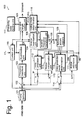
- the video encoder generally denoted by reference numeral 100, comprises a frame memory 101, a subtracting unit 102, a frequency transform unit 103, a quantization unit 104, a variable length coding unit 105, an inverse quantization unit 106, an inverse frequency transform unit 107, an adding unit 108, a reference picture memory 109, an intra prediction mode determination unit 110, an intra prediction unit 112, a control unit 116 and a probability table holding unit 117.
- Each frame of the input video data is stored in the frame memory 101 and then outputted from the frame memory 101 on a block-by-block basis (e.g. in units of macroblocks having horizontal 16 pixels and vertical 16 pixels).
- Each macroblock can either be coded in intra or in inter prediction mode.
- the macroblock outputted from the frame memory 101 is inputted to the intra prediction mode determination unit 110 (the switch 114 is connected to "a" by the control unit 116).
- the intra prediction mode determination unit 110 determines how to perform intra prediction on the inputted macroblock.
- IPM intra prediction mode
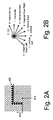
- an intra prediction direction e.g. an intra prediction current block 410 is predicted in nine different intra prediction directions using pixel group 420, cf. FIG. 2).
- the information indicating the IPM determined intra prediction mode IPM is outputted to the intra prediction unit 112 and the variable length coding unit 105.
- the intra prediction unit 112 based on the intra prediction mode IPM determined by the intra prediction mode determination unit 110, obtains intra reference pixels from the reference picture memory 109, generates an intra predictive image IP, and outputs the intra predictive image IP to the subtracting unit 102.
- the subtracting unit 102 receives the macroblock of the input picture from the frame memory 101 and the intra predictive image IP generated by the intra prediction unit 112, generates a differential image between the macroblock and the intra predictive image IP, and outputs the differential image to the frequency transform unit 103.
- the frequency transform unit 103 performs frequency transformation on the differential image generated by the prediction unit 112, and outputs frequency transform coefficients.
- the quantization unit 104 performs quantization of the frequency transform coefficients generated by the frequency transform unit 103, and outputs the quantized frequency transform coefficients QT.
- the quantization is a process of dividing the frequency transform coefficients by a predetermined value (quantization step). It is assumed that this quantization step is given by the control unit 116 (the quantization step may be included in a control signal CTL from the control unit 106).
- the quantized frequency transform coefficients QT are outputted to the variable length coding unit 105 and the inverse quantization unit 106.
- the quantized frequency transform coefficients QT are inverse quantized by the inverse quantization unit 106, inverse frequency transformed by the inverse frequency transform unit 107, and become a decoded differential image LDD.
- the decoded differential image LDD is added to the predicted image IP or MP in the adding unit 108, becomes a decoded image LD, and stored in the reference picture memory 109.
- the decoded image LD stored in the reference picture memory 109 is used in a later coding as a reference picture.
- variable length coding unit 105 performs variable length coding on the quantized frequency transform coefficients QT inputted from the quantization unit 104, information indicating the prediction mode IPM inputted from the intra prediction mode determination unit 110 and the like, and outputs a bitstream, which is also referred to as a code sequence.
- the context adaptive arithmetic coding method is a method of switching the probability tables used for arithmetic coding according to the variable length coding target data and data on which the variable length coding has already been performed (context adaptation). For example, as a context for performing variable length coding of the quantized frequency transform coefficients QT, a block size for intra prediction and a block size for frequency transformation and the like are used. Here, it is assumed that the probability tables are held in the probability table holding unit 117.
- the macroblock outputted from the frame memory 101 is inputted to the motion estimation unit 111 (the switch 114 is connected to "b" by the control unit 116).
- the motion estimation unit 111 estimates, for the inputted macroblock, the motion (motion vector) to the reference picture (a coded picture that is held in the reference picture memory 109 and is different from the picture to be coded).
- the motion vector generally the following motion vector is selected: the motion vector having a minimum differential value between the block to be coded and a predictive image (an image in the reference picture referred by the motion vector) and a minimum sum of weights for coding amount of the motion vector.
- the estimated motion vector is outputted to the motion compensation unit 113 and the coding mode determination unit 105.
- the motion compensation unit 113 generates a predictive image MP by obtaining inter reference pixels from the reference picture memory 109 based on the motion vector determined by the motion estimation unit 111, and outputs the predictive image MP to the subtracting unit 102 (the switch 115 is connected to "b" by the control unit 116).
- the processing performed by the subtracting unit 102, the frequency transform unit 103, the quantization unit 104, the inverse quantization unit 106, the inverse frequency transform unit 107 and the adding unit 108 is same as the processing described in the case of intra prediction. Therefore, the explanation about the processing is omitted here.
- the coding mode determination unit 118 determines a coding mode of a macroblock to be coded using outputs from the intra prediction mode determination unit 110, motion estimation unit 111, quantization unit 104, frame memory 101, and adding unit 108, and the like. Here, it is determined which one of the intra-picture prediction coding and the inter-picture prediction coding is used for coding the macroblock to be coded. For determining the coding mode, in general, a coding mode having a small value of the sum of weights between the amount of bits to be generated and the coded distortion.
- the information indicating the intra prediction mode IPM is outputted to the variable length coding unit 105, while the motion vector MV and the coding mode MD are outputted to the variable length coding unit 105 in the case where the inter-picture prediction coding is selected as a coding mode.
- variable length coding unit 105 performs variable length coding on a quantized frequency transform coefficients QT inputted from the quantization unit 104 and on the coding mode MD and the intra prediction mode IPM or the motion vector MV outputted from the coding mode determination unit 118, and outputs a bitstream.
- variable length coding unit 105 codes the motion vector MV using a context adaptive arithmetic coding method
- a method of changing a probability table depending on a size (context) of the motion vector of the coded peripheral block can be used.
- the probability tables have been held in the probability table holding unit 117.
- a prediction mode contains the full set of information that is required by the decoder to reproduce the prediction performed by the encoder in the process of encoding the video data. Therefore, a prediction mode defines the coding mode for each macroblock, i.e., whether intra or inter prediction is applied. Further, the prediction mode comprises information on how the macroblock is subdivided. According to H.264/AVC, a macroblock consists of 16x16 pixels that may, for instance in case of intra prediction, be further subdivided into blocks of 8x8 or 4x4 pixels each.
- the prediction mode further specifies the set of motion vectors employed for motion compensation or the intra prediction mode applied to intra predict the block under consideration.
- Figure 2 illustrates intra prediction modes as defined in the H.264/AVC standard.
- a block of 4x4 pixels (410) is predicted from previously encoded pixels (430) by extrapolating a set of 13 reference pixels (420) located above and to the left of the pixel block (410) to be predicted.
- a set of 13 reference pixels (420) located above and to the left of the pixel block (410) to be predicted In order to perform the extrapolation, one out of nine possible extrapolation direction shown in Fig 2B is selected.
- the decoding unit 300 is made up of an inverse quantization unit 301, an inverse frequency transform unit 302, an adding unit 303, a frame memory 304, an inter prediction unit 305, a motion compensation unit 306, a control unit 307, and switches 308 and 309.
- the decoding unit 302 decodes each block of the encoded video data either as an intra or inter-frame prediction coded block.
- the coding mode MD is inputted to the control unit 307, the information indicating the intra prediction mode IPM or the motion vector MV is inputted to the switch 308, and the quantized frequency transform coefficients QT are inputted to the inverse quantization unit 301.
- the control unit 307 controls the switch 308 based on the coding mode MD.
- the switch 308 In the case where the coding mode MD indicates the intra prediction coding, the switch 308 is connected to "a”, and the information indicating the intra prediction mode IPM is inputted to the intra prediction unit 305.
- the switch 308 In the case where the coding mode MD indicates the inter-picture prediction coding, the switch 308 is connected to "b", the motion vector MV is inputted to the motion compensation unit 306
- the switches 308 and 309 are connected to "a".
- the information indicating the intra prediction mode is thus inputted to the intra prediction unit 305 and the quantized frequency transform coefficients QT are inputted to the inverse quantization unit 301.
- the intra prediction unit 305 based on the inputted intra prediction mode, obtains intra reference pixels from the frame memory 304, generates an intra predictive image, and outputs the intra predictive image to the adding unit 303.
- the quantized frequency transform coefficients QT are inverse quantized by the inverse quantization unit 301, are further inverse frequency transformed by the inverse frequency transform unit 302, and become a decoded differential image LDD.
- the decoded differential image LDD is added to the intra predictive image IP by the adding unit 303 so as to obtain the decoded image LD, and stored in the frame memory 304.
- the decoded image stored in the frame memory 304 is used as a reference picture in a later decoding. Also, it is outputted to form the decoded video data.
- the switches 308 and 309 are connected to "b".
- the coding mode MD is thus inputted to the control unit 307, the information indicating the intra prediction mode IPM or the motion vector MV is inputted to the switch 308, and the quantized frequency transform coefficients QT are inputted to the inverse quantization unit 301.
- the motion compensation unit 306 based on the inputted motion vector MV, obtains reference pixels from the frame memory 304, generates a predictive picture, and outputs the predictive picture to the adding unit 303.
- the processing of the inverse quantization unit 301, inverse frequency transform unit 302 and adding unit 303 are same as the processing explained in the case of intra predicted blocks.
- the decoded images LDs are stored in the frame memory 304.
- the decoded images stored in the frame memory 304 are used as reference pictures for the later decoding. Also, the decoded images are outputted to form the decoded video data.
- Video data usually consists of several image components, such as three different color components.
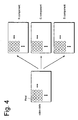
- Figure 4 illustrates an example of video data coded in the red/green/blue (RGB) color space.
- the video data consists of three image components, each of them representing one of the color components red, green, and blue.
- Video data may also be coded in other color spaces, such the luminance/chrominance (YUV) color space, where one image component represents luminance (Y) and two image components represent the two chrominance components (U, V).
- YUV luminance/chrominance
- U, V two chrominance components
- video data may also consist of image components other than color components, such as foreground and background video data as in a chroma keying application.
- Each image component is encoded separately by the above described video encoder 100 and the resulting bitstreams of each image component are multiplexed so as to form one output bitstream.
- the multiplexing can be performed on the level of individual blocks or macroblocks, as well as on the level of slices, fields, frames, pictures, sequences, etc.
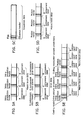
- Figures 5A and 5D show examples of the structure of a bitstream multiplexed on macroblock level in case of intra and inter prediction, respectively;
- Fig 5B shows an example of the structure of a bitstream multiplexed on slice level, which results in a reduced multiplexing overhead.
- the decoder has to separate the input bitstream into data of the individual image components after performing variable length decoding of the input bitstream, and decodes data of each image component separately.
- the decoded image components are then re-assembled upon storing or displaying the decoded video data.
- the luminance component and the chrominance component are handled independently by the video encoder 102, i.e., prediction modes for luminance and chrominance components are determined independently of each other. Therefore, the luminance components of a block may be predicted by different prediction modes than the chrominance components or may even be coded by a different coding mode.
- the two chrominance components are coded in the same coding mode and predicted by a common prediction mode. Consequently, two prediction modes have to be encoded in the bitstream for each block of video data according to H.264/AVC.
- the chrominance component is usually coded with reduced resolution only.
- the H.264/AVC standard thus provides only a reduced set of intra prediction modes for the chrominance component.
- the luminance component can be predicted by one out of nine intra prediction modes (cf. Fig 2B)
- the chrominance component can only be predicted by one out of four different intra prediction modes.
- video data in the RGB color space format is coded and decoded using the same method as for coding and decoding YUV data by mapping the RGB data to YUV data.
- the G component is mapped to the Y component
- B and R are mapped to the U and V components, respectively.
- the H.264/AVC standard is thus disadvantageous because the discrimination of the B and the R component can significantly harm coding efficiency and image quality.
- the H.264/AVC standard is disadvantageous for any type of video data where image components are equally important and have the same spatial resolution.
- the above problem can be overcome by using a common prediction mode for all image components.
- This is particularly advantageous for video data where all image components are highly correlated so that they can be predicted equally well by the same prediction mode. This is typically the case for RGB data where, for instance, each image component exhibits the same motion so that a common set of motion vectors can be employed.
- the prediction mode itself has to be encoded in the bitstream only once. Hence, coding efficiency can be improved. Consequently, the decoder has to detect the prediction mode only once from the encoded video data to decoded the image components.
- a set of independently selected prediction modes can be used, one prediction mode for each image component. This is particularly advantageous for poorly correlated image components so that each image component can be predicted with the optimal prediction mode. This is typically the case for RGB data with smooth color transitions that are predicted best by independent intra prediction modes for each color component. This is also the case for totally uncorrelated image components such as foreground and background in a chroma keying application.
- predicting the individual color components independently can also reduce the computational complexity of the encoding and decoding processes, because each image component can readily be handled by a separate subprocess.
- the subprocesses can operate at a large extend independently of each other because no information on a common prediction mode has to be exchanged. This lends itself to parallelization of the encoding and decoding process which is particularly important for high-resolution video under real-time requirements.
- each prediction mode has to be encoded in the bitstream. Nevertheless, coding efficiency can be improved provided that the gain in an improved prediction outweighs the prediction mode coding overhead. Consequently, the decoder has to detect the full number of prediction modes from the encoded video data for each block or macroblock to decoded the image components.
- Figure 5E shows an example of the structure of a bitstream where the above described alternatives have been combined so that independent (intra) prediction modes are used for the first macroblock shown and a common (inter) prediction mode for the second macroblock.
- independent (intra) prediction modes are used for the first macroblock shown
- common (inter) prediction mode for the second macroblock.
- a common prediction mode or a set of independent prediction modes can be signaled by a flag in, e.g., the sequence header (cf. Fig 5C).
- the use of signaling information will be explained in greater detail below in the context of Fig. 6.
- an intermediate approach for encoding the image components is pursued.
- two color components may be predicted by a common prediction mode whereas the third color component is predicted by an independent prediction mode.
- this may be advantageous for intra-prediction of RGB video data where a color gradient shows up in only two of the three color components.
- encoding and decoding methods that can handle image components in a flexible manner by adapting the number of prediction modes employed for encoding the image components.
- This flexibility may be used to meet coding efficiency and/or computational complexity requirements.
- coding efficiency for instance, can be improved by determining on sequence, frame, slice, or even macroblock level, the optimum number of prediction modes for predicting the image components.
- the decoder is thus able to detect the signaled number of prediction modes from the encoded video data and to decode the image components accordingly.
- the decoder can signal the image components that have been predicted by a common prediction mode and the image components that have been predicted independently. The decoder is thus able to assign the correct prediction mode to each image component and decode the image components accordingly.
- Figure 6A illustrates an example of a bitstream 600 with independent prediction modes for each of an RGB color component.
- a number identifier 610 indicates that three prediction modes (620R, 620G, 620B) have to be detected from the encoded video data for each macroblock in order to decode the macroblock data (630R, 630G, 630B) of the three color components.
- the decoder can detect the corresponding number of prediction modes from the encoded video data and decode the image components accordingly.
- Figure 6B illustrates an example of a bitstream 600 with a common prediction mode for the RGB color components.
- the number identifier 610 thus indicates that only one prediction mode (620C) has to be detected from the encoded video data for each macroblock in order to decode the macroblock data (630R, 630G, 630B) of the three color components.
- the decoder can detect the corresponding number of prediction modes for each block from the encoded video data and decode the image components accordingly.
- Figure 6C illustrates an example of a bitstream 600 where two color components are predicted by common prediction mode whereas a third color component is predicted by an independent prediction mode. Consequently, the number identifier 610 indicates that two prediction modes (620a, 620b) have to be detected from the encoded video data for each macroblock.
- assignment information 650 identifies the color components that are commonly predicted and the color components that are independently predicted. After having extracted the number identifier 610 an the assignment information 650, the decoder is thus able to detect the corresponding number of prediction modes from the encoded video data and to assign the correct prediction mode to each of the color components in order to decode the macroblock data (630R, 630G, 630B) of the three color components.
- the assignment information may, for example, contain a table that specifies for each image component whether the first, the second, etc., of the detected prediction modes is to be applied.
- the assignment information may also consist of a reference to one of a predefined plurality of such tables.
- Figure 6D illustrates an example of a bitstream 600 where the coding of prediction modes is set adaptively.
- a first number identifier 610a indicates that only one prediction mode (620C) has to be detected from the encoded video data for each of the subsequent macroblocks in order to decode the macroblock data (630R, 630G, 630B) of the three color components.
- a second number identifier 610b indicates that three prediction modes (620R, 620G, 620B) have to be detected from the encoded video data for each subsequent macroblock.
- Fig. 6 are based on image component multiplexing on macroblock level as shown, for instance in Fig. 5A.
- the present invention is not restricted to this form of multiplexing and can be applied any type of multiplexing the bitstreams of the individual image components.
- the present invention is not limit in this respect.
- the present invention can be applied to video data with any type of color space coding, or, even more generally, to any type of image components.
- the signaling by the number identifier and/or the assignment information is not necessarily part of the macroblock header. Instead, this signaling can be done, e.g., on Profile, Level, sequence, picture, frame, field, slice, or macroblock level.
- the present invention is not limited to video in the 4:4:4 format but can rather be applied also to 4:2:2 or 4:2:0 format video.
- the present invention relates to encoding and decoding of video data consisting of a plurality of image components.
- the present invention provides an encoder and a decoder together with methods to signal to the decoder the number of prediction modes that have been employed for encoding the image components.
- the decoder is thus able to detect the signaled number of prediction modes from the encoded video data and to decode the image components accordingly.
- the decoder signals the image components that have been predicted by a common prediction mode and the image components that have been predicted independently. The decoder is thus able to assign the correct prediction mode to each image component and decode the image components accordingly.
Landscapes
- Engineering & Computer Science (AREA)
- Multimedia (AREA)
- Signal Processing (AREA)
- Computing Systems (AREA)
- Theoretical Computer Science (AREA)
- Compression Or Coding Systems Of Tv Signals (AREA)
- Color Television Systems (AREA)
Priority Applications (9)
| Application Number | Priority Date | Filing Date | Title |
|---|---|---|---|
| EP05022148A EP1753242A2 (fr) | 2005-07-18 | 2005-10-11 | Codage commutable d'information de mode et de prédiction |
| US11/996,034 US8204113B2 (en) | 2005-07-18 | 2006-06-18 | Moving picture coding apparatus, moving picture decoding apparatus, and stream data |
| EP06781197A EP1906676A4 (fr) | 2005-07-18 | 2006-07-18 | Appareil de codage d`images animees, appareil de decodage d`images animees, et donnees de flux |
| JP2007526016A JP4819051B2 (ja) | 2005-07-18 | 2006-07-18 | 動画像符号化装置、動画像復号化装置、動画像符号化方法、動画像復号化方法およびストリームデータ |
| PCT/JP2006/314184 WO2007010901A1 (fr) | 2005-07-18 | 2006-07-18 | Dispositif de codage et de décodage d'image dynamique et format de suite de codes |
| EP20197675.0A EP3780597A1 (fr) | 2005-07-18 | 2006-07-18 | Appareil et methode de codage d'images animées et appareil et methode de décodage d'images animées |
| JP2011155271A JP5393736B2 (ja) | 2005-07-18 | 2011-07-13 | 動画像符号化装置、動画像復号化装置、動画像符号化方法および動画像復号化方法 |
| US13/457,851 US9197901B2 (en) | 2005-07-18 | 2012-04-27 | Moving picture coding apparatus, moving picture decoding apparatus, and stream data |
| US15/821,163 USRE49510E1 (en) | 2005-07-18 | 2017-11-22 | Moving picture coding apparatus, moving picture decoding apparatus, and stream data |
Applications Claiming Priority (2)
| Application Number | Priority Date | Filing Date | Title |
|---|---|---|---|
| EP05015562A EP1746838A1 (fr) | 2005-07-18 | 2005-07-18 | Dispositif de codage et de décodage d'images animées |
| EP05022148A EP1753242A2 (fr) | 2005-07-18 | 2005-10-11 | Codage commutable d'information de mode et de prédiction |
Publications (1)
| Publication Number | Publication Date |
|---|---|
| EP1753242A2 true EP1753242A2 (fr) | 2007-02-14 |
Family
ID=37603996
Family Applications (3)
| Application Number | Title | Priority Date | Filing Date |
|---|---|---|---|
| EP05022148A Withdrawn EP1753242A2 (fr) | 2005-07-18 | 2005-10-11 | Codage commutable d'information de mode et de prédiction |
| EP06781197A Withdrawn EP1906676A4 (fr) | 2005-07-18 | 2006-07-18 | Appareil de codage d`images animees, appareil de decodage d`images animees, et donnees de flux |
| EP20197675.0A Pending EP3780597A1 (fr) | 2005-07-18 | 2006-07-18 | Appareil et methode de codage d'images animées et appareil et methode de décodage d'images animées |
Family Applications After (2)
| Application Number | Title | Priority Date | Filing Date |
|---|---|---|---|
| EP06781197A Withdrawn EP1906676A4 (fr) | 2005-07-18 | 2006-07-18 | Appareil de codage d`images animees, appareil de decodage d`images animees, et donnees de flux |
| EP20197675.0A Pending EP3780597A1 (fr) | 2005-07-18 | 2006-07-18 | Appareil et methode de codage d'images animées et appareil et methode de décodage d'images animées |
Country Status (4)
| Country | Link |
|---|---|
| US (3) | US8204113B2 (fr) |
| EP (3) | EP1753242A2 (fr) |
| JP (2) | JP4819051B2 (fr) |
| WO (1) | WO2007010901A1 (fr) |
Cited By (13)
| Publication number | Priority date | Publication date | Assignee | Title |
|---|---|---|---|---|
| EP2169961A4 (fr) * | 2007-06-28 | 2011-06-15 | Mitsubishi Electric Corp | Codeur d'image et décodeur d'image |
| CN102413325A (zh) * | 2010-09-25 | 2012-04-11 | 富士通株式会社 | 图像编码方法和系统 |
| EP2228995A3 (fr) * | 2005-09-20 | 2012-07-25 | Mitsubishi Electric Corporation | Procédé de codage d'images et procédé de décodage d'images, encodeur d'images et décodeur d'images, et train de bits encodé d'images et support d'enregistrement |
| US8300694B2 (en) | 2005-09-20 | 2012-10-30 | Mitsubishi Electric Corporation | Image encoding method and image decoding method, image encoder and image decoder, and image encoded bit stream and recording medium |
| US8300700B2 (en) | 2005-09-20 | 2012-10-30 | Mitsubishi Electric Corporation | Image encoding method and image decoding method, image encoder and image decoder, and image encoded bit stream and recording medium |
| US8306112B2 (en) | 2005-09-20 | 2012-11-06 | Mitsubishi Electric Corporation | Image encoding method and image decoding method, image encoder and image decoder, and image encoded bit stream and recording medium |
| EP2595386A4 (fr) * | 2010-07-15 | 2015-02-18 | Mitsubishi Electric Corp | Dispositif de codage vidéo, dispositif de décodage vidéo, procédé de codage vidéo et procédé de décodage vidéo |
| US8964840B2 (en) | 2010-04-05 | 2015-02-24 | Samsung Electronics Co., Ltd. | Determining intra prediction mode of image coding unit and image decoding unit |
| RU2547239C2 (ru) * | 2010-12-22 | 2015-04-10 | Квэлкомм Инкорпорейтед | Зависящее от режима сканирование коэффициентов блока видеоданных |
| EP2805509A4 (fr) * | 2012-01-19 | 2015-07-29 | Magnum Semiconductor Inc | Procédés et appareils d'application de mode de rafraîchissement à résolution réduite adaptative |
| US9794575B2 (en) | 2013-12-18 | 2017-10-17 | Magnum Semiconductor, Inc. | Apparatuses and methods for optimizing rate-distortion costs in video encoding |
| WO2020187328A1 (fr) * | 2019-03-21 | 2020-09-24 | Beijing Bytedance Network Technology Co., Ltd. | Signalisation de prédiction intra-inter combinée |
| US12425578B2 (en) | 2019-02-01 | 2025-09-23 | Beijing Bytedance Network Technology Co., Ltd. | Harmonization between different video process mode |
Families Citing this family (34)
| Publication number | Priority date | Publication date | Assignee | Title |
|---|---|---|---|---|
| JP5047990B2 (ja) | 2006-01-10 | 2012-10-10 | トムソン ライセンシング | 4:4:4符号化の並列な実現方法及び装置 |
| KR101330630B1 (ko) * | 2006-03-13 | 2013-11-22 | 삼성전자주식회사 | 최적인 예측 모드를 적응적으로 적용하여 동영상을부호화하는 방법 및 장치, 동영상을 복호화하는 방법 및장치 |
| JP2008193627A (ja) | 2007-01-12 | 2008-08-21 | Mitsubishi Electric Corp | 画像符号化装置、画像復号装置、および画像符号化方法、画像復号方法 |
| US20080170793A1 (en) | 2007-01-12 | 2008-07-17 | Mitsubishi Electric Corporation | Image encoding device and image encoding method |
| JP2010147508A (ja) * | 2007-04-13 | 2010-07-01 | Panasonic Corp | 撮影装置及び再生装置 |
| JP5289440B2 (ja) * | 2008-07-10 | 2013-09-11 | 三菱電機株式会社 | 画像符号化装置、画像復号装置、画像符号化方法及び画像復号方法 |
| US8634466B2 (en) * | 2009-03-17 | 2014-01-21 | Freescale Semiconductor, Inc. | Video decoder plus a discrete cosine transform unit |
| JP5481923B2 (ja) * | 2009-04-28 | 2014-04-23 | 富士通株式会社 | 画像符号化装置、画像符号化方法および画像符号化プログラム |
| KR101633459B1 (ko) | 2009-08-10 | 2016-06-24 | 삼성전자주식회사 | 컬러 간의 상관 관계를 이용한 영상 데이터 인코딩 장치 및 방법, 그리고 영상 데이터 디코딩 장치 및 방법 |
| BR112012024167A2 (pt) | 2010-04-01 | 2016-06-28 | Sony Corp | dispositivo e método de processamento de imagem |
| JP5441803B2 (ja) | 2010-04-12 | 2014-03-12 | キヤノン株式会社 | 動きベクトル決定装置及び動きベクトル決定方法、コンピュータプログラム |
| JP2011223393A (ja) * | 2010-04-12 | 2011-11-04 | Canon Inc | 符号化装置及び符号化装置の制御方法 |
| US8463059B2 (en) * | 2010-04-23 | 2013-06-11 | Futurewei Technologies, Inc. | Two-layer prediction method for multiple predictor-set intra coding |
| PL3668094T3 (pl) * | 2011-01-13 | 2023-02-13 | Canon Kabushiki Kaisha | Urządzenie do kodowania obrazu, sposób kodowania obrazu i program, oraz urządzenie do dekodowania obrazu, sposób dekodowania obrazu i program |
| CA2830036C (fr) | 2011-04-12 | 2019-03-05 | Panasonic Corporation | Procede de codage de video animee, appareil de codage de video animee, procede de decodage de video animee, appareil de decodage de video animee et appareil de codage/decodage de video animee |
| PL3751854T3 (pl) | 2011-05-24 | 2023-08-28 | Sun Patent Trust | Sposób kodowania obrazu, urządzenie do kodowania obrazu, sposób dekodowania obrazu, urządzenie do dekodowania obrazu oraz urządzenie do kodowania/dekodowania obrazu |
| JP5865366B2 (ja) | 2011-05-27 | 2016-02-17 | パナソニック インテレクチュアル プロパティ コーポレーション オブアメリカPanasonic Intellectual Property Corporation of America | 画像符号化方法、画像符号化装置、画像復号方法、画像復号装置、および、画像符号化復号装置 |
| US9485518B2 (en) | 2011-05-27 | 2016-11-01 | Sun Patent Trust | Decoding method and apparatus with candidate motion vectors |
| SG194746A1 (en) | 2011-05-31 | 2013-12-30 | Kaba Gmbh | Image encoding method, image encoding device, image decoding method, image decoding device, and image encoding/decoding device |
| TW201304552A (zh) | 2011-05-31 | 2013-01-16 | 松下電器產業股份有限公司 | 動態圖像編碼方法、動態圖像編碼裝置、動態圖像解碼方法、動態圖像解碼裝置、及動態圖像編碼解碼裝置 |
| KR101900986B1 (ko) | 2011-06-30 | 2018-09-20 | 선 페이턴트 트러스트 | 화상 복호 방법, 화상 부호화 방법, 화상 복호 장치, 화상 부호화 장치, 및, 화상 부호화 복호 장치 |
| EP2741499A4 (fr) | 2011-08-03 | 2014-12-10 | Panasonic Ip Corp America | Procédé de codage vidéo, appareil de codage vidéo, procédé de décodage vidéo, appareil de décodage vidéo et appareil de codage/décodage vidéo |
| EP2770738A4 (fr) | 2011-10-19 | 2016-07-27 | Panasonic Ip Corp America | Procédé de codage d'image, dispositif de codage d'image, procédé de décodage d'image et dispositif de décodage d'image |
| JP5833961B2 (ja) * | 2012-03-23 | 2015-12-16 | 株式会社東芝 | 画像圧縮装置、画像処理システム、及び画像圧縮方法 |
| US9491475B2 (en) | 2012-03-29 | 2016-11-08 | Magnum Semiconductor, Inc. | Apparatuses and methods for providing quantized coefficients for video encoding |
| JP6066583B2 (ja) * | 2012-05-01 | 2017-01-25 | キヤノン株式会社 | 動画像符号化装置及び動画像符号化方法 |
| CN104782132B (zh) * | 2012-07-09 | 2018-06-19 | 株式会社尼康 | 动态图像压缩装置、动态图像解码装置、图像压缩装置、图像解码装置、拍摄装置以及方法 |
| JP5974692B2 (ja) * | 2012-07-09 | 2016-08-23 | 株式会社ニコン | 動画像復号装置およびプログラム |
| JP5974691B2 (ja) * | 2012-07-09 | 2016-08-23 | 株式会社ニコン | 動画像圧縮装置、撮像装置およびプログラム |
| EP4622263A3 (fr) * | 2012-09-26 | 2025-12-24 | Sun Patent Trust | Procédé de codage d'image |
| US9392286B2 (en) | 2013-03-15 | 2016-07-12 | Magnum Semiconductor, Inc. | Apparatuses and methods for providing quantized coefficients for video encoding |
| JP6593122B2 (ja) * | 2015-11-20 | 2019-10-23 | 富士通株式会社 | 動画像符号化装置、動画像符号化方法、及びプログラム |
| GB2570324A (en) * | 2018-01-19 | 2019-07-24 | V Nova Int Ltd | Multi-codec processing and rate control |
| TWI800812B (zh) * | 2020-04-02 | 2023-05-01 | 弗勞恩霍夫爾協會 | 在4:4:4色度格式及單一樹狀結構情況下針對所有通道之基於矩陣的內部預測技術 |
Family Cites Families (24)
| Publication number | Priority date | Publication date | Assignee | Title |
|---|---|---|---|---|
| US5072290A (en) * | 1986-09-19 | 1991-12-10 | Canon Kabushiki Kaisha | Color image signal encoding device |
| JP2741696B2 (ja) | 1986-09-19 | 1998-04-22 | キヤノン株式会社 | 適応形差分符号化方式 |
| US6563875B2 (en) | 1987-12-30 | 2003-05-13 | Thomson Licensing S.A. | Adaptive method of encoding and decoding a series of pictures by transformation, and devices for implementing this method |
| US5209220A (en) | 1989-10-05 | 1993-05-11 | Olympus Optical Co., Ltd. | Endoscope image data compressing apparatus |
| JPH03121037A (ja) | 1989-10-05 | 1991-05-23 | Olympus Optical Co Ltd | 内視鏡画像データ圧縮装置 |
| JP3050562B2 (ja) | 1989-10-11 | 2000-06-12 | オリンパス光学工業株式会社 | 内視鏡画像データ圧縮装置 |
| US5121138A (en) | 1990-05-22 | 1992-06-09 | General Scanning, Inc. | Resonant scanner control system |
| US5379757A (en) * | 1990-08-28 | 1995-01-10 | Olympus Optical Co. Ltd. | Method of compressing endoscope image data based on image characteristics |
| JPH1032822A (ja) | 1996-07-16 | 1998-02-03 | Oki Electric Ind Co Ltd | 動きベクトル検出装置 |
| US6829301B1 (en) | 1998-01-16 | 2004-12-07 | Sarnoff Corporation | Enhanced MPEG information distribution apparatus and method |
| JP2000078411A (ja) * | 1998-08-28 | 2000-03-14 | Matsushita Electric Ind Co Ltd | 可逆符号化装置及び可逆符号化方法 |
| US6611620B1 (en) | 1998-08-28 | 2003-08-26 | Matsushita Electric Industrial Co. Ltd. | Reversible coding method, reversible coding apparatus, and memory medium used therein |
| EP1032218B1 (fr) * | 1998-09-21 | 2010-03-03 | Sony Corporation | Dispositif et procede de codage et de decodage |
| KR100689642B1 (ko) * | 1998-09-21 | 2007-03-09 | 소니 가부시끼 가이샤 | 부호화 장치 및 방법, 복호 장치 및 방법 |
| KR100967237B1 (ko) * | 2002-11-01 | 2010-06-30 | 파나소닉 주식회사 | 동화상 부호화 방법 및 동화상 복호화 방법 |
| WO2004047453A1 (fr) * | 2002-11-20 | 2004-06-03 | Matsushita Electric Industrial Co., Ltd. | Procede de prediction d'image animee, procede et dispositif de codage d'image animee et procede et dispositif de decodage d'image animee |
| BRPI0307119B1 (pt) * | 2002-11-25 | 2018-02-14 | Godo Kaisha Ip Bridge 1 | Método e aparelho de decodificação de imagem móvel |
| CN1771736A (zh) | 2003-04-04 | 2006-05-10 | 皇家飞利浦电子股份有限公司 | 视频编码、解码方法和相应设备 |
| US7469069B2 (en) | 2003-05-16 | 2008-12-23 | Samsung Electronics Co., Ltd. | Method and apparatus for encoding/decoding image using image residue prediction |
| CN101616329B (zh) | 2003-07-16 | 2013-01-02 | 三星电子株式会社 | 用于色彩图像的视频编码/解码装置和方法 |
| KR100970726B1 (ko) * | 2003-10-04 | 2010-07-16 | 삼성전자주식회사 | 계층적 움직임 추정 방법 |
| EP2373033A3 (fr) * | 2004-01-30 | 2011-11-30 | Panasonic Corporation | Procédé de codage et de décodage d'image, appareil et programme associes |
| JP4152930B2 (ja) | 2004-08-20 | 2008-09-17 | ヒロセ電機株式会社 | カード用コネクタ |
| BRPI0611668B1 (pt) | 2005-09-20 | 2019-06-18 | Mitsubishi Electric Corporation | Decodificador de imagem, e, método de decodificação de imagem |
-
2005
- 2005-10-11 EP EP05022148A patent/EP1753242A2/fr not_active Withdrawn
-
2006
- 2006-06-18 US US11/996,034 patent/US8204113B2/en active Active
- 2006-07-18 EP EP06781197A patent/EP1906676A4/fr not_active Withdrawn
- 2006-07-18 JP JP2007526016A patent/JP4819051B2/ja active Active
- 2006-07-18 EP EP20197675.0A patent/EP3780597A1/fr active Pending
- 2006-07-18 WO PCT/JP2006/314184 patent/WO2007010901A1/fr not_active Ceased
-
2011
- 2011-07-13 JP JP2011155271A patent/JP5393736B2/ja active Active
-
2012
- 2012-04-27 US US13/457,851 patent/US9197901B2/en not_active Ceased
-
2017
- 2017-11-22 US US15/821,163 patent/USRE49510E1/en active Active
Cited By (35)
| Publication number | Priority date | Publication date | Assignee | Title |
|---|---|---|---|---|
| EP2228995A3 (fr) * | 2005-09-20 | 2012-07-25 | Mitsubishi Electric Corporation | Procédé de codage d'images et procédé de décodage d'images, encodeur d'images et décodeur d'images, et train de bits encodé d'images et support d'enregistrement |
| US8300694B2 (en) | 2005-09-20 | 2012-10-30 | Mitsubishi Electric Corporation | Image encoding method and image decoding method, image encoder and image decoder, and image encoded bit stream and recording medium |
| US8300700B2 (en) | 2005-09-20 | 2012-10-30 | Mitsubishi Electric Corporation | Image encoding method and image decoding method, image encoder and image decoder, and image encoded bit stream and recording medium |
| US8306112B2 (en) | 2005-09-20 | 2012-11-06 | Mitsubishi Electric Corporation | Image encoding method and image decoding method, image encoder and image decoder, and image encoded bit stream and recording medium |
| US8320462B2 (en) | 2005-09-20 | 2012-11-27 | Mitsubishi Electric Corporation | Image encoding method, image decoding method, image encoding apparatus, image decoding apparatus, image encoded bitstream and recording medium |
| US8422803B2 (en) | 2007-06-28 | 2013-04-16 | Mitsubishi Electric Corporation | Image encoding device, image decoding device, image encoding method and image decoding method |
| US7991237B2 (en) | 2007-06-28 | 2011-08-02 | Mitsubishi Electric Corporation | Image encoding device, image decoding device, image encoding method and image decoding method |
| US8139875B2 (en) | 2007-06-28 | 2012-03-20 | Mitsubishi Electric Corporation | Image encoding device, image decoding device, image encoding method and image decoding method |
| US8145002B2 (en) | 2007-06-28 | 2012-03-27 | Mitsubishi Electric Corporation | Image encoding device and image encoding method |
| EP2169961A4 (fr) * | 2007-06-28 | 2011-06-15 | Mitsubishi Electric Corp | Codeur d'image et décodeur d'image |
| US8345968B2 (en) | 2007-06-28 | 2013-01-01 | Mitsubishi Electric Corporation | Image encoding device, image decoding device, image encoding method and image decoding method |
| US9667974B2 (en) | 2010-04-05 | 2017-05-30 | Samsung Electronics Co., Ltd. | Determining intra prediction mode of image coding unit and image decoding unit |
| US9967572B2 (en) | 2010-04-05 | 2018-05-08 | Samsung Electronics Co., Ltd. | Determining intra prediction mode of image coding unit and image decoding unit |
| US10432948B2 (en) | 2010-04-05 | 2019-10-01 | Samsung Electronics Co., Ltd. | Determining intra prediction mode of image coding unit and image decoding unit |
| US8964840B2 (en) | 2010-04-05 | 2015-02-24 | Samsung Electronics Co., Ltd. | Determining intra prediction mode of image coding unit and image decoding unit |
| RU2542884C2 (ru) * | 2010-04-05 | 2015-02-27 | Самсунг Электроникс Ко., Лтд. | Определение режима внутрикадрового предсказания блока кодирования изображения и блока декодирования изображения |
| US9794577B2 (en) | 2010-04-05 | 2017-10-17 | Samsung Electronics Co., Ltd. | Determining intra prediction mode of image coding unit and image decoding unit |
| RU2608397C2 (ru) * | 2010-04-05 | 2017-01-18 | Самсунг Электроникс Ко., Лтд. | Определение режима внутрикадрового предсказания блока кодирования изображения и блока декодирования изображения |
| RU2595947C2 (ru) * | 2010-04-05 | 2016-08-27 | Самсунг Электроникс Ко., Лтд. | Определение режима внутрикадрового предсказания блока кодирования изображения и блока декодирования изображения |
| RU2595950C2 (ru) * | 2010-04-05 | 2016-08-27 | Самсунг Электроникс Ко., Лтд. | Определение режима внутрикадрового предсказания блока кодирования изображения и блока декодирования изображения |
| RU2595946C2 (ru) * | 2010-04-05 | 2016-08-27 | Самсунг Электроникс Ко., Лтд. | Определение режима внутрикадрового предсказания блока кодирования изображения и блока декодирования изображения |
| RU2595949C2 (ru) * | 2010-04-05 | 2016-08-27 | Самсунг Электроникс Ко., Лтд. | Определение режима внутрикадрового предсказания блока кодирования изображения и блока декодирования изображения |
| EP2595386A4 (fr) * | 2010-07-15 | 2015-02-18 | Mitsubishi Electric Corp | Dispositif de codage vidéo, dispositif de décodage vidéo, procédé de codage vidéo et procédé de décodage vidéo |
| CN105657419A (zh) * | 2010-07-15 | 2016-06-08 | 三菱电机株式会社 | 图像编码装置及其方法和图像解码装置及其方法 |
| CN105657419B (zh) * | 2010-07-15 | 2019-03-01 | 三菱电机株式会社 | 图像编码装置及其方法和图像解码装置及其方法 |
| CN102413325A (zh) * | 2010-09-25 | 2012-04-11 | 富士通株式会社 | 图像编码方法和系统 |
| CN102413325B (zh) * | 2010-09-25 | 2014-09-10 | 富士通株式会社 | 图像编码方法和系统 |
| RU2547239C2 (ru) * | 2010-12-22 | 2015-04-10 | Квэлкомм Инкорпорейтед | Зависящее от режима сканирование коэффициентов блока видеоданных |
| EP2805509A4 (fr) * | 2012-01-19 | 2015-07-29 | Magnum Semiconductor Inc | Procédés et appareils d'application de mode de rafraîchissement à résolution réduite adaptative |
| US9794575B2 (en) | 2013-12-18 | 2017-10-17 | Magnum Semiconductor, Inc. | Apparatuses and methods for optimizing rate-distortion costs in video encoding |
| US12425578B2 (en) | 2019-02-01 | 2025-09-23 | Beijing Bytedance Network Technology Co., Ltd. | Harmonization between different video process mode |
| WO2020187328A1 (fr) * | 2019-03-21 | 2020-09-24 | Beijing Bytedance Network Technology Co., Ltd. | Signalisation de prédiction intra-inter combinée |
| US11330257B2 (en) | 2019-03-21 | 2022-05-10 | Beijing Bytedance Network Technology Co., Ltd. | Extended application of combined intra-inter prediction |
| US11425406B2 (en) | 2019-03-21 | 2022-08-23 | Beijing Bytedance Network Technology Co., Ltd. | Weighting processing of combined intra-inter prediction |
| US11876993B2 (en) | 2019-03-21 | 2024-01-16 | Beijing Bytedance Network Technology Co., Ltd | Signaling of combined intra-inter prediction |
Also Published As
| Publication number | Publication date |
|---|---|
| EP3780597A1 (fr) | 2021-02-17 |
| USRE49510E1 (en) | 2023-04-25 |
| EP1906676A4 (fr) | 2011-11-23 |
| US20090257491A1 (en) | 2009-10-15 |
| JPWO2007010901A1 (ja) | 2009-01-29 |
| US9197901B2 (en) | 2015-11-24 |
| US20120213277A1 (en) | 2012-08-23 |
| JP4819051B2 (ja) | 2011-11-16 |
| WO2007010901A1 (fr) | 2007-01-25 |
| EP1906676A1 (fr) | 2008-04-02 |
| JP2011239456A (ja) | 2011-11-24 |
| JP5393736B2 (ja) | 2014-01-22 |
| US8204113B2 (en) | 2012-06-19 |
Similar Documents
| Publication | Publication Date | Title |
|---|---|---|
| JP7077385B2 (ja) | サンプル適応オフセットの処理を実行するための情報を符号化する符号化方法 | |
| US9936212B2 (en) | Video encoding device, video decoding device, video encoding method, video decoding method, and program | |
| EP2384002B1 (fr) | Procédé de décodage d'images en mouvement en utilisant des matrices de quantification additionelles | |
| US8442334B2 (en) | Image coding method and image decoding method based on edge direction | |
| US8345968B2 (en) | Image encoding device, image decoding device, image encoding method and image decoding method | |
| CN104396245B (zh) | 用于对图像进行编码或解码的方法和装置 | |
| TWI530161B (zh) | Image processing apparatus and method | |
| KR102547644B1 (ko) | 양자화 파라미터 도출에 기초한 영상 코딩 장치 및 방법 | |
| CN101222644A (zh) | 运动图像编码、解码装置以及运动图像编码、解码方法 | |
| JP5475409B2 (ja) | 動画像符号化装置および動画像符号化方法 | |
| KR20150139884A (ko) | 인코딩 방법 및 장치, 디코딩 방법 및 장치, 및 컴퓨터 판독가능 저장 매체 | |
| US11770543B2 (en) | Method and device for decoding video | |
| KR20130118250A (ko) | 깊이 영상의 부호화 장치 및 방법, 그리고 복호화 장치 및 방법 | |
| WO2011126153A1 (fr) | Restriction de mots de code pour codage vidéo à hautes performances | |
| EP1746838A1 (fr) | Dispositif de codage et de décodage d'images animées |
Legal Events
| Date | Code | Title | Description |
|---|---|---|---|
| PUAI | Public reference made under article 153(3) epc to a published international application that has entered the european phase |
Free format text: ORIGINAL CODE: 0009012 |
|
| AK | Designated contracting states |
Kind code of ref document: A2 Designated state(s): AT BE BG CH CY CZ DE DK EE ES FI FR GB GR HU IE IS IT LI LT LU LV MC NL PL PT RO SE SI SK TR |
|
| AX | Request for extension of the european patent |
Extension state: AL BA HR MK YU |
|
| STAA | Information on the status of an ep patent application or granted ep patent |
Free format text: STATUS: THE APPLICATION IS DEEMED TO BE WITHDRAWN |
|
| 18D | Application deemed to be withdrawn |
Effective date: 20080503 |