EP1754547A2 - In situ Fluorpolymerpolymerisation in poröse Substrate - Google Patents
In situ Fluorpolymerpolymerisation in poröse Substrate Download PDFInfo
- Publication number
- EP1754547A2 EP1754547A2 EP06075643A EP06075643A EP1754547A2 EP 1754547 A2 EP1754547 A2 EP 1754547A2 EP 06075643 A EP06075643 A EP 06075643A EP 06075643 A EP06075643 A EP 06075643A EP 1754547 A2 EP1754547 A2 EP 1754547A2
- Authority
- EP
- European Patent Office
- Prior art keywords
- wood
- ptfe
- substrate
- tfe
- composition
- Prior art date
- Legal status (The legal status is an assumption and is not a legal conclusion. Google has not performed a legal analysis and makes no representation as to the accuracy of the status listed.)
- Withdrawn
Links
- 239000000758 substrate Substances 0.000 title claims abstract description 125
- 229920002313 fluoropolymer Polymers 0.000 title claims abstract description 56
- 239000004811 fluoropolymer Substances 0.000 title claims abstract description 56
- 238000006116 polymerization reaction Methods 0.000 title abstract description 91
- 238000011065 in-situ storage Methods 0.000 title abstract description 4
- -1 poly(p-phenylene terephthalamide) Polymers 0.000 claims description 171
- 239000002023 wood Substances 0.000 claims description 165
- 229920001343 polytetrafluoroethylene Polymers 0.000 claims description 139
- 239000004810 polytetrafluoroethylene Substances 0.000 claims description 137
- BFKJFAAPBSQJPD-UHFFFAOYSA-N tetrafluoroethene Chemical group FC(F)=C(F)F BFKJFAAPBSQJPD-UHFFFAOYSA-N 0.000 claims description 127
- 229920001721 polyimide Polymers 0.000 claims description 66
- 239000004642 Polyimide Substances 0.000 claims description 65
- 239000000203 mixture Substances 0.000 claims description 47
- 239000000843 powder Substances 0.000 claims description 47
- 229920003366 poly(p-phenylene terephthalamide) Polymers 0.000 claims description 43
- 239000011148 porous material Substances 0.000 claims description 34
- 240000005020 Acaciella glauca Species 0.000 claims description 24
- 235000003499 redwood Nutrition 0.000 claims description 24
- 229920000889 poly(m-phenylene isophthalamide) Polymers 0.000 claims description 23
- 229920003235 aromatic polyamide Polymers 0.000 claims description 22
- 239000004760 aramid Substances 0.000 claims description 16
- 239000000835 fiber Substances 0.000 claims description 16
- 241000219000 Populus Species 0.000 claims description 14
- 235000016976 Quercus macrolepis Nutrition 0.000 claims description 14
- 239000010985 leather Substances 0.000 claims description 11
- 235000008331 Pinus X rigitaeda Nutrition 0.000 claims description 10
- 241000018646 Pinus brutia Species 0.000 claims description 10
- 235000011613 Pinus brutia Nutrition 0.000 claims description 10
- 235000009496 Juglans regia Nutrition 0.000 claims description 9
- 235000020234 walnut Nutrition 0.000 claims description 9
- 241000218645 Cedrus Species 0.000 claims description 8
- 239000000945 filler Substances 0.000 claims description 8
- 229920002635 polyurethane Polymers 0.000 claims description 8
- 239000004814 polyurethane Substances 0.000 claims description 8
- 241000167854 Bourreria succulenta Species 0.000 claims description 6
- 235000019693 cherries Nutrition 0.000 claims description 6
- 229920001577 copolymer Polymers 0.000 claims description 6
- 239000006227 byproduct Substances 0.000 claims description 5
- QMIWYOZFFSLIAK-UHFFFAOYSA-N 3,3,3-trifluoro-2-(trifluoromethyl)prop-1-ene Chemical group FC(F)(F)C(=C)C(F)(F)F QMIWYOZFFSLIAK-UHFFFAOYSA-N 0.000 claims description 4
- YSYRISKCBOPJRG-UHFFFAOYSA-N 4,5-difluoro-2,2-bis(trifluoromethyl)-1,3-dioxole Chemical compound FC1=C(F)OC(C(F)(F)F)(C(F)(F)F)O1 YSYRISKCBOPJRG-UHFFFAOYSA-N 0.000 claims description 4
- 229920001519 homopolymer Polymers 0.000 claims description 4
- BLTXWCKMNMYXEA-UHFFFAOYSA-N 1,1,2-trifluoro-2-(trifluoromethoxy)ethene Chemical compound FC(F)=C(F)OC(F)(F)F BLTXWCKMNMYXEA-UHFFFAOYSA-N 0.000 claims description 3
- MIZLGWKEZAPEFJ-UHFFFAOYSA-N 1,1,2-trifluoroethene Chemical group FC=C(F)F MIZLGWKEZAPEFJ-UHFFFAOYSA-N 0.000 claims description 3
- BQCIDUSAKPWEOX-UHFFFAOYSA-N 1,1-Difluoroethene Chemical compound FC(F)=C BQCIDUSAKPWEOX-UHFFFAOYSA-N 0.000 claims description 3
- BZPCMSSQHRAJCC-UHFFFAOYSA-N 1,2,3,3,4,4,5,5,5-nonafluoro-1-(1,2,3,3,4,4,5,5,5-nonafluoropent-1-enoxy)pent-1-ene Chemical compound FC(F)(F)C(F)(F)C(F)(F)C(F)=C(F)OC(F)=C(F)C(F)(F)C(F)(F)C(F)(F)F BZPCMSSQHRAJCC-UHFFFAOYSA-N 0.000 claims description 3
- 241000219492 Quercus Species 0.000 claims description 3
- UUAGAQFQZIEFAH-UHFFFAOYSA-N chlorotrifluoroethylene Chemical group FC(F)=C(F)Cl UUAGAQFQZIEFAH-UHFFFAOYSA-N 0.000 claims description 3
- 240000007049 Juglans regia Species 0.000 claims 1
- 150000001336 alkenes Chemical class 0.000 claims 1
- XUCNUKMRBVNAPB-UHFFFAOYSA-N fluoroethene Chemical compound FC=C XUCNUKMRBVNAPB-UHFFFAOYSA-N 0.000 claims 1
- 238000010186 staining Methods 0.000 abstract description 11
- 238000009736 wetting Methods 0.000 abstract description 9
- 230000015556 catabolic process Effects 0.000 abstract description 8
- 238000006731 degradation reaction Methods 0.000 abstract description 8
- XLYOFNOQVPJJNP-UHFFFAOYSA-N water Substances O XLYOFNOQVPJJNP-UHFFFAOYSA-N 0.000 description 85
- 229910052731 fluorine Inorganic materials 0.000 description 73
- YCKRFDGAMUMZLT-UHFFFAOYSA-N Fluorine atom Chemical compound [F] YCKRFDGAMUMZLT-UHFFFAOYSA-N 0.000 description 63
- 239000011737 fluorine Substances 0.000 description 63
- 239000000243 solution Substances 0.000 description 55
- 239000003999 initiator Substances 0.000 description 53
- 208000021017 Weight Gain Diseases 0.000 description 34
- 238000009838 combustion analysis Methods 0.000 description 34
- 230000004584 weight gain Effects 0.000 description 34
- 235000019786 weight gain Nutrition 0.000 description 34
- 239000007789 gas Substances 0.000 description 33
- 239000000523 sample Substances 0.000 description 30
- 239000002904 solvent Substances 0.000 description 30
- 238000000034 method Methods 0.000 description 29
- 239000007788 liquid Substances 0.000 description 25
- 239000004698 Polyethylene Substances 0.000 description 22
- 229920000573 polyethylene Polymers 0.000 description 22
- 239000000178 monomer Substances 0.000 description 20
- 230000035515 penetration Effects 0.000 description 17
- 238000012360 testing method Methods 0.000 description 16
- 230000008569 process Effects 0.000 description 15
- 239000003921 oil Substances 0.000 description 14
- 239000000047 product Substances 0.000 description 14
- IJGRMHOSHXDMSA-UHFFFAOYSA-N Atomic nitrogen Chemical compound N#N IJGRMHOSHXDMSA-UHFFFAOYSA-N 0.000 description 12
- DTQVDTLACAAQTR-UHFFFAOYSA-N Trifluoroacetic acid Chemical compound OC(=O)C(F)(F)F DTQVDTLACAAQTR-UHFFFAOYSA-N 0.000 description 10
- 238000001914 filtration Methods 0.000 description 10
- 238000005303 weighing Methods 0.000 description 10
- 239000000463 material Substances 0.000 description 9
- 238000009864 tensile test Methods 0.000 description 9
- UXVMQQNJUSDDNG-UHFFFAOYSA-L Calcium chloride Chemical compound [Cl-].[Cl-].[Ca+2] UXVMQQNJUSDDNG-UHFFFAOYSA-L 0.000 description 8
- 241000758789 Juglans Species 0.000 description 8
- SECXISVLQFMRJM-UHFFFAOYSA-N N-Methylpyrrolidone Chemical compound CN1CCCC1=O SECXISVLQFMRJM-UHFFFAOYSA-N 0.000 description 8
- 239000001110 calcium chloride Substances 0.000 description 8
- 229910001628 calcium chloride Inorganic materials 0.000 description 8
- 238000001816 cooling Methods 0.000 description 8
- 230000008021 deposition Effects 0.000 description 8
- 238000001035 drying Methods 0.000 description 8
- 238000007654 immersion Methods 0.000 description 8
- 229920000642 polymer Polymers 0.000 description 8
- CURLTUGMZLYLDI-UHFFFAOYSA-N Carbon dioxide Chemical compound O=C=O CURLTUGMZLYLDI-UHFFFAOYSA-N 0.000 description 7
- 238000010521 absorption reaction Methods 0.000 description 7
- 238000000576 coating method Methods 0.000 description 7
- 230000000694 effects Effects 0.000 description 7
- 238000001493 electron microscopy Methods 0.000 description 7
- 238000002474 experimental method Methods 0.000 description 7
- 238000011068 loading method Methods 0.000 description 7
- 238000002156 mixing Methods 0.000 description 7
- 230000000007 visual effect Effects 0.000 description 7
- 150000004984 aromatic diamines Chemical class 0.000 description 6
- 125000003118 aryl group Chemical group 0.000 description 6
- 235000011089 carbon dioxide Nutrition 0.000 description 6
- 150000001805 chlorine compounds Chemical class 0.000 description 6
- 229910052757 nitrogen Inorganic materials 0.000 description 6
- 239000011541 reaction mixture Substances 0.000 description 6
- 239000007787 solid Substances 0.000 description 6
- 239000003039 volatile agent Substances 0.000 description 6
- 241000233866 Fungi Species 0.000 description 5
- 239000011248 coating agent Substances 0.000 description 5
- 239000012530 fluid Substances 0.000 description 5
- 239000008187 granular material Substances 0.000 description 5
- 238000003828 vacuum filtration Methods 0.000 description 5
- WZCQRUWWHSTZEM-UHFFFAOYSA-N 1,3-phenylenediamine Chemical compound NC1=CC=CC(N)=C1 WZCQRUWWHSTZEM-UHFFFAOYSA-N 0.000 description 4
- CBCKQZAAMUWICA-UHFFFAOYSA-N 1,4-phenylenediamine Chemical compound NC1=CC=C(N)C=C1 CBCKQZAAMUWICA-UHFFFAOYSA-N 0.000 description 4
- FXHOOIRPVKKKFG-UHFFFAOYSA-N N,N-Dimethylacetamide Chemical compound CN(C)C(C)=O FXHOOIRPVKKKFG-UHFFFAOYSA-N 0.000 description 4
- 239000012298 atmosphere Substances 0.000 description 4
- FDQSRULYDNDXQB-UHFFFAOYSA-N benzene-1,3-dicarbonyl chloride Chemical compound ClC(=O)C1=CC=CC(C(Cl)=O)=C1 FDQSRULYDNDXQB-UHFFFAOYSA-N 0.000 description 4
- 230000003247 decreasing effect Effects 0.000 description 4
- 239000004744 fabric Substances 0.000 description 4
- 229940018564 m-phenylenediamine Drugs 0.000 description 4
- 238000004519 manufacturing process Methods 0.000 description 4
- 239000002245 particle Substances 0.000 description 4
- 239000002244 precipitate Substances 0.000 description 4
- 230000001376 precipitating effect Effects 0.000 description 4
- 229910001220 stainless steel Inorganic materials 0.000 description 4
- 239000010935 stainless steel Substances 0.000 description 4
- 239000000126 substance Substances 0.000 description 4
- LXEJRKJRKIFVNY-UHFFFAOYSA-N terephthaloyl chloride Chemical compound ClC(=O)C1=CC=C(C(Cl)=O)C=C1 LXEJRKJRKIFVNY-UHFFFAOYSA-N 0.000 description 4
- 239000011800 void material Substances 0.000 description 4
- 238000005406 washing Methods 0.000 description 4
- 239000004743 Polypropylene Substances 0.000 description 3
- 238000004458 analytical method Methods 0.000 description 3
- 239000004566 building material Substances 0.000 description 3
- 150000001875 compounds Chemical class 0.000 description 3
- 230000007423 decrease Effects 0.000 description 3
- 239000006185 dispersion Substances 0.000 description 3
- 239000011888 foil Substances 0.000 description 3
- 238000010438 heat treatment Methods 0.000 description 3
- PGFXOWRDDHCDTE-UHFFFAOYSA-N hexafluoropropylene oxide Chemical class FC(F)(F)C1(F)OC1(F)F PGFXOWRDDHCDTE-UHFFFAOYSA-N 0.000 description 3
- 239000012528 membrane Substances 0.000 description 3
- 239000002184 metal Substances 0.000 description 3
- 229910052751 metal Inorganic materials 0.000 description 3
- 239000011859 microparticle Substances 0.000 description 3
- 239000002480 mineral oil Substances 0.000 description 3
- 235000010446 mineral oil Nutrition 0.000 description 3
- 239000000123 paper Substances 0.000 description 3
- 239000012071 phase Substances 0.000 description 3
- 230000000704 physical effect Effects 0.000 description 3
- 230000000379 polymerizing effect Effects 0.000 description 3
- 229920001155 polypropylene Polymers 0.000 description 3
- 238000011084 recovery Methods 0.000 description 3
- 239000011347 resin Substances 0.000 description 3
- 229920005989 resin Polymers 0.000 description 3
- 239000002002 slurry Substances 0.000 description 3
- 238000002791 soaking Methods 0.000 description 3
- QAOWNCQODCNURD-UHFFFAOYSA-N sulfuric acid Substances OS(O)(=O)=O QAOWNCQODCNURD-UHFFFAOYSA-N 0.000 description 3
- 239000010876 untreated wood Substances 0.000 description 3
- RIQRGMUSBYGDBL-UHFFFAOYSA-N 1,1,1,2,2,3,4,5,5,5-decafluoropentane Chemical compound FC(F)(F)C(F)C(F)C(F)(F)C(F)(F)F RIQRGMUSBYGDBL-UHFFFAOYSA-N 0.000 description 2
- RFJVDJWCXSPUBY-UHFFFAOYSA-N 2-(difluoromethylidene)-4,4,5-trifluoro-5-(trifluoromethyl)-1,3-dioxolane Chemical compound FC(F)=C1OC(F)(F)C(F)(C(F)(F)F)O1 RFJVDJWCXSPUBY-UHFFFAOYSA-N 0.000 description 2
- NZUHAGMVTPMOIV-UHFFFAOYSA-N 3-(3-carbonochloridoylphenoxy)benzoyl chloride Chemical compound ClC(=O)C1=CC=CC(OC=2C=C(C=CC=2)C(Cl)=O)=C1 NZUHAGMVTPMOIV-UHFFFAOYSA-N 0.000 description 2
- NMTYZEFTDQDWBF-UHFFFAOYSA-N 3-(3-carbonochloridoylphenyl)sulfonylbenzoyl chloride Chemical compound ClC(=O)C1=CC=CC(S(=O)(=O)C=2C=C(C=CC=2)C(Cl)=O)=C1 NMTYZEFTDQDWBF-UHFFFAOYSA-N 0.000 description 2
- CGRZXNMHQUZZDX-UHFFFAOYSA-N 3-(4-carbonochloridoylphenoxy)benzoyl chloride Chemical compound C1=CC(C(=O)Cl)=CC=C1OC1=CC=CC(C(Cl)=O)=C1 CGRZXNMHQUZZDX-UHFFFAOYSA-N 0.000 description 2
- IRULYGRXMPOARD-UHFFFAOYSA-N 3-(4-carbonochloridoylphenyl)sulfonylbenzoyl chloride Chemical compound C1=CC(C(=O)Cl)=CC=C1S(=O)(=O)C1=CC=CC(C(Cl)=O)=C1 IRULYGRXMPOARD-UHFFFAOYSA-N 0.000 description 2
- OSUWBBMPVXVSOA-UHFFFAOYSA-N 4-(4-carbonochloridoylphenoxy)benzoyl chloride Chemical compound C1=CC(C(=O)Cl)=CC=C1OC1=CC=C(C(Cl)=O)C=C1 OSUWBBMPVXVSOA-UHFFFAOYSA-N 0.000 description 2
- QDBOAKPEXMMQFO-UHFFFAOYSA-N 4-(4-carbonochloridoylphenyl)benzoyl chloride Chemical compound C1=CC(C(=O)Cl)=CC=C1C1=CC=C(C(Cl)=O)C=C1 QDBOAKPEXMMQFO-UHFFFAOYSA-N 0.000 description 2
- ACJYZTIHYXBBSN-UHFFFAOYSA-N 4-(4-carbonochloridoylphenyl)sulfonylbenzoyl chloride Chemical compound C1=CC(C(=O)Cl)=CC=C1S(=O)(=O)C1=CC=C(C(Cl)=O)C=C1 ACJYZTIHYXBBSN-UHFFFAOYSA-N 0.000 description 2
- 241000208140 Acer Species 0.000 description 2
- OKTJSMMVPCPJKN-UHFFFAOYSA-N Carbon Chemical compound [C] OKTJSMMVPCPJKN-UHFFFAOYSA-N 0.000 description 2
- VEXZGXHMUGYJMC-UHFFFAOYSA-M Chloride anion Chemical compound [Cl-] VEXZGXHMUGYJMC-UHFFFAOYSA-M 0.000 description 2
- VYZAMTAEIAYCRO-UHFFFAOYSA-N Chromium Chemical compound [Cr] VYZAMTAEIAYCRO-UHFFFAOYSA-N 0.000 description 2
- 229910052782 aluminium Inorganic materials 0.000 description 2
- XAGFODPZIPBFFR-UHFFFAOYSA-N aluminium Chemical compound [Al] XAGFODPZIPBFFR-UHFFFAOYSA-N 0.000 description 2
- 230000008901 benefit Effects 0.000 description 2
- 230000000903 blocking effect Effects 0.000 description 2
- 239000001913 cellulose Substances 0.000 description 2
- 229920002678 cellulose Polymers 0.000 description 2
- 239000003795 chemical substances by application Substances 0.000 description 2
- 238000004587 chromatography analysis Methods 0.000 description 2
- 230000001186 cumulative effect Effects 0.000 description 2
- 150000004985 diamines Chemical class 0.000 description 2
- 239000012153 distilled water Substances 0.000 description 2
- 235000020280 flat white Nutrition 0.000 description 2
- 239000011521 glass Substances 0.000 description 2
- 238000010348 incorporation Methods 0.000 description 2
- 235000008960 ketchup Nutrition 0.000 description 2
- 230000013011 mating Effects 0.000 description 2
- 230000003278 mimic effect Effects 0.000 description 2
- NZZGQZMNFCTNAM-UHFFFAOYSA-N naphthalene-2,6-dicarbonyl chloride Chemical compound C1=C(C(Cl)=O)C=CC2=CC(C(=O)Cl)=CC=C21 NZZGQZMNFCTNAM-UHFFFAOYSA-N 0.000 description 2
- RVZRBWKZFJCCIB-UHFFFAOYSA-N perfluorotributylamine Chemical compound FC(F)(F)C(F)(F)C(F)(F)C(F)(F)N(C(F)(F)C(F)(F)C(F)(F)C(F)(F)F)C(F)(F)C(F)(F)C(F)(F)C(F)(F)F RVZRBWKZFJCCIB-UHFFFAOYSA-N 0.000 description 2
- 229920003023 plastic Polymers 0.000 description 2
- 239000004033 plastic Substances 0.000 description 2
- 230000002035 prolonged effect Effects 0.000 description 2
- 239000011253 protective coating Substances 0.000 description 2
- 230000001681 protective effect Effects 0.000 description 2
- 230000001012 protector Effects 0.000 description 2
- 230000002441 reversible effect Effects 0.000 description 2
- 235000015067 sauces Nutrition 0.000 description 2
- 239000004753 textile Substances 0.000 description 2
- 230000004580 weight loss Effects 0.000 description 2
- AJDIZQLSFPQPEY-UHFFFAOYSA-N 1,1,2-Trichlorotrifluoroethane Chemical compound FC(F)(Cl)C(F)(Cl)Cl AJDIZQLSFPQPEY-UHFFFAOYSA-N 0.000 description 1
- VLDPXPPHXDGHEW-UHFFFAOYSA-N 1-chloro-2-dichlorophosphoryloxybenzene Chemical compound ClC1=CC=CC=C1OP(Cl)(Cl)=O VLDPXPPHXDGHEW-UHFFFAOYSA-N 0.000 description 1
- HLBLWEWZXPIGSM-UHFFFAOYSA-N 4-Aminophenyl ether Chemical compound C1=CC(N)=CC=C1OC1=CC=C(N)C=C1 HLBLWEWZXPIGSM-UHFFFAOYSA-N 0.000 description 1
- JIUOLPMEUGECKL-UHFFFAOYSA-N 4-methyl-2-methylidene-1,3-dioxolane Chemical compound CC1COC(=C)O1 JIUOLPMEUGECKL-UHFFFAOYSA-N 0.000 description 1
- 241000219198 Brassica Species 0.000 description 1
- 235000003351 Brassica cretica Nutrition 0.000 description 1
- 235000003343 Brassica rupestris Nutrition 0.000 description 1
- 229920000271 Kevlar® Polymers 0.000 description 1
- 235000007688 Lycopersicon esculentum Nutrition 0.000 description 1
- GRYLNZFGIOXLOG-UHFFFAOYSA-N Nitric acid Chemical compound O[N+]([O-])=O GRYLNZFGIOXLOG-UHFFFAOYSA-N 0.000 description 1
- 229920000784 Nomex Polymers 0.000 description 1
- 229920001774 Perfluoroether Polymers 0.000 description 1
- 240000003768 Solanum lycopersicum Species 0.000 description 1
- 229910000831 Steel Inorganic materials 0.000 description 1
- 239000004809 Teflon Substances 0.000 description 1
- 229920006362 Teflon® Polymers 0.000 description 1
- 238000005299 abrasion Methods 0.000 description 1
- 239000002253 acid Substances 0.000 description 1
- 150000007513 acids Chemical class 0.000 description 1
- NIXOWILDQLNWCW-UHFFFAOYSA-N acrylic acid group Chemical group C(C=C)(=O)O NIXOWILDQLNWCW-UHFFFAOYSA-N 0.000 description 1
- 239000000853 adhesive Substances 0.000 description 1
- 230000001070 adhesive effect Effects 0.000 description 1
- 238000007605 air drying Methods 0.000 description 1
- 239000007864 aqueous solution Substances 0.000 description 1
- 229920006231 aramid fiber Polymers 0.000 description 1
- 239000010425 asbestos Substances 0.000 description 1
- QVGXLLKOCUKJST-UHFFFAOYSA-N atomic oxygen Chemical compound [O] QVGXLLKOCUKJST-UHFFFAOYSA-N 0.000 description 1
- 239000002585 base Substances 0.000 description 1
- QKSKPIVNLNLAAV-UHFFFAOYSA-N bis(2-chloroethyl) sulfide Chemical compound ClCCSCCCl QKSKPIVNLNLAAV-UHFFFAOYSA-N 0.000 description 1
- 238000004364 calculation method Methods 0.000 description 1
- 229910052799 carbon Inorganic materials 0.000 description 1
- 239000011111 cardboard Substances 0.000 description 1
- 239000004568 cement Substances 0.000 description 1
- 230000008859 change Effects 0.000 description 1
- 238000006243 chemical reaction Methods 0.000 description 1
- 230000001112 coagulating effect Effects 0.000 description 1
- 239000002131 composite material Substances 0.000 description 1
- 238000011109 contamination Methods 0.000 description 1
- 239000002537 cosmetic Substances 0.000 description 1
- 239000006071 cream Substances 0.000 description 1
- 238000004200 deflagration Methods 0.000 description 1
- 230000001419 dependent effect Effects 0.000 description 1
- 239000002274 desiccant Substances 0.000 description 1
- 239000012933 diacyl peroxide Substances 0.000 description 1
- 238000000921 elemental analysis Methods 0.000 description 1
- 239000000839 emulsion Substances 0.000 description 1
- 238000005516 engineering process Methods 0.000 description 1
- 238000001704 evaporation Methods 0.000 description 1
- 230000008020 evaporation Effects 0.000 description 1
- 238000011049 filling Methods 0.000 description 1
- 238000013100 final test Methods 0.000 description 1
- ZYMKZMDQUPCXRP-UHFFFAOYSA-N fluoro prop-2-enoate Chemical compound FOC(=O)C=C ZYMKZMDQUPCXRP-UHFFFAOYSA-N 0.000 description 1
- 235000013305 food Nutrition 0.000 description 1
- 239000012634 fragment Substances 0.000 description 1
- 238000012685 gas phase polymerization Methods 0.000 description 1
- 239000003365 glass fiber Substances 0.000 description 1
- 239000010439 graphite Substances 0.000 description 1
- 229910002804 graphite Inorganic materials 0.000 description 1
- 230000002401 inhibitory effect Effects 0.000 description 1
- 239000004761 kevlar Substances 0.000 description 1
- 239000007791 liquid phase Substances 0.000 description 1
- 239000000314 lubricant Substances 0.000 description 1
- 230000007246 mechanism Effects 0.000 description 1
- 239000000155 melt Substances 0.000 description 1
- 239000012229 microporous material Substances 0.000 description 1
- 235000010460 mustard Nutrition 0.000 description 1
- 229910017604 nitric acid Inorganic materials 0.000 description 1
- GVGCUCJTUSOZKP-UHFFFAOYSA-N nitrogen trifluoride Chemical class FN(F)F GVGCUCJTUSOZKP-UHFFFAOYSA-N 0.000 description 1
- 239000004763 nomex Substances 0.000 description 1
- 239000000615 nonconductor Substances 0.000 description 1
- 235000015097 nutrients Nutrition 0.000 description 1
- 238000000399 optical microscopy Methods 0.000 description 1
- 239000001301 oxygen Substances 0.000 description 1
- 229910052760 oxygen Inorganic materials 0.000 description 1
- UJMWVICAENGCRF-UHFFFAOYSA-N oxygen difluoride Chemical class FOF UJMWVICAENGCRF-UHFFFAOYSA-N 0.000 description 1
- 239000011087 paperboard Substances 0.000 description 1
- 229960004624 perflexane Drugs 0.000 description 1
- ZJIJAJXFLBMLCK-UHFFFAOYSA-N perfluorohexane Chemical compound FC(F)(F)C(F)(F)C(F)(F)C(F)(F)C(F)(F)C(F)(F)F ZJIJAJXFLBMLCK-UHFFFAOYSA-N 0.000 description 1
- 150000002978 peroxides Chemical class 0.000 description 1
- 125000005634 peroxydicarbonate group Chemical group 0.000 description 1
- 239000009719 polyimide resin Substances 0.000 description 1
- 238000002459 porosimetry Methods 0.000 description 1
- 239000012255 powdered metal Substances 0.000 description 1
- 238000002360 preparation method Methods 0.000 description 1
- 238000003825 pressing Methods 0.000 description 1
- 150000003254 radicals Chemical class 0.000 description 1
- 238000010992 reflux Methods 0.000 description 1
- 230000003252 repetitive effect Effects 0.000 description 1
- 230000000717 retained effect Effects 0.000 description 1
- 229910052895 riebeckite Inorganic materials 0.000 description 1
- 239000011343 solid material Substances 0.000 description 1
- 239000007858 starting material Substances 0.000 description 1
- 239000010959 steel Substances 0.000 description 1
- 238000010998 test method Methods 0.000 description 1
- 239000010875 treated wood Substances 0.000 description 1
Images


Classifications
-
- B—PERFORMING OPERATIONS; TRANSPORTING
- B05—SPRAYING OR ATOMISING IN GENERAL; APPLYING FLUENT MATERIALS TO SURFACES, IN GENERAL
- B05D—PROCESSES FOR APPLYING FLUENT MATERIALS TO SURFACES, IN GENERAL
- B05D1/00—Processes for applying liquids or other fluent materials
- B05D1/60—Deposition of organic layers from vapour phase
-
- B—PERFORMING OPERATIONS; TRANSPORTING
- B05—SPRAYING OR ATOMISING IN GENERAL; APPLYING FLUENT MATERIALS TO SURFACES, IN GENERAL
- B05D—PROCESSES FOR APPLYING FLUENT MATERIALS TO SURFACES, IN GENERAL
- B05D7/00—Processes, other than flocking, specially adapted for applying liquids or other fluent materials to particular surfaces or for applying particular liquids or other fluent materials
- B05D7/06—Processes, other than flocking, specially adapted for applying liquids or other fluent materials to particular surfaces or for applying particular liquids or other fluent materials to wood
- B05D7/08—Processes, other than flocking, specially adapted for applying liquids or other fluent materials to particular surfaces or for applying particular liquids or other fluent materials to wood using synthetic lacquers or varnishes
-
- B—PERFORMING OPERATIONS; TRANSPORTING
- B05—SPRAYING OR ATOMISING IN GENERAL; APPLYING FLUENT MATERIALS TO SURFACES, IN GENERAL
- B05D—PROCESSES FOR APPLYING FLUENT MATERIALS TO SURFACES, IN GENERAL
- B05D7/00—Processes, other than flocking, specially adapted for applying liquids or other fluent materials to particular surfaces or for applying particular liquids or other fluent materials
- B05D7/12—Processes, other than flocking, specially adapted for applying liquids or other fluent materials to particular surfaces or for applying particular liquids or other fluent materials to leather
-
- C—CHEMISTRY; METALLURGY
- C14—SKINS; HIDES; PELTS; LEATHER
- C14C—CHEMICAL TREATMENT OF HIDES, SKINS OR LEATHER, e.g. TANNING, IMPREGNATING, FINISHING; APPARATUS THEREFOR; COMPOSITIONS FOR TANNING
- C14C11/00—Surface finishing of leather
- C14C11/003—Surface finishing of leather using macromolecular compounds
-
- D—TEXTILES; PAPER
- D06—TREATMENT OF TEXTILES OR THE LIKE; LAUNDERING; FLEXIBLE MATERIALS NOT OTHERWISE PROVIDED FOR
- D06M—TREATMENT, NOT PROVIDED FOR ELSEWHERE IN CLASS D06, OF FIBRES, THREADS, YARNS, FABRICS, FEATHERS OR FIBROUS GOODS MADE FROM SUCH MATERIALS
- D06M14/00—Graft polymerisation of monomers containing carbon-to-carbon unsaturated bonds on to fibres, threads, yarns, fabrics, or fibrous goods made from such materials
-
- D—TEXTILES; PAPER
- D06—TREATMENT OF TEXTILES OR THE LIKE; LAUNDERING; FLEXIBLE MATERIALS NOT OTHERWISE PROVIDED FOR
- D06M—TREATMENT, NOT PROVIDED FOR ELSEWHERE IN CLASS D06, OF FIBRES, THREADS, YARNS, FABRICS, FEATHERS OR FIBROUS GOODS MADE FROM SUCH MATERIALS
- D06M15/00—Treating fibres, threads, yarns, fabrics, or fibrous goods made from such materials, with macromolecular compounds; Such treatment combined with mechanical treatment
- D06M15/19—Treating fibres, threads, yarns, fabrics, or fibrous goods made from such materials, with macromolecular compounds; Such treatment combined with mechanical treatment with synthetic macromolecular compounds
- D06M15/21—Macromolecular compounds obtained by reactions only involving carbon-to-carbon unsaturated bonds
- D06M15/244—Macromolecular compounds obtained by reactions only involving carbon-to-carbon unsaturated bonds of halogenated hydrocarbons
- D06M15/256—Macromolecular compounds obtained by reactions only involving carbon-to-carbon unsaturated bonds of halogenated hydrocarbons containing fluorine
-
- D—TEXTILES; PAPER
- D21—PAPER-MAKING; PRODUCTION OF CELLULOSE
- D21H—PULP COMPOSITIONS; PREPARATION THEREOF NOT COVERED BY SUBCLASSES D21C OR D21D; IMPREGNATING OR COATING OF PAPER; TREATMENT OF FINISHED PAPER NOT COVERED BY CLASS B31 OR SUBCLASS D21G; PAPER NOT OTHERWISE PROVIDED FOR
- D21H19/00—Coated paper; Coating material
- D21H19/10—Coatings without pigments
- D21H19/14—Coatings without pigments applied in a form other than the aqueous solution defined in group D21H19/12
- D21H19/16—Coatings without pigments applied in a form other than the aqueous solution defined in group D21H19/12 comprising curable or polymerisable compounds
Definitions
- This invention relates to the polymerization of fluoropolymers into porous substrates.
- the fluoropolymer/substrate network that results is present on the surface of the substrate and is also deposited into the substrate at appreciable depths.
- the fluoropolymer may provide a protective coating for the substrate and/or the substrate may improve the physical properties of the fluoropolymer.
- Porous materials have a host of uses. Common uses for leather and porous polyurethane are to produce clothing and furniture. Common uses for wood include use as a building material and for the production of furniture. Polyimide compositions are known to have unique performance characteristics, which make them suitable for uses in the form of bushings, seals, electrical insulators, compressor vanes, brake linings, and others as described in U.S. Patent No. 5,789,523 . Para-oriented aromatic polyamides (para-aramids) are used to make fiber substrates that are useful for wear resistant applications.
- porous materials described may degrade and decay over time by staining, wetting, warping, tearing or wearing. It is desirable to treat porous materials to improve resistance to wear, tear, creep, decay, and degradation by wetting, staining and warping, and to improve durability while maintaining the appearance of the materials.
- U.S. Patent No. 3,962,171 discusses a protective coating composition.
- the composition is used for painted and unpainted metal, plastic and wood surfaces.
- the method comprises preparing a mixture of a solution of 20 parts of granular polytetrafluoroethylene in Freon®.
- the composition is sprayed onto an acrylic painted surface, dried and wiped to form a transparent coating.
- the use of granular fluoro-compounds is also discussed in Japanese Patent 05318413 .
- the invention involves a method whereby a raw wood material is impregnated with fluorinated microparticles having a diameter of 5 microns and a compound which changes to insoluble cured resin. The compound is cured to fix the microparticles with the resin.
- the uses and advantages listed in the abstract include use as building materials, woody appearance, contamination resistance, and moisture and water resistance.
- the invention does not teach polymerization of a fluoro-compound into the wood as the present invention does.
- U.S. Patent No. 5,156,780 teaches a method for treating microporous substrates to achieve water and oil repellency while maintaining porosity.
- the substrates are impregnated with a solution of monomer in a carrier solvent.
- the carrier solvent is first substantially removed from the substrate for the express purpose of leaving the monomer as a thin conformal coating on all internal and external substrate surfaces. In this manner, the monomer is converted to polymer and the polymer does not block the pores or restrict flow in subsequent use as a filtration membrane.
- fluoropolymers such as PTFE are commonly filled with substances such as glass fibers, graphite, asbestos, and powdered metals ( Kirk-Othmer Encyclopedia of Chemical Technology, Fourth Edition, Volume 11, John Wiley and Sons, New York, pages 626 and 630 ).
- the filler is generally added for the purpose of improving some property of the fluoropolymer, such as creep or hardness.
- filled fluoropolymers are made by physically mixing the fluoropolymer with the filler or by coagulating an aqueous fluoropolymer emulsion on the filler, but such methods have their problems. Adhesion of fluoropolymer to filler can be quite poor, particularly if the fluoropolymer does not wet the filler and penetrate its pores and finer surface features. Fluoropolymer melts can be very stiff, making mixing/dispersion poor and nonuniform. Mechanical mixing can degrade some fillers, for example by breaking fine fibers. It is desirable to polymerize fluoromonomer onto the surface and into the pores of a substrate to achieve intimate fluoropolymer/substrate interpenetration and dispersion with minimal mechanical stress.
- porous substrates such as wood, wood by-products, aramids, polyimides, porous polyurethane, and leather compositions, such that the porous substrate is more resistant to degradation, especially by staining, warping and wetting.
- Disclosed in this invention is a process for preparing a fluoropolymer/substrate composition, comprising:
- composition of matter made by a process for preparing a fluoropolymer/substrate composition wherein said process, comprises:
- a further disclosure of the present invention is a composition of matter, comprising: a porous substrate wherein said substrate is an open pore structure having a surface and interconnecting pores throughout the substrate; and polymerized fluoropolymer, wherein said fluoropolymer is present within and on the surface of said substrate, and wherein the amount of fluoropolymer present in said composition is, in the case of a non-wood substrate, from about 0.1 percent to about 300 percent of the weight of said non-wood substrate, and in the case of a wood substrate, from about 0.1 to about 150 percent of the weight of said wood substrate.
- compositions as filler materials for other polymers.
- the present invention discloses a fluoropolymer/substrate composition.
- the presence of fluoropolymer in the composition provides a protective material for the substrate and may also add aesthetic qualities to the substrate.
- a further advantage of the fluoropolymer/substrate composition is that the physical properties of the fluoropolymer are improved.
- the present invention also discloses a method for in-situ fluoropolymer polymerization into porous substrates.
- the method produces a fluoropolymer/substrate composition wherein the presence of fluoropolymer adds aesthetic quality to some substrates, enhances some of the porous substrates, or functions as a protective material for other porous substrates.
- the method used leaves the initiator and the initiator carrier solvent in the substrate during polymerization and uses undiluted monomer or, in its preferred embodiment, gaseous monomer, to penetrate and block all pores to the greatest depth possible.
- the object of the present invention is to provide a method for treating the substrate such that the presence of the fluoropolymer/substrate composition decreases or eliminates penetration of agents that cause degradation so as to increase the substrate's resistance to wetting by oil and water, reduce warping and staining by oil, water, and other common materials, and to improve durability.
- the fluoropolymer/substrate composition improves resistance to wear, tear, creep and decay.
- the disclosed fluoropolymer/substrate compositions that result have properties that give them a variety of utilities.
- TFE preferred fluoromonomer
- a PTFE/wood composition results and the wood is protected by the presence of the PTFE.
- PTFE polymerized into the wood increases the wood's resistance to wetting by oil and water, reduces staining by oil and water, decreases warpage and improves durability. These properties make the composition attractive for building materials.
- the method disclosed herein for preparing intimately interpenetrated fluoropolymer/substrate compositions improves the functional lifetime and/or the appearance of the substrates.
- Coating the surface and blocking the pores of a substrate with fluoropolymer prevents or slows degradation by wetting and penetration of the substrate by agents such as water, acids, bases, foodstuffs, and cosmetics, thereby preventing staining, warping, and unwanted chemical or physical property changes in the substrate.
- the Ultrasuede ® /PTFE composition of Example 15 below wets less readily than untreated Ultrasuede ® .
- Coating the surface and blocking the pores of a substrate with fluoropolymer can also slow mechanical degradation by such means as abrasion, creep, or tearing.
- the polyimide/PTFE composition of Example 8A abraded 8X more slowly than untreated polyimide.
- the substrate can then be considered as dispersed in the fluoropolymer for the purpose of modifying fluoropolymer properties.
- These compositions are commonly referred to as "filled fluoropolymers".
- filled fluoropolymers For example, intimately interpenetrated porous polyimide or aramid particulates can be added to poly(tetrafluoroethylene) to potentially decrease PTFE creep.
- the fluoromonomer is polymerized both on the surfaces and into the pores of a substrate to achieve intimate fluoropolymer/substrate interpenetration and dispersion.
- the filled fluoropolymer is prepared with minimal mechanical stress. This process reduces degradation, and thereby, offers a solution to the problem of degradation that occurs with mechanical mixing.
- porous substrate any solid material penetrated throughout with interconnecting pores of a size such as to allow absorption of liquid initiator solution and monomer.
- the porous substrates can take any form including microscopic particulates, microscopic fibers, coarse particulates, pulp, fibrids, chunks, blocks, uncompressed, partially or fully compressed parts, sheets, films, membranes, and coatings.
- Porous substrates are not meant to include materials such as cloth where the only mechanism of fluoropolymer entrainment is gross entrapment between separate fibers rather than subsurface penetration into a substrate's pores. This process works with any porous substrate that does not inhibit fluoromonomer polymerization.
- Substrates not inhibiting polymerization include wood (including wood by-products such as paper), p-aramid fibers, molded polyimide parts, porous polyurethane and leather.
- wood we mean raw lumber as well as more processed forms of wood and its by-products including wood veneer, wood chips, sawdust, paper, and cardboard. Whether a substrate will inhibit polymerization must be determined empirically substrate by substrate and may vary for the same substrate, depending upon prior finishing and treatment.
- the inventive process involves in situ polymerization of fluoromonomer into substrates.
- Polymerization temperatures range from about 0°C to about 300°C, for non-wood substrates, preferably from about 0°C to about 100°C for all disclosed substrates, most preferably from about 5°C to about 30°C for all disclosed substrates.
- polymerizations can be run at temperatures up to about 300°C.
- Polymerization pressures may vary. For gaseous monomers, pressures are generally from about 7 psia to about 500 psia. In the case of liquid monomers, such as 4,5-difluoro-2,2-bis(trifluoromethyl)-1,3-dioxole (PDD) or perfluoro (2-methylene-4-methyl-1,3-dioxolane) (PMD), the reaction is generally carried out under atmospheric pressure unless copolymers with TFE or other gaseous monomers are desired. In the absence of a pure gaseous monomer phase, oxygen should be excluded and an inert atmosphere, such as nitrogen, provided.
- PDD 4,5-difluoro-2,2-bis(trifluoromethyl)-1,3-dioxole
- PMD perfluoro (2-methylene-4-methyl-1,3-dioxolane)
- Gaseous monomers include tetrafluoroethylene (TFE), trifluoroethylene, vinylidene fluoride, chlorotrifluoroethylene, hexafluoroisobutylene and perfluoro methyl vinyl ether.
- Liquid monomers include PDD, PMD and perfluoro propyl vinyl ether. These monomers may be homopolymerized or copolymerized to make compositions known to those skilled in the art.
- Examples include tetrafluoroethylene homopolymer, tetrafluoroethylene/4,5-difluoro-2,2-bis(trifluoromethyl)-1,3-dioxole copolymer, and tetrafluoroethylene/perfluoro (2-methylene-4-methyl-1,3-dioxolane) copolymer.
- polymerization often deposits about 0.1 to 10 wt. % PTFE in the substrate at atmospheric pressure. Higher TFE pressures yield higher weight gains. When higher pressures are used, standard barricading must be employed to protect against TFE deflagration and runaway polymerization.
- the process invention disclosed herein works for most organic initiators commonly used for fluoroolefin polymerizations, including, but not limited to, diacylperoxides, peroxides, azos and peroxydicarbonates.
- the preferred initiator is DP.
- DP has a half-life of about 4 hours at 20°C which means that DP lasts long enough for a polymerization run to be set up at room temperature without excessive initiator loss and yet DP still reacts fast enough at room temperature for polymerizations to run to completion fairly quickly.
- Preferred run times are from about 4 to about 24 hours.
- the initiator is first synthesized in any solvent that is compatible with fluoroolefin polymerization and the initiator solution then absorbed into the substrate.
- Suitable solvents comprise chlorofluorocarbons such as Freon ® 113 (CFCl 2 CF 2 Cl), hydrofluorocarbons, such as Vertrel ® XF (HFC-43-10mee; 2,3-dihydroperfluoropentane) specialty fluid, perfluorocarbons, such as perfluorohexane, perfluoroethers, such as Fluorinert ® FC-75 sold by 3M Company, perfluoroamines, such as Fluorinert ® FC 40, and perfluorodialkylsulfides, such as CF 3 CF 2 CF 2 CF 2 SCF 2 CF 2 CF 2 CF 2 CF 3 .
- the preferred solvents for DP are Vertrel ® XF and Freon ® E1(CF 3 CF 2 CF 2
- the preferred initiator solution comprises a solution of DP in Vertrel ® XF (CF 3 CFHCFHCF 2 CF 3 ). It is further preferred that the fluoromonomer is tetrafluoroethylene. TFE polymerizes to form PTFE.
- the wood is soaked in a solution of free radical initiator.
- the preferred initiator when wood is used as a substrate is DP.
- the wood is then removed from the initiator solution and the free liquid is allowed to drain away.
- free liquid is meant solution that is not absorbed by the substrate during soaking.
- the initiator-soaked wood is then placed in an apparatus suitable for polymerization.
- the apparatus is filled with gas phase fluoromonomer, and the polymerization allowed to run.
- the polymerization apparatus can be a simple plastic bag for atmospheric pressure polymerization or an autoclave for polymerization at pressures up to several hundred psi.
- the porous aramid or polyimide is immersed for about 1 minute in a 0.1 to 0.2 M solution of DP in CF 3 CFHCFHCF 2 CF 3 solvent.
- the excess solvent is filtered off or is drained from the aramid or polyimide, and the still damp polymer placed in a container with 1 atmosphere pressure of tetrafluoroethylene gas until the substrate has gained preferably 5 to 20% of its weight by polymerization of the tetrafluoroethylene to poly(tetrafluoroethylene).
- the preferred aramids are poly(p-phenylene terephthalamide) (hereinafter “PPD-T”) fibers and poly(m-phenylene isophthalamide)(hereinafter “MPD-I”) in the form of fiber, particles, pulp or fibrids, that are dried or never-dried.
- PPD-T poly(p-phenylene terephthalamide)
- MPD-I poly(m-phenylene isophthalamide)
- a “never-dried aramid” means an aramid coagulated from a solution by contact with a non-solvent (usually an aqueous bath of some sort, such as water or an aqueous solution). When contacted with the non-solvent, the polymer coagulates and most of the solvent is removed from the aramid.
- the aramid has an open sponge-like structure, which usually contains about 150-200% by weight of the aramid of non-solvent (again, usually water). It is this open sponge-like structure, which has imbibed the non-solvent, which is referred to herein as "never-dried aramid".
- PPD-T is meant the homopolymer resulting from mole-for-mole polymerization of p-phenylenediamine and terephthaloyl chloride and, also, copolymers resulting from incorporation of small amounts of other aromatic diamine with the p-phenylene diamine and of small amounts of other aromatic diacid chloride with the terephthaloyl chloride.
- aromatic diamines examples include m-phenylene diamine, 4,4'-diphenyldiamine, 3,3'-diphenyldiamine, 3,4'-diphenyldiamine, 4,4'-oxydiphenyldiamine, 3,3'-oxydiphenyldiamine, 3,4'-oxydiphenyldiamine, 4,4'-sulfonyldiphenyldiamine, 3,3'-sulfonyldiphenyldiamine, 3,4'-sulfonyldiphenyldiamine, and the like.
- aromatic diacid chlorides examples include 2,6-naphthalenedicarboxylic acid chloride, isophthaloyl chloride, 4,4'-oxydibenzoyl chloride, 3,3'-oxydibenzoyl chloride, 3,4'-oxydibenzoyl chloride, 4,4'-sulfonyldibenzoyl chloride, 3,3'-sulfonyldibenzoyl chloride, 3,4'-sulfonyldibenzoyl chloride, 4,4'-dibenzoyl chloride, 3,3'-dibenzoyl chloride, 3,4'-dibenzoyl chloride, and the like.
- aromatic diamines and other aromatic diacid chlorides can be used in amounts up to as much as about 10 mole percent of the p-phenylene diamine or the terephthaloyl chloride, or perhaps slightly higher, provided only the other diamines and diacid chlorides have no reactive groups which interfere with the polymerization reaction.
- MPD-I is meant the homopolymer resulting from mole-for-mole polymerization of m-phenylenediamine and isophthaloyl chloride and, also, copolymers resulting from incorporation of small amounts of other aromatic diamine with the m-phenylene diamine and of small amounts of other aromatic diacid chloride with the isophthaloyl chloride.
- aromatic diamines examples include p-phenylene diamine, 4,4'-diphenyldiamine, 3,3'-diphenyldiamine, 3,4'-diphenyldiamine, 4,4'-oxydiphenyldiamine, 3,3'-oxydiphenyldiamine, 3,4'-oxydiphenyldiamine, 4,4'-sulfonyldiphenyldiamine, 3,3'-sulfonyldiphenyldiamine, 3,4'-sulfonyldiphenyldiamine, and the like.
- aromatic diacid chlorides examples include 2,6-naphthalenedicarboxylic acid chloride, terephthaloyl chloride, 4,4'-oxydibenzoyl chloride, 3,3'-oxydibenzoyl chloride, 3,4'-oxydibenzoyl chloride, 4,4'-sulfonyldibenzoyl chloride, 3,3'-sulfonyldibenzoyl chloride, 3,4'-sulfonyldibenzoyl chloride, 4,4'-dibenzoyl chloride, 3,3'-dibenzoyl chloride, 3,4'-dibenzoyl chloride, and the like.
- aromatic diamines and other aromatic diacid chlorides can be used in amounts up to as much as about 10 mole percent of the m-phenylene diamine or the isophthaloyl chloride, or perhaps slightly higher, provided only the other diamines and diacid chlorides have no reactive groups which interfere with the polymerization reaction.
- Substrates specifically exemplified for the present invention include wood, molded polyimide parts, porous polyimide powder (or polyimide particulate), porous para-aramids such as poly(para-phenylene terephthalamide) [PPD-T] in the forms of powder, pulp and/or fiber, and porous meta-aramids, such as poly(m-phenylene isophthalamide) [MPD-I] in the forms of powder, fibers or fibrids, porous polyurethane, and leather (pigskin and cowskin).
- porous polyimide powder or polyimide particulate
- porous para-aramids such as poly(para-phenylene terephthalamide) [PPD-T] in the forms of powder, pulp and/or fiber
- porous meta-aramids such as poly(m-phenylene isophthalamide) [MPD-I] in the forms of powder, fibers or fibrids, porous polyurethane, and leather (pigskin and cows
- the present invention also provides a fluoropolymer/substrate composition wherein the substrates are open structures with interconnecting pores throughout their bulk and the level of fluoropolymer in the fluoropolymer/substrate composition is about 0.1% to about 300%, for non-wood substrates, and about 0.1 to about 150% for wood substrates, of the weight of the substrate.
- Substrates useful in this invention include wood, paper, leather, porous polyurethane, and aramids and polyimides that have been precipitated as porous particulates or porous fibers and then left wet, dried, or molded only so far as to preserve enough porosity for subsequent penetration by fluoromonomer and initiator.
- Preferred substrates are porous aramid, polyimide particulates and polyimide parts.
- a saw was used to cut samples of cedar, cherry, oak, pine, poplar, redwood, and walnut into cubes which measured roughly 0.75 inches on a side.
- TFE tetrafluoroethylene
- weight gains from TFE polymerized into the wood as PTFE ranged from 14 to 95% as shown in Chart 1 below, wherein the woods are listed in order of decreasing sample weight and density. Most often, the less dense the starting wood, the greater the weight of PTFE deposited into the wood.
- TABLE 1 PTFE Weight Gains for Different Woods Averaged over 3 Cubes Wood Type Grams TFE Loaded to Autoclave Average Cube Wt. Before Average Cube Wt. After Average Wt.
- the cubes were soaked a second time for 15 minutes in -15°C 0.16 M DP solution. The average weight of the cubes was 5.7628 g.
- the cubes were reloaded into the 400 ml autoclave with 25 g of TFE. The autoclave was heated for 4 hours at 40°C. The cubes were recovered, lightly sanded, and dried under pump vacuum overnight. The average weight was brought to 6.383 g.
- the cubes were soaked a third time in DP, reacted with 25 g TFE in a 400 ml autoclave tube, recovered, lightly sanded, and dried for 3 days at room temperature under pump vacuum.
- the average weight was brought to 6.4953 g, which was a 71.2% weight gain compared to the start.
- Chart 3 compares the 600-hour water absorption results for the poplar cubes prepared in part C of this Example to the poplar cubes of part B of this Example. While the poplar cube exposed to three polymerization cycles contained almost twice as much PTFE as the cube exposed to a single polymerization cycle, no difference was detected in the amount of water absorbed after 600 hours.
- TFE polymerizes in wood at least inches below the wood surface and that, while deposition along the grain may be mildly favored, penetration occurs in other directions as well.
- the first block measuring 10.8 cm X 2.6 cm X 1.8 cm was cut so that the grain of the wood ran in the 10.8 cm direction. It is referred to hereinafter as the "lengthwise" block.
- a second block measuring 11.0 cm X 2.7 cm X 1.8 cm was cut so that the grain of the wood ran in the 2.7 cm direction. It is referred to as the "crossgrain” block. It is supposed that if TFE can penetrate wood substrates only along the direction of the grain of the wood, then TFE must travel 5.4 cm to get to the center of the lengthwise block but only 1.35 cm to get to the center of the crossgrain block.
- the two blocks could thus differ greatly in PTFE weight gain and how any PTFE is distributed spatially.
- Each block was weighed and then soaked for 1 hour at -15°C in 0.16 M DP in Freon ® E1.
- the blocks were briefly air dried and then transferred to separate 400 ml stainless steel autoclaves.
- Each tube was charged with 50 g of TFE and heated for four hours at 40°C.
- the blocks were recovered, lightly sanded to remove loose PTFE from the surface, dried for at least 4 days under pump vacuum, and reweighed.
- the lengthwise block increased in weight from 17.9 g to 30.3 g for a 69% weight gain.
- the crossgrain block increased in weight from 16.0 g to 28.7 g for a 79% weight gain.
- the volume of PTFE picked up per ml of wood was 0.103 ml of PTFE for the crossgrain sample and 0.108 ml for the lengthwise sample. These results are likely the same within experimental error and are not much different from the 0.13 ml of PTFE per ml of wood reported above for the much smaller redwood cubes in Example 1. This experiment provided the first indication that grain direction did not dominate deposition, that PTFE deposition is not limited primarily to the wood surface, and that sample size did not dramatically affect results up to dimensions of several inches.
- Untreated wood contains no fluorine while PTFE is 76% by weight fluorine.
- concentration of PTFE in a treated wood sample is proportional to the wood's fluorine content.
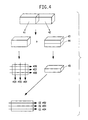
- the crossgrain sample (block 10 of Figure 1) was sawed in half creating two new blocks (blocks 12 and 13 of Figure 1), each measuring roughly 5.5 cm X 2.7 cm X 1.8 cm.
- the cut wood sample exposed the interior of the original block as two new faces.
- One of the two new block faces was scanned across its full width with the beam of an electron microscope set to a 50 micron spot size (scans #2 - #7).
- the electron microscope was operated in energy dispersive mode so as to give an output signal proportional to the fluorine content of the wood. In this way microscopic variations in relative fluorine concentration (y axis) could be plotted across the full width of the wood block (x axis).
- Scan #3 was in the direction of the wood grain (the 2.7 cm dimension) while scan #6 was perpendicular to the grain (the 1.8 cm direction).
- the scans showed choppy alternation between areas of high and low fluorine concentration which was attributed to random areas of cellulose, void and PTFE that were crossed by the beam during the scan. While high fluorine concentrations were observed throughout the bulk of the wood, fluorine concentrations were noticeably higher toward the surface of the wood in scans #3 and #6.
- the redwood "lengthwise block” was cut into three pieces.
- a piece measuring ⁇ 5.4 cm X 2.6 cm X 0.9 cm and weighing about 4.5 g was digested chemically by heating it to reflux with 10 ml of concentrated sulfuric acid. Additional sulfuric acid was added to reduce the wood to an oily black residue. The carbon responsible for the black color was then burned away by the gradual addition of concentrated nitric acid. The residue was diluted with water, filtered, and dried. A white fibrous PTFE deposit was recovered. The residue accounted for 35.6% of starting sample weight, which was similar to the fluorine levels measured by combustion analysis. At 100X to 20,000X magnification, electron microscopy detected rod shaped structures 20 ⁇ -60 ⁇ across and of indefinite length.
- the rods showed a spongy fine structure. Such spongy morphology is often seen when TFE is polymerized in the gas phase. Perhaps the void spaces in wood function as microscopic gas phase polymerization reactors for TFE. In this invention, the polymerization appears to have filled the pores in the wood substrates with spongy PTFE deposits rather than having deposited the PTFE as a conformal coating on the walls of the pores.
- the TFE must travel 6.05 cm to get to the center of the lengthwise block but only 1.25 cm to get to the center of the crossgrain block.
- the two blocks could thus differ greatly in PTFE weight gain and how any PTFE is distributed spatially.
- Each block was weighed and then soaked for 1 hour at -15°C in 0.16 M DP in Freon ® E1.
- the blocks were briefly air dried and then transferred to separate 400 ml stainless steel autoclaves.
- Each tube was charged with 25 g of TFE and heated for four hours at 40°C.
- the blocks were recovered, lightly sanded to remove loose PTFE from the surface, dried for at least 4 days under pump vacuum, and reweighed.
- the lengthwise block increased in weight from 44.36 to 47.98 g for an 8.1% weight gain.
- the crossgrain block increased in weight from 42.54 g to 49.81 g, or a 17.1 % weight gain.
- the crossgrain sample picked up 0.05 ml of PTFE/ml of oak and the lengthwise sample picked up 0.03 ml of PTFE/ml of oak. This compares to 0.048 ml of PTFE per ml of oak in the case of the 0.75" oak cubes of Example 1.
- the ⁇ 2X greater deposition of PTFE in the crossgrain block suggested a mild preference for penetration in the direction along the wood's conductive tissues by which food and nutrients travel.
- Scans #19, #20, and #21 shown in Figure 3 were in the direction of the wood grain (the 2.5 cm dimension) while scans #22, #23 and #24 were perpendicular to the grain (the 1.9 cm direction). All six scans showed choppy alternation between areas of high and low fluorine concentration which was attributed to the random crossing of areas of cellulose, void, and PTFE by the electron microscope beam. High PTFE concentrations occurred throughout the wood and were not clustered near the surface.
- a 3.8 cm X 8.6 cm rectangle was cut from each of the six types of wood in a package of Band-it ® Real Wood Variety Veneer (Cloverdale Company, Inc., P. O. Box 400, Cloverdale, VA 24077). While the exact identities of the woods were unknown, their visual appearance suggested common woods such as walnut, pine, maple, and redwood. All six rectangles were notched so as to enable later identification and weighed and then soaked for one hour at -15°C in 0.175 M DP in Freon ® E1. The strips were briefly air dried and loaded into a pre-chilled 400 ml autoclave along with 50 g tetrafluoroethylene gas.
- a 30 mm X 40 mm rectangle was cut from each of the six types of wood in a package of Band-it ® Real Wood Variety Veneer (Cloverdale Company, Inc., P. O. Box 400, Cloverdale, VA 24077). While the exact identities of the woods were unknown, their visual appearance suggested common woods such as walnut, pine, maple, and redwood. All six rectangles were notched so as to enable later identification and weighed.
- the strips were soaked for one hour at -15°C in 0.165 M DP in CF 3 CFHCFHCF 2 CF 3 , briefly air dried, loaded into a 20.3 cm X 25.4 cm zip lock polyethylene bag (Brandywine Bag Co., part number 301630) equipped with a polypropylene gas inlet valve, and the bag was clamped shut.
- the bag was taped to a rectangular wire frame attached in turn to an ordinary laboratory stirrer motor.
- the bag was evacuated/purged three with N 2 and two times with TFE and then inflated loosely with TFE gas.
- the bag and its contents were slowly tumbled using the stirrer motor mounted in a horizontal position.
- the wood strips were unchanged in visual appearance.
- the strips were devolatilized for 72 hours under pump vacuum and reweighed.
- the strips had a weight gains of 0.9 wt % to 7 wt % as shown in Chart 5, column 2.
- Drops of water were placed on the wood and advancing contact angles measured about 10 minutes later. Advancing contact angles were uniformly high, 120° to 127° (Chart 5, column 3), indicative of PTFE at the surface.
- the behavior of the untreated control samples containing no polymerized PTFE was markedly different. While reasonably high contact angles of 90 to 122° were observed for the untreated control wood samples initially (Chart 5, column 5), these contact angles could be observed only briefly because the water droplets started to spread out over the surface after only about 15 seconds to 2 minutes (Chart 5, column 6).
- the PTFE treated and the control samples were next submerged in water at room temperature and then air dried to observe what effect the PTFE treatment had on warpage.
- TFE polymerized into the wood makes the wood harder to wet by oil and water, less subject to staining by oil and water, and less subject to warpage when wetted and then dried.
- Ajar was chilled to about -15°C and 25 ml of PMD and 2 ml of ⁇ 0.16 M DP in CF 3 CF 2 CFHCFHCF 3 solvent were added.
- a cube of redwood ⁇ 1.9 cm on a side weighing 2.46 g was immersed in the solution contained in the jar for about 1 hour at -15°C.
- the redwood cube was removed, allowed to drain and then transferred to a 20.32 cm X 25.4 cm zip lock polyethylene bag (Brandywine Bag Co., part number 301630) equipped with a polypropylene gas inlet valve. The bag was clamped shut, inflated and evacuated 3 times with nitrogen, and allowed to sit over the weekend.
- the cube was removed and a few pieces of white polymer rubbed off its surface with a spatula. After devolatilizing for 9 days under pump vacuum at room temperature, the cube weighed 4.45 g for a 81% weight gain. One side of the cube was lightly sanded revealing an attractive brown surface slightly darker in appearance. A drop of water placed on the surface remained there for about two hours until it evaporated. A drop of water placed on an untreated redwood cube wet the surface within a minute and took about 30 minutes to soak into the cube, having spread out into a visibly large wet area on the cube.
- a cube of redwood, ⁇ 1.9 cm on a side and weighing 2.27 g was immersed in the PMD/DP solution left over from part A of this Example for 1 hour at -15°C.
- the redwood cube was removed, allowed to drain and then transferred to a 20.32 cm X 25.4 cm zip lock polyethylene bag (Brandywine Bag Co., part number 301630) equipped with a polypropylene gas inlet valve.
- the bag was clamped shut, inflated and evacuated three times with nitrogen, inflated and evacuated three times with TFE, loosely inflated with TFE, and allowed to sit over a three days.
- the cube was removed along with 2.9 g of PTFE.
- Lumber is most often cut with the wood grain running lengthwise. For monomer and initiator to thoroughly penetrate a long board, much of this penetration must either occur perpendicular to the wood grain or else monomer and initiator must be able to enter at the ends and travel rapidly down the wood grain. The experiments below show that significant penetration and PTFE deposition occurs perpendicular to the wood grain.
- Block A measuring ⁇ 7.0 X 2.6 X 1.9 cm and weighing 16.1 g
- Block B measuring ⁇ 7.4 X 2.6 X 1.9 cm and weighing 17.2 g.
- Epoxy-Patch ® cement Hydrophilic Adhesives, The Dexter Corporation, Seabrook, NH
- 2.6 X 1.9 cm patches of aluminum foil Reynolds Wrap ® , Reynolds Metal Company, Richmond, Virginia
- Blocks A and B were immersed for 1 hour at -15°C in ⁇ 0.16 M DP in CF 3 CF 2 CF 2 OCFHCF 3 solvent.
- the blocks were removed, briefly drained, chilled on dry ice, and loaded into a chilled (less than -20°C) 400 ml autoclave.
- the autoclave was evacuated and loaded with 50 g of TFE. After four hours at 40°C, the wood blocks were recovered, trace loose PTFE wiped off the surface with a tissue, and the blocks were dried under pump vacuum for 3 days.
- Block A weighed 23.9 g for a 46% weight gain and Block B weighed 25.0 g for a 45% weight gain.
- PTFE deposition was not particularly dependent upon the direction of the wood grain; or upon which wood surfaces (end grain or non-end grain) were exposed to initiator and TFE.
- Polyimide resin powder used in the following Examples 1, 2 and 3 was prepared from pyromellitic dianhydride and 4,4'-oxydianiline, according to the procedures of U.S. Patent No. 3,179,614 or U.S. Patent No. 4,622,384 .
- Polyimide powder samples weighing 2.1 to 2.5 g were cold pressed at room temperature into tensile bars. These tensile bars were dogbone shaped, measuring 90 mm long by 5 mm to 10 mm wide.
- test bars were recovered from a large volume of white PTFE fluff, using a tissue to wipe loose white PTFE off the surface. After 12 days of devolatilization under pump vacuum, the bars were analyzed for fluorine content by combustion analysis with the results shown in Table 8 below. TABLE 8 Bar Fluorine by Combustion Analysis 10K 13.97 wt % F 50K 0.93 wt % F 100K 0.51 wt % F The fluorine contents are higher than observed when the TFE polymerization was run at atmospheric pressure in section B immediately above.
- Groups of four to eight 20K, 30K, and 40K bars were soaked at -15°C in 20 to 30 ml of initiator solution, ⁇ 0.16 M DP 1 in Vertrel ® XF solvent (CF 3 CFHCFHCF 2 CF 3 ). After 60 minutes, the bars were pulled from the initiator solution allowing excess initiator to drain away and then loaded into a 6 X 9" ziplock polyethylene bag equipped with a gas inlet valve. The bag was evacuated and filled 3X with N 2 and then 3X with tetrafluoroethylene (TFE). The bag was inflated with TFE and allowed to stand overnight at room temperature.
- TFE tetrafluoroethylene
- test bars were recovered, loose white PTFE powder wiped off the surface, and dried in a 75°C vacuum oven. Three bars from each set were further compressed at 100,000 psi at room temperature and then sintered by raising temperature at 1.5°C/min to 405°C and holding at 405°C for 3 hours. Tensile tests were performed and the broken fragments analyzed for fluorine content as shown in the table below. The data results in Table 9 below show that polymerization of TFE into an as-molded polyimide bar does not have a major effect on ultimate tensile properties.
- the bag was inflated and then evacuated 3X with N 2 and 3X with tetrafluoroethylene (TFE).
- TFE tetrafluoroethylene
- the bag was inflated a final time with TFE and polymerization allowed to run until about half the TFE had been reacted as judged by visible deflation of the bag. This took about 72 minutes.
- the surface of the polyimide powder remained yellow indicating that the bulk of the PTFE polymerization was occurring within the pores of the particles rather than on the surface.
- the recovered polyimide powder weighed 19.33 g upon removal from the bag, 16.48 g after 147 minutes in a 75°C vacuum oven, and 16.38 g after continuing another -70 hours in the 75°C vacuum oven.
- Weight gain was 0.79 g or 5.1% relative to the weight of the starting polyimide powder.
- Combustion analysis on the product found 6.34 wt % fluorine. Finding 6.34 wt % fluorine versus a 5.1 wt % gain overall is, as observed with the test bars above, consistent with starting with a raw polyimide powder that had not been devolatilized.
- the polyimide/PTFE composite made in this experiment was tested for resistance to wear using the method described in U.S. Patent No. 5,789,523 , column 4, line 51.
- the powder was compressed at 100,000 psi into a disk 1" in diameter by about 0.25" thick. This disk was then heated to 405°C for three hours. After cooling to room temperature, the parts were machined to final dimensions for test specimens.
- the 0.25" (6.35 mm wide) contact surface of the wear/friction disk was machined to such a curvature that it conformed to the outer circumference of the 1.375" (34.9 mm) diameter X 0.375" (9.5 mm) wide metal mating ring.
- the disks were oven dried and maintained dry over desiccant until tested.
- the bag was purged of air by inflating and evacuating the bag 3X with N 2 and 3X with tetrafluoroethylene (TFE). Polymerization was started by inflating the bag with TFE and allowing polymerization to deflate the bag over about a 2 hour period. The still yellow polyimide powder was dried overnight in an 88°C vacuum oven. Combustion analysis on the product found 14.15 wt % fluorine.
- the bag was purged of air by inflating and evacuating the bag 3X with N 2 and 3X with tetrafluoroethylene (TFE). Polymerization was started by repeatedly inflating the bag with TFE and allowing polymerization to deflate the bag twice, the defilations taking 40 minutes and overnight respectively. The still yellow polyimide powder was dried for ⁇ 4 days in a 75°C vacuum oven. Combustion analysis on the product found 19.93 wt % fluorine.
- TFE tetrafluoroethylene
- the bag was purged of air by repeatedly inflating and evacuating the bag 3X with N 2 and 3X with tetrafluoroethylene (TFE). Polymerization was started by repeatedly inflating the bag with TFE and allowing polymerization to deflate the bag three times, the defilations taking 55, 50, and 130 minutes respectively.
- TFE tetrafluoroethylene
- the still yellow polyimide powder was dried overnight ( ⁇ 17 hrs) in a 75°C vacuum oven. Combustion analysis on the product found 23.99 wt % fluorine.
- the bag was purged of air by inflating and evacuating the bag 3X with N 2 and 3X with tetrafluoroethylene (TFE). Polymerization was started by repeatedly inflating the bag with TFE and allowing polymerization to deflate the bag four times, the defilations taking 21, 23, 23, and 42 minutes respectively. The still yellow polyimide powder was dried overnight ( ⁇ 19 hrs) in a 75°C vacuum oven. Combustion analysis on the product found 27.77 wt % fluorine.
- TFE tetrafluoroethylene
- a round-bottomed flask chilled to ⁇ 0°C was loaded with 16.6 g of polyimide powder, 40 ml of Vertrel ® XF, and 10 ml of ⁇ 0.16 M DP in Vertrel ® XF. Excess solvent was rapidly pulled off first using a rotary evaporator and then a pump so as to keep the reaction mixture cold by evaporative cooling.
- the polyimide powder, now impregnated with DP was loaded into a 6 X 9" ziplock polyethylene bag equipped with a gas inlet valve. The bag was purged of air by inflating and evacuating the bag 3X with N 2 and 3X with tetrafluoroethylene (TFE).
- TFE tetrafluoroethylene
- Polymerization was started by repeatedly inflating the bag with TFE and allowing polymerization to deflate the bag over an afternoon and then overnight. The next morning the polyimide powder was recovered. After three days of devolatilization under pump vacuum, combustion analysis on the product found 37.94 wt % fluorine.
- a 400-ml stainless steel autoclave was loaded first with 15.05 g of polyimide powder and then with a 100-g layer of dry ice on top. Five ml of ⁇ 0.16 M DP in Vertrel ® XF was poured over the dry ice. The autoclave was sealed and its contents shaken without any provision for additional cooling. As soon as the contents of the autoclave reached 0°C, the CO 2 was vented. The polyimide powder was recovered and chilled on dry ice until it could be transferred to a 6 X 9" ziplock polyethylene bag equipped with a gas inlet valve. The bag was inflated and evacuated 3X with N 2 and 3X with tetrafluoroethylene (TFE). The bag was inflated a final time with TFE.
- TFE tetrafluoroethylene
- Polymerization was allowed to run 132 minutes until about a quarter of the TFE had been reacted as judged from deflation of the bag. Drying for 21 hours in a 75°C vacuum oven gave 13.69 g of polyimide powder that analyzed for 2.49 wt % fluorine by combustion analysis.
- Porous poly(p-phenylene terephthalamide) particulates were prepared by adding poly(p-phenylene terephthalamide) precipitate as made in N-methyl-pyrrolidinone/CaCl 2 to water, filtering, rinsing with water, and sucking dry on the filter. A 25.6 g sample of these poly(p-phenylene terephthalamide) particulates was soaked in 30 ml of 0.18 M HFPO dimer peroxide in Vertrel ® XF at -15°C. After 15 minutes, the poly(p-phenylene terephthalamide) was separated by vacuum filtration, stopping filtration as soon as the liquid flow seemed near an end.
- the bag was evacuated and filled 3X with N 2 and 3X with TFE.
- the bag was inflated a final time with TFE and the polymerization allowed to run at room temperature. Over the next several hours the bag was reinflated four times with TFE.
- the contents of the bag were shaken and/or squeezed lightly with finger pressure to break up nascent lumps.
- the polymerization was allowed to continue overnight at room temperature. The next morning the contents of the bag were poured out, avoiding as much as possible entrainment of white PTFE deposits attached to the walls of the bag.
- the product consisting largely of yellow granules plus a few white PTFE flakes from the wall of the bag, weighed 32.9 g for a weight gain of 28%. Taking just the yellow granules, combustion analysis found 15.70 wt % fluorine.
- Porous poly(p-phenylene terephthalamide) particulates were prepared by adding poly(p-phenylene terephthalamide) precipitate as made in N-methyl-pyrrolidinone/CaCl 2 to water, filtering, rinsing with water, and sucking dry on the filter. These particulates were then dried overnight in a 150°C vacuum oven. A 36 mL sample of ⁇ 0.17 M HFPO dimer in Vertrel ® XF at -15°C was added to 360 ml of room temperature Vertrel ® XF with swirling for ⁇ 1 minute. This initiator solution was then added immediately to 218.1 g of dried poly(p-phenylene terephthalamide) in a large crystallizing dish.
- the contents of the crystallizing dish were worked for 1 minute with a spatula.
- the resulting poly(p-phenylene terephthalamide) slurry was filtered using a Buchner funnel, the vaccuum being applied for ⁇ 1 minute so as to leave the poly(p-phenylene terephthalamide) still damp with initiator solution (weight 295 g).
- the poly(p-phenylene terephthalamide) was transferred to a 8 X 10" ziplock polyethylene bag equipped with a gas inlet valve.
- the bag was evacuated and filled 3X with N 2 and 3X with TFE.
- the bag was inflated a final time with TFE to a height of ⁇ 3.5 inches and the polymerization allowed to run at room temperature.
- the bag As TFE polymerization proceeded the bag periodically deflated to a near vacuum and was then reinflated with TFE gas first 10 and again 18 minutes into the run. Throughout the run, the bag was noticeably warm to the touch. After the last deflation, 28 minutes into the run, the contents of the bag were transferred back to a large crystallizing dish. Residual volatiles were removed by first putting under pump vacuum overnight and then in a 150°C vacuum oven overnight. The product consisting largely of yellow granules, weighed 227.8 g for a weight gain of 4.4% and combustion analysis found 4.16 wt % fluorine or 5 wt % PTFE in reasonable agreement with the measured weight gain.
- Porous poly(p-phenylene terephthalamide) particulates were prepared by adding poly(p-phenylene terephthalamide) precipitate as made in N-methyl-pyrrolidinone/CaCl 2 to water, filtering, rinsing with water, and sucking dry on the filter. These particulates were then dried overnight in a 150°C vacuum oven. A 36 mL sample of ⁇ 0.17 M HFPO dimer in Vertrel ® XF at -15°C was added to 360 ml of room temperature Vertrel ® XF with swirling. This initiator solution was then added immediately to 218 g of dried poly(p-phenylene terephthalamide) in a large crystallizing dish.
- the resulting poly(p-phenylene terephthalamide) slurry was filtered using a Buchner funnel, the vacuum being applied for only 50 seconds so as to leave the poly(p-phenylene terephthalamide) still damp with initiator solution.
- the poly(p-phenylene terephthalamide) was transferred to an 8 X 10" ziplock polyethylene bag equipped with a gas inlet valve. The bag was evacuated and filled 3X with N 2 and 3X with TFE. The bag was inflated a final time with TFE and the polymerization allowed to run at room temperature.
- the bag As TFE polymerization proceeded the bag periodically deflated to a near vacuum and was then reinflated -2 to 3" tall with TFE gas 8, 14, 25, 37, 46, 62, and 80 minutes into the run. During much of the run, the bag was noticeably warm to the touch. After the last deflation, 98 minutes into the run, the contents of the bag were transferred back to a large crystallizing dish. Residual volatiles were removed by first putting under pump vacuum overnight and then in a 150°C vacuum oven overnight. The product consisting largely of yellow granules, weighed 244 g for a weight gain of 12% and combustion analysis found 8.40 wt % fluorine or 11 wt % PTFE in reasonable agreement with the measured weight gain.
- Porous poly(p-phenylene terephthalamide) particulates were prepared by adding poly(p-phenylene terephthalamide) precipitate as made in N-methyl-pyrrolidinone/CaCl 2 to water, filtering, rinsing with water, and sucking dry on the filter. These particulates were then dried overnight in a 150°C vacuum oven. A 36 mL sample of ⁇ 0.17 M HFPO dimer in Vertrel ® XF at -15°C was added to 360 ml of room temperature Vertrel ® XF with swirling. This initiator solution was then added immediately to 217 g of dried poly(p-phenylene terephthalamide) in a large crystallizing dish.
- the resulting poly(p-phenylene terephthalamide) slurry was filtered using a Buchner funnel, the vacuum being applied for only 50 seconds so as to leave the poly(p-phenylene terephthalamide) still damp with initiator solution.
- the poly(p-phenylene terephthalamide) was transferred to a 8 X 10" ziplock polyethylene bag equipped with a gas inlet valve. The bag was evacuated and filled 3X with N 2 and 3X with TFE. The bag was inflated a final time with TFE and the polymerization allowed to run at room temperature.
- the bag As TFE polymerization proceeded the bag periodically deflated to a near vacuum and was then reinflated -2 to 4" tall with TFE gas 9, 18, 27, 40, 50, 57, 67, 81, 97, 110, 133, 161, 199, and 250 minutes into the run. During much of the run, the bag was noticeably warm to the touch. After the last deflation, 303 minutes into the run, the contents of the bag were transferred back to a large crystallizing dish. Residual volatiles were removed by first putting under pump vacuum overnight and then in a 150°C vacuum oven for 73 hours. The product consisting largely of yellow granules, weighed 261 g for a weight gain of 20% and combustion analysis found 12.33 wt % fluorine or 16 wt % PTFE in rough agreement with the measured weight gain.
- the cold DP solution was drained through the poly(p-phenylene terephthalamide) as rapidly as possible while low pressure nitrogen was applied to the top of the column towards the end for the purpose of expelling most unabsorbed fluid. In this operation the nitrogen flow was stopped before drying out of the poly(p-phenylene terephthalamide) particulates occurred.
- the poly(p-phenylene terephthalamide) having DP initiator in its pores was chilled on dry ice and transferred to a 400 ml autoclave pre-chilled to less than -20°C. The autoclave was evacuated and 25 g of TFE was added, raising pressure to -78 psi at -43°C.
- the poly(p-phenylene terephthalamide) weighed 38.3 g.
- the appearance of the composition after recovery was a mix of free flowing particulates and agglomerated particulates, and was cream colored.
- the poly(p-phenylene terephthalamide) was yellow in color prior to TFE polymerization. Examination by optical microscopy under cross polarizers showed bright, irregularly-shaped poly(p-phenylene terephthalamide) particles with dark PTFE deposits filling most of the pores. Little PTFE was visible at the surface of the poly(p-phenylene terephthalamide) particles. Most often, the dark PTFE areas were 50 microns to 200 microns in diameter. Combustion analysis of one of the agglomerated chunks showed 57.1% fluorine by weight.
- Porous poly(m-phenylene isophthalamide) [MPD-I] particulates were prepared by precipitating MPD-I solution (in dimethylacetamide/CaCl 2 ) in water, washing with water and drying in vacuum at 100°C. A 4.83 g sample of these poly(m-phenylene isophthalamide) particulates was soaked at -15°C in 40 ml of CF 2 ClCCl 2 F containing 1.0 ml 0.16 M HFPO dimer peroxide in Vertrel ® XF. After 15 minutes, the poly(m-phenylene isophthalamide) was separated by vacuum filtration, stopping filtration as soon as the liquid flow seemed near an end.
- the bag was evacuated and filled 3X with N 2 and 3X with TFE.
- the bag was inflated a final time with TFE and the polymerization allowed to run at room temperature. Most of the TFE reacted over the next 2.5 hours as seen in the near total deflation of the bag.
- the contents of the bag were poured out. After ⁇ 64 hours under pump vacuum, the product weighed 7.50 g (153% of starting weight) and consisted largely of white lumps not much different in visual appearance than at the start. Combustion analysis found 12.8 wt % fluorine.
- Porous poly(m-phenylene isophthalamide) [MPD-I] particulates were prepared by precipitating MPD-I solution (in dimethylacetamide/CaCl 2 ) in water, washing with water and drying in vacuum at 100°C.. A 6.5 g sample of these poly(m-phenylene isophthalamide) particulates was soaked at -15°C in 50 ml of 0.18 M HFPO dimer peroxide in Vertrel® XF. After 15 minutes, the poly(m-phenylene isophthalamide) was separated by vacuum filtration, stopping filtration as soon as the liquid flow seemed near an end.
- the bag was evacuated and filled 3X with N 2 and 3X with TFE.
- the bag was inflated a final time with TFE and the polymerization allowed to run at room temperature. Over the next 3 hours the bag deflated and was refilled with TFE five times.
- the contents of the bag were poured out. After four days under pump vacuum, the product weighed 20.5 g (315 % of starting weight) and consisted largely of white lumps not much different in visual appearance than at the start. Combustion analysis found 48.7 wt % fluorine.
- Porous [poly(m-phenylene isophthalamide)] fibrids were prepared by precipitating MPD-I solution (in dimethylacetamide/CaCl 2 ) in water under shear, washing with water and drying in vacuum at 100°C.
- a 6.52 g sample of these poly(m-phenylene isophthalamide) fibrids was soaked at -15°C in 40 ml of CF 2 ClCCl 2 F containing 1.0 ml 0.16 M HFPO dimer peroxide in Vertrel ® XF. After 15 minutes, the poly(m-phenylene isophthalamide) was separated by vacuum filtration, stopping filtration as soon as the liquid flow seemed near an end.
- the bag was evacuated and filled 3X with N 2 and 3X with TFE.
- the bag was inflated a final time with TFE and the polymerization allowed to run at room temperature. Most of the TFE reacted over the next 1.5 hours as seen in the near total deflation of the bag.
- the contents of the bag were poured out. After a weekend under pump vacuum, the product weighed 9.84 g (151% of starting weight) and consisted largely of flat white clumps of fibrids not much different in visual appearance than at the start. Combustion analysis found 40.5 wt % fluorine.
- Porous poly(m-phenylene isophthalamide) [MPD-I] particulates were prepared by precipitating MPD-I solution (in dimethylacetamide/CaCl 2 ) in water, washing with water and drying in vacuum at 100°C. A 6.5 g sample of these poly(m-phenylene isophthalamide) particulates was soaked at -15°C in 50 ml of 0.18 M HFPO dimer peroxide in Vertrel® XF. After 15 minutes, the poly(m-phenylene isophthalamide) was separated by vacuum filtration, stopping filtration as soon as the liquid flow seemed near an end.
- the bag was evacuated and filled 3X with N 2 and 3X with TFE.
- the bag was inflated a final time with TFE and the polymerization allowed to run at room temperature. Over the next 3 hours the bag deflated and was refilled with TFE five times.
- the contents of the bag were poured out. After four days under pump vacuum, the product weighed 18.1 g (278% of starting weight) and consisted largely of flat white clumps of particulates not much different in visual appearance than at the start. Combustion analysis found 55.3 wt % fluorine.
- a rectangular sample of blue Ultrasuede ® (a leather mimic believed to be a foamed polyurethane) weighing 2.1 g and measuring 7.6 cm X 8.2 cm X 0.09 cm thick, was immersed in a ⁇ 0.16 M solution of DP in Vertrel ® XF maintained at -15°C. After 15 minutes, the Ultrasuede ® was removed from the initiator solution and excess fluid allowed to drain for five or 10 seconds. The Ultrasuede ® still wet with absorbed initiator was transferred to a 6 X 9" ziplock polyethylene bag provided with a gas inlet valve. The bag was sealed, evacuated and inflated 3X with N 2 and 3X with TFE. The bag was inflated a fourth time with TFE.
- the leather samples still wet with absorbed initiator were transferred to a 6 X 9" ziplock polyethylene bag provided with a gas inlet valve.
- the bag was sealed, evacuated and inflated 3X with N 2 and 3X with TFE.
- the bag was inflated a fourth time and the bag and its contents tumbled overnight at room temperature.
- the leather samples were devolatilized to constant weight under pump vacuum.
Landscapes
- Engineering & Computer Science (AREA)
- Chemical & Material Sciences (AREA)
- Life Sciences & Earth Sciences (AREA)
- Wood Science & Technology (AREA)
- Chemical Kinetics & Catalysis (AREA)
- Textile Engineering (AREA)
- General Chemical & Material Sciences (AREA)
- Organic Chemistry (AREA)
- Addition Polymer Or Copolymer, Post-Treatments, Or Chemical Modifications (AREA)
- Paints Or Removers (AREA)
Applications Claiming Priority (4)
| Application Number | Priority Date | Filing Date | Title |
|---|---|---|---|
| US10579898P | 1998-10-27 | 1998-10-27 | |
| US09/409,207 US6306989B1 (en) | 1999-09-30 | 1999-09-30 | Situ fluoropolymer polymerization into porous substrates |
| US09/409,173 US6558743B1 (en) | 1998-10-27 | 1999-09-30 | In situ fluoropolymer polymerization into porous substrates |
| EP99970953A EP1124647B1 (de) | 1998-10-27 | 1999-10-26 | In situ flourpolymerpolymerisation in poröse substrate |
Related Parent Applications (1)
| Application Number | Title | Priority Date | Filing Date |
|---|---|---|---|
| EP99970953A Division EP1124647B1 (de) | 1998-10-27 | 1999-10-26 | In situ flourpolymerpolymerisation in poröse substrate |
Publications (2)
| Publication Number | Publication Date |
|---|---|
| EP1754547A2 true EP1754547A2 (de) | 2007-02-21 |
| EP1754547A3 EP1754547A3 (de) | 2007-05-30 |
Family
ID=37648566
Family Applications (1)
| Application Number | Title | Priority Date | Filing Date |
|---|---|---|---|
| EP06075643A Withdrawn EP1754547A3 (de) | 1998-10-27 | 1999-10-26 | In situ Fluorpolymerpolymerisation in poröse Substrate |
Country Status (1)
| Country | Link |
|---|---|
| EP (1) | EP1754547A3 (de) |
Family Cites Families (8)
| Publication number | Priority date | Publication date | Assignee | Title |
|---|---|---|---|---|
| BE787405A (fr) * | 1971-08-11 | 1973-02-12 | Blochl Walter | Esters acryliques contenant des groupes perfluoroalkyles et leurs polymerisats |
| DE2151755A1 (de) * | 1971-10-18 | 1973-04-26 | Hoechst Ag | Wasser- und oelabweisende ausruestung |
| US3912449A (en) * | 1973-01-31 | 1975-10-14 | Trinidad Mares | Process for preparing water repellent cotton textiles and the product |
| FR2549869B1 (fr) * | 1983-07-29 | 1986-07-11 | Electricite De France | Procede et dispositif pour realiser la polymerisation in situ de monomeres fluocarbones sur un substrat |
| FR2614047B1 (fr) * | 1987-04-14 | 1989-07-28 | Inst Textile De France | Procede de greffage assurant l'impermeabilisation d'un materiau polymerique par un monomere fluore et materiau ainsi obtenu |
| US5773098A (en) * | 1991-06-20 | 1998-06-30 | British Technology Group, Ltd. | Applying a fluoropolymer film to a body |
| US5310824A (en) * | 1991-12-03 | 1994-05-10 | E. I. Du Pont De Nemours And Company | Water repellent aramids |
| AU1673597A (en) * | 1996-03-29 | 1997-10-22 | Daikin Industries, Ltd. | Process for fluorinating cellulosic materials and fluorinated cellulosic materials |
-
1999
- 1999-10-26 EP EP06075643A patent/EP1754547A3/de not_active Withdrawn
Also Published As
| Publication number | Publication date |
|---|---|
| EP1754547A3 (de) | 2007-05-30 |
Similar Documents
| Publication | Publication Date | Title |
|---|---|---|
| US6306989B1 (en) | Situ fluoropolymer polymerization into porous substrates | |
| Iriyama et al. | Plasma surface treatment on nylon fabrics by fluorocarbon compounds | |
| JP3184531B2 (ja) | 親水性の膜 | |
| US5429839A (en) | Method for grafting preformed hydrophillic polymers onto hydrophobic polymer substrates | |
| EP0170232B1 (de) | Herstellung von zusammengesetzten Membranen | |
| Vargo et al. | Hydrogen/liquid vapor radio frequency glow discharge plasma oxidation/hydrolysis of expanded poly (tetrafluoroethylene)(ePTFE) and poly (vinylidene fluoride)(PVDF) surfaces | |
| EP0194465B1 (de) | Schmiermittelzusammensetzung mit Filmformungseigenschaften | |
| KR102205670B1 (ko) | 열가소성 엘라스토머 및 실리카 나노입자를 포함하는 섬유, 이로부터 제조된 신축성 및 소수성 섬유 물품, 및 이의 제조 방법 | |
| EP1124647B1 (de) | In situ flourpolymerpolymerisation in poröse substrate | |
| JPH043788B2 (de) | ||
| US4369231A (en) | Method of application, and product thereof | |
| WO1998011293A1 (en) | Modification of polymeric substrates using dense gas | |
| WO2018048329A1 (en) | Process for applying hydrophobic and oleophobic coating to textile material and textile material with hydrophobic and oleophobic coating | |
| JPS61201078A (ja) | 新規な含浸物品 | |
| EP1754547A2 (de) | In situ Fluorpolymerpolymerisation in poröse Substrate | |
| CA1269209A (en) | Method for sizing polytetrafluoroethylene fabrics | |
| JP7124861B2 (ja) | 撥水撥油剤組成物の製造方法及び撥水撥油性物品の製造方法 | |
| US6124403A (en) | Thermoplastic fluoropolymer containing elastomer and production process therefor | |
| Somanathan et al. | Mechanical properties of alkali treated casein films | |
| US6916549B2 (en) | In situ fluoropolymer polymerization into porous substrates | |
| Castner et al. | Surface characterization of a series of polyurethanes by X-ray photoelectron spectroscopy and contact angle methods | |
| Barbucci et al. | Physiochemical characterization and coating of polyurethane with a new heparin-adsorbing material | |
| Shin et al. | Antithrombogenicity of hydrophilic polyurethane-hydrophobic polystyrene IPNs. I. Synthesis and characterization | |
| Irissin-Mangata et al. | Bilayer films composed of wheat gluten film and UV-cured coating: water vapor permeability and other functional properties | |
| Wu et al. | Properties of cyanate ester-cured epoxy/polyphenylene oxide blends as a matrix material for Kevlar fiber composites |
Legal Events
| Date | Code | Title | Description |
|---|---|---|---|
| PUAI | Public reference made under article 153(3) epc to a published international application that has entered the european phase |
Free format text: ORIGINAL CODE: 0009012 |
|
| AC | Divisional application: reference to earlier application |
Ref document number: 1124647 Country of ref document: EP Kind code of ref document: P |
|
| AK | Designated contracting states |
Kind code of ref document: A2 Designated state(s): DE ES FR GB IT NL |
|
| PUAL | Search report despatched |
Free format text: ORIGINAL CODE: 0009013 |
|
| AK | Designated contracting states |
Kind code of ref document: A3 Designated state(s): DE ES FR GB IT NL |
|
| RIC1 | Information provided on ipc code assigned before grant |
Ipc: D21H 19/16 20060101ALI20070424BHEP Ipc: B05D 5/00 20060101AFI20070424BHEP Ipc: B05D 7/24 20060101ALI20070424BHEP Ipc: D06M 14/00 20060101ALI20070424BHEP |
|
| 17P | Request for examination filed |
Effective date: 20071128 |
|
| AKX | Designation fees paid |
Designated state(s): DE ES FR GB |
|
| RBV | Designated contracting states (corrected) |
Designated state(s): DE FR GB IT |
|
| 17Q | First examination report despatched |
Effective date: 20080213 |
|
| STAA | Information on the status of an ep patent application or granted ep patent |
Free format text: STATUS: THE APPLICATION IS DEEMED TO BE WITHDRAWN |
|
| 18D | Application deemed to be withdrawn |
Effective date: 20080624 |