EP1754820B1 - Tissu pour machine à papier - Google Patents
Tissu pour machine à papier Download PDFInfo
- Publication number
- EP1754820B1 EP1754820B1 EP06116124A EP06116124A EP1754820B1 EP 1754820 B1 EP1754820 B1 EP 1754820B1 EP 06116124 A EP06116124 A EP 06116124A EP 06116124 A EP06116124 A EP 06116124A EP 1754820 B1 EP1754820 B1 EP 1754820B1
- Authority
- EP
- European Patent Office
- Prior art keywords
- yarns
- yarn
- longitudinal
- binding
- transverse
- Prior art date
- Legal status (The legal status is an assumption and is not a legal conclusion. Google has not performed a legal analysis and makes no representation as to the accuracy of the status listed.)
- Expired - Lifetime
Links
Images


Classifications
-
- D—TEXTILES; PAPER
- D21—PAPER-MAKING; PRODUCTION OF CELLULOSE
- D21F—PAPER-MAKING MACHINES; METHODS OF PRODUCING PAPER THEREON
- D21F1/00—Wet end of machines for making continuous webs of paper
- D21F1/0027—Screen-cloths
- D21F1/0036—Multi-layer screen-cloths
- D21F1/0045—Triple layer fabrics
Definitions
- the invention relates to a papermaking wire, in particular a forming fabric, according to the preamble of patent claim 1.
- Forming fabrics are used in the forming section of a paper machine.
- a fiber suspension is applied from the headbox of the paper machine to a forming fabric or to two forming fabrics (Gap formers).
- An object of the forming fabric here is to dewater the fiber suspension and form a fibrous web, as little as possible pulp fibers and fillers from the fiber suspension should be washed during the dewatering process.
- the quality of the fibrous web formed is strongly influenced by the structure of the fibrous web-facing surface (paper side) of the forming fabric.
- the life of the forming fabric is greatly affected by the structure of the paper machine facing surface (machine side) of the forming fabric.
- binding threads are preferably an integral part of the paper-side weave structure (integral binding threads), whereby marking tendencies are reduced due to the connection of the stitching threads.
- Multilayer forming fabrics are, for example, from the EP 0 432 413 B1 , of the DE 297 24 238 U1 , of the EP 1 00 197 B1 and the US 2004/0149342 A1 known.
- the uneven abrasion is, as the inventors have realized, at least partially due to a poor planarity of the machine side of the known paper machine fabrics.
- the lack of planarity is caused by an uneven connection of the two fabric layers by means of the binding threads.
- the uneven connection of the two fabric layers also has an often insufficient planarity of the paper side result, whereby the tendency to mark is significantly increased, especially in graphic papers.
- the too high thickness of the screen is often caused by an insufficient connection of the paper-side fabric layer with the machine-side fabric layer by means of the binding threads.
- the known papermaking fabric in particular forming fabric, has an upper fabric layer whose outer side forms a paper side of the Textilmaschinerisiebs, and a lower fabric layer whose outside forms a machine side of the papermaking fabric. Furthermore, the known papermaking fabric has binding threads for joining the upper and lower fabric layers.
- the outer side should in each case be the side of the fabric layer which is not in contact with one side of the other fabric layer.
- the upper fabric layer is formed at least by the binding threads and with the binding threads interwoven transversely to the binding threads extending upper longitudinal threads.
- the lower fabric layer is formed at least by the binding threads and with these interwoven lower longitudinal threads extending transversely to the binding threads, the weave pattern of the lower fabric layer repeating itself in lower repeats.
- the binding threads are arranged in pairs, the binding threads of a pair, interchangeable with each other, are interwoven with the upper and lower longitudinal threads and at the exchanging alternation of interweaving with the upper longitudinal threads for weaving with the lower longitudinal threads and vice versa to form Cross intersections.
- the first of the two binding threads interweaves with the upper longitudinal threads, if the second of the two binding threads woven with the lower longitudinal threads and vice versa.
- each lower longitudinal thread of a lower repeat is held on the outside of the lower fabric layer by at least four binding threads by each of these four binding threads on the outside of the lower fabric layer continuously crosses the respective lower longitudinal thread and that by the mutually exchanging Weaving the binding threads with the upper longitudinal threads, the weaving pattern formed by interweaving the upper transverse threads with the upper longitudinal threads is continued.
- each lower longitudinal thread of a lower repeat is held on the outside of the lower fabric layer by at least four binding threads
- a papermachine clothing is provided with a greater number of binding sites mediated by the binding threads between the upper and lower fabric layers per machine-side repeat. Due to the increased number of connection points, the two fabric layers can be very uniformly connected to each other, whereby the planarity of both the machine and the paper side is significantly improved.
- connection points Due to the increased number of connection points, a significantly stronger connection between the two fabric layers can be achieved with the same holding force of the individual connection point, whereby the relative movement of the two fabric layers can be reduced to a minimum.
- the two layers of fabric so evenly and firmly connect to each other that the total thickness of the paper machine fabric according to the invention can be significantly reduced compared to the prior art.
- the upper fabric layer can be formed both only by the binding threads and the upper longitudinal threads woven together with them, as well as by the upper longitudinal threads interwoven with the binding threads and with upper transverse threads.
- the binding thread of a pair which interweaves between two successive crossing points with upper longitudinal threads, at least two upper longitudinal threads crossed when it runs on the outside of the upper fabric layer.
- each binding thread when changing from weaving with an upper longitudinal thread, which crosses the binding thread on the outside of the upper fabric layer continuously, for weaving with a lower longitudinal thread, which runs continuously through the binding thread on the outside of the lower fabric layer, between the upper and the lower fabric layer and in this case crosses at least one and a maximum of three successive lower longitudinal threads.
- each binder thread when switching from weaving with a lower longitudinal thread, which crosses the binding thread on the outside of the lower fabric layer continuously, for interweaving with an upper longitudinal thread, which crosses the binding thread on the outside of the upper fabric layer, between the upper and the lower fabric layer running, at least one crosses and a maximum of three consecutive lower longitudinal threads.
- the lower fabric layer is formed by the weaving of the lower longitudinal threads with the binding threads and with lower transverse threads.
- Machine-side fabric layer has lower longitudinal threads, which alternately have very short and then very long floats. This can lead to an instability of the lower fabric layer and their lack of planarity.
- the lower longitudinal threads of the first type and the second type are arranged alternately next to one another in the repeat unit.
- the float length of a lower longitudinal thread is determined by the number of successive lower transverse threads which the lower longitudinal thread crosses when the lower longitudinal thread passes between the upper and lower fabric layers.
- the lower transverse threads are fixed in position by this arrangement, whereby a paired grouping of the lower transverse threads and a resulting gap formation between the pairs is prevented. Due to the pairwise grouping and the gap formation, a spatially uneven drainage resistance is generated, from which hydraulic markings can arise in the paper web produced on the wire.
- the embodiment with lower longitudinal threads of the first type and the second type, which are arranged alternately next to one another in the repeat unit can also be a form independent solution of the invention without reference to the claimed by claim 1 solution.
- the lower repeat unit comprises a plurality of juxtaposed lower longitudinal threads of the third type.
- a binding yarn running on the outside of the lower fabric layer crosses only one longitudinal yarn in each case in order to bind the upper fabric layer to the lower fabric layer.
- the respective binding force depends only on the one connected lower longitudinal thread, whereby it is achieved that this is drawn into the papermachine wire in the direction of the upper fabric layer.
- the planarity of the lower fabric layer is disturbed.
- a preferred embodiment of the invention provides that the binding thread of a pair, which interweaves between two successive crossing points with lower longitudinal threads, running on the outside of the lower fabric layer, at least two and a maximum of three consecutive lower longitudinal threads crossed. In other words, this means that the binding thread crosses two or three consecutive lower longitudinal threads when it runs on the outside of the lower fabric layer.
- a weave pattern which forms part of the entire lower weave pattern is produced in each case by the two binding threads of a pair of binder threads so that the binding threads alternately run on the outside of the lower fabric layer and between the upper and lower fabric layers and in each case two arranged side by side cross lower longitudinal threads.
- part of the lower weave pattern formed by the binding threads and the lower longitudinal threads does not necessarily have to continue the weave pattern formed by the lower longitudinal and transverse threads.
- At least one lower transverse thread is arranged between the binding threads of at least one pair, whereby the planarity of the lower fabric layer is increased.
- two upper transverse threads are arranged between the pairs of binding threads.
- the lower repeat unit 8 or by 10 or by 12 or by 14 or more lower longitudinal threads In order to increase the wear resistance of the machine side, it is provided that the lower repeat unit 8 or by 10 or by 12 or by 14 or more lower longitudinal threads.
- the wear resistance can be improved by passing each lower transverse yarn in the lower repeat unit between the lower and upper fabric layers, only a lower one Crosses longitudinal thread and crosses the other lower longitudinal threads when the lower transverse thread runs in the lower repeat unit on the outside of the lower fabric layer.
- the lower load-absorbing lower longitudinal threads are generally protected by long floats of the lower transverse threads.
- a concrete embodiment of the invention provides that the lower repeat unit comprises 8 pairs of binding threads.
- a concrete embodiment of the invention further provides that the lower repeat unit 16 comprises lower transverse threads.
- the ratio of the number of pairs of twine and upper transverse threads together to the number of lower Cross threads is 3: 2.
- a concrete embodiment of the invention provides that the longitudinal threads are warp threads and the transverse and binding threads are weft threads.
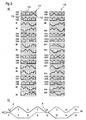
- FIG. 1 shows a first embodiment of a forming machine according to the invention formed as a papermaking wire 100 in the transverse thread direction.
- the FIG. 1a in this case shows all transverse thread courses of a repeat unit of the weaving pattern of the forming fabric 100 according to the invention.
- Forming screen 100 has upper longitudinal threads 1,3,5,7,9,11,13 and 15 formed as warp threads and lower longitudinal threads 2,4,6,8,10 and 12 designed as warp threads.
- the longitudinal threads extend perpendicularly from the plane of the drawing FIG. 1 ,
- the forming fabric 100 comprises binding yarns B1 to B16 arranged in binder yarn pairs B1 and B2, B3 and B4 to B15 and B16.
- the FIG. 1b shows here in an illustration the two weft courses of the binding threads B1 and B2 of a pair of binding threads.
- the forming fabric 100 has formed as weft threads upper transverse threads OS1 to OS16 and formed as weft threads lower transverse threads US1 to US16.
- the ratio of the number of pairs of twines B1 and B2, B3 and B3 to B15 and B16 (these are 8 pairs of binder yarns) and upper transverse yarns OS1 to OS16 together with the number of lower transverse yarns US1 to US16 is 3: 2.
- the forming fabric 100 of the invention has an upper fabric layer 101 whose outer side 103 (in the illustration of FIG. 1 is the outside of the upper fabric layer 101 whose upwardly facing side) a paper side and a lower Fabric layer 102 whose outside 104 (in the illustration of FIG. 1 the outer side 104 of the lower fabric layer 102 is the downwardly facing side thereof) forming a machine side of the forming fabric.
- the upper fabric layer 101 is formed by interweaving the upper longitudinal threads 1,3,5,7,9,11,13 and 15 with the binding threads B1 to B16 and with the upper transverse threads OS1 to OS16.
- the lower fabric layer 102 is formed by the interweaving of the lower longitudinal threads 2,4,6,8,10,12,14 and 16 with the binding threads B1 to B16 and with the lower transverse threads US1 to US16, wherein the weave pattern of the lower fabric layer 102nd repeated in lower repeats (the Kettrapport the lower repeat is hereby formed by the lower longitudinal threads 2,4,6,8,10,12,14 and 16, the Schussrapport the lower repeat is hereby formed by B1 to B16 and US1 to US16) ,
- each lower longitudinal thread 2, 4, 6, 8, 10, 12, 14 and 16 of a lower repeat is held on the outside of the lower fabric layer 102 by at least four binding threads B1 to B16, by placing each of these four binding threads B1 to B16 on the outside 104 of the lower fabric layer 102, the respective lower longitudinal thread 2,4,6,8,10,12,14 and 16 crosses.
- the lower longitudinal thread 2 of the lower repeat is held by the binding threads B6, B8, B13 and B15 on the outer side 104 of the lower fabric layer 102 by running each of these four binding threads B6, B8, B13 and B15 on the outer side 104 of the lower fabric layer 102, crosses the lower longitudinal thread 2.
- the lower longitudinal thread 8 of the lower repeat is held by the binding threads B3, B5, B12 and B14 on the outer side 104 of the lower fabric layer 102 by each of these four binding threads B3, B5, B12 and B14 on the outer side 104 of the lower fabric layer 102 continuously lower longitudinal thread 8 crosses.
- the binding threads of a pair eg B1 and B2 are mutually exchanging with the upper longitudinal threads 1,3,5,7,9,11,13 and 15 and with the lower longitudinal threads 2,4,6,8,10,12,14 and 16 interwoven.
- the binding threads intersect, for example. B1 and B2 or B3 and B4 of a pair forming intersections A.
- the first of the two binding threads weaves, e.g. B1 with upper longitudinal threads 9, 11, 13 and 15, if the second of the two binding threads is e.g. B2 interweaves with lower longitudinal threads 10, 12, 14 and 16 and vice versa, i.
- the second binding yarn B2 interweaves with upper longitudinal yarns 1, 3, 5 and 7, the first binding yarn B1 is interwoven with lower longitudinal yarns 2, 4, 6 and 8.
- the upper fabric layer 10 forms here as a weave a plain weave, which by the interchangeable interweaving the binding threads B1 to B16 with the upper longitudinal threads 1,3,5,7,9,11,13 and 15 by the weaving of the upper transverse threads OS1 until OS16 continues with the upper longitudinal threads 1,3,5,7,9,11,13 and 15 formed weave pattern.
- each pair of binder threads each weave together a weaving path, wherein the common weaving path is such that two juxtaposed lower longitudinal threads 2,4,6,8,10,12,14 and 16 by the binding threads alternately on the outside 104 of the lower fabric layer 102 running, and between the upper fabric layer 101 and lower fabric layer 102 running, are crossed.
- each lower transverse thread US1 to US16 in the lower repeat unit when passing between the lower fabric layer 102 and the upper fabric layer 101, crosses only one lower longitudinal yarn and crosses the remaining lower longitudinal yarns when running on the outer surface 104 of the lower fabric layer 102 , For example. Crosses the lower transverse thread US1 in the lower Kettrapport 2,4,6,8,10,12,14 and 16 only the lower longitudinal thread 8, when the lower transverse thread US1 between the lower 102 and the upper fabric layer runs. The remaining lower longitudinal threads 2,4,6,10,12,14 and 16 crosses the lower transverse thread US1 when it runs on the outer side 104 of the lower fabric layer.
- Each binding thread B1 to B16 intersects with the change from interweaving with an upper longitudinal thread 1,3,5,7,9,11,13 and 15, which the binder thread B1 to B16 on the outer side 103 of the upper fabric layer 101 continuously crosses, for weaving a lower longitudinal thread 2,4,6,8,10,12,14 and 16, the binder thread B1 to B16 on the outside 104 of the lower fabric layer 102 continuously crosses, between the upper fabric layer 101 and the lower fabric layer 102 running, two each other following upper longitudinal threads.
- the binder thread B2 crosses for weaving with a lower longitudinal thread 12 passing through the binding thread B2 on the outer side 104 of the lower fabric layer 102 Crossing between the upper fabric layer 101 and the lower fabric layer 102, the two consecutive upper longitudinal threads 7 and 9.
- each binder thread B1 to B16 intersects with the change from interweaving with a lower longitudinal thread 2,4,6,8,10,12,14 and 16, which the binder thread B1 to B16 on the outer side 104 of the lower fabric layer 102 continuously crosses Interweaving with an upper longitudinal thread 1,3,5,7,9,11,13 and 15, which the binder thread B1 to B16 on the outer side 103 of the upper fabric layer 101 continuously crosses, running between the upper fabric layer 101 and the lower fabric layer 102, an upper longitudinal threads 1,3,5,7,9,11,13 and 15.
- the binding thread B1 crosses for weaving with an upper longitudinal thread 9, that of the binding thread B1 running on the outer side 103 of the upper fabric layer 101 Crossing, between the upper fabric layer 101 and the lower fabric layer 102 running, the upper longitudinal thread. 7
- the lower longitudinal threads 2,4,6,8,10,12,14 and 16 of the lower repeat unit form lower longitudinal threads of the first type 2,6,10 and 14 and lower longitudinal threads of the second type 4,8,12 and 16, the alternating are arranged side by side.
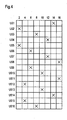
- FIG. 2 Here, a distribution of formed between the lower transverse threads US1 to US16 and the lower longitudinal threads 2,4,6,8,10,12,14 and 16 crossing points of the Formiersiebs 100 of FIG. 1 , wherein crossing points at which a lower transverse thread between the upper fabric 101 and the lower fabric 102 running, a lower longitudinal thread crosses with an "X" are designated.
- FIG. 1b is an example of the pair of binder yarns B1 and B2 to recognize that the respective lower longitudinal threads 2,4,6,8,10,12,14 and 16 interwoven binding yarn, eg B2 of the pair B1 and B2, between two successive crossing points A on the Outer side 104 of the lower fabric layer 102 running, two juxtaposed lower longitudinal threads crosses, in the example, the lower longitudinal threads 12 and 14th
- Formiersieb 100 is further arranged between the binding threads of a pair always a lower transverse thread.
- the lower transverse thread US1 is arranged between the binding threads B1, B2 of the pair B1 and B2.
- a lower transverse thread is respectively arranged between adjacent binding threads of different pairs of binder threads.
- the lower transverse thread US2 is arranged between the binding threads B2 and B3.
- two upper transverse threads are arranged between the pairs of binding threads.
- the upper transverse threads OS1 and OS2 are arranged between the pair B1 and B2 and the pair B3 and B4, the lower transverse thread US2 being arranged between the two upper transverse threads OS1 and OS2.
- FIG. 3 shows a second embodiment of a paper forming machine 110 according to the invention designed as a forming fabric in the transverse thread direction.
- the FIG. 3a in this case shows all transverse thread courses of a repeat unit of the weaving pattern of the forming fabric 110 according to the invention.
- Forming screen 110 has upper longitudinal threads 1,3,5,7,9,11,13 and 15 formed as warp threads and lower longitudinal threads 2,4,6,8,10 and 12 in the form of warp threads.
- the longitudinal threads extend perpendicularly from the plane of the drawing FIG. 3a ,
- the forming fabric 110 has binding yarns B1 to B16 arranged in binder yarn pairs B1 and B2, B3 and B4 to B15 and B16.
- the FIG. 3b shows here in an illustration the two weft courses of the binding threads B1 and B2 of a pair of binding threads.
- the forming fabric 110 has upper transverse threads OS1 to OS16 formed as weft threads and lower transverse threads US1 to US16 formed as weft threads.
- the ratio of the number of pairs of twines B1 and B2, B3 and B3 to B15 and B16 (these are 8 pairs of binder yarns) and upper transverse yarns OS1 to OS16 together with the number of lower transverse yarns US1 to US16 is 3: 2.
- the forming fabric 110 has an upper fabric layer 111 whose outer side 113 (in the illustration of FIGS FIG. 1 is the outside of the upper fabric layer 101 whose upwardly facing side) a paper side and a lower fabric layer 112 whose outer side 114 (in the illustration of FIG. 1 the outside of the lower fabric layer 102 is the downwardly facing side thereof) forms a machine side of the forming fabric 110.
- the upper fabric layer 111 is formed by the interweaving of the upper longitudinal threads 1,3,5,7,9,11,13 and 15 with the binding threads B1 to B16 and with the upper transverse threads OS1 to OS16.
- the lower fabric layer 112 is formed by the interweaving of the lower longitudinal threads 2,4,6,8,10,12,14 and 16 with the binding threads B1 to B16 and with the lower transverse threads US1 to US16, wherein the weave pattern of the lower fabric layer 112th repeated in lower repeats (the Kettrapport the lower repeat is hereby formed by the lower longitudinal threads 2,4,6,8,10,12,14 and 16, the Schussrapport the lower repeat is hereby formed by B1 to B16 and US1 to US16) ,
- each lower longitudinal thread 2,4,6,8,10,12,14 and 16 of a lower repeat on the outer side 114 of the lower fabric layer 112 by at least four binding threads B1 to B16 held by each of these four binding threads B1 to B16 on the Outer side of the lower fabric layer 112 running, the respective lower longitudinal thread 2,4,6,8,10,12,14 and 16 crosses.
- the lower longitudinal thread 2 of the lower repeat is held by the binding threads B5, B8, B14 and B15 on the outer side 114 of the lower fabric layer 112 by running each of these four binding threads B5, B8, B14 and B15 on the outer side 114 of the lower fabric layer 112, crosses the lower longitudinal thread 2.
- the lower longitudinal thread 8 of the lower repeat is held by the binding threads B3, B6, B12 and B13 on the outer side 114 of the lower fabric layer 112, by each of these four binding threads B3, B6, B12 and B13 on the outer side 114 of the lower fabric layer 112 running the lower longitudinal thread 8 crosses.
- the binding threads of a pair e.g. B1 and B2 are mutually interwoven with the upper longitudinal threads 1,3,5,7,9,11,13 and 15 and with the lower longitudinal threads 2,4,6,8,10,12,14 and 16 interwoven.
- the binding threads intersect, for example. B1 and B2 or B3 and B4 of a pair forming intersections A.
- the first of the two binding threads eg B1 interweaves with upper longitudinal threads 1,3,5 and 7, if the second of the two binding threads eg B2 with lower longitudinal threads 2,4,6 and 8 interweaves and vice versa, ie, the second binding yarn B2 woven interweaves with upper longitudinal threads 9,11,13 and 15, weaves the first binding thread B1 with lower longitudinal threads 10,12,14 and 16.
- the upper fabric layer 111 forms here as a weave a plain weave, which by the interchangeable interweaving the binding threads B1 to B16 with the upper longitudinal threads 1,3,5,7,9,11,13 and 15 by the weaving of the upper transverse threads OS1 until OS16 continues with the upper longitudinal threads 1,3,5,7,9,11,13 and 15 formed weave pattern.
- each pair of binder yarns weaves together with the lower transverse threads 2,4,6,8,10,12,14 and 16 together in each case a weaving path, wherein the common weaving path is such that in each case two juxtaposed lower longitudinal threads 2,4,6,8 , 10,12,14 and 16 by the binding threads alternately on the outer side 114 of the lower fabric layer 112 running, and running between the upper fabric layer 111 and lower fabric layer 112, are crossed.
- each lower transverse thread US1 to US16 in the lower repeat unit when passing between the lower fabric layer 112 and the upper fabric layer 111, crosses only one lower longitudinal yarn and crosses the remaining lower longitudinal yarns as it runs on the outer surface 114 of the lower fabric layer 112 , For example. Crosses the lower transverse thread US1 in the lower Kettrapport 2,4,6,8,10,12,14 and 16 only the lower longitudinal thread 14, when the lower transverse thread US1 between the lower 112 and the upper fabric layer 111 runs. The remaining lower longitudinal threads 2,4,6,8,10,12 and 16 crosses the lower transverse thread US1 when it runs on the outer side 114 of the lower fabric layer 112.
- Each binding thread B1 to B16 intersects with the change from interweaving with an upper longitudinal thread 1,3,5,7,9,11,13 and 15, which the binder thread B1 to B16 on the outer side 113 of the upper fabric layer 111 continuously crosses, for weaving a lower longitudinal thread 2,4,6,8,10,12,14 and 16, the binder thread B1 to B16 on the outer side 114 of the lower fabric layer 112 continuously crosses, between the upper fabric layer 111 and the lower fabric layer 112 running, only one upper longitudinal thread.
- the binder thread B1 crosses during the change from interweaving with an upper longitudinal thread 7, which the binder thread B1 continuously crosses on the outside 113 of the upper fabric layer 111, for interweaving with a lower longitudinal thread 12, the binder thread B1 running on the outside 114 of the lower fabric layer 112 Crossing, between the upper fabric layer 111 and the lower fabric layer 112 running, the upper longitudinal thread.
- each binder thread B1 to B16 intersects when changing from weaving with a lower longitudinal thread 2,4,6,8,10,12,14 and 16, the binder thread B1 to B16 on the outer side 114 of the lower fabric layer 112 continuously crosses to Weaving with an upper longitudinal thread 1,3,5,7,9,11,13 and 15, which the binder thread B1 to B16 on the outer side 113 of the upper fabric layer 111 continuously crosses, running between the upper fabric layer 111 and the lower fabric layer 112, two juxtaposed upper longitudinal threads 1,3,5,7,9,11,13 and 15.
- the lower longitudinal threads 2,4,6,8,10,12,14 and 16 of the lower repeat unit form lower longitudinal threads of the third type, the lower repeat unit only lower longitudinal threads 2,4,6,8,10,12,14 and 16 of the third kind.
- FIG. 4 a distribution of formed between the lower transverse threads US1 to US16 and the lower longitudinal threads 2,4,6,8,10,12,14 and 16 crossing points of the Formiersiebs 110 of FIG. 3 wherein crossing points at which a lower transverse thread between the upper fabric 111 and the lower fabric 112 continuously crosses a lower longitudinal thread are designated by an "X".
- FIG. 3b is an example of the pair of binder yarns B1 and B2 to recognize that the respective lower longitudinal threads 2,4,6,8,10,12,14 and 16 interwoven binding yarn, for example B1 of the pair B1 and B2 between two successive crossing points A on the outside 114th the lower fabric layer 112 running, two juxtaposed lower longitudinal threads crossed, in the example, the lower longitudinal threads 12 and 14th
- two lower and two upper transverse threads are each arranged between adjacent binding threads of different binder pairs.
- the binding threads B2 and B3 of the lower transverse threads US3 and US4 and the upper transverse threads OS3 and OS4 are arranged, the sequence of the transverse threads being as follows: upper transverse thread OS3, lower transverse thread US3, upper transverse thread OS4, lower transverse thread US4.
- FIGS. 1 to 4 The two in the FIGS. 1 to 4
- the embodiments of the invention shown in each case show a 1: 1 ratio of the number of upper longitudinal threads 1, 3, 5, 7, 9, 11, 13 and 15 to the number of lower longitudinal threads 2,4,6,8,10,12,14 and 16.
- the idea according to the invention is also applicable to other ratios of the number of upper longitudinal threads to the number of lower longitudinal threads, such as. 2: 1 or 3: 2, applicable.
Landscapes
- Paper (AREA)
- Developing Agents For Electrophotography (AREA)
- Storage Of Web-Like Or Filamentary Materials (AREA)
- Polishing Bodies And Polishing Tools (AREA)
- Woven Fabrics (AREA)
Claims (23)
- Tamis pour machine à papier, en particulier tamis de façonnage (100, 110), présentant :une couche supérieure de tissu (101, 111) dont le côté extérieur (103, 113) forme un côté papier et une couche inférieure de tissu (102, 112) dont le côté extérieur (104, 114) forme le côté machine du tamis (100, 110) de machine à papier etdes fils de liaison (B1-B16) qui relient la couche supérieure de tissu (101, 111) et la couche inférieure de tissu (102, 112),la couche supérieure de tissu (101, 111) étant formée au moins par les fils de liaison (B1-B16) et des fils longitudinaux supérieurs (1, 3, 5, 7, 9, 11, 13, 15) tissés avec ces derniers et s'étendant transversalement par rapport aux fils de liaison (B1-B16),la couche inférieure de tissu (102, 112) étant formée au moins par des fils de liaison (B1-B16), et des fils longitudinaux inférieurs (2, 4, 6, 8, 10, 12, 14, 16) tissés avec ces derniers et s'étendant transversalement par rapport au fils de liaison (B1-B16), (102, 112) se répétant dans les rapports inférieurs,les fils de liaison (B1-B16) étant disposés par paires et les fils de liaison d'une paire étant tissés en alternance mutuelle avec les fils longitudinaux supérieurs (1, 3, 5, 7, 9, 11, 13, 15) et les fils longitudinaux inférieurs (2, 4, 6, 8, 10, 12, 14, 16) et se croisant en alternance avec un tissage avec les fils longitudinaux supérieurs (1, 3, 5, 7, 9, 11, 13, 15) et un tissage avec les fils longitudinaux inférieurs (2, 4, 6, 8, 10, 12, 14, 16) et inversement en formant des emplacements de croisement (A),la couche supérieure de tissu (101, 111) étant formée par tissage des fils longitudinaux supérieurs (1, 3, 5, 7, 9, 11, 13, 15) avec les fils de liaison (B1-B16) des fils transversaux supérieurs (OS1-OS16),
caractérisé en ce quechaque fil longitudinal inférieur (2, 4, 6, 8, 10, 12, 14, 16) d'un rapport inférieur est maintenu sur le côté extérieur (104, 114) de la couche inférieure de tissu (102, 112) par au moins quatre fils de liaison (B1-B16) par le fait que chacun de ces quatre fils de liaison (B1-B16) situés sur le côté extérieur (104, 114) de la couche inférieure de tissu (102, 112) croise en permanence le fil longitudinal inférieur correspondant (2, 4, 6, 8, 10, 12, 14, 16) eten ce que le motif de tissage formé par tissage des fils transversaux supérieurs (OS1-OS16) avec les fils longitudinaux supérieurs (1, 3, 5, 7, 9, 11, 13, 15) est poursuivi par tissage alterné des fils de liaison (B1-B16) avec les fils longitudinaux supérieurs (1, 3, 5, 7, 9, 11, 13, 15). - Tamis pour machine à papier selon la revendication 1, caractérisé en ce que chaque fil de liaison (B1-B16) d'une paire tissée avec des fils longitudinaux supérieurs (1, 3, 5, 7, 9, 11, 13, 15) qui s'étend entre deux emplacements successifs de croisement (A) sur le côté extérieur (103, 113) de la couche supérieure de tissu (101, 111) croise au moins deux fils longitudinaux supérieurs (1, 3, 5, 7, 9, 11, 13, 15).
- Tamis pour machine à papier selon l'une des revendications 1 et 2, caractérisé en ce que lors du passage du tissage avec un fil longitudinal supérieur (1, 3, 5, 7, 9, 11, 13, 15) que le fil de liaison (B1-B16) croise en permanence sur le côté extérieur (103, 113) de la couche supérieure du tissu (101, 111) au tissage avec un fil longitudinal inférieur (2, 4, 6, 8, 10, 12, 14, 16) que le fil de liaison (B1-B16) croise en permanence sur le côté extérieur (104, 114) de la couche inférieure de tissu (102, 112), chaque fil de liaison (B1-B16) s'étend entre la couche supérieure de tissu (101, 111) et la couche inférieure de tissu (102, 112) et croise au moins un et au plus trois fils longitudinaux inférieurs (2, 4, 6, 8, 10, 12, 14, 16) successifs.
- Tamis pour machine à papier selon l'une des revendications 1 à 3, caractérisé en ce que lors du passage du tissage avec un fil longitudinal inférieur (2, 4, 6, 8, 10, 12, 14, 16) que le fil de liaison (B1-B16) croise en permanence sur le côté extérieur (104, 114) de la couche inférieure du tissu (102, 112) au tissage avec un fil longitudinal supérieur (1, 3, 5, 7, 9, 11, 13, 15) que le fil de liaison (B1-B16) croise en permanence sur le côté extérieur (103, 113) de la couche supérieure du tissu (101, 111), chaque fil de liaison (B1-B16) qui s'étend entre la couche supérieure de tissu (101, 111) et la couche inférieure de tissu (102, 112) croise un et au plus trois fils longitudinaux inférieurs (2, 4, 6, 8, 10, 12, 14, 16) successifs.
- Tamis pour machine à papier selon l'une des revendications 1 à 4, caractérisé en ce que la couche supérieure de tissu (101, 111) a une armure de toile.
- Tamis pour machine à papier selon l'une des revendications 1 à 5, caractérisé en ce que la couche inférieure de tissu (103, 113) est formée par tissage des fils longitudinaux inférieurs (2, 4, 6, 8, 10, 12, 14, 16) avec les fils de liaison (B1-B16) et avec les fils transversaux inférieurs (US1-US16).
- Tamis pour machine à papier selon la revendication 6, caractérisé en ce qu'il présente au moins un fil longitudinal inférieur (2, 6, 10, 14) d'un premier type, qui est tissé avec des fils transversaux inférieurs (US1-US16) successifs de la façon suivante :- un fil transversal inférieur croise en permanence le fil longitudinal inférieur du premier type entre la couche supérieure et la couche inférieure de tissu,- quatre fils transversaux inférieurs successifs croisent en permanence le fils longitudinal inférieur du premier type sur le côté extérieur de la couche inférieure du tissu,- un fil transversal inférieur croise en permanence le fil longitudinal inférieur du premier type entre la couche supérieure et la couche inférieure de tissu et- dix fils inférieurs successifs croisent en permanence le fil longitudinal inférieur du premier type sur le côté extérieur de la couche inférieure de tissu.
- Tamis pour machine à papier selon les revendications 6 ou 7, caractérisé en ce qu'il présente au moins un fil longitudinal inférieur (4, 8, 12, 16) d'un deuxième type, qui est tissé avec des fils transversaux inférieurs (US1-US16) successifs de la manière suivante :- un fil transversal inférieur croise en permanence le fil longitudinal inférieur du deuxième type entre la couche supérieure et la couche inférieure du tissu,- six fils transversaux inférieurs successifs croisent en permanence le fil longitudinal inférieur du deuxième type sur le côté extérieur de la couche inférieure de tissu,- un fil transversal inférieur croise en permanence le fil longitudinal inférieur du deuxième type entre la couche supérieure et la couche inférieure de tissu,- huit fils transversaux inférieurs successifs croisent en permanence le fil longitudinal inférieur du deuxième type sur le côté extérieur de la couche inférieure de tissu.
- Tamis pour machine à papier selon la revendication 8, caractérisé en ce que l'unité inférieure de rapport comprend les fils longitudinaux inférieurs (2, 6, 10, 14) du premier type et des fils longitudinaux inférieurs (4, 8, 12, 16) du deuxième type qui sont disposés en alternance les uns à côté des autres.
- Tamis pour machine à papier selon les revendications 1 à 6, caractérisé en ce qu'il présente au moins un fil longitudinal inférieur d'un troisième type qui est tissé avec des fils transversaux inférieurs (US1-US16) successifs de la manière suivante :- un fil transversal inférieur croise en permanence le fil longitudinal inférieur du troisième type entre la couche supérieure et la couche inférieure de tissu,- deux fils transversaux inférieurs successifs croisent en permanence le fil longitudinal inférieur du troisième type sur le côté extérieur de la couche inférieur de tissu,- un fil transversal inférieur croise en permanence le fil longitudinal inférieur du troisième type entre la couche supérieure et la couche inférieure de tissu et- douze fils transversaux inférieurs successifs croisent en permanence le fil longitudinal inférieur du troisième type sur le côté extérieur de la couche inférieure de tissu.
- Tamis pour machine à papier selon la revendication 10, caractérisé en ce que l'unité inférieure de rapport comprend plusieurs fils longitudinaux inférieurs (2, 4, 6, 8, 10, 12, 14, 16) du troisième type disposés les uns à côté des autres.
- Tamis pour machine à papier selon l'une des revendications 1 à 11, caractérisé en ce que chaque fil de liaison (B1-B16) d'une paire qui tisse des fils longitudinaux inférieurs (2, 4, 6, 8, 10, 12, 14, 16) situés entre deux emplacements successifs de croisement (A) sur le côté extérieur (104, 114) de la couche inférieure de tissu (102, 112) croise en permanence au moins deux et au plus trois fils longitudinaux inférieurs (2, 4, 6, 8, 10, 12, 14, 16) disposés les uns à côté des autres.
- Tamis pour machine à papier selon l'une des revendications 6 à 12, caractérisé en ce qu'au moins un fils transversal inférieur (US1, US3, US5) est disposé entre les fils de liaison d'une paire (B1-B16).
- Tamis pour machine à papier selon l'une des revendications 6 à 13, caractérisé en ce qu'un fil transversal inférieur (US2, US4, US6, ...) est disposé entre des fils de liaisons (B1-B16) voisins de différentes paires de fils de liaison.
- Tamis pour machine à papier selon l'une des revendications 1 à 14, caractérisé en ce que deux fils transversaux supérieurs (OS1-OS16) sont disposés entre les paires de fils de liaison (B1-B16).
- Tamis pour machine à papier selon la revendication 15, caractérisé en ce qu'un fil transversal inférieur (US1-US16) est disposé entre les deux fils transversaux supérieurs (OS1-OS16).
- Tamis pour machine à papier selon l'une des revendications 6 à 16, caractérisé en ce que des fils transversaux supérieurs et des fils transversaux inférieurs sont disposés de la manière suivante entre les paires de fils de liaison :- un fil transversal supérieur,- un fil transversal inférieur,- un fil transversale supérieur et- un fil transversal inférieur.
- Tamis pour machine à papier selon l'une des revendications 1 à 17, caractérisé en ce que les fils de liaison (B1-B16) mutuellement alternés d'une paire croise en permanence des paires de fils longitudinaux inférieurs disposées ensemble les unes à côté des autres en alternance sur le côté extérieur (104, 114) de la couche inférieur de tissu (102, 112) et entre la couche supérieure de tissu (101, 111) et la couche inférieure de tissu (102, 112).
- Tamis pour machine à papier selon l'une des revendications 1 à 18, caractérisé en ce que l'unité inférieure de rapport comprend huit fils longitudinaux inférieurs (2, 4, 6, 8, 10, 12, 14, 16) ou davantage.
- Tamis pour machine à papier selon l'une des revendications 1 à 18, caractérisé en ce que l'unité inférieure de rapport comprend huit paires de fils de liaison (B1-B16) .
- Tamis pour machine à papier selon l'une des revendications 1 à 20, caractérisé en ce que l'unité inférieure de rapport comprend 16 fils transversaux inférieurs (US1-US16) .
- Tamis pour machine à papier selon l'une des revendications 6 à 21, caractérisé en ce que le rapport entre le nombre de paires de fils de liaison (B1-B16) et les fils transversaux inférieurs (OS1-OS16) pris ensemble et le nombre des fils transversaux inférieurs (US1-US16) est de 3:2.
- Tamis pour machine à papier selon l'une des revendications 1 à 22, caractérisé en ce que les fils longitudinaux sont des fils de chaîne et en ce que les fils transversaux et les fils de liaison sont des fils de trame.
Applications Claiming Priority (1)
| Application Number | Priority Date | Filing Date | Title |
|---|---|---|---|
| DE102005039447A DE102005039447A1 (de) | 2005-08-18 | 2005-08-18 | Papiermaschinensieb |
Publications (2)
| Publication Number | Publication Date |
|---|---|
| EP1754820A1 EP1754820A1 (fr) | 2007-02-21 |
| EP1754820B1 true EP1754820B1 (fr) | 2009-12-02 |
Family
ID=37387416
Family Applications (1)
| Application Number | Title | Priority Date | Filing Date |
|---|---|---|---|
| EP06116124A Expired - Lifetime EP1754820B1 (fr) | 2005-08-18 | 2006-06-27 | Tissu pour machine à papier |
Country Status (4)
| Country | Link |
|---|---|
| EP (1) | EP1754820B1 (fr) |
| AT (1) | ATE450649T1 (fr) |
| DE (2) | DE102005039447A1 (fr) |
| ES (1) | ES2337714T3 (fr) |
Families Citing this family (4)
| Publication number | Priority date | Publication date | Assignee | Title |
|---|---|---|---|---|
| DE102010029447A1 (de) * | 2010-05-28 | 2011-12-01 | Voith Patent Gmbh | Gewebeband, insbesondere Formiersieb |
| DE102010039360A1 (de) | 2010-08-16 | 2012-02-16 | Voith Patent Gmbh | Sieb für eine Maschine zur Herstellung einer Faserstoffbahn |
| DE102013106327B4 (de) | 2013-06-18 | 2015-01-08 | Andritz Technology And Asset Management Gmbh | Papiermaschinensieb |
| DE102015206287A1 (de) * | 2015-04-09 | 2016-10-13 | Voith Patent Gmbh | Gewebeband |
Family Cites Families (4)
| Publication number | Priority date | Publication date | Assignee | Title |
|---|---|---|---|---|
| DE3938159A1 (de) | 1989-11-16 | 1991-05-23 | Oberdorfer Fa F | Verbundgewebe fuer papiermaschinensiebe |
| US5967195A (en) | 1997-08-01 | 1999-10-19 | Weavexx Corporation | Multi-layer forming fabric with stitching yarn pairs integrated into papermaking surface |
| US6860969B2 (en) | 2003-01-30 | 2005-03-01 | Weavexx Corporation | Papermaker's forming fabric |
| US7007722B2 (en) * | 2003-11-17 | 2006-03-07 | Voith Paper Patent Gmbh | Forming fabric |
-
2005
- 2005-08-18 DE DE102005039447A patent/DE102005039447A1/de not_active Withdrawn
-
2006
- 2006-06-27 AT AT06116124T patent/ATE450649T1/de active
- 2006-06-27 DE DE502006005489T patent/DE502006005489D1/de not_active Expired - Lifetime
- 2006-06-27 EP EP06116124A patent/EP1754820B1/fr not_active Expired - Lifetime
- 2006-06-27 ES ES06116124T patent/ES2337714T3/es not_active Expired - Lifetime
Also Published As
| Publication number | Publication date |
|---|---|
| ATE450649T1 (de) | 2009-12-15 |
| DE502006005489D1 (de) | 2010-01-14 |
| DE102005039447A1 (de) | 2007-02-22 |
| ES2337714T3 (es) | 2010-04-28 |
| EP1754820A1 (fr) | 2007-02-21 |
Similar Documents
| Publication | Publication Date | Title |
|---|---|---|
| EP1294981B1 (fr) | Toile de machine a papier | |
| EP2106477B1 (fr) | Ruban tissu pour une machine destinee a la fabrication de materiaux en bande, en particulier de papier ou de carton | |
| EP1985749B1 (fr) | Habillage pour une machine a papier | |
| EP2922995B1 (fr) | Toile pour machine a papier ayant des flottes de longueur differente sur la face machine | |
| EP1619295B1 (fr) | Toile pour machine à papier | |
| DE102013106327B4 (de) | Papiermaschinensieb | |
| WO2010049304A1 (fr) | Toile de formation | |
| EP2205791A1 (fr) | Toile de formation | |
| EP1619294A2 (fr) | Toile pour machine à papier | |
| EP1798335B1 (fr) | Habillage de machine à papier | |
| EP1754820A1 (fr) | Tissu pour machine à papier | |
| EP1798336B1 (fr) | Habillage de machine à papier | |
| EP1738020B1 (fr) | Toile notamment toile de machine a papier | |
| EP1977037B1 (fr) | Tamis pour machine a papier | |
| EP1798334B1 (fr) | Habillage de machine à papier | |
| DE102007058369A1 (de) | Gewebeband für eine Maschine zur Herstellung von Bahnmaterial, insbesondere Papier oder Karton | |
| EP1619296A2 (fr) | Toile pour machine à papier | |
| EP1586696B1 (fr) | Toile de formation | |
| DE102022117301B3 (de) | Gewebeband | |
| EP1788151B1 (fr) | Tissu pour machine à papier | |
| DE102005041042A1 (de) | Papiermaschinensieb | |
| DE102011083192A1 (de) | Papiermaschinensieb | |
| DE102015206287A1 (de) | Gewebeband | |
| DE202006011572U1 (de) | Formiersieb |
Legal Events
| Date | Code | Title | Description |
|---|---|---|---|
| PUAI | Public reference made under article 153(3) epc to a published international application that has entered the european phase |
Free format text: ORIGINAL CODE: 0009012 |
|
| AK | Designated contracting states |
Kind code of ref document: A1 Designated state(s): AT BE BG CH CY CZ DE DK EE ES FI FR GB GR HU IE IS IT LI LT LU LV MC NL PL PT RO SE SI SK TR |
|
| AX | Request for extension of the european patent |
Extension state: AL BA HR MK YU |
|
| 17P | Request for examination filed |
Effective date: 20070821 |
|
| AKX | Designation fees paid |
Designated state(s): AT BE BG CH CY CZ DE DK EE ES FI FR GB GR HU IE IS IT LI LT LU LV MC NL PL PT RO SE SI SK TR |
|
| 17Q | First examination report despatched |
Effective date: 20070927 |
|
| GRAP | Despatch of communication of intention to grant a patent |
Free format text: ORIGINAL CODE: EPIDOSNIGR1 |
|
| GRAS | Grant fee paid |
Free format text: ORIGINAL CODE: EPIDOSNIGR3 |
|
| GRAA | (expected) grant |
Free format text: ORIGINAL CODE: 0009210 |
|
| AK | Designated contracting states |
Kind code of ref document: B1 Designated state(s): AT BE BG CH CY CZ DE DK EE ES FI FR GB GR HU IE IS IT LI LT LU LV MC NL PL PT RO SE SI SK TR |
|
| REG | Reference to a national code |
Ref country code: GB Ref legal event code: FG4D Free format text: NOT ENGLISH |
|
| REG | Reference to a national code |
Ref country code: CH Ref legal event code: EP |
|
| REG | Reference to a national code |
Ref country code: IE Ref legal event code: FG4D |
|
| REF | Corresponds to: |
Ref document number: 502006005489 Country of ref document: DE Date of ref document: 20100114 Kind code of ref document: P |
|
| REG | Reference to a national code |
Ref country code: SE Ref legal event code: TRGR |
|
| REG | Reference to a national code |
Ref country code: NL Ref legal event code: VDEP Effective date: 20091202 |
|
| REG | Reference to a national code |
Ref country code: ES Ref legal event code: FG2A Ref document number: 2337714 Country of ref document: ES Kind code of ref document: T3 |
|
| PG25 | Lapsed in a contracting state [announced via postgrant information from national office to epo] |
Ref country code: LT Free format text: LAPSE BECAUSE OF FAILURE TO SUBMIT A TRANSLATION OF THE DESCRIPTION OR TO PAY THE FEE WITHIN THE PRESCRIBED TIME-LIMIT Effective date: 20091202 |
|
| LTIE | Lt: invalidation of european patent or patent extension |
Effective date: 20091202 |
|
| PG25 | Lapsed in a contracting state [announced via postgrant information from national office to epo] |
Ref country code: SI Free format text: LAPSE BECAUSE OF FAILURE TO SUBMIT A TRANSLATION OF THE DESCRIPTION OR TO PAY THE FEE WITHIN THE PRESCRIBED TIME-LIMIT Effective date: 20091202 Ref country code: PL Free format text: LAPSE BECAUSE OF FAILURE TO SUBMIT A TRANSLATION OF THE DESCRIPTION OR TO PAY THE FEE WITHIN THE PRESCRIBED TIME-LIMIT Effective date: 20091202 Ref country code: LV Free format text: LAPSE BECAUSE OF FAILURE TO SUBMIT A TRANSLATION OF THE DESCRIPTION OR TO PAY THE FEE WITHIN THE PRESCRIBED TIME-LIMIT Effective date: 20091202 Ref country code: CY Free format text: LAPSE BECAUSE OF FAILURE TO SUBMIT A TRANSLATION OF THE DESCRIPTION OR TO PAY THE FEE WITHIN THE PRESCRIBED TIME-LIMIT Effective date: 20091202 |
|
| REG | Reference to a national code |
Ref country code: IE Ref legal event code: FD4D |
|
| PG25 | Lapsed in a contracting state [announced via postgrant information from national office to epo] |
Ref country code: PT Free format text: LAPSE BECAUSE OF FAILURE TO SUBMIT A TRANSLATION OF THE DESCRIPTION OR TO PAY THE FEE WITHIN THE PRESCRIBED TIME-LIMIT Effective date: 20100402 Ref country code: NL Free format text: LAPSE BECAUSE OF FAILURE TO SUBMIT A TRANSLATION OF THE DESCRIPTION OR TO PAY THE FEE WITHIN THE PRESCRIBED TIME-LIMIT Effective date: 20091202 Ref country code: RO Free format text: LAPSE BECAUSE OF FAILURE TO SUBMIT A TRANSLATION OF THE DESCRIPTION OR TO PAY THE FEE WITHIN THE PRESCRIBED TIME-LIMIT Effective date: 20091202 Ref country code: BG Free format text: LAPSE BECAUSE OF FAILURE TO SUBMIT A TRANSLATION OF THE DESCRIPTION OR TO PAY THE FEE WITHIN THE PRESCRIBED TIME-LIMIT Effective date: 20100302 Ref country code: EE Free format text: LAPSE BECAUSE OF FAILURE TO SUBMIT A TRANSLATION OF THE DESCRIPTION OR TO PAY THE FEE WITHIN THE PRESCRIBED TIME-LIMIT Effective date: 20091202 Ref country code: IS Free format text: LAPSE BECAUSE OF FAILURE TO SUBMIT A TRANSLATION OF THE DESCRIPTION OR TO PAY THE FEE WITHIN THE PRESCRIBED TIME-LIMIT Effective date: 20100402 Ref country code: IE Free format text: LAPSE BECAUSE OF FAILURE TO SUBMIT A TRANSLATION OF THE DESCRIPTION OR TO PAY THE FEE WITHIN THE PRESCRIBED TIME-LIMIT Effective date: 20091202 |
|
| PG25 | Lapsed in a contracting state [announced via postgrant information from national office to epo] |
Ref country code: CZ Free format text: LAPSE BECAUSE OF FAILURE TO SUBMIT A TRANSLATION OF THE DESCRIPTION OR TO PAY THE FEE WITHIN THE PRESCRIBED TIME-LIMIT Effective date: 20091202 Ref country code: SK Free format text: LAPSE BECAUSE OF FAILURE TO SUBMIT A TRANSLATION OF THE DESCRIPTION OR TO PAY THE FEE WITHIN THE PRESCRIBED TIME-LIMIT Effective date: 20091202 |
|
| PLBE | No opposition filed within time limit |
Free format text: ORIGINAL CODE: 0009261 |
|
| STAA | Information on the status of an ep patent application or granted ep patent |
Free format text: STATUS: NO OPPOSITION FILED WITHIN TIME LIMIT |
|
| PG25 | Lapsed in a contracting state [announced via postgrant information from national office to epo] |
Ref country code: GR Free format text: LAPSE BECAUSE OF FAILURE TO SUBMIT A TRANSLATION OF THE DESCRIPTION OR TO PAY THE FEE WITHIN THE PRESCRIBED TIME-LIMIT Effective date: 20100303 |
|
| 26N | No opposition filed |
Effective date: 20100903 |
|
| BERE | Be: lapsed |
Owner name: VOITH PATENT G.M.B.H. Effective date: 20100630 |
|
| PG25 | Lapsed in a contracting state [announced via postgrant information from national office to epo] |
Ref country code: MC Free format text: LAPSE BECAUSE OF NON-PAYMENT OF DUE FEES Effective date: 20100630 Ref country code: DK Free format text: LAPSE BECAUSE OF FAILURE TO SUBMIT A TRANSLATION OF THE DESCRIPTION OR TO PAY THE FEE WITHIN THE PRESCRIBED TIME-LIMIT Effective date: 20091202 |
|
| REG | Reference to a national code |
Ref country code: CH Ref legal event code: PL |
|
| PG25 | Lapsed in a contracting state [announced via postgrant information from national office to epo] |
Ref country code: LI Free format text: LAPSE BECAUSE OF NON-PAYMENT OF DUE FEES Effective date: 20100630 Ref country code: CH Free format text: LAPSE BECAUSE OF NON-PAYMENT OF DUE FEES Effective date: 20100630 |
|
| PG25 | Lapsed in a contracting state [announced via postgrant information from national office to epo] |
Ref country code: BE Free format text: LAPSE BECAUSE OF NON-PAYMENT OF DUE FEES Effective date: 20100630 |
|
| PGFP | Annual fee paid to national office [announced via postgrant information from national office to epo] |
Ref country code: ES Payment date: 20110616 Year of fee payment: 6 |
|
| PGFP | Annual fee paid to national office [announced via postgrant information from national office to epo] |
Ref country code: AT Payment date: 20110613 Year of fee payment: 6 |
|
| PGFP | Annual fee paid to national office [announced via postgrant information from national office to epo] |
Ref country code: DE Payment date: 20120622 Year of fee payment: 7 |
|
| PGFP | Annual fee paid to national office [announced via postgrant information from national office to epo] |
Ref country code: FI Payment date: 20120613 Year of fee payment: 7 Ref country code: SE Payment date: 20120621 Year of fee payment: 7 Ref country code: GB Payment date: 20120622 Year of fee payment: 7 Ref country code: FR Payment date: 20120705 Year of fee payment: 7 |
|
| PG25 | Lapsed in a contracting state [announced via postgrant information from national office to epo] |
Ref country code: LU Free format text: LAPSE BECAUSE OF NON-PAYMENT OF DUE FEES Effective date: 20100627 Ref country code: HU Free format text: LAPSE BECAUSE OF FAILURE TO SUBMIT A TRANSLATION OF THE DESCRIPTION OR TO PAY THE FEE WITHIN THE PRESCRIBED TIME-LIMIT Effective date: 20100603 |
|
| PGFP | Annual fee paid to national office [announced via postgrant information from national office to epo] |
Ref country code: IT Payment date: 20120625 Year of fee payment: 7 |
|
| PG25 | Lapsed in a contracting state [announced via postgrant information from national office to epo] |
Ref country code: TR Free format text: LAPSE BECAUSE OF FAILURE TO SUBMIT A TRANSLATION OF THE DESCRIPTION OR TO PAY THE FEE WITHIN THE PRESCRIBED TIME-LIMIT Effective date: 20091202 |
|
| REG | Reference to a national code |
Ref country code: AT Ref legal event code: MM01 Ref document number: 450649 Country of ref document: AT Kind code of ref document: T Effective date: 20120627 |
|
| PG25 | Lapsed in a contracting state [announced via postgrant information from national office to epo] |
Ref country code: AT Free format text: LAPSE BECAUSE OF NON-PAYMENT OF DUE FEES Effective date: 20120627 |
|
| REG | Reference to a national code |
Ref country code: ES Ref legal event code: FD2A Effective date: 20131021 |
|
| PG25 | Lapsed in a contracting state [announced via postgrant information from national office to epo] |
Ref country code: ES Free format text: LAPSE BECAUSE OF NON-PAYMENT OF DUE FEES Effective date: 20120628 |
|
| PG25 | Lapsed in a contracting state [announced via postgrant information from national office to epo] |
Ref country code: SE Free format text: LAPSE BECAUSE OF NON-PAYMENT OF DUE FEES Effective date: 20130628 |
|
| REG | Reference to a national code |
Ref country code: SE Ref legal event code: EUG |
|
| GBPC | Gb: european patent ceased through non-payment of renewal fee |
Effective date: 20130627 |
|
| PG25 | Lapsed in a contracting state [announced via postgrant information from national office to epo] |
Ref country code: FI Free format text: LAPSE BECAUSE OF NON-PAYMENT OF DUE FEES Effective date: 20130627 |
|
| REG | Reference to a national code |
Ref country code: DE Ref legal event code: R119 Ref document number: 502006005489 Country of ref document: DE Effective date: 20140101 |
|
| REG | Reference to a national code |
Ref country code: FR Ref legal event code: ST Effective date: 20140228 |
|
| PG25 | Lapsed in a contracting state [announced via postgrant information from national office to epo] |
Ref country code: DE Free format text: LAPSE BECAUSE OF NON-PAYMENT OF DUE FEES Effective date: 20140101 Ref country code: GB Free format text: LAPSE BECAUSE OF NON-PAYMENT OF DUE FEES Effective date: 20130627 |
|
| PG25 | Lapsed in a contracting state [announced via postgrant information from national office to epo] |
Ref country code: IT Free format text: LAPSE BECAUSE OF NON-PAYMENT OF DUE FEES Effective date: 20130627 Ref country code: FR Free format text: LAPSE BECAUSE OF NON-PAYMENT OF DUE FEES Effective date: 20130701 |