EP1754904A2 - Mécanisme d'embrayage - Google Patents
Mécanisme d'embrayage Download PDFInfo
- Publication number
- EP1754904A2 EP1754904A2 EP06016075A EP06016075A EP1754904A2 EP 1754904 A2 EP1754904 A2 EP 1754904A2 EP 06016075 A EP06016075 A EP 06016075A EP 06016075 A EP06016075 A EP 06016075A EP 1754904 A2 EP1754904 A2 EP 1754904A2
- Authority
- EP
- European Patent Office
- Prior art keywords
- torque
- housing
- disengagement
- pressing means
- engagement
- Prior art date
- Legal status (The legal status is an assumption and is not a legal conclusion. Google has not performed a legal analysis and makes no representation as to the accuracy of the status listed.)
- Withdrawn
Links
- 238000003825 pressing Methods 0.000 claims abstract description 61
- 230000008878 coupling Effects 0.000 claims description 84
- 238000010168 coupling process Methods 0.000 claims description 84
- 238000005859 coupling reaction Methods 0.000 claims description 84
- 230000005540 biological transmission Effects 0.000 claims description 31
- 238000006073 displacement reaction Methods 0.000 claims description 15
- 230000033001 locomotion Effects 0.000 claims description 15
- 238000000034 method Methods 0.000 claims description 6
- 230000008569 process Effects 0.000 claims description 6
- 230000000750 progressive effect Effects 0.000 claims description 5
- 238000012546 transfer Methods 0.000 claims description 5
- 230000007423 decrease Effects 0.000 claims description 3
- 238000001816 cooling Methods 0.000 description 16
- 230000008859 change Effects 0.000 description 12
- 239000012530 fluid Substances 0.000 description 9
- 230000009471 action Effects 0.000 description 4
- 238000010276 construction Methods 0.000 description 4
- 210000002105 tongue Anatomy 0.000 description 4
- 230000002411 adverse Effects 0.000 description 3
- 230000008901 benefit Effects 0.000 description 3
- 238000013459 approach Methods 0.000 description 2
- 239000012809 cooling fluid Substances 0.000 description 2
- 230000000694 effects Effects 0.000 description 2
- 238000004146 energy storage Methods 0.000 description 2
- 239000011324 bead Substances 0.000 description 1
- 230000033228 biological regulation Effects 0.000 description 1
- 238000006243 chemical reaction Methods 0.000 description 1
- 238000002485 combustion reaction Methods 0.000 description 1
- 238000004891 communication Methods 0.000 description 1
- 230000006835 compression Effects 0.000 description 1
- 238000007906 compression Methods 0.000 description 1
- 230000001143 conditioned effect Effects 0.000 description 1
- 230000003247 decreasing effect Effects 0.000 description 1
- 230000001419 dependent effect Effects 0.000 description 1
- 238000013461 design Methods 0.000 description 1
- 230000002688 persistence Effects 0.000 description 1
- 230000009467 reduction Effects 0.000 description 1
- 230000001105 regulatory effect Effects 0.000 description 1
- 230000000630 rising effect Effects 0.000 description 1
- 238000005096 rolling process Methods 0.000 description 1
- 230000001960 triggered effect Effects 0.000 description 1
Images
Classifications
-
- F—MECHANICAL ENGINEERING; LIGHTING; HEATING; WEAPONS; BLASTING
- F16—ENGINEERING ELEMENTS AND UNITS; GENERAL MEASURES FOR PRODUCING AND MAINTAINING EFFECTIVE FUNCTIONING OF MACHINES OR INSTALLATIONS; THERMAL INSULATION IN GENERAL
- F16D—COUPLINGS FOR TRANSMITTING ROTATION; CLUTCHES; BRAKES
- F16D25/00—Fluid-actuated clutches
- F16D25/06—Fluid-actuated clutches in which the fluid actuates a piston incorporated in, i.e. rotating with the clutch
- F16D25/062—Fluid-actuated clutches in which the fluid actuates a piston incorporated in, i.e. rotating with the clutch the clutch having friction surfaces
- F16D25/063—Fluid-actuated clutches in which the fluid actuates a piston incorporated in, i.e. rotating with the clutch the clutch having friction surfaces with clutch members exclusively moving axially
- F16D25/0635—Fluid-actuated clutches in which the fluid actuates a piston incorporated in, i.e. rotating with the clutch the clutch having friction surfaces with clutch members exclusively moving axially with flat friction surfaces, e.g. discs
- F16D25/0638—Fluid-actuated clutches in which the fluid actuates a piston incorporated in, i.e. rotating with the clutch the clutch having friction surfaces with clutch members exclusively moving axially with flat friction surfaces, e.g. discs with more than two discs, e.g. multiple lamellae
Definitions
- the present invention relates to a coupling device, comprising a housing connected to a drive, an output which is arranged relative to the housing in the circumferential direction relatively rotatable, and at least one accommodated in the housing, between an engagement position and a disengaged position switchable friction clutch, as coupling members at least has a contact pressure and at least one acted upon by the contact pressure coupling element which as well as the contact pressure in the axial direction is limited displaceable and at least one friction surface and a downforce operatively connected to the clutch hub, starting in a lying between engagement and disengagement position Bermmites until To achieve the engagement position, a torque of the drive via the housing and the friction clutch is transferable to the output, while beyond the Berntonabiteses to the disengaged position this Dr transmission of torque is canceled.
- the contact pressure means is formed by a piston which acts on a friction clutch formed by a plurality of coupling elements in the form of lamellae.
- the coupling elements are arranged for cooling in a cold room, which has an inflow and a Outflow is in communication with an external source of fluid pressure, and is separated by the piston from a both in terms of its volume and in terms of its radial extent significantly smaller pressure chamber, the latter via a control line which is provided in the transmission input shaft designed as output, with pressure can be applied.
- the piston At an overpressure in the pressure chamber relative to the cooling chamber, the piston is moved in the direction of the latter and thus engaged the friction clutch, while after a pressure reduction in the pressure chamber via the control line below the pressure level of the cooling chamber of the piston in the opposite direction and thus the friction clutch is disengaged.
- the amount of fluid contained in the cooling space can be significantly reduced, so that at a restart of the drive due to the initially insufficient amount of fluid in the refrigerator can build up an overpressure in the pressure chamber, which leads to engagement of the piston and thus to an undesirable torque transfer in the coupling device.
- dangerous situations are predetermined when the transmission control of the vehicle inserts a drive during a starting process, and the vehicle thus sets in motion without driver's request.
- This fundamental problem is further exacerbated when restarting in a cold environment and therefore with viscous fluid, thereby delaying the required filling of the cold room.
- the invention has the object of providing a coupling device in such a way that it provides a security against unintentional engagement, and on the other hand performs a precisely influenced engaging movement.
- the invention has for its object to exclude adverse effects of tolerances and ripples, and also to make the engagement soft and uniform.
- a disengagement support assembly By assigning a disengagement support assembly to a preferably designed as a piston pressure means of a coupling device is exerted in the pressing means in the direction of disengagement position acting Ausgur-support arrangement, an axial force on the pressing means by which this is pushed away by at least one coupling element of a friction clutch.
- axial force is independent of the set in the previous standstill filling levels in a pressure chamber and a cold room and, as a result, a filling degrees associated pressure difference between the pressure chamber and the refrigerator, ensures that the Clamping means spaced from the friction clutch held and thus the construction of an undesirable torque transmission is effectively prevented.
- the axial force exerted by the disengagement support assembly is such that the contact pressure means will also be subject to adverse conditions such as restarting in a cold environment and therefore viscous cooling fluid, stopping a vehicle incorporating the coupling device on a slope and / or at a launch driver side requested high speed, is held stable in its disengaged position.
- the disengagement support arrangement ensures that the pressing means is held in a region between disengagement position and contact section, with particular preference even directly in the disengaged position, and Thus, an undesirable torque transfer, which can lead to a rolling of the vehicle when the drive is engaged, is avoided.
- this is preferably designed with degressive characteristic.
- the resistance exerted by this axial force accumulator which counteracts a displacement movement of the pressing means, progressively increases from the disengagement position toward the contact portion, immediately adjacent to the contact portion of the contact portion or at least in the immediate vicinity thereof in one of the maximum forces To open plateau.
- this characteristic range is selected such that the contact pressure counteracting the resistance and thus exerted by the Axialkraft Eaton contact force after passage of this plateau, so with further displacement movement of the pressing means in the direction of engagement position, continues to decrease, and thereby less and less of the simultaneously building torque transmission counteracts.
- another characteristic range with progressive characteristic or an at least substantially linear characteristic of the axial force store can be selected with advantage, so that the axial force storage relative to the pressing means applied, a displacement movement of the same counteracting resistance, starting from the disengagement position, not only up to the Bermmabites, but also beyond, continues to rise.
- the axial energy store then also counteracts the increase in torque transmission with increasing axial force between the contact section and the engagement position.
- the disengagement support assembly is noted that regardless of the respective characteristic supports a displacement movement of the pressing means in its disengaged position and thereby the disengagement process is accelerated.
- the torque-structure assembly is designed for a significantly lower contact force than the pressing means, so that after contacting the torque assembly with the coupling element with continued engagement first the torque-assembly undergoes deformation until the torque-structure associated axial force is reached , And then the pressing means is itself brought into operative connection with further continued engagement process to the coupling element, in order thereafter to increase by a further load in the direction of the engagement position, the torque transmission to the predetermined level.
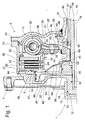
- a drive train 1 with a coupling device 3 is shown schematically.
- the coupling device 3 comprises a housing 5 which is connected via a plurality of fastening elements 7 and a coupling element 9, e.g. a flex plate, with a drive 11, for example, the crankshaft 13 of an internal combustion engine, can be coupled for common rotation and in the region of a rotation axis 14 provided on a drive-side housing hub 15 bearing pin 10 which is received in a drive 11 formed on the centering guide 12.
- the housing 5 has an output-side housing hub 16, which is connected, for example, to a gear arrangement, not shown, and drives there a fluid feed pump (also not shown) for rotation.
- Concentrically arranged on the driven-side housing hub 16 is an output 18 which protrudes with its free end out of the housing 5. This output 18 may be formed for example by a transmission input shaft 19.
- the housing 5 has a drive-side housing wall 20 extending substantially radially outward from the drive-side housing hub 15 and a drive-side housing wall 21 extending substantially radially outward from the drive-side housing hub 16.
- These two housing walls 20, 21 each go in the radially outer region in housing outer shells 23, 24, through which the two housing walls 20, 21 are axially connected to each other and are pressure-tightly secured together in a manner not shown to prevent loss of fluid from one of the housing walls 20, 21 and the housing outer shells 23, 24 enclosed refrigerator 28.
- first coupling elements 22 which are coupled to the housing 5 and in particular with its drive side coupling element carrier 30 effective housing outer shell 23 for common rotation, and a plurality of second coupling elements 24 which on a driven side coupling element carrier 32 are rotationally fixed, included to form a friction clutch 98.
- the output-side coupling element carrier 32 is supported radially via a first cover plate 34 of a torsional vibration damper 38 on a coupling hub 40 of the torsional vibration damper 38, wherein the first cover plate 34 together with a second cover plate 35 forms an input part 36 of the torsional vibration damper 38.
- the input part 36 is relative to the action of energy storage 39 relative to an output member 42 in the form of a hub disc 44 is relatively rotatable, the hub disc 44 is rotatably attached to the clutch hub 40.
- the clutch hub 40 in turn is centered both on the output-side housing hub 16 and on a radially between this housing hub 16 and the output 18 arranged support shaft 47 and coupled to the output 18 for common rotation.
- the support shaft 47 defines with the output-side housing hub 16, a first annular channel 49, with the output 18, however, a second annular channel 50th
- the clutch hub 40 is positioned by a first axial bearing 45 with respect to the drive-side housing hub 15 and by a second axial bearing 46 with respect to the driven-side housing hub 16 within the housing 5.
- the drive-side housing hub 15 receives, axially between the drive-side housing 20 and the clutch hub 40, a pressing means 80, said pressing means 80 formed as a piston 82 and via a torque-mounting assembly 56 in the form of an axial force accumulator 57 with the adjacent coupling element 22 operatively engageable is.
- the torque-mounting assembly 56 is supported on the one hand on a circumferential bead 58 of the pressing means 80 and on the other hand on the side facing him of the adjacent coupling element 22 from.
- the pressing means 80 as well as each of the coupling elements 22, 24 as a coupling member 84 of the friction clutch 98 is effective.
- the axial force accumulator 54 is formed as a plate spring 62 with a ringfömigen base spring member 61 and spring tongues 60. While the axial force accumulator 54 is on the one hand with its spring tongues 60 on the pressing means 80 in abutment, it is supported with its main spring body 61 on the other hand on a support surface 64 of a fixedly provided on the drive side housing hub 15 component 66 in the form of a radial projection.
- the pressing means 80 is acted upon in the direction of the drive-side housing wall 20.
- the contact pressure means 80 is arranged axially between the drive-side housing wall 20 and the cooling space 28 and together with the drive-side housing wall 20 delimits a pressure chamber 86 which has flow passages 90 in the drive-side housing hub 15 and flow passages 92 in the output 18, ie in the transmission input shaft 19. is connected to a serving as a control line 94 center bore of the transmission input shaft 19. Furthermore, flow passages 96 are provided in the clutch hub 40, through which a flow connection between the channel 50 and the cooling space 28 can be produced. The latter is sealed off from the pressure chamber 86, as well as the Gearbox input shaft 19 relative to the drive-side housing hub 15 and the clutch hub 40 relative to the first cover plate 34 of the torsional vibration damper 38 and the support shaft 47.
- the pressing means 80 is in its disengaged position, in which the coupling elements 22, 24 relieved and therefore not capable of transmitting an originating from the drive 11 and guided to the housing 5 torque to the output 18 are.
- the pressing means 80 is axially displaced against the action of the Axialkraft Itemss 54 of the disengagement support assembly 52 and deformation of the Axialkraft towelss 58 of the torque-mounting assembly 56, toward the coupling elements 22, 24.
- the torque transmission begins, while when the pressing means 80 has reached its engagement position and its Veriagerungsmony is completed, the coupling elements 22, 24 are pressed against each other with a predetermined axial force, in which the maximum torque transmission is possible. It remains to add that from a predetermined position of the pressing means 80, preferably in an axial region between the Bermmabites and the engagement position, the Axialkraft towels 57 of the torque-mounting assembly 56 has reached its maximum contact pressure, whereupon the pressing means 80, by applying a much higher contact pressure is effective without the assistance of the torque-buildup assembly 56.
- torque-buildup assembly 56 may, due to the introduced with their Axialkraft Eat 57 elasticity, compared to the torque-assembly 56 substantially inelastic clamping means 80 with the also comparatively inelastic friction surfaces of the coupling elements 22, 24 are brought relatively soft and uniform in operative connection.
- radial and / or axial tolerances between the coupling elements 22, 24 as well as a possible ripple on the friction surfaces in the circumferential direction are compensated by the torque-mounting assembly 56 and thereby increases the efficiency of these friction surfaces for the torque transmission at the same time reduced surface pressures.
- the pressing means 80 acts in the direction of the disengagement position of the disengagement support assembly 52, this exerts an axial force the pressing means 80, through which the same of the coupling elements 22, 24 is pushed.
- axial force arises at a start regardless of the set at the previous standstill filling between pressure chamber 86 and the refrigerator 28 and thereby conditioned pressure difference a direction of action on the pressing means 80, by which this spaced from the coupling elements 22, 24 is held and thus the construction of an undesirable torque transmission is effectively prevented.
- the force exerted by the disengagement support assembly 52 axial force is dimensioned such that the contact pressure 80 even under unfavorable influences, such as a cold restart in cold environment and therefore viscous cooling fluid and / or requested on the driver side high speed, stable in his Release position is held.
- the disengagement support arrangement 52 ensures that the pressing means 80 are held in a disengaged position and contact section, even more preferably in the disengaged position is.
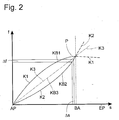
- the axial force accumulator 54 of the disengagement support arrangement 52 can be designed with degressive characteristic K1.
- the resistance exerted by the axial force accumulator 54 starting from the disengagement position AP, continues to increase in the direction of the contact section BA, in the axial extension region of the contact section BA or immediately adjacent to it in a plateau associated with the maximum force P to open.
- the characteristic area KB1 is designed in such a way that the resistance of the axial force store 54 counteracting the pressing means 80 begins to drop in the axial extent of the contact section BA, so that the contact force exerted by the axial force store 54 after passage of this Extending region in the direction of the engagement position EP continues to decrease, and thereby less and less counteracts the simultaneously building torque transmission.
- a characteristic range KB2 a progressive characteristic K2 of the Axialkraft Itemss 54 may be selected so that the force exerted by the Axialkraft immediately 54 against the pressing means 80, a displacement movement of the same counteracting resistance, starting from the disengaged position AP, not only to the Bermmabites BA, but beyond that, always rising.
- FIG. 2 shows an axial force accumulator 54 with an at least substantially linear characteristic K3 and a characteristic range KB3 in a dashed representation.
Landscapes
- Engineering & Computer Science (AREA)
- General Engineering & Computer Science (AREA)
- Mechanical Engineering (AREA)
- Mechanical Operated Clutches (AREA)
- Arrangement And Mounting Of Devices That Control Transmission Of Motive Force (AREA)
Applications Claiming Priority (1)
| Application Number | Priority Date | Filing Date | Title |
|---|---|---|---|
| DE200510039273 DE102005039273A1 (de) | 2005-08-19 | 2005-08-19 | Kopplungsvorrichtung |
Publications (2)
| Publication Number | Publication Date |
|---|---|
| EP1754904A2 true EP1754904A2 (fr) | 2007-02-21 |
| EP1754904A3 EP1754904A3 (fr) | 2010-08-04 |
Family
ID=37203798
Family Applications (1)
| Application Number | Title | Priority Date | Filing Date |
|---|---|---|---|
| EP06016075A Withdrawn EP1754904A3 (fr) | 2005-08-19 | 2006-08-02 | Mécanisme d'embrayage |
Country Status (2)
| Country | Link |
|---|---|
| EP (1) | EP1754904A3 (fr) |
| DE (1) | DE102005039273A1 (fr) |
Cited By (3)
| Publication number | Priority date | Publication date | Assignee | Title |
|---|---|---|---|---|
| WO2008107077A1 (fr) * | 2007-03-03 | 2008-09-12 | Zf Friedrichshafen Ag | Embrayage à friction pour chaîne cinématique de véhicule |
| DE102008061683A1 (de) * | 2008-05-21 | 2009-11-26 | Borgwarner Inc., Auburn Hills | Verfahren zur Montage einer nasslaufenden Anfahrkupplung und nasslaufende Anfahrkupplung für ein Getriebe |
| CN108105278A (zh) * | 2017-01-25 | 2018-06-01 | 青岛丰宝汽车离合器有限公司 | 湿式离合器总成 |
Citations (1)
| Publication number | Priority date | Publication date | Assignee | Title |
|---|---|---|---|---|
| DE10234822A1 (de) | 2002-07-31 | 2004-02-19 | Zf Sachs Ag | Kupplungsanordnung |
Family Cites Families (3)
| Publication number | Priority date | Publication date | Assignee | Title |
|---|---|---|---|---|
| JPS6086627U (ja) * | 1983-11-18 | 1985-06-14 | 株式会社大金製作所 | 油圧クラツチ |
| JP3248749B2 (ja) * | 1992-03-19 | 2002-01-21 | ジヤトコ・トランステクノロジー株式会社 | クラッチピストンのスプリングリテーナ |
| DE10143834A1 (de) * | 2001-09-07 | 2003-03-27 | Zf Sachs Ag | Kupplungssystem mit einer nasslaufenden oder/und hydraulisch betätigbaren Mehrfach-Kupplungseinrichtung |
-
2005
- 2005-08-19 DE DE200510039273 patent/DE102005039273A1/de not_active Withdrawn
-
2006
- 2006-08-02 EP EP06016075A patent/EP1754904A3/fr not_active Withdrawn
Patent Citations (1)
| Publication number | Priority date | Publication date | Assignee | Title |
|---|---|---|---|---|
| DE10234822A1 (de) | 2002-07-31 | 2004-02-19 | Zf Sachs Ag | Kupplungsanordnung |
Cited By (4)
| Publication number | Priority date | Publication date | Assignee | Title |
|---|---|---|---|---|
| WO2008107077A1 (fr) * | 2007-03-03 | 2008-09-12 | Zf Friedrichshafen Ag | Embrayage à friction pour chaîne cinématique de véhicule |
| DE102008061683A1 (de) * | 2008-05-21 | 2009-11-26 | Borgwarner Inc., Auburn Hills | Verfahren zur Montage einer nasslaufenden Anfahrkupplung und nasslaufende Anfahrkupplung für ein Getriebe |
| CN108105278A (zh) * | 2017-01-25 | 2018-06-01 | 青岛丰宝汽车离合器有限公司 | 湿式离合器总成 |
| CN108105278B (zh) * | 2017-01-25 | 2024-06-04 | 青岛丰宝汽车离合器有限公司 | 湿式离合器总成 |
Also Published As
| Publication number | Publication date |
|---|---|
| EP1754904A3 (fr) | 2010-08-04 |
| DE102005039273A1 (de) | 2007-02-22 |
Similar Documents
| Publication | Publication Date | Title |
|---|---|---|
| EP1548313B2 (fr) | Dispositif de transmission de couple et train d'entraînement le comprenant | |
| EP2161466B1 (fr) | Dispositif d'embrayage multiple, notamment dispositif d'embrayage double, doté d'un agencement d'embrayage à lamelles pouvant être actionné à l'aide d'un support de lamelles | |
| DE10004189A1 (de) | Mehrfach-Kupplungseinrichtung | |
| EP1857698B1 (fr) | Agencement d'accouplement | |
| EP2085654A1 (fr) | Amortisseur de vibrations de torsion pour convertisseur de couple | |
| WO2008077370A1 (fr) | Convertisseur de couple avec plusieurs fonctions comprenant un ressort de levier et procédé pour la commande de la pression et du flux hydraulique | |
| DE3838865A1 (de) | Mehrfachkupplungsaggregat | |
| DE10226860A1 (de) | Föttinger-Anfahrelement | |
| DE102013216333A1 (de) | Mehrfachkupplungsvorrichtung, insbesondere Doppelkupplungsvorrichtung | |
| DE102007061949A1 (de) | Kopplungsanordnung | |
| EP1754905A2 (fr) | Dispositif d'accouplement | |
| EP3133308B1 (fr) | Embrayage axial a disques multiples | |
| EP1754904A2 (fr) | Mécanisme d'embrayage | |
| DE10358902B4 (de) | Torsionsschwingungsdämpfer | |
| EP0898091A1 (fr) | Embrayage à friction pour véhicules automobiles | |
| DE19519363C2 (de) | Geteilte Schwungradvorrichtung | |
| EP1826459A1 (fr) | Convertisseur de couple avec embrayage de pontage | |
| DE102010042639B4 (de) | Kupplungsmechanismus mit Ausgleichsgewicht | |
| DE10240679B4 (de) | Vorrichtung zum Betätigen einer Lamellenkupplung | |
| DE102016114271A1 (de) | Schaltvorrichtung für ein Kraftfahrzeuggetriebe | |
| EP2087252B1 (fr) | Embrayage à friction pour la chaîne cinématique d'un véhicule | |
| DE19508855C2 (de) | Hydrodynamischer Drehmomentwandler mit einer Überbrückungskupplung | |
| DE102012023721A1 (de) | Torsionsschwingungsdämpfer mit Kupplungseinrichtung und Antriebsstrang für ein Kraftfahrzeug mit einem solchen Torsionsschwingungsdämpfer | |
| DE102005012241A1 (de) | Hydrodynamische Kopplungsvorrichtung | |
| EP2028384B1 (fr) | Plateau de pression pour un embrayage à friction |
Legal Events
| Date | Code | Title | Description |
|---|---|---|---|
| PUAI | Public reference made under article 153(3) epc to a published international application that has entered the european phase |
Free format text: ORIGINAL CODE: 0009012 |
|
| AK | Designated contracting states |
Kind code of ref document: A2 Designated state(s): AT BE BG CH CY CZ DE DK EE ES FI FR GB GR HU IE IS IT LI LT LU LV MC NL PL PT RO SE SI SK TR |
|
| AX | Request for extension of the european patent |
Extension state: AL BA HR MK YU |
|
| PUAL | Search report despatched |
Free format text: ORIGINAL CODE: 0009013 |
|
| AK | Designated contracting states |
Kind code of ref document: A3 Designated state(s): AT BE BG CH CY CZ DE DK EE ES FI FR GB GR HU IE IS IT LI LT LU LV MC NL PL PT RO SE SI SK TR |
|
| AX | Request for extension of the european patent |
Extension state: AL BA HR MK RS |
|
| AKY | No designation fees paid | ||
| STAA | Information on the status of an ep patent application or granted ep patent |
Free format text: STATUS: THE APPLICATION IS DEEMED TO BE WITHDRAWN |
|
| 18D | Application deemed to be withdrawn |
Effective date: 20110205 |