EP1755272A2 - Verfahren zur Zertifikation von öffentlichen Schlüsseln, die zum Signieren von Postwertzeichen verwendet werden und derart signierte Postzeichen - Google Patents
Verfahren zur Zertifikation von öffentlichen Schlüsseln, die zum Signieren von Postwertzeichen verwendet werden und derart signierte Postzeichen Download PDFInfo
- Publication number
- EP1755272A2 EP1755272A2 EP06022244A EP06022244A EP1755272A2 EP 1755272 A2 EP1755272 A2 EP 1755272A2 EP 06022244 A EP06022244 A EP 06022244A EP 06022244 A EP06022244 A EP 06022244A EP 1755272 A2 EP1755272 A2 EP 1755272A2
- Authority
- EP
- European Patent Office
- Prior art keywords
- key
- postage meter
- public key
- certifying
- indicium
- Prior art date
- Legal status (The legal status is an assumption and is not a legal conclusion. Google has not performed a legal analysis and makes no representation as to the accuracy of the status listed.)
- Withdrawn
Links
Images






Classifications
-
- G—PHYSICS
- G07—CHECKING-DEVICES
- G07B—TICKET-ISSUING APPARATUS; FARE-REGISTERING APPARATUS; FRANKING APPARATUS
- G07B17/00—Franking apparatus
- G07B17/00733—Cryptography or similar special procedures in a franking system
-
- G—PHYSICS
- G07—CHECKING-DEVICES
- G07B—TICKET-ISSUING APPARATUS; FARE-REGISTERING APPARATUS; FRANKING APPARATUS
- G07B17/00—Franking apparatus
- G07B17/00185—Details internally of apparatus in a franking system, e.g. franking machine at customer or apparatus at post office
- G07B17/00193—Constructional details of apparatus in a franking system
-
- H—ELECTRICITY
- H04—ELECTRIC COMMUNICATION TECHNIQUE
- H04L—TRANSMISSION OF DIGITAL INFORMATION, e.g. TELEGRAPHIC COMMUNICATION
- H04L9/00—Cryptographic mechanisms or cryptographic arrangements for secret or secure communications; Network security protocols
- H04L9/30—Public key, i.e. encryption algorithm being computationally infeasible to invert or user's encryption keys not requiring secrecy
- H04L9/3066—Public key, i.e. encryption algorithm being computationally infeasible to invert or user's encryption keys not requiring secrecy involving algebraic varieties, e.g. elliptic or hyper-elliptic curves
-
- H—ELECTRICITY
- H04—ELECTRIC COMMUNICATION TECHNIQUE
- H04L—TRANSMISSION OF DIGITAL INFORMATION, e.g. TELEGRAPHIC COMMUNICATION
- H04L9/00—Cryptographic mechanisms or cryptographic arrangements for secret or secure communications; Network security protocols
- H04L9/32—Cryptographic mechanisms or cryptographic arrangements for secret or secure communications; Network security protocols including means for verifying the identity or authority of a user of the system or for message authentication, e.g. authorization, entity authentication, data integrity or data verification, non-repudiation, key authentication or verification of credentials
- H04L9/3247—Cryptographic mechanisms or cryptographic arrangements for secret or secure communications; Network security protocols including means for verifying the identity or authority of a user of the system or for message authentication, e.g. authorization, entity authentication, data integrity or data verification, non-repudiation, key authentication or verification of credentials involving digital signatures
- H04L9/3252—Cryptographic mechanisms or cryptographic arrangements for secret or secure communications; Network security protocols including means for verifying the identity or authority of a user of the system or for message authentication, e.g. authorization, entity authentication, data integrity or data verification, non-repudiation, key authentication or verification of credentials involving digital signatures using DSA or related signature schemes, e.g. elliptic based signatures, ElGamal or Schnorr schemes
-
- H—ELECTRICITY
- H04—ELECTRIC COMMUNICATION TECHNIQUE
- H04L—TRANSMISSION OF DIGITAL INFORMATION, e.g. TELEGRAPHIC COMMUNICATION
- H04L9/00—Cryptographic mechanisms or cryptographic arrangements for secret or secure communications; Network security protocols
- H04L9/32—Cryptographic mechanisms or cryptographic arrangements for secret or secure communications; Network security protocols including means for verifying the identity or authority of a user of the system or for message authentication, e.g. authorization, entity authentication, data integrity or data verification, non-repudiation, key authentication or verification of credentials
- H04L9/3263—Cryptographic mechanisms or cryptographic arrangements for secret or secure communications; Network security protocols including means for verifying the identity or authority of a user of the system or for message authentication, e.g. authorization, entity authentication, data integrity or data verification, non-repudiation, key authentication or verification of credentials involving certificates, e.g. public key certificate [PKC] or attribute certificate [AC]; Public key infrastructure [PKI] arrangements
-
- G—PHYSICS
- G07—CHECKING-DEVICES
- G07B—TICKET-ISSUING APPARATUS; FARE-REGISTERING APPARATUS; FRANKING APPARATUS
- G07B17/00—Franking apparatus
- G07B17/00185—Details internally of apparatus in a franking system, e.g. franking machine at customer or apparatus at post office
- G07B17/00435—Details specific to central, non-customer apparatus, e.g. servers at post office or vendor
-
- G—PHYSICS
- G07—CHECKING-DEVICES
- G07B—TICKET-ISSUING APPARATUS; FARE-REGISTERING APPARATUS; FRANKING APPARATUS
- G07B17/00—Franking apparatus
- G07B17/00185—Details internally of apparatus in a franking system, e.g. franking machine at customer or apparatus at post office
- G07B17/00435—Details specific to central, non-customer apparatus, e.g. servers at post office or vendor
- G07B2017/00443—Verification of mailpieces, e.g. by checking databases
-
- G—PHYSICS
- G07—CHECKING-DEVICES
- G07B—TICKET-ISSUING APPARATUS; FARE-REGISTERING APPARATUS; FRANKING APPARATUS
- G07B17/00—Franking apparatus
- G07B17/00733—Cryptography or similar special procedures in a franking system
- G07B2017/00741—Cryptography or similar special procedures in a franking system using specific cryptographic algorithms or functions
- G07B2017/00758—Asymmetric, public-key algorithms, e.g. RSA, Elgamal
-
- G—PHYSICS
- G07—CHECKING-DEVICES
- G07B—TICKET-ISSUING APPARATUS; FARE-REGISTERING APPARATUS; FRANKING APPARATUS
- G07B17/00—Franking apparatus
- G07B17/00733—Cryptography or similar special procedures in a franking system
- G07B2017/00741—Cryptography or similar special procedures in a franking system using specific cryptographic algorithms or functions
- G07B2017/00758—Asymmetric, public-key algorithms, e.g. RSA, Elgamal
- G07B2017/00766—Digital signature, e.g. DSA, DSS, ECDSA, ESIGN
-
- G—PHYSICS
- G07—CHECKING-DEVICES
- G07B—TICKET-ISSUING APPARATUS; FARE-REGISTERING APPARATUS; FRANKING APPARATUS
- G07B17/00—Franking apparatus
- G07B17/00733—Cryptography or similar special procedures in a franking system
- G07B2017/00741—Cryptography or similar special procedures in a franking system using specific cryptographic algorithms or functions
- G07B2017/00782—Hash function, e.g. MD5, MD2, SHA
-
- G—PHYSICS
- G07—CHECKING-DEVICES
- G07B—TICKET-ISSUING APPARATUS; FARE-REGISTERING APPARATUS; FRANKING APPARATUS
- G07B17/00—Franking apparatus
- G07B17/00733—Cryptography or similar special procedures in a franking system
- G07B2017/00911—Trusted party
-
- G—PHYSICS
- G07—CHECKING-DEVICES
- G07B—TICKET-ISSUING APPARATUS; FARE-REGISTERING APPARATUS; FRANKING APPARATUS
- G07B17/00—Franking apparatus
- G07B17/00733—Cryptography or similar special procedures in a franking system
- G07B2017/00919—Random number generator
-
- G—PHYSICS
- G07—CHECKING-DEVICES
- G07B—TICKET-ISSUING APPARATUS; FARE-REGISTERING APPARATUS; FRANKING APPARATUS
- G07B17/00—Franking apparatus
- G07B17/00733—Cryptography or similar special procedures in a franking system
- G07B2017/00927—Certificates, e.g. X.509
-
- H—ELECTRICITY
- H04—ELECTRIC COMMUNICATION TECHNIQUE
- H04L—TRANSMISSION OF DIGITAL INFORMATION, e.g. TELEGRAPHIC COMMUNICATION
- H04L2209/00—Additional information or applications relating to cryptographic mechanisms or cryptographic arrangements for secret or secure communication H04L9/00
- H04L2209/56—Financial cryptography, e.g. electronic payment or e-cash
Definitions
- EP-A-1 043 695 (Attorney Docket E-837) and EP-A-1 043 696 (Attorney Docket E-838) filed on March 30, 2000.
- the subject invention relates to encryption of information using public key encryption technology.
- public key encryption herein is meant encryption technology which uses pairs of keys: a public key, which is published or made publicly known; and a corresponding private key, kept secret by a user.
- More particularly it relates to the use of private keys to certify postal indicia and the like and the certification of corresponding public keys.
- public keys can be distributed so widely, it will in general be the case that persons communicating with users of public key systems will not be in direct contact with the users and will not be able to directly determine the identity and/or characteristics of the putative users of a public key system.
- proof of payment systems in particular postage meters, which generate indicia encrypted using public key systems as proof of payment have recently been developed by the assignee of the present application and others; and, given the hundreds of thousands of postage meters in service, it is clear that the postal services will face a severe problem in assuring that indicia purportedly generated by a meter corresponding to a particular public key is in fact generated by an authorized postage meter.
- a trusted third party (hereinafter sometimes a "certifying authority") provides parties who wish to communicate with a user with a certificate containing the user's public key, the certificate serving to evidence the third party's assurances as to the identity or characteristics of the user.
- certifying authority provides parties who wish to communicate with a user with a certificate containing the user's public key, the certificate serving to evidence the third party's assurances as to the identity or characteristics of the user.
- certificates are no more than entries in a directory delivered through a secure channel. More generally the certifying authority will use an encryption technology to deliver the certificate.
- the ITU X509.3 standard teaches a standard in which a first user's certificates includes the user's public key, identification and authorization information, and a signature of the certificate authority.
- a second user verifies a signature of a message generated by the first user by verifying that the authorization information is satisfactory, that the certificate authority's signature on the certificate verifies, extracting the first user's public key, and verifying the signature.
- PKCS #10 Certification Request Syntax Standard, An RSA Laboratories Technical Note," Version 1.0, December 1993 .
- Elliptic curve encryption is an example of a cryptographic algorithm based on application of a binary operator to points in a finite group.
- elliptic curve encryption a finite group of points [P] of order n is defined on an elliptic curve.
- a binary additive operator [+] (hereinafter sometimes "point addition") is defined on the group [P] such that P [+] P' is a point in [P].
- point addition A more detailed, graphical description of point addition is shown in Figure 1.
- Figure 2 shows the special case for computation of P [+] P.
- Straight line 14 is defined as tangent to the closed portion of curve 10 and intersecting point P, and R(P [+] P) is defined as the second point common to line 14 and curve 10.
- a second operation K* P (herein after sometimes "point multiplication") is defined as the application of [+] to K copies of a point P.
- Point multiplication is the basic operation underlying elliptic curve encryption and has the property that computation of K from knowledge of the group [P], a particular point P, and K*P is hard.
- hard as used herein in regard to computation is meant a computation wherein the time required increases faster than the order of the operands log n, preferably exponentially or faster with the order of the operands (log n). This means that where K is of order n, the order of [P], and n is chosen large enough the cost, in time or money, of computing K from knowledge of the definition of [P], P, and K*P can be made arbitrarily large while the cost of other computations relating to encryption or decryption remains relatively low and practicable.
- Point multiplication has been described in terms of the group represented by point addition on a discrete elliptic curve.
- the subject invention can be implemented using any group representation where determining K is hard given the point P and the point formed by combining K copies of point P by repeated application of the group additive point operation.
- a user U has a private key Key U and a corresponding public key Key U *P; where P is a published or publicly known point in [P].
- P is a published or publicly known point in [P].
- user U i.e. a station operated by user U
- generates and keeps secret a random number r U and computes and sends to a certifying authority CA the point r U *P.
- Certifying authority CA has a private Key CA and a public key Key CA *P.
- r U *P Upon receipt of r U *P the CA generates a random number r CA and computes and publishes a certificate including a point, r U *P [+] r CA *P, wherein r CA is a random number generated by the CA (i.e. by the CA station).
- Authority CA which is presumed to have the capability to directly determine the identity or characteristics of user U, also generates information ID U and about U includes ID U in the certificate.
- Certifying Authority CA then returns an integer derived from the CA's private key and the certificate to the user station which uses that integer to compute key Key U in such a manner that a party communicating with user U can compute Key U *P from the certificate and the certifying authority's public key Key CA; providing evidence that the certifying authority has linked user U, Key U , and ID U .
- the above described certification scheme is believed to be advantageous in that it is computationally simpler, produces smaller certificates, and does not require special secure hardware. However it does not address the special situation of certification of public keys used to verify value evidencing indicia such as digital postal indicia.
- a Postal Service which wishes to verify encrypted metered mail may need assurance that the putative public key of a meter has been certified by the meter manufacturer or one or more agencies of the Postal Service.
- digital signatures hereinafter sometimes Cryptographic Integrity Validation Code or CIVC
- the above object is achieved and the disadvantages of the prior art are overcome in accordance with subject invention by method for controlling a digital postage meter and a certifying station operated by a certifying authority CA for publishing information, so that a public key Key DM * P of the digital postage meter can be determined by a party seeking to verify indicia printed by the digital postage meter from the published information with assurance that the public key Key DM *P has been certified by the certifying authority CA, where the method includes; defining and publishing a finite group [P] with a binary operation [+] and publishing a particular point P in the group; defining and publishing a binary operation K*P, where K is an integer and P is a point in the group, such that K*P is a point in the group computed by applying the operation [+] to K copies of the point P, and computation of K from knowledge of the definition of the group [P], the point P, and K*P is hard.
- the certifying station is controlled to publish a certificate OMC DM
- the digital postage meter then prints an indicium and digitally sign the indicium with the key Key DM .
- the publicly known manner for deriving an integer from the published information includes applying a hashing function to the message M.
- the message M includes information IAV identifying the digital postage meter and operating parameters applicable to the digital postage meter.
- the group [P] is defined on an elliptic curve.
- the message M includes information tying the postage meter public key Key DM *P to the information IAV.
- An article in accordance with the subject invention has an indicium imprinted thereon as evidence of attributes of the article.
- the indicium including a signature generated with a private key of a first party; a certificate; information specifying attributes of the article.
- the private key of the first party is generated as a function of the certificate, the information, and a private key of a certifying authority, the function being chosen so that a party wishing to verify the indicium can determine a public key corresponding to the private key of the first party by operating on the certificate and the information with a corresponding public key of the certifying authority.
- a digital postage meter in accordance with the subject invention is controlled to print indicia signed with a private key Key DM based upon a published a finite group [P] with a binary operation [+] and a published particular point P in the group and a published a binary operation K*P, where K is an integer and P is a point in the group, such that K*P is a point in the group computed by applying the operation [+] to K copies of the point P, and computation of K from knowledge of the definition of the group [P], the point P, and K*P is hard, so that a public key Key DM *P of the digital postage meter can be determined by a party seeking to verify indicia printed by the digital postage meter from published information with assurance that the public key Key DM *P has been certified by a certifying authority CA.
- a certifying station operated by a certifying authority CA in accordance with the subject invention is controlled to publish information relating to a digital postage meter for printing indicia signed with a private key Key DM based upon a published a finite group [P] with a binary operation [+] and a published particular point P in the group and a published a binary operation K*P, where K is an integer and P is a point in the group, such that K*P is a point in the group computed by applying the operation [+] to K copies of the point P, and computation of K from knowledge of the definition of the group [P], the point P, and K*P is hard, so that a public key Key DM *P of the digital postage meter can be determined by a party seeking to verify indicia printed by the digital postage meter from the published information with assurance that the public key Key DM *P has been certified by a certifying authority CA.
- a certifying authority certifies a public key of a digital postage meter, the digital postage meter producing indicia signed with a corresponding private key of the digital postage meter, the certifying authority having a published public key and a corresponding private key, by providing the meter with an integer, the integer being a first function of the private key of the authority; the meter computing a digital postage meter private key as a second function of the integer; and the certifying authority publishing related information.
- the first function, the second function and the published related information are chosen so that a party seeking to verify the indicia can compute the digital postage meter public key by operating on the published related information with the published public key of the authority.
- a certifying authority certifies a public key of a digital postage meter, the digital postage meter producing indicia signed with a corresponding private key of the digital postage meter, the certifying authority having a published public key and a corresponding private key, by the certifying authority providing a user with an integer, the integer being a first function of the private key of the authority; the user computing a digital postage meter private key as a second function of the integer and downloading the postage meter private key to the digital postage meter ; and the certifying authority publishing related information.
- the first function, the second function and the published related information are chosen so that a party seeking to verify the indicia can compute the digital postage meter public key by operating on the published related information with the published public key of the authority.
- Figure 1 is a graph illustrating the prior art operation of point addition of points P and P'.
- Figure 2 is a graph illustrating the prior art operation of point addition of two copies of point P.
- Figure 3 is a graph illustrating the prior art operation of point multiplication of point P.
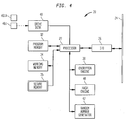
- Figure 4 is a schematic block diagram of a general encryption station which can be programmed to serve in digital postage meters, user stations or certifying stations.
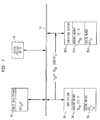
- Figures 5 and 6 show communication of a digital postage meter and a certifying station over a data link to generate a public key pair and certificate in accordance with the method of the subject invention.
- Figures 7 and 8 show communication of a user station and a certifying station over a data link to generate a public key pair for downloading to a digital postage meter, and a certificate in accordance with the method of the subject invention.
- Figure 9 is a schematic representation of a digital indicium in accordance with the subject invention.
- FIG. 4 shows a general encryption station 20 which can be adapted to perform the functions required by a user or a certifying authority. Station 20 can also be incorporated into a digital postage meter in embodiments of the subject invention where a communications link is provided between a certifying authority and a postage meter for generation of public key pairs and corresponding certificates.
- Digital postage meters are well known devices for printing mail pieces with indicia evidencing payment of postage and accounting for postage expended and a description of their operation in carrying out these functions is not necessary for an understanding of the subject invention. Also, it will be apparent to those skilled in the art that the various functional units shown in Figure 4 need not be incorporated in corresponding hardware subsystems but can be provided, wholly or partially, by appropriate software routines.
- Station 20 includes processor 22 connected to data link 24 through I/O device 26.
- Data link 24 may be of any convenient kind, including but not limited to computer communication networks, telephone networks and dedicated lines, or can simply be the exchange of portable data storage media such as magnetic disks, with I/O device 26 being designed in a conventional manner to interface to link 24.
- Processor 22 also communicates with program memory 32 to access program code to control station 20 to carry out functions of a user or digital postage meter in generating a public key pair, or of certifying authority in generating a corresponding certificate, and working memory 34 for temporary storage of data.
- station 20 also includes secure memory 35 for storing certain critical parameters, as will be described further below.
- memory 35 is secured against unauthorized access by conventional means known to those skilled in the art, which can include physical security such as be shielding and software based techniques such as passwords and encryption.
- Processor 22 also communicates with, and controls as necessary:
- Station 20 is preferably adapted to carry out the functions of a user or a certifying authority by reading signals representative of an appropriate control program code recorded on portable media such as magnetic disks 46U or 46CA into program memory through disk drive 48 (For security reasons postage meters are preferably not designed to be programmable. Details of the operations of certifying authorities and users, or digital postage meters, in carrying out the method of the subject invention are described more fully below and development of control programs to control stations to function in such roles would be well within the ability of a person skilled in the cryptographic art.)
- Figures 5 and 6 show a digital postage meter and a certifying station having substantially the architecture shown in Figure 4 which communicate over data link 24 to carry out the method of the subject invention in an embodiment where digital postage meters communicate directly with a certifying authority.
- Public data store 46 is also connected to link 24 to store data accessible to any party communicating over link 24.
- Initially meter 20DM stores identifying information ID DM (e.g. a meter identification number), a description of a group [P] (i.e. information needed to carry out additive operation [+]) and a particular, publicly known point P in its working memory 34DM, and stores a previous private Key p in secure memory 35DM.
- ID DM e.g. a meter identification number
- P group [P]
- P information needed to carry out additive operation [+]
- Meter 20DM initiates the certification process by generating and storing a random number r DM in secure memory 35DM, computing the point r DM *P, and sending point r DM *P to station 20CA together with its identifying information ID DM .
- the information is signed using the previous private key of meter 20DM to provide assurance to station 20CA as to the source of the information.
- An initial private key can be installed in meter 20DM by the equipment supplier.
- Other methods for assuring the source of communications such as physical control of the device, secure channels or call back protocols can also be used to provide assurance of the source of the information.
- a certifying station cannot certify meter 20DM the station can enter an error routine to abort the certification process. Details of such an error routine form no part of the subject invention. In other embodiments of the invention, successive certifying stations can alter or amend information ID U to indicate user U's status.
- Meter 20DM then uses Key DM to sign indicia it generates, as will be described further below.
- Figures 7 and 8 show a user and a certifying station having substantially the architecture shown in Figure 4 which communicate over data link 24 to carry out the method of the subject invention in an embodiment where a user, which can be a digital postage meter supplier communicates with a certifying authority to obtain public key pairs and download the private keys to digital postage meters.
- a user which can be a digital postage meter supplier communicates with a certifying authority to obtain public key pairs and download the private keys to digital postage meters.
- Public data store 46 is also connected to link 24 to store data accessible to any party communicating over link 24.
- identifying information ID 50 for digital postage meter 50 e.g. a meter identification number
- a description of a group [P] i.e. information needed to carry out additive operation [+]
- Certifying station 20CA stores [P], P, and information IAV 50 which identifies or characterizes meter 50 in its working memory 34CA; and private key Key CA in secure memory 35CA.
- public data store 46 stores public key Key CA *P.
- User station 20U initiates the certification process by generating and storing a random number r 50 in secure memory 35U, computing the point r 50 *P, and sending point r 50 *P to station 20CA together with its identifying information ID 50 .
- the information is signed using the private key of station 20U to provide assurance to station 20CA as to the source of the information.
- Other methods for assuring the source of communications, such as secure channels or call back protocols can also be used to provide assurance of the source of the information.
- Meter 50 then uses Key 50 to sign indicia it generates, as will be described further below.
- Key 50 is shown as being downloaded over data link 24 and encrypted with user's key Key U for security, in other embodiments the user may physically load keys into meters prior to delivery to mailers. Also, suppliers may operate certifying stations in the manner described with respect to Figures 5 and 6 to provide new keys to meters, for example after remote or physical inspection of meters; and suppliers can obtain initial keys Key p , described with respect to Figures 5 and 6, in the manner shown in Figures 7 and 8.
- indicium 60 includes human readable parameters 62 (which can be OCR scanable), scanable mailpiece parameters 64, Identification and Attribute Value 66, Optimal Mail Certificate 70, and digital signature 72.
- Human readable parameters include postage value 74, date 78 and other desired parameters 80 which are provided for the convenience of postal personnel and for the detection of mail underrating and the like. These parameters do not form part of the subject invention per se.
- Scanable mail piece parameters are printed in a machine readable form such as the commercially available 2-dimensional barcodes "DataMatrix" and “Aztec” or the stacked barcode PDF417.
- Scanable mail piece parameters can include parameters such as meter accounting register values, meter sequential counter values, mail piece rating parameters such as weight or size, delivery control code, e.g. destination zipcode, and can also include values which are included in human readable parameters 62. These values can form part of the signed portion of indicium 60 if assurance as to their correctness is desired, or can be used only to facilitate handling of the mailpiece.
- IAV 66 is also represented in machine readable form and, as described above, forms part of the signed portion of the indicia and includes meter identification 82, expiration date of the certificate 86, maximum postage value 90, and other parameters 92 such as a range of allowable postal codes, date of last meter inspection, or values of meter security sensors. Since the public key pair and corresponding OMC are functions of IAV it is preferred that IAV values remain constant for processing of a substantial number of mailpieces, preferably 10,000 or more; however if communications and processing rates are high enough IAV values can vary more rapidly.
- OMC 70 also forms part of the signed portion of indicium 60.
- Digital signature 72 (i.e. the CIVC)can be generated using known techniques and a more detailed description of signature mechanisms is not required for an understanding of the subject invention.
- CIVC values can be generated in one of two general ways: a digital signature with appendix, or a digital signature with message recovery.
- a digital signature with appendix or a digital signature with message recovery.
- Use of signatures with appendix is well known and involves generating a hash of the message to be signed, using a known hash function, and encrypting the hash.
- the recipient also generates a hash of the message and compares it to the decrypted hash received with the message. Successful comparison validates the signature, i.e. signature of the message.
- Typical such algorithms are the RSA, DSA, and ECDSA algorithms and signing with appendix, (e.g. ECDSA) can be used with the subject invention.
- digital signature with message recovery can be used.
- Signatures with message recovery rely upon encryption of all or a portion of a message which is successfully recovered from the signature or CIVC and validated by internal redundancies; i.e. there is sufficient internal redundancy in the message that it is highly unlikely that a falsely signed message will not be internally inconsistent when recovered.
- These techniques for signing are particularly useful for signing of short messages and are preferred for signing of postal indicia which are necessarily short due to the size limitations discussed above and which include a high degree of redundancy.
- a postage meter or mailing system defines a message m including indicia data requiring protection such as postage value, date, ascending register value, piece count and perhaps other data need to provide increased redundancy.
- m is less than approximately 20 bytes.
- the signature for message m is the pair (s,e)
- This method has particular advantages for postal indicia since plain text of m need not be incorporated into the indicia, saving scarce space in the indicia while protecting critical values.
- Public key Key CA *P can also be included in indicium 60 to facilitate verification with out the need to communicate with an external data base, space permitting.
- key Key CA *P is also published, as for example by storage in public data store 46, to allow at least periodic independent verification.
- Certificates generally are controlled by a validity period and authenticate that the certificate owner has certain rights.
- limiting parameters such as expiration date or maximum postage value
- a simple check of the parameters enables the verification authority to detect mail pieces produced by a digital postage meter with an expired certificate or which otherwise exceeds parameter limits. This equivalent to revocation of the certificate but simpler and more automatic in execution and provide a finer control of the system.
- certification can be carried out, substantially as described above, over other sets [E] for which an operation [op] exists such that I[op]E, where I is an integer, is an element of [E] and computation of I from knowledge of [E], E, and I[op]E is hard.
- the Digital Signature Algorithm is based on a subgroup of integers modulo a prime number p with binary operation being exponentiation.
- elliptic curves are preferred as computationally more efficient.
Landscapes
- Engineering & Computer Science (AREA)
- Computer Security & Cryptography (AREA)
- Theoretical Computer Science (AREA)
- Computer Networks & Wireless Communication (AREA)
- Signal Processing (AREA)
- Physics & Mathematics (AREA)
- General Physics & Mathematics (AREA)
- Algebra (AREA)
- Mathematical Optimization (AREA)
- Mathematical Physics (AREA)
- Pure & Applied Mathematics (AREA)
- Mathematical Analysis (AREA)
- Computing Systems (AREA)
- Devices For Checking Fares Or Tickets At Control Points (AREA)
- Management, Administration, Business Operations System, And Electronic Commerce (AREA)
Applications Claiming Priority (2)
| Application Number | Priority Date | Filing Date | Title |
|---|---|---|---|
| US09/280,528 US6847951B1 (en) | 1999-03-30 | 1999-03-30 | Method for certifying public keys used to sign postal indicia and indicia so signed |
| EP00106073A EP1043694B1 (de) | 1999-03-30 | 2000-03-30 | Verfahren zur Zertifikation von öffentlichen Schlüsseln, die zum Signieren von Postwertzeichen verwendet werden und derart signierte Postzeichen |
Related Parent Applications (1)
| Application Number | Title | Priority Date | Filing Date |
|---|---|---|---|
| EP00106073A Division EP1043694B1 (de) | 1999-03-30 | 2000-03-30 | Verfahren zur Zertifikation von öffentlichen Schlüsseln, die zum Signieren von Postwertzeichen verwendet werden und derart signierte Postzeichen |
Publications (2)
| Publication Number | Publication Date |
|---|---|
| EP1755272A2 true EP1755272A2 (de) | 2007-02-21 |
| EP1755272A3 EP1755272A3 (de) | 2007-09-12 |
Family
ID=23073469
Family Applications (2)
| Application Number | Title | Priority Date | Filing Date |
|---|---|---|---|
| EP00106073A Expired - Lifetime EP1043694B1 (de) | 1999-03-30 | 2000-03-30 | Verfahren zur Zertifikation von öffentlichen Schlüsseln, die zum Signieren von Postwertzeichen verwendet werden und derart signierte Postzeichen |
| EP06022244A Withdrawn EP1755272A3 (de) | 1999-03-30 | 2000-03-30 | Verfahren zur Zertifikation von öffentlichen Schlüsseln, die zum Signieren von Postwertzeichen verwendet werden und derart signierte Postzeichen |
Family Applications Before (1)
| Application Number | Title | Priority Date | Filing Date |
|---|---|---|---|
| EP00106073A Expired - Lifetime EP1043694B1 (de) | 1999-03-30 | 2000-03-30 | Verfahren zur Zertifikation von öffentlichen Schlüsseln, die zum Signieren von Postwertzeichen verwendet werden und derart signierte Postzeichen |
Country Status (5)
| Country | Link |
|---|---|
| US (1) | US6847951B1 (de) |
| EP (2) | EP1043694B1 (de) |
| AU (1) | AU768934B2 (de) |
| CA (1) | CA2303542C (de) |
| DE (1) | DE60031470T2 (de) |
Families Citing this family (5)
| Publication number | Priority date | Publication date | Assignee | Title |
|---|---|---|---|---|
| DE10020566C2 (de) * | 2000-04-27 | 2002-11-14 | Deutsche Post Ag | Verfahren zum Versehen von Postsendungen mit Freimachungsvermerken |
| DE10131254A1 (de) * | 2001-07-01 | 2003-01-23 | Deutsche Post Ag | Verfahren zum Überprüfen der Gültigkeit von digitalen Freimachungsvermerken |
| DE102007052458A1 (de) * | 2007-11-02 | 2009-05-07 | Francotyp-Postalia Gmbh | Frankierverfahren und Postversandsystem mit zentraler Portoerhebung |
| CA2830285C (en) * | 2011-03-18 | 2016-11-08 | Blackberry Limited | Keyed pv signatures |
| US9380048B2 (en) * | 2012-10-15 | 2016-06-28 | Saife, Inc. | Certificate authority server protection |
Citations (8)
| Publication number | Priority date | Publication date | Assignee | Title |
|---|---|---|---|---|
| US4853961A (en) | 1987-12-18 | 1989-08-01 | Pitney Bowes Inc. | Reliable document authentication system |
| US5661803A (en) | 1995-03-31 | 1997-08-26 | Pitney Bowes Inc. | Method of token verification in a key management system |
| US5680456A (en) | 1995-03-31 | 1997-10-21 | Pitney Bowes Inc. | Method of manufacturing generic meters in a key management system |
| US5742682A (en) | 1995-03-31 | 1998-04-21 | Pitney Bowes Inc. | Method of manufacturing secure boxes in a key management system |
| US5805701A (en) | 1996-11-01 | 1998-09-08 | Pitney Bowes Inc. | Enhanced encryption control system for a mail processing system having data center verification |
| US5878136A (en) | 1993-10-08 | 1999-03-02 | Pitney Bowes Inc. | Encryption key control system for mail processing system having data center verification |
| EP1043696A2 (de) | 1999-03-30 | 2000-10-11 | Pitney Bowes Inc. | Verfahren zur Veröffentlichung von Zertifikationsinformationen, die eine wählbare Untereinheit von Rechten darstellen, sowie Vorrichtung und tragbares Speichermedium zur Durchführung des Verfahrens |
| EP1043695A2 (de) | 1999-03-30 | 2000-10-11 | Pitney Bowes Inc. | Verfahren zur Veröffentlichung von Zertifikationsinformationen, die von einer Vielzahl von Bevollmächtigten zertifiziert sind, sowie Vorrichtung und tragbares Speichermedium zur Durchführung des Verfahrens |
Family Cites Families (27)
| Publication number | Priority date | Publication date | Assignee | Title |
|---|---|---|---|---|
| US4796193A (en) | 1986-07-07 | 1989-01-03 | Pitney Bowes Inc. | Postage payment system where accounting for postage payment occurs at a time subsequent to the printing of the postage and employing a visual marking imprinted on the mailpiece to show that accounting has occurred |
| US5214702A (en) | 1988-02-12 | 1993-05-25 | Fischer Addison M | Public key/signature cryptosystem with enhanced digital signature certification |
| US5272755A (en) * | 1991-06-28 | 1993-12-21 | Matsushita Electric Industrial Co., Ltd. | Public key cryptosystem with an elliptic curve |
| US5351297A (en) * | 1991-06-28 | 1994-09-27 | Matsushita Electric Industrial Co., Ltd. | Method of privacy communication using elliptic curves |
| US5271061A (en) * | 1991-09-17 | 1993-12-14 | Next Computer, Inc. | Method and apparatus for public key exchange in a cryptographic system |
| US5442707A (en) | 1992-09-28 | 1995-08-15 | Matsushita Electric Industrial Co., Ltd. | Method for generating and verifying electronic signatures and privacy communication using elliptic curves |
| US5497423A (en) | 1993-06-18 | 1996-03-05 | Matsushita Electric Industrial Co., Ltd. | Method of implementing elliptic curve cryptosystems in digital signatures or verification and privacy communication |
| US5420927B1 (en) | 1994-02-01 | 1997-02-04 | Silvio Micali | Method for certifying public keys in a digital signature scheme |
| US5588061A (en) | 1994-07-20 | 1996-12-24 | Bell Atlantic Network Services, Inc. | System and method for identity verification, forming joint signatures and session key agreement in an RSA public cryptosystem |
| US5737419A (en) | 1994-11-09 | 1998-04-07 | Bell Atlantic Network Services, Inc. | Computer system for securing communications using split private key asymmetric cryptography |
| NZ306846A (en) | 1995-06-05 | 2000-01-28 | Certco Llc | Digital signing method using partial signatures |
| US5796841A (en) * | 1995-08-21 | 1998-08-18 | Pitney Bowes Inc. | Secure user certification for electronic commerce employing value metering system |
| US5604804A (en) | 1996-04-23 | 1997-02-18 | Micali; Silvio | Method for certifying public keys in a digital signature scheme |
| US5610982A (en) | 1996-05-15 | 1997-03-11 | Micali; Silvio | Compact certification with threshold signatures |
| CA2206937A1 (en) * | 1996-06-06 | 1997-12-06 | Pitney Bowes Inc. | Secure apparatus and method for printing value with a value printer |
| GB9621274D0 (en) | 1996-10-11 | 1996-11-27 | Certicom Corp | Signature protocol for mail delivery |
| JPH10133576A (ja) | 1996-10-31 | 1998-05-22 | Hitachi Ltd | 公開鍵暗号方法および装置 |
| US5982896A (en) * | 1996-12-23 | 1999-11-09 | Pitney Bowes Inc. | System and method of verifying cryptographic postage evidencing using a fixed key set |
| JP4117912B2 (ja) * | 1997-06-13 | 2008-07-16 | ピットニイ ボウズ インコーポレイテッド | 安全なデジタル署名デバイスを有する仮想郵便料金メーター |
| EP1710951A3 (de) | 1997-07-17 | 2006-10-25 | Matsushita Electric Industrial Co., Ltd. | Vorrichtung zur Berechnung einer elliptischen Kurve welche vielfache mit hoher Geschwindigkeit berechnen kann |
| US6424712B2 (en) | 1997-10-17 | 2002-07-23 | Certicom Corp. | Accelerated signature verification on an elliptic curve |
| DE19748954A1 (de) * | 1997-10-29 | 1999-05-06 | Francotyp Postalia Gmbh | Verfahren für eine digital druckende Frankiermaschine zur Erzeugung und Überprüfung eines Sicherheitsabdruckes |
| DE19757652B4 (de) | 1997-12-15 | 2005-03-17 | Francotyp-Postalia Ag & Co. Kg | Frankiermaschine mit einer Chipkarten-Schreib-/Leseeinheit |
| US6175827B1 (en) * | 1998-03-31 | 2001-01-16 | Pitney Bowes Inc. | Robus digital token generation and verification system accommodating token verification where addressee information cannot be recreated automated mail processing |
| US6336188B2 (en) | 1998-05-01 | 2002-01-01 | Certicom Corp. | Authenticated key agreement protocol |
| US6295359B1 (en) * | 1998-05-21 | 2001-09-25 | Pitney Bowes Inc. | Method and apparatus for distributing keys to secure devices such as a postage meter |
| US6938023B1 (en) * | 1998-12-24 | 2005-08-30 | Pitney Bowes Inc. | Method of limiting key usage in a postage metering system that produces cryptographically secured indicium |
-
1999
- 1999-03-30 US US09/280,528 patent/US6847951B1/en not_active Expired - Lifetime
-
2000
- 2000-03-30 EP EP00106073A patent/EP1043694B1/de not_active Expired - Lifetime
- 2000-03-30 CA CA002303542A patent/CA2303542C/en not_active Expired - Lifetime
- 2000-03-30 DE DE60031470T patent/DE60031470T2/de not_active Expired - Lifetime
- 2000-03-30 AU AU24180/00A patent/AU768934B2/en not_active Expired
- 2000-03-30 EP EP06022244A patent/EP1755272A3/de not_active Withdrawn
Patent Citations (8)
| Publication number | Priority date | Publication date | Assignee | Title |
|---|---|---|---|---|
| US4853961A (en) | 1987-12-18 | 1989-08-01 | Pitney Bowes Inc. | Reliable document authentication system |
| US5878136A (en) | 1993-10-08 | 1999-03-02 | Pitney Bowes Inc. | Encryption key control system for mail processing system having data center verification |
| US5661803A (en) | 1995-03-31 | 1997-08-26 | Pitney Bowes Inc. | Method of token verification in a key management system |
| US5680456A (en) | 1995-03-31 | 1997-10-21 | Pitney Bowes Inc. | Method of manufacturing generic meters in a key management system |
| US5742682A (en) | 1995-03-31 | 1998-04-21 | Pitney Bowes Inc. | Method of manufacturing secure boxes in a key management system |
| US5805701A (en) | 1996-11-01 | 1998-09-08 | Pitney Bowes Inc. | Enhanced encryption control system for a mail processing system having data center verification |
| EP1043696A2 (de) | 1999-03-30 | 2000-10-11 | Pitney Bowes Inc. | Verfahren zur Veröffentlichung von Zertifikationsinformationen, die eine wählbare Untereinheit von Rechten darstellen, sowie Vorrichtung und tragbares Speichermedium zur Durchführung des Verfahrens |
| EP1043695A2 (de) | 1999-03-30 | 2000-10-11 | Pitney Bowes Inc. | Verfahren zur Veröffentlichung von Zertifikationsinformationen, die von einer Vielzahl von Bevollmächtigten zertifiziert sind, sowie Vorrichtung und tragbares Speichermedium zur Durchführung des Verfahrens |
Also Published As
| Publication number | Publication date |
|---|---|
| AU2418000A (en) | 2000-10-05 |
| EP1043694A3 (de) | 2004-04-07 |
| AU768934B2 (en) | 2004-01-08 |
| EP1043694A2 (de) | 2000-10-11 |
| US6847951B1 (en) | 2005-01-25 |
| CA2303542C (en) | 2004-06-01 |
| EP1043694B1 (de) | 2006-10-25 |
| CA2303542A1 (en) | 2000-09-30 |
| EP1755272A3 (de) | 2007-09-12 |
| DE60031470T2 (de) | 2007-08-23 |
| DE60031470D1 (de) | 2006-12-07 |
Similar Documents
| Publication | Publication Date | Title |
|---|---|---|
| US6005945A (en) | System and method for dispensing postage based on telephonic or web milli-transactions | |
| EP0762692B1 (de) | Sichere Benutzerbeglaubigung für elektronischen Handel unter Verwendung eines Wertezählersystems | |
| US9634843B2 (en) | Apparatus and methods for the secure transfer of electronic data | |
| CA2234454C (en) | Apparatus and method for authenticating the dispatch and contents of documents | |
| US6073125A (en) | Token key distribution system controlled acceptance mail payment and evidencing system | |
| US6041317A (en) | Postal security device incorporating periodic and automatic self implementation of public/private key pair | |
| EP1043696B1 (de) | Verfahren zur Veröffentlichung von Zertifikationsinformationen, die eine wählbare Untereinheit von Rechten darstellen, sowie Vorrichtung und tragbares Speichermedium zur Durchführung des Verfahrens | |
| US6898581B1 (en) | Secure user certification for electronic commerce employing value metering system | |
| EP1043694B1 (de) | Verfahren zur Zertifikation von öffentlichen Schlüsseln, die zum Signieren von Postwertzeichen verwendet werden und derart signierte Postzeichen | |
| US6976169B1 (en) | Undeniable digital signature scheme based on quadratic field | |
| CA2327895C (en) | Method and system for generating messages including a verifiable assertion that a variable is within predetermined limits | |
| CA2303475C (en) | Method for publishing certification information certified by a plurality of authorities and apparatus and portable data storage media used to practice said method | |
| US8676715B2 (en) | System and method for authenticating indicia using identity-based signature scheme | |
| US7433847B2 (en) | System and method for manufacturing and securing transport of postage printing devices | |
| EP1056053A2 (de) | Effiziente digitale Unterschrift für Postsysteme | |
| EP1185025A1 (de) | System zur Erzeugung einer auf einem quadratischen Feld basierenden unbestreitbaren Digitalsignatur | |
| HK1071488A1 (en) | Method and device for the generation of checkable forgery-proof documents |
Legal Events
| Date | Code | Title | Description |
|---|---|---|---|
| PUAI | Public reference made under article 153(3) epc to a published international application that has entered the european phase |
Free format text: ORIGINAL CODE: 0009012 |
|
| AC | Divisional application: reference to earlier application |
Ref document number: 1043694 Country of ref document: EP Kind code of ref document: P |
|
| AK | Designated contracting states |
Kind code of ref document: A2 Designated state(s): DE FR GB IT |
|
| AX | Request for extension of the european patent |
Extension state: AL LT LV MK RO SI |
|
| PUAL | Search report despatched |
Free format text: ORIGINAL CODE: 0009013 |
|
| AK | Designated contracting states |
Kind code of ref document: A3 Designated state(s): DE FR GB IT |
|
| 17P | Request for examination filed |
Effective date: 20080307 |
|
| AKX | Designation fees paid |
Designated state(s): DE FR GB IT |
|
| 17Q | First examination report despatched |
Effective date: 20080821 |
|
| STAA | Information on the status of an ep patent application or granted ep patent |
Free format text: STATUS: THE APPLICATION IS DEEMED TO BE WITHDRAWN |
|
| 18D | Application deemed to be withdrawn |
Effective date: 20090105 |