EP1757563A2 - Procédé de fabrication d'une paraison de verre - Google Patents
Procédé de fabrication d'une paraison de verre Download PDFInfo
- Publication number
- EP1757563A2 EP1757563A2 EP06017323A EP06017323A EP1757563A2 EP 1757563 A2 EP1757563 A2 EP 1757563A2 EP 06017323 A EP06017323 A EP 06017323A EP 06017323 A EP06017323 A EP 06017323A EP 1757563 A2 EP1757563 A2 EP 1757563A2
- Authority
- EP
- European Patent Office
- Prior art keywords
- mold
- gob
- glass
- pressed
- filled
- Prior art date
- Legal status (The legal status is an assumption and is not a legal conclusion. Google has not performed a legal analysis and makes no representation as to the accuracy of the status listed.)
- Withdrawn
Links
- 239000011521 glass Substances 0.000 title claims abstract description 19
- 238000000034 method Methods 0.000 title claims description 19
- 239000005401 pressed glass Substances 0.000 claims abstract description 20
- 239000000919 ceramic Substances 0.000 claims abstract description 17
- 239000006060 molten glass Substances 0.000 claims abstract description 17
- 230000003287 optical effect Effects 0.000 claims abstract description 9
- 230000003647 oxidation Effects 0.000 claims abstract description 5
- 238000007254 oxidation reaction Methods 0.000 claims abstract description 5
- UONOETXJSWQNOL-UHFFFAOYSA-N tungsten carbide Chemical compound [W+]#[C-] UONOETXJSWQNOL-UHFFFAOYSA-N 0.000 claims abstract description 4
- 238000004519 manufacturing process Methods 0.000 claims description 19
- 238000000227 grinding Methods 0.000 claims description 8
- RTAQQCXQSZGOHL-UHFFFAOYSA-N Titanium Chemical compound [Ti] RTAQQCXQSZGOHL-UHFFFAOYSA-N 0.000 claims description 6
- 239000000156 glass melt Substances 0.000 claims description 6
- 229910052719 titanium Inorganic materials 0.000 claims description 6
- 239000010936 titanium Substances 0.000 claims description 6
- 239000000463 material Substances 0.000 claims description 4
- 238000000465 moulding Methods 0.000 claims description 3
- 239000002243 precursor Substances 0.000 claims description 3
- 229910052575 non-oxide ceramic Inorganic materials 0.000 claims description 2
- 239000011225 non-oxide ceramic Substances 0.000 claims description 2
- 238000003825 pressing Methods 0.000 abstract description 10
- 229910010271 silicon carbide Inorganic materials 0.000 abstract description 7
- HBMJWWWQQXIZIP-UHFFFAOYSA-N silicon carbide Chemical compound [Si+]#[C-] HBMJWWWQQXIZIP-UHFFFAOYSA-N 0.000 abstract description 7
- 229910052580 B4C Inorganic materials 0.000 abstract description 2
- INAHAJYZKVIDIZ-UHFFFAOYSA-N boron carbide Chemical compound B12B3B4C32B41 INAHAJYZKVIDIZ-UHFFFAOYSA-N 0.000 abstract description 2
- 238000002360 preparation method Methods 0.000 description 3
- 238000011049 filling Methods 0.000 description 2
- 238000001764 infiltration Methods 0.000 description 2
- 230000008595 infiltration Effects 0.000 description 2
- 238000005245 sintering Methods 0.000 description 2
- OKTJSMMVPCPJKN-UHFFFAOYSA-N Carbon Chemical compound [C] OKTJSMMVPCPJKN-UHFFFAOYSA-N 0.000 description 1
- 238000004026 adhesive bonding Methods 0.000 description 1
- 238000003491 array Methods 0.000 description 1
- 229910052799 carbon Inorganic materials 0.000 description 1
- 238000007796 conventional method Methods 0.000 description 1
- 238000001816 cooling Methods 0.000 description 1
- 238000005520 cutting process Methods 0.000 description 1
- 238000002955 isolation Methods 0.000 description 1
- 239000000155 melt Substances 0.000 description 1
- 229910052751 metal Inorganic materials 0.000 description 1
- 239000002184 metal Substances 0.000 description 1
- 229910001092 metal group alloy Inorganic materials 0.000 description 1
- 238000003801 milling Methods 0.000 description 1
- 239000011224 oxide ceramic Substances 0.000 description 1
- 229910052574 oxide ceramic Inorganic materials 0.000 description 1
- 238000005096 rolling process Methods 0.000 description 1
- 238000010008 shearing Methods 0.000 description 1
- 230000009466 transformation Effects 0.000 description 1
Images

Classifications
-
- C—CHEMISTRY; METALLURGY
- C03—GLASS; MINERAL OR SLAG WOOL
- C03B—MANUFACTURE, SHAPING, OR SUPPLEMENTARY PROCESSES
- C03B19/00—Other methods of shaping glass
- C03B19/02—Other methods of shaping glass by casting molten glass, e.g. injection moulding
-
- C—CHEMISTRY; METALLURGY
- C03—GLASS; MINERAL OR SLAG WOOL
- C03B—MANUFACTURE, SHAPING, OR SUPPLEMENTARY PROCESSES
- C03B11/00—Pressing molten glass or performed glass reheated to equivalent low viscosity without blowing
- C03B11/06—Construction of plunger or mould
- C03B11/08—Construction of plunger or mould for making solid articles, e.g. lenses
-
- C—CHEMISTRY; METALLURGY
- C03—GLASS; MINERAL OR SLAG WOOL
- C03B—MANUFACTURE, SHAPING, OR SUPPLEMENTARY PROCESSES
- C03B7/00—Distributors for the molten glass; Means for taking-off charges of molten glass; Producing the gob, e.g. controlling the gob shape, weight or delivery tact
- C03B7/10—Cutting-off or severing the glass flow with the aid of knives or scissors or non-contacting cutting means, e.g. a gas jet; Construction of the blades used
Definitions
- the invention relates to a method for producing a gob as a precursor for producing a pressed glass product for optical applications, in which first a glass melt is filled into a mold from a feeder, wherein the molten glass is separated for portioning the gobs by means of a glass shear, the gob is cooled and is released from the mold.
- a gob from a feeder is filled into a mold which approximates the shape of a later-produced lens compact.
- the mold used consists of ceramic, a hard metal alloy, carbon or a metal.
- JP 55-062815 A Patent Abstracts of Japan are prepared from the melt initially approximately conical gobs, which are transmitted by a suction device at its top for molding in a pressing device.
- a production of various pressed glass products, such as lenses, microlenses, microlens arrays, made of gobs is from the US 2004/0079114 A1 known. For this disc-shaped or block-shaped gobs are used.
- the fire-polished side generally has a scissors print from the shearing off of the gobs from the molten glass.
- the invention is therefore based on the object to provide a method for producing a gobs, which is suitable for the production of high quality pressed glass products for optical applications, without requiring a grinding treatment of the gobs is required.
- a method for producing a gob as a precursor for producing a pressed glass product for optical applications in which first a glass melt is filled from a feeder into a substantially cylindrical shape, which is made of an oxidation-resistant, largely resistant to glass, not for Gluing material is separated, wherein the glass melt for portioning the gobs is separated by means of a glass shear, the gob is cooled and is released from the mold, so that a Gob is formed with a fire polished end face and a formed by contact with the shell surface, the suitable for molding a pressed glass product for optical applications.
- a gob is produced which, contrary to the previous approach known in the prior art, has a high-quality surface suitable for precision pressing on its lateral surface. This is ensured, in particular, by the use of an oxidation-resistant, largely glass-resistant and non-sticky material for the mold in the production of the gobs.
- the impression of the glass shears that is always produced on the fire-polished end face during the production of a gob can be moved out of the area of the blank press to the side. This makes it possible to avoid a qualitatively disadvantageous influence on the produced blank pressed surface. This makes it possible to produce high-quality pressed glass products without first performing a grinding treatment of the gobs on the side on which a blank press is performed.
- the mold for the preparation of the gobs according to the invention is substantially cylindrical. In this way, a particularly simple and inexpensive form for the preparation of the gobs can be used, which on the inner surface on relative simple and inexpensive way can be processed with a high surface quality, to ensure a correspondingly high surface quality of the gobs produced therein without aftertreatment.
- the molten glass is filled into a cylindrical shape which has a flattening on its inner surface.
- the gob can be positioned correctly in the mold on its outer surface during later blank pressing in a mold with the flattening thus produced.
- the molten glass is filled into a mold which consists of titanium.
- Such a mold is relatively easy to produce and yet has a very high resistance to molten glass and a very low tendency to stick.
- the molten glass is filled into a mold which consists of a non-oxide ceramic.
- this is a mold made of a carbide ceramic, more preferably a carbide ceramic selected from the group consisting of a silicon carbide ceramic, a boron carbide ceramic and a tungsten carbide ceramic.
- the mold is made of titanium, it can be produced by a cutting process, such as by turning or milling, and then ground to final gauge.
- the mold is made of ceramic, it is preferably made by a sintering process. In the case of silicon carbide ceramics, an infiltration process can also be used. After production by sintering or infiltration, the mold in question is usually ground to final size by a grinding treatment.
- the shape is dimensioned such that the actuation of the glass shears is controlled such that a gob is formed, which has a height-to-diameter ratio lying between 0.3 and 3, preferably in the range between 0, 5 and 2, more preferably between 0.8 and 1.25, more preferably between 0.9 and 1.1.
- the gob is preferably placed on its outer surface lying in a mold and pressed blank, without first carrying out a grinding treatment.
- the gob is preferably placed on a flattening on its lateral surface lying in the mold.
- the gob can be pressed blank on its upper side, pressed blank on its underside or blank pressed on both sides.
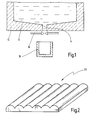
- a feeder 10 is shown schematically, in which a molten glass 12 is located.
- Glass melt can emerge from the feeder 10 via a bottom-side outlet opening 14 into a mold 18 arranged underneath for the production of gobs.
- a suitable portioning by using a pair of glass shears 16.
- a Gob so there is, for example, a cylindrical Gob with a fire polished surface (face), in which, however, always gives an impression of the glass shears used.
- Such gobs are required, for example, for the production of optically high-quality pressed glass products for optical applications, as is indicated by way of example in FIG. 2 with the number 20.
- This pressed glass product 20 is, for example, a cylindrical lens array as shown in FIG US 2004/0079114 A1 known.
- a mold is used, with a lower mold half 22 and an upper mold half 24.
- Gob a Gob 28 is used for this purpose, since this is convex on its underside, which is followed at the top by a cylindrical shape, which at its top 30th is ground.
- the convex shape of the Bottom is used to minimize the contact time of the glass with the mold.
- a ground surface on the side of the blank pressing is necessary in the prior art to ensure a sufficiently high surface quality on the side of the blank press.
- the gob 28 is heated between the two mold halves 22, 24 to a sufficiently high temperature above the transformation temperature and pressed by moving the two mold halves 22, 24 to each other, as shown by the arrow 26 to the final shape, as for example. is shown in Fig. 2.
- the method according to the invention which is shown schematically in FIG. 4, results in a considerable simplification and a considerable cost saving compared with the conventional method, whereby at the same time a consistently high surface quality on the blank-pressed side (upper side of the pressed glass product 20 according to FIG. 2). is guaranteed.
- a Gob 32 is used, which has a cylindrical shape and is placed on its lateral surface 34 lying in the mold 22, 24.
- the gob 32 has a narrow flattening 36 in the region of its lateral surface 34. In this way, rolling away after placement in the mold is avoided.
- the gob 32 is fabricated by filling from a feeder 10 into a mold 18 using glass shears 16, as shown schematically in FIG.
- the mold 18 used consists of an oxidation-resistant, compared to a molten glass largely resistant material, preferably titanium, or not one oxide ceramic, preferably of a carbide ceramic, such as silicon carbide ceramic, a Borkarbidkeramik or tungsten carbide ceramic.
- a titanium or silicon carbide production because of its resistance to molten glass, ensures easy release from the mold without any sticking.
- both titanium and silicon carbide can be produced and processed in a cost effective manner.
- a grinding treatment of the gobs used to produce the pressed glass products is not required according to the invention.
Landscapes
- Chemical & Material Sciences (AREA)
- Engineering & Computer Science (AREA)
- Materials Engineering (AREA)
- Organic Chemistry (AREA)
- Manufacturing & Machinery (AREA)
- Re-Forming, After-Treatment, Cutting And Transporting Of Glass Products (AREA)
- Surface Treatment Of Glass (AREA)
- Grinding And Polishing Of Tertiary Curved Surfaces And Surfaces With Complex Shapes (AREA)
Applications Claiming Priority (1)
| Application Number | Priority Date | Filing Date | Title |
|---|---|---|---|
| DE102005041033A DE102005041033B4 (de) | 2005-08-26 | 2005-08-26 | Verfahren zur Herstellung eines Pressglasproduktes |
Publications (2)
| Publication Number | Publication Date |
|---|---|
| EP1757563A2 true EP1757563A2 (fr) | 2007-02-28 |
| EP1757563A3 EP1757563A3 (fr) | 2008-07-02 |
Family
ID=37546667
Family Applications (1)
| Application Number | Title | Priority Date | Filing Date |
|---|---|---|---|
| EP06017323A Withdrawn EP1757563A3 (fr) | 2005-08-26 | 2006-08-19 | Procédé de fabrication d'une paraison de verre |
Country Status (4)
| Country | Link |
|---|---|
| US (1) | US20070044515A1 (fr) |
| EP (1) | EP1757563A3 (fr) |
| JP (1) | JP4362500B2 (fr) |
| DE (1) | DE102005041033B4 (fr) |
Families Citing this family (6)
| Publication number | Priority date | Publication date | Assignee | Title |
|---|---|---|---|---|
| MY169095A (en) * | 2009-12-29 | 2019-02-18 | Hoya Corp | Manufacturing method of glass substrate for magnetic disk and sheet glass material for magnetic disk |
| US8806895B2 (en) * | 2010-12-09 | 2014-08-19 | Hoya Corporation | Manufacturing method for a glass substrate for magnetic disk |
| JP2012160252A (ja) | 2011-01-31 | 2012-08-23 | Hoya Corp | 磁気ディスク用ガラス基板の製造方法 |
| US8931308B2 (en) * | 2011-02-10 | 2015-01-13 | Hoya Corporation | Method of producing glass blank for substrate of information recording medium, substrate for information recording medium, and information recording medium; and manufacturing apparatus for glass blank for substrate of information recording medium |
| WO2017033113A1 (fr) | 2015-08-21 | 2017-03-02 | Acerta Pharma B.V. | Associations thérapeutiques d'un inhibiteur de mek et d'un inhibiteur de btk |
| DE102019207119A1 (de) * | 2019-05-16 | 2020-11-19 | Realization Desal Ag | Verfahren zum Herstellen eines Uhrglases mit mindestens einer Ausnehmung und Werkzeug für ein derartiges Verfahren |
Citations (1)
| Publication number | Priority date | Publication date | Assignee | Title |
|---|---|---|---|---|
| JPS6452619A (en) | 1988-05-12 | 1989-02-28 | Ohara Kk | Method for molding molded product of optical glass |
Family Cites Families (18)
| Publication number | Priority date | Publication date | Assignee | Title |
|---|---|---|---|---|
| US3205043A (en) * | 1962-04-04 | 1965-09-07 | Carborundum Co | Cold molded dense silicon carbide articles and method of making the same |
| US3351449A (en) * | 1964-06-15 | 1967-11-07 | Corning Glass Works | Forced stream feeding through orifice |
| US3961927A (en) * | 1973-03-05 | 1976-06-08 | Pilkington Brothers Limited | Apparatus and method for moulding glass objects |
| JPS5562815A (en) * | 1978-11-06 | 1980-05-12 | Ohara Inc | Press molding method for thick optical glass molding |
| JP2577055B2 (ja) * | 1988-07-13 | 1997-01-29 | ホーヤ株式会社 | ガラス成形型 |
| DE4404130A1 (de) * | 1994-02-09 | 1995-08-10 | Siemens Ag | Elektrochemische Bestimmung der Sauerstoffkonzentration |
| DE4413989C2 (de) * | 1994-04-21 | 1997-10-02 | Fraunhofer Ges Forschung | Verfahren zur Herstellung von Microstablinsen für Lasereinrichtungen und Umformvorrichtung hierfür |
| US5873921A (en) * | 1994-09-09 | 1999-02-23 | Hoya Precisions Inc. | Process for manufacturing glass optical elements |
| US5738701A (en) * | 1995-04-05 | 1998-04-14 | Minolta Co., Ltd. | Glass gob production device and production method |
| EP1283817B1 (fr) * | 2000-04-27 | 2005-08-03 | Schott Ag | Procede de realisation de fins articles en verre, et mise en oeuvre dudit procede |
| JP4495842B2 (ja) * | 2000-09-01 | 2010-07-07 | Hoya株式会社 | ガラス成形品の製造方法及び製造装置、並びにガラス製品の製造方法 |
| DE10139040B4 (de) * | 2000-12-16 | 2004-11-25 | Schott Glas | Verfahren und Vorrichtung zum Erzeugen flüssiger Glasposten |
| US6799437B2 (en) * | 2001-05-23 | 2004-10-05 | Schott Glas | Method for the hot shaping of molten gobs |
| JP3912774B2 (ja) * | 2002-03-18 | 2007-05-09 | Hoya株式会社 | 精密プレス成形用光学ガラス、精密プレス成形用プリフォームおよびその製造方法 |
| US7143609B2 (en) * | 2002-10-29 | 2006-12-05 | Corning Incorporated | Low-temperature fabrication of glass optical components |
| EP1468974A3 (fr) * | 2003-04-17 | 2004-12-01 | Hoya Corporation | Verre optique, préforme à moulage et méthode de sa production et élément optique et méthode de sa production |
| DE10348947B4 (de) * | 2003-10-18 | 2008-08-28 | Schott Ag | Presse und Verfahren zum Heißformen optischer Elemente aus Glas |
| JP2005208330A (ja) * | 2004-01-22 | 2005-08-04 | Nippon Sheet Glass Co Ltd | ホルダ付き成形光学部品およびその製造方法 |
-
2005
- 2005-08-26 DE DE102005041033A patent/DE102005041033B4/de not_active Expired - Fee Related
-
2006
- 2006-08-19 EP EP06017323A patent/EP1757563A3/fr not_active Withdrawn
- 2006-08-21 JP JP2006224185A patent/JP4362500B2/ja not_active Expired - Fee Related
- 2006-08-22 US US11/507,822 patent/US20070044515A1/en not_active Abandoned
Patent Citations (1)
| Publication number | Priority date | Publication date | Assignee | Title |
|---|---|---|---|---|
| JPS6452619A (en) | 1988-05-12 | 1989-02-28 | Ohara Kk | Method for molding molded product of optical glass |
Also Published As
| Publication number | Publication date |
|---|---|
| EP1757563A3 (fr) | 2008-07-02 |
| US20070044515A1 (en) | 2007-03-01 |
| JP2007063119A (ja) | 2007-03-15 |
| JP4362500B2 (ja) | 2009-11-11 |
| DE102005041033A1 (de) | 2007-03-01 |
| DE102005041033B4 (de) | 2010-10-28 |
Similar Documents
| Publication | Publication Date | Title |
|---|---|---|
| DE112013006145B4 (de) | Verfahren zur Herstellung eines Glasformkörpers und Formwerkzeug | |
| DE112012005570B4 (de) | Formvorrichtung und Formverfahren für Glasgehäuse | |
| DE102009030852B3 (de) | Verfahren und Vorrichtung zum Ziehen eines Quarzglaszylinders aus einem Schmelztiegel | |
| DE2725704A1 (de) | Herstellung von korundhaeltigen schleifkoernern, beispielsweise aus zirkonkorund | |
| DE2410923B2 (de) | Verfahren zur Herstellung eines Vorformlings und Form zur Durchführung des Verfahrens | |
| EP3560896A1 (fr) | Procédé et dispositif de fabrication de produits à corps creux de verre ainsi que produits à corps creux de verre et leur utilisation | |
| DE69628876T2 (de) | Vorrichtung und Verfahren zum Formen von geschmolzenem glasartigen Material in Stäben | |
| EP1757563A2 (fr) | Procédé de fabrication d'une paraison de verre | |
| EP2421802B1 (fr) | Procédé et dispositifs pour fabriquer des éléments en verre optiques, notamment des éléments optiques de concentrateur | |
| DE102005060907B4 (de) | Verfahren zur Herstellung einer Glasscheibe mit definierten Ausbuchtungen und Werkzeugform zur Verwendung in einem solchen Verfahren | |
| DE102004034797B4 (de) | Verfahren zur Herstellung feuerpolierter Gobs | |
| DE2553325A1 (de) | Linsen mit mehrfach-brennweite und verfahren zum herstellen derselben | |
| DE102010047476B4 (de) | Verfahren zur konturgetreuen Herstellung von Wellenlängenkonvertern für eine auf Halbleiterlichtquellen basierende weiße oder farbige Lichtquelle | |
| DE69228202T2 (de) | Verfahren zur Herstellung von Glasrohlingen | |
| EP1284243A2 (fr) | Corps de verre moulé par pressage et méthode pour sa fabrication | |
| DE60035808T2 (de) | Verfahren zum umformen des ziehendes einer vorform für optische fasern | |
| DE763883C (de) | Verfahren und Vorrichtung zur Herstellung von Leichtmetallkolben | |
| EP2650255B1 (fr) | Procédé de fabrication d'une microbuse | |
| DE2802734C2 (de) | Vorrichtung zur Wärmebehandlung abgeteilter Glasposten | |
| DE10337388B4 (de) | Vertikal-Tiegelziehverfahren zur Herstellung eines zylinderförmigen Quarzglaskörpers und Vorrichtung zur Durchführung des Verfahrens | |
| DE10305059A1 (de) | Verfahren zur Herstellung von Glasformteilen und hierzu verwendetes Formgebungswerkzeug | |
| DE890233C (de) | Verfahren zur Herstellung eines Pressglasteiles, insbesondere eines Pressglasfusses,fuer elektrische Entladungsgefaesse | |
| DE1596367C (de) | Schleudergießform fur Tnchterteile rechteckiger Fernsehbildrohrenkolben | |
| DE1139943B (de) | Verfahren zur Herstellung von Bifokallinsen | |
| DE2435019C3 (de) | Verfahren und Vorrichtung zur Her-' stellung einer Spinndüse, vorzugsweise zum Ausziehen von Glas zu Fäden und danach hergestellte Spinndüse |
Legal Events
| Date | Code | Title | Description |
|---|---|---|---|
| PUAI | Public reference made under article 153(3) epc to a published international application that has entered the european phase |
Free format text: ORIGINAL CODE: 0009012 |
|
| AK | Designated contracting states |
Kind code of ref document: A2 Designated state(s): AT BE BG CH CY CZ DE DK EE ES FI FR GB GR HU IE IS IT LI LT LU LV MC NL PL PT RO SE SI SK TR |
|
| AX | Request for extension of the european patent |
Extension state: AL BA HR MK YU |
|
| PUAL | Search report despatched |
Free format text: ORIGINAL CODE: 0009013 |
|
| AK | Designated contracting states |
Kind code of ref document: A3 Designated state(s): AT BE BG CH CY CZ DE DK EE ES FI FR GB GR HU IE IS IT LI LT LU LV MC NL PL PT RO SE SI SK TR |
|
| AX | Request for extension of the european patent |
Extension state: AL BA HR MK RS |
|
| 17P | Request for examination filed |
Effective date: 20080918 |
|
| AKX | Designation fees paid |
Designated state(s): AT BE BG CH CY CZ DE DK EE ES FI FR GB GR HU IE IS IT LI LT LU LV MC NL PL PT RO SE SI SK TR |
|
| 17Q | First examination report despatched |
Effective date: 20090226 |
|
| RAP1 | Party data changed (applicant data changed or rights of an application transferred) |
Owner name: BARBERINI GMBH |
|
| STAA | Information on the status of an ep patent application or granted ep patent |
Free format text: STATUS: THE APPLICATION IS DEEMED TO BE WITHDRAWN |
|
| 18D | Application deemed to be withdrawn |
Effective date: 20130301 |