EP1758331A1 - Methode und Vorrichtung für Streaming von drahtlosen digitalen Inhalt - Google Patents
Methode und Vorrichtung für Streaming von drahtlosen digitalen Inhalt Download PDFInfo
- Publication number
- EP1758331A1 EP1758331A1 EP05018215A EP05018215A EP1758331A1 EP 1758331 A1 EP1758331 A1 EP 1758331A1 EP 05018215 A EP05018215 A EP 05018215A EP 05018215 A EP05018215 A EP 05018215A EP 1758331 A1 EP1758331 A1 EP 1758331A1
- Authority
- EP
- European Patent Office
- Prior art keywords
- digital content
- streaming
- wireless
- communication module
- wireless communication
- Prior art date
- Legal status (The legal status is an assumption and is not a legal conclusion. Google has not performed a legal analysis and makes no representation as to the accuracy of the status listed.)
- Withdrawn
Links
- 238000000034 method Methods 0.000 title claims description 39
- 238000004891 communication Methods 0.000 claims abstract description 54
- 230000006870 function Effects 0.000 claims description 3
- 230000007246 mechanism Effects 0.000 claims description 3
- 238000001514 detection method Methods 0.000 claims description 2
- 230000005236 sound signal Effects 0.000 claims description 2
- 230000003213 activating effect Effects 0.000 claims 2
- 230000008569 process Effects 0.000 description 14
- 238000005516 engineering process Methods 0.000 description 5
- 238000010586 diagram Methods 0.000 description 4
- 238000012545 processing Methods 0.000 description 3
- 238000012546 transfer Methods 0.000 description 2
- 238000007796 conventional method Methods 0.000 description 1
- 238000013500 data storage Methods 0.000 description 1
- 230000002452 interceptive effect Effects 0.000 description 1
- 239000004973 liquid crystal related substance Substances 0.000 description 1
- 238000012986 modification Methods 0.000 description 1
- 230000004048 modification Effects 0.000 description 1
- 230000003287 optical effect Effects 0.000 description 1
- 230000002093 peripheral effect Effects 0.000 description 1
- 238000004826 seaming Methods 0.000 description 1
- 230000003068 static effect Effects 0.000 description 1
Images


Classifications
-
- H—ELECTRICITY
- H04—ELECTRIC COMMUNICATION TECHNIQUE
- H04W—WIRELESS COMMUNICATION NETWORKS
- H04W28/00—Network traffic management; Network resource management
- H04W28/02—Traffic management, e.g. flow control or congestion control
- H04W28/10—Flow control between communication endpoints
- H04W28/14—Flow control between communication endpoints using intermediate storage
-
- H—ELECTRICITY
- H04—ELECTRIC COMMUNICATION TECHNIQUE
- H04L—TRANSMISSION OF DIGITAL INFORMATION, e.g. TELEGRAPHIC COMMUNICATION
- H04L65/00—Network arrangements, protocols or services for supporting real-time applications in data packet communication
- H04L65/60—Network streaming of media packets
- H04L65/61—Network streaming of media packets for supporting one-way streaming services, e.g. Internet radio
- H04L65/613—Network streaming of media packets for supporting one-way streaming services, e.g. Internet radio for the control of the source by the destination
-
- H—ELECTRICITY
- H04—ELECTRIC COMMUNICATION TECHNIQUE
- H04W—WIRELESS COMMUNICATION NETWORKS
- H04W52/00—Power management, e.g. Transmission Power Control [TPC] or power classes
- H04W52/02—Power saving arrangements
- H04W52/0209—Power saving arrangements in terminal devices
- H04W52/0225—Power saving arrangements in terminal devices using monitoring of external events, e.g. the presence of a signal
- H04W52/0229—Power saving arrangements in terminal devices using monitoring of external events, e.g. the presence of a signal where the received signal is a wanted signal
-
- H—ELECTRICITY
- H04—ELECTRIC COMMUNICATION TECHNIQUE
- H04W—WIRELESS COMMUNICATION NETWORKS
- H04W84/00—Network topologies
- H04W84/02—Hierarchically pre-organised networks, e.g. paging networks, cellular networks, WLAN [Wireless Local Area Network] or WLL [Wireless Local Loop]
- H04W84/10—Small scale networks; Flat hierarchical networks
- H04W84/12—WLAN [Wireless Local Area Networks]
-
- Y—GENERAL TAGGING OF NEW TECHNOLOGICAL DEVELOPMENTS; GENERAL TAGGING OF CROSS-SECTIONAL TECHNOLOGIES SPANNING OVER SEVERAL SECTIONS OF THE IPC; TECHNICAL SUBJECTS COVERED BY FORMER USPC CROSS-REFERENCE ART COLLECTIONS [XRACs] AND DIGESTS
- Y02—TECHNOLOGIES OR APPLICATIONS FOR MITIGATION OR ADAPTATION AGAINST CLIMATE CHANGE
- Y02D—CLIMATE CHANGE MITIGATION TECHNOLOGIES IN INFORMATION AND COMMUNICATION TECHNOLOGIES [ICT], I.E. INFORMATION AND COMMUNICATION TECHNOLOGIES AIMING AT THE REDUCTION OF THEIR OWN ENERGY USE
- Y02D30/00—Reducing energy consumption in communication networks
- Y02D30/70—Reducing energy consumption in communication networks in wireless communication networks
Definitions
- the present invention relates to a method and a device for streaming wireless digital content, and in particular to a method and a device for streaming digital content through wireless local area network (WLAN).
- WLAN wireless local area network
- Portable multimedia devices such as portable MP3 players utilize the integrated flash memory or hard disks thereof to store multimedia files so that users can access the multimedia files anytime.
- QoS Quality of Service
- US Patent No. 6,665,772 discloses a method for storing streaming and non-streaming data.
- the method of the '772 patent organizes addressable locations of a data storage in a logical sequence to store non-streaming data by accessing the logical sequence of addressable locations.
- US Patent No. 6,263,371 entitled “Method and Apparatus for Seaming of Streaming Content” uses packet sequence numbers or time stamps to identify characteristics of packet received from different content sources. Besides, a proxy is disposed in the streaming download device to detect data loss for merging together information from other content sources so that information "gaps" are as few as possible.
- the conventional portable multimedia device With an understanding of processing of network packets, streaming download technology and wireless telecommunication systems, the conventional portable multimedia device has everything to do with storage space requirements and multimedia file contents. Electric power supplied to the conventional portable multimedia device is crucial. For example, a wireless communication module consumes most electric power supplied to the conventional portable multimedia device when the multimedia file is downloaded via the wireless telecommunication. In addition, driving hard disks also consume a great deal of electric power.
- the present invention utilizes a small amount of a storage memory to download digital content by streaming through the Internet so that a real-time playback of multimedia data is produced.
- the downloaded digital content may be stored in an external storage device, or the downloaded digital content may be discarded without saving after the downloaded digital content is played back.
- the real-time playback of multimedia content remains unchanged.
- the present invention detects a memory space of storage device and determines whether to turn on a wireless communication module so that the electric power and the cost of the storage device are conserved.
- a device for streaming wireless digital content includes a processor, an output unit, a wireless communication module, a storage unit and an input unit.
- the processor includes an arbitration circuit module used to manage streaming, storage and output of digital content packets.
- An output unit is electrically connected to the processor and includes a video signal output and an audio signal output.
- the wireless communication module is electrically connected to the processor and connects to a wireless local area network (WLAN) to stream digital content packets.
- WLAN wireless local area network
- the storage unit is electrically connected to the processor and includes a register to save the downloaded digital content packets.
- the input unit is electrically connected to the processor and inputs operation instruction.
- the storage unit includes a register with a small capacity.
- the downloaded digital content packets are stored in the register and consumed by real-time playback.
- the present invention utilizes the processor to detect how much digital content is stored in the storage unit, and thereby determine whether the wireless communication module is activated or deactivated. Thus, the device of the present invention consumes much less electric power.
- a method for streaming wireless digital content utilizes a device for streaming wireless digital content to download digital contents from one or more servers of multimedia content providers. After the device is turned on, the device detects the status of a connection network and quantity of digital content. Then, the wireless network connection is activated to stream wireless data and store the downloaded data in a register. The downloaded data is retrieved by a FIFO (First-In, First-Out) method and decoded to output the decoded data to the output unit in real time. It is determined whether to continue to stream wireless data during the streaming period. That is, whether the network connection is activated or deactivated depends on how much digital content is stored in the register.
- FIFO First-In, First-Out
- the network connection When the digital content stored in the register is equal to or larger than a preset threshold value, the network connection is deactivated and the downloading process stops. When the digital content is lower than the preset threshold value, the network connection is activated and the downloading process begins. Thus, the device for streaming digital content consumes less electrical power.
- the present invention provides a method and a device for streaming wireless digital content.
- the present invention can save memory space and playback real-time streaming multimedia files. Even, the present invention can protect copyrights of the multimedia files.
- FIG. 1 schematically illustrates the relationship between a device for downloading wireless multimedia content of the present invention and the Internet.
- servers 12a, 12b and 12c are connected to the Internet 10 and are not limited to these servers to provide digital content.
- a plurality of servers 12a, 12b and 12c connected to the Internet 10.
- Consumers can download digital content by their portable multimedia devices 100 and 100'.
- Digital content such as music files in MP3 format is stored in databases 14a, 14b and 14c of the corresponding servers.
- Music files can be compressed by another compressed format such as OGG, WMA, WAV or AAC.
- digital content also includes MPEG video files, e-book, photograph, e-news and video games.
- the portable multimedia device 100 and 100' can access the Internet 10 via wireless or physical connection technology, as shown in FIG. 2.
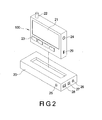
- FIG. 2 illustrates the portable multimedia device 100 and a cradle 20 of the present invention. Functionality of the cradle 20 can be extended and the cradle 20 is connected to the electrical power.
- the portable multimedia device 100 includes a display 21, an antenna 22, an input interface 23, an output interface 24 and a communication port 29.
- the display 21 is used to playback video, view photos or show an interactive menu.
- the antenna 22 is used to access wireless LAN, and for the sake of aesthetics, the antenna 22 can be an embedded-type component.
- the input interface 23 consists of, for example, a plurality of buttons, touch buttons or voice recognition module.
- the communication port 29 is positioned in the portable multimedia device 100, and the communication port 29 can be an USB port for connecting computers to update data.
- the portable multimedia device 100 is charged through the USB port.
- the communication port 29 with a suitable adapter can access the Internet via a physical network.
- the first output interface 24 is used to connect earphones or external stereo speakers.
- the portable multimedia device 100 is connected to the cradle 20 by a connection adapter, and the cradle 20 includes a second audio output interface 26 to playback audio files by earphones or external stereo speakers.
- the cradle 20 also includes an Ethernet jack 27 such as a RJ45 jack.
- the cradle 20 can connect to the Internet through the Ethernet jack 27 even if there is no wireless access point.
- a power connector port 28 is used to provide AC or DC electric power with the portable multimedia device 100.
- the cradle 20 also includes a control interface 25 to provide a function of remote control through a remote controller (not shown) by communication protocols such as radio wave, Infrared Data (IrDA) or Bluetooth standards.
- IrDA Infrared Data
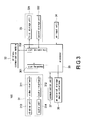
- FIG. 3 is a block diagram illustrating every component of the portable multimedia device 100 of the present invention.
- the portable multimedia device 100 includes a processor 30, an output unit 31, a wireless communication module 32, a storage unit 33, an input unit 34 and an external storage device interface 36.
- the processor 30 is used to receive and output signals, and manage streaming and the address memory.
- the output unit 31 is electrically connected to the processor 30.
- the wireless communication module 32 and the storage unit 33 are electrically connected to the processor 30.
- the input unit 34 is electrically connected to the processor 30 to input operation instructions.
- the external storage device interface 36 is electrically connected to the processor 30, and the external storage device interface 36 can be an external storage medium (e.g.
- the portable multimedia device 100 can play back the digital content.
- consumers can store the downloaded digital content to the external storage medium through the external storage device interface.
- consumers may be authorized to store the downloaded digital content to the external storage medium through the external storage device interface.
- the portable multimedia device 100 also includes a communication unit 37 such as USB or IEEE 1394 communication interfaces to connect to other computers (not shown).
- the portable multimedia device 100 can transfer digital content with other computers and be recharged by the communication unit 37. Even if there are no wireless access points and suitable interface adapters, the portable multimedia device 100 has no difficulty in accessing the Internet.
- the processor 30 includes an arbitration circuit module (not shown) to manage streaming, storage, and output of digital content packets. Thus, it ensures seamless data content playback.
- the processor 30 also includes a control unit 302 and a decoding unit 301, and the control unit 302 and the decoding unit 301 are electrically connected to the storage unit 33 and the output unit 31, respectively.
- the wireless communication module 32 is activated.
- the digital content is downloaded through the digital content servers connected to the Internet.
- the digital content is temporarily stored in a register of the storage unit 33 and decoded by the decoding unit 301. Then, the decoded digital content is output to the output unit 31.
- the storage unit 33 includes a first storage unit 331 to provide a small space of memory.
- the storage unit 331 can be a flash memory or a dynamic random access memory (DRAM).
- the downloaded digital content files are temporarily stored in the first storage unit 331 and consumed because of real-time playback. It is possible to stream wireless data and do seamless playback with minimum space of memory.
- the processor 30 also has a capability of addressing memory of the storage unit 33 and is used to divide the memory into different segments and provide them with different indices.
- the processor 30 also defines an upper limit and a lower limit of the data content and their corresponding addresses.
- the control unit 302 includes a memory data content detection mechanism (not shown) to detect the quantity of digital content by firmware or hardware.
- the control unit 302 can detect how much digital content is stored in the first storage unit 301.
- the control unit 302 deactivates the wireless communication module 32.
- the wireless communication module 32 is in power saving mode or sleeping mode so that streaming digital content stops
- the control unit 302 activates the wireless communication module 32. Then, the wireless communication module returns to normal condition so that streaming of digital content begins and power consumption is increased to normal value.
- the present invention utilizes the processor to detect how much digital content is stored in the register, and determine whether the wireless communication module is to be activated or deactivated.
- the wireless communication module 32 using the method according to the present invention, consumes much less electric power than when using conventional methods.
- a second storage unit 332 of the storage unit 33 can be a Read-Only Memory (ROM) or a static random access memory (SDRAM) to install an embedded operating system and peripheral drivers of the present invention.
- ROM Read-Only Memory
- SDRAM static random access memory
- the compressed multimedia files are decoded by the decoding unit 301 of the processor 30.
- the video portion of the multimedia files is output to a display unit 313 by a video interface 311 of the output unit 31, e.g. a liquid crystal display of the portable multimedia device 100.
- the audio portion of the multimedia files is output to an audio unit 314 for connecting earphones.
- the external storage device interface 36 is used to connect the external storage medium with the portable multimedia device 100 so that digital content stored in the external storage medium is played back.
- the digital content stored in the external storage medium is decoded by the decoding unit 301 of the processor 30 and output to the output unit 31.
- FIG. 4 is a block diagram illustrating the portable multimedia device 100 and the cradle 20 of the present invention.
- the portable multimedia device 100 is connected to the cradle 20 by an extension interface 41.
- the extension interface 41 is positioned at the cradle 20.
- An electric unit 42 is used to charge the portable multimedia device 100 and can be a rechargeable battery or an external (AC/DC) electric power.
- the cradle 20 includes a control interface 44 with a remote control function, and the control interface 44 can be an infrared remote control interface, a Bluetooth communication remote control interface or a radio wave remote control interface.
- a network interface 45 for connecting physical network is provided.
- a communication interface 43 e.g. USB or IEEE1394
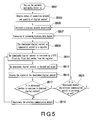
- FIG. 5 is a flowchart illustrating a method for downloading wireless streaming digital content of the present invention.
- the digital content is downloaded from one or more servers of digital content providers. The processing of the flowchart is described in detail below.
- Step S501 In step S501, the portable multimedia device 100 is turned on. Then, the process continues to step S503.
- Step S503 In step S503, the device detects status of connection network and quantity of digital content. Then, the process continues to step S505.
- Step S505 In step S505, a wireless network connection is activated. Then, the process continues to step S507.
- Step S507 In step S507, processing of streaming wireless data begins. Then, the process continues to step S509.
- Step S509 In step S509, the downloaded digital content is stored in a register such as a flash memory or a Random Access Memory (RAM). Then, the process continues to step S511.
- a register such as a flash memory or a Random Access Memory (RAM).
- Step S511 In step S511, the downloaded digital content is retrieved by a FIFO (First-In, First-Out) method from the register. Then, the process continues to step S513.
- FIFO First-In, First-Out
- Step S513 In step S513, the downloaded digital content is decoded and output to the output unit 31 in real-time. Then, the process continues to step S515.
- Step S515 In step S515, the processor detects the status of the downloaded digital content. Then, the process continues to step S517.
- Step S517 In step S517, whether digital content downloading is to continue is determined. That is, whether the network connection is activated or deactivated depends on how much data content is stored in the register. If the data content saved in the register is equal to or larger than a preset threshold value, the network connection is deactivated and downloading stops. Then, the process continues to step S519. Otherwise, if the data is lower than the preset threshold value, the process continues to step S521.
- Step S519 In step S519, the wireless communication module is deactivated.
- Step S521 In step S521, whether or not the wireless communication module is activated is determined. If the wireless communication module is activated, the process returns to step S507. Otherwise, if the wireless communication module is deactivated, the process returns to step S505.
Landscapes
- Engineering & Computer Science (AREA)
- Multimedia (AREA)
- Computer Networks & Wireless Communication (AREA)
- Signal Processing (AREA)
- Two-Way Televisions, Distribution Of Moving Picture Or The Like (AREA)
Priority Applications (1)
| Application Number | Priority Date | Filing Date | Title |
|---|---|---|---|
| EP05018215A EP1758331A1 (de) | 2005-08-22 | 2005-08-22 | Methode und Vorrichtung für Streaming von drahtlosen digitalen Inhalt |
Applications Claiming Priority (1)
| Application Number | Priority Date | Filing Date | Title |
|---|---|---|---|
| EP05018215A EP1758331A1 (de) | 2005-08-22 | 2005-08-22 | Methode und Vorrichtung für Streaming von drahtlosen digitalen Inhalt |
Publications (1)
| Publication Number | Publication Date |
|---|---|
| EP1758331A1 true EP1758331A1 (de) | 2007-02-28 |
Family
ID=35520007
Family Applications (1)
| Application Number | Title | Priority Date | Filing Date |
|---|---|---|---|
| EP05018215A Withdrawn EP1758331A1 (de) | 2005-08-22 | 2005-08-22 | Methode und Vorrichtung für Streaming von drahtlosen digitalen Inhalt |
Country Status (1)
| Country | Link |
|---|---|
| EP (1) | EP1758331A1 (de) |
Citations (1)
| Publication number | Priority date | Publication date | Assignee | Title |
|---|---|---|---|---|
| EP1526659A1 (de) * | 2002-07-31 | 2005-04-27 | Sharp Kabushiki Kaisha | Datenkommunikationsgerät, sein stossweises kommunikationsverfahren, sein verfahren beschreibendes programm und aufzeichnungsmedium auf dem das programm aufgezeichnet ist |
-
2005
- 2005-08-22 EP EP05018215A patent/EP1758331A1/de not_active Withdrawn
Patent Citations (1)
| Publication number | Priority date | Publication date | Assignee | Title |
|---|---|---|---|---|
| EP1526659A1 (de) * | 2002-07-31 | 2005-04-27 | Sharp Kabushiki Kaisha | Datenkommunikationsgerät, sein stossweises kommunikationsverfahren, sein verfahren beschreibendes programm und aufzeichnungsmedium auf dem das programm aufgezeichnet ist |
Non-Patent Citations (3)
| Title |
|---|
| ANASTASI G. ET AL.: "A power-aware multimedia streaming protocol for mobile users", PERVASIVE SERVICES, 2005. ICPS '05. PROCEEDINGS. INTERNATIONAL CONFERENCE ON SANTORINI, GREECE JULY 11-14, 2005, PISCATAWAY, NJ, USA,IEEE, 11 July 2005 (2005-07-11), pages 371 - 381, XP010834911, ISBN: 0-7803-9032-6 * |
| BERTOZZI D. ET AL.: "Power aware network interface management for streaming multimedia", WIRELESS COMMUNICATIONS AND NETWORKING CONFERENCE, 2002. WCNC2002. 2002 IEEE, PISCATAWAY, NJ, USA,IEEE, vol. 2, 17 March 2002 (2002-03-17), pages 926 - 930, XP010585720, ISBN: 0-7803-7376-6 * |
| HAO ZHU ET AL.: "A power-aware and QoS-aware service model on wireless networks", INFOCOM 2004. TWENTY-THIRD ANNUALJOINT CONFERENCE OF THE IEEE COMPUTER AND COMMUNICATIONS SOCIETIES HONG KONG, PR CHINA 7-11 MARCH 2004, PISCATAWAY, NJ, USA,IEEE, vol. 2, 7 March 2004 (2004-03-07), pages 1393 - 1403, XP010742867, ISBN: 0-7803-8355-9 * |
Similar Documents
| Publication | Publication Date | Title |
|---|---|---|
| US8019887B2 (en) | Method, system, and program for managing a speed at which data is transmitted between network adaptors | |
| US7590773B2 (en) | Hot unpluggable media storage device | |
| US7813697B2 (en) | Power efficient high speed communication systems and methods | |
| US8429286B2 (en) | Methods and systems for rapid data acquisition over the internet | |
| US6987635B2 (en) | Magnetic disk drive which accesses host RAM | |
| US20070060135A1 (en) | Method and device for streaming wireless digital content | |
| JP5543369B2 (ja) | データ受信方法及び装置 | |
| US9374789B2 (en) | Maintaining network services across multiple physical interfaces | |
| US7221725B2 (en) | Host interface data receiver | |
| US20090319063A1 (en) | Splittable portable media player as remote control | |
| EP2604024B1 (de) | System und verfahren zur unterbrechung einer komponente einer auf ein stummschaltungskommando reagierenden mobilen kommunikationsvorrichtung | |
| CN101296258A (zh) | 具有网络功能的硬盘装置 | |
| US20060277216A1 (en) | Portable media storage device with wireless network connectivity | |
| US20090172433A1 (en) | Powering on devices via intermediate computing device | |
| EP1758331A1 (de) | Methode und Vorrichtung für Streaming von drahtlosen digitalen Inhalt | |
| KR101521780B1 (ko) | 에너지 보존을 갖는 연속적인 데이터 전달 | |
| US20130114653A1 (en) | Device for playback in a motor vehicle and method for synchronization | |
| CN107040840A (zh) | 一种耳机、音乐播放方法及其装置、电子设备 | |
| US20040267985A1 (en) | Information processor, method therefor, program therefor, recording medium storing the program and reproducing device | |
| US8301283B2 (en) | Method for outputting audio-visual media contents on a mobile electronic device, and mobile electronic device | |
| US20100053453A1 (en) | Digital media controller | |
| JP2009205548A (ja) | バックアップシステム | |
| WO2023193599A1 (zh) | 文件传输方法、装置及终端设备 | |
| JP2007019884A (ja) | ワイヤレスデジタルコンテンツの直流ダウンロード方法及びその装置 | |
| CN101911003B (zh) | 信息处理设备和程序 |
Legal Events
| Date | Code | Title | Description |
|---|---|---|---|
| PUAI | Public reference made under article 153(3) epc to a published international application that has entered the european phase |
Free format text: ORIGINAL CODE: 0009012 |
|
| 17P | Request for examination filed |
Effective date: 20050822 |
|
| AK | Designated contracting states |
Kind code of ref document: A1 Designated state(s): AT BE BG CH CY CZ DE DK EE ES FI FR GB GR HU IE IS IT LI LT LU LV MC NL PL PT RO SE SI SK TR |
|
| AX | Request for extension of the european patent |
Extension state: AL BA HR MK YU |
|
| AKX | Designation fees paid | ||
| STAA | Information on the status of an ep patent application or granted ep patent |
Free format text: STATUS: THE APPLICATION IS DEEMED TO BE WITHDRAWN |
|
| 18D | Application deemed to be withdrawn |
Effective date: 20070829 |
|
| REG | Reference to a national code |
Ref country code: DE Ref legal event code: 8566 |