EP1760118A2 - Ausrichtbare Effektpigmentplättchen und Verfahren für ihre Ausrichtung - Google Patents
Ausrichtbare Effektpigmentplättchen und Verfahren für ihre Ausrichtung Download PDFInfo
- Publication number
- EP1760118A2 EP1760118A2 EP06017222A EP06017222A EP1760118A2 EP 1760118 A2 EP1760118 A2 EP 1760118A2 EP 06017222 A EP06017222 A EP 06017222A EP 06017222 A EP06017222 A EP 06017222A EP 1760118 A2 EP1760118 A2 EP 1760118A2
- Authority
- EP
- European Patent Office
- Prior art keywords
- flakes
- pigment
- diffractive
- substrate
- magnetic
- Prior art date
- Legal status (The legal status is an assumption and is not a legal conclusion. Google has not performed a legal analysis and makes no representation as to the accuracy of the status listed.)
- Withdrawn
Links
Images













Classifications
-
- C—CHEMISTRY; METALLURGY
- C09—DYES; PAINTS; POLISHES; NATURAL RESINS; ADHESIVES; COMPOSITIONS NOT OTHERWISE PROVIDED FOR; APPLICATIONS OF MATERIALS NOT OTHERWISE PROVIDED FOR
- C09C—TREATMENT OF INORGANIC MATERIALS, OTHER THAN FIBROUS FILLERS, TO ENHANCE THEIR PIGMENTING OR FILLING PROPERTIES ; PREPARATION OF CARBON BLACK ; PREPARATION OF INORGANIC MATERIALS WHICH ARE NO SINGLE CHEMICAL COMPOUNDS AND WHICH ARE MAINLY USED AS PIGMENTS OR FILLERS
- C09C1/00—Treatment of specific inorganic materials other than fibrous fillers; Preparation of carbon black
- C09C1/0015—Pigments exhibiting interference colours, e.g. transparent platelets of appropriate thinness or flaky substrates, e.g. mica, bearing appropriate thin transparent coatings
-
- C—CHEMISTRY; METALLURGY
- C09—DYES; PAINTS; POLISHES; NATURAL RESINS; ADHESIVES; COMPOSITIONS NOT OTHERWISE PROVIDED FOR; APPLICATIONS OF MATERIALS NOT OTHERWISE PROVIDED FOR
- C09C—TREATMENT OF INORGANIC MATERIALS, OTHER THAN FIBROUS FILLERS, TO ENHANCE THEIR PIGMENTING OR FILLING PROPERTIES ; PREPARATION OF CARBON BLACK ; PREPARATION OF INORGANIC MATERIALS WHICH ARE NO SINGLE CHEMICAL COMPOUNDS AND WHICH ARE MAINLY USED AS PIGMENTS OR FILLERS
- C09C3/00—Treatment in general of inorganic materials, other than fibrous fillers, to enhance their pigmenting or filling properties
- C09C3/04—Physical treatment, e.g. grinding or treatment with ultrasonic vibrations
-
- C—CHEMISTRY; METALLURGY
- C09—DYES; PAINTS; POLISHES; NATURAL RESINS; ADHESIVES; COMPOSITIONS NOT OTHERWISE PROVIDED FOR; APPLICATIONS OF MATERIALS NOT OTHERWISE PROVIDED FOR
- C09D—COATING COMPOSITIONS, e.g. PAINTS, VARNISHES OR LACQUERS; FILLING PASTES; CHEMICAL PAINT OR INK REMOVERS; INKS; CORRECTING FLUIDS; WOODSTAINS; PASTES OR SOLIDS FOR COLOURING OR PRINTING; USE OF MATERIALS THEREFOR
- C09D11/00—Inks
- C09D11/02—Printing inks
- C09D11/03—Printing inks characterised by features other than the chemical nature of the binder
- C09D11/037—Printing inks characterised by features other than the chemical nature of the binder characterised by the pigment
-
- C—CHEMISTRY; METALLURGY
- C09—DYES; PAINTS; POLISHES; NATURAL RESINS; ADHESIVES; COMPOSITIONS NOT OTHERWISE PROVIDED FOR; APPLICATIONS OF MATERIALS NOT OTHERWISE PROVIDED FOR
- C09D—COATING COMPOSITIONS, e.g. PAINTS, VARNISHES OR LACQUERS; FILLING PASTES; CHEMICAL PAINT OR INK REMOVERS; INKS; CORRECTING FLUIDS; WOODSTAINS; PASTES OR SOLIDS FOR COLOURING OR PRINTING; USE OF MATERIALS THEREFOR
- C09D5/00—Coating compositions, e.g. paints, varnishes or lacquers, characterised by their physical nature or the effects produced; Filling pastes
- C09D5/36—Pearl essence, e.g. coatings containing platelet-like pigments for pearl lustre
-
- C—CHEMISTRY; METALLURGY
- C01—INORGANIC CHEMISTRY
- C01P—INDEXING SCHEME RELATING TO STRUCTURAL AND PHYSICAL ASPECTS OF SOLID INORGANIC COMPOUNDS
- C01P2006/00—Physical properties of inorganic compounds
- C01P2006/42—Magnetic properties
-
- C—CHEMISTRY; METALLURGY
- C09—DYES; PAINTS; POLISHES; NATURAL RESINS; ADHESIVES; COMPOSITIONS NOT OTHERWISE PROVIDED FOR; APPLICATIONS OF MATERIALS NOT OTHERWISE PROVIDED FOR
- C09C—TREATMENT OF INORGANIC MATERIALS, OTHER THAN FIBROUS FILLERS, TO ENHANCE THEIR PIGMENTING OR FILLING PROPERTIES ; PREPARATION OF CARBON BLACK ; PREPARATION OF INORGANIC MATERIALS WHICH ARE NO SINGLE CHEMICAL COMPOUNDS AND WHICH ARE MAINLY USED AS PIGMENTS OR FILLERS
- C09C2200/00—Compositional and structural details of pigments exhibiting interference colours
- C09C2200/10—Interference pigments characterized by the core material
- C09C2200/1054—Interference pigments characterized by the core material the core consisting of a metal
-
- C—CHEMISTRY; METALLURGY
- C09—DYES; PAINTS; POLISHES; NATURAL RESINS; ADHESIVES; COMPOSITIONS NOT OTHERWISE PROVIDED FOR; APPLICATIONS OF MATERIALS NOT OTHERWISE PROVIDED FOR
- C09C—TREATMENT OF INORGANIC MATERIALS, OTHER THAN FIBROUS FILLERS, TO ENHANCE THEIR PIGMENTING OR FILLING PROPERTIES ; PREPARATION OF CARBON BLACK ; PREPARATION OF INORGANIC MATERIALS WHICH ARE NO SINGLE CHEMICAL COMPOUNDS AND WHICH ARE MAINLY USED AS PIGMENTS OR FILLERS
- C09C2210/00—Special effects or uses of interference pigments
- C09C2210/30—A layer or the substrate forming a grating
-
- C—CHEMISTRY; METALLURGY
- C09—DYES; PAINTS; POLISHES; NATURAL RESINS; ADHESIVES; COMPOSITIONS NOT OTHERWISE PROVIDED FOR; APPLICATIONS OF MATERIALS NOT OTHERWISE PROVIDED FOR
- C09C—TREATMENT OF INORGANIC MATERIALS, OTHER THAN FIBROUS FILLERS, TO ENHANCE THEIR PIGMENTING OR FILLING PROPERTIES ; PREPARATION OF CARBON BLACK ; PREPARATION OF INORGANIC MATERIALS WHICH ARE NO SINGLE CHEMICAL COMPOUNDS AND WHICH ARE MAINLY USED AS PIGMENTS OR FILLERS
- C09C2210/00—Special effects or uses of interference pigments
- C09C2210/40—Embossed layers
-
- G—PHYSICS
- G03—PHOTOGRAPHY; CINEMATOGRAPHY; ANALOGOUS TECHNIQUES USING WAVES OTHER THAN OPTICAL WAVES; ELECTROGRAPHY; HOLOGRAPHY
- G03H—HOLOGRAPHIC PROCESSES OR APPARATUS
- G03H2270/00—Substrate bearing the hologram
- G03H2270/20—Shape
- G03H2270/24—Having particular size, e.g. microscopic
Definitions
- the present invention relates generally to pigments with an optically diffractive structure and diffractive optically variable image devices ("DOVID”), such as orientable diffractive pigment flakes and stereograms, kinegrams, graphic element-oriented devices, dot-oriented devices, and pixel-oriented devices, and oriented optically variable pigment flakes.
- DOE diffractive optically variable image devices
- Optically variable pigments are used in a wide variety of applications. They can be used in paint or ink, or mixed with plastic. Such paint or ink is used for decorative purposes or as an anti-counterfeiting measure on currency.
- OVP Optically variable pigments
- One type of OVP uses a number of thin-film layers on a substrate that form an optical interference structure. Generally, a dielectric (spacer) layer is often formed on a reflector, and then a layer of optically absorbing material is formed on the spacer layer. Additional layers may be added for additional effects, such as adding additional spacer-absorber layer pairs. Alternatively optical stacks composed of (high-low-high) n or (low-high-low) n dielectric materials, or combinations of both, may be prepared.
- Diffractive pigments have been used to create an iridescent effect, both on printed media and in paints, such as automotive paint.
- DOVIDs diffractive, optically-variable image devices
- Some DOVIDs provide various images depending on the angle at which they are viewed. For example, some types of DOVIDs can make one printed object appear in front of another, provide a succession of images based on viewing angle, or give the appearance of motion in a two-dimensional image as the angle of view is changed. Other DOVIDs might have an image that appears at one viewing angle, and disappears at another. DOVIDs have been used for anti-counterfeiting purposes on bank notes, credit cards, software media, and other high-value documents, as well as for decorative purposes. A particular type of DOVID is known as a "pixel-gram".
- a pixel-gram is based on a non-uniform spatial distribution of different linear diffraction areas (pixels). When rotated or tilted, different images can appear or disappear, making the pixel-grams difficult to counterfeit because even a high-quality color photocopier will not copy the variable effects of the image.
- holographic microstructures on a master hologram such as interferometry, holography, chemical etching, ion beam lithography, and electron beam lithography are relatively complex and expensive.
- a replication tool from the master is typically generated.
- the replication tool presses the surface relief microstructure in a polymeric foil, which is then aluminized on the back of the foil.
- the foil is then stamped on the document.
- a master hologram must be made for each new image, or if the master hologram wears out.
- Another object of the present invention is to provide simple articles and techniques for producing DOVIDs. Another object of the present invention is to be able to align pigment flakes in a desired orientation
- this object is achieved by a pigment particle as defined in claim 1, an image as defined in claim 9, a method of orienting pigment particles as defined in claims 12 and 22, an apparatus for orienting pigment particles as defined in claim 16 and a plurality of pigment particles as defined in claim 21.
- the dependent claims define preferred and advantageous embodiments of the invention.
- Pigment particles with diffraction gratings are selectively aligned to form an image or images.
- Different fields can be printed with different diffractive pigment, or with diffractive pigment that has been aligned in selected directions.
- images can be created with pixels or dots of different and/or differently aligned diffractive pigments.
- One embodiment of the present invention is a printed pixelgram, another is a dot DOVID, and another is a kinegram.
- an orientable pigment particle comprising: a material forming or having formed therein, a diffraction grating having a predetermined pattern of lines or ridges, wherein the material and diffraction grating pattern facilitates orientation of the pigment particle in a direction along the lines or ridges of the grating pattern in the presence of an applied electric field; preferably, the ridges, lines or grooves are parallel or substantially parallel and span the flake from one edge to an opposing edge; preferably the cross section through the flake is uniform from one edge, to an opposing edge in a direction along the lines or grooves.
- the entire surface of a flake has parallel lines running therein or therethrough.
- the material comprises a plurality of stripes forming the diffraction grating.
- the pigment particle can comprise a semi-transparent material; the diffraction grating may comprise a plurality of grooves having for example a spacing of between 100 lines per mm and 5000 lines per mm.
- a method of orienting pigment particles comprising the steps of: applying a plurality of pigment particles having diffraction gratings formed therein, or thereon to a substrate; and, exposing the pigment particles to an electric field about the substrate so that the particles orient in a direction along the lines or ridges of the grating parallel to the direction of the electric field.
- an apparatus for orienting pigment particles as having a diffractive grating thereon or therein comprises; a container for holding the diffractive pigment particles, suspended in a liquid; electrodes for providing an electric field for orienting the flakes so that the diffractive gratings on the flakes are oriented along field lines between the at least first and second electrodes; and, a drum for picking up and transferring the oriented flakes to a secondary drum or roller or directly to the substrate.
- a plurality of e-field orientable pigment particles is proivded wherein the particles are deposited on a substrate and aligned and oriented in an electric field such that at least some of the flakes form different angles with the substrate and wherein some of the flakes are out of plane.
- an image is produced wherein the image is a pixilated image of flakes having a diffraction grating therein or thereon the flakes, wherein the flakes within the pixilated image are oriented in a predetermined orientation along the diffraction grating by having been exposed to an electric field.
- the present invention provides magnetically orientable diffractive pigment flakes.
- magnetically orientable diffractive pigment flakes are used to print images, including DOVIDs.
- Diffractive pigment flakes are generally small particles used in paints, inks, films, plastics that provide variable perceived color, lightness, hue, and/or chroma, depending on the angle of view.
- Some diffractive pigments such as ones including Fabry-Perot-type interference structures, shift the observed color, as well as providing diffractive effects.
- Thin-film interference structures using dielectric layers can also be combined with a microstructure diffraction pattern.
- Some embodiments include a diffractive reflector layer in combination with a spacer layer and an absorber layer to form a flake having both diffraction and thin-film interference.
- Pigments with diffraction gratings separate light into spectral components, similar to a prism, so that the perceived color changes with viewing angle. It has been found that pigment flakes can be oriented with magnetic fields if the pigment flake includes a magnetic material.
- magnetic materials can be ferro- or ferri-magnetic.
- flakes with permanent magnet material are applied to a substrate to form a visual image, and subsequently magnetized to form a magnetic image, in addition to the visual image.
- Some magnetic flakes tend to clump together if the remnant magnetization is too high prior to forming the image or mixing with a paint or ink vehicle.
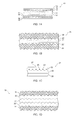
- Fig. 1A is a simplified cross section of a coated flake 10 according to an embodiment of the present invention.
- a series of thin film layers has been deposited on a substrate 12.
- the thin film layers include a layer of magnetic material 14, 14' , a layer of reflective material 16, 16' , and additional layers 18, 18'.
- the additional layers could be spacer layers of dielectric material 18, 18' having a thickness selected to provide a particular interference wavelength and an absorber layer 19, 19' , for example.
- the coated flake is shown as having a symmetrical coating on both sides of the substrate 12, the coatings could be unsymmetrical, even completely absent, on one side. Similarly, a flake could be encapsulated by successive coating layers.
- the substrate 12 is a magnetic material and the separate layer of magnetic material 14 is omitted.
- the substrate is both reflective and magnetic, and the reflective layer 16 is also omitted.
- the reflective layer is a magnetic material, and a separate layer of magnetic material is omitted.
- the absorber layer(s) can be a magnetic layer.
- Suitable substrates may be formed from materials such as glass, mica, alumina, iron oxide, graphite, bismuth oxychloride, boron nitride, polymer or metal or similar particle.
- suitable reflector material include aluminum, silver, iron, tantalum, iridium, rhenium, copper, silver, gold, platinum, palladium, nickel, cobalt, niobium, chromium, tin, and combinations or alloys.
- Suitable materials for the spacer layer includes zinc sulfide (ZnS), zinc oxide (ZnO), zirconium oxide (ZrO 2 ), titanium dioxide (TiO 2 ), diamond-like carbon, indium oxide (In 2 O 3 ), indium-tin-oxide ("ITO"), tantalum pentoxide (Ta2O5), ceric oxide (CeO 2 ), yttrium oxide (Y 2 O 3 ), europium oxide (Eu 2 O 3 ), iron oxides such as (II)diiron(III) oxide (Fe 3 O 4 ) and ferric oxide (Fe 2 O 3 ), hafnium nitride (HfN), hafnium carbide (HfC), hafnium oxide (HfO 2 ), lanthanum oxide (La 2 O 3 ), magnesium oxide (MgO), neodymium oxide (Nd 2 O 3 ), praseodymium oxide (Pr 6 O 11 ), samarium oxide (
- LiF lithium fluoride
- organic monomers and polymers including dienes or alkenes such as acrylates (e.g. , methacrylate), perfluoroalkenes, polytetrafluoroethylene ( e.g. , TEFLON®), fluorinated ethylene propylene (“FEP”), combinations thereof, and the like.
- Suitable absorber materials include chromium, nickel, iron, titanium, aluminum, tungsten, molybdenum, niobium, combinations, compounds or alloys thereof, such as INCONEL TM (Ni--Cr--Fe), metals mixed in a dielectric matrix, or other substances that are capable of acting as a uniform or selective absorber in the visible spectrum.
- the absorber can also be a dielectric material such as an iron oxide ( e.g., Fe 2 O 3 ), silicon monoxide (SiO), chromium oxide (Cr 2 O 3 ), carbon, titanium sub-oxide (TiO x ) where x is less than 2.0), metal carbides, metal carbo-nitrides, combinations thereof, and the like.
- Metal absorber layers are generally deposited in a layer that is sufficiently thin so as to allow substantial transmission of light through the absorber layer.
- the substrate is a glass flake
- the magnetic material is Ni-Co
- the reflective layer is aluminum.
- the additional layers 18 include a dielectric material, such as SiO 2 or TiO 2
- the absorber material is a semi-transparent layer of metal or intermetallic such as titanium nitride (TiN). These materials are merely exemplary of possible embodiments, and many other suitable materials and combinations are known.
- the reflector layer 16 and subsequent thin film layers 18 form a Fabry-Perot interference filter, which can provide a strong color shift, also called "color travel", as the viewing angle of the flake changes. If dispersed in a binder, such as clear paint, plastic, or other medium, the aggregate effect is that the color of the object varies with viewing angle, which can arise because of relative motion between the object and viewer, or because the object includes a curved surface. Other embodiments may omit the reflector layer, or may not have a Fabry-Perot interference structure, some having a silvery color.
- Fig. 1B is a simplified cross section of a diffractive flake 20 according to another embodiment of the present invention.
- Reflector layers 22, 22' have been patterned, e.g. embossed, with a periodic structure that is shown in cross-section as a sinusoidal variation in the surface of the substrate, and includes a magnetic layer 24.
- the reflector layer is an embossed reflective magnetic material and the separate magnetic layer 24 is omitted.
- the magnetic layer is shown as not being embossed, but could be embossed in other embodiments.
- the magnetic layer is discontinuous and formed along the structure of the diffraction grating.
- an embossed layer is provided on only one side of the flake.
- a substrate such as a polyethylene terephthalate (“PET”) flake or film
- PET polyethylene terephthalate
- the embossing layer might be a layer of polymer that is crosslinked before or after embossing the pattern, such as by rolling the substrate between rollers, at least one of which is patterned.
- an embossed roll of film is coated with a magnetic layer, either continuous or discontinuous, and then a reflective layer, such as a layer of aluminum.
- the magnetic layer is a reflective material, obviating the need for a separate reflector layer.
- the coated, embossed film is then processed into flakes, such as by laser-cutting.
- the magnetic layer may be omitted.
- Such flakes may be used to form DOVIDs with appropriate techniques of application of the flake to a substrate to align the diffraction grating in a desired direction.
- the embossed pattern is commonly known as a "diffraction grating".
- the line density is typically between about 500 lines/mm to about 5000 lines/mm, and are typically about 20 nm to about 300 nm deep.
- a line density of about 1400-2000 lines/mm with an aluminum reflector has been found to provide good color characteristics in paint draw-down samples.
- the lines (grooves) can be straight lines, triangular symmetrical gratings, triangular blazed gratings, square-wave gratings, or cross-hatched gratings, to name a few.
- the flakes are generally about 20-50 microns across, although the flakes may be significantly smaller or larger, and the total thickness of the flakes can be very thin.
- the total thickness of a flake is between about 500 nm to about 2 microns, but can be thinner or thicker.
- flakes having a stiffening layer(s) might be thicker.
- Stiffening layers are typically layers of dielectric material that are added to flake structures to improve handling characteristics.
- the diffraction grating pattern is shown as being replicated in the outer surfaces of the clear layers 26, 26' , but this is not necessary in other embodiments.
- the clear layers could be an inorganic material, such as SiO 2 , or a polymer.
- the clear layers add stiffness to the coating structures to assist in processing, such as grinding and sorting to size, and application of the pigment flakes to an object.
- the clear layers can also protect the reflective layer from environmental factors that could otherwise degrade the reflectivity.
- the clear layer(s) is omitted.
- pigment flakes with diffraction grating patterns are applied in a carrier that provides some degree of environmental protection.
- the material of the clear layers is chosen to have a refractive index similar to the refractive index of the intended carrier or binder.
- Fig. 1C is a simplified cross section of a portion of a diffractive flake 21 according to another embodiment of the invention.
- An embossed layer 23 is formed on a substrate, such as a PET flake or film 25.
- a discontinuous layer of magnetic material is deposited on the diffraction grating pattern 27 to form magnetic needles 29, 29' (protruding in the direction from the viewer into the paper).
- the needles can form on the tops, sides, or valleys (bottoms) of the grating pattern, depending on nature of the pattern and deposition parameters.
- a clear top layer 33 is formed over the magnetic needles and embossed layer, such as a layer of thermosetting or thermoplastic polymer that is fluidized at some point to flow and form the flat surface.
- the illustrated top layer is relatively flat, but could follow the pattern of the embossed layer.
- the top layer could be a layer of reflective material, or a layer of reflective material could be included between the embossed layer and the top layer, typically overlying the magnetic needles.
- the embossed layer is formed on a film substrate, laser-cutting or other techniques can be used to process the film into flakes. It is generally desirable that the flakes have a suitable aspect ratio of surface area to thickness to promote the flakes to align ( i.e . flatten out or "leaf") to the surface that they are applied to, such as in a paint vehicle or an ink vehicle.
- An example would be a flake nominally 100 microns X 100 microns or 50 X 50 microns and about 10-15 microns thick.
- Fig. 1D is a simplified cross section of a portion of a diffractive flake 30 according to another embodiment of the present invention.
- the diffraction grating pattern in the reflector layers 32, 32' is replicated from a deposition substrate.
- a polymer film can be embossed with a grating pattern.
- the first clear layer 34' is deposited on the embossed film (typically over a release layer, which is not shown as it is removed when the flake is separated from the deposition substrate), and then the first reflector layer 32'.
- a layer of magnetic material 31 is deposited, then another reflector layer 32, and another clear layer 34.
- the coated layers are then separated from the embossed deposition substrate and processed to form the desired diffractive flakes.
- the diffraction grating pattern can be embossed on a flake substrate, such as a magnetic flake substrate, and then the reflector layers and subsequent layers can be deposited on the flake substrate.
- a single reflector layer can be used with magnetic needles formed on one or more surfaces of one of the clear layers or reflector layer, and the magnetic layer omitted.
- Flakes according to embodiments illustrated in Figs. 1A-1D can be magnetically oriented within the plane of the flake if the flake is appropriately shaped.
- the flake which is relatively flat and has an aspect ratio of minimum transverse dimension to thickness of at least 2:1, and more typically greater than about 100:1, is longer in one surface dimension than another, then the flake will tend to align itself in a magnetic field to minimize the field energy.
- Fig. 2A is a simplified top view of a magnetic flake 40 according to an embodiment of the present invention.
- the magnetic flake is a pigment flake that includes a magnetic material.
- the magnetic material can be essentially uniform in the plane of the flake, e.g. a flat sheet or a layer patterned with the diffraction grating, or the magnetic material can be patterned, such as in "stripes", such as are discussed in conjunction with Figs. 3A and 3B, below.
- embodiments with stripes of magnetic material would not require the flakes to be in any specific shape to allow magnetic alignment of the flake, it may be desirable to pattern the flake to have a long axis generally parallel to the magnetic stripes.
- the flakes may be intentionally shaped, or may be shaped as an artifact of the flake or substrate manufacturing process, and may be sorted to improve the percentage of flakes with suitable shapes. While a high percentage of strongly magnetically orientable flakes is generally desirable, it is not necessary that all the flakes be magnetically orientable to achieve suitable effects.
- the magnetic flake 40 has a long side 42 and a short side 44. Flakes with suitable aspect ratios of length to thickness and in appropriate carriers tend to lie flat on surfaces that they are applied to. The aspect ratio between the length (long side) and width (short side) allow magnetic orientation within the plane of the flake. Carriers are typically liquid for a period to permit some motion of the flake before the carrier evaporates or hardens. Alternatively, the flake can be oriented prior to placement on a surface, and the carrier can dry or solidify essentially immediately. For example, ink might have a volatile carrier that evaporates to fix the flake, or a clear paint carrier, such as a clear paint base, might harden to fix the flake. Similarly, uncured thermosetting resin or heated thermoplastic resin might allow the flake to be oriented prior to curing or cooling, respectively, either before, during, or after application to a surface.
- a flake having magnetic material placed in a magnetic field twists the magnetic field lines.
- the most stable condition of the flake in the field is when the flake pole points in the direction of the field.
- the flake typically rotates until its position becomes oriented to reduce the energy of the system.
- the torque experienced by the flake depends upon many factors, such as the magnitude of the magnetic flux, the magnetic structure in the flake, and the size of the flake (lever arm).
- the shaped flakes 40 will tend to align themselves so that the longest dimension is essentially parallel to the lines of a magnetic field.
- the length of the long side relative to the short side is not limiting.
- the greater the aspect ratio of the surface of the flake the greater the tendency to align along the applied magnetic field. It is not necessary that all flakes align with the magnetic field to produce a suitable optical effect. Typically, some flakes are not perfectly aligned, either along the diffraction pattern, or within the plane of the substrate.
- Fig. 2B is a simplified top view of a magnetic flake 50 according to another embodiment of the present invention.
- the flake is in the shape of a rhombus, commonly called a "diamond".
- the flake has a long axis, on which the sharper points 52, 52' lie, and a short axis, along with the broader points 54, 54' lie.
- the flakes tend to align so that the long axis is essentially parallel to the magnetic field, as discussed above in reference to Fig. 2A.
- Shaped flakes can be produced according to a variety of techniques.
- One approach is to pattern the deposition substrate in a roll coater to have surface features, such as relatively deep grooves or high ridges, in the desired particle shape that facilitates removal of the thin film layers from the deposition substrate in the desired shape, or in subsequent milling, grinding, or cutting operations.
- the substrate such as a roll of PET film, can be laser-cut prior to separating the thin-film layers (flakes) from the substrate.
- the magnetic flake could include a Fabry-Perot-type interference structure and/or a diffractive grating on one or both major surfaces.
- the diffractive grating could be aligned so that the grooves align along the magnetic field, or the grooves could be at another angle with respect to the axis of orientation.
- Fig. 3A is a simplified top view of a magnetic flake 60 according to another embodiment of the present invention.
- the flake is shown having an arbitrary, irregular shape, but could be selectively shaped.
- Stripes 62 of magnetic material have been deposited, and the stripes tend to align along the magnetic field 46.
- the stripes of magnetic material could be deposited through a shadow mask, for example.
- the stripes of magnetic material could be deposited on a deposition substrate in a roll coater, for example, or on the surface of the flake(s), or as an intermediate layer in the flake.
- the stripes can be relatively thin to avoid unduly affecting the optical characteristics of the flake.
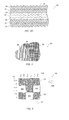
- Fig. 3B is a simplified perspective view of a portion of a coating stack 70 on an embossed deposition substrate 72 shown with an edge in cross section.
- a first clear layer 74 of the coating stack is deposited on the embossed substrate.
- a reflector layer 76 is then deposited, and then a second clear layer 78.
- the diffraction grating pattern embossed on the deposition substrate is preserved throughout the layers.
- Magnetic "needles" 80 are formed on the high points of the diffraction grating structure. Other magnetic needles (not shown) might similarly form in the "valleys" between the ridges, or in some cases only on the ridges.
- the magnetic material preferentially deposits on the ridges and/or in the valleys due to nucleation kinetics or "shadowing" effects during the deposition.
- Differential vapor density between the bottoms of the grooves and the tops of the grooves, the slope of the grating side-walls might all affect how the magnetic material is deposited on the diffraction grating. In other words, there may be more than one reason such needles are formed.
- a coating stack could include two reflector layers on either side of a stiffening layer, such as a layer of MgF 2 .
- the reflector layers could be opaque aluminum. While MgF 2 is an essentially clear material, clarity is not essential for material(s) between the reflector layers.
- the magnetic layer could be deposited on the second aluminum layer to form magnetic needles, or elsewhere.
- the magnetic needles were formed by depositing a 50 nm-thick layer of nickel on the second clear layer using e-beam evaporation. It was found that a 200 nm-thick layer of nickel did not form the needles, but could be used to form magnetic flakes according to the present invention if the flakes themselves were shaped. It is believed that the thinner layer of nickel is at least magnetically discontinuous and forms magnetic needles aligned with the diffraction grating pattern. Some needles might be at least partially joined with thin sections of magnetic material, but very thin sections might not be able to form strong magnetic domains, hence the layer is magnetically discontinuous. In some instances, the magnetic film (layer) might have a variable thickness.
- a stronger magnetic torque is provided in the direction of the diffraction grating, thus facilitating alignment of the particles in a magnetic field. It is further believed that layers of nickel thinner than 50 nm may form discontinuous magnetic layers aligned with some diffraction grating patterns, and that magnetic layers between 50 nm and 200 nm thick might form needles in some instances.
- a grooved diffraction grating can also facilitate fabricating flakes with desirable shapes.
- the thin film stack tends to break along the grooves of the diffraction grating. This results in flakes with a longer dimension in the direction of the grooves, and a shorter dimension across the grooves.
- This sort of aspect ratio can facilitate magnetic or fluid alignment of the resultant flakes to form an image.
- Fig. 3C is a simplified cross section of a magnetic diffractive flake 71 according to another embodiment of the present invention.
- the flake is made by depositing thin-film layers on an embossed substrate, such as embossed PET film, separating the thin-film layers from the deposition substrate, and then grinding and sorting the flake to the desired size.
- the flake includes a first layer of MgF 2 73, a first layer of aluminum reflector 75, an 50 nm layer of nickel 77 forming a magnetically discontinuous layer illustrated as needles on the peaks of the grating, a second layer of aluminum 79 and a second layer of MgF 2 81.
- Fig. 3D is a simplified cross section of a color-shifting diffractive flake 83 according to an embodiment of the invention.
- the flake is symmetrical with an absorber layer 84, a spacer layer 85, a reflector layer 86, a magnetic layer 87, which in some embodiments has a thickness selected to form a magnetically discontinuous layer, i.e. magnetic needles, on a diffraction grating, and another reflector layer 86' , spacer layer 85' , and absorber layer 84'.
- the diffraction grating can be embossed onto a roll coating substrate, such as film of PET with an embossed layer.
- the order of the layers is merely exemplary, and non-symmetrical or asymmetrical pigments may be made.
- a green-blue color-shifting diffractive flake was made by depositing a first absorber layer of chromium 8 nm thick, a first spacer layer of MgF 2 of four quarter-wave optical thickness at 530 nm, a first reflector layer of aluminum 80 nm thick, a magnetic layer of nickel 50 nm thick, a second reflector layer essentially similar to the first reflector layer, a second spacer layer essentially the same as the first spacer layer, and a second absorber layer essentially the same as the first absorber layer.
- the layers were deposited on an embossed film (web) in a roll coating machine, and were separated from the web and processed into flakes.
- a gold-to-silver color-shifting diffractive flake was made by depositing a first absorber layer of chromium 8 nm thick, a first spacer layer of MgF2 of two quarter-wave optical thickness at 605 nm, a first reflector layer of aluminum 80 nm thick, a magnetic layer of nickel 50 nm thick, a second reflector layer essentially similar to the first reflector layer, a second spacer layer essentially the same as the first spacer layer, and a second absorber layer essentially the same as the first absorber layer.
- the layers were deposited on an embossed film (web) in a roll coating machine, and were separated from the web and processed into flakes.
- a silvery flake was made by depositing a layer of MgF 2 of four quarter-wave optical thickness at 530 nm, a magnetic layer of nickel 50 nm thick, and another layer of MgF 2 of four quarter-wave optical thickness at 530 nm. It is believed that tinted (transparent colored) dichroic or color-shifting diffractive pigments may be made using alternating layers of high-index and low-index dielectric materials, and a magnetic oxide such as Fe 3 O 4 . A diffraction grating pattern may be imparted to the flakes by depositing the layers on a patterned ( e.g. embossed) substrate from which the flakes are subsequently separated.
- H represents a layer of high-index material
- L represents a layer of low-index material having selected optical thicknesses.
- a layer of magnetic material might be deposited at any number of positions in the stack, such as on the center H layer.
- Other designs such as 7-layer or 9-layer designs may be desired.
- an LHLHL-type configuration may be desirable, including 7-layer and 9-layer designs, as well as designs with more or fewer layers.
- Magnetic pigment particles with diffractive gratings can be used to create a number of effects, such as DOVIDs or polarizers.
- DOVIDs optical incandescent
- a diffractive grating when illuminated, an observer looking in a direction essentially perpendicular to the grooves of the grating will see diffracted light, while the observer will not see the diffracted light when looking along the grooves in the grating.
- the appearance of the pixel changes with rotation of the viewing angle.
- the difference in appearance can include color travel as well as lightness. It may be desirable to align diffractive pigment flakes to obtain a stronger diffractive effect, or to create images, such as pixelgrams, dot images, or kinegrams.
- a more pronounced optical effect is generally achieved if more flakes are lying in the same plane, which is typically, but not necessarily, the plane of the substrate. Effects can be obtained by selecting the orientation of the diffraction gratings, or by using diffraction gratings having different spacings. For example, one region of the device might have flakes with a linear grating spacing of 1,400 lines/mm, while another region might have flakes with a linear grating spacing of 2,000 lines/mm. One region might appear green, while the other region appears red. A viewer would observe different optical effects from each region as the angle of view was changed.
- Fig. 4 is a simplified top view of an image 90 printed with diffractive pigment flakes according to an embodiment of the present invention.
- the image is shown as having an arbitrary perimeter and three fields, each field being indicated by a pattern representative of a grating pattern of diffractive flakes in that field.
- a first field 92 is printed with ink containing a first type of diffractive pigment with a grooved diffraction grating of relatively fine pitch.
- the diffractive pigment flakes in the first field are not aligned.
- a second field 94 is printed with ink containing a second type of diffractive pigment flakes with a grooved diffraction grating of coarser pitch.
- the diffractive pigment flakes are not necessarily aligned, but have a different grating pattern, illustrated by the higher spacing between the lines in the second field.
- a third field 96 is printed with ink having diffractive pigment flakes with a cross grating, for example. This third field is included only to illustrate that the pigment flakes in different fields could have a different spacing, or have a different pattern, and only two types of fields are needed to make an image.
- the diffractive pigment flakes in one or more fields could be aligned in a selected direction.
- the pigment flakes in the first field 92 could be aligned so that the diffraction grating is aligned more or less along the lines in the field.
- the pigment flakes in the second field 94 could be aligned in a different direction, or be random. In fact, they could be the same type of flakes used to print the first field. The image would appear when viewed under light at an appropriate angle, or when the printed medium is rotated.
- first 92 and second 94 field were printed with similar flakes, one field magnetically aligned and the other not aligned or aligned at a different angle, no image might appear under some viewing conditions, the image appearing to be a uniform field, such as a silver or light gray field. As the image, light source, and/or viewing angle is varied, the image will appear.
- Images may also be produced using diffractive pigment techniques. Many images are composed of a number of picture cells ("pixels") or dots. Images may be simple images, or may be holographic. Some DOVIDs can appear to be a 3-dimensional image of an object, other DOVIDs can change images with viewing angle, or appear to impart motion to an image.
- Fig. 5 is a simplified top view of a portion of an image 100 printed with magnetically oriented diffractive flakes.
- the portion of the image is composed of nine pixels laid out on essentially a grid. This configuration is exemplary only, and the pixels do not have to be square, or be the same shape or size. Other embodiments may use dots instead of pixels to form an image(s).
- pixels are at least rectangular and have the same size. In some applications the pixels do not abut one another, and a narrow "alley" of unprinted area separates the pixels. Some of the pixels 102 are optionally unprinted. Other pixels 104 are optionally printed in plain ink, either black ink or colored ink. Similarly, pixels may be printed with ink having non-magnetic diffractive pigment, or with randomly oriented magnetic diffractive pigment flakes. The other illustrated pixels are printed with ink that includes magnetic diffractive pigment flakes that have been oriented in a selected direction.
- the magnetic diffractive pigment flakes are oriented within a pixel by providing a magnetic field before, during, and/or after application of the ink.
- the pixels are shown as having a plurality of randomly shaped particles.
- the pixels could contain selectively shaped magnetic diffractive flakes.
- the term "oriented” means that the diffraction gratings on the oriented flakes are sufficiently aligned to produce an aggregate effect distinguishable from the effect observed from similar, but randomly oriented, flakes. "Oriented” means that a majority of flakes are aligned in such a way that their grooves are parallel or almost parallel.
- diffractive flakes are not aligned in any pixel, but the diffraction grating pattern is different in different pixels, and several different diffraction gratings may be used in each of several pixels. In further embodiments, different diffraction grating patterns are used, and one or more of the pigment flakes are aligned in a selected fashion.
- the diffraction pattern on the flakes is represented by parallel lines 106, 108 that run in a horizontal or vertical direction in the illustration.
- the gratings do not have to align with a pixel edge, and an image may contain several different sets of aligned pixels and/or dots.
- Each area grating (pixel) can diffract light in a selected direction under a particular common oriented beam of white light, represented by the box arrows 110.
- the light is diffracted in a direction normal to the dominant grating direction, i.e. light is diffracted horizontally from vertically aligned pixel gratings, and vertically from horizontally aligned pixel gratings.
- the flakes with "horizontal" lines have an aggregate effect so that the direction of viewing represented by the box arrow 107 would provide diffracted light from those pixels, and similarly for the vertically aligned diffraction gratings, which would diffract light in the direction of view represented by the box arrow 109.
- the incident light should be from the direction of the arrows 110', and viewed from the box arrow 109.
- a set of pixels could contain flakes with crossed diffraction gratings. It is not necessary that the image contains equal numbers of types of pixels, and pixels having the same diffraction grating orientation could adjoin one another. It is understood that not all flakes need to be perfectly aligned with one another within a pixel.
- pixels might contain randomly oriented diffractive pigment flakes having different diffraction gratings in different pixels to form images.
- Different images can be constructed using different ensembles of types of pixels. This can produce an effect of animation for each of the images obtained with a set of pixels as the viewing angle changes or the printed object is rotated.
- more than one image can be constructed on a printed area by an appropriate distribution of different types of pixels.
- the relative sizes of flakes and pixels is not to scale. Generally, a pixel is on the order of about 50 microns to about 1,000 microns, while the diffractive flakes are typically on the order of about 5 microns to about 50 microns across.
- Figs. 6A-6D illustrate how different images can appear when an optically variable image is printed with magnetically orientated diffractive pigment flakes.
- Fig. 6A is a simplified top view of a printed DOVID 120. Three letters, "A" 122, "B” 124, and "C” 126 have been printed with overlapping regions. Only the outlines of the letters are shown in this figure for simplicity of illustration.
- the actual DOVID could be embedded in a non-diffractive or randomly diffractive field.
- the background which is plain paper in Fig. 6A, could be printed with the same ink as the letters, but not magnetically aligned, or printed with non-diffractive ink, or left blank.
- the image of each letter is composed of several pixels.
- the set of pixels composing a single letter includes pixels with diffractive pigment flakes oriented in a particular direction.
- the viewer looks at the DOVID from a direction essentially perpendicular to diffractive gratings of the diffractive pigment flakes composing the image, the viewer observes that image.
- the viewer observes the other images when his angle of view changes, as by rotating the DOVID, for example. If one or more of the letters was printed with a diffractive pigment having a thin-film interference structure, tilting the image would provide a color-shifting feature as well as diffractive color travel.
- the pixels for the various images are interleaved, that is, diffractive pixels composing the letter "A” are interspersed with diffractive pixels composing the letters "B” and "C". It is not necessary that each image have a comparable number of pixels in the overlapping regions, and some pixels may be unprinted, printed with non-diffractive ink, or printed with randomly oriented diffractive pigment flakes to adjust the density or other characteristics of the image.
- DOVID photo-copying the DOVID on a copier would not preserve the optically variable effect of the image. A letter or letters might appear, but the image would not change with rotation. Thus, printed DOVID can serve as security or authenticity features on documents or other objects. Covert security might be provided by diffractive pigments having grating spacing greater than 3,000 lines/mm, which could be invisible to the unaided eye, but detected with an ultra-violet camera or detector.
- Fig. 6B is a plan view of the DOVID of Fig. 6A when viewed from the direction indicated by the arrow 128.
- the other letters are represented by dashed lines to represent that they would not be prominent from this direction because the oriented diffractive flakes of the pixels composing these letters would not diffract light in the viewing direction.
- Fig. 6C is a plan view of the DOVID of Fig. 6A when viewed from the direction indicated by the arrow 130
- Fig. 6D is a plan view of the DOVID of Fig. 6A when viewed from the direction indicated by the arrow 132.
- the lines across the letters in Figs. 6B-6D represent the aggregate effective diffraction grating pattern for the oriented diffractive pigment flakes in pixels making up the respective images.
- Fig. 7 is a simplified representation of a kinegram 140 illustrating how an image might appear to move across the page as the page is rotated.
- a first version of the image 142 is printed with oriented diffractive pigment flakes aligned in a first direction, represented by the vertical lines 144 indicating the predominate direction of diffraction grooves on the pigment flakes.
- a second version of the image 146 is printed with the diffraction grooves at a non-vertical angle, represented by lines 148, and a third version of the image 150 is printed with the diffraction grooves essentially horizontal, as represented by lines 152.
- the illumination source is represented by the box arrow 154, and the initial direction of view is represented by the arrow 156.
- diffractive magnetic pigment flakes Other effects can be obtained using diffractive magnetic pigment flakes.
- an annular magnet was placed behind a piece of card stock.
- Diffractive magnetic pigment in a clear binder was drawn across the side of the card stock opposite the magnet with a doctor blade (essentially a thin, narrow stainless-steel spatula).
- the resulting image gave the impression of a true three-dimensional "fish-eye". It is believed that the diffractive magnetic pigment flakes were aligned by both tilting and rotating flakes along the magnetic field lines.
- the pigment was applied as a spray paint.
- Magnetic pigment flakes can be aligned in a number of fashions.
- a magnetic field can be used to align the pigment flakes before, during, or after applying the pigment onto a medium, or a magnetic field can be applied at several parts of the process, or throughout the process.
- a magnetic field may be applied to align or pre-align the flakes before application by a printing, dying, powder-coating, or painting device, and a magnetic field may be applied after the pigment flakes have been applied to a medium.
- the application device such as the spray head, roller, or screen may be magnetized to align the pigment flakes as they are applied to the medium.
- suitable media include paper, plastic, metal, wood, leather, and fabric.
- Exemplary printing techniques include gravure, stamping, Intaglio, flexographic, silk-screen, jet, and lithographic printing, and images may produced using a combination of printing techniques.
- Diffractive pigments might also be aligned during extrusion or injection molding of plastic articles or films, either with a magnetic field or as a result of fluid tending to align the diffraction grating along the direction of flow.
- the ink source may be magnetized to orient the pigment flakes before they are picked up by the roller. The orientation is substantially preserved as the flakes are transferred to the intended medium.
- a magnetic field may be applied across the screen or screen elements to align the pigment flakes, or the squeegee may be magnetized to align the flakes as the ink or paint is drawn across the screen. In that case, different orientations of the flakes are obtained simply by changing the direction of the draw.
- Printed or painted images may be used in many applications.
- printed DOVIDs may be used as security or authentication features on bank notes, traveler's checks, software media, and credit cards.
- the DOVIDs may be printed directly on the media or may be printed on a transfer film or foil, such as a hot foil, that is then applied (hot pressed) to the media.
- Either approach provides a DOVID without having to make a master hologram. This in turn allows flexibility in what images are provided. For example, a diffractive optically variable date code could be used.
- Making a master hologram, especially for a single use, using conventional techniques would be expensive and time consuming in comparison. However, counterfeiters have obtained access to apparatus for making a master hologram, so such devices are becoming easier to counterfeit.
- the medium itself may be magnetized.
- an emblem or logo might be produced on a steel panel by imparting remnant magnetization in a selected pattern to the steel pattern. Paint containing magnetic pigment flakes would align in the areas having sufficient magnetic field, and not align in areas with little or no field.
- a magnetic template with permanent and/or electro-magnets or magnetic fluid could be placed behind a panel, such as a metal, plastic, or wooden panel, to align the pigment flakes after they are applied to the panel.
- Other techniques could apply or embed magnetized wires or particles in or on a medium, or to apply a magnetic fluid to the side of the substrate opposite the pigment flakes. Magnetic diffractive pigment particles in a paint or ink that were subsequently applied would then align to the magnetized material.
- the orientation of the diffractive pigment could also align other non-magnetic particles, such as micro-wires, that would not otherwise be oriented. Flakes might be aligned before application to the surface of the substrate, such as by using filtered cathode arc deposition to align the flakes during their trajectory to the substrate.
- a paint vehicle may be combined with the pigment flakes to provide a paint formulation
- an ink vehicle may be combined with the pigment flakes to provide an ink formulation
- a powder-coating binder may be combined with the pigment flakes to form a powder-coating formulation, for example.
- Powder coating material should be pre-formulated because during application the magnetic pigment may spread so that only a small portion will reach the article being coated.
- the vehicle or carrier may be relatively volatile, or be rapidly absorbed into the medium, such as a paper. Techniques aligning the pigment flakes before application may be compatible with such fast-drying or fast-setting carriers. For example, with gravure printing, the ink receiver can be magnetized before the idlers pick up the ink.
- an automotive paint formulation might use a polyurethane carrier that stays relatively fluid for at least several minutes.
- the flakes could be aligned prior to application, the orientation being preserved when the paint cured, or could be applied with random orientation and subsequently aligned by applying a magnetic field.
- the flakes typically lie along the surface of the medium, facilitating orienting the diffraction grating in the plane of the flake.
- Other carriers might remain fluid until selectively cured, such as a carrier that is cured using infrared, ultra-violet or other light, or heat.
- magnetic diffractive pigment flakes can be included in polymeric films, such as extruded films.
- the extrusion process generally aligns the flakes in the plane of the film, and a magnetic field can be applied as the film is extruded to align the diffraction gratings in the plane of the flake.
- magnetic diffractive pigment flakes could be cast in a polymer, and magnetically aligned before casting or while the polymer was still fluid. Such techniques could include aligning the plane of the flake, as well as the rotational orientation of the diffraction grating in the plane of the flake.
- Examples of materials that might be used in polymeric films include aqueous polymer, such as a polyvinyl alcohol, polyvinyl acetate polyvinylpyrrolidone, poly(ethoxyethylene), poly(methoxyethylene), poly(acrylic) acid, poly(acrylamide), poly(oxyethylene), poly(maleic anhydride), hydroxyethyl cellulose, cellulose acetate and poly(sacchrides) such as gum arabic and pectin may be used. If an organic solvent base is to be utilized, almost any polymer system that is dissolvable may be used.
- poly(acetals) such as polyvinylbutyral, poly(vinyl halides), such as polyvinyl chloride and polyvinylene chloride, poly(dienes) such as polybutadiene, poly(alkenes) such as polyethylene, poly(acrylates) such as polymethyl acrylate, poly(methacrylates) such as poly methylmethacrylate, poly(carbonates) such as poly(oxycarbonyl oxyhexamethylene, poly(esters) such as polyethylene terephthalate, poly(urethanes), poly(siloxanes), poly(suphides), poly(sulphones), poly(vinylnitriles), poly(acrylonitriles), poly(styrene), poly(phenylenes) such as poly(2,5 dihydroxy-1,4-phenyleneethylene), poly(amides), natural rubbers, formaldahyde resins and other polymers
- poly(acetals) such as polyvinylbutyral, poly(vinyl
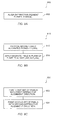
- Fig. 8A is a simplified flow diagram of a method of forming an image on a medium 800 according to an embodiment of the present invention.
- Diffractive pigment flakes are aligned in a first field of the image (step 802). The alignment may occur before the diffractive pigment flakes are applied to the medium, during application, and/or after application.
- Fig. 8B is a simplified flow diagram of a method of aligning a pigment flake 810 according to another embodiment of the present invention.
- a pigment flake having a magnetic structure alignable in the plane of the flake is provided (step 812).
- the magnetic structure could be an essentially uniform layer of magnetic material capable of being aligned due to the shape of the flake, or could be a non-uniform layer of magnetic material, such as stripes or needles formed on a diffraction grating.
- a magnetic field is applied across the pigment flake to align the pigment flake in the plane of the flake (step 814).
- the magnetic pigment flake has a diffraction grating and the diffraction grating is aligned in a selected orientation according to the applied magnetic field.
- Fig. 8C is a simplified flow diagram of a method of printing an optically variable image 820 according to another embodiment of the present invention.
- a first plurality of pixels having diffractive pigment flakes aligned in a first selected direction are disposed on a medium (step 822).
- a second plurality of pixels having diffractive pigment flakes aligned in a second direction are disposed on the medium (step 824). Additional pixels with diffractive flakes aligned in additional directions may be included.
- the alignment can be in the plane of the foil, or tilted at a desired angle.
- the order of the steps is not limiting, and some processes may allow the different sets of pixels to be concurrently applied to the medium.
- pixels may be printed with non-oriented diffractive pigment flakes, or non-diffractive pigment, or left blank.
- the optically variable image or a portion of the image might be printed over another image, or another image might overly the optically variable image or a portion of the image.
- the flakes can also be aligned at a desired tilt, as well as at a desired orientation of the diffraction grating by applying a magnetic field that is not in-plane with the medium that the flakes are applied to.
- a magnetic field that is not in-plane with the medium that the flakes are applied to.
- an end pole of a bar magnet can be placed underneath a card across which diffractive flakes have been spread.
- the curving field lines produce a dramatic and unusual effect of a three-dimensional "eye”. Similar effects were obtained using the edges of bar, disk, and annular magnets. When the face of an annular magnet was placed against the backside of the card, a multiple, three-dimensional ringed effect was produced in the diffractive pigment.
- Magnetic diffractive pigments were applied to media using a variety of techniques, including screening, spreading, and spraying.
- the flakes were generally made by depositing thin film layers on embossed PET film, and then separating the thin film layers from the deposition substrate and grinding and sorting the flakes. The flakes were then mixed with a binder, such as 150KTM basecoat sold by E.I. DU PONT DE NEMOURS AND COMPANY, as a carrier.
- a binder such as 150KTM basecoat sold by E.I. DU PONT DE NEMOURS AND COMPANY
- Other suitable binders and carriers are available, such as CHROMASYSTEMS binders and basemakers, also from E.I. DU PONT DE NEMOURS AND COMPANY, and other products from other suppliers. The mixture was spread onto a card using a doctor blade to draw down the pigments.
- Drawing the doctor blade across the card generally flattens the pigment flakes in the plane of the card.
- One magnet was placed at an edge of the card so that the magnet's north pole was next to the card's edge.
- a second magnet was placed at the opposite edge of the card with its south pole adjacent to the edge of the card. This established a magnetic field between the north pole of the first magnet and the south pole of the second magnet.
- the flakes were drawn across the area between the magnets, which were about seven inches apart, to align the diffraction gratings.
- the aligned diffractive pigment flakes emulated a foil that might be produced by conventional techniques using a master hologram, or a continuous sheet of embossed reflector.
- a magnetic field was applied after drawing down the pigment flakes.
- the carrier remained sufficiently fluid while opposing (north-south) magnetic poles were placed facing each other beneath the card across which the pigment flakes had been drawn.
- the pigment flakes had magnetic needles formed along the diffraction grating pattern, and the magnetic needles aligned themselves along magnetic field lines between the poles.
- a goniospectrophotometer was used to measure the color travel of the samples.
- a scanning mask was used on the photodetector.
- the "a" axis represents green in the negative direction and red in the positive direction
- the "b" axis represents blue in the negative direction and yellow in the positive direction, in accordance with standard CIETM LAB colormetric conventions.
- CIETM LAB colormetric conventions Generally speaking, the further the curve is from the origin, the more chromatic the color for a given lightness when viewed from that direction. Absolute viewing angles are omitted for clarity of illustration, but the data points are approximately 2 degrees apart.
- Fig. 9A is a simplified graph 900 of the color travel of magnetically aligned diffractive pigment flakes according to an embodiment of the present invention.
- the pigment flakes were made on PET film that was embossed with 1400 lines/mm, and then stripped from the deposition substrate.
- the flake structure was MgF 2 -Al-Ni-Al-MgF 2 (See generally Fig. 3C).
- the magnesium fluoride layers were about 400 nm thick to provide rigidity to the resultant flakes and ease of handling and processing. They are not required for optical properties, and other materials may be used. In some embodiments, such layers can be used to provide environmental protection or index-matching.
- the aluminum layers were about 80 nm thick, which provided generally opaque, bright reflectors.
- Thinner or thicker reflector layers could be used, or omitted in other embodiments.
- the nickel layer in this and the embodiments illustrated in Figs. 9B-9E was approximately 50 nm thick, and appeared to deposit along the grooves, producing magnetic needles. This flake exhibited a bright silver appearance.
- the first curve 902 shows the color travel of the sample illuminated with an incident light beam at 45 degrees and perpendicular to the applied field or to the diffraction grating (applied magnetic field) as the sample, i.e. groove orientation, is rotated between about -33 degrees 904 and about 80 degrees 906, with essentially specular reflection 907 occurring at viewing angles of about 45 degrees.
- the second curve 908 shows the color travel of the sample illuminated with the incident light beam parallel to the diffraction grating as the sample is rotated through essentially the same arc.
- the first curve 902 shows a high degree of color travel compared to the second curve 908.
- the essentially out-and-back nature of the second curve from the origin shows relatively little color travel, which is characteristic of no diffractive interference effects.
- Fig. 9B is a simplified graph 910 of the color travel of magnetically aligned diffractive pigment flakes according to an embodiment of the present invention.
- Magnetic diffractive flake was made substantially the same as the example illustrated in Fig. 9A, but with a grating of 2000 lines/mm embossed on the deposition substrate.
- the resultant flakes were similarly mixed in a carrier and spread on a card using a doctor blade to draw down the flakes between two magnets that provided a magnetic field in the plane of the card to align the flakes. All samples were analyzed at 45 degrees incidence and from viewing angles of minus 33 to 80 degrees in steps of two degrees.
- the first curve 912 shows the color travel of the sample illuminated with an incident beam perpendicular to the aggregated diffraction gratings of the flakes.
- the second curve 914 shows the color travel of the sample illuminated with the incident beam perpendicular to the aggregated diffractions gratings. This sample showed wide color travel with the illumination source perpendicular to the magnetic field through some angles of viewing, but relatively little color travel or chromaticity over the remainder of the range. The second curve shows relatively low color travel.
- Fig. 9C is a simplified graph 920 of the color travel of magnetically aligned diffractive pigment flakes according to an embodiment of the present invention. Note the scale change on the "a" axis and on the negative "b" axis.
- Magnetic diffractive flake was made substantially the same as the example illustrated in Fig. 9A, but with a grating of 3000 lines/mm embossed on the deposition substrate. The resultant flakes were similarly mixed in a carrier and spread on a card using a doctor blade to draw down the flakes between two magnets that provided a magnetic field in the plane of the card to align the flakes.
- the first curve 922 shows the color travel of the sample illuminated with an incident beam perpendicular to the aggregated diffraction gratings of the flakes.
- the second curve 924 shows the color travel of the sample illuminated with the incident beam perpendicular to the aggregated diffractions gratings. This sample showed moderate color travel with the illumination source perpendicular to the magnetic field, particularly a relatively fast transition from the achromatic center to the +a, -b quadrant.
- the second curve shows relatively low color travel, and relatively low chromaticity.
- Fig. 9D is a simplified graph 930 of the color travel of magnetically aligned diffractive pigment flakes according to an embodiment of the present invention. Note the scale change. Magnetic diffractive flake was made substantially the same as the example illustrated in Fig. 9A with a grating of 1400 lines/mm embossed on the deposition substrate, but without the aluminum layers. The 50 nm layer of nickel served as the reflector. The overall appearance of the sample was less bright (more gray) than the similar sample made with aluminum reflective layers. The resultant flakes were similarly mixed in a carrier and spread on a card using a doctor blade to draw down the flakes between two magnets that provided a magnetic field in the plane of the card to align the flakes.
- the first curve 932 shows the color travel of the sample illuminated with an incident beam perpendicular to the aggregated diffraction gratings of the flakes.
- the second curve 934 shows the color travel of the sample illuminated with the incident beam parallel to the aggregated diffractions gratings.
- Fig. 9E is a simplified graph 940 of the color travel of a magnetically aligned diffractive pigment flakes according to an embodiment of the present invention.
- This design produced a gold-to-silver color change effect. Note that the scales are different from other figures.
- Magnetic diffractive flake was made with a grating of 1400 lines/mm embossed on the deposition substrate, but with a different optical design.
- the thin-film stack included semi-transparent layers of chromium (i.e. absorber layers) over the MgF 2 layers. In other words, the thin film structure was Cr-MgF 2 -Al-Ni-Al-MgF 2 -Cr.
- the MgF 2 layers provided stiffness and the spacer layer for the Fabry-Perot filter, although Fabry-Perot-type interference structures could be formed over the reflectors patterned with diffraction gratings.
- the resultant flakes were similarly mixed in a carrier and spread on a card using a doctor blade to draw down the flakes between two magnets that provided a magnetic field in the plane of the card to align the flakes.
- the first curve 942 shows the color travel of the sample illuminated with an incident beam perpendicular to the aggregated diffraction gratings of the flakes.
- the second curve 944 shows the color travel of the sample illuminated with the incident beam parallel to the aggregated diffractions gratings.
- the general impression of this sample is a gold field changing to silver upon tilting of the sample under illumination and presenting diffractive effects when illuminated with a highly oriented beam perpendicular to the oriented grooves (diffraction grating) of the flakes.
- titanium nitride might be used as a reflector material to impart a golden base color to a diffractive flake.
- gold makes an excellent reflector for diffractive flake applications. Copper could be used to obtain yet other base colors and color shifts.
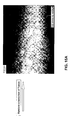
- Fig. 10a a photograph shows a plurality of magnetically alignable flakes with their orientation with respect to diffractive grooves therein, being random, hence, the flakes are not aligned with one another or oriented in a particular fashion.
- the periodically grooved flakes have a same pattern with 500 grooved or corrugated lines / mm.
- the flakes are placed in viscous fluid such as pump oil, imitating the standard loading of inks where the flakes would typically be used.
- the formulation shown in Fig. 10a is a low concentration used to illustrate the orientation, or lack thereof, of the flakes.
- Fig. 10a is a low concentration used to illustrate the orientation, or lack thereof, of the flakes.
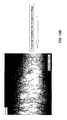
- 10b shows the same sample of flakes after a magnetic field is applied between the two magnets labeled North and South.
- the diffractive flakes tend to align in columnar structures with their grooves parallel to the magnetic field.
- the parallel groove alignment with the field is substantially independent of the shape and size of the flakes.
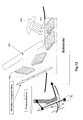
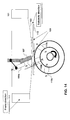
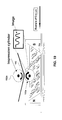
- Fig. 11 shows schematically, a silk screen flat printing apparatus and method in accordance with an embodiment of this invention.
- the arrangement differs from a conventional silk screen process by way of having two magnets 109a, 109b, coupled to the squeegee 107 for applying the ink in a magnetic field between the two magnets to orient magnetically alignable flakes in a manner wherein diffraction grating lines or grooves on the flakes align with the magnetic field.
- a frame 101 having a stencil and screen 103 is disposed above a substrate 105 to be printed.
- a first of the magnets 109a is positioned behind the squeegee 107 and the second other magnet 109b is disposed behind the substrate 105.
- these two magnets can be mechanically connected or can move simultaneously in a parallel position with two synchronized systems.
- the magnets' dimensions and relative positions will depend on the magnetic strengths, printing speed, distance between stencil and substrate, etc.
- Printed regions 108 with flakes oriented in dependence upon the lines of the diffraction gratings are shown upon the substrate.
- Fig. 12 shows a magnified region of the apparatus of Fig. 11, wherein the orientation of the flakes 112 with respect to the flake grooves can be seen as well as a region where the flakes are cured.
- the flake and groove orientation are similar to the orientations shown in Fig. 10b.
- a UV, e-beam or thermal curing station 114 is disposed so as to fix the flakes' position within the printed ink area.
- a rotation of the magnet/squeegee system will produce another series of pixels, dots or areas with the flakes parallel to the substrate but with a different groove orientation in the plane of the substrate as illustrated on Fig. 13.
- the lines of the grating on or in the flakes follow the magnetic field; and, the flakes lie substantially flat with a preferred orientation so that the grooves or lines are parallel to the magnetic field.
- a simple magnet 111 as is shown in Fig. 12b can be localized behind or in front of the squeegee to create the magnetic alignment of the flakes.
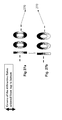
- FIG. 13 two windows 130 and 132 are shown, both having printed images formed therein. Flakes in both images having their grating lines or grooves oriented along a particular but different direction. This is done by changing the direction of the squeegee that moves across the substrate.
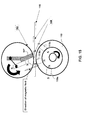
- Fig. 14 shows an embodiment that in some respects resembles the embodiment of Fig. 11.
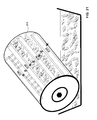
- Fig. 14 has the printing roller 119 and magnets 119a, 119b, 119c etc. that provide a magnetic field in the region of the substrate 115 as the substrate is advanced in the direction shown by the arrow.
- the printing roller 119 advances the substrate or web 115 between the rollers and the screen 103 as it rotates.
- the magnets situated inside the roller 119 advance sequentially to the printing region, so that the substrate can continuously be printed with oriented diffractive flakes.
- a rotary web printing apparatus includes a screen 152 attached to and covering a printing cylinder.
- the squeegee portion of the printing apparatus 107 with a magnet 109a attached is essentially the same as is shown in Fig. 11.
- the drum 119 is essentially the same as the drum in Fig. 14. In operation the printing cylinder rotates with the roller drum 119 to print regions on the moving substrate 115.
- a primary aspect of this invention relates to the discovery that non-magnetic semiconductor and dielectric flakes can oriented in a direction along electric field lines, in an applied electric field.
- a particle in a DC electrical field is will be polarized and electrical charges appear along the "easy" axis producing the preferential orientation of the particles. If the loading of the polarized particles is relatively high, + and - sides of the particles attract each other creating a chain like alignment of the particles in between the electrodes. This alignment feature is useful definitely in printing to create special effect images.
- a DC field will have the tendency to move the polarized particles.
- the side of the particle that is positively charged will tend to move towards the cathode, conversely the negative charged end or side will be attracted to the anode. If the particle is perfectly uniformly polarized, it will not move. Notwithstanding it is unlikely that uniform polarization with the same amount of charges with respect to the easy-axis will prevail. It is expected that generally the electrical field will not be uniform since one of the electrodes may be larger than another or they may not be perfectly parallel to each other. In these conditions the particles will be attracted to the electrode of smaller dimensions where the electrical field is higher.
- AC electrical fields are generally easier to work with and therefore preferable.
- the fluid electrical layer will not be created.
- the mobility of cations and anions in most instances will not be high enough to follow the frequency of the change of the alternative current.
- the particles will not have the tendency to move to the electrodes on an uniform electrical field since the current is constantly changing.
- the particles will have the tendency to be displaced to one of the electrodes in the case on none uniform AC fields. This will depend upon the strength non-uniformity and on the viscosity of the fluid.
- Figs. 15a and 16a are micrographs at different magnification before an electric field has been applied, that is, in the absence of an applied electric field; and Figs. 15b and 16b are pictures illustrating aligned particles suspended in oil, simulating flake material in ink, and after a 1500 V electric field is applied.
- the dielectric flakes have a grating formed within of 5001/mm.
- a columnar formation of the flakes is evident.
- the dipole moment present due to the electric field is influenced by the shape, size, and volume of the particles.
- Fig. 14b shows the preferential orientation of simple shaped particles in an electric field. Both ellipsoid and rod shaped particles align with the electric field.
- the pigments in Figures 15a, 15b, 16a, 16b and 17 where obtained with a 500 l/mm grating substrate.
- the layers used are: 50 nm MgF 2 / 100 nm Si/ 50 nm MgF 2 .
- the flakes were suspended in silicone oil used for vacuum pumps.
- a plurality of materials can be used as diffractive particles for alignment within an electric field. It is not only the material of the suspended particle that must be considered.
- the orientation will, in general, be a function of the difference in dielectric constants of the particles and the liquid the particles are in forming the ink.
- polymers, semiconductors and ceramics (for example dielectric) particles can be used, alone or in combination.
- poly(p-phenylene-2,6-benzobisthiazole) which is a liquid crystalline polymer with semi-conductive properties can be oriented.
- orientable non-magnetic materials formed into diffractive flakes can include ceramic such as SiO2, Al2O3 which are typically used as electro-rheological fluids.
- Si, Ge, etc can be certainly used as metallic semiconductors diffractive flakes.
- Fig. 17 clearly illustrates the tendency for dielectric diffractive flakes to align along their diffractive grooves parallel to electric field lines in an applied electric field.
- a 1500V field is applied.
- FIGs. 18, 19, and 20 are illustrative of further embodiments of aligning diffractive flakes and are not limited to alignment in magnetic field only. This apparatus could very simply be modified for use in aligning non-magnetic flakes in electric fields.
- Fig. 21 reveals a more complex but compact arrangement for aligning diffractive flakes.
- Fig. 18 The embodiment shown in Fig. 18 is particularly practicable as it provides a means in which to align flakes en masse within a container or vessel from which ink containing flakes is directly applied to a printing roller while substantially preserving the orientation of the pre-oriented flakes.
- diffractive magnetic flakes 182 are shown suspended in a vessel 184 with their grooves aligned parallel to each other and parallel to the magnetic field between North and South magnets 183 and 185.
- these magnets could be replaced with electrode plates capable of providing a voltage sufficient to align diffractive dielectric or semiconductor flakes, or any diffractive flake that can be aligned within an electric field.
- the e-field alienable i.e. dielectric or semiconductor flakes although shown in Fig.
- a rotatable printing cylinder 187 in the form for example of an anilox cylinder, flexographic cylinder or gravure (intaglio) cylinder is shown contacting the ink within the vessel 184.
- the orientation of the flakes can be purposefully varied following the magnetic field.
- a similar arrangement can be provided for flakes which align in an electric field, and the permanent magnets could be replaced with high voltage plates suitable for aligning particles that will orient in an e-field.
- the printing apparatus in Fig. 19 shows a similar arrangement to that of Fig. 18, wherein a first gravure cylinder 192a is used to pick up flakes from the vessel 194 and wherein an impression roller 192b applies tension on a moving substrate 195 forcing it to contact the cylinder 192.
- a similar system is shown in Fig. 20, wherein three rollers 202a, 202b, and 202c are utilized.
- a first anilox roller 202a contact the ink in the vessel and also makes contact with a soft printing plate 202b which transfers an image of field oriented flakes onto a moving web.
- An impression roller 202c ensures that the web 195 is firmly held against the impression roller.
- Figure 21 shows a more complex compact printing apparatus wherein a printing cylinder 210 has a plurality of bar magnets 214a, 214b, 214c 214d ... etc. spaced around its circumference. The direction of the magnetic field is shown between adjacent magnets around the entire cylinder.
- the cylinder 210 can be an anilox, flexographic, gravure, or other form of printing cylinder.
- a substrate would contact the top of the cylinder 210 with an impression roller ensuring adequate contact of the substrate with cylinder 210. As the flakes are taken up by the cylinder 210, they become aligned within the field provided by the magnets.
- bar magnets 214a, 214b, 214c 214d ... etc. spaced around the circumference can be replaced with electric field generating plates facing one another and electrically isolated from the container walls and the ink, so that this arrangement can by used with e-field orientable flakes.
- the power supply could be placed within or external to the drum. If the power supply is external to the drive the electrical connections can be provided through a rotating shaft. The intensity of the e-field is dependent upon the dielectric constant of the flakes and the ink medium used.
- Fig. 22 is a side view of a diffractive flake in accordance with an embodiment of this invention.
- the applied fields will produce an alignment along the grooves of the diffractive flakes.
- the flakes are aligned creating a condition of light dispersion or diffraction when the incident light is perpendicular to the grooves of the flakes.
- the image formed by these aligned diffractive flakes is rotated 90 degrees about a vertical axis, or if the source of illumination is accordingly altered, the dispersion is not longer observable and the ensemble of flakes behaves as a flat pigment.
- the dispersion of light and diffraction will be different.
- a low frequency grating there will be multiple diffractive orders that can be superimposed; the observed effect is dark/bright upon rotating the image about a vertical axis by 90 degrees.
- high frequencies gratings there will be only one or a partial diffractive order producing dispersion in the visible.
- the image will display diffractive effects on tilting with respect to the vertical axis in the y direction as defined in figure 22 about a vertical axis. These effects will disappear on rotating about the vertical axis since the grooves of the flakes will be oriented parallel to the illumination.
- a arrangement can be provided for flakes that are alignable and oreintable in an electric field or magnetic field, in dependence upon the flakes used.
- Fig. 23 is a simplified cross section of a printed image 20 that will be referred to as a "switching" optical effect, or “flip-flop", for purposes of discussion, according to an embodiment of the present invention.
- the flip-flop includes a first printed portion 22 and a second printed portion 24, separated by a transition 25.
- Pigment flakes 26 surrounded by carrier 28, such as an ink vehicle or a paint vehicle have been aligned parallel to a first plane in the first portion, and pigment flakes 26' in the second portion have been aligned parallel to a second plane.
- the flakes are shown as short lines in the cross-sectional view.
- the flakes are magnetic flakes, i.e. pigment flakes that can be aligned using a magnetic field. They might or might not retain remnant magnetization.
- flakes viewed normal to the plane of the flake appear bright, while flakes viewed along the edge of the plane appear dark.
- light from an illumination source 30 is reflected off the flakes in the first region to the viewer 32.
- the flakes in the first region 22 will be viewed on-end, while light will be reflected off the flakes in the second region 24.
- the first region will appear light and the second region will appear dark, while in the second viewing position the fields will flip-flop, the first region becoming dark and the second region becoming light. This provides a very striking visual effect.
- the pigment flakes are color-shifting, one portion may appear to be a first color and the other portion another color.
- the carrier is typically transparent, either clear or tinted, and the flakes are typically fairly reflective.
- the carrier could be tinted green and the flakes could include a metallic layer, such as a thin film of aluminum, gold, nickel, platinum, or metal alloy, or be a metal flake, such as a nickel or alloy flake.
- the light reflected off a metal layer through the green-tinted carrier might appear bright green, while another portion with flakes viewed on end might appear dark green or other color. If the flakes are merely metallic flakes in a clear carrier, then one portion of the image might appear bright metallic, while another appears dark.
- the metallic flakes might be coated with a tinted layer, or the flakes might include an optical interference structure, such as an absorber-spacer-reflector Fabry-Perot type structure.
- a diffractive structure may be formed on the reflective surface for providing an enhancement and an additional security feature.
- the diffractive structure may have a simple linear grating formed in the reflective surface, or may have a more complex predetermined pattern that can only be discerned when magnified but having an overall effect when viewing. By providing diffractive reflective layer, a colour change or brightness change is seen by a viewer by simply turning the sheet, banknote, or structure having the diffractive flakes.
- Fig. 24 is a simplified plan view of the printed image 20 on the substrate 29, which could be a document, such as a bank note or stock certificate, at a first selected viewing angle.
- the printed image can act as a security and/or authentication feature because the illusive image will not photocopy and cannot be produced using conventional printing techniques.
- the first portion 22 appears bright and the second portion 24 appears dark.
- the section line 40 indicates the cross section shown in Fig. 23.
- the transition 25 between the first and second portions is relatively sharp.
- the document could be a bank note, stock certificate, or other high-value printed material, for example.
- Fig. 26 is a simplified cross section of a printed image 42 of a kinematic optical device that will be referred to as a "rolling bar" for purposes of discussion, according to another embodiment of the present invention.
- the image includes pigment flakes 26 surrounded by a transparent carrier 28 printed on a substrate 29.
- the pigment flakes are aligned in a curving fashion.
- the region(s) of the rolling bar that reflect light off the faces of the pigment flakes to the viewer appear lighter than areas that do not directly reflect the light to the viewer.
- This image provides a light band(s) or bar(s) that appear to move ("roll") across the image when the image is tilted with respect to the viewing angle (assuming a fixed illumination source(s)).
- Fig. 27a an image of the numeral 100 is shown wherein a rolling bar effect is seen when the image is tilted about the axis 270. Illumination is from the top side of the foil. The bright bar within the image appears to move from a central position across the numeral "100" to a lower region thereof. In this instance the image is comprised of diffractive flakes having their grooves oriented from top to bottom in the image and tilting in this manner exhibits no diffractive effects. It should be noted that Figs 27c through 27e shown in black and white actually appear as silver, blue and reddish (not shown). In contrast, Figs, 27c through 27e exhibit additional effects due to the diffractive nature of the grooved flakes which make up the image.
- the image of the rolling bar in Figs 27c through 27e becomes diffractive when it is rotated 90 degrees from the position in Fig. 27a.
- Fig. 27c the grooves of the flakes within the numeral are oriented from left to right and as the image is rotated, the color of the rolling bar shifts from silver in the specular reflection (c) to violet-blue (d) and finally to yellow-red as illustrated in 27(e) when tilted back and forward with respect to the tiling axis 270 due to the diffraction of the incident light.
- the color shifting effect is dependent on the grating frequency and optical design. Because of the groove orientation, the reflective portion (bar) of the image exhibits diffractive effects when rotated 90 degrees as the grooves are in this position perpendicularly oriented with respect to the incident light.
- Magnetic particles are oriented along a direction corresponding to the axis of easy magnetization, referred hereafter as the "easy axis".
- Diffractive flakes have their easy axis parallel to their grooves or lines of the gratings.
- diffractive flakes when exposed to an out-of plane magnetic field, diffractive flakes will simultaneously be aligned out of plane and along the grooves or lines of the grating.
- the diffractive magnetically orientable flakes described heretofore can be used to make flip-flop images, rolling bar images and other images that require flakes to be aligned with their "easy axis" out of plane with respect to the substrate versus parallel to the substrate.
- an drum can be used, similar to embodiments described in conjunction with a magnetic field, wherein the magnets are disposed outside of the drum inducing a field within the drum.
- Using an e-field can be done by having an essentially electrically insulating drum having on opposing regions or sides of the drum metal plates insulated from one another in which to induce a high enough voltage to generate an electric field. It is believed that placing the electrodes distal from the drum with the drum between the electrodes, would not provide a suitable field within the drum.
- AC and DC electric fields can be utilized in this invention; however AC fields may be preferable as they can be more controllable.
Landscapes
- Chemical & Material Sciences (AREA)
- Organic Chemistry (AREA)
- Materials Engineering (AREA)
- Wood Science & Technology (AREA)
- Life Sciences & Earth Sciences (AREA)
- Engineering & Computer Science (AREA)
- General Chemical & Material Sciences (AREA)
- Chemical Kinetics & Catalysis (AREA)
- Diffracting Gratings Or Hologram Optical Elements (AREA)
- Physical Or Chemical Processes And Apparatus (AREA)
- Pigments, Carbon Blacks, Or Wood Stains (AREA)
- Electrochromic Elements, Electrophoresis, Or Variable Reflection Or Absorption Elements (AREA)
- Credit Cards Or The Like (AREA)
Applications Claiming Priority (1)
| Application Number | Priority Date | Filing Date | Title |
|---|---|---|---|
| US71312705P | 2005-08-31 | 2005-08-31 |
Publications (2)
| Publication Number | Publication Date |
|---|---|
| EP1760118A2 true EP1760118A2 (de) | 2007-03-07 |
| EP1760118A3 EP1760118A3 (de) | 2008-07-09 |
Family
ID=37561124
Family Applications (1)
| Application Number | Title | Priority Date | Filing Date |
|---|---|---|---|
| EP06017222A Withdrawn EP1760118A3 (de) | 2005-08-31 | 2006-08-18 | Ausrichtbare Effektpigmentplättchen und Verfahren für ihre Ausrichtung |
Country Status (5)
| Country | Link |
|---|---|
| EP (1) | EP1760118A3 (de) |
| JP (1) | JP2007065673A (de) |
| KR (1) | KR20070026063A (de) |
| CN (1) | CN1923912B (de) |
| TW (1) | TW200717202A (de) |
Cited By (18)
| Publication number | Priority date | Publication date | Assignee | Title |
|---|---|---|---|---|
| EP1878585A1 (de) | 2006-07-12 | 2008-01-16 | JDS Uniphase Corporation | Stempelung einer Beschichtung aus gehärteten feldausgerichteten Spezialeffektspänen und daraus erzeugtes Bild |
| US7550197B2 (en) | 2003-08-14 | 2009-06-23 | Jds Uniphase Corporation | Non-toxic flakes for authentication of pharmaceutical articles |
| US7625632B2 (en) | 2002-07-15 | 2009-12-01 | Jds Uniphase Corporation | Alignable diffractive pigment flakes and method and apparatus for alignment and images formed therefrom |
| US7645510B2 (en) | 2002-09-13 | 2010-01-12 | Jds Uniphase Corporation | Provision of frames or borders around opaque flakes for covert security applications |
| US7674501B2 (en) | 2002-09-13 | 2010-03-09 | Jds Uniphase Corporation | Two-step method of coating an article for security printing by application of electric or magnetic field |
| WO2010097180A1 (de) * | 2009-02-24 | 2010-09-02 | Dürr Systems GmbH | Beschichtungsvorrichtung und beschichtungsverfahren zur beschichtung eines werkstückes |
| EP2067825A3 (de) * | 2007-12-05 | 2010-09-15 | JDS Uniphase Corporation | Verstärkter Glitter |
| US8025952B2 (en) | 2002-09-13 | 2011-09-27 | Jds Uniphase Corporation | Printed magnetic ink overt security image |
| US8658280B2 (en) | 2002-09-13 | 2014-02-25 | Jds Uniphase Corporation | Taggent flakes for covert security applications having a selected shape |
| DE102013015277A1 (de) | 2013-09-16 | 2015-03-19 | Schwarz Druck GmbH | Orientierung magnetisch orientierbarer Partikel in einer Farbe mit mehreren einander überlagerten Magnetfeldern |
| US9164575B2 (en) | 2002-09-13 | 2015-10-20 | Jds Uniphase Corporation | Provision of frames or borders around pigment flakes for covert security applications |
| US9458324B2 (en) | 2002-09-13 | 2016-10-04 | Viava Solutions Inc. | Flakes with undulate borders and method of forming thereof |
| EP3421551A1 (de) * | 2017-06-28 | 2019-01-02 | Andres Ruiz Quevedo | Effektpigment |
| DE102017008918A1 (de) | 2017-09-22 | 2019-03-28 | Giesecke+Devrient Currency Technology Gmbh | Plättchenförmiges Pigment, Druckfarbe, Sicherheitselement und Herstellungsverfahren |
| EP3663007A1 (de) * | 2006-01-17 | 2020-06-10 | Viavi Solutions Inc. | Vorrichtung zur ausrichtung von magnetspänen |
| WO2021115628A1 (de) * | 2019-12-13 | 2021-06-17 | Giesecke+Devrient Currency Technology Gmbh | Verfahren zur herstellung von plättchenförmigen effektpigmenten |
| EP4079815A4 (de) * | 2021-02-24 | 2023-07-26 | Huizhou Foryou Optical Technology Co., Ltd. | Magnetpigmentflocken, optisch variable tinte und fälschungsschutzartikel |
| EP4286481A4 (de) * | 2021-01-26 | 2025-05-07 | Zhongchao Special Security Technology Co., Ltd | Plättchenförmiges optisches pigment und herstellungsverfahren dafür sowie fälschungsschutzelement |
Families Citing this family (8)
| Publication number | Priority date | Publication date | Assignee | Title |
|---|---|---|---|---|
| AU2008219354B2 (en) * | 2007-09-19 | 2014-02-13 | Viavi Solutions Inc. | Anisotropic magnetic flakes |
| CA2699277C (en) | 2007-09-20 | 2012-12-18 | Toppan Printing Co., Ltd. | Optical device, laminate and labeled article |
| JP5163039B2 (ja) * | 2007-09-28 | 2013-03-13 | 凸版印刷株式会社 | 偽造防止構造体及びそれを用いた偽造防止枚葉体、並びにその真偽判定方法 |
| EP2586834B1 (de) * | 2011-10-31 | 2018-08-01 | Viavi Solutions Inc. | Mischung aus diffraktiven Pigmenten und Zusammensetzung |
| EP3168696A1 (de) * | 2015-11-11 | 2017-05-17 | Nivarox-FAR S.A. | Herstellungsverfahren für ein werkstück auf siliziumbasis mit mindestens einem motiv mit optischen täuschungselementen |
| DE102020000030A1 (de) * | 2020-01-03 | 2021-07-08 | Giesecke+Devrient Currency Technology Gmbh | Optisch variables Sicherheitselement |
| CN111402706B (zh) * | 2020-04-29 | 2022-07-22 | 广东聚航新材料研究院有限公司 | 表面具有光栅化加密图案的薄膜及其制备方法 |
| CN113325503A (zh) * | 2021-05-31 | 2021-08-31 | 江西欧迈斯微电子有限公司 | 衍射光学元件及光学设备 |
Family Cites Families (5)
| Publication number | Priority date | Publication date | Assignee | Title |
|---|---|---|---|---|
| US7047883B2 (en) * | 2002-07-15 | 2006-05-23 | Jds Uniphase Corporation | Method and apparatus for orienting magnetic flakes |
| US6692830B2 (en) * | 2001-07-31 | 2004-02-17 | Flex Products, Inc. | Diffractive pigment flakes and compositions |
| US6902807B1 (en) * | 2002-09-13 | 2005-06-07 | Flex Products, Inc. | Alignable diffractive pigment flakes |
| US7625632B2 (en) * | 2002-07-15 | 2009-12-01 | Jds Uniphase Corporation | Alignable diffractive pigment flakes and method and apparatus for alignment and images formed therefrom |
| US7258900B2 (en) * | 2002-07-15 | 2007-08-21 | Jds Uniphase Corporation | Magnetic planarization of pigment flakes |
-
2006
- 2006-08-18 EP EP06017222A patent/EP1760118A3/de not_active Withdrawn
- 2006-08-28 KR KR1020060081668A patent/KR20070026063A/ko not_active Withdrawn
- 2006-08-30 TW TW095132037A patent/TW200717202A/zh unknown
- 2006-08-30 JP JP2006234582A patent/JP2007065673A/ja not_active Withdrawn
- 2006-08-31 CN CN2006101122726A patent/CN1923912B/zh active Active
Cited By (32)
| Publication number | Priority date | Publication date | Assignee | Title |
|---|---|---|---|---|
| US7625632B2 (en) | 2002-07-15 | 2009-12-01 | Jds Uniphase Corporation | Alignable diffractive pigment flakes and method and apparatus for alignment and images formed therefrom |
| US8118963B2 (en) | 2002-09-13 | 2012-02-21 | Alberto Argoitia | Stamping a coating of cured field aligned special effect flakes and image formed thereby |
| US9458324B2 (en) | 2002-09-13 | 2016-10-04 | Viava Solutions Inc. | Flakes with undulate borders and method of forming thereof |
| US7645510B2 (en) | 2002-09-13 | 2010-01-12 | Jds Uniphase Corporation | Provision of frames or borders around opaque flakes for covert security applications |
| US7674501B2 (en) | 2002-09-13 | 2010-03-09 | Jds Uniphase Corporation | Two-step method of coating an article for security printing by application of electric or magnetic field |
| US8025952B2 (en) | 2002-09-13 | 2011-09-27 | Jds Uniphase Corporation | Printed magnetic ink overt security image |
| US8658280B2 (en) | 2002-09-13 | 2014-02-25 | Jds Uniphase Corporation | Taggent flakes for covert security applications having a selected shape |
| US8999616B2 (en) | 2002-09-13 | 2015-04-07 | Jds Uniphase Corporation | Taggent flakes for covert security applications having a selected shape |
| USRE45762E1 (en) | 2002-09-13 | 2015-10-20 | Jds Uniphase Corporation | Printed magnetic ink overt security image |
| US9164575B2 (en) | 2002-09-13 | 2015-10-20 | Jds Uniphase Corporation | Provision of frames or borders around pigment flakes for covert security applications |
| US7550197B2 (en) | 2003-08-14 | 2009-06-23 | Jds Uniphase Corporation | Non-toxic flakes for authentication of pharmaceutical articles |
| EP3663007A1 (de) * | 2006-01-17 | 2020-06-10 | Viavi Solutions Inc. | Vorrichtung zur ausrichtung von magnetspänen |
| EP1878585A1 (de) | 2006-07-12 | 2008-01-16 | JDS Uniphase Corporation | Stempelung einer Beschichtung aus gehärteten feldausgerichteten Spezialeffektspänen und daraus erzeugtes Bild |
| EP2067825A3 (de) * | 2007-12-05 | 2010-09-15 | JDS Uniphase Corporation | Verstärkter Glitter |
| WO2010097180A1 (de) * | 2009-02-24 | 2010-09-02 | Dürr Systems GmbH | Beschichtungsvorrichtung und beschichtungsverfahren zur beschichtung eines werkstückes |
| DE102013015277B4 (de) * | 2013-09-16 | 2016-02-11 | Schwarz Druck GmbH | Orientierung magnetisch orientierbarer Partikel in einer Farbe mit mehreren einander überlagerten Magnetfeldern |
| DE102013015277A1 (de) | 2013-09-16 | 2015-03-19 | Schwarz Druck GmbH | Orientierung magnetisch orientierbarer Partikel in einer Farbe mit mehreren einander überlagerten Magnetfeldern |
| EP3421551A1 (de) * | 2017-06-28 | 2019-01-02 | Andres Ruiz Quevedo | Effektpigment |
| CN110799601B (zh) * | 2017-06-28 | 2021-11-02 | 锡克拜控股有限公司 | 光学效应颜料 |
| US11787948B2 (en) | 2017-06-28 | 2023-10-17 | Sicpa Holding Sa | Optical effect pigment |
| CN110799601A (zh) * | 2017-06-28 | 2020-02-14 | 锡克拜控股有限公司 | 光学效应颜料 |
| WO2019002645A1 (es) * | 2017-06-28 | 2019-01-03 | Andres Ruiz Quevedo | Pigmento de efecto óptico |
| AU2018293774B2 (en) * | 2017-06-28 | 2022-11-24 | Sicpa Holding Sa | Optical effect pigment |
| RU2760964C2 (ru) * | 2017-06-28 | 2021-12-01 | Сикпа Холдинг Са | Пигмент с оптическим эффектом |
| DE102017008918A1 (de) | 2017-09-22 | 2019-03-28 | Giesecke+Devrient Currency Technology Gmbh | Plättchenförmiges Pigment, Druckfarbe, Sicherheitselement und Herstellungsverfahren |
| CN111132851B (zh) * | 2017-09-22 | 2021-11-09 | 捷德货币技术有限责任公司 | 片状颜料、印刷油墨、防伪元件及生产方法 |
| US11034182B2 (en) | 2017-09-22 | 2021-06-15 | Giesecke+Devrient Currency Technology Gmbh | Disc-shaped pigment, printing ink, security element and method of production |
| WO2019057327A1 (de) | 2017-09-22 | 2019-03-28 | Giesecke+Devrient Currency Technology Gmbh | Plättchenförmiges pigment, druckfarbe, sicherheitselement und herstellungsverfahren |
| WO2021115628A1 (de) * | 2019-12-13 | 2021-06-17 | Giesecke+Devrient Currency Technology Gmbh | Verfahren zur herstellung von plättchenförmigen effektpigmenten |
| EP4286481A4 (de) * | 2021-01-26 | 2025-05-07 | Zhongchao Special Security Technology Co., Ltd | Plättchenförmiges optisches pigment und herstellungsverfahren dafür sowie fälschungsschutzelement |
| EP4079815A4 (de) * | 2021-02-24 | 2023-07-26 | Huizhou Foryou Optical Technology Co., Ltd. | Magnetpigmentflocken, optisch variable tinte und fälschungsschutzartikel |
| US12411269B2 (en) | 2021-02-24 | 2025-09-09 | Huizhou Foryou Optical Technology Co., Ltd. | Magnetic pigment flake, optically variable ink, and anti-falsification article |
Also Published As
| Publication number | Publication date |
|---|---|
| JP2007065673A (ja) | 2007-03-15 |
| CN1923912A (zh) | 2007-03-07 |
| TW200717202A (en) | 2007-05-01 |
| EP1760118A3 (de) | 2008-07-09 |
| CN1923912B (zh) | 2010-12-29 |
| KR20070026063A (ko) | 2007-03-08 |
Similar Documents
| Publication | Publication Date | Title |
|---|---|---|
| US7625632B2 (en) | Alignable diffractive pigment flakes and method and apparatus for alignment and images formed therefrom | |
| EP1878773B2 (de) | Ausrichtbare diffraktive Pigmentflocken | |
| EP1760118A2 (de) | Ausrichtbare Effektpigmentplättchen und Verfahren für ihre Ausrichtung | |
| US6759097B2 (en) | Methods for producing imaged coated articles by using magnetic pigments | |
| EP4157552B1 (de) | Magnetische anordnungen und verfahren zur herstellung von schichten mit optischem effekt mit ausgerichteten plättchenförmigen magnetischen oder magnetisierbaren pigmentpartikeln | |
| CA2639554C (en) | Anisotropic magnetic flakes | |
| JP7271826B2 (ja) | 配向磁性又は磁化可能顔料粒子を含む光学効果層を生成するためのアセンブリ及びプロセス | |
| EP1918331A2 (de) | Mehrschichtige magnetische Pigmente und Folien | |
| AU2002305131A1 (en) | Methods for producing imaged coated articles by using magnetic pigments | |
| EA040878B1 (ru) | Сборки и способы получения слоев с оптическим эффектом, содержащих ориентированные магнитные или намагничиваемые частицы пигмента | |
| HK40039884A (en) | Assemblies and processes for producing optical effect layers comprising oriented magnetic or magnetizable pigment particles | |
| HK40039884B (en) | Assemblies and processes for producing optical effect layers comprising oriented magnetic or magnetizable pigment particles |
Legal Events
| Date | Code | Title | Description |
|---|---|---|---|
| PUAI | Public reference made under article 153(3) epc to a published international application that has entered the european phase |
Free format text: ORIGINAL CODE: 0009012 |
|
| AK | Designated contracting states |
Kind code of ref document: A2 Designated state(s): AT BE BG CH CY CZ DE DK EE ES FI FR GB GR HU IE IS IT LI LT LU LV MC NL PL PT RO SE SI SK TR |
|
| AX | Request for extension of the european patent |
Extension state: AL BA HR MK YU |
|
| PUAL | Search report despatched |
Free format text: ORIGINAL CODE: 0009013 |
|
| AK | Designated contracting states |
Kind code of ref document: A3 Designated state(s): AT BE BG CH CY CZ DE DK EE ES FI FR GB GR HU IE IS IT LI LT LU LV MC NL PL PT RO SE SI SK TR |
|
| AX | Request for extension of the european patent |
Extension state: AL BA HR MK RS |
|
| AKX | Designation fees paid | ||
| STAA | Information on the status of an ep patent application or granted ep patent |
Free format text: STATUS: THE APPLICATION IS DEEMED TO BE WITHDRAWN |
|
| 18D | Application deemed to be withdrawn |
Effective date: 20090110 |
|
| REG | Reference to a national code |
Ref country code: DE Ref legal event code: 8566 |