EP1760196A2 - Verfahren zur Herstellung von einem Verkleidungsprodukt für Bauplatten und Verkleidungsprodukt - Google Patents
Verfahren zur Herstellung von einem Verkleidungsprodukt für Bauplatten und Verkleidungsprodukt Download PDFInfo
- Publication number
- EP1760196A2 EP1760196A2 EP06017684A EP06017684A EP1760196A2 EP 1760196 A2 EP1760196 A2 EP 1760196A2 EP 06017684 A EP06017684 A EP 06017684A EP 06017684 A EP06017684 A EP 06017684A EP 1760196 A2 EP1760196 A2 EP 1760196A2
- Authority
- EP
- European Patent Office
- Prior art keywords
- accordance
- base material
- wax
- cardboard
- facing
- Prior art date
- Legal status (The legal status is an assumption and is not a legal conclusion. Google has not performed a legal analysis and makes no representation as to the accuracy of the status listed.)
- Granted
Links
Images

Classifications
-
- D—TEXTILES; PAPER
- D21—PAPER-MAKING; PRODUCTION OF CELLULOSE
- D21H—PULP COMPOSITIONS; PREPARATION THEREOF NOT COVERED BY SUBCLASSES D21C OR D21D; IMPREGNATING OR COATING OF PAPER; TREATMENT OF FINISHED PAPER NOT COVERED BY CLASS B31 OR SUBCLASS D21G; PAPER NOT OTHERWISE PROVIDED FOR
- D21H25/00—After-treatment of paper not provided for in groups D21H17/00 - D21H23/00
- D21H25/02—Chemical or biochemical treatment
-
- D—TEXTILES; PAPER
- D21—PAPER-MAKING; PRODUCTION OF CELLULOSE
- D21H—PULP COMPOSITIONS; PREPARATION THEREOF NOT COVERED BY SUBCLASSES D21C OR D21D; IMPREGNATING OR COATING OF PAPER; TREATMENT OF FINISHED PAPER NOT COVERED BY CLASS B31 OR SUBCLASS D21G; PAPER NOT OTHERWISE PROVIDED FOR
- D21H21/00—Non-fibrous material added to the pulp, characterised by its function, form or properties; Paper-impregnating or coating material, characterised by its function, form or properties
- D21H21/14—Non-fibrous material added to the pulp, characterised by its function, form or properties; Paper-impregnating or coating material, characterised by its function, form or properties characterised by function or properties in or on the paper
- D21H21/36—Biocidal agents, e.g. fungicidal, bactericidal, insecticidal agents
-
- D—TEXTILES; PAPER
- D21—PAPER-MAKING; PRODUCTION OF CELLULOSE
- D21H—PULP COMPOSITIONS; PREPARATION THEREOF NOT COVERED BY SUBCLASSES D21C OR D21D; IMPREGNATING OR COATING OF PAPER; TREATMENT OF FINISHED PAPER NOT COVERED BY CLASS B31 OR SUBCLASS D21G; PAPER NOT OTHERWISE PROVIDED FOR
- D21H19/00—Coated paper; Coating material
- D21H19/10—Coatings without pigments
- D21H19/14—Coatings without pigments applied in a form other than the aqueous solution defined in group D21H19/12
- D21H19/18—Coatings without pigments applied in a form other than the aqueous solution defined in group D21H19/12 comprising waxes
-
- E—FIXED CONSTRUCTIONS
- E04—BUILDING
- E04C—STRUCTURAL ELEMENTS; BUILDING MATERIALS
- E04C2/00—Building elements of relatively thin form for the construction of parts of buildings, e.g. sheet materials, slabs, or panels
- E04C2/02—Building elements of relatively thin form for the construction of parts of buildings, e.g. sheet materials, slabs, or panels characterised by specified materials
- E04C2/04—Building elements of relatively thin form for the construction of parts of buildings, e.g. sheet materials, slabs, or panels characterised by specified materials of concrete or other stone-like material; of asbestos cement; of cement and other mineral fibres
-
- D—TEXTILES; PAPER
- D21—PAPER-MAKING; PRODUCTION OF CELLULOSE
- D21H—PULP COMPOSITIONS; PREPARATION THEREOF NOT COVERED BY SUBCLASSES D21C OR D21D; IMPREGNATING OR COATING OF PAPER; TREATMENT OF FINISHED PAPER NOT COVERED BY CLASS B31 OR SUBCLASS D21G; PAPER NOT OTHERWISE PROVIDED FOR
- D21H27/00—Special paper not otherwise provided for, e.g. made by multi-step processes
- D21H27/18—Paper- or board-based structures for surface covering
Definitions
- This invention relates to a method for treating sheeted base materials containing organic natural fibres or regenerated fibres, and to a sheeted base material meant for use as a facing for wallboard, particularly gypsum board.
- sheeted base materials this application refers to materials which have a flat form, i.e. ones whose thickness is very small in relation to their width and length. Cardboard is one example of a sheeted base material. Sheeted base materials may be provided in sheet or web form for production purposes.
- structural boards use facings with several separate or simultaneous functions.
- structural boards this application refers to boards made of gypsum, wood fibre, concrete, cement or other materials, for which the use of facings is recommended due to their characteristics or production methods.
- these facings are based on paper or other fibres.
- the facing described in this invention is intended for indoor and outdoor use.
- US patent 6,638,356 describes a gypsum board protected against the generation of hydrogen sulphide in the presence of sulphate-reducing bacteria.
- the solution uses anthraquinone or its compounds, accounting for approximately 100 ppm of the gypsum's weight.
- US patent 6,680,127 proposes antifungal protection for gypsum boards in the form of cetylpyridinium chloride.
- the fungicide agents can either be freely present or be encapsulated in order to release their chemical properties over time.
- Anthraquinone is a typical, known oxidation and reduction catalyst.
- US patent 6,773,822 (Temple-Inland Forest Products) further describes how a fungicide can release the active agent in a controlled fashion while being mainly encapsulated into the gypsum itself. Some 200 compounds are listed as fungicides, including ones which are toxic to living organisms.
- US patent 6,770,354 by G-P Gypsum Corporation describes the production of moisture-tolerant gypsum panels or boards. Here, the panel is faced with a mat consisting of glass fibres, pigments, mineral binder and a polymer latex adhesive binder. Further, the publication defines that the mat must allow water to evaporate from the gypsum during drying.
- US patent 6,833,137 describes a treatment of the cardboard facing for gypsum board against termites and other insects, with CIF amino-sulphinylpyrazole. These agents are toxic to humans.
- US patent 6,800,361 describes a gypsum board faced with nonwoven fabric with a certain resistance level. The idea is that the nonwoven fabric is polymer-based, so that it cannot act as a nutrient medium to fungi, as paper can.
- US patent 6,893,752 describes a fungicide solution where the treatment agent is pyrithione, which is mixed into the gypsum, forming calcium salts at a concentration of at least 100 ppm.
- Publication 6,767,647 addresses the same issue - mould prevention - with a gypsum board faced with nonwoven fabric and containing at least two different agents in the gypsum.
- agents include for instance propiconazole and sodium pyrithione. They are used at concentrations of 50-1,200 ppm in the facing or 80-1,200 ppm in the gypsum core.
- the solution described in this invention is such that no changes are required to normal gypsum board production lines in order to achieve a water-repellent, breathable facing with long-term antifungal protection.
- the facing protects the boards, increases their bending resistance, prevents dust formation, can be painted or printed on, and protects the boards from denting.
- This kind of facing is particularly important for gypsum board. Suitable surface friction properties are required for the facing process at the production plant, for transport and when the boards are moved at the installation site. Further, the boards must have antifungal protection on their surface and, optimally, the facing must in many cases be porous to water vapour so that excess water can be evaporated out of the core material behind the facing, for instance in the case of gypsum and cement boards.
- the hydration process increases the board's temperature to at least +66 °C, while drying increases it further to over 100 °C, so mould contaminations always come from the outside.
- the friction coefficient between the boards' surfaces should be optimal. In board-to-board contact, air should be allowed to escape from between the boards to prevent sliding.
- the friction coefficient must be high enough to hold a pile of boards steady during transport, but low enough that it is easy to remove boards from the pile at the installation site. The prevention of water absorption reduces damage caused by mould and keeps fungicides that have not been encapsulated into the product from being washed out of the board.
- our invention which applies mainly to gypsum and cement boards but can apply to any boards that are manufactured by casting the core on top of a facing and from which excess moisture must be removed, solves the abovementioned problems, among others, affordably and without being toxic to humans.
- the facing described in this invention can be used as a coating for various fibreboards.
- the board facing described in this invention also allows various moisture barriers, particularly ones consisting of water-emulsion polymer binders, to be spread on top of the facing. Such boards are used underneath tiles in wet rooms.
- a base material produced of wood or chemical pulp fibre, or a combination of the two, typically 250-350 ⁇ m and optimally approximately 300 ⁇ m in thickness, is treated with an antimicrobial agent such as sodium benzoate, which is a sodium salt of benzoic acid.
- an antimicrobial agent such as sodium benzoate, which is a sodium salt of benzoic acid.
- the base material may include regenerated fibres such as viscose.
- benzoic acid is a natural preservative that prevents fungal growth, present for instance in lingonberries and cranberries.
- Benzoic acid (E210) and its salts (E211, E213) are widely used as preservatives in foods.
- sodium benzoate causes swift absorption of water and more expansion of the fibres than the use of pure water does.
- the antimicrobial agent e.g. benzoate
- the binding agent which can be e.g. an acrylic polymer emulsion adhesive
- Mould prevention tests have indicated that the fungicidal properties of benzoic acid salts work best when the pH of the surface of the paper facing has first been reduced to 3-6.5 using e.g. sulphuric acid, boric acid, alum, phosphoric acid, adipic acid, tartaric acid, citric acid or another similar acid, optimally with mild sulphuric acid at a concentration of ⁇ 1 % by weight or with alum or boric acid at a concentration of 1-3 % by weight.
- the acidulation treatment should be completed before the treatment with the antimicrobial agent and binder. The acidulation treatment can also be left out of the process, because the product will be functional without it.
- the polymer binder can be any other kind of binder that emulsifies in water, such as polyvinyl acetate. Pigments and one or more fungicides can be mixed in with the polymer binder. In order to work properly, their HLB (hydrophile-lypophile balance) value must be within a certain range. On a scale of 1-20 (related to how many per cent of polyethylene oxide are needed for emulsification or dissolution), polymer binders may, depending on the manufacturer, have HLB values ranging between 8 and 12. According to the invention, the optimal joint HLB value for the polymer binder and pigment compound should be between 8 and 11 (equivalent to values of 28-32 g/m 2 , optimally approx. 30 g/m 2 , obtained using the Cobb 60 method) . Then, the pigment will not dissolve from the polymer into the water, and a second water-repellent layer may be applied on top of this layer.
- HLB hydrophile-lypophile balance
- microcrystalline wax typically containing 1/3-1/5 parts microcrystalline wax.
- the molecular structure of microcrystalline was is mainly that of a branched hydrocarbon wax.
- the melting point of microcrystalline wax is 60-100 °C.
- the layer may include linear wax and/or compounds formed between these and typical polymer binders.
- this layer will be referred to as the "wax layer”.
- Suitable linear waxes include paraffin wax.
- the purpose of the wax layer is to make the surface UV- and ozone-resistant and suitably water-repellent. After spreading on the wax layer, any excess wax is scraped off with a sharp doctor blade and the wax layer is absorbed using the same method as that used for the previous acrylate+benzoate+pigment layer, such that the surface temperature of the drying cylinder is optimally 125-130 °C.
- suitable water-repellent we mean that the surface should not be so water-repellent that a moisture-proofing layer consisting of a water emulsion, required for use under tiles in wet rooms, cannot be spread or applied onto it.
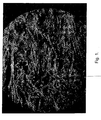
- the wax layer penetrates the board to a depth of 90-150 ⁇ m. Approximately 12 g/m 2 of wax is applied or allowed to penetrate. Typically, the wax layer is scraped at a temperature of 125-130 °C. A new layer which is properly porous to air and water vapour is formed. After scraping, there is no "free" wax on the surface as a continuous layer. According to the invention, the correct HLB value for the wax layer is between 10 and 12 (cf. Figure 1, which shows loose fibres).
- the penetration of the wax layer to the other side can be stopped by cooling the web so that its temperature optimally falls to below 30 °C. Cooling can be achieved using one or more cooling cylinders.
- the durability of the surface improves by about 15%.
- a typical paper product, used to manufacture the product in accordance with the invention has water absorption levels of 20-25 g/m 2 (measured with the Cobb 60 method, ISO 535:1991), this level increases typically to 50-60 g/m 2 during the acrylate+benzoate treatment, and decreases to approx. 12-14 g/m 2 in the final product, after the "waxing" treatment.
- the air permeance of paper or cardboard measured with a Guerley device (ISO 5636-5:1986), is approximately 60-70 ⁇ /Pa ⁇ s for base papers, and approx. 200 ⁇ /Pa ⁇ s after the benzoate+acrylate treatment.
- the benzoate attaches to the acrylic polymer in the treatment described above.
- the sodium benzoate penetrates a fibrous product to a depth of 50-60 ⁇ m.
- These typical conditions are created when the fibrous product is dried immediately after the acrylic+benzoate is spread on, by putting it into direct contact with the surface of a drying cylinder so that the treated surface is against the hot surface of the cylinder.
- the swift release of steam (30% acrylate and benzoate + ⁇ 70% water) makes the surface porous.
- sodium benzoate is present at a concentration of 2-4 g/m 2 , optimally 3 g/m 2 , and present in the surface layer at a level of 7-9% of the weight of the surface layer.
- the sodium benzoate improves the penetration of water into the fibres, which causes the fibres to swell and the surface to roughen. Naturally, this can be achieved with other known chemicals that cause fibres to swell. Optimally it should be one which also has fungicidal properties.
- suitable substances are: ethyl-p-hydroxybenzoate; the sodium, potassium or calcium salts of ethyl-p-hydroxybenzoate; propyl-p-hydroxybenzoate; the sodium, potassium or calcium salts of propyl-p-hydroxybenzoate; methyl-p-hydroxybenzoate; and the sodium, potassium or calcium salts of methyl-p-hydroxybenzoate.
- suitable substances for use as antimicrobial agents are hexamethylenetetramine; ortho-phenylphenol; the salts, e.g. sodium, potassium or calcium salts, of ortho-phenylphenol; and thiabendazole. Compounds of the substances listed above may also be used as antimicrobial agents.
- the invention consists of many separate factors, which are described in the text above. However, there are certain major factors which are essential to the invention, such as the use of benzoic acid salts or their derivatives, or other substances listed in this application, as fungicides; and the treatment of a binder such as an acrylate polymer, and a wax layer on a hot surface so that the surface onto which the substance has been applied comes into direct contact with the hot cylinder surface.
- This text refers to acrylic polymers, but any polymers which emulsify in water achieve the same ends in principle. Such polymers include polyvinyl acetate and the ammoniacal form of polyethylene terephthal sulphone (e.g. EvCote, Asia Pacific Specialty Chemicals, USA). As there are many viable polymers, they must be used together with additives which provide optimal HLB values. Hundreds of such additives are listed in bibliography.
- the finished cardboard is attached to a gypsum board with gypsite, after which the finished boards are dried.
- This process further improves the cardboard's steam permeability and friction.
- the wax penetrates deeper into the gypsum board, which improves the water tolerance of the cardboard/gypsum boundary layer. In practice this is a great advantage, as wax cannot be applied to the cardboard on the side to be attached to the gypsum board prior to the attachment to the gypsum board, because it would cause the adhesion of the gypsum board to the cardboard to deteriorate.
- Figure 1 shows the surface of the product.
- Figure 2 is a photograph of a gypsum board, onto which a drop of water has been applied. Although there are free fibres on the surface, the water's angle of contact is >90°. It is also notable, that these samples were approximately one year old and had been stored in sunlight in the laboratory. Typically, waxes and oils become oxidised, which causes the moistening angle to decrease. In the examples produced for this invention, this problem has been addressed with branched microwaxes, which are known radical inhibitors, protecting the surface against ozone and UV rays. Those skilled in the art will see that other radical inhibitors, such as acrylated bisphenols and lactones, can also be used.
- the acidulation of the paper product means that its pH is reduced to ⁇ 7 but ⁇ 3, because the fungicidal effects of sodium benzoate and its derivatives appear in acidic conditions but are very limited in neutral conditions.
- the aqueous solution of sodium benzoate is naturally slightly alkaline. At a pH of ⁇ 3, the paper begins to hydrolyze into sugars too quickly, also weakening in other ways. Any acids can be used which do not evaporate or break down, but sulphuric acid is the cheapest, while boric acid significantly improves fire-proofing and is a particularly good antimicrobial agent.
- Non-toxic substances such as melamine sulphate or zinc borate can also be used to improve fire-retardant qualities.
- the waxing procedure used in the invention to waterproof the surface means that the fungicide agents attached to the polymer binder cannot be washed away as easily. Further, the lipophile balance of the surface and of the layer underneath the surface is improved e.g. by an acrylic binder, which also prevents the fungicidal agents from being washed away.
- the methods described in the technique, and the given basis weight and penetration depths are important parameters, because they cause e.g. the gypsum board side of the cardboard to stay in its original form, which binds the gypsum.
- suitable additives for use as fire retardants include zinc borate and melamine sulphate.
- the calorimetric fuel value of a facing in accordance with the invention is ⁇ 4 MJ/m 2 , taking into account all additives, if the pulling resistance of the base cardboard in the machine direction is at times at least 12-13 kN/m. In these conditions, the cardboard will typically be 190 g/m 2 in weight, fulfilling the normal requirements regarding durability.
- wax we mean a combination of waxes and/or polymers, whose characteristics include the HLB value mentioned above, and which contain radical inhibitors, i.e. agents which improve resistance to UV rays and ozone. They can also be other agents than the branched microwax mentioned above. Further, the joint HLB value of the polymer layer and the pigment and fungicide contained in it must be suitable, as described above, in order to allow the wax layer, which is applied later, to penetrate the surface as desired.
- the polymer layer and its additives can favourably be applied using known methods such as gravure coating, offset gravure coating, rod coating, airbrush coating, treating with a surface-size press, curtain coating, or controlled lick coating, feeding polymer emulsion onto the cardboard's surface from below.
- the facing in accordance with the invention can be manufactured on the same production line as the base material.
- the treatment of the base material can be carried out using a paper or board machine.
- the liquid substance, containing an antimicrobial agent and a binder, can be spread onto the base material for instance using a surface-size press.
- the wax layer can be spread at an elevated temperature, after which any excess is removed with a scraping method such as a trailing blade.
- Finished surfaces can also be printed e.g. with logos using common printing techniques, as long as the HLB value of the printing ink is approx. 10.
- the finished facing is attached to the surface of the construction board. If the board contains gypsum, this is done using gypsite. Usually, both sides of the construction board are faced.
Landscapes
- Life Sciences & Earth Sciences (AREA)
- Pest Control & Pesticides (AREA)
- Engineering & Computer Science (AREA)
- Architecture (AREA)
- Civil Engineering (AREA)
- Structural Engineering (AREA)
- Chemical & Material Sciences (AREA)
- Biochemistry (AREA)
- Chemical Kinetics & Catalysis (AREA)
- General Chemical & Material Sciences (AREA)
- Laminated Bodies (AREA)
- Paper (AREA)
- Treatments For Attaching Organic Compounds To Fibrous Goods (AREA)
- Dry Formation Of Fiberboard And The Like (AREA)
Priority Applications (1)
| Application Number | Priority Date | Filing Date | Title |
|---|---|---|---|
| PL06017684T PL1760196T3 (pl) | 2005-08-24 | 2006-08-24 | Sposób wytwarzania materiału wykończeniowego do płyt strukturalnych oraz materiały wykończeniowe |
Applications Claiming Priority (2)
| Application Number | Priority Date | Filing Date | Title |
|---|---|---|---|
| PCT/FI2005/000365 WO2006021614A1 (en) | 2004-08-25 | 2005-08-24 | Gypsum board coating, gypsum board and cardboard-coated gypsum board production method |
| FI20065106A FI121190B (fi) | 2005-08-24 | 2006-02-13 | Menetelmä rakennelevyn pinnoitetuotteen valmistamiseksi ja pinnoitetuote |
Publications (3)
| Publication Number | Publication Date |
|---|---|
| EP1760196A2 true EP1760196A2 (de) | 2007-03-07 |
| EP1760196A3 EP1760196A3 (de) | 2007-11-07 |
| EP1760196B1 EP1760196B1 (de) | 2009-11-11 |
Family
ID=35953705
Family Applications (1)
| Application Number | Title | Priority Date | Filing Date |
|---|---|---|---|
| EP06017684A Active EP1760196B1 (de) | 2005-08-24 | 2006-08-24 | Verfahren zur Herstellung von einem Verkleidungsprodukt für Bauplatten und Verkleidungsprodukt |
Country Status (4)
| Country | Link |
|---|---|
| EP (1) | EP1760196B1 (de) |
| FI (1) | FI121190B (de) |
| PL (1) | PL1760196T3 (de) |
| UA (1) | UA89178C2 (de) |
Cited By (2)
| Publication number | Priority date | Publication date | Assignee | Title |
|---|---|---|---|---|
| WO2017095947A3 (en) * | 2015-11-30 | 2017-07-20 | MOORE, Heidi | Permeable elastomeric membrane adhered to fire-rated structural osb panels |
| CN116477853A (zh) * | 2023-04-17 | 2023-07-25 | 巨石集团有限公司 | 玻璃纤维表面处理剂及其制备方法、玻璃纤维及其应用 |
Citations (8)
| Publication number | Priority date | Publication date | Assignee | Title |
|---|---|---|---|---|
| US6638356B2 (en) | 2000-08-29 | 2003-10-28 | Kawasaki Kasei Chemicals Ltd. | Gypsum-based building material |
| US6680127B2 (en) | 2001-08-03 | 2004-01-20 | Temple-Inland Forest Products, Corporation | Antifungal gypsum board |
| US6767647B2 (en) | 2002-06-07 | 2004-07-27 | Microban Products Company | Antimicrobial wallboard |
| US6770354B2 (en) | 2001-04-19 | 2004-08-03 | G-P Gypsum Corporation | Mat-faced gypsum board |
| US6773822B2 (en) | 2001-08-03 | 2004-08-10 | Temple-Inland Forest Products Corporation | Antifungal gypsum board |
| US6800361B2 (en) | 2002-06-14 | 2004-10-05 | E. I. Du Pont De Nemours And Company | Gypsum board having improved flexibility, toughness, abuse resistance, water resistance and fire resistance |
| US6833137B1 (en) | 1996-05-10 | 2004-12-21 | Bayer Cropscience S.A. | Protection against termites |
| US6893752B2 (en) | 2002-06-28 | 2005-05-17 | United States Gypsum Company | Mold-resistant gypsum panel and method of making same |
Family Cites Families (1)
| Publication number | Priority date | Publication date | Assignee | Title |
|---|---|---|---|---|
| US3998944A (en) * | 1972-08-14 | 1976-12-21 | United States Gypsum Company | Fungicidal paper |
-
2006
- 2006-02-13 FI FI20065106A patent/FI121190B/fi active IP Right Grant
- 2006-08-21 UA UAA200609211A patent/UA89178C2/ru unknown
- 2006-08-24 EP EP06017684A patent/EP1760196B1/de active Active
- 2006-08-24 PL PL06017684T patent/PL1760196T3/pl unknown
Patent Citations (8)
| Publication number | Priority date | Publication date | Assignee | Title |
|---|---|---|---|---|
| US6833137B1 (en) | 1996-05-10 | 2004-12-21 | Bayer Cropscience S.A. | Protection against termites |
| US6638356B2 (en) | 2000-08-29 | 2003-10-28 | Kawasaki Kasei Chemicals Ltd. | Gypsum-based building material |
| US6770354B2 (en) | 2001-04-19 | 2004-08-03 | G-P Gypsum Corporation | Mat-faced gypsum board |
| US6680127B2 (en) | 2001-08-03 | 2004-01-20 | Temple-Inland Forest Products, Corporation | Antifungal gypsum board |
| US6773822B2 (en) | 2001-08-03 | 2004-08-10 | Temple-Inland Forest Products Corporation | Antifungal gypsum board |
| US6767647B2 (en) | 2002-06-07 | 2004-07-27 | Microban Products Company | Antimicrobial wallboard |
| US6800361B2 (en) | 2002-06-14 | 2004-10-05 | E. I. Du Pont De Nemours And Company | Gypsum board having improved flexibility, toughness, abuse resistance, water resistance and fire resistance |
| US6893752B2 (en) | 2002-06-28 | 2005-05-17 | United States Gypsum Company | Mold-resistant gypsum panel and method of making same |
Cited By (2)
| Publication number | Priority date | Publication date | Assignee | Title |
|---|---|---|---|---|
| WO2017095947A3 (en) * | 2015-11-30 | 2017-07-20 | MOORE, Heidi | Permeable elastomeric membrane adhered to fire-rated structural osb panels |
| CN116477853A (zh) * | 2023-04-17 | 2023-07-25 | 巨石集团有限公司 | 玻璃纤维表面处理剂及其制备方法、玻璃纤维及其应用 |
Also Published As
| Publication number | Publication date |
|---|---|
| FI20065106A0 (fi) | 2006-02-13 |
| EP1760196A3 (de) | 2007-11-07 |
| PL1760196T3 (pl) | 2010-06-30 |
| UA89178C2 (ru) | 2010-01-11 |
| FI121190B (fi) | 2010-08-13 |
| EP1760196B1 (de) | 2009-11-11 |
| FI20065106L (fi) | 2007-02-25 |
Similar Documents
| Publication | Publication Date | Title |
|---|---|---|
| US8613829B2 (en) | Anti-microbial paper substrates useful in wallboard tape applications | |
| DE69422965T2 (de) | Polymerverstärktes Papier mit verbesserter Reissfestigkeit in der Querrichtung | |
| US4362781A (en) | Flushable premoistened wiper | |
| US6767647B2 (en) | Antimicrobial wallboard | |
| US8617718B2 (en) | Mold-resistant gypsum panel paper | |
| US20060008496A1 (en) | Insulation paper facing containing an antimicotic or fungicide and methods of making and using the same | |
| RU2674428C2 (ru) | Неплесневеющая бумага и гипсовая панель, противомикробное бумажное покрытие и связанные способы | |
| JP2004501286A (ja) | 改善された生物学的安定性を有するセルロース繊維およびその結果得られる製品の生産方法 | |
| BR112018012677B1 (pt) | Sistema de composição de revestimento e método para tratar artigos celulósicos, uso de um kit, e, artigo celulósico | |
| JP7782918B2 (ja) | 紙製マルチシート | |
| EP1760196B1 (de) | Verfahren zur Herstellung von einem Verkleidungsprodukt für Bauplatten und Verkleidungsprodukt | |
| EP1792011B1 (de) | Kartonplatte, gipskartonplatte und herstellungsverfahren dafür | |
| RU2394008C2 (ru) | Способ обработки листового материала, материал, полученный указанным способом, и его применение в качестве облицовки | |
| DE202005005208U1 (de) | Textiles Flächengebilde zur Verwendung als Wandbekleidung | |
| WO2015119542A1 (en) | Insulating material and fire inhibiting composition | |
| US5948357A (en) | Heat resistant paper interleaver for sheet metal | |
| US8057881B2 (en) | Fungi resistant asphalt and asphalt sheet materials | |
| DE60215082T2 (de) | Dekorschicht | |
| JP2004068218A (ja) | 防腐・防カビ性紙 | |
| JP2004115978A (ja) | 耐水性防黴紙 | |
| DE4435918A1 (de) | Mineralwolleprodukt, Verfahren zu seiner Herstellung, Imprägnierungsmasse hierfür sowie deren Verwendung | |
| DD234616A1 (de) | Herstellung von wasserbindenden matten aus faservliesen oder geweben | |
| DE102006024335A1 (de) | Konservierungsverfahren für Objekte insbesondere Gesteine | |
| DE9422317U1 (de) | Polymerverstärktes Papier mit verbesserter Reißfestigkeit in Querrichtung |
Legal Events
| Date | Code | Title | Description |
|---|---|---|---|
| PUAI | Public reference made under article 153(3) epc to a published international application that has entered the european phase |
Free format text: ORIGINAL CODE: 0009012 |
|
| AK | Designated contracting states |
Kind code of ref document: A2 Designated state(s): AT BE BG CH CY CZ DE DK EE ES FI FR GB GR HU IE IS IT LI LT LU LV MC NL PL PT RO SE SI SK TR |
|
| AX | Request for extension of the european patent |
Extension state: AL BA HR MK YU |
|
| PUAL | Search report despatched |
Free format text: ORIGINAL CODE: 0009013 |
|
| AK | Designated contracting states |
Kind code of ref document: A3 Designated state(s): AT BE BG CH CY CZ DE DK EE ES FI FR GB GR HU IE IS IT LI LT LU LV MC NL PL PT RO SE SI SK TR |
|
| AX | Request for extension of the european patent |
Extension state: AL BA HR MK YU |
|
| RAP1 | Party data changed (applicant data changed or rights of an application transferred) |
Owner name: WALKI GROUP OY |
|
| 17P | Request for examination filed |
Effective date: 20080507 |
|
| AKX | Designation fees paid |
Designated state(s): AT BE BG CH CY CZ DE DK EE ES FI FR GB GR HU IE IS IT LI LT LU LV MC NL PL PT RO SE SI SK TR |
|
| GRAP | Despatch of communication of intention to grant a patent |
Free format text: ORIGINAL CODE: EPIDOSNIGR1 |
|
| GRAS | Grant fee paid |
Free format text: ORIGINAL CODE: EPIDOSNIGR3 |
|
| GRAA | (expected) grant |
Free format text: ORIGINAL CODE: 0009210 |
|
| AK | Designated contracting states |
Kind code of ref document: B1 Designated state(s): AT BE BG CH CY CZ DE DK EE ES FI FR GB GR HU IE IS IT LI LT LU LV MC NL PL PT RO SE SI SK TR |
|
| REG | Reference to a national code |
Ref country code: GB Ref legal event code: FG4D |
|
| REG | Reference to a national code |
Ref country code: CH Ref legal event code: EP |
|
| REG | Reference to a national code |
Ref country code: IE Ref legal event code: FG4D |
|
| REF | Corresponds to: |
Ref document number: 602006010284 Country of ref document: DE Date of ref document: 20091224 Kind code of ref document: P |
|
| REG | Reference to a national code |
Ref country code: CH Ref legal event code: NV Representative=s name: OFFICE ERNEST T. FREYLINGER S.A. C/O SCHLUEP & DEG |
|
| REG | Reference to a national code |
Ref country code: SE Ref legal event code: TRGR |
|
| REG | Reference to a national code |
Ref country code: DK Ref legal event code: T3 |
|
| LTIE | Lt: invalidation of european patent or patent extension |
Effective date: 20091111 |
|
| PG25 | Lapsed in a contracting state [announced via postgrant information from national office to epo] |
Ref country code: PT Free format text: LAPSE BECAUSE OF FAILURE TO SUBMIT A TRANSLATION OF THE DESCRIPTION OR TO PAY THE FEE WITHIN THE PRESCRIBED TIME-LIMIT Effective date: 20100311 Ref country code: LT Free format text: LAPSE BECAUSE OF FAILURE TO SUBMIT A TRANSLATION OF THE DESCRIPTION OR TO PAY THE FEE WITHIN THE PRESCRIBED TIME-LIMIT Effective date: 20091111 Ref country code: IS Free format text: LAPSE BECAUSE OF FAILURE TO SUBMIT A TRANSLATION OF THE DESCRIPTION OR TO PAY THE FEE WITHIN THE PRESCRIBED TIME-LIMIT Effective date: 20100311 Ref country code: FI Free format text: LAPSE BECAUSE OF FAILURE TO SUBMIT A TRANSLATION OF THE DESCRIPTION OR TO PAY THE FEE WITHIN THE PRESCRIBED TIME-LIMIT Effective date: 20091111 Ref country code: ES Free format text: LAPSE BECAUSE OF FAILURE TO SUBMIT A TRANSLATION OF THE DESCRIPTION OR TO PAY THE FEE WITHIN THE PRESCRIBED TIME-LIMIT Effective date: 20100222 |
|
| PG25 | Lapsed in a contracting state [announced via postgrant information from national office to epo] |
Ref country code: SI Free format text: LAPSE BECAUSE OF FAILURE TO SUBMIT A TRANSLATION OF THE DESCRIPTION OR TO PAY THE FEE WITHIN THE PRESCRIBED TIME-LIMIT Effective date: 20091111 Ref country code: LV Free format text: LAPSE BECAUSE OF FAILURE TO SUBMIT A TRANSLATION OF THE DESCRIPTION OR TO PAY THE FEE WITHIN THE PRESCRIBED TIME-LIMIT Effective date: 20091111 Ref country code: CY Free format text: LAPSE BECAUSE OF FAILURE TO SUBMIT A TRANSLATION OF THE DESCRIPTION OR TO PAY THE FEE WITHIN THE PRESCRIBED TIME-LIMIT Effective date: 20091111 |
|
| PG25 | Lapsed in a contracting state [announced via postgrant information from national office to epo] |
Ref country code: RO Free format text: LAPSE BECAUSE OF FAILURE TO SUBMIT A TRANSLATION OF THE DESCRIPTION OR TO PAY THE FEE WITHIN THE PRESCRIBED TIME-LIMIT Effective date: 20091111 Ref country code: EE Free format text: LAPSE BECAUSE OF FAILURE TO SUBMIT A TRANSLATION OF THE DESCRIPTION OR TO PAY THE FEE WITHIN THE PRESCRIBED TIME-LIMIT Effective date: 20091111 Ref country code: BG Free format text: LAPSE BECAUSE OF FAILURE TO SUBMIT A TRANSLATION OF THE DESCRIPTION OR TO PAY THE FEE WITHIN THE PRESCRIBED TIME-LIMIT Effective date: 20100211 |
|
| PG25 | Lapsed in a contracting state [announced via postgrant information from national office to epo] |
Ref country code: SK Free format text: LAPSE BECAUSE OF FAILURE TO SUBMIT A TRANSLATION OF THE DESCRIPTION OR TO PAY THE FEE WITHIN THE PRESCRIBED TIME-LIMIT Effective date: 20091111 Ref country code: CZ Free format text: LAPSE BECAUSE OF FAILURE TO SUBMIT A TRANSLATION OF THE DESCRIPTION OR TO PAY THE FEE WITHIN THE PRESCRIBED TIME-LIMIT Effective date: 20091111 |
|
| PLBE | No opposition filed within time limit |
Free format text: ORIGINAL CODE: 0009261 |
|
| STAA | Information on the status of an ep patent application or granted ep patent |
Free format text: STATUS: NO OPPOSITION FILED WITHIN TIME LIMIT |
|
| 26N | No opposition filed |
Effective date: 20100812 |
|
| PG25 | Lapsed in a contracting state [announced via postgrant information from national office to epo] |
Ref country code: GR Free format text: LAPSE BECAUSE OF FAILURE TO SUBMIT A TRANSLATION OF THE DESCRIPTION OR TO PAY THE FEE WITHIN THE PRESCRIBED TIME-LIMIT Effective date: 20100212 |
|
| PG25 | Lapsed in a contracting state [announced via postgrant information from national office to epo] |
Ref country code: IT Free format text: LAPSE BECAUSE OF FAILURE TO SUBMIT A TRANSLATION OF THE DESCRIPTION OR TO PAY THE FEE WITHIN THE PRESCRIBED TIME-LIMIT Effective date: 20091111 Ref country code: MC Free format text: LAPSE BECAUSE OF NON-PAYMENT OF DUE FEES Effective date: 20100831 |
|
| PG25 | Lapsed in a contracting state [announced via postgrant information from national office to epo] |
Ref country code: HU Free format text: LAPSE BECAUSE OF FAILURE TO SUBMIT A TRANSLATION OF THE DESCRIPTION OR TO PAY THE FEE WITHIN THE PRESCRIBED TIME-LIMIT Effective date: 20100512 Ref country code: LU Free format text: LAPSE BECAUSE OF NON-PAYMENT OF DUE FEES Effective date: 20100824 |
|
| REG | Reference to a national code |
Ref country code: FR Ref legal event code: PLFP Year of fee payment: 11 |
|
| REG | Reference to a national code |
Ref country code: FR Ref legal event code: PLFP Year of fee payment: 12 |
|
| REG | Reference to a national code |
Ref country code: FR Ref legal event code: PLFP Year of fee payment: 13 |
|
| P01 | Opt-out of the competence of the unified patent court (upc) registered |
Effective date: 20230621 |
|
| PGFP | Annual fee paid to national office [announced via postgrant information from national office to epo] |
Ref country code: NL Payment date: 20250818 Year of fee payment: 20 |
|
| PGFP | Annual fee paid to national office [announced via postgrant information from national office to epo] |
Ref country code: DK Payment date: 20250826 Year of fee payment: 20 Ref country code: DE Payment date: 20250819 Year of fee payment: 20 |
|
| PGFP | Annual fee paid to national office [announced via postgrant information from national office to epo] |
Ref country code: PL Payment date: 20250812 Year of fee payment: 20 Ref country code: TR Payment date: 20250808 Year of fee payment: 20 |
|
| PGFP | Annual fee paid to national office [announced via postgrant information from national office to epo] |
Ref country code: BE Payment date: 20250818 Year of fee payment: 20 Ref country code: GB Payment date: 20250819 Year of fee payment: 20 |
|
| PGFP | Annual fee paid to national office [announced via postgrant information from national office to epo] |
Ref country code: FR Payment date: 20250818 Year of fee payment: 20 Ref country code: AT Payment date: 20250819 Year of fee payment: 20 |
|
| PGFP | Annual fee paid to national office [announced via postgrant information from national office to epo] |
Ref country code: CH Payment date: 20250901 Year of fee payment: 20 Ref country code: SE Payment date: 20250819 Year of fee payment: 20 |
|
| PGFP | Annual fee paid to national office [announced via postgrant information from national office to epo] |
Ref country code: IE Payment date: 20250818 Year of fee payment: 20 |