EP1760418A1 - Verfahren zur Modellierung von einem Zementofen - Google Patents
Verfahren zur Modellierung von einem Zementofen Download PDFInfo
- Publication number
- EP1760418A1 EP1760418A1 EP05405518A EP05405518A EP1760418A1 EP 1760418 A1 EP1760418 A1 EP 1760418A1 EP 05405518 A EP05405518 A EP 05405518A EP 05405518 A EP05405518 A EP 05405518A EP 1760418 A1 EP1760418 A1 EP 1760418A1
- Authority
- EP
- European Patent Office
- Prior art keywords
- volatiles
- concentration
- volatility
- clinker
- heater
- Prior art date
- Legal status (The legal status is an assumption and is not a legal conclusion. Google has not performed a legal analysis and makes no representation as to the accuracy of the status listed.)
- Withdrawn
Links
Images
Classifications
-
- C—CHEMISTRY; METALLURGY
- C04—CEMENTS; CONCRETE; ARTIFICIAL STONE; CERAMICS; REFRACTORIES
- C04B—LIME, MAGNESIA; SLAG; CEMENTS; COMPOSITIONS THEREOF, e.g. MORTARS, CONCRETE OR LIKE BUILDING MATERIALS; ARTIFICIAL STONE; CERAMICS; REFRACTORIES; TREATMENT OF NATURAL STONE
- C04B7/00—Hydraulic cements
- C04B7/36—Manufacture of hydraulic cements in general
- C04B7/361—Condition or time responsive control in hydraulic cement manufacturing processes
-
- F—MECHANICAL ENGINEERING; LIGHTING; HEATING; WEAPONS; BLASTING
- F27—FURNACES; KILNS; OVENS; RETORTS
- F27B—FURNACES, KILNS, OVENS OR RETORTS IN GENERAL; OPEN SINTERING OR LIKE APPARATUS
- F27B7/00—Rotary-drum furnaces, i.e. horizontal or slightly inclined
- F27B7/20—Details, accessories or equipment specially adapted for rotary-drum furnaces
-
- F—MECHANICAL ENGINEERING; LIGHTING; HEATING; WEAPONS; BLASTING
- F27—FURNACES; KILNS; OVENS; RETORTS
- F27B—FURNACES, KILNS, OVENS OR RETORTS IN GENERAL; OPEN SINTERING OR LIKE APPARATUS
- F27B7/00—Rotary-drum furnaces, i.e. horizontal or slightly inclined
- F27B7/20—Details, accessories or equipment specially adapted for rotary-drum furnaces
- F27B7/42—Arrangement of controlling, monitoring, alarm or like devices
Definitions
- the invention relates to the field of cement kiln. It relates to a method for determining model parameters for model predictive control of the transforming process in a kiln System
- Cement is produced in large, hollow, internally sloping cylinders known as kilns where raw meal is heated with fuel to 1500°C and transformed into clinker.
- Gypsum and lime stone are the main ingredients in the raw meal fed to the kiln, while the fuels include both conventional fuels such as coal and oil and alternative fuels like tires, plastics and solvents.
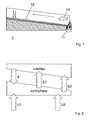
- Some components in the raw meal and the fuel are volatile and evaporate to some extent as the raw meal moves from the pre-heater down towards the burning zone of the kiln, where the fuel is added - sulfur, chlorine and alkalis are important examples of such components.
- the evaporated components travel in the opposite direction up the kiln, until eventually the volatile components condense back and close the circle, as is schematically depicted in the figure below.
- Volatile components play an important part in the mass and energy balances that shape the cement production process.
- the volatile components are as a rule viewed as contaminations in the clinker - the concentration of volatiles in the clinker should therefore be kept below an upper limit and as low as possible for quality purposes.
- volatiles can be let out as emissions in the gaseous phase, but environmental laws regulate the upper bounds for these emissions and, furthermore, energy is lost from the system which could otherwise be used to heat the raw meal.
- the negative cost associated with alternative fuels has prompted cement manufacturers to switch part of their fuel consumption to alternative fuels such as tires and solvents; the drawback is that many of these fuels contain high levels of volatiles like sulfur.
- Model predictive control and mixed-integer programming are used to optimize cement production. Since constraints concerning clinker quality and emissions control also need to be satisfied, the concentration of volatile components naturally becomes part of the optimization constraints. For optimal results and margins as narrow as possible, the concentration of volatiles needs to be estimated and predicted as accurately as possible.
- Changing volatility parameters are determined and the concentration of the volatiles is estimated with a parameterized model of the circulation of volatiles. The estimates of the volatility parameters are then used to predict the evolution of the volatile concentration over time.
- mass balance equations can be taken from cement literature, forming together with the original mass balance equation a system of equations with quite some redundancy.
- Exemplary equations represent mass balances for the volatile in the pre-heater, for the clinker residue, for volatile emissions in the chimney and for dust recirculation.
- Equation (1) and (2) The two mass balance equations used, obtained from the cement literature, are given below as equations (1) and (2), where x ( t ) denotes the concentration of the volatile component in the pre-heater and r ( t ) is the concentration of volatile as a residue in the clinker.
- B, c FCC and c RMCC are constants while u 1 ( t ) is the fuel input, u 2 ( t ) is the raw meal input and ⁇ is a variable time delay.
- B varying from 0 to 1, is the fraction of volatile that is not let out of the system as emissions;
- c FCC and c RMCC are vectors where the i th element denotes the concentration of volatile in the i th component of the fuel or feed, respectively.
- the third volatility parameter has to be assumed constant and known - since no such information was available, this filter was not sufficient to predict the trajectory of the volatile concentration.
- the additional information provided with the reduced range can be of help.
- the prediction of the volatile concentration has rather low sensitivity to the value of the secondary volatility within the reduced range.
- the low sensitivity is related to the fact that seen as a function of E 2 , the system function as expressed above in equations (1) and (2) is linear. When E 2 varies in the interval of unphysical values [0,0.68], the results were quite different with much higher sensitivity to the value of E 2 and qualitatively different trajectories.
- the estimated secondary volatility can be validated with a time delay, by comparing the estimation and prediction errors obtained with different values of E 2 ; that way, the unobservability associated with the simultaneous estimation of all three volatility parameters can be eluded and an estimate also of the third parameter can be obtained.
- the inventive method can be applied in a computer based simulation of the cement kiln. Model predictive control and mixed-integer programming are used to optimize cement production.
- the module predicts the evolution over time of the concentration of volatile components, a quantity which is used in the mixed-integer program solved in each optimization.
- the inventive method is not restricted to the application for cement kiln but can rather be extended to other industrial processes where volatile components appear or even to mathematically analogous problems not necessarily related to volatiles.
Landscapes
- Engineering & Computer Science (AREA)
- Chemical & Material Sciences (AREA)
- Ceramic Engineering (AREA)
- Mechanical Engineering (AREA)
- General Engineering & Computer Science (AREA)
- Materials Engineering (AREA)
- Structural Engineering (AREA)
- Organic Chemistry (AREA)
- Curing Cements, Concrete, And Artificial Stone (AREA)
- Muffle Furnaces And Rotary Kilns (AREA)
Priority Applications (2)
| Application Number | Priority Date | Filing Date | Title |
|---|---|---|---|
| EP05405518A EP1760418A1 (de) | 2005-09-02 | 2005-09-02 | Verfahren zur Modellierung von einem Zementofen |
| PCT/CH2006/000475 WO2007025406A1 (en) | 2005-09-02 | 2006-09-04 | Model for a cement kiln process |
Applications Claiming Priority (1)
| Application Number | Priority Date | Filing Date | Title |
|---|---|---|---|
| EP05405518A EP1760418A1 (de) | 2005-09-02 | 2005-09-02 | Verfahren zur Modellierung von einem Zementofen |
Publications (1)
| Publication Number | Publication Date |
|---|---|
| EP1760418A1 true EP1760418A1 (de) | 2007-03-07 |
Family
ID=35929618
Family Applications (1)
| Application Number | Title | Priority Date | Filing Date |
|---|---|---|---|
| EP05405518A Withdrawn EP1760418A1 (de) | 2005-09-02 | 2005-09-02 | Verfahren zur Modellierung von einem Zementofen |
Country Status (2)
| Country | Link |
|---|---|
| EP (1) | EP1760418A1 (de) |
| WO (1) | WO2007025406A1 (de) |
Cited By (3)
| Publication number | Priority date | Publication date | Assignee | Title |
|---|---|---|---|---|
| ES2908114A1 (es) * | 2020-10-26 | 2022-04-27 | Univ Sevilla | Herramienta para gestionar la incorporacion eficiente de combustibles alternativos en plantas de cemento |
| CN118819097A (zh) * | 2024-09-14 | 2024-10-22 | 浙江大学 | 一种基于时序预测的水泥煅烧过程的在线实时优化方法 |
| US12370492B2 (en) | 2020-04-24 | 2025-07-29 | Petroliam Nasional Berhad (Petronas) | Method and system for designing and assessing the performance of a hollow fibre membrane contactor (MBC) in a natural gas sweetening process |
Families Citing this family (1)
| Publication number | Priority date | Publication date | Assignee | Title |
|---|---|---|---|---|
| CN117259406A (zh) * | 2023-09-22 | 2023-12-22 | 天津商业大学 | 一种水泥窑协同处理固体废弃物的配伍控制方法及系统 |
Citations (5)
| Publication number | Priority date | Publication date | Assignee | Title |
|---|---|---|---|---|
| US5687077A (en) * | 1991-07-31 | 1997-11-11 | Universal Dynamics Limited | Method and apparatus for adaptive control |
| US5707444A (en) * | 1994-04-21 | 1998-01-13 | F. L. Smidth & Co. A/S | Method for controlling the temperature in a kiln |
| WO2002022246A1 (en) * | 2000-09-11 | 2002-03-21 | Thermo Gamma-Metrics | System and method for mixture optimization |
| EP1382905A1 (de) * | 2002-07-19 | 2004-01-21 | Abb Research Ltd. | Bestimmung der Zusammenstellung eines Stoffgemisches zur Zufuhr in einen Ofen |
| US6790034B1 (en) * | 1999-11-04 | 2004-09-14 | Pretoria Portland Cement Company Limited | Kiln plant control system |
-
2005
- 2005-09-02 EP EP05405518A patent/EP1760418A1/de not_active Withdrawn
-
2006
- 2006-09-04 WO PCT/CH2006/000475 patent/WO2007025406A1/en not_active Ceased
Patent Citations (5)
| Publication number | Priority date | Publication date | Assignee | Title |
|---|---|---|---|---|
| US5687077A (en) * | 1991-07-31 | 1997-11-11 | Universal Dynamics Limited | Method and apparatus for adaptive control |
| US5707444A (en) * | 1994-04-21 | 1998-01-13 | F. L. Smidth & Co. A/S | Method for controlling the temperature in a kiln |
| US6790034B1 (en) * | 1999-11-04 | 2004-09-14 | Pretoria Portland Cement Company Limited | Kiln plant control system |
| WO2002022246A1 (en) * | 2000-09-11 | 2002-03-21 | Thermo Gamma-Metrics | System and method for mixture optimization |
| EP1382905A1 (de) * | 2002-07-19 | 2004-01-21 | Abb Research Ltd. | Bestimmung der Zusammenstellung eines Stoffgemisches zur Zufuhr in einen Ofen |
Non-Patent Citations (2)
| Title |
|---|
| DATABASE CA [online] CHEMICAL ABSTRACTS SERVICE, COLUMBUS, OHIO, US; VERMA, C. L.: "A case study on optimal design and performance of lime shaft kilns through simulation technique", XP009063059, retrieved from STN Database accession no. 2003:338062 * |
| INDIAN CHEMICAL ENGINEER , 45(1), 35-42 CODEN: ICENFW; ISSN: 0019-4506, 2003 * |
Cited By (4)
| Publication number | Priority date | Publication date | Assignee | Title |
|---|---|---|---|---|
| US12370492B2 (en) | 2020-04-24 | 2025-07-29 | Petroliam Nasional Berhad (Petronas) | Method and system for designing and assessing the performance of a hollow fibre membrane contactor (MBC) in a natural gas sweetening process |
| ES2908114A1 (es) * | 2020-10-26 | 2022-04-27 | Univ Sevilla | Herramienta para gestionar la incorporacion eficiente de combustibles alternativos en plantas de cemento |
| WO2022090599A1 (es) * | 2020-10-26 | 2022-05-05 | Universidad De Sevilla | Herramienta para gestionar la incorporación eficiente de combustibles alternativos en plantas de cemento |
| CN118819097A (zh) * | 2024-09-14 | 2024-10-22 | 浙江大学 | 一种基于时序预测的水泥煅烧过程的在线实时优化方法 |
Also Published As
| Publication number | Publication date |
|---|---|
| WO2007025406A1 (en) | 2007-03-08 |
Similar Documents
| Publication | Publication Date | Title |
|---|---|---|
| O'Neill | The thermodynamic controls on sulfide saturation in silicate melts with application to ocean floor basalts | |
| Dewald et al. | Why more sustainable cements failed so far? Disruptive innovations and their barriers in a basic industry | |
| EP2446329B1 (de) | Schätzen der Anfangszustände eines Systemmodells für die Steuerung eines industriellen Prozesses. | |
| Asprion et al. | Work flow in process development for energy efficient processes | |
| Yang et al. | Ash deposition propensity of coals/blends combustion in boilers: a modeling analysis based on multi-slagging routes | |
| CN104794263A (zh) | 基于ls_svm软测量的水泥回转窑烧成带温度的混杂建模方法 | |
| Ardente et al. | FALCADE: a fuzzy software for the energy and environmental balances of products | |
| Chelgani et al. | Estimation of free-swelling index based on coal analysis using multivariable regression and artificial neural network | |
| Wu et al. | Modeling of adaptive multi-output soft-sensors with applications in wastewater treatments | |
| US20180230390A1 (en) | Slag management toolset for determining optimal gasification temperatures | |
| Ali et al. | A machine learning approach for clinker quality prediction and nonlinear model predictive control design for a rotary cement kiln | |
| EP1760418A1 (de) | Verfahren zur Modellierung von einem Zementofen | |
| Gonçalves et al. | Toward smart and sustainable cement manufacturing process: Analysis and optimization of cement clinker quality using thermodynamic and data-informed approaches | |
| Farrag et al. | Graphical design and analysis of mass exchange networks using composition driving forces | |
| Castañón et al. | Energy and environmental savings via optimisation of the production process at a Spanish cement factory | |
| Voglauer et al. | Reaction-kinetics of the vanadium roast process using steel slag as a secondary raw material | |
| Durastanti et al. | Assessing the climate effects of clinker production: A statistical analysis to reduce its environmental impacts | |
| Khorami et al. | Studies of relationships between free swelling index (FSI) and coal quality by regression and adaptive neuro fuzzy inference system | |
| US10185792B2 (en) | Method for predicting slagging production position and slagging production possibility in furnace | |
| Keulen et al. | Comparing in silico flowsheet optimization strategies in biopharmaceutical downstream processes | |
| Alcaide-Moreno et al. | An efficient numerical model for fast simulation of the combustion of alternative fuels in a cement rotary kiln | |
| Rieger et al. | Advanced high-performance liquid chromatography method development: discovering unexpected choices in chromatography | |
| Pannocchia et al. | Rigorous simulation and model predictive control of a crude distillation unit | |
| CN116682514A (zh) | 水泥熟料性能预测和矿相设计模型、数据库及其应用 | |
| Doghmane et al. | Identification and modeling of a rotary kiln in cement plant based on ANN (MLP) |
Legal Events
| Date | Code | Title | Description |
|---|---|---|---|
| PUAI | Public reference made under article 153(3) epc to a published international application that has entered the european phase |
Free format text: ORIGINAL CODE: 0009012 |
|
| AK | Designated contracting states |
Kind code of ref document: A1 Designated state(s): AT BE BG CH CY CZ DE DK EE ES FI FR GB GR HU IE IS IT LI LT LU LV MC NL PL PT RO SE SI SK TR |
|
| AX | Request for extension of the european patent |
Extension state: AL BA HR MK YU |
|
| AKX | Designation fees paid | ||
| REG | Reference to a national code |
Ref country code: DE Ref legal event code: 8566 |
|
| STAA | Information on the status of an ep patent application or granted ep patent |
Free format text: STATUS: THE APPLICATION IS DEEMED TO BE WITHDRAWN |
|
| 18D | Application deemed to be withdrawn |
Effective date: 20071009 |