EP1760643A2 - Datenverarbeitung - Google Patents
Datenverarbeitung Download PDFInfo
- Publication number
- EP1760643A2 EP1760643A2 EP06119014A EP06119014A EP1760643A2 EP 1760643 A2 EP1760643 A2 EP 1760643A2 EP 06119014 A EP06119014 A EP 06119014A EP 06119014 A EP06119014 A EP 06119014A EP 1760643 A2 EP1760643 A2 EP 1760643A2
- Authority
- EP
- European Patent Office
- Prior art keywords
- rules
- data
- data processing
- processing system
- node
- Prior art date
- Legal status (The legal status is an assumption and is not a legal conclusion. Google has not performed a legal analysis and makes no representation as to the accuracy of the status listed.)
- Withdrawn
Links
Images


Classifications
-
- G—PHYSICS
- G06—COMPUTING OR CALCULATING; COUNTING
- G06N—COMPUTING ARRANGEMENTS BASED ON SPECIFIC COMPUTATIONAL MODELS
- G06N5/00—Computing arrangements using knowledge-based models
- G06N5/02—Knowledge representation; Symbolic representation
-
- G—PHYSICS
- G06—COMPUTING OR CALCULATING; COUNTING
- G06N—COMPUTING ARRANGEMENTS BASED ON SPECIFIC COMPUTATIONAL MODELS
- G06N5/00—Computing arrangements using knowledge-based models
- G06N5/04—Inference or reasoning models
Definitions
- the present invention relates to data processing and is concerned particularly with data processing systems that function as rules engines, and associated methods of data processing.
- a rules engine takes a set of input data and processes it in accordance with a set of predetermined rules to produce a set of output data.
- a rules engine may be realised in either hardware or software.
- Preferred embodiments of the present invention aim to provide rules engines that are improved in these respects.
- a data processing system arranged:
- said rules have an IF, THEN structure.
- each of said fundamental rule fragments comprises a single IF condition.
- said output from each node for which all fundamental rule fragments connected to that node have been satisfied is a THEN result.
- a data processing system as above is preferably arranged to process data comprising XML elements, value-attribute pairs or concepts and relations for a conceptual graph.
- the rules are arranged into sets of generations which are processed sequentially, the set of rules within each generation being processed non-sequentially.
- the rules include inheritance rules.
- the invention also extends to a method of processing data, comprising the steps of:
- such a method is carried out by a data processing system according to any of the preceding aspects of the invention.
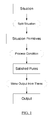
- the Non-Sequential Rules Engine having the functionality illustrated in Figure 1 is a data processing apparatus that transforms a situation and produces an output based on the rules within the NSRE. It may be realised in either hardware or software and may be regarded as a rules based object that takes an input of arbitrary complexity and generates a deterministic output.
- the rules engine can be regarded as an indexing of the rules based on a partial ordering of conditions.
- the illustrated NSRE uses a standard IF, THEN structure for rules.
- the IF part of the rule is the condition and may comprise complex data structures.
- the NSRE process starts by breaking the condition down into its primitive components.
- the primitive component is the basic building block of data and is defined by the data structure used. This could comprise XML elements, value-attribute pairs for a database NSRE or concepts and relations for a conceptual graph based NSRE.
- the condition model is processed to find satisfied rules and an output is formed from the THEN parts of the satisfied rules.
- the condition has a hierachical structure of nodes and the hierarchy may take the form of a tree or Directed Graph.
- This structure has at its highest level a hashed set of nodes which represent every primitive component that is present in its rules.
- Nodes are linked to join nodes which represent more complex data structures built up by adding together two or more primitive components.
- Figure 2 is a diagrammatic representation of a value-attribute pair condition model built up from a few simple rules.
- the situation primitive concepts are fed into the NSRE condition model and the nodes which represent each primitive component are found through the hashset. Once the node is satisfied, it passes the situation fragment down to its children (each of which has 2 or more parents). When all the parents of a child are satisfied, then the child is also satisfied.
- Each node represents a part or all of the condition for one of the NSREs rules.
- Each rule will have a node which exactly represents its condition. When this node is satisfied through the process decided above, then the rule is also considered satisfied.
- An output is made from satisfied rules.
- the THEN component from each satisfied rule is added into the output data structure and this is returned by the NSRE as the final result of the transform operation.
- the illustrated NSRE has several innovative features over traditional rules engines that are embodied by either hardware or software.
- the NSRE processes every rule at once. It can be viewed as searching the set of rules for the rules that are true, rather than executing them. This is achieved by breaking the condition component of every rule into its primitive components and representing these components as nodes. These nodes are linked to a hierarchy of join nodes, which together represent the condition of each rule.
- condition model which represents the sum total of the rules within the NSRE
- the nodes within the condition model are found using a set. Any nodes unrelated to the situation being processed will not increase the process time as these nodes are never visited or evaluated.
- An NSRE can be adapted to handle structured data both within the input situation and internally within the condition model. Structure allows data to be grouped and joined, allowing a much broader scoped data representation language.
- Examples of structured data format include Conceptual Graphs, database tables, XML and languages implemented with XML, such as HTML.
- a simple Conceptual Graph containing structure could be: [ Cat ] - > sat on - > Mat - > is - > Red .
- structured data can be processed using an NSRE process as has been described above.
- the join nodes within the condition model need one additional piece of information and that is if and how the parent nodes join together to form the child node. This can be achieved by having a deterministic ordering of the nodes and storing a joinMap within each node, which lists the numeric value of where nodes are identical.
- the preceding example could have a Map which contains [2,1]. This would mean that the second concept in the first parent node ([Map]) is the same as the first concept in the second parent node ([Map]).
- the basic NSRE function as outlined above with reference to Figure 1 is designed as an extensible framework. Modification to the NSRE can allow the NSRE to handle contextual information. Contextual information allows the NSRE to not only determine if a condition model node is satisfied within the situation, but how many times and where the node is true within the situation and where.
- the graph shown in Figure 4 is a simple example of a graph that can be processed using a contextual, structured graph.
- a Contextual NSRE can successfully handle the difficult case of where the context of the output is as important as the conclusion reached.
- the nodes within the condition model need to know additional information - that is, which node within the input data has satisfied the node in question.
- An NSRE may contain the rule:
- the node representing the primitive fragment [Dog]->(has)->[Bone] needs to handle the context of the fragment. This is done by maintaining a list of fragments within the situation that satisfy this node.
- join nodes In the case of join nodes, two or more lists are needed to represent fragments delivered from each of the parent nodes. The node then has to assess every permutation of all possible fragments to see if the join node itself is satisfied with respect to a joinMap as outlined above.
- knowing which dog is happy is much more useful than just knowing that there is a happy dog.
- An NSRE may be adapted to provide "generational rules", which allow rules to be made on previous rules. This may allows an expert to make a series of dependent conclusions seamlessly.
- An NSRE may have sets of ontological data which define how the world works, with the NSRE supporting multiple inheritance within the ontology. This allows structures such as that shown in Figure 7 to be constructed.
- a preferred embodiment takes rules represented by Conceptual Graphs, breaks them down into their fundamental graph fragments, and recombines the rule by joining these fragments together.
- This approach has the advantage that when the NSRE is processed, only fundamental fragments that are true need to be processed. Rules which contain fragments that are not true will never even be evaluated.
- Figure 8 shows an object BDag (Binary Directed acyclic graph) that holds a description of NSRE rules for a behaviour engine with the rule:
- BDag has split the conceptual graph in the conditional part of the rule into its fundamental fragments, i.e. [Man]->(has)->[Dog] and [Dog]->(has)->[Bone], and has joined these nodes back together to fully describe the whole conditional fragment in the bottom node in Figure 8.
- Preferred embodiments use conceptual graphs, but these principles can be extended to any data representation format where the data is processed first as its fundamental components.
- Contextual Non-Sequential Rules Engine The Conceptual Graph data representation language allows data to be given both structure and contextual information. This allows different instances of the same concept to be distinguished. A preferred embodiment of NSRE makes this contextual information available to the user. This allows the user to make the rules able to fire in several different places within a situation but also to make rules relating the exact contextual structure of the situation. For example, the two statements below are very different. and
- the Dog who has the bone might not necessarily be the same dog that is owned by the man.
- the second situation will not fire the example rule above if contextual reasoning is used.
- Generational Rules handle chains of dependent rules by placing these rules into their logical processing order and then separating these rules into generations. Generations are processed sequentially, with the set of rules within each generation being processed non-sequentially. The same BDag is used for every generation and as rules become true in each generation, their conclusions are fed back into this BDag.
- Data representation languages can support inheritance - these inheritance structures are normally grouped into an object called an ontology. Preferred embodiments allow the user to state inheritance structures such as:
- Figure 9 summarises the NSRE process of embodiments of the invention as described above.
- a data processing system 1 receives rules and splits them into their fundamental fragments that are joined by nodes, as explained in the foregoing description.
- the data processing system 1 then processes input data by the rule fragments and produces output data from nodes that are satisfied by their respective rule fragments.
- NSRE including the examples given herein, may be used with advantage in data processing systems arranged to replace legacy systems.
- the reader is referred to the specification and drawings of our patent application GB 05 16785.3 filed 16 August 2005 , a copy of the specification and drawings being annexed hereto.
Landscapes
- Engineering & Computer Science (AREA)
- Theoretical Computer Science (AREA)
- Computing Systems (AREA)
- Data Mining & Analysis (AREA)
- Evolutionary Computation (AREA)
- Physics & Mathematics (AREA)
- Computational Linguistics (AREA)
- General Engineering & Computer Science (AREA)
- General Physics & Mathematics (AREA)
- Mathematical Physics (AREA)
- Software Systems (AREA)
- Artificial Intelligence (AREA)
- Information Retrieval, Db Structures And Fs Structures Therefor (AREA)
- Devices For Executing Special Programs (AREA)
Applications Claiming Priority (1)
| Application Number | Priority Date | Filing Date | Title |
|---|---|---|---|
| GBGB0516786.1A GB0516786D0 (en) | 2005-08-16 | 2005-08-16 | Data processing |
Publications (2)
| Publication Number | Publication Date |
|---|---|
| EP1760643A2 true EP1760643A2 (de) | 2007-03-07 |
| EP1760643A3 EP1760643A3 (de) | 2011-10-19 |
Family
ID=35098390
Family Applications (1)
| Application Number | Title | Priority Date | Filing Date |
|---|---|---|---|
| EP06119014A Withdrawn EP1760643A3 (de) | 2005-08-16 | 2006-08-16 | Datenverarbeitung |
Country Status (2)
| Country | Link |
|---|---|
| EP (1) | EP1760643A3 (de) |
| GB (1) | GB0516786D0 (de) |
Cited By (1)
| Publication number | Priority date | Publication date | Assignee | Title |
|---|---|---|---|---|
| US11243949B2 (en) | 2017-04-21 | 2022-02-08 | Microsoft Technology Licensing, Llc | Query execution across multiple graphs |
Family Cites Families (2)
| Publication number | Priority date | Publication date | Assignee | Title |
|---|---|---|---|---|
| JPS647232A (en) * | 1987-06-30 | 1989-01-11 | Toshiba Corp | Inference processor |
| US7506307B2 (en) * | 2003-10-24 | 2009-03-17 | Microsoft Corporation | Rules definition language |
-
2005
- 2005-08-16 GB GBGB0516786.1A patent/GB0516786D0/en not_active Ceased
-
2006
- 2006-08-16 EP EP06119014A patent/EP1760643A3/de not_active Withdrawn
Cited By (1)
| Publication number | Priority date | Publication date | Assignee | Title |
|---|---|---|---|---|
| US11243949B2 (en) | 2017-04-21 | 2022-02-08 | Microsoft Technology Licensing, Llc | Query execution across multiple graphs |
Also Published As
| Publication number | Publication date |
|---|---|
| GB0516786D0 (en) | 2005-09-21 |
| EP1760643A3 (de) | 2011-10-19 |
Similar Documents
| Publication | Publication Date | Title |
|---|---|---|
| US20230334080A1 (en) | Putative ontology generating method and apparatus | |
| Segerlind et al. | A switching lemma for small restrictions and lower bounds for k-DNF resolution | |
| Leskovec et al. | Realistic, mathematically tractable graph generation and evolution, using kronecker multiplication | |
| US7774293B2 (en) | System and methods for assessing risk using hybrid causal logic | |
| US20170083547A1 (en) | Putative ontology generating method and apparatus | |
| Figueiredo et al. | Breaking into pieces: An ontological approach to conceptual model complexity management | |
| Rudolph et al. | Nominals, inverses, counting, and conjunctive queries or: why infinity is your friend! | |
| Bezhanishvili et al. | Completeness of S4 with respect to the real line: revisited | |
| WO2015161340A1 (en) | Ontology browser and grouping method and apparatus | |
| Ottosson et al. | Mixed global constraints and inference in hybrid CLP–IP solvers | |
| Hornung et al. | Rule-based Autocompletion of Business Process Models. | |
| Alvaro et al. | A declarative semantics for Dedalus | |
| Andersen et al. | Easy cases of probabilistic satisfiability | |
| EP1760643A2 (de) | Datenverarbeitung | |
| Huete et al. | Learning causal polytrees | |
| Hassanpour et al. | Exploration of SWRL rule bases through visualization, paraphrasing, and categorization of rules | |
| Hjelseth | Foundation for development of computable rules | |
| Kubis | A query language for WordNet-like lexical databases | |
| Klein | Linear time logic and deterministic omega-automata | |
| KR101225333B1 (ko) | 구문론적으로 분석된 텍스트 코퍼스로부터 정보를 추출하는 트리 패턴 표현식을 이용한 시스템 및 방법 | |
| Shachter | A graph-based inference method for conditional independence | |
| Arai et al. | Extended normal form theorems for logical proofs from axioms | |
| Lorini et al. | A modal framework for relating belief and signed information | |
| Ghasemzadeh | A new algorithm for the quantified satisfiability problem, based on zero-suppressed binary decision diagrams and memoization | |
| McKinley | Canonical proof nets for classical logic |
Legal Events
| Date | Code | Title | Description |
|---|---|---|---|
| PUAI | Public reference made under article 153(3) epc to a published international application that has entered the european phase |
Free format text: ORIGINAL CODE: 0009012 |
|
| AK | Designated contracting states |
Kind code of ref document: A2 Designated state(s): AT BE BG CH CY CZ DE DK EE ES FI FR GB GR HU IE IS IT LI LT LU LV MC NL PL PT RO SE SI SK TR |
|
| AX | Request for extension of the european patent |
Extension state: AL BA HR MK YU |
|
| PUAL | Search report despatched |
Free format text: ORIGINAL CODE: 0009013 |
|
| AK | Designated contracting states |
Kind code of ref document: A3 Designated state(s): AT BE BG CH CY CZ DE DK EE ES FI FR GB GR HU IE IS IT LI LT LU LV MC NL PL PT RO SE SI SK TR |
|
| AX | Request for extension of the european patent |
Extension state: AL BA HR MK RS |
|
| RIC1 | Information provided on ipc code assigned before grant |
Ipc: G06N 5/02 20060101ALI20110909BHEP Ipc: G06N 5/04 20060101AFI20110909BHEP |
|
| AKY | No designation fees paid | ||
| REG | Reference to a national code |
Ref country code: DE Ref legal event code: R108 |
|
| STAA | Information on the status of an ep patent application or granted ep patent |
Free format text: STATUS: THE APPLICATION IS DEEMED TO BE WITHDRAWN |
|
| REG | Reference to a national code |
Ref country code: DE Ref legal event code: R108 Effective date: 20120627 |
|
| 18D | Application deemed to be withdrawn |
Effective date: 20120301 |