EP1762144B1 - Chaussure pour sabot avec moyen de rétention du talon pivotant - Google Patents
Chaussure pour sabot avec moyen de rétention du talon pivotant Download PDFInfo
- Publication number
- EP1762144B1 EP1762144B1 EP06018893.5A EP06018893A EP1762144B1 EP 1762144 B1 EP1762144 B1 EP 1762144B1 EP 06018893 A EP06018893 A EP 06018893A EP 1762144 B1 EP1762144 B1 EP 1762144B1
- Authority
- EP
- European Patent Office
- Prior art keywords
- boot
- base
- hoof
- heel
- heel captivator
- Prior art date
- Legal status (The legal status is an assumption and is not a legal conclusion. Google has not performed a legal analysis and makes no representation as to the accuracy of the status listed.)
- Active
Links
Images









Classifications
-
- A—HUMAN NECESSITIES
- A01—AGRICULTURE; FORESTRY; ANIMAL HUSBANDRY; HUNTING; TRAPPING; FISHING
- A01K—ANIMAL HUSBANDRY; AVICULTURE; APICULTURE; PISCICULTURE; FISHING; REARING OR BREEDING ANIMALS, NOT OTHERWISE PROVIDED FOR; NEW BREEDS OF ANIMALS
- A01K13/00—Devices for grooming or caring of animals, e.g. curry-combs; Fetlock rings; Tail-holders; Devices for preventing crib-biting; Washing devices; Protection against weather conditions or insects
- A01K13/006—Protective coverings
- A01K13/007—Leg, hoof or foot protectors
-
- A—HUMAN NECESSITIES
- A01—AGRICULTURE; FORESTRY; ANIMAL HUSBANDRY; HUNTING; TRAPPING; FISHING
- A01L—SHOEING OF ANIMALS
- A01L3/00—Horseshoes fastened by means other than nails, with or without additional fastening by nailing
-
- A—HUMAN NECESSITIES
- A01—AGRICULTURE; FORESTRY; ANIMAL HUSBANDRY; HUNTING; TRAPPING; FISHING
- A01L—SHOEING OF ANIMALS
- A01L5/00—Horseshoes made of elastic materials
Definitions
- the field of the invention is in equine footwear.
- the known hoof boots tend to have poor conformation to different hooves, and tend to fall off the hooves upon extreme movements.
- the boots retain the heel in place by gripping the very lowest portion of the heels with a strap, and using gripper teeth to bite into the hoof wall.
- the gripping and the grabbing, especially by the gripper teeth, can cause significant hoof wall damage.
- this retention method only works on horses that have shoes nailed in place, or for barefoot horses where the hooves are foamed or glued into place.
- the rigidity of the boot and its closed design tends to trap debris between the boot and the hoof during use. Once dirt and mud get inside a hoof, they can cause painful bruises on the sole of the foot.
- boots according to the'958 or '363 patents must be properly fitted, and must be frequently checked for debris.
- U.S. Patent No. 4,744,422 (to Dallmer) provides a hoof boot with mountable belts. While the belts of this design are less rigid than an enclosed boot, they still do not provide adequate flexibility, and at the same time securely retain the hoof. In addition, the '422 design has insufficient clearance for the descending pastern bones, and is open on the bottom, thereby providing little protection to the sole of the horses hoof.
- GB 2 128 867 A discloses a horseshoe assembly that is adapted to accommodate a hoof and includes a body made of elastomeric material.
- the horse shoe is rear opened and receives the hoof through a rear opening.Further the horseshoe comprises bottoms where a band can be attached to close the horseshoe at the rear opening.
- a hoof boot includes a base, a heel retention piece (“heel captivator”), and a mechanism that moveably couples the heel captivator to the base.
- the base and other components of the boot can be made of any suitable substance or substances. Polymers are currently preferred, with the heel captivator being formed into a mesh with a plurality of holes. A liner underlying the heel captivator can be used to give extra protection.
- the sole of the boot preferably has a height of no more than 9 cm from the top of the sole.
- the heel retention piece can be coupled to the base in any suitable manner.
- Preferred coupling mechanisms provide sufficient play to provide for freestanding up/down, and forward/ rearward displacement of the heel captivator of at least 1.2 cm.
- An especially preferred coupling mechanism is a mechanically advantaged lacing system, with hook and loop fasteners.
- the lace preferably extends through a channel, and the pivoting mechanism comprises a restriction point where the lace exits from the channel.
- Such mechanisms are especially advantageously in that they allow the heel captivator at least three degrees of freedom of movement relative to the base.
- the base of the boot can include a sole with a top, and the pivoting mechanism is preferably disposed at a restriction point within 2 cm from the top of the sole. In many cases the restriction point is also at least 4-6 cm rearward from the front of the base.
- the base can include a front and a back, and the pivoting mechanism can have a restriction point disposed rearward at least 50% of the distance between the front and the back.
- the pivoting mechanism (which could be a hinge pin) can advantageously have a pivot or other restriction point within 2 or 3 cm of the back of the base.
- the action of the heel captivator would be identical to the non-hinge pin version insofar as its ability to move with the foot. There is a sweet spot in this regard whereby a balance between movement, restriction and retention is achieved.
- Tightening mechanisms are preferably mechanically advantaged in some manner, and can also include a ratchet.
- a tongue can advantageously underlie the tightening mechanism.
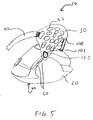
- a hoof boot 10 generally comprises a base 20, a heel captivator 30, a keeper strap 40, a hook strap 50 with cables 60, and a liner 70.
- a heel captivator 30 can comprise a single, contoured piece with an arch top 106, a strap holder portion 104 extending from a heel bulb 105 on each side of the heel captivator 30, an attachment position 101 on each side also extending from the heel bulb 105, and an edge 108.
- the arch top 106 extends from one of the strap holder portions 104 to the other as seen in Figures 2 and 3 .
- the arch top 106 has a U-shape or other conformation that provides adequate clearance for the pastern bone region of the hoof as shown in Figure 4 .
- the pastern bones descend very low upon the weight bearing phase of a horse and can approach ground parallel angles or lower angles near or below ground surface, especially during elevated or faster gaits such as the extended trot, canter or gallop.
- the arch top 106 is advantageously contoured to the soft tissue of the pastern bones to allow for ample clearance of the pastern bones to descend, without impacting the bones and tendons, or abrading the soft tissue and lateral cartilages of the lower leg.
- Another advantage of the arch top 106 design in Figure 4 is that it provides adequate closure and retention of the heel of the hoof within the boot.
- the heel captivator Extending from the arch top 106 to the edge 108, the heel captivator has two heel bulb portions 105, one located on each side.
- the heel bulb portions 105 are of a concave design that contours to the hoof of the horse.
- hoof boots for animals other than horses could require different contours, and all such contours are contemplated since the present inventive subject matter contemplates applications to other hoofed animals, including especially mules and other equine animals.
- the heel region comprises delicate soft tissue, tendons, cartilage structures, which encompass the majority of the heel and the lower leg. Conformability of the hoof boot in the heel region is important to reduce pressure points on the soft tissue, tendons, and lateral cartilages and will minimize the potential for bruising, chaffing, and abrasion of the hoof capsule.
- the heel bulb portions 105 advantageously provide conformable flexibility and comfort to the heel and retain the heel in the boot and can withstand tremendous forces that are applied to the heel inside the boot.
- a strap holder portion 104 is located on either side of the heel captivator 30.
- the design of the heel captivator is an open mesh architecture.
- the heel captivator 30 comprises different sized holes 107 throughout the piece. It is contemplated that the holes 107 are of a oval shape that average 1.5 cm x 1.0 cm. Other shapes, such as rectangular, triangular or any irregular shapes are also contemplated. Similarity, the size of the holes can vary from small 0.1 cm diameter circles 5 cm diameter circles.
- the strap holder portions 104 are essentially two large holes that are can accommodate a keeper strap 30. They look like ears of the heel captivator. The advantage of the open mesh design allows for the escape of dirt and debris from the hoof.
- Enclosing or encasing the hoof inside of a closed boot can trap debris such as sand, rocks, dirt, gravel, water, mud, and snow, between the boot and the hoof during use.
- debris such as sand, rocks, dirt, gravel, water, mud, and snow
- the open mesh design allows the debris to fall out of the boot instead of being trapped.
- the edge 108 of the heel captivator is a straight edge that contours to the body of the heel captivator 30.
- the edge 108 is open and disconnected to the bottom 22 of the base 20 of the heel captivator 30.
- the open nature of this interface between the heel captivator and the base further allow the ejection of debris.
- the lack of attachment in the back of the boot allows the heel captivator to follow with the hoof and interface with the hoof in an intimate and well conforming manner minimizing concentrated pressure. This not only serves to minimize bruising and chafing but serves to maximize the holding and restraining capability of the heel captivator.
- the hoof (not shown) in the boot 10 can pull out of the boot in an upward, outward, and downward manner without having uneven or concentrated pressure applied to heel captivator 30 as it interacts with and attempts restrain the caudal portion of the hoof.
- the heel captivator 30 is attached to the bottom 22 of the base 20 via a hinge 110.
- the hinge 110 rests in the center section of the edge 108 and is connected by inserting a steel rod (not shown) to an edge of the bottom 22.
- the hinge 110 is then pushed into the bottom 22 and the steel rod goes through both the bottom 22 and the hinge 110 to form a secure connection.
- the hinge action allows for flexibility of the heel captivator and permits the boot top to open wide making installation and removal of the boot much easier.
- Horses can wear hoof boots with a hinged heel captivator in extreme conditions, such as trotting through heavy mud, deep snow, or other rough terrain, when the hooves need greater retention.
- extreme conditions such as trotting through heavy mud, deep snow, or other rough terrain
- the vacuum or sucking action of the mud causes extreme force to act upon the boot which allows for undesirable movement of the boot in it's normal relationship with the hoof.
- such forces can easily cause the boot to either come off partially or entirely.
- the heel captivator is hinged to the base of the boot, the hoof must stay inside the boot. Even if the horse is trying to pull itself free from the boot, or for some other reason there is extreme erratic movement of the horse, or interference from the opposing hooves, the heel captivator with the hinge is free to move along with the hoof.
- the action of the boot can automatically adjust, and the boot base can automatically tighten, thereby increasing the holding and restraining power of the heel captivator creating a near impossibility of the boot inadvertently departing from the hoof.
- the hinged version of the boot is combined with a full pastern wrap heel liner, and a keeper strap or pastern strap, to provide for even better foot and/or boot retention.
- This version is especially good at retaining the foot when the inside of the boot gets slippery, as in the case of use in deep mud or snow.
- the hinge and a pastern wrap With the use of the hinge and a pastern wrap, the heel inside the heel captivator is even more restricted than with an unhinged version.
- a liner inside of the hinged boot can further prevent abrasion from the hoof moving relative to the heel captivator, in the same manner that a sock can help prevent the heel of a human from rubbing on the back of the heel part of a boot or shoe.
- heel captivators as discussed herein can be designed to automatically adjust to the heel height of the hoof, which can vary from animal to animal.
- heel captivators can be shaped in a manner that provides intimate contact with the compound and bulbous contours of the caudal region of the hoof.
- heel captivators can be constructed of sufficiently flexible, pliable and conforming materials to further maximize the intimate contact, and reduce the possibility of concentrated pressure caused by variances in the contours of various hooves.
- urethane urethane
- rubber elastomeric material
- a singular or composite of materials such as urethane, leather, rubber, vinyl, plastic, flexible plastic sheet, sponge neoprene sheet, heavy fabric or canvas, various cords, straps and or other textile materials. All of this minimizes or at least reduces the possibility of chafing and bruising.
- attachment positions 101 on both sides of the heel captivator 30.
- the attachment positions 101 are preferably of a circular shape, and have a slot 103 on the side 102 of the heel captivator 30 where a cable pulley is inserted. This allows cables 60 to go through via the slot 103.
- the base 20 of the boot comprises two sides 304, a front flap 302 and a bottom 22.
- the sides 304 are conformed to the shape of the hoof and extends from the back of the boot and continues in a curved fashion on both edges of the boot to form a slope and round shape.
- the cable guides 62 are protruded portions that comprise at least one hole on one side and two holes on the other to allow for the cables 60 to extend from the front to the heal captivator.
- the front flap 302 extends from the bottom 22 and covers the sides 304. To prevent damaging the soft tissues, the front flap 302 takes into consideration the hooves' structure. It is contemplated that the front flap 302 does not cover the top portion of the hoof wall. More preferably the front flap 302 sits below the horn juncture. The low design prevents the trapping of debris against the delicate soft tissues. Prior art stops at or near the soft tissue to horn juncture where the tough hoof wall horn is not fully developed. Having a higher frontal region also subjects the hoof to damages. Old boot shell can rise well above the horn juncture where it can trap debris against the soft tissue, causing bruising, chaffing and abrasions, especially when debris is trapped between the hoof and the boot.
- One preferred embodiment has the front flap 302 acting like a tongue enclosed with overlapping sides. It is contemplated that the front flap is no higher than 10 cm, and preferably 9 cm. The lower design of the front flap allows for variances in hoof wall angle which permits the boot to conform well with the hoof wall. Hoof wall angels vary from hoof to hoof and from horse to horse.
- the thickness of the front flap is preferably no more than 1 cm. The minimal thickness in the toe region is desirable as it reduces the possibility of damage to the horse's hoof.
- the overlapping features of the front flap 302 to the sides forms a tight closure that serves to seal out debris. This overlapping front flap contrasts to the prior art which includes V cut interface between the adjustable portion and the front region or a bifurcated folding flap, which is generally loose and does not seal well.
- the base of the boot can be constructed with any suitable material.
- Preferred embodiments include a flexible, tough, resilient and elastic material that would permit normal expansion and contraction of the hoof and at the same time allowing the blood in the hoof to circulate and to absorbs shock.
- the material of the base should not appreciably hinder the hoofs natural movements, such as lateral vertical displacement as the hoof contacts on various terrain. It is important to prevent the bones, joints, ligaments, tendons and other connective tissues in the foot and lower leg of the horse from being overloaded.
- the base can be of a variety of colors and owners can decorate the base with different features, such as glitters and rhinestones.
- urethane urethane
- rubber or other elastomeric material or a singular or composite of materials such as urethane, leather, rubber, vinyl, plastic, flexible plastic sheet, sponge neoprene sheet, heavy fabric or canvas, various cords, straps and or other textile materials can be used.
- the sole 500 as shown in Figure 18 preferably is a shape similar to that of a horse's bare hoof.
- the sole 500 features a prominent outer rim 502 and a frog pressure zone 504 tapered away from the ground towards the center of the boot. Frog pressure is especially important for preserving proper hoof expansion and contraction during loading and unloading.
- the shape allows the boot to preserve the natural ground pressure and traction capabilities of the bare hoof while wearing the boot.
- the heel captivator 30 is attached to the base at attachment positions 101 depicted in Figures 1 , 2 , 4 , 5 , 9 , 11 , and 12 in a pivoting motion.
- the pivoting motion includes use of sloppy pivots that have more than a rotational freedom of movement and allows the heel captivator in all directions.
- the cable pulley block 122 comprises two end pieces 128, and a connector 129 about which the cable is disposed.
- the cables 60 go through the cable guides 220 to the front of the base 20 and allow the heel captivator to have elasticity upon wearing.
- the cables 60 extend through the cable guides 220 to the front of the base, crossing over to the opposing side.
- the mechanically advantaged cable lacing pathway reduces the tension forces required of the cable tension mechanism, by virtue of the cables passing though and around the cable pulley. Use of a mechanically advantaged pathway also serves to reduce the effort required of the user in tensioning the lacing system, thereby eliminating the need for geared or similar systems.
- the cable pulley block 122 is preferably designed flush with generally contour of the heel captivator. Cable pulley block 122 can be made of any suitable material, including plastics. Other types and modes of attachments can alternatively or additionally be used.
- cables 60 are made of stainless steel, but other types of resilient, flexible and durable wires are contemplated.
- the diameter of the wires are no larger than 1 cm.
- the cable tension mechanism also known as the coupling system, provides sufficient freestanding up/down and forward/backward displacement of the heel captivator of at least 0.5 cm, preferably 1.0 cm and most preferably 1.2 cm.
- the cable originates from the cable tension mechanism at or near the upper portion of the tongue, passes rearward through the lateral cable guides, around the cable pulley block located on the forward distal ends of the heel captivator, then forward through the lateral cable guide, and further onto the toe cable guide, crossing over to the opposing side and ditto for the other side.
- This pathway serves to reduce the tension forces required of the cable tension mechanism by virtue of the cable passing through and around the cable pulley block.
- pulley systems to increase mechanical advantage is well understood and its employment here serves to reduce the force required of the end user to tension and secure the lacing cables, whether the boot is deployed with a ratcheting cable spool/drum, or a hook and loop fastener strap, or some other means of tensioning and securing the laces.
- the use of a mechanically advantaged tensioning system is also advantageous because it mitigates a dis-advantageous loosening which would tend to occur in a direct tensioning system.
- Figure 4 shows the perspective view of the cable tension mechanism in action. It shows how the heel captivator can pivot freely along with the hoof during extreme movement by allowing the heel captivator to not only restrain the hoof within the boot but provide enough lateral and up and down movements for the hoof to move freely.
- the cables increase in tension in unison with the upward movement of the hoof which in turn increases holding pressure of the heel captivator, further minimizing the possibility of the hoof inadvertently separating from the boot during use.
- the heel captivator 30 can be attached to a boot base by any suitable means, including, for example: adjustable cables, cords, straps or other similar structures.
- Preferred heel captivators emanate only from the forward lateral distal ends of the heel captivator, and then pivots to the lateral region of the boot base with no other direct attachments thereunto. This method of attachment permits the heel captivator to move freely along with the hoof as the hoof moves about in relationship to the boot during use which enables the heel captivator to retain maximum and intimate contact with the hoof enabling maximum effectiveness in retaining the boot upon the hoof.
- a preferred heel captivator can be loose and free to move, flex and adjust upwardly which allows the heel captivator to conform to various heel heights of the hoof which can vary from hoof to hoof and from animal to animal. This is in contrast to prior art designs which have the heel captivator attached to the rearmost portion of the boot that requires a constant adjustment of the boot. Many fittings are also required to find the appropriate size for the hooves. It is contemplated that heel captivators can be designed to require no adjustment or fitting whatsoever, and instead automatically adjust to varying heel heights when installed upon the hoof for use.
- FIGS. 8A and 9 show a hook strap 50 on the base 20 with buckle adapter 202 on either side.
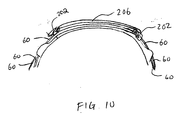
- the hook strap 50 is one continuous material 206 that folds into two layers as shown in Figures 10 and 11 .
- the hook strap first wraps around the buckle adapter 202 on both sides for a secured connection, then the hook strap goes through the outer portion of the buckle adapter and straps across the bottom layer.
- the inner surface of the layers comprises an adhesive material, preferably a VelcroTM or other hook and loop material that allows the two layers to fasten to each other and form a tight connection.
- This mechanism is similar to the cable tension mechanism in that the hook strap allows for elasticity and adjustment without causing damage to the boot and hoof.
- the hook strap is made of any suitable strap materials that are resilient, durable and easy to use. Preferred materials include plastics with an adhesive portion, or a hook and loop arrangement that allows attachment to attach to itself.
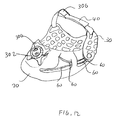
- FIG. 12 An alternative embodiment of the front tension mechanism is shown in Figure 12 .
- this embodiment employs the use of winding knob 300.
- the winding knob 300 works like a cable spool where the base plate engages the ratchet pawl 302 and rotates the winding knob clockwise until the desired tension is achieved. By moving the winding knob 300 in the opposite direction, the tension is released. This not only serves to release all of the cables from the winding knob, but also helps to eject dirt and debris from under and around the mechanism and makes cleaning easy with a simple brush.
- the winding knob 300 uses a "pop up” action to release and wind the cables 60.
- the mechanism could be closed, but is preferably an open system that continues to function in the presence of dirt and debris.
- a keeper strap 40 couples to heel captivator 30 through strap positions 104.
- the keeper strap 40 keeps the pastern bone intact which enhances boot retention during use, especially in extreme conditions, such as galloping in deep water, snow or mud.
- the keeper strap is made of nylon or other suitable materials that can be adjusted and released by means of a cam lock buckle 306 or a hook and loop fastener.
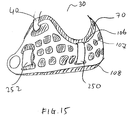
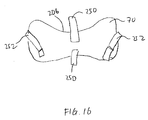
- an optional liner 70 as shown in Figures 15 and 16 can be inserted in the heel captivator for added cushion.
- neoprene is used, but other suitable material and fabric that are comfortable and form-fitting are contemplated, including viscoelastic foams.
- the liner 70 has a middle strap 250 and two side straps 252 that can be secured through the holes of the heal captivator 30.
- the straps can use Velcro ⁇ > or other suitable fastener means to attach to the heal captivator.
- the liner provides comfort to the hoof without causing chafing and abrasion to the region. It can be quickly and easily installed or removed with the strap or hook and loop fastener.
- the liner 70 has holes that correspond with the open mesh of the heel captivator to release debris that is trapped in between the boot and the hoof.
- Various sizes are contemplated for the liner. Depending on the size, the liner can be wrapped across the front, lateral, all other directions of the pastern bone. Different shapes are also contemplated, including a full height liner shown in Figure 17 .
- the keeper strap 40 can keep the liner in tact over the pastern bone region of the hoof.
Landscapes
- Life Sciences & Earth Sciences (AREA)
- Environmental Sciences (AREA)
- Zoology (AREA)
- Engineering & Computer Science (AREA)
- Wood Science & Technology (AREA)
- Animal Husbandry (AREA)
- Biodiversity & Conservation Biology (AREA)
- Footwear And Its Accessory, Manufacturing Method And Apparatuses (AREA)
Claims (21)
- Chaussure de sabot comprenant une partie inférieure, un support de talon et un mécanisme de pivotement qui agence ledit support de talon de manière à pivoter par rapport à la partie inférieure, le mécanisme de pivotement présentant des pivots lâches qui présentent plus d'un degré de liberté de mouvement de rotation et permettent au support de talon de se déplacer dans toutes les directions.
- Chaussure selon la revendication 1, dans laquelle la partie inférieure présente une substance polymérique.
- Chaussure selon la revendication 1, dans laquelle le support de talon comprend un filet ayant une pluralité d'ouvertures.
- Chaussure selon la revendication 1, comprenant en outre un revêtement situé sous le support de talon.
- Chaussure selon la revendication 1, dans laquelle ledit mécanisme de pivotement présente un mécanisme de couplage plus hautement développé sur le plan mécanique qui relie, au moins en partie, la partie inférieure au support de talon.
- Chaussure selon la revendication 5, dans laquelle ledit mécanisme de couplage comprend un jeu suffisant pour procurer un déplacement autonome vers le haut/bas du support de talon d'au moins 1,2 cm.
- Chaussure selon la revendication 6, dans laquelle ledit mécanisme de couplage comprend un jeu suffisant pour procurer un déplacement autonome en avant/arrière du support de talon d'au moins 1,2 cm.
- Chaussure selon la revendication 5, dans laquelle ledit mécanisme de couplage présente des lanières et comprend en outre une fermeture velcro qui fixe les lanières.
- Chaussure selon la revendication 4, dans laquelle ladite partie inférieure et ledit support de talon ne sont reliés que par l'intermédiaire du mécanisme de couplage.
- Chaussure selon la revendication 1, dans laquelle le mécanisme de pivotement permet au support de talon au moins trois degrés de liberté de mouvement par rapport à la partie inférieure.
- Chaussure selon la revendication 1, dans laquelle la partie inférieure présente une semelle ayant une face supérieure et le mécanisme de pivotement présente un point de limitation qui est disposé dans les 2 cm de la face supérieure de la semelle.
- Chaussure selon la revendication 1, dans laquelle la partie inférieure présente une face avant et le mécanisme de pivotement présente un point de limitation qui est disposé au moins 6 cm en arrière à partir de la face avant de la partie inférieure.
- Chaussure selon la revendication 1, dans laquelle la partie inférieure présente une face avant et une face arrière et le mécanisme de pivotement présente un point de limitation qui est disposé en arrière au moins 50 % d'une distance séparant la face avant et la face arrière.
- Chaussure selon la revendication 1, dans laquelle la partie inférieure présente une face avant et une face arrière et le mécanisme de pivotement présente un point de limitation qui est disposé en arrière au moins 55 % d'une distance séparant la face avant et la face arrière.
- Chaussure selon la revendication 1, dans laquelle la partie inférieure présente une face arrière et le mécanisme de pivotement présente un point de limitation qui comprend un tourillon dans les 3 cm de la face arrière de la partie inférieure.
- Chaussure selon la revendication 5, dans laquelle le mécanisme de couplage présente une lanière qui s'étend à travers un canal, et le mécanisme de pivotement présente un point de limitation comprenant un point de sortie de la lanière dudit canal.
- Chaussure selon la revendication 5, dans laquelle le mécanisme de couplage présente un mécanisme de serrage, et la chaussure présente en outre une languette qui est située sous ledit mécanisme de serrage.
- Chaussure selon la revendication 1, dans laquelle la partie inférieure présente une semelle ayant une face supérieure, et une partie supérieure ayant une hauteur de pas plus de 9 cm à partir de la face supérieure de la semelle.
- Chaussure selon la revendication 5, dans laquelle le mécanisme de couplage présente un laçage et un mécanisme à cliquet qui est agencé pour tendre le laçage.
- Chaussure selon la revendication 1, comprenant en outre une lanière de paturon qui relie entre elles des parties avant du support de talon.
- Chaussure selon la revendication 1, comprenant en outre une enveloppe de paturon qui est disposée par rapport au support de talon afin de procurer une retenue de pied supplémentaire.
Priority Applications (4)
| Application Number | Priority Date | Filing Date | Title |
|---|---|---|---|
| DK16197659.2T DK3187043T5 (da) | 2005-09-09 | 2006-09-08 | Hovsko med drejelig hælholder |
| PL06018893T PL1762144T3 (pl) | 2005-09-09 | 2006-09-08 | But na kopyto, z przechylnym usztywniaczem piętki |
| PL16197659T PL3187043T3 (pl) | 2005-09-09 | 2006-09-08 | But kopytowy z obrotowym uchwytem na piętę |
| EP16197659.2A EP3187043B8 (fr) | 2005-09-09 | 2006-09-08 | Chaussure pour sabot avec moyen de rétention du talon pivotant |
Applications Claiming Priority (3)
| Application Number | Priority Date | Filing Date | Title |
|---|---|---|---|
| US71601305P | 2005-09-09 | 2005-09-09 | |
| US76207006P | 2006-01-25 | 2006-01-25 | |
| US82465106P | 2006-09-06 | 2006-09-06 |
Related Child Applications (1)
| Application Number | Title | Priority Date | Filing Date |
|---|---|---|---|
| EP16197659.2A Division EP3187043B8 (fr) | 2005-09-09 | 2006-09-08 | Chaussure pour sabot avec moyen de rétention du talon pivotant |
Publications (2)
| Publication Number | Publication Date |
|---|---|
| EP1762144A1 EP1762144A1 (fr) | 2007-03-14 |
| EP1762144B1 true EP1762144B1 (fr) | 2016-11-09 |
Family
ID=37309020
Family Applications (2)
| Application Number | Title | Priority Date | Filing Date |
|---|---|---|---|
| EP06018893.5A Active EP1762144B1 (fr) | 2005-09-09 | 2006-09-08 | Chaussure pour sabot avec moyen de rétention du talon pivotant |
| EP16197659.2A Active EP3187043B8 (fr) | 2005-09-09 | 2006-09-08 | Chaussure pour sabot avec moyen de rétention du talon pivotant |
Family Applications After (1)
| Application Number | Title | Priority Date | Filing Date |
|---|---|---|---|
| EP16197659.2A Active EP3187043B8 (fr) | 2005-09-09 | 2006-09-08 | Chaussure pour sabot avec moyen de rétention du talon pivotant |
Country Status (10)
| Country | Link |
|---|---|
| US (2) | US9363980B2 (fr) |
| EP (2) | EP1762144B1 (fr) |
| AU (1) | AU2006287623B2 (fr) |
| BR (1) | BRPI0616122A2 (fr) |
| CA (1) | CA2621402C (fr) |
| DK (2) | DK1762144T3 (fr) |
| ES (2) | ES2864647T3 (fr) |
| PL (2) | PL3187043T3 (fr) |
| PT (2) | PT3187043T (fr) |
| WO (1) | WO2007030497A2 (fr) |
Families Citing this family (78)
| Publication number | Priority date | Publication date | Assignee | Title |
|---|---|---|---|---|
| US20060156517A1 (en) | 1997-08-22 | 2006-07-20 | Hammerslag Gary R | Reel based closure system |
| EP1814417B1 (fr) | 2004-10-29 | 2014-04-16 | Boa Technology, Inc. | Système de fermeture à enrouleur |
| US9894880B2 (en) * | 2005-09-09 | 2018-02-20 | Kirt Lander | Hoof boot with pivoting heel captivator |
| US8277401B2 (en) | 2006-09-12 | 2012-10-02 | Boa Technology, Inc. | Closure system for braces, protective wear and similar articles |
| US20080156503A1 (en) * | 2006-12-27 | 2008-07-03 | Penn Equine Gear, Inc. | Therapeutic equine hoof sock |
| WO2009050750A1 (fr) * | 2007-10-18 | 2009-04-23 | Osca 2 S.R.L. | Botte pour cheval |
| CN101977525B (zh) | 2008-01-18 | 2012-12-12 | 博技术有限公司 | 用于物件的收紧系统和用于将两个物体彼此拉近或拉开的方法 |
| NO328659B1 (no) * | 2008-03-26 | 2010-04-19 | Equine Fusion As | Sko og sale for sko til bruk pa hovdyr eller klovdyr. |
| USD603107S1 (en) * | 2008-07-16 | 2009-10-27 | Kirt Lander | Heel captivator |
| KR101688997B1 (ko) | 2008-11-21 | 2016-12-22 | 보아 테크놀러지, 인크. | 릴 기반 끈 조임 시스템 |
| ATE541456T1 (de) * | 2009-03-12 | 2012-02-15 | Muriel F Colquhoun | Hufeisenschutzvorrichtung |
| GB2463542B (en) * | 2009-06-03 | 2010-08-11 | Muriel Frances Colquhoun | Horse shoe shielding device |
| US20100229509A1 (en) | 2009-03-16 | 2010-09-16 | Mills Brett W | Protective articles for horses |
| USD611157S1 (en) * | 2009-07-13 | 2010-03-02 | Ultra Athlete Llc | Side portion of a stirrup of a pivoting ankle brace |
| USD611158S1 (en) * | 2009-07-13 | 2010-03-02 | Ultra Athlete Llc | Outside of upper portion of a pivoting ankle brace |
| AU2014201403B2 (en) * | 2009-09-15 | 2015-10-15 | Big Brain Holdings, Inc. | Hoof boot with pivoting heel captivator |
| JP5768064B2 (ja) | 2010-01-21 | 2015-08-26 | ボア テクノロジー, インク. | 紐締めシステム及び紐締めシステムを締め付ける方法 |
| US9375053B2 (en) | 2012-03-15 | 2016-06-28 | Boa Technology, Inc. | Tightening mechanisms and applications including the same |
| US10070695B2 (en) | 2010-04-30 | 2018-09-11 | Boa Technology Inc. | Tightening mechanisms and applications including the same |
| KR20200077624A (ko) | 2010-04-30 | 2020-06-30 | 보아 테크놀러지, 인크. | 릴 기반 끈 조임 시스템 |
| CN103079418B (zh) | 2010-07-01 | 2015-11-25 | 博技术有限公司 | 系带引导件 |
| ES1072993Y (es) | 2010-07-22 | 2011-02-17 | Shoe Floting S L | Calza de fijacion por material adhesivo |
| US20130014960A1 (en) * | 2011-07-15 | 2013-01-17 | Palmer Alissa M | Equine Protective Traction Device |
| US9101181B2 (en) | 2011-10-13 | 2015-08-11 | Boa Technology Inc. | Reel-based lacing system |
| US9179729B2 (en) | 2012-03-13 | 2015-11-10 | Boa Technology, Inc. | Tightening systems |
| WO2014036471A2 (fr) | 2012-08-31 | 2014-03-06 | Boa Technology Inc. | Système de tensionnement motorisé pour appareils orthopédiques et dispositifs associés |
| DE112013005273B4 (de) | 2012-11-02 | 2017-08-24 | Boa Technology, Inc. | Kupplungsteile für Verschlussvorrichtungen und -systeme |
| EP2916680B1 (fr) | 2012-11-06 | 2018-12-26 | Boa Technology Inc. | Dispositifs et procédés de réglage de l'ajustement de chaussures |
| US9439477B2 (en) | 2013-01-28 | 2016-09-13 | Boa Technology Inc. | Lace fixation assembly and system |
| WO2014124054A1 (fr) | 2013-02-05 | 2014-08-14 | Boa Technology Inc. | Dispositifs de fermeture pour dispositifs médicaux et procédés |
| US10251451B2 (en) | 2013-03-05 | 2019-04-09 | Boa Technology Inc. | Closure devices including incremental release mechanisms and methods therefor |
| EP2964048B1 (fr) | 2013-03-05 | 2019-08-28 | Boa Technology Inc. | Systèmes et dispositifs de fermeture automatique de dispositifs médicaux |
| ES2966628T3 (es) | 2013-03-15 | 2024-04-23 | Scootboot Pty Ltd | Bota para casco de equino |
| KR20260030757A (ko) | 2013-04-01 | 2026-03-06 | 보아 테크놀러지, 인크. | 릴 기반의 폐쇄 시스템을 포함하도록 신발류를 개장하기 위한 방법 및 장치 |
| US10076160B2 (en) | 2013-06-05 | 2018-09-18 | Boa Technology Inc. | Integrated closure device components and methods |
| EP4721617A2 (fr) | 2013-06-05 | 2026-04-08 | Boa Technology, Inc. | Éléments d'un dispositif de fermeture intégré, et procédés |
| DE112014003135B4 (de) | 2013-07-02 | 2020-12-24 | Boa Technology Inc. | Rolle zur verwendung mit einem verschnürungssystem zum festziehen eines gegenstandes sowie vorrichtungen hierzu und verfahren zum zusammenbauen einer vorrichtung zum festziehen eines gegenstandes |
| WO2015006616A1 (fr) | 2013-07-10 | 2015-01-15 | Boa Technology Inc. | Dispositifs de fermeture comprenant des mécanismes de relâchement incrémentiels et procédés associés |
| WO2015035257A2 (fr) | 2013-09-05 | 2015-03-12 | Boa Technology Inc. | Variantes de guides de laçage pour serrer des mécanismes et procédés associés |
| KR102738961B1 (ko) | 2013-09-13 | 2024-12-06 | 보아 테크놀러지, 인크. | 릴 기반 폐쇄 장치 및 그에 따른 방법 |
| KR101895140B1 (ko) | 2013-11-18 | 2018-09-04 | 보아 테크놀러지, 인크. | 보철 및 장구의 자동 폐쇄를 제공하기 위한 방법 및 장치 |
| USD835976S1 (en) | 2014-01-16 | 2018-12-18 | Boa Technology Inc. | Coupling member |
| USD751281S1 (en) | 2014-08-12 | 2016-03-15 | Boa Technology, Inc. | Footwear tightening reels |
| USD767269S1 (en) | 2014-08-26 | 2016-09-27 | Boa Technology Inc. | Footwear tightening reel |
| US20160058127A1 (en) | 2014-08-28 | 2016-03-03 | Boa Technology Inc. | Devices and methods for enhancing the fit of boots and other footwear |
| USD758061S1 (en) | 2014-09-08 | 2016-06-07 | Boa Technology, Inc. | Lace tightening device |
| US10182935B2 (en) | 2014-10-01 | 2019-01-22 | Ossur Hf | Support for articles and methods for using the same |
| WO2016057697A1 (fr) | 2014-10-07 | 2016-04-14 | Boa Technology Inc. | Mécanisme de réglage de tension, et procédé d'ajustement de chaussure |
| USD835898S1 (en) | 2015-01-16 | 2018-12-18 | Boa Technology Inc. | Footwear lace tightening reel stabilizer |
| USD776421S1 (en) | 2015-01-16 | 2017-01-17 | Boa Technology, Inc. | In-footwear lace tightening reel |
| US10004297B2 (en) | 2015-10-15 | 2018-06-26 | Boa Technology Inc. | Lacing configurations for footwear |
| AU2017237256B2 (en) | 2016-03-25 | 2022-07-07 | Big Brain Holdings, Inc. | Hoof boot |
| KR20250020493A (ko) | 2016-08-02 | 2025-02-11 | 보아 테크놀러지, 인크. | 신발끈 결속 시스템의 인장 부재 가이드 |
| WO2018033650A1 (fr) * | 2016-08-16 | 2018-02-22 | Evo Horse S.L | Élément de protection pour sabots et onglons d'animaux |
| CN109862801B (zh) | 2016-10-26 | 2021-08-24 | 耐克创新有限合伙公司 | 用于足部进入的带铰链的鞋类鞋底结构及制造方法 |
| CN113876075B (zh) | 2016-10-26 | 2024-07-26 | 耐克创新有限合伙公司 | 用于鞋类物品的鞋面部件 |
| KR102822775B1 (ko) | 2016-12-09 | 2025-06-20 | 보아 테크놀러지, 인크. | 릴 기반의 폐쇄 시스템 |
| US10543630B2 (en) | 2017-02-27 | 2020-01-28 | Boa Technology Inc. | Reel based closure system employing a friction based tension mechanism |
| US11304479B2 (en) | 2017-02-28 | 2022-04-19 | Nike, Inc. | Footwear with laceless fastening system |
| US10758010B2 (en) | 2017-04-17 | 2020-09-01 | Nike, Inc. | Increased access footwear |
| US11357279B2 (en) | 2017-05-09 | 2022-06-14 | Boa Technology Inc. | Closure components for a helmet layer and methods for installing same |
| US10512298B2 (en) | 2017-05-23 | 2019-12-24 | Nike, Inc. | Footwear upper with lace-engaged zipper system |
| WO2018217423A1 (fr) | 2017-05-23 | 2018-11-29 | Nike Innovate C.V. | Article chaussant à accès arrière à partie talon mobile |
| US10159310B2 (en) | 2017-05-25 | 2018-12-25 | Nike, Inc. | Rear closing upper for an article of footwear with front zipper to rear cord connection |
| US10772384B2 (en) | 2017-07-18 | 2020-09-15 | Boa Technology Inc. | System and methods for minimizing dynamic lace movement |
| US12396520B2 (en) | 2017-07-18 | 2025-08-26 | Boa Technology Inc. | Configurations for footwear employing reel based closure systems |
| EP4183289A1 (fr) | 2018-04-13 | 2023-05-24 | NIKE Innovate C.V. | Système de fixation de chaussure |
| USD899710S1 (en) | 2018-07-23 | 2020-10-20 | Scootboot Pty Ltd | Flexible strap for a hoof boot |
| EP3826461B1 (fr) * | 2018-07-23 | 2025-07-09 | Scootboot Pty Ltd | Sangle pour botte de sabot équin et botte |
| CN115844103B (zh) | 2018-12-28 | 2026-03-24 | 耐克创新有限合伙公司 | 具有活动相接鞋底结构的易于进入的鞋 |
| EP4678055A3 (fr) | 2019-02-01 | 2026-04-15 | Boa Technology, Inc. | Dispositifs de fermeture à base d'enrouleurs pour serrer une chaussure de ski |
| JP7454267B2 (ja) | 2019-05-01 | 2024-03-22 | ボア テクノロジー,インコーポレイテッド | リール式クロージャーシステム |
| US11140941B2 (en) | 2019-05-03 | 2021-10-12 | Nike, Inc. | Footwear upper with unitary support frame |
| EP4044862B1 (fr) | 2019-10-18 | 2025-06-18 | NIKE Innovate C.V. | Article chaussant à accès facile avec bloqueur de cordon |
| WO2021108034A1 (fr) | 2019-11-25 | 2021-06-03 | Nike Innovate C.V. | Système de retenue de tension pour article pouvant être porté |
| CA3175793A1 (fr) | 2020-04-22 | 2021-10-28 | Scootboot Pty Ltd | Botte de sabot equin, sangle et tendeur associes |
| DE102020129777B4 (de) | 2020-11-11 | 2024-05-16 | Eelco De Groot | Hufschutz |
| WO2024118458A1 (fr) | 2022-11-28 | 2024-06-06 | Nike Innovate C.V. | Article chaussant doté d'une structure de semelle articulée pour faciliter l'accès |
Family Cites Families (41)
| Publication number | Priority date | Publication date | Assignee | Title |
|---|---|---|---|---|
| US626313A (en) | 1899-06-06 | Device for treating feet of horses | ||
| US538685A (en) * | 1895-05-07 | Horse-boot | ||
| US752090A (en) * | 1904-02-16 | Horseshoe | ||
| US123007A (en) | 1872-01-23 | Improvement in horseshoes | ||
| US162052A (en) * | 1875-04-13 | Jacob p | ||
| US115311A (en) * | 1871-05-30 | Improvement in temporary shoes for horses | ||
| US275872A (en) | 1883-04-17 | Quarter-boot for horses | ||
| US226313A (en) * | 1880-04-06 | Steam-stove | ||
| US181750A (en) | 1876-08-29 | Improvement in horse-boots | ||
| US503869A (en) | 1893-08-22 | Horseshoe and quarter-boot | ||
| US289177A (en) * | 1883-11-27 | Detachable horseshoe | ||
| US591510A (en) * | 1897-03-01 | 1897-10-12 | Horse-foot protector | |
| US830403A (en) * | 1906-02-01 | 1906-09-04 | Richard Barclay | Horseshoe. |
| US1094474A (en) * | 1912-12-30 | 1914-04-28 | Earl J Reece | Horseshoe attachment. |
| US1135657A (en) * | 1915-02-15 | 1915-04-13 | Bella B Brenner | Horseshoe. |
| US1395689A (en) * | 1921-01-24 | 1921-11-01 | Joseph H Mckenzie | Horse-boot |
| US1434275A (en) | 1921-10-18 | 1922-10-31 | Wozny Thomas | Horseshoe |
| GB339193A (en) | 1930-02-05 | 1930-12-04 | Imperator Hestesko As | Improvements in or relating to arrangements for attaching horse shoes |
| NZ195295A (en) * | 1980-10-20 | 1984-08-24 | G J Laurent | Animal hoof cover |
| JPS5970478U (ja) | 1982-11-01 | 1984-05-12 | 新技術企業株式会社 | 装蹄具 |
| DE8438230U1 (de) | 1984-12-29 | 1985-03-28 | Dallmer, Helmuth, 2125 Salzhausen | Mit gurten anbringbarer pferdehufschuh |
| US5002132A (en) * | 1989-09-22 | 1991-03-26 | Fox Alfred E | Hoofed animal shoe |
| US5661958A (en) | 1995-04-14 | 1997-09-02 | Easycare, Inc. | Size-adjustable composition horseboot |
| US5934599A (en) | 1997-08-22 | 1999-08-10 | Hammerslag; Gary R. | Footwear lacing system |
| DE29821595U1 (de) * | 1998-12-03 | 1999-02-04 | Marquis, Helmut, 89537 Giengen | Hufschuh |
| US6053884A (en) * | 1999-02-18 | 2000-04-25 | Athlete Protection Gear, Llc | Ankle brace with cuff |
| US6192989B1 (en) * | 1999-03-02 | 2001-02-27 | Barbara A. Tooman | Temporary horseshoe |
| US6295704B1 (en) * | 1999-03-05 | 2001-10-02 | Juan Rivas | Apparatus for securing laces on footwear |
| GB9906072D0 (en) * | 1999-03-17 | 1999-05-12 | Pryce William I | Removable shoe for a horse or pony |
| USD440363S1 (en) | 2000-08-09 | 2001-04-10 | Easycare, Inc. | Horse boot |
| US6651410B2 (en) * | 2001-09-15 | 2003-11-25 | Tommy Lee Osha | Comfort management system for equine |
| US6526920B1 (en) | 2002-06-17 | 2003-03-04 | Robert Griffin | Dog boot for hunting and other outdoor activities |
| DE50305712D1 (de) * | 2002-11-27 | 2006-12-28 | Manolo Maestrini | Grössenverstellbarer schuh für huftiere |
| US7490458B2 (en) | 2003-02-11 | 2009-02-17 | Easycare, Inc. | Horse boot with dual tongue entry system |
| US7174858B2 (en) | 2004-01-13 | 2007-02-13 | Ford Garrett N | Horse boot sleeve for pastern protection |
| US20050066632A1 (en) | 2003-09-26 | 2005-03-31 | Ford Garrett N. | Horse boot with high-profile protective cuff |
| US20050150197A1 (en) | 2004-01-13 | 2005-07-14 | Ford Garrett N. | Horse boot sleeve for pastern protection |
| US7461497B2 (en) | 2003-09-26 | 2008-12-09 | Easycare, Inc. | Slip-on horse boot with replaceable pastern gaiter |
| US7691076B2 (en) * | 2003-10-29 | 2010-04-06 | Castro Ernesto G | Articulated custom ankle-foot orthosis systems |
| US7032367B1 (en) | 2004-06-16 | 2006-04-25 | Yoho Bonnie R | Hoof boot for hoofed animals and methods of making same |
| US7185612B2 (en) * | 2005-04-12 | 2007-03-06 | Kevin Faulk | Animal wound shield |
-
2006
- 2006-09-06 WO PCT/US2006/034653 patent/WO2007030497A2/fr not_active Ceased
- 2006-09-06 CA CA2621402A patent/CA2621402C/fr active Active
- 2006-09-06 US US11/516,914 patent/US9363980B2/en active Active
- 2006-09-06 BR BRPI0616122-7A patent/BRPI0616122A2/pt not_active Application Discontinuation
- 2006-09-06 AU AU2006287623A patent/AU2006287623B2/en active Active
- 2006-09-08 PT PT161976592T patent/PT3187043T/pt unknown
- 2006-09-08 ES ES16197659T patent/ES2864647T3/es active Active
- 2006-09-08 ES ES06018893.5T patent/ES2614604T3/es active Active
- 2006-09-08 PL PL16197659T patent/PL3187043T3/pl unknown
- 2006-09-08 PT PT60188935T patent/PT1762144T/pt unknown
- 2006-09-08 EP EP06018893.5A patent/EP1762144B1/fr active Active
- 2006-09-08 DK DK06018893.5T patent/DK1762144T3/en active
- 2006-09-08 PL PL06018893T patent/PL1762144T3/pl unknown
- 2006-09-08 DK DK16197659.2T patent/DK3187043T5/da active
- 2006-09-08 EP EP16197659.2A patent/EP3187043B8/fr active Active
-
2012
- 2012-09-15 US US13/621,199 patent/US20130008139A1/en not_active Abandoned
Also Published As
| Publication number | Publication date |
|---|---|
| PL1762144T3 (pl) | 2017-04-28 |
| DK1762144T3 (en) | 2017-01-23 |
| EP3187043B1 (fr) | 2021-01-06 |
| US9363980B2 (en) | 2016-06-14 |
| CA2621402C (fr) | 2014-05-20 |
| AU2006287623A1 (en) | 2007-03-15 |
| PL3187043T3 (pl) | 2021-11-29 |
| DK3187043T5 (da) | 2021-04-19 |
| EP3187043A1 (fr) | 2017-07-05 |
| BRPI0616122A2 (pt) | 2011-06-07 |
| US20070113524A1 (en) | 2007-05-24 |
| US20130008139A1 (en) | 2013-01-10 |
| ES2614604T3 (es) | 2017-06-01 |
| PT1762144T (pt) | 2016-12-14 |
| AU2006287623B2 (en) | 2012-12-13 |
| WO2007030497A2 (fr) | 2007-03-15 |
| EP3187043B8 (fr) | 2021-04-28 |
| PT3187043T (pt) | 2021-03-22 |
| DK3187043T3 (da) | 2021-04-12 |
| CA2621402A1 (fr) | 2007-03-15 |
| WO2007030497A3 (fr) | 2007-06-21 |
| ES2864647T3 (es) | 2021-10-14 |
| EP1762144A1 (fr) | 2007-03-14 |
Similar Documents
| Publication | Publication Date | Title |
|---|---|---|
| EP1762144B1 (fr) | Chaussure pour sabot avec moyen de rétention du talon pivotant | |
| US9894880B2 (en) | Hoof boot with pivoting heel captivator | |
| EP1122998B1 (fr) | Protege-sabot polyvalent pour cheval | |
| US6868656B2 (en) | Comfort management system for equine | |
| AU2017276238B2 (en) | Equine hoof boot | |
| US7207163B2 (en) | Size-adjustable shoe for hoofed animals | |
| US7032367B1 (en) | Hoof boot for hoofed animals and methods of making same | |
| WO2014051490A1 (fr) | Support de ligament pour sabots | |
| AU2010295636B2 (en) | Hoof boot with pivoting heel captivator | |
| AU2014201403B2 (en) | Hoof boot with pivoting heel captivator | |
| US20170231194A1 (en) | Low-profile equine overreach boot | |
| AT519083B1 (de) | Hufschuh mit drehbarem Fersenhalter | |
| AU743287B2 (en) | Equine multi-purpose protector boot | |
| GB2499813A (en) | Anti-slip horse boot |
Legal Events
| Date | Code | Title | Description |
|---|---|---|---|
| PUAI | Public reference made under article 153(3) epc to a published international application that has entered the european phase |
Free format text: ORIGINAL CODE: 0009012 |
|
| AK | Designated contracting states |
Kind code of ref document: A1 Designated state(s): AT BE BG CH CY CZ DE DK EE ES FI FR GB GR HU IE IS IT LI LT LU LV MC NL PL PT RO SE SI SK TR |
|
| AX | Request for extension of the european patent |
Extension state: AL BA HR MK YU |
|
| 17P | Request for examination filed |
Effective date: 20070911 |
|
| AKX | Designation fees paid |
Designated state(s): AT BE BG CH CY CZ DE DK EE ES FI FR GB GR HU IE IS IT LI LT LU LV MC NL PL PT RO SE SI SK TR |
|
| 17Q | First examination report despatched |
Effective date: 20140506 |
|
| RIC1 | Information provided on ipc code assigned before grant |
Ipc: A01K 13/00 20060101ALI20160224BHEP Ipc: A01L 5/00 20060101ALI20160224BHEP Ipc: A01L 3/00 20060101AFI20160224BHEP |
|
| GRAP | Despatch of communication of intention to grant a patent |
Free format text: ORIGINAL CODE: EPIDOSNIGR1 |
|
| INTG | Intention to grant announced |
Effective date: 20160415 |
|
| GRAS | Grant fee paid |
Free format text: ORIGINAL CODE: EPIDOSNIGR3 |
|
| GRAA | (expected) grant |
Free format text: ORIGINAL CODE: 0009210 |
|
| AK | Designated contracting states |
Kind code of ref document: B1 Designated state(s): AT BE BG CH CY CZ DE DK EE ES FI FR GB GR HU IE IS IT LI LT LU LV MC NL PL PT RO SE SI SK TR |
|
| REG | Reference to a national code |
Ref country code: GB Ref legal event code: FG4D |
|
| REG | Reference to a national code |
Ref country code: DE Ref legal event code: R081 Ref document number: 602006050822 Country of ref document: DE Owner name: BIG BRAIN HOLDINGS, INC., KINGMAN, US Free format text: FORMER OWNER: LANDER, KIRT, LAKE HAVASU CITY, ARIZ., US |
|
| REG | Reference to a national code |
Ref country code: AT Ref legal event code: REF Ref document number: 843027 Country of ref document: AT Kind code of ref document: T Effective date: 20161115 Ref country code: CH Ref legal event code: EP |
|
| REG | Reference to a national code |
Ref country code: IE Ref legal event code: FG4D |
|
| REG | Reference to a national code |
Ref country code: PT Ref legal event code: SC4A Ref document number: 1762144 Country of ref document: PT Date of ref document: 20161214 Kind code of ref document: T Free format text: AVAILABILITY OF NATIONAL TRANSLATION Effective date: 20161206 |
|
| REG | Reference to a national code |
Ref country code: DE Ref legal event code: R096 Ref document number: 602006050822 Country of ref document: DE |
|
| REG | Reference to a national code |
Ref country code: NL Ref legal event code: FP |
|
| REG | Reference to a national code |
Ref country code: DK Ref legal event code: T3 Effective date: 20170119 |
|
| REG | Reference to a national code |
Ref country code: SE Ref legal event code: TRGR |
|
| PG25 | Lapsed in a contracting state [announced via postgrant information from national office to epo] |
Ref country code: LV Free format text: LAPSE BECAUSE OF FAILURE TO SUBMIT A TRANSLATION OF THE DESCRIPTION OR TO PAY THE FEE WITHIN THE PRESCRIBED TIME-LIMIT Effective date: 20161109 |
|
| REG | Reference to a national code |
Ref country code: LT Ref legal event code: MG4D |
|
| REG | Reference to a national code |
Ref country code: AT Ref legal event code: MK05 Ref document number: 843027 Country of ref document: AT Kind code of ref document: T Effective date: 20161109 |
|
| PG25 | Lapsed in a contracting state [announced via postgrant information from national office to epo] |
Ref country code: LT Free format text: LAPSE BECAUSE OF FAILURE TO SUBMIT A TRANSLATION OF THE DESCRIPTION OR TO PAY THE FEE WITHIN THE PRESCRIBED TIME-LIMIT Effective date: 20161109 Ref country code: GR Free format text: LAPSE BECAUSE OF FAILURE TO SUBMIT A TRANSLATION OF THE DESCRIPTION OR TO PAY THE FEE WITHIN THE PRESCRIBED TIME-LIMIT Effective date: 20170210 |
|
| PG25 | Lapsed in a contracting state [announced via postgrant information from national office to epo] |
Ref country code: IS Free format text: LAPSE BECAUSE OF FAILURE TO SUBMIT A TRANSLATION OF THE DESCRIPTION OR TO PAY THE FEE WITHIN THE PRESCRIBED TIME-LIMIT Effective date: 20170309 Ref country code: AT Free format text: LAPSE BECAUSE OF FAILURE TO SUBMIT A TRANSLATION OF THE DESCRIPTION OR TO PAY THE FEE WITHIN THE PRESCRIBED TIME-LIMIT Effective date: 20161109 |
|
| REG | Reference to a national code |
Ref country code: ES Ref legal event code: FG2A Ref document number: 2614604 Country of ref document: ES Kind code of ref document: T3 Effective date: 20170601 |
|
| PG25 | Lapsed in a contracting state [announced via postgrant information from national office to epo] |
Ref country code: SK Free format text: LAPSE BECAUSE OF FAILURE TO SUBMIT A TRANSLATION OF THE DESCRIPTION OR TO PAY THE FEE WITHIN THE PRESCRIBED TIME-LIMIT Effective date: 20161109 Ref country code: RO Free format text: LAPSE BECAUSE OF FAILURE TO SUBMIT A TRANSLATION OF THE DESCRIPTION OR TO PAY THE FEE WITHIN THE PRESCRIBED TIME-LIMIT Effective date: 20161109 Ref country code: EE Free format text: LAPSE BECAUSE OF FAILURE TO SUBMIT A TRANSLATION OF THE DESCRIPTION OR TO PAY THE FEE WITHIN THE PRESCRIBED TIME-LIMIT Effective date: 20161109 |
|
| REG | Reference to a national code |
Ref country code: DE Ref legal event code: R097 Ref document number: 602006050822 Country of ref document: DE |
|
| PG25 | Lapsed in a contracting state [announced via postgrant information from national office to epo] |
Ref country code: BG Free format text: LAPSE BECAUSE OF FAILURE TO SUBMIT A TRANSLATION OF THE DESCRIPTION OR TO PAY THE FEE WITHIN THE PRESCRIBED TIME-LIMIT Effective date: 20170209 |
|
| PLBE | No opposition filed within time limit |
Free format text: ORIGINAL CODE: 0009261 |
|
| STAA | Information on the status of an ep patent application or granted ep patent |
Free format text: STATUS: NO OPPOSITION FILED WITHIN TIME LIMIT |
|
| REG | Reference to a national code |
Ref country code: FR Ref legal event code: PLFP Year of fee payment: 12 |
|
| 26N | No opposition filed |
Effective date: 20170810 |
|
| PG25 | Lapsed in a contracting state [announced via postgrant information from national office to epo] |
Ref country code: SI Free format text: LAPSE BECAUSE OF FAILURE TO SUBMIT A TRANSLATION OF THE DESCRIPTION OR TO PAY THE FEE WITHIN THE PRESCRIBED TIME-LIMIT Effective date: 20161109 |
|
| REG | Reference to a national code |
Ref country code: AT Ref legal event code: NF05 Ref document number: 843027 Country of ref document: AT Kind code of ref document: T Effective date: 20171220 |
|
| PG25 | Lapsed in a contracting state [announced via postgrant information from national office to epo] |
Ref country code: MC Free format text: LAPSE BECAUSE OF FAILURE TO SUBMIT A TRANSLATION OF THE DESCRIPTION OR TO PAY THE FEE WITHIN THE PRESCRIBED TIME-LIMIT Effective date: 20161109 |
|
| PG25 | Lapsed in a contracting state [announced via postgrant information from national office to epo] |
Ref country code: LU Free format text: LAPSE BECAUSE OF NON-PAYMENT OF DUE FEES Effective date: 20170908 |
|
| REG | Reference to a national code |
Ref country code: FR Ref legal event code: PLFP Year of fee payment: 13 |
|
| REG | Reference to a national code |
Ref country code: AT Ref legal event code: UEP Ref document number: 843027 Country of ref document: AT Kind code of ref document: T Effective date: 20161109 |
|
| PG25 | Lapsed in a contracting state [announced via postgrant information from national office to epo] |
Ref country code: HU Free format text: LAPSE BECAUSE OF FAILURE TO SUBMIT A TRANSLATION OF THE DESCRIPTION OR TO PAY THE FEE WITHIN THE PRESCRIBED TIME-LIMIT; INVALID AB INITIO Effective date: 20060908 |
|
| PG25 | Lapsed in a contracting state [announced via postgrant information from national office to epo] |
Ref country code: CY Free format text: LAPSE BECAUSE OF NON-PAYMENT OF DUE FEES Effective date: 20161109 |
|
| PG25 | Lapsed in a contracting state [announced via postgrant information from national office to epo] |
Ref country code: TR Free format text: LAPSE BECAUSE OF FAILURE TO SUBMIT A TRANSLATION OF THE DESCRIPTION OR TO PAY THE FEE WITHIN THE PRESCRIBED TIME-LIMIT Effective date: 20161109 |
|
| REG | Reference to a national code |
Ref country code: DE Ref legal event code: R082 Ref document number: 602006050822 Country of ref document: DE Representative=s name: PATENTANWAELTE BAUER VORBERG KAYSER PARTNERSCH, DE Ref country code: DE Ref legal event code: R081 Ref document number: 602006050822 Country of ref document: DE Owner name: BIG BRAIN HOLDINGS, INC., KINGMAN, US Free format text: FORMER OWNER: LANDER, KIRT, LAKE HAVASU CITY, ARIZ., US |
|
| REG | Reference to a national code |
Ref country code: GB Ref legal event code: 732E Free format text: REGISTERED BETWEEN 20210624 AND 20210630 |
|
| REG | Reference to a national code |
Ref country code: BE Ref legal event code: PD Owner name: BIG BRAIN HOLDINGS, INC.; US Free format text: DETAILS ASSIGNMENT: CHANGE OF OWNER(S), ASSIGNMENT; FORMER OWNER NAME: LANDER, KIRT Effective date: 20210727 |
|
| PGFP | Annual fee paid to national office [announced via postgrant information from national office to epo] |
Ref country code: IE Payment date: 20210924 Year of fee payment: 16 Ref country code: FI Payment date: 20210920 Year of fee payment: 16 |
|
| PGFP | Annual fee paid to national office [announced via postgrant information from national office to epo] |
Ref country code: PL Payment date: 20210929 Year of fee payment: 16 Ref country code: SE Payment date: 20210921 Year of fee payment: 16 Ref country code: BE Payment date: 20210921 Year of fee payment: 16 Ref country code: DK Payment date: 20210921 Year of fee payment: 16 |
|
| PGFP | Annual fee paid to national office [announced via postgrant information from national office to epo] |
Ref country code: PT Payment date: 20210928 Year of fee payment: 16 |
|
| PGFP | Annual fee paid to national office [announced via postgrant information from national office to epo] |
Ref country code: NL Payment date: 20220922 Year of fee payment: 17 Ref country code: CZ Payment date: 20220902 Year of fee payment: 17 |
|
| PGFP | Annual fee paid to national office [announced via postgrant information from national office to epo] |
Ref country code: IT Payment date: 20220930 Year of fee payment: 17 |
|
| REG | Reference to a national code |
Ref country code: NL Ref legal event code: PD Owner name: BIG BRAIN HOLDINGS, INC.; US Free format text: DETAILS ASSIGNMENT: CHANGE OF OWNER(S), ASSIGNMENT; FORMER OWNER NAME: LANDER, KIRT Effective date: 20230309 |
|
| REG | Reference to a national code |
Ref country code: ES Ref legal event code: PC2A Owner name: BIG BRAIN HOLDINGS, INC. Effective date: 20230420 |
|
| PG25 | Lapsed in a contracting state [announced via postgrant information from national office to epo] |
Ref country code: PT Free format text: LAPSE BECAUSE OF NON-PAYMENT OF DUE FEES Effective date: 20230308 Ref country code: FI Free format text: LAPSE BECAUSE OF NON-PAYMENT OF DUE FEES Effective date: 20220908 |
|
| REG | Reference to a national code |
Ref country code: DK Ref legal event code: EBP Effective date: 20220930 |
|
| REG | Reference to a national code |
Ref country code: SE Ref legal event code: EUG |
|
| REG | Reference to a national code |
Ref country code: BE Ref legal event code: MM Effective date: 20220930 |
|
| PG25 | Lapsed in a contracting state [announced via postgrant information from national office to epo] |
Ref country code: IE Free format text: LAPSE BECAUSE OF NON-PAYMENT OF DUE FEES Effective date: 20220908 |
|
| PG25 | Lapsed in a contracting state [announced via postgrant information from national office to epo] |
Ref country code: SE Free format text: LAPSE BECAUSE OF NON-PAYMENT OF DUE FEES Effective date: 20220909 |
|
| PG25 | Lapsed in a contracting state [announced via postgrant information from national office to epo] |
Ref country code: BE Free format text: LAPSE BECAUSE OF NON-PAYMENT OF DUE FEES Effective date: 20220930 |
|
| PG25 | Lapsed in a contracting state [announced via postgrant information from national office to epo] |
Ref country code: DK Free format text: LAPSE BECAUSE OF NON-PAYMENT OF DUE FEES Effective date: 20220930 |
|
| PG25 | Lapsed in a contracting state [announced via postgrant information from national office to epo] |
Ref country code: CZ Free format text: LAPSE BECAUSE OF NON-PAYMENT OF DUE FEES Effective date: 20230908 |
|
| REG | Reference to a national code |
Ref country code: NL Ref legal event code: MM Effective date: 20231001 |
|
| PG25 | Lapsed in a contracting state [announced via postgrant information from national office to epo] |
Ref country code: PL Free format text: LAPSE BECAUSE OF NON-PAYMENT OF DUE FEES Effective date: 20220908 |
|
| PG25 | Lapsed in a contracting state [announced via postgrant information from national office to epo] |
Ref country code: NL Free format text: LAPSE BECAUSE OF NON-PAYMENT OF DUE FEES Effective date: 20231001 |
|
| PG25 | Lapsed in a contracting state [announced via postgrant information from national office to epo] |
Ref country code: NL Free format text: LAPSE BECAUSE OF NON-PAYMENT OF DUE FEES Effective date: 20231001 |
|
| PG25 | Lapsed in a contracting state [announced via postgrant information from national office to epo] |
Ref country code: IT Free format text: LAPSE BECAUSE OF NON-PAYMENT OF DUE FEES Effective date: 20230908 |
|
| PG25 | Lapsed in a contracting state [announced via postgrant information from national office to epo] |
Ref country code: IT Free format text: LAPSE BECAUSE OF NON-PAYMENT OF DUE FEES Effective date: 20230908 |
|
| PGFP | Annual fee paid to national office [announced via postgrant information from national office to epo] |
Ref country code: DE Payment date: 20250925 Year of fee payment: 20 |
|
| PGFP | Annual fee paid to national office [announced via postgrant information from national office to epo] |
Ref country code: FR Payment date: 20250929 Year of fee payment: 20 Ref country code: AT Payment date: 20250930 Year of fee payment: 20 |
|
| REG | Reference to a national code |
Ref country code: CH Ref legal event code: U11 Free format text: ST27 STATUS EVENT CODE: U-0-0-U10-U11 (AS PROVIDED BY THE NATIONAL OFFICE) Effective date: 20251025 |
|
| PGFP | Annual fee paid to national office [announced via postgrant information from national office to epo] |
Ref country code: GB Payment date: 20251024 Year of fee payment: 20 |
|
| PGFP | Annual fee paid to national office [announced via postgrant information from national office to epo] |
Ref country code: CH Payment date: 20251025 Year of fee payment: 20 |
|
| PGFP | Annual fee paid to national office [announced via postgrant information from national office to epo] |
Ref country code: ES Payment date: 20251020 Year of fee payment: 20 |