EP1762288A2 - Oberfläche zur Förderung von Tröpfchenbildung - Google Patents
Oberfläche zur Förderung von Tröpfchenbildung Download PDFInfo
- Publication number
- EP1762288A2 EP1762288A2 EP06022982A EP06022982A EP1762288A2 EP 1762288 A2 EP1762288 A2 EP 1762288A2 EP 06022982 A EP06022982 A EP 06022982A EP 06022982 A EP06022982 A EP 06022982A EP 1762288 A2 EP1762288 A2 EP 1762288A2
- Authority
- EP
- European Patent Office
- Prior art keywords
- liquid
- regions
- attracting
- repelling
- droplets
- Prior art date
- Legal status (The legal status is an assumption and is not a legal conclusion. Google has not performed a legal analysis and makes no representation as to the accuracy of the status listed.)
- Withdrawn
Links
Images



Classifications
-
- B—PERFORMING OPERATIONS; TRANSPORTING
- B01—PHYSICAL OR CHEMICAL PROCESSES OR APPARATUS IN GENERAL
- B01D—SEPARATION
- B01D53/00—Separation of gases or vapours; Recovering vapours of volatile solvents from gases; Chemical or biological purification of waste gases, e.g. engine exhaust gases, smoke, fumes, flue gases, aerosols
- B01D53/26—Drying gases or vapours
- B01D53/261—Drying gases or vapours by adsorption
-
- B—PERFORMING OPERATIONS; TRANSPORTING
- B01—PHYSICAL OR CHEMICAL PROCESSES OR APPARATUS IN GENERAL
- B01D—SEPARATION
- B01D1/00—Evaporating
- B01D1/30—Accessories for evaporators ; Constructional details thereof
-
- B—PERFORMING OPERATIONS; TRANSPORTING
- B01—PHYSICAL OR CHEMICAL PROCESSES OR APPARATUS IN GENERAL
- B01D—SEPARATION
- B01D1/00—Evaporating
- B01D1/30—Accessories for evaporators ; Constructional details thereof
- B01D1/305—Demister (vapour-liquid separation)
-
- B—PERFORMING OPERATIONS; TRANSPORTING
- B01—PHYSICAL OR CHEMICAL PROCESSES OR APPARATUS IN GENERAL
- B01D—SEPARATION
- B01D53/00—Separation of gases or vapours; Recovering vapours of volatile solvents from gases; Chemical or biological purification of waste gases, e.g. engine exhaust gases, smoke, fumes, flue gases, aerosols
- B01D53/26—Drying gases or vapours
-
- C—CHEMISTRY; METALLURGY
- C02—TREATMENT OF WATER, WASTE WATER, SEWAGE, OR SLUDGE
- C02F—TREATMENT OF WATER, WASTE WATER, SEWAGE, OR SLUDGE
- C02F1/00—Treatment of water, waste water, or sewage
- C02F1/02—Treatment of water, waste water, or sewage by heating
- C02F1/04—Treatment of water, waste water, or sewage by heating by distillation or evaporation
- C02F1/18—Transportable devices to obtain potable water
-
- E—FIXED CONSTRUCTIONS
- E03—WATER SUPPLY; SEWERAGE
- E03B—INSTALLATIONS OR METHODS FOR OBTAINING, COLLECTING, OR DISTRIBUTING WATER
- E03B3/00—Methods or installations for obtaining or collecting drinking water or tap water
- E03B3/28—Methods or installations for obtaining or collecting drinking water or tap water from humid air
-
- Y—GENERAL TAGGING OF NEW TECHNOLOGICAL DEVELOPMENTS; GENERAL TAGGING OF CROSS-SECTIONAL TECHNOLOGIES SPANNING OVER SEVERAL SECTIONS OF THE IPC; TECHNICAL SUBJECTS COVERED BY FORMER USPC CROSS-REFERENCE ART COLLECTIONS [XRACs] AND DIGESTS
- Y02—TECHNOLOGIES OR APPLICATIONS FOR MITIGATION OR ADAPTATION AGAINST CLIMATE CHANGE
- Y02A—TECHNOLOGIES FOR ADAPTATION TO CLIMATE CHANGE
- Y02A20/00—Water conservation; Efficient water supply; Efficient water use
-
- Y—GENERAL TAGGING OF NEW TECHNOLOGICAL DEVELOPMENTS; GENERAL TAGGING OF CROSS-SECTIONAL TECHNOLOGIES SPANNING OVER SEVERAL SECTIONS OF THE IPC; TECHNICAL SUBJECTS COVERED BY FORMER USPC CROSS-REFERENCE ART COLLECTIONS [XRACs] AND DIGESTS
- Y10—TECHNICAL SUBJECTS COVERED BY FORMER USPC
- Y10T—TECHNICAL SUBJECTS COVERED BY FORMER US CLASSIFICATION
- Y10T137/00—Fluid handling
- Y10T137/0318—Processes
-
- Y—GENERAL TAGGING OF NEW TECHNOLOGICAL DEVELOPMENTS; GENERAL TAGGING OF CROSS-SECTIONAL TECHNOLOGIES SPANNING OVER SEVERAL SECTIONS OF THE IPC; TECHNICAL SUBJECTS COVERED BY FORMER USPC CROSS-REFERENCE ART COLLECTIONS [XRACs] AND DIGESTS
- Y10—TECHNICAL SUBJECTS COVERED BY FORMER USPC
- Y10T—TECHNICAL SUBJECTS COVERED BY FORMER US CLASSIFICATION
- Y10T428/00—Stock material or miscellaneous articles
- Y10T428/24—Structurally defined web or sheet [e.g., overall dimension, etc.]
- Y10T428/24355—Continuous and nonuniform or irregular surface on layer or component [e.g., roofing, etc.]
-
- Y—GENERAL TAGGING OF NEW TECHNOLOGICAL DEVELOPMENTS; GENERAL TAGGING OF CROSS-SECTIONAL TECHNOLOGIES SPANNING OVER SEVERAL SECTIONS OF THE IPC; TECHNICAL SUBJECTS COVERED BY FORMER USPC CROSS-REFERENCE ART COLLECTIONS [XRACs] AND DIGESTS
- Y10—TECHNICAL SUBJECTS COVERED BY FORMER USPC
- Y10T—TECHNICAL SUBJECTS COVERED BY FORMER US CLASSIFICATION
- Y10T428/00—Stock material or miscellaneous articles
- Y10T428/31—Surface property or characteristic of web, sheet or block
Definitions
- This invention relates to a surface suitable for promoting the formation of droplets of a liquid on said surface in such a manner as to control the droplet dimensions.
- the invention is in particular suitable for enabling collection of that liquid from a wind-blown fog or mist.
- a surface suitable for promoting the formation of droplets of a liquid comprises regions of liquid repelling and liquid attracting material alternating in at least one direction across the surface whereby the diameter of the droplets is controlled by the size of the smallest dimension of the liquid attracting material.
- hydrophilic regions of the surface attract the polar liquid and the hydrophobic regions repel the polar liquid. If the liquid is an oil, the hydrophobic regions attract the liquid and the hydrophilic regions repel the liquid.
- the smallest dimension (the width) of the liquid attracting regions determines the size of the droplet to be formed. There is a maximum diameter that a stable droplet can attain which is related to the width of the liquid attracting regions.
- the liquid repelling regions separating the liquid attracting regions are preferably of at least the same width, so as to prevent overlap of droplets on neighbouring liquid attracting regions.
- the liquid attracting regions take the form of discrete regions on a liquid repelling substrate i.e. each liquid attracting region is isolated from other liquid attracting regions. This enables the droplets to form in isolation, constraining them in two dimensions and limiting their surface contact area with the liquid attracting substrate (and hence their adhesion to the surface).
- the surface is textured such that the regions of liquid attracting material protrude in relation to the regions of liquid repelling material. This allows for the droplets, when formed, to sit proud in relation to the liquid repelling regions, and encourages detachment of the droplets from the liquid attracting material when a specified droplet size is attained i.e. when the diameter of the droplet has reached its maximum stable size.
- the said smallest dimension of the liquid attracting material regions is more than 150 ⁇ m, more preferably more than 200 ⁇ m, and for certain applications is preferably more than 300 ⁇ m, 400 ⁇ m, 500 ⁇ m, or even at least 600 ⁇ m
- the said smallest dimension is in the said one direction of the surface. If the said smallest direction is in another direction from the said one direction, then in the said one direction the smallest dimension of the liquid attracting material region in the said one direction preferably also has the stated preferred minimum sizes (more than 150, 200, 300, 400, 500, or at least 600 ⁇ m).
- the said surface is preferably substantially planar. It is also envisaged that the surface may be curved, e.g. concave or convex, or be a combination of curved and substantially planar parts. Where we say that a surface is substantially planar, this specifically includes substantially planar surfaces with regions projecting or protruding from the surface, e.g. protruding above the surface.
- the surface is preferably designed in use to be inclined to the horizontal plane. This is described in more detail below with reference to other categories of the invention. It is mentioned here because, especially where the surface is substantially planar, the said one direction of the said surface is preferably the direction of the surface that defines the incline. More specifically, when the surface is inclined the angle of inclination is preferably defined as the angle between the horizontal and any line drawn along the surface in the said one direction.
- the said smallest dimension of the liquid attracting region is at most 5mm, more preferably at most 4mm, and for certain applications is preferably at most 3mm, 2mm, 1mm, or 0.8mm (800 ⁇ m).
- the smallest dimension of the liquid attracting region this will typically be the width, depending on the shape of the region.
- the liquid attracting regions are in the shape of stripes, it will be the width of the stripes.
- the liquid attracting regions are in the shape of discrete dots, it will be the width or diameter of the dots.
- the smallest dimension in any direction Preferably where there are a plurality of liquid attracting regions these will all be of similar shape and size. However it is envisaged that combinations of shapes and sizes of liquid attracting regions could also be used.
- the liquid repelling regions are preferably at least as wide as the liquid attracting regions, and possibly twice as wide.
- the width or distance of liquid repelling region separating adjacent liquid attracting regions is at least 400 ⁇ m, more preferably at least 600 ⁇ m, especially at least 800 ⁇ m, or even at least 1 or 2mm.
- the smallest dimension of the liquid attracting regions control the diameter of the droplets formed on the surface. This can best be explained by considering a preferred substantially planar surface in its preferred use position in which it is inclined to the horizontal. In this orientation, when small liquid droplets from a vapour adjacent the surface strike the inclined surface, if they strike a liquid attracting region then they may form a droplet attached to the liquid attracting region, but if they strike a liquid repelling region they will roll down the inclined surface to the nearest liquid attracting region. The droplets grow, by joining with other droplets that attach to the same liquid attracting region, until they reach a point at which their surface contact area covers the liquid attracting region.
- the droplets are gaining in mass without any increase in contact area, so that the droplet has to move into the liquid repelling regions.
- the force of gravity increases without any increase in surface adhesion, causing the droplet to move down the inclined slope.
- the surface is in a calm environment the droplets will fall directly down the slope, but if the surface is facing into a headwind the droplets may be blown randomly across the surface by the wind.
- the surface spacing and the size of the liquid attracting regions is sufficiently large that the droplets will roll down the slope only once they are sufficiently heavy to roll directly downwards even against a headwind.
- a method of collecting a liquid carried by or condensed out of a vapour comprises passing a vapour across a surface; and collecting droplets of liquid formed on the surface in collecting means; wherein the surface comprises alternating regions of liquid repelling and liquid attracting material in at least one direction across the surface and the collecting means is disposed so as to collect drops formed on the surface.
- the surface will usually be a man-made surface, and the method may comprise an initial step of selecting the smallest dimension of the liquid attracting regions so as to determine the droplet size having regard to the prevailing environmental conditions.
- vapour is used to embrace media both in an entirely gaseous state and also in which liquid droplets are suspended in the gas forming for example a fog or a mist.
- the surface is inclined to the horizontal plane. This enables the droplets to flow under the influence of gravity towards the collecting means which is a container of some description.
- a system for collecting a liquid comprises a surface having alternating regions of liquid repelling and liquid attracting material in at least one direction across the surface; and collection means, whereby on the movement of a vapour across the surface, droplets within the vapour collect into larger droplets on the surface and are collected by the collection means.
- the surface is preferably inclined to the horizontal plane by an angle of at least 5° , more preferably at least 10°.
- the surface is preferably inclined by at least 20°, 30°, or even 40°.
- the surface is inclined at most 90°, especially at most 80°, or sometimes at most 70°.
- the angle of incline like the width of the liquid attracting regions, is one of the factors determining when a droplet forming on the surface will roll down the slope for collection.
- the surface, and the method and system for collecting a liquid are particularly applicable for collecting liquid from a vapour that is moving across the surface. This will be the case, for example in a headwind.
- Typical preferred headwinds according to the invention may be at most, or of the order of 5ms -1 , 10ms -1 , 15 ms -1 or 20ms -1 .
- the headwind is another factor that affects when a droplet forming on the surface will roll down the slope for collection: too large a headwind (for the size of drop and angle of surface incline) will cause a drop to be randomly blown across the surface, rather than rolling directly down for collection.
- headwind this may be in a natural environment, or in a controlled environment such as a distillation or a dehumidifier unit.
- the smallest dimension of the liquid attracting regions is selected so that it can be used in a variety of headwinds, by appropriate variation of slope, such that in this controlled manner the droplets always grow to a sufficiently large size before rolling down the slope to be heavy enough to roll directly down the slope even against the headwind.
- the arrangement of liquid attracting and repelling regions on the surface is such that along any line drawn along the surface in the said one direction there will be alternating liquid attracting and liquid repelling regions.
- the said one direction is preferably the direction which together with the horizontal defines the angle of tilt, so that with this arrangement any drop rolling down the slope in the said one direction will always meet a liquid attracting region as it rolls.
- This arrangement can be for example provided by stripes of liquid attracting and repelling regions crossing, preferably perpendicular to the said one direction.
- discrete portions e.g. dots, of liquid attracting regions in a surround of liquid repelling material, the liquid attracting discrete portions being off set laterally to each other relative to the said one direction.
- dots in adjacent rows may be staggered with respect to each other so as to prevent there being a clear "uphill" path of liquid repelling regions along which droplets could be blown away.
- the path into the collecting means of substantially all the liquid is preferably across both liquid attracting and liquid repelling regions.
- the aforementioned method and/or system for collecting a liquid may be a water collection method or system being used or intended for use in an arid/desert environment and adapted to collect at least 100 ml, preferably at least 0.5 l and ideally at least 1 l per week.
- a method of spreading a liquid across a surface comprises providing a surface having alternating regions of liquid repelling and liquid attracting material in at least one direction across the surface; placing a liquid on the surface; and spreading the liquid across the surface using spreading means.
- the regions of liquid attracting material comprise a pattern whereby on placing a sheet of printing material over the surface, the pattern produced by the positioning of the liquid attracting material is transferred to the sheet of printing material.
- the patterned region may be made by a continuous liquid attracting region, or more preferably by a plurality of discrete liquid attracting regions, e.g. a plurality of liquid attracting dots, surrounded by liquid repelling regions.
- a continuous liquid attracting region or more preferably by a plurality of discrete liquid attracting regions, e.g. a plurality of liquid attracting dots, surrounded by liquid repelling regions.
- the latter configuration better controlling the density and distribution of liquid, e.g. ink
- a surface as hereinbefore described has the added advantage that it may be self cleaning.
- the surface promotes droplet formation and those droplets may be directed under the influence of gravity. As the droplets move over the surface, small particles will be picked up by the droplets and thus removed from the surface.
- the invention provides a water collection kit that may be assembled to form a collection system as described above, the kit comprising the surface, support means for supporting the surface at a desired inclination, and collection means.
- the kit may form part of a portable survival kit.
- Figure 1 shows a surface 1 having hydrophobic 2 and hydrophilic 3 regions.
- the hydrophobic 2 and hydrophilic 3 regions alternate across the surface 1 and form a striped pattern.
- An efficient surface for the collection of water from wind-blown fogs consists of 600 to 800 micron width hydrophilic regions spaced a minimum of 800 microns apart on a hydrophobic substrate. This allows for the formation of droplets of a size whereby, under the influence of gravity on a tilted surface, the droplets flow downwards into a moderate headwind.
- Figure 2 shows a surface 10 having hydrophobic 12 and hydrophilic 13 regions.
- the hydrophobic regions 12 form a grid structure across the surface 10.
- the hydrophilic regions 13, are raised above the hydrophobic regions 12 forming a textured surface.
- droplets within the vapour are attracted to the hydrophilic regions 13.
- larger droplets of liquid begin to form on the hydrophilic regions 13 as the small droplets in the vapour combine on the surface.
- the droplets reach a certain size, they move from one hydrophilic region 13a to another hydrophilic region 13b under the influence of gravity.
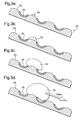
- Figures 3a to 3d show a textured surface 20 inclined to the horizontal plane having hydrophobic 22 and hydrophilic 23 regions.
- the hydrophilic regions 23 protrude in relation to the hydrophobic regions 22.
- small droplets from a wind-blown vapour strike the tilted surface 20 then they may form a droplet 24 attached to a hydrophilic region 23.
- the drops will reach a point at which their surface contact area covers the hydrophilic region 23; as is shown in Figure 3b, 25. Beyond this size they are gaining in mass without a corresponding increase in surface contact area, as shown in Figure 3c, 26, thereafter, the droplet must now expand into the water-repelling hydrophobic regions of the surface, shown in Figure 3d, 27.
- droplets of a tailored diameter can be formed that can roll into the headwind of the wind-blown fog or mist and be collected at the lowest point of the tilted surface.
- the windspeed may also be controlled and tailored.
- droplets When droplets move on such a tailored surface, they may also be guided by the hydrophilic regions, the surface attraction being sufficient to influence their direction and speed of motion. This would particularly be the case if the liquid attracting regions formed channels or stripes on the hydrophobic surface.
- a textured surface as described above can manufactured using a variety of techniques. Clean (grease-free) glass surfaces are hydrophilic, and hence glass can be combined with hydrophobic materials such as waxes in order to produce appropriate patterns. Glass beads of 800 micron diameter can be partially embedded into a wax film to produce an array of hydrophilic hemispheres on a hydrophobic substrate. A clean glass surface can be made hydrophobic by exposure to materials such as hexamethyldisilazane, and this may be used in combination with contact masks to produce an appropriate pattern of hydrophilic regions. Surface texturing can be achieved via techniques such as the moulding and hot-pressing of plastics, which can subsequently be treated with hydrophilic/hydrophobic surface coatings.
- Figure 4 shows a schematic sectional illustration of a textured surface 30 suitable for collecting liquid 35 having a surface 31 with hydrophobic 32 and hydrophilic 33 regions.
- a collector 34 is positioned below the surface.
- vapour is to be cooled and collected it is often passed through a tube that is enclosed in a cooling system (e.g. a second tube through which cold water flows). Vapour condenses on the walls of the inner tube and runs down to a collector. Since any vapour that condenses into a film on this inner wall insulates the remaining vapour from the cold surface, the inner tube is sometimes coated with a hydrophobic material to encourage condensed droplets to quickly flow downwards. However, small vapour droplets are more likely to be repelled from the hydrophobic walls, being deflected,back into the vapour and hence slowing the collection process.
- vapour is travelling in a specific direction (e.g. rising up a vertical pipe via convection currents) then small droplets are less likely to fall downwards against the vapour flow.
- a textured hydrophobic/liquid attracting surface such as those described above would improve the efficiency of the distillation process.
- Figure 5a illustrates a surface 50 having ink attracting 51 and ink repelling 52 regions.
- the ink repelling regions 52 form or define a recognisable shape.
- Ink 54 (not shown) is spread across the surface 50.
- Ink 54 is attracted to the ink attracting 51 regions and repelled from the ink repelling regions 52 shown in Figure 5b. This causes the ink 54 to only be present on the surface 50 in the ink attracting regions 51.
- a sheet of paper (not shown) placed over the surface 50 results in a transfer of ink from the surface 50 to the paper and thus in production of a print of the recognisable shape or negative thereof.
- Figure 5c shows an alternative surface 50' having a plurality of densely distributed discrete dot shaped ink attracting regions 51' in a surround or matrix of ink repelling material 60.
- These ink attracting regions 51' in a surround or matrix of ink repelling material 60 form a pattern (which is the letter "A" in the Figure).
- the pattern region is in a background of ink repelling material 52 as in the previous embodiment.
- Ink 54 (not shown) is spread across the surface 50'. As in the previous embodiment, ink is attracted to the regions 51'. Ink is repelled from regions 60 and 52.
- the discrete dot nature of the liquid attracting regions 51' in the "A" pattern better controls the density of the ink held on the pattern compared with the continuous liquid attracting region 51 of the Figure 5a and 5b embodiment.
- the pattern can then be printed by transfer to a sheet of paper as in the Figure 5a/5b embodiment.
Landscapes
- Chemical & Material Sciences (AREA)
- Engineering & Computer Science (AREA)
- Chemical Kinetics & Catalysis (AREA)
- Water Supply & Treatment (AREA)
- Life Sciences & Earth Sciences (AREA)
- Hydrology & Water Resources (AREA)
- Environmental & Geological Engineering (AREA)
- General Chemical & Material Sciences (AREA)
- Oil, Petroleum & Natural Gas (AREA)
- Analytical Chemistry (AREA)
- Organic Chemistry (AREA)
- Health & Medical Sciences (AREA)
- Public Health (AREA)
- Ink Jet (AREA)
- Application Of Or Painting With Fluid Materials (AREA)
- Manufacturing Of Electric Cables (AREA)
- Insulating Bodies (AREA)
- Seal Device For Vehicle (AREA)
- Pharmaceuticals Containing Other Organic And Inorganic Compounds (AREA)
- Acyclic And Carbocyclic Compounds In Medicinal Compositions (AREA)
- Sampling And Sample Adjustment (AREA)
- Drying Of Solid Materials (AREA)
- Vaporization, Distillation, Condensation, Sublimation, And Cold Traps (AREA)
- Control Or Security For Electrophotography (AREA)
- Catching Or Destruction (AREA)
- Coating Apparatus (AREA)
- Separating Particles In Gases By Inertia (AREA)
- Electroluminescent Light Sources (AREA)
- Separation Of Particles Using Liquids (AREA)
- Electrical Discharge Machining, Electrochemical Machining, And Combined Machining (AREA)
- Printing Plates And Materials Therefor (AREA)
- Details Or Accessories Of Spraying Plant Or Apparatus (AREA)
Applications Claiming Priority (2)
| Application Number | Priority Date | Filing Date | Title |
|---|---|---|---|
| GB0109814A GB2374818B (en) | 2001-04-23 | 2001-04-23 | Surface for promoting droplet formation |
| EP02711099A EP1385591B1 (de) | 2001-04-23 | 2002-02-18 | Verfahren und Anlage zum Auffangen von Flüssigkeit |
Related Parent Applications (1)
| Application Number | Title | Priority Date | Filing Date |
|---|---|---|---|
| EP02711099A Division EP1385591B1 (de) | 2001-04-23 | 2002-02-18 | Verfahren und Anlage zum Auffangen von Flüssigkeit |
Publications (2)
| Publication Number | Publication Date |
|---|---|
| EP1762288A2 true EP1762288A2 (de) | 2007-03-14 |
| EP1762288A3 EP1762288A3 (de) | 2007-09-26 |
Family
ID=9913203
Family Applications (2)
| Application Number | Title | Priority Date | Filing Date |
|---|---|---|---|
| EP20060022982 Withdrawn EP1762288A3 (de) | 2001-04-23 | 2002-02-18 | Oberfläche zur Förderung von Tröpfchenbildung |
| EP02711099A Expired - Lifetime EP1385591B1 (de) | 2001-04-23 | 2002-02-18 | Verfahren und Anlage zum Auffangen von Flüssigkeit |
Family Applications After (1)
| Application Number | Title | Priority Date | Filing Date |
|---|---|---|---|
| EP02711099A Expired - Lifetime EP1385591B1 (de) | 2001-04-23 | 2002-02-18 | Verfahren und Anlage zum Auffangen von Flüssigkeit |
Country Status (14)
| Country | Link |
|---|---|
| US (2) | US7402195B2 (de) |
| EP (2) | EP1762288A3 (de) |
| JP (2) | JP3984551B2 (de) |
| KR (2) | KR100871586B1 (de) |
| CN (2) | CN1235658C (de) |
| AT (1) | ATE355878T1 (de) |
| AU (2) | AU2002229990B2 (de) |
| CA (1) | CA2444928C (de) |
| DE (1) | DE60218650T2 (de) |
| ES (1) | ES2278903T3 (de) |
| GB (1) | GB2374818B (de) |
| NO (1) | NO20034753L (de) |
| PT (1) | PT1385591E (de) |
| WO (1) | WO2002085484A1 (de) |
Families Citing this family (61)
| Publication number | Priority date | Publication date | Assignee | Title |
|---|---|---|---|---|
| DE10120035B4 (de) * | 2001-04-24 | 2005-07-07 | Advalytix Ag | Verfahren und Vorrichtung zur Manipulation kleiner Flüssigkeitsmengen auf Oberflächen |
| WO2004093160A2 (en) | 2003-04-10 | 2004-10-28 | Nikon Corporation | Run-off path to collect liquid for an immersion lithography apparatus |
| CN100439091C (zh) * | 2005-06-03 | 2008-12-03 | 中国科学院化学研究所 | 一种仿生集水复合薄膜的制备方法 |
| JP2008025298A (ja) * | 2006-07-25 | 2008-02-07 | Hideya Koshiyama | 金属プレート式自動造水装置 |
| EP2045401A4 (de) * | 2006-07-25 | 2014-06-18 | Koshiyama Hideya | Verfahren zur bildung von wasser mit einer metallplatte, eine metallplatte verwendende vorrichtung zur bildung von wasser, metallplatte zum sammeln von wasser und metallelement zum sammeln von wasser |
| US20080038302A1 (en) * | 2006-08-08 | 2008-02-14 | The Procter & Gamble Company | Collapsible water-containing capsules |
| EP2028432A1 (de) * | 2007-08-06 | 2009-02-25 | Université de Mons-Hainaut | Vorrichtungen und Verfahren für verbesserte Wärmeübertragung |
| IL185565A0 (en) * | 2007-08-28 | 2008-01-06 | Katzir Haim | A system for collecting condensed dew water and a method thereof |
| US9279435B2 (en) * | 2008-02-25 | 2016-03-08 | University of Washington through its Center for Communication | Vibration-driven droplet transport devices |
| EP2098359A1 (de) * | 2008-03-04 | 2009-09-09 | Lm Glasfiber A/S | Eigenschaften zur Flächenregeneration von Verbundstoffen |
| JP2011053334A (ja) * | 2009-08-31 | 2011-03-17 | Housetec Inc | 成形構造体 |
| US8347927B2 (en) * | 2009-12-11 | 2013-01-08 | Robert Kenneth Edwin Mitchell | Water collection apparatus and method |
| KR101190724B1 (ko) * | 2010-06-30 | 2012-10-12 | 한국전력공사 | 산성가스 분리 회수 장치 |
| WO2012054043A1 (en) * | 2010-10-21 | 2012-04-26 | Hewlett-Packard Development Company, L.P. | Nano-structure and method of making the same |
| US9751755B2 (en) | 2010-10-21 | 2017-09-05 | Hewlett-Packard Development Company, L.P. | Method of forming a micro-structure |
| US9410260B2 (en) | 2010-10-21 | 2016-08-09 | Hewlett-Packard Development Company, L.P. | Method of forming a nano-structure |
| US20170267520A1 (en) | 2010-10-21 | 2017-09-21 | Hewlett-Packard Development Company, L.P. | Method of forming a micro-structure |
| JPWO2012081695A1 (ja) * | 2010-12-17 | 2014-05-22 | 株式会社堀場製作所 | 被検液分析用チップ |
| CN103205994A (zh) * | 2013-03-13 | 2013-07-17 | 武汉大学 | 水汽捕捉装置 |
| US9669139B2 (en) | 2013-03-14 | 2017-06-06 | Kci Licensing, Inc. | Fluid collection canister with integrated moisture trap |
| US20150118414A1 (en) * | 2013-10-31 | 2015-04-30 | General Electric Company | Method for manufacturing an article |
| CN104338333A (zh) * | 2014-05-28 | 2015-02-11 | 中国科学院力学研究所 | 一种空间水基液滴定位基片及其制备方法 |
| KR101492823B1 (ko) | 2014-08-06 | 2015-02-23 | 경희대학교 산학협력단 | 미세 라인 패턴을 갖는 물 포집기 |
| CN104445042B (zh) * | 2014-11-19 | 2016-08-24 | 中国科学院合肥物质科学研究院 | 一种雾气收集复合材料及其制备方法 |
| CN106638776A (zh) * | 2015-07-15 | 2017-05-10 | 季德贵 | 便携式淡水收集装置 |
| EP3387491B1 (de) | 2015-12-08 | 2020-01-01 | ASML Netherlands B.V. | Substrattisch, lithografische vorrichtung und verfahren zum betrieb einer lithografischen vorrichtung |
| US10895808B2 (en) | 2015-12-15 | 2021-01-19 | Asml Netherlands B.V. | Substrate holder, a lithographic apparatus and method of manufacturing devices |
| KR101879800B1 (ko) * | 2016-08-10 | 2018-07-19 | 한국기계연구원 | 수분 포집 메쉬 및 그 제작 방법 |
| CN110462127B (zh) | 2017-02-14 | 2021-03-26 | 耐克创新有限合伙公司 | 防味组合物、具有防味特性的结构、制备防味组合物和结构的方法 |
| US11565529B2 (en) | 2017-06-21 | 2023-01-31 | Hewlett-Packard Development Company, L.P. | Dehumidifier condensing unit for an inkjet printer |
| EP3638507B1 (de) | 2017-09-29 | 2021-01-06 | NIKE Innovate C.V. | Verfahren zur herstellung und verwendung von strukturgefärbten artikeln |
| US10702826B2 (en) | 2017-12-12 | 2020-07-07 | University Of Kentucky Research Foundtion | Method and apparatus for increasing mass transfer in aqueous gas adsorption processes |
| KR102101368B1 (ko) * | 2018-06-29 | 2020-05-29 | 주식회사 이케이 | 바이오가스 고질화 시스템 |
| US10703489B2 (en) * | 2018-06-29 | 2020-07-07 | Hamilton Sunstrand Corporation | Moisture extraction component |
| WO2020033667A1 (en) * | 2018-08-08 | 2020-02-13 | Northwestern University | Liquid collection on wavy surfaces |
| US11338220B2 (en) * | 2018-12-03 | 2022-05-24 | Exaeris Water Innovations, Llc | Atmospheric water generator apparatus |
| CN109707004B (zh) * | 2019-01-18 | 2023-05-12 | 长春理工大学 | 具有雾收集能力的仿生结构 |
| KR102163962B1 (ko) * | 2019-03-27 | 2020-10-12 | 연세대학교 산학협력단 | 액적 트랩을 이용한 액적 마찰대전 에너지 하베스터 |
| CN110038758A (zh) * | 2019-05-08 | 2019-07-23 | 吉林省瑞恩嘉华科技开发有限公司 | 一种环保型的分流集液回收器 |
| WO2020236085A1 (en) * | 2019-05-22 | 2020-11-26 | Singapore University Of Technology And Design | Surface wettability strain engineering and nearly-zero-energy water harvesters fabricated thereby |
| EP3969947A1 (de) | 2019-06-26 | 2022-03-23 | Nike Innovate C.V. | Strukturell gefärbte artikel und verfahren zur herstellung und verwendung von strukturell gefärbten artikeln |
| WO2021021562A1 (en) | 2019-07-26 | 2021-02-04 | Nike, Inc. | Structurally-colored articles and methods for making and using structurally-colored articles |
| US11986042B2 (en) | 2019-10-21 | 2024-05-21 | Nike, Inc. | Structurally-colored articles and methods for making and using structurally-colored articles |
| CN111271180B (zh) * | 2019-12-24 | 2022-06-17 | 哈尔滨工程大学 | 一种输水槽带涂层的进气滤清装置惯性级叶片 |
| EP4219189A1 (de) | 2020-05-29 | 2023-08-02 | Nike Innovate C.V. | Strukturgefärbte artikel und verfahren zur herstellung und verwendung von strukturgefärbten artikeln |
| CN111537398B (zh) * | 2020-05-29 | 2021-10-15 | 河南农业大学 | 一种控制液滴撞击形态、接触时间及液滴可控分裂的方法 |
| US11090581B1 (en) | 2020-06-25 | 2021-08-17 | Saudi Arabian Oil Company | Oil and water separation |
| US11691093B2 (en) | 2020-07-29 | 2023-07-04 | Saudi Arabian Oil Company | Coalescer plate with phyllotaxis-derived pattern |
| US11889894B2 (en) | 2020-08-07 | 2024-02-06 | Nike, Inc. | Footwear article having concealing layer |
| US11129444B1 (en) | 2020-08-07 | 2021-09-28 | Nike, Inc. | Footwear article having repurposed material with concealing layer |
| US11241062B1 (en) | 2020-08-07 | 2022-02-08 | Nike, Inc. | Footwear article having repurposed material with structural-color concealing layer |
| US11938440B2 (en) | 2020-12-15 | 2024-03-26 | International Business Machines Corporation | Smart fog net |
| CN113385393B (zh) * | 2021-05-31 | 2022-12-27 | 中物院成都科学技术发展中心 | 一种仿沙漠甲虫结构复合材料及其制备方法 |
| CN114134959B (zh) * | 2021-11-01 | 2024-06-21 | 丽水学院 | 一种利用雕刻工艺进行高效集水的结构及其方法 |
| KR102609279B1 (ko) * | 2021-11-11 | 2023-12-04 | 성균관대학교산학협력단 | 하이브리드 구조체 및 이를 포함하는 안개 포집기 |
| CN114165941B (zh) * | 2021-11-15 | 2023-03-24 | 浙江大学 | 一种全天候水收集的微结构冷凝布 |
| CN114753446A (zh) * | 2022-05-05 | 2022-07-15 | 哈尔滨工业大学 | 一种零能耗可拉花式复合膜空气取水装置 |
| CN115057673B (zh) * | 2022-05-27 | 2023-10-31 | 上海建工建材科技集团股份有限公司 | 一种高效率自清洁光催化混凝土及其制备方法 |
| US20240254735A1 (en) * | 2023-01-31 | 2024-08-01 | Saudi Arabian Oil Company | Systems to passively capture water from air and related methods |
| CN116876615B (zh) * | 2023-07-21 | 2025-12-12 | 江苏大学 | 耦合楔形结构、二维尖端图案和三维锥形柱的集水表面 |
| KR20250110004A (ko) | 2024-01-11 | 2025-07-18 | 울산대학교 산학협력단 | 물 수집 장치 및 집수판 제조방법 |
Family Cites Families (20)
| Publication number | Priority date | Publication date | Assignee | Title |
|---|---|---|---|---|
| US2413101A (en) * | 1943-10-20 | 1946-12-24 | Gallowhur Chemical Corp | Solar still with nonfogging window |
| US3138107A (en) * | 1961-11-20 | 1964-06-23 | Borg Warner | Hydrodynamic coupling devices |
| US3336206A (en) * | 1962-10-24 | 1967-08-15 | Nippon Electric Co | Water collecting apparatus having a synthetic resin roof treated with an oxidizing agent |
| US3318107A (en) * | 1965-08-11 | 1967-05-09 | Melpar Inc | Dew collecting method and apparatus |
| JPS6458722A (en) * | 1987-08-28 | 1989-03-06 | Kinji Urayama | Dew collecting structure |
| US5145758A (en) * | 1988-07-29 | 1992-09-08 | Man Roland Druckmaschinen Ag | Method of producing a printing image carrier |
| US5443727A (en) * | 1990-10-30 | 1995-08-22 | Minnesota Mining And Manufacturing Company | Articles having a polymeric shell and method for preparing same |
| JPH07256001A (ja) | 1994-03-25 | 1995-10-09 | Bankaku Souhonpo:Kk | 水蒸気の凝結方法 |
| JPH09131914A (ja) * | 1995-11-08 | 1997-05-20 | Fuji Xerox Co Ltd | 画像形成装置および方法 |
| JP3444332B2 (ja) | 1996-07-10 | 2003-09-08 | 株式会社タツノ・メカトロニクス | 油種判断機能を備えた給油ノズル |
| JPH10249977A (ja) * | 1997-03-14 | 1998-09-22 | Toyota Motor Corp | 撥水部材及びそれを製造する治具 |
| DE19748295A1 (de) * | 1997-10-31 | 1999-05-06 | Max Planck Gesellschaft | Element mit extrem stark wasserabweisenden Trockenzonen an der Oberfläche |
| JP2000001620A (ja) * | 1998-01-26 | 2000-01-07 | Toto Ltd | 防汚性組成物及び防汚性組成物を備えた複合材 |
| US6352758B1 (en) * | 1998-05-04 | 2002-03-05 | 3M Innovative Properties Company | Patterned article having alternating hydrophilic and hydrophobic surface regions |
| JP2000308603A (ja) * | 1999-02-24 | 2000-11-07 | Toto Ltd | 部 材 |
| CA2344946A1 (en) * | 2000-05-10 | 2001-11-10 | Symyx Technologies, Inc. | Polymer libraries on a substrate, method of forming polymer libraries on a substrate and characterization methods with same |
| EP1188481A3 (de) * | 2000-09-15 | 2002-05-15 | Agfa-Gevaert | Mikrotiterplatte mit Öffnungen für Anwendungen in der kombinatorischen Chemie |
| US20020187428A1 (en) | 2001-02-20 | 2002-12-12 | Keith Christall | Method for obtaining a lithographic printing surface using an organic base |
| US6623908B2 (en) * | 2001-03-28 | 2003-09-23 | Eastman Kodak Company | Thermal imaging composition and imaging member containing polymethine IR dye and methods of imaging and printing |
| KR200247380Y1 (ko) * | 2001-06-14 | 2001-10-17 | (주) 개마텍 | 요철이 형성된 코팅 제품 |
-
2001
- 2001-04-23 GB GB0109814A patent/GB2374818B/en not_active Expired - Fee Related
-
2002
- 2002-02-18 CA CA 2444928 patent/CA2444928C/en not_active Expired - Fee Related
- 2002-02-18 ES ES02711099T patent/ES2278903T3/es not_active Expired - Lifetime
- 2002-02-18 CN CNB028125894A patent/CN1235658C/zh not_active Expired - Fee Related
- 2002-02-18 EP EP20060022982 patent/EP1762288A3/de not_active Withdrawn
- 2002-02-18 AU AU2002229990A patent/AU2002229990B2/en not_active Ceased
- 2002-02-18 CN CNA2005101271779A patent/CN1781570A/zh active Pending
- 2002-02-18 DE DE2002618650 patent/DE60218650T2/de not_active Expired - Lifetime
- 2002-02-18 EP EP02711099A patent/EP1385591B1/de not_active Expired - Lifetime
- 2002-02-18 KR KR1020087003083A patent/KR100871586B1/ko not_active Expired - Fee Related
- 2002-02-18 PT PT02711099T patent/PT1385591E/pt unknown
- 2002-02-18 AT AT02711099T patent/ATE355878T1/de not_active IP Right Cessation
- 2002-02-18 WO PCT/GB2002/000671 patent/WO2002085484A1/en not_active Ceased
- 2002-02-18 JP JP2002583055A patent/JP3984551B2/ja not_active Expired - Fee Related
- 2002-02-18 KR KR1020037013789A patent/KR100846616B1/ko not_active Expired - Fee Related
- 2002-02-18 US US10/475,783 patent/US7402195B2/en not_active Expired - Fee Related
-
2003
- 2003-10-23 NO NO20034753A patent/NO20034753L/no not_active Application Discontinuation
-
2006
- 2006-12-06 JP JP2006329059A patent/JP2007170169A/ja active Pending
-
2008
- 2008-01-17 AU AU2008200250A patent/AU2008200250B2/en not_active Expired - Fee Related
- 2008-05-29 US US12/129,174 patent/US7507277B2/en not_active Expired - Fee Related
Also Published As
| Publication number | Publication date |
|---|---|
| NO20034753D0 (no) | 2003-10-23 |
| KR100846616B1 (ko) | 2008-07-16 |
| US20080274359A1 (en) | 2008-11-06 |
| KR20030094360A (ko) | 2003-12-11 |
| EP1385591A1 (de) | 2004-02-04 |
| ATE355878T1 (de) | 2007-03-15 |
| GB2374818B (en) | 2005-01-12 |
| NO20034753L (no) | 2003-10-23 |
| DE60218650D1 (de) | 2007-04-19 |
| WO2002085484A1 (en) | 2002-10-31 |
| GB0109814D0 (en) | 2001-06-13 |
| EP1385591B1 (de) | 2007-03-07 |
| PT1385591E (pt) | 2007-05-31 |
| CN1518473A (zh) | 2004-08-04 |
| ES2278903T3 (es) | 2007-08-16 |
| KR20080018283A (ko) | 2008-02-27 |
| CA2444928A1 (en) | 2002-10-31 |
| KR100871586B1 (ko) | 2008-12-02 |
| AU2008200250A1 (en) | 2008-02-07 |
| US7507277B2 (en) | 2009-03-24 |
| CN1781570A (zh) | 2006-06-07 |
| US7402195B2 (en) | 2008-07-22 |
| EP1762288A3 (de) | 2007-09-26 |
| CA2444928C (en) | 2010-01-26 |
| JP3984551B2 (ja) | 2007-10-03 |
| JP2007170169A (ja) | 2007-07-05 |
| US20040109981A1 (en) | 2004-06-10 |
| CN1235658C (zh) | 2006-01-11 |
| GB2374818A (en) | 2002-10-30 |
| JP2004530066A (ja) | 2004-09-30 |
| DE60218650T2 (de) | 2007-11-29 |
| AU2002229990B2 (en) | 2007-11-01 |
| AU2008200250B2 (en) | 2009-10-01 |
Similar Documents
| Publication | Publication Date | Title |
|---|---|---|
| US7402195B2 (en) | Surface for promoting droplet formation | |
| AU2002229990A1 (en) | Surface for promoting droplet formation | |
| US20130220813A1 (en) | Articles and methods for modifying condensation on surfaces | |
| US20200298174A1 (en) | Methods and apparatuses for harvesting water from air | |
| JP2015513462A5 (de) | ||
| JP2021037701A (ja) | インクジェット記録装置 | |
| US11680391B2 (en) | Surfaces with high surface areas for enhanced condensation and airborne liquid droplet collection | |
| Mhatre et al. | Microtextured coatings from superhydrophobic bark-derived bioparticles for fog harvesting | |
| KR101128018B1 (ko) | 냉각탑에 용수를 공급하기 위한 시스템 및 방법 | |
| US20200158440A1 (en) | Evaporative cooling systems and methods of using | |
| KR102963863B1 (ko) | 응축수 수집기 | |
| Beysens | Micro-and Nano-Patterned Substrates | |
| Rahul et al. | Comprehensive Analysis of Factors Leveraging Bio-Inspired Conical Designs for Efficient Fog Harvesting | |
| Wang et al. | Smart materials for controlled droplet motion | |
| Dong et al. | A Bioinspired Aerodynamically Enhanced Fog Harvester for High-Efficiency Water Collection and Agricultural Irrigation | |
| JPH09280787A (ja) | 海水淡水化装置 | |
| JPH0647368A (ja) | 太陽熱を利用した純水の製造装置 | |
| KR20160137266A (ko) | 일체형 플레이트를 포함하는 담수 장치 |
Legal Events
| Date | Code | Title | Description |
|---|---|---|---|
| PUAI | Public reference made under article 153(3) epc to a published international application that has entered the european phase |
Free format text: ORIGINAL CODE: 0009012 |
|
| 17P | Request for examination filed |
Effective date: 20061104 |
|
| AC | Divisional application: reference to earlier application |
Ref document number: 1385591 Country of ref document: EP Kind code of ref document: P |
|
| AK | Designated contracting states |
Kind code of ref document: A2 Designated state(s): AT BE CH CY DE DK ES FI FR GB GR IE IT LI LU MC NL PT SE TR |
|
| PUAL | Search report despatched |
Free format text: ORIGINAL CODE: 0009013 |
|
| AK | Designated contracting states |
Kind code of ref document: A3 Designated state(s): AT BE CH CY DE DK ES FI FR GB GR IE IT LI LU MC NL PT SE TR |
|
| AKX | Designation fees paid |
Designated state(s): AT BE CH CY DE DK ES FI FR GB GR IE IT LI LU MC NL PT SE TR |
|
| STAA | Information on the status of an ep patent application or granted ep patent |
Free format text: STATUS: THE APPLICATION IS DEEMED TO BE WITHDRAWN |
|
| 18D | Application deemed to be withdrawn |
Effective date: 20100901 |