EP1762425A2 - Siège de sécurité - Google Patents
Siège de sécurité Download PDFInfo
- Publication number
- EP1762425A2 EP1762425A2 EP06254710A EP06254710A EP1762425A2 EP 1762425 A2 EP1762425 A2 EP 1762425A2 EP 06254710 A EP06254710 A EP 06254710A EP 06254710 A EP06254710 A EP 06254710A EP 1762425 A2 EP1762425 A2 EP 1762425A2
- Authority
- EP
- European Patent Office
- Prior art keywords
- seat
- energy absorbing
- strap
- slots
- seat back
- Prior art date
- Legal status (The legal status is an assumption and is not a legal conclusion. Google has not performed a legal analysis and makes no representation as to the accuracy of the status listed.)
- Withdrawn
Links
Images








Classifications
-
- B—PERFORMING OPERATIONS; TRANSPORTING
- B60—VEHICLES IN GENERAL
- B60N—SEATS SPECIALLY ADAPTED FOR VEHICLES; VEHICLE PASSENGER ACCOMMODATION NOT OTHERWISE PROVIDED FOR
- B60N2/00—Seats specially adapted for vehicles; Arrangement or mounting of seats in vehicles
- B60N2/24—Seats specially adapted for vehicles; Arrangement or mounting of seats in vehicles for particular purposes or particular vehicles
- B60N2/26—Seats specially adapted for vehicles; Arrangement or mounting of seats in vehicles for particular purposes or particular vehicles for children
- B60N2/28—Seats readily mountable on, and dismountable from, existing seats or other parts of the vehicle
- B60N2/2884—Seats readily mountable on, and dismountable from, existing seats or other parts of the vehicle with protection systems against abnormal g-forces
-
- B—PERFORMING OPERATIONS; TRANSPORTING
- B60—VEHICLES IN GENERAL
- B60N—SEATS SPECIALLY ADAPTED FOR VEHICLES; VEHICLE PASSENGER ACCOMMODATION NOT OTHERWISE PROVIDED FOR
- B60N2/00—Seats specially adapted for vehicles; Arrangement or mounting of seats in vehicles
- B60N2/24—Seats specially adapted for vehicles; Arrangement or mounting of seats in vehicles for particular purposes or particular vehicles
- B60N2/26—Seats specially adapted for vehicles; Arrangement or mounting of seats in vehicles for particular purposes or particular vehicles for children
- B60N2/28—Seats readily mountable on, and dismountable from, existing seats or other parts of the vehicle
- B60N2/2803—Adaptations for seat belts
- B60N2/2812—Adaptations for seat belts for securing the child to the child seat
Definitions
- This invention relates to safety seats for conveyances, such as vehicles.
- the invention has particular application as a safety seat for children, and is intended to provide an improved level of protection to the child by reducing the amount of force the restraining straps exert upon the child during a collision.
- Conventional child safety seats have restraining straps that hold the child in place. In the event of an accident, the restraining straps exert a restraining force upon the child to hold the child securely in place and prevent the child from moving forward. While it is important to hold the child securely in place, the child can possibly sustain injury as a result of the significant force the restraining straps apply to the upper body of the child during a sudden stop or deceleration. Children are especially vulnerable to forces applied to their upper bodies because their heads are relatively heavy compared to the rest of their body. Children also have relatively weak necks with soft bones and stretchy ligaments making them more susceptible to injury. Conventional child safety seats have no specific mechanism to dissipate energy or force exerted upon the child during a collision. As such, there is a need for a child safety seat that reduces the amount of force applied to the child by the restraining straps during a sudden deceleration.
- the safety seat of the present invention includes an energy-absorbing feature that reduces the load applied to the child in a collision or during a sudden stop or deceleration.
- the energy absorbing feature of this invention helps absorb shock and lessen the potential injury to the head and chest of the child, the parts of the body most vulnerable in a collision.
- a seat including a seat frame having a seat back and an energy absorbing member.
- the seat back includes a slot for receiving a strap for restraining a seat occupant.
- the energy absorbing member is operatively associated with the slot and reduces the amount of force applied by the strap to the seat occupant during a sudden deceleration of the seat.
- the energy absorbing member includes an elongate weakness area extending from a bottom edge of the slot, and adapted for progressive separation during a sudden deceleration to allow the strap to move forward, at a controlled rate, a predetermined distance during the sudden deceleration of the seat.
- the energy absorbing member is positioned between a rearward side of the seat frame and the strap.
- the energy absorbing member includes a crushable material adapted for progressive crushing during a sudden deceleration to allow the strap to move forward, at a controlled rate, a predetermined distance during the sudden deceleration of the seat.
- the energy absorbing member is mounted on the rearward side of the seat frame adjacent to the slot.
- the seat back includes a plurality of slots positioned substantially vertically from a bottom of the seat back to a top of the seat back for receiving the strap.
- the seat frame includes a plurality of energy absorbing members.
- Each of the energy absorbing members are positioned on the seat back adjacent to a respective one of the plurality of slots.
- the plurality of energy absorbing members include an area of reduced resistance to application of a force extending from a bottom edge of the slot, and adapted for separation from the seat back during a sudden deceleration to allow the strap to move forward, at a controlled rate, a predetermined distance during the sudden deceleration of the seat.
- the plurality of energy absorbing members decrease in size from the bottom of the seat back to the top of the seat back.
- the plurality of energy absorbing members decrease in energy absorbing capacity from the bottom of the seat back to the top of the seat back.
- the energy absorbing members are positioned between a rearward side of the seat frame and the strap.
- the energy absorbing members include a crushable material adapted for progressive crushing during a sudden deceleration to allow the strap to gradually move forward a predetermined distance during the sudden deceleration of the seat.
- the seat frame includes a plurality of energy absorbing members.
- Each of the energy absorbing members are positioned on the rearward side of the seat back adjacent to a respective one of the plurality of slots.
- the plurality of energy absorbing members decrease in energy absorbing capacity from the bottom of the seat back to the top of the seat back.
- the seat back includes a bottom pair of slots, an intermediate pair of slots positioned above the bottom pair of slots, and a top pair of slots positioned above the intermediate pair of slots.
- the seat back also includes a first pair of energy absorbing members positioned adjacent the bottom pair of slots, and a second pair of energy absorbing members positioned adjacent the intermediate pair of slots.
- the first pair of energy absorbing members have greater energy absorbing capacity than the second pair of energy absorbing members.
- a seat includes a seat frame having a seat back and a seat bottom.
- the seat back includes a plurality of slots positioned substantially vertically from a bottom of the seat back to a top of the seat back for receiving a strap for restraining a seat occupant.
- the seat frame further includes an energy absorbing member operatively associated with at least one of the plurality of slots for reducing the amount of force applied by the strap to the seat occupant during a sudden deceleration of the seat.
- the energy absorbing member includes an elongated weakness area extending from a bottom edge of the at least one of the plurality of slots, and adapted for progressive separation from the seat back during a sudden deceleration to allow the strap to move forward, at a controlled rate, a predetermined distance during the sudden deceleration of the seat.
- the energy absorbing member is positioned between a rearward side of the seat frame and the strap.
- the energy absorbing member includes a crushable material adapted for progressive crushing during a sudden deceleration to allow the strap to move forward, at a controlled rate, a predetermined distance during the sudden deceleration of the seat.
- a seat includes a seat frame having a seat back and a seat bottom.
- the seat back has an upper pair of slots, an intermediate pair of slots, and a bottom pair of slots for receiving a strap for restraining a seat occupant.
- the seat frame further includes a first pair of energy absorbing members operatively associated with the bottom pair of slots and a second pair of energy absorbing members operatively associated with the intermediate pair of slots to allow the strap to move forward, at a controlled rate, a predetermined distance during a sudden deceleration of the seat, thereby reducing the amount of force applied by the strap to the seat occupant.
- the first pair of energy absorbing members have a greater energy absorbing capacity than the second pair of energy absorbing members.
- the first and second pairs of energy absorbing members include an area of reduced resistance to application of a force extending from a bottom edge of the slot, and are adapted for separation from the seat back during a sudden deceleration to allow the strap to move forward, at a controlled rate, a predetermined distance during the sudden deceleration of the seat.
- the first and second pairs of energy absorbing members are positioned between a rearward side of the seat frame and the strap.
- the first and second pairs of energy absorbing members include a crushable material adapted for progressive crushing during a sudden deceleration to allow the strap to move forward, at a controlled rate, a predetermined distance during the sudden deceleration of the seat.
- a method for restraining a seat occupant includes the steps of providing a seat having a seat frame, a seat back, and a slot for receiving a strap; placing a seat occupant in the seat, and securing the seat occupant in the seat using the strap; and providing an energy absorbing member operatively associated with the slot for reducing the amount of force applied by the strap to the seat occupant during a sudden deceleration of the seat.
- the step of providing an energy absorbing member includes positioning a crushable material between the seat frame the strap, the crushable material adapted for progressive crushing during a sudden deceleration of the seat.
- the step of providing an energy absorbing member includes forming an elongated weakness area extending from a bottom edge of the slot and adapted for progressive separation from the seat back during a sudden deceleration of the seat.
- Figure 1 is a perspective view of an energy absorbing child seat according to a preferred embodiment of the invention.
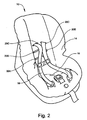
- Figure 2 is another perspective view of the energy absorbing seat of Figure 1;
- Figure 3 is a perspective view of a seat frame of the energy absorbing seat of Figure 1;
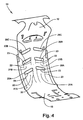
- Figure 4 is a perspective view of a center support of the seat frame of Figure 3;
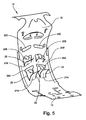
- Figure 5 is another perspective view of the center support of Figure 4.
- Figure 6 is another perspective view of the center support of Figure 4.
- Figure 7 is another perspective view of the center support of Figure 4.
- Figure 8 is a perspective view of a child secured and positioned on the center support of Figure 4.
- Figure 9 is a perspective view of the child positioned on the center support of Figure 4 and moving in a forward direction;
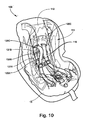
- Figure 10 is a perspective view of an energy absorbing child seat according to another preferred embodiment of the invention.
- Figure 11 is another perspective view of the energy absorbing seat of Figure 10;
- Figure 12 is a perspective view of a seat frame of the energy absorbing seat of Figure 10;
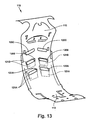
- Figure 13 is a perspective view of a center support of the seat frame of Figure 12;
- Figure 14 is another perspective view of the center support of Figure 13;
- Figure 15 is a partial cross sectional view of the energy absorbing seat of Figure 10;
- Figure 16 is another partial cross sectional view of the energy absorbing seat of Figure 10, showing a child moving forward;
- Figure 17 is a perspective view of a child secured and positioned on the center support of Figure 13;
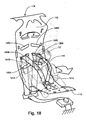
- Figure 18 is a perspective view of the child positioned on the center support of Figure 13, and moving in a forward direction;
- FIG. 1 and 2 an energy absorbing child safety seat according to a preferred embodiment of the invention is illustrated in Figures 1 and 2, and shown generally at reference numeral 10.
- the seat 10 is particularly for use in a vehicle, and generally comprises a seat frame 11 having a seat back 12 and a seat bottom 13 and energy absorbing members 21A, 21B.
- a restraining harness, such as straps 16 passes through the seat back 12 and is connected to the seat frame 11 for restraining a seat occupant within the seat.
- a cover 14 including suitable padding is positioned over the seat frame 11 to provide comfort to a seat occupant.
- the seat frame 11 includes a pair of molded plastic opposing sides 17 and 18 connected by a molded plastic center support 19.
- the center support 19 has a curvature that defines the seat back 12 and the seat bottom 13.
- three pairs of slots 20A, 20B, 20C are vertically positioned in the seat back 12 to allow the straps 16 to pass therethrough.
- the slots 20A, 20B, 20C are arranged in a pair of vertical columns to allow the straps 16 to be adjusted to accommodate seat occupants of different height.
- the bottom slots 20A are used for the smallest seat occupants, the intermediate slots 20B for larger seat occupants, and the top slots 20C for the largest seat occupants.
- the seat 10 can be adjusted as a seat occupant grows, or when used by a different child.
- each of the energy absorbing members 21A, 21B include an area defined by two spaced-apart weakened lines 22 of relatively thinner plastic material that extend downward from a bottom edge 23 of one of the bottom slots 20A or intermediate slots 20B, respectively.
- the lines 22 are weakened to allow for tearing in a sudden stop or deceleration.
- the lines 22 may be formed such that the degree of weakness decreases from a top of the line 22 to a bottom of the line 22.
- the lines 22 may be formed of spaced-apart perforations.
- the lines 22 of the lower energy absorbing members 21A extend from the bottom pair of slots 20A, and the lines 22 of the upper energy absorbing members 21B extend from the intermediate pair of slots 21B.
- the length of the lines 22 extending from intermediate slots 20B is less than the lines 22 extending from bottom slots 20A.
- the lines 22 allow the energy absorbing members 21A, 21B to tear away from the center support 19 at a controlled rate, decreasing the rate of acceleration of the seat occupant. This allows the energy absorbing members 21A, 21B to dissipate energy being applied to the slots 20A, 20B, respectively, by the straps 16 passing therethrough, as illustrated in Figures 6 and 7.
- a seat occupant such as a child "C" is positioned in the seat 10 on the center support 19.
- the child “C” is secured to the center support 19 of the seat 10 by the straps 16.
- the straps 16 are passed through the intermediate slots 20B to correspond to the size of the child "C”.
- the straps 16 restrain the child “C” to prevent the child “C” from being thrown forward.
- the straps of a conventional child seat may exert a force substantial enough to injure the child "C”.
- the energy absorbing members 21B of the seat 10 allow the straps 16 to move slightly forward before completely stopping.
- the energy absorbing members 21B gradually tear along the lines 22 as the force exerted by the straps 16 onto the child “C” increases. As such, forward motion of the child “C” is slowed gradually before coming to a complete stop, thereby reducing the potential for injury.
- Center 19 is replaced after incident causing sacrifice of the energy absorbing member.
- FIG. 10 An energy absorbing child safety seat according to another preferred embodiment of the invention is illustrated in Figures 10 and 11, and shown generally at reference numeral 100.
- the seat 100 generally comprises a seat frame 111 having a seat back 112 and a seat bottom 113 and energy absorbing members 121A, 121B.
- a restraining harness such as straps 116, passes through the seat back 112 and is connected to the seat frame 111 for restraining a seat occupant within the seat.
- a padded cover is positioned on the seat frame 111 to provide comfort to a seat occupant.
- the seat frame 111 includes a pair of opposing sides 117 and 118 connected by a center support 119.
- the center support 119 has a curvature that defines the seat back 112 and the seat bottom 113.
- three pairs of slots 120A, 120B, 120C are positioned on the seat back 112 to allow the straps 116 to pass therethrough, as illustrated with respect to slots 120B in Figure 14.
- the slots 120A, 120B, 120C are arranged in a pair of vertical columns to allow the straps 116 to be adjusted to accommodate a seat occupant of different heights.
- the bottom slots 120A are used for the smallest seat occupants, the intermediate slots 120B for larger seat occupants, and the top slots 120C for the largest seat occupants. As such, the seat 10 can be adjusted as the seat occupant grows.
- two pairs of energy absorbing members 121A, 121B are operatively associated with the slots 120A, 120B respectively.
- the energy absorbing members 121A, 121B are incorporated into the center support 119, as shown in Figure 13.
- Each of the energy absorbing members 121A, 121B includes a block of crushable material, such as a high density open or closed cell foam selected to provide a gradual deformation under load, preferably mounted on the rear side of the seat frame 111 proximate one of the bottom slots 120A or intermediate slots 120B, respectively, such that straps 116 can be positioned over the energy absorbing members 121A, 121B, as shown in Figure 15.
- the energy absorbing members 121A, 121B may be positioned at other suitable positions on the center support 119, such as under the seat bottom 113.
- the energy absorbing members 121A proximate the bottom slots 120A are larger than the energy absorbing members 121B proximate the intermediate slots 120B. There are no energy absorbing members proximate the top pair of slots 120C.
- Such an arrangement is due to the fact that the smallest children have the greatest need for energy absorption in a vehicle's sudden stop or impact, while energy absorption is not as critical for larger children. Also, the longer upper torso of larger children cannot be allowed to move so far forward as to impact the rear of the front seat.
- Figures 15 and 16 illustrate the function of the energy absorbing member 121A in a sudden stop.
- Figure 15 shows a child "C” riding at normal speed in a vehicle, and restrained by strap 116 positioned through the bottom slots 120A.
- the crushable material of the energy absorbing member 121A absorbs a significant amount of force from the strap 116.
- the energy absorbing member 121A allows the strap 116 to move slightly forward before coming to a complete stop by contacting the rear side of the seat frame 111. As such the child "C” is allowed to come to a more gradual stop, and is less likely to suffer an injury in an accident.
- Figures 17 and 18 illustrate the use of the energy absorbing members 121B proximate the intermediate slots 120B.
- the child “C” is positioned in the seat 100 on the center support 119, as shown in Figure 17.
- the child “C” is secured to the center support 119 of the seat 100 by the straps 116.
- the straps 116 are passed through the intermediate slots 120B to correspond to the size of the child "C”.
- the crushable material of the energy absorbing members 121B absorb a significant amount of the force exerted on the child by straps 116.
- the invention has the potential of decreasing the g-forces applied to a child during a sudden stop or deceleration from approximately 60g's to approximately 35-40g's.
Landscapes
- Engineering & Computer Science (AREA)
- Health & Medical Sciences (AREA)
- Child & Adolescent Psychology (AREA)
- General Health & Medical Sciences (AREA)
- Aviation & Aerospace Engineering (AREA)
- Transportation (AREA)
- Mechanical Engineering (AREA)
- Seats For Vehicles (AREA)
Applications Claiming Priority (1)
| Application Number | Priority Date | Filing Date | Title |
|---|---|---|---|
| US11/223,502 US7472952B2 (en) | 2005-09-09 | 2005-09-09 | Safety seat |
Publications (2)
| Publication Number | Publication Date |
|---|---|
| EP1762425A2 true EP1762425A2 (fr) | 2007-03-14 |
| EP1762425A3 EP1762425A3 (fr) | 2007-09-19 |
Family
ID=37546735
Family Applications (1)
| Application Number | Title | Priority Date | Filing Date |
|---|---|---|---|
| EP06254710A Withdrawn EP1762425A3 (fr) | 2005-09-09 | 2006-09-11 | Siège de sécurité |
Country Status (3)
| Country | Link |
|---|---|
| US (2) | US7472952B2 (fr) |
| EP (1) | EP1762425A3 (fr) |
| CA (1) | CA2558978C (fr) |
Cited By (4)
| Publication number | Priority date | Publication date | Assignee | Title |
|---|---|---|---|---|
| EP2177395A1 (fr) * | 2008-10-20 | 2010-04-21 | Curt Würstl Vermögensverwaltungs-GmbH & Co. KG | Moyen d'absorption des forces de collision survenant sur une ceinture de sécurité sur un siège de sécurité pour enfant |
| CN104627117A (zh) * | 2013-11-13 | 2015-05-20 | 明门(中国)幼童用品有限公司 | 缓冲机构及儿童安全座椅 |
| CN106004554A (zh) * | 2016-06-18 | 2016-10-12 | 金余和 | 带棘爪锁能机构的提蓝式安全座椅 |
| WO2017109137A1 (fr) * | 2015-12-23 | 2017-06-29 | Cybex Gmbh | Siège pour enfant destiné à être monté sur un siège de véhicule automobile |
Families Citing this family (31)
| Publication number | Priority date | Publication date | Assignee | Title |
|---|---|---|---|---|
| US9440563B2 (en) * | 2007-05-07 | 2016-09-13 | Arjuna Indraeswaran Rajasingham | Occupant support system |
| US20080012401A1 (en) * | 2006-05-09 | 2008-01-17 | Britax Child Safety, Inc. | Energy absorbing tether for child safety seat |
| DE102007018715A1 (de) * | 2007-04-20 | 2008-10-23 | Faurecia Autositze Gmbh | Fahrzeugsitz |
| US8500196B2 (en) * | 2008-04-15 | 2013-08-06 | Britax Child Safety, Inc. | Child seat having a crush zone |
| US8342604B2 (en) * | 2009-02-04 | 2013-01-01 | Cosco Management, Inc. | Juvenile vehicle seat with seat-back channel cover |
| USD660605S1 (en) | 2010-03-17 | 2012-05-29 | Britax Child Safety, Inc. | Child safety seat |
| US8905478B2 (en) | 2010-03-17 | 2014-12-09 | Britax Child Safety, Inc. | Child safety seat with structural support |
| USD651418S1 (en) | 2010-03-17 | 2012-01-03 | Britax Child Safety, Inc. | Child safety seat |
| USD651417S1 (en) | 2010-03-17 | 2012-01-03 | Britax Child Safety, Inc. | Child safety seat |
| US8348337B2 (en) * | 2010-03-17 | 2013-01-08 | Britax Child Safety, Inc. | Child safety seat with energy absorbing apparatus |
| US8579369B2 (en) | 2010-10-26 | 2013-11-12 | Cosco Management, Inc. | Truss system for juvenile vehicle seat |
| US8585138B2 (en) | 2010-10-26 | 2013-11-19 | Cosco Management, Inc. | Rigidifying system for single shell juvenile vehicle seat |
| US8496293B2 (en) | 2010-12-13 | 2013-07-30 | Cosco Management, Inc. | Energy-dissipation system for juvenile vehicle seat |
| US8573693B2 (en) | 2010-12-21 | 2013-11-05 | Cosco Management, Inc. | Adjustable headrest for juvenile vehicle |
| US9022471B2 (en) | 2011-01-07 | 2015-05-05 | Cosco Management, Inc. | Headrest for juvenile vehicle seat |
| US8764108B2 (en) | 2011-03-22 | 2014-07-01 | Cosco Management, Inc. | Adjustable headrest for juvenile vehicle seat |
| EP2546096B1 (fr) * | 2011-07-14 | 2013-09-11 | Volvo Car Corporation | Siège enfant |
| US9211820B2 (en) | 2012-11-01 | 2015-12-15 | Graco Children's Products Inc. | Child safety seat with side impact energy redirection |
| PL225439B1 (pl) | 2013-02-26 | 2017-04-28 | Karwala Łukasz Firma Lookart Eksport Imp | Fotelik samochodowy dla dzieci |
| US9487110B2 (en) | 2014-03-05 | 2016-11-08 | Pidyon Controls Inc. | Car seat |
| US8911015B2 (en) | 2013-03-05 | 2014-12-16 | Yochanan Cohen | Car seat |
| US10220734B2 (en) | 2013-03-05 | 2019-03-05 | Pidyon Controls Inc. | Car seat |
| US8991935B2 (en) * | 2013-03-11 | 2015-03-31 | Inspired Products Group, LLC | Child safety seat with shock absorber having compression-type soft material resilient member |
| CN204136815U (zh) * | 2013-09-13 | 2015-02-04 | 明门(中国)幼童用品有限公司 | 支撑脚缓冲装置及汽车安全座椅 |
| PL226538B1 (pl) | 2014-04-18 | 2017-08-31 | Karwala Lukasz Firma Lookart Eksport Imp | Fotelik samochodowy dla dzieci |
| US9616782B2 (en) | 2014-08-29 | 2017-04-11 | Pidyon Controls Inc. | Car seat vehicle connection system, apparatus, and method |
| US10011199B2 (en) * | 2014-10-30 | 2018-07-03 | Diono, Llc | Rear facing ride down safety seat |
| MX2017013976A (es) | 2015-05-12 | 2018-03-14 | Pidyon Controls Inc | Asiento para automovil y sistema de conexion. |
| CA2936917C (fr) | 2015-07-23 | 2018-05-22 | Dorel Juvenile Group, Inc. | Dispositif de securite pour enfant dote d'un mecanisme de gestion d'energie |
| US10457246B2 (en) * | 2017-04-12 | 2019-10-29 | Dorel Juvenile Group, Inc. | Child restraint system for juvenile vehicle seat |
| US10596929B2 (en) * | 2017-09-22 | 2020-03-24 | Jodi L. Houin | Child restraint system including harness and adjustment mechanism |
Citations (1)
| Publication number | Priority date | Publication date | Assignee | Title |
|---|---|---|---|---|
| US20040095004A1 (en) | 2002-11-14 | 2004-05-20 | William Horton | Shock absorber for juvenile vehicle seat tether |
Family Cites Families (5)
| Publication number | Priority date | Publication date | Assignee | Title |
|---|---|---|---|---|
| US3791694A (en) * | 1972-02-18 | 1974-02-12 | Safety Equipment Corp | Child restraining seat assembly |
| GB1442398A (en) * | 1973-05-08 | 1976-07-14 | Universal Oil Prod Co | Seats |
| GB9103841D0 (en) * | 1991-02-23 | 1991-04-10 | Britax Roemer Kindersicherheit Gmbh | Shock absorber for vehicle seat belt |
| JP2001097086A (ja) * | 1999-09-28 | 2001-04-10 | Combi Corp | チャイルドシート |
| JP4472127B2 (ja) | 2000-06-28 | 2010-06-02 | コンビ株式会社 | チャイルドシート |
-
2005
- 2005-09-09 US US11/223,502 patent/US7472952B2/en not_active Expired - Lifetime
-
2006
- 2006-09-06 CA CA002558978A patent/CA2558978C/fr active Active
- 2006-09-11 EP EP06254710A patent/EP1762425A3/fr not_active Withdrawn
-
2007
- 2007-12-27 US US11/964,998 patent/US7467824B2/en not_active Expired - Lifetime
Patent Citations (1)
| Publication number | Priority date | Publication date | Assignee | Title |
|---|---|---|---|---|
| US20040095004A1 (en) | 2002-11-14 | 2004-05-20 | William Horton | Shock absorber for juvenile vehicle seat tether |
Cited By (6)
| Publication number | Priority date | Publication date | Assignee | Title |
|---|---|---|---|---|
| EP2177395A1 (fr) * | 2008-10-20 | 2010-04-21 | Curt Würstl Vermögensverwaltungs-GmbH & Co. KG | Moyen d'absorption des forces de collision survenant sur une ceinture de sécurité sur un siège de sécurité pour enfant |
| CN104627117A (zh) * | 2013-11-13 | 2015-05-20 | 明门(中国)幼童用品有限公司 | 缓冲机构及儿童安全座椅 |
| WO2017109137A1 (fr) * | 2015-12-23 | 2017-06-29 | Cybex Gmbh | Siège pour enfant destiné à être monté sur un siège de véhicule automobile |
| JP2018538199A (ja) * | 2015-12-23 | 2018-12-27 | サイベックス ゲーエムベーハー | 自動車座席取付用チャイルドシート |
| US10625636B2 (en) | 2015-12-23 | 2020-04-21 | Cybex Gmbh | Child seat for attaching to a motor vehicle seat |
| CN106004554A (zh) * | 2016-06-18 | 2016-10-12 | 金余和 | 带棘爪锁能机构的提蓝式安全座椅 |
Also Published As
| Publication number | Publication date |
|---|---|
| US20070057544A1 (en) | 2007-03-15 |
| CA2558978A1 (fr) | 2007-03-09 |
| US7472952B2 (en) | 2009-01-06 |
| CA2558978C (fr) | 2009-06-30 |
| EP1762425A3 (fr) | 2007-09-19 |
| US7467824B2 (en) | 2008-12-23 |
| US20080106129A1 (en) | 2008-05-08 |
Similar Documents
| Publication | Publication Date | Title |
|---|---|---|
| US7467824B2 (en) | Safety seat | |
| US5733003A (en) | Child safety seat | |
| KR101332737B1 (ko) | 에너지 흡수 장치를 구비한 아동 안전 좌석 | |
| US8500196B2 (en) | Child seat having a crush zone | |
| US7513575B1 (en) | Shoulder- and neck holder | |
| KR20110104919A (ko) | 구조적 지지를 갖는 아동 안전 좌석 | |
| WO1999002367A1 (fr) | Coussin d'impact pour siege de securite | |
| Zellmer et al. | Optimized restraint systems for rear seat passengers | |
| US3961805A (en) | Safety system for the occupants of vehicles, especially motor vehicles | |
| US6042181A (en) | Convertible child safety seat | |
| US20040145223A1 (en) | Vehicle seat for preventing a neck injury | |
| US3881744A (en) | Automobile passenger restraint | |
| US9580032B1 (en) | Impact absorption cushion | |
| US20040000802A1 (en) | Child safety seat | |
| GB2417416A (en) | Adaptive vehicle child restraint system | |
| EP3825176B1 (fr) | Siège orienté vers l'arrière comportant un renfort de sécurité | |
| CN214647744U (zh) | 一种用于汽车的儿童安全座椅 | |
| CA2314345C (fr) | Dispositif de retenue pour les epaules et le cou | |
| Severy et al. | Safer seat designs | |
| CA2447580C (fr) | Ceinture de securite qui permet d'eviter le sous-marinage | |
| AU2022209313A1 (en) | Top tether dampener | |
| KR100551780B1 (ko) | 자동차의 서브마린 방지용 승객 구속장치 | |
| KR0125519Y1 (ko) | 뒷좌석의 탑승자 보호장치 | |
| KR20080038292A (ko) | 차량시트의 후방추돌 충격완화 장치 | |
| GB2504515A (en) | An impact protection device for attachment to the inside of a vehicle door |
Legal Events
| Date | Code | Title | Description |
|---|---|---|---|
| PUAI | Public reference made under article 153(3) epc to a published international application that has entered the european phase |
Free format text: ORIGINAL CODE: 0009012 |
|
| AK | Designated contracting states |
Kind code of ref document: A2 Designated state(s): AT BE BG CH CY CZ DE DK EE ES FI FR GB GR HU IE IS IT LI LT LU LV MC NL PL PT RO SE SI SK TR |
|
| AX | Request for extension of the european patent |
Extension state: AL BA HR MK YU |
|
| RIN1 | Information on inventor provided before grant (corrected) |
Inventor name: AMESAR, PANKAJ TULSIDAS Inventor name: NAKHLA, SAID |
|
| RIN1 | Information on inventor provided before grant (corrected) |
Inventor name: AMESAR, PANKAJ TULSIDAS Inventor name: NAKHLA, SAID |
|
| PUAL | Search report despatched |
Free format text: ORIGINAL CODE: 0009013 |
|
| AK | Designated contracting states |
Kind code of ref document: A3 Designated state(s): AT BE BG CH CY CZ DE DK EE ES FI FR GB GR HU IE IS IT LI LT LU LV MC NL PL PT RO SE SI SK TR |
|
| AX | Request for extension of the european patent |
Extension state: AL BA HR MK YU |
|
| 17P | Request for examination filed |
Effective date: 20080213 |
|
| 17Q | First examination report despatched |
Effective date: 20080317 |
|
| AKX | Designation fees paid |
Designated state(s): DE ES FR GB NL |
|
| GRAP | Despatch of communication of intention to grant a patent |
Free format text: ORIGINAL CODE: EPIDOSNIGR1 |
|
| STAA | Information on the status of an ep patent application or granted ep patent |
Free format text: STATUS: THE APPLICATION IS DEEMED TO BE WITHDRAWN |
|
| 18D | Application deemed to be withdrawn |
Effective date: 20091118 |