EP1762469A2 - Traverse, notamment de véhicule automobile - Google Patents
Traverse, notamment de véhicule automobile Download PDFInfo
- Publication number
- EP1762469A2 EP1762469A2 EP06017858A EP06017858A EP1762469A2 EP 1762469 A2 EP1762469 A2 EP 1762469A2 EP 06017858 A EP06017858 A EP 06017858A EP 06017858 A EP06017858 A EP 06017858A EP 1762469 A2 EP1762469 A2 EP 1762469A2
- Authority
- EP
- European Patent Office
- Prior art keywords
- cross member
- module component
- arrangement according
- highly
- highly integrated
- Prior art date
- Legal status (The legal status is an assumption and is not a legal conclusion. Google has not performed a legal analysis and makes no representation as to the accuracy of the status listed.)
- Granted
Links
Images


Classifications
-
- B—PERFORMING OPERATIONS; TRANSPORTING
- B62—LAND VEHICLES FOR TRAVELLING OTHERWISE THAN ON RAILS
- B62D—MOTOR VEHICLES; TRAILERS
- B62D25/00—Superstructure or monocoque structure sub-units; Parts or details thereof not otherwise provided for
- B62D25/08—Front or rear portions
- B62D25/14—Dashboards as superstructure sub-units
- B62D25/145—Dashboards as superstructure sub-units having a crossbeam incorporated therein
Definitions
- the invention relates to a cross member arrangement, in particular for a motor vehicle, according to the preamble of claim 1.
- a cross member for a motor vehicle which consists of an upper half-shell and a lower half-shell, which have at their mutually facing ends tabs which are glued together by an adhesive.
- a holder is secured by means of several screws on the cross member. The screws are glued after screwing.
- DE 102 54 348 A1 is an assembly for a cockpit area, consisting of a cross member and a dashboard described, which is composed of a driver, a center and a passenger module. At these modules, adapters and attachments, such as holders are fastened.
- cross members or other structural components are known to which holders are welded directly.
- cross member arrangement with the features of claim 1.
- Advantageous embodiments are the subject of the dependent claims.
- the term of the cross member is to be regarded not only in the sense of a structural component for connecting the A pillars of a vehicle, but generally as a structural component of a vehicle, so for example also a front end structural component.
- a cross member arrangement in particular for a motor vehicle, is provided, which is attached at least from a cross member to the at least one highly integrative module component, wherein the highly integrative modular component is used to attach components to the cross member.
- the highly integrated module component has a partial area corresponding to the outer profile of the cross member receptacle for the cross member, which forms a contact area between the highly integrated module component and the cross member, and is removably attached to the cross member by means of at least one cross member in its circumference at least partially enclosing fastener. Where this solubility is to be seen as largely non-destructive. A repeated joining is possible with little effort.
- a highly integrative module component is to be understood as meaning a component which has at least 2, 3, 4 or 5, preferably 6, 7, 8 or 9 and particularly preferably 10 or more than 10 integration, connection and / or holding elements ,
- the highly integrated module component is designed in particular as an essentially injection molded or stamped and bent part.
- the fastening element may in this case also be designed in several parts, wherein a region of the highly integrative modular component may also form part of the multipart fastening element.
- a strap, a cable tie, a metal clamp, a hose clamp, a mounting clamp, for example made of polyamide, a Velcro cable tie or at least a second highly integrated module component is provided as a fastener or part of the fastener.
- the highly integrative module component to which preferably various, to be attached to the cross member components can be attached has the following integration, connection and / or holding elements: breakthroughs, holes, screws, nuts, Aufsteckmuttern, ringdome, Blindniet connector, metal clamps, cable ties , Plastic or metal holders for attachments, connectors, felt tapes, (foam) seals, adhesives and sealants, sound or vibration damping elements, parts of clip connections, adjustment elements, magnets, hook-type surfaces and / or adhesiveness, hook tapes, components a Velcro closure or pipe and cable holders.
- Such highly-integrated modular components can be produced relatively inexpensively in smaller injection molds with shorter cycle times, longer service lives and higher discharge rates than in the case of direct injection molding on the cross member.
- weight advantages and additional degrees of freedom in terms of design and functionality Due to the separate design, in particular a limited investment or contact surface, changes in the construction in the region of a highly integrated module component or the cross member can be realized more easily, since the cross member and the highly integrated module component are formed substantially independently.
- connections such as holders for the A-pillars, no consideration must be taken to plastic parts, since these are first mounted in a later manufacturing step.
- the choice of welding processes for the production of the cross member together with welded connections is less limited.
- the highly integrated module components can be adapted more easily to different models and variants of vehicles by combining them accordingly.
- three highly integral modular components are preferably arranged in the longitudinal direction of the cross member, associated with the driver's side, center and passenger side.
- the individual highly integrative module components can also be connected to one another directly to increase stability.
- This modular design also enables faster implementation of changes to individual series.
- the arrangement of at least two highly integral module components in the transverse direction of the cross member is provided behind one another, which are in particular interconnected.
- At least one functional module is connected or integrated with the highly integrated modular component.
- the following functional modules may be mentioned: instrument panel, panels, tunnel or end wall support, A-pillar connection, speedometer, displays, radio, loudspeaker, antenna, navigation system, operating and control units, sensors, motors, RFID, wiring harness, hoses, pipes, lines, plug, windscreen wiper system, gasket to the windscreen, steering column, pedal pedals, Pedalwertgeber, metal or plastic holder, airbag including generators, deformation elements, knee protection, foams, damping elements, footwell paneling, Dämmwand, Dämmmatte, GPS, computer, optical fibers, light sources, parts of the heating / air conditioning, in particular housing, blowers, filters, Air inlet and outlet elements, flaps, in particular rotatable or pivotable flaps, air vents, kinematics, levers or motors, shelves, glove box, center console, as well as circuits which are mounted on the cross member.
- a front end functional module includes, for example, cooling modules, headlights, control units, bumpers, damping elements, crash boxes, foams, fenders, water tanks, motors, filters, sensors, for example for distance measurement, pipes, air guide elements, sealing elements, wiring harness, fanfare or a closing unit for bonnets.
- the highly integrated module component can directly or partially replace the functions of individual function modules.
- the highly integrative module component can have compatible interfaces, such as, for example, a joining flange or a part of a tongue and groove joint, and position the elements to be joined together in the correct position via index elements.
- the one or more fasteners are preferably band-like, firmly around the cross member to rest on the same attractable elements, such as in particular tabs, cable ties or metal clamps.
- a plurality of fasteners are provided over the length of the cross member, in special cases or at low loads can also be sufficient for a single fastener.
- the power flow is in this case preferably ensured by a form-fitting geometry and / or clamping between highly integrated module component and cross member.
- the cross member may be accommodated between two or possibly even more highly integrated modular components.
- the fastening element may in this case be designed in several parts, wherein at least one module component itself is part of the fastening element and with the at least second module component by means of screws or the like. under pressing the cross member is attached to each other.
- a mating element on the highly integrative module component can be fixed on the opposite side of the highly integrative module component by means of adhesive, ultrasonic, contact heat or vibration welding method, so that the crossmember is enclosed by the highly integrative module component and mating element which form the fastening element.
- At least the contact region of the cross member is convex, in particular in the form of a circular arc section, so that the fastening element is flat against the highly integrative module component and / or the cross member, optionally with the interposition of a tolerance compensating layer, such as a foam.
- the cross member is additionally reinforced, so that it can be dispensed with additional stiffeners in individual cases with appropriate design.
- the power flow in the cross member can be optimized by the structural design of the module component in a relatively simple and cost-effective manner, so that voltage peaks can be avoided.
- the highly integrative module component is preferably formed as a cast part or injection molded part, in particular as a plastic or magnesium injection molded part, or stamped, deep-drawn and / or bent part made of metal.
- plastic particularly preferably high-strength, fiber-reinforced Plastic, eg. Polyamide or ABS (eg PA6 GF30) or thermoplastic foams (eg PPE) or combinations of different plastics (eg with amorphous and crystalline form, polypropylene talc 20 + PP + long glass fibers), light metals, especially aluminum or magnesium in question.
- fillers such as gases or granules filled with gas may also be used.
- components with foam character can be used, for example Mucell.
- an embodiment as a hybrid component for example made of plastic and magnesium, suitable.
- Stiffening elements can also be integrated into the highly integrative module component, such as, for example, injected stiffeners or insert sheets.
- the injected stiffeners preferably have features such as holes or deformations to achieve better anchoring in the injection molded material.
- At least one stiffening sheet is preferably integrated into the highly integrative module component, in particular by means of injection molding of the stiffening sheet. A subsequent attachment of the stiffening plate is possible. It may be a stiffening for an integrated tunnel or end wall support for the cross member. Also, stiffeners are preferably provided, which are arranged parallel to the cross member extending in the highly integrated module component. As stiffening sheets are preferably KLT-coated, perforated steel sheets with a wall thickness of 0.5 mm - 3mm, in particular about 0.8 mm in question.
- the highly integrated module component can have ribs which can serve as stiffeners or as energy-absorbing deformation elements.
- the highly integrative module component is preferably provided at the edge of the receptacle for the cross member at least one slot or slot through which the fastening element, in particular preferably formed by a tab, a cable tie, a mounting clamp made of polyamide or a metal clamp, is guided.
- the slot is in this case preferably designed such that no cracking occurs during a load. For example, relief notches or relief holes are possible at the ends. Also, special reinforcements to prevent cracking around the slot ends are possible.
- a slot or slot at the same height is provided for each attachment element on both sides of the receptacle, so that the highly integrated module component is pressed over a large area over a peripheral region of the cross member.
- tolerance compensating and / or vibration damping liners for example. From foam, rubber or possibly also adhesive possible.
- the highly integrated module component preferably forms part of a channel, in particular an air channel, through which air can be supplied to the vehicle interior.
- At least one component of a heating and / or air conditioning system is connected or integrated with the highly integrated modular component.
- a covering element is preferably attached to the highly integrative module component, so that the module component forms the air channel in conjunction with the covering element.
- the covering element here is preferably made of a light material, such as PE, PP, PET non-woven or PE foam, especially preferred are single-layer or multi-layer, cross-linked polyolefin foams with densities of 20 to 200 kg / m 3 . These can be pressed during assembly and have an acoustically damping effect.
- the connection to the highly integrative module component can be done, for example, by gluing or friction welding.
- the cross member itself may have a cavity for passing a medium, in particular of air.
- connections to the channel formed by the cavity can be formed by appropriately designed highly integrated module components.
- the contact region on the cross member and the corresponding contact region on the module component each have an indexing and / or position orientation element or a corresponding, complementary element.
- elements for example, grooves, beads, fixing bolts, impressions or attacks serve.
- the cross member is formed by a tube, in particular a steel tube with a diameter of about 40 mm - 100 mm, more preferably about 60 mm and wall thicknesses of about 1.5 mm.
- the production costs are relatively low.
- material can be saved.
- the embodiment of the cross member by means of two half-shells is possible, which are connected to each other in a known manner.
- stiffening elements may be provided in one or both half-shells.
- the half shells are preferably extruded or rolled profiles, which have a continuous profile in the undeformed state.
- the half-shells may also be made by hydroforming or otherwise.
- the cross member in particular in tubular form, also made of carbon fiber reinforced plastic, with Aramidgewebe or mixed fibers reinforced plastic.
- stiffening elements which is, for example, a plastic structure, preferably with cross-shaped ribs or a honeycomb structure, is. This can be injected relatively easily and increases the stiffness significantly at a relatively low weight. Despite the stiffening elements channels may be provided for a medium to be carried in the interior of the cross member.
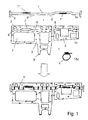
- a cross member 1 of a motor vehicle is formed by a tube 2 according to the first embodiment.
- This is a metal structure that is made by extrusion molding or roll forming and has an approximately circular cross-section over substantially the entire length.
- the cross member 1 has an offset in the region of the connection for the steering column.
- On the cross member 1 are directly end two links 1 'for the attachment of the cross member 1 to the two A-pillars, a connection 1 "for the steering column and a connection 1"' for the passenger airbag welded.
- two flexibly insertable highly integrative module components 3 are attached, with the aid of a total of thirteen cable binders serving as fastening elements 4, in a manner described in more detail below.
- the two highly integrative modular components 3 are each a plastic injection-molded part with a plurality of openings, holding devices, screw domes, indicated in FIG. 1 by "X", which serve for attachment to the highly integrative module components to be fastened.
- the highly integrative module components 3 have receptacles 5 forming depressions whose dimensions are designed so that the highly integrative module components of the cross member to about the center plane thereof in the receptacle 5 record, so that a relatively large contact area 5 'between highly integrated module component 3 and cross member. 1 is formed.
- a total of twenty-six slots 6 are provided in the high-integration modular components 3 on both sides along the receptacle 5, with two slots 6 each being arranged on opposite sides of the receptacle 5.
- the interior of the cross member 1 is formed according to the present embodiment, a hollow cylinder, so that the passage of air is possible. This is a part of the ventilation system in the cross member 1 can be integrated. Instead of or in addition to air, other media can be passed through the cross member 1.
- the cross member 1 has transversely to its longitudinal extent arranged openings (not shown) for introducing and discharging the air.
- Corresponding openings 7 for the introduction of air into the vehicle interior are also provided in the highly-integrated modular components. Further openings for the connections 1 "and 1" 'welded to the cross member 1 and for other purposes, such as cable bushings, are also provided in the highly integrative module components.
- a tunnel support 8 is provided on the highly integrative modular component 3.
- any other cross-sectional shapes are possible, such as in particular oval, rectangular cross-sections or cross-sections formed as a polygon.
- Fig. 2 shows a second embodiment of a cross member 1, formed by a tube 2 having a circular cross-section, and a highly integrative module component 3 attached thereto, which has side parts, on which holding devices and screw domes are provided, indicated by "X", for connection to highly integrative module component to be fastened components.
- the highly integrated module component 3 is, corresponding to the module component 3 of the first embodiment, attached by means of a plurality of cable ties on the cross member 1, for which 3 slots are provided in the highly integrated module component.
- the highly integrated module component 3 is designed such that it has, in addition to the receptacle 5 for the cross member 1, a further semi-cylindrical recess 11 which forms part of an air channel 12 through which air from an air conditioner can be supplied to the vehicle interior ,
- the second part of the air channel 12 is formed by an air half-channel 13, which is mounted directly on the high-integration module component 3 here by means of friction or ultrasonic welding.
- Fig. 3 shows a third embodiment of a cross member 1, also formed by a tube with a circular arc-shaped cross section, and two attached thereto highly integrative modular components 3, 3 ', which receive the cross member 1 between them.
- the fixing of the two modular components 3, 3 ' takes place on the cross member 1, which in turn is formed by a tube with a circular cross section, by means of a plurality of connecting points, three of which in the illustration of FIG " Marked are.
- the highly integrative module components 3, 3 ' have a solid shape, wherein an air half-channel 13 is attached to one of the module components 3' and a part of an air-conditioning system 20 is integrated.
- fixation on the cross member 1 can also be effected by means of cable ties or metal clamps, which are each outwardly guided around the corresponding area of the highly integrative modular components 3, 3 'and by mutually aligned slots on both sides of the cross member 1.
- FIGS. 6 and 7 A fourth exemplary embodiment is shown in FIGS. 6 and 7, two transverse beams 1, namely an upper and a lower end wall support, being provided, between which three highly integrative modular components 3 are arranged in the present case.
- the cross members 1 according to the fourth embodiment have approximately rectangular cross-sections, wherein the highly integral module components 3 - according to the first and second embodiments - have a predominantly flat contact area with the cross members 1.
- For fixing cable ties (not shown) are again provided, which are each guided by a slot in the module component 3.
- Fig. 8 shows the fifth embodiment.
- the cross member assembly shown has the cross member 1, formed by a multi-part steel cross member with different diameters for driver and passenger side, the steel cross member are connected by welding firmly together, to the cross member 1 right and left welded connections for the A-pillars, and a welded tunnel support 8 ', and two attached by means of metal clamps on the cross member 1 highly integrated modular components 3.
- These have in the installed state in the knee area parallel to the cross member 1 extending stiffening plates 30 extending from one A-pillar to the other A-pillar, where they are connected to each other in the intermediate region of the highly integrated module components 3.
- the stiffening plates 30 are each integrated directly by means of Hinterspritztechnik in the modular components 3.
- the stiffening plates have slots for tolerance compensation during vehicle assembly.
- a tunnel support 8 made of steel is additionally integrated, which is attached to the cross member 1 via the modular component 3.
- a second cross member are attached.
Landscapes
- Engineering & Computer Science (AREA)
- Chemical & Material Sciences (AREA)
- Combustion & Propulsion (AREA)
- Transportation (AREA)
- Mechanical Engineering (AREA)
- Body Structure For Vehicles (AREA)
Applications Claiming Priority (1)
| Application Number | Priority Date | Filing Date | Title |
|---|---|---|---|
| DE102005042588 | 2005-09-07 |
Publications (3)
| Publication Number | Publication Date |
|---|---|
| EP1762469A2 true EP1762469A2 (fr) | 2007-03-14 |
| EP1762469A3 EP1762469A3 (fr) | 2008-01-02 |
| EP1762469B1 EP1762469B1 (fr) | 2009-10-14 |
Family
ID=37403002
Family Applications (1)
| Application Number | Title | Priority Date | Filing Date |
|---|---|---|---|
| EP20060017858 Expired - Fee Related EP1762469B1 (fr) | 2005-09-07 | 2006-08-28 | Traverse, notamment de véhicule automobile |
Country Status (2)
| Country | Link |
|---|---|
| EP (1) | EP1762469B1 (fr) |
| DE (1) | DE502006005085D1 (fr) |
Cited By (4)
| Publication number | Priority date | Publication date | Assignee | Title |
|---|---|---|---|---|
| EP2305394A1 (fr) * | 2009-09-30 | 2011-04-06 | Mazda Motor Corporation | Procédé de formation de tablier de véhicule |
| FR2965530A1 (fr) * | 2010-09-30 | 2012-04-06 | Faurecia Interieur Ind | Ensemble de traverse de planche de bord pour vehicule automobile. |
| US8652611B2 (en) | 2009-09-11 | 2014-02-18 | GM Global Technology Operations LLC | Plastic moulded part for a motor vehicle |
| CN119513457A (zh) * | 2025-01-21 | 2025-02-25 | 北京科技大学 | 管路减振卡箍 |
Families Citing this family (1)
| Publication number | Priority date | Publication date | Assignee | Title |
|---|---|---|---|---|
| CN110239632B (zh) | 2019-07-17 | 2024-11-26 | 上海延锋金桥汽车饰件系统有限公司 | 仪表板横梁 |
Citations (2)
| Publication number | Priority date | Publication date | Assignee | Title |
|---|---|---|---|---|
| DE10221654A1 (de) | 2001-10-01 | 2003-04-24 | Dura Automotive Plettenberg | Querträger für ein Kraftfahrzeug |
| DE10254348A1 (de) | 2002-11-21 | 2004-06-09 | Daimlerchrysler Ag | Baugruppe für einen Cockpit-Bereich |
Family Cites Families (4)
| Publication number | Priority date | Publication date | Assignee | Title |
|---|---|---|---|---|
| FR2724900B1 (fr) * | 1994-09-28 | 1996-12-13 | Valeo Thermique Habitacle | Planche de bord pour vehicule automobile |
| FR2724901B1 (fr) * | 1994-09-28 | 1996-12-13 | Valeo Thermique Habitacle | Dispositif de support d'une planche de bord de vehicule automobile |
| DE102004015086A1 (de) * | 2004-03-25 | 2005-10-13 | Behr Gmbh & Co. Kg | Querträger mit integrierter Luftführung für ein Kraftfahrzeug |
| DE102004053380A1 (de) * | 2004-11-02 | 2006-05-24 | Johnson Controls Interiors Gmbh & Co. Kg | Fahrzeugcockpit |
-
2006
- 2006-08-28 DE DE200650005085 patent/DE502006005085D1/de active Active
- 2006-08-28 EP EP20060017858 patent/EP1762469B1/fr not_active Expired - Fee Related
Patent Citations (2)
| Publication number | Priority date | Publication date | Assignee | Title |
|---|---|---|---|---|
| DE10221654A1 (de) | 2001-10-01 | 2003-04-24 | Dura Automotive Plettenberg | Querträger für ein Kraftfahrzeug |
| DE10254348A1 (de) | 2002-11-21 | 2004-06-09 | Daimlerchrysler Ag | Baugruppe für einen Cockpit-Bereich |
Cited By (7)
| Publication number | Priority date | Publication date | Assignee | Title |
|---|---|---|---|---|
| US8652611B2 (en) | 2009-09-11 | 2014-02-18 | GM Global Technology Operations LLC | Plastic moulded part for a motor vehicle |
| EP2305394A1 (fr) * | 2009-09-30 | 2011-04-06 | Mazda Motor Corporation | Procédé de formation de tablier de véhicule |
| CN102030043A (zh) * | 2009-09-30 | 2011-04-27 | 马自达汽车株式会社 | 车用前围板的成形方法 |
| CN102030043B (zh) * | 2009-09-30 | 2014-10-08 | 马自达汽车株式会社 | 车用前围板的成形方法 |
| FR2965530A1 (fr) * | 2010-09-30 | 2012-04-06 | Faurecia Interieur Ind | Ensemble de traverse de planche de bord pour vehicule automobile. |
| EP2436579A3 (fr) * | 2010-09-30 | 2013-01-23 | Faurecia Intérieur Industrie | Ensemble de traverse de planche de bord pour véhicule automobile. |
| CN119513457A (zh) * | 2025-01-21 | 2025-02-25 | 北京科技大学 | 管路减振卡箍 |
Also Published As
| Publication number | Publication date |
|---|---|
| EP1762469B1 (fr) | 2009-10-14 |
| EP1762469A3 (fr) | 2008-01-02 |
| DE502006005085D1 (de) | 2009-11-26 |
Similar Documents
| Publication | Publication Date | Title |
|---|---|---|
| EP1686044B1 (fr) | Poutre transversale de support pour véhicule | |
| AT522671B1 (de) | Fahrzeugkarosserie-Plattform für ein Automobil und Automobil, das eine solche Fahrzeugkarosserie-Plattform umfasst | |
| EP1233900B1 (fr) | Element constitutif pour automobile | |
| EP0672576B1 (fr) | Module pour la partie comportant la cloison séparatrice et le poste de conduite d'un véhicule automobile | |
| DE69500207T3 (de) | Doppelwandige Türinnenverkleidung für Kraftfahrzeuge | |
| EP2064108B1 (fr) | Tube porteur d'un tableau de bord d'un vehicule automobile | |
| DE3119572C2 (fr) | ||
| EP1682401B1 (fr) | Element constitutif, utilisation d'un element constitutif et procede pour produire un element constitutif, notamment un longeron de vehicule | |
| DE10014606A1 (de) | Querträger in Hybridbauweise | |
| DE202019107014U1 (de) | Polymerfahrzeugboden | |
| DE102007024804A1 (de) | Selbsttragendes Karosserie-Struktur-Verbundbauteil-Modul | |
| KR20050098231A (ko) | 성형 횡단 차량 비임 | |
| DE10240395A1 (de) | Querträger für ein Kraftfahrzeug | |
| DE10220025A1 (de) | Querträger | |
| DE102021131018A1 (de) | Lokal verstärkte, schaumstoffgefüllte verbundbauteile für fahrzeugkarosseriestrukturen und verfahren zu deren herstellung | |
| EP2039592B1 (fr) | Module avant de véhicule automobile | |
| DE20008201U1 (de) | Instrumententafelträger | |
| EP1429941B1 (fr) | Element d'habillage con u pour le toit de l'habitable d'un vehicule | |
| DE10064522A1 (de) | Bauteil für ein Kraftfahrzeug | |
| DE10160676A1 (de) | Kotflügel aus Kunststoff an Kraftfahrzeugen | |
| DE102009006960A1 (de) | Fahrzeug-Instrumententafel-Montageträger und Verfahren zur Herstellung eines Fahrzeug-Instrumententafel-Montageträgers | |
| EP2112054A1 (fr) | Traverse de cockpit pour un véhicule automobile | |
| EP1762469B1 (fr) | Traverse, notamment de véhicule automobile | |
| EP1802512B1 (fr) | Toit de vehicule | |
| DE10132969A1 (de) | Unterbodenabdeckung |
Legal Events
| Date | Code | Title | Description |
|---|---|---|---|
| PUAI | Public reference made under article 153(3) epc to a published international application that has entered the european phase |
Free format text: ORIGINAL CODE: 0009012 |
|
| AK | Designated contracting states |
Kind code of ref document: A2 Designated state(s): AT BE BG CH CY CZ DE DK EE ES FI FR GB GR HU IE IS IT LI LT LU LV MC NL PL PT RO SE SI SK TR |
|
| AX | Request for extension of the european patent |
Extension state: AL BA HR MK YU |
|
| PUAL | Search report despatched |
Free format text: ORIGINAL CODE: 0009013 |
|
| AK | Designated contracting states |
Kind code of ref document: A3 Designated state(s): AT BE BG CH CY CZ DE DK EE ES FI FR GB GR HU IE IS IT LI LT LU LV MC NL PL PT RO SE SI SK TR |
|
| AX | Request for extension of the european patent |
Extension state: AL BA HR MK YU |
|
| 17P | Request for examination filed |
Effective date: 20080702 |
|
| AKX | Designation fees paid |
Designated state(s): DE FR |
|
| 17Q | First examination report despatched |
Effective date: 20080822 |
|
| GRAP | Despatch of communication of intention to grant a patent |
Free format text: ORIGINAL CODE: EPIDOSNIGR1 |
|
| GRAS | Grant fee paid |
Free format text: ORIGINAL CODE: EPIDOSNIGR3 |
|
| GRAA | (expected) grant |
Free format text: ORIGINAL CODE: 0009210 |
|
| AK | Designated contracting states |
Kind code of ref document: B1 Designated state(s): DE FR |
|
| REF | Corresponds to: |
Ref document number: 502006005085 Country of ref document: DE Date of ref document: 20091126 Kind code of ref document: P |
|
| PLBE | No opposition filed within time limit |
Free format text: ORIGINAL CODE: 0009261 |
|
| STAA | Information on the status of an ep patent application or granted ep patent |
Free format text: STATUS: NO OPPOSITION FILED WITHIN TIME LIMIT |
|
| 26N | No opposition filed |
Effective date: 20100715 |
|
| PGFP | Annual fee paid to national office [announced via postgrant information from national office to epo] |
Ref country code: FR Payment date: 20100901 Year of fee payment: 5 Ref country code: DE Payment date: 20100920 Year of fee payment: 5 |
|
| REG | Reference to a national code |
Ref country code: FR Ref legal event code: ST Effective date: 20120430 |
|
| REG | Reference to a national code |
Ref country code: DE Ref legal event code: R119 Ref document number: 502006005085 Country of ref document: DE Effective date: 20120301 |
|
| PG25 | Lapsed in a contracting state [announced via postgrant information from national office to epo] |
Ref country code: FR Free format text: LAPSE BECAUSE OF NON-PAYMENT OF DUE FEES Effective date: 20110831 |
|
| PG25 | Lapsed in a contracting state [announced via postgrant information from national office to epo] |
Ref country code: DE Free format text: LAPSE BECAUSE OF NON-PAYMENT OF DUE FEES Effective date: 20120301 |