EP1762926A2 - Procédé et appareil permettant de commander le fonctionnement d'un dispositif multimédia - Google Patents
Procédé et appareil permettant de commander le fonctionnement d'un dispositif multimédia Download PDFInfo
- Publication number
- EP1762926A2 EP1762926A2 EP06120188A EP06120188A EP1762926A2 EP 1762926 A2 EP1762926 A2 EP 1762926A2 EP 06120188 A EP06120188 A EP 06120188A EP 06120188 A EP06120188 A EP 06120188A EP 1762926 A2 EP1762926 A2 EP 1762926A2
- Authority
- EP
- European Patent Office
- Prior art keywords
- multimedia device
- tapping
- pattern
- detected
- detector
- Prior art date
- Legal status (The legal status is an assumption and is not a legal conclusion. Google has not performed a legal analysis and makes no representation as to the accuracy of the status listed.)
- Withdrawn
Links
Images




Classifications
-
- G—PHYSICS
- G06—COMPUTING OR CALCULATING; COUNTING
- G06F—ELECTRIC DIGITAL DATA PROCESSING
- G06F3/00—Input arrangements for transferring data to be processed into a form capable of being handled by the computer; Output arrangements for transferring data from processing unit to output unit, e.g. interface arrangements
- G06F3/01—Input arrangements or combined input and output arrangements for interaction between user and computer
- G06F3/03—Arrangements for converting the position or the displacement of a member into a coded form
- G06F3/041—Digitisers, e.g. for touch screens or touch pads, characterised by the transducing means
- G06F3/043—Digitisers, e.g. for touch screens or touch pads, characterised by the transducing means using propagating acoustic waves
-
- G—PHYSICS
- G01—MEASURING; TESTING
- G01H—MEASUREMENT OF MECHANICAL VIBRATIONS OR ULTRASONIC, SONIC OR INFRASONIC WAVES
- G01H17/00—Measuring mechanical vibrations or ultrasonic, sonic or infrasonic waves, not provided for in the other groups of this subclass
-
- G—PHYSICS
- G06—COMPUTING OR CALCULATING; COUNTING
- G06F—ELECTRIC DIGITAL DATA PROCESSING
- G06F3/00—Input arrangements for transferring data to be processed into a form capable of being handled by the computer; Output arrangements for transferring data from processing unit to output unit, e.g. interface arrangements
- G06F3/01—Input arrangements or combined input and output arrangements for interaction between user and computer
- G06F3/03—Arrangements for converting the position or the displacement of a member into a coded form
- G06F3/033—Pointing devices displaced or positioned by the user, e.g. mice, trackballs, pens or joysticks; Accessories therefor
- G06F3/038—Control and interface arrangements therefor, e.g. drivers or device-embedded control circuitry
-
- G—PHYSICS
- G06—COMPUTING OR CALCULATING; COUNTING
- G06F—ELECTRIC DIGITAL DATA PROCESSING
- G06F2200/00—Indexing scheme relating to G06F1/04 - G06F1/32
- G06F2200/16—Indexing scheme relating to G06F1/16 - G06F1/18
- G06F2200/163—Indexing scheme relating to constructional details of the computer
- G06F2200/1636—Sensing arrangement for detection of a tap gesture on the housing
Definitions
- the present general inventive concept relates to a method and apparatus to control an operation of a multimedia device.
- a conventional portable multimedia device is controlled using push buttons thereof.
- the user when a user carries the conventional portable multimedia device in a pocket such that push buttons thereof cannot be directly seen to use the device, the user must take the portable multimedia device out of the pocket and push one of the buttons.
- an additional device must be separately installed within a main body of the conventional multimedia device, or the user must directly connect the conventional multimedia device with the additional device.
- Figure 1 is a view illustrating a method of operating a conventional multimedia device 100.
- buttons 110 of the multimedia device 100 to press a button corresponding to a desired function among buttons 110 of the multimedia device 100, a user must take the multimedia device 100 out of a pocket, for example, to push one of the buttons 110.
- the present general inventive concept provides a method and apparatus to control an operation of a multimedia device which do not require a user to press a button thereof.
- the foregoing and/or other aspects and utilities of the present general inventive concept may be achieved by providing a method of controlling operations of a multimedia device, the method including detecting an input tapping, detecting a pattern of the detected tapping, and controlling an operation of the multimedia device according to the detected pattern.
- the detection of the input tapping may include sensing a sound signal of the input tapping, detecting energy of the sensed sound signal, and if the detected energy satisfies predetermined conditions, detecting the detected energy as an event.
- the predetermined conditions may be a magnitude of the detected energy being greater than a predetermined level and the detected energy has a predetermined duration.
- the detection of the input tapping may include sensing a pressure of the input tapping, and if a magnitude of the sensed pressure satisfies a predetermined condition, detecting the tapping as an event.
- the detection of the pattern of the detected tapping may include searching a pattern storage unit for an operation of the multimedia device corresponding to the detected pattern of the tapping, and the controlling of an operation of the multimedia device may include controlling an operation of the multimedia device so as to perform the found operation of the multimedia device.
- the method may further include receiving the pattern of the tapping and the operation of the multimedia device corresponding to the pattern from a user interface and storing them in a pattern storage unit.
- the foregoing and/or other aspects and utilities of the present general inventive concept may also be achieved by providing a method of controlling operations of a multimedia device, the method including detecting a pattern of an input tapping and controlling an operation of the multimedia device based on the detected tapping.
- an apparatus to control an operation of a multimedia device including a tapping detector to detect an input tapping, a pattern detector to detect a pattern of the detected tapping, and a controller to control an operation of the multimedia device according to the detected pattern.
- the tapping detector may include a sound signal receiver to receive a sound signal of the input tapping, an energy detector to detect an energy of the sensed sound signal, and an event detector to detect the detected energy as an event when the detected energy satisfies predetermined conditions.
- the predetermined conditions may include a magnitude of the detected energy is greater than a predetermined level and the detected energy has a predetermined duration.
- the tapping detector may include a sensor to sense a pressure of the input tapping, and an event detector to detect the tapping as an event when the magnitude of the sensed pressure satisfies a predetermined condition.
- the pattern detector may search a pattern storage unit for operations of the multimedia device corresponding to the detected pattern of the tapping, and the controller may control an operation of the multimedia device so as to perform the found operation of the multimedia device.
- the pattern of the tapping and the operation of the multimedia device corresponding to the pattern may be received from a user interface and stored in the pattern storage unit.
- an apparatus to control an operation of a multimedia device including a microphone to sense a sound signal of an input tapping, a low pass filter (LPF) low pass to filter the sound signal sensed by the microphone, an energy detector to detect an energy of the low pass filtered signal, an event detector to detect the detected energy as an event when the detected energy satisfies predetermined conditions, a pattern detector to detect a pattern of the tapping detected as the event, and a controller to control an operation of the multimedia device according to the detected pattern.
- LPF low pass filter
- an apparatus to control operations of a multimedia device including a pressure sensor to sense a pressure of input tapping, an event detector to detect a signal sensed by the pressure sensor as an event when the sensed signal satisfies predetermined conditions, a pattern detector to detect a pattern of the tapping detected as the event, and a controller to control an operation of the multimedia device according to the detected pattern.
- an apparatus to control operations of a multimedia device including a detecting unit to detect a pattern of tappings and a control unit to control the multimedia device based on the detected pattern.
- Figure 2 is a view illustrating a method of operating a multimedia device 200, according to an embodiment of the present general inventive concept.
- a user can control an operation of the multimedia device 200 not by pressing a button of a multimedia device but by tapping the multimedia device 200 with a finger or other instrument.
- An operation of a user tapping the multimedia device 200 with a palm, finger, or other instrument is defined as "tapping," and various devices may be used to sense the user's tapping.
- the present general inventive concept is characterized not by the type of sensing devices used to sense the user's tapping but by the fact that the operation of the multimedia device 200 can be controlled via a tapping operation. Thus, it will be fully understood by those of ordinary skill in the art that any device that can properly sense the user's tapping can be used.
- Figure 3 is a schematic block diagram illustrating an apparatus 300 to control operations of a multimedia device, according to an embodiment of the present general inventive concept.
- the apparatus 300 includes a tapping detector 310, a pattern detector 320, and a controller 330.
- the apparatus 300 is installed inside the multimedia device and controls the operation of the multimedia device.
- the apparatus 300 receives a tapping input signal corresponding to a tapping of a user, processes the received tapping input signal, and outputs an operation control signal to other components inside the multimedia device based on the processed tapping input signal.
- the tapping detector 310 receives the tapping input signal and detects the user's tapping. As described above, the tapping detector 310 to detect the user's tapping can be any device that can properly sense tapping of the user.
- the pattern detector 320 detects a pattern of the tapping detected by the tapping detector 310.
- a pattern storage unit 340 stores the tapping patterns and operations of the multimedia device corresponding to the patterns.
- the pattern detector 320 searches for the operation of the multimedia device corresponding to the detected tapping by referring to data stored in the pattern storage unit 340 and outputs a signal corresponding to the found operation of the multimedia device to the controller 330.
- the controller 330 outputs an operation control signal to control the operation of the multimedia device to an operation execution unit (not shown) of the multimedia device according to the pattern detected by the pattern detector 320.
- Figure 4 is a view illustrating tapping patterns stored in the pattern storage unit 340 and corresponding operations of the multimedia device of Figure 3.
- the pattern storage unit 340 stores predetermined tapping patterns and corresponding multimedia device operations.
- the tapping pattern for each operation is pre-defined and used in a manner such that a tapping pattern of "TapTap-Tap", i.e., tapping twice, waiting, and tapping once, denotes a play/stop operation, a tapping pattern of "Tap-TapTap", i.e., tapping once, waiting, and tapping twice, denotes a subsequent music play operation, and a tapping pattern of "TapTap-TapTap", i.e., tapping twice, waiting, and tapping twice, denotes a previous music play operation.
- Figure 5 is a schematic block diagram illustrating an apparatus 500 to control an operation of a multimedia device according to an embodiment of the present general inventive concept.
- the apparatus 500 to control the operation of the multimedia device includes a sound receiver 510, a low pass filter (LPF) 520, an energy detector 530, an event detector 540, a pattern detector 550, a controller 560, a user interface 570, and a pattern storage unit 580.
- LPF low pass filter
- the sound receiver 510 receives a tapping signal input by a user.
- a microphone may be used as the sound receiver 510.
- the LPF 520 receives the tapping signal from the sound receiver 510 and low pass filters the tapping signal. That is, since only an ultra low frequency signal is needed to discriminate the tapping signal from other signals, the received tapping signal is low pass filtered to recognize only the tapping signal to remove unnecessary noises, such as people's voices.
- a cut-off frequency of the LPF 520 is assigned within a range of an ultra low frequency, e.g., 100Hz or 50Hz.
- the energy detector 530 receives a signal having only a portion necessary to recognize a 'Tap', which was low passed by the LPF 520, (i.e., a filtered tap pattern or filtered tapping signal) and detects energy of the signal. In more detail, the energy detector 530 identifies a signal lasting for over a predetermined time with a level greater than a specific threshold level.
- the event detector 540 determines whether an input signal satisfies conditions of a 'Tap' using a magnitude of energy of the input signal and a duration of the input signal. For example, when the magnitude of energy of the input signal is greater than a specific value using a root mean square (RMS) energy calculator and the duration is greater than 10msec, the input signal is determined as an event, i.e., a 'Tap'. If the input signal does not satisfy the conditions, the input signal is determined to not be the 'Tap,' and is therefore ignored.
- RMS root mean square
- Figure 6 is a signal diagram illustrating a continuous 'tap' 'tap'. Referring to Figure 6, to recognize a signal as the 'Tap' , conditions that a threshold of the tapping signal must be greater than a specific level 640, a duration of the tapping signal must be greater than, for example, 10-30 msec, and a gap 630 between 'Tap' and 'Tap' must be within 150-250 msec can be set. Figure 6 illustrates a signal of two continuous tapping signals, 'Tap 610' and 'Tap 620' that satisfy the 'Tap' conditions.
- the pattern detector 550 detects a pattern of the signal determined as the 'Tap', searches for an operation corresponding to the tapping sequence of the signal, and outputs a signal corresponding to the found operation to the controller 560.
- the pattern detector 550 searches for the operation of the multimedia device corresponding to the detected tapping pattern using information on tapping patterns and operations of the multimedia device corresponding to the tapping patterns, which is stored in the pattern storage unit 580.
- the pattern storage unit 580 may store, for instance, the information illustrated in Figure 4. If a simple tapping pattern, i.e., a single 'Tap' or double 'Taps', is used, the tapping pattern can be confused with a signal similar to the single 'Tap', which is generated by accidentally hitting the multimedia device. Thus, patterns containing several 'Taps' may be used as the tapping patterns.
- tapping patterns information pre-set in the pattern storage unit 580 when the multimedia device was manufactured can be used, or the user can set desired tapping patterns and corresponding operations through the user interface 570, similar to a method of setting an equalizer.
- an error which can occur when a tapping pattern is detected may be reduced by delimiting a temporal gap between taps within 100-150 msec.
- the controller 560 receives the information of the operation corresponding to the detected pattern from the pattern detector 550 and outputs a control signal to perform the operation to each corresponding operation execution unit (not shown). Since the operation execution unit, which has received the control signal, performs the operation according to the control signal, the operation of the multimedia device can be controlled by the tapping signal of the user.
- Figure 7 is a schematic block diagram illustrating an apparatus 700 to control operations of a multimedia device, according to another embodiment of the present general inventive concept.
- the apparatus 700 to control the operations of the multimedia device includes a sensor 710, an event detector 720, a pattern detector 730, a controller 740, a user interface 750, and a pattern storage unit 760.
- the sensor 710 senses a tapping signal input by a user, and a pressure sensor, for instance, can be used as the sensor 710.
- a signal generated by sensing the user's tapping is output to the event detector 720 and used to control an operation of the multimedia device.
- the operation of detecting a tapping signal of the user in the multimedia device may be turned on/off according to whether the user uses the multimedia device by carrying it while being out, i.e., traveling, or by staying somewhere, i.e., at home or in an office.
- the microphone or sensor to detect the user's tapping may always be active when the tapping detection operation is turned on.
- Figure 8 is a flowchart illustrating a method of controlling an operation of a multimedia device according to an embodiment of the present general inventive concept.
- An apparatus to control an operation of a multimedia device detects tapping of a user in Operation 810.
- the user taps the portable multimedia device by hand.
- a microphone or a sensor installed in the multimedia device can be used.
- control apparatus detects a pattern of the detected tapping.
- control apparatus controls a corresponding operation according to the detected pattern.
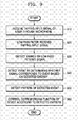
- Figure 9 is a flowchart illustrating the method of Figure 8, when the multimedia device includes the microphone.
- control apparatus receives a tapping input signal corresponding to tapping of the user through the microphone in Operation 910.
- the control apparatus low pass filters the received tapping input signal in Operation 920, detects energy of the low pass filtered signal in Operation 930, and detects an event by determining whether the received signal corresponds to the event, i.e., tapping, based on the detected energy in Operation 940. If the received signal is determined as the event, an operation of the multimedia device is controlled in subsequent operations, but if the received signal is not determined as the event, the received signal is ignored.
- the control apparatus detects the pattern of the detected event in Operation 950 and controls the operation of the multimedia device according to the detected pattern in Operation 960.
- Figure 10 is a flowchart illustrating the method of Figure 8, when the multimedia device includes the sensor.
- control apparatus senses a tapping input of the user using a sensor in Operation 1010.
- the control apparatus detects an event by determining whether the tapping input corresponds to an event, i.e., tapping, in Operation 1020, detects a pattern of the detected event in Operation 1030, and controls an operation of the multimedia device according to the detected pattern in Operation 1040.
- FIG 11 is a schematic block diagram illustrating an apparatus 1100 to control an operation of a multimedia device according to an embodiment of the present general inventive concept.
- the apparatus 1100 to control the operation of the multimedia device includes a detector unit 1110 and a controller 1120.
- the detector unit 1110 detects a pattern of tapping input to the multimedia device by a user.
- the controller 1120 controls the multimedia device based on the detected pattern of tapping.
- the multimedia device may also include a pattern storage unit to store a plurality of the patterns of tapping and corresponding commands.
- the multimedia device may also include a pattern detector to compare the detected pattern of the tapping to the stored plurality of patterns of tapping.
- the controller 1120 can control the multimedia device based on the commands corresponding to the stored patterns of tapping.
- the method of controlling an operation of a multimedia device of an embodiment of the present general inventive concept can be applied to portable and fixed devices, such as MP3 players, radios, and cell phones.
- an apparatus to control operations of a multimedia device according to embodiments of the present general inventive concept, a user can easily operate the multimedia device without having to take the multimedia device out of a pocket.
Landscapes
- Engineering & Computer Science (AREA)
- General Engineering & Computer Science (AREA)
- Theoretical Computer Science (AREA)
- Physics & Mathematics (AREA)
- General Physics & Mathematics (AREA)
- Human Computer Interaction (AREA)
- Acoustics & Sound (AREA)
- User Interface Of Digital Computer (AREA)
- Selective Calling Equipment (AREA)
Applications Claiming Priority (1)
| Application Number | Priority Date | Filing Date | Title |
|---|---|---|---|
| KR1020050084241A KR100677613B1 (ko) | 2005-09-09 | 2005-09-09 | 멀티미디어 기기의 동작을 제어하는 방법 및 그 장치 |
Publications (2)
| Publication Number | Publication Date |
|---|---|
| EP1762926A2 true EP1762926A2 (fr) | 2007-03-14 |
| EP1762926A3 EP1762926A3 (fr) | 2007-08-22 |
Family
ID=37482383
Family Applications (1)
| Application Number | Title | Priority Date | Filing Date |
|---|---|---|---|
| EP06120188A Withdrawn EP1762926A3 (fr) | 2005-09-09 | 2006-09-06 | Procédé et appareil permettant de commander le fonctionnement d'un dispositif multimédia |
Country Status (4)
| Country | Link |
|---|---|
| US (1) | US20070079206A1 (fr) |
| EP (1) | EP1762926A3 (fr) |
| KR (1) | KR100677613B1 (fr) |
| CN (1) | CN1928781A (fr) |
Cited By (21)
| Publication number | Priority date | Publication date | Assignee | Title |
|---|---|---|---|---|
| EP2375775A1 (fr) * | 2010-04-07 | 2011-10-12 | Sony Corporation | Appareil de traitement de signal audio, procédé de traitement de signal audio et programme |
| US20110293102A1 (en) * | 2010-06-01 | 2011-12-01 | Sony Corporation | Sound signal processing apparatus, microphone apparatus, sound signal processing method, and program |
| EP2386943A4 (fr) * | 2009-12-11 | 2012-08-01 | Sony Corp | Dispositif, procédé et programme de commande |
| EP2584459A1 (fr) * | 2011-10-21 | 2013-04-24 | Research In Motion Limited | Système et procédé de changement d'état d'activation d'un dispositif électronique utilisant des signaux acoustiques |
| EP2661105A2 (fr) * | 2012-05-03 | 2013-11-06 | DSP Group Inc. | Système et appareil permettant de contrôler un dispositif avec un transducteur à conduction osseuse |
| EP2752757A1 (fr) * | 2013-01-08 | 2014-07-09 | Sensitive Object | Détermination d'événement de geste |
| EP2695396A4 (fr) * | 2011-04-01 | 2014-10-01 | Uri Yehuday | Système et appareil de contrôle d'une interface utilisateur avec un transducteur à conduction osseuse |
| EP2769291A4 (fr) * | 2011-10-18 | 2015-08-26 | Univ Carnegie Mellon | Procédé et appareil de classification d'événements tactiles sur une surface tactile |
| EP2806351A3 (fr) * | 2013-05-22 | 2015-11-11 | Samsung Electronics Co., Ltd. | Dispositif d'entrée, appareil d'affichage et procédé de commande de dispositif d'entrée |
| US10282024B2 (en) | 2014-09-25 | 2019-05-07 | Qeexo, Co. | Classifying contacts or associations with a touch sensitive device |
| US10599251B2 (en) | 2014-09-11 | 2020-03-24 | Qeexo, Co. | Method and apparatus for differentiating touch screen users based on touch event analysis |
| US10642404B2 (en) | 2015-08-24 | 2020-05-05 | Qeexo, Co. | Touch sensitive device with multi-sensor stream synchronized data |
| US10942603B2 (en) | 2019-05-06 | 2021-03-09 | Qeexo, Co. | Managing activity states of an application processor in relation to touch or hover interactions with a touch sensitive device |
| US10949029B2 (en) | 2013-03-25 | 2021-03-16 | Qeexo, Co. | Method and apparatus for classifying a touch event on a touchscreen as related to one of multiple function generating interaction layers |
| US11009989B2 (en) | 2018-08-21 | 2021-05-18 | Qeexo, Co. | Recognizing and rejecting unintentional touch events associated with a touch sensitive device |
| US11029785B2 (en) | 2014-09-24 | 2021-06-08 | Qeexo, Co. | Method for improving accuracy of touch screen event analysis by use of spatiotemporal touch patterns |
| US11175698B2 (en) | 2013-03-19 | 2021-11-16 | Qeexo, Co. | Methods and systems for processing touch inputs based on touch type and touch intensity |
| US11231815B2 (en) | 2019-06-28 | 2022-01-25 | Qeexo, Co. | Detecting object proximity using touch sensitive surface sensing and ultrasonic sensing |
| US11262864B2 (en) | 2013-03-25 | 2022-03-01 | Qeexo, Co. | Method and apparatus for classifying finger touch events |
| US11592423B2 (en) | 2020-01-29 | 2023-02-28 | Qeexo, Co. | Adaptive ultrasonic sensing techniques and systems to mitigate interference |
| US11619983B2 (en) | 2014-09-15 | 2023-04-04 | Qeexo, Co. | Method and apparatus for resolving touch screen ambiguities |
Families Citing this family (18)
| Publication number | Priority date | Publication date | Assignee | Title |
|---|---|---|---|---|
| US8787599B2 (en) * | 2010-09-20 | 2014-07-22 | Plantronics, Inc. | Reduced microphone handling noise |
| CN101957736A (zh) * | 2010-09-30 | 2011-01-26 | 汉王科技股份有限公司 | 电子阅读装置和电子阅读装置的控制方法 |
| JP2013025757A (ja) * | 2011-07-26 | 2013-02-04 | Sony Corp | 入力装置、信号処理方法、プログラム、および記録媒体 |
| DE102011080518A1 (de) * | 2011-08-05 | 2013-02-07 | Sennheiser Electronic Gmbh & Co. Kg | Hörer und Verfahren zum Steuern eines Hörers |
| US20130101127A1 (en) * | 2011-10-21 | 2013-04-25 | Research In Motion Limited | System and method for changing an activation state of an electronic device using acoustic signals |
| US9351089B1 (en) * | 2012-03-14 | 2016-05-24 | Amazon Technologies, Inc. | Audio tap detection |
| TWI457789B (zh) * | 2012-05-30 | 2014-10-21 | Wistron Corp | 電子裝置和輸入指令方法 |
| JP2014048701A (ja) * | 2012-08-29 | 2014-03-17 | Kyocera Corp | 携帯端末、及び報知方法 |
| US9319150B2 (en) * | 2012-10-29 | 2016-04-19 | Dell Products, Lp | Reduction of haptic noise feedback in system |
| KR20140113119A (ko) | 2013-03-15 | 2014-09-24 | 엘지전자 주식회사 | 전자 기기 및 그 제어방법 |
| KR20160016747A (ko) * | 2013-06-07 | 2016-02-15 | 임머숀 코퍼레이션 | 햅틱 효과 핸드쉐이크 잠금 해제 |
| US9271064B2 (en) * | 2013-11-13 | 2016-02-23 | Personics Holdings, Llc | Method and system for contact sensing using coherence analysis |
| EP2945398B1 (fr) * | 2014-05-15 | 2017-10-11 | Nxp B.V. | Capteur de mouvement |
| CN106060698B (zh) * | 2016-07-26 | 2022-08-19 | 深圳市冠旭电子股份有限公司 | 触控式蓝牙耳机 |
| CN106445120A (zh) * | 2016-09-05 | 2017-02-22 | 华为技术有限公司 | 触控操作的识别方法及装置 |
| US10354641B1 (en) * | 2018-02-13 | 2019-07-16 | Bose Corporation | Acoustic noise reduction audio system having tap control |
| CN111684522A (zh) * | 2019-05-15 | 2020-09-18 | 深圳市大疆创新科技有限公司 | 声音识别方法、交互方法、声音识别系统、计算机可读存储介质及可移动平台 |
| CN115243125B (zh) * | 2021-04-23 | 2026-04-17 | 华为技术有限公司 | 一种控制方法及电子设备 |
Citations (2)
| Publication number | Priority date | Publication date | Assignee | Title |
|---|---|---|---|---|
| US20020167699A1 (en) | 2000-05-17 | 2002-11-14 | Christopher Verplaetse | Motion-based input system for handheld devices |
| US20040004600A1 (en) | 2000-02-17 | 2004-01-08 | Seiko Epson Corporation | Input device using tapping sound detection |
Family Cites Families (6)
| Publication number | Priority date | Publication date | Assignee | Title |
|---|---|---|---|---|
| FR2722637B1 (fr) * | 1994-07-15 | 1996-09-20 | Mahieux Yannick | Systeme de prise de son selective pour environnement reverberant et bruyant |
| US7684570B2 (en) * | 1998-11-17 | 2010-03-23 | Aamp Of America | Vehicle remote control interface for controlling multiple electronic devices |
| US6466198B1 (en) * | 1999-11-05 | 2002-10-15 | Innoventions, Inc. | View navigation and magnification of a hand-held device with a display |
| US6498601B1 (en) * | 1999-11-29 | 2002-12-24 | Xerox Corporation | Method and apparatus for selecting input modes on a palmtop computer |
| JP2003131760A (ja) | 2001-10-25 | 2003-05-09 | Casio Comput Co Ltd | 電源制御装置及び電源制御方法 |
| KR20040092030A (ko) * | 2003-04-23 | 2004-11-03 | 엘지전자 주식회사 | 휴대용 무선 단말기의 정보 입력 장치 |
-
2005
- 2005-09-09 KR KR1020050084241A patent/KR100677613B1/ko not_active Expired - Fee Related
-
2006
- 2006-08-24 US US11/466,808 patent/US20070079206A1/en not_active Abandoned
- 2006-09-06 EP EP06120188A patent/EP1762926A3/fr not_active Withdrawn
- 2006-09-11 CN CNA2006101515439A patent/CN1928781A/zh active Pending
Patent Citations (2)
| Publication number | Priority date | Publication date | Assignee | Title |
|---|---|---|---|---|
| US20040004600A1 (en) | 2000-02-17 | 2004-01-08 | Seiko Epson Corporation | Input device using tapping sound detection |
| US20020167699A1 (en) | 2000-05-17 | 2002-11-14 | Christopher Verplaetse | Motion-based input system for handheld devices |
Cited By (36)
| Publication number | Priority date | Publication date | Assignee | Title |
|---|---|---|---|---|
| EP2386943A4 (fr) * | 2009-12-11 | 2012-08-01 | Sony Corp | Dispositif, procédé et programme de commande |
| US9053709B2 (en) | 2009-12-11 | 2015-06-09 | Sony Corporation | Control device, control method, and program |
| TWI458359B (zh) * | 2010-04-07 | 2014-10-21 | 新力股份有限公司 | 音訊處理設備,音訊處理方法及程式 |
| US8634565B2 (en) | 2010-04-07 | 2014-01-21 | Sony Corporation | Audio signal processing apparatus, audio signal processing method, and program |
| US9479883B2 (en) | 2010-04-07 | 2016-10-25 | Sony Corporation | Audio signal processing apparatus, audio signal processing method, and program |
| EP2375775A1 (fr) * | 2010-04-07 | 2011-10-12 | Sony Corporation | Appareil de traitement de signal audio, procédé de traitement de signal audio et programme |
| US20110293102A1 (en) * | 2010-06-01 | 2011-12-01 | Sony Corporation | Sound signal processing apparatus, microphone apparatus, sound signal processing method, and program |
| JP2011254188A (ja) * | 2010-06-01 | 2011-12-15 | Sony Corp | 音声信号処理装置、マイクロホン装置、音声信号処理方法、プログラム |
| US9485569B2 (en) | 2010-06-01 | 2016-11-01 | Sony Corporation | Sound signal processing apparatus, microphone apparatus, sound signal processing method, and program |
| US8699718B2 (en) * | 2010-06-01 | 2014-04-15 | Sony Corporation | Sound signal processing apparatus, microphone apparatus, sound signal processing method, and program |
| EP2393305A3 (fr) * | 2010-06-01 | 2014-09-17 | Sony Corporation | Appareil de traitement de signal sonore, appareil de microphone, procédé de traitement de signal sonore et programme |
| EP2695396A4 (fr) * | 2011-04-01 | 2014-10-01 | Uri Yehuday | Système et appareil de contrôle d'une interface utilisateur avec un transducteur à conduction osseuse |
| US10642407B2 (en) | 2011-10-18 | 2020-05-05 | Carnegie Mellon University | Method and apparatus for classifying touch events on a touch sensitive surface |
| EP2769291A4 (fr) * | 2011-10-18 | 2015-08-26 | Univ Carnegie Mellon | Procédé et appareil de classification d'événements tactiles sur une surface tactile |
| US9851841B2 (en) | 2011-10-18 | 2017-12-26 | Carnegie Mellon University | Method and apparatus for classifying touch events on a touch sensitive surface |
| EP2584459A1 (fr) * | 2011-10-21 | 2013-04-24 | Research In Motion Limited | Système et procédé de changement d'état d'activation d'un dispositif électronique utilisant des signaux acoustiques |
| EP2661105A2 (fr) * | 2012-05-03 | 2013-11-06 | DSP Group Inc. | Système et appareil permettant de contrôler un dispositif avec un transducteur à conduction osseuse |
| WO2014108328A1 (fr) * | 2013-01-08 | 2014-07-17 | Sensitive Object | Détermination d'événement gestuel |
| US9990071B2 (en) | 2013-01-08 | 2018-06-05 | Elo Touch Solutions, Inc. | Gesture event determination |
| EP2752757A1 (fr) * | 2013-01-08 | 2014-07-09 | Sensitive Object | Détermination d'événement de geste |
| US11175698B2 (en) | 2013-03-19 | 2021-11-16 | Qeexo, Co. | Methods and systems for processing touch inputs based on touch type and touch intensity |
| US10949029B2 (en) | 2013-03-25 | 2021-03-16 | Qeexo, Co. | Method and apparatus for classifying a touch event on a touchscreen as related to one of multiple function generating interaction layers |
| US11262864B2 (en) | 2013-03-25 | 2022-03-01 | Qeexo, Co. | Method and apparatus for classifying finger touch events |
| EP2806351A3 (fr) * | 2013-05-22 | 2015-11-11 | Samsung Electronics Co., Ltd. | Dispositif d'entrée, appareil d'affichage et procédé de commande de dispositif d'entrée |
| US9383962B2 (en) | 2013-05-22 | 2016-07-05 | Samsung Electronics Co., Ltd. | Input device, display apparatus, and method of controlling the input device |
| US10599251B2 (en) | 2014-09-11 | 2020-03-24 | Qeexo, Co. | Method and apparatus for differentiating touch screen users based on touch event analysis |
| US11619983B2 (en) | 2014-09-15 | 2023-04-04 | Qeexo, Co. | Method and apparatus for resolving touch screen ambiguities |
| US11029785B2 (en) | 2014-09-24 | 2021-06-08 | Qeexo, Co. | Method for improving accuracy of touch screen event analysis by use of spatiotemporal touch patterns |
| US10282024B2 (en) | 2014-09-25 | 2019-05-07 | Qeexo, Co. | Classifying contacts or associations with a touch sensitive device |
| US10642404B2 (en) | 2015-08-24 | 2020-05-05 | Qeexo, Co. | Touch sensitive device with multi-sensor stream synchronized data |
| US11009989B2 (en) | 2018-08-21 | 2021-05-18 | Qeexo, Co. | Recognizing and rejecting unintentional touch events associated with a touch sensitive device |
| US10942603B2 (en) | 2019-05-06 | 2021-03-09 | Qeexo, Co. | Managing activity states of an application processor in relation to touch or hover interactions with a touch sensitive device |
| US11231815B2 (en) | 2019-06-28 | 2022-01-25 | Qeexo, Co. | Detecting object proximity using touch sensitive surface sensing and ultrasonic sensing |
| US11543922B2 (en) | 2019-06-28 | 2023-01-03 | Qeexo, Co. | Detecting object proximity using touch sensitive surface sensing and ultrasonic sensing |
| US11592423B2 (en) | 2020-01-29 | 2023-02-28 | Qeexo, Co. | Adaptive ultrasonic sensing techniques and systems to mitigate interference |
| US12163923B2 (en) | 2020-01-29 | 2024-12-10 | Qeexo, Co. | Adaptive ultrasonic sensing techniques and systems to mitigate interference |
Also Published As
| Publication number | Publication date |
|---|---|
| KR100677613B1 (ko) | 2007-02-02 |
| CN1928781A (zh) | 2007-03-14 |
| US20070079206A1 (en) | 2007-04-05 |
| EP1762926A3 (fr) | 2007-08-22 |
Similar Documents
| Publication | Publication Date | Title |
|---|---|---|
| EP1762926A2 (fr) | Procédé et appareil permettant de commander le fonctionnement d'un dispositif multimédia | |
| US9958950B2 (en) | Detector | |
| US8634565B2 (en) | Audio signal processing apparatus, audio signal processing method, and program | |
| US8843222B2 (en) | Selective locking of input controls for a portable media player | |
| US8699718B2 (en) | Sound signal processing apparatus, microphone apparatus, sound signal processing method, and program | |
| US9411446B2 (en) | Electronic device with a touch sensor and method for operating the same | |
| US20090138507A1 (en) | Automated playback control for audio devices using environmental cues as indicators for automatically pausing audio playback | |
| US20140079239A1 (en) | System and apparatus for controlling a user interface with a bone conduction transducer | |
| WO2005015374A1 (fr) | Clavier alphanumérique doté d'un élément fonctionnel intégré | |
| WO2009085338A2 (fr) | Commande d'un dispositif électronique utilisant les empreintes digitales d'une personne | |
| US20070225935A1 (en) | Controlling an Electronic Device | |
| CN104184901A (zh) | 一种利用重力感应和加速度感应控制手持设备的方法 | |
| US10276180B2 (en) | Audio command adaptive processing system and method | |
| CN105791595A (zh) | 基于压力传感器进行音量控制的方法及系统 | |
| CN107491254A (zh) | 一种手势操作方法、装置和移动终端 | |
| CN106873889A (zh) | 一种指纹操作方法、装置及电子设备 | |
| US7319890B2 (en) | Detection method and foldable electronic device thereof | |
| CN113628616A (zh) | 音频采集设备、无线耳机以及电子设备系统 | |
| GB2526980A (en) | Sensor input recognition | |
| JP2012063950A (ja) | 入力装置及び電子機器 | |
| US9298289B2 (en) | Method and apparatus for adjusting a function of an electronic device | |
| GB2553040A (en) | Sensor input recognition | |
| JP2017194748A (ja) | タッチセンサ、端末装置及び押下検出プログラム | |
| JP2000039900A (ja) | 自己診断機能付き音声対話装置 | |
| US11360567B2 (en) | Interacting with a true wireless headset |
Legal Events
| Date | Code | Title | Description |
|---|---|---|---|
| PUAI | Public reference made under article 153(3) epc to a published international application that has entered the european phase |
Free format text: ORIGINAL CODE: 0009012 |
|
| 17P | Request for examination filed |
Effective date: 20060906 |
|
| AK | Designated contracting states |
Kind code of ref document: A2 Designated state(s): AT BE BG CH CY CZ DE DK EE ES FI FR GB GR HU IE IS IT LI LT LU LV MC NL PL PT RO SE SI SK TR |
|
| AX | Request for extension of the european patent |
Extension state: AL BA HR MK YU |
|
| PUAL | Search report despatched |
Free format text: ORIGINAL CODE: 0009013 |
|
| AK | Designated contracting states |
Kind code of ref document: A3 Designated state(s): AT BE BG CH CY CZ DE DK EE ES FI FR GB GR HU IE IS IT LI LT LU LV MC NL PL PT RO SE SI SK TR |
|
| AX | Request for extension of the european patent |
Extension state: AL BA HR MK YU |
|
| RIC1 | Information provided on ipc code assigned before grant |
Ipc: G06F 3/038 20060101ALI20070718BHEP Ipc: G06F 3/043 20060101AFI20061211BHEP |
|
| 17Q | First examination report despatched |
Effective date: 20071011 |
|
| AKX | Designation fees paid |
Designated state(s): DE FR GB IT NL |
|
| STAA | Information on the status of an ep patent application or granted ep patent |
Free format text: STATUS: THE APPLICATION IS DEEMED TO BE WITHDRAWN |
|
| 18D | Application deemed to be withdrawn |
Effective date: 20100401 |