EP1762933B1 - Verfahren und Software für die Optimierung der Positionierung von Software-Funktionen in einem Speicher - Google Patents
Verfahren und Software für die Optimierung der Positionierung von Software-Funktionen in einem Speicher Download PDFInfo
- Publication number
- EP1762933B1 EP1762933B1 EP05018805A EP05018805A EP1762933B1 EP 1762933 B1 EP1762933 B1 EP 1762933B1 EP 05018805 A EP05018805 A EP 05018805A EP 05018805 A EP05018805 A EP 05018805A EP 1762933 B1 EP1762933 B1 EP 1762933B1
- Authority
- EP
- European Patent Office
- Prior art keywords
- software functions
- calls
- software
- functions
- memory
- Prior art date
- Legal status (The legal status is an assumption and is not a legal conclusion. Google has not performed a legal analysis and makes no representation as to the accuracy of the status listed.)
- Expired - Lifetime
Links
Images

Classifications
-
- G—PHYSICS
- G06—COMPUTING OR CALCULATING; COUNTING
- G06F—ELECTRIC DIGITAL DATA PROCESSING
- G06F9/00—Arrangements for program control, e.g. control units
- G06F9/06—Arrangements for program control, e.g. control units using stored programs, i.e. using an internal store of processing equipment to receive or retain programs
- G06F9/44—Arrangements for executing specific programs
- G06F9/445—Program loading or initiating
-
- G—PHYSICS
- G06—COMPUTING OR CALCULATING; COUNTING
- G06F—ELECTRIC DIGITAL DATA PROCESSING
- G06F9/00—Arrangements for program control, e.g. control units
- G06F9/06—Arrangements for program control, e.g. control units using stored programs, i.e. using an internal store of processing equipment to receive or retain programs
- G06F9/44—Arrangements for executing specific programs
- G06F9/445—Program loading or initiating
- G06F9/44557—Code layout in executable memory
Definitions
- the present invention relates to a method for optimising the positioning of software functions in a memory of a computing device and a software program herefor.
- a main storage medium for data, information, software code and so forth is used in combination with a working memory means, in which software code and/or information is stored while being worked on.
- the main storage means is e.g. a hard disk or the like
- the main working means is e.g. an RAM (Random Access Memory).
- RAM Random Access Memory
- On a hard disk the stored software code and information remains stored even when a computing means is shut-off, while the RAM is cleared after computer shut-off.
- this processing is usually performed using the RAM, since an RAM allows the addressing of stored software code and information with the same speed at any location of the RAM.
- a virtual memory In any kind of computing device the situation may occur in which more RAM space is needed than available. Since a larger RAM is much more expensive than a smaller RAM, and the situation where more RAM space than available is necessary usually does not occur very often, the concept of a virtual memory has been introduced. The idea is basically that software code or data from the RAM are copied to a secondary memory to make room for other software code or data which are loaded back from the secondary memory.
- the secondary memory can hereby e.g. be the main storage means, such as the hard disk, of the computing device or any other suitable memory or storage device available within the computer device.
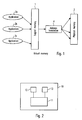
- the general concept of a virtual memory is visualised in Fig. 1 .
- the logical (or virtual) memory 1 has a larger storage space than the physical memory 2, which is e.g.
- the applications 3a, 3b, 3c have address data in the logical memory 1 which are translated (address translation 4) into the "real" addresses of the data or software code in the physical memory 2. This translation of the address data or software is completely transparent to the applications.
- the virtual or logical memory 1 can be larger than the physical memory 2, whereby a secondary memory is used as a backup for data or software code which does not fit in the main working memory which is normally an RAM as mentioned.
- the concept of a virtual memory can also be used to execute software code - virtually directly - from non-execution in place (XiP) devices such as NAND flash and hard drives, which means that the application or software code does not need to handle any loading from the secondary memory since this is automatically handled by the system code.
- XiP non-execution in place
- the logical or virtual memory space is larger than the physical memory space it might happen that a required page with required data or software code is accessed, which is not available in the physical memory. When this happens, a so-called page fault occurs. This is handled by the system and it starts by searching for an empty page in the logical memory. If no such empty page is found it selects a victim data or software code block to be unloaded. If the data in the victim page has been changed before due to some processing, it must be written back to the secondary memory in order to save the changes, otherwise it can simply be overwritten. The next step is to copy the required data or software code from the secondary memory to the main memory, i.e. the RAM, and to update the address translation data. Finally, the system returns the translated address data to the application which resumes execution with a slight delay.
- the advantages of the virtual memory concept are a larger available memory space without the need to provide a larger physical memory device and the possibility to transparently execute applications from non-XiP memory.
- the disadvantage is the delay caused by the above described page faults.
- the number of page faults that occur is basically dependent on the size of the logical and the physical memory, the algorithm for selecting the victim page and the layout of data and code.
- Pettis and Hansen hereby suggest to find an optimal order of software code or software functions on the basis of the number of calls between the code or software functions.
- software codes or software functions with the highest number of calls between them are merged or combined first and thereafter the remaining software codes or software functions are combined with the formerly combined ones depending on their respective number of calls in decreasing order.
- two software codes or software functions are merged which each have a number of calls linking them to one other software code or software function, these number of calls are just summed up in order to update the number of calls between the newly combined software functions or software codes and the remaining software code or software function.
- EP 0 459 192 A2 which serves as a basis for the preamble of claim 1, discloses a computer code optimization method in which a new ordering for code blocks is determined. Code blocks that are often executed after one another are positioned close to each other in a computer's memory.
- US 6,839,895 B1 relates to a method of code reordering, in which a Program Execution Graph corresponding to a level of the memory hierarchy is reordered. Nodes are assigned a weight equal to the size of the basic block that the node represents. In the graph reordering, clusters are defined as sets of nodes, subject to the total weight of the nodes in each cluster not exceeding a given threshold.
- the object of the present invention is to provide a method for optimising the positioning of software functions in a memory of a computing device with an increased efficiency and a decreased number of page faults as compared to the prior art.
- the above object is achieved by a method for optimising the positioning of software functions in a memory of a computing device according to the enclosed claim 1 and a software program as defined in claim 6.
- the dependent claims define preferred or advantageous embodiments.
- the method for optimising the positioning of software functions in a memory of a computing device according to the present invention comprises the steps of identifying each of a number of software functions and the respective number of calls between the identified software functions, positioning the two software functions with the highest number of calls next to each other to form a group of software functions and updating the number of calls between the newly formed group and the other software functions, and repeating the positioning step and the updating step for the software functions and/or groups of software functions sharing the respective highest number of calls in the next calculation round and so forth until all software functions are positioned in a sequential order, whereby said positioning step and said updating step are performed on the basis of the size of the software functions and the number of calls between the software functions.
- the positioning step and the updating step comprise a step of selecting calls from among the number of calls depending on the location of the software functions within a group, the step of selecting calls being performed on the basis of the size of the software functions.
- the term "software functions" used in the present application and claims is intended to comprise all kinds of software code, programming code, processing code, routines, sub-routines and functionalities and parts thereof which are used in computing devices to process data, information, instructions and/or the like.
- the memory in which the software functions are placed with an optimised positioning according to the present invention is e.g. a secondary memory which works as a backup memory for a main working memory of a computing device, but can also be any kind of other memory in which an optimised positioning of software functions in the sense of the present invention is advantageous.
- computing device according to the present invention and claims is intended to comprise any kind of device which is able to process data, information, instructions and so forth in any kind of capacity, although it should be noted that an advantageous application of the present invention is in computing devices and electronic equipments of a small size in which the memory space is usually limited or in which it is advantageous to use small memory space because of cost considerations.
- the present invention could be applied in a portable radio communication equipment, which includes all equipment such as mobile telephones, pagers, communicators, i.e. electronic organisers, smartphones or the like which are able and adapted to communicate one- or bi-directionally in a wireless communication system.
- the updating step is performed on the basis of the size of the software functions of the newly formed group and of the one other software function or group of software functions.
- the updating step comprises a step of comparing the size of a window reflecting the size of segments of said memory with the size of said software functions of the newly formed group and of said one other software function or group of software functions.
- the step of positioning a group of software functions and a software function or a group of software functions and another group of software functions next to each other to form a new group of software functions comprises the step of comparing the size of a window reflecting the size of segments of said memory with the size of said software functions in said group(s) of software functions or said software functions which are to be positioned next to each other.
- the step of comparing step only selected adjacent software functions of said software functions of the newly formed group and or said one other software function or group of software functions are used in said positioning step which have an added size which is smaller than said size of said window.
- the software functions to be positioned next to each other are determined on the basis of the calls shared between the software functions which are adjacent to said selected adjacent software functions of said group(s) of software functions which have an added size which is smaller than said size of said window, whereby the number of calls shared within a group of software functions is not used in said determination step.
- the present invention is further directed to a software program or a computer program for optimising the positioning of software functions in a memory of a computing device, said software program or computer program being adapted to perform a method according to the present invention if loaded into a memory of the computing device and run on the computing device.
- a block diagram of a computing device 10 comprising a central processing unit 11 as well as a main memory 12 and a secondary memory 13 is shown.
- the computing device 12 may be any kind of portable or non-portable computing device which is able and adapted to process data, information, instructions or the like in the central processing unit 11 by using the main memory 12 and the secondary memory 13.
- the main memory 12 is e.g. a main working memory, such as an RAM
- the secondary memory 13 is e.g. a hard disk or any other kind of memory or storage device.
- a method for optimising the positioning of software functions of the present invention will typically be applied by a processing unit, such as the central processing unit 11 in order to store software functions in a memory of the computing device, such as a secondary memory 13.
- a processing unit such as the central processing unit 11
- these additional software functions have to be stored in the secondary memory 13.
- the secondary memory 13 is usually not an RAM memory in which every address can be accessed with the same speed, the storage order of the software functions has to be optimised.
- the method according to the present invention provides this optimisation.
- Fig. 3 shows a comparison of a storage layout of the prior art in comparison to the storage layout which can be achieved by the method according to the present invention.
- the left side of Fig. 3 shows as layout 1 a first page 14a and a second page 14b of software functions A, B, C and D which have been stored according to a prior art method.
- the division and the storing of the software functions in pages corresponds to the page system described further above, in which the logical and physical memory (i.e. the RAM) is divided into equally sized pages.
- the described example identically relates to segmented systems also, in which the storage sections or blocks have varying sizes.
- the term "segments" is used which comprises pages, segments, sections of fixed and varying sizes used to store data code and so forth in a memory of a computing device.
- the function A is of a type which during the processing calls the software function D three times and then calls the software function B once before the processing is ended.
- the software function B is of a type which calls the software function C twice before the processing is finished.
- the software functions C and D do not call any other software function during processing. Therefore, if the execution starts with the software function A, the central processing unit, e.g. the central processing unit 11, demands software code from the software function in the order ADADADABCBCBA. Assuming that only a very small main working memory 12 is available, such as a very small RAM which only has one RAM page which is full.
- the method for optimising the positioning of software functions in a memory of a computing device according to the present invention has significant processing power and processing time advantages over the prior art.
- the method of the present invention decreases the rate of page faults by typically 20 to 40 % as compared to prior art solutions. Since the rate of page faults is decreased, the execution speed can be increased, the size of the logical memory space can be increased and/or the size of the main memory can be decreased.
- an undirected weighted call graph is built as shown in Fig. 4 .
- profiling data of the software functions i.e. information about the size of each software function as well as information about the number of calls between the software functions is used to built the call graph.
- software function A has a size of 1
- software function B has a size of 5
- software function C has a size of 8
- software function D has a size of 3
- software function E has a size of 2
- software function F has a size of 4
- software function G has a size of 7
- software function H has a size of 9.
- the number of calls between the software functions A and B is 7, between software functions A and F is 6, between software functions A and C is 8 and between software functions A and D is 2.
- the number of calls between software functions E and B is 4 and between the software functions E and F is 8.
- the number of calls between the software functions G and C is 3 and between the software functions G and D is 6.
- the number of calls between the software functions H and F is 9 and between the software functions H and G is 2.
- the number of calls between software functions C and H is 5.
- each software function A, B, C, D, E, F, G and H is represented as a node, whereby the edges between the nodes correspond to calls between the respective software functions and the weights of the edges corresponds to the sum of the number of calls made between the connected software functions.
- the edges between the nodes correspond to calls between the respective software functions and the weights of the edges corresponds to the sum of the number of calls made between the connected software functions.
- any suitable way or method can be applied.
- One possibility is to insert code into the start and end of software functions at an assembly code level. This extra code can be adapted to write the current physical address to a specific super-global variable. Also, the current process identification should be written to another variable. The writing into these variables could then be recorded by a logic analyser. The recorded list of addresses can then be mapped against the software function involved by use of a map-file.
- a map-file is essentially a list of the linked software functions with start and end addresses for each software function.
- a call-tree can then be produced for each process.
- logs could be made from a system which runs without profiling by also using a logic analyser.
- the produced logs are a list of physical addresses of executing code that was transferred between the memory and the central processing unit.
- the demand paging environment could be simulated, whereby the simulator could go through the logs and output the number of page faults encountered.
- this simulation can be done on the original log and on the same log with changed addresses.
- the method for optimising the positioning of software functions starts from a situation as visualised by Fig. 4 , in which information about the size of every software function as well as the number of calls between the various software functions to be ordered and positioned in the secondary memory is available.
- This situation is visualised by the undirected weighted call graph in Fig. 4 .
- the first step is then to join the respective software functions which share the highest number of calls.
- the software functions F and H would be joined in a first step in order to form a new group of software functions FH.
- a new node FH would be formed.
- the number of the calls connecting the newly formed group of software functions, in this example F and H, exchanged with the remaining software functions is updated.
- the number of calls exchanged with the software functions E, A, C and G, respectively remain the same, since the software functions F and H did not exchange calls with one (the same) other software function.
- the highest number of calls remaining is 8, which occurs twice, namely between the software functions A and C and between the software functions E and the newly formed group FH. Then, the next combination is randomly chosen.
- the software function E is joined to the group FH in the second step, then the software functions A and C are joined in the third step.
- the updating of the calls which are shared with other software functions (or group of software functions) is simple because the software function E and the group FH did not share calls with the same software function or group of software functions. This changes when the software functions A and C are linked together in the third step.
- software function F exchanges 5 calls with software function H and software function A exchanges 6 calls with software function F.
- software function A and C exchanges 5 calls with software function H
- software function A exchanges 6 calls with software function F.
- the number of calls between the newly formed group AC and the (old) group EFH has to be updated and re-calculated.
- the exact algorithm will be explained in relation to the sixth step, in which the software function B is joined to the newly formed group AC.
- the updating calculation for calls does not just sum up the calls between the two (groups of) software functions to be joined, but selects the calls to be summed up depending on the location of the respective software function within the group.
- the updating algorithm according to the present invention mainly considers the number of calls between software functions which are located on the sides of an already formed group of software functions. These sides or the size of these sides is defined as a so-called window which has a maximum size of one page (or one segment) of the memory in which the software functions are to be stored. It is to be noted that an updated number of calls may exceed the initially highest number of calls.
- the highest number of calls between the software functions A and B determines that the software function B is joined to the newly formed group AC. Since the software function B shares 4 calls with the software function E which is part of the group EFH, and the software function C (being part of the group AC) and the software function H (being part of the group EFH) share 5 calls. Therefore, when merging the groups BAC and EFH the number of calls between these two groups has to be updated.
- Fig. 5 hereby shows the result of the updating calculation, namely that the groups BAC and EFH share 5 calls.
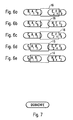
- Figs. 6a to 6e help to understand how this updated number of calls is calculated.
- the size of the window is equal or smaller to the size of a page or a segment of the memory in which the software functions are to be stored.
- the window size is smaller than a corresponding page or segment size.
- the assumed page size is 8 and the window size is 2 less than the page size, i.e. 6.
- the groups BAC and EFH can be connected in four ways, namely BAC-EFH, BAC-HFE, CAB-EFH or CAB-HFE. This means that there are at least four different ways to place the window.
- FIG. 6a shows the case for BAC-EFH, where the window 16 (having a size of 6) is placed over the software functions E and F, which have an added size of 6.
- Fig. 6b which shows the example BAC-HFE
- the window 16 (having a size of 6) can be placed over any neighbouring functions of both groups and is therefore placed in the middle.
- Fig. 6c which shows the example CAB-EFH
- the window 16 (having a size of 6) is also placed over the software functions E and F which have an added size of 6.
- Fig. 6a shows the case for BAC-EFH, where the window 16 (having a size of 6) is placed over the software functions E and F, which have an added size of 6.
- Fig. 6c which shows the example CAB-EFH
- the window 16 is placed over the software functions A and B, which have an added size of 6.
- the window 16 is also placed over the software functions A and B. Therefore, the window is always placed over two or more software functions on a side of one of the groups to be joined where the combined sizes of the software functions is smaller or equal the window size.
- the window could be placed over one or more software functions from one group and one or more software function from another group at the same time, whereby the combined size of the software functions is smaller or equal the window size. If these two options are not possible, the window is placed in the middle between the two groups, as shown in Fig. 6b .
- the maximum result is chosen to be the new and updated number of calls between the groups of software functions. In the present case, the result of 5 calls has been achieved 3 times, so that the result is 5 calls. It has to be noted that the software functions which are in the middle of groups to be joined are only rarely used for the calculation of the updated number of calls.
- the number of calls between the software functions A and F which is 6, is not used, since the software function A is hidden between C and B and the software function F is hidden between the software functions E and H.
- a and F could never end up on the same page or segment of the memory anyway.
- the group DG is linked to the group BACHFE.
- the result of this combination is shown in Fig. 7 .
- the same algorithm as explained in relation to Figs. 6a to 6e is applied.
- the window is placed over the software functions BA, the possibilities to join DG and GD have to be compared.
- the combination DG achieves the result of 3 calls.
- the window can be placed over the software functions FE and the two possibilities are again DG and GD.
- the possibility DG results in 0 calls and the possibility GD results in 2 calls, so that the highest result of 3 calls leads to the decision that the group DG in this order is joined to the group BACHFE, so that the resulting group of software functions in a sequential order is DGBACHFE as shown in Fig. 7 .
- This final group of software functions is then stored in the secondary memory.
Landscapes
- Engineering & Computer Science (AREA)
- Software Systems (AREA)
- Theoretical Computer Science (AREA)
- Physics & Mathematics (AREA)
- General Engineering & Computer Science (AREA)
- General Physics & Mathematics (AREA)
- Stored Programmes (AREA)
Claims (6)
- Verfahren zur Optimierung der Positionierung von Software-Funktionen in einem Speicher einer Rechenvorrichtung, folgende Schritte umfassend:jeweiliges Bestimmen von mehreren Software-Funktionen und der entsprechenden Anzahl von Aufrufen zwischen den bestimmten Software-Funktionen;Positionieren derjenigen zwei Software-Funktionen nebeneinander, welche die höchste Anzahl von Aufrufen zwischen einander aufweisen, um eine Gruppe von Software-Funktionen auszubilden, undAktualisieren der Anzahl der Aufrufe zwischen der neu ausgebildeten Gruppe und den anderen Software-Funktionen, undWiederholen des Positionierungs-Schrittes und des Aktualisierungs-Schrittes für die Software-Funktionen und/oder Gruppen von Software-Funktionen mit der jeweils höchsten Anzahl von Aufrufen zwischen einander in der nächsten Berechnungsrunde und so weiter, bis alle Software-Funktionen in einer sequenziellen Reihenfolge positioniert sind,wobei der Positionierungs-Schritt und der Aktualisierungs-Schritt abhängig von der Anzahl der Aufrufe zwischen den Software-Funktionen ausgeführt werden,dadurch gekennzeichnet,dass der Positionierungs-Schritt und der Aktualisierungs-Schritt einen Schritt eines Auswählens von Aufrufen aus der Anzahl der Aufrufe abhängig von dem Ort der Software-Funktionen innerhalb einer Gruppe umfasst, wobei der Schritt des Auswählens von Aufrufen abhängig von der Größe der Software-Funktionen ausgeführt wird.
- Verfahren nach Anspruch 1, dadurch gekennzeichnet, dass der Positionierungs-Schritt und der Aktualisierungs-Schritt einen Schritt eines Aufsummierens der ausgewählten Aufrufe umfasst.
- Verfahren nach Anspruch 2, dadurch gekennzeichnet, dass die aktualisierte Anzahl der Aufrufe durch die Summe der ausgewählten Anzahl von Aufrufen bestimmt wird.
- Verfahren nach Anspruch 3, dadurch gekennzeichnet, dass die Schritte des Auswählens der Aufrufe und des Aufsummierens der Aufrufe für die verschiedenen Möglichkeiten eines Positionierens der Software-Funktionen und/oder der Gruppen von Software-Funktionen mit der entsprechenden höchsten Anzahl von Aufrufen zwischen einander wiederholt werden,
wobei die aktualisierte Anzahl der Aufrufe die größte der erhaltenen Summen ist und
wobei die Software-Funktionen und/oder Gruppen von Software-Funktionen mit der jeweils höchsten Anzahl von Aufrufen zwischen einander entsprechend einer der Möglichkeiten eines Positionierens nebeneinander positioniert werden, für welche die größte Summe erhalten wird. - Verfahren nach einem der Ansprüche 1 bis 4, dadurch gekennzeichnet, dass die Aufrufe zwischen Funktionen, welche zu derselben Gruppe von Funktion gehören, nicht ausgewählt werden.
- Softwareprogramm zur Optimierung der Positionierung von Software-Funktionen in einem Speicher einer Rechenvorrichtung, wobei das Softwareprogramm derart ausgestaltet ist, dass es das Verfahren nach einem der Ansprüche 1 bis 5 durchführt, wenn es in einen Speicher einer Rechenvorrichtung geladen wird.
Priority Applications (6)
| Application Number | Priority Date | Filing Date | Title |
|---|---|---|---|
| AT05018805T ATE486316T1 (de) | 2005-08-30 | 2005-08-30 | Verfahren und software für die optimierung der positionierung von software-funktionen in einem speicher |
| EP05018805A EP1762933B1 (de) | 2005-08-30 | 2005-08-30 | Verfahren und Software für die Optimierung der Positionierung von Software-Funktionen in einem Speicher |
| DE602005024399T DE602005024399D1 (de) | 2005-08-30 | 2005-08-30 | Verfahren und Software für die Optimierung der Positionierung von Software-Funktionen in einem Speicher |
| CN2006800316900A CN101253479B (zh) | 2005-08-30 | 2006-08-30 | 用于优化存储器中软件功能的配置的方法 |
| US12/065,221 US8191055B2 (en) | 2005-08-30 | 2006-08-30 | Method and software for optimising the positioning of software functions in a memory |
| PCT/EP2006/008492 WO2007025743A1 (en) | 2005-08-30 | 2006-08-30 | Method and software for optimising the positioning of software functions in a memory |
Applications Claiming Priority (1)
| Application Number | Priority Date | Filing Date | Title |
|---|---|---|---|
| EP05018805A EP1762933B1 (de) | 2005-08-30 | 2005-08-30 | Verfahren und Software für die Optimierung der Positionierung von Software-Funktionen in einem Speicher |
Publications (2)
| Publication Number | Publication Date |
|---|---|
| EP1762933A1 EP1762933A1 (de) | 2007-03-14 |
| EP1762933B1 true EP1762933B1 (de) | 2010-10-27 |
Family
ID=35825309
Family Applications (1)
| Application Number | Title | Priority Date | Filing Date |
|---|---|---|---|
| EP05018805A Expired - Lifetime EP1762933B1 (de) | 2005-08-30 | 2005-08-30 | Verfahren und Software für die Optimierung der Positionierung von Software-Funktionen in einem Speicher |
Country Status (6)
| Country | Link |
|---|---|
| US (1) | US8191055B2 (de) |
| EP (1) | EP1762933B1 (de) |
| CN (1) | CN101253479B (de) |
| AT (1) | ATE486316T1 (de) |
| DE (1) | DE602005024399D1 (de) |
| WO (1) | WO2007025743A1 (de) |
Families Citing this family (10)
| Publication number | Priority date | Publication date | Assignee | Title |
|---|---|---|---|---|
| US8407676B2 (en) * | 2007-06-21 | 2013-03-26 | Nxp B.V. | Device and a method of managing a plurality of software items |
| KR101273201B1 (ko) * | 2009-10-27 | 2013-06-14 | 한국전자통신연구원 | 통신 시스템에서 단말 소프트웨어의 동시 업데이트 방법 및 장치 |
| KR101636521B1 (ko) * | 2010-03-26 | 2016-07-06 | 삼성전자주식회사 | 코드 오버레이 생성 장치 및 방법 |
| JP5392203B2 (ja) | 2010-08-19 | 2014-01-22 | 株式会社リコー | 情報処理装置、情報処理システム、インストール支援方法、及びインストール支援プログラム |
| US10469578B2 (en) * | 2011-11-28 | 2019-11-05 | Pure Storage, Inc. | Prioritization of messages of a dispersed storage network |
| US9274920B2 (en) * | 2012-09-28 | 2016-03-01 | Dialog Semiconductor B.V. | Code profiling in embedded ULE applications |
| US9449230B2 (en) * | 2014-11-26 | 2016-09-20 | Zepp Labs, Inc. | Fast object tracking framework for sports video recognition |
| US9703537B2 (en) * | 2015-11-02 | 2017-07-11 | International Business Machines Corporation | Method for defining alias sets |
| US10585647B2 (en) * | 2017-05-02 | 2020-03-10 | International Business Machines Corporation | Program optimization by converting code portions to directly reference internal data representations |
| US11200070B2 (en) * | 2018-08-03 | 2021-12-14 | International Business Machines Corporation | Dynamic-link library usage based on memory size |
Family Cites Families (25)
| Publication number | Priority date | Publication date | Assignee | Title |
|---|---|---|---|---|
| CA2002201C (en) * | 1988-12-06 | 1999-04-27 | John Charles Goettelmann | Translation technique |
| US5212794A (en) | 1990-06-01 | 1993-05-18 | Hewlett-Packard Company | Method for optimizing computer code to provide more efficient execution on computers having cache memories |
| US5410703A (en) * | 1992-07-01 | 1995-04-25 | Telefonaktiebolaget L M Ericsson | System for changing software during computer operation |
| US5579520A (en) * | 1994-05-13 | 1996-11-26 | Borland International, Inc. | System and methods for optimizing compiled code according to code object participation in program activities |
| AU6183798A (en) * | 1997-02-27 | 1998-09-29 | Siebel Systems, Inc. | Method of migrating to a successive level of a software distribution incorporating local modifications |
| US5933635A (en) * | 1997-10-06 | 1999-08-03 | Sun Microsystems, Inc. | Method and apparatus for dynamically deoptimizing compiled activations |
| US6175957B1 (en) | 1997-12-09 | 2001-01-16 | International Business Machines Corporation | Method of, system for, and computer program product for providing efficient utilization of memory hierarchy through code restructuring |
| US6425125B1 (en) * | 1999-03-30 | 2002-07-23 | Microsoft Corporation | System and method for upgrading client software |
| US6487715B1 (en) * | 1999-04-16 | 2002-11-26 | Sun Microsystems, Inc. | Dynamic code motion optimization and path tracing |
| US6848100B1 (en) * | 2000-03-31 | 2005-01-25 | Intel Corporation | Hierarchical software path profiling |
| AU2001281164A1 (en) * | 2000-08-07 | 2002-02-18 | Altera Corporation | Inter-device communication interface |
| US6903110B2 (en) * | 2001-07-25 | 2005-06-07 | Wyeth | Antidepressant azaheterocyclylmethyl derivatives of 7,8-dihydro-6H-5-oxa-1-aza-phenanthrene |
| MXPA01012371A (es) * | 2001-11-30 | 2003-06-05 | Fernando Mejias Butron Manuel | Metodo para optimizar el desempe°o de una computadora y medio principal de almacenamiento no volatil optimizado con secciones de proposito especifico. |
| US6925467B2 (en) * | 2002-05-13 | 2005-08-02 | Innopath Software, Inc. | Byte-level file differencing and updating algorithms |
| US9207958B1 (en) * | 2002-08-12 | 2015-12-08 | Arm Finance Overseas Limited | Virtual machine coprocessor for accelerating software execution |
| US7096464B1 (en) * | 2002-12-02 | 2006-08-22 | Sap Aktiengesellschaft | Software update method and apparatus |
| US7287068B1 (en) * | 2002-12-13 | 2007-10-23 | Bmc Software, Inc. | System and method for updating devices that execute an operating system or application program directly from nonvolatile storage |
| US7293264B2 (en) * | 2003-09-17 | 2007-11-06 | Nokia Corporation | Method and a device for abstracting instruction sequences with tail merging |
| JP4042972B2 (ja) * | 2003-09-30 | 2008-02-06 | インターナショナル・ビジネス・マシーンズ・コーポレーション | 最適化コンパイラ、コンパイラプログラム、及び記録媒体 |
| US7290253B1 (en) * | 2003-09-30 | 2007-10-30 | Vmware, Inc. | Prediction mechanism for subroutine returns in binary translation sub-systems of computers |
| US7426724B2 (en) * | 2004-07-02 | 2008-09-16 | Nvidia Corporation | Optimized chaining of vertex and fragment programs |
| US8032874B1 (en) * | 2006-01-20 | 2011-10-04 | Xilinx, Inc. | Generation of executable threads having source code specifications that describe network packets |
| US7873952B2 (en) * | 2006-03-09 | 2011-01-18 | Oracle America, Inc. | Code transformation to optimize fragments that implement constant loading |
| US8032875B2 (en) * | 2006-11-28 | 2011-10-04 | Oracle America, Inc. | Method and apparatus for computing user-specified cost metrics in a data space profiler |
| US8006239B2 (en) * | 2007-01-16 | 2011-08-23 | Nec Laboratories America, Inc. | Program analysis using symbolic ranges |
-
2005
- 2005-08-30 EP EP05018805A patent/EP1762933B1/de not_active Expired - Lifetime
- 2005-08-30 AT AT05018805T patent/ATE486316T1/de not_active IP Right Cessation
- 2005-08-30 DE DE602005024399T patent/DE602005024399D1/de not_active Expired - Lifetime
-
2006
- 2006-08-30 CN CN2006800316900A patent/CN101253479B/zh not_active Expired - Fee Related
- 2006-08-30 US US12/065,221 patent/US8191055B2/en not_active Expired - Fee Related
- 2006-08-30 WO PCT/EP2006/008492 patent/WO2007025743A1/en not_active Ceased
Also Published As
| Publication number | Publication date |
|---|---|
| US20080196017A1 (en) | 2008-08-14 |
| WO2007025743A1 (en) | 2007-03-08 |
| DE602005024399D1 (de) | 2010-12-09 |
| CN101253479A (zh) | 2008-08-27 |
| EP1762933A1 (de) | 2007-03-14 |
| US8191055B2 (en) | 2012-05-29 |
| ATE486316T1 (de) | 2010-11-15 |
| CN101253479B (zh) | 2012-07-04 |
Similar Documents
| Publication | Publication Date | Title |
|---|---|---|
| EP1762933B1 (de) | Verfahren und Software für die Optimierung der Positionierung von Software-Funktionen in einem Speicher | |
| US12400125B2 (en) | Learning task compiling method of artificial intelligence processor and related products | |
| EP2808778A1 (de) | Kapazitätserweiterungsverfahren und vorrichtung | |
| CN113419672B (zh) | 一种存储容量管理方法、系统及存储介质 | |
| CN114968671B (zh) | 克隆卷的实现方法及装置 | |
| US9189382B2 (en) | Noncontiguous representation of an array | |
| Ahmadinia et al. | Speeding up Online Placement for XILINX FPGAs by Reducing Configuration Overhead. | |
| KR102689493B1 (ko) | Cad를 이용한 도면의 중앙관리 기반의 레이저 시스템 운용 지원을 위한 장치 및 방법 | |
| CN105528303A (zh) | 用于管理存储系统的方法和装置 | |
| US7093096B2 (en) | Optimised management method for allocating memory workspace of an onboard system and corresponding onboard system | |
| CN114428641B (zh) | 数据处理方法和电子设备 | |
| CN110851178B (zh) | 一种基于分布式图可达计算的过程间程序静态分析方法 | |
| CN116933451A (zh) | 基于Petri网的多维架构映射关系模型评价方法、装置及设备 | |
| CN103235745A (zh) | 一种地址冲突检测方法及装置 | |
| CN120724958B (zh) | 芯片设计方法、装置、芯片、控制器及运载工具 | |
| US6345053B1 (en) | Method of generating program loaded data in a communications system | |
| KR100957343B1 (ko) | 이동통신시스템에서 다수의 프로세서들이시스템운용데이터를 효과적으로 접근하는 장치 및 방법 | |
| CN115794260B (zh) | 一种简单的dsp软件库动态加载方法 | |
| WO2004114571A2 (en) | Optimizer of interdependent information | |
| Mohagheghi | State ordering and classification for analyzing non-sparse large Markov models: M. Mohagheghi | |
| CN1151436C (zh) | 将操作系统与应用程序放入存储装置的方法 | |
| CN110262993B (zh) | 输入信息的读取方法及电路、存储介质、电子装置 | |
| CN120215818A (zh) | 磁盘整理方法、装置、电子设备和存储介质 | |
| WO2009082403A1 (en) | System and method for solving connection violations | |
| JP2026073979A (ja) | ハードウェア環境において人工ニューラルネットワークを計算すべくプログラムコードを作成するコード生成用のメモリプランニングのための方法及び装置 |
Legal Events
| Date | Code | Title | Description |
|---|---|---|---|
| PUAI | Public reference made under article 153(3) epc to a published international application that has entered the european phase |
Free format text: ORIGINAL CODE: 0009012 |
|
| AK | Designated contracting states |
Kind code of ref document: A1 Designated state(s): AT BE BG CH CY CZ DE DK EE ES FI FR GB GR HU IE IS IT LI LT LU LV MC NL PL PT RO SE SI SK TR |
|
| AX | Request for extension of the european patent |
Extension state: AL BA HR MK YU |
|
| 17P | Request for examination filed |
Effective date: 20070724 |
|
| 17Q | First examination report despatched |
Effective date: 20070921 |
|
| AKX | Designation fees paid |
Designated state(s): AT BE BG CH CY CZ DE DK EE ES FI FR GB GR HU IE IS IT LI LT LU LV MC NL PL PT RO SE SI SK TR |
|
| GRAP | Despatch of communication of intention to grant a patent |
Free format text: ORIGINAL CODE: EPIDOSNIGR1 |
|
| GRAS | Grant fee paid |
Free format text: ORIGINAL CODE: EPIDOSNIGR3 |
|
| GRAA | (expected) grant |
Free format text: ORIGINAL CODE: 0009210 |
|
| AK | Designated contracting states |
Kind code of ref document: B1 Designated state(s): AT BE BG CH CY CZ DE DK EE ES FI FR GB GR HU IE IS IT LI LT LU LV MC NL PL PT RO SE SI SK TR |
|
| REG | Reference to a national code |
Ref country code: GB Ref legal event code: FG4D |
|
| REG | Reference to a national code |
Ref country code: CH Ref legal event code: EP |
|
| REG | Reference to a national code |
Ref country code: IE Ref legal event code: FG4D |
|
| REF | Corresponds to: |
Ref document number: 602005024399 Country of ref document: DE Date of ref document: 20101209 Kind code of ref document: P |
|
| REG | Reference to a national code |
Ref country code: NL Ref legal event code: VDEP Effective date: 20101027 |
|
| LTIE | Lt: invalidation of european patent or patent extension |
Effective date: 20101027 |
|
| PG25 | Lapsed in a contracting state [announced via postgrant information from national office to epo] |
Ref country code: LT Free format text: LAPSE BECAUSE OF FAILURE TO SUBMIT A TRANSLATION OF THE DESCRIPTION OR TO PAY THE FEE WITHIN THE PRESCRIBED TIME-LIMIT Effective date: 20101027 |
|
| PG25 | Lapsed in a contracting state [announced via postgrant information from national office to epo] |
Ref country code: BG Free format text: LAPSE BECAUSE OF FAILURE TO SUBMIT A TRANSLATION OF THE DESCRIPTION OR TO PAY THE FEE WITHIN THE PRESCRIBED TIME-LIMIT Effective date: 20110127 Ref country code: SI Free format text: LAPSE BECAUSE OF FAILURE TO SUBMIT A TRANSLATION OF THE DESCRIPTION OR TO PAY THE FEE WITHIN THE PRESCRIBED TIME-LIMIT Effective date: 20101027 Ref country code: AT Free format text: LAPSE BECAUSE OF FAILURE TO SUBMIT A TRANSLATION OF THE DESCRIPTION OR TO PAY THE FEE WITHIN THE PRESCRIBED TIME-LIMIT Effective date: 20101027 Ref country code: LV Free format text: LAPSE BECAUSE OF FAILURE TO SUBMIT A TRANSLATION OF THE DESCRIPTION OR TO PAY THE FEE WITHIN THE PRESCRIBED TIME-LIMIT Effective date: 20101027 Ref country code: NL Free format text: LAPSE BECAUSE OF FAILURE TO SUBMIT A TRANSLATION OF THE DESCRIPTION OR TO PAY THE FEE WITHIN THE PRESCRIBED TIME-LIMIT Effective date: 20101027 Ref country code: FI Free format text: LAPSE BECAUSE OF FAILURE TO SUBMIT A TRANSLATION OF THE DESCRIPTION OR TO PAY THE FEE WITHIN THE PRESCRIBED TIME-LIMIT Effective date: 20101027 Ref country code: SE Free format text: LAPSE BECAUSE OF FAILURE TO SUBMIT A TRANSLATION OF THE DESCRIPTION OR TO PAY THE FEE WITHIN THE PRESCRIBED TIME-LIMIT Effective date: 20101027 Ref country code: IS Free format text: LAPSE BECAUSE OF FAILURE TO SUBMIT A TRANSLATION OF THE DESCRIPTION OR TO PAY THE FEE WITHIN THE PRESCRIBED TIME-LIMIT Effective date: 20110227 Ref country code: PT Free format text: LAPSE BECAUSE OF FAILURE TO SUBMIT A TRANSLATION OF THE DESCRIPTION OR TO PAY THE FEE WITHIN THE PRESCRIBED TIME-LIMIT Effective date: 20110228 |
|
| PG25 | Lapsed in a contracting state [announced via postgrant information from national office to epo] |
Ref country code: BE Free format text: LAPSE BECAUSE OF FAILURE TO SUBMIT A TRANSLATION OF THE DESCRIPTION OR TO PAY THE FEE WITHIN THE PRESCRIBED TIME-LIMIT Effective date: 20101027 Ref country code: GR Free format text: LAPSE BECAUSE OF FAILURE TO SUBMIT A TRANSLATION OF THE DESCRIPTION OR TO PAY THE FEE WITHIN THE PRESCRIBED TIME-LIMIT Effective date: 20110128 |
|
| PG25 | Lapsed in a contracting state [announced via postgrant information from national office to epo] |
Ref country code: EE Free format text: LAPSE BECAUSE OF FAILURE TO SUBMIT A TRANSLATION OF THE DESCRIPTION OR TO PAY THE FEE WITHIN THE PRESCRIBED TIME-LIMIT Effective date: 20101027 Ref country code: CZ Free format text: LAPSE BECAUSE OF FAILURE TO SUBMIT A TRANSLATION OF THE DESCRIPTION OR TO PAY THE FEE WITHIN THE PRESCRIBED TIME-LIMIT Effective date: 20101027 Ref country code: ES Free format text: LAPSE BECAUSE OF FAILURE TO SUBMIT A TRANSLATION OF THE DESCRIPTION OR TO PAY THE FEE WITHIN THE PRESCRIBED TIME-LIMIT Effective date: 20110207 |
|
| PG25 | Lapsed in a contracting state [announced via postgrant information from national office to epo] |
Ref country code: PL Free format text: LAPSE BECAUSE OF FAILURE TO SUBMIT A TRANSLATION OF THE DESCRIPTION OR TO PAY THE FEE WITHIN THE PRESCRIBED TIME-LIMIT Effective date: 20101027 Ref country code: RO Free format text: LAPSE BECAUSE OF FAILURE TO SUBMIT A TRANSLATION OF THE DESCRIPTION OR TO PAY THE FEE WITHIN THE PRESCRIBED TIME-LIMIT Effective date: 20101027 Ref country code: SK Free format text: LAPSE BECAUSE OF FAILURE TO SUBMIT A TRANSLATION OF THE DESCRIPTION OR TO PAY THE FEE WITHIN THE PRESCRIBED TIME-LIMIT Effective date: 20101027 Ref country code: DK Free format text: LAPSE BECAUSE OF FAILURE TO SUBMIT A TRANSLATION OF THE DESCRIPTION OR TO PAY THE FEE WITHIN THE PRESCRIBED TIME-LIMIT Effective date: 20101027 |
|
| PLBE | No opposition filed within time limit |
Free format text: ORIGINAL CODE: 0009261 |
|
| STAA | Information on the status of an ep patent application or granted ep patent |
Free format text: STATUS: NO OPPOSITION FILED WITHIN TIME LIMIT |
|
| 26N | No opposition filed |
Effective date: 20110728 |
|
| REG | Reference to a national code |
Ref country code: DE Ref legal event code: R097 Ref document number: 602005024399 Country of ref document: DE Effective date: 20110728 |
|
| PG25 | Lapsed in a contracting state [announced via postgrant information from national office to epo] |
Ref country code: IT Free format text: LAPSE BECAUSE OF FAILURE TO SUBMIT A TRANSLATION OF THE DESCRIPTION OR TO PAY THE FEE WITHIN THE PRESCRIBED TIME-LIMIT Effective date: 20101027 |
|
| PG25 | Lapsed in a contracting state [announced via postgrant information from national office to epo] |
Ref country code: MC Free format text: LAPSE BECAUSE OF NON-PAYMENT OF DUE FEES Effective date: 20110831 |
|
| REG | Reference to a national code |
Ref country code: CH Ref legal event code: PL |
|
| PG25 | Lapsed in a contracting state [announced via postgrant information from national office to epo] |
Ref country code: LI Free format text: LAPSE BECAUSE OF NON-PAYMENT OF DUE FEES Effective date: 20110831 Ref country code: CH Free format text: LAPSE BECAUSE OF NON-PAYMENT OF DUE FEES Effective date: 20110831 |
|
| REG | Reference to a national code |
Ref country code: IE Ref legal event code: MM4A |
|
| PG25 | Lapsed in a contracting state [announced via postgrant information from national office to epo] |
Ref country code: IE Free format text: LAPSE BECAUSE OF NON-PAYMENT OF DUE FEES Effective date: 20110830 |
|
| PG25 | Lapsed in a contracting state [announced via postgrant information from national office to epo] |
Ref country code: LU Free format text: LAPSE BECAUSE OF NON-PAYMENT OF DUE FEES Effective date: 20110830 Ref country code: CY Free format text: LAPSE BECAUSE OF EXPIRATION OF PROTECTION Effective date: 20101027 |
|
| PG25 | Lapsed in a contracting state [announced via postgrant information from national office to epo] |
Ref country code: TR Free format text: LAPSE BECAUSE OF FAILURE TO SUBMIT A TRANSLATION OF THE DESCRIPTION OR TO PAY THE FEE WITHIN THE PRESCRIBED TIME-LIMIT Effective date: 20101027 |
|
| PG25 | Lapsed in a contracting state [announced via postgrant information from national office to epo] |
Ref country code: HU Free format text: LAPSE BECAUSE OF FAILURE TO SUBMIT A TRANSLATION OF THE DESCRIPTION OR TO PAY THE FEE WITHIN THE PRESCRIBED TIME-LIMIT Effective date: 20101027 |
|
| PGFP | Annual fee paid to national office [announced via postgrant information from national office to epo] |
Ref country code: DE Payment date: 20150825 Year of fee payment: 11 Ref country code: GB Payment date: 20150826 Year of fee payment: 11 |
|
| REG | Reference to a national code |
Ref country code: FR Ref legal event code: PLFP Year of fee payment: 12 |
|
| PGFP | Annual fee paid to national office [announced via postgrant information from national office to epo] |
Ref country code: FR Payment date: 20160729 Year of fee payment: 12 |
|
| REG | Reference to a national code |
Ref country code: DE Ref legal event code: R119 Ref document number: 602005024399 Country of ref document: DE |
|
| GBPC | Gb: european patent ceased through non-payment of renewal fee |
Effective date: 20160830 |
|
| PG25 | Lapsed in a contracting state [announced via postgrant information from national office to epo] |
Ref country code: GB Free format text: LAPSE BECAUSE OF NON-PAYMENT OF DUE FEES Effective date: 20160830 Ref country code: DE Free format text: LAPSE BECAUSE OF NON-PAYMENT OF DUE FEES Effective date: 20170301 |
|
| REG | Reference to a national code |
Ref country code: FR Ref legal event code: ST Effective date: 20180430 |
|
| PG25 | Lapsed in a contracting state [announced via postgrant information from national office to epo] |
Ref country code: FR Free format text: LAPSE BECAUSE OF NON-PAYMENT OF DUE FEES Effective date: 20170831 |