EP1765261B1 - Dentalzusammensetzung mit ungesättigtes carbosilan enthaltenden bestandteilen - Google Patents
Dentalzusammensetzung mit ungesättigtes carbosilan enthaltenden bestandteilen Download PDFInfo
- Publication number
- EP1765261B1 EP1765261B1 EP04740971.9A EP04740971A EP1765261B1 EP 1765261 B1 EP1765261 B1 EP 1765261B1 EP 04740971 A EP04740971 A EP 04740971A EP 1765261 B1 EP1765261 B1 EP 1765261B1
- Authority
- EP
- European Patent Office
- Prior art keywords
- aryl
- dental composition
- component
- carbosilane
- moiety
- Prior art date
- Legal status (The legal status is an assumption and is not a legal conclusion. Google has not performed a legal analysis and makes no representation as to the accuracy of the status listed.)
- Expired - Lifetime
Links
- 239000000203 mixture Substances 0.000 title claims description 88
- 125000003118 aryl group Chemical group 0.000 claims description 59
- 125000001997 phenyl group Chemical group [H]C1=C([H])C([H])=C(*)C([H])=C1[H] 0.000 claims description 37
- 229910052710 silicon Inorganic materials 0.000 claims description 31
- 150000001875 compounds Chemical class 0.000 claims description 26
- 229910052760 oxygen Inorganic materials 0.000 claims description 25
- 239000003999 initiator Substances 0.000 claims description 22
- 239000000463 material Substances 0.000 claims description 22
- 239000000945 filler Substances 0.000 claims description 20
- NIXOWILDQLNWCW-UHFFFAOYSA-M acrylate group Chemical group C(C=C)(=O)[O-] NIXOWILDQLNWCW-UHFFFAOYSA-M 0.000 claims description 19
- 125000001931 aliphatic group Chemical group 0.000 claims description 15
- 229910052794 bromium Inorganic materials 0.000 claims description 15
- 125000004432 carbon atom Chemical group C* 0.000 claims description 14
- 229910052801 chlorine Inorganic materials 0.000 claims description 13
- 239000000460 chlorine Substances 0.000 claims description 13
- -1 ethy Chemical group 0.000 claims description 13
- 239000003054 catalyst Substances 0.000 claims description 12
- 125000004429 atom Chemical group 0.000 claims description 11
- 125000004435 hydrogen atom Chemical group [H]* 0.000 claims description 11
- 238000000034 method Methods 0.000 claims description 10
- 125000002496 methyl group Chemical group [H]C([H])([H])* 0.000 claims description 10
- 238000006459 hydrosilylation reaction Methods 0.000 claims description 9
- 125000006850 spacer group Chemical group 0.000 claims description 9
- 239000012763 reinforcing filler Substances 0.000 claims description 8
- 239000000126 substance Substances 0.000 claims description 8
- XUIMIQQOPSSXEZ-UHFFFAOYSA-N Silicon Chemical group [Si] XUIMIQQOPSSXEZ-UHFFFAOYSA-N 0.000 claims description 7
- 239000005548 dental material Substances 0.000 claims description 7
- 238000011049 filling Methods 0.000 claims description 7
- 239000000975 dye Substances 0.000 claims description 5
- 125000002619 bicyclic group Chemical group 0.000 claims description 3
- 239000003085 diluting agent Substances 0.000 claims description 3
- 239000003607 modifier Substances 0.000 claims description 3
- 239000001301 oxygen Substances 0.000 claims description 3
- 239000000049 pigment Substances 0.000 claims description 3
- 239000004094 surface-active agent Substances 0.000 claims description 3
- 239000002562 thickening agent Substances 0.000 claims description 3
- 239000013008 thixotropic agent Substances 0.000 claims description 3
- WKBOTKDWSSQWDR-UHFFFAOYSA-N Bromine atom Chemical group [Br] WKBOTKDWSSQWDR-UHFFFAOYSA-N 0.000 claims description 2
- 229910052799 carbon Inorganic materials 0.000 claims description 2
- 125000001309 chloro group Chemical group Cl* 0.000 claims description 2
- 125000001495 ethyl group Chemical group [H]C([H])([H])C([H])([H])* 0.000 claims description 2
- 239000000796 flavoring agent Substances 0.000 claims description 2
- 229910052739 hydrogen Inorganic materials 0.000 claims description 2
- 238000002156 mixing Methods 0.000 claims description 2
- 125000004430 oxygen atom Chemical group O* 0.000 claims description 2
- 230000003014 reinforcing effect Effects 0.000 claims description 2
- 229910052720 vanadium Inorganic materials 0.000 claims description 2
- 229910052731 fluorine Inorganic materials 0.000 claims 1
- 230000015572 biosynthetic process Effects 0.000 description 10
- 238000003786 synthesis reaction Methods 0.000 description 10
- 125000001624 naphthyl group Chemical group 0.000 description 9
- VYPSYNLAJGMNEJ-UHFFFAOYSA-N silicon dioxide Inorganic materials O=[Si]=O VYPSYNLAJGMNEJ-UHFFFAOYSA-N 0.000 description 9
- 238000005259 measurement Methods 0.000 description 8
- 235000012239 silicon dioxide Nutrition 0.000 description 8
- 0 *c(ccc1c2)cc1ccc2OCCCCC*=* Chemical compound *c(ccc1c2)cc1ccc2OCCCCC*=* 0.000 description 7
- 150000001252 acrylic acid derivatives Chemical class 0.000 description 6
- 239000003178 glass ionomer cement Substances 0.000 description 5
- 239000000178 monomer Substances 0.000 description 5
- VTYYLEPIZMXCLO-UHFFFAOYSA-L Calcium carbonate Chemical compound [Ca+2].[O-]C([O-])=O VTYYLEPIZMXCLO-UHFFFAOYSA-L 0.000 description 4
- IISBACLAFKSPIT-UHFFFAOYSA-N bisphenol A Chemical compound C=1C=C(O)C=CC=1C(C)(C)C1=CC=C(O)C=C1 IISBACLAFKSPIT-UHFFFAOYSA-N 0.000 description 4
- 238000006243 chemical reaction Methods 0.000 description 4
- 229940125904 compound 1 Drugs 0.000 description 4
- 229940125782 compound 2 Drugs 0.000 description 4
- 239000011521 glass Substances 0.000 description 4
- 230000007246 mechanism Effects 0.000 description 4
- 238000002360 preparation method Methods 0.000 description 4
- XLYOFNOQVPJJNP-UHFFFAOYSA-N water Substances O XLYOFNOQVPJJNP-UHFFFAOYSA-N 0.000 description 4
- UHOVQNZJYSORNB-UHFFFAOYSA-N Benzene Chemical compound C1=CC=CC=C1 UHOVQNZJYSORNB-UHFFFAOYSA-N 0.000 description 3
- 125000005036 alkoxyphenyl group Chemical group 0.000 description 3
- 239000011350 dental composite resin Substances 0.000 description 3
- 150000002978 peroxides Chemical class 0.000 description 3
- 239000010453 quartz Substances 0.000 description 3
- 150000004756 silanes Chemical class 0.000 description 3
- 125000005624 silicic acid group Chemical class 0.000 description 3
- 239000010703 silicon Substances 0.000 description 3
- 238000004381 surface treatment Methods 0.000 description 3
- 229930185605 Bisphenol Natural products 0.000 description 2
- PXKLMJQFEQBVLD-UHFFFAOYSA-N Bisphenol F Natural products C1=CC(O)=CC=C1CC1=CC=C(O)C=C1 PXKLMJQFEQBVLD-UHFFFAOYSA-N 0.000 description 2
- CERQOIWHTDAKMF-UHFFFAOYSA-M Methacrylate Chemical compound CC(=C)C([O-])=O CERQOIWHTDAKMF-UHFFFAOYSA-M 0.000 description 2
- 244000269722 Thea sinensis Species 0.000 description 2
- XLOMVQKBTHCTTD-UHFFFAOYSA-N Zinc monoxide Chemical compound [Zn]=O XLOMVQKBTHCTTD-UHFFFAOYSA-N 0.000 description 2
- 238000007259 addition reaction Methods 0.000 description 2
- 239000000654 additive Substances 0.000 description 2
- XAGFODPZIPBFFR-UHFFFAOYSA-N aluminium Chemical compound [Al] XAGFODPZIPBFFR-UHFFFAOYSA-N 0.000 description 2
- PNEYBMLMFCGWSK-UHFFFAOYSA-N aluminium oxide Inorganic materials [O-2].[O-2].[O-2].[Al+3].[Al+3] PNEYBMLMFCGWSK-UHFFFAOYSA-N 0.000 description 2
- 150000001412 amines Chemical class 0.000 description 2
- TZCXTZWJZNENPQ-UHFFFAOYSA-L barium sulfate Chemical compound [Ba+2].[O-]S([O-])(=O)=O TZCXTZWJZNENPQ-UHFFFAOYSA-L 0.000 description 2
- 229910000019 calcium carbonate Inorganic materials 0.000 description 2
- 239000002131 composite material Substances 0.000 description 2
- 229940126214 compound 3 Drugs 0.000 description 2
- KPUWHANPEXNPJT-UHFFFAOYSA-N disiloxane Chemical class [SiH3]O[SiH3] KPUWHANPEXNPJT-UHFFFAOYSA-N 0.000 description 2
- FFUAGWLWBBFQJT-UHFFFAOYSA-N hexamethyldisilazane Chemical compound C[Si](C)(C)N[Si](C)(C)C FFUAGWLWBBFQJT-UHFFFAOYSA-N 0.000 description 2
- 239000011256 inorganic filler Substances 0.000 description 2
- 229910003475 inorganic filler Inorganic materials 0.000 description 2
- 238000006116 polymerization reaction Methods 0.000 description 2
- 229920001296 polysiloxane Polymers 0.000 description 2
- 239000000843 powder Substances 0.000 description 2
- 239000002243 precursor Substances 0.000 description 2
- 239000001294 propane Substances 0.000 description 2
- 230000001698 pyrogenic effect Effects 0.000 description 2
- 150000003254 radicals Chemical class 0.000 description 2
- 230000009257 reactivity Effects 0.000 description 2
- 235000020095 red wine Nutrition 0.000 description 2
- 239000011347 resin Substances 0.000 description 2
- 229920005989 resin Polymers 0.000 description 2
- 239000000377 silicon dioxide Substances 0.000 description 2
- 235000012217 sodium aluminium silicate Nutrition 0.000 description 2
- 239000003381 stabilizer Substances 0.000 description 2
- 229910052712 strontium Inorganic materials 0.000 description 2
- CIOAGBVUUVVLOB-UHFFFAOYSA-N strontium atom Chemical compound [Sr] CIOAGBVUUVVLOB-UHFFFAOYSA-N 0.000 description 2
- 125000004209 (C1-C8) alkyl group Chemical group 0.000 description 1
- 125000005913 (C3-C6) cycloalkyl group Chemical group 0.000 description 1
- VNQXSTWCDUXYEZ-UHFFFAOYSA-N 1,7,7-trimethylbicyclo[2.2.1]heptane-2,3-dione Chemical compound C1CC2(C)C(=O)C(=O)C1C2(C)C VNQXSTWCDUXYEZ-UHFFFAOYSA-N 0.000 description 1
- WZJUBBHODHNQPW-UHFFFAOYSA-N 2,4,6,8-tetramethyl-1,3,5,7,2$l^{3},4$l^{3},6$l^{3},8$l^{3}-tetraoxatetrasilocane Chemical compound C[Si]1O[Si](C)O[Si](C)O[Si](C)O1 WZJUBBHODHNQPW-UHFFFAOYSA-N 0.000 description 1
- ZNMYETZLUUEBRA-UHFFFAOYSA-N 2-[3-[[5-[2-[3,5-bis[dimethyl-[3-[2-(2-methylprop-2-enoyloxy)ethoxy]propyl]silyl]-4-(3-methylbutoxy)phenyl]propan-2-yl]-3-[dimethyl-[3-[2-(2-methylprop-2-enoyloxy)ethoxy]propyl]silyl]-2-(3-methylbutoxy)phenyl]-dimethylsilyl]propoxy]ethyl 2-methylprop-2-enoate Chemical compound C[Si](C=1C=C(C=C(C=1OCCC(C)C)[Si](CCCOCCOC(=O)C(=C)C)(C)C)C(C)(C)C1=CC(=C(C(=C1)[Si](CCCOCCOC(=O)C(=C)C)(C)C)OCCC(C)C)[Si](CCCOCCOC(=O)C(=C)C)(C)C)(CCCOCCOC(=O)C(=C)C)C ZNMYETZLUUEBRA-UHFFFAOYSA-N 0.000 description 1
- XDLMVUHYZWKMMD-UHFFFAOYSA-N 3-trimethoxysilylpropyl 2-methylprop-2-enoate Chemical compound CO[Si](OC)(OC)CCCOC(=O)C(C)=C XDLMVUHYZWKMMD-UHFFFAOYSA-N 0.000 description 1
- 125000006374 C2-C10 alkenyl group Chemical group 0.000 description 1
- 125000000041 C6-C10 aryl group Chemical group 0.000 description 1
- PZBCNHIJVNIUDB-UHFFFAOYSA-N CC(c1ccccc1)(c(cc1Br)cc(Br)c1OCCC=C)c(cc1[BrH+])cc(Br)c1OCCC=C Chemical compound CC(c1ccccc1)(c(cc1Br)cc(Br)c1OCCC=C)c(cc1[BrH+])cc(Br)c1OCCC=C PZBCNHIJVNIUDB-UHFFFAOYSA-N 0.000 description 1
- AADRHIYCVDDYFH-UHFFFAOYSA-N CC(c1ccccc1)(c(cc1Br)cc(Br)c1OCCCC=C)c(cc1Br)cc(Br)c1OCCCC=C Chemical compound CC(c1ccccc1)(c(cc1Br)cc(Br)c1OCCCC=C)c(cc1Br)cc(Br)c1OCCCC=C AADRHIYCVDDYFH-UHFFFAOYSA-N 0.000 description 1
- ICYNWLJMJHLFQI-UHFFFAOYSA-N COC1=C([SiH](C)C)C=C([SiH](C)C)C=C1[SiH](C)C Chemical compound COC1=C([SiH](C)C)C=C([SiH](C)C)C=C1[SiH](C)C ICYNWLJMJHLFQI-UHFFFAOYSA-N 0.000 description 1
- LHRBHFVFUACXIJ-UHFFFAOYSA-N C[SiH](C)C1=CC([SiH](C)C)=CC([SiH](C)C)=C1 Chemical compound C[SiH](C)C1=CC([SiH](C)C)=CC([SiH](C)C)=C1 LHRBHFVFUACXIJ-UHFFFAOYSA-N 0.000 description 1
- JOYRKODLDBILNP-UHFFFAOYSA-N Ethyl urethane Chemical compound CCOC(N)=O JOYRKODLDBILNP-UHFFFAOYSA-N 0.000 description 1
- 238000003747 Grignard reaction Methods 0.000 description 1
- 239000005909 Kieselgur Substances 0.000 description 1
- 238000005481 NMR spectroscopy Methods 0.000 description 1
- CWLKGDAVCFYWJK-UHFFFAOYSA-N Nc1cccc(O)c1 Chemical compound Nc1cccc(O)c1 CWLKGDAVCFYWJK-UHFFFAOYSA-N 0.000 description 1
- AMFGWXWBFGVCKG-UHFFFAOYSA-N Panavia opaque Chemical compound C1=CC(OCC(O)COC(=O)C(=C)C)=CC=C1C(C)(C)C1=CC=C(OCC(O)COC(=O)C(C)=C)C=C1 AMFGWXWBFGVCKG-UHFFFAOYSA-N 0.000 description 1
- 241000183024 Populus tremula Species 0.000 description 1
- 229910018540 Si C Inorganic materials 0.000 description 1
- BLRPTPMANUNPDV-UHFFFAOYSA-N Silane Chemical compound [SiH4] BLRPTPMANUNPDV-UHFFFAOYSA-N 0.000 description 1
- 244000028419 Styrax benzoin Species 0.000 description 1
- 235000000126 Styrax benzoin Nutrition 0.000 description 1
- 235000008411 Sumatra benzointree Nutrition 0.000 description 1
- 239000007983 Tris buffer Substances 0.000 description 1
- 229910021536 Zeolite Inorganic materials 0.000 description 1
- GHCSUNQLIYAPQD-UHFFFAOYSA-N [(4-butylphenyl)-(2,6-dichlorobenzoyl)phosphoryl]-(2,6-dichlorophenyl)methanone Chemical compound C1=CC(CCCC)=CC=C1P(=O)(C(=O)C=1C(=CC=CC=1Cl)Cl)C(=O)C1=C(Cl)C=CC=C1Cl GHCSUNQLIYAPQD-UHFFFAOYSA-N 0.000 description 1
- 230000004913 activation Effects 0.000 description 1
- 239000012190 activator Substances 0.000 description 1
- 230000000996 additive effect Effects 0.000 description 1
- 239000000853 adhesive Substances 0.000 description 1
- 230000001070 adhesive effect Effects 0.000 description 1
- 125000003342 alkenyl group Chemical group 0.000 description 1
- 125000003545 alkoxy group Chemical group 0.000 description 1
- 125000000217 alkyl group Chemical group 0.000 description 1
- 239000004411 aluminium Substances 0.000 description 1
- 229910052782 aluminium Inorganic materials 0.000 description 1
- 229940115440 aluminum sodium silicate Drugs 0.000 description 1
- 125000005013 aryl ether group Chemical group 0.000 description 1
- 150000007656 barbituric acids Chemical class 0.000 description 1
- 229910052788 barium Inorganic materials 0.000 description 1
- DSAJWYNOEDNPEQ-UHFFFAOYSA-N barium atom Chemical compound [Ba] DSAJWYNOEDNPEQ-UHFFFAOYSA-N 0.000 description 1
- 239000000440 bentonite Substances 0.000 description 1
- 229910000278 bentonite Inorganic materials 0.000 description 1
- SVPXDRXYRYOSEX-UHFFFAOYSA-N bentoquatam Chemical compound O.O=[Si]=O.O=[Al]O[Al]=O SVPXDRXYRYOSEX-UHFFFAOYSA-N 0.000 description 1
- WURBFLDFSFBTLW-UHFFFAOYSA-N benzil Chemical compound C=1C=CC=CC=1C(=O)C(=O)C1=CC=CC=C1 WURBFLDFSFBTLW-UHFFFAOYSA-N 0.000 description 1
- 229960002130 benzoin Drugs 0.000 description 1
- 229930006711 bornane-2,3-dione Natural products 0.000 description 1
- 125000000484 butyl group Chemical group [H]C([*])([H])C([H])([H])C([H])([H])C([H])([H])[H] 0.000 description 1
- 239000000378 calcium silicate Substances 0.000 description 1
- 229910052918 calcium silicate Inorganic materials 0.000 description 1
- OYACROKNLOSFPA-UHFFFAOYSA-N calcium;dioxido(oxo)silane Chemical compound [Ca+2].[O-][Si]([O-])=O OYACROKNLOSFPA-UHFFFAOYSA-N 0.000 description 1
- 239000004568 cement Substances 0.000 description 1
- 239000003795 chemical substances by application Substances 0.000 description 1
- 239000008199 coating composition Substances 0.000 description 1
- 229910052906 cristobalite Inorganic materials 0.000 description 1
- 125000000392 cycloalkenyl group Chemical group 0.000 description 1
- 239000000412 dendrimer Substances 0.000 description 1
- 229920000736 dendritic polymer Polymers 0.000 description 1
- ISAOCJYIOMOJEB-UHFFFAOYSA-N desyl alcohol Natural products C=1C=CC=CC=1C(O)C(=O)C1=CC=CC=C1 ISAOCJYIOMOJEB-UHFFFAOYSA-N 0.000 description 1
- GUJOJGAPFQRJSV-UHFFFAOYSA-N dialuminum;dioxosilane;oxygen(2-);hydrate Chemical compound O.[O-2].[O-2].[O-2].[Al+3].[Al+3].O=[Si]=O.O=[Si]=O.O=[Si]=O.O=[Si]=O GUJOJGAPFQRJSV-UHFFFAOYSA-N 0.000 description 1
- LIKFHECYJZWXFJ-UHFFFAOYSA-N dimethyldichlorosilane Chemical compound C[Si](C)(Cl)Cl LIKFHECYJZWXFJ-UHFFFAOYSA-N 0.000 description 1
- HNPSIPDUKPIQMN-UHFFFAOYSA-N dioxosilane;oxo(oxoalumanyloxy)alumane Chemical compound O=[Si]=O.O=[Al]O[Al]=O HNPSIPDUKPIQMN-UHFFFAOYSA-N 0.000 description 1
- 238000002845 discoloration Methods 0.000 description 1
- 238000006266 etherification reaction Methods 0.000 description 1
- 150000002222 fluorine compounds Chemical class 0.000 description 1
- 238000009472 formulation Methods 0.000 description 1
- 239000000499 gel Substances 0.000 description 1
- 239000008187 granular material Substances 0.000 description 1
- 239000005337 ground glass Substances 0.000 description 1
- 235000019382 gum benzoic Nutrition 0.000 description 1
- 125000004051 hexyl group Chemical group [H]C([H])([H])C([H])([H])C([H])([H])C([H])([H])C([H])([H])C([H])([H])* 0.000 description 1
- 125000002887 hydroxy group Chemical group [H]O* 0.000 description 1
- 238000011065 in-situ storage Methods 0.000 description 1
- 238000010348 incorporation Methods 0.000 description 1
- 238000001746 injection moulding Methods 0.000 description 1
- 229910052746 lanthanum Inorganic materials 0.000 description 1
- FZLIPJUXYLNCLC-UHFFFAOYSA-N lanthanum atom Chemical compound [La] FZLIPJUXYLNCLC-UHFFFAOYSA-N 0.000 description 1
- 238000004519 manufacturing process Methods 0.000 description 1
- 239000011159 matrix material Substances 0.000 description 1
- 150000002736 metal compounds Chemical class 0.000 description 1
- 229910044991 metal oxide Inorganic materials 0.000 description 1
- 150000004706 metal oxides Chemical class 0.000 description 1
- 229910052901 montmorillonite Inorganic materials 0.000 description 1
- 229910000510 noble metal Inorganic materials 0.000 description 1
- 229920006136 organohydrogenpolysiloxane Polymers 0.000 description 1
- 150000001282 organosilanes Chemical class 0.000 description 1
- 239000002245 particle Substances 0.000 description 1
- 125000001147 pentyl group Chemical group C(CCCC)* 0.000 description 1
- AQSJGOWTSHOLKH-UHFFFAOYSA-N phosphite(3-) Chemical class [O-]P([O-])[O-] AQSJGOWTSHOLKH-UHFFFAOYSA-N 0.000 description 1
- 239000011505 plaster Substances 0.000 description 1
- 239000004033 plastic Substances 0.000 description 1
- 125000003367 polycyclic group Chemical group 0.000 description 1
- 229920000642 polymer Polymers 0.000 description 1
- 229920000193 polymethacrylate Polymers 0.000 description 1
- 238000001556 precipitation Methods 0.000 description 1
- DNAJDTIOMGISDS-UHFFFAOYSA-N prop-2-enylsilane Chemical compound [SiH3]CC=C DNAJDTIOMGISDS-UHFFFAOYSA-N 0.000 description 1
- 125000001436 propyl group Chemical group [H]C([*])([H])C([H])([H])C([H])([H])[H] 0.000 description 1
- 238000010526 radical polymerization reaction Methods 0.000 description 1
- 229910052761 rare earth metal Inorganic materials 0.000 description 1
- 150000002910 rare earth metals Chemical class 0.000 description 1
- 229910000077 silane Inorganic materials 0.000 description 1
- RMAQACBXLXPBSY-UHFFFAOYSA-N silicic acid Chemical compound O[Si](O)(O)O RMAQACBXLXPBSY-UHFFFAOYSA-N 0.000 description 1
- 229910010271 silicon carbide Inorganic materials 0.000 description 1
- 229920002545 silicone oil Polymers 0.000 description 1
- 239000000429 sodium aluminium silicate Substances 0.000 description 1
- 239000000243 solution Substances 0.000 description 1
- 238000010186 staining Methods 0.000 description 1
- 238000005728 strengthening Methods 0.000 description 1
- 125000001424 substituent group Chemical group 0.000 description 1
- 230000008961 swelling Effects 0.000 description 1
- 150000003512 tertiary amines Chemical class 0.000 description 1
- 239000012749 thinning agent Substances 0.000 description 1
- RBORBHYCVONNJH-UHFFFAOYSA-K yttrium(iii) fluoride Chemical compound F[Y](F)F RBORBHYCVONNJH-UHFFFAOYSA-K 0.000 description 1
- 239000010457 zeolite Substances 0.000 description 1
- 239000011787 zinc oxide Substances 0.000 description 1
- GFQYVLUOOAAOGM-UHFFFAOYSA-N zirconium(iv) silicate Chemical compound [Zr+4].[O-][Si]([O-])([O-])[O-] GFQYVLUOOAAOGM-UHFFFAOYSA-N 0.000 description 1
Classifications
-
- A—HUMAN NECESSITIES
- A61—MEDICAL OR VETERINARY SCIENCE; HYGIENE
- A61K—PREPARATIONS FOR MEDICAL, DENTAL OR TOILETRY PURPOSES
- A61K6/00—Preparations for dentistry
- A61K6/15—Compositions characterised by their physical properties
- A61K6/16—Refractive index
-
- A—HUMAN NECESSITIES
- A61—MEDICAL OR VETERINARY SCIENCE; HYGIENE
- A61K—PREPARATIONS FOR MEDICAL, DENTAL OR TOILETRY PURPOSES
- A61K6/00—Preparations for dentistry
- A61K6/80—Preparations for artificial teeth, for filling teeth or for capping teeth
- A61K6/884—Preparations for artificial teeth, for filling teeth or for capping teeth comprising natural or synthetic resins
- A61K6/891—Compounds obtained otherwise than by reactions only involving carbon-to-carbon unsaturated bonds
- A61K6/896—Polyorganosilicon compounds
Definitions
- the present invention relates to a curable dental composition containing an unsaturated carbosilane component.
- the composition has improved properties and can be used e.g. as a dental filling material.
- the dental filling materials on the market can generally be divided into composites, resin modified glass ionomer cements and glass ionomer cements (GIZ).
- the composites cure usually via a light induced radical polymerisation of unsaturated components, especially (meth)acrylates.
- the glass ionomer cements cure by a cement setting reaction, whereas the resin modified glass ionomer cements both curing is achieved using both mechanisms.
- the dental composites Of special interest are the dental composites, the curing of which results in a very hard material compared to the glass ionomer cements which is especially useful for filling teeth cavities.
- a well known disadvantage of the dental composites on the market is that the compositions shrink on curing.
- a further drawback is, that some of the components of the dental composite materials are not hydrolytically very stable and/or comparable hydrophilic. Thus harmful substances can emerge from the cured composition over the years.
- US 6,624,236 B1 is directed to cyclosiloxane-based crosslinkable monomers, production thereof and use thereof in polymerisable materials, in particular to polysiloxanes from solgel-condensable cyclosiloxane (meth)acrylates as well as resinous compositions.
- US 6,566,413 B1 relates to polymerisable materials based on hardenable siloxane compounds useful for dental compositions. It is described that the siloxane compounds used display a low viscosity, permit a high filler uptake and lead to compositions with a low polymerisation shrinkage.
- WO 01/92271 A1 prepolymeric (meth)acrylates with polycyclic or aromatic segments are described useful for the preparation of dental materials. It is said that the siloxane monomers have a high molecular weight (e.g. over 600 g/mol), have a high (meth)acrylate functionality and a low viscosity.
- WO 01/095862 A1 refers to a low shrinking polymerisable dental material including a mixture of di- or poly(meth)acrylate, an alkoxylated bisphenol dimethacrylate, a polymerisable monomer, a polymerisation initiator and/or sensitizer, a stabilizer and a filler. It is mentioned that the volumetric shrinkage during polymerisation is less than 2 Vol-%.
- EP 0 451 709 A2 describes silanes of a certain formula which can comprise groups containing (meth)acrylate moieties. It is stated that the silanes can be used as such or as additives for coating compositions, bulk materials, adhesives and compositions for injection moulding.
- EP 1 512 724 A1 relates to an addition curable silicone formulation comprising allyl silane containing compositions.
- US 6,335,413 describes a curable material comprising organohydrogenpolysiloxanes, a catalyst, fillers and at least one silane dendrimer with terminal alkenyl groups.
- aromatic carbosilane containing components comprising polymerisable groups such as (meth)acrylates and not containing carbosiloxane structures enables one to provide curable dental compositions with improved properties.
- the invention relates to a dental composition
- a dental composition comprising
- the present invention also relates to a method of producing the composition as described below.
- the present invention relates to a method of using the composition as described below.
- Carbosilane containing component (A) can be used alone or in a mixture with other (meth)acrylate functional components as reactive compounds in dental materials that may also contain other reactive and/or unreactive compounds, if needed.
- Carbosilane containing component (A) usually shows a comparably high refractive index together with a comparably low viscosity so that the dental compositions provided usually have a good opacity and thus are highly esthetic. Moreover, the compositions usually show comparably low shrinkage as well as low uptake of water and/or water soluble dyes (e.g. from coffee, tea, red wine) after curing compared to other dental compositions on the market.
- water and/or water soluble dyes e.g. from coffee, tea, red wine
- the term "dental composition” according to the invention is a curable composition to be used in the dental field for different purposes, usually in small amounts of a few grams.
- initiator is a substance or mixture of substances capable of starting a curing reaction, preferably a radical curing reaction.
- unsaturated moiety refers to a moiety which is polymerisable and compriser a (meth)acrylate group.
- aryl refers to an aromatic moiety (e.g. comprising C 6 to C 14 carbon atoms), preferably phenyl, naphthyl, alkoxyphenyl, alkoxy naphthyl, bisphenol A ethers, bisphenol F ethers. Besides an attached Si-Atom, the aryl moiety can bear 1 or 2 substituents, preferably alkyl and/or aryl ether groups (e.g. C 1-8 alkyl, C 2-10 alkenyl, C 3-6 cycloalkyl, C 4-6 cycloalkenyl, C 6-10 aryl).
- substituents e.g. C 1-8 alkyl, C 2-10 alkenyl, C 3-6 cycloalkyl, C 4-6 cycloalkenyl, C 6-10 aryl.
- Carbosilane containing component (A) can be synthesized e.g. via a hydrosilylation reaction (cf. Marciniec, B., Comprehensive Handbook on Hydrosilylation, Pergamon Press, Oxford, 1992 ).
- the carbosilane compound (A) of the present invention can be obtained via a hydrosilylation reaction according to general scheme (I) by reacting a poly SiH functional carbosilane component (i) with an olefinic substituted (meth)acrylate moiety containing component (ii) using e.g. common noble metal compounds as catalyst as described e.g. for similar siloxane based compounds in WO 01/92271 (preparation examples 1-5 on pages 23-25) resp. in U.S. Pat No. 2003/0166816 (preparation examples 1-5 on pages 8-9) or in WO 00/38619 (example on page 26) resp. U.S. Pat No. 6,566,413 (preparation example in column 22).
- general scheme (I) by reacting a poly SiH functional carbosilane component (i) with an olefinic substituted (meth)acrylate moiety containing component (ii) using e.g. common noble metal compounds as catalyst as described
- Poly SiH functional carbosilane components (i) like e.g. 1,3,5-Tris(dimethylsilyl)benzene and 2,4,6-Tris(dimethylsilyl)anisole can be synthesized via an in situ Grignard reaction as e.g. described by Beck, H., N., Chaffee, R., G., J. Chem. Eng. Data 1963, 8(3), 453-454 .
- Olefinic substituted (meth)acrylate moiety containing components (ii) like e.g. 5-vinyl-2(3)-norbornanyl-methacrylate can be synthesized via an addition reaction as e.g. described in U.S. Pat No. 3,927,116 or are commercially available as e.g. (2-Allyloxyethyl)methacrylate.
- Carbosilane containing component (A) of the inventive composition comprises preferably the following structural elements:
- Carbosilane containing component (A) can be as low as about 1 wt.-%, preferably as low as about 3 wt.-%, and more preferably as low as about 10 wt.-% with respect to the cured composition
- the amount of carbosilane containing component (A) can be as high as about 90 wt.-%, preferably as high as about 65 wt.-%, and more preferably as high as about 30 wt.-% with respect to the cured composition.
- the amount of initiator (B) can be as low as about 0.01 wt.-%, preferably as low as about 0.1 wt.-%, and more preferably as low as about 0.5 wt.-% with respect to the cured composition.
- the amount of initiator (B) can be as high as about 25 wt.-%, preferably as high as about 10 wt.-%, more preferably as high as about 3 wt.-% with respect to the cured composition.
- the amount of filler (C) can be as low as about 3 wt.-%, preferably as low as about 25 wt.-%, more preferably as low as about 50 wt.-% with respect to the cured composition.
- the amount of filler (C) can be as high as about 90 wt.-%, preferably as high as about 80 wt.-%, more preferably as high as about 75 wt.-% with respect to the cured composition.
- the amount of optional component (D) can be as high as about 25 wt.-%, preferably as high as about 15 wt.-%, more preferably as high as about 3 wt.-% with respect to the cured composition.
- the refractive index of carbosilane containing component (A) usually can be equal or above about 1.500, equal or above about 1.510, or equal or above about 1.520.
- the refractive index usually does not exceed about 1.600, can be below about 1.580 or below about 1.560.
- the opacity of the cured dental composition usually can be above about 10 %, above about 40 %, or above about 70 %.
- the opacity usually does not exceed about 92 %, can be below about 90 % or below about 88 %.
- the molecular mass (Mw) of carbosilane containing component (A) usually can be above about 500, above about 800, or above about 1200.
- the molecular mass (Mw) usually does not exceed about 10.000, can be below about 5.000 or below about 2000.
- the compressive strength usually can be above about 150 MPa, above about 200 MPa, or above about 250 MPa.
- the flexural strength usually can be above about 50 MPa, above about 65 MPa, or above about 80 MPa.
- the refractive index of carbosilane containing component (A) can be measured with a Kruess AR 4 D device (refractometer according to Abbe's measure principle). The refractive index is measured at 20.0 °C. The refractive index is measured at a wavelength of 589 nm.
- the viscosity of carbosilane containing component (A) can be measured with a Haake RotoVisco RV1 device (rotor C60/1 for viscosities up to 8000 mPa*s or rotor C20/1 for viscosities above 8000 mPa*s together with stator P61).
- the viscosity is measured at 23.0 °C between two plane and parallel plates (i.e. stator and rotor). After activation and rectification of the system, the appropriate rotor is installed. Then the rotor is lowered and the distance between stator and rotor is adjusted to 0.052 mm (using Software RheoWin Pro Job Manager Software Version 2.94 ⁇ for the viscosity measurement.
- the rotor is lifted and the material to be measured is put on the stator (1.0 ml with rotor C60/1 or 0.04 ml with rotor C20/1). Without undue delay, the rotor is lowered back to the preliminary adjusted measuring position.
- the material to be measured is tempered at 23.0 °C.
- the shear rate for the measurement is adjusted to a value that produced a torque of at least 5000 ⁇ Nm (therefore normally shear rates of 100, 200, 500, or 1000 s -1 are used depending on the viscosity of the material to be measured).
- the measurement is started and run for 60s.
- the viscosity values (Pa*s) are recorded 20 s after the start of measurement and the mean value of the recorded values is given as viscosity.
- the molecular weight (M w ) of carbosilane containing component (A) can be determined with GPC. Appropriate methods are know by the expert. In addition the determination of the molecular weight is possible using nuclear magnetic resonance spectroscopy (endgroup determination).
- the opacity of the cured dental composition can be measured by means of specimens with a defined height of 3.6 (+/- 0.1) mm and a diameter of 20 (+/- 0.1) mm. These are prepared by filling the material to be measured into suitably high rings, evenly and free of bubbles, and illuminating it in overlapping areas and in the contact every 40s by means of a lighting device (Trilight®, 3M ESPE) between plane, transparent, silicone oil treated glass slides. The opacity is then measured with the colour measuring device "HunterLab LabScan Spectralcolorimeter" of Hunter Lab Associates Laboratory, Inc., USA (Software SpecWare Software Version 1.01) and given by the device in %-values.
- the compressive strength and the flexural strength can be measured comparably to ISO 9917, respectively according to ISO 4049.
- 10 specimens (3 x 3 x 5 mm) of each material are prepared according to the manufacturer's recommendations and the measurements are carried out comparably to ISO 9917 using an universal testing machine (Zwick Z 010, crosshead speed 4mm/min).
- the compressive strength is given is MPa.
- the measurement of the flexural strength is carried out according to ISO 4049 using an universal testing machine (Zwick Z 010, crosshead speed 2mm/min).
- the flexural strength is given in MPa.
- Carbosilane containing component (A) of the inventive composition can be represented by formula (A): Aryl-[Si(A) a (D-B) b ] n (A) with independently selected from each other
- Carbosilane containing component (A) of the inventive composition has usually a comparably high refractive index together with a comparably low viscosity.
- Carbosilane containing component (A) might also have in addition a comparably high molecular weight.
- Carbosilane containing component (A) may also have a comparably high lipophilicity.
- a comparably low viscosity of carbosilane containing component (A) can be adjusted which might be of some importance for dental materials to achieve appropriate handling properties.
- Spacer D can be a mixture of different types of spacers having a similar and/or non similar chemical structure within the same molecule.
- the use of a mixture of different types of spacers D within the same molecule is of special interest concerning to the tailor-made adjustment of viscosity and/or reactivity and/or polarity and/or refractive index of the carbosilane containing component (A) as well as of the properties of the cured dental composition like stiffness.
- carbosilane containing component (A) can be characterized by formulas (I-IV) depending on the molecular structure of carbosilane containing component (A) as well as on the number m of the structural elements ⁇ Aryl-[Si(A) a (D-B) b ] n ⁇ m within carbosilane containing component (A).
- carbosilane containing component (A) comprises more than one aromatic moiety within the molecule in the structural element ⁇ Aryl-[Si(A) a (D-B) b ] n ⁇ m (i.e. m ⁇ 2) and can be characterized by formula (III): F- ⁇ Aryl-[Si(A) a (D-B) b ] n ⁇ m (III) with independently selected from each other
- carbosilane containing component (A) comprises more than one aromatic moiety within the molecule not only in the structural element ⁇ Aryl-[Si(A) a (D-B) b ] n ⁇ m and can be characterized by formula (IV): G- ⁇ Aryl-[Si(A) a (D-B) b ] n ⁇ m (IV) with independently selected from each other
- carbosilane containing component (A) according to formula (IV) can be represented by formula (IVa), wherein the indices are as defined above: wherein
- poly SiH functional carbosilane components (I) can be synthesized e.g. via hydrosilation reaction of non silicon containing diolefinic precursor (ia) and poly SiH functional carbosilane component (ib) used according to scheme (I) for the synthesis of SiH compound (i).
- non silicon containing diolefinic precursors (ia) are:
- Examples of preferred poly SiH functional carbosilane components (ib) are:
- Useful initiators (B) can initiate curing of carbosilane compound (A) of the composition.
- Such initiators can be light curing or redox curing. Both types of initiators are well known to the skilled person in the art.
- photoinitiators are benzoin alkyl ethers, benzil ketals, acylphosphinic oxides or aliphatic and aromatic 1,2-diketone compounds, for example camphorquinone
- the light polymerization can be accelerated by the addition of activators, such as tertiary amines or organic phosphites.
- Suitable initiator systems for the triggering of the polymerization via redox mechanism are e.g. the peroxide/amine and peroxide/barbituric acid derivatives systems.
- initiator e.g. peroxide
- catalyst components e.g. amine
- the composition of the present invention also includes a filler (C), preferably inorganic fillers like quartz, ground glasses, silica gels as well as pyrogenic silicic acids and precipitation silicic acids or their granules.
- a filler preferably inorganic fillers like quartz, ground glasses, silica gels as well as pyrogenic silicic acids and precipitation silicic acids or their granules.
- X-ray-opaque fillers are also preferably used, at least partially. These can for example be X-ray-opaque glasses, i.e. glasses which for example contain strontium, barium or lanthanum (e.g. according to U.S. Pat. No.
- fillers consist of an X-ray-opaque additive, such as for example yttrium trifluoride, strontium hexafluorozirconate or fluorides of the rare earth metals (e.g. according to EP 0 238 025 A1 ).
- an X-ray-opaque additive such as for example yttrium trifluoride, strontium hexafluorozirconate or fluorides of the rare earth metals (e.g. according to EP 0 238 025 A1 ).
- Customary hydrophobization agents are silanes, e.g. (3-Methacroyloxypropyl)trimethoxysilane.
- the fillers preferably have an average grain size ⁇ 20 ⁇ m, preferably ⁇ 5 ⁇ m and in particular ⁇ 2 ⁇ m and an upper grain limit of 150 ⁇ m, preferably 70 ⁇ m and in particular 25 ⁇ m.
- Such fillers can be present in amounts of from about 3 to about 90 weight percent, especially about 25 to about 80 or about 50 to about 75 wt.-% of the composition.
- Non-reinforcing fillers may also be used in the invention such as quartz, cristobalite, calcium silicate, diatomaceous earth, zirconium silicate, montmorillonite such as bentonite, zeolite, including moleculer sieves such as sodium aluminium silicate, metal oxide powder such as aluminium or zinc oxide or their mixed oxides, barium sulphate, calcium carbonate, plaster, glass and plastic powder.
- Suitable fillers also include reinforcing fillers such as e.g. pyrogenic or precipitated silicic acid and silica aluminium mixed oxides.
- the above mentioned fillers can be hydrophobized, for example by treatment with organosilanes or siloxanes or by the etherification of hydroxyl groups to alkoxy groups.
- One type of filler or also a mixture of at least two fillers can be used.
- a combination of reinforcing and non-reinforcing fillers is particularly preferred.
- the quantity of reinforcing fillers can vary from about 1 to about 10 wt.-%, and in particular, from about 2 to about 5 wt.-%.
- Pyrogenically-prepared highly-disperse, silicic acids which have preferably been hydrophobized by surface treatment are preferred as reinforcing fillers.
- the surface treatment can be carried out, e.g. with dimethyldichlorosilane, hexamethyldisilazane, tetramethylcyclotetrasiloxane or polymethylsiloxane.
- non-reinforcing fillers are quartzes, cristobalites, calcium carbonate and sodium aluminium silicates which can be surface-treated.
- the surface treatment can generally be carried out with the same methods as described in the case of the strengthening fillers.
- components (D) like stabilizers, modifiers, dyes, pigments, thixotropic agents, flow improvers, or thinning agents, polymeric thickeners, surfactants, and diluting agent(s) can be added alone or in admixture as appropriate.
- the above described carbosilane containing component (A) can be used as monomer in dental compositions that are curable preferably via radical polymerization of unsaturated groups, especially (meth)acrylate groups.
- the dental composition of the invention can be used e.g. as dental filling material, crown and bridge material, veneer material, inlay or onlay.
- the dental compositions of the invention can be provided as a 1 part mixture or as a 2 part mixture. This usually depends on the initiator used. If the initiator is light curing, the dental composition can be provided as a 1 part mixture, if the initiator is redox curing, the dental composition should be provided as a 2 part mixture.
- the present invention also relates to a kit of parts, comprising a base part (I) and a catalyst part (II), wherein the base part (I) comprises carbosilane containing component (A) and filler (C), and the catalyst part (II) comprises initiator (B), and wherein component (D) is present either in the base part or the catalyst part or in the base part and the catalyst part.
- the dental compositions of the invention is usually packaged in a container or cartridge, preferably in a dental compule.
- a dental compule examples of such compules are described in US 5,322,440 A1 or US 4,391,590 or US 5,165,890 ....
- the present invention also relates to a method of using a dental composition comprising the steps of
- the surface is usually a surface of a tooth, a crown or a bridge.
- the present invention also relates to a method of producing a curable dental composition comprising the steps
- the hydrosilylation reaction comprises reacting poly Si-H functional carbosilane component (i) and olefinic substituted (meth)acrylate moiety containing component (ii) as described above.
Landscapes
- Health & Medical Sciences (AREA)
- Oral & Maxillofacial Surgery (AREA)
- Epidemiology (AREA)
- Life Sciences & Earth Sciences (AREA)
- Animal Behavior & Ethology (AREA)
- General Health & Medical Sciences (AREA)
- Public Health (AREA)
- Veterinary Medicine (AREA)
- Plastic & Reconstructive Surgery (AREA)
- Dental Preparations (AREA)
Claims (15)
- Dentalzusammensetzung, umfassenda) einen carbosilanhaltigen Bestandteil (A), umfassend- mindestens 1 Si-Aryl-Bindung- mindestens 1 Siliciumatom- mindestens 1 ungesättigte Einheit, die eine (Meth)acrylatgruppe ist;- keine Si-Sauerstoff-Bindungb) Initiator (B);c) optional Füllstoff (C);d) optional einen Bestandteil (D), ausgewählt aus Modifikationsmitteln, Farbstoffen, Pigmenten, thixotropen Mitteln, Fließverbesserern, polymeren Verdickungsmitteln, Tensiden, Geruchsstoffen, Verdünnungsmittel bzw. Verdünnungsmitteln und Geschmacksstoffen.
- Dentalzusammensetzung nach Anspruch 1, die mindestens eine der folgenden Anforderungen erfüllt:a) Bestandteil (A) besitzt einen Brechungsindex von über etwa 1,500b) Bestandteil (A) besitzt eine Viskosität von über etwa 0,1 Pa.sc) Bestandteil (A) besitzt eine Molekülmasse von über etwa 500d) Opazität der gehärteten Zusammensetzung über etwa 10 %e) Druckfestigkeit der gehärteten Zusammensetzung größer oder gleich etwa 150 MPa;f) Biegefestigkeit der gehärteten Zusammensetzung: größer oder gleich etwa 50 MPa.
- Dentalzusammensetzung nach einem der vorstehenden Ansprüche, wobeia) der carbosilanhaltige Bestandteil (A) in einer Menge von mindestens 1 Gew.-% vorhanden ist,b) der Initiator (B) in einer Menge von mindestens 0,01 Gew.-% vorhanden ist,c) der optionale Füllstoff (C) in einer Menge von mindestens 3 Gew.-% vorhanden ist,d) der optionale Bestandteil (D) in einer Menge von weniger als 25 Gew.-% vorhanden ist,bezogen auf die gesamte Zusammensetzung.
- Dentalzusammensetzung nach einem der vorstehenden Ansprüche, wobei Bestandteil (A) dargestellt wird durch Formel (A):
Aryl-[Si(A)a(D-B)b]n (A)
wobei unabhängig voneinander ausgewähltA = aliphatische oder cycloaliphatische Einheit mit C1 bis C6 oder aromatische Einheit mit C6 bis C14B = (Meth)acrylateinheit, die an einen Spacer D gebunden istD = aliphatische oder (cyclo)aliphatische Einheit, wobei Alkadiyl C2 bis C10 ist, wobei C- und/oder H-Atome durch O-, Br-, Cl- und Si-Atome substituiert sein können, und die ein bicyclisches Strukturelement umfassen kannBr = BromatomC = KohlenstoffatomCl = ChloratomH = WasserstoffatomO = SauerstoffatomSi = SiliciumatomAryl = aromatische Einheit C6 bis C14a+b= 3a = 0, 1 oder 2b = 1, 2 oder 3n = 1, 2, 3, 4, 5 oder 6 - Dentalzusammensetzung nach Anspruch 4, wobei Verbindung (A) dargestellt wird durch eine der Formeln (I), (II), (III), (IV):
B-D-E-{Aryl-[Si(A)a(D-B)b]n}m (I)
wobei unabhängig voneinander ausgewähltm = 1n = 1E = (cyclo)aliphatische Einheit, wobei Alkadiyl C5 bis C11 ist, wobei mindestens ein C-Atom durch ein Si-Atom substituiert sein kann und wobei andere C- und/oder H-Atome durch O-, Br-, Cl- und Si-Atome substituiert sein könnenwobei die anderen Indices wie in Anspruch 4 definiert vorliegen;
{Aryl-[Si(A)a(D-B)b]n}m (II)
wobei unabhängig voneinander ausgewähltm = 1n = 2, 3, 4, 5 oder 6wobei die anderen Indices wie in Anspruch 4 definiert vorliegen;
F-{Aryl-[Si(A)a(D-B)b]n}m (III)
wobei unabhängig voneinander ausgewähltm = 2, 3 oder 4n = 1, 2, 3, 4, 5 oder 6F = (cyclo)aliphatische Einheit, wobei Alkadiyl Co bis C25 ist, wobei C- und/oder H-Atome durch O-, Br-, Cl- und Si-Atome substituiert sein könnenwobei die anderen Indices wie in Anspruch 4 definiert vorliegen;
G-{Aryl-[Si(A)a(D-B)b]n}m (IV)
wobei unabhängig voneinander ausgewähltm = 2, 3 oder 4n = 1, 2, 3, 4, 5 oder 6G = (cyclo)aliphatische oder aromatische oder (cyclo)aliphatische aromatische oder aromatische (cyclo)aliphatische Einheit, wobei Diyl C1 bis C100 ist, wobei C- und/oder H-Atome durch O-, Br-, CI- und Si-Atome substituiert sein könnenwobei die anderen Indices wie in Anspruch 4 definiert vorliegen. - Dentalzusammensetzung nach einem der vorstehenden Ansprüche, wobei Verbindung (A) dargestellt wird durch eine der Formeln (IVa) und (IVb):

 p = 0, 1, 2, 3 oder 4o = 0, 1, 2, 3, 4 oder 5Q = H, CH3R, S = H, Methyl, Ethyl, Phenyl oder Alkadiyl C5 bis C8T, U = H, Methyl oder EthylV, W, X, Y = H, Br, Cl oder Fwobei die anderen Indices wie in Anspruch 4 definiert vorliegen.
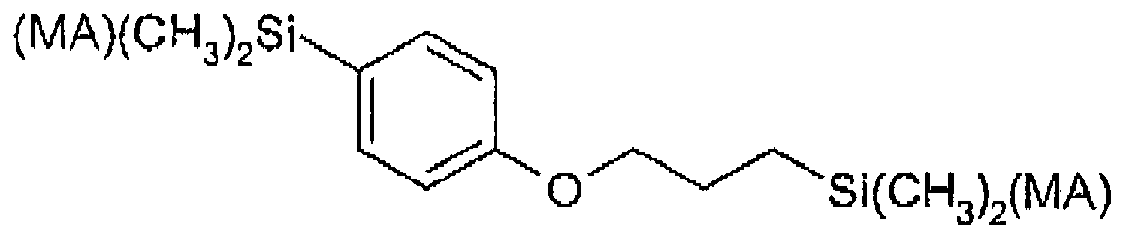
 - Dentalzusammensetzung nach einem der Ansprüche 1 bis 5, wobei der carbosilanhaltige Bestandteil (A) ausgewählt ist aus



- Dentalzusammensetzung nach einem der vorstehenden Ansprüche, wobei der Initiator (B) einen lichthärtenden Initiator oder einen redoxhärtenden Initiator oder eine Kombination von beidem umfasst.
- Dentalzusammensetzung nach einem der vorstehenden Ansprüche, wobei der Füllstoff (C) verstärkende und/oder nichtverstärkende Füllstoffe umfasst.
- Dentalzusammensetzung nach einem der vorstehenden Ansprüche, gefüllt in einen Behälter oder eine Kartusche.
- Teilesatz, umfassend einen Basisteil (I) und einen Katalysatorteil (II), wobei der Basisteil (I) den carbosilanhaltigen Bestandteil (A) umfasst und der Katalysatorteil (II) den Initiator (B) umfasst, und wobei die Bestandteile (C) und (D) entweder im Basisteil oder im Katalysatorteil oder im Basisteil und im Katalysatorteil vorhanden sind, und wobei die Bestandteile (A), (B), (C) und (D) wie in den vorstehenden Ansprüchen 1 bis 9 definiert vorliegen.
- Verfahren zur Herstellung einer Dentalzusammensetzung, umfassend die Schrittea) Bereitstellen der Verbindungen (A), (B), optional (C) und optional (D), wie in den vorstehenden Ansprüchen 1 bis 9 beschrieben;b) Mischen der Verbindungen von Schritt a),wobei Bestandteil (A) durch eine Hydrosilylierungsreaktion erhältlich ist.
- Verfahren nach Anspruch 12, wobei die Hydrosilylierungsreaktion die Reaktion eines funktionellen poly-Si-H-Carbosilan-Bestandteils mit einem olefinischen substituierten (Meth)acrylateinheit-haltigen Bestandteil umfasst.
- Verwendung der Dentalzusammensetzung nach einem der Ansprüche 1 bis 9 zur Herstellung eines Zahnfüllungsmaterials, Kronen- und Brückenmaterials, Verblendmaterials, Inlays oder Onlays.
- Verwendung des carbosilanhaltigen Bestandteils (A), wie in einem der Ansprüche 1 bis 7 beschrieben, zur Herstellung eines Dentalmaterials in einem Verfahren, umfassend die Schrittea) Bereitstellen einer Dentalzusammensetzung, umfassend die carbosilanhaltige Verbindung (A) und den Initiator (B);b) Aufbringen der Dentalzusammensetzung auf eine Oberfläche;c) Härten der Dentalzusammensetzung.
Applications Claiming Priority (1)
| Application Number | Priority Date | Filing Date | Title |
|---|---|---|---|
| PCT/EP2004/007746 WO2006005363A1 (en) | 2004-07-14 | 2004-07-14 | Dental composition containing unsaturated carbosilane containing components |
Publications (2)
| Publication Number | Publication Date |
|---|---|
| EP1765261A1 EP1765261A1 (de) | 2007-03-28 |
| EP1765261B1 true EP1765261B1 (de) | 2015-08-19 |
Family
ID=34958130
Family Applications (1)
| Application Number | Title | Priority Date | Filing Date |
|---|---|---|---|
| EP04740971.9A Expired - Lifetime EP1765261B1 (de) | 2004-07-14 | 2004-07-14 | Dentalzusammensetzung mit ungesättigtes carbosilan enthaltenden bestandteilen |
Country Status (7)
| Country | Link |
|---|---|
| US (1) | US7915324B2 (de) |
| EP (1) | EP1765261B1 (de) |
| JP (1) | JP4797019B2 (de) |
| CN (1) | CN1988875B (de) |
| AU (1) | AU2004321429A1 (de) |
| CA (1) | CA2573496A1 (de) |
| WO (1) | WO2006005363A1 (de) |
Families Citing this family (12)
| Publication number | Priority date | Publication date | Assignee | Title |
|---|---|---|---|---|
| AU2004321432A1 (en) | 2004-07-14 | 2006-01-19 | 3M Espe Ag | Dental composition containing Si-H functional carbosilane components |
| EP1781724B1 (de) * | 2004-07-14 | 2009-07-08 | 3M Innovative Properties Company | Dentalzusammensetzungen mit carbosilanpolymere |
| CA2573507A1 (en) * | 2004-07-14 | 2006-01-19 | 3M Espe Ag | Dental composition containing unsaturated carbosilane containing components |
| AU2005275246B2 (en) * | 2004-07-14 | 2011-10-06 | 3M Deutschland Gmbh | Dental compositions containing carbosilane monomers |
| CN1988875B (zh) | 2004-07-14 | 2012-05-02 | 3M埃斯佩股份公司 | 含有含不饱和碳硅烷的组分的牙科组合物 |
| KR100634382B1 (ko) * | 2005-03-23 | 2006-10-16 | 한국화학연구원 | 환형 실록산계 화합물과 이 화합물을 가교제로 함유하는고체 고분자 전해질 조성물 |
| EP2153812B1 (de) * | 2008-08-13 | 2014-11-26 | Mühlbauer Technology GmbH | Röntgenopaker Infiltrant |
| DE102013008176A1 (de) | 2012-10-05 | 2014-04-10 | Voco Gmbh | Kit und Verfahren zur indirekten chairside Herstellung von Kompositinlays |
| WO2015164630A1 (en) * | 2014-04-25 | 2015-10-29 | Novartis Ag | Carbosiloxane vinylic monomers |
| CN109890344B (zh) * | 2016-10-21 | 2022-02-22 | 可乐丽则武齿科株式会社 | 分包型的牙科用胶合剂 |
| KR102198801B1 (ko) | 2017-12-07 | 2021-01-05 | 삼성에스디아이 주식회사 | 색 변환 패널 및 색 변환 패널의 제조 방법 |
| EP3804688B1 (de) * | 2019-09-26 | 2025-01-22 | Shofu Inc. | Zahnärztliche einkomponenten-klebstoffzusammensetzung |
Family Cites Families (38)
| Publication number | Priority date | Publication date | Assignee | Title |
|---|---|---|---|---|
| US3927116A (en) | 1967-10-24 | 1975-12-16 | Union Carbide Corp | Bicyclo{8 2.2.1{9 {0 Hept-5(6)-yl compounds |
| US3814730A (en) | 1970-08-06 | 1974-06-04 | Gen Electric | Platinum complexes of unsaturated siloxanes and platinum containing organopolysiloxanes |
| US3715334A (en) | 1970-11-27 | 1973-02-06 | Gen Electric | Platinum-vinylsiloxanes |
| US3779952A (en) | 1971-03-22 | 1973-12-18 | Shell Oil Co | Metal-containing polymers |
| US3971754A (en) | 1973-12-10 | 1976-07-27 | Pennwalt Corporation | X-ray opaque, enamel-matching dental filling composition |
| US3933880A (en) | 1974-12-02 | 1976-01-20 | Dow Corning Corporation | Method of preparing a platinum catalyst inhibitor |
| US4391590A (en) | 1981-04-09 | 1983-07-05 | Dentsply Research & Development Corp. | Cartridge for viscous material |
| WO1986001219A1 (en) * | 1984-08-17 | 1986-02-27 | Mc Carry, John, D. | Alkylsilane contact lens and polymer |
| US4707438A (en) * | 1984-08-22 | 1987-11-17 | Tel Aviv University | Immunoassay for breast cancer employing monoclonal antibodies |
| DE3609038A1 (de) | 1986-03-18 | 1987-09-24 | Espe Stiftung | Roentgenopake polymerisierbare dentalmassen |
| JPS62246905A (ja) | 1986-04-18 | 1987-10-28 | Toa Nenryo Kogyo Kk | スチレン系共重合体 |
| US4788268A (en) | 1987-05-05 | 1988-11-29 | Hughes Aircraft Company | Method for preparation of epoxysilicone compounds and allyl-terminated silicone compounds |
| US5145886A (en) | 1988-05-19 | 1992-09-08 | Minnesota Mining And Manufacturing Company | Radiation activated hydrosilation reaction |
| JPH0672084B2 (ja) | 1989-03-31 | 1994-09-14 | 信越化学工業株式会社 | 印象材組成物 |
| DE4011044A1 (de) | 1990-04-05 | 1991-10-10 | Fraunhofer Ges Forschung | Silane, verfahren zu ihrer herstellung und ihre verwendung zur herstellung von polymerisaten und polykondensaten |
| US6376569B1 (en) | 1990-12-13 | 2002-04-23 | 3M Innovative Properties Company | Hydrosilation reaction utilizing a (cyclopentadiene)(sigma-aliphatic) platinum complex and a free radical photoinitiator |
| US6046250A (en) | 1990-12-13 | 2000-04-04 | 3M Innovative Properties Company | Hydrosilation reaction utilizing a free radical photoinitiator |
| US5165890A (en) | 1991-01-07 | 1992-11-24 | Centrix, Inc. | Dosing dental cartridge |
| US5322440A (en) | 1992-10-20 | 1994-06-21 | Kerr Manufacturing Company | Dental syringe tip |
| EP0661331B1 (de) | 1993-12-28 | 2001-05-23 | Kanegafuchi Chemical Industry Co., Ltd. | Silizium-enthaltendes Polymer, Verfahren zur Herstellung und Monomer |
| DE19648283A1 (de) | 1996-11-21 | 1998-05-28 | Thera Ges Fuer Patente | Polymerisierbare Massen auf der Basis von Epoxiden |
| DE19736665A1 (de) | 1997-08-22 | 1999-02-25 | Espe Dental Ag | Härtbare Masse mit Silan-Dendrimeren |
| US6653375B2 (en) * | 1998-01-28 | 2003-11-25 | Ivoclar Ag | Urethane di(meth)acrylate derivatives of 1,3-bis(1-isocyanato-1-methylethyl)benzene |
| DE19860364C2 (de) | 1998-12-24 | 2001-12-13 | 3M Espe Ag | Polymerisierbare Dentalmassen auf der Basis von zur Aushärtung befähigten Siloxanverbindungen, deren Verwendung und Herstellung |
| DE19860361A1 (de) | 1998-12-24 | 2000-06-29 | Espe Dental Ag | Vernetzbare Monomere auf Cyclosiloxanbasis, deren Herstellung und deren Verwendung in polymerisierbaren Massen |
| DE19934407A1 (de) * | 1999-07-22 | 2001-01-25 | Espe Dental Ag | Hydrolysierbare und polymerisierbare Silane mit geringer Viskosität und deren Verwendung |
| DE10001228B4 (de) | 2000-01-13 | 2007-01-04 | 3M Espe Ag | Polymerisierbare Zubereitungen auf der Basis von siliziumhaltigen Epoxiden |
| DE10026432A1 (de) | 2000-05-29 | 2002-02-14 | 3M Espe Ag | Präpolymere (Meth)acrylate mit polycyclischen oder aromatischen Segmenten |
| CA2411464A1 (en) | 2000-06-13 | 2001-12-20 | Dentsply International Inc. | Low shrinking polymerizable dental material |
| DE10100736C2 (de) * | 2001-01-10 | 2003-07-17 | Kettenbach Gmbh & Co Kg | Trennmittel |
| DE10107985C1 (de) | 2001-02-19 | 2002-04-18 | 3M Espe Ag | Polymerisierbare Zubereitungen auf der Basis von Siliziumverbindungen mit aliphatischen und cycloaliphatischen Epoxidgruppen und deren Verwendung |
| DE10116223A1 (de) | 2001-03-30 | 2002-10-10 | 3M Espe Ag | Automatisch mischbare Abformassen mit Putty-Konsistenz |
| DE60313164T2 (de) * | 2003-09-04 | 2007-12-13 | 3M Espe Ag | Allylsilan enthaltende Zusammensetzung |
| DE102004005562A1 (de) * | 2004-02-03 | 2005-08-25 | Kettenbach Gmbh & Co. Kg | Über Hydrosilylierungs-Reaktion additionsvernetzende Zweikomponenten-Dentalmaterial mit starren und/oder voluminösen Gruppen sowie mit hoher Biegefestigkeit und E-Modul |
| CN1988875B (zh) | 2004-07-14 | 2012-05-02 | 3M埃斯佩股份公司 | 含有含不饱和碳硅烷的组分的牙科组合物 |
| AU2005275246B2 (en) * | 2004-07-14 | 2011-10-06 | 3M Deutschland Gmbh | Dental compositions containing carbosilane monomers |
| CA2573507A1 (en) * | 2004-07-14 | 2006-01-19 | 3M Espe Ag | Dental composition containing unsaturated carbosilane containing components |
| AU2004321432A1 (en) | 2004-07-14 | 2006-01-19 | 3M Espe Ag | Dental composition containing Si-H functional carbosilane components |
-
2004
- 2004-07-14 CN CN200480043602XA patent/CN1988875B/zh not_active Expired - Fee Related
- 2004-07-14 WO PCT/EP2004/007746 patent/WO2006005363A1/en not_active Ceased
- 2004-07-14 CA CA002573496A patent/CA2573496A1/en not_active Abandoned
- 2004-07-14 AU AU2004321429A patent/AU2004321429A1/en not_active Abandoned
- 2004-07-14 JP JP2007520668A patent/JP4797019B2/ja not_active Expired - Fee Related
- 2004-07-14 EP EP04740971.9A patent/EP1765261B1/de not_active Expired - Lifetime
- 2004-07-14 US US11/572,069 patent/US7915324B2/en not_active Expired - Fee Related
Also Published As
| Publication number | Publication date |
|---|---|
| CN1988875A (zh) | 2007-06-27 |
| US20070207443A1 (en) | 2007-09-06 |
| US7915324B2 (en) | 2011-03-29 |
| AU2004321429A1 (en) | 2006-01-19 |
| EP1765261A1 (de) | 2007-03-28 |
| CN1988875B (zh) | 2012-05-02 |
| JP2008505939A (ja) | 2008-02-28 |
| WO2006005363A1 (en) | 2006-01-19 |
| CA2573496A1 (en) | 2006-01-19 |
| JP4797019B2 (ja) | 2011-10-19 |
Similar Documents
| Publication | Publication Date | Title |
|---|---|---|
| WO2009110848A1 (en) | Low shrinkage multifunctional ssq resins | |
| EP1765261B1 (de) | Dentalzusammensetzung mit ungesättigtes carbosilan enthaltenden bestandteilen | |
| EP1765263B1 (de) | Dentalzusammensetzung mit si-h-funktionalen carbosilan-komponenten | |
| EP1765265B1 (de) | Dentalzusammensetzung mit einer epoxy-funktionalen carbosilan-verbindung | |
| EP1776079B1 (de) | Dentalzusammensetzung mit epoxy-funktionalen polymerisierbaren verbindungen | |
| EP1765264B1 (de) | Dentalzusammensetzung mit ungesättigtes carbosilan enthaltenden bestandteilen | |
| EP1765262B1 (de) | Dentalzusammensetzung mit ungesättigten halogenierten arylalkylether-bestandteilen | |
| KR20070032377A (ko) | 불포화 카르보실란 함유 성분을 함유하는 치과용 조성물 | |
| KR20070032378A (ko) | 불포화 카르보실란 함유 성분을 함유하는 치과용 조성물 | |
| KR20070031455A (ko) | Si―H 관능성 카르보실란 성분을 함유하는 치과용조성물 |
Legal Events
| Date | Code | Title | Description |
|---|---|---|---|
| PUAI | Public reference made under article 153(3) epc to a published international application that has entered the european phase |
Free format text: ORIGINAL CODE: 0009012 |
|
| 17P | Request for examination filed |
Effective date: 20061218 |
|
| AK | Designated contracting states |
Kind code of ref document: A1 Designated state(s): AT BE BG CH CY CZ DE DK EE ES FI FR GB GR HU IE IT LI LU MC NL PL PT RO SE SI SK TR |
|
| DAX | Request for extension of the european patent (deleted) | ||
| 17Q | First examination report despatched |
Effective date: 20100219 |
|
| RAP1 | Party data changed (applicant data changed or rights of an application transferred) |
Owner name: 3M DEUTSCHLAND GMBH |
|
| GRAP | Despatch of communication of intention to grant a patent |
Free format text: ORIGINAL CODE: EPIDOSNIGR1 |
|
| INTG | Intention to grant announced |
Effective date: 20150327 |
|
| GRAS | Grant fee paid |
Free format text: ORIGINAL CODE: EPIDOSNIGR3 |
|
| GRAA | (expected) grant |
Free format text: ORIGINAL CODE: 0009210 |
|
| AK | Designated contracting states |
Kind code of ref document: B1 Designated state(s): AT BE BG CH CY CZ DE DK EE ES FI FR GB GR HU IE IT LI LU MC NL PL PT RO SE SI SK TR |
|
| REG | Reference to a national code |
Ref country code: GB Ref legal event code: FG4D |
|
| REG | Reference to a national code |
Ref country code: CH Ref legal event code: EP |
|
| REG | Reference to a national code |
Ref country code: IE Ref legal event code: FG4D |
|
| REG | Reference to a national code |
Ref country code: AT Ref legal event code: REF Ref document number: 743268 Country of ref document: AT Kind code of ref document: T Effective date: 20150915 |
|
| REG | Reference to a national code |
Ref country code: DE Ref legal event code: R096 Ref document number: 602004047714 Country of ref document: DE |
|
| REG | Reference to a national code |
Ref country code: AT Ref legal event code: MK05 Ref document number: 743268 Country of ref document: AT Kind code of ref document: T Effective date: 20150819 |
|
| REG | Reference to a national code |
Ref country code: NL Ref legal event code: MP Effective date: 20150819 |
|
| PG25 | Lapsed in a contracting state [announced via postgrant information from national office to epo] |
Ref country code: FI Free format text: LAPSE BECAUSE OF FAILURE TO SUBMIT A TRANSLATION OF THE DESCRIPTION OR TO PAY THE FEE WITHIN THE PRESCRIBED TIME-LIMIT Effective date: 20150819 Ref country code: GR Free format text: LAPSE BECAUSE OF FAILURE TO SUBMIT A TRANSLATION OF THE DESCRIPTION OR TO PAY THE FEE WITHIN THE PRESCRIBED TIME-LIMIT Effective date: 20151120 |
|
| PG25 | Lapsed in a contracting state [announced via postgrant information from national office to epo] |
Ref country code: SE Free format text: LAPSE BECAUSE OF FAILURE TO SUBMIT A TRANSLATION OF THE DESCRIPTION OR TO PAY THE FEE WITHIN THE PRESCRIBED TIME-LIMIT Effective date: 20150819 Ref country code: PL Free format text: LAPSE BECAUSE OF FAILURE TO SUBMIT A TRANSLATION OF THE DESCRIPTION OR TO PAY THE FEE WITHIN THE PRESCRIBED TIME-LIMIT Effective date: 20150819 Ref country code: PT Free format text: LAPSE BECAUSE OF FAILURE TO SUBMIT A TRANSLATION OF THE DESCRIPTION OR TO PAY THE FEE WITHIN THE PRESCRIBED TIME-LIMIT Effective date: 20151221 Ref country code: AT Free format text: LAPSE BECAUSE OF FAILURE TO SUBMIT A TRANSLATION OF THE DESCRIPTION OR TO PAY THE FEE WITHIN THE PRESCRIBED TIME-LIMIT Effective date: 20150819 Ref country code: ES Free format text: LAPSE BECAUSE OF FAILURE TO SUBMIT A TRANSLATION OF THE DESCRIPTION OR TO PAY THE FEE WITHIN THE PRESCRIBED TIME-LIMIT Effective date: 20150819 |
|
| PG25 | Lapsed in a contracting state [announced via postgrant information from national office to epo] |
Ref country code: NL Free format text: LAPSE BECAUSE OF FAILURE TO SUBMIT A TRANSLATION OF THE DESCRIPTION OR TO PAY THE FEE WITHIN THE PRESCRIBED TIME-LIMIT Effective date: 20150819 |
|
| PG25 | Lapsed in a contracting state [announced via postgrant information from national office to epo] |
Ref country code: SK Free format text: LAPSE BECAUSE OF FAILURE TO SUBMIT A TRANSLATION OF THE DESCRIPTION OR TO PAY THE FEE WITHIN THE PRESCRIBED TIME-LIMIT Effective date: 20150819 Ref country code: DK Free format text: LAPSE BECAUSE OF FAILURE TO SUBMIT A TRANSLATION OF THE DESCRIPTION OR TO PAY THE FEE WITHIN THE PRESCRIBED TIME-LIMIT Effective date: 20150819 Ref country code: IT Free format text: LAPSE BECAUSE OF FAILURE TO SUBMIT A TRANSLATION OF THE DESCRIPTION OR TO PAY THE FEE WITHIN THE PRESCRIBED TIME-LIMIT Effective date: 20150819 Ref country code: EE Free format text: LAPSE BECAUSE OF FAILURE TO SUBMIT A TRANSLATION OF THE DESCRIPTION OR TO PAY THE FEE WITHIN THE PRESCRIBED TIME-LIMIT Effective date: 20150819 Ref country code: CZ Free format text: LAPSE BECAUSE OF FAILURE TO SUBMIT A TRANSLATION OF THE DESCRIPTION OR TO PAY THE FEE WITHIN THE PRESCRIBED TIME-LIMIT Effective date: 20150819 |
|
| REG | Reference to a national code |
Ref country code: DE Ref legal event code: R097 Ref document number: 602004047714 Country of ref document: DE |
|
| PG25 | Lapsed in a contracting state [announced via postgrant information from national office to epo] |
Ref country code: RO Free format text: LAPSE BECAUSE OF FAILURE TO SUBMIT A TRANSLATION OF THE DESCRIPTION OR TO PAY THE FEE WITHIN THE PRESCRIBED TIME-LIMIT Effective date: 20150819 |
|
| PLBE | No opposition filed within time limit |
Free format text: ORIGINAL CODE: 0009261 |
|
| STAA | Information on the status of an ep patent application or granted ep patent |
Free format text: STATUS: NO OPPOSITION FILED WITHIN TIME LIMIT |
|
| 26N | No opposition filed |
Effective date: 20160520 |
|
| PG25 | Lapsed in a contracting state [announced via postgrant information from national office to epo] |
Ref country code: SI Free format text: LAPSE BECAUSE OF FAILURE TO SUBMIT A TRANSLATION OF THE DESCRIPTION OR TO PAY THE FEE WITHIN THE PRESCRIBED TIME-LIMIT Effective date: 20150819 |
|
| PG25 | Lapsed in a contracting state [announced via postgrant information from national office to epo] |
Ref country code: BE Free format text: LAPSE BECAUSE OF FAILURE TO SUBMIT A TRANSLATION OF THE DESCRIPTION OR TO PAY THE FEE WITHIN THE PRESCRIBED TIME-LIMIT Effective date: 20150819 |
|
| GBPC | Gb: european patent ceased through non-payment of renewal fee |
Effective date: 20160714 |
|
| PG25 | Lapsed in a contracting state [announced via postgrant information from national office to epo] |
Ref country code: MC Free format text: LAPSE BECAUSE OF FAILURE TO SUBMIT A TRANSLATION OF THE DESCRIPTION OR TO PAY THE FEE WITHIN THE PRESCRIBED TIME-LIMIT Effective date: 20150819 |
|
| PG25 | Lapsed in a contracting state [announced via postgrant information from national office to epo] |
Ref country code: FR Free format text: LAPSE BECAUSE OF NON-PAYMENT OF DUE FEES Effective date: 20160801 |
|
| REG | Reference to a national code |
Ref country code: FR Ref legal event code: ST Effective date: 20170331 |
|
| REG | Reference to a national code |
Ref country code: IE Ref legal event code: MM4A |
|
| PG25 | Lapsed in a contracting state [announced via postgrant information from national office to epo] |
Ref country code: GB Free format text: LAPSE BECAUSE OF NON-PAYMENT OF DUE FEES Effective date: 20160714 |
|
| PG25 | Lapsed in a contracting state [announced via postgrant information from national office to epo] |
Ref country code: IE Free format text: LAPSE BECAUSE OF NON-PAYMENT OF DUE FEES Effective date: 20160714 |
|
| PG25 | Lapsed in a contracting state [announced via postgrant information from national office to epo] |
Ref country code: LU Free format text: LAPSE BECAUSE OF NON-PAYMENT OF DUE FEES Effective date: 20160714 |
|
| PGFP | Annual fee paid to national office [announced via postgrant information from national office to epo] |
Ref country code: DE Payment date: 20170711 Year of fee payment: 14 Ref country code: CH Payment date: 20170712 Year of fee payment: 14 |
|
| PG25 | Lapsed in a contracting state [announced via postgrant information from national office to epo] |
Ref country code: CY Free format text: LAPSE BECAUSE OF FAILURE TO SUBMIT A TRANSLATION OF THE DESCRIPTION OR TO PAY THE FEE WITHIN THE PRESCRIBED TIME-LIMIT Effective date: 20150819 Ref country code: HU Free format text: LAPSE BECAUSE OF FAILURE TO SUBMIT A TRANSLATION OF THE DESCRIPTION OR TO PAY THE FEE WITHIN THE PRESCRIBED TIME-LIMIT; INVALID AB INITIO Effective date: 20040714 |
|
| PG25 | Lapsed in a contracting state [announced via postgrant information from national office to epo] |
Ref country code: TR Free format text: LAPSE BECAUSE OF FAILURE TO SUBMIT A TRANSLATION OF THE DESCRIPTION OR TO PAY THE FEE WITHIN THE PRESCRIBED TIME-LIMIT Effective date: 20150819 |
|
| PG25 | Lapsed in a contracting state [announced via postgrant information from national office to epo] |
Ref country code: BG Free format text: LAPSE BECAUSE OF FAILURE TO SUBMIT A TRANSLATION OF THE DESCRIPTION OR TO PAY THE FEE WITHIN THE PRESCRIBED TIME-LIMIT Effective date: 20150819 |
|
| REG | Reference to a national code |
Ref country code: DE Ref legal event code: R119 Ref document number: 602004047714 Country of ref document: DE |
|
| REG | Reference to a national code |
Ref country code: CH Ref legal event code: PL |
|
| PG25 | Lapsed in a contracting state [announced via postgrant information from national office to epo] |
Ref country code: LI Free format text: LAPSE BECAUSE OF NON-PAYMENT OF DUE FEES Effective date: 20180731 Ref country code: DE Free format text: LAPSE BECAUSE OF NON-PAYMENT OF DUE FEES Effective date: 20190201 Ref country code: CH Free format text: LAPSE BECAUSE OF NON-PAYMENT OF DUE FEES Effective date: 20180731 |