EP1765914B1 - Procede de preparation d"un melange bitume-polymere - Google Patents
Procede de preparation d"un melange bitume-polymere Download PDFInfo
- Publication number
- EP1765914B1 EP1765914B1 EP05777328.5A EP05777328A EP1765914B1 EP 1765914 B1 EP1765914 B1 EP 1765914B1 EP 05777328 A EP05777328 A EP 05777328A EP 1765914 B1 EP1765914 B1 EP 1765914B1
- Authority
- EP
- European Patent Office
- Prior art keywords
- polymer
- bitumen
- master batch
- extrusion
- dilution
- Prior art date
- Legal status (The legal status is an assumption and is not a legal conclusion. Google has not performed a legal analysis and makes no representation as to the accuracy of the status listed.)
- Revoked
Links
Images
Classifications
-
- C—CHEMISTRY; METALLURGY
- C08—ORGANIC MACROMOLECULAR COMPOUNDS; THEIR PREPARATION OR CHEMICAL WORKING-UP; COMPOSITIONS BASED THEREON
- C08L—COMPOSITIONS OF MACROMOLECULAR COMPOUNDS
- C08L95/00—Compositions of bituminous materials, e.g. asphalt, tar, pitch
-
- B—PERFORMING OPERATIONS; TRANSPORTING
- B29—WORKING OF PLASTICS; WORKING OF SUBSTANCES IN A PLASTIC STATE IN GENERAL
- B29C—SHAPING OR JOINING OF PLASTICS; SHAPING OF MATERIAL IN A PLASTIC STATE, NOT OTHERWISE PROVIDED FOR; AFTER-TREATMENT OF THE SHAPED PRODUCTS, e.g. REPAIRING
- B29C48/00—Extrusion moulding, i.e. expressing the moulding material through a die or nozzle which imparts the desired form; Apparatus therefor
- B29C48/022—Extrusion moulding, i.e. expressing the moulding material through a die or nozzle which imparts the desired form; Apparatus therefor characterised by the choice of material
-
- C—CHEMISTRY; METALLURGY
- C08—ORGANIC MACROMOLECULAR COMPOUNDS; THEIR PREPARATION OR CHEMICAL WORKING-UP; COMPOSITIONS BASED THEREON
- C08J—WORKING-UP; GENERAL PROCESSES OF COMPOUNDING; AFTER-TREATMENT NOT COVERED BY SUBCLASSES C08B, C08C, C08F, C08G or C08H
- C08J3/00—Processes of treating or compounding macromolecular substances
- C08J3/005—Processes for mixing polymers
-
- B—PERFORMING OPERATIONS; TRANSPORTING
- B29—WORKING OF PLASTICS; WORKING OF SUBSTANCES IN A PLASTIC STATE IN GENERAL
- B29C—SHAPING OR JOINING OF PLASTICS; SHAPING OF MATERIAL IN A PLASTIC STATE, NOT OTHERWISE PROVIDED FOR; AFTER-TREATMENT OF THE SHAPED PRODUCTS, e.g. REPAIRING
- B29C48/00—Extrusion moulding, i.e. expressing the moulding material through a die or nozzle which imparts the desired form; Apparatus therefor
- B29C48/03—Extrusion moulding, i.e. expressing the moulding material through a die or nozzle which imparts the desired form; Apparatus therefor characterised by the shape of the extruded material at extrusion
-
- B—PERFORMING OPERATIONS; TRANSPORTING
- B29—WORKING OF PLASTICS; WORKING OF SUBSTANCES IN A PLASTIC STATE IN GENERAL
- B29C—SHAPING OR JOINING OF PLASTICS; SHAPING OF MATERIAL IN A PLASTIC STATE, NOT OTHERWISE PROVIDED FOR; AFTER-TREATMENT OF THE SHAPED PRODUCTS, e.g. REPAIRING
- B29C48/00—Extrusion moulding, i.e. expressing the moulding material through a die or nozzle which imparts the desired form; Apparatus therefor
- B29C48/03—Extrusion moulding, i.e. expressing the moulding material through a die or nozzle which imparts the desired form; Apparatus therefor characterised by the shape of the extruded material at extrusion
- B29C48/04—Particle-shaped
-
- B—PERFORMING OPERATIONS; TRANSPORTING
- B29—WORKING OF PLASTICS; WORKING OF SUBSTANCES IN A PLASTIC STATE IN GENERAL
- B29K—INDEXING SCHEME ASSOCIATED WITH SUBCLASSES B29B, B29C OR B29D, RELATING TO MOULDING MATERIALS OR TO MATERIALS FOR MOULDS, REINFORCEMENTS, FILLERS OR PREFORMED PARTS, e.g. INSERTS
- B29K2021/00—Use of unspecified rubbers as moulding material
-
- B—PERFORMING OPERATIONS; TRANSPORTING
- B29—WORKING OF PLASTICS; WORKING OF SUBSTANCES IN A PLASTIC STATE IN GENERAL
- B29K—INDEXING SCHEME ASSOCIATED WITH SUBCLASSES B29B, B29C OR B29D, RELATING TO MOULDING MATERIALS OR TO MATERIALS FOR MOULDS, REINFORCEMENTS, FILLERS OR PREFORMED PARTS, e.g. INSERTS
- B29K2095/00—Use of bituminous materials as moulding material
-
- B—PERFORMING OPERATIONS; TRANSPORTING
- B29—WORKING OF PLASTICS; WORKING OF SUBSTANCES IN A PLASTIC STATE IN GENERAL
- B29K—INDEXING SCHEME ASSOCIATED WITH SUBCLASSES B29B, B29C OR B29D, RELATING TO MOULDING MATERIALS OR TO MATERIALS FOR MOULDS, REINFORCEMENTS, FILLERS OR PREFORMED PARTS, e.g. INSERTS
- B29K2105/00—Condition, form or state of moulded material or of the material to be shaped
- B29K2105/0005—Condition, form or state of moulded material or of the material to be shaped containing compounding ingredients
- B29K2105/0044—Stabilisers, e.g. against oxydation, light or heat
-
- C—CHEMISTRY; METALLURGY
- C08—ORGANIC MACROMOLECULAR COMPOUNDS; THEIR PREPARATION OR CHEMICAL WORKING-UP; COMPOSITIONS BASED THEREON
- C08J—WORKING-UP; GENERAL PROCESSES OF COMPOUNDING; AFTER-TREATMENT NOT COVERED BY SUBCLASSES C08B, C08C, C08F, C08G or C08H
- C08J2395/00—Bituminous materials, e.g. asphalt, tar or pitch
-
- C—CHEMISTRY; METALLURGY
- C08—ORGANIC MACROMOLECULAR COMPOUNDS; THEIR PREPARATION OR CHEMICAL WORKING-UP; COMPOSITIONS BASED THEREON
- C08L—COMPOSITIONS OF MACROMOLECULAR COMPOUNDS
- C08L19/00—Compositions of rubbers not provided for in groups C08L7/00 - C08L17/00
- C08L19/003—Precrosslinked rubber; Scrap rubber; Used vulcanised rubber
-
- C—CHEMISTRY; METALLURGY
- C08—ORGANIC MACROMOLECULAR COMPOUNDS; THEIR PREPARATION OR CHEMICAL WORKING-UP; COMPOSITIONS BASED THEREON
- C08L—COMPOSITIONS OF MACROMOLECULAR COMPOUNDS
- C08L21/00—Compositions of unspecified rubbers
-
- C—CHEMISTRY; METALLURGY
- C08—ORGANIC MACROMOLECULAR COMPOUNDS; THEIR PREPARATION OR CHEMICAL WORKING-UP; COMPOSITIONS BASED THEREON
- C08L—COMPOSITIONS OF MACROMOLECULAR COMPOUNDS
- C08L53/00—Compositions of block copolymers containing at least one sequence of a polymer obtained by reactions only involving carbon-to-carbon unsaturated bonds; Compositions of derivatives of such polymers
- C08L53/02—Compositions of block copolymers containing at least one sequence of a polymer obtained by reactions only involving carbon-to-carbon unsaturated bonds; Compositions of derivatives of such polymers of vinyl-aromatic monomers and conjugated dienes
Definitions
- the invention relates to a process for preparing a mixture containing bitumen and at least one polymer.
- bitumens coming out of the refinery are commonly used to manufacture anhydrous or emulsion binders for road applications.
- anhydrous or emulsion binders for road applications.
- the use of polymers dispersed in the bitumen is also common.
- This incorporation is generally done in dedicated factories comprising agitated, heated tanks, connected to bitumen, polymer and additive supply systems, as well as to storage tanks where the binder can be stirred, contributing to the if necessary at its maturation.
- crosslinking or dispersion systems will be used or not.
- time required for dispersion can vary greatly, considerably affecting production rates as well as costs.
- the use of certain additives can have a significant environmental impact.
- Heating mixing tanks which can sometimes contain more than 50 m 3 requires large amounts of energy which are also repeated in each plant.
- one solution consists in producing premixes called masterbatches. These mixtures are commonly used for the manufacture of binders for surface coatings.
- masterbatches These mixtures are commonly used for the manufacture of binders for surface coatings.
- fluxing agents or thinners allows pre-dissolution of the polymer in large quantities at temperatures compatible with the flash point of these fluxes, as well as the subsequent pumping of the binder.
- the polymers most often used in bitumens are copolymers of styrene and of butadiene, whether they are random, bisblock or triblock. Copolymers of ethylene and vinyl acetate are also in common use. Other polymers are used marginally.
- the binder obtained After dispersion of the masterbatch in the bitumen, the binder obtained exhibits characteristics very close to those of an equivalent binder obtained in a conventional manner, that is to say by successive additions of polymer and then of flux in the bitumen.
- FR 2 619 821 A describes the incorporation of rubber particles into binders and / or bituminous mixes.
- the document BE 1 002 939 discloses a process for the preparation by extrusion of modified bitumen compositions, and bitumen-polymer compositions used in this process.
- polymers such as polyethylenes, polypropylenes and other polyolefins can be usefully added to the mix so as to improve the resistance to rutting or to hydrocarbons. These polymers are not miscible with bitumen and are therefore added directly to the mix during mixing in the coating station.
- the Applicant has also tried to mix the polymer in liquid form with the bitumen.
- the mixing times are then very short, the mixing being almost instantaneous.
- the energy required for softening the polymer is very high and the time required is long.
- the interest is limited, except for incorporating a large amount of polymer at viscosities low enough for the mixing with the bitumen to be instantaneous.
- the aim of the invention is to provide a process for incorporating polymers into bituminous binders while avoiding the drawbacks of known processes.
- the invention relates in particular to a process for preparing a mixture containing bitumen and at least one polymer, in which bitumen and at least one polymer are mixed by extrusion, as defined in the appended claims.
- extrusion any treatment allowing the shearing of a pasty mass and its transport through an appropriate orifice to obtain a profile.
- stirring ensures the homogenization of the mixture of bitumen and of the polymer introduced separately into the extruder.
- a subject of the invention is also a masterbatch obtained by the process claimed for road application, as well as the use of such a masterbatch for the manufacture by dilution of an anhydrous bituminous binder or in emulsion, fluxed or not.
- An advantage of using an extruder is the possibility of varying the working temperature along the sleeve in which the screw turns. It has been found that a temperature above 160 ° C is preferable, in the case of a styrene-butadiene-styrene (SBS) triblock copolymer, in the feed and kneading zones in order to ensure the softening of the one. -this. In the transfer zones and at the level of the die, the temperature could usefully be reduced in order to promote cooling.
- SBS styrene-butadiene-styrene
- the masterbatch can be used hot, directly after extrusion, or cold after cooling and possible granulation.
- the hot use is advantageous in the case where the masterbatch is immediately diluted in a continuous or batch process.
- the cooling as well as the granulation make it possible to avoid the energy consumption linked to maintaining the temperature as well as the investment in a very large capacity pump in order to supply the final mixer. as a very viscous premix.
- the masterbatch granules can be more or less sticky.
- an anti-sticking agent may be retained.
- the latter can be chosen from mineral fillers (silicas, talc, etc.), fatty substances (fatty acids, stearates or other salts, etc.) or polymers (silicones, organofluorinated polymers, polyethylene, etc.).
- Anti-stick agents can be added directly to the extruder. Preferably, however, they will be applied to the surface of the profile during cooling at the extruder outlet. To do this, we will choose in particular substances capable of being dissolved or suspended in water.
- the profiles will be, depending on the case, very elastic, soft or hard.
- the granulator will be chosen accordingly.
- the appearance of the binder is also much smoother and shinier.
- the "orange peel" appearance that is obtained with conventional processes is avoided.
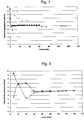
- the figures 1 to 3 are graphs showing the variation in viscosity of different bituminous binders as a function of mixing time.
- the binders obtained according to the invention not only have physical characteristics at least equivalent to those of known binders, but also improved storage stability. This makes premixing possible even with polymers which are a priori incompatible with bitumen. Cooling the masterbatch, which slows down the phase separation, further improves this property.
- the dilution can immediately precede the use of the binder, simplifying the manufacture of the mix. This can be further simplified by adding the masterbatch directly to the coating station at the same time as the bitumen used to adjust the final bitumen content.
- the process makes it possible to considerably reduce the manufacturing times for bituminous binders.
- the energy gain will therefore be all the greater the higher the polymer content.
- binders containing diene elastomeric polymers can be optimized by the use of a so-called "vulcanization" system which makes it possible to stabilize the dispersion and to lower the quantities of polymer necessary to obtain the desired characteristics of these binders.
- FR 2 617 491 A describes a process in which the vulcanizer content is about 20% based on the polymer.
- the dilution of the vulcanized masterbatches is carried out under the same conditions as that of the unvulcanized masterbatches.
- the characteristics of the binder obtained with these reduced vulcanizing contents are identical to those obtained by the process described in FR 2 617 491 A .
- Two masterbatches containing 30 and 40% SBS respectively were produced, cooled to room temperature, then granulated to obtain granules with a size of between 0.5 and 3 mm. These masterbatches were diluted with bitumen at 170 ° C to obtain a final polymer content of 5%.
- vulcanization systems complex mixtures of sulfur, donor of sulfur, vulcanization accelerator and vulcanization activator.
- Bitumen was mixed in a twin-screw extruder with 20% SBS and 3% of a vulcanization composition according to FR 2 619 821 A , or a vulcanization composition / polymer ratio equal to 15% as used in conventional manufacture.
- the formation of a gel plugging the extruder was immediate. Tests were therefore carried out using 2/3 and 1/3 respectively of this usual amount. In both cases, extrusion was possible without any difficulty.
- the masterbatches were cooled to room temperature.
- the viscosity measurements indicate, here again, that the dispersion time is divided by 4 compared to a conventional manufacture.
- the physical characteristics of the binder obtained are identical to those of the conventional mixture and consequently comply with the internal specifications of the Applicant, as shown in the table.
- a division by three of the quantities of vulcanizing agent obviously has an extremely positive impact in terms of the environment and economy.
- the few atmospheric emissions associated with its use are moreover easily sucked up and fixed in a suction system above the extruder.
- the centralization of the manufacture of vulcanized masterbatches also makes it possible to avoid the corresponding investments in factories for the manufacture of final binders. They can thus also gain access to an interesting technology both economically and technically, with a low impact on the environment.
Landscapes
- Chemical & Material Sciences (AREA)
- Engineering & Computer Science (AREA)
- Chemical Kinetics & Catalysis (AREA)
- Medicinal Chemistry (AREA)
- Polymers & Plastics (AREA)
- Organic Chemistry (AREA)
- Health & Medical Sciences (AREA)
- Civil Engineering (AREA)
- Materials Engineering (AREA)
- Structural Engineering (AREA)
- Mechanical Engineering (AREA)
- Processes Of Treating Macromolecular Substances (AREA)
- Compositions Of Macromolecular Compounds (AREA)
Description
- L'invention concerne un procédé de préparation d'un mélange contenant du bitume et au moins un polymère.
- Les bitumes purs sortis de raffinerie sont couramment utilisés pour fabriquer des liants anhydres ou en émulsion pour applications routières. Pour diminuer la sensibilité thermique de ces bitumes, augmenter leur cohésion ou leur élasticité et par conséquent améliorer le comportement du liant sous forte sollicitation, l'usage de polymères dispersés dans le bitume est également courant.
- Cette incorporation se fait en général dans des usines dédiées comportant des cuves agitées, chauffées, connectées à des systèmes d'alimentation en bitume, en polymère et en additifs, ainsi qu'à des cuves de stockage où le liant peut être brassé, contribuant le cas échéant à sa maturation.
- Selon le taux de modification recherché, des systèmes de réticulation ou de dispersion seront utilisés ou non. Par ailleurs, la durée nécessaire pour la dispersion peut varier fortement, affectant considérablement les cadences de production ainsi que les coûts. L'usage de certains additifs peut avoir un impact environnemental sensible.
- Toute ces contraintes impliquent des investissements, parfois lourds, pour chaque site de production.
- La mise en chauffe de cuves de malaxage qui peuvent contenir parfois plus de 50 m3 nécessite des quantités d'énergie importantes qui elles aussi sont répétées dans chaque usine.
- L'évolution permanente des besoins, la proximité de chantiers nécessitant de fortes quantités de liants, aussi bien que la rationalisation des outils industriels, nécessitent l'extension des capacités de production ainsi qu'une plus grande souplesse de ces sites industriels. Outre le surcoût d'investissement correspondant à ces nouveaux besoins, la nécessité de chauffer et d'agiter des volumes supérieurs ou d'augmenter le nombre de lots par jour a un impact environnemental fort, aussi bien en matière de consommation d'énergie qu'en matière de rejets atmosphériques.
- Afin de limiter ces surcoûts et impacts environnementaux, une solution consiste à réaliser des pré-mélanges appelés mélanges maîtres. Ces mélanges sont couramment utilisés pour la fabrication des liants pour enduits superficiels. Dans ce cas, l'usage de produits solvants du bitume appelés fluxants ou fluidifiants permet une pré-dissolution du polymère en grande quantité à des températures compatibles avec le point éclair de ces fluxants, ainsi que le pompage ultérieur du liant. Les polymères le plus souvent utilisés dans les bitumes sont les copolymères de styrène et de butadiène, qu'ils soient statistiques, biséquencés ou triséquencés. Les copolymères d'éthylène et d'acétate de vinyle sont également d'usage courant. D'autre polymères sont utilisés de manière marginale.
- Après dispersion du mélange maître dans le bitume, le liant obtenu présente des caractéristiques très voisines de celles d'un liant équivalent obtenu de façon classique, c'est-à-dire par ajouts successifs de polymère puis de fluxant dans le bitume.
- Dans le cas des liants d'enrobage, la situation est plus délicate. En effet, ces liants ne comportant pas de fluxant, un pré-mélange avec les technologies classiques incorporant de fort taux de polymères pose un problème de viscosité, et par conséquent nécessite une durée de fabrication longue.
- Avec les technologies classiques, des teneurs supérieures à 20 % sont pratiquement inenvisageables.
-
FR 2 619 821 A - Le document
BE 1 002 939 - La faible compatibilité de ces particules avec le bitume impose le plus souvent l'usage d'additifs supplémentaires destinés à améliorer cette compatibilité, dont l'incorporation allonge la durée de fabrication.
- Enfin, d'autres polymères tels que polyéthylènes, polypropylènes et autres polyoléfines peuvent être utilement ajoutés à l'enrobé de façon à améliorer la résistance à l'orniérage ou aux hydrocarbures. Ces polymères ne sont pas miscibles au bitume et sont donc ajoutés directement à l'enrobé lors du malaxage en poste d'enrobage.
- Des études menées par la Demanderesse ont montré qu'un paramètre primordial dans la préparation des mélanges liant-polymère est la granulométrie du polymère. Plus celui-ci est finement dispersé, plus la durée d'agitation est courte. Cependant, le conditionnement des polymères sous forme de poudre a un coût d'autant plus élevé que la taille de cette dernière est petite. L'intérêt de l'optimisation des durées de malaxage en jouant sur ce paramètre est donc économiquement limitée.
- La Demanderesse a également essayé de mélanger le polymère sous forme liquide avec le bitume. Les temps de malaxage sont alors très courts, le mélange étant quasi instantané. En revanche, l'énergie nécessaire au ramollissement du polymère est très importante et le temps nécessaire est long. Globalement, l'intérêt est limité, sauf à incorporer de grande quantité de polymère à des viscosités suffisamment faibles pour que le mélange au bitume soit instantané.
- Le but de l'invention est de fournir un procédé pour incorporer des polymères dans des liants bitumineux en évitant les inconvénients des procédés connus.
- L'invention vise notamment un procédé de préparation d'un mélange contenant du bitume et au moins un polymère, dans lequel on mélange du bitume et au moins un polymère par extrusion, tel que défini dans les revendications annexées.
- Par extrusion, on entend tout traitement permettant le cisaillement d'une masse pâteuse et son transport à travers un orifice approprié pour obtenir un profilé. Dans le procédé selon l'invention, le brassage assure l'homogénéisation du mélange du bitume et du polymère introduits séparément dans l'extrudeuse. Ces opérations peuvent être effectuées au moyen d'une ou plusieurs vis de type vis d'Archimède.
- Dans le cas d'une extrudeuse à au moins deux vis, ces dernières peuvent tourner dans le même sens ou en sens contraire. Dans tous les cas, les expérimentations ont montré que le mélange se faisait en quelques dizaines de secondes. Bien qu'aucun profil de vis particulier ne soit nécessaire, l'homme du métier pourra déterminer des profils appropriés afin d'optimiser les cadences ainsi que l'efficacité du malaxage.
- Sauf indication contraire, tous les pourcentages donnés ici sont en masse.
- Des caractéristiques optionnelles de l'invention, complémentaires ou de substitution, sont énoncées ci-après:
- On mélange par extrusion du bitume à l'état liquide et au moins un polymère à l'état fondu.
- Le polymère est choisi parmi un plastomère, un élastomère, une résine thermodurcissable et des mélanges de ceux-ci.
- Le polymère est un plastomère choisi parmi les polyéthylènes, polypropylènes et autres polyoléfines, les polystyrènes et tous copolymères obtenus par réaction de tout monomère avec une polyoléfine et/ou avec le styrène.
- L'élastomère est un élastomère naturel ou synthétique de préférence choisi parmi les copolymères comportant des motifs de styrène, butadiène ou tout autre diène, acrylonitrile, isoprène, chloroprène, acrylates, méthacrylates, éthylène, propylène, isobutène.
- L'élastomère est sous la forme de particules de caoutchouc issues du broyage de caoutchoucs neufs ou usagés.
- Le mélange contient un stabilisant pour le polymère.
- Le stabilisant comprend au moins du soufre et/ou un donneur de soufre et/ou un activateur de vulcanisation et/ou un accélérateur de vulcanisation ou au moins un peroxyde ou au moins un sel métallique.
- Le taux de stabilisant est compris entre 1 et 20 % par rapport au polymère, préférentiellement entre 3 et 10 %.
- La température du mélange peut être ajustée à des valeurs différentes le long de la cavité d'extrusion entre une zone d'introduction des constituants et un orifice de sortie, et est par exemple maximale dans la zone d'introduction et minimale au voisinage de l'orifice de sortie.
- Le mélange obtenu par extrusion est un mélange maître à fort taux de polymère destiné à être dilué dans un bitume pour fabriquer un liant bitumineux.
- Le taux de polymère dans le mélange maître est compris entre 10 et 90 %, préférentiellement entre 20 et 60 %.
- L'invention a également pour objet un mélange maître obtenu par le procédé revendiqué pour application routière, ainsi que l'utilisation d'un tel mélange maître pour la fabrication par dilution d'un liant bitumineux anhydre ou en émulsion, fluxé ou non.
- Selon des caractéristiques avantageuses:
- Le rapport du mélange maître au liant final est compris entre 5 et 80 %, préférentiellement entre 10 et 40 %.
- On dilue le mélange maître chaud directement après extrusion.
- On refroidit et facultativement on granule le mélange maître avant dilution.
- Le liant est mis en contact avec des fragments solides minéraux après dilution.
- Le mélange maître et le bitume de dilution sont mis en contact simultanément avec des fragments solides minéraux.
- Un avantage de l'utilisation d'une extrudeuse est la possibilité de faire varier la température de travail le long du fourreau dans lequel tourne la vis. Il a été constaté qu'une température supérieure à 160 °C était préférable, dans le cas d'un copolymère triséquencé styrène-butadiène-styrène (SBS), dans les zones d'alimentation et de malaxage afin d'assurer le ramollissement de celui-ci. Dans les zones de transfert et au niveau de la filière, on pourra utilement diminuer la température afin de favoriser le refroidissement.
- Selon l'invention, le mélange maître peut être utilisé chaud, directement après extrusion, ou froid après refroidissement et granulation éventuelle. L'utilisation à chaud est intéressante dans le cas où le mélange maître est immédiatement dilué selon un processus continu ou discontinu. Dans le cas d'un stockage avant dilution, le refroidissement ainsi que la granulation permettent d'éviter la consommation d'énergie liée à un maintien en température ainsi que l'investissement dans une pompe de très grosse capacité afin d'alimenter le mélangeur final en pré-mélange très visqueux.
- Suivant le type et la quantité de polymère, les granulés de mélange maître peuvent être plus ou moins collants. Afin d'éviter leur agglomération, l'emploi d'un agent anti-collant pourra être retenu. Ce dernier pourra être choisi parmi les charges minérales (silices, talc...), les corps gras (acide gras, stéarates ou autres sels...) ou les polymères (silicones, polymères organofluorés, polyéthylène...).
- Les agents anti-collants peuvent être ajoutés directement dans l'extrudeuse. De façon préférentielle, toutefois, ils seront appliqués à la surface du profilé lors du refroidissement en sortie d'extrudeuse. Pour ce faire, on choisira notamment des substances capables d'être dissoutes ou mises en suspension dans l'eau.
- Les profilés seront, selon les cas, très élastiques, mous ou durs. Le granulateur sera choisi en conséquence.
- Les essais menés ont montré que, de façon surprenante, la taille des granulés intervenait peu dans la vitesse de fabrication du liant final par dilution. Il s'agit d'une différence majeure avec l'incorporation de poudre selon l'état de la technique, cette poudre devant être la plus fine possible.
- Tout aussi surprenante est la diminution considérable du temps de dilution nécessaire à l'obtention d'un liant commercial, notamment pour les produits les plus riches en polymère nécessitant les temps de mélange les plus longs, pour lesquels on a observé un facteur quatre. Ainsi, dans le cas d'un bitume 70/100 comprenant 5 % de SBS, le temps nécessaire à l'obtention d'une dispersion homogène passe-t-il de 70 minutes au moins à 5 à 20 minutes, selon le mode opératoire.
- L'aspect du liant est par ailleurs beaucoup plus lisse et brillant. On évite l'aspect "peau d'orange" que l'on obtient avec les procédés classiques.
- Les caractéristiques et avantages de l'invention sont exposés plus en détail dans la description ci-après, avec référence aux dessins annexés.
- Les
figures 1 à 3 sont des graphiques représentant la variation de la viscosité de différents liants bitumineux en fonction du temps de malaxage. - Les exemples qui suivent montrent que les liants obtenus selon l'invention ont non seulement des caractéristiques physiques au moins équivalentes à celles des liants connus, mais également une stabilité en stockage améliorée. Cela rend possible le pré-mélange même avec des polymères a priori incompatibles avec le bitume. Le refroidissement du mélange maître, qui ralentit la séparation de phases, améliore encore cette propriété.
- La dilution peut précéder immédiatement l'utilisation du liant, simplifiant la fabrication de l'enrobé. Celle-ci peut être encore simplifiée par l'ajout du mélange maître directement dans le poste d'enrobage en même temps que le bitume servant à ajuster la teneur finale en bitume.
- On le voit, le procédé permet de diminuer considérablement les temps de fabrication des liants bitumineux.
- Effectuée dans des extrudeuses travaillant sur des volumes beaucoup plus limités que les réacteurs classiques, la fabrication du mélange maître nécessite peu d'énergie. L'échauffement de la matière provoqué par les cisaillements très importants intervenant au sein de l'extrudeuse contribue également à la diminution de l'énergie nécessaire au processus.
- De façon surprenante, les essais effectués ont montré que le temps nécessaire à l'obtention d'un mélange homogène variait peu avec la teneur en polymère dans le mélange maître (voir exemple 3).
- Le gain énergétique sera par conséquent d'autant plus important que la teneur en polymère sera élevée.
- Le gain aussi bien énergétique qu'en cadence de production est encore plus marqué dans le cas de l'incorporation de particules de caoutchouc.
- Dans ce cas, il est possible d'incorporer au moment de l'extrusion les additifs prévus dans
FR 2 619 821 A - Enfin, les performances des liants contenant des polymères élastomères diéniques peuvent être optimisées par l'emploi d'un système dit de "vulcanisation" qui permet de stabiliser la dispersion et d'abaisser les quantités de polymère nécessaires à l'obtention des caractéristiques recherchées de ces liants.
-
FR 2 617 491 A - L'ajout de telles quantités dans l'extrudeuse peut conduire à une vulcanisation trop poussée se traduisant par une prise en masse. Une teneur inférieure ou égale à 5 % est donc préférée dans la présente invention. (voir exemple 4). Il en résulte un gain environnemental puisque les systèmes de vulcanisation contiennent des composés soufrés susceptibles de produire H2S lors de la réaction. Lés rejets sont ainsi diminués. En outre, la mise en place d'une aspiration au-dessus de l'extrudeuse permet de façon simple d'éviter tout rejet dans l'environnement.
- La dilution des mélanges maîtres vulcanisés se fait dans les mêmes conditions que celle des mélanges maîtres non vulcanisés. Les caractéristiques du liant obtenu avec ces teneurs en vulcanisant réduites sont identiques à celles obtenues par le procédé décrit dans
FR 2 617 491 A - Les exemples ci-après utilisent un bitume 70/100 et un SBS linéaire commercialisé par la société Kraton sous la dénomination 1101 CM.
- Afin d'évaluer le temps de malaxage nécessaire pour obtenir les liants étudiés, des mesures de viscosité dynamique en fonction du temps ont été effectuées à 150 °C à l'aide d'un appareil de type Brookfield cap 1000 équipé d'un cône plan de taille 3.
- On a préparé deux liants à 5 % de SBS, l'un par mélange direct du SBS en poudre (diamètre moyen 1 mm) et du bitume (témoin), l'autre par les étapes suivantes (invention):
- mélange en extrudeuse monovis, en 20 à 40 secondes, de 30 % de SBS et de 70 % de bitume, la température étant de 180 °C dans toute l'extrudeuse;
- dilution du mélange maître obtenu, maintenu à 160° C, à raison de 16,7 % dans le bitume.
- Les résultats des mesures de viscosité sont reportés sur la
figure 1 , le symbole ■ correspondant à l'invention et le symbole ◆ au témoin. - Les oscillations observées sur la courbe témoin résultent d'une hétérogénéité de la dispersion de polymère qui prouve que ce dernier n'est pas complètement dispersé. Survient ensuite un plateau de viscosité qui montre que la dispersion est uniforme. Le temps nécessaire pour atteindre ce plateau est retenu comme temps de dispersion.
- Dans le cas de la dispersion à chaud du mélange maître, on constate qu'après 5 minutes de dispersion le plateau est déjà atteint, alors que 70 minutes sont nécessaires avec le procédé classique.
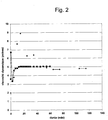
- Après extrusion, un mélange maître à 40 % de SBS a été laissé au repos jusqu'à atteindre la température ambiante, puis granulé manuellement à une taille de granulés comprise entre 0,5 et 3 mm. Les granulés ont été dispersés à raison de 12,5 % dans le bitume. L'ajout des granulés froids dans le bitume à 170 °C a été effectué en une fois en 10 secondes.
- L'évolution de la viscosité est donnée sur la
figure 2 (symbole ■), en comparaison de la courbe témoin de lafigure 1 . - Si la dispersion des granulés s'effectue plus lentement que celle du mélange maître chaud, le gain de temps reste significatif, puisque 20 minutes suffisent au lieu des 70 minutes du témoin.
- Deux mélanges maîtres contenant respectivement 30 et 40 % de SBS ont été fabriqués, refroidis à la température ambiante, puis granulés pour obtenir des granulés de taille comprise entre 0,5 et 3 mm. Ces mélanges maîtres ont été dilués avec du bitume à 170 °C pour obtenir une teneur finale en polymère de 5 %.
- L'évolution de la viscosité est donnée sur la
figure 3 (■ = 30 %, ◆ = 40 %). - De façon surprenante, il semble que la teneur en SBS du mélange maître influence très peu la vitesse de dispersion dans le bitume.
- Les caractéristiques d'usage des liants obtenus ont été comparés à celles du liant témoin. Aucune différence significative n'a pu être mesurée. On a cependant observé une meilleure stabilité en stockage.
- Comme déjà décrit, une solution technique intéressante pour l'optimisation des quantités et des performances des polymères diéniques dans le bitume est l'emploi de systèmes dits de vulcanisation, mélanges complexes de soufre, de donneur de soufre, d'accélérateur de vulcanisation et d'activateur de vulcanisation.
- On a mélangé dans une extrudeuse bi-vis du bitume avec 20 % de SBS et 3 % d'une composition de vulcanisation selon
FR 2 619 821 A - La granulation du mélange maître vulcanisé avec 2 % de composition de vulcanisation est apparue difficile du fait d'une élasticité exceptionnelle. Celui à 1 % n'a pas posé de problème et a été ajouté à du bitume à 170 °C pour obtenir un liant contenant 5,5 % de polymère.
- Les mesures de viscosité indiquent, ici encore, que le temps de dispersion est divisé par 4 par rapport à une fabrication classique.
- Les caractéristiques physiques du liant obtenu sont identiques à celles du mélange classique et par conséquent conformes aux spécifications internes de la Demanderesse comme le montre le tableau.
Tableau Liant Spécification Pénétrabilité selon NF EN 1426 51 40-70 Température bille et anneau (°C) selon NF EN 1427 84,5 >65 % de polymère 5,5 5 Stabilité en stockage selon méthode interne oui non Cohésion selon NF T 66.037 Cohésion maxi 1,6 >1,5 Température maxi (°C) 40 40 Intervalle de température (°C) 39 - - Une division par trois des quantités d'agent vulcanisant a bien évidemment un impact extrêmement positif en matière d'environnement et d'économie. Les quelques rejets atmosphériques liés à son emploi sont par ailleurs aisément aspirés et fixés dans un système d'aspiration surmontant l'extrudeuse. La centralisation de la fabrication des mélanges maîtres vulcanisés permet également d'éviter les investissements correspondants dans les usines de fabrication des liants finaux. Celles-ci peuvent ainsi en outre accéder à une technologie intéressante tant économiquement que techniquement, avec un faible impact sur l'environnement.
Claims (14)
- Procédé de préparation d'un mélange contenant du bitume et au moins un polymère, dans lequel on mélange du bitume et au moins un polymère par extrusion et dans lequel le mélange obtenu par extrusion est un mélange maître à fort taux de polymère destiné à être dilué dans un bitume pour fabriquer un liant bitumineux, caractérisé en ce que le polymère est un copolymère triséquencé styrène-butadiène-styrène (SBS) dont le taux massique dans le mélange maître est compris entre 20 et 40 %, et en ce que la température du mélange est ajustée à des valeurs différentes le long de la cavité d'extrusion entre une zone d'introduction des constituants et un orifice de sortie.
- Procédé selon la revendication 1, dans lequel le taux massique du polymère dans le mélange maître est de 20 %.
- Procédé selon l'une des revendications précédentes, dans lequel on mélange par extrusion du bitume à l'état liquide et au moins un polymère à l'état fondu.
- Procédé selon l'une des revendications précédentes, dans lequel le mélange maître contient un stabilisant pour le polymère.
- Procédé selon la revendication 4, dans lequel le stabilisant comprend au moins du soufre et/ou un donneur de soufre et/ou un activateur de vulcanisation et/ou un accélérateur de vulcanisation ou au moins un peroxyde ou au moins un sel métallique.
- Procédé selon l'une des revendications 4 et 5, dans lequel le taux massique de stabilisant est compris entre 1 et 20 % par rapport au polymère, préférentiellement entre 3 et 10 %.
- Procédé selon l'une des revendications précédentes, dans lequel ladite température est maximale dans la zone d'introduction et minimale au voisinage de l'orifice de sortie.
- Mélange maître obtenu par le procédé selon l'une des revendications 1 à 7 pour applications routières.
- Utilisation d'un mélange maître selon la revendication 8 pour la fabrication par dilution d'un liant bitumineux anhydre ou en émulsion, fluxé ou non.
- Utilisation selon la revendication 9, dans laquelle le rapport massique du mélange maître au liant final est compris entre 5 et 80 %, préférentiellement entre 10 et 40 %.
- Utilisation selon l'une des revendications 9 et 10, dans laquelle on dilue le mélange maître chaud directement après extrusion.
- Utilisation selon l'une des revendications 9 et 10, dans laquelle on refroidit et facultativement on granule le mélange maître avant dilution, avec le cas échéant utilisation d'agents anti-collants.
- Utilisation selon l'une des revendications 9 à 12, dans laquelle le liant est mis en contact avec des fragments solides minéraux après dilution.
- Utilisation selon l'une des revendications 9 à 12, dans laquelle le mélange maître et le bitume de dilution sont mis en contact simultanément avec des fragments solides minéraux.
Applications Claiming Priority (2)
| Application Number | Priority Date | Filing Date | Title |
|---|---|---|---|
| FR0406525A FR2871804B1 (fr) | 2004-06-16 | 2004-06-16 | Procede de preparation d'un melange bitume-polymere |
| PCT/FR2005/001432 WO2006003309A1 (fr) | 2004-06-16 | 2005-06-09 | Procede de preparation d’un melange bitume-polymere |
Publications (2)
| Publication Number | Publication Date |
|---|---|
| EP1765914A1 EP1765914A1 (fr) | 2007-03-28 |
| EP1765914B1 true EP1765914B1 (fr) | 2021-08-04 |
Family
ID=34946206
Family Applications (1)
| Application Number | Title | Priority Date | Filing Date |
|---|---|---|---|
| EP05777328.5A Revoked EP1765914B1 (fr) | 2004-06-16 | 2005-06-09 | Procede de preparation d"un melange bitume-polymere |
Country Status (6)
| Country | Link |
|---|---|
| US (1) | US20080015288A1 (fr) |
| EP (1) | EP1765914B1 (fr) |
| CA (1) | CA2570163A1 (fr) |
| ES (1) | ES2895323T3 (fr) |
| FR (1) | FR2871804B1 (fr) |
| WO (1) | WO2006003309A1 (fr) |
Families Citing this family (24)
| Publication number | Priority date | Publication date | Assignee | Title |
|---|---|---|---|---|
| FR2871804B1 (fr) | 2004-06-16 | 2008-08-22 | Appia | Procede de preparation d'un melange bitume-polymere |
| US20100081738A1 (en) * | 2007-08-20 | 2010-04-01 | Road Science, Llc | Super concentrated polymer-binder composite |
| US20090054561A1 (en) * | 2007-08-20 | 2009-02-26 | Barnat James J | Polymer-binder composite and methods of making and using same |
| KR100862057B1 (ko) * | 2007-10-04 | 2008-10-09 | 금호석유화학 주식회사 | 용융 속도가 향상된 아스팔트 개질제 조성물 및 이를이용한 개질 아스팔트 |
| EP2093274B1 (fr) | 2008-02-20 | 2011-07-27 | Ceca S.A. | Compositions bitumineuses |
| US20110115116A1 (en) * | 2008-06-20 | 2011-05-19 | De Amorim Novais Da Costa Nobrega Joao Miguel | Method for preparing coated binder units |
| US20100222464A1 (en) * | 2009-02-27 | 2010-09-02 | Semmaterials, L.P. | Emulsion of a polymer modified asphalt |
| US9884965B2 (en) | 2009-03-08 | 2018-02-06 | Lehigh Tehnologies, Inc. | Functional group asphalt modifiers, methods of modifying asphalt, asphalt compositions and methods of making |
| US9617424B2 (en) | 2009-03-08 | 2017-04-11 | Lehigh Technologies, Inc. | Polyolefin asphalt modifiers, methods of modifying asphalt, asphalt compositions and methods of making |
| US9896582B2 (en) * | 2009-03-08 | 2018-02-20 | Lehigh Technologies, Inc. | Micronized asphalt modifiers, methods of modifying asphalt, asphalt compositions and methods of making |
| FR2948944B1 (fr) * | 2009-08-04 | 2012-10-05 | Ceca Sa | Supramolecular polymer-containing bituminous composition |
| EP2507029B1 (fr) | 2009-12-04 | 2014-02-26 | Shell Internationale Research Maatschappij B.V. | Procédé pour préparer des unités de liant enrobées |
| WO2011067355A1 (fr) | 2009-12-04 | 2011-06-09 | Shell Internationale Research Maatschappij B.V. | Procédé pour préparer des unités de liant enrobées et système pour utilisation dans celui-ci |
| WO2011079762A1 (fr) * | 2009-12-29 | 2011-07-07 | 海南赛诺实业有限公司 | Substrat film de polypropylène à orientation biaxiale dépourvu de couche primaire et film dépourvu de couche primaire |
| WO2012108836A1 (fr) * | 2011-02-10 | 2012-08-16 | Eps Offshore Oil Trading Plc | Procédé et système permettant d'emballer du bitume |
| CN103597035B (zh) | 2011-06-07 | 2016-03-16 | 国际壳牌研究有限公司 | 制备包覆粘合剂单元的方法 |
| FR2998896B1 (fr) | 2012-12-05 | 2015-01-16 | Eiffage Travaux Publics | Composition bitumeuse sous forme de granules et son procede de preparation |
| WO2014140401A1 (fr) | 2013-03-14 | 2014-09-18 | Repsol, S.A. | Composition de liant synthétique sous forme de granulé destiné à des applications de revêtements de chaussée |
| FR3044675B1 (fr) * | 2015-12-02 | 2018-01-05 | Total Marketing Services | Composition bitume-polymere thermoreticulee et son procede de preparation |
| FR3044674B1 (fr) * | 2015-12-02 | 2020-07-31 | Total Marketing Services | Composition bitume-polymere non reticulee et son procede de preparation |
| WO2018073315A1 (fr) * | 2016-10-20 | 2018-04-26 | Shell Internationale Research Maatschappij B.V. | Composition de bitume contenant un copolymère a blocs entièrement ou partiellement hydrogénés, et procédé de préparation associé |
| CN109438849A (zh) * | 2018-11-13 | 2019-03-08 | 上海博怀化工有限公司 | 一种用于聚丙烯材料专用的免喷涂母粒及其制备方法 |
| AU2019283783B2 (en) * | 2018-12-19 | 2020-11-05 | Indian Oil Corporation Limited | Co-solubilization process for preparing modified bitumen and product obtained thereof |
| FR3146687A1 (fr) | 2023-03-13 | 2024-09-20 | Eiffage Infrastructures | Revêtement de voirie comprenant de la poix |
Citations (5)
| Publication number | Priority date | Publication date | Assignee | Title |
|---|---|---|---|---|
| EP0343027A1 (fr) * | 1988-04-25 | 1989-11-23 | Colas S.A. | Procédé d'obtention de bitumes renfermant au moins un élastomère et produits obtenus |
| EP0426025A2 (fr) | 1989-10-31 | 1991-05-08 | E.I. Du Pont De Nemours And Company | Séparation par extrusion de mélanges de caoutchouc et d'asphalte |
| BE1002939A3 (fr) | 1989-03-14 | 1991-09-10 | Fina Research | Procede ameliore de preparation de compositions de bitume modifie, et nouvelles compositions de bitume-polymere utilisees dans ce procede. |
| CN1300801A (zh) * | 1999-12-22 | 2001-06-27 | 巴陵石化岳阳石油化工总厂 | 道路沥青改性母粒及其生产方法 |
| FR2871804A1 (fr) | 2004-06-16 | 2005-12-23 | Appia | Procede de preparation d'un melange bitume-polymere |
Family Cites Families (7)
| Publication number | Priority date | Publication date | Assignee | Title |
|---|---|---|---|---|
| IT952889B (it) * | 1971-04-03 | 1973-07-30 | Bergwerksverband Gmbh | Procedimento per la fabbricazione di corpi stampati di carbone |
| US4385142A (en) * | 1980-04-16 | 1983-05-24 | The Firestone Tire & Rubber Company | Thermoplastic elastomer blends with bitumen |
| DE3306439C2 (de) * | 1983-02-24 | 1987-01-02 | Phoenix Ag, 2100 Hamburg | Verwendung eines Schmelzklebers zum Verbinden von Artikeln aus EPDM |
| GB8317540D0 (en) * | 1983-06-28 | 1983-08-03 | Exxon Research Engineering Co | Bituminous compositions |
| US5539033A (en) * | 1992-11-06 | 1996-07-23 | Minnesota Mining And Manufacturing Company | Solventless compounding and coating of non-thermoplastic hydrocarbon elastomers |
| GB9227035D0 (en) * | 1992-12-29 | 1993-02-24 | Univ Toronto Innovation Found | Treatment of rubber |
| JP2000290507A (ja) * | 1999-02-01 | 2000-10-17 | Bridgestone Corp | アスファルト改質剤及び改質アスファルトの製造方法 |
-
2004
- 2004-06-16 FR FR0406525A patent/FR2871804B1/fr not_active Expired - Lifetime
-
2005
- 2005-06-09 US US11/629,488 patent/US20080015288A1/en not_active Abandoned
- 2005-06-09 WO PCT/FR2005/001432 patent/WO2006003309A1/fr not_active Ceased
- 2005-06-09 CA CA002570163A patent/CA2570163A1/fr not_active Abandoned
- 2005-06-09 ES ES05777328T patent/ES2895323T3/es not_active Expired - Lifetime
- 2005-06-09 EP EP05777328.5A patent/EP1765914B1/fr not_active Revoked
Patent Citations (6)
| Publication number | Priority date | Publication date | Assignee | Title |
|---|---|---|---|---|
| EP0343027A1 (fr) * | 1988-04-25 | 1989-11-23 | Colas S.A. | Procédé d'obtention de bitumes renfermant au moins un élastomère et produits obtenus |
| BE1002939A3 (fr) | 1989-03-14 | 1991-09-10 | Fina Research | Procede ameliore de preparation de compositions de bitume modifie, et nouvelles compositions de bitume-polymere utilisees dans ce procede. |
| EP0426025A2 (fr) | 1989-10-31 | 1991-05-08 | E.I. Du Pont De Nemours And Company | Séparation par extrusion de mélanges de caoutchouc et d'asphalte |
| CN1300801A (zh) * | 1999-12-22 | 2001-06-27 | 巴陵石化岳阳石油化工总厂 | 道路沥青改性母粒及其生产方法 |
| FR2871804A1 (fr) | 2004-06-16 | 2005-12-23 | Appia | Procede de preparation d'un melange bitume-polymere |
| FR2871804B1 (fr) | 2004-06-16 | 2008-08-22 | Appia | Procede de preparation d'un melange bitume-polymere |
Non-Patent Citations (2)
| Title |
|---|
| "Précis de matières plastiques", 1 January 1986, article TROTIGNON J. P., VERDU J., PIPERAUD M., DOBRACZYNSKI A.: "Extrusion des thermoplastiques", pages: 109 - 110, XP055922373 |
| DOWNES, JW: "Modified Binders to the year 2000", 6TH INTERNATIONAL CONFERENCE, 1986, pages 35 - 39, XP055922374 |
Also Published As
| Publication number | Publication date |
|---|---|
| ES2895323T3 (es) | 2022-02-18 |
| WO2006003309A1 (fr) | 2006-01-12 |
| FR2871804A1 (fr) | 2005-12-23 |
| EP1765914A1 (fr) | 2007-03-28 |
| US20080015288A1 (en) | 2008-01-17 |
| CA2570163A1 (fr) | 2006-01-12 |
| FR2871804B1 (fr) | 2008-08-22 |
Similar Documents
| Publication | Publication Date | Title |
|---|---|---|
| EP1765914B1 (fr) | Procede de preparation d"un melange bitume-polymere | |
| US9102834B2 (en) | Method for producing agglomerates having rubber and wax, agglomerates produced according to the method, and use of the agglomerates in asphalt or bitumen masses | |
| CA1334777C (fr) | Procede de preparation d'un liant pour revetement de chaussee a base de bitume et de poudre de caoutchouc de recuperation ainsi que liant obtenu par la mise en oeuvre de ce procede | |
| JPS61138663A (ja) | 粉末エラストマ−組成物およびエラストマ−の射出成形方法 | |
| CA2892943C (fr) | Composition bitumineuse sous forme de granules et son procede de preparation. | |
| KR20150083130A (ko) | 엘라스토머 복합물 및 그의 제조 방법 | |
| CN113150566A (zh) | 一种高熔指高模量沥青混合料添加剂及其制法和应用 | |
| TWI744425B (zh) | 過氧化物母體 | |
| US4060510A (en) | Dry blending process | |
| JP3395935B2 (ja) | パラフインを含む成型素練剤 | |
| JP2002502453A (ja) | 軟質pvcの製法 | |
| US5475059A (en) | Method of achieving superior dispersions of polymeric sulfur and products thereof | |
| CN101044210A (zh) | 用于注塑应用的聚合物混合物 | |
| CN116396563A (zh) | 一种热塑性有机硅弹性体母粒、其制备方法及复合材料 | |
| CN1733833A (zh) | Sbs改性沥青母粒及其制备方法 | |
| US20100168335A1 (en) | Method for producing polymer mixtures | |
| US5703165A (en) | Method of achieving superior dispersions of insoluble sulfur and products thereof | |
| FR3110860A1 (fr) | Zéolithes à compatibilité améliorée | |
| CN111087642A (zh) | 一种以海藻胶熔融包覆水为发泡剂的发泡材料制备方法 | |
| EP2097473B1 (fr) | Melanges-maitres ayant pour support un copolymere d'ethylene et d'alpha-olefine et contenant des agents de vulcanisation | |
| CN106589987A (zh) | 一种sbs沥青稳定剂的制备方法 | |
| CN115558116A (zh) | 一种不析出、不发黏的有机硅母粒的制备方法及其应用 | |
| CN118562059A (zh) | 反应性聚烯烃改性剂及制备方法、改性沥青及制备方法 | |
| CN106221108B (zh) | 一种沥青混合料改性剂颗粒及其制备方法 | |
| CN112608554A (zh) | 一种高熔指聚丙烯抗盐驻极母粒及其制备方法 |
Legal Events
| Date | Code | Title | Description |
|---|---|---|---|
| PUAI | Public reference made under article 153(3) epc to a published international application that has entered the european phase |
Free format text: ORIGINAL CODE: 0009012 |
|
| 17P | Request for examination filed |
Effective date: 20061213 |
|
| AK | Designated contracting states |
Kind code of ref document: A1 Designated state(s): AT BE BG CH CY CZ DE DK EE ES FI FR GB GR HU IE IS IT LI LT LU MC NL PL PT RO SE SI SK TR |
|
| 17Q | First examination report despatched |
Effective date: 20070809 |
|
| DAX | Request for extension of the european patent (deleted) | ||
| STAA | Information on the status of an ep patent application or granted ep patent |
Free format text: STATUS: EXAMINATION IS IN PROGRESS |
|
| RAP1 | Party data changed (applicant data changed or rights of an application transferred) |
Owner name: EIFFAGE INFRASTRUCTURES |
|
| 111L | Licence recorded |
Designated state(s): AT BE BG CH CY CZ DE DK EE ES FI FR GB GR HU IE IS IT LT LU MC NL PL PT RO SE SI SK TR Free format text: EXCLUSIVE LICENSE Name of requester: ROADWAY SOLUTIONS, FR Effective date: 20170331 |
|
| RBV | Designated contracting states (corrected) |
Designated state(s): AT BE BG CH CY CZ DE DK EE ES FI GB GR HU IE IS IT LI LT LU MC NL PL PT RO SE SI SK TR |
|
| REG | Reference to a national code |
Ref country code: DE Ref legal event code: R079 Ref document number: 602005057275 Country of ref document: DE Free format text: PREVIOUS MAIN CLASS: C08J0003000000 Ipc: C08L0095000000 |
|
| RIC1 | Information provided on ipc code assigned before grant |
Ipc: B29K 105/00 20060101ALI20201203BHEP Ipc: C08J 3/00 20060101ALI20201203BHEP Ipc: C08L 53/02 20060101ALI20201203BHEP Ipc: B29K 95/00 20060101ALI20201203BHEP Ipc: B29C 48/00 20190101ALI20201203BHEP Ipc: C08L 21/00 20060101ALI20201203BHEP Ipc: B29K 21/00 20060101ALI20201203BHEP Ipc: C08L 19/00 20060101ALI20201203BHEP Ipc: E01C 7/18 20060101ALI20201203BHEP Ipc: C08L 95/00 20060101AFI20201203BHEP |
|
| GRAP | Despatch of communication of intention to grant a patent |
Free format text: ORIGINAL CODE: EPIDOSNIGR1 |
|
| STAA | Information on the status of an ep patent application or granted ep patent |
Free format text: STATUS: GRANT OF PATENT IS INTENDED |
|
| INTG | Intention to grant announced |
Effective date: 20210120 |
|
| GRAS | Grant fee paid |
Free format text: ORIGINAL CODE: EPIDOSNIGR3 |
|
| GRAA | (expected) grant |
Free format text: ORIGINAL CODE: 0009210 |
|
| STAA | Information on the status of an ep patent application or granted ep patent |
Free format text: STATUS: THE PATENT HAS BEEN GRANTED |
|
| REG | Reference to a national code |
Ref country code: DE Ref legal event code: R081 Ref document number: 602005057275 Country of ref document: DE Owner name: EIFFAGE INFRASTRUCTURES, FR Free format text: FORMER OWNER: EIFFAGE TRAVAUX PUBLICS, NEUILLY SUR MARNE, FR |
|
| 111L | Licence recorded |
Designated state(s): AT BE BG CH CY CZ DE DK EE ES FI GB GR HU IE IS IT LT LU MC NL PL PT RO SE SI SK TR Free format text: EXCLUSIVE LICENSE Name of requester: ROADWAY SOLUTIONS, FR Effective date: 20170331 |
|
| AK | Designated contracting states |
Kind code of ref document: B1 Designated state(s): AT BE BG CH CY CZ DE DK EE ES FI GB GR HU IE IS IT LI LT LU MC NL PL PT RO SE SI SK TR |
|
| REG | Reference to a national code |
Ref country code: GB Ref legal event code: FG4D Free format text: NOT ENGLISH |
|
| REG | Reference to a national code |
Ref country code: AT Ref legal event code: REF Ref document number: 1416972 Country of ref document: AT Kind code of ref document: T Effective date: 20210815 |
|
| REG | Reference to a national code |
Ref country code: CH Ref legal event code: EP |
|
| REG | Reference to a national code |
Ref country code: DE Ref legal event code: R096 Ref document number: 602005057275 Country of ref document: DE |
|
| REG | Reference to a national code |
Ref country code: IE Ref legal event code: FG4D Free format text: LANGUAGE OF EP DOCUMENT: FRENCH |
|
| REG | Reference to a national code |
Ref country code: SE Ref legal event code: TRGR |
|
| REG | Reference to a national code |
Ref country code: LT Ref legal event code: MG9D |
|
| REG | Reference to a national code |
Ref country code: NL Ref legal event code: FP |
|
| PG25 | Lapsed in a contracting state [announced via postgrant information from national office to epo] |
Ref country code: PT Free format text: LAPSE BECAUSE OF FAILURE TO SUBMIT A TRANSLATION OF THE DESCRIPTION OR TO PAY THE FEE WITHIN THE PRESCRIBED TIME-LIMIT Effective date: 20211206 Ref country code: FI Free format text: LAPSE BECAUSE OF FAILURE TO SUBMIT A TRANSLATION OF THE DESCRIPTION OR TO PAY THE FEE WITHIN THE PRESCRIBED TIME-LIMIT Effective date: 20210804 Ref country code: LT Free format text: LAPSE BECAUSE OF FAILURE TO SUBMIT A TRANSLATION OF THE DESCRIPTION OR TO PAY THE FEE WITHIN THE PRESCRIBED TIME-LIMIT Effective date: 20210804 Ref country code: BG Free format text: LAPSE BECAUSE OF FAILURE TO SUBMIT A TRANSLATION OF THE DESCRIPTION OR TO PAY THE FEE WITHIN THE PRESCRIBED TIME-LIMIT Effective date: 20211104 |
|
| REG | Reference to a national code |
Ref country code: ES Ref legal event code: FG2A Ref document number: 2895323 Country of ref document: ES Kind code of ref document: T3 Effective date: 20220218 |
|
| PG25 | Lapsed in a contracting state [announced via postgrant information from national office to epo] |
Ref country code: PL Free format text: LAPSE BECAUSE OF FAILURE TO SUBMIT A TRANSLATION OF THE DESCRIPTION OR TO PAY THE FEE WITHIN THE PRESCRIBED TIME-LIMIT Effective date: 20210804 Ref country code: GR Free format text: LAPSE BECAUSE OF FAILURE TO SUBMIT A TRANSLATION OF THE DESCRIPTION OR TO PAY THE FEE WITHIN THE PRESCRIBED TIME-LIMIT Effective date: 20211105 |
|
| PG25 | Lapsed in a contracting state [announced via postgrant information from national office to epo] |
Ref country code: DK Free format text: LAPSE BECAUSE OF FAILURE TO SUBMIT A TRANSLATION OF THE DESCRIPTION OR TO PAY THE FEE WITHIN THE PRESCRIBED TIME-LIMIT Effective date: 20210804 |
|
| REG | Reference to a national code |
Ref country code: DE Ref legal event code: R026 Ref document number: 602005057275 Country of ref document: DE |
|
| PLBI | Opposition filed |
Free format text: ORIGINAL CODE: 0009260 |
|
| PLAX | Notice of opposition and request to file observation + time limit sent |
Free format text: ORIGINAL CODE: EPIDOSNOBS2 |
|
| PG25 | Lapsed in a contracting state [announced via postgrant information from national office to epo] |
Ref country code: SK Free format text: LAPSE BECAUSE OF FAILURE TO SUBMIT A TRANSLATION OF THE DESCRIPTION OR TO PAY THE FEE WITHIN THE PRESCRIBED TIME-LIMIT Effective date: 20210804 Ref country code: RO Free format text: LAPSE BECAUSE OF FAILURE TO SUBMIT A TRANSLATION OF THE DESCRIPTION OR TO PAY THE FEE WITHIN THE PRESCRIBED TIME-LIMIT Effective date: 20210804 Ref country code: EE Free format text: LAPSE BECAUSE OF FAILURE TO SUBMIT A TRANSLATION OF THE DESCRIPTION OR TO PAY THE FEE WITHIN THE PRESCRIBED TIME-LIMIT Effective date: 20210804 Ref country code: CZ Free format text: LAPSE BECAUSE OF FAILURE TO SUBMIT A TRANSLATION OF THE DESCRIPTION OR TO PAY THE FEE WITHIN THE PRESCRIBED TIME-LIMIT Effective date: 20210804 |
|
| 26 | Opposition filed |
Opponent name: PR INDUSTRIE Effective date: 20220502 |
|
| PG25 | Lapsed in a contracting state [announced via postgrant information from national office to epo] |
Ref country code: SI Free format text: LAPSE BECAUSE OF FAILURE TO SUBMIT A TRANSLATION OF THE DESCRIPTION OR TO PAY THE FEE WITHIN THE PRESCRIBED TIME-LIMIT Effective date: 20210804 |
|
| PLBB | Reply of patent proprietor to notice(s) of opposition received |
Free format text: ORIGINAL CODE: EPIDOSNOBS3 |
|
| PG25 | Lapsed in a contracting state [announced via postgrant information from national office to epo] |
Ref country code: MC Free format text: LAPSE BECAUSE OF FAILURE TO SUBMIT A TRANSLATION OF THE DESCRIPTION OR TO PAY THE FEE WITHIN THE PRESCRIBED TIME-LIMIT Effective date: 20210804 |
|
| REG | Reference to a national code |
Ref country code: CH Ref legal event code: PL |
|
| PG25 | Lapsed in a contracting state [announced via postgrant information from national office to epo] |
Ref country code: LU Free format text: LAPSE BECAUSE OF NON-PAYMENT OF DUE FEES Effective date: 20220609 Ref country code: LI Free format text: LAPSE BECAUSE OF NON-PAYMENT OF DUE FEES Effective date: 20220630 Ref country code: CH Free format text: LAPSE BECAUSE OF NON-PAYMENT OF DUE FEES Effective date: 20220630 |
|
| REG | Reference to a national code |
Ref country code: AT Ref legal event code: UEP Ref document number: 1416972 Country of ref document: AT Kind code of ref document: T Effective date: 20210804 |
|
| P01 | Opt-out of the competence of the unified patent court (upc) registered |
Effective date: 20230530 |
|
| RDAF | Communication despatched that patent is revoked |
Free format text: ORIGINAL CODE: EPIDOSNREV1 |
|
| PG25 | Lapsed in a contracting state [announced via postgrant information from national office to epo] |
Ref country code: HU Free format text: LAPSE BECAUSE OF FAILURE TO SUBMIT A TRANSLATION OF THE DESCRIPTION OR TO PAY THE FEE WITHIN THE PRESCRIBED TIME-LIMIT; INVALID AB INITIO Effective date: 20050609 |
|
| APAH | Appeal reference modified |
Free format text: ORIGINAL CODE: EPIDOSCREFNO |
|
| APBM | Appeal reference recorded |
Free format text: ORIGINAL CODE: EPIDOSNREFNO |
|
| APBP | Date of receipt of notice of appeal recorded |
Free format text: ORIGINAL CODE: EPIDOSNNOA2O |
|
| PG25 | Lapsed in a contracting state [announced via postgrant information from national office to epo] |
Ref country code: CY Free format text: LAPSE BECAUSE OF FAILURE TO SUBMIT A TRANSLATION OF THE DESCRIPTION OR TO PAY THE FEE WITHIN THE PRESCRIBED TIME-LIMIT Effective date: 20210804 |
|
| APBQ | Date of receipt of statement of grounds of appeal recorded |
Free format text: ORIGINAL CODE: EPIDOSNNOA3O |
|
| PGFP | Annual fee paid to national office [announced via postgrant information from national office to epo] |
Ref country code: IE Payment date: 20240619 Year of fee payment: 20 |
|
| PGFP | Annual fee paid to national office [announced via postgrant information from national office to epo] |
Ref country code: GB Payment date: 20240619 Year of fee payment: 20 |
|
| PGFP | Annual fee paid to national office [announced via postgrant information from national office to epo] |
Ref country code: DE Payment date: 20240619 Year of fee payment: 20 |
|
| PGFP | Annual fee paid to national office [announced via postgrant information from national office to epo] |
Ref country code: NL Payment date: 20240619 Year of fee payment: 20 |
|
| PGFP | Annual fee paid to national office [announced via postgrant information from national office to epo] |
Ref country code: AT Payment date: 20240620 Year of fee payment: 20 |
|
| PGFP | Annual fee paid to national office [announced via postgrant information from national office to epo] |
Ref country code: SE Payment date: 20240619 Year of fee payment: 20 Ref country code: BE Payment date: 20240529 Year of fee payment: 20 |
|
| PGFP | Annual fee paid to national office [announced via postgrant information from national office to epo] |
Ref country code: IT Payment date: 20240625 Year of fee payment: 20 |
|
| PGFP | Annual fee paid to national office [announced via postgrant information from national office to epo] |
Ref country code: ES Payment date: 20240726 Year of fee payment: 20 |
|
| REG | Reference to a national code |
Ref country code: DE Ref legal event code: R071 Ref document number: 602005057275 Country of ref document: DE |
|
| REG | Reference to a national code |
Ref country code: NL Ref legal event code: MK Effective date: 20250608 |
|
| REG | Reference to a national code |
Ref country code: GB Ref legal event code: PE20 Expiry date: 20250608 |
|
| PG25 | Lapsed in a contracting state [announced via postgrant information from national office to epo] |
Ref country code: GB Free format text: LAPSE BECAUSE OF EXPIRATION OF PROTECTION Effective date: 20250608 |
|
| REG | Reference to a national code |
Ref country code: AT Ref legal event code: MK07 Ref document number: 1416972 Country of ref document: AT Kind code of ref document: T Effective date: 20250609 |
|
| REG | Reference to a national code |
Ref country code: SE Ref legal event code: EUG |
|
| REG | Reference to a national code |
Ref country code: IE Ref legal event code: MK9A |
|
| REG | Reference to a national code |
Ref country code: BE Ref legal event code: MK Effective date: 20250609 |
|
| APBU | Appeal procedure closed |
Free format text: ORIGINAL CODE: EPIDOSNNOA9O |
|
| REG | Reference to a national code |
Ref country code: DE Ref legal event code: R064 Ref document number: 602005057275 Country of ref document: DE Ref country code: DE Ref legal event code: R103 Ref document number: 602005057275 Country of ref document: DE |
|
| PG25 | Lapsed in a contracting state [announced via postgrant information from national office to epo] |
Ref country code: IE Free format text: LAPSE BECAUSE OF EXPIRATION OF PROTECTION Effective date: 20250609 |
|
| RDAG | Patent revoked |
Free format text: ORIGINAL CODE: 0009271 |
|
| STAA | Information on the status of an ep patent application or granted ep patent |
Free format text: STATUS: PATENT REVOKED |
|
| REG | Reference to a national code |
Ref country code: CH Ref legal event code: N12 Free format text: ST27 STATUS EVENT CODE: U-0-0-N10-N12 (AS PROVIDED BY THE NATIONAL OFFICE) Effective date: 20251029 |
|
| 27W | Patent revoked |
Effective date: 20251020 |
|
| PG25 | Lapsed in a contracting state [announced via postgrant information from national office to epo] |
Ref country code: TR Free format text: LAPSE BECAUSE OF FAILURE TO SUBMIT A TRANSLATION OF THE DESCRIPTION OR TO PAY THE FEE WITHIN THE PRESCRIBED TIME-LIMIT Effective date: 20210804 |
|
| REG | Reference to a national code |
Ref country code: AT Ref legal event code: MA03 Ref document number: 1416972 Country of ref document: AT Kind code of ref document: T Effective date: 20251020 |