EP1767376B1 - Organisches teilchen für tintenstrahlaufzeichnungsmaterial und aufzeichnungsmaterial - Google Patents
Organisches teilchen für tintenstrahlaufzeichnungsmaterial und aufzeichnungsmaterial Download PDFInfo
- Publication number
- EP1767376B1 EP1767376B1 EP05741459A EP05741459A EP1767376B1 EP 1767376 B1 EP1767376 B1 EP 1767376B1 EP 05741459 A EP05741459 A EP 05741459A EP 05741459 A EP05741459 A EP 05741459A EP 1767376 B1 EP1767376 B1 EP 1767376B1
- Authority
- EP
- European Patent Office
- Prior art keywords
- recording sheet
- organic particles
- emulsion composition
- inkjet recording
- weight
- Prior art date
- Legal status (The legal status is an assumption and is not a legal conclusion. Google has not performed a legal analysis and makes no representation as to the accuracy of the status listed.)
- Expired - Lifetime
Links
- 239000011146 organic particle Substances 0.000 title claims abstract description 121
- 239000000178 monomer Substances 0.000 claims abstract description 52
- 229920001577 copolymer Polymers 0.000 claims abstract description 32
- 125000002723 alicyclic group Chemical group 0.000 claims abstract description 20
- NIXOWILDQLNWCW-UHFFFAOYSA-M Acrylate Chemical compound [O-]C(=O)C=C NIXOWILDQLNWCW-UHFFFAOYSA-M 0.000 claims abstract description 18
- 125000002496 methyl group Chemical group [H]C([H])([H])* 0.000 claims abstract description 7
- 125000004432 carbon atom Chemical group C* 0.000 claims abstract description 6
- 125000004435 hydrogen atom Chemical group [H]* 0.000 claims abstract description 4
- 238000000034 method Methods 0.000 claims description 41
- 238000009499 grossing Methods 0.000 claims description 37
- 238000000576 coating method Methods 0.000 claims description 28
- 230000009477 glass transition Effects 0.000 claims description 28
- 125000002091 cationic group Chemical group 0.000 claims description 26
- HRPVXLWXLXDGHG-UHFFFAOYSA-N Acrylamide Chemical compound NC(=O)C=C HRPVXLWXLXDGHG-UHFFFAOYSA-N 0.000 claims description 19
- 230000008569 process Effects 0.000 claims description 12
- IAXXETNIOYFMLW-COPLHBTASA-N [(1s,3s,4s)-4,7,7-trimethyl-3-bicyclo[2.2.1]heptanyl] 2-methylprop-2-enoate Chemical compound C1C[C@]2(C)[C@@H](OC(=O)C(=C)C)C[C@H]1C2(C)C IAXXETNIOYFMLW-COPLHBTASA-N 0.000 claims description 8
- 229940119545 isobornyl methacrylate Drugs 0.000 claims description 8
- 239000000203 mixture Substances 0.000 description 128
- 239000000839 emulsion Substances 0.000 description 107
- 239000000976 ink Substances 0.000 description 74
- XLYOFNOQVPJJNP-UHFFFAOYSA-N water Substances O XLYOFNOQVPJJNP-UHFFFAOYSA-N 0.000 description 50
- 239000002245 particle Substances 0.000 description 38
- 229920000642 polymer Polymers 0.000 description 31
- 239000010410 layer Substances 0.000 description 30
- 239000007787 solid Substances 0.000 description 22
- -1 acrylic ester Chemical class 0.000 description 20
- 238000005259 measurement Methods 0.000 description 20
- 238000000149 argon plasma sintering Methods 0.000 description 19
- VYPSYNLAJGMNEJ-UHFFFAOYSA-N Silicium dioxide Chemical compound O=[Si]=O VYPSYNLAJGMNEJ-UHFFFAOYSA-N 0.000 description 18
- 239000011248 coating agent Substances 0.000 description 18
- 230000000052 comparative effect Effects 0.000 description 18
- 239000004372 Polyvinyl alcohol Substances 0.000 description 16
- 229920002451 polyvinyl alcohol Polymers 0.000 description 16
- 239000003795 chemical substances by application Substances 0.000 description 14
- 239000008199 coating composition Substances 0.000 description 13
- 239000011247 coating layer Substances 0.000 description 13
- 239000000049 pigment Substances 0.000 description 11
- 238000007639 printing Methods 0.000 description 11
- PPBRXRYQALVLMV-UHFFFAOYSA-N Styrene Chemical compound C=CC1=CC=CC=C1 PPBRXRYQALVLMV-UHFFFAOYSA-N 0.000 description 10
- 239000008367 deionised water Substances 0.000 description 9
- 229910021641 deionized water Inorganic materials 0.000 description 9
- 238000013019 agitation Methods 0.000 description 8
- 239000008119 colloidal silica Substances 0.000 description 8
- 150000001252 acrylic acid derivatives Chemical class 0.000 description 7
- 238000006243 chemical reaction Methods 0.000 description 7
- 239000003999 initiator Substances 0.000 description 7
- 239000010954 inorganic particle Substances 0.000 description 7
- 239000004816 latex Substances 0.000 description 7
- 229920000126 latex Polymers 0.000 description 7
- 238000002156 mixing Methods 0.000 description 7
- 229920003023 plastic Polymers 0.000 description 7
- 239000004033 plastic Substances 0.000 description 7
- IJGRMHOSHXDMSA-UHFFFAOYSA-N Atomic nitrogen Chemical compound N#N IJGRMHOSHXDMSA-UHFFFAOYSA-N 0.000 description 6
- VBIIFPGSPJYLRR-UHFFFAOYSA-M Stearyltrimethylammonium chloride Chemical compound [Cl-].CCCCCCCCCCCCCCCCCC[N+](C)(C)C VBIIFPGSPJYLRR-UHFFFAOYSA-M 0.000 description 6
- LXEKPEMOWBOYRF-UHFFFAOYSA-N [2-[(1-azaniumyl-1-imino-2-methylpropan-2-yl)diazenyl]-2-methylpropanimidoyl]azanium;dichloride Chemical compound Cl.Cl.NC(=N)C(C)(C)N=NC(C)(C)C(N)=N LXEKPEMOWBOYRF-UHFFFAOYSA-N 0.000 description 6
- TZCXTZWJZNENPQ-UHFFFAOYSA-L barium sulfate Chemical compound [Ba+2].[O-]S([O-])(=O)=O TZCXTZWJZNENPQ-UHFFFAOYSA-L 0.000 description 6
- 239000003093 cationic surfactant Substances 0.000 description 6
- 238000011156 evaluation Methods 0.000 description 6
- 238000006116 polymerization reaction Methods 0.000 description 6
- 239000000126 substance Substances 0.000 description 6
- PNEYBMLMFCGWSK-UHFFFAOYSA-N aluminium oxide Inorganic materials [O-2].[O-2].[O-2].[Al+3].[Al+3] PNEYBMLMFCGWSK-UHFFFAOYSA-N 0.000 description 5
- 239000011230 binding agent Substances 0.000 description 5
- 230000000740 bleeding effect Effects 0.000 description 5
- 230000006866 deterioration Effects 0.000 description 5
- 238000001035 drying Methods 0.000 description 5
- FQPSGWSUVKBHSU-UHFFFAOYSA-N methacrylamide Chemical compound CC(=C)C(N)=O FQPSGWSUVKBHSU-UHFFFAOYSA-N 0.000 description 5
- VVQNEPGJFQJSBK-UHFFFAOYSA-N Methyl methacrylate Chemical compound COC(=O)C(C)=C VVQNEPGJFQJSBK-UHFFFAOYSA-N 0.000 description 4
- QAOWNCQODCNURD-UHFFFAOYSA-N Sulfuric acid Chemical compound OS(O)(=O)=O QAOWNCQODCNURD-UHFFFAOYSA-N 0.000 description 4
- GWEVSGVZZGPLCZ-UHFFFAOYSA-N Titan oxide Chemical compound O=[Ti]=O GWEVSGVZZGPLCZ-UHFFFAOYSA-N 0.000 description 4
- XLOMVQKBTHCTTD-UHFFFAOYSA-N Zinc monoxide Chemical compound [Zn]=O XLOMVQKBTHCTTD-UHFFFAOYSA-N 0.000 description 4
- NIXOWILDQLNWCW-UHFFFAOYSA-N acrylic acid group Chemical group C(C=C)(=O)O NIXOWILDQLNWCW-UHFFFAOYSA-N 0.000 description 4
- 239000000654 additive Substances 0.000 description 4
- 125000000129 anionic group Chemical group 0.000 description 4
- 239000002216 antistatic agent Substances 0.000 description 4
- 238000003490 calendering Methods 0.000 description 4
- 238000010276 construction Methods 0.000 description 4
- 239000002270 dispersing agent Substances 0.000 description 4
- 239000006185 dispersion Substances 0.000 description 4
- 238000007720 emulsion polymerization reaction Methods 0.000 description 4
- STVZJERGLQHEKB-UHFFFAOYSA-N ethylene glycol dimethacrylate Substances CC(=C)C(=O)OCCOC(=O)C(C)=C STVZJERGLQHEKB-UHFFFAOYSA-N 0.000 description 4
- 238000012546 transfer Methods 0.000 description 4
- 229920003169 water-soluble polymer Polymers 0.000 description 4
- 238000004383 yellowing Methods 0.000 description 4
- DGVVWUTYPXICAM-UHFFFAOYSA-N β‐Mercaptoethanol Chemical compound OCCS DGVVWUTYPXICAM-UHFFFAOYSA-N 0.000 description 4
- JKNCOURZONDCGV-UHFFFAOYSA-N 2-(dimethylamino)ethyl 2-methylprop-2-enoate Chemical compound CN(C)CCOC(=O)C(C)=C JKNCOURZONDCGV-UHFFFAOYSA-N 0.000 description 3
- DBCAQXHNJOFNGC-UHFFFAOYSA-N 4-bromo-1,1,1-trifluorobutane Chemical compound FC(F)(F)CCCBr DBCAQXHNJOFNGC-UHFFFAOYSA-N 0.000 description 3
- VTYYLEPIZMXCLO-UHFFFAOYSA-L Calcium carbonate Chemical compound [Ca+2].[O-]C([O-])=O VTYYLEPIZMXCLO-UHFFFAOYSA-L 0.000 description 3
- WOBHKFSMXKNTIM-UHFFFAOYSA-N Hydroxyethyl methacrylate Chemical compound CC(=C)C(=O)OCCO WOBHKFSMXKNTIM-UHFFFAOYSA-N 0.000 description 3
- 239000004698 Polyethylene Substances 0.000 description 3
- 238000010521 absorption reaction Methods 0.000 description 3
- 230000000996 additive effect Effects 0.000 description 3
- 229920006317 cationic polymer Polymers 0.000 description 3
- 150000001875 compounds Chemical class 0.000 description 3
- 239000012792 core layer Substances 0.000 description 3
- 239000007789 gas Substances 0.000 description 3
- 229910052757 nitrogen Inorganic materials 0.000 description 3
- 230000003287 optical effect Effects 0.000 description 3
- 229920000573 polyethylene Polymers 0.000 description 3
- 238000002360 preparation method Methods 0.000 description 3
- 229920005989 resin Polymers 0.000 description 3
- 239000011347 resin Substances 0.000 description 3
- 238000012216 screening Methods 0.000 description 3
- SJMYWORNLPSJQO-UHFFFAOYSA-N tert-butyl 2-methylprop-2-enoate Chemical compound CC(=C)C(=O)OC(C)(C)C SJMYWORNLPSJQO-UHFFFAOYSA-N 0.000 description 3
- 239000012463 white pigment Substances 0.000 description 3
- PSGCQDPCAWOCSH-UHFFFAOYSA-N (4,7,7-trimethyl-3-bicyclo[2.2.1]heptanyl) prop-2-enoate Chemical compound C1CC2(C)C(OC(=O)C=C)CC1C2(C)C PSGCQDPCAWOCSH-UHFFFAOYSA-N 0.000 description 2
- 125000004209 (C1-C8) alkyl group Chemical group 0.000 description 2
- MYRTYDVEIRVNKP-UHFFFAOYSA-N 1,2-Divinylbenzene Chemical compound C=CC1=CC=CC=C1C=C MYRTYDVEIRVNKP-UHFFFAOYSA-N 0.000 description 2
- SMZOUWXMTYCWNB-UHFFFAOYSA-N 2-(2-methoxy-5-methylphenyl)ethanamine Chemical compound COC1=CC=C(C)C=C1CCN SMZOUWXMTYCWNB-UHFFFAOYSA-N 0.000 description 2
- OMIGHNLMNHATMP-UHFFFAOYSA-N 2-hydroxyethyl prop-2-enoate Chemical compound OCCOC(=O)C=C OMIGHNLMNHATMP-UHFFFAOYSA-N 0.000 description 2
- GNSFRPWPOGYVLO-UHFFFAOYSA-N 3-hydroxypropyl 2-methylprop-2-enoate Chemical compound CC(=C)C(=O)OCCCO GNSFRPWPOGYVLO-UHFFFAOYSA-N 0.000 description 2
- QZPSOSOOLFHYRR-UHFFFAOYSA-N 3-hydroxypropyl prop-2-enoate Chemical compound OCCCOC(=O)C=C QZPSOSOOLFHYRR-UHFFFAOYSA-N 0.000 description 2
- SOGAXMICEFXMKE-UHFFFAOYSA-N Butylmethacrylate Chemical compound CCCCOC(=O)C(C)=C SOGAXMICEFXMKE-UHFFFAOYSA-N 0.000 description 2
- RRHGJUQNOFWUDK-UHFFFAOYSA-N Isoprene Chemical compound CC(=C)C=C RRHGJUQNOFWUDK-UHFFFAOYSA-N 0.000 description 2
- CERQOIWHTDAKMF-UHFFFAOYSA-N Methacrylic acid Chemical compound CC(=C)C(O)=O CERQOIWHTDAKMF-UHFFFAOYSA-N 0.000 description 2
- BAPJBEWLBFYGME-UHFFFAOYSA-N Methyl acrylate Chemical compound COC(=O)C=C BAPJBEWLBFYGME-UHFFFAOYSA-N 0.000 description 2
- 125000003277 amino group Chemical group 0.000 description 2
- 239000012736 aqueous medium Substances 0.000 description 2
- 125000003118 aryl group Chemical group 0.000 description 2
- OSGAYBCDTDRGGQ-UHFFFAOYSA-L calcium sulfate Chemical compound [Ca+2].[O-]S([O-])(=O)=O OSGAYBCDTDRGGQ-UHFFFAOYSA-L 0.000 description 2
- 238000005266 casting Methods 0.000 description 2
- 238000004040 coloring Methods 0.000 description 2
- OIWOHHBRDFKZNC-UHFFFAOYSA-N cyclohexyl 2-methylprop-2-enoate Chemical compound CC(=C)C(=O)OC1CCCCC1 OIWOHHBRDFKZNC-UHFFFAOYSA-N 0.000 description 2
- 238000001938 differential scanning calorimetry curve Methods 0.000 description 2
- 239000003995 emulsifying agent Substances 0.000 description 2
- 125000001495 ethyl group Chemical group [H]C([H])([H])C([H])([H])* 0.000 description 2
- 239000004744 fabric Substances 0.000 description 2
- 125000002887 hydroxy group Chemical group [H]O* 0.000 description 2
- 238000003384 imaging method Methods 0.000 description 2
- 230000001771 impaired effect Effects 0.000 description 2
- 230000001965 increasing effect Effects 0.000 description 2
- 239000007788 liquid Substances 0.000 description 2
- 238000004519 manufacturing process Methods 0.000 description 2
- 229910052751 metal Inorganic materials 0.000 description 2
- 239000002184 metal Substances 0.000 description 2
- 239000011859 microparticle Substances 0.000 description 2
- FBCQUCJYYPMKRO-UHFFFAOYSA-N prop-2-enyl 2-methylprop-2-enoate Chemical compound CC(=C)C(=O)OCC=C FBCQUCJYYPMKRO-UHFFFAOYSA-N 0.000 description 2
- BOQSSGDQNWEFSX-UHFFFAOYSA-N propan-2-yl 2-methylprop-2-enoate Chemical compound CC(C)OC(=O)C(C)=C BOQSSGDQNWEFSX-UHFFFAOYSA-N 0.000 description 2
- 238000011160 research Methods 0.000 description 2
- 150000003839 salts Chemical group 0.000 description 2
- 239000002344 surface layer Substances 0.000 description 2
- 229910002029 synthetic silica gel Inorganic materials 0.000 description 2
- 125000000391 vinyl group Chemical group [H]C([*])=C([H])[H] 0.000 description 2
- 229920002554 vinyl polymer Polymers 0.000 description 2
- 238000011179 visual inspection Methods 0.000 description 2
- 239000002023 wood Substances 0.000 description 2
- 239000011787 zinc oxide Substances 0.000 description 2
- NWPIOULNZLJZHU-UHFFFAOYSA-N (1,2,2,6,6-pentamethylpiperidin-4-yl) 2-methylprop-2-enoate Chemical compound CN1C(C)(C)CC(OC(=O)C(C)=C)CC1(C)C NWPIOULNZLJZHU-UHFFFAOYSA-N 0.000 description 1
- 125000003837 (C1-C20) alkyl group Chemical group 0.000 description 1
- AFDXODALSZRGIH-QPJJXVBHSA-N (E)-3-(4-methoxyphenyl)prop-2-enoic acid Chemical compound COC1=CC=C(\C=C\C(O)=O)C=C1 AFDXODALSZRGIH-QPJJXVBHSA-N 0.000 description 1
- BQCIDUSAKPWEOX-UHFFFAOYSA-N 1,1-Difluoroethene Chemical compound FC(F)=C BQCIDUSAKPWEOX-UHFFFAOYSA-N 0.000 description 1
- NVZWEEGUWXZOKI-UHFFFAOYSA-N 1-ethenyl-2-methylbenzene Chemical compound CC1=CC=CC=C1C=C NVZWEEGUWXZOKI-UHFFFAOYSA-N 0.000 description 1
- XLPJNCYCZORXHG-UHFFFAOYSA-N 1-morpholin-4-ylprop-2-en-1-one Chemical compound C=CC(=O)N1CCOCC1 XLPJNCYCZORXHG-UHFFFAOYSA-N 0.000 description 1
- QTKPMCIBUROOGY-UHFFFAOYSA-N 2,2,2-trifluoroethyl 2-methylprop-2-enoate Chemical compound CC(=C)C(=O)OCC(F)(F)F QTKPMCIBUROOGY-UHFFFAOYSA-N 0.000 description 1
- JAHNSTQSQJOJLO-UHFFFAOYSA-N 2-(3-fluorophenyl)-1h-imidazole Chemical compound FC1=CC=CC(C=2NC=CN=2)=C1 JAHNSTQSQJOJLO-UHFFFAOYSA-N 0.000 description 1
- OEPOKWHJYJXUGD-UHFFFAOYSA-N 2-(3-phenylmethoxyphenyl)-1,3-thiazole-4-carbaldehyde Chemical compound O=CC1=CSC(C=2C=C(OCC=3C=CC=CC=3)C=CC=2)=N1 OEPOKWHJYJXUGD-UHFFFAOYSA-N 0.000 description 1
- DPBJAVGHACCNRL-UHFFFAOYSA-N 2-(dimethylamino)ethyl prop-2-enoate Chemical compound CN(C)CCOC(=O)C=C DPBJAVGHACCNRL-UHFFFAOYSA-N 0.000 description 1
- GOXQRTZXKQZDDN-UHFFFAOYSA-N 2-Ethylhexyl acrylate Chemical compound CCCCC(CC)COC(=O)C=C GOXQRTZXKQZDDN-UHFFFAOYSA-N 0.000 description 1
- ULIKDJVNUXNQHS-UHFFFAOYSA-N 2-Propene-1-thiol Chemical compound SCC=C ULIKDJVNUXNQHS-UHFFFAOYSA-N 0.000 description 1
- MYECVPCGFLCGQX-UHFFFAOYSA-N 2-[(1-amino-2-methyl-1-phenyliminopropan-2-yl)diazenyl]-2-methyl-n'-phenylpropanimidamide;dihydrochloride Chemical compound Cl.Cl.C=1C=CC=CC=1NC(=N)C(C)(C)N=NC(C)(C)C(=N)NC1=CC=CC=C1 MYECVPCGFLCGQX-UHFFFAOYSA-N 0.000 description 1
- MJGLWGBXQWRFCX-UHFFFAOYSA-N 2-[(1-imino-2-methyl-1-pyrrolidin-1-ylpropan-2-yl)diazenyl]-2-methyl-1-pyrrolidin-1-ylpropan-1-imine;dihydrochloride Chemical compound Cl.Cl.C1CCCN1C(=N)C(C)(C)N=NC(C)(C)C(=N)N1CCCC1 MJGLWGBXQWRFCX-UHFFFAOYSA-N 0.000 description 1
- VCYCUECVHJJFIQ-UHFFFAOYSA-N 2-[3-(benzotriazol-2-yl)-4-hydroxyphenyl]ethyl 2-methylprop-2-enoate Chemical compound CC(=C)C(=O)OCCC1=CC=C(O)C(N2N=C3C=CC=CC3=N2)=C1 VCYCUECVHJJFIQ-UHFFFAOYSA-N 0.000 description 1
- BMROYLZOZRHCAI-UHFFFAOYSA-N 2-[[1-amino-1-(4-chlorophenyl)imino-2-methylpropan-2-yl]diazenyl]-n'-(4-chlorophenyl)-2-methylpropanimidamide;dihydrochloride Chemical compound Cl.Cl.C=1C=C(Cl)C=CC=1NC(=N)C(C)(C)N=NC(C)(C)C(=N)NC1=CC=C(Cl)C=C1 BMROYLZOZRHCAI-UHFFFAOYSA-N 0.000 description 1
- WDQMWEYDKDCEHT-UHFFFAOYSA-N 2-ethylhexyl 2-methylprop-2-enoate Chemical compound CCCCC(CC)COC(=O)C(C)=C WDQMWEYDKDCEHT-UHFFFAOYSA-N 0.000 description 1
- HFCUBKYHMMPGBY-UHFFFAOYSA-N 2-methoxyethyl prop-2-enoate Chemical compound COCCOC(=O)C=C HFCUBKYHMMPGBY-UHFFFAOYSA-N 0.000 description 1
- JNDVNJWCRZQGFQ-UHFFFAOYSA-N 2-methyl-N,N-bis(methylamino)hex-2-enamide Chemical compound CCCC=C(C)C(=O)N(NC)NC JNDVNJWCRZQGFQ-UHFFFAOYSA-N 0.000 description 1
- RUMACXVDVNRZJZ-UHFFFAOYSA-N 2-methylpropyl 2-methylprop-2-enoate Chemical compound CC(C)COC(=O)C(C)=C RUMACXVDVNRZJZ-UHFFFAOYSA-N 0.000 description 1
- CFVWNXQPGQOHRJ-UHFFFAOYSA-N 2-methylpropyl prop-2-enoate Chemical compound CC(C)COC(=O)C=C CFVWNXQPGQOHRJ-UHFFFAOYSA-N 0.000 description 1
- CNGYZEMWVAWWOB-VAWYXSNFSA-N 5-[[4-anilino-6-[bis(2-hydroxyethyl)amino]-1,3,5-triazin-2-yl]amino]-2-[(e)-2-[4-[[4-anilino-6-[bis(2-hydroxyethyl)amino]-1,3,5-triazin-2-yl]amino]-2-sulfophenyl]ethenyl]benzenesulfonic acid Chemical compound N=1C(NC=2C=C(C(\C=C\C=3C(=CC(NC=4N=C(N=C(NC=5C=CC=CC=5)N=4)N(CCO)CCO)=CC=3)S(O)(=O)=O)=CC=2)S(O)(=O)=O)=NC(N(CCO)CCO)=NC=1NC1=CC=CC=C1 CNGYZEMWVAWWOB-VAWYXSNFSA-N 0.000 description 1
- SAPGBCWOQLHKKZ-UHFFFAOYSA-N 6-(2-methylprop-2-enoyloxy)hexyl 2-methylprop-2-enoate Chemical compound CC(=C)C(=O)OCCCCCCOC(=O)C(C)=C SAPGBCWOQLHKKZ-UHFFFAOYSA-N 0.000 description 1
- NLHHRLWOUZZQLW-UHFFFAOYSA-N Acrylonitrile Chemical compound C=CC#N NLHHRLWOUZZQLW-UHFFFAOYSA-N 0.000 description 1
- 239000005995 Aluminium silicate Substances 0.000 description 1
- 239000004604 Blowing Agent Substances 0.000 description 1
- OKTJSMMVPCPJKN-UHFFFAOYSA-N Carbon Chemical compound [C] OKTJSMMVPCPJKN-UHFFFAOYSA-N 0.000 description 1
- 229920000298 Cellophane Polymers 0.000 description 1
- 229920002284 Cellulose triacetate Polymers 0.000 description 1
- VEXZGXHMUGYJMC-UHFFFAOYSA-M Chloride anion Chemical compound [Cl-] VEXZGXHMUGYJMC-UHFFFAOYSA-M 0.000 description 1
- JIGUQPWFLRLWPJ-UHFFFAOYSA-N Ethyl acrylate Chemical compound CCOC(=O)C=C JIGUQPWFLRLWPJ-UHFFFAOYSA-N 0.000 description 1
- GYCMBHHDWRMZGG-UHFFFAOYSA-N Methylacrylonitrile Chemical compound CC(=C)C#N GYCMBHHDWRMZGG-UHFFFAOYSA-N 0.000 description 1
- WHNWPMSKXPGLAX-UHFFFAOYSA-N N-Vinyl-2-pyrrolidone Chemical compound C=CN1CCCC1=O WHNWPMSKXPGLAX-UHFFFAOYSA-N 0.000 description 1
- 239000002202 Polyethylene glycol Substances 0.000 description 1
- 239000004642 Polyimide Substances 0.000 description 1
- 239000004743 Polypropylene Substances 0.000 description 1
- 239000004793 Polystyrene Substances 0.000 description 1
- 229920001328 Polyvinylidene chloride Polymers 0.000 description 1
- OFOBLEOULBTSOW-UHFFFAOYSA-N Propanedioic acid Natural products OC(=O)CC(O)=O OFOBLEOULBTSOW-UHFFFAOYSA-N 0.000 description 1
- RTAQQCXQSZGOHL-UHFFFAOYSA-N Titanium Chemical compound [Ti] RTAQQCXQSZGOHL-UHFFFAOYSA-N 0.000 description 1
- OKKRPWIIYQTPQF-UHFFFAOYSA-N Trimethylolpropane trimethacrylate Chemical compound CC(=C)C(=O)OCC(CC)(COC(=O)C(C)=C)COC(=O)C(C)=C OKKRPWIIYQTPQF-UHFFFAOYSA-N 0.000 description 1
- XTXRWKRVRITETP-UHFFFAOYSA-N Vinyl acetate Chemical compound CC(=O)OC=C XTXRWKRVRITETP-UHFFFAOYSA-N 0.000 description 1
- BZHJMEDXRYGGRV-UHFFFAOYSA-N Vinyl chloride Chemical compound ClC=C BZHJMEDXRYGGRV-UHFFFAOYSA-N 0.000 description 1
- QYKIQEUNHZKYBP-UHFFFAOYSA-N Vinyl ether Chemical compound C=COC=C QYKIQEUNHZKYBP-UHFFFAOYSA-N 0.000 description 1
- 229910021536 Zeolite Inorganic materials 0.000 description 1
- FMRLDPWIRHBCCC-UHFFFAOYSA-L Zinc carbonate Chemical compound [Zn+2].[O-]C([O-])=O FMRLDPWIRHBCCC-UHFFFAOYSA-L 0.000 description 1
- 239000005083 Zinc sulfide Substances 0.000 description 1
- NNLVGZFZQQXQNW-ADJNRHBOSA-N [(2r,3r,4s,5r,6s)-4,5-diacetyloxy-3-[(2s,3r,4s,5r,6r)-3,4,5-triacetyloxy-6-(acetyloxymethyl)oxan-2-yl]oxy-6-[(2r,3r,4s,5r,6s)-4,5,6-triacetyloxy-2-(acetyloxymethyl)oxan-3-yl]oxyoxan-2-yl]methyl acetate Chemical compound O([C@@H]1O[C@@H]([C@H]([C@H](OC(C)=O)[C@H]1OC(C)=O)O[C@H]1[C@@H]([C@@H](OC(C)=O)[C@H](OC(C)=O)[C@@H](COC(C)=O)O1)OC(C)=O)COC(=O)C)[C@@H]1[C@@H](COC(C)=O)O[C@@H](OC(C)=O)[C@H](OC(C)=O)[C@H]1OC(C)=O NNLVGZFZQQXQNW-ADJNRHBOSA-N 0.000 description 1
- HVVWZTWDBSEWIH-UHFFFAOYSA-N [2-(hydroxymethyl)-3-prop-2-enoyloxy-2-(prop-2-enoyloxymethyl)propyl] prop-2-enoate Chemical compound C=CC(=O)OCC(CO)(COC(=O)C=C)COC(=O)C=C HVVWZTWDBSEWIH-UHFFFAOYSA-N 0.000 description 1
- YKTSYUJCYHOUJP-UHFFFAOYSA-N [O--].[Al+3].[Al+3].[O-][Si]([O-])([O-])[O-] Chemical compound [O--].[Al+3].[Al+3].[O-][Si]([O-])([O-])[O-] YKTSYUJCYHOUJP-UHFFFAOYSA-N 0.000 description 1
- 150000008065 acid anhydrides Chemical class 0.000 description 1
- 125000005396 acrylic acid ester group Chemical group 0.000 description 1
- WNROFYMDJYEPJX-UHFFFAOYSA-K aluminium hydroxide Chemical compound [OH-].[OH-].[OH-].[Al+3] WNROFYMDJYEPJX-UHFFFAOYSA-K 0.000 description 1
- 235000012211 aluminium silicate Nutrition 0.000 description 1
- VXAUWWUXCIMFIM-UHFFFAOYSA-M aluminum;oxygen(2-);hydroxide Chemical compound [OH-].[O-2].[Al+3] VXAUWWUXCIMFIM-UHFFFAOYSA-M 0.000 description 1
- 150000001408 amides Chemical class 0.000 description 1
- 239000002280 amphoteric surfactant Substances 0.000 description 1
- 239000003945 anionic surfactant Substances 0.000 description 1
- 239000002518 antifoaming agent Substances 0.000 description 1
- 239000004599 antimicrobial Substances 0.000 description 1
- 239000003963 antioxidant agent Substances 0.000 description 1
- 230000003078 antioxidant effect Effects 0.000 description 1
- 239000007864 aqueous solution Substances 0.000 description 1
- 230000015572 biosynthetic process Effects 0.000 description 1
- CQEYYJKEWSMYFG-UHFFFAOYSA-N butyl acrylate Chemical compound CCCCOC(=O)C=C CQEYYJKEWSMYFG-UHFFFAOYSA-N 0.000 description 1
- 229910000019 calcium carbonate Inorganic materials 0.000 description 1
- 239000000378 calcium silicate Substances 0.000 description 1
- 229910052918 calcium silicate Inorganic materials 0.000 description 1
- OYACROKNLOSFPA-UHFFFAOYSA-N calcium;dioxido(oxo)silane Chemical compound [Ca+2].[O-][Si]([O-])=O OYACROKNLOSFPA-UHFFFAOYSA-N 0.000 description 1
- 229910052799 carbon Inorganic materials 0.000 description 1
- 150000001735 carboxylic acids Chemical class 0.000 description 1
- WOWHHFRSBJGXCM-UHFFFAOYSA-M cetyltrimethylammonium chloride Chemical compound [Cl-].CCCCCCCCCCCCCCCC[N+](C)(C)C WOWHHFRSBJGXCM-UHFFFAOYSA-M 0.000 description 1
- 230000008859 change Effects 0.000 description 1
- 239000004927 clay Substances 0.000 description 1
- 229910052570 clay Inorganic materials 0.000 description 1
- 238000001246 colloidal dispersion Methods 0.000 description 1
- 239000002131 composite material Substances 0.000 description 1
- 230000006835 compression Effects 0.000 description 1
- 238000007906 compression Methods 0.000 description 1
- 238000007796 conventional method Methods 0.000 description 1
- 238000007334 copolymerization reaction Methods 0.000 description 1
- 239000002537 cosmetic Substances 0.000 description 1
- 230000003247 decreasing effect Effects 0.000 description 1
- GDVKFRBCXAPAQJ-UHFFFAOYSA-A dialuminum;hexamagnesium;carbonate;hexadecahydroxide Chemical compound [OH-].[OH-].[OH-].[OH-].[OH-].[OH-].[OH-].[OH-].[OH-].[OH-].[OH-].[OH-].[OH-].[OH-].[OH-].[OH-].[Mg+2].[Mg+2].[Mg+2].[Mg+2].[Mg+2].[Mg+2].[Al+3].[Al+3].[O-]C([O-])=O GDVKFRBCXAPAQJ-UHFFFAOYSA-A 0.000 description 1
- NZZIMKJIVMHWJC-UHFFFAOYSA-N dibenzoylmethane Chemical compound C=1C=CC=CC=1C(=O)CC(=O)C1=CC=CC=C1 NZZIMKJIVMHWJC-UHFFFAOYSA-N 0.000 description 1
- REZZEXDLIUJMMS-UHFFFAOYSA-M dimethyldioctadecylammonium chloride Chemical compound [Cl-].CCCCCCCCCCCCCCCCCC[N+](C)(C)CCCCCCCCCCCCCCCCCC REZZEXDLIUJMMS-UHFFFAOYSA-M 0.000 description 1
- HNPSIPDUKPIQMN-UHFFFAOYSA-N dioxosilane;oxo(oxoalumanyloxy)alumane Chemical compound O=[Si]=O.O=[Al]O[Al]=O HNPSIPDUKPIQMN-UHFFFAOYSA-N 0.000 description 1
- 238000007599 discharging Methods 0.000 description 1
- 238000012674 dispersion polymerization Methods 0.000 description 1
- 239000004664 distearyldimethylammonium chloride (DHTDMAC) Substances 0.000 description 1
- DDXLVDQZPFLQMZ-UHFFFAOYSA-M dodecyl(trimethyl)azanium;chloride Chemical compound [Cl-].CCCCCCCCCCCC[N+](C)(C)C DDXLVDQZPFLQMZ-UHFFFAOYSA-M 0.000 description 1
- 238000004945 emulsification Methods 0.000 description 1
- 230000002708 enhancing effect Effects 0.000 description 1
- UIWXSTHGICQLQT-UHFFFAOYSA-N ethenyl propanoate Chemical compound CCC(=O)OC=C UIWXSTHGICQLQT-UHFFFAOYSA-N 0.000 description 1
- SUPCQIBBMFXVTL-UHFFFAOYSA-N ethyl 2-methylprop-2-enoate Chemical compound CCOC(=O)C(C)=C SUPCQIBBMFXVTL-UHFFFAOYSA-N 0.000 description 1
- 238000001125 extrusion Methods 0.000 description 1
- 239000010419 fine particle Substances 0.000 description 1
- 210000004905 finger nail Anatomy 0.000 description 1
- 238000007667 floating Methods 0.000 description 1
- 239000006260 foam Substances 0.000 description 1
- VOZRXNHHFUQHIL-UHFFFAOYSA-N glycidyl methacrylate Chemical compound CC(=C)C(=O)OCC1CO1 VOZRXNHHFUQHIL-UHFFFAOYSA-N 0.000 description 1
- 229910001701 hydrotalcite Inorganic materials 0.000 description 1
- 229960001545 hydrotalcite Drugs 0.000 description 1
- 230000006872 improvement Effects 0.000 description 1
- 239000003112 inhibitor Substances 0.000 description 1
- NLYAJNPCOHFWQQ-UHFFFAOYSA-N kaolin Chemical compound O.O.O=[Al]O[Si](=O)O[Si](=O)O[Al]=O NLYAJNPCOHFWQQ-UHFFFAOYSA-N 0.000 description 1
- 239000000314 lubricant Substances 0.000 description 1
- ZLNQQNXFFQJAID-UHFFFAOYSA-L magnesium carbonate Chemical compound [Mg+2].[O-]C([O-])=O ZLNQQNXFFQJAID-UHFFFAOYSA-L 0.000 description 1
- 239000001095 magnesium carbonate Substances 0.000 description 1
- 229910000021 magnesium carbonate Inorganic materials 0.000 description 1
- VTHJTEIRLNZDEV-UHFFFAOYSA-L magnesium dihydroxide Chemical compound [OH-].[OH-].[Mg+2] VTHJTEIRLNZDEV-UHFFFAOYSA-L 0.000 description 1
- 239000000347 magnesium hydroxide Substances 0.000 description 1
- 229910001862 magnesium hydroxide Inorganic materials 0.000 description 1
- ZADYMNAVLSWLEQ-UHFFFAOYSA-N magnesium;oxygen(2-);silicon(4+) Chemical compound [O-2].[O-2].[O-2].[Mg+2].[Si+4] ZADYMNAVLSWLEQ-UHFFFAOYSA-N 0.000 description 1
- VZCYOOQTPOCHFL-UPHRSURJSA-N maleic acid Chemical compound OC(=O)\C=C/C(O)=O VZCYOOQTPOCHFL-UPHRSURJSA-N 0.000 description 1
- 239000011976 maleic acid Substances 0.000 description 1
- 230000001404 mediated effect Effects 0.000 description 1
- 125000005397 methacrylic acid ester group Chemical group 0.000 description 1
- LVHBHZANLOWSRM-UHFFFAOYSA-N methylenebutanedioic acid Natural products OC(=O)CC(=C)C(O)=O LVHBHZANLOWSRM-UHFFFAOYSA-N 0.000 description 1
- 239000006082 mold release agent Substances 0.000 description 1
- QRWZCJXEAOZAAW-UHFFFAOYSA-N n,n,2-trimethylprop-2-enamide Chemical compound CN(C)C(=O)C(C)=C QRWZCJXEAOZAAW-UHFFFAOYSA-N 0.000 description 1
- DFENKTCEEGOWLB-UHFFFAOYSA-N n,n-bis(methylamino)-2-methylidenepentanamide Chemical compound CCCC(=C)C(=O)N(NC)NC DFENKTCEEGOWLB-UHFFFAOYSA-N 0.000 description 1
- JMCVCHBBHPFWBF-UHFFFAOYSA-N n,n-diethyl-2-methylprop-2-enamide Chemical compound CCN(CC)C(=O)C(C)=C JMCVCHBBHPFWBF-UHFFFAOYSA-N 0.000 description 1
- OVHHHVAVHBHXAK-UHFFFAOYSA-N n,n-diethylprop-2-enamide Chemical compound CCN(CC)C(=O)C=C OVHHHVAVHBHXAK-UHFFFAOYSA-N 0.000 description 1
- 229940088644 n,n-dimethylacrylamide Drugs 0.000 description 1
- YLGYACDQVQQZSW-UHFFFAOYSA-N n,n-dimethylprop-2-enamide Chemical compound CN(C)C(=O)C=C YLGYACDQVQQZSW-UHFFFAOYSA-N 0.000 description 1
- OMNKZBIFPJNNIO-UHFFFAOYSA-N n-(2-methyl-4-oxopentan-2-yl)prop-2-enamide Chemical compound CC(=O)CC(C)(C)NC(=O)C=C OMNKZBIFPJNNIO-UHFFFAOYSA-N 0.000 description 1
- DNTMQTKDNSEIFO-UHFFFAOYSA-N n-(hydroxymethyl)-2-methylprop-2-enamide Chemical compound CC(=C)C(=O)NCO DNTMQTKDNSEIFO-UHFFFAOYSA-N 0.000 description 1
- DCBBWYIVFRLKCD-UHFFFAOYSA-N n-[2-(dimethylamino)ethyl]-2-methylprop-2-enamide Chemical compound CN(C)CCNC(=O)C(C)=C DCBBWYIVFRLKCD-UHFFFAOYSA-N 0.000 description 1
- WDQKICIMIPUDBL-UHFFFAOYSA-N n-[2-(dimethylamino)ethyl]prop-2-enamide Chemical compound CN(C)CCNC(=O)C=C WDQKICIMIPUDBL-UHFFFAOYSA-N 0.000 description 1
- QNILTEGFHQSKFF-UHFFFAOYSA-N n-propan-2-ylprop-2-enamide Chemical compound CC(C)NC(=O)C=C QNILTEGFHQSKFF-UHFFFAOYSA-N 0.000 description 1
- 239000002736 nonionic surfactant Substances 0.000 description 1
- 239000004745 nonwoven fabric Substances 0.000 description 1
- 125000006353 oxyethylene group Chemical class 0.000 description 1
- UCUUFSAXZMGPGH-UHFFFAOYSA-N penta-1,4-dien-3-one Chemical compound C=CC(=O)C=C UCUUFSAXZMGPGH-UHFFFAOYSA-N 0.000 description 1
- PNJWIWWMYCMZRO-UHFFFAOYSA-N pent‐4‐en‐2‐one Natural products CC(=O)CC=C PNJWIWWMYCMZRO-UHFFFAOYSA-N 0.000 description 1
- 230000035699 permeability Effects 0.000 description 1
- 239000002985 plastic film Substances 0.000 description 1
- 229920006255 plastic film Polymers 0.000 description 1
- 229920003207 poly(ethylene-2,6-naphthalate) Polymers 0.000 description 1
- 229920000515 polycarbonate Polymers 0.000 description 1
- 239000004417 polycarbonate Substances 0.000 description 1
- 229920001223 polyethylene glycol Polymers 0.000 description 1
- 239000011112 polyethylene naphthalate Substances 0.000 description 1
- 229920000139 polyethylene terephthalate Polymers 0.000 description 1
- 239000005020 polyethylene terephthalate Substances 0.000 description 1
- 229920001721 polyimide Polymers 0.000 description 1
- 229920000098 polyolefin Polymers 0.000 description 1
- 229920001155 polypropylene Polymers 0.000 description 1
- 229920005650 polypropylene glycol diacrylate Polymers 0.000 description 1
- 229920002223 polystyrene Polymers 0.000 description 1
- 229920000915 polyvinyl chloride Polymers 0.000 description 1
- 239000004800 polyvinyl chloride Substances 0.000 description 1
- 239000005033 polyvinylidene chloride Substances 0.000 description 1
- 229940088417 precipitated calcium carbonate Drugs 0.000 description 1
- 239000011164 primary particle Substances 0.000 description 1
- LYBIZMNPXTXVMV-UHFFFAOYSA-N propan-2-yl prop-2-enoate Chemical compound CC(C)OC(=O)C=C LYBIZMNPXTXVMV-UHFFFAOYSA-N 0.000 description 1
- LVTJOONKWUXEFR-FZRMHRINSA-N protoneodioscin Natural products O(C[C@@H](CC[C@]1(O)[C@H](C)[C@@H]2[C@]3(C)[C@H]([C@H]4[C@@H]([C@]5(C)C(=CC4)C[C@@H](O[C@@H]4[C@H](O[C@H]6[C@@H](O)[C@@H](O)[C@@H](O)[C@H](C)O6)[C@@H](O)[C@H](O[C@H]6[C@@H](O)[C@@H](O)[C@@H](O)[C@H](C)O6)[C@H](CO)O4)CC5)CC3)C[C@@H]2O1)C)[C@H]1[C@H](O)[C@H](O)[C@H](O)[C@@H](CO)O1 LVTJOONKWUXEFR-FZRMHRINSA-N 0.000 description 1
- 239000000377 silicon dioxide Substances 0.000 description 1
- 125000003808 silyl group Chemical group [H][Si]([H])([H])[*] 0.000 description 1
- 239000002356 single layer Substances 0.000 description 1
- GGCZERPQGJTIQP-UHFFFAOYSA-N sodium;9,10-dioxoanthracene-2-sulfonic acid Chemical compound [Na+].C1=CC=C2C(=O)C3=CC(S(=O)(=O)O)=CC=C3C(=O)C2=C1 GGCZERPQGJTIQP-UHFFFAOYSA-N 0.000 description 1
- 238000007711 solidification Methods 0.000 description 1
- 230000008023 solidification Effects 0.000 description 1
- 238000011105 stabilization Methods 0.000 description 1
- 125000000542 sulfonic acid group Chemical group 0.000 description 1
- 229920003002 synthetic resin Polymers 0.000 description 1
- 239000000057 synthetic resin Substances 0.000 description 1
- 239000000454 talc Substances 0.000 description 1
- 229910052623 talc Inorganic materials 0.000 description 1
- 239000002562 thickening agent Substances 0.000 description 1
- 239000010936 titanium Substances 0.000 description 1
- 229910052719 titanium Inorganic materials 0.000 description 1
- 239000004408 titanium dioxide Substances 0.000 description 1
- OGIDPMRJRNCKJF-UHFFFAOYSA-N titanium oxide Inorganic materials [Ti]=O OGIDPMRJRNCKJF-UHFFFAOYSA-N 0.000 description 1
- 229910000349 titanium oxysulfate Inorganic materials 0.000 description 1
- VZCYOOQTPOCHFL-UHFFFAOYSA-N trans-butenedioic acid Natural products OC(=O)C=CC(O)=O VZCYOOQTPOCHFL-UHFFFAOYSA-N 0.000 description 1
- 239000006097 ultraviolet radiation absorber Substances 0.000 description 1
- 229920001567 vinyl ester resin Polymers 0.000 description 1
- 239000011800 void material Substances 0.000 description 1
- 239000002699 waste material Substances 0.000 description 1
- 229920003176 water-insoluble polymer Polymers 0.000 description 1
- 238000004078 waterproofing Methods 0.000 description 1
- 239000002759 woven fabric Substances 0.000 description 1
- 229910052724 xenon Inorganic materials 0.000 description 1
- FHNFHKCVQCLJFQ-UHFFFAOYSA-N xenon atom Chemical compound [Xe] FHNFHKCVQCLJFQ-UHFFFAOYSA-N 0.000 description 1
- 239000010457 zeolite Substances 0.000 description 1
- 239000011667 zinc carbonate Substances 0.000 description 1
- 229910000010 zinc carbonate Inorganic materials 0.000 description 1
- 235000004416 zinc carbonate Nutrition 0.000 description 1
- UGZADUVQMDAIAO-UHFFFAOYSA-L zinc hydroxide Chemical compound [OH-].[OH-].[Zn+2] UGZADUVQMDAIAO-UHFFFAOYSA-L 0.000 description 1
- 229940007718 zinc hydroxide Drugs 0.000 description 1
- 229910021511 zinc hydroxide Inorganic materials 0.000 description 1
- 229910052984 zinc sulfide Inorganic materials 0.000 description 1
- DRDVZXDWVBGGMH-UHFFFAOYSA-N zinc;sulfide Chemical compound [S-2].[Zn+2] DRDVZXDWVBGGMH-UHFFFAOYSA-N 0.000 description 1
Classifications
-
- B—PERFORMING OPERATIONS; TRANSPORTING
- B41—PRINTING; LINING MACHINES; TYPEWRITERS; STAMPS
- B41M—PRINTING, DUPLICATING, MARKING, OR COPYING PROCESSES; COLOUR PRINTING
- B41M5/00—Duplicating or marking methods; Sheet materials for use therein
-
- B—PERFORMING OPERATIONS; TRANSPORTING
- B41—PRINTING; LINING MACHINES; TYPEWRITERS; STAMPS
- B41M—PRINTING, DUPLICATING, MARKING, OR COPYING PROCESSES; COLOUR PRINTING
- B41M5/00—Duplicating or marking methods; Sheet materials for use therein
- B41M5/50—Recording sheets characterised by the coating used to improve ink, dye or pigment receptivity, e.g. for ink-jet or thermal dye transfer recording
- B41M5/52—Macromolecular coatings
- B41M5/5254—Macromolecular coatings characterised by the use of polymers obtained by reactions only involving carbon-to-carbon unsaturated bonds, e.g. vinyl polymers
-
- C—CHEMISTRY; METALLURGY
- C08—ORGANIC MACROMOLECULAR COMPOUNDS; THEIR PREPARATION OR CHEMICAL WORKING-UP; COMPOSITIONS BASED THEREON
- C08F—MACROMOLECULAR COMPOUNDS OBTAINED BY REACTIONS ONLY INVOLVING CARBON-TO-CARBON UNSATURATED BONDS
- C08F20/00—Homopolymers and copolymers of compounds having one or more unsaturated aliphatic radicals, each having only one carbon-to-carbon double bond, and only one being terminated by only one carboxyl radical or a salt, anhydride, ester, amide, imide or nitrile thereof
- C08F20/02—Monocarboxylic acids having less than ten carbon atoms, Derivatives thereof
- C08F20/10—Esters
- C08F20/12—Esters of monohydric alcohols or phenols
- C08F20/16—Esters of monohydric alcohols or phenols of phenols or of alcohols containing two or more carbon atoms
- C08F20/18—Esters of monohydric alcohols or phenols of phenols or of alcohols containing two or more carbon atoms with acrylic or methacrylic acids
-
- C—CHEMISTRY; METALLURGY
- C08—ORGANIC MACROMOLECULAR COMPOUNDS; THEIR PREPARATION OR CHEMICAL WORKING-UP; COMPOSITIONS BASED THEREON
- C08F—MACROMOLECULAR COMPOUNDS OBTAINED BY REACTIONS ONLY INVOLVING CARBON-TO-CARBON UNSATURATED BONDS
- C08F220/00—Copolymers of compounds having one or more unsaturated aliphatic radicals, each having only one carbon-to-carbon double bond, and only one being terminated by only one carboxyl radical or a salt, anhydride ester, amide, imide or nitrile thereof
- C08F220/02—Monocarboxylic acids having less than ten carbon atoms; Derivatives thereof
- C08F220/10—Esters
- C08F220/12—Esters of monohydric alcohols or phenols
- C08F220/16—Esters of monohydric alcohols or phenols of phenols or of alcohols containing two or more carbon atoms
- C08F220/18—Esters of monohydric alcohols or phenols of phenols or of alcohols containing two or more carbon atoms with acrylic or methacrylic acids
- C08F220/1811—C10or C11-(Meth)acrylate, e.g. isodecyl (meth)acrylate, isobornyl (meth)acrylate or 2-naphthyl (meth)acrylate
-
- C—CHEMISTRY; METALLURGY
- C08—ORGANIC MACROMOLECULAR COMPOUNDS; THEIR PREPARATION OR CHEMICAL WORKING-UP; COMPOSITIONS BASED THEREON
- C08F—MACROMOLECULAR COMPOUNDS OBTAINED BY REACTIONS ONLY INVOLVING CARBON-TO-CARBON UNSATURATED BONDS
- C08F220/00—Copolymers of compounds having one or more unsaturated aliphatic radicals, each having only one carbon-to-carbon double bond, and only one being terminated by only one carboxyl radical or a salt, anhydride ester, amide, imide or nitrile thereof
- C08F220/02—Monocarboxylic acids having less than ten carbon atoms; Derivatives thereof
- C08F220/52—Amides or imides
- C08F220/54—Amides, e.g. N,N-dimethylacrylamide or N-isopropylacrylamide
- C08F220/56—Acrylamide; Methacrylamide
-
- B—PERFORMING OPERATIONS; TRANSPORTING
- B41—PRINTING; LINING MACHINES; TYPEWRITERS; STAMPS
- B41M—PRINTING, DUPLICATING, MARKING, OR COPYING PROCESSES; COLOUR PRINTING
- B41M2205/00—Printing methods or features related to printing methods; Location or type of the layers
- B41M2205/12—Preparation of material for subsequent imaging, e.g. corona treatment, simultaneous coating, pre-treatments
-
- C—CHEMISTRY; METALLURGY
- C08—ORGANIC MACROMOLECULAR COMPOUNDS; THEIR PREPARATION OR CHEMICAL WORKING-UP; COMPOSITIONS BASED THEREON
- C08F—MACROMOLECULAR COMPOUNDS OBTAINED BY REACTIONS ONLY INVOLVING CARBON-TO-CARBON UNSATURATED BONDS
- C08F220/00—Copolymers of compounds having one or more unsaturated aliphatic radicals, each having only one carbon-to-carbon double bond, and only one being terminated by only one carboxyl radical or a salt, anhydride ester, amide, imide or nitrile thereof
- C08F220/02—Monocarboxylic acids having less than ten carbon atoms; Derivatives thereof
- C08F220/10—Esters
- C08F220/12—Esters of monohydric alcohols or phenols
- C08F220/14—Methyl esters, e.g. methyl (meth)acrylate
-
- C—CHEMISTRY; METALLURGY
- C08—ORGANIC MACROMOLECULAR COMPOUNDS; THEIR PREPARATION OR CHEMICAL WORKING-UP; COMPOSITIONS BASED THEREON
- C08F—MACROMOLECULAR COMPOUNDS OBTAINED BY REACTIONS ONLY INVOLVING CARBON-TO-CARBON UNSATURATED BONDS
- C08F220/00—Copolymers of compounds having one or more unsaturated aliphatic radicals, each having only one carbon-to-carbon double bond, and only one being terminated by only one carboxyl radical or a salt, anhydride ester, amide, imide or nitrile thereof
- C08F220/02—Monocarboxylic acids having less than ten carbon atoms; Derivatives thereof
- C08F220/10—Esters
- C08F220/26—Esters containing oxygen in addition to the carboxy oxygen
-
- C—CHEMISTRY; METALLURGY
- C08—ORGANIC MACROMOLECULAR COMPOUNDS; THEIR PREPARATION OR CHEMICAL WORKING-UP; COMPOSITIONS BASED THEREON
- C08F—MACROMOLECULAR COMPOUNDS OBTAINED BY REACTIONS ONLY INVOLVING CARBON-TO-CARBON UNSATURATED BONDS
- C08F220/00—Copolymers of compounds having one or more unsaturated aliphatic radicals, each having only one carbon-to-carbon double bond, and only one being terminated by only one carboxyl radical or a salt, anhydride ester, amide, imide or nitrile thereof
- C08F220/02—Monocarboxylic acids having less than ten carbon atoms; Derivatives thereof
- C08F220/10—Esters
- C08F220/34—Esters containing nitrogen, e.g. N,N-dimethylaminoethyl (meth)acrylate
Definitions
- the present invention relates to organic particles for an inkjet recording sheet applied to printers or plotters utilizing an inkjet recording system and an inkjet recording sheet comprising the same.
- the inkjet recording system comprises effecting flight of minuscule ink liquid droplets according to various operating principles and sticking them to paper or other recording sheets to thereby attain recording of images, characters, etc.
- efforts are being made to attain an enhancement of resolution and an expansion of color reproduction range in accordance with the market demand for further image quality improvement. These are being coped with by increasing the amount of ink discharged. Accordingly, an increase of ink reception capacity in conformity with the amount of ink discharged is now an important technical task for recording sheets, and thus it is now indispensable to ensure high ink reception capacity and attain application of a coating layer capable of desirable color formation.
- Inkjet recording sheets has been calendered at high linear pressure in order to impart gloss thereto.
- this method there has occurred such a problem that voids of a coating layer are reduced so as to obtain sufficient gloss to thus result in delay in ink absorption and insufficient ink absorption capacity, thereby resulting in bleeding of ink. Consequently, calendering must be performed under conditions selected within the permissible range of ink absorption capacity. Thus, it is difficult to simultaneously attain ink absorptivity and high gloss in current techniques.
- an inkjet recording sheet is produced by a method referred to as a cast coating method in which a large amount of microsized inorganic particles are contained in a coating layer.
- a coating surface and a cast drum have to contact with each other until the coating layer is completely dried, and hence productivity is remarkably lowered.as compared to smoothness by calendaring.
- a pigment ink having excellent light resistance and gas resistance is used as an ink itself for the purpose of enhancing durability such as light resistance and gas resistance.
- a nozzle serving as an ink discharging port is easily blocked.
- the pigment ink when the pigment ink is used, the pigment ink remained around the surface layer of printed matters is scraped off due to friction and rubbing, the so-called scratch resistance is deteriorated.
- Patent Document 1 discloses a cationic additive for inkjet recording, in which a copolymerizable monomer containing 50 to 100 mol% of an alicyclic (meth)acrylic ester is copolymerized in the presence of a polymer containing 50 to 100 mol% of a cationic monomer.
- Patent Document 2 discloses a recording sheet in which a cationic emulsion composition is contained in a gloss layer. These have been improved in water resistance and printing concentration by using together a component in which a cationic monomer is copolymerized.
- the amount of the cationic polymer is increased, there has been a problem that it is difficult to ensure ink absorptivity since the content of inorganic particles is decreased.
- Patent Document 3 As a technique intended for imparting a gloss, for example, an inkjet recording sheet in which a coating composition comprising cationic colloidal particles consisting primarily of alumina and cationic latex is subjected to cast coating at a temperature higher than a glass transition temperature of the latex, is disclosed (Patent Document 4).
- Patent Document 4 As a technique intended for imparting a gloss, for example, an inkjet recording sheet in which a coating composition comprising cationic colloidal particles consisting primarily of alumina and cationic latex is subjected to cast coating at a temperature higher than a glass transition temperature of the latex, is disclosed (Patent Document 4).
- Patent Document 4 As a technique intended for imparting a gloss, for example, an inkjet recording sheet in which a coating composition comprising cationic colloidal particles consisting primarily of alumina and cationic latex is subjected to cast coating at a temperature higher than a glass transition temperature of the latex, is disclosed (Patent Document
- an inkjet sheet in which a dispersion of an acrylic/styrene polymer comprising a cationic monomer and (meth)acrylamide is coated on an ink receptive layer so that ink permeability is expressed (Patent Document 5).
- acrylic/styrene organic particles in which a hydrophilic monomer such as (meth)acrylamide is copolymerized are plasticized without depending on a glass transition temperature (Tg) of the organic particles. Therefore, there has been a problem that particles are thermal-deformed to block voids and thereby sufficient ink absorptivity cannot be obtained, particularly when a smoothing treatment such as a cast coating method is carried out at high temperature.
- EP 1 418 055 A1 describes a sheet for ink jet recording, comprising a sheet support and at least one ink receptive layer superimposed on a recording surface side of the sheet support.
- the organic particles may be emulsion particles obtained by copolymerizing at least one monomer selected from among styrene, t-butyl methacrylate, isobornyl acrylate, isobornyl methacrylate and isopropyl methacrylate with another monomer copolymerizable therewith.
- WO 03/057495 A describes a composition for the gloss layer coating of ink-jet recording media, said composition comprising a synthetic resin emulsion having a particle diameter of 100 nm or less and colloidal silica, and being obtainable by emulsion-polymerizing in the presence of an emulsifier which contains a radical-polymerizable emulsifier having a sulfonic acid group, an unsaturated monomer having a silyl group and an unsaturated monomer having a six-membered ring as a side chain and, optionally, another radically polymerizable monomer which is copolymerizable therewith.
- an emulsifier which contains a radical-polymerizable emulsifier having a sulfonic acid group, an unsaturated monomer having a silyl group and an unsaturated monomer having a six-membered ring as a side chain and, optionally, another radically polymerizable monomer which is cop
- WO 96/16120 describes a water-based toner-receptive composition
- a transparent film forming imageable polymer formed from at least one monomer selected from the group consisting of bicyclic alkyl (meth) acrylates, aliphatic alkyl (meth)acrylate having from one to 12 carbon atoms, aromatic (meth)acrylates, and amino substituted (meth)acrylates; at least one lubricating agent selected from the group consisting of monosubstituted poly(oxyethylenes) and poly-substituted poly(oxyethylenes; polymeric particles; and an antistatic agent selected from the group consisting of cationic agents, anionic agents and mixtures thereof.
- WO 96/16357 describes a water-based toner-receptive composition suitable for electrophotographic or xerographic imaging, comprising from 65 to 99 parts of a transparent film-forming core/shell latex polymer, wherein the ratio of core to shell of said core/shell latex polymer ranges from 10/90 to 90/10, with the core having a lower Tg than the shell; from 1 to 15 parts polymeric particles; and from 0 to 20 parts of an antistatic agent selected from the group consisting of cationic agents, anionic agents, fluorinated agents, and nonionic agents.
- US 5 310 595 A describes an image recording sheet and a transparent water-based toner receptive coating comprising an imaging copolymer formed from at least one monomer selected from the group consisting of bicyclic alkyl (meth) acrylates, aliphatic alkyl (meth)acrylates having from about one to about 12 carbon atoms, aromatic (meth)acrylates, and amino substituted (meth)acrylates or the quaternary cationic salts thereof, at least one long chain polymeric particle having good antifriction characteristics and optionally an antistatic agent selected from the group consisting of cationic agents, anionic agents, fluorinated agents, and nonionic agents.
- an imaging copolymer formed from at least one monomer selected from the group consisting of bicyclic alkyl (meth) acrylates, aliphatic alkyl (meth)acrylates having from about one to about 12 carbon atoms, aromatic (meth)acrylates, and amino substituted (meth)acrylates or the quaternary
- US 6 586 097 B1 describes crosslinked microparticles between 10-300 nm in size, obtained by dispersion polymerization, in non-aqueous medium of a composition of ethylenically unsaturated polymerizable compounds, comprising at least one monomer A, comprising only one ethylenic unsaturation, giving the microparticles formed in the said non-aqueous medium self-stabilization during and after polymerization, at least one compound B comprising at least two ethylenic unsaturation and optionally at least one compound C comprising only one ethylenic unsaturation and/or at least one compound D which is different from A, B and C and comprises at least one ethylenic unsaturation which can undergo radical-mediated polymerization and at least one second reactive function other than an ethylenic unsaturation.
- US 6 338 838 B1 and EP 1 051 963 A1 describe a photostable cosmetic or pharmaceutical light screening composition containing a dibenzoylmethane UV-A screening agent and a p-methoxycinnamate UV-B screening agent, one of said agents being incorporated into a polymer latex which is a colloidal dispersion of polymer particles in an aqueous or an aqueous based phase including polymers and/or copolymers of unfunctional and/or multifunctional monomers.
- the unfunctional monomers are selected from C 1 -C 8 -alkyl(meth)acrylate, C 1 -C 8 -alkyl(meth) acrylic acid, acrylic acid, styrene, ethylene, propylene, butylene, butadiene, isoprene, isobornylmethacrylate, trifluoroethylmethacrylate or perfluoralkyl-2-ethylacrylate; while the multifunctional monomers are selected from allylmethacrylate or ethyleneglycol dimethacrylate (EGDMA).
- EGDMA ethyleneglycol dimethacrylate
- the present inventors have studied extensively and intensively to solve the above problems and have found specific organic particles, and thus have completed the present invention.
- the organic particles for an inkjet recording sheet comprise a copolymer (a) which is obtained by copolymerizing alicyclic (meth)acrylate (A) represented by the formula (1) and other monomer (B) copolymerizable with, (A): wherein R represents a hydrogen atom or a methyl group; and R1 represents an alicyclic hydrocarbon group having 8 to 20 carbon atoms, and a copolymer (b) which is obtained by copolymerizing (meth)acrylamide (C) and another monomer (D) copolymerizable with (C) (a)/(b) is 100/0 to 70/30 % by weight, when the total weight of (a) and (b) is taken as 100 % by weight.
- a copolymer (a) which is obtained by copolymerizing alicyclic (meth)acrylate (A) represented by the formula (1) and other monomer (B) copolymerizable with, (A): wherein R represents a hydrogen
- the alicyclic (meth)acrylate (A) represented by the formula (1) is preferably isobornyl methacrylate.
- the copolymer (a) preferably comprises 20 to 100% by weight of (A) and 0 to 80% by weight of (B), when the total weight of alicyclic (meth)acrylate (A) represented by the formula (1) and the other monomer (B) copolymerizable with (A) is taken as 100% by weight.
- the copolymer (b) preferably comprises 50 to 100% by weight of (C) and 0 to 50% by weight of (D), when the total weight of (meth)acrylamide (C) and the other monomer (D) copolymerizable with (C) is taken as 100% by weight.
- the invention provides a process for producing organic particles for an inkjet recording sheet, wherein the organic particles comprise (a) and (b) are obtained by copolymerizing (meth)acrylamide (C) and other monomer (D) copolymerizable with (C) in the presence of the copolymer (a).
- the glass transition temperature of the organic particles as measured in accordance with JIS K 7121 is preferably 90 to 160°C.
- the organic particles are preferably cationic organic particles.
- the inkjet recording sheet according to the present invention comprises a sheet-shaped support and, superimposed thereon, at least one ink receptive layer superimposed thereon which contains the above-mentioned organic particles.
- the ink receptive layer containing the organic particles is an outermost layer, and the outermost layer is subjected to a smoothing treatment by means of a cast coating method.
- methyl (meth)acrylate represents methyl acylate and/or methyl methacrylate
- (meth)acrylamide represents methacrylamide and/or acrylamide
- the embodiment of the organic particles according to the invention is organic particles comprising a copolymer (a) which is obtained by copolymerizing alicyclic (meth)acrylate (A) represented by the formula (1) and other monomer (B) copolymerizable with (A). Further, the embodiment thereof is organic particles comprising the copolymer (a), and a copolymer (b) which is obtained by copolymerizing (meth)acrylamide (C) and other monomer (D) copolymerizable with (C).
- the copolymer (a) in the invention is a copolymer which is obtained by copolymerizing alicyclic (meth)acrylate (A) represented by the formula (1) and other copolymerizable monomer (B).
- the alicyclic (meth)acrylate (A) in the invention is alicyclic (meth)acrylate represented by the formula (1): wherein R represents a hydrogen atom or a methyl group; and R1 represents an alicyclic hydrocarbon group having 8 to 20 carbon atoms, and examples thereof include isobornyl acrylate and isobornyl methacrylate.
- the other monomer (B) copolymerizable with (A) in the invention is not particularly limited and examples thereof include acrylic acid esters such as methyl acrylate, ethyl acrylate, isopropyl acrylate, n-butyl acrylate, isobutyl acrylate, 2-ethylhexyl acrylate and other C1-C20 alkyl acrylates; methacrylic acid esters such as methyl methacrylate, ethyl methacrylate, isopropyl methacrylate, n-butyl methacrylate, t-butyl methacrylate, isobutyl methacrylate, 2-ethylhexyl methacrylate and other C1-C20 methacrylates; aromatic vinyls such as styrene, 2-methylstyrene and divinylbenzene; unsaturated carboxylic acids such as acrylic acid, methacrylic acid, itaconic acid, maleic acid and acid anhydr
- hydroxyl group-containing monomers such as 2-hydroxyethyl acrylate, hydroxypropyl acrylate, 2-hydroxyethyl methacrylate and hydroxypropyl methacrylate is contained, it is preferred in that stability of emulsion particles as shapes of organic particles to be obtained, is improved.
- the content ratio of (A) is usually 20 to 100% by weight, preferably 20 to 70% by weight and the content ratio of (B) is usually 0 to 80% by weight, preferably 30 to 80% by weight, when the total weight of (A) and (B) is taken as 100% by weight.
- the content ratio of (A) and (B) is in the range described above, respectively, it is preferred in that (A) and (B) have excellent copolymerizability and unreacted monomers can be reduced. Further, since the degree of shape variation in the organic particles occurred during a smoothing treatment is low, the ink absorptivity of the inkjet recording sheet according to the invention is enhanced and glossiness thereof is not impaired.
- the copolymer (b) in the invention is a copolymer which is obtained by copolymerizing (meth)acrylamide (C) and other monomer (D) copolymerizable with (C).
- the methacrylamide (C) in the invention includes acrylamide and/or methacrylamide.
- methacrylamide is selected, it is preferred in that it is excellent in ink absorptivity.
- the other monomer (D) copolymerizable with (C) in the invention is not particularly limited, and examples of the other monomer (D) copolymerizable with (C) usable include the same monomers as those illustrated for the other monomer (B) copolymerizable with (A) and these may be used alone or in combination of two or more kinds. Further, in the invention, the copolymerizable monomers used for (B) may be (D).
- the content ratio of (C) is usually 50 to 100% by weight and the content ratio of (D) is usually 0 to 50% by weight, when the total weight of (C) and (D) is taken as 100% by weight.
- the embodiment of the organic particles according to the invention is organic particles comprising the copolymer (a) as described above. Further, the embodiment thereof is organic particles comprising the copolymer (a) and a copolymer (b).
- (a)/(b) is 100/0 to 70/30% by weight, when the total weight of (a) and (b) is taken as 100% by weight, from the viewpoint of ink absorptivity and coating film strength of the inkjet recording sheet comprising the organic particles.
- Cationic organic particles having cationic properties imparted thereto as properties of the organic particles according to the invention are preferred in order to obtain high color density.
- cationic organic particles as used herein means organic particles having a degree of cationization of 1 ⁇ eq/g or more in the case that a 1% sample aqueous solution of organic particles having pH adjusted to 2 is titrated using a particle charge detector (PCD-03, manufactured by Mutek).
- a method for imparting cationic properties to organic particles there may be exemplified a method of using a cationic initiator, a method of using a cationic surfactant, a method of copolymerizing a cationic monomer and a method of using together with a cationic polymer.
- the method of using a cationic initiator and the method of using a cationic surfactant are preferred.
- the method of copolymerizing a cationic monomer and the method of using together with a cationic polymer may deteriorate ink absorptivity.
- Examples of an initiator having a cationic group include 2,2'-azobis(2-amidinopropane) dihydrochloride, 2,2'-azobis[2-(N-phenylamidino)propane] dihydrochloride, 2,2'-azobis ⁇ 2-[N-(4-chlorophenyl)amidino]propane ⁇ dihydrochloride and 2,2'-azobis(1-imino-1-pyrrolidino-2-methylpropane) dihydrochloride.
- examples of the cationic surfactant include lauryltrimethylammonium chloride, stearyltrimethylammonium chloride, cetyltrimethylammonium chloride, distearyldimethylammonium chloride and alkylbenzyldimethylammonium chloride.
- An average particle diameter of the organic particles according to the invention is preferably 10 to 300 nm, more preferably 30 to 200 nm.
- the average particle diameter of the above range is preferred from the viewpoint of ink absorptivity and printing density characteristics.
- the average particle diameter in the invention is measured using specifically a laser particle diameter analyzing system LPA-3100 (manufactured by Otsuka Electronics Co., Ltd.).
- the glass transition temperature of the organic particles according to the invention is usually 90 to 160°C, preferably 100 to 140°C.
- the drying temperature of a coating layer is suitable, and as a result, the production efficiency is good and the glossiness is not impaired.
- the glass transition temperature in the invention is determined from DSC curves in accordance with JIS K 7121.
- the recording sheet layer containing organic particles according to the invention is excellent in gloss after smoothing treatment as long as the organic particles are present in an outermost layer of a recording surface of a recording sheet. Further, when a printer using a pigment ink is used, it is preferred in that the pigment ink has excellent fixability and improved scratch resistance.
- the recording sheet layer containing organic particles may comprise various additives usually used in the inkjet recording sheet.
- a polymer having a binder function for example, include water soluble polymers or water dispersions of water insoluble polymer.
- the amount of the polymer having a binder function to be used is usually 0 to 30% by weight based on 100% by weight of the total solid content of an ink receptive layer containing organic particles.
- the binder tends to fill up interparticle voids to thereby deteriorate the ink absorptivity.
- the content of the organic particles is preferably 5 to 100% by weight in 100% by weight of the total solid content of an ink receptive layer containing organic particles.
- the organic particles of the invention even if without substantially inorganic particles, can realize high ink absorptivity. Consequently, it is not always indispensable to use organic particles together with inorganic particles. However, if desired, the organic particles can be used in combination with inorganic particles.
- the inorganic particles include light precipitated calcium carbonate, heavy calcium carbonate, magnesium carbonate, kaolin, clay, talc, calcium sulfate, barium sulfate, titanium dioxide, zinc oxide, zinc hydroxide, zinc sulfide, zinc carbonate, hydrotalcite, aluminum silicate, diatom earth, calcium silicate, magnesium silicate, synthetic amorphous silica, colloidal silica, alumina, colloidal alumina, pseudo-boehmite, aluminum hydroxide, lithopone, zeolite and magnesium hydroxide.
- silica and alumina are preferred from the viewpoint of attaining a high void ratio to thereby enhance the ink absorptivity of the ink receptive layer. It is more preferred to use fine particles having a primary particle diameter of 100 nm or less.
- a layer containing the organic particles according to the invention may comprise an antistatic agent, an antioxidant, a dry paper strength additive, a wet paper strength additive, a waterproofing agent, an antiseptic agent, an ultraviolet absorber, a photostabilizer, a fluorescent brightener, a coloring pigment, a coloring dye, a penetrant, a blowing agent, a mold release agent, a foam inhibitor, a defoaming agent, a fluidity improver, a thickening agent, a pigment dispersant, a cationic fixer, or the like.
- the gloss in the invention is the level of gloss at 75° of the recording surface of each recording sheet, measured in accordance with JIS Z8741.
- the level of gloss can be measured by means of a deformation glossmeter (Model GM-3D, manufactured by Murakami Color Research Laboratory Co., Ltd.).
- the recording sheet according to the invention preferably has the level of gloss at 75° of 50% or more.
- the process for producing the organic particles comprising the copolymer (a) and the copolymer (b) there may be exemplified a process which comprises copolymerizing (meth)acrylamide (C) and other monomer (D) copolymerizable with (C) in the presence of the copolymer (a) which is obtained by copolymerizing alicyclic (meth)acrylate (A) represented by the formula (1) and other monomer (B) copolymerizable with (A), and a process which comprises copolymerizing alicyclic (meth)acrylate (A) represented by the formula (1) and other monomer (B) copolymerizable with (A), and a process which comprises copolymerizing alicyclic (meth)acrylate (A) represented by the formula (1) and other monomer (B) copolymerizable with
- copolymer (b) which is obtained by copolymerizing (meth)acrylamide (C) and other monomer (D) copolymerizable with (C).
- copolymerization of (meth)acrylamide (C) and other monomer (D) copolymerizable with (C) in the presence of the copolymer (a) is preferable because the particle diameter is easily controlled.
- the organic particles according to the invention can be produced according to a conventionally well-known emulsion polymerization process or a mechanical emulsification process.
- emulsion polymerization process there can be employed a method wherein various monomers are simultaneously charged and polymerized in the presence of a dispersant and an initiator and a method wherein monomers are continuously fed and polymerized.
- the polymerization temperature is usually 30 to 90°C, and thus substantially a water dispersion of the organic particles, generally referred to as "emulsion", can be obtained.
- the water dispersion of the organic particles obtained by the emulsion polymerization process is highly stable in the presence of a small amount of a dispersant and is excellent in that the organic particles of extremely small particle diameter can be easily obtained.
- the organic particles according to the invention have a multilayer structure with core/shell layers
- a method wherein a core layer is polymerized in the presence of a composition of polymer components of a shell layer and a method wherein a composition of polymer components of a shell layer is polymerized in the presence of a core layer.
- the copolymer (a) forms the core layer
- the copolymer (b) forms the shell layer.
- Examples of the dispersant preferably used in the production of the organic particles according to the invention include a cationic surfactant, an amphoteric surfactant, a nonionic surfactant, an anionic surfactant, a cationic water-soluble polymer, a nonionic water-soluble polymer and an anionic water-soluble polymer.
- a cationic surfactant an amphoteric surfactant, a nonionic surfactant, an anionic surfactant, a cationic water-soluble polymer, a nonionic water-soluble polymer and an anionic water-soluble polymer.
- the initiator for use in the polymerization can be any of common radical initiators.
- the amount of the initiator used is in the range of 0.01 to 20% by weight based on the total weight of monomers copolymerized.
- the surface layer involved for the reception of ink consists of a layer comprising the organic particles.
- the inkjet recording sheet may have a monolayer structure in which only a layer comprising the organic particles according to the invention is superimposed on the support.
- the inkjet recording sheet may have a multilayer structure that the support is overlaid in sequence with an ink receptive layer and the layer comprising the organic particles according to the invention, or overlaid in sequence with the layer comprising the organic particles according to the invention and another layer.
- the amount of the layer containing the organic particles according to the invention, which is superimposed on a sheet support is usually 1 to 300 g/m 2 in terms of a basis weight, this is not particularly limited.
- a paper support such as plain paper, art paper, coated paper, cast coated paper, resin coated paper, resin impregnated paper, noncoated paper or coated paper; a paper support having its both sides or one side coated with polyolefin such as polyethylene and/or polyethylene having titanium or other white pigment milled therein; a plastic support; a support of nonwoven fabric, cloth, woven fabric, metal film or metal plate; and a composite support consisting of a laminate of these.
- plastic support there can preferably be used, for example, a sheet or film of plastic such as polyethylene, polypropylene, polystyrene, polyethylene terephthalate, polyethylene naphthalate, triacetylcellulose, polyvinyl chloride, polyvinylidene chloride, polyimide, polycarbonate, cellophane and polynylon.
- plastic supports transparent, translucent, or opaque ones can appropriately be selected according to intended use.
- a white plastic film As the white plastic support, use can be made of a support constituted of a plastic compounded with a small amount of white pigment such as barium sulfate, titanium oxide and zinc oxide, a foamed plastic support provided with opacity by forming a multiplicity of minute voids, and a support furnished with a layer containing a white pigment (e.g., titanium oxide or barium sulfate).
- a support constituted of a plastic compounded with a small amount of white pigment such as barium sulfate, titanium oxide and zinc oxide
- a foamed plastic support provided with opacity by forming a multiplicity of minute voids
- a support furnished with a layer containing a white pigment e.g., titanium oxide or barium sulfate
- the configuration of the support is not limited, not only customarily employed films, sheets and plates but also cylindrical form such as that of a drink can, disc form as that of CD or CD-R and other complex
- the recording sheet of the present invention is produced by coating one side or both sides of a sheet support with a coating composition containing the organic particles and drying the coating composition so as to form a layer.
- the method of application of the coating liquid is not particularly limited, and use can be made of, for example, conventional application techniques by means of an air knife coater, a roll coater, a bar coater, a blade coater, a slide hopper coater, a gravure coater, a flexogravure coater, a curtain coater, an extrusion coater, a floating knife coater, a comma coater, a die coater or the like.
- the treatment method for imparting gloss is not particularly limited and there can be employed the common calendering method wherein with the use of a calendar apparatus such as a supercalender or a gloss calender, the recording sheet is passed between rolls having pressure and heat applied thereto so as to smooth the surface of a coating layer.
- a calendar apparatus such as a supercalender or a gloss calender
- the cast coating method such as a direct method, a solidification method, a rewetting method and a precasting method.
- the cast coating method it is preferred in that high gloss and high ink absorptivity can be obtained without deterioration of ink absorptivity.
- the pressure at compression, the temperature of the specular drum, the coating speed, etc. can be appropriately selected.
- the temperature of the specular drum has an influence on the drying speed, and hence on productivity. Further, the temperature of the specular drum has an influence on the ink absorptivity of the finished recording sheet.
- the temperature of the casting drum is usually 100 to 140°C. When the temperature of the casting drum is in the above range, it is preferred in that productivity is improved and high gloss is easily obtained without deterioration of ink absorptivity.
- composition and the obtained glass transition temperature (Tg), the particle diameter and the ionicity of the organic particles were shown in Table 1.
- an emulsion composition wherein organic particles were dispersed in water was obtained.
- the nonvolatile content thereof was 30%, and the pH value of the emulsion composition was 5.
- the average particle diameter determined by light scattering measurement was 60 nm.
- the glass transition temperature of a polymer of organic particles determined from DSC curves in accordance with JIS K 7121 was 111°C.
- An emulsion composition was prepared using proportions shown in Table 1, in the same manner as in Preparative Example 1 except that 195 parts of deionized water and 1.8 parts of stearyltrimethylammonium chloride were charged into the reaction vessel. As a result, an emulsion composition wherein organic particles were dispersed in water was obtained. The nonvolatile content thereof was 30%, and the pH value of the emulsion composition was 5. The average particle diameter determined by light scattering measurement was 91 nm. The glass transition temperature of a polymer of organic particles was 106°C.
- An emulsion composition was prepared using proportions shown in Table 1, in the same manner as in Preparative Example 2. As a result, an emulsion composition wherein organic particles were dispersed in water was obtained. The nonvolatile content thereof was 30%, and the pH value of the emulsion composition was 5. The average particle diameter determined by light scattering measurement was 80 nm. The glass transition temperature of a polymer of organic particles was 98°C.
- An emulsion composition was prepared using proportions shown in Table 1, in the same manner as in Preparative Example 1 except that 195 parts of deionized water and 0.05 part of stearyltrimethylammonium chloride were charged into the reaction vessel. As a result, an emulsion composition wherein organic particles were dispersed in water was obtained. The nonvolatile content thereof was 30%, and the pH value of the emulsion composition was 5. The average particle diameter determined by light scattering measurement was 400 nm. The glass transition temperature of a polymer of organic particles was 104°C.
- An emulsion composition was prepared using proportions shown in Table 1, in the same manner as in Preparative Example 1 except that 195 parts of deionized water and 1.5 parts of stearyltrimethylammonium chloride were charged into the reaction vessel. As a result, an emulsion composition wherein organic particles were dispersed in water was obtained. The nonvolatile content thereof was 30%, and the pH value of the emulsion composition was 5. The average particle diameter determined by light scattering measurement was 120 nm. The glass transition temperature of a polymer of organic particles was 108°C.
- An emulsion composition was prepared using proportions shown in Table 1, in the same manner as in Preparative Example 2. As a result, an emulsion composition wherein organic particles were dispersed in water was obtained. The nonvolatile content thereof was 30%, and the pH value of the emulsion composition was 5. The average particle diameter determined by light scattering measurement was 87 nm. The glass transition temperature of a polymer of organic particles was 120°C.
- An emulsion composition was prepared using proportions shown in Table 1, in the same manner as in Preparative Example 1. As a result, an emulsion composition wherein organic particles were dispersed in water was obtained. The nonvolatile content thereof was 30%, and the pH value of the emulsion composition was 5. The average particle diameter determined by light scattering measurement was 68 nm. The glass transition temperature of a polymer of organic particles was 107°C.
- An emulsion composition was prepared using proportions shown in Table 1, in the same manner as in Preparative Example 5. As a result, an emulsion composition wherein organic particles were dispersed in water was obtained. The nonvolatile content thereof was 30%, and the pH value of the emulsion composition was 5. The average particle diameter determined by light scattering measurement was 121 nm. The glass transition temperature of a polymer of organic particles was 98°C.
- An emulsion composition was prepared using proportions shown in Table 1, in the same manner as in Preparative Example 5. As a result, an emulsion composition wherein organic particles were dispersed in water was obtained. The nonvolatile content thereof was 30%, and the pH value of the emulsion composition was 5. The average particle diameter determined by light scattering measurement was 131 nm. The glass transition temperature of a polymer of organic particles was 92°C.
- An emulsion composition was prepared using proportions shown in Table 1, in the same manner as in Preparative Example 2. As a result, an emulsion composition wherein organic particles were dispersed in water was obtained.
- the nonvolatile content thereof was 30%, and the pH value of the emulsion composition was 5.
- the average particle diameter determined by light scattering measurement was 108 nm.
- the glass transition temperature of a polymer of organic particles was 70°C.
- An emulsion composition was prepared using proportions shown in Table 1, in the same manner as in Preparative Example 2. As a result, an emulsion composition wherein organic particles were dispersed in water was obtained. The nonvolatile content thereof was 30%, and the pH value of the emulsion composition was 5. The average particle diameter determined by light scattering measurement was 99 nm. The glass transition temperature of a polymer of organic particles was 115°C.
- An emulsion composition was prepared using proportions shown in Table 1, in the same manner as in Preparative Example 2. As a result, an emulsion composition wherein organic particles were dispersed in water was obtained.
- the nonvolatile content thereof was 30%, and the pH value of the emulsion composition was 5.
- the average particle diameter determined by light scattering measurement was 89 nm.
- the glass transition temperature of a polymer of organic particles was 118°C.
- An emulsion composition was prepared using proportions shown in Table 1, in the same manner as in Preparative Example 2. As a result, an emulsion composition wherein organic particles were dispersed in water was obtained. The nonvolatile content thereof was 30%, and the pH value of the emulsion composition was 5. The average particle diameter determined by light scattering measurement was 105 nm. The glass transition temperature of a polymer of organic particles was 112°C.
- An emulsion composition was prepared using proportions shown in Table 1, in the same manner as in Preparative Example 5. As a result, an emulsion composition wherein organic particles were dispersed in water was obtained. The nonvolatile content thereof was 30%, and the pH value of the emulsion composition was 5. The average particle diameter determined by light scattering measurement was 115 nm. The glass transition temperature of a polymer of organic particles was 113°C.
- An emulsion composition was prepared using proportions shown in Table 1, in the same manner as in Preparative Example 5. As a result, an emulsion composition wherein organic particles were dispersed in water was obtained. The nonvolatile content thereof was 30%, and the pH value of the emulsion composition was 5. The average particle diameter determined by light scattering measurement was 111 nm. The glass transition temperature of a polymer of organic particles was 118°C.
- An emulsion composition was prepared using proportions shown in Table 1, in the same manner as in Preparative Example 5. As a result, an emulsion composition wherein organic particles were dispersed in water was obtained. The nonvolatile content thereof was 30%, and the pH value of the emulsion composition was 5. The average particle diameter determined by light scattering measurement was 112 nm. The glass transition temperature of a polymer of organic particles was 92°C.
- An emulsion composition was prepared using proportions shown in Table 1, in the same manner as in Preparative Example 5. As a result, an emulsion composition wherein organic particles were dispersed in water was obtained. The nonvolatile content thereof was 30%, and the pH value of the emulsion composition was 5. The average particle diameter determined by light scattering measurement was 108 nm. The glass transition temperature of a polymer of organic particles was 98°C.
- the resultant inkjet receptive paper was coated with another coating composition having a solid content of 15%, which was obtained by adding 500 parts of the emulsion composition obtained in Preparative Example 1, 750 parts of colloidal silica (trade name: Snowtex O ® manufactured by Nissan Chemical Industries, Ltd.; solid content 20%) and 20 parts of completely saponified polyvinyl alcohol (trade name: PVA 117, manufactured by Kuraray Co., Ltd.) to water and mixing them under agitation, so that the coating amount was 5 g/m 2 in absolute dry condition. Thereafter, the resultant coating layer was compressed at a linear pressure of 100 kg/cm onto a specular drum having its surface temperature maintained at 108°C as a smoothing treatment, thereby obtaining a recording sheet of Example 1.
- Example 2 The same inkjet receptive paper as that of Example 1 was coated with a coating composition having a solid content of 15%, which was obtained by adding 1000 parts of the emulsion composition obtained in Preparative Example 1 and 20 parts of completely saponified polyvinyl alcohol (trade name: PVA 117, manufactured by Kuraray Co., Ltd.) to water and mixing them under agitation, so that the coating amount was 5 g/m 2 in absolute dry condition. Thereafter, the resultant coating layer was compressed at a linear pressure of 100 kg/cm onto a specular drum having its surface temperature maintained at 108°C as a smoothing treatment, thereby obtaining a recording sheet of Example 2.
- a coating composition having a solid content of 15% which was obtained by adding 1000 parts of the emulsion composition obtained in Preparative Example 1 and 20 parts of completely saponified polyvinyl alcohol (trade name: PVA 117, manufactured by Kuraray Co., Ltd.) to water and mixing them under agitation, so that the coating amount was 5 g
- Example 2 The same inkjet receptive paper as that of Example 1 was coated with a coating composition having a solid content of 15%, which was obtained by adding 100 parts of the emulsion composition obtained in Preparative Example 1, 1350 parts of colloidal silica (trade name: Snowtex O ® , manufactured by Nissan Chemical Industries, Ltd.; solid content 20%) and 20 parts of completely saponified polyvinyl alcohol (trade name: PVA 117, manufactured by Kuraray Co., Ltd.) to water and mixing them under agitation, so that the coating amount was 5 g/m 2 in absolute dry condition. Thereafter, the resultant coating layer was compressed at a linear pressure of 100 kg/cm onto a specular drum having its surface temperature maintained at 108°C as a smoothing treatment, thereby obtaining a recording sheet of Example 3.
- colloidal silica trade name: Snowtex O ® , manufactured by Nissan Chemical Industries, Ltd.; solid content 20%
- PVA 117 completely saponified polyvinyl alcohol
- Example 2 The same inkjet receptive paper as that of Example 1 was coated with a coating composition having a solid content of 15%, which was obtained by adding 500 parts of the emulsion composition obtained in Preparative Example 1, 750 parts of colloidal silica (trade name: Snowtex O ® , manufactured by Nissan Chemical Industries, Ltd.; solid content 20%) and 20 parts of completely saponified polyvinyl alcohol (trade name: PVA 117, manufactured by Kuraray Co., Ltd.) to water and mixing them under agitation, so that the coating amount was 5 g/m 2 in absolute dry condition, and dried at 120°C for 1 min. Thereafter, the resultant coating layer was compressed at a linear pressure of 50 kg/cm onto a calender roll having its surface temperature maintained at 108°C and passed five times between rolls as a smoothing treatment, thereby obtaining a recording sheet of Example 4.
- a coating composition having a solid content of 15% which was obtained by adding 500 parts of the emulsion composition obtained in Preparative Example 1, 750
- a recording sheet was prepared in the same manner as in Example 1 except that the emulsion composition used in Example 1 was changed to the emulsion composition obtained in Preparative Example 2 and the surface temperature of a specular drum was changed to 103°C as a smoothing treatment, thereby obtaining a recording sheet of Example 5.
- a recording sheet was prepared in the same manner as in Example 1 except that the emulsion composition used in Example 1 was changed to the emulsion composition obtained in Preparative Example 3 and the surface temperature of a specular drum was changed to 100°C as a smoothing treatment, thereby obtaining a recording sheet of Example 6.
- Example 7 The same inkjet receptive paper as that of Example 1 was coated with a coating composition having a solid content of 15%, which was obtained by adding 200 parts of the emulsion composition obtained in Preparative Example 4, 1200 parts of colloidal silica (trade name: Snowtex O ® , manufactured by Nissan Chemical Industries, Ltd.; solid content 20%) and 20 parts of completely saponified polyvinyl alcohol (trade name: PVA 117, manufactured by Kuraray Co., Ltd.) to water and mixing them under agitation, so that the coating amount was 5 g/m 2 in absolute dry condition. Thereafter, the resultant coating layer was compressed at a linear pressure of 100 kg/cm onto a specular drum having its surface temperature maintained at 104°C as a smoothing treatment, thereby obtaining a recording sheet of Example 7.
- a coating composition having a solid content of 15% which was obtained by adding 200 parts of the emulsion composition obtained in Preparative Example 4, 1200 parts of colloidal silica (trade name: Snowtex O ®
- Example 7 The same inkjet receptive paper as that of Example 1 was coated with a coating composition having a solid content of 15%, the coating composition obtained by adding 800 parts of the emulsion composition obtained in Preparative Example 5, 300 parts of colloidal silica (trade name: Snowtex O ® , manufactured by Nissan Chemical Industries, Ltd.; solid content 20%) and 20 parts of completely saponified polyvinyl alcohol (trade name: PVA 117, manufactured by Kuraray Co., Ltd.) to water and mixing them under agitation, so that the coating amount was 5 g/m 2 in absolute dry condition. Thereafter, the resultant coating layer was compressed at a linear pressure of 100 kg/cm onto a specular drum having its surface temperature maintained at 102°C as a smoothing treatment, thereby obtaining a recording sheet of Example 7.
- a coating composition having a solid content of 15% the coating composition obtained by adding 800 parts of the emulsion composition obtained in Preparative Example 5, 300 parts of colloidal silica (trade name: Snowtex O ®
- a recording sheet was prepared in the same manner as in Example 2 except that the emulsion composition used in Example 2 was changed to the emulsion composition obtained in Preparative Example 6 and the surface temperature of a specular drum was changed to 121°C as a smoothing treatment, thereby obtaining a recording sheet of Example 9.
- a recording sheet was prepared in the same manner as in Example 2 except that the emulsion composition used in Example 2 was changed to the emulsion composition obtained in Preparative Example 7 and the surface temperature of a specular drum was changed to 109°C as a smoothing treatment, thereby obtaining a recording sheet of Example 10.
- a recording sheet was prepared in the same manner as in Example 2 except that the emulsion composition used in Example 2 was changed to the emulsion composition obtained in Preparative Example 8 and the surface temperature of a specular drum was changed to 100°C as a smoothing treatment, thereby obtaining a recording sheet of Example 11.
- a recording sheet was prepared in the same manner as in Example 7 except that the emulsion composition used in Example 7 was changed to the emulsion composition obtained in Preparative Example 9 and the surface temperature of a specular drum was changed to 100°C as a smoothing treatment, thereby obtaining a recording sheet of Example 12.
- a recording sheet was prepared in the same manner as in Example 1 except that the emulsion composition used in Example 1 was changed to the emulsion composition obtained in Preparative Example 10 and the surface temperature of a specular drum was changed to 70°C as a smoothing treatment, thereby obtaining a recording sheet of Example 13.
- a recording sheet was prepared in the same manner as in Example 1 except that the emulsion composition used in Example 1 was changed to the emulsion composition obtained in Preparative Example 11 and the surface temperature of a specular drum was changed to 118°C as a smoothing treatment, thereby obtaining a recording sheet of Example 14.
- a recording sheet was prepared in the same manner as in Example 1 except that the emulsion composition used in Example 1 was changed to the emulsion composition obtained in Preparative Example 12 and the surface temperature of a specular drum was changed to 120°C as a smoothing treatment, thereby obtaining a recording sheet of Example 15.
- a recording sheet was prepared in the same manner as in Example 2 except that the emulsion composition used in Example 2 was changed to the emulsion composition obtained in Preparative Example 12 and the surface temperature of a specular drum was changed to 120°C as a smoothing treatment, thereby obtaining a recording sheet of Example 16.
- a recording sheet was prepared in the same manner as in Example 3 except that the emulsion composition used in Example 3 was changed to the emulsion composition obtained in Preparative Example 12 and the surface temperature of a specular drum was changed to 120°C as a smoothing treatment, thereby obtaining a recording sheet of Example 17.
- a recording sheet was prepared in the same manner as in Example 4 except that the emulsion composition used in Example 4 was changed to the emulsion composition obtained in Preparative Example 12 and the surface temperature of a calender roll was changed to 120°C as a smoothing treatment, thereby obtaining a recording sheet of Example 18.
- a recording sheet was prepared in the same manner as in Example 1 except that the emulsion composition used in Example 1 was changed to the emulsion composition obtained in Preparative Example 13 and the surface temperature of a specular drum was changed to 112°C as a smoothing treatment, thereby obtaining a recording sheet of Example 19.
- a recording sheet was prepared in the same manner as in Example 8 except that the emulsion composition used in Example 8 was changed to the emulsion composition obtained in Preparative Example 14 and the surface temperature of a specular drum was changed to 110°C as a smoothing treatment, thereby obtaining a recording sheet of Example 20.
- a recording sheet was prepared in the same manner as in Example 7 except that the emulsion composition used in Example 7 was changed to the emulsion composition obtained in Preparative Example 15 and the surface temperature of a specular drum was changed to 120°C as a smoothing treatment, thereby obtaining a recording sheet of Example 21.
- a recording sheet was prepared in the same manner as in Example 1 except that the emulsion composition used in Example 1 was changed to the emulsion composition obtained in Preparative Example 16 and the surface temperature of a specular drum was changed to 90°C as a smoothing treatment, thereby obtaining a recording sheet of Comparative Example 1.
- a recording sheet was prepared in the same manner as in Example 1 except that the emulsion composition used in Example 1 was changed to the emulsion composition obtained in Preparative Example 17 and the surface temperature of a specular drum was changed to 100°C as a smoothing treatment, thereby obtaining a recording sheet of Comparative Example 2.
- a recording sheet was prepared in the same manner as in Example 1 except that the emulsion composition used in Example 1 was changed to the emulsion composition obtained in Preparative Example 18 and the surface temperature of a specular drum was changed to 100°C as a smoothing treatment, thereby obtaining a recording sheet of Comparative Example 3.
- a recording sheet was prepared in the same manner as in Example 1 except that the emulsion composition used in Example 1 was changed to the emulsion composition obtained in Preparative Example 19 and the surface temperature of a specular drum was changed to 70°C as a smoothing treatment, thereby obtaining a recording sheet of Comparative Example 4.
- a recording sheet was prepared in the same manner as in Example 1 except that the emulsion composition used in Example 1 was changed to the emulsion composition obtained in Preparative Example 19 and the surface temperature of a specular drum was changed to 100°C as a smoothing treatment, thereby obtaining a recording sheet of Comparative Example 5.
- a recording sheet was prepared in the same manner as in Example 3 except that the emulsion composition used in Example 3 was changed to the emulsion composition obtained in Preparative Example 19 and the surface temperature of a specular drum was changed to 100°C as a smoothing treatment, thereby obtaining a recording sheet of Comparative Example 6.
- a recording sheet was prepared in the same manner as in Example 2 except that the emulsion composition used in Example 2 was changed to the emulsion composition obtained in Preparative Example 19 and the surface temperature of a specular drum was changed to 100°C as a smoothing treatment, thereby obtaining a recording sheet of Comparative Example 7.
- Example 2 The same inkjet receptive paper as that of Example 1 was coated with a coating composition having a solid content of 15%, which was obtained by adding 1500 parts of colloidal silica (trade name: Snowtex O ® , manufactured by Nissan Chemical Industries, Ltd.; solid content 20%) and 20 parts of completely saponified polyvinyl alcohol (trade name: PVA 117, manufactured by Kuraray Co., Ltd.) to water and mixing them under agitation, so that the coating amount was 5 g/m 2 in absolute dry condition. Thereafter, the resultant coating layer was compressed at a linear pressure of 100 kg/cm onto a specular drum having its surface temperature maintained at 100°C as a smoothing treatment, thereby obtaining a recording sheet of Comparative Example 8.
- colloidal silica trade name: Snowtex O ® , manufactured by Nissan Chemical Industries, Ltd.; solid content 20%
- PVA 117 completely saponified polyvinyl alcohol
- the level of gloss at 75° of the recording surface of each recording sheet was measured by means of a deformation glossmeter (Model GM-3D, manufactured by Murakami Color Research Laboratory Co., Ltd.) in accordance with JIS Z8741.
- Solid printing of each of yellow ink, magenta ink, cyan ink and black ink was effected in the longitudinal direction of a recording sheet by means of a commercially available inkjet printer (Model PM2000C, manufactured by Seiko Epson Corporation).
- a PPC paper was pressed onto the upper surface of the recording sheet, and the degree of transfer of ink from the recording sheet to the PPC paper was evaluated by visual inspection.
- the evaluation criteria were as follows:
- Solid printing of black ink was effected by means of a commercially available inkjet printer (Model MC2000, manufactured by Seiko Epson Corporation). After drying overnight, a printed portion was slightly scratched with fingernails and the degree of ink peeling at the printed portion was visually evaluated.
- the evaluation criteria were as follows:
- Solid printing of magenta ink was effected by means of a commercially available inkjet printer (Model PM2000C, manufactured by Seiko Epson Corporation).
- the recording sheet after printing was exposed to light for 100 hours by means of a xenon fadometer.
- the residual ratio of optical reflection density after light exposure to that before light exposure was measured and referred to as "light resistance”.
- the optical reflection density was measured by means of a Macbeth densitometer (RD-918).
- ⁇ E ⁇ L * 2 + ⁇ a * 2 + ⁇ b * 2 1 / 2 from the results of measuring of color before light exposure and color after light exposure, in accordance with L*a*b* (expression method in conformity with CIE). The larger the color difference, the higher the color deterioration.
- Solid printing with black ink was effected by means of commercially available inkjet printers (Model PM2000C, manufactured by Seiko Epson Corporation (using a dye ink); and Model MC2000, manufactured by Seiko Epson Corporation (using a pigment ink)).
- the optical reflection density of a solid portion was measured by means of a Macbeth densitometer (RD-918).
- Character printing with black ink was effected by means of a commercially available inkjet printer (Model PM2000C, manufactured by Seiko Epson Corporation). City water of 30°C was dropped on printed portion, and allowed to stand still for 1 hour. Thereafter, when any water drop remained thereon, it was sucked with waste cloth. The condition of print, such as surface appearance or bleeding, was evaluated by visual inspection. The evaluation criteria were as follows:
Landscapes
- Chemical & Material Sciences (AREA)
- Chemical Kinetics & Catalysis (AREA)
- Health & Medical Sciences (AREA)
- Medicinal Chemistry (AREA)
- Polymers & Plastics (AREA)
- Organic Chemistry (AREA)
- Ink Jet Recording Methods And Recording Media Thereof (AREA)
- Paper (AREA)
- Addition Polymer Or Copolymer, Post-Treatments, Or Chemical Modifications (AREA)
- Inks, Pencil-Leads, Or Crayons (AREA)
- Ink Jet (AREA)
- Duplication Or Marking (AREA)
Claims (10)
- Organische Partikel für ein Tintenstrahl-Aufzeichnungsblatt, umfassend ein Copolymer (a), welches durch Copolymerisation eines alicyclischen (Meth)acrylats (A) der Formel (1) und eines anderen mit (A) copolymerisierbaren Monomers (B) erhalten wird:
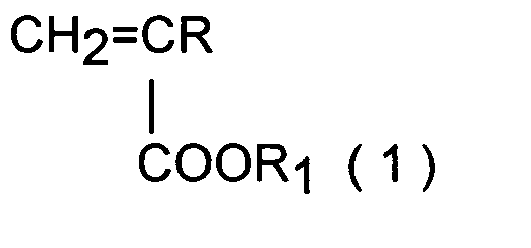
und ein Copolymer (b), welches durch Copolymerisation eines (Meth)acrylamids (C) und eines anderen mit (C) copolymerisierbaren Monomers (D) erhalten wird;(a)/(b) ist 100/0 bis 70/30 Gew.%, wenn das Gesamtgewicht von (a) und (b) als 100 Gew.% genommen wird. - Organische Partikel für ein Tintenstrahl-Aufzeichnungsblatt gemäss Anspruch 1, worin das alicyclische (Meth)acrylat (A) der Formel (1) Isobornylmethacrylat ist.
- Organische Partikel für ein Tintenstrahl-Aufzeichnungsblatt gemäss Anspruch 1, worin das Copolymer (a) 20 bis 100 Gew.% von (A) und 0 bis 80 Gew.% von (B) umfasst, wenn das Gesamtgewicht des alicyclischen (Meth)acrylats (A) der Formel (1) und des anderen mit (A) copolymerisierbaren Monomers (B) als 100 Gew.% genommen wird.
- Organische Partikel für ein Tintenstrahl-Aufzeichnungsblatt gemäss Anspruch 1, worin das Copolymer (b) 50 bis 100 Gew.% von (C) und 0 bis 50 Gew.% von (D) umfasst, wenn das Gesamtgewicht des (Meth)acrylamids (C) und des anderen mit (C) copolymerisierbaren Monomers (D) als 100 Gew.% genommen wird.
- Verfahren zur Herstellung der organischen Partikel für ein Tintenstrahl-Aufzeichnungsblatt gemäss einem der Ansprüche 1 bis 4, worin die organischen Partikel, umfassend (a) und (b), durch Copolymerisation eines (Meth)acrylamids (C) und eines anderen mit (C) copolymerisierbaren Monomers (D) in Gegenwart des Copolymers (a) erhalten werden.
- Organische Partikel für ein Tintenstrahl-Aufzeichnungsblatt gemäss Anspruch 1, worin die gemäss JIS K 7121 gemessene Glasübergangstemperatur der organischen Partikel 90 bis 160°C ist.
- Organische Partikel für ein Tintenstrahl-Aufzeichnungsblatt gemäss Anspruch 1, worin die organischen Partikel kationische organische Partikel sind.
- Tintenstrahl-Aufzeichnungsblatt, umfassend einen blattförmigen Träger und mindestens eine darüberliegende Tintenaufnahmeschicht, welche organische Partikel gemäss Anspruch 1 enthält.
- Tintenstrahl-Aufzeichnungsblatt gemäss Anspruch 8, worin die Tintenaufnahmeschicht, welche die organischen Partikel enthält, die äusserste Schicht ist.
- Tintenstrahl-Aufzeichnungsblatt gemäss Anspruch 8, worin die äusserste Schicht des Aufzeichnungsblattes einer Glättungsbehandlung mittels eines Giessbeschichtungsverfahrens unterworfen ist.
Applications Claiming Priority (3)
| Application Number | Priority Date | Filing Date | Title |
|---|---|---|---|
| JP2004148076 | 2004-05-18 | ||
| JP2004270985 | 2004-09-17 | ||
| PCT/JP2005/008924 WO2005110767A1 (ja) | 2004-05-18 | 2005-05-17 | インクジェット記録シート用有機粒子及びその記録シート |
Publications (3)
| Publication Number | Publication Date |
|---|---|
| EP1767376A1 EP1767376A1 (de) | 2007-03-28 |
| EP1767376A4 EP1767376A4 (de) | 2007-08-08 |
| EP1767376B1 true EP1767376B1 (de) | 2011-07-27 |
Family
ID=35394060
Family Applications (1)
| Application Number | Title | Priority Date | Filing Date |
|---|---|---|---|
| EP05741459A Expired - Lifetime EP1767376B1 (de) | 2004-05-18 | 2005-05-17 | Organisches teilchen für tintenstrahlaufzeichnungsmaterial und aufzeichnungsmaterial |
Country Status (7)
| Country | Link |
|---|---|
| US (1) | US20070242124A1 (de) |
| EP (1) | EP1767376B1 (de) |
| JP (1) | JPWO2005110767A1 (de) |
| KR (1) | KR100864752B1 (de) |
| AT (1) | ATE517757T1 (de) |
| TW (1) | TWI282795B (de) |
| WO (1) | WO2005110767A1 (de) |
Families Citing this family (4)
| Publication number | Priority date | Publication date | Assignee | Title |
|---|---|---|---|---|
| DE102008057438A1 (de) | 2008-11-14 | 2010-05-20 | Evonik Röhm Gmbh | Copolymer zur Herstellung wärmeformstabiler Formkörper aus Formmassen oder Gussglas |
| JP4752933B2 (ja) * | 2009-03-03 | 2011-08-17 | 富士ゼロックス株式会社 | インク受容性粒子及びその製造方法、硬化性樹脂分散体 |
| EP2701922B1 (de) | 2011-04-28 | 2016-07-20 | Hewlett-Packard Development Company, L.P. | Aufzeichnungsmedien |
| EP4141037A1 (de) * | 2017-12-08 | 2023-03-01 | Dai Nippon Toryo Co., Ltd. | Tintenzusammensetzung |
Family Cites Families (18)
| Publication number | Priority date | Publication date | Assignee | Title |
|---|---|---|---|---|
| US4728707A (en) * | 1985-03-18 | 1988-03-01 | Daikin Industries Ltd. | Water- and oil-repellent |
| US5310595A (en) * | 1992-09-18 | 1994-05-10 | Minnesota Mining And Manufacturing Company | Water-based transparent image recording sheet for plain paper copiers |
| JP3402514B2 (ja) * | 1993-06-24 | 2003-05-06 | 三菱製紙株式会社 | インクジェット記録シート |
| JPH10510062A (ja) * | 1994-11-18 | 1998-09-29 | ミネソタ・マイニング・アンド・マニュファクチュアリング・カンパニー | 普通紙複写機用水性透明画像記録紙 |
| US5500457A (en) * | 1994-11-18 | 1996-03-19 | Minnesota Mining And Manufacturing Company | Water based toner receptive core/shell latex compositions |
| JP3728062B2 (ja) | 1997-06-26 | 2005-12-21 | 三菱製紙株式会社 | インクジェット記録シート |
| JP3490290B2 (ja) | 1998-04-17 | 2004-01-26 | 三菱製紙株式会社 | カチオン性エマルジョン組成物及びそれを用いたインクジェット記録シート |
| FR2791689B1 (fr) * | 1999-03-31 | 2001-06-08 | Cray Valley Sa | Microparticules reticulees, leur procede de preparation et applications |
| NO20002309L (no) | 1999-05-12 | 2000-11-13 | Hoffmann La Roche | Fotostabile kosmetiske lysavskjermende sammensetninger |
| JP3436351B2 (ja) | 1999-08-20 | 2003-08-11 | 荒川化学工業株式会社 | インクジェット記録用添加物およびインクジェット記録用記録媒体 |
| JP2002046345A (ja) * | 2000-08-04 | 2002-02-12 | Harima Chem Inc | インクジェット記録用添加剤、及び当該添加剤を用いた記録紙 |
| JPWO2003008198A1 (ja) * | 2001-07-17 | 2004-11-04 | 三井化学株式会社 | インクジェット用記録シート |
| JP3730568B2 (ja) | 2001-12-28 | 2006-01-05 | 日本合成化学工業株式会社 | インクジェット記録媒体用コーティング組成物およびインクジェット記録用媒体 |
| JP2003211821A (ja) | 2002-01-17 | 2003-07-30 | Mitsui Chemicals Inc | インクジェット用記録シート |
| JP2004042626A (ja) * | 2002-05-21 | 2004-02-12 | Nippon Paper Industries Co Ltd | 光沢インクジェット記録媒体およびその製造方法 |
| US7052536B2 (en) * | 2002-10-02 | 2006-05-30 | Seiko Epson Corporation | Water-based ink |
| WO2004043703A1 (ja) | 2002-11-12 | 2004-05-27 | Nippon Paper Industries Co., Ltd. | インクジェット記録媒体およびその製造方法 |
| US7914864B2 (en) * | 2004-02-27 | 2011-03-29 | Hewlett-Packard Development Company, L.P. | System and a method for forming a heat fusible microporous ink receptive coating |
-
2005
- 2005-05-17 KR KR1020067026403A patent/KR100864752B1/ko not_active Expired - Fee Related
- 2005-05-17 TW TW094115889A patent/TWI282795B/zh not_active IP Right Cessation
- 2005-05-17 WO PCT/JP2005/008924 patent/WO2005110767A1/ja not_active Ceased
- 2005-05-17 AT AT05741459T patent/ATE517757T1/de not_active IP Right Cessation
- 2005-05-17 US US11/596,709 patent/US20070242124A1/en not_active Abandoned
- 2005-05-17 EP EP05741459A patent/EP1767376B1/de not_active Expired - Lifetime
- 2005-05-17 JP JP2006519544A patent/JPWO2005110767A1/ja active Pending
Also Published As
| Publication number | Publication date |
|---|---|
| EP1767376A1 (de) | 2007-03-28 |
| ATE517757T1 (de) | 2011-08-15 |
| JPWO2005110767A1 (ja) | 2008-03-21 |
| TW200617033A (en) | 2006-06-01 |
| TWI282795B (en) | 2007-06-21 |
| EP1767376A4 (de) | 2007-08-08 |
| US20070242124A1 (en) | 2007-10-18 |
| KR20070010084A (ko) | 2007-01-19 |
| WO2005110767A1 (ja) | 2005-11-24 |
| KR100864752B1 (ko) | 2008-10-22 |
Similar Documents
| Publication | Publication Date | Title |
|---|---|---|
| EP1277590B1 (de) | Aufzeichnungsblatt und dessen herstellungsverfahren | |
| US7592054B2 (en) | Ink jet recording medium | |
| US20070242124A1 (en) | Organic Particle for Inkjet Recording Sheet and Recording Sheet | |
| JP2002086905A (ja) | インクジェット用記録シート及びその製造方法 | |
| US20040170778A1 (en) | Sheet for ink jet recording | |
| JPWO2003008200A1 (ja) | 耐光性に優れる記録媒体及びその製造方法 | |
| JP4295452B2 (ja) | インクジェット記録用シート | |
| JP2006335004A (ja) | インクジェット記録シート及びそれに用いる有機粒子 | |
| US20040160504A1 (en) | Ink jet-use recording sheet | |
| JP4073016B2 (ja) | 印刷記録媒体用水性組成物、インクジェット記録媒体用水性組成物及びインクジェット記録媒体 | |
| JP2006346879A (ja) | インクジェット記録シート用水性エマルション及び記録シート | |
| JP2002046347A (ja) | 記録シート及びその製造方法 | |
| JP4519868B2 (ja) | インクジェット記録用媒体 | |
| JP2006327166A (ja) | インクジェット記録シート用水性エマルション及びインクジェット記録シート | |
| JP2004034380A (ja) | インクジェット記録媒体用水性組成物 | |
| CN100540323C (zh) | 喷墨记录片材用有机粒子及其制造方法、喷墨记录片材 | |
| JP2003211822A (ja) | インクジェット用記録シート | |
| JP2002046345A (ja) | インクジェット記録用添加剤、及び当該添加剤を用いた記録紙 | |
| JP4568898B2 (ja) | インクジェット記録用媒体 | |
| JP2006110986A (ja) | インクジェット記録シート用有機粒子及び記録シート | |
| JP2006001266A (ja) | インクジェット記録シート用有機粒子及び記録シート | |
| JP2003211831A (ja) | インクジェット記録用シート | |
| JP2003211821A (ja) | インクジェット用記録シート | |
| JP2004237463A (ja) | インクジェット記録媒体用水性組成物 | |
| JP2007160510A (ja) | インクジェット記録シート用水性エマルション及び記録シート |
Legal Events
| Date | Code | Title | Description |
|---|---|---|---|
| PUAI | Public reference made under article 153(3) epc to a published international application that has entered the european phase |
Free format text: ORIGINAL CODE: 0009012 |
|
| 17P | Request for examination filed |
Effective date: 20061215 |
|
| AK | Designated contracting states |
Kind code of ref document: A1 Designated state(s): AT BE BG CH CY CZ DE DK EE ES FI FR GB GR HU IE IS IT LI LT LU MC NL PL PT RO SE SI SK TR |
|
| A4 | Supplementary search report drawn up and despatched |
Effective date: 20070705 |
|
| RIC1 | Information provided on ipc code assigned before grant |
Ipc: C08F 220/18 20060101ALI20070629BHEP Ipc: B41M 5/00 20060101AFI20051201BHEP |
|
| DAX | Request for extension of the european patent (deleted) | ||
| 17Q | First examination report despatched |
Effective date: 20100517 |
|
| GRAP | Despatch of communication of intention to grant a patent |
Free format text: ORIGINAL CODE: EPIDOSNIGR1 |
|
| RIC1 | Information provided on ipc code assigned before grant |
Ipc: C08F 220/56 20060101ALI20101007BHEP Ipc: C08F 220/18 20060101ALI20101007BHEP Ipc: B41M 5/52 20060101AFI20101007BHEP |
|
| GRAS | Grant fee paid |
Free format text: ORIGINAL CODE: EPIDOSNIGR3 |
|
| GRAA | (expected) grant |
Free format text: ORIGINAL CODE: 0009210 |
|
| AK | Designated contracting states |
Kind code of ref document: B1 Designated state(s): AT BE BG CH CY CZ DE DK EE ES FI FR GB GR HU IE IS IT LI LT LU MC NL PL PT RO SE SI SK TR |
|
| REG | Reference to a national code |
Ref country code: GB Ref legal event code: FG4D |
|
| REG | Reference to a national code |
Ref country code: CH Ref legal event code: EP |
|
| REG | Reference to a national code |
Ref country code: DE Ref legal event code: R096 Ref document number: 602005029216 Country of ref document: DE Effective date: 20110922 |
|
| REG | Reference to a national code |
Ref country code: NL Ref legal event code: VDEP Effective date: 20110727 |
|
| REG | Reference to a national code |
Ref country code: AT Ref legal event code: MK05 Ref document number: 517757 Country of ref document: AT Kind code of ref document: T Effective date: 20110727 |
|
| PG25 | Lapsed in a contracting state [announced via postgrant information from national office to epo] |
Ref country code: LT Free format text: LAPSE BECAUSE OF FAILURE TO SUBMIT A TRANSLATION OF THE DESCRIPTION OR TO PAY THE FEE WITHIN THE PRESCRIBED TIME-LIMIT Effective date: 20110727 Ref country code: IS Free format text: LAPSE BECAUSE OF FAILURE TO SUBMIT A TRANSLATION OF THE DESCRIPTION OR TO PAY THE FEE WITHIN THE PRESCRIBED TIME-LIMIT Effective date: 20111127 Ref country code: NL Free format text: LAPSE BECAUSE OF FAILURE TO SUBMIT A TRANSLATION OF THE DESCRIPTION OR TO PAY THE FEE WITHIN THE PRESCRIBED TIME-LIMIT Effective date: 20110727 Ref country code: PT Free format text: LAPSE BECAUSE OF FAILURE TO SUBMIT A TRANSLATION OF THE DESCRIPTION OR TO PAY THE FEE WITHIN THE PRESCRIBED TIME-LIMIT Effective date: 20111128 Ref country code: SE Free format text: LAPSE BECAUSE OF FAILURE TO SUBMIT A TRANSLATION OF THE DESCRIPTION OR TO PAY THE FEE WITHIN THE PRESCRIBED TIME-LIMIT Effective date: 20110727 Ref country code: FI Free format text: LAPSE BECAUSE OF FAILURE TO SUBMIT A TRANSLATION OF THE DESCRIPTION OR TO PAY THE FEE WITHIN THE PRESCRIBED TIME-LIMIT Effective date: 20110727 Ref country code: BE Free format text: LAPSE BECAUSE OF FAILURE TO SUBMIT A TRANSLATION OF THE DESCRIPTION OR TO PAY THE FEE WITHIN THE PRESCRIBED TIME-LIMIT Effective date: 20110727 |
|
| PG25 | Lapsed in a contracting state [announced via postgrant information from national office to epo] |
Ref country code: PL Free format text: LAPSE BECAUSE OF FAILURE TO SUBMIT A TRANSLATION OF THE DESCRIPTION OR TO PAY THE FEE WITHIN THE PRESCRIBED TIME-LIMIT Effective date: 20110727 Ref country code: CY Free format text: LAPSE BECAUSE OF FAILURE TO SUBMIT A TRANSLATION OF THE DESCRIPTION OR TO PAY THE FEE WITHIN THE PRESCRIBED TIME-LIMIT Effective date: 20110727 Ref country code: SI Free format text: LAPSE BECAUSE OF FAILURE TO SUBMIT A TRANSLATION OF THE DESCRIPTION OR TO PAY THE FEE WITHIN THE PRESCRIBED TIME-LIMIT Effective date: 20110727 Ref country code: AT Free format text: LAPSE BECAUSE OF FAILURE TO SUBMIT A TRANSLATION OF THE DESCRIPTION OR TO PAY THE FEE WITHIN THE PRESCRIBED TIME-LIMIT Effective date: 20110727 Ref country code: GR Free format text: LAPSE BECAUSE OF FAILURE TO SUBMIT A TRANSLATION OF THE DESCRIPTION OR TO PAY THE FEE WITHIN THE PRESCRIBED TIME-LIMIT Effective date: 20111028 |
|
| PG25 | Lapsed in a contracting state [announced via postgrant information from national office to epo] |
Ref country code: CZ Free format text: LAPSE BECAUSE OF FAILURE TO SUBMIT A TRANSLATION OF THE DESCRIPTION OR TO PAY THE FEE WITHIN THE PRESCRIBED TIME-LIMIT Effective date: 20110727 Ref country code: SK Free format text: LAPSE BECAUSE OF FAILURE TO SUBMIT A TRANSLATION OF THE DESCRIPTION OR TO PAY THE FEE WITHIN THE PRESCRIBED TIME-LIMIT Effective date: 20110727 |
|
| PG25 | Lapsed in a contracting state [announced via postgrant information from national office to epo] |
Ref country code: RO Free format text: LAPSE BECAUSE OF FAILURE TO SUBMIT A TRANSLATION OF THE DESCRIPTION OR TO PAY THE FEE WITHIN THE PRESCRIBED TIME-LIMIT Effective date: 20110727 Ref country code: IT Free format text: LAPSE BECAUSE OF FAILURE TO SUBMIT A TRANSLATION OF THE DESCRIPTION OR TO PAY THE FEE WITHIN THE PRESCRIBED TIME-LIMIT Effective date: 20110727 Ref country code: EE Free format text: LAPSE BECAUSE OF FAILURE TO SUBMIT A TRANSLATION OF THE DESCRIPTION OR TO PAY THE FEE WITHIN THE PRESCRIBED TIME-LIMIT Effective date: 20110727 |
|
| PLBE | No opposition filed within time limit |
Free format text: ORIGINAL CODE: 0009261 |
|
| STAA | Information on the status of an ep patent application or granted ep patent |
Free format text: STATUS: NO OPPOSITION FILED WITHIN TIME LIMIT |
|
| PG25 | Lapsed in a contracting state [announced via postgrant information from national office to epo] |
Ref country code: DK Free format text: LAPSE BECAUSE OF FAILURE TO SUBMIT A TRANSLATION OF THE DESCRIPTION OR TO PAY THE FEE WITHIN THE PRESCRIBED TIME-LIMIT Effective date: 20110727 |
|
| 26N | No opposition filed |
Effective date: 20120502 |
|
| PGFP | Annual fee paid to national office [announced via postgrant information from national office to epo] |
Ref country code: DE Payment date: 20120510 Year of fee payment: 8 |
|
| REG | Reference to a national code |
Ref country code: DE Ref legal event code: R097 Ref document number: 602005029216 Country of ref document: DE Effective date: 20120502 |
|
| PGFP | Annual fee paid to national office [announced via postgrant information from national office to epo] |
Ref country code: GB Payment date: 20120516 Year of fee payment: 8 Ref country code: FR Payment date: 20120608 Year of fee payment: 8 |
|
| PG25 | Lapsed in a contracting state [announced via postgrant information from national office to epo] |
Ref country code: MC Free format text: LAPSE BECAUSE OF NON-PAYMENT OF DUE FEES Effective date: 20120531 |
|
| REG | Reference to a national code |
Ref country code: CH Ref legal event code: PL |
|
| PG25 | Lapsed in a contracting state [announced via postgrant information from national office to epo] |
Ref country code: CH Free format text: LAPSE BECAUSE OF NON-PAYMENT OF DUE FEES Effective date: 20120531 Ref country code: LI Free format text: LAPSE BECAUSE OF NON-PAYMENT OF DUE FEES Effective date: 20120531 |
|
| REG | Reference to a national code |
Ref country code: IE Ref legal event code: MM4A |
|
| PG25 | Lapsed in a contracting state [announced via postgrant information from national office to epo] |
Ref country code: IE Free format text: LAPSE BECAUSE OF NON-PAYMENT OF DUE FEES Effective date: 20120517 Ref country code: ES Free format text: LAPSE BECAUSE OF FAILURE TO SUBMIT A TRANSLATION OF THE DESCRIPTION OR TO PAY THE FEE WITHIN THE PRESCRIBED TIME-LIMIT Effective date: 20111107 |
|
| PG25 | Lapsed in a contracting state [announced via postgrant information from national office to epo] |
Ref country code: BG Free format text: LAPSE BECAUSE OF FAILURE TO SUBMIT A TRANSLATION OF THE DESCRIPTION OR TO PAY THE FEE WITHIN THE PRESCRIBED TIME-LIMIT Effective date: 20111027 |
|
| GBPC | Gb: european patent ceased through non-payment of renewal fee |
Effective date: 20130517 |
|
| PG25 | Lapsed in a contracting state [announced via postgrant information from national office to epo] |
Ref country code: DE Free format text: LAPSE BECAUSE OF NON-PAYMENT OF DUE FEES Effective date: 20131203 |
|
| REG | Reference to a national code |
Ref country code: FR Ref legal event code: ST Effective date: 20140131 |
|
| REG | Reference to a national code |
Ref country code: DE Ref legal event code: R119 Ref document number: 602005029216 Country of ref document: DE Effective date: 20131203 |
|
| PG25 | Lapsed in a contracting state [announced via postgrant information from national office to epo] |
Ref country code: TR Free format text: LAPSE BECAUSE OF FAILURE TO SUBMIT A TRANSLATION OF THE DESCRIPTION OR TO PAY THE FEE WITHIN THE PRESCRIBED TIME-LIMIT Effective date: 20110727 Ref country code: GB Free format text: LAPSE BECAUSE OF NON-PAYMENT OF DUE FEES Effective date: 20130517 |
|
| PG25 | Lapsed in a contracting state [announced via postgrant information from national office to epo] |
Ref country code: LU Free format text: LAPSE BECAUSE OF NON-PAYMENT OF DUE FEES Effective date: 20120517 Ref country code: FR Free format text: LAPSE BECAUSE OF NON-PAYMENT OF DUE FEES Effective date: 20130531 |
|
| PG25 | Lapsed in a contracting state [announced via postgrant information from national office to epo] |
Ref country code: HU Free format text: LAPSE BECAUSE OF FAILURE TO SUBMIT A TRANSLATION OF THE DESCRIPTION OR TO PAY THE FEE WITHIN THE PRESCRIBED TIME-LIMIT Effective date: 20050517 |