EP1768208A2 - Anodengestützte Hochleistungsbrennstoffzelle - Google Patents
Anodengestützte Hochleistungsbrennstoffzelle Download PDFInfo
- Publication number
- EP1768208A2 EP1768208A2 EP06254796A EP06254796A EP1768208A2 EP 1768208 A2 EP1768208 A2 EP 1768208A2 EP 06254796 A EP06254796 A EP 06254796A EP 06254796 A EP06254796 A EP 06254796A EP 1768208 A2 EP1768208 A2 EP 1768208A2
- Authority
- EP
- European Patent Office
- Prior art keywords
- anode
- oxide
- cathode
- ion
- fuel cell
- Prior art date
- Legal status (The legal status is an assumption and is not a legal conclusion. Google has not performed a legal analysis and makes no representation as to the accuracy of the status listed.)
- Withdrawn
Links
Images

Classifications
-
- H—ELECTRICITY
- H01—ELECTRIC ELEMENTS
- H01M—PROCESSES OR MEANS, e.g. BATTERIES, FOR THE DIRECT CONVERSION OF CHEMICAL ENERGY INTO ELECTRICAL ENERGY
- H01M8/00—Fuel cells; Manufacture thereof
- H01M8/10—Fuel cells with solid electrolytes
- H01M8/12—Fuel cells with solid electrolytes operating at high temperature, e.g. with stabilised ZrO2 electrolyte
- H01M8/1213—Fuel cells with solid electrolytes operating at high temperature, e.g. with stabilised ZrO2 electrolyte characterised by the electrode/electrolyte combination or the supporting material
- H01M8/1226—Fuel cells with solid electrolytes operating at high temperature, e.g. with stabilised ZrO2 electrolyte characterised by the electrode/electrolyte combination or the supporting material characterised by the supporting layer
-
- H—ELECTRICITY
- H01—ELECTRIC ELEMENTS
- H01M—PROCESSES OR MEANS, e.g. BATTERIES, FOR THE DIRECT CONVERSION OF CHEMICAL ENERGY INTO ELECTRICAL ENERGY
- H01M4/00—Electrodes
- H01M4/86—Inert electrodes with catalytic activity, e.g. for fuel cells
-
- H—ELECTRICITY
- H01—ELECTRIC ELEMENTS
- H01M—PROCESSES OR MEANS, e.g. BATTERIES, FOR THE DIRECT CONVERSION OF CHEMICAL ENERGY INTO ELECTRICAL ENERGY
- H01M4/00—Electrodes
- H01M4/86—Inert electrodes with catalytic activity, e.g. for fuel cells
- H01M4/8605—Porous electrodes
-
- H—ELECTRICITY
- H01—ELECTRIC ELEMENTS
- H01M—PROCESSES OR MEANS, e.g. BATTERIES, FOR THE DIRECT CONVERSION OF CHEMICAL ENERGY INTO ELECTRICAL ENERGY
- H01M4/00—Electrodes
- H01M4/86—Inert electrodes with catalytic activity, e.g. for fuel cells
- H01M4/8605—Porous electrodes
- H01M4/8621—Porous electrodes containing only metallic or ceramic material, e.g. made by sintering or sputtering
-
- H—ELECTRICITY
- H01—ELECTRIC ELEMENTS
- H01M—PROCESSES OR MEANS, e.g. BATTERIES, FOR THE DIRECT CONVERSION OF CHEMICAL ENERGY INTO ELECTRICAL ENERGY
- H01M4/00—Electrodes
- H01M4/86—Inert electrodes with catalytic activity, e.g. for fuel cells
- H01M4/8647—Inert electrodes with catalytic activity, e.g. for fuel cells consisting of more than one material, e.g. consisting of composites
- H01M4/8652—Inert electrodes with catalytic activity, e.g. for fuel cells consisting of more than one material, e.g. consisting of composites as mixture
-
- H—ELECTRICITY
- H01—ELECTRIC ELEMENTS
- H01M—PROCESSES OR MEANS, e.g. BATTERIES, FOR THE DIRECT CONVERSION OF CHEMICAL ENERGY INTO ELECTRICAL ENERGY
- H01M4/00—Electrodes
- H01M4/86—Inert electrodes with catalytic activity, e.g. for fuel cells
- H01M4/88—Processes of manufacture
- H01M4/8878—Treatment steps after deposition of the catalytic active composition or after shaping of the electrode being free-standing body
- H01M4/8882—Heat treatment, e.g. drying, baking
- H01M4/8885—Sintering or firing
-
- H—ELECTRICITY
- H01—ELECTRIC ELEMENTS
- H01M—PROCESSES OR MEANS, e.g. BATTERIES, FOR THE DIRECT CONVERSION OF CHEMICAL ENERGY INTO ELECTRICAL ENERGY
- H01M4/00—Electrodes
- H01M4/86—Inert electrodes with catalytic activity, e.g. for fuel cells
- H01M4/90—Selection of catalytic material
-
- H—ELECTRICITY
- H01—ELECTRIC ELEMENTS
- H01M—PROCESSES OR MEANS, e.g. BATTERIES, FOR THE DIRECT CONVERSION OF CHEMICAL ENERGY INTO ELECTRICAL ENERGY
- H01M4/00—Electrodes
- H01M4/86—Inert electrodes with catalytic activity, e.g. for fuel cells
- H01M4/90—Selection of catalytic material
- H01M4/9016—Oxides, hydroxides or oxygenated metallic salts
-
- H—ELECTRICITY
- H01—ELECTRIC ELEMENTS
- H01M—PROCESSES OR MEANS, e.g. BATTERIES, FOR THE DIRECT CONVERSION OF CHEMICAL ENERGY INTO ELECTRICAL ENERGY
- H01M4/00—Electrodes
- H01M4/86—Inert electrodes with catalytic activity, e.g. for fuel cells
- H01M4/90—Selection of catalytic material
- H01M4/9016—Oxides, hydroxides or oxygenated metallic salts
- H01M4/9025—Oxides specially used in fuel cell operating at high temperature, e.g. SOFC
- H01M4/9033—Complex oxides, optionally doped, of the type M1MeO3, M1 being an alkaline earth metal or a rare earth, Me being a metal, e.g. perovskites
-
- H—ELECTRICITY
- H01—ELECTRIC ELEMENTS
- H01M—PROCESSES OR MEANS, e.g. BATTERIES, FOR THE DIRECT CONVERSION OF CHEMICAL ENERGY INTO ELECTRICAL ENERGY
- H01M4/00—Electrodes
- H01M4/86—Inert electrodes with catalytic activity, e.g. for fuel cells
- H01M4/90—Selection of catalytic material
- H01M4/9041—Metals or alloys
- H01M4/905—Metals or alloys specially used in fuel cell operating at high temperature, e.g. SOFC
- H01M4/9066—Metals or alloys specially used in fuel cell operating at high temperature, e.g. SOFC of metal-ceramic composites or mixtures, e.g. cermets
-
- H—ELECTRICITY
- H01—ELECTRIC ELEMENTS
- H01M—PROCESSES OR MEANS, e.g. BATTERIES, FOR THE DIRECT CONVERSION OF CHEMICAL ENERGY INTO ELECTRICAL ENERGY
- H01M8/00—Fuel cells; Manufacture thereof
- H01M8/10—Fuel cells with solid electrolytes
- H01M8/12—Fuel cells with solid electrolytes operating at high temperature, e.g. with stabilised ZrO2 electrolyte
- H01M8/1213—Fuel cells with solid electrolytes operating at high temperature, e.g. with stabilised ZrO2 electrolyte characterised by the electrode/electrolyte combination or the supporting material
-
- H—ELECTRICITY
- H01—ELECTRIC ELEMENTS
- H01M—PROCESSES OR MEANS, e.g. BATTERIES, FOR THE DIRECT CONVERSION OF CHEMICAL ENERGY INTO ELECTRICAL ENERGY
- H01M8/00—Fuel cells; Manufacture thereof
- H01M8/10—Fuel cells with solid electrolytes
- H01M8/12—Fuel cells with solid electrolytes operating at high temperature, e.g. with stabilised ZrO2 electrolyte
- H01M8/124—Fuel cells with solid electrolytes operating at high temperature, e.g. with stabilised ZrO2 electrolyte characterised by the process of manufacturing or by the material of the electrolyte
- H01M8/1246—Fuel cells with solid electrolytes operating at high temperature, e.g. with stabilised ZrO2 electrolyte characterised by the process of manufacturing or by the material of the electrolyte the electrolyte consisting of oxides
-
- H—ELECTRICITY
- H01—ELECTRIC ELEMENTS
- H01M—PROCESSES OR MEANS, e.g. BATTERIES, FOR THE DIRECT CONVERSION OF CHEMICAL ENERGY INTO ELECTRICAL ENERGY
- H01M8/00—Fuel cells; Manufacture thereof
- H01M8/10—Fuel cells with solid electrolytes
- H01M8/12—Fuel cells with solid electrolytes operating at high temperature, e.g. with stabilised ZrO2 electrolyte
- H01M8/124—Fuel cells with solid electrolytes operating at high temperature, e.g. with stabilised ZrO2 electrolyte characterised by the process of manufacturing or by the material of the electrolyte
- H01M8/1246—Fuel cells with solid electrolytes operating at high temperature, e.g. with stabilised ZrO2 electrolyte characterised by the process of manufacturing or by the material of the electrolyte the electrolyte consisting of oxides
- H01M8/1253—Fuel cells with solid electrolytes operating at high temperature, e.g. with stabilised ZrO2 electrolyte characterised by the process of manufacturing or by the material of the electrolyte the electrolyte consisting of oxides the electrolyte containing zirconium oxide
-
- H—ELECTRICITY
- H01—ELECTRIC ELEMENTS
- H01M—PROCESSES OR MEANS, e.g. BATTERIES, FOR THE DIRECT CONVERSION OF CHEMICAL ENERGY INTO ELECTRICAL ENERGY
- H01M8/00—Fuel cells; Manufacture thereof
- H01M8/10—Fuel cells with solid electrolytes
- H01M8/12—Fuel cells with solid electrolytes operating at high temperature, e.g. with stabilised ZrO2 electrolyte
- H01M8/124—Fuel cells with solid electrolytes operating at high temperature, e.g. with stabilised ZrO2 electrolyte characterised by the process of manufacturing or by the material of the electrolyte
- H01M8/1246—Fuel cells with solid electrolytes operating at high temperature, e.g. with stabilised ZrO2 electrolyte characterised by the process of manufacturing or by the material of the electrolyte the electrolyte consisting of oxides
- H01M8/126—Fuel cells with solid electrolytes operating at high temperature, e.g. with stabilised ZrO2 electrolyte characterised by the process of manufacturing or by the material of the electrolyte the electrolyte consisting of oxides the electrolyte containing cerium oxide
-
- H—ELECTRICITY
- H01—ELECTRIC ELEMENTS
- H01M—PROCESSES OR MEANS, e.g. BATTERIES, FOR THE DIRECT CONVERSION OF CHEMICAL ENERGY INTO ELECTRICAL ENERGY
- H01M4/00—Electrodes
- H01M4/02—Electrodes composed of, or comprising, active material
- H01M4/04—Processes of manufacture in general
- H01M4/0471—Processes of manufacture in general involving thermal treatment, e.g. firing, sintering, backing particulate active material, thermal decomposition, pyrolysis
-
- Y—GENERAL TAGGING OF NEW TECHNOLOGICAL DEVELOPMENTS; GENERAL TAGGING OF CROSS-SECTIONAL TECHNOLOGIES SPANNING OVER SEVERAL SECTIONS OF THE IPC; TECHNICAL SUBJECTS COVERED BY FORMER USPC CROSS-REFERENCE ART COLLECTIONS [XRACs] AND DIGESTS
- Y02—TECHNOLOGIES OR APPLICATIONS FOR MITIGATION OR ADAPTATION AGAINST CLIMATE CHANGE
- Y02E—REDUCTION OF GREENHOUSE GAS [GHG] EMISSIONS, RELATED TO ENERGY GENERATION, TRANSMISSION OR DISTRIBUTION
- Y02E60/00—Enabling technologies; Technologies with a potential or indirect contribution to GHG emissions mitigation
- Y02E60/10—Energy storage using batteries
-
- Y—GENERAL TAGGING OF NEW TECHNOLOGICAL DEVELOPMENTS; GENERAL TAGGING OF CROSS-SECTIONAL TECHNOLOGIES SPANNING OVER SEVERAL SECTIONS OF THE IPC; TECHNICAL SUBJECTS COVERED BY FORMER USPC CROSS-REFERENCE ART COLLECTIONS [XRACs] AND DIGESTS
- Y02—TECHNOLOGIES OR APPLICATIONS FOR MITIGATION OR ADAPTATION AGAINST CLIMATE CHANGE
- Y02E—REDUCTION OF GREENHOUSE GAS [GHG] EMISSIONS, RELATED TO ENERGY GENERATION, TRANSMISSION OR DISTRIBUTION
- Y02E60/00—Enabling technologies; Technologies with a potential or indirect contribution to GHG emissions mitigation
- Y02E60/30—Hydrogen technology
- Y02E60/50—Fuel cells
-
- Y—GENERAL TAGGING OF NEW TECHNOLOGICAL DEVELOPMENTS; GENERAL TAGGING OF CROSS-SECTIONAL TECHNOLOGIES SPANNING OVER SEVERAL SECTIONS OF THE IPC; TECHNICAL SUBJECTS COVERED BY FORMER USPC CROSS-REFERENCE ART COLLECTIONS [XRACs] AND DIGESTS
- Y02—TECHNOLOGIES OR APPLICATIONS FOR MITIGATION OR ADAPTATION AGAINST CLIMATE CHANGE
- Y02P—CLIMATE CHANGE MITIGATION TECHNOLOGIES IN THE PRODUCTION OR PROCESSING OF GOODS
- Y02P70/00—Climate change mitigation technologies in the production process for final industrial or consumer products
- Y02P70/50—Manufacturing or production processes characterised by the final manufactured product
Definitions
- the present invention relates to a solid oxide fuel cell, and more particularly, to a method for preparing an optimum composition for a single cell component (anode, cathode and electrolyte).
- a solid oxide fuel cell is operated at a high temperature of 600°C ⁇ 1000°C, and has the most excellent power conversion efficiency among the related art fuel cells. Also, the SOFC can be variously selected and used heat thereof is recyclable. Owing to the advantages, the SOFC can be applied to a residential fuel cell of 1 ⁇ 5KW, a large electric generation more than 200KW, and a larger scale hybrid power generation system with a gas turbine.
- the SOFC consists of an oxygen ion conductive electrolyte, and an anode and a cathode positioned at both surfaces of the electrolyte.
- air and a fuel are respectively supplied to a cathode and an anode of a single cell
- a reduction for oxygen is performed at the cathode thus to generate oxygen ions.
- the oxygen ions moved to the anode through the electrolyte react with hydrogen supplied from the anode thus to generate water.
- electrons are generated at the anode, and the electrons are exhausted at the cathode. Accordingly, the anode and the cathode are connected to each other so as to generate electricity.
- the SOFC uses doped-ZrO 2 as the electrolyte, and a Yttriz Stabilized Zirconi (YSZ: zirconia doped with Y 2 O 3 ) is being mainly used.
- YSZ zirconia doped with Y 2 O 3
- Various SOFCs are being developed with different configuration of a single cell and a stack, for different operation temperatures.
- the single cell is divided into an electrolyte supported type and an electrode supported type according to a type of structural supporter.
- the electrode supported type is divided into a cathode supported type and an anode supported type.
- the anode supported type single cell has a structure that an anode functional layer, an electrolyte, and a cathode layer are sequentially formed on an anode supporter.
- the anode supporter has to be controlled to have a high gas permeability, a high electrical conductivity, and a high electrochemical activity.
- the anode supporter has to be designed so as to have a mechanical strength as a supporter of a single cell, and so as to fabricate an anode of a large area.
- An anode functional layer for attenuating a surface defect of an anode supporter and maximizing an electrochemical activation at the anode is provided.
- An electrolyte having a ultra-thin film has to be designed.
- a cathode functional layer for removing an interface reaction between the electrolyte and the cathode and enhancing an electrochemical reaction at the cathode is provided.
- a cathode having an excellent interface bonding characteristic with the cathode functional layer and a high electrical conductivity is provided.
- a current collect layer for maximizing an electrical connection between the cathode and a interconnector (or separator) is provided.
- an object of the present invention is to provide an optimum composition of each unit cell components (anode, cathode and electrolyte) for a solid oxide fuel cell (SOFC) having an excellent performance.
- Another object of the present invention is to provide general criterion to determine the optimum composition of unit cell components for a solid oxide fuel cell capable of being applied to different shape, size, and operation conditions of a single cell.
- the composition includes not only a combination ratio between different materials, but also a combination ratio of a homo-material having different powder characteristics.
- the method for preparing an optimum composition of each component for_a solid oxide fuel cell comprises: preparing a slurry consisting of uniformly dispersed NiO powder, YSZ powder, and a binding material; spraying the slurry into liquid for the condensation and drying of granule at a temperature less than 70°C thus preparing a granule consisting of the uniformly-distributed powder and the binding material; filling the dried granule in a mold, and fabricating an anode of a desired shape by a thermoset molding method; screen-printing an anode functional layer on an anode supporter; screen-printing an electrolyte on the anode functional layer, and performing a simultaneous sintering; and sequentially screen-printing a cathode functional layer, a cathode, a cathode current collect layer on an electrolyte-coated anode.
- SOFC solid oxide fuel cell
- the present invention provides a method for preparing an optimum composition of each unit cell component for a solid oxide fuel cell (SOFC).
- SOFC solid oxide fuel cell
- the present invention provides an anode supporter for a SOFC implemented as a composite between an ion-conductive oxide and a transition metal oxide having an electron conductivity.
- a coarse powder and fine power having an average particle diameter ratio of 20:1 ⁇ 5:1 are used.
- the ion-conductive oxide is selected from a group consisting of doped zirconia, doped ceria, Perovskite-based oxide, and a combination therebetween.
- the present invention also provides an SOFC including an anode supporter, in which an anode functional layer, an electrolyte, a cathode functional layer, a cathode, and a current collect layer are sequentially formed on the anode supporter.
- the anode functional layer uses an ion-conductive oxide and a transition metal oxide as a starting material, and the ion-conductive oxide is selected from a group consisting of doped zirconia, doped ceria, Perovskite-based oxide, and a combination therebetween.
- the ion-conductive oxide has a particle diameter corresponding to an intermediate size between the coarse powder and the fine powder used at the anode supporter.
- the transition metal oxide includes a metal having a catalytic activity such as Ni, Cu, Fe etc.
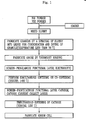
- FIG. 1 is a flowchart sequentially showing a method for fabricating an anode supported-solid oxide fuel cell according to the present invention.
- the method for preparing an optimum composition of each component for a solid oxide fuel cell comprises: preparing a slurry consisting of uniformly dispersed NiO powder, YSZ powder, and a binding material; spraying the slurry into liquid for condensation and drying of granule at a temperature less than 70°C thus preparing a granule consisting of the uniformly-distributed powder and the binding material; filling the dried granule in a mold, and fabricating an anode of a desired shape by a thermoset molding method; screen-printing an anode functional layer on an anode supporter; screen-printing an electrolyte on the anode functional layer, and performing a simultaneous sintering; and sequentially screen-printing a cathode functional layer, a cathode, a cathode current collect layer
- SOFC
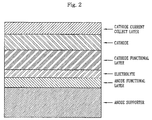
- FIG. 2 is a schematic view showing a construction of a single cell according to the present invention.
- an Ni-YSZ anode, a YSZ electrolyte, and an LSM cathode were used to fabricate a single cell.
- the single cell according to the present invention consists of a porous anode supporter having a thickness of 0.3 ⁇ 1mm, an anode functional layer of 5 ⁇ 50 ⁇ m, an electrolyte of 5 ⁇ 20 ⁇ m, and a composite cathode layer of 25 ⁇ 80 ⁇ m.
- the composite cathode layer is composed of a cathode functional layer, a cathode, and a current collect layer.
- An anode supporter of an anode supported SOFC has to be provided with a mechanical property to support a multi-layered single cell, and has to be provided with an electrochemical property to perform an oxidation of a fuel. Also, the anode supporter has to have an excellent conductivity and a high gas permeability.
- the mechanical property of the anode has to be strong enough to overcome the stress induced not only from a mechanical stress in anode supporter but also from a thermal expansion mismatch with an electrolyte on the supporter, thereby preventing a defect generation during a thermal cycle.
- the anode not only serves as a conducting body to transmit electricity but also enables an oxidation of a fuel at the anode. Accordingly, only a catalytically active metal can be used as the anode.
- a catalyst having a high catalytic activity has to be included in the anode so as to activate an oxidation of the fuel, and a concentration of an active reaction site has to be highly maintained in the anode.
- the anode supporter has to smoothly supply a fuel up to a reaction site where an electrochemical reaction of a fuel occurs, and has to smoothly exhaust water vapor generated when the fuel is oxidized. Accordingly, the anode supporter has to have a porous structure having pores serving as a passage of a reactant or a product.
- a composite between an ion-conductive oxide and a metal having an electrochemical activity and an excellent electrical conductivity is used as the anode.
- a composition ration between the oxide and the metal is controlled thus to control a mechanical strength and a thermal expansion coefficient.
- the composition ratio between the oxide and the metal is controlled so as to optimize a combination between an electrical conductivity and a gas permeability that are conflict properties to each other.
- a porosity of the composite is determined with consideration of a mechanical property and a gas permeability, and an active reaction site of a fuel has to be maximized within an allowable porosity.
- the most representative composition for the anode is porous Ni-Yttria Stabilized Zirconia (YSZ).
- the Ni has a catalytically active characteristic for a fuel and a sufficient electron conductivity, and the YSZ has a high ionic conductivity as an ion conducting media.
- the anode supporter serving as a supporter in the single cell for a SOFC has the following composition according to a required condition.
- the starting material of anode supporter (an anode functional layer that will be later explained) has a composite between NiO (further reduced to Ni) and YSZ of an ion-conductive oxide.
- Ni-YSZ serves as a composite anode of the single cell in a reduction atmosphere.
- a mechanical property of the anode supporter can be changed according to a particle characteristic of the ion-conductive oxide.
- the ion-conductive oxide coarse powder and fine power having an average particle diameter ratio of 20:1 ⁇ 5:1 were used.
- a mechanical strength of the anode supporter is increased.
- a sintering shrinkage of the anode supporter is larger than that of the electrolyte, a defect can be easily generated during co-sintering of the anode and the electrolyte.
- the mechanical strength of the anode supporter is lowered and a porosity more than necessity occurs.
- the coarse YSZ powder having a low sintering degree and the fine YSZ powder having a high sintering degree are properly combined to each other, a optimum thermal mechanical property can be obtained.
- the coarse YSZ powder and the fine YSZ powder are mixed to each other with a ratio of approximately 8:2 ⁇ 5:5.
- the mixture ratio between the coarse YSZ powder and the fine YSZ powder is 8:2, a simultaneous sintering (or co-sintering) for the anode and the electrolyte is facilitated.
- a volume ratio between the coarse YSZ powder and the fine YSZ powder of the ion-conductive oxide of the anode supporter is 55:45 ⁇ 45:55.
- the used powder for the anode supporter had a following average particle size.
- the YSZ powder had average particle diameters of 3 ⁇ m and 0.2 ⁇ m having a large difference therebetween.
- the NiO had an average particle diameter of 0.8 ⁇ m.
- the reason why the two kinds of YSZ powder having different average diameters are used is in order to control a mechanical property and an electrochemical property of the anode supporter.
- a ratio between the coarse YSZ powder and the fine YSZ powder was 50:50.
- the volume ratio of the YSZ serving as an oxide can be controlled within a range of 40% ⁇ 70% when compared to the Ni after the reduction.
- a volume ratio between the ion-conductive oxide and the metal in a reduced state is 65:35 ⁇ 55:45. It is advantageous to increase a volume ratio of the metal so as to obtain a sufficient electrical conductivity of the anode (100S/cm at an operation temperature).
- the volume ratio of the metal is made to be less than 60% in the Ni-YSZ composite due to the mechanical property and the thermal expansion coefficient.
- the volume ratio of the metal has to be lowered and the conductivity has to be maintained.
- the volume ratio of the metal can be lowered down to 30% within a range of a sufficient electrical conductivity of the anode supporter.
- Ni not only Ni but also a transition metal having a catalytic activity such as Cu, Fe etc. can be used as the metallic component of anode.
- the transition metal oxide has a particle diameter corresponding to an intermediate size between the coarse ion conducting oxide powder and the fine ion conducting oxide powder.
- an average diameter ratio between the transition metal oxide and the fine ion conductive oxide powder is 6:1 ⁇ 3:1.
- the following table 1 shows a volume ratio of the YSZ and Ni after a reduction, and a final porosity of anode supporter.
- the porosity of the anode supporter is changed within a range of 28% ⁇ 55% according to each volume ratio of the Ni and the YSZ.
- a proper porosity is 35% ⁇ 45%.
- the porosity of the anode supporter may be more increased than the 35% ⁇ 45% when the anode functional layer is separately constructed in the present invention.
- the porosity is increased by increasing the amount of the Ni, the anode supporter has a problem in a mechanical property. Accordingly, it is advantageous to increase the porosity of the anode supporter by increasing the powder fraction of the coarse YSZ powder or by lowering a sintering temperature in the simultaneous sintering step after coating the electrolyte.
- the anode supporter is designed to have an enhanced gas permeability even if an electrochemical activity becomes low.
- an anode functional layer is added between the anode supporter and the electrolyte so as to back-up the low electrochemical activation of the anode supporter.
- the anode functional layer serves to compensate the low electrochemical activity of anode supporter, it is implemented as a composite between an electron-conductive metal and an ion-conductive oxide.
- the anode functional layer is designed so as to enhance an electrochemical activity and a concentration of an active reaction sites at the anode. Accordingly, the anode functional layer is designed so as to have a thin thickness and a porosity lower than that of the anode supporter, thereby not having a concentration polarization loss.
- the anode functional layer serves not only as an electrochemical activation layer but also as a buffer layer to coat a thin and dense electrolyte on a porous anode supporter. Accordingly, the anode functional layer is constructed so as to have a minimized a surface roughness and a low porosity.
- anode functional layer As a representative of the anode functional layer, a porous Ni-Yttria Stabilized Zirconia (YSZ) is used like the aforementioned anode supporter.
- the anode functional layer has a different composition from the anode supporter.
- the anode functional layer Since a main purpose of the anode functional layer is to activate an electrochemical reaction at the anode, the anode function is designed to increase an electrochemical property rather than a mechanical property. Accordingly, not coarse YSZ powder but only fine YSZ powder is used as a material of the anode functional layer.
- the anode functional layer has a volume ratio between the Ni and the YSZ of 40:605 ⁇ 70:30, and preferably 55:45 ⁇ 45:55.
- volume ratio between the Ni and the YSZ When the volume ratio between the Ni and the YSZ is close to 40:60, a bonding strength between the anode functional layer and the electrolyte is increased thus to decrease an occurrence probability of an interfacial defect at the time of a simultaneous sintering (co-sintering). Also, when the volume ratio between the Ni and the YSZ is close to 70:30, the anode functional layer has an enhanced electrochemical activation thus to decrease an activation polarization loss at the anode. An average diameter ratio between the YSZ and the NiO was 6:1 ⁇ 3:1.
- the porosity of the anode functional layer was 10% ⁇ 30% lower than that of the anode supporter. However, since the anode functional layer had a maximum thickness less than 50 ⁇ m, a concentration polarization does not occur.
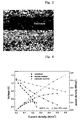
- FIGS. 3 and 4 A microstructure and an enhanced performance of the single cell having the anode functional layer are shown in FIGS. 3 and 4. As shown in FIG. 4, when the anode functional layer is provided to the single cell, an output performance of the single cell was greatly increased.
- a single material was mainly used as the electrolyte. However, a powder composition and a powder characteristic become different according to a thickness of an electrolyte to be used or a fabrication process.
- the electrolyte is formed of the same material as the ion-conductive oxide in composite anode.
- the most representative material of the electrolyte is a Yttria Stabilized Zirconia (YSZ), followed by Ceria doped with Sm or Gd, etc.
- the electrolyte is formed of not a composite material but a single material, there is less difficulty in selecting a composition of the electrolyte.
- the electrolyte has to have a sufficient sintering degree to obtain a thin and dense layer at a simultaneous sintering temperature whereas the electrode has a porous structure.
- the electrolyte has to have a powder characteristic so as to make a thin layer of approximately 5 ⁇ m.
- the most influential factor on a sintering degree and a thickness of the electrolyte is a size and a distribution of a electrolyte powder.
- powder having an average diameter less than 0.5 ⁇ m was preferably used to fabricate the single cell, and especially powder having an average diameter of approximately 0.2 ⁇ m was preferably used to construct a thin and dense electrolyte layer for a simultaneous sintered single cells.
- a representative material for a cathode, LSM (La 0.7 Sr 0.3 ) 0.95 MnO is a pure electronic conductor thus to have a limitation in an electrochemical activity and an activation site for cathode reaction. Accordingly, a cathode functional layer is provided between the electrolyte and the cathode.
- the cathode functional layer As the cathode functional layer , a composite between an ion-conductive material and a material of the cathode was mainly used. Herein, not a composite between a metal and an oxide but a composite between an oxide and an oxide has to be used due to an oxidation atmosphere at the cathode. Most preferably, a composite between an ion-conductive oxide of the electrolyte and an electron-conductive oxide of the cathode is used as the cathode functional layer.
- a ratio between the ion-conductor and the electron-conductor is controlled so that a concentration of an active reaction sites necessary to an electrochemical reaction can be maximized, so that an interface bonding characteristic with the electrolyte can be increased, and so that an inconsistency point between the cathode and the electrolyte in physical and chemical characteristics can be compensated.
- a composite between YSZ that is an ion-conductive oxide applied to the electrolyte and LSM that is an electron-conductive oxide was used for cathode.
- An average diameter ratio between the electron-conductive oxide and the ion-conductive oxide was 6:1 ⁇ 2:1.
- the LSM had an average diameter of approximately 1 ⁇ m, and the YSZ has an average diameter of approximately 0.2 ⁇ m.
- the LSM and the YSZ were mixed to each other with a volume ratio therebetween of 30:705 ⁇ 70:30.
- the cathode functional layer has a different performance according to a mixture ratio between the LSM and the YSZ like the aforementioned anode functional layer.
- a bonding characteristic between the electrolyte and the cathode control is enhanced thus to decrease a probability of an interfacial defect generation during a fabrication process or an operation under a thermal cycle condition.
- the cathode functional layer has a thickness less than 25 ⁇ m.
- FIG. 4 shows an enhanced performance of the single cell by the cathode functional layer. As shown in FIG. 4, the performance of the single cell was greatly enhanced by more than two times when the cathode functional layer was additionally provided to the single cell.
- Perovskite-based oxide represented as an LSM was mainly used. Since the cathode is not too thick as much as like the anode, a limitation in a porosity is not great. A preferable porosity of the cathode is 30% ⁇ 35%. An catalytic activity of oxide is generally not higher than a metallic catalyst, and thus a cathode polarization loss can be minimized by smoothly supplying of gas into the cathode functional layer. Accordingly, a microstructure of the cathode layer has to be appropriately controlled.
- a particle diameter of the electron-conductive oxide for the cathode was larger than that of the electron-conductive oxide for the cathode functional layer.
- an average particle diameter ratio between the electron-coductive oxide of the cathode and the electron-conductive oxide of the cathode functional layer is 2:1 ⁇ 1.5:1.
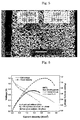
- LSM powder having an average diameter of approximately 1.5 ⁇ m larger than the average diameter of approximately 1 ⁇ m of the LSM powder for the cathode functional layer was used for the cathode, resulting in a high performance of the single cell.
- the porosity of the cathode was increased by using the coarse LSM powder, thereby smoothly supplying gas to the cathode functional layer and thus enhancing the performance of the single cell.
- the enhanced performance of the single cell was shown in FIG. 6.
- an oxide having a high electrical conductivity was added on top of the LSM cathode as a current collect layer.
- the high electrical conducting oxide is LSC (La 0.84 Sr 0.16 CoO) having a higher electron-conductivity than the aforementioned LSM.
- the LSC powder had an average diameter of 0.5 ⁇ 0.8 ⁇ m with consideration of a bonding strength with the cathode and a thermal expansion coefficient mismatch with the cathode.
- a porosity of the current collect layer was 30% ⁇ 35%.
- FIG. 7 is a photo showing a microstructure of the single cell that the high electronic conducting oxide was added on top of the cathode as the current collect layer.
- An enhanced performance of the single cell when the high electronic conducting oxide was used as the current collect layer was shown in FIG. 8. Referring to FIG. 8, the performance of the single cell was increased by approximately 30% when the high electronic conducting oxide was used as the current collect layer.
- an anode supported single cell having a high performance and a large area can be implemented, and a maximum performance thereof can be implemented at each operation condition.
- the composition of the SOFC can be equally applicable to a new material and a new structure, which enables a maximum performance of the fuel cell at each operation condition.
Landscapes
- Chemical & Material Sciences (AREA)
- Engineering & Computer Science (AREA)
- Chemical Kinetics & Catalysis (AREA)
- Electrochemistry (AREA)
- General Chemical & Material Sciences (AREA)
- Manufacturing & Machinery (AREA)
- Life Sciences & Earth Sciences (AREA)
- Sustainable Development (AREA)
- Sustainable Energy (AREA)
- Materials Engineering (AREA)
- Ceramic Engineering (AREA)
- Composite Materials (AREA)
- Physics & Mathematics (AREA)
- Thermal Sciences (AREA)
- Fuel Cell (AREA)
- Inert Electrodes (AREA)
Applications Claiming Priority (1)
| Application Number | Priority Date | Filing Date | Title |
|---|---|---|---|
| KR1020050086504A KR100648144B1 (ko) | 2005-09-15 | 2005-09-15 | 고성능 연료극지지형 고체산화물 연료전지 |
Publications (2)
| Publication Number | Publication Date |
|---|---|
| EP1768208A2 true EP1768208A2 (de) | 2007-03-28 |
| EP1768208A3 EP1768208A3 (de) | 2008-05-28 |
Family
ID=37591851
Family Applications (1)
| Application Number | Title | Priority Date | Filing Date |
|---|---|---|---|
| EP06254796A Withdrawn EP1768208A3 (de) | 2005-09-15 | 2006-09-14 | Anodengestützte Hochleistungsbrennstoffzelle |
Country Status (3)
| Country | Link |
|---|---|
| US (1) | US20070015045A1 (de) |
| EP (1) | EP1768208A3 (de) |
| KR (1) | KR100648144B1 (de) |
Cited By (6)
| Publication number | Priority date | Publication date | Assignee | Title |
|---|---|---|---|---|
| EP2107630A1 (de) * | 2008-04-03 | 2009-10-07 | Institute of Nuclear Energy Research Atomic Energy Council, Executive Yuan | Anode-Behandlungsverfahren einer Membranelektrodenanordnung einer Festoxidbrennstoffzelle |
| WO2011060756A1 (de) * | 2009-11-18 | 2011-05-26 | Forschungszentrum Jülich GmbH | Anode für eine hochtemperatur-brennstoffzelle sowie deren herstellung |
| CN102265441A (zh) * | 2008-12-31 | 2011-11-30 | 圣戈本陶瓷及塑料股份有限公司 | sofc阴极以及用于共烧制的电池以及堆叠体的方法 |
| EP2377192A4 (de) * | 2008-12-19 | 2012-08-08 | Saint Gobain Ceramics | Reduktionsoxidationstolerante elektroden für festoxidbrennstoffzellen |
| EP2688128A4 (de) * | 2011-03-18 | 2014-08-20 | Ngk Insulators Ltd | Festoxid-brennstoffzelle |
| WO2015059166A1 (en) * | 2013-10-22 | 2015-04-30 | Danmarks Tekniske Universitet | Planar half-cell shaped precursor body |
Families Citing this family (26)
| Publication number | Priority date | Publication date | Assignee | Title |
|---|---|---|---|---|
| WO2008116312A1 (en) * | 2007-03-26 | 2008-10-02 | Alberta Research Council Inc. | Solid state electrochemical cell having reticulated electrode matrix and method of manufacturing same |
| KR100858423B1 (ko) * | 2007-07-24 | 2008-09-17 | 한국과학기술원 | 고체산화물 연료전지의 연료극 및 전해질 제조방법 |
| KR101075422B1 (ko) | 2008-10-14 | 2011-10-24 | 한국과학기술연구원 | 금속 산화물 박막 구조체를 제조하는 방법 및 이에 의해 제조된 금속 산화물 박막 구조체를 포함하는 고체산화물 연료전지 |
| EP2377189B1 (de) * | 2008-12-18 | 2018-05-02 | Saint-Gobain Ceramics & Plastics Inc. | Hoch sinterbare lanthan-strontium-titanat-verbindungen durch dotierung |
| KR101098035B1 (ko) * | 2009-04-27 | 2011-12-22 | 연세대학교 산학협력단 | 고체산화물 연료전지용 공기극 |
| KR101072137B1 (ko) * | 2009-06-15 | 2011-10-10 | 한국생산기술연구원 | 고체산화물 연료전지의 연료극 지지체형 전해질 및 그 제조방법 |
| KR20110109104A (ko) * | 2010-03-30 | 2011-10-06 | 삼성전기주식회사 | 금속 산화물-이트리아 안정화 지르코니아 복합체 및 이를 포함하는 고체산화물 연료전지 |
| KR101146349B1 (ko) * | 2010-04-12 | 2012-05-21 | 한국과학기술원 | 금속지지체형 고체산화물 연료전지의 제조방법 |
| KR101204140B1 (ko) * | 2010-07-26 | 2012-11-22 | 삼성전기주식회사 | 고체 산화물 연료 전지 및 그 제조방법 |
| KR101228763B1 (ko) * | 2010-12-28 | 2013-01-31 | 주식회사 포스코 | 반응 면적이 증가된 평판형 고체산화물 연료전지 및 그의 제조방법 |
| DE102011005599B4 (de) * | 2011-03-16 | 2012-12-13 | Siemens Aktiengesellschaft | Elektrischer Energiespeicher und Verfahren zum Betreiben eines elektrischen Energiespeichers |
| KR101335063B1 (ko) * | 2011-10-21 | 2013-12-03 | 한국생산기술연구원 | 고출력 고체산화물 연료전지 단위셀 제조기술 |
| US8921007B2 (en) * | 2011-11-15 | 2014-12-30 | Saint-Gobain Ceramics & Plastics, Inc. | Solid oxide fuel cell interconnect cells |
| WO2013096756A1 (en) | 2011-12-22 | 2013-06-27 | Saint-Gobain Ceramics & Plastics, Inc. | Solid oxide fuel cell interconnects including a ceramic interconnect material and partially stabilized zirconia |
| KR101763722B1 (ko) * | 2014-08-25 | 2017-08-14 | 창원대학교 산학협력단 | 고 신뢰성 연료전지의 적층을 위한 프로톤 전도성 세라믹 전해질 |
| KR101620470B1 (ko) * | 2014-12-18 | 2016-05-13 | 한국에너지기술연구원 | 튜브형 공전해 셀 제조방법 |
| KR20180040885A (ko) * | 2016-10-13 | 2018-04-23 | 한국과학기술연구원 | 박막 전해질 고체 산화물 셀 연료극용 촉매 중간층 및 이의 형성방법 |
| KR20180071673A (ko) | 2016-12-20 | 2018-06-28 | 희성금속 주식회사 | 고체산화물형 연료전지 지지체의 제조방법 및 이로부터 제조된 고체산화물형 연료전지 지지체 |
| WO2019241738A1 (en) | 2018-06-14 | 2019-12-19 | Saint-Gobain Ceramics & Plastics, Inc. | Cathode layer and electrochemical device including the same |
| KR102128941B1 (ko) * | 2018-07-17 | 2020-07-01 | 창원대학교 산학협력단 | 역 전압 열화 현상이 방지된 고체산화물 연료전지의 제조방법 |
| CN112739464A (zh) * | 2018-09-11 | 2021-04-30 | 维萨电力系统有限公司 | 减轻氧化还原的固体氧化物电池组合物 |
| CN111769296B (zh) * | 2019-03-27 | 2022-03-25 | 景德镇陶瓷大学 | 一种SOFC抗积碳Ni-YSZ阳极材料的制备方法 |
| KR102220867B1 (ko) * | 2019-04-26 | 2021-02-26 | 창원대학교 산학협력단 | 역전류에 의한 열화 현상이 방지된 고체산화물 연료전지 |
| KR20210080956A (ko) * | 2019-12-23 | 2021-07-01 | 인천대학교 산학협력단 | 고체산화물 연료전지의 연료극 기능층 제조용 페로브스카이트 구조 산화물, 이를 포함하는 연료극 기능층 조성물 및 고체산화물 연료전지 |
| CN112768704B (zh) * | 2021-01-12 | 2023-05-26 | 万华化学(四川)有限公司 | 一种基于质子传导型电解质的固态氧化物燃料电池及制备方法 |
| CN114824346B (zh) * | 2022-05-26 | 2024-07-05 | 西安交通大学 | 一端密封导电扁管支撑型固体氧化物燃料电池/电解池以及电池堆结构 |
Family Cites Families (15)
| Publication number | Priority date | Publication date | Assignee | Title |
|---|---|---|---|---|
| JPH08306361A (ja) * | 1995-04-28 | 1996-11-22 | Central Res Inst Of Electric Power Ind | 固体電解質燃料電池用燃料極材料およびその製造方法 |
| JPH1021931A (ja) | 1996-06-27 | 1998-01-23 | Kyocera Corp | 固体電解質型燃料電池セル |
| US6344271B1 (en) * | 1998-11-06 | 2002-02-05 | Nanoenergy Corporation | Materials and products using nanostructured non-stoichiometric substances |
| JPH1140169A (ja) * | 1997-07-16 | 1999-02-12 | Fujikura Ltd | 固体電解質型燃料電池の燃料電極材料およびそれを用いた燃料電極成膜方法 |
| KR20000043716A (ko) * | 1998-12-29 | 2000-07-15 | 윤영석 | 연료극의 제조방법 |
| US6589680B1 (en) * | 1999-03-03 | 2003-07-08 | The Trustees Of The University Of Pennsylvania | Method for solid oxide fuel cell anode preparation |
| JP3731648B2 (ja) * | 2000-11-27 | 2006-01-05 | 日産自動車株式会社 | 燃料電池用単セル及び固体電解質型燃料電池 |
| JP2002289248A (ja) * | 2001-01-17 | 2002-10-04 | Nissan Motor Co Ltd | 燃料電池用単セル及び固体電解質型燃料電池 |
| US6803138B2 (en) * | 2001-07-02 | 2004-10-12 | Nextech Materials, Ltd. | Ceramic electrolyte coating methods |
| CA2486931A1 (en) * | 2002-05-22 | 2003-11-27 | Nippon Shokubai Co., Ltd. | Solid oxide type fuel cell-use electrode support substrate and production method therefor |
| JP3996861B2 (ja) * | 2002-05-29 | 2007-10-24 | 京セラ株式会社 | 燃料電池セル及び燃料電池 |
| JP4201247B2 (ja) * | 2002-08-06 | 2008-12-24 | 財団法人電力中央研究所 | 固体酸化物形燃料電池用燃料極材料 |
| CA2501877A1 (en) * | 2002-10-11 | 2004-04-22 | Nippon Shokubai Co., Ltd. | Electrolyte sheets for solid oxide fuel cells and production process thereof |
| JP2005085758A (ja) * | 2003-09-05 | 2005-03-31 | Sulzer Hexis Ag | 高温型燃料電池 |
| JP4406355B2 (ja) | 2004-12-13 | 2010-01-27 | 財団法人電力中央研究所 | 固体電解質燃料電池用燃料極材料 |
-
2005
- 2005-09-15 KR KR1020050086504A patent/KR100648144B1/ko not_active Expired - Fee Related
-
2006
- 2006-09-14 EP EP06254796A patent/EP1768208A3/de not_active Withdrawn
- 2006-09-15 US US11/521,478 patent/US20070015045A1/en not_active Abandoned
Cited By (12)
| Publication number | Priority date | Publication date | Assignee | Title |
|---|---|---|---|---|
| EP2107630A1 (de) * | 2008-04-03 | 2009-10-07 | Institute of Nuclear Energy Research Atomic Energy Council, Executive Yuan | Anode-Behandlungsverfahren einer Membranelektrodenanordnung einer Festoxidbrennstoffzelle |
| EP2377192A4 (de) * | 2008-12-19 | 2012-08-08 | Saint Gobain Ceramics | Reduktionsoxidationstolerante elektroden für festoxidbrennstoffzellen |
| US8455153B2 (en) | 2008-12-19 | 2013-06-04 | Saint-Gobain Ceramics & Plastics, Inc. | Reduction-oxidation-tolerant electrodes for solid oxide fuel cells |
| CN102265441A (zh) * | 2008-12-31 | 2011-11-30 | 圣戈本陶瓷及塑料股份有限公司 | sofc阴极以及用于共烧制的电池以及堆叠体的方法 |
| CN102265441B (zh) * | 2008-12-31 | 2014-09-03 | 圣戈本陶瓷及塑料股份有限公司 | sofc阴极以及用于共烧制的电池以及堆叠体的方法 |
| WO2011060756A1 (de) * | 2009-11-18 | 2011-05-26 | Forschungszentrum Jülich GmbH | Anode für eine hochtemperatur-brennstoffzelle sowie deren herstellung |
| EP2333883A1 (de) * | 2009-11-18 | 2011-06-15 | Forschungszentrum Jülich Gmbh (FJZ) | Anode für eine Hochtemperatur-Brennstoffzelle sowie deren Herstellung |
| US9048498B2 (en) | 2009-11-18 | 2015-06-02 | Forschungszentrum Juelich Gmbh | Anode for a high-temperature fuel cell and production thereof |
| TWI577077B (zh) * | 2009-11-18 | 2017-04-01 | Plansee Se | 高溫燃料電池用的陽極及其製造方法 |
| EP2688128A4 (de) * | 2011-03-18 | 2014-08-20 | Ngk Insulators Ltd | Festoxid-brennstoffzelle |
| US8945789B2 (en) | 2011-03-18 | 2015-02-03 | Ngk Insulators, Ltd. | Solid oxide fuel cell |
| WO2015059166A1 (en) * | 2013-10-22 | 2015-04-30 | Danmarks Tekniske Universitet | Planar half-cell shaped precursor body |
Also Published As
| Publication number | Publication date |
|---|---|
| KR100648144B1 (ko) | 2006-11-24 |
| EP1768208A3 (de) | 2008-05-28 |
| US20070015045A1 (en) | 2007-01-18 |
Similar Documents
| Publication | Publication Date | Title |
|---|---|---|
| EP1768208A2 (de) | Anodengestützte Hochleistungsbrennstoffzelle | |
| López-Robledo et al. | Reversible operation of microtubular solid oxide cells using La0. 6Sr0. 4Co0. 2Fe0. 8O3-δ-Ce0. 9Gd0. 1O2-δ oxygen electrodes | |
| US11817589B2 (en) | Solid oxide fuel cells with cathode functional layers | |
| EP3352274B1 (de) | Metallträgerartiges elektrochemisches element und verfahren zur herstellung einer festoxidbrennstoffzelle und metallträgerartiges elektrochemisches element | |
| US7445814B2 (en) | Methods of making porous cermet and ceramic films | |
| US6663999B2 (en) | Method of fabricating an assembly comprising an anode-supported electrolyte, and ceramic cell comprising such an assembly | |
| US8697313B2 (en) | Method for making a fuel cell from a solid oxide monolithic framework | |
| Han et al. | Fabrication and properties of anode-supported solid oxide fuel cell | |
| EP3054511B1 (de) | Verfahren zur herstellung eines anodenträgers einer festoxidbrennstoffzelle und anodenträger einer festoxidbrennstoffzelle | |
| DK2669984T3 (en) | Layered anode system for electrochemical applications and processes for their preparation | |
| JP2004355814A (ja) | 固体酸化物形燃料電池用セル及びその製造方法 | |
| JP2025045901A (ja) | 固体酸化物形電解セルの製造方法 | |
| US8617762B2 (en) | Method of processing a ceramic electrolyte, and related articles | |
| KR20160058275A (ko) | 금속지지형 고체산화물 연료전지 및 그 제조 방법 | |
| KR20190028340A (ko) | 고체산화물 연료 전지 및 이를 포함하는 전지 모듈 | |
| KR102109730B1 (ko) | 고체산화물 연료전지 제조방법 | |
| KR100813420B1 (ko) | 고체산화물 연료전지용 전해질막의 제조 방법 | |
| US20250079472A1 (en) | Solid oxide cell and manufacturing method thereof | |
| US12381247B2 (en) | Solid oxide fuel cells and methods of forming thereof | |
| Tanveer et al. | Intermediate-temperature solid-oxide fuel cells with a gadolinium-doped ceria anodic functional layer deposited via radio-frequency sputtering | |
| JP2025045900A (ja) | 固体酸化物形電解セルの製造方法 | |
| JP2022119219A (ja) | 燃料極-固体電解質層複合体、燃料極-固体電解質層複合部材、燃料電池、および、燃料電池の製造方法 | |
| HK1260355B (en) | Solid oxide fuel cells with cathode functional layers |
Legal Events
| Date | Code | Title | Description |
|---|---|---|---|
| PUAI | Public reference made under article 153(3) epc to a published international application that has entered the european phase |
Free format text: ORIGINAL CODE: 0009012 |
|
| 17P | Request for examination filed |
Effective date: 20060923 |
|
| AK | Designated contracting states |
Kind code of ref document: A2 Designated state(s): AT BE BG CH CY CZ DE DK EE ES FI FR GB GR HU IE IS IT LI LT LU LV MC NL PL PT RO SE SI SK TR |
|
| AX | Request for extension of the european patent |
Extension state: AL BA HR MK YU |
|
| RIC1 | Information provided on ipc code assigned before grant |
Ipc: H01M 4/88 20060101ALI20071101BHEP Ipc: H01M 4/86 20060101ALI20071101BHEP Ipc: H01M 8/12 20060101AFI20070111BHEP |
|
| PUAL | Search report despatched |
Free format text: ORIGINAL CODE: 0009013 |
|
| AK | Designated contracting states |
Kind code of ref document: A3 Designated state(s): AT BE BG CH CY CZ DE DK EE ES FI FR GB GR HU IE IS IT LI LT LU LV MC NL PL PT RO SE SI SK TR |
|
| AX | Request for extension of the european patent |
Extension state: AL BA HR MK RS |
|
| 17Q | First examination report despatched |
Effective date: 20080718 |
|
| AKX | Designation fees paid |
Designated state(s): AT BE BG CH CY CZ DE DK EE ES FI FR GB GR HU IE IS IT LI LT LU LV MC NL PL PT RO SE SI SK TR |
|
| STAA | Information on the status of an ep patent application or granted ep patent |
Free format text: STATUS: THE APPLICATION IS DEEMED TO BE WITHDRAWN |
|
| 18D | Application deemed to be withdrawn |
Effective date: 20090129 |