EP1768341A1 - Méthode et dispositif pour contrôler la vitesse de transmission - Google Patents
Méthode et dispositif pour contrôler la vitesse de transmission Download PDFInfo
- Publication number
- EP1768341A1 EP1768341A1 EP20060120626 EP06120626A EP1768341A1 EP 1768341 A1 EP1768341 A1 EP 1768341A1 EP 20060120626 EP20060120626 EP 20060120626 EP 06120626 A EP06120626 A EP 06120626A EP 1768341 A1 EP1768341 A1 EP 1768341A1
- Authority
- EP
- European Patent Office
- Prior art keywords
- path
- slow
- congestion window
- start threshold
- stored
- Prior art date
- Legal status (The legal status is an assumption and is not a legal conclusion. Google has not performed a legal analysis and makes no representation as to the accuracy of the status listed.)
- Withdrawn
Links
Images


Classifications
-
- H—ELECTRICITY
- H04—ELECTRIC COMMUNICATION TECHNIQUE
- H04L—TRANSMISSION OF DIGITAL INFORMATION, e.g. TELEGRAPHIC COMMUNICATION
- H04L1/00—Arrangements for detecting or preventing errors in the information received
- H04L1/0001—Systems modifying transmission characteristics according to link quality, e.g. power backoff
- H04L1/0002—Systems modifying transmission characteristics according to link quality, e.g. power backoff by adapting the transmission rate
-
- H—ELECTRICITY
- H04—ELECTRIC COMMUNICATION TECHNIQUE
- H04L—TRANSMISSION OF DIGITAL INFORMATION, e.g. TELEGRAPHIC COMMUNICATION
- H04L1/00—Arrangements for detecting or preventing errors in the information received
- H04L1/0001—Systems modifying transmission characteristics according to link quality, e.g. power backoff
- H04L1/0015—Systems modifying transmission characteristics according to link quality, e.g. power backoff characterised by the adaptation strategy
-
- H—ELECTRICITY
- H04—ELECTRIC COMMUNICATION TECHNIQUE
- H04L—TRANSMISSION OF DIGITAL INFORMATION, e.g. TELEGRAPHIC COMMUNICATION
- H04L1/00—Arrangements for detecting or preventing errors in the information received
- H04L1/12—Arrangements for detecting or preventing errors in the information received by using return channel
- H04L1/16—Arrangements for detecting or preventing errors in the information received by using return channel in which the return channel carries supervisory signals, e.g. repetition request signals
- H04L1/18—Automatic repetition systems, e.g. Van Duuren systems
- H04L1/1867—Arrangements specially adapted for the transmitter end
- H04L1/187—Details of sliding window management
-
- H—ELECTRICITY
- H04—ELECTRIC COMMUNICATION TECHNIQUE
- H04L—TRANSMISSION OF DIGITAL INFORMATION, e.g. TELEGRAPHIC COMMUNICATION
- H04L65/00—Network arrangements, protocols or services for supporting real-time applications in data packet communication
- H04L65/1066—Session management
- H04L65/1101—Session protocols
-
- H—ELECTRICITY
- H04—ELECTRIC COMMUNICATION TECHNIQUE
- H04L—TRANSMISSION OF DIGITAL INFORMATION, e.g. TELEGRAPHIC COMMUNICATION
- H04L65/00—Network arrangements, protocols or services for supporting real-time applications in data packet communication
- H04L65/60—Network streaming of media packets
- H04L65/65—Network streaming protocols, e.g. real-time transport protocol [RTP] or real-time control protocol [RTCP]
-
- H—ELECTRICITY
- H04—ELECTRIC COMMUNICATION TECHNIQUE
- H04L—TRANSMISSION OF DIGITAL INFORMATION, e.g. TELEGRAPHIC COMMUNICATION
- H04L69/00—Network arrangements, protocols or services independent of the application payload and not provided for in the other groups of this subclass
- H04L69/16—Implementation or adaptation of Internet protocol [IP], of transmission control protocol [TCP] or of user datagram protocol [UDP]
-
- H—ELECTRICITY
- H04—ELECTRIC COMMUNICATION TECHNIQUE
- H04L—TRANSMISSION OF DIGITAL INFORMATION, e.g. TELEGRAPHIC COMMUNICATION
- H04L69/00—Network arrangements, protocols or services independent of the application payload and not provided for in the other groups of this subclass
- H04L69/16—Implementation or adaptation of Internet protocol [IP], of transmission control protocol [TCP] or of user datagram protocol [UDP]
- H04L69/163—In-band adaptation of TCP data exchange; In-band control procedures
-
- H—ELECTRICITY
- H04—ELECTRIC COMMUNICATION TECHNIQUE
- H04L—TRANSMISSION OF DIGITAL INFORMATION, e.g. TELEGRAPHIC COMMUNICATION
- H04L69/00—Network arrangements, protocols or services independent of the application payload and not provided for in the other groups of this subclass
- H04L69/16—Implementation or adaptation of Internet protocol [IP], of transmission control protocol [TCP] or of user datagram protocol [UDP]
- H04L69/165—Combined use of TCP and UDP protocols; selection criteria therefor
-
- Y—GENERAL TAGGING OF NEW TECHNOLOGICAL DEVELOPMENTS; GENERAL TAGGING OF CROSS-SECTIONAL TECHNOLOGIES SPANNING OVER SEVERAL SECTIONS OF THE IPC; TECHNICAL SUBJECTS COVERED BY FORMER USPC CROSS-REFERENCE ART COLLECTIONS [XRACs] AND DIGESTS
- Y02—TECHNOLOGIES OR APPLICATIONS FOR MITIGATION OR ADAPTATION AGAINST CLIMATE CHANGE
- Y02D—CLIMATE CHANGE MITIGATION TECHNOLOGIES IN INFORMATION AND COMMUNICATION TECHNOLOGIES [ICT], I.E. INFORMATION AND COMMUNICATION TECHNOLOGIES AIMING AT THE REDUCTION OF THEIR OWN ENERGY USE
- Y02D30/00—Reducing energy consumption in communication networks
- Y02D30/50—Reducing energy consumption in communication networks in wire-line communication networks, e.g. low power modes or reduced link rate
Definitions
- the present invention relates to methods and apparatus of controlling a transmission rate and to a communication device using the same.
- SCTP Stream Control Transmission Protocol
- TCP Transmission Control Protocol
- UDP User Datagram Protocol
- the SCTP provides connection-oriented, reliable data transmission.
- the error and flow control of the SCTP is the same as that of the TCP.
- multi-homing allows multiple paths to be used for packet transmission between communication devices. In this case, if a problem occurs in one path, another path can be used, and thus multi-homing provides seamless packet transmission between the communication devices.
- a path for packet transmission is changed, for example, upon handover of the communication device.
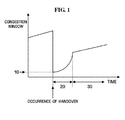
- a congestion window is set to a default value (10), regardless of the communication environment of a new path.
- the communication device controls a transmission rate through a slow-start process (20) and a congestion avoidance process (30), and thus the data transmission amount during the handover is drastically reduced and then is gradually increased.
- service quality is greatly influenced according to kinds of service to be used by the communication device. For example, when the communication device is executing a voice call service using Voice over Internet Protocol (VoIP), a call delay may be long. Further, when the communication device is using a streaming service, video dropping and blocking may occur.
- VoIP Voice over Internet Protocol
- Korean Unexamined Patent Publication No. 2001-0043592 entitled “Soft Handoff in Cellular Mobile Communication Network", discloses a soft handoff technique in a cellular mobile communication network which includes signal measurement values for base transceiver stations involved in a handoff operation into one or more uplink signals and causes the individual signal measurement values to be used to represent performance of communication channels between the associated base transceiver stations and a mobile station. According to the technique described in Patent Document 1, the communication device can select a channel having excellent performance among a plurality of channels.
- Korean Unexamined Patent Publication No. 2001-0043592 does not describe a technique for allowing the communication device to perform the active control of the transmission rate.
- Preferred embodiments of the present invention provides a method of controlling a transmission rate which can efficiently control a transmission rate when a path for packet transmission is changed, and a communication device using the same
- a method of controlling a transmission rate includes changing a path for packet transmission/reception from a first path to a second path, setting a congestion window and a slow-start threshold to be used in the second path to a congestion window and a slow-start threshold used in the first path, and adapting the congestion window and the slow-start threshold to be used in the second path according to a packet loss generated in the second path.
- a communication device includes a multi-homing support module which establishes a plurality of paths to be communicatable with other communication devices, sets a first path among the plurality of paths as a path for packet transmission/reception, and changes the path for packet transmission/reception to a second path among the plurality of paths upon handover, a control information managing module which sets a congestion window and a slow-start threshold to be used in the second path to a congestion window and a slow-start threshold used in the first path, and adapts the congestion window and the slow-start threshold to be used in the second path according to a packet loss generated in the second path, and a control module which controls the transmission rate according to the congestion window and the slow-start threshold to be managed by the control information managing module.
- This embodiment of the present invention is based on a transmission protocol which supports multi-homing.
- SCTP can be used as the transmission protocol which supports multi-homing. Accordingly, among the details of the invention, parts not particularly described herein can be understood through the SCTP. However, the details of the SCTP are not intended to limit the present invention, and the present invention can also be applied through other transmission protocols which support multi-homing.
- the SCTP standards are enacted according to Request For Comments (RFC) 2960 on, October 2000, which is described in a web site "www.ietf.org/rfc.html ".
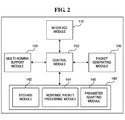
- FIG. 2 is a block diagram showing a communication device according to an exemplary embodiment of the present invention.
- the communication device shown in FIG. 2 is a computing device which has a wireless communication feature and ability for processing various kinds of data.
- a mobile apparatus such as a notebook computer, a personal digital assistant (PDA), or a cellular phone can be used.
- the communication device is not limited to the mobile apparatus.
- an immobile apparatus such as a desktop computer can be used.
- the communication device includes an interface module 110, a multi-homing support module 120, a packet generating module 130, a control information managing module 140, and a control module 150.
- the interface module 110 performs communication with other communication devices.
- the communication device for communication is referred to as a destination device.
- the interface module 110 can transmit/receive packets through wireless mediums.
- the multi-homing support module 120 forms a plurality of communication connections to the destination device through the interface module 110.
- the communication connection can be understood as the association in the SCTP.
- the multi-homing support module 120 allows the communication device to have several addresses assigned thereto and establishes a plurality of paths capable of transmitting the packets to and receiving the packets from the destination device using the individual addresses.
- a path which is actually used to transmit and receive the packets is referred to as a primary path.
- the remaining paths, excluding the primary path, among the plurality of paths can be used for retransmission of the lost packets.
- the multi-homing support module 120 can change the primary path. For example, in the SCTP, when a T3-rtx timer is expired for a certain address, an error counter is increased. Further, when the error counter exceeds a predetermined parameter, the path set through that address becomes inactive. Accordingly, if the primary path in use becomes inactive, the multi-homing support module 120 can set another path as the primary path.
- the multi-homing support module 120 can change the primary path upon handover of the communication device.
- the packet generating module 130 generates the packets to be transmitted to the destination device.
- the packets generated by the packet generating module 130 include various kinds of data according to the applications to be used by the communication device. For example, multimedia data such as sound data and movie data based on the VoIP can be used.
- the control information managing module 140 manages control information which is used for the control of the transmission rate by the control module 150.
- the transmission rate control information includes a congestion window cwnd and a slow-start threshold ssthresh.
- the control information managing module 140 sets a congestion window and a slow-start threshold to be used in a changed path to the congestion window and the slow-start threshold used in a path before the change. Further, the control information managing module 140 adapts the congestion window and the slow-start threshold to be used in the changed path according to the lost packets generated in the changed path.
- the control information managing module 140 includes a storage module 142, a response packet processing module 144, and a parameter adapting module 146.
- the storage module 142 stores the control information of a predetermined transmission rate
- the response packet processing module 144 processes a response packet received from the destination device.
- the parameter adapting module 146 adapts the transmission rate control information which is used by the communication device.
- the control module 150 controls the operations of the individual modules 110, 120, 130, 140, 142, 144, and 146 of the communication device. Further, the control module 150 controls the transmission rate according to the congestion window and the slow-start threshold which are managed by the control information managing module 140.
- the individual modules of the communication device described with reference to FIG. 2 may be embodied as a software or hardware component, such as a Field Programmable Gate Array(FPGA) or Application Specific Integrated Circuit(ASIC), which performs certain tasks.
- a module may advantageously be configured to reside on the addressable storage medium and configured to execute on one or more processors.
- a module may include, by way of example, components, such as software components, object-oriented software components, class components and task components, processes, functions, attributes, procedures, subroutines, segments of program code, drivers, firmware, microcode, circuitry, data, databases, data structures, tables, arrays, and variables.
- the functionality provided for in the components and modules may be combined into fewer components and modules or further separated into additional components and modules.
- the operation process of the communication device described above will be described in detail with reference to FIGS. 3 to 5.
- the operation process of the communication device is broadly divided into a process of storing the transmission rate control information, a process of setting the transmission rate control information, and a process of adapting the transmission rate control information.
- a method of controlling a transmission rate according to the embodiment of the invention can be executed through these processes.
- the process of storing the transmission rate control information, the process of setting the transmission rate control information, and the process of adapting the transmission rate control information will be described with reference to FIGS. 3 to 5, respectively.
- FIG. 3 is a flow chart showing the process of storing the transmission rate control information according to an exemplary embodiment of the invention.
- the communication connection to the destination device is established.
- a process of establishing the communication connection is known in the art, and thus the description thereof will be omitted.
- the parameter adapting module 146 basically adapts the transmission rate control information according to the related art.
- the parameter adapting module 146 adapts the transmission rate control information using slow-start algorithm, congestion avoidance algorithm, fast retransmission algorithm, and so on.
- the transmission rate control information includes the congestion window and the slow-start threshold.
- the slow-start algorithm, the congestion avoidance algorithm, and the fast retransmission algorithm are known through SCTP, TCP, and associated protocols.
- the control module 150 can control the transmission rate of the interface module 110 according to the congestion window which is to be adapted by the parameter adapting module 146.
- the interface module 110 transmits the packet generated by the packet generating module 130, the interface module 110 can receive the response packet from the destination device.
- the response packet processing module 144 determines through the response packet whether a condition for the reduction of the current transmission rate occurs (Operation S110).
- a condition for the reduction of the transmission rate the occurrence of a retransmission timeout when the response packet is not received for a predetermined time or the execution of the fast retransmission algorithm when consecutive lost packets exceeding a threshold number of lost packets are generated can be exemplified. This is because the congestion window is set to the initial value upon the occurrence of the retransmission timeout or the congestion window is set to about half of the current level upon the execution of the fast retransmission algorithm.
- the storage module 142 determines whether the previously stored congestion window and slow-start threshold exist (Operation S120). If it is determined that the previously stored congestion window and slow-start threshold exist, the storage module 142 determines whether a time difference between storage time of the stored congestion window and slow-start threshold and occurrence time of the condition for the reduction of the transmission rate is less than threshold time (Operation S130).
- the storage module 142 updates the storage time of the stored congestion window and slow-start threshold to the occurrence time of the condition for the reduction of the transmission rate (Operation S 140).
- the storage module 142 stores the congestion window and the slow-start threshold at the time when the condition for the reduction of the transmission rate occurs (S150). Accordingly, the storage module 142 stores the congestion window and the slow-start threshold immediately before the transmission rate is reduced. When the congestion window and the slow-start threshold are stored, the congestion window and the slow-start threshold previously stored in the storage module 142 can be deleted. Further, the storage module 142 can store the time when the condition for the reduction of the transmission rate occurs. Here, the time when the condition for the reduction of the transmission rate occurs is used as the storage time of the congestion window and the slow-start threshold later.
- the congestion window and the slow-start threshold are reduced due to the retransmission timeout and the fast retransmission caused by the packet loss. Therefore, through the process in FIG. 3, the values immediately before the congestion window and the slow-start threshold are reduced are stored and then are used after the handover is completed, such that the transmission rate can be kept uniform.
- FIG. 4 is a flow chart showing the process of setting a transmission rate according to an embodiment of the present invention.
- the handover process is known, and thus the specific description thereof will be omitted.
- the storage module 142 determines whether the previously stored congestion window and slow-start threshold exist (Operation S220).
- the congestion window and the slow-start threshold stored in the storage module 142 can be understood through the process shown in FIG. 3.
- the multi-homing support module 120 changes the path for packet transmission from the first path to the second path.
- the path for packet transmission may be the primary path of the SCTP.
- the storage module 142 determines whether a time difference between the storage time of the stored congestion window and slow-start threshold and triggering time of the handover (that is, time when the path for packet transmission is changed from the first path to the second path) is less than threshold time (Operation S230).
- the threshold time may preferably have the same value as the threshold time in FIG. 3, but the present invention is not limited to this configuration.
- the storage module 142 maintains the previously stored congestion window and slow-start threshold as they are (Operation S240).
- the storage module 142 stores the current congestion window and slow-start threshold (Operation S250). Accordingly, the storage module 142 stores the congestion window and the slow-start threshold lastly used in the first path. That is, the storage module 142 can store the congestion window and the slow-start threshold immediately before the path for packet transmission is changed. When storing the congestion window and the slow-start threshold, the storage module 142 can delete the previously stored congestion window and slow-start threshold. Further, the storage module 142 can also store the storage time of the congestion window and the slow-start threshold.
- the parameter adapting module 146 determines whether the size of the congestion window stored in the storage module 142 is larger than the size of the congestion window in the second path (Operation S270). This may be useful when the managing module 140 manages the transmission rate control information for the primary path and another path in parallel. However, operation S270 may be omitted according to the exemplary embodiments.
- the parameter adapting module 146 sets the congestion window and the slow-start threshold to be used in the second path to the congestion window and the slow-start threshold used in the second path (Operation S280). That is, when the process passes through operation S240, the congestion window and the slow-start threshold to be used in the second path are set to the congestion window and the slow-start threshold previously stored in the storage module 142. Further, when the process passes through operation S250, the congestion window and the slow-start threshold to be used in the second path are set to the congestion window and the slow-start threshold lastly used in the first path.
- operation S280 can be executed immediately after operation S260.
- the congestion window and the slow-start threshold used before the path for packet transmission is changed is used in the changed path continuously, and thus the transmission rate can be kept uniform upon handover.
- FIG. 5 is a flow chart showing the process of adapting the transmission rate control information according to an exemplary embodiment of the present invention.
- the interface module 110 transmits the packets by the amount corresponding to the congestion window set at operation S280 in FIG. 4 according to the control of the control module 150 (Operation S310), and receives the response packet from the destination device which receives the packets (Operation S320).
- the response packet may be Selective Acknowledgement (SACK).
- the response packet module 144 identifies lost packets among the packets transmitted at operation S310 through the received response packet (operation S330). At this time, the response packet processing module 144 can calculate the amount of lost packets.
- the parameter adapting module 146 changes the slow-start threshold to be used in the changed path to a value obtained by subtracting the amount of lost packets identified by the response packet processing module 144 from the congestion window set at operation S280 in FIG. 4, and changes the congestion window to be used in the changed path to a value equal to the changed slow-start threshold (Operation S340).
- a known process of controlling the transmission rate through the congestion avoidance algorithm is executed.
- the congestion window and the slow-start threshold to be used in the changed path are rarely adapted through the process of FIG. 5. At this time, even though the path is changed, a known process of controlling the transmission rate can be immediately applied.
- the parameter adapting module 146 can also change the slow-start threshold to be used in the changed path using a larger value of a value, which is obtained by subtracting the amount of lost packets identified by the response packet processing module 144 from the congestion window set at operation S280, and a limit initial value of the congestion window.
- the parameter adapting module 146 can change the congestion window to be used in the changed path to a value which is equal to the change slow-start threshold.
- the limit initial value of the congestion window can have various values according to kinds of the transmission protocols, kinds of the communication devices, or network states.
- the initial value of the congestion window is determined to be larger than 0 and equal to or smaller than 2 * MTU (Maximum Transmission Unit) (0 ⁇ cwnd ⁇ 2 * MTU), and thus the limit initial value of the congestion window can be 2 * MTU on the basis of the SCTP. Accordingly, unlike the related art, a drastic reduction in the congestion window when the path for packet transmission is changed can be prevented.
- MTU Maximum Transmission Unit
- FIGS. 6 to 8 the simulation result according to the application of an embodiment of the present invention will be described with reference to FIGS. 6 to 8.
- the features of FIGS. 3 to 5 are applied on the basis of the SCTP. Meanwhile, in the related art, only the SCTP is used.
- two communication devices 210 and 220 which can perform the features of this embodiment of the present invention establish the associations through two paths (path A and path B).
- the communication device 220 is the destination device and the description will be given, laying emphasis on the communication device 210.
- the communication devices 210 and 220 change the primary path from the path A to the path B.
- the communication environments of the path A and the path B used to perform the simulation are as described in Table 1.
- Table 1 BANDWIDTH (Mbps) DELAY (msec) PATH A 1.2 60 PATH B 0.3 500
- FIG. 7 is a diagram showing a change in the transmission rate of the related art and a change in the transmission rate of the embodiment of the present invention according to a first simulation result for comparison.
- the primary path is changed from the path A to the path B, and the packet loss does not occur before the change of the primary path. Since the packet loss does not occur, the condition for the reduction of the transmission rate is not generated, and thus the process in FIG. 3 is omitted.
- the congestion window is changed to the default value and the transmission rate is drastically reduced.
- the congestion window 310 and the slow-start threshold lastly used in the path A immediately before the handover is generated are used in the path B continuously, and thus a drastic reduction in the transmissive display region does not occur. This can be executed through operation S240 in FIG. 4.
- the communication device 210 receives the response packet from the destination device and reduces the congestion window and the slow-start threshold by the amount of lost packets identified through the response packet at the time t3. Accordingly, a stable transmission rate suitable for the environment of the path B can be used. This can be executed through the process of FIG. 5.
- FIG. 8 is a diagram showing a change in the transmission rate of the related art and a change in the transmission rate of the embodiment of the present invention according to a second simulation result for comparison.
- the primary path is changed from the path A to the path B, and the transmission rate is reduced due to the packet loss before the change of the primary path.
- the congestion window 320 and the slow-start threshold immediately before the transmission rate is reduced are stored by the communication device 210. This can be executed through the process of FIG. 3. In this simulation, it is assumed that the retransmission timeout is generated. Alternately, when the fast retransmission is generated, the congestion window and the slow-start threshold are changed to be about half of the congestion window 320 at the time t5. Subsequent operations are as described below.
- the congestion window is changed to the default value 330 again, and the transmission rate is reduced.
- the congestion window 320 and the slow-start threshold stored at the time t5 are used in the path B, and thus the transmission rate is increased. This can be executed through operation S250 in FIG. 4.
- the communication device 210 receives the response packet from the destination device 220 and reduces the congestion window and the slow-start threshold by the amount of lost packets identified through the response packet at the time t7. Accordingly, a stable transmission rate suitable for the path B can be used. This can be executed through the process of FIG. 5.
- the process of adapting the transmission rate described with reference to FIG. 5 can be omitted. Accordingly, as another simulation example of embodiments of the present invention, when the primary path is changed from the path B to the path A, the operation of reducing the transmission rate at the time t3 of FIG. 7 and the time t7 of FIG. 8 may not be executed.
- the transmission rate when the path is changed for packet transmission can be efficiently controlled.
Landscapes
- Engineering & Computer Science (AREA)
- Computer Networks & Wireless Communication (AREA)
- Signal Processing (AREA)
- Multimedia (AREA)
- Computer Security & Cryptography (AREA)
- Quality & Reliability (AREA)
- Business, Economics & Management (AREA)
- General Business, Economics & Management (AREA)
- Data Exchanges In Wide-Area Networks (AREA)
- Mobile Radio Communication Systems (AREA)
Applications Claiming Priority (1)
| Application Number | Priority Date | Filing Date | Title |
|---|---|---|---|
| KR20050088915A KR100664947B1 (ko) | 2005-09-23 | 2005-09-23 | 전송률 제어 방법 및 이를 이용한 통신 장치 |
Publications (1)
| Publication Number | Publication Date |
|---|---|
| EP1768341A1 true EP1768341A1 (fr) | 2007-03-28 |
Family
ID=37414058
Family Applications (1)
| Application Number | Title | Priority Date | Filing Date |
|---|---|---|---|
| EP20060120626 Withdrawn EP1768341A1 (fr) | 2005-09-23 | 2006-09-14 | Méthode et dispositif pour contrôler la vitesse de transmission |
Country Status (5)
| Country | Link |
|---|---|
| US (1) | US7881200B2 (fr) |
| EP (1) | EP1768341A1 (fr) |
| JP (1) | JP2007089155A (fr) |
| KR (1) | KR100664947B1 (fr) |
| CN (1) | CN1937454B (fr) |
Cited By (2)
| Publication number | Priority date | Publication date | Assignee | Title |
|---|---|---|---|---|
| WO2009157826A1 (fr) * | 2008-06-24 | 2009-12-30 | Telefonaktiebolaget L M Ericsson (Publ) | Régulation d'encombrement dans un réseau de communication sans fil |
| CN111886875A (zh) * | 2018-03-27 | 2020-11-03 | 英国电讯有限公司 | 及时媒体传送的拥塞响应 |
Families Citing this family (28)
| Publication number | Priority date | Publication date | Assignee | Title |
|---|---|---|---|---|
| US7808908B1 (en) * | 2006-09-20 | 2010-10-05 | Meru Networks | Wireless rate adaptation |
| KR100832537B1 (ko) * | 2006-12-01 | 2008-05-27 | 한국전자통신연구원 | 네트워크 대역폭 상태에 따라 전송량을 가변하는멀티미디어 데이터 스트리밍 서버 및 방법 |
| FR2921529B1 (fr) * | 2007-09-21 | 2009-11-13 | Alcatel Lucent | Procede de transmission de donnees depuis une infrastructure d'un reseau de radiocommunication vers des equipements utilisateur, et equipements pour la mise en oeuvre du procede |
| CN101188473B (zh) * | 2007-12-20 | 2010-06-09 | 上海交通大学 | 无线自组织网络中的传输层发送速率自适应调整方法 |
| JP5088957B2 (ja) * | 2008-02-18 | 2012-12-05 | パナソニック株式会社 | 電力線通信装置、電力線通信システム、および登録処理方法 |
| KR100969154B1 (ko) | 2008-06-04 | 2010-07-08 | 주식회사 팬택 | Tcp에 의한 통신 방법 및 이를 위한 이동통신단말기 |
| KR101048251B1 (ko) | 2009-02-17 | 2011-07-08 | 경북대학교 산학협력단 | 이종 무선망간 수직 핸드오버를 위한 이동 sctp의 적응적 혼잡 제어 방법 및 장치 |
| US8036223B2 (en) * | 2009-02-26 | 2011-10-11 | Research In Motion Limited | Method, apparatus and system for improving packet throughput based on classification of packet loss in data transmissions |
| EP2224631B1 (fr) * | 2009-02-26 | 2015-08-26 | BlackBerry Limited | Procédé, appareil et système pour améliorer le rendement de paquets basé sur une classification de perte de paquets dans des transmissions de donnés |
| EP2550607B1 (fr) * | 2010-03-23 | 2020-02-12 | Reversinglabs Corporation | Filtrage de contenu web basé sur un nuage |
| JP5638832B2 (ja) * | 2010-04-16 | 2014-12-10 | 京セラ株式会社 | 通信端末、通信システム、および通信端末の動作方法 |
| KR101144408B1 (ko) | 2010-06-14 | 2012-05-10 | 브로드밴드미디어주식회사 | 이중화 구조를 갖는 네트워크 접속 시스템 및 방법 |
| JPWO2011158484A1 (ja) * | 2010-06-14 | 2013-08-19 | 三洋電機株式会社 | 端末装置 |
| US8904027B2 (en) * | 2010-06-30 | 2014-12-02 | Cable Television Laboratories, Inc. | Adaptive bit rate for data transmission |
| US9319330B2 (en) * | 2011-09-23 | 2016-04-19 | Oracle International Corporation | Apparatus and method for avoiding packet losses in a network connection |
| KR101491604B1 (ko) * | 2011-11-02 | 2015-02-13 | 주식회사 케이티 | 다중 채널을 이용한 콘텐츠 제공 방법 및 시스템 |
| JP5867188B2 (ja) * | 2012-03-12 | 2016-02-24 | 富士通株式会社 | 情報処理装置、輻輳制御方法および輻輳制御プログラム |
| CN104426636A (zh) * | 2013-09-11 | 2015-03-18 | 松下电器产业株式会社 | 通信控制装置及通信控制方法 |
| KR102131427B1 (ko) * | 2014-03-20 | 2020-07-08 | 엘지전자 주식회사 | Sctp에서의 혼잡 제어 방법 및 장치 |
| US10341245B2 (en) * | 2014-03-24 | 2019-07-02 | Vmware, Inc. | Bursty data transmission in a congestion controlled network |
| KR101659730B1 (ko) * | 2015-06-29 | 2016-09-26 | 주식회사 아라기술 | 모바일 네트워크의 트래픽을 절감하기 위한 방법, 장치 및 시스템 |
| WO2017194172A1 (fr) * | 2016-05-13 | 2017-11-16 | Telefonaktiebolaget Lm Ericsson (Publ) | Utilisation de ressources améliorées dans un réseau à trajets multiples |
| US11159834B2 (en) | 2016-12-21 | 2021-10-26 | British Telecommunications Public Limited Company | Managing congestion response during content delivery |
| WO2018121990A1 (fr) | 2016-12-29 | 2018-07-05 | British Telecommunications Public Limited Company | Commande de paramètre de transmission pour distribution de segment |
| CN108881056B (zh) * | 2017-05-15 | 2022-02-25 | 华为技术有限公司 | 一种拥塞控制方法、网络设备及其网络接口控制器 |
| CN107749827B (zh) * | 2017-10-30 | 2023-06-27 | 哈尔滨理工大学 | 基于网络状态分类的网络拥塞控制方法、装置及系统 |
| CN110708725A (zh) * | 2019-09-29 | 2020-01-17 | 中科睿微(宁波)电子技术有限公司 | 一种速率自适应调整方法及无线通信系统 |
| WO2024156072A1 (fr) * | 2023-01-25 | 2024-08-02 | Qualcomm Incorporated | Gestion d'une session de diffusion en continu de données |
Citations (1)
| Publication number | Priority date | Publication date | Assignee | Title |
|---|---|---|---|---|
| US20050022089A1 (en) * | 2003-07-25 | 2005-01-27 | Nokia Corporation | System and method for a communication network |
Family Cites Families (13)
| Publication number | Priority date | Publication date | Assignee | Title |
|---|---|---|---|---|
| GB2337414A (en) | 1998-05-14 | 1999-11-17 | Fujitsu Ltd | Soft handoff in cellular communications networks |
| US6603748B1 (en) * | 1999-04-08 | 2003-08-05 | Lucent Technologies Inc. | System and method for prevention of reverse jamming due to link imbalance in wireless communication systems |
| US6876639B1 (en) * | 2000-06-01 | 2005-04-05 | Nortel Networks Limited | Transmission control protocol handoff notification system and method |
| US6741555B1 (en) * | 2000-06-14 | 2004-05-25 | Nokia Internet Communictions Inc. | Enhancement of explicit congestion notification (ECN) for wireless network applications |
| US7304948B1 (en) * | 2000-12-29 | 2007-12-04 | Nortel Networks Limited | Congestion control for signalling transport protocols |
| JP2002247630A (ja) | 2001-02-20 | 2002-08-30 | Nec Corp | Cdma移動通信システムの輻輳制御方式 |
| US6985463B1 (en) * | 2001-03-08 | 2006-01-10 | Ipr Licensing, Inc. | Resource utilization efficiency during hand-off in mobile communication systems |
| US7099273B2 (en) * | 2001-04-12 | 2006-08-29 | Bytemobile, Inc. | Data transport acceleration and management within a network communication system |
| AU2002253437A1 (en) * | 2002-04-12 | 2003-10-27 | Nokia Corporation | System, device and method for improving throughput in a communication network, preferably a mobile ipv6-based network |
| KR100534610B1 (ko) | 2003-05-29 | 2005-12-07 | 삼성전자주식회사 | 아이피브이 6 기반 무선망에서 모바일 노드의 핸드 오프시바인드 업데이트 메시지를 이용한 패킷 전송 제어 방법 및그 시스템 |
| CN1327677C (zh) * | 2003-11-21 | 2007-07-18 | 清华大学 | 基于ecn且带预测验证的拥塞控制方法 |
| WO2006055784A2 (fr) * | 2004-11-19 | 2006-05-26 | The Trustees Of The Stevens Institute Of Technology | Terminal a utilisateurs multiples avec capacite de connectabilite simultanee a de multiples canaux de communication |
| US7760638B2 (en) * | 2004-11-29 | 2010-07-20 | Nec Corporation | High-throughput communication system, communication terminal, session relay, and communication protocol |
-
2005
- 2005-09-23 KR KR20050088915A patent/KR100664947B1/ko not_active Expired - Fee Related
-
2006
- 2006-09-13 JP JP2006248023A patent/JP2007089155A/ja active Pending
- 2006-09-14 EP EP20060120626 patent/EP1768341A1/fr not_active Withdrawn
- 2006-09-22 US US11/525,080 patent/US7881200B2/en active Active
- 2006-09-22 CN CN2006101392975A patent/CN1937454B/zh not_active Expired - Fee Related
Patent Citations (1)
| Publication number | Priority date | Publication date | Assignee | Title |
|---|---|---|---|---|
| US20050022089A1 (en) * | 2003-07-25 | 2005-01-27 | Nokia Corporation | System and method for a communication network |
Non-Patent Citations (3)
| Title |
|---|
| IYENGAR J R ET AL: "Preventing SCTP Congestion Window Overgrowth During Changeover draft-iyengar-sctp-cacc-00.txt", IETF STANDARD-WORKING-DRAFT, INTERNET ENGINEERING TASK FORCE, IETF, CH, 22 February 2002 (2002-02-22), XP015003761, ISSN: 0000-0004 * |
| IZUMIKAWA H ET AL: "An efficient TCP with explicit handover notification for mobile networks", WIRELESS COMMUNICATIONS AND NETWORKING CONFERENCE, 2004. WCNC. 2004 IEEE ATLANTA, GA, USA 21-25 MARCH 2004, PISCATAWAY, NJ, USA,IEEE, vol. 2, 21 March 2004 (2004-03-21), pages 647 - 652, XP010709539, ISBN: 0-7803-8344-3 * |
| TABERY P ET AL: "Handoff-triggered TCP (hot-TCP): performance and fairness evaluation", VEHICULAR TECHNOLOGY CONFERENCE, 2004. VTC2004-FALL. 2004 IEEE 60TH LOS ANGELES, CA, USA 26-29 SEPT. 2004, PISCATAWAY, NJ, USA,IEEE, 26 September 2004 (2004-09-26), pages 3181 - 3185, XP010787460, ISBN: 0-7803-8521-7 * |
Cited By (3)
| Publication number | Priority date | Publication date | Assignee | Title |
|---|---|---|---|---|
| WO2009157826A1 (fr) * | 2008-06-24 | 2009-12-30 | Telefonaktiebolaget L M Ericsson (Publ) | Régulation d'encombrement dans un réseau de communication sans fil |
| US8693329B2 (en) | 2008-06-24 | 2014-04-08 | Unwired Planet, Llc | Congestion control in a wireless communication network |
| CN111886875A (zh) * | 2018-03-27 | 2020-11-03 | 英国电讯有限公司 | 及时媒体传送的拥塞响应 |
Also Published As
| Publication number | Publication date |
|---|---|
| CN1937454B (zh) | 2011-04-20 |
| CN1937454A (zh) | 2007-03-28 |
| US20070070892A1 (en) | 2007-03-29 |
| US7881200B2 (en) | 2011-02-01 |
| JP2007089155A (ja) | 2007-04-05 |
| KR100664947B1 (ko) | 2007-01-04 |
Similar Documents
| Publication | Publication Date | Title |
|---|---|---|
| US7881200B2 (en) | Method of controlling transmission rate and communication device using the same | |
| EP3311534B1 (fr) | Procédé et appareil pour une distribution multimédia à trajets multiples | |
| US8565242B2 (en) | Transport protocol performance using network bit rate information | |
| US12375992B2 (en) | Calculating round trip time in a mobile communication network | |
| JP4248550B2 (ja) | マルチtcp確認応答を用いたtcp輻輳制御システム及びその方法 | |
| US7706269B2 (en) | Method, system and device for controlling a transmission window size | |
| US8189532B2 (en) | Mobile node, a method or handover and a computer program | |
| EP1913710B1 (fr) | Systeme et procede pour signalisation de regulation d'encombrement | |
| KR101068425B1 (ko) | 종래의 유선 기반 프로토콜을 위한 무선 아키텍쳐 | |
| RU2505927C1 (ru) | Способ управления разноскоростными потоками трафика | |
| US20060092838A1 (en) | TCP flow controlling method in high-speed mobile communications network | |
| WO2019019825A1 (fr) | Procédé et appareil de commande de surcharge et dispositif associé | |
| US20070064599A1 (en) | Method and apparatus fo handling timers during reestablishing transmitting sides in wireless communications systems | |
| KR20050021522A (ko) | 전송 윈도 사이즈를 계산하는 방법 | |
| CN115087043A (zh) | 多路径冗余传输方法、用户设备、网络实体及存储介质 | |
| JP2017028589A (ja) | 通信装置、無線通信装置、および通信方法 | |
| US20060133281A1 (en) | System for managing round trip time of a transmission control protocol and supporting method and apparatus | |
| CN111131179B (zh) | 业务处理方法、装置、网络设备及存储介质 | |
| KR100534610B1 (ko) | 아이피브이 6 기반 무선망에서 모바일 노드의 핸드 오프시바인드 업데이트 메시지를 이용한 패킷 전송 제어 방법 및그 시스템 | |
| US10547558B2 (en) | Methods, systems and apparatus for dynamic discard timer | |
| WO2017177356A1 (fr) | Procédé de transmission de données, station de base et équipement utilisateur | |
| JP2009135931A (ja) | 最大受信状態変数を設定する方法及び通信装置 | |
| KR20180126133A (ko) | 복수의 이종 통신망을 통해 데이터를 선택적으로 이중 전송하는 방법 및 장치 | |
| US20080037521A1 (en) | Apparatus and Method for End-to-End Adaptive Frame Packing and Redundancy in a Heterogeneous Network Environment | |
| US9198090B2 (en) | Node and method for AoIP address change |
Legal Events
| Date | Code | Title | Description |
|---|---|---|---|
| PUAI | Public reference made under article 153(3) epc to a published international application that has entered the european phase |
Free format text: ORIGINAL CODE: 0009012 |
|
| 17P | Request for examination filed |
Effective date: 20060914 |
|
| AK | Designated contracting states |
Kind code of ref document: A1 Designated state(s): AT BE BG CH CY CZ DE DK EE ES FI FR GB GR HU IE IS IT LI LT LU LV MC NL PL PT RO SE SI SK TR |
|
| AX | Request for extension of the european patent |
Extension state: AL BA HR MK YU |
|
| 17Q | First examination report despatched |
Effective date: 20070611 |
|
| AKX | Designation fees paid |
Designated state(s): DE FR GB NL |
|
| RAP1 | Party data changed (applicant data changed or rights of an application transferred) |
Owner name: SAMSUNG ELECTRONICS CO., LTD. |
|
| STAA | Information on the status of an ep patent application or granted ep patent |
Free format text: STATUS: THE APPLICATION IS DEEMED TO BE WITHDRAWN |
|
| 18D | Application deemed to be withdrawn |
Effective date: 20160719 |