EP1769097B1 - Formstahl mit hoher hitzebeständigkeit und formstahlherstellungsverfahren - Google Patents
Formstahl mit hoher hitzebeständigkeit und formstahlherstellungsverfahren Download PDFInfo
- Publication number
- EP1769097B1 EP1769097B1 EP05767835A EP05767835A EP1769097B1 EP 1769097 B1 EP1769097 B1 EP 1769097B1 EP 05767835 A EP05767835 A EP 05767835A EP 05767835 A EP05767835 A EP 05767835A EP 1769097 B1 EP1769097 B1 EP 1769097B1
- Authority
- EP
- European Patent Office
- Prior art keywords
- alloy
- steel
- shaped steel
- precipitate
- carbonitrides
- Prior art date
- Legal status (The legal status is an assumption and is not a legal conclusion. Google has not performed a legal analysis and makes no representation as to the accuracy of the status listed.)
- Expired - Lifetime
Links
Images

Classifications
-
- C—CHEMISTRY; METALLURGY
- C22—METALLURGY; FERROUS OR NON-FERROUS ALLOYS; TREATMENT OF ALLOYS OR NON-FERROUS METALS
- C22C—ALLOYS
- C22C38/00—Ferrous alloys, e.g. steel alloys
- C22C38/12—Ferrous alloys, e.g. steel alloys containing tungsten, tantalum, molybdenum, vanadium, or niobium
Definitions
- the present invention relates to a novel shaped steel, such as H-shaped steel, I-shaped steel, angle steel, channel steel, etc., which is used as a building construction material, with a low yield ratio and having excellence in toughness and fire resistance, and a method for producing the same.
- JP-A-9-104944 proposes a fire-resistant shaped steel using precipitation strengthening technology and oxide metallurgy technology.
- Oxide metallurgy technology is a technology, which can control the number of oxides, which oxides are obtained by deoxidization of the dissolved oxygen in steel using Ti, B and Mg. Oxide metallurgy technology provides the following effects.
- the flange portion especially, the fillet part (see Fig.1 ), at which a flange portion and web portion meet, is less strained by rolling and forced to be processed at higher temperature compared with other portions.
- the degree of finishing temperature dependency in the formation of microstructure during the hot rolling process can be reduced by dispersing the transformation nuclei, such as Ti oxide, in the ferrite grains and thereby expediting transformations in the grains.
- the grain of the microstructure is not only homogenized but also finely grained, this leads to improved toughness.
- the present inventors carried out extensive investigations in order to provide a shaped steel, such as H-shaped steel, which has a low yield ratio and is excellent in toughness and fire resistance and the method for producing the same. During extensive investigations, the inventors recognized the following possible technical issues.
- the shaped steel excellent in fire-resistance is produced using oxide metallurgy technology, it is required for the processes, especially for casting the slab, billet, bloom, near net-shape slab, ingot, etc., to have complicated steps. Such complicated steps include oxygen content control before Ti is added and further Ti addition thereafter. Such steps may cause low productivity and high cost in the manufacture of the shaped steels.
- precipitation strengthening technology contributes to the fire-resistance of shaped steels, such as the strength and yield ratio at high temperature.
- Mo-based carbides which contain mainly Mo 2 C
- such carbides may be solid-soluted in steel at the temperature range of 600 - 650°C if the components are within certain ranges. Consequently contribution to the strength of the steel provided by precipitation strengthening with alloy carbides and alloy carbonitrides may disappear.
- alloy carbonitrides include alloy carbides and alloy carbonitrides. Note that one or more metal may be present with the carbides or carbonitrides. Namely, here, alloy carbides mean metal carbides other than cementite.
- alloy carbides mean metal carbides other than cementite.
- the amount of precipitate is expressed in mol fraction of precipitate and also may be simply referred to as "mol fraction of precipitate”.
- the amount of precipitate depends upon the temperature. Further, such temperature dependence can be influenced by other factors, such as the carbon content of the steel and the thermodynamic characteristics based on the kinds of alloy carbides and alloy carbonitrides and so on.
- the carbon content if the content of C in the steel is sufficient in comparison with the contents of the metal elements, such as Mo, Ti, V, Nb, Cr, and capable of forming alloy carbonitrides, the amount of precipitate of alloy carbonitrides can be increased as the temperature decreases. This is because the content of C capable of forming precipitate increases as the carbon content solid-soluted (present in a solid-solution) in ferrite decreases when the temperature of the steel decreases.
- EP-A-0 347 156 discloses a process for manufacturing building construction steel having excellent fire resistance and low yield ratio which contains 0.005 to 0.10% of V as an optional element.
- EP-A-1 026 275 discloses a high-strength, high-toughness rolled shape steel contains 0.04 to 0.10% of V.
- the alloy carbides and alloy carbonitrides have not only thermodynamic stability, but also have the characteristic of being solid-soluted in the steel at the reheating temperature but not being solid-soluted at temperatures such as 600-650 °C, and ii) alloy carbides and alloy carbonitrides, which are capable of being soluted in the reheating process once and subsequently being precipitated in the cooling process of the hot rolling, can effectively contribute to precipitation strengthening.
- the inventors after close investigation, recognized that it is preferred to properly control the mol fraction of precipitate of alloy carbides and alloy carbonitrides at a high temperature range and at room temperature range, and that it is preferred to determine the components of the steel considering the following items.
- the inventors designed various alloy carbides and alloy carbonitrides and found that the amount of precipitate of alloy carbides and alloy carbonitrides can be controlled by making a proper balance in the amount (content) between the metal elements, such as Mo, Ti, V, Nb, Cr capable of forming alloy carbides and alloy carbonitrides, and C and N. It was found that the thermodynamic characteristics can be controlled by making a proper balance in the amount (content) between the metal elements.
- Mo-based alloy carbide such as Mo 2 C
- Mo 2 C the main constituent of the precipitate
- contribution to the strength of the steel through precipitation strengthening by alloy carbides and alloy carbonitrides may disappear.
- MCN type alloy carbonitrides which are more stable than M 2 C type alloy carbides in high temperature ranges, as a partial substitution for the Mo-based alloy carbides (i.e., an increase of precipitate amount of MCN type alloy carbonitrides in comparison with M 2 C type alloy carbides, here "M” stands for metal other than ferrum) is very effective to solve the above issue.
- V replacing Mo partially therewith is added in order to form alloy carbonitrides other than Mo-based alloy carbides, and the generation of favorable alloy carbonitrides based mainly on V, Nb and Mo can be controlled by making a proper balance of the added amounts of V, Nb and Mo.
- a room temperature this is generally meant to refer to a temperature ranging from about 0°C to about 30°C.
- the data at 300°C can be representative of the data at room temperature. This is because the amount of precipitate of alloy carbides and alloy carbonitrides increases very little between room temperature and 300°C. Rather, these precipitates of alloy carbides and alloy carbonitrides, measured in the present invention, occur mainly between 300°C and 600°C. This is due to the fact that as the temperature becomes closer to room temperature, the diffusion of solid solution elements such as metal elements, carbon and nitrogen, in the steel is extremely lowered in terms of precipitation behavior. More specifically, the equilibrium state of the precipitation remains almost unchanged between room temperature and 300°C.
- the precipitation state at a temperature of 300°C can also be representative of that at room temperature.
- the inventors have selected the temperature of 600°C as being a suitable "high temperature” for the measurement or evaluation of certain mechanical properties, as well as amounts of precipitate of alloy carbides and alloy carbonitrides.
- the "high temperature” is not limited to 600°C and can include other suitable temperatures.
- An object of the invention is to provide a novel shaped steel, such as H-shaped steel, which is used as building construction material, with a low yield ratio and excellence in toughness and fire resistance, and the method for producing the same.
- the object may be accomplished by the following shaped steel and producing method thereof.
- the object above can be achieved by the features specified in the claims.
- a shaped steel such as H-shaped steel having excellent strength at high temperature and excellent mechanical properties at room temperature can be obtained by forming alloy carbides and alloy carbonitrides containing mainly V and Mo in proper amounts by the specific process such as hot rolling a casted steel containing specific components.
- casted steel includes a slab, bloom, billet, near-net shape slab, ingot, etc.
- FIG.1 shows locations where test pieces (specimen) are taken from an H-shaped steel 1.
- a first location is the center area of the flange 2 in the thickness direction (1/2 t 2 ) and one-fourth (1/4 B) position of the total flange width (B) away from the end of flange 2 in the flange width direction.
- a second location is the center area of the flange 2 in the thickness direction (1/2 t 2 ) and a half (1/2 B) position of the total flange width (B) in the flange width direction (fillet part 4).
- a third location is the center area of the web 3 in the thickness direction (1/2 t 1 ) and a half (1/2 H) position of the total web height (H) in the flange width direction.
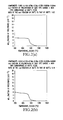
- FIG.2(a) is a graph showing a relationship between a total mol fraction of precipitate (which is a summation of M 2 C type alloy carbides mol fraction and MCN type alloy carbonitrides mol fraction) and temperature, with respect to one example of the invention which contains V of 0. 35 %, where the M 2 C type alloy carbides partially include V and Nb as a solid solution and the MCN type alloy carbonitrides include V and Nb as main components, and partially include Mo as a solid solution.
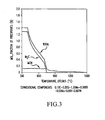
- the vertical axes of Figures 2 (a), 2 (b) and 3 are mol fraction of precipitates of alloy carbides, alloy carbonitrides and the total of alloy carbides and alloy carbonitrides.
- FIG.2(b) is a graph showing the relationship between total mol fraction of precipitate and temperature, similar to FIG.2(a) , where the V content is 0.22%.
- FIG.3 is a graph showing relationships between temperature and each of the mol fractions of precipitates of M 2 C type alloy carbides, MCN type alloy carbonitrides and a total of the M 2 C type alloy carbides and the MCN type alloy carbonitrides using conventional technology.
- a conventional method is any method in which neither the mol fraction of precipitate of alloy carbides and alloy carbonitrides at 600°C is 0,3% or more, nor the ratio of the mol fraction of precipitate of alloy carbides and alloy carbonitrides at 300°C to the mol fraction of precipitate of alloy carbides and alloy carbonitrides at 600°C is 2.0 or less.
- C is an element capable of improving the strength of steel. From the viewpoint of sufficient strength for structural steel, the content of C is 0. 03 % or more. C also has an influence on the toughness of the steel of the base material, the weld crack resistance and the toughness at heat affected zones (HAZ). From the viewpoint of such properties, the content of C is 0.15 % or less. Thus, the content of C is 0.03 to 0.15 %.
- Si works as a deoxidizer (or oxygen scavenger) in the process of steel making and also influences the strength of the steel. From the viewpoint of sufficient strength for structural steel, the content of Si is 0.05 % or more. Si also influences the toughness at HAZ since excess amounts of Si may generate M-A (Martensite-Austenite) constituent of hardening structure, which may deteriorate the toughness at HAZ. In view of this, the content of Si is 0.5 % or less. Thus, the content of Si is 0.05 to 0.50 %.
- Mn is an element capable of improving the strength and toughness of the mother phase. From this viewpoint, the content of Mn is 0.4 % or more. Mn also has an influence on the crack resistance and the toughness at HAZ. From the viewpoint of such properties, the content of Mn is 2. 0 % or less. Thus, the content of Mn is preferably 0.4 to 2.0 %.
- Mo is an element, which is capable of forming Mo-based alloy carbide.
- the content of Mo is 0.1 % or more.
- Mo also improves the hardenability of steel. Excess content of Mo may deteriorate the toughness of steel and of HAZ since hardenability may be increased excessively. From the viewpoint of such properties, the content of Mo is 0.6 % or less.
- the content of Mo is 0.1 to 0.6 %, preferably 0.2 to 0.4 %, more preferably 0.2 to 0.3 %.
- V is an element, which is capable of forming alloy carbonitride, and contributes to precipitation strengthening of steel.
- V when V is used with Mo, V can be solid-soluted in the alloy carbide of M 2 C, which contains Mo mainly, to form ((Mo, V) 2 C), Further, V allows Mo to be solid-soluted in the alloy carbonitride of M(C, N), which contains V mainly, to form ((Mo,V) (C,N)) .
- Properties of precipitate based on thermodynamics can be adjusted properly by transforming alloy carbides into either or both alloy carbides having the structure of M 2 C and/or alloy carbonitrides having the structure of M (C, N) by adjusting the content of V and Mo.
- the content of V is 0.04 % or more.
- V is 0.35 % or less.
- the content of V is more than 0.20 %.
- the content of V is more than 0.20 to 0.35 %.
- V-based alloy carbides having a structure of M 2 C has been mainly controlled in order to obtain fire-resistance.
- forming alloy carbonitrides having a structure of M(C, N) is mainly controlled in order to effectively improve the fire-resistance: From this viewpoint, the content of V is more than 0.20 %.
- N is an element, which is capable of forming alloy carbonitrides.
- the content of N is 0. 002 % or more. Further, the content N is 0.012 % or less since excess amounts of N may cause deterioration of the toughness of steel. Thus, the content of N is 0.002 to 0.012 %.
- A1 works as a strong deoxidizer (oxygen scavenger) in the process of steel making.
- A1 may form A1N combining with N, which leads to reduction in the amount of alloy carbonitrides (precipitate). Therefore, the A1 content is preferably 0.01 % or less.
- Nb is an element, similar to V and Ti, which is capable of forming alloy carbonitrides, such as M(C,N), and contributing to precipitation strengthening.
- the content of Nb is more than 0.06 %, it may not further improve the strength of the steel of the present invention by precipitation strengthening since the amount of alloy carbonitride which is not soluted at 1100-1300 °C, the temperature of heating, prior to hot rolling increases.
- the Nb content is preferably 0. 02 % or more.
- the content of Nb is preferably 0.02 to 0.06 %.
- Ti is an element similar to Nb and V, which is capable of forming alloy carbonitrides such as M(C,N) and contributing to precipitation strengthening.
- Ti is solid-soluted in alloy carbonitride such as M(C,N), which is formed by adding V or a combination of V and Nb, to form alloy carbonitrides such as (V,Ti)(C,N) or (V,Ti,Nb) (C N). Accordingly, Ti influences the stability of alloy carbonitrides at high temperatures.
- alloy carbonitrides such as M(C,N) can extend the thermal stability range to higher temperatures when Ti is present.
- the content of Ti exceeds 0.02 %, it may not contribute to precipitation strengthening since an amount of alloy carbonitride, which does not become solid-soluted at the heating temperature applied prior to hot rolling, such as 1100 - 1300°C, increases. Therefore, the content of Ti is preferably 0.02 % or less.
- Cr is an element capable of not only improving the strength at room temperature and high temperature by increasing hardenability of steel and precipitation hardening, but is also capable of preventing the grain boundary from being oxidized (intergranular oxidation) at the surface of the steel and thus, improves the properties of surface of the steel, such as smoothness and evenness.
- the toughness of the mother phase and the toughness at HAZ may be deteriorated.
- the content of Cr is preferably 0.7 % or less.
- Ni is an element capable of improving the toughness of the mother steel.
- the content of Ni is preferably 1.0 % or less.
- Cu is an element capable of improving the strength of steel. However, when excess amounts of Cu are present, the hardenability of the steel may be excessively increased and thus the toughness of steel and the toughness at HAZ may be deteriorated. From this viewpoint, the content of Cu is preferably 1.0 % or less.
- the structure of the alloy carbides and alloy carbonitrides and the mol fraction of precipitate of alloy carbides and alloy carbonitrides can be measured by observation and analysis using an electron microscope. As a simpler method, a software program for computing thermodynamic equilibrium can be used.
- thermodynamic equilibrium With respect to software usable in the present invention, for example, "Thermo-Calc” (manufactured by “Thermo Calc Software, USA)) can be employed for computing thermodynamic equilibrium.
- a database for example, "SSOL” can be also employed to carry out analysis.
- the software and database usable in the present invention there is no limitation imposed on the software and database usable in the present invention, as long as the software and the database are dependable.
- the total of two types of alloy carbides and alloy carbonitrides i.e., the mol fraction of precipitate of alloy carbonitrides having a structure of Face Centered Cubic, which is on behalf of MCN type alloy carbonitrides and the mol fraction of precipitate of alloy carbides having a structure of Hexagonal Closed-Packed, which is on behalf of M 2 C type alloy carbides, here, is defined as the mol fraction of precipitate of alloy carbides and alloy carbonitrides.
- the inventors compute both precipitate amounts of alloy carbides and alloy carbonitrides, and sum them up, and they apply the total precipitate amounts of the alloy carbides and the alloy carbonitrides as the mol fraction of precipitate.
- the specific mol fraction of precipitate of alloy carbides and alloy carbonitrides are evaluated with respect to various kinds of elements and various temperatures.
- the mol fractions of precipitates of alloy carbides and alloy carbonitrides are estimated by computing the thermodynamic equilibrium assuming that alloy carbides, which contain Mo mainly and in which V and/or Nb can also be solid-soluted, is "M 2 C type alloy carbide", and alloy carbonitrides, which contain V and Nb mainly and in which Mo can be solid-soluted, is "MCN type alloy carbonitride”.
- M 2 C type alloy carbide alloy carbides, which contain Mo mainly and in which V and/or Nb can also be solid-soluted
- MN type alloy carbonitride alloy carbonitrides
- Proof stress of 0.2% is preferably 157 MPa or more.
- the properties of the shaped steel are evaluated at a range of 0-1.0 % of the mol fraction of precipitate of alloy carbides and alloy carbonitrides. It is found necessary that the mol fraction of precipitate of alloy carbides and alloy carbonitrides at 600°C is 0.3 % or more.
- a suitable ratio of the mol fraction of precipitate of alloy carbides and alloy carbonitrides i.e., the ratio of the mol fraction of precipitate of alloy carbides and alloy carbonitrides at 300 °C and that at 600 °C, and suitable mechanical properties at several high and room temperatures, are investigated.
- the properties of the shaped steel are evaluated at range of 0-5.0 % of the mol fraction of precipitate of alloy carbides and alloy carbonitrides. It is found necessary that the ratio of the mol fraction of precipitate of alloy carbides and alloy carbonitrides at 300 °C and at 600 °C is 2.0 or less.
- Fig.2 (a) shows the case where the content of V is 0.35%.
- the mol fraction of precipitate of alloy carbides and alloy carbonitrides at the temperature of 600 °C is 0.52%, which is within the range of the invention (0.3 or more).
- the mol fraction of precipitate of alloy carbides and alloy carbonitrides increases from about 0.52 % to about 0.54 %.
- the ratio of these is approximately 1.03, satisfying the condition of 2.0% or less of the invention.
- Fig.2 (b) shows the case where the content of V is 0.22%.
- the mol fraction of precipitate of alloy carbides and alloy carbonitrides at the temperature of 600 °C is 0.52%, which is within the range of the invention (0.3 % or more).
- the mol fraction of precipitate of alloy carbides and alloy carbonitrides increases from about 0.52 % to about 0.59 %.
- the ratio between these is approximately 1.14, satisfying the condition of 2.0%
- composition design described above can simultaneously attain both a suppression of excessive increase of strength at room temperature and an excellent fire-resistance at 600°C.
- Fig.3 shows the results where a conventional method is applied to a steel whose composition is within the range of the invention.
- the mol fraction of precipitate of alloy carbides and alloy carbonitrides at 600 °C is within that of the invention (0.30% or more).
- the mol fraction of precipitate of alloy carbides and alloy carbonitrides increases drastically from about 0. 61 % to about 1.42 %.
- the ratio of the mol fraction of precipitate at 300°C and 600°C is 2.3, which is outside the range of the invention (2.0 or less).
- Fig.3 shows that the conventional method has a problem in that the strength at 300 °C is excessively high. It is noted that a conventional method is any method in which neither the mol fraction of precipitate of alloy carbides and alloy carbonitrides at 600°C is 0,3% more, nor the ratio of the mol fraction of precipitate of alloy carbides and alloy carbonitrides at 300°C to the mol fraction of precipitate of alloy carbides and alloy carbonitrides at 600°C is 2.0 or less.
- the size of precipitates such as alloy carbides and alloy carbonitrides has an influence on the strength. In accordance with the desirable strength, it is preferred to make the precipitate fine-grained, for instance, to the size of 10-1000nm. It is preferred that solution treatment be conducted prior to hot rolling and precipitate be formed during cooling after hot rolling, or precipitate be formed by keeping the temperature of the steel at about 600 °C.
- the ratio of the precipitate amounts between MCN type alloy carbonitrides having a stable less-temperature(only temperature range of 300°C to 600°C) -dependent precipitate amount and M 2 C type alloy carbides having a temperature-dependent precipitate amount is larger than that achieved by conventional methods.
- a ratio of MCN/M 2 C of 0.7 or more provides a significant effect at high temperatures, for example, 600°C.
- the ratio of MCN/M 2 C may not be a determining factor. In other words, the ratio of MCN/M 2 C of 0.7 or more is not a required condition of the invention.
- the reason for the limitation in the hot rolling process is as follows. First the casted steel, such as the slab, billet, bloom, near-net shape slab, ingot, etc., is reheated to a range between 1100 and 1300°C. The reason for the limitation of the temperature is to ensure a sufficient temperature to allow the casted steel to be processed in an austenite range and to sufficiently develop precipitation strengthening by making alloy carbides and alloy carbonitrides once a solid-solution in the process of hot rolling of the shaped steel.
- the hot rolling process basically includes a break-down process performed by groove rolling, intermediate rolling, and finishing rolling.
- the intermediate rolling process may be performed by any of a group of intermediate universal rolling machines including an edger rolling machine and a universal rolling machine, and the finishing rolling process may be performed by a universal rolling machine.
- the above-mentioned process also includes a rolling process using a skew roll for controlling the height of the web portion of the shaped steel.
- the casted steel is rolled in the width direction by a plurality of rolls, each roll has a groove of which bottom width is different to each other and the bottom part has a projected portion in the middle of the groove bottom. This is to ensure an appropriate flange width and web height.
- an appropriate flange width is obtained by an edger rolling machine and appropriate web thickness and flange thickness are obtained by an universal rolling machine. Furthermore in the finishing rolling process, shaped steel with predetermined size is formed while keeping the surface temperature of the flange portion, for instance, at 800°C or more.
- the present invention can be preferably applied to a shaped steel of which the web thickness ranges from 9 mm to 40 mm, the flange thickness ranges from 12 mm to 60 mm, the web height is about 500 mm and the flange width ranges from 200 mm to 500 mm.
- the shaped steel is water-cooled at least once to 700°C or less as measured at the surface of the flange portion and then rolled in the heat returning process.
- the temperatures of the fillet and the flange portion are usually higher than that of the web portion due to the shape of shaped steel.
- the water-cooling of the flange portion and the rolling in the heat returning process are carried out at least once.
- this cyclic process of water-cooling and rolling can be repeatedly performed according to the size of shaped steel and the number of rolling passes.
- the shaped steel is either naturally cooled, or rapidly cooled, for instance, at least once, and then naturally cooled.
- the microstructure of the steel is fine-grained, which leads to improvements of strength at room temperatures, toughness and strength at high temperatures.
- the average cooling rate is preferably between 0.5 and 5.0°C/s so that the microstructure can be further fine-grained.
- shaped steel excellent in fire-resistance having the following mechanical properties can be manufactured. That is, for example: mechanical properties where strength ratio defined by (0.2% proof stress at 600°C)/(yield strength at room temperature) is 50% or more, yield ratio at room temperature is 80% or less and Charpy impact absorption energy at 0°C is 100J or more; where the flange portion tensile strength at room temperature is 400 MPa class (grade), 0.2% proof stress at 600°C is 157 MPa or more and Charpy impact absorption energy at 0°C is 100J or more; and where the flange portion tensile strength at room temperature is 490 MPa class, 0.2% proof stress at 600°C is 217 MPa or more and Charpy impact absorption energy at 0°C is 100J or more.
- examples “a - g" of comparison steels are outside the range of the invention.
- the conditions of components of example “a - c" are within that of the invention, but the mol fractions of precipitates of alloy carbides and alloy carbonitrides at 600 °C are not within the range of the invention (0.3 % and more).
- examples “d - g” each of the ratios of the mol fraction of the precipitate of alloy carbides and alloy carbonitrides at 300 °C to the mol fraction of the precipitate of alloy carbides and alloy carbonitrides at 600 °C, i.e., (the mol fraction at 300°C) / (the mol fraction at 600°C) are outside the range of the invention (2.0 and less).
- the ratio of mol fraction of precipitate of alloy carbides and alloy carbonitrides at 300 °C to that at 600 °C shown in the rightmost column is not completely identical to the value calculated by each of the mol fraction of precipitate of alloy carbides and alloy carbonitrides at 300 °C and that at 600 °C.
- the difference is caused by number of significant digits, because each of the mol fraction of precipitate of alloy carbides and alloy carbonitrides are calculated to three decimal places, which is rounded off.
- Each of the casted steel are reheated to 1100 - 1300°C and then subjected to the hot rolling process including a break-down process performed by a groove rolling process, an intermediate rolling process of a group of intermediate universal rolling machine including an edger rolling machine and a universal rolling machine, and a finishing rolling process performed by a universal rolling machine to form a H-shaped steel of predetermined size.
- the web height of H-shaped steel is controlled by a rolling process using a skew roll.
- H-shaped steel of which the web thickness ranges from 9 mm to 40 mm, the flange thickness ranges from 12 mm to 60 mm, the web height is about 500 mm and the flange width ranges from 200 mm to 500 mm, are manufactured.
- FIG. 1 shows a C-section of H-shaped steel, which is created by cutting the steel in a lateral direction (not longitudinal direction).
- the mechanical properties of the manufactured H-shaped steel are obtained by carrying out a variety of tests using a test piece (specimen).
- FIG.1 shows locations from where the test pieces (specimen) are taken.
- a first location is the center area of flange 2 in the thickness direction (1/2 t 2 ) and one-fourth (1/4 B) position of the total flange width (B) away from the end of flange 2 in the flange width direction.
- a second location is the center area of flange 2 in the thickness direction (1/2 t 2 ) and a half (1/2 B ) position of the total flange width (B) in the flange width direction (fillet part).
- a third location is the center area of web 3 in the thickness direction (1/2 t 1 ) and a half (1/2 H) position of the total web height (H) in the flange width direction.
- the mechanical properties at the above (1/4 B) position can represent the mechanical properties of the flange portion of H-shaped steel.
- the mechanical properties at the above three locations are measured and an average value of the mechanical properties of the three locations and a value of the mechanical property of the web portion (third location) are checked to confirm that excessive strengthening of mechanical properties with the web portion can be prevented. That is, a ratio of the value of the web portion to the average value of the three locations is calculated.
- TABLE 2 illustrates the results of the above test, i.e., yield strength at room temperature, tensile strength at room temperature, yield ratio at room temperature, Charpy impact absorption energy at 0°C (3 points average value according to JIS, the specimen is JIS NO.4 (full size), with 2mm V-shape notch), 0.2% proof stress at 600°C according to JIS A2, and ratio of 0.2% proof stress at 600°C and yield strength at room temperature, for instance, according to JIS NO. 13A or 13B, depending upon the thickness of the shaped steel.
- the data in TABLE 2 represents measured values of the fillet part (1/2 B) which has a lower value in the Charpy impact test than that of any other part in the section of the H-shaped steel.
- the data in TABLE 2 represent measured values of the (1/4 B) position in the flange portion.
- the value of the(1/4 B) position represents the strength of the H-shaped steel.
- SN400 class examples whose strengths are approximately 400-520 MPa are shown.
- SN490 class examples whose strengths are approximately 500-611 MPa are shown.
- TABLE 2 the results are described according to the classes. Also, the ratio of the value of the mechanical property of the web portion to that of the average value of the three locations is calculated and listed therewith.
- the steel of the invention satisfy such conditions as the components, and the mol fraction of precipitate of the alloy carbides and alloy carbonitrides.
- the mechanical properties of the steel of the invention attain the target properties both at high temperature (600 °C) and room temperature, such as yield strength, tensile strength, Charpy impact absorption energy at 0°C, particularly the strength ratio of the flange part of the steel is defined as (0.2 % proof strength at 600 °C)/(yield strength at room temperature) and yield ratio at room temperature.
- the comparative examples despite of having the same components as the steel of the present invention, do not satisfy at least one of the mechanical properties at room temperature and high temperature because they do not meet the requirements of mol fraction of precipitate of alloy carbides and alloy carbonitrides in the present invention.
- Comparative steels "c, f, g” are insufficient in the Charpy impact absorption energy at 0°C in comparison with the steel of the present invention (100 J or more) .
- Comparative steels "a, b", belonging to class SN400 do not reach the target value of 0.2% proof strength at 600 °C, i.e., 157MPa and more.
- Comparative steels "d, e”, belonging to class SN490 have a 0.2 % proof strength at 600 °C of 206, 212MPa respectively, which do not reach the target value of 217MPa and more.
- the strength ratios of comparative steels "d, e” do not reach the target value of 50% or more.
- the present invention provides for shaped steel excellent in fire-resistance and having the desired strength at high temperature and mechanical properties at room temperature by forming alloy carbides and alloy carbonitrides mainly made of V and Mo under the proper balance of added amounts of V and Mo.
- the shaped steel of the present invention is very useful as a construction material and has great industrial applicability.
- test piece location for Charpy impact test flange 1/2 B (fillet part) *2 test piece location for tensile test at high temperature: flange 1/4 B *3 yield strength at room temperature at web portion; 0.2 % proof strength at 600 ° C at flange 1/4 B
Landscapes
- Chemical & Material Sciences (AREA)
- Engineering & Computer Science (AREA)
- Materials Engineering (AREA)
- Mechanical Engineering (AREA)
- Metallurgy (AREA)
- Organic Chemistry (AREA)
- Heat Treatment Of Steel (AREA)
- Metal Rolling (AREA)
Claims (4)
- Formstahl, umfassend in Gewichtsprozent (%):C: 0,03 bis 0,15;Si: 0,05 bis 0,50;Mn: 0,4 bis 2,0;Mo: 0,1 bis 0,6;V: mehr als 0,20 bis 0,35%; undN: 0,002 bis 0,012;gegebenenfalls Al ≤ 0,01, weiter gegebenenfalls eines oder mehrere der folgenden Elemente in Gewichtsprozent (%):Ti: 0,005 bis 0,020;Nb ≤ 0,06%;Cr ≤ 0,7;Ni ≤ 1,0; undCu ≤ 1,0;wobei es sich bei dem Rest um Eisen und vorhandene Verunreinigungen handelt, wobei(x) die Molfraktion des Niederschlags aus Carbidlegierungen und Carbonitridlegierungen bei 600°C 0,3% oder mehr beträgt, und(y) das Verhältnis der Molfraktion des Niederschlags aus Carbidlegierungen und Carbonitridlegierungen bei 300°C zur Molfraktion des Niederschlags aus Carbidlegierungen vom M2C-Typ und Carbonitridlegierungen vom MCN-Typ bei 600°C 2,0 oder weniger beträgt,wobei ein Flanschbereich des Formstahls ein Verhältnis der Festigkeit von 50% oder mehr, eine Streckgrenze von 80% oder weniger und eine Schlagzähigkeit beim Kerbschlagbiegeversuch nach Charpy bei 0°C von 100 J oder mehr aufweist, wobei das Verhältnis der Festigkeit = (Dehngrenze von 0,2% bei 600°C)/(Streckgrenze bei Raumtemperatur) ist.
- Verfahren zur Herstellung eines Formstahls nach Anspruch 1 durch Warmwalzen nach dem Wiedererhitzen eines Gussstahls, umfassend die Schritte:(a) Wiedererhitzen des Gussstahls auf 1100 bis 1300°C;(b) Warmwalzen des Gussstahls, um den Formstahl zu bilden; und(c) nach Beenden des Warmwalzens natürliches Abkühlen oder schnelles Abkühlen, gefolgt von natürlichem Abkühlen des Formstahls.
- Verfahren nach Anspruch 2, wobei der Schritt des Warmwalzens das mindestens einmalige Abkühlen des Formstahls mit Wasser auf 700°C oder weniger, gemessen an der Oberfläche eines Flanschbereichs des Formstahls, und das anschließende Walzen während der erneuten Wärmezufuhr umfasst.
- Verfahren nach Anspruch 3, wobei der Schritt des schnellen Abkühlens bei einer durchschnittlichen Abkühlgeschwindigkeit von 0,5 bis 5,0°C/s erfolgt.
Applications Claiming Priority (4)
| Application Number | Priority Date | Filing Date | Title |
|---|---|---|---|
| JP2004220337 | 2004-07-28 | ||
| JP2004220454 | 2004-07-28 | ||
| JP2005207185A JP2006063443A (ja) | 2004-07-28 | 2005-07-15 | 耐火性に優れたh形鋼およびその製造方法 |
| PCT/JP2005/013999 WO2006011618A1 (en) | 2004-07-28 | 2005-07-26 | Shaped steel excellent in fire resistance and producing method therefor |
Publications (2)
| Publication Number | Publication Date |
|---|---|
| EP1769097A1 EP1769097A1 (de) | 2007-04-04 |
| EP1769097B1 true EP1769097B1 (de) | 2008-03-26 |
Family
ID=34973110
Family Applications (1)
| Application Number | Title | Priority Date | Filing Date |
|---|---|---|---|
| EP05767835A Expired - Lifetime EP1769097B1 (de) | 2004-07-28 | 2005-07-26 | Formstahl mit hoher hitzebeständigkeit und formstahlherstellungsverfahren |
Country Status (5)
| Country | Link |
|---|---|
| US (1) | US20080302453A1 (de) |
| EP (1) | EP1769097B1 (de) |
| JP (1) | JP2006063443A (de) |
| TW (1) | TWI312372B (de) |
| WO (1) | WO2006011618A1 (de) |
Families Citing this family (2)
| Publication number | Priority date | Publication date | Assignee | Title |
|---|---|---|---|---|
| US20190184436A1 (en) * | 2016-08-29 | 2019-06-20 | Nippon Steel & Sumitomo Metal Corporation | Rolled h-shaped steel and manufacturing method thereof |
| US11041231B2 (en) * | 2017-03-15 | 2021-06-22 | Nippon Steel Corporation | H-section steel and method of producing the same |
Family Cites Families (8)
| Publication number | Priority date | Publication date | Assignee | Title |
|---|---|---|---|---|
| US4990196A (en) * | 1988-06-13 | 1991-02-05 | Nippon Steel Corporation | Process for manufacturing building construction steel having excellent fire resistance and low yield ratio |
| JP2661845B2 (ja) * | 1992-09-24 | 1997-10-08 | 新日本製鐵株式会社 | 含オキサイド系耐火用形鋼の制御圧延による製造方法 |
| JP2760713B2 (ja) * | 1992-09-24 | 1998-06-04 | 新日本製鐵株式会社 | 耐火性及び靱性の優れた制御圧延形鋼の製造方法 |
| JP3718348B2 (ja) * | 1998-07-31 | 2005-11-24 | 新日本製鐵株式会社 | 高強度高靱性圧延形鋼とその製造方法 |
| EP1182268B1 (de) * | 2000-02-02 | 2004-09-29 | JFE Steel Corporation | Hochfeste, hochzähe, nahtlose stahlrohre für leitungsrohre |
| JP2001247930A (ja) * | 2000-03-06 | 2001-09-14 | Nkk Corp | 耐震性および耐火性に優れた圧延形鋼とその製造方法 |
| WO2002036840A1 (fr) * | 2000-10-31 | 2002-05-10 | Nkk Corporation | Tole d"acier laminee a chaud presentant une resistance elevee a la traction et procede de fabrication |
| JP2003096534A (ja) * | 2001-07-19 | 2003-04-03 | Mitsubishi Heavy Ind Ltd | 高強度耐熱鋼、高強度耐熱鋼の製造方法、及び高強度耐熱管部材の製造方法 |
-
2005
- 2005-07-15 JP JP2005207185A patent/JP2006063443A/ja not_active Withdrawn
- 2005-07-22 TW TW094124884A patent/TWI312372B/zh not_active IP Right Cessation
- 2005-07-26 WO PCT/JP2005/013999 patent/WO2006011618A1/en not_active Ceased
- 2005-07-26 EP EP05767835A patent/EP1769097B1/de not_active Expired - Lifetime
- 2005-07-26 US US11/658,348 patent/US20080302453A1/en not_active Abandoned
Also Published As
| Publication number | Publication date |
|---|---|
| TW200607871A (en) | 2006-03-01 |
| TWI312372B (en) | 2009-07-21 |
| JP2006063443A (ja) | 2006-03-09 |
| WO2006011618A1 (en) | 2006-02-02 |
| EP1769097A1 (de) | 2007-04-04 |
| US20080302453A1 (en) | 2008-12-11 |
Similar Documents
| Publication | Publication Date | Title |
|---|---|---|
| EP3012340B1 (de) | Ht550-stahlplatte mit ultrahoher zähigkeit und hervorragender schweissbarkeit und herstellungsverfahren dafür | |
| EP2832879B1 (de) | Hochfestes stahlrohr für leitungsrohr mit hervorragender beständigkeit gegen wasserstoffinduzierte rissbildung, hochfestes stahlblech für ein leitungsrohr damit und verfahren zur herstellung davon | |
| EP2272994B1 (de) | Stahl mit hoher bruchfestigkeit und herstellungsverfahren dafür | |
| EP2042616B1 (de) | Gewalzte platte aus nichtrostendem austenitstahl mit einer dicke von 100 mm oder mehr und herstellungsverfahren dafür | |
| EP2617851B1 (de) | Hochfestes heissgewalztes stahlblech mit hervorragender stanzbarkeit und verfahren zu seiner herstellung | |
| EP3653736B1 (de) | Warmgewalztes stahlband und herstellungsverfahren | |
| EP2853615B1 (de) | Dicke Stahlplatte mit niedriger Streckgrenze, hoher Festigkeit, hoher Zähigkeit und geschweißtes Stahlrohr sowie Verfahren zur Herstellung davon | |
| EP3859040A1 (de) | Verschleissfester stahl mit ausgezeichneter härte und schlagzähigkeit und verfahren zur herstellung davon | |
| EP2221392A1 (de) | Stahlrohr mit hervorragenden aufweitungseigenschaften und herstellungsverfahren dafür | |
| EP3098331B1 (de) | Verschleissfeste stahlplatte und verfahren zur herstellung davon | |
| EP2484791A1 (de) | Stahlplatte mit geringem streckgrenzenverhältnis, hoher härte und hoher gleichförmiger ausdehnung sowie verfahren zu ihrer herstellung | |
| EP2792761B1 (de) | Extradicker hochfester doppel-t-stahlträger | |
| EP2071044A1 (de) | Verfahren zur Herstellung von Hartstahlschienen, die eine hervorragende Verschleißfestigkeit und Duktilität aufweisen | |
| JP7211530B2 (ja) | 耐摩耗鋼板および耐摩耗鋼板の製造方法 | |
| KR102020513B1 (ko) | 고온 내산화성이 우수한 페라이트계 스테인리스강 및 그 제조방법 | |
| CN101512033B (zh) | 高温强度、韧性和耐再热脆化特性优异的耐火钢材及其制造方法 | |
| EP3425080B1 (de) | H-förmiger stahl für niedrige temperaturen und verfahren zur herstellung davon | |
| EP1726675B1 (de) | Grundmaterial für einen plattierten Stahl und Vefahren zur Herstellung von einem daraus hergestellten plattierten Stahl | |
| EP2837705A1 (de) | Warmgewalztes stahlblech mit hohem kohlenstoffgehalt und ausgezeichneter uniformität und verfahren zur herstellung davon | |
| EP2258880B1 (de) | Verfahren zur herstellung einer hochfesten dicken stahlplatte | |
| EP1769097B1 (de) | Formstahl mit hoher hitzebeständigkeit und formstahlherstellungsverfahren | |
| KR20090069608A (ko) | 냉간 공구강 및 그 제조방법 | |
| WO2006011617A1 (en) | Shaped steel excellent in fire resistance and producing method therefor | |
| EP4450668A1 (de) | Kaltgewalztes stahlblech mit hervorragender schweissbarkeit und verfahren zur herstellung davon | |
| CN100535161C (zh) | 耐火性优异的型钢及其制备方法 |
Legal Events
| Date | Code | Title | Description |
|---|---|---|---|
| PUAI | Public reference made under article 153(3) epc to a published international application that has entered the european phase |
Free format text: ORIGINAL CODE: 0009012 |
|
| 17P | Request for examination filed |
Effective date: 20070213 |
|
| AK | Designated contracting states |
Kind code of ref document: A1 Designated state(s): LU |
|
| DAX | Request for extension of the european patent (deleted) | ||
| RBV | Designated contracting states (corrected) |
Designated state(s): LU |
|
| GRAP | Despatch of communication of intention to grant a patent |
Free format text: ORIGINAL CODE: EPIDOSNIGR1 |
|
| GRAS | Grant fee paid |
Free format text: ORIGINAL CODE: EPIDOSNIGR3 |
|
| GRAA | (expected) grant |
Free format text: ORIGINAL CODE: 0009210 |
|
| RTI1 | Title (correction) |
Free format text: SHAPED STEEL EXCELLENT IN FIRE RESISTANCE AND PRODUCING METHOD THEREFOR |
|
| AK | Designated contracting states |
Kind code of ref document: B1 Designated state(s): LU |
|
| PLBE | No opposition filed within time limit |
Free format text: ORIGINAL CODE: 0009261 |
|
| STAA | Information on the status of an ep patent application or granted ep patent |
Free format text: STATUS: NO OPPOSITION FILED WITHIN TIME LIMIT |
|
| 26N | No opposition filed |
Effective date: 20081230 |
|
| PGFP | Annual fee paid to national office [announced via postgrant information from national office to epo] |
Ref country code: LU Payment date: 20240711 Year of fee payment: 20 |