EP1769833A1 - Spielfigur bestehend aus Plüsch und Elastomer Gel Kombination - Google Patents
Spielfigur bestehend aus Plüsch und Elastomer Gel Kombination Download PDFInfo
- Publication number
- EP1769833A1 EP1769833A1 EP06255022A EP06255022A EP1769833A1 EP 1769833 A1 EP1769833 A1 EP 1769833A1 EP 06255022 A EP06255022 A EP 06255022A EP 06255022 A EP06255022 A EP 06255022A EP 1769833 A1 EP1769833 A1 EP 1769833A1
- Authority
- EP
- European Patent Office
- Prior art keywords
- toy
- elastomeric gel
- section
- elastomeric
- fabric
- Prior art date
- Legal status (The legal status is an assumption and is not a legal conclusion. Google has not performed a legal analysis and makes no representation as to the accuracy of the status listed.)
- Withdrawn
Links
- 238000010276 construction Methods 0.000 title description 22
- 239000000463 material Substances 0.000 claims abstract description 101
- 239000004744 fabric Substances 0.000 claims abstract description 55
- 239000000853 adhesive Substances 0.000 claims abstract description 6
- 230000001070 adhesive effect Effects 0.000 claims abstract description 6
- 239000003292 glue Substances 0.000 claims description 23
- 229920001187 thermosetting polymer Polymers 0.000 claims description 17
- 229920000428 triblock copolymer Polymers 0.000 claims description 6
- 230000001815 facial effect Effects 0.000 claims 2
- 238000009958 sewing Methods 0.000 abstract description 13
- 238000000034 method Methods 0.000 abstract description 11
- 238000004519 manufacturing process Methods 0.000 abstract description 5
- 239000012530 fluid Substances 0.000 abstract description 2
- 239000000499 gel Substances 0.000 description 67
- 239000004033 plastic Substances 0.000 description 12
- 229920003023 plastic Polymers 0.000 description 12
- 210000003128 head Anatomy 0.000 description 6
- 239000013536 elastomeric material Substances 0.000 description 5
- 210000005069 ears Anatomy 0.000 description 4
- 230000002787 reinforcement Effects 0.000 description 4
- 241001465754 Metazoa Species 0.000 description 3
- 239000000835 fiber Substances 0.000 description 3
- 239000007788 liquid Substances 0.000 description 3
- NIXOWILDQLNWCW-UHFFFAOYSA-N acrylic acid group Chemical group C(C=C)(=O)O NIXOWILDQLNWCW-UHFFFAOYSA-N 0.000 description 2
- 239000004035 construction material Substances 0.000 description 2
- 238000001746 injection moulding Methods 0.000 description 2
- 239000000155 melt Substances 0.000 description 2
- 238000002844 melting Methods 0.000 description 2
- 230000008018 melting Effects 0.000 description 2
- 229920000728 polyester Polymers 0.000 description 2
- 239000011347 resin Substances 0.000 description 2
- 229920005989 resin Polymers 0.000 description 2
- 210000004761 scalp Anatomy 0.000 description 2
- 229920000742 Cotton Polymers 0.000 description 1
- 239000004831 Hot glue Substances 0.000 description 1
- 241000417893 Kania Species 0.000 description 1
- 241000282330 Procyon lotor Species 0.000 description 1
- 238000004026 adhesive bonding Methods 0.000 description 1
- 230000006835 compression Effects 0.000 description 1
- 238000007906 compression Methods 0.000 description 1
- 238000007598 dipping method Methods 0.000 description 1
- 230000000694 effects Effects 0.000 description 1
- 239000007789 gas Substances 0.000 description 1
- 230000002209 hydrophobic effect Effects 0.000 description 1
- 238000005304 joining Methods 0.000 description 1
- 239000011344 liquid material Substances 0.000 description 1
- 239000000203 mixture Substances 0.000 description 1
- 238000012986 modification Methods 0.000 description 1
- 230000004048 modification Effects 0.000 description 1
- 239000004014 plasticizer Substances 0.000 description 1
- 229910052573 porcelain Inorganic materials 0.000 description 1
- 239000000243 solution Substances 0.000 description 1
- 229920002725 thermoplastic elastomer Polymers 0.000 description 1
- 238000002604 ultrasonography Methods 0.000 description 1
Images



Classifications
-
- A—HUMAN NECESSITIES
- A63—SPORTS; GAMES; AMUSEMENTS
- A63H—TOYS, e.g. TOPS, DOLLS, HOOPS OR BUILDING BLOCKS
- A63H3/00—Dolls
- A63H3/02—Dolls made of fabrics or stuffed
Definitions
- the present invention relates to manufacturing techniques used in the fabrication of toy figures. More particularly, the present invention relates to techniques used to combine fabric construction materials with synthetic elastomeric construction materials to produce figures that embody different tactile characteristics.
- plush toys is the name used to describe toys with a fabric-based construction. Such toys include stuffed animals, dolls and the like. Traditionally plush toys are made by sewing together a fabric shell from some type of material, such as cotton or synthetic fur. The fabric shell defines the external shape of the toy. The fabric shell is then stuffed with polyester fibers of some similar type of stuffing material. Hard objects, such as button eyes, can then be either sewn or glued to the exterior of the fabric shell.
- toys began to be manufactured from different types of plastic, rather than fabric.
- many dolls have bodies made from hard plastic.
- the heads of the dolls are often molded from a softer more pliable plastic.
- plastic is used, the type of connections between the two different types of plastic parts remains traditional.
- the toy part made from the harder plastic is molded with a grooved base.
- the toy part made from the softer plastic is made with an opening that can be stretched around the grooved base. When the opening of softer plastic contracts into the groove of the harder plastic, a mechanical interconnection is created that joins the plastic sections.
- Elastomeric gels are becoming increasingly popular.
- Elastomeric gels are triblock copolymer plastics that have been mixed with a plasticizing oil to form an elastic gel.
- Elastomeric gels embody a high degree of elasticity and a high resistance to tearing that make such gels useful in toy manufacturing.
- One of the earliest elastomeric gels is exemplified by U.S. Patent No. 4,369,284 to Chen , entitled Thermoplastic Elastomer Gelatinous Compositions.
- Elastomeric gels are typically molded into toys such as balls and flying discs using traditional injection molding techniques.
- injection molding techniques prohibits elastomeric gels from being molded directly onto a non-plastic plush form.
- elastomeric gels have been applied to fabric objects, such as socks, in order to provide cushioning.
- fabric objects such as socks
- the fabric body is dipped into a vat of molten elastomeric gel material. The elastomeric gel material is then given time to cure upon the fabric body.
- Traditional mechanical attachment techniques do not work. Since the elastomeric gel is so elastic, it easily pulls away from any sort of grooved connection base it may be stretched across. Furthermore, elastomeric gels cannot be molded onto plush toys, nor can elements of a plush toy figure be created by molten dipping.
- the only solution to date has been to glue elastomeric gel material to fabric using traditional acrylic based glues. However, since the traditional acrylic glues used harden when they cure, the glues quickly peel away from the elastomeric gel as the elastomeric gel stretches and deforms under the hardened glue. The component of the toy made from the elastomeric gel, therefore, quickly peels away from the remainder of the toy, where it can become a choking hazard.
- the present invention is a toy figure assembly and its method of manufacture.
- the toy figure has a body structure with an exposed exterior.
- the exposed exterior of the figure includes at least one first section of fabric material and at least one second section of elastomeric gel material that are joined together along at least one common seam.
- the common seam can be closed using adhesive, heat bonding or sewing.
- the sections of the toy figure defined by fabric material are filled with dry fill.
- the sections of the toy figure defined by elastomeric gel material can be filled with either dry fill or a fluid fill, such as liquid or air.
- a toy figure By forming a toy figure from both fabric material and elastomeric gel, a toy figure is obtained that has external areas having contrasting tactile characteristics, thereby increasing the play value of the toy figure.
- plush toys There are countless varieties of plush toys.
- the present invention is described using one exemplary configuration of a plush toy. This configuration is intended to be merely exemplary of any plush toy configuration and should not be considered to limit the application of the present invention to other plush toy configurations.
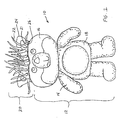
- the toy figure 10 has a plush section 12 made in the traditional manner.
- the plush section 12 is made from a sewn fabric shell 14 that is stuffed with dry fill material, such as polyester fibers.
- the toy figure 10 is a doll.
- the plush section 12 of the doll is the body 16 and face 18 of the doll.
- the toy figure 10 also has at least one stretchable section 20 that is made from an elastomeric gel.
- the stretchable section 20 is the scalp 21, hair 22 and ears 24 of the toy figure 10.
- the stretchable section 20 is a molded segment of elastomeric gel that is prefabricated prior to the assembly of the toy figure 10. Since the stretchable section 20 of the toy figure 10 is made from elastomeric gel, it is highly elastic. It will therefore be understood that the hair 22, scalp 21 and ears 24 of the toy figure 10 can be elastically stretched by a person pulling on these elements.
- the stretchable section 20 of the toy figure 10 joins to the plush section 12 of the toy figure 10 along at least one common seam 26.
- the physical interconnection between the stretchable section 20 and the plush section 12 can be accomplished in a few ways.
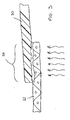
- thermoset glue 34 is used to bond the elastomeric gel material 30 to the fabric material 32.
- the thermoset glue 34 is comprised of a triblock copolymer that is mixed with a resin and optionally with a small amount of plasticizing oil. Such glues are commercially available and are exemplified by U.S. Patent No. 6,391,960, to Sambasivam , entitled Multipurpose Hot Melt Adhesive.
- the thermoset glue 34 is applied to the common seam 26 in a heated molten form. The thermoset glue 34 therefore flows into the weave of the fabric material 32. Once the thermoset glue 34 cools and cures, the bond between the fabric material 32 and the thermoset glue 34 is exceptionally strong due to the seepage of the glue into the weave of the fabric material 32.
- thermoset glue 34 is made of a triblock copolymer.
- the elastomeric gel material 30 is made from the same family of materials. Accordingly, the elastomeric material 30 readily bonds with the thermoset glue 34. Furthermore, since the thermoset glue 34 is applied in a heated molten form, the thermoset glue 34 momentarily melts the elastomeric gel material 30 it contacts, thereby creating a direct heat bond between the elastomeric gel material 30 and the thermoset glue 34.
- thermoset glue 34 is made primarily from triblock copolymers mixed with resin and a plasticizer.
- the thermoset glue 34 therefore is highly flexible and exhibits a resistance to tearing comparable to that of the elastomeric gel material 30.
- the result is that the common seam 26 is strongly bonded to both the elastomeric gel material 30 and the fabric material 32.
- the thermoset glue 34 will also bend and twist as the elastomeric gel material 30 is stretched, without pulling away from either the elastomeric gel material 30 or the fabric material 32.
- FIG. 3 an alternate embodiment of a segment of common seam 36 is shown.
- a layer of the elastomeric gel material 30 again overlaps a layer of fabric material 32.
- No secondary adhesive is used between the elastomeric gel material 30 and the fabric material 32. Rather, the elastomeric gel material 30 is brought into contact with the fabric material 32.
- Energy is then applied to the common seam 36 in the form of heat energy, ultrasound energy or microwave energy. The energy is used to momentarily melt the elastomeric gel material 30 in contact with the fabric material 32. As the melting energy is present, the fabric material 32 is biased against the elastomeric gel material 30.
- the elastomeric gel material 30 melts into the fibers of the fabric material 32. Once the melting energy is removed, the elastomeric gel material 30 cures and becomes interlocked within the weave of the fabric material 32. The result is a bond along the common seam 36 that will not separate as the elastomeric gel material 30 is stretched.
- FIG. 4 another alternate embodiment of a segment of a common seam 40 is shown.
- a layer of elastomeric gel material 30 is placed in between two flaps 41, 42 of fabric material 44.
- the threads used in the sewing tend to cut through the elastomeric gel material over time. This effect is exasperated by the stretching of the elastomeric gel material along the seam.
- the sewing thread 46 is not pulled laterally across the elastomeric gel material 30. Rather, the sewing threads 46 only travel vertically through the elastomeric gel material 30. The sewing threads 46 are moved laterally only above the upper flap 42 and below the lower flap 41. The sewing of the common seam 40 compresses the elastomeric gel material 30 in between the two flaps 41, 42 of fabric material 44. Since the elastomeric gel material 30 is recompressed by the sewing of the common seam 40, the elastomeric gel material 30 does not significantly further deform as the stretchable section of the toy figure is pulled and stretched. The result is very string mechanical connection between the elastomeric gel material 30 and the fabric material 44 that will not separate as the elastomeric gel material 30 is pulled and stretched.
- a reinforcement patch 47 of fabric is attached to a layer of elastomeric gel material 30 using either the previously described adhesive bonding technique or the previously described heat bonding technique.
- the layer of elastomeric gel material 30 is then overlapped upon the fabric material 48 forming the remainder of the toy.
- Sewing thread 49 is sewn through the common seam 45.
- the sewing thread 49 passes through the reinforcement patch 47.
- the sewing thread 49 cuts through the elastomeric gel material 30 but cannot pass through the reinforcement patch 47. Consequently, the presence of the reinforcement patch 47 prevents the sewing thread 49 from disconnecting from the elastomeric gel material 30.
- a toy figure 10 is shown having a stretchable section 20 and a plush section 12. Although the exterior of the toy figure 10 is made from different materials, the toy figure 10 is filled with a common dry fill material.
- Elastomeric gels are hydrophobic and are capable of holding liquid and semi-liquid materials. Plush materials cannot. Thus, in the embodiment of Fig. 1, the toy figure 10 must be filled with a dry fill material so that fill material does not leak out of the plush section 12 of the toy figure 10.
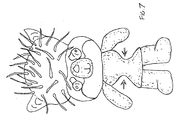
- an elastomeric subassembly 52 is combined with a plush construction 56 to create the toy figure 10.
- the elastomeric subassembly 52 is comprised of a sealed sack 54 of elastomeric gel material that is filled with gas, liquid, gel or another such fluidic material. When the elastomeric subassembly 52 is squeezed, the elastomeric subassembly 52 will deform and bulge in areas that are not under compression.
- the plush construction 56 is not completely filled with traditional fill material. Rather, the plush construction 56 is made to be at least partially hollow. In this manner, the plush construction 56 is partially hollow and a substantial portion of the sealed sack 54 of elastomeric gel can pass into the plush construction 56.
- the plush construction 56 has an edge that contacts the elastomeric subassembly 52 along one or more seam lines 58. On each of the seam lines 58, the fabric material of the plush construction 56 is attached to the elastomeric material of the sealed sack 54 using one of the interconnection techniques previously described.
- the toy figure 50 is a stuffed animal made in the form of a raccoon.
- the toy figure 50 has a head 61 and body 62.
- the body 62 is made of traditional plush construction.
- the head 61 is partially made of plush construction.
- the remainder of the head 61 is made from the exposed sections of an elastomeric subassembly 52 that is partially enveloped by the plush construction 56.
- the exposed sections of the elastomeric subassembly 52 bulge.
- the elastomeric subassembly 52 bulges in areas unrestricted by the plush construction 56. In the shown embodiment, those unrestricted areas comprise the ears and eyes of the toy figure.
- those unrestricted areas comprise the ears and eyes of the toy figure.
- the embodiments of the present invention illustrate a new toy figure construction.
- the toy figure has external portions that are made of traditional plush construction and other portions that are made from elastomeric gel.
- the fill material under the elastomeric gel can also be different from the fill under the plush construction.
- the toy figure therefore will have external portions that vary greatly in tactile characteristics.
- the toy figure can take any shape. It can be a person, an animal or an inanimate object.
- the shape of the toy figure is a matter of design choice. What is important is that elastomeric material and fabric material are both used to create the toy figure.
- the elastomeric material is not separate from the plush construction, but rather the elastomeric material and the fabric material are joined together along common seams and integrate to form a toy figure with unique tactile features. Consequently, variations, modifications and alternate embodiments of the illustrated embodiments are intended to be covered by the scope of the claims as defined below.
Landscapes
- Toys (AREA)
Applications Claiming Priority (1)
| Application Number | Priority Date | Filing Date | Title |
|---|---|---|---|
| US11/237,817 US7422507B2 (en) | 2005-09-29 | 2005-09-29 | Toy figure that combines plush construction with elastomeric gel |
Publications (1)
| Publication Number | Publication Date |
|---|---|
| EP1769833A1 true EP1769833A1 (de) | 2007-04-04 |
Family
ID=36686129
Family Applications (1)
| Application Number | Title | Priority Date | Filing Date |
|---|---|---|---|
| EP06255022A Withdrawn EP1769833A1 (de) | 2005-09-29 | 2006-09-28 | Spielfigur bestehend aus Plüsch und Elastomer Gel Kombination |
Country Status (7)
| Country | Link |
|---|---|
| US (3) | US7422507B2 (de) |
| EP (1) | EP1769833A1 (de) |
| JP (1) | JP2007090043A (de) |
| CN (1) | CN1939566A (de) |
| AU (1) | AU2006200919A1 (de) |
| CA (1) | CA2560985A1 (de) |
| HK (1) | HK1083421A2 (de) |
Families Citing this family (17)
| Publication number | Priority date | Publication date | Assignee | Title |
|---|---|---|---|---|
| GB2436805B (en) * | 2006-04-03 | 2008-05-21 | Wong T K Ass Ltd | Soft Toy Or Doll |
| US20080182479A1 (en) * | 2007-01-26 | 2008-07-31 | Ellihay Corp. | Items With Stretchable Members And/Or Magnetic Action |
| US7785170B2 (en) * | 2007-07-10 | 2010-08-31 | Chernick Mark J | Novelty device having elastomeric protrusions with hard plastic terminations and its associated method of construction |
| KR200443281Y1 (ko) * | 2008-06-17 | 2009-02-05 | 김진성 | 고흡수성 수지가 충전된 봉제완구 |
| JP2011234985A (ja) * | 2010-05-12 | 2011-11-24 | Bandai Co Ltd | 人形体及び人形体組立てキット |
| US20120289117A1 (en) * | 2011-05-09 | 2012-11-15 | Montana Bach Nielsen | Modular figurine and accessory system |
| US20130331000A1 (en) * | 2012-06-06 | 2013-12-12 | Airlie E. Drozdowski | Stuffed children's toy with therapeutic feature |
| CN104941189B (zh) * | 2013-11-29 | 2018-04-27 | 刘淑敏 | 一种改进的娃娃植发的工具 |
| CN104689569A (zh) * | 2013-12-07 | 2015-06-10 | 招远鲁娃婴幼儿用品有限公司 | 一种毛绒玩具面料 |
| CN103978605A (zh) * | 2014-05-31 | 2014-08-13 | 奉化市骏兴玩具有限公司 | 一种新型温变公仔鸭搪胶玩具模具及其生产工艺 |
| CN103978601A (zh) * | 2014-05-31 | 2014-08-13 | 奉化市骏兴玩具有限公司 | 一种新型温变公仔鹰搪胶玩具模具及其生产工艺 |
| CN106693378B (zh) * | 2015-05-27 | 2019-04-05 | 新昌县焕诚农业发展有限公司 | 一种爆炸头发型的人偶头及其种发方法 |
| USD798393S1 (en) * | 2015-12-01 | 2017-09-26 | Merril Newman | Toy animal |
| US12377359B1 (en) * | 2017-05-19 | 2025-08-05 | Genncomm, Llc | Plush stuffed with molded or sculpted foam |
| US11738280B2 (en) * | 2017-08-07 | 2023-08-29 | Randy Wayne Clark | Expandable and collapsible plush toy |
| KR102532560B1 (ko) * | 2020-12-18 | 2023-05-15 | 우석대학교 산학협력단 | 치매환자용 자극치료 인형 |
| US20250161831A1 (en) * | 2023-11-17 | 2025-05-22 | The Calm Caterpillar LLC | Children's toy |
Citations (4)
| Publication number | Priority date | Publication date | Assignee | Title |
|---|---|---|---|---|
| US2577849A (en) * | 1948-04-14 | 1951-12-11 | Henry Beulah Louise | Simulated dispensing device |
| US2795896A (en) * | 1954-09-21 | 1957-06-18 | Richard C Snyder | Animated caricature |
| US20030228446A1 (en) * | 1996-02-14 | 2003-12-11 | Pearce Tony M. | Squeezable cushions with relief |
| US6672932B1 (en) * | 2002-01-14 | 2004-01-06 | Treasure Bay, Inc. | Actuatable toy containing deformable bladder |
Family Cites Families (13)
| Publication number | Priority date | Publication date | Assignee | Title |
|---|---|---|---|---|
| US800333A (en) * | 1905-03-31 | 1905-09-26 | Ella Smith | Doll. |
| US1880109A (en) * | 1931-01-28 | 1932-09-27 | Ideal Novelty & Toy Co | Doll |
| US4369284A (en) | 1977-03-17 | 1983-01-18 | Applied Elastomerics, Incorporated | Thermoplastic elastomer gelatinous compositions |
| US4952191A (en) * | 1989-03-09 | 1990-08-28 | Martinez Gabriel A | Tumbling toy |
| US5215493A (en) * | 1992-06-10 | 1993-06-01 | Karen Zgrodek | Stuffed toy with changeable facial expression |
| CA2260801A1 (en) | 1996-07-31 | 1998-02-05 | Ohio Willow Wood Company | Gel and cushioning devices |
| US5676584A (en) * | 1996-09-27 | 1997-10-14 | Perryman; Joyce A. | Doll with interchangeable faces |
| KR20000011458U (ko) * | 1998-12-03 | 2000-07-05 | 이재형 | 자수한 천이나 나염한 천을 이용한 완구용 마스크 |
| US6264526B1 (en) * | 1999-07-14 | 2001-07-24 | Donald W. Meeker | Shape transformable stuffed animals |
| US6461214B1 (en) * | 1999-11-09 | 2002-10-08 | Therese Anthony Lynch | Apparatus for satisfying the non-nutritive, oral-motor sucking needs of infants |
| US20030234462A1 (en) * | 2002-02-11 | 2003-12-25 | Edizone, Lc | Method for making gel including salt reduction step |
| US6805607B2 (en) * | 2002-06-04 | 2004-10-19 | Ethel Hidalgo | Scented doll with the appearance of an aged person |
| EP1617755A4 (de) * | 2003-04-25 | 2012-10-24 | Tyco Healthcare | Chirurgisches handgerät |
-
2005
- 2005-09-29 US US11/237,817 patent/US7422507B2/en not_active Expired - Lifetime
-
2006
- 2006-02-21 US US11/356,833 patent/US7507138B2/en not_active Expired - Fee Related
- 2006-03-01 CN CNA2006100198709A patent/CN1939566A/zh active Pending
- 2006-03-01 HK HK06102709A patent/HK1083421A2/xx not_active IP Right Cessation
- 2006-03-03 AU AU2006200919A patent/AU2006200919A1/en not_active Abandoned
- 2006-06-15 JP JP2006166625A patent/JP2007090043A/ja active Pending
- 2006-09-18 US US11/522,140 patent/US20070072514A1/en not_active Abandoned
- 2006-09-26 CA CA002560985A patent/CA2560985A1/en not_active Abandoned
- 2006-09-28 EP EP06255022A patent/EP1769833A1/de not_active Withdrawn
Patent Citations (4)
| Publication number | Priority date | Publication date | Assignee | Title |
|---|---|---|---|---|
| US2577849A (en) * | 1948-04-14 | 1951-12-11 | Henry Beulah Louise | Simulated dispensing device |
| US2795896A (en) * | 1954-09-21 | 1957-06-18 | Richard C Snyder | Animated caricature |
| US20030228446A1 (en) * | 1996-02-14 | 2003-12-11 | Pearce Tony M. | Squeezable cushions with relief |
| US6672932B1 (en) * | 2002-01-14 | 2004-01-06 | Treasure Bay, Inc. | Actuatable toy containing deformable bladder |
Also Published As
| Publication number | Publication date |
|---|---|
| CA2560985A1 (en) | 2007-03-29 |
| AU2006200919A1 (en) | 2007-04-19 |
| US20070072514A1 (en) | 2007-03-29 |
| US7422507B2 (en) | 2008-09-09 |
| HK1083421A2 (en) | 2006-06-30 |
| JP2007090043A (ja) | 2007-04-12 |
| US20070072512A1 (en) | 2007-03-29 |
| US20070072515A1 (en) | 2007-03-29 |
| CN1939566A (zh) | 2007-04-04 |
| US7507138B2 (en) | 2009-03-24 |
Similar Documents
| Publication | Publication Date | Title |
|---|---|---|
| US7422507B2 (en) | Toy figure that combines plush construction with elastomeric gel | |
| US20040077278A1 (en) | Flexible toy figure with wire armature | |
| WO2002028210A3 (en) | Garments assembled without sewing | |
| CA2400733C (en) | Sealing slide fastener with teeth welded onto the tapes which they join | |
| JP2002112660A (ja) | 投げた玩具が動物を傷つける恐れを減少させる方法及び器具 | |
| JP2009254636A (ja) | ボール及びその製造方法 | |
| CN204930473U (zh) | 手套 | |
| KR100440193B1 (ko) | 탄성밴드 제조방법 및 그 탄성밴드 | |
| US7841921B2 (en) | Soft toy or doll | |
| US8702468B2 (en) | Toy having hard molded body with soft elastomeric appendages and its associated method of manufacture | |
| CA2498519C (en) | High-volume inserts for flexible dolls | |
| US20090017721A1 (en) | Novelty device having elastomeric protrusions with hard plastic terminations and its associated method of construction | |
| CN201040187Y (zh) | 玩偶 | |
| JP2001314485A (ja) | 医療用栓体および医療用キャップ | |
| CN209111445U (zh) | 折叠桌塑料桌面的注塑模具 | |
| WO2015113320A1 (zh) | 一种软硬材料结合一体成型装置及其制造方法 | |
| KR930019384A (ko) | 중공형 게임 라켓 성형방법 및 그 방법에 의해 제조된 중공형 게임 라켓 프레임 | |
| ATE260750T1 (de) | Reibschweissverbindung von bauteilen aus thermoplastischem kunststoff mit schweissgratspeicher | |
| CN205913728U (zh) | 一种机缝球 | |
| CN205623800U (zh) | 一种用于狗的训练装置 | |
| US800333A (en) | Doll. | |
| CN200966917Y (zh) | 毛绒布偶用弹性凝胶体附件和毛绒布偶 | |
| JPS6189029A (ja) | Cfrpと金属との接合方法 | |
| KR102248162B1 (ko) | 장식 부재와 그를 포함하는 안경테 | |
| CN2921528Y (zh) | 一种空调排水管 |
Legal Events
| Date | Code | Title | Description |
|---|---|---|---|
| PUAI | Public reference made under article 153(3) epc to a published international application that has entered the european phase |
Free format text: ORIGINAL CODE: 0009012 |
|
| AK | Designated contracting states |
Kind code of ref document: A1 Designated state(s): AT BE BG CH CY CZ DE DK EE ES FI FR GB GR HU IE IS IT LI LT LU LV MC NL PL PT RO SE SI SK TR |
|
| AX | Request for extension of the european patent |
Extension state: AL BA HR MK YU |
|
| 17P | Request for examination filed |
Effective date: 20070820 |
|
| 17Q | First examination report despatched |
Effective date: 20070924 |
|
| AKX | Designation fees paid |
Designated state(s): AT BE BG CH CY CZ DE DK EE ES FI FR GB GR HU IE IS IT LI LT LU LV MC NL PL PT RO SE SI SK TR |
|
| GRAP | Despatch of communication of intention to grant a patent |
Free format text: ORIGINAL CODE: EPIDOSNIGR1 |
|
| STAA | Information on the status of an ep patent application or granted ep patent |
Free format text: STATUS: THE APPLICATION IS DEEMED TO BE WITHDRAWN |
|
| 18D | Application deemed to be withdrawn |
Effective date: 20081125 |