EP1769882B1 - Fil fourré pour le soudage à l'arc sous gaz de protection - Google Patents
Fil fourré pour le soudage à l'arc sous gaz de protection Download PDFInfo
- Publication number
- EP1769882B1 EP1769882B1 EP06016642A EP06016642A EP1769882B1 EP 1769882 B1 EP1769882 B1 EP 1769882B1 EP 06016642 A EP06016642 A EP 06016642A EP 06016642 A EP06016642 A EP 06016642A EP 1769882 B1 EP1769882 B1 EP 1769882B1
- Authority
- EP
- European Patent Office
- Prior art keywords
- flux
- mass
- wire
- fluorine
- equivalence
- Prior art date
- Legal status (The legal status is an assumption and is not a legal conclusion. Google has not performed a legal analysis and makes no representation as to the accuracy of the status listed.)
- Active
Links
Images
Classifications
-
- B—PERFORMING OPERATIONS; TRANSPORTING
- B23—MACHINE TOOLS; METAL-WORKING NOT OTHERWISE PROVIDED FOR
- B23K—SOLDERING OR UNSOLDERING; WELDING; CLADDING OR PLATING BY SOLDERING OR WELDING; CUTTING BY APPLYING HEAT LOCALLY, e.g. FLAME CUTTING; WORKING BY LASER BEAM
- B23K35/00—Rods, electrodes, materials, or media, for use in soldering, welding, or cutting
- B23K35/22—Rods, electrodes, materials, or media, for use in soldering, welding, or cutting characterised by the composition or nature of the material
- B23K35/36—Selection of non-metallic compositions, e.g. coatings or fluxes; Selection of soldering or welding materials, conjoint with selection of non-metallic compositions, both selections being of interest
-
- B—PERFORMING OPERATIONS; TRANSPORTING
- B23—MACHINE TOOLS; METAL-WORKING NOT OTHERWISE PROVIDED FOR
- B23K—SOLDERING OR UNSOLDERING; WELDING; CLADDING OR PLATING BY SOLDERING OR WELDING; CUTTING BY APPLYING HEAT LOCALLY, e.g. FLAME CUTTING; WORKING BY LASER BEAM
- B23K35/00—Rods, electrodes, materials, or media, for use in soldering, welding, or cutting
- B23K35/22—Rods, electrodes, materials, or media, for use in soldering, welding, or cutting characterised by the composition or nature of the material
- B23K35/36—Selection of non-metallic compositions, e.g. coatings or fluxes; Selection of soldering or welding materials, conjoint with selection of non-metallic compositions, both selections being of interest
- B23K35/362—Selection of compositions of fluxes
-
- B—PERFORMING OPERATIONS; TRANSPORTING
- B23—MACHINE TOOLS; METAL-WORKING NOT OTHERWISE PROVIDED FOR
- B23K—SOLDERING OR UNSOLDERING; WELDING; CLADDING OR PLATING BY SOLDERING OR WELDING; CUTTING BY APPLYING HEAT LOCALLY, e.g. FLAME CUTTING; WORKING BY LASER BEAM
- B23K35/00—Rods, electrodes, materials, or media, for use in soldering, welding, or cutting
- B23K35/02—Rods, electrodes, materials, or media, for use in soldering, welding, or cutting characterised by mechanical features, e.g. shape
- B23K35/0255—Rods, electrodes, materials, or media, for use in soldering, welding, or cutting characterised by mechanical features, e.g. shape for use in welding
- B23K35/0261—Rods, electrodes or wires
- B23K35/0266—Rods, electrodes or wires flux-cored
-
- B—PERFORMING OPERATIONS; TRANSPORTING
- B23—MACHINE TOOLS; METAL-WORKING NOT OTHERWISE PROVIDED FOR
- B23K—SOLDERING OR UNSOLDERING; WELDING; CLADDING OR PLATING BY SOLDERING OR WELDING; CUTTING BY APPLYING HEAT LOCALLY, e.g. FLAME CUTTING; WORKING BY LASER BEAM
- B23K35/00—Rods, electrodes, materials, or media, for use in soldering, welding, or cutting
- B23K35/22—Rods, electrodes, materials, or media, for use in soldering, welding, or cutting characterised by the composition or nature of the material
- B23K35/24—Selection of soldering or welding materials proper
- B23K35/30—Selection of soldering or welding materials proper with the principal constituent melting at less than 1550°C
- B23K35/3053—Fe as the principal constituent
-
- B—PERFORMING OPERATIONS; TRANSPORTING
- B23—MACHINE TOOLS; METAL-WORKING NOT OTHERWISE PROVIDED FOR
- B23K—SOLDERING OR UNSOLDERING; WELDING; CLADDING OR PLATING BY SOLDERING OR WELDING; CUTTING BY APPLYING HEAT LOCALLY, e.g. FLAME CUTTING; WORKING BY LASER BEAM
- B23K35/00—Rods, electrodes, materials, or media, for use in soldering, welding, or cutting
- B23K35/40—Making wire or rods for soldering or welding
- B23K35/406—Filled tubular wire or rods
-
- B—PERFORMING OPERATIONS; TRANSPORTING
- B23—MACHINE TOOLS; METAL-WORKING NOT OTHERWISE PROVIDED FOR
- B23K—SOLDERING OR UNSOLDERING; WELDING; CLADDING OR PLATING BY SOLDERING OR WELDING; CUTTING BY APPLYING HEAT LOCALLY, e.g. FLAME CUTTING; WORKING BY LASER BEAM
- B23K9/00—Arc welding or cutting
- B23K9/16—Arc welding or cutting making use of shielding gas
-
- C—CHEMISTRY; METALLURGY
- C22—METALLURGY; FERROUS OR NON-FERROUS ALLOYS; TREATMENT OF ALLOYS OR NON-FERROUS METALS
- C22C—ALLOYS
- C22C38/00—Ferrous alloys, e.g. steel alloys
- C22C38/02—Ferrous alloys, e.g. steel alloys containing silicon
-
- C—CHEMISTRY; METALLURGY
- C22—METALLURGY; FERROUS OR NON-FERROUS ALLOYS; TREATMENT OF ALLOYS OR NON-FERROUS METALS
- C22C—ALLOYS
- C22C38/00—Ferrous alloys, e.g. steel alloys
- C22C38/04—Ferrous alloys, e.g. steel alloys containing manganese
-
- C—CHEMISTRY; METALLURGY
- C22—METALLURGY; FERROUS OR NON-FERROUS ALLOYS; TREATMENT OF ALLOYS OR NON-FERROUS METALS
- C22C—ALLOYS
- C22C38/00—Ferrous alloys, e.g. steel alloys
- C22C38/08—Ferrous alloys, e.g. steel alloys containing nickel
Definitions
- the present invention relates to a flux-cored wire for gas shielded arc welding which allows delayed cracking to be hardly generated after welding by: making flux particles hardly adherable to water molecules and thus hardly hygroscopic; reducing hydrogen intruding into a weld metal; and thus reducing diffusible hydrogen.
- JP-B No. 110432/1995 proposes an arc electrode wherein an arc stabilizer, titanium dioxide, calcium fluoride, alloy of aluminum or the like, iron, and polytetrafluoroethylene (PTFE) powder are blended in flux.
- arc stabilizer titanium dioxide, calcium fluoride, alloy of aluminum or the like, iron, and polytetrafluoroethylene (PTFE) powder are blended in flux.
- PTFE polytetrafluoroethylene
- JP-A No. 224883/2002 proposes an arc electrode wherein resistance to hygroscopicity is improved and thus welding operability is also improved by: blending resin powder with flux; filling a structural casing with them; subjecting the entire wire to wire drawing; and thus producing a flux-cored wire.
- the present invention has been established in view of the above problems and an object thereof is to provide a flux-cored wire for gas shielded arc welding which: can prevent diffusible hydrogen from intruding into a weld at arc welding; is excellent in the resistance to hygroscopicity of the wire; and exhibits far better welding operability.
- a flux-cored wire for gas shielded arc welding is a flux-cored wire for gas shielded arc welding formed by filling a steel casing with flux, wherein: the flux contains, by mass percentage to the total mass of the wire, titanium dioxide: 4.0 to 8.0%, alkali metal fluoride (fluorine equivalence): 0.02 to 0.40%, and polytetrafluoroethylene (fluorine equivalence): 0.02 to 0.40%; the fluorine equivalence of alkali-earth metal fluoride in said flux is regulated to 0.01% or less by mass to the total mass of wire; and the fluorine equivalence of alkali metal fluoride and the fluorine equivalence of polytetrafluoroethylene satisfy the following expressions 1 and 2; fluorine equivalence of alkali metal fluoride / ( fluorine equivalence of polytetrafluoroethylene )
- fluorine equivalence means the content of the mass of the fluorine part constituting a relevant material.
- the fluorine equivalence of NaF is the value obtained by multiplying the content of NaF by the coefficient 0.4523.
- the steel casing and the flux contains C: 0.007 to 0.15% by mass percentage to the total mass of the wire.
- the C content is in the range of 0.01 to 0.12% by mass percentage to the total mass of the wire.
- the present invention makes it possible to: reduce diffusible hydrogen in a weld metal; make a flux-cored wire hardly hygroscopic; and obtain good welding operability. As a consequence, it is possible to: carry out welding under a good welding operation environment; improve the resistance to hygroscopicity of a flux-cored welding wire; attempt to reduce diffusible hydrogen; hence prevent the hydrogen embrittlement of a weld; and further enhance the safety of a structure.
- the present inventors repeated research through various experiments in order to solve the problems imposed on the present invention; and as a result have found that, in a flux-cored wire for gas shielded welding, by blending polytetrafluoroethylene (PTFE) and alkali metal fluoride in appropriate amounts, it is possible to reduce diffusible hydrogen, improve the resistance to hygroscopicity of the wire, and realize the improvement of welding operability while allowing all position welding.
- PTFE polytetrafluoroethylene
- the PTFE having water repellency softens by the heat and pressure during wire drawing and covers the surfaces of flux particles; thereby the water absorption from the flux surfaces reduces; and resultantly very good resistance to hygroscopicity is obtained.
- the PTFE dissociates by the arc heat during arc welding, hydrogen fluoride is generated at the time, the hydrogen fluoride scatters in the air and thereafter decomposes into fluorine and hydrogen, thereby hydrogen is prevented from intruding into a weld metal, and diffusible hydrogen can be reduced.
- the welding operability deteriorates considerably. Therefore, a means of reducing the amount of PTFE and thus suppressing the deterioration of the welding operability can be considered in order to secure the welding operability.
- the effects of PTFE namely the effects in the reduction of the diffusible hydrogen amount and the improvement of resistance to hygroscopicity, weaken.
- the present inventors have found that the welding operability improves by blending alkali metal fluoride in an appropriate amount.
- the present invention is characterized in that all the improvement of welding operability, the reduction of diffusible hydrogen, and the improvement of resistance to hygroscopicity can be obtained by blending alkali metal fluoride in an appropriate amount together with the blend of a sufficient amount of PTFE.
- composition of flux is explained. Note that the composition of flux is represented by the percentage of a mass (% by mass) to the total mass of a wire.
- Titanium dioxide 4.0 to 8.0% by mass
- Titanium dioxide is the main component of titania type flux.
- the titanium dioxide is a component functioning as a slag former and an arc stabilizer and, by blending an appropriate amount of it, it is possible to apply all position welding. Consequently, a wire according to the present invention contains titanium dioxide by 4.0 to 8.0% by mass percentage to the total mass of the wire.
- a content of titanium dioxide is less than 4.0% by mass, all position welding cannot be applied.
- a content of titanium dioxide exceeds 8.0% by mass, the effects of improving resistance to hygroscopicity and reducing diffusible hydrogen cannot be obtained due to the moisture absorption of the titanium dioxide.
- the content of titanium dioxide is set at 4.0 to 8.0% by mass, and preferably 4.5 to 7.5% by mass.
- As a raw material of titanium dioxide rutile, reduced ilminite, or the like may be used.
- Alkali metal fluoride 0.02 to 0.40% by mass of fluorine equivalence
- the alkali metal fluoride functions as an arc stabilizer, suppresses the deterioration of welding operability caused by PTFE, functions as a source of fluorine, and has an effect of reducing diffusible hydrogen.
- the fluorine equivalence of alkali metal fluoride is less than 0.02% by mass percentage to the total mass of a wire, the effect of improving welding operability cannot be expected.
- the fluorine equivalence of alkali metal fluoride exceeds 0.40% by mass, since alkali metal fluoride tends to absorb moisture, the effects of improving resistance to hygroscopicity and reducing diffusible hydrogen with PTFE cannot be obtained.
- alkali metal fluoride The most appropriate content of alkali metal fluoride is 0.03 to 0.30% by mass of fluorine equivalence and hence a content of alkali metal fluoride is set at 0.02 to 0.40% by mass of fluorine equivalence.
- the PTFE having water repellency softens due to the heat and pressure during wire drawing, covers the surfaces of flux particles, thereby reduces moisture absorption from the flux surface, and makes resistance to hygroscopicity very good.
- the PTFE dissociates due to arc heat during arc welding, reacts with hydrogen in arc, and generates hydrogen fluoride (HF). Consequently the amount of hydrogen in arc reduces and resultantly the hydrogen intruding into a weld metal reduces.
- HF hydrogen fluoride
- a content of PTFE is set at 0.02 to 0.40% by mass of fluorine equivalence.
- a preferable content of PTFE is in the range of 0.05 to 0.30% by mass of fluorine equivalence.
- a preferable particle size of PTFE is in the range of 0.01 to 400 ⁇ m in the process of filling a steel casing with flux (namely at a stage before wire drawing).
- Alkali-earth metal fluoride 0.01% or less by mass of fluorine equivalence
- alkali-earth metal fluoride When alkali-earth metal fluoride is blended in flux, welding operability deteriorates and further resistance to hygroscopicity also deteriorates.
- the fluorine equivalence of alkali-earth metal fluoride exceeds 0.01% by mass percentage to the total mass of a wire, welding operability and resistance to hygroscopicity deteriorate conspicuously and hence it is necessary to regulate alkali-earth metal fluoride to 0.01% or less by mass of fluorine equivalence.
- alkali metal fluoride and alkali-earth metal fluoride are used often.
- the ratio (fluorine equivalence of alkali metal fluoride + 0.35)/(fluorine equivalence of PTFE) is less than one, the influence of PTFE on the deterioration of welding operability appears more conspicuously than the effect of improving welding operability with alkali metal fluoride, the effect of improving welding operability by containing alkali metal fluoride is not obtained, and hence the aforementioned ratio has to be one or more.
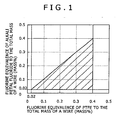
- alkali metal fluoride is necessary in accordance with the amount of PTFE, and PTFE and alkali metal fluoride are required to satisfy the following expressions 3 and 4; fluorine equivalence of alkali metal fluoride / ( fluorine equivalence of polytetrafluoroethylene ) ⁇ 1 , fluorine equivalence of alkali metal fluoride + 0.35 / ( fluorine equivalence of polytetrafluoroethylene ) ⁇ 1.
- a content of PTFE fluorine equivalence by mass percentage to the total mass of a wire
- a content of alkali metal fluoride fluorine equivalence by mass percentage to the total mass of a wire
- the region wherein the fluorine equivalence of PTFE falls within the range of 0.02 to 0.40% by mass and the fluorine equivalence of alkali metal fluoride falls within the range of 0.02 to 0.40% by mass and simultaneously the expressions 3 and 4 are satisfied is shown with the hatching.
- PTFE and alkali metal fluoride satisfy the following expressions 5 and 6; fluorine equivalence of alkali metal fluoride / ( fluorine equivalence of polytetrafluoroethylene ) ⁇ 0.8 , fluorine equivalence of alkali metal fluoride + 0.35 / ( fluorine equivalence of polytetrafluoroethylene ) ⁇ 1.2.
- the toughness of a weld metal can be stabilized.
- the lower limit of the addition amount of PTFE is 0.02% by mass percentage of fluorine equivalence to the total mass of a wire and, in this case, the C content in the PTFE is about 0.006% by mass. Hence, at least C of 0.006% by mass is contained in a wire. Further, since a steel casing and others contain C, actual C content in a wire is 0.007% or more by mass percentage to the total mass of the wire.
- a C content exceeds 0.15% by mass, arc stability at welding deteriorates, current fluctuation increases, and high temperature cracking is likely to occur during welding. For that reason, a C content is set at 0.15% or less by mass.
- the effects of reducing diffusible hydrogen and improving resistance to hygroscopicity are further exhibited.
- the PTFE content is 0.05% or more by mass (fluorine equivalence) which is in a preferable range of PTFE in this case
- the C content therein is 0.01% or more by mass.
- a required C content is 0.01% or more by mass. In this case, the effect of stabilizing the toughness of a weld with C can also be obtained.
- a C content is preferably 0.01 to 0.12% by mass, and yet preferably 0.03 to 0.10% by mass.
- C may be added not only to flux as PTFE but also to a steel casing.
- Mn 0.5 to 3.0% by mass, preferably 0.8 to 2.5% by mass
- Mn functions as a deoxidizer and improves the strength and toughness of a weld metal.
- a Mn content is less than 0.5% by mass percentage to the total mass of a wire, the effect of improving the strength and toughness of a weld metal cannot be obtained.
- a Mn content exceeds 3.0% by mass, the strength of a weld metal increases excessively, cracking resistance deteriorates, and the toughness of a weld metal is also adversely affected.
- a Mn content is set at 0.5 to 3.0% by mass, and preferably 0.8 to 2.5% by mass.
- a method of adding Mn to a wire there are two methods; one is the method of adding Mn as metallic Mn or Mn alloy such as Fe-Mn to flux and the other is the method of adding Mn as a Mn component to a steel casing, and both of the methods may be adopted.
- Si 0.2 to 1.00% by mass, preferably 0.25 to 0.80% by mass
- Si functions as a deoxidizer but, if added excessively, influences the structure of a weld metal and lowers the toughness of the weld metal.
- a Si content exceeds 1.00% by mass percentage to the total mass of a wire, the toughness of a weld metal deteriorates.
- a Si content is set at 0.2 to 1.00% by mass, and preferably 0.25 to 0.80% by mass.
- the present invention there are two methods of adding Si; one is the method of adding Si as Si alloy such as Fe-Si, Fe-Si-Mn, or the like to flux and the other is the method of adding Si as a Si component to a steel casing, and both of the methods may be adopted.
- Ni has the effect of improving the toughness of a weld metal but, when it is added excessively, high temperature cracking tends to occur. For that reason, when Ni is added, it is necessary to regulate a Ni content to 3.00% or less by mass percentage to the total mass of a wire.
- Ni may be added not only to flux as metallic Ni but also to a steel casing as a Ni component, and both of them may be adopted.
- Cr has the effect of improving the strength of a weld metal but, when it is added excessively, the strength of a weld metal increases excessively and cracking resistance deteriorates. For that reason, when Cr is added, it is necessary to regulate a Cr content to 2.50% or less by mass percentage to the total mass of a wire.
- Cr may be added not only to flux as metallic Cr but also to a steel casing as a Cr component, and both of them may be adopted.
- Mo has the effect of improving the strength of a weld metal but, when it is added excessively, the strength of a weld metal increases excessively and cracking resistance deteriorates. For that reason, when Mo is added, it is necessary to regulate a Mo content to 2.00% or less by mass percentage to the total mass of a wire.
- there are two methods of adding Mo one is the method of adding Mo as metallic Mo or alloy such as Mo-C, or the like to flux and the other is the method of adding Mo as a Mo component to a steel casing, and both of the methods may be adopted.
- Al has the effects of increasing the viscosity of molten metal at welding, improving vertical up hand weldability, and improving also welding operability.
- Al when Al is added excessively, the conformity of a bead at down hand welding deteriorates and toughness also deteriorates. For that reason, when Al is added, it is necessary to regulate an Al content to 1.00% or less by mass percentage to the total mass of a wire.
- there are two methods of adding Al one is the method of adding Al as metallic Al or alloy such as Al-Mg, or the like to flux and the other is the method of adding Al as an Al component to a steel casing, and both of the methods may be adopted.
- the aforementioned components may be added in the ranges stipulated above not only to a steel casing as the steel components but also to flux as the metallic components. That is, the aforementioned components are added as metals (including alloys thereof) also when they are added to flux. In contrast, the components stated below are those added as slag formers or deoxidizers.
- Al 2 O 3 functions as a slag former.
- Al 2 O 3 exceeds 1.00% by mass percentage to the total mass of a wire, the conformity of a bead deteriorates at down hand welding and welding operability also deteriorates.
- Al 2 O 3 is set at 1.00% or less by mass when it is added.
- a preferable addition amount of Al 2 O 3 is 0.05% or more by mass.
- a preferable upper limit of Al 2 O 3 is 0.80% by mass.
- an Al 2 O 3 source alumina or the like is cited.
- SiO 2 functions as a slag former. However, when SiO 2 exceeds 1.00% by mass percentage to the total mass of a wire, a bead at vertical welding takes a convex form. For that reason, SiO 2 is set at 1.00% or less by mass when it is added. A preferable addition amount of SiO 2 is 0.15% or more by mass. Then a preferable upper limit of SiO 2 is 0.80% by mass.
- SiO 2 source silica, potassium glass, soda glass, or the like is cited.
- ZrO 2 functions as a slag former. However, when ZrO 2 exceeds 0.80% by mass percentage to the total mass of a wire, a bead at vertical welding takes a convex form. For that reason, ZrO 2 is set at 0.80% or less by mass when it is added. A preferable addition amount of ZrO 2 is 0.05% or more by mass. Then a preferable upper limit of ZrO 2 is 0.7% by mass.
- zircon sand, zirconia, or the like is cited as a ZrO 2 source.
- Mg functions as a deoxidizer. However, when Mg exceeds 1.5% by mass percentage to the total mass of a wire, welding operability deteriorates. For that reason, Mg is set at 1.5% or less by mass when it is added. A preferable addition amount of Mg is 0.2% or more by mass. Then a preferable upper limit of Mg is 0.9% by mass.
- a Mg source metallic Mg, Ni-Mg alloy, or the like is cited.
- the balance is Fe and unavoidable impurities.
- a Fe content is less than 85% by mass percentage to the total mass of the wire, the amount of generated slag is excessive and hence weld defects such as slag inclusions are likely to occur.
- a Fe content exceeds 95% by mass, essential alloy components cannot be added.
- iron powder or Fe alloy may be added to flux.
- Fe is supplied from a steel casing, iron powder in flux, and iron alloy such as Fe-Mn, Fe-Si, and the like in flux.
- unavoidable impurities are contained in the steel casing and the added materials.
- the unavoidable impurities are P, S, Cu, V, Nb, Zr, Co, and Sn.
- the unavoidable impurities in a wire are regulated to, by mass percentage to the total mass of the wire, P: 0.03% or less, S: 0.03% or less, Cu: 0.3% or less (including Cu plating on the wire surface), V: 0.05% or less, Nb: 0.05% or less, Zr: 0.01% or less, Co: 0.01% or less, and Sn: 0.02% or less.
- alloying elements besides the above components, an arc stabilizer, and others may also be added.
- a content as metal is distinguished from a content as a chemical compound.
- Al for example, Al cited in the aforementioned term "A1: 1.00% or less by mass” does not include Al existing as a chemical compound thereof such as Al 2 O 3 .
- the diameter of a flux-cored wire according to the present invention is in the range of 1.0 to 2.0 mm. A preferable range thereof is 1.2 to 1.6 mm in practical use. Further, a preferable filling factor of flux is 10 to 25% by mass.
- the amount of moisture of each produced wire as it was and the amount of moisture of a relevant wire which was dried for one hour at 110°C and thereafter retained for 48 hours at 30°C in the atmosphere of 80% relative humidity were measured in an Ar atmosphere of 750°C by the KF (Karl Fischer) method (conforming to JIS K0068). The results are shown in Table 5. A case where the moisture after moisture absorption treatment was 500 ppm or less was defined as acceptable.
- Example Nos. 1 to 14 were the cases of satisfying the ranges stipulated in the present invention and, in any of the cases, good results were obtained in diffusible hydrogen reduction effect, resistance to hygroscopicity, and welding operability.
- Example No. 8 although the conditions stipulated in a first aspect according to the present invention were satisfied, the condition stipulated in a second aspect was not satisfied and hence the fluctuation width of the electric current was relatively large.
- Example Nos. 7 and 10 although the conditions stipulated in the first and second aspects were satisfied, the condition stipulated in a third aspect was not satisfied and hence the fluctuation width of the electric current was smaller than that in the case of Example No. 8 but was relatively large.
- the cases of Comparative example Nos. 15 to 28 had following problems.
Landscapes
- Engineering & Computer Science (AREA)
- Mechanical Engineering (AREA)
- Chemical & Material Sciences (AREA)
- Materials Engineering (AREA)
- Metallurgy (AREA)
- Organic Chemistry (AREA)
- Physics & Mathematics (AREA)
- Plasma & Fusion (AREA)
- Nonmetallic Welding Materials (AREA)
- Arc Welding In General (AREA)
Claims (7)
- Fil à flux incorporé pour le soudage à l'arc sous protection gazeuse formé en remplissant une enveloppe en acier avec un flux, dans lequel :ledit flux contient, en pourcentage en masse de la masse totale du fil, du dioxyde de titane : de 4,0 à 8,0 %, du fluorure de métal alcalin (équivalent en fluor) : de 0,02 à 0,40 %, et du polytétrafluoroéthylène (équivalent en fluor) : de 0,02 à 0,40 ;l'équivalent en fluor du fluorure de métal alcalino-terreux dans ledit flux est régulé à 0,01 % ou moins en pourcentage en masse de la masse totale du fil ; etl'équivalent en fluor du fluorure de métal alcalin dans ledit flux en pourcentage en masse de la masse totale du fil et l'équivalent en fluor du polytétrafluoroéthylène dans ledit flux en pourcentage en masse de la masse totale du fil satisfont les deux expressions suivantes ;


- Fil à flux incorporé pour le soudage à l'arc sous protection gazeuse selon la revendication 1, dans lequel au moins l'un de ladite enveloppe en acier et dudit flux contient C : de 0,007 à 0,15 % en pourcentage en masse de la masse totale du fil.
- Fil à flux incorporé pour le soudage à l'arc sous protection gazeuse selon la revendication 2, dans lequel au moins l'un de ladite enveloppe en acier et dudit flux contient C : de 0,01 à 0,12 % en pourcentage en masse de la masse totale du fil.
- Fil à flux incorporé pour le soudage à l'arc sous protection gazeuse selon l'une quelconque des revendications 1 à 3, dans lequel au moins l'un de ladite enveloppe en acier et dudit flux contient Mn : de 0,5 à 3,0 % et Si : de 0,2 à 1,00 % en pourcentage en masse de la masse totale du fil.
- Fil à flux incorporé pour le soudage à l'arc sous protection gazeuse selon l'une quelconque des revendications 1 à 4, dans lequel ledit flux contient Al2O3 : de 0,05 à 1,00 %, SiO2 : de 0,15 à 1,00 %, et ZrO2 : de 0,05 à 0,80% en pourcentage en masse de la masse totale du fil.
- Fil à flux incorporé pour le soudage à l'arc sous protection gazeuse selon l'une quelconque des revendications 1 à 5, dans lequel au moins l'un de ladite enveloppe en acier et dudit flux contient Mn : de 0,2 à 1,5 % en pourcentage en masse de la masse totale du fil.
- Fil à flux incorporé pour le soudage à l'arc sous protection gazeuse selon l'une quelconque des revendications 1 à 6, dans lequel dans lequel au moins l'un de ladite enveloppe en acier et dudit flux contient Ni : 3,00 % ou moins, Cr : 2,50 % ou moins, et Mo : 2,00 % ou moins en pourcentage en masse de la masse totale du fil.
Applications Claiming Priority (1)
| Application Number | Priority Date | Filing Date | Title |
|---|---|---|---|
| JP2005281695A JP4646764B2 (ja) | 2005-09-28 | 2005-09-28 | ガスシールドアーク溶接用フラックス入りワイヤ |
Publications (2)
| Publication Number | Publication Date |
|---|---|
| EP1769882A1 EP1769882A1 (fr) | 2007-04-04 |
| EP1769882B1 true EP1769882B1 (fr) | 2008-04-16 |
Family
ID=37487434
Family Applications (1)
| Application Number | Title | Priority Date | Filing Date |
|---|---|---|---|
| EP06016642A Active EP1769882B1 (fr) | 2005-09-28 | 2006-08-09 | Fil fourré pour le soudage à l'arc sous gaz de protection |
Country Status (7)
| Country | Link |
|---|---|
| EP (1) | EP1769882B1 (fr) |
| JP (1) | JP4646764B2 (fr) |
| KR (1) | KR100783944B1 (fr) |
| CN (1) | CN100462186C (fr) |
| NO (1) | NO343875B1 (fr) |
| RU (1) | RU2336983C2 (fr) |
| SG (1) | SG131012A1 (fr) |
Families Citing this family (23)
| Publication number | Priority date | Publication date | Assignee | Title |
|---|---|---|---|---|
| FR2950553A1 (fr) * | 2009-09-29 | 2011-04-01 | Air Liquide | Fil fourre au chrome pour soudage a l'arc |
| JP4995929B2 (ja) | 2010-01-27 | 2012-08-08 | 株式会社神戸製鋼所 | ステンレス鋼フラックス入りワイヤ |
| JP5415998B2 (ja) * | 2010-03-11 | 2014-02-12 | 株式会社神戸製鋼所 | ガスシールドアーク溶接用フラックス入りワイヤ |
| CN101837525B (zh) * | 2010-06-10 | 2011-11-16 | 哈尔滨工业大学(威海) | 一种大线能量焊接电弧焊焊条 |
| JP5842585B2 (ja) * | 2011-12-13 | 2016-01-13 | Jfeスチール株式会社 | メタル系フラックス入りワイヤおよびそれを用いた多電極サブマージアーク溶接方法 |
| US10316395B2 (en) * | 2012-10-09 | 2019-06-11 | The Esab Group, Inc. | Low-manganese gas-shielded flux cored welding electrodes |
| WO2014104731A1 (fr) | 2012-12-27 | 2014-07-03 | 주식회사 포스코 | Joint soudé à l'arc au fil fourré ultrarésistant présentant une excellente ténacité aux chocs et fil de soudage pour sa fabrication |
| JP6257193B2 (ja) * | 2013-07-12 | 2018-01-10 | 株式会社神戸製鋼所 | 肉盛溶接用フラックス入りワイヤ |
| JP6322093B2 (ja) * | 2014-09-03 | 2018-05-09 | 株式会社神戸製鋼所 | ガスシールドアーク溶接用フラックス入りワイヤ |
| RU2585605C1 (ru) * | 2014-12-09 | 2016-05-27 | Общество с ограниченной ответственностью "Региональный Северо-Западный Межотраслевой Аттестационный Центр" (ООО "РСЗ МАЦ) | Порошковая проволока для подводной сварки сталей |
| JP6382117B2 (ja) * | 2015-01-16 | 2018-08-29 | 日鐵住金溶接工業株式会社 | Ar−CO2混合ガスシールドアーク溶接用フラックス入りワイヤ |
| MY199279A (en) | 2016-03-08 | 2023-10-24 | Nippon Steel Corp | Flux-cored wire, manufacturing method of welded joint, and welded joint |
| MX395104B (es) | 2016-03-08 | 2025-03-11 | Nippon Steel Corp | Alambre con nucleo fundente, metodo de fabricacion de junta soldada y junta soldada. |
| CN106312370B (zh) * | 2016-10-28 | 2018-10-12 | 北京工业大学 | 一种用于薄板焊接的308l不锈钢药芯焊丝 |
| JP6809533B2 (ja) | 2016-11-08 | 2021-01-06 | 日本製鉄株式会社 | フラックス入りワイヤ、溶接継手の製造方法、及び溶接継手 |
| US10668572B2 (en) * | 2016-11-16 | 2020-06-02 | Lincoln Global, Inc. | Welding electrode wires having alkaline earth metals |
| CN106670682B (zh) * | 2016-12-28 | 2019-04-05 | 北京工业大学 | 一种用于薄板焊接的316(l)不锈钢药芯焊丝 |
| CN106670678B (zh) * | 2016-12-28 | 2019-04-05 | 北京工业大学 | 一种用于薄板焊接的347不锈钢药芯焊丝 |
| WO2019142835A1 (fr) * | 2018-01-16 | 2019-07-25 | 株式会社神戸製鋼所 | Fil fourré pour soudage à l'arc sous protection gazeuse |
| CN109317866B (zh) * | 2018-11-28 | 2021-06-29 | 山东聚力焊接材料有限公司 | 一种药芯材料和含该药芯材料的焊丝及该焊丝的制作方法 |
| CN114667201B (zh) * | 2019-11-08 | 2024-02-09 | 日本制铁株式会社 | 药芯焊丝以及焊接接头的制造方法 |
| CN112917044B (zh) * | 2021-02-03 | 2022-09-06 | 武汉铁锚焊接材料股份有限公司 | 一种耐潮性优良的550MPa级药芯焊丝 |
| CN116690028B (zh) * | 2023-06-14 | 2025-12-12 | 武汉铁锚焊接材料股份有限公司 | 一种高韧高效埋弧焊剂及其制备方法 |
Family Cites Families (13)
| Publication number | Priority date | Publication date | Assignee | Title |
|---|---|---|---|---|
| GB1339533A (en) * | 1969-12-08 | 1973-12-05 | Mcnish T G | Fibrous insulating materials |
| US3702390A (en) * | 1970-02-10 | 1972-11-07 | Murex Welding Processes Ltd | Arc welding |
| JPS5230736A (en) * | 1975-09-04 | 1977-03-08 | Kobe Steel Ltd | Welding flux |
| SU617216A1 (ru) * | 1977-02-07 | 1978-07-30 | Ленинградский Ордена Ленина Политехнический Институт Имени М.И.Калинина | Порошкова проволока |
| US5003155A (en) * | 1989-09-11 | 1991-03-26 | The Lincoln Electric Company | Basic metal cored electrode |
| US5091628A (en) * | 1989-09-11 | 1992-02-25 | The Lincoln Electric Company | Low hydrogen basic metal cored electrode |
| US5055655A (en) * | 1989-09-11 | 1991-10-08 | The Lincoln Electric Company | Low hydrogen basic metal cored electrode |
| US5369244A (en) * | 1989-09-11 | 1994-11-29 | The Lincoln Electric Company | Flux cored arc welding electrode |
| AU641594B2 (en) * | 1991-07-05 | 1993-09-23 | Lincoln Electric Company, The | Submerged arc flux and method of making same |
| JP2002224883A (ja) * | 2001-02-01 | 2002-08-13 | Kobe Steel Ltd | アーク溶接用フラックス入りワイヤ |
| JP3765771B2 (ja) * | 2002-04-23 | 2006-04-12 | 株式会社神戸製鋼所 | ステンレス鋼アーク溶接フラックス入りワイヤ |
| JP3758040B2 (ja) * | 2002-07-26 | 2006-03-22 | 株式会社神戸製鋼所 | 低合金耐熱鋼用ガスシールドアーク溶接用フラックス入りワイヤ |
| US20060226138A1 (en) * | 2005-04-11 | 2006-10-12 | Lincoln Global, Inc. | High strength flux cored electrode |
-
2005
- 2005-09-28 JP JP2005281695A patent/JP4646764B2/ja not_active Expired - Lifetime
-
2006
- 2006-08-09 EP EP06016642A patent/EP1769882B1/fr active Active
- 2006-08-15 SG SG200605533-9A patent/SG131012A1/en unknown
- 2006-09-26 CN CNB200610154373XA patent/CN100462186C/zh active Active
- 2006-09-27 RU RU2006134380/02A patent/RU2336983C2/ru active
- 2006-09-27 KR KR1020060094170A patent/KR100783944B1/ko active Active
- 2006-09-28 NO NO20064396A patent/NO343875B1/no unknown
Also Published As
| Publication number | Publication date |
|---|---|
| KR20070035996A (ko) | 2007-04-02 |
| EP1769882A1 (fr) | 2007-04-04 |
| NO343875B1 (no) | 2019-06-24 |
| RU2336983C2 (ru) | 2008-10-27 |
| JP2007090376A (ja) | 2007-04-12 |
| RU2006134380A (ru) | 2008-04-10 |
| JP4646764B2 (ja) | 2011-03-09 |
| CN100462186C (zh) | 2009-02-18 |
| CN1939648A (zh) | 2007-04-04 |
| KR100783944B1 (ko) | 2007-12-10 |
| NO20064396L (no) | 2007-03-29 |
| SG131012A1 (en) | 2007-04-26 |
Similar Documents
| Publication | Publication Date | Title |
|---|---|---|
| EP1769882B1 (fr) | Fil fourré pour le soudage à l'arc sous gaz de protection | |
| KR880002508B1 (ko) | 가스시일드 아아크 용접용 플럭스 충전 용접봉 | |
| US11136654B2 (en) | Low-manganese gas-shielded flux cored welding electrodes | |
| KR100805494B1 (ko) | Ni기 합금 플럭스 코어드 와이어 | |
| EP3045259B1 (fr) | Fil fourré pour soudage à l'arc sous protection de gaz mélangé ar-co2 | |
| KR101824722B1 (ko) | 탄산 가스 실드 아크 용접용 플럭스 함유 와이어 | |
| KR20060107283A (ko) | 불소를 함유한 플럭스 코어드 용접봉 | |
| EP2289661A1 (fr) | Fil à flux incorporé pour soudure à l'arc protégée en acier de grande résistance | |
| EP2463053A1 (fr) | Fil à flux incorporé pour soudure à l'arc sous protection gazeuse | |
| EP3378594A1 (fr) | Fil à flux incorporé pour soudure à l'arc sous protection gazeuse | |
| US20110073570A1 (en) | Flux cored wire for gas shielded arc welding of high strength steel | |
| KR100985681B1 (ko) | 가스 실드 아크 용접용 플럭스 함유 와이어 | |
| JP3815984B2 (ja) | 低合金耐熱鋼用ガスシールドアーク溶接用フラックス入りワイヤ | |
| KR102675635B1 (ko) | 플럭스 코어드 와이어 및 용접 방법 | |
| EP0688630B2 (fr) | Fil fourré le soudage à l'arc sous gaz protecteur | |
| EP3081327A1 (fr) | Fil à flux incorporé pour soudure à l'arc sous protection gazeuse | |
| EP0563866A1 (fr) | Fil-fourré basique pour le soudage à l'arc sous protection de gaz | |
| KR100265097B1 (ko) | 아크 용접용 플럭스 충전 와이어 | |
| JP6599807B2 (ja) | 炭酸ガスシールドアーク溶接用フラックス入りワイヤ | |
| EP0798070B2 (fr) | Fil électrode à âme de flux pour soudage à l'àrc | |
| JPH08257791A (ja) | 低水素系被覆アーク溶接棒 | |
| JP4838100B2 (ja) | 耐候性鋼用水平すみガスシールドアーク溶接用フラックス入りワイヤ | |
| JPH0378197B2 (fr) | ||
| KR100532244B1 (ko) | 용접용 메탈계 플럭스 충전와이어 | |
| KR20240068729A (ko) | Ni기 합금 피복 아크 용접봉 |
Legal Events
| Date | Code | Title | Description |
|---|---|---|---|
| PUAI | Public reference made under article 153(3) epc to a published international application that has entered the european phase |
Free format text: ORIGINAL CODE: 0009012 |
|
| AK | Designated contracting states |
Kind code of ref document: A1 Designated state(s): AT BE BG CH CY CZ DE DK EE ES FI FR GB GR HU IE IS IT LI LT LU LV MC NL PL PT RO SE SI SK TR |
|
| AX | Request for extension of the european patent |
Extension state: AL BA HR MK YU |
|
| 17P | Request for examination filed |
Effective date: 20070802 |
|
| GRAP | Despatch of communication of intention to grant a patent |
Free format text: ORIGINAL CODE: EPIDOSNIGR1 |
|
| AKX | Designation fees paid |
Designated state(s): GB NL SE |
|
| REG | Reference to a national code |
Ref country code: DE Ref legal event code: 8566 |
|
| GRAS | Grant fee paid |
Free format text: ORIGINAL CODE: EPIDOSNIGR3 |
|
| GRAA | (expected) grant |
Free format text: ORIGINAL CODE: 0009210 |
|
| AK | Designated contracting states |
Kind code of ref document: B1 Designated state(s): GB NL SE |
|
| REG | Reference to a national code |
Ref country code: SE Ref legal event code: TRGR |
|
| PLBE | No opposition filed within time limit |
Free format text: ORIGINAL CODE: 0009261 |
|
| STAA | Information on the status of an ep patent application or granted ep patent |
Free format text: STATUS: NO OPPOSITION FILED WITHIN TIME LIMIT |
|
| 26N | No opposition filed |
Effective date: 20090119 |
|
| PGFP | Annual fee paid to national office [announced via postgrant information from national office to epo] |
Ref country code: GB Payment date: 20190814 Year of fee payment: 14 |
|
| GBPC | Gb: european patent ceased through non-payment of renewal fee |
Effective date: 20200809 |
|
| PG25 | Lapsed in a contracting state [announced via postgrant information from national office to epo] |
Ref country code: GB Free format text: LAPSE BECAUSE OF NON-PAYMENT OF DUE FEES Effective date: 20200809 |
|
| P01 | Opt-out of the competence of the unified patent court (upc) registered |
Effective date: 20230523 |
|
| PGFP | Annual fee paid to national office [announced via postgrant information from national office to epo] |
Ref country code: NL Payment date: 20250613 Year of fee payment: 20 |
|
| PGFP | Annual fee paid to national office [announced via postgrant information from national office to epo] |
Ref country code: SE Payment date: 20250610 Year of fee payment: 20 |