EP1772285A2 - Dispositif de post-traitement avec une unité d'aplatissement d'une portion pliée et dispositif de formation d'image - Google Patents
Dispositif de post-traitement avec une unité d'aplatissement d'une portion pliée et dispositif de formation d'image Download PDFInfo
- Publication number
- EP1772285A2 EP1772285A2 EP06254524A EP06254524A EP1772285A2 EP 1772285 A2 EP1772285 A2 EP 1772285A2 EP 06254524 A EP06254524 A EP 06254524A EP 06254524 A EP06254524 A EP 06254524A EP 1772285 A2 EP1772285 A2 EP 1772285A2
- Authority
- EP
- European Patent Office
- Prior art keywords
- booklet
- unit
- sheet
- folded portion
- grasping members
- Prior art date
- Legal status (The legal status is an assumption and is not a legal conclusion. Google has not performed a legal analysis and makes no representation as to the accuracy of the status listed.)
- Withdrawn
Links
- 238000011282 treatment Methods 0.000 title claims description 166
- 238000004080 punching Methods 0.000 description 25
- 238000010586 diagram Methods 0.000 description 20
- 238000009966 trimming Methods 0.000 description 16
- 238000001514 detection method Methods 0.000 description 14
- 230000001788 irregular Effects 0.000 description 6
- 238000013459 approach Methods 0.000 description 3
- 238000000034 method Methods 0.000 description 2
- 238000012986 modification Methods 0.000 description 2
- 230000004048 modification Effects 0.000 description 2
- 238000006073 displacement reaction Methods 0.000 description 1
Images



Classifications
-
- B—PERFORMING OPERATIONS; TRANSPORTING
- B42—BOOKBINDING; ALBUMS; FILES; SPECIAL PRINTED MATTER
- B42C—BOOKBINDING
- B42C5/00—Preparing the edges or backs of leaves or signatures for binding
- B42C5/02—Preparing the edges or backs of leaves or signatures for binding by rounding or backing
-
- B—PERFORMING OPERATIONS; TRANSPORTING
- B42—BOOKBINDING; ALBUMS; FILES; SPECIAL PRINTED MATTER
- B42C—BOOKBINDING
- B42C13/00—Bookbinding presses; Joint-creasing equipment for bookbinding; Drying or setting devices for books
- B42C13/003—Joint-creasing devices
-
- B—PERFORMING OPERATIONS; TRANSPORTING
- B42—BOOKBINDING; ALBUMS; FILES; SPECIAL PRINTED MATTER
- B42C—BOOKBINDING
- B42C3/00—Making booklets, pads, or form sets from multiple webs
-
- B—PERFORMING OPERATIONS; TRANSPORTING
- B65—CONVEYING; PACKING; STORING; HANDLING THIN OR FILAMENTARY MATERIAL
- B65H—HANDLING THIN OR FILAMENTARY MATERIAL, e.g. SHEETS, WEBS, CABLES
- B65H2301/00—Handling processes for sheets or webs
- B65H2301/50—Auxiliary process performed during handling process
- B65H2301/51—Modifying a characteristic of handled material
- B65H2301/512—Changing form of handled material
- B65H2301/5123—Compressing, i.e. diminishing thickness
- B65H2301/51232—Compressing, i.e. diminishing thickness for flattening
-
- B—PERFORMING OPERATIONS; TRANSPORTING
- B65—CONVEYING; PACKING; STORING; HANDLING THIN OR FILAMENTARY MATERIAL
- B65H—HANDLING THIN OR FILAMENTARY MATERIAL, e.g. SHEETS, WEBS, CABLES
- B65H2701/00—Handled material; Storage means
- B65H2701/10—Handled articles or webs
- B65H2701/13—Parts concerned of the handled material
- B65H2701/132—Side portions
- B65H2701/1321—Side portions of folded article or web
- B65H2701/13212—Fold, spine portion of folded article
Definitions
- the present invention relates to a folded portion flattening unit incorporated into a post-treatment device which performs various post-treatments to a sheet in which an image is formed by an image forming apparatus, the post-treatment unit, and the image forming apparatus.
- the online image forming apparatus is being promoted, and the post-treatment device for performing various post-treatments to the sheet in which the image is already formed has been widely used.
- the post-treatment include a stapling treatment, a bookbinding treatment, and a punching treatment.
- an image forming apparatus 1 such as an electrophotographic printer and an electrophotographic copying machine and a post-treatment device2 connected to the image forming apparatus 1 are well known.
- the post-treatment device2 performs various post-treatments to the sheet in which the image is already formed by the image forming apparatus 1.
- the post-treatment device2 includes a transport unit 3, an intermediate treatment unit 4, and a final treatment unit 5.
- the transport unit 3 receives the sheet from the image forming apparatus 1.
- the intermediate treatment unit 4 performs various intermediate treatments to the sheet taken in by the transport unit 3, and examples of the intermediate treatment include a half-folding treatment, the stapling treatment, a saddle stitching treatment, and an interposing treatment.
- the final treatment unit 5 performs various final treatments to the sheet delivered from the intermediate treatment unit 4.
- the final treatment unit 5 includes a trimming unit 6, a folded portion flattening unit 7, a punching treatment unit 8, and a stacker unit 9.
- the trimming unit 6 trims a sheet irregular portion at a rear end of the half-folded booklet.
- the folded portion flattening unit 7 flattens a curve of a folded portion at a front end of the booklet after the trimming treatment is performed.
- the punching treatment unit 8 performs the punching treatment near the booklet front-end portion after the flattening treatment is performed.
- the booklets are stacked on the stacker unit 9 after the punching treatment is performed.
- a sheet irregular portion 10b at the rear end of the booklet 10 is trimmed by a movable blade 6a and a fixed blade 6b of a guillotine cutter which falls down toward an arrow direction as shown in Fig. 2B.
- the booklet 10 is delivered with the folded portion 10a in the lead as shown in Fig. 3A, the booklet 10 is clamped and grasped from both sides by a pair of booklet grasping members 7a as shown in Fig. 3B, a front end 10a of the folded portion is pressed with a roller 7b which travels along a longitudinal direction of the folded portion as shown in Fig. 3C, and thereby a curve 10d at the front end of the booklet is pressed to form a flat surface 10e at the front end of the folded portion.
- the booklet 10 cannot enter an opening portion of the booklet grasping members 7a, especially when a thickness of the conveyed booklet 10 is larger than an opening amount of the pair of booklet grasping members 7a.
- the thickness of the booklet 10 is smaller than the opening amount of the pair of booklet grasping members 7a, a degree of freedom for the booklet which approaches the opening portion of the booklet grasping member 7a is increased to generate a rise, the sheets are grasped while curled, and thereby the booklet cannot be uniformly grasped at an even position. Therefore, when the booklet is pressed by the roller 7b, the desired flat surface cannot be formed at the front end of the booklet, which results in a problem that the quality of the finished booklet is remarkably degraded.
- a first folded portion flattening unit includes: a sheet conveyance unit that conveys a booklet including a folded sheet with a folded portion in a lead toward a predetermined conveyance direction; a sheet stopper that stops the booklet at a predetermined position, the booklet being conveyed by the sheet conveyance unit; a pair of booklet grasping members that clamp and grasp the booklet stopped by the sheet stopper at both faces of the booklet; a pressing member that substantially flattens a curve at a front end of the folded portion of the booklet being grasped by the booklet grasping members, by pressing the front end of the folded portion toward a direction opposite to the conveyance direction; and an opening amount setting unit that sets an opening amount of an opening portion between the pair of booklet grasping members, when the conveyed booklet is sandwiched between the pair of booklet grasping members.
- the opening amount setting unit can set the opening amount of the opening portion of the booklet grasping members, so that the flat surface can stably be formed at the front end of the folded portion of the booklet.
- the folded portion flattening unit may be incorporated into a post-treatment device, the post-treatment device receiving the sheet that an image is formed on by an image forming apparatus connected to the folded portion flattening unit, the post-treatment device folding and delivering the sheet, the folded portion flattening unit includes a booklet information receiving unit that receives booklet information from the image forming apparatus, the booklet information forming the basis for setting the opening amount, and the opening amount setting unit sets the opening amount based on the booklet information received by the booklet information receiving unit.
- the opening amount can be set based on the booklet information such as the number of sheets, the sheet size, the sheet thickness, the type of sheet which constitutes the booklet. Therefore, the flat surface can stably be formed at the front end of the folded portion of the booklet.
- a first post-treatment device includes: an intermediate treatment unit that folds a sheet to produce a booklet; a sheet conveyance unit that conveys the booklet with a half-folded portion in a lead toward a predetermined conveyance direction, the booklet being produced by the intermediate treatment unit; a sheet stopper that stops the booklet at a predetermined position, the booklet being conveyed by the sheet conveyance unit; a pair of booklet grasping members that clamp and grasp the booklet stopped by the sheet stopper at both faces of the booklet; a pressing member that substantially flattens a curve at a front end of the folded portion of the booklet being grasped by the booklet grasping members, by pressing the front end of the folded portion toward a direction opposite to the conveyance direction; and an opening amount setting unit that sets an opening amount of an opening portion between the pair of booklet grasping members, when the conveyed booklet is sandwiched between the pair of booklet grasping members.
- An first image forming apparatus includes: an image forming unit that forms an image on a sheet; an intermediate treatment unit that folds a sheet to produce a booklet, the image being formed on the sheet by the image forming unit; a sheet conveyance unit that conveys the booklet with a half-folded portion in a lead toward a predetermined conveyance direction, the booklet being produced by the intermediate treatment unit; a sheet stopper that stops the booklet at a predetermined position, the booklet being conveyed by the sheet conveyance unit; a pair of booklet graspingmembers that clamp and grasp the booklet stopped by the sheet stopper at both faces of the booklet; a pressing member that substantially flattens a curve at a front end of the folded portion of the booklet being grasped by the booklet grasping members, by pressing the front end of the folded portion toward the opposite direction to the conveyance direction; and an opening amount setting unit that sets an opening amount of an opening portion between the pair of booklet grasping members, when the conveyed booklet is sandwiched between the pair of booklet grasping members
- a second folded portion flattening unit includes: a sheet conveyance unit that conveys a booklet including a folded sheet with a folded portion in a lead toward a predetermined conveyance direction; a sheet stopper that stops the booklet at a predetermined position, the booklet being conveyed by the sheet conveyance unit; a pair of booklet grasping members that clamps and grasps the booklet stopped by the sheet stopper at both faces of the booklet; a pressing member that substantially flattens a curve at a front end of the folded portion of the booklet being grasped by the booklet grasping members, by pressing the front end of the folded portion toward the opposite direction to the conveyance direction; and a grasping force adjustment unit that adjusts grasping force, the grasping force being generated by the pair of booklet grasping members when the pair of booklet grasping members grasp the booklet stopped by the sheet stopper.
- the grasping force adjustment unit can adjust the grasping force by the booklet grasping members, so that the flat surface can stably be formed at the front end of the folded portion of the booklet.
- the folded portion flattening unit may be incorporated into a post-treatment device, the post-treatment device receiving the sheet that an image is formed on by an image forming apparatus connected to the folded portion flattening unit, the post-treatment device folding and delivering the sheet, the folded portion flattening unit includes a booklet information receiving unit that receives booklet information from the image forming apparatus, the booklet information forming the basis for adjusting the grasping force, and the opening amount setting unit adjusts the grasping force based on the booklet information received by the booklet information receiving unit.
- the grasping force can be adjusted based on the booklet information such as the number of sheets, the sheet size, the sheet thickness, and the type of sheet which constitutes the booklet. Therefore, the flat surface can stably be formed at the front end of the folded portion of the booklet.
- a second post-treatment device includes: an intermediate treatment unit that folds a sheet to produce a booklet; a sheet conveyance unit that conveys the booklet with a foldedportion in a lead toward a predetermined conveyance direction, the booklet being produced by the intermediate treatment unit; a sheet stopper that stops the booklet at a predetermined position, the booklet being conveyed by the sheet conveyance unit; a pair of booklet grasping members that clamp and grasp the booklet stopped by the sheet stopper at both faces of the booklet; a pressing member that substantially flattens a curve at a front end of the folded portion of the booklet being grasped by the booklet grasping members, by pressing the front end of the folded portion toward the opposite direction to the conveyance direction; and a grasping force adjustment unit that adjusts grasping force, the grasping force being generated by the pair of booklet grasping members when the pair of booklet grasping members grasp the booklet stopped by the sheet stopper.
- a second image forming apparatus includes: an image forming unit that forms an image on a sheet; an intermediate treatment unit that folds a sheet to produce a booklet, the images being formed in the sheets by the image forming unit; a sheet conveyance unit that conveys the booklet with a folded portion in a lead toward a predetermined conveyance direction, the booklet being produced by the intermediate treatment unit; a sheet stopper that stops the booklet at a predetermined position, the booklet being conveyed by the sheet conveyance unit; a pair of booklet grasping members that clamp and grasp the booklet stopped by the sheet stopper at both faces of the booklet; a pressing member that substantially flattens a curve at a front end of the folded portion of the booklet being grasped by the booklet grasping members, by pressing the front end of the folded portion toward the opposite direction to the conveyance direction; and a grasping force adjustment unit that adjusts grasping force, the grasping force being generated by the pair of booklet grasping members when the pair of booklet grasping members grasp
- the invention can provide the folded portion flattening unit, the post-treatment device, and the image forming apparatus, which can stably form the flat surface by flattening the curve at the front end of the folded portion of the half-folded booklet.
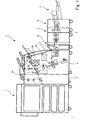
- Fig. 1 is a block diagram showing a post-treatment device into which a folded portion flattening unit of a first exemplary embodiment is incorporated.
- Fig. 1 shows a post-treatment device 2 connected to an image forming apparatus 1 such as a printer and a copying machine.
- the post-treatment device 2 includes a transport unit 3, an intermediate treatment unit 4, and a final treatment unit 5.
- the transport unit 3 receives a sheet from the image forming apparatus 1.
- the intermediate treatment unit 4 includes a punching treatment section 4a which performs a punching treatment to the sheet taken in by the transport unit 3, a stapling treatment section 4b which performs a stapling treatment, and a half-fold treatment section 4c which performs a half-fold treatment.
- a final treatment unit 5 performs various final treatments to the sheet delivered from the intermediate treatment unit 4.
- the image forming apparatus 1 corresponds to an example of the image forming unit according to an aspect of the invention.
- a combination of the image forming apparatus 1 and the post-treatment device 2 corresponds to an example of the image forming apparatus according to the aspect of the invention.
- the final treatment unit 5 includes a trimming unit 6, a folded portion flattening unit 7, a punching treatment section 8, and a stacker unit 9.
- the trimming unit 6 trims a sheet irregular portion at a rear end of the half-folded booklet.
- the folded portion flattening unit 7 flattens a curve at a front end of the trimmed folded booklet.
- the punching treatment section 8 performs the punching treatment near the flattened booklet front-end portion.
- the booklets to which the punching treatment is already performed are stacked in the stacker unit 9.
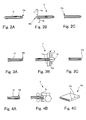
- Figs. 2A to 2C are a schematic diagram of the trimming unit 6 incorporated into the final treatment unit 5 of the post-treatment device 2 shown in Fig. 1.
- a booklet 10 which is half-folded by the intermediate treatment unit 4 (see Fig. 1) is delivered to the trimming unit 6 of the final treatment unit 5 with a folded portion 10a in the lead as shown in Fig. 2A
- a sheet irregular portion 10b at the rear end of the booklet 10 is trimmed by a movable blade 6a and a fixed blade 6b of a guillotine cutter which falls down toward an arrow direction as shown in Fig. 2B.
- the rear end portion 10c of the booklet 10 is trimmed, which produces the booklet 10 in which the page is easily turned over.
- Figs. 3A to 3C are a schematic diagram of the foldedportion flattening unit 7 incorporated into the final treatment unit 5 of the post-treatment device 2 shown in Fig. 1.
- the booklet 10 When the booklet 10 whose rear end is trimmed by the trimming unit 6 (see Fig. 2) is delivered to the folded portion flattening unit 7 with the folded portion 10a in the lead as shown in Fig. 3A, the booklet 10 is clamped and grasped by a pair of booklet grasping members 7a included in the folded portion flattening unit 7 as shown in Fig. 3B. As shown in Fig. 3C, in the front end 10a of the folded portion, the curve 10d at the front end is pressed by a roller 7b to finally form the flattened flat surface 10e.
- Fig. 4 is a schematic diagram of the punching treatment section 8 incorporated into the final treatment unit 5 of the post-treatment device 2 shown in Fig. 1.
- the booklet flattened by the folded portion flattening unit 7 (see Figs. 3A through 3C) is delivered to the punching treatment section 8 as shown in Fig. 4A, the puncher 8a performs the punching treatment near the booklet front-end portion 10f as shown in Fig. 4B, and punch holes 10g are made to complete a booklet 10h as shown in Fig. 4C.
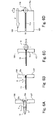
- Fig. 5 shows a block diagram showing the folded portion flattening unit according to the first exemplary embodiment.
- the folded portion flattening unit 100 includes a sheet conveyance unit, a sheet stopper 104, a sheet stopper motor 105, a pair of booklet grasping members 106 and 107, a grasping member drive motor 108, a spring 109, and a roller 110.
- the curve at the front end of the booklet folded portion 10a is flattened to form the flat surface at the front end of the folded portion 10a by the roller 110.
- the sheet conveyance unit includes sheet conveyance rollers 101, clamp rollers 102, and a sheet detection sensor 103.
- the sheet conveyance rollers 101 conveys the booklet 10 including the plural half-folded sheets toward a conveyance direction shown by an arrow A with the folded portion 10a in the lead, and the clamp rollers 102 clamp the conveyed booklet 10.
- the sheet stopper 104 stops the booklet 10 conveyed by the sheet conveyance unit at a predetermined position.
- the sheet stopper motor 105 moves the sheet stopper 104 between an actuated position 104a and a standby position 104b in the direction of an arrow C.
- the pair of booklet grasping members 106 and 107 clamps and grasps the booklet 10 stopped by the sheet stopper 104.
- the grasping member drive motor 108 vertically moves the booklet grasping member 106 in the direction of an arrow D.
- the spring 109 presses the booklet grasping member 107 against the booklet 10.
- the roller 110 presses the front end of the folded portion 10a of the booklet 10 grasped by the booklet grasping members 106 and 107 toward the opposite direction to the conveyance direction A.
- the folded portion flattening unit 100 also includes an opening amount setting unit 114 which sets an opening amount O of an opening portion formed between the pair of booklet grasping members 106 and 107 when the conveyed booklet 10 is sandwiched between the pair of booklet grasping members 106 and 107.
- the folded portion flattening unit 100 of the first exemplary embodiment has a booklet information receiving unit 115.
- the booklet information receiving unit 115 is incorporated into the post-treatment device2 (see Fig. 1).
- the post-treatment device2 receives the plural sheets in which the images are formed by the image forming apparatus 1 (see Fig. 1) connected to the folded portion flattening unit 100, and the post-treatment device2 half-folds and delivers the sheets.
- the booklet information receiving unit 115 receives booklet information which forms the basis for setting the opening amount from the image forming apparatus 1.
- the opening amount setting unit 114 is configured to set the opening amount based on the booklet information received by the booklet information receiving unit 115.
- the roller 110 of the first exemplary embodiment corresponds to the pressing member according to the aspect of the invention, and the roller 110 includes.a roller which is rotated while pressing the folded portion toward a longitudinal direction.
- the roller 110 is configured to be moved between the operating position and the standby position (not shown) by a roller moving motor 111.
- a roller surface of the roller 110 which presses the front end of the folded portion is formed in an abacus bead-shape.
- the concave surface disappears instantly to form the flat surface after pressing the front end.
- the folded portion flattening unit 100 includes a control unit 113 which comprehensively controls operations of the sheet conveyance rollers 101, the clamp rollers 102, the sheet detection sensor 103, the sheet stopper 104, the sheet stopper motor 105, the booklet graspingmembers 106 and 107, the grasping member drive motor 108, the roller 110, the roller moving motor 111, the opening amount setting unit 114, the booklet information receiving unit 115, and the like.
- Figs. 6A to 6D are an explanatory view showing an operation of the folded portion flattening unit shown in Fig. 5.
- the booklet information receiving unit 115 receives the booklet information from the image forming apparatus 1 (see Fig. 1) and the opening amount setting unit 114 sets the opening amount based on the booklet information.
- the booklet information forms the basis for setting the opening amount of the opening portion between the booklet grasping members 106 and 107. Examples of the booklet information include the number of sheets, a sheet size, a sheet thickness, and a type of sheet which constitutes the booklet.
- the booklet 10 including the plural half-folded sheets are delivered with the folded portion 10a in the lead into the opening portion of the booklet grasping members 106 and 107 which is set at the opening amount O predetermined by the opening amount setting unit 114.
- the opening amount O is set based on the booklet information received from the image forming apparatus 1 by the opening amount setting unit 114. Therefore, it is possible to prevent a problem that the booklet cannot enter the opening portion because the booklet has the thickness larger than the opening amount O between the pair of booklet grasping members 7a, and there is also prevented the problem that the booklet rises in the opening portion of the booklet grasping members 7a because the booklet has the thickness smaller than the opening amount O.
- the clamp rollers 102 clamp and convey the conveyed booklet in the direction of the arrow A in conjunction with the sheet conveyance rollers 101, and the folded portion 10a reaches a predetermined position, namely, the folded portion 10a abuts on the sheet stopper 104 which is moved to the actuated position 104a by the sheet stopper motor 105. At this point, the conveyance is ended.
- the sheet detection sensor 103 arranged in front of the clamp rollers 102 detects the booklet approach
- the sheet detection sensor 103 sends a detection signal to the control unit 113
- the control unit 113 performs the sheet conveyance controls with the sheet conveyance rollers 101 and the clamp rollers 102 based on the detection signal from the sheet detection sensor 103.
- control unit 113 receives information that the booklet 10 abuts on the sheet stopper 104, the control unit 113 places priority on the information and performs the control such that the conveyance of the booklet 10 is ended.
- the sheet stopper 104 is moved to the standby position 104b by the sheet stopper motor 105, the booklet grasping member 106 is moved downward by the grasping member drive motor 108 as shown in Fig. 6B, and the booklet grasping member 106 and the booklet grasping member 107 located below clamp and grasp the booklet 10 at both faces of the booklet.
- the booklet 10 is grasped with predetermined graspingforce,because the booklet grasping member 107 is supported through the spring 109 against a chassis of the folded portion flattening unit 100.
- the roller 110 is moved to the predetermined position by the roller moving motor 111.
- Fig. 6D is a view when Fig. 6C is viewed from the direction of the arrow E.
- the roller 110 travels in the direction of the arrow F, namely, in the longitudinal direction of the folded portion 10a of the booklet 10 while rotated about a rotation axis 110a, which allows the roller 110 to press the front end of the folded portion 10a of the booklet 10 grasped by the booklet grasping members 106 and 107 toward a direction opposite to the conveyance direction A. Therefore, the curve is flattened at the front end of the folded portion 10a of the booklet 10 and the flat surface 10e (see Fig. 3C) is formed at the front end of the folded portion 10a.
- the opening amount setting unit sets the opening amount based on the booklet information received from the image forming apparatus. Therefore, there is generated no problem that the booklet having the thickness larger than the opening amount between the booklet grasping members cannot enter the opening portion. There is also prevented the problem that the evenly flat surface is not obtained in the case where when the booklet having the thickness smaller than the opening amount is conveyed, a degree of freedom for the booklet is increased to generate the rise of the booklet in the opening portion of the booklet grasping members, and the sheets are grasped while curled.
- Fig. 7 is a block diagram showing a post-treatment device into which a folded portion flattening unit according to a second exemplary embodiment of the invention is incorporated.
- Fig. 7 shows a post-treatment device22 connected to an image forming apparatus 21 such as a printer and a copying machine.
- the post-treatment device22 includes a transport unit 23, an intermediate treatment unit 24, and a final treatment unit 25.
- the transport unit 23 receives a sheet from the image forming apparatus 21.
- the intermediate treatment unit 24 includes a punching treatment section 24a which performs a punching treatment to the sheet taken in by the transport unit 23, a stapling treatment section 24b which performs a stapling treatment, and a half-fold treatment section 24c which performs a half-fold treatment.
- the final treatment unit 25 performs various final treatments to the sheet delivered from the intermediate treatment unit 24.
- the image forming apparatus 21 corresponds to an example of the image forming unit according to another aspect of the invention.
- a combination of the image forming apparatus 21 and the post-treatment device 22 corresponds to an example of the image forming apparatus according to another aspect of the invention.
- the final treatment unit 25 includes a trimming unit 26, a foldedportion flattening unit 27, a punching treatment section 28, and a stacker unit 29.
- the trimming unit 26 trims the sheet irregular portion at the rear end of the half-folded booklet.
- the folded portion flattening unit 27 flattens a curve at the front end of the trimmed folded portion.
- the punching treatment section 28 performs the punching treatment near the flattened booklet front-end portion.
- the booklets to which the punching treatment is already performed are stacked in the stacker unit 29.
- Figs. 8A to 8C are a schematic diagram of the trimming unit 26 incorporated into the final treatment unit 25 of the post-treatment device 22 shown in Fig. 7.
- a booklet 20 which is half-folded by the intermediate treatment unit 24 (see Fig. 7) is delivered to the trimming unit 26 of the final treatment unit 25 with a folded portion 20a in the lead as shown in Fig. 8A
- a sheet irregular portion 20b at the rear end of the booklet 20 is trimmed by a movable blade 26a and a fixed blade 26b of a guillotine cutter which falls down toward an arrow direction as shown in Fig. 8B.
- the rear end portion 20c of the booklet 20 is trimmed, which produces the booklet 20 whose pages can be easily turned over.
- Figs. 9A to 9C are a schematic diagram of the folded portion flattening unit incorporated into the final treatment unit 25 of the post-treatment device 22 shown in Fig. 7.
- Fig. 10 is a schematic diagram of the punching treatment section 24a incorporated into the final treatment unit 25 of the post-treatment device 22 shown in Fig. 7.
- the booklet flattened by the folded portion flattening unit 27 (see Fig. 9) is delivered to the punching treatment section 28 as shown in Fig. 10A, the puncher 28a performs the punching treatment near the booklet front-end portion 20f as shown in Fig. 10B, and punch holes 20g are made to complete a booklet 20h as shown in Fig. 10C.
- Fig. 11 is a schematic diagram showing the folded portion flattening unit according to the second exemplary embodiment.
- the folded portion flattening unit 200 includes a sheet conveyance unit, a sheet stopper 204, a sheet stopper motor 205, a pair of booklet grasping members 206 and 207, a grasping member drive motor 208, a spring 209, and a roller 210.
- the curve at the front end of the booklet folded portion 20a is flattened to form the flat surface at the front end of the folded portion 20a by the roller 210.
- the sheet conveyance unit includes sheet conveyance rollers 201, clamp rollers 202, and a sheet detection sensor 203.
- the sheet conveyance rollers 201 conveys the booklet 20 including the plural half-folded sheets toward a conveyance direction shown by an arrow A with the folded portion 20a in the lead, and the clamp rollers 202 clamps the conveyed booklet 20.
- the sheet stopper 204 stops the booklet 20 conveyed by the sheet conveyance unit at a predetermined position.
- the sheet stopper motor 205 mutually moves the sheet stopper 204 between an actuated position 204a and a standby position 204b in the direction of an arrow C.
- the pair of booklet grasping members 206 and 207 clamps and grasps the booklet 20 stopped by the sheet stopper 204.
- the grasping member drive motor 208 vertically moves one of the booklet grasping member 206 in the direction of an arrow D.
- the spring 209 presses the other grasping member 207 against the booklet 20.
- the roller 210 presses the front end of the folded portion 20a of the booklet 20 grasped by the booklet grasping members 206 and 207 toward the opposite direction to the conveyance direction A.
- the folded portion flattening unit 200 also includes an grasping force adjustment unit 214 which adjusts the grasping force by the pair of booklet grasping members 206 and 207 when the pair of booklet grasping members 206 and 207 clamp and grasp the booklet 20 at the both faces thereof that is stopped by the sheet stopper 204.
- the folded portion flattening unit 200 of the second exemplary embodiment has a booklet information receiving unit 215.
- the booklet information receiving unit 215 is incorporated into the post-treatment device 22 (see Fig. 7).
- the post-treatment device 22 receives the plural sheets in which the images are formed by the image forming apparatus 21 (see Fig. 7) connected to the folded portion flattening unit 200, and the post-treatment device22 half-folds and delivers the sheets.
- the booklet information receiving unit 215 receives booklet information, from the image forming apparatus 21, which forms the basis for setting the opening amount between the booklet grasping members 206 and 207. Examples of the booklet information include the number of sheets, the sheet size, the sheet thickness, and the type of sheet which constitutes the booklet.
- the grasping force adjustment unit 214 is configured to adjust the grasping force based on the booklet information received by the booklet information receiving unit 215.
- the roller 210 of the second exemplary embodiment corresponds to the pressing member according to another aspect of the invention, which consists of a roller which is rotated while pressing the folded portion toward a longitudinal direction of the booklet.
- the roller 210 is configured to be moved between the operating position shown in Fig. 11 and the standby position (not shown) by a roller moving motor 211.
- a roller surface of the roller 210 which presses the front end of the folded portion is formed in the abacus bead-shape.
- the concave surface disappears instantly to form the flat surface after pressing the front end.
- the folded portion flattening unit 200 includes control unit 213 which comprehensively controls operations of the sheet conveyance rollers 201, the clamp rollers 202, the sheet detection sensor 203, the sheet stopper 204, the sheet stopper motor 205, the booklet grasping members 206 and 207, the grasping member drive motor 208, the roller 210, the roller moving motor 211, the grasping force adjustment unit 214, the booklet information receiving unit 215, and the like.
- Figs. 12A to 12D are an explanatory view showing the operation of the folded portion flattening unit shown in Fig. 11.
- the booklet information receiving unit 215 receives the booklet information from the image forming apparatus 21 (see Fig. 7) and the grasping force adjustment unit 214 adjusts the grasping force based on the booklet information.
- the booklet information forms the basis for adjusting the grasping force of the booklet grasping members 206 and 207. Examples of the booklet information include the number of sheets, the sheet size, the sheet thickness, and the type of sheet which constitutes the booklet.
- the clamp rollers 202 clamp and convey the conveyed booklet in the direction of the arrow A in conjunction with the sheet conveyance rollers 201, and the folded portion 20a reaches a predetermined position, namely, the folded portion 20a abuts on the sheet stopper 204 which is moved to the actuated position 204a by the sheet stopper motor 205. At this point, the conveyance is ended.
- the sheet detection sensor 203 arranged in front of the clamp rollers 202 detect the booklet approach
- the sheet detection sensor 203 sends a detection signal to the control unit 213, and the control unit 213 performs the sheet conveyance controls with the sheet conveyance rollers 201 and the clamp rollers 202 based on the detection signal from the sheet detection sensor 203.
- control unit 213 receives information from the sheet stopper 204 that the booklet 20 abuts on the sheet stopper 204, the control unit 213 places priority on the information, and performs the control such that the conveyance of the booklet 20 is ended.
- the sheet stopper 204 is moved to the standby position 204b by the sheet stopper motor 205, the booklet grasping member 206 is moved downward by the grasping member drive motor 208 as shown in Fig. 12B, and the booklet grasping member 206 and the booklet grasping member 207 located below clamp and grasp the booklet 20 at the both faces.
- the booklet 20 is grasped with the proper grasping force adjusted by the grasping force adjustment unit 214.
- the roller 210 is moved to the predetermined position by the roller moving motor 211.
- Fig. 12D isaviewwhenFig. 12C is viewed from the direction of the arrow E.
- the roller 210 travels in the direction of the arrow F, namely, in the longitudinal of the folded portion 20a of the booklet 20 while rotated about a rotation axis 210a, which allows the roller 210 to press the front end of the folded portion 20a of the booklet 20 grasped by the booklet grasping members 206 and 207 toward the opposite direction to the conveyance direction A. Therefore, the curve is flattened at the front end of the folded portion 20a of the booklet 20 and the flat surface 20e (see Fig. 9C) is formed at the front end of the folded portion 20a.
- the grasping force adjustment unit 214 adjusts the grasping force of the booklet grasping members 206 and 207 based on the booklet information received from the image forming apparatus 21 (see Fig. 7).
- the booklet information include the number of sheets, the sheet size, the sheet thickness, and the type of sheet which constitutes the booklet. Therefore, for example, there is prevented the problem that the booklet is excessively pressed with the excessively large grasping force resulting in a trace on the booklet, when the number of sheets included in the booklet is small.
Landscapes
- Engineering & Computer Science (AREA)
- Mechanical Engineering (AREA)
- Folding Of Thin Sheet-Like Materials, Special Discharging Devices, And Others (AREA)
Applications Claiming Priority (2)
| Application Number | Priority Date | Filing Date | Title |
|---|---|---|---|
| JP2005294428A JP4760280B2 (ja) | 2005-10-07 | 2005-10-07 | 折り部平坦化装置 |
| JP2005294426A JP4760279B2 (ja) | 2005-10-07 | 2005-10-07 | 折り部平坦化装置 |
Publications (2)
| Publication Number | Publication Date |
|---|---|
| EP1772285A2 true EP1772285A2 (fr) | 2007-04-11 |
| EP1772285A3 EP1772285A3 (fr) | 2012-08-29 |
Family
ID=37772622
Family Applications (1)
| Application Number | Title | Priority Date | Filing Date |
|---|---|---|---|
| EP06254524A Withdrawn EP1772285A3 (fr) | 2005-10-07 | 2006-08-30 | Dispositif de post-traitement avec une unité d'aplatissement d'une portion pliée et dispositif de formation d'image |
Country Status (2)
| Country | Link |
|---|---|
| US (1) | US7631858B2 (fr) |
| EP (1) | EP1772285A3 (fr) |
Cited By (1)
| Publication number | Priority date | Publication date | Assignee | Title |
|---|---|---|---|---|
| EP2143679A3 (fr) * | 2008-07-11 | 2011-03-23 | Canon Kabushiki Kaisha | Appareil de traitement de feuille et appareil de formation d'image |
Families Citing this family (7)
| Publication number | Priority date | Publication date | Assignee | Title |
|---|---|---|---|---|
| JP5361351B2 (ja) * | 2007-12-07 | 2013-12-04 | キヤノン株式会社 | シート処理装置及び画像形成装置及び画像形成システム |
| US7976001B2 (en) * | 2007-12-28 | 2011-07-12 | Seiko Ltd. | Sheet stack cutter and finisher having the same |
| CN102741058B (zh) * | 2010-02-02 | 2014-10-29 | 好利用国际株式会社 | 对于向主体粘贴前的封面加入折弯加工用的纹线的装置 |
| JP5585136B2 (ja) * | 2010-03-16 | 2014-09-10 | 株式会社リコー | 背面形成装置、及び製本装置 |
| JP2011251816A (ja) * | 2010-06-02 | 2011-12-15 | Ricoh Co Ltd | 筋付け装置、及び画像形成システム |
| JP5920511B1 (ja) * | 2015-03-27 | 2016-05-18 | 富士ゼロックス株式会社 | 用紙処理装置および画像形成システム |
| JP7725283B2 (ja) * | 2021-08-04 | 2025-08-19 | 株式会社Pfu | 媒体搬送装置 |
Citations (1)
| Publication number | Priority date | Publication date | Assignee | Title |
|---|---|---|---|---|
| JP2001260564A (ja) | 2000-03-07 | 2001-09-25 | Watkiss Automation Ltd | 小冊子を製造するための方法および装置 |
Family Cites Families (8)
| Publication number | Priority date | Publication date | Assignee | Title |
|---|---|---|---|---|
| US3954548A (en) * | 1973-02-22 | 1976-05-04 | Xerox Corporation | Binding strip applicator |
| DE19859332A1 (de) * | 1998-12-22 | 2000-06-29 | Kolbus Gmbh & Co Kg | Vorrichtung zum Runden und Abpressen von Buchblocks |
| SE519617C2 (sv) * | 2001-07-19 | 2003-03-18 | Plockmatic Int Ab | Anordning och sätt för att förse hophäftade och falsade häften med fyrkantrygg |
| GB2401820B (en) * | 2003-05-21 | 2007-01-17 | Watkiss Automation Ltd | Booklet production |
| JP4541906B2 (ja) * | 2004-01-27 | 2010-09-08 | キヤノン株式会社 | シート束背面折り部平坦処理装置、シート処理装置、及び画像形成装置 |
| JP4217640B2 (ja) * | 2004-02-27 | 2009-02-04 | キヤノン株式会社 | シート束背面折り部平坦処理装置、シート束処理装置及び画像形成装置 |
| JP2006096453A (ja) * | 2004-09-28 | 2006-04-13 | Toshiba Tec Corp | シート後処理装置及び処理トレイ |
| JP4052324B2 (ja) * | 2005-01-12 | 2008-02-27 | コニカミノルタビジネステクノロジーズ株式会社 | 用紙後処理装置および画像形成システム |
-
2006
- 2006-08-30 EP EP06254524A patent/EP1772285A3/fr not_active Withdrawn
- 2006-08-31 US US11/513,180 patent/US7631858B2/en active Active
Patent Citations (1)
| Publication number | Priority date | Publication date | Assignee | Title |
|---|---|---|---|---|
| JP2001260564A (ja) | 2000-03-07 | 2001-09-25 | Watkiss Automation Ltd | 小冊子を製造するための方法および装置 |
Cited By (3)
| Publication number | Priority date | Publication date | Assignee | Title |
|---|---|---|---|---|
| EP2143679A3 (fr) * | 2008-07-11 | 2011-03-23 | Canon Kabushiki Kaisha | Appareil de traitement de feuille et appareil de formation d'image |
| KR101123575B1 (ko) | 2008-07-11 | 2012-03-12 | 캐논 가부시끼가이샤 | 시트 처리 장치 및 화상 형성 장치 |
| US8616541B2 (en) | 2008-07-11 | 2013-12-31 | Canon Kabushiki Kaisha | Sheet processing apparatus and image forming apparatus |
Also Published As
| Publication number | Publication date |
|---|---|
| US20070081877A1 (en) | 2007-04-12 |
| EP1772285A3 (fr) | 2012-08-29 |
| US7631858B2 (en) | 2009-12-15 |
Similar Documents
| Publication | Publication Date | Title |
|---|---|---|
| US8376344B2 (en) | Sheet processing apparatus and image forming apparatus equipped with the same | |
| US8186663B2 (en) | Spine formation device, saddle-stitch bookbinding apparatus, sheet-edge cutting apparatus, sheet processing apparatus, and image forming apparatus | |
| JP5669565B2 (ja) | シート処理装置及び画像形成システム | |
| CN104512758B (zh) | 纸张后处理装置及具备该纸张后处理装置的图像形成装置 | |
| US10046938B2 (en) | Apparatus for processing sheet bunches and system for forming images provided with the apparatus | |
| EP1772285A2 (fr) | Dispositif de post-traitement avec une unité d'aplatissement d'une portion pliée et dispositif de formation d'image | |
| JP4315460B2 (ja) | シート搬送装置及び画像形成装置 | |
| US8342498B2 (en) | Sheet post-processing apparatus and image forming apparatus | |
| EP1772284B1 (fr) | Dispositif de mise à plat le dos d'un bloc de livre, dispositif de post-traitement et appareil de formation d'images | |
| US8439341B2 (en) | Sheet bundle treatment apparatus configured to perform processes on crease of folded sheet bundle | |
| US8302951B2 (en) | Sheet processing apparatus and image forming system | |
| JP4760279B2 (ja) | 折り部平坦化装置 | |
| JP4760280B2 (ja) | 折り部平坦化装置 | |
| JP2011156828A (ja) | 冊子成形装置 | |
| US10518998B2 (en) | Sheet processing apparatus | |
| JP6227350B2 (ja) | シート後処理装置及びこれを備えた画像形成装置 | |
| EP1534533B1 (fr) | Appareil et procede permettant d'assembler une couverture et un ensemble de feuilles | |
| CN106185445B (zh) | 片材处理设备、图像形成系统和成对的挤压构件 | |
| JP2007237337A (ja) | 後処理装置 | |
| JP2022502287A (ja) | 同時の、背の四角折り及びブックレットの化粧裁ちのためのデバイス及び方法 | |
| JP2005306558A5 (fr) | ||
| JP2018202515A (ja) | 製本システム、製本装置、及び裁断装置とその制御方法 | |
| JP2010137378A (ja) | 製本装置及びこれを備えた画像形成システム | |
| JP2012218829A (ja) | シート処理装置及び画像形成装置 |
Legal Events
| Date | Code | Title | Description |
|---|---|---|---|
| PUAI | Public reference made under article 153(3) epc to a published international application that has entered the european phase |
Free format text: ORIGINAL CODE: 0009012 |
|
| AK | Designated contracting states |
Kind code of ref document: A2 Designated state(s): AT BE BG CH CY CZ DE DK EE ES FI FR GB GR HU IE IS IT LI LT LU LV MC NL PL PT RO SE SI SK TR |
|
| AX | Request for extension of the european patent |
Extension state: AL BA HR MK YU |
|
| PUAL | Search report despatched |
Free format text: ORIGINAL CODE: 0009013 |
|
| AK | Designated contracting states |
Kind code of ref document: A3 Designated state(s): AT BE BG CH CY CZ DE DK EE ES FI FR GB GR HU IE IS IT LI LT LU LV MC NL PL PT RO SE SI SK TR |
|
| AX | Request for extension of the european patent |
Extension state: AL BA HR MK RS |
|
| RIC1 | Information provided on ipc code assigned before grant |
Ipc: B42C 3/00 20060101ALI20120726BHEP Ipc: B42C 5/02 20060101AFI20120726BHEP Ipc: B42C 13/00 20060101ALI20120726BHEP |
|
| 17P | Request for examination filed |
Effective date: 20130225 |
|
| AKX | Designation fees paid |
Designated state(s): AT DE GB |
|
| STAA | Information on the status of an ep patent application or granted ep patent |
Free format text: STATUS: THE APPLICATION HAS BEEN WITHDRAWN |
|
| 18W | Application withdrawn |
Effective date: 20140114 |