EP1773123B1 - Pheromones - Google Patents
Pheromones Download PDFInfo
- Publication number
- EP1773123B1 EP1773123B1 EP05755592.2A EP05755592A EP1773123B1 EP 1773123 B1 EP1773123 B1 EP 1773123B1 EP 05755592 A EP05755592 A EP 05755592A EP 1773123 B1 EP1773123 B1 EP 1773123B1
- Authority
- EP
- European Patent Office
- Prior art keywords
- use according
- pheromone
- pheromone substance
- midge
- acetoxy
- Prior art date
- Legal status (The legal status is an assumption and is not a legal conclusion. Google has not performed a legal analysis and makes no representation as to the accuracy of the status listed.)
- Expired - Lifetime
Links
Images


Classifications
-
- C—CHEMISTRY; METALLURGY
- C07—ORGANIC CHEMISTRY
- C07C—ACYCLIC OR CARBOCYCLIC COMPOUNDS
- C07C69/00—Esters of carboxylic acids; Esters of carbonic or haloformic acids
- C07C69/003—Esters of saturated alcohols having the esterified hydroxy group bound to an acyclic carbon atom
-
- A—HUMAN NECESSITIES
- A01—AGRICULTURE; FORESTRY; ANIMAL HUSBANDRY; HUNTING; TRAPPING; FISHING
- A01N—PRESERVATION OF BODIES OF HUMANS OR ANIMALS OR PLANTS OR PARTS THEREOF; BIOCIDES, e.g. AS DISINFECTANTS, AS PESTICIDES OR AS HERBICIDES; PEST REPELLANTS OR ATTRACTANTS; PLANT GROWTH REGULATORS
- A01N37/00—Biocides, pest repellants or attractants, or plant growth regulators containing organic compounds containing a carbon atom having three bonds to hetero atoms with at the most two bonds to halogen, e.g. carboxylic acids
- A01N37/12—Biocides, pest repellants or attractants, or plant growth regulators containing organic compounds containing a carbon atom having three bonds to hetero atoms with at the most two bonds to halogen, e.g. carboxylic acids containing the group, wherein Cn means a carbon skeleton not containing a ring; Thio analogues thereof
-
- C—CHEMISTRY; METALLURGY
- C07—ORGANIC CHEMISTRY
- C07C—ACYCLIC OR CARBOCYCLIC COMPOUNDS
- C07C69/00—Esters of carboxylic acids; Esters of carbonic or haloformic acids
- C07C69/007—Esters of unsaturated alcohols having the esterified hydroxy group bound to an acyclic carbon atom
Definitions
- the present invention relates to the use of compounds attractive to certain insect species and a phenomene substance.
- Sex pheromones are volatile substances, produced by individuals of one sex of a species (usually the female), and which attract the opposite sex for the purposes of mating. They are generally produced in small, sometimes very small, quantities, and can be very difficult to identify. Those pheromones that have successfully been identified take a number of different forms, and are frequently long chain, saturated or unsaturated alcohols, esters or aldehydes, though pheromones with many other chemical structures have been identified, and are often blends of two or more compounds.
- pheromones are often powerful attractants, and an artificial source of a pheromone can severely disrupt the natural mate location process of the originating insect species. Thus, it is potentially useful to be able to isolate and characterise pheromones from pest or beneficial species.
- levels of natural pheromone production are sometimes exceedingly low and, in addition, natural production is also generally limited to a specific phase in the life cycle.
- Levels of production of pheromones vary greatly but are typically measurable in nanogram (1,000th of 1,000,000th of a gram) range, so that they can be very difficult to detect and characterise.
- the apple leaf midge ( Dasineura mali (Kieffer) has been demonstrated to rely on pheromones for mating.
- the pheromone is believed to be produced by a small gland which is visible, with the aid of a microscope, at the base of the female midge's ovipositor.
- This midge is a particularly important pest in apple orchards in many apple producing areas of the world, and various attempts have been made to isolate and characterise the pheromone.
- Attraction of male apple leaf midges by females was demonstrated in a laboratory bioassay, but it was not possible to isolate and identify the pheromone ( Heath, J.J., Gaul, S.O., Nash, D.M. and Smith, R.F. (1998), Evidence for a female-produced sex pheromone in the apple leaf midge, Dasineura mali (Kieffer) (Diptera: Cecidomyiidae), Canadian Entomologist 130: 109-110 ).
- the adult midge lays eggs in splits in young canes, and larvae feed on the pith beneath the rind, causing penetrating lesions which allow entry of diseases, such as the cane blight fungus Leptosphaeria coniothyrium. There are three or more generations per annum.
- organophosphate insecticides such as chlorpyrifos
- organophosphate residues were found in 22% of samples of UK produced raspberry fruit (KG Fruits Residues Data).
- EP-A-0130951 (Magnusson, et al ) discloses C12 alkyl chains substituted with alkyl and acyloxy groups for the inhibition of pheromone mediated attraction between mail and female of insects of the family Diprionidae.
- Baudouy et al (Tetrahedron (1991), 47(48), 10016-22 ) disclose synthesis of a dimethyl-6-isopropyl-deca -5,9-dien-1-yi acetate from Aonidiella citrina.
- Odinokov et al Journal Of Organic Chemistry (China), 1986, 22(5), 953-7 ) disclose ozonolysis of alkenes and the synthesis of acetates of dimethylpentadecan-2-ol and its 7-nor analogue, which are useful as pheromones of pine sawflies.
- Cooke et al (Journal Of Organic Chemistry (1982), 47(25), 4955-63 ) disclose pheromones for California red scale, particularly 8-acetyloxy-3-(3-butenyl)-6-methyl-5-octen-2-one.
- Tolstikov et al (Khimiya Prirodnykh Soedinenii (1982), (2), 239-45 ) disclose pheromones for moths, particularly 9-acetyloxy-5-nonen-2-one.
- Mori et al (Tetrahedron Letters (1981), 22(12), 1127-30 ) disclose pheromones for the cigarette beetle, particularly acetyloxy-dimethyl substituted nonanone.
- Magnusson, G (Tetrahedron (1978), 34(9), 1385-8 ) discloses pine sawfly pheromones, especially 2-acetyloxy-3-methyl-7-pentadecanone.
- a pheromone substance in a method to disrupt the mating patterns of, or to detect the presence of, a midge the pheromone substance being a C 9-19 oxoalkyl or oxoalkenyl molecule substituted with a lower alkanoyloxy group.
- the carrier or vehicle may be any suitable substance or medium, ranging from a simple solvent, generally liquid or solid, such as ethanol or wax, through to substrates such as wicking materials. Solvents need only sparingly dissolve the pheromone substance, as the such substances generally need only be used in very small amounts.
- the solvent may be selected based on its other physical characteristics, such as vapour pressure such that, on exposure to air, the solvent may readily evaporate to release the pheromone substance.
- the carrier may enable the pheromone substance to be retained in the form of a reservoir for dispensing into a device employing the pheromone, or may act to transport the pheromone and to facilitate handling, for example. Wicks may be sealed prior to use to prevent release of pheromone other than at the desired site.
- Preferred molecules have between 11 and 17 carbons, inclusive, in the alkyl or akenyl chain.
- aldehyde groups are not included in the term "oxo".
- the lower alkanoyloxy group is linked to a methylene group, to form a group >CH-O(CO)Alk where -O(CO)Alk represents the alkanoyloxy group, and >CH- represents a saturated carbon linked to at least two other carbons, and preferably only two other carbons.
- the pheromone consist only of the oxoalkyl or oxoalkenyl backbone possessing only the alkanoyloxy and oxo substituents.
- the compounds for use in the present invention are preferably straight chain compounds, and may be saturated or unsaturated.
- Unsaturated compounds for use according to the invention may be unsaturated at a plurality of positions, but preferably no more than three. It is preferred that compounds of the invention are alkanes, or are singly or doubly unsaturated alkenes. Alkanes and singly unsaturated compounds are most preferred. Where the compound is multiply unsaturated, it is preferred that the double bonds are not located on consecutive carbon atoms.
- the double bond, or bonds, where present, may be located at any position, but it is preferred that they not be located at either terminus of the molecule. Thus, it is preferred to avoid the 1- and 16- positions in a C 17 molecule, for example. More preferably, any double bonds are preferably located 3 or more carbon atoms removed from the end of the molecule.
- Preferred compounds used in the present invention are heptadecene straight chain compounds, wherein the double bond is located at a position between carbon atoms 4 and 13, preferably at the 7, 8 or 9 position, and especially at the 8 position.
- Other preferred compounds are the undecanes, especially the 2-alkanoyloxy, 5-oxo and the 2-oxo, 5-alkanoyloxy compounds, the 2-alkanoyloxy, 5-oxo being most preferred.
- Tridecane, tridecene, pentadecane and pentadecene compounds are also preferred.
- the oxo group also referred to herein as the ketone group when referred to jointly with the carbon of the backbone of the molecule to which it is attached, is located at the 2-position.
- the alkanoyloxy is situated at the 2-position, then the oxo may preferably be located at a position between 5- and 9-, preferably at the 5-position.
- the 5- position is a preferred position for the oxo moiety.
- the lower alkanoyloxy group is preferably a C 1-6 alkanoyloxy, such as the butyryloxy, propionyloxy or acetoxy groups, and is especially preferably the acetoxy group.
- the ketone group be located proximal to the double bond whilst the alkanoyloxy group is located distal to the double bond.
- the ketone group is located at any of carbon atoms 2 to 7. It is particularly preferred that the ketone group be located at the 2 position.
- the alkanoyloxy group may be located anywhere on the latter portion of the molecule, distal to the double bond, such as on any of the positions between 10 and 17, but is preferably located at position 13 of the heptadecene molecule, for example.
- the length of the molecule is not critical to the present invention. However, molecules having lengths of 9, 11, 13, 15, 17 and 19 carbons are preferred, as it has been established that biologically active compounds of this nature tend to progress in homologous series increasing by two carbons. In addition, based on a most preferred compound, 13-acetoxy-8-heptadecen-2-one, then it is preferred that, where there is at least one double bond, an increase or decrease of 2 carbons be effected at one or other side of the double bond.
- a preferred 15 carbon compound is 11-acetoxy-6-pentadecen-2-one, while another is 13-acetoxy-6-pentadecen-2-one, and another is 13-acetoxy-8-pentadecen-2-one.
- Preferred saturated compounds include: 11-acetoxypentadecan-2-one, 13-acetoxypentadecan-2-one, and 13-acetoxypentadecan-2-one.
- Preferred dienes include: 11-acetoxypentadec-6,8-dien-2-one, 13-acetoxypentadec-4,6-diene-2-one, and 13-acetoxypentadec-8,10-diene-2-one.
- Preferred 11 carbon compounds include 8-acetoxy-6-undecen-2-one, 2-acetoxy-6-undecen-5-one, 8-acetoxy-4-undecen-2-one, 6-acetoxy-6-undecen-2-one, 2-acetoxy-6-undecen-8-one, 2-acetoxy-4-undecen-8-one, and 2-acetoxy-8-undecen-6-one.
- Preferred saturated compounds include: 6-acetoxyundecan-2-one, 8-acetoxyundecan-2-one, 4-acetoxyundecan-2-one, 2-acetoxyundecan-6-one, 2-acetoxyundecan-8-one, 2-acetoxyundecan-5-one and 2-acetoxyundecan-4-one.
- Preferred dienes include 8-acetoxypentadec-4,6-dien-2-one and 2-acetoxypentadec-4,6-dien-8-one.
- Preferred 19 carbon compounds include 13-acetoxy-8-nonadecen-2-one, 15-acetoxy-8-nonadecen-2-one, 15-acetoxy-10-nonadecen-2-one, 13-acetoxy-10-nonadecen-2-one, and 15-acetoxy-6-nonadecen-2-one.
- Preferred 19 carbon dienes include: 13-acetoxynonadec-6,8-diene-2-one, 15-acetoxynonadec-11,13-diene-2-one, 15-acetoxynonadec-6,10-diene-2-one, 13-acetoxynonadec-8,10-diene-2-one, and 15-acetoxynonadec-4,6-diene-2-one.
- Preferred 17 carbon compounds include 13-acetoxy-8-heptadecen-2-one, 15-acetoxy-8-heptadecen-2-one, 15-acetoxy-10-heptadecen-2-one, 13-acetoxy-10-heptadecen-2-one, 15-acetoxy-6-heptadecen-2-one, 2-acetoxy-8-heptadecen-13-one, 2-acetoxy-8-heptadecen-15-one, 2-acetoxy-10-heptadecen-15-one, 2-acetoxy-10-heptadecen-13-one, and 2-acetoxy-6-heptadecen-15-one.
- Preferred 17 carbon dienes include: 13-acetoxyheptadec-6,8-diene-2-one, 15-acetoxyheptadec-11,13-diene-2-one, 15-acetoxyheptadec-6,10-diene-2-one, 13-acetoxyheptadec-8,10-diene-2-one, and 15-acetoxyheptadec-4,6-diene-2-one.
- the alkanoyloxy group may be in either of the R and S configurations.
- the configuration of the acetoxy group is not generally important to the present invention, as racemic mixtures of the compounds used in the invention have proven to be highly effective.
- a racemic mixture of (Z)-13-acetoxy-8-heptadecen-2-one when released at approximately 1 ng/hr, attracted 1,600 apple leaf midges to a trap.
- Similar field tests using racemic 2-acetoxy-5-undecanone attracted a significant number of raspberry cane midges to a trap.
- racemic mixtures are used, or useful, it is convenient to employ the ratio of enantiomers that occur as a result of the synthetic procedure, in order to avoid unnecessary process steps. Provided that the mixtures are effective to attract the target animal, then it does not matter what the ratio is, and even trace amounts of the active enantiomer in the mixture, if one enantiomer is more active than the other, will still have the desired effect, provided that the less active or inactive enantiomer does not serve to block, disable or otherwise mask the effect of the active enantiomer in the chosen circumstances.
- acetoxy group is referred to herein, this includes reference to any alkanoyloxy group, unless otherwise apparent or indicated. In general, the acetoxy group is the preferred alkanoyloxy group.
- the compound may be in either the Z or E configurations in relation to each double bond. Where there is a single double bond, then the Z configuration is especially preferred.
- a preferred compound of the present invention is an acetoxyheptadecenone.
- Another preferred compound for use according to the invention is an acetoxyundecanone.
- particularly preferred compounds of the invention have the following formula: and are referred to as (Z)-13-acetoxy-8-heptadecen-2-one.
- the compound produced by female apple leaf midges has been characterised as being this compound.
- Another particularly preferred compound for use according to the invention has the formula: and is referred to as 2-acetoxy-5-undecanone.
- the compound produced by female raspberry cane midges has been characterised as being this compound.
- a further preferred compound for use according to the invention has the formula: and is referred to as 5-acetoxy-2-undecanone.
- the present invention provides the use of a molecule as defined above.
- the present invention provides the use of a C 9-19 oxoalkyl or oxoalkenyl molecule substituted with a C 1-6 alkanoyloxy group, and wherein the alkanoyloxy group is attached to a methylene constituent of the oxoalkyl or oxoalkenyl molecule.
- the compounds of the invention have the formula (Z)-13-acetoxy-8-heptadecen-2-one. While we have established that only one of the R and S isomers is significantly attractive to male apple leaf midges, we have also established that racemic mixtures work exceptionally well, so that there is no need to use enantiomerically pure material.
- a further preferred compound used in the invention is 2-acetoxy-5-undecanone. While it is highly likely that one or other of the R and S isomers is more attractive to raspberry cane midges than the other, racemic mixtures have been demonstrated to work exceptionally well, so that there is no need to use enantiomerically pure material. Nevertheless, the S compound appears to be the naturally occurring compound, and is the preferred compound used in the invention.
- the preferred compounds for use according to the present invention have been shown to be identical to the naturally occurring pheromones by mass spectrometry, for example, and 13-acetoxy-8-heptadecen-2-one has been demonstrated to have a strongly attractive effect on the male apple leaf midge, for example.
- Other compounds used in the invention are expected to have similar effects on other insects, especially closely related species, particularly other midges, and limited field trials with other compounds used in the invention have attracted other, as yet unidentified, midges, thereby establishing that many midges share this pheromone structure.
- the pheromones for use according to the present invention may be made by any suitable means, although isolation from the natural source is not feasible in the absence of genetic modification. Even if the female apple leaf midge were genetically modified to produce large quantities of the pheromone, it is unlikely that commercially useful quantities could be isolated.
- target animals are midges, particularly commercial crop and especially food crop midges, including those for grain (such as wheat), olive, raspberry, apple, blackcurrant, rhubarb, blackberry, plum, cherry, blueberry, the rosaceae and the cruciferae, particularly the brasica pod midge and swede midge, as well as other plant feeding midges that have agricultural, horticultural, ornamental or forestry crops or plants as their host plant.
- the compounds for use according to the present invention may be used as desired. In general, they are suitable to attract midges or to interfere with the natural mate location process, and the preferred compounds for use according to the present invention attract the males of the apple leaf midge and the raspberry cane midge.
- a simple dispenser may be set up at a location remote from a target area, such as an orchard, but within detectable distance, thereby to attract male midges away from the orchard and prevent fertilisation of female midges in the orchard. While the males remain susceptible to the pheromone, then the artificial supply of the pheromone will act to ensure that, as far as possible, the midges remain away from the females in the orchard.
- the pheromone be suitably formulated to release it at an appropriate rate into the atmosphere and to protect it from degradation through the effects of temperature, oxygen and/or sunlight, for example.
- the apple leaf midge occurs in relatively well-defined generations in the UK and Europe, for example. Traps baited with the pheromone are suitable to provide a means of monitoring the pattern of emergence. As the traps are simple to use and specific for the target pest, they can be used by the growers themselves to optimise the timing of application of insecticide, so as to maximise the effect against the pest, and to minimise the effect on important beneficial insects, such as the parasitic wasp Platygaster demades or the predatory flower bugs Anthocoris nemorum and Anthocoris nemoratis. Similar considerations apply to the raspberry cane midge and, indeed, other insect pests.
- traps baited with pheromone may be used to verify the presence or absence of the pest in particular areas or places, such as in apple orchards in which the midge is believed not to occur, or in consignments of fruit for export or import, where fruit quarantine restrictions apply.
- determination of the presence or absence of the midge is important in determining whether any treatment is necessary.
- countries where the target midge is officially absent may use suitably baited traps to confirm the absence of midges either in consignments or areas suspected of, or liable to, contamination, for example.
- Suitable substrates include polyethylene, rubber, cotton wool, cellulose fibres, glass or ceramics, and these may take the form of supports or containers, for example.
- the amount of pheromone employed will often be very small, and it will be appropriate to employ amounts that compete effectively with, or even overwhelm, any naturally occurring pheromone in the area. Nevertheless, if too great a quantity of pheromone is employed, this can overwhelm the insects' sensors. In certain circumstances, it may be appropriate to simply overwhelm the insect in such a fashion, such as in an orchard so as to render the females undetectable by the males, but it will be appreciated that the overwhelmed insect will not be able to detect the concentration gradient necessary to attract it to the source.
- the synthetic pheromone may be dispensed from formulations such as microcapsules or twist-ties, such as are commonly used for disruption of the mating of moth pests.
- a trap loaded with at least one compound is disclosed herein. Insects attracted to the trap may be collected for counting, or investigation, for example, or a toxic substance may be incorporated into the trap to kill any insects caught.
- Such traps may take any suitable form, and killing traps need not necessarily incorporate toxic substances, the insects being optionally killed by other means, such as drowning or electrocution. Even where the insects are not killed, the trap can serve to remove the male insects from the locale of the female insects, to prevent breeding.
- Suitable forms of device for use in the present invention include traps that retain the insect until dead, such as sticky, water and oil traps, and devices that contaminate the insect with a killing agent, such as an insecticide, fungus or virus, that kills the insect later.
- a killing agent such as an insecticide, fungus or virus
- Traps may also be placed within an orchard to overwhelm the pheromones emitted by the females, so that the males simply cannot locate the females.
- a trap need be nothing more than the simple apparatus alluded to above, being simply, for example, a protected wick able to dispense pheromone.
- the wick or trap may be adapted to emit a pheromone for a period at least equivalent to the breeding season(s) of the midge, although highly aromatic pheromones may not lend themselves to such constructs.
- the midge may well have an extended breeding season, or repeated breeding season, in which case, in an alternative, the present disclosure provides a wick or trap capable of emitting pheromone for a period of time, especially about two weeks, and generally between about 1 and 4 weeks and up to 6 weeks, which may be rotated or replaced by subsequent similar traps.
- the traps may be provided in made-up form, where the compound used in the invention has already been applied. In such an instance, depending on the half life of the compound, the compound may be exposed, or may be sealed in conventional manner, such as is standard with other aromatic dispensers, the seal only being removed once the trap is in place.
- the traps may be sold separately, and the compound disclosed herein provided in dispensable format so that an amount may be applied to trap, once the trap is in place.
- the present invention may provide the use of the compound in a sachet or other dispenser.
- a device may be used that contaminates the male insects with a powder containing the pheromone substance itself.
- the contaminated males then fly off and provide a source of mating disruption by permeating the atmosphere with the pheromone substance, or by attracting other males to the contaminated males, rather than to real females.
- racemic 13-acetoxy-8-heptadecen-2-one is as shown in Scheme 3.
- Racemic 13-acetoxy-8-heptadecen-2-one was synthesised on a 20 g scale in eight steps from commercially available 6-bromo-hexanoic acid. The overall yield was 63% of distilled material (175°C/0.04 mm Hg).
- Mature raspberry cane midge larvae were collected from two infested commercial raspberry plantations of the primocane varieties Autumn Bliss and Joan Squire at Beech Farm, West Peckham, Kent on 27 and 28 of July 2004. Sections of primocane with splits and characteristic patch lesions caused by the midge of up to 25 cm length were cut from the canes and stored in ventilated plastic boxes which contained a layer of moistened paper towel in the base. The boxes each contained about 20 cane sections and were kept on the laboratory bench. Many of the mature larvae exited the lesions underneath the epidermis seeking sites to pupate on the side, lid or in the base of the boxes or they pupated in situ.
- Porapak Q 200 mg; 50/80 mesh; Supelco.
- the Porapak was Soxhlet extracted with chloroform for 8 hr, and the filters were washed well with dichloromethane immediately prior to collections. Trapped volatiles were eluted with dichloromethane (Pesticide grade; 3 x 0.5 ml) and the resulting solutions stored at 4°C.
- a low airflow rate of approximately 200 ml/min was used to minimise the desiccation stress to which the insects were subjected.
- GC analyses were carried out on a capillary GC column (30 m x 0.32 mm i.d.) coated with polar stationary phase (Wax 10; Supelco). Injection was splitless (220°C) and detection by flame ionisation detection (FID; 250°C). The oven temperature was programmed at 60°C for 2 min then at 10°C/min to 250°C. Retention times are expressed as Retention Indices relative to the retention times of normal, saturated hydrocarbons.
- GC analyses were also carried out on a column (25 mm x 0.32 mm i.d.) coated with a chiral cyclodextrin stationary phase (Chirasil-Dex CB; Chrompack). Injection was splitless (220°C) and detection by FID (250°C). The oven temperature was programmed at 60°C for 2 min then at 6°C/min to 250°C.
- GC-MS analyses were carried out with a Carlo Erba 5130 GC (Thermoelectron) linked directly to an ion trap detector (Finnigan ITD 700) operated in electron impact (EI) or chemical ionisation with isobutene (CI) modes.
- the GC column (30 m x 0.25 mm i.d.) was coated with polar Wax 10 (Supelco) and the oven temperature was programmed from 50°C for 2 min, then at 6°C/min to 250°C.
- GC-MS analyses were also carried out on a HP 6890 GC (Agilent) coupled directly to a HP 5973 MSD (Agilent) operated in EI mode.
- the GC column (30 m x 0.25 mm i.d.) was coated with non-polar SPB1 (Supelco) and the oven temperature was programmed from 60°C for 2 min, then at 6°C/min to 250°C.
- GC-EAG analyses were carried out with a HP 6890 GC (Agilent) fitted with capillary GC columns (30 mm x 0.32 mm i.d.) coated with polar (Wax10; Supelco) and non-polar (SPB1; Supelco) phases. Injection was splitless (220°C) and detection was by FID (250°). The oven temperature was programmed from 50°C for 2 min, then at 10°C/min to 250°C. The GC column effluent was split (1:1) between the FID and a silanised glass T-piece in the column oven. Nitrogen (500 ml/min) was blown continuously over the EAG preparation and every 17 sec this was diverted through the T-piece for 3 sec, blowing the contents over the EAG preparation, as described by Cork et al. (1991).
- the EAG preparation was set up by suspending the whole insect between glass electrodes containing electrolyte (0.1 M potassium chloride with 10% polyvinylpyrrolidone added to reduce evaporation). The ends of both antennae were inserted into the recording electrode and the body into the reference electrode. The electrodes were inserted into silver/silver chloride electrodes held in micromanipulators on the portable EAG device developed by Syntech (INR-02; Syntech, Hilversum, The Netherlands).
- electrolyte 0.1 M potassium chloride with 10% polyvinylpyrrolidone added to reduce evaporation.
- the ends of both antennae were inserted into the recording electrode and the body into the reference electrode.
- the electrodes were inserted into silver/silver chloride electrodes held in micromanipulators on the portable EAG device developed by Syntech (INR-02; Syntech, Hilversum, The Netherlands).
- 2-undecanone 2-acetoxyundecane
- 2-undecanol 2-acetoxyundecane was synthesised by acetylation of 2-undecanol (Example 5).
- Figure 1 of the accompanying drawings shows an example GC-EAG analysis of volatiles from female midges with male midge EAG preparation and polar GC column (GC lower trace, EAG upper trace).
- Major female-specific component is at 14.24 min; 2-undecanone at 9.07 min, 2-acetoxyundecane at 9.77 min and 2-undecanol at 10.45 min.
- EAG signals at 13.2 min and 14.9 min are probably interference spikes.
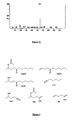
- Figures 2a-c show GC-MS analyses of volatiles from female midges.
- Figure 2a shows the Total Ion Trace (component at scan 1635);
- Figure 2b shows the EI mass spectrum;
- Figure 2c shows the CI (isobutane) mass spectrum
- the enantiomers of the chiral pheromone components could be separated in analyses on the chiral Cyclodextrin GC column. Separations of the enantiomers of 2-acetoxyundecane and 2-acetoxy-5-undecanone were very good, but the enantiomers of 2-undecanol were only poorly separated.
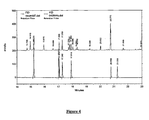
- Figure 4 shows the GC analyses on the chiral cyclodextrin column of synthetic standards (lower spectrum) and volatiles from female R. theobaldi (upper spectrum). The peaks are: 2-undecanone at 15.24 min; 2-undecanol at 17.04 and 17.06 min; 2-acetoxyundecane at 17.29 and 17.92 min; 2-acetoxy-5-undecanone at 20.80 and 21.26 min.
- Analysis of variance of the total counts from each , after log 10 (n+1) transformation to stabilise variances, followed by pairwise comparisons of means using the least significant difference (P 0.01), showed that there were no statistically significant differences between the catches in traps baited with lures containing the racemic 2-acetoxy-5-undecanone ('Major') alone or those containing a blend of racemic 2-acetoxy-5-undecanone with racemic 2-undecanol, undecanone and racemic 2-undecyl acetate ('Blend').
- Table 2 shows mean total numbers of raspberry cane midge males caught in sticky traps baited with rubber septa or polythene vial lures containing racemic 2-acetoxy-5-undecanone alone (Major), or with a blend of 2-acetoxy-5-undecanone with racemic 2-undecanol, undecanone and racemic 2-undecyl acetate ('Blend').
- Table 3 shows mean release rates of pheromone components at increasing interval from two replicate rubber septa and two replicate polythene vials in a laboratory wind tunnel at 27°C and 8 km/hr wind speed. Release rates (ng/hr) and their ratios to the major component are shown.
Landscapes
- Organic Chemistry (AREA)
- Chemical & Material Sciences (AREA)
- Life Sciences & Earth Sciences (AREA)
- Dentistry (AREA)
- Health & Medical Sciences (AREA)
- Engineering & Computer Science (AREA)
- Plant Pathology (AREA)
- General Health & Medical Sciences (AREA)
- Wood Science & Technology (AREA)
- Zoology (AREA)
- Environmental Sciences (AREA)
- Pest Control & Pesticides (AREA)
- Agronomy & Crop Science (AREA)
- Agricultural Chemicals And Associated Chemicals (AREA)
- Catching Or Destruction (AREA)
Priority Applications (1)
| Application Number | Priority Date | Filing Date | Title |
|---|---|---|---|
| PL05755592T PL1773123T3 (pl) | 2004-06-25 | 2005-06-27 | Feromony |
Applications Claiming Priority (3)
| Application Number | Priority Date | Filing Date | Title |
|---|---|---|---|
| GBGB0414359.0A GB0414359D0 (en) | 2004-06-25 | 2004-06-25 | Pheromones |
| GB0423294A GB0423294D0 (en) | 2004-06-25 | 2004-10-20 | Pheromones |
| PCT/GB2005/002504 WO2006000798A1 (en) | 2004-06-25 | 2005-06-27 | Pheromones |
Publications (2)
| Publication Number | Publication Date |
|---|---|
| EP1773123A1 EP1773123A1 (en) | 2007-04-18 |
| EP1773123B1 true EP1773123B1 (en) | 2014-06-04 |
Family
ID=34971230
Family Applications (1)
| Application Number | Title | Priority Date | Filing Date |
|---|---|---|---|
| EP05755592.2A Expired - Lifetime EP1773123B1 (en) | 2004-06-25 | 2005-06-27 | Pheromones |
Country Status (6)
| Country | Link |
|---|---|
| EP (1) | EP1773123B1 (pl) |
| AU (1) | AU2005256845B2 (pl) |
| CA (1) | CA2572025C (pl) |
| NO (1) | NO20070456L (pl) |
| PL (1) | PL1773123T3 (pl) |
| WO (1) | WO2006000798A1 (pl) |
Families Citing this family (1)
| Publication number | Priority date | Publication date | Assignee | Title |
|---|---|---|---|---|
| CN108588234B (zh) * | 2018-05-03 | 2021-12-07 | 中国林业科学研究院森林生态环境与保护研究所 | 刺槐叶瘿蚊广腹细蜂的ssr引物及其在种群遗传多样性分析中的应用 |
Family Cites Families (4)
| Publication number | Priority date | Publication date | Assignee | Title |
|---|---|---|---|---|
| SE460754B (sv) | 1983-05-30 | 1989-11-20 | Hans Goeran Magnusson | Anvaendning foer inhibering av feromonmedierad attraktion mellan hane och hona av skadeinsekten neodiprion sertifer av vissa foereningar som foereligger i 2,3-treokonfiguration |
| JPS61181419A (ja) * | 1985-02-08 | 1986-08-14 | 株式会社東芝 | コ−ヒ−ミル |
| JPS6363632A (ja) * | 1986-09-05 | 1988-03-22 | Sagami Chem Res Center | カルボニル化合物の製造方法 |
| US4925985A (en) * | 1988-11-02 | 1990-05-15 | Philip Morris Incorporated | Novel process for the production of 4,6-dimethyl-7-hydroxynonan-3-one |
-
2005
- 2005-06-27 PL PL05755592T patent/PL1773123T3/pl unknown
- 2005-06-27 AU AU2005256845A patent/AU2005256845B2/en not_active Ceased
- 2005-06-27 CA CA2572025A patent/CA2572025C/en not_active Expired - Lifetime
- 2005-06-27 WO PCT/GB2005/002504 patent/WO2006000798A1/en not_active Ceased
- 2005-06-27 EP EP05755592.2A patent/EP1773123B1/en not_active Expired - Lifetime
-
2007
- 2007-01-24 NO NO20070456A patent/NO20070456L/no not_active Application Discontinuation
Also Published As
| Publication number | Publication date |
|---|---|
| AU2005256845B2 (en) | 2009-11-19 |
| PL1773123T3 (pl) | 2015-02-27 |
| CA2572025C (en) | 2010-09-14 |
| NO20070456L (no) | 2007-03-23 |
| AU2005256845A1 (en) | 2006-01-05 |
| CA2572025A1 (en) | 2006-01-05 |
| WO2006000798A1 (en) | 2006-01-05 |
| EP1773123A1 (en) | 2007-04-18 |
Similar Documents
| Publication | Publication Date | Title |
|---|---|---|
| Rochat et al. | Male aggregation pheromone of date palm fruit stalk borer Oryctes elegans | |
| WO2014068303A1 (en) | Method of monitoring and/or controlling thysanoptera | |
| De Silva et al. | Identification of sex pheromone components of blueberry spanworm Itame argillacearia (Lepidoptera: Geometridae) | |
| Fang et al. | Sex pheromone components of the sandthorn carpenterworm, Holcocerus hippophaecolus | |
| EP1773123B1 (en) | Pheromones | |
| Stanley et al. | Evidence of male pheromone in Conogethes punctiferalis (Lepidoptera: Pyralidae) | |
| US20240057617A1 (en) | Compositions and methods for mealybug monitoring and control | |
| US8071117B2 (en) | Pheromones | |
| US7655253B2 (en) | Navel orangeworm pheromone composition | |
| AU2021268682B2 (en) | Fruit fly control | |
| US6958360B2 (en) | Attractant pheromone for the Colorado potato beetle | |
| Amarawardana | The chemical diversity of midge pheromones | |
| JP7194942B2 (ja) | 2-(1,2,2-トリメチル-3-シクロペンテニル)-2-オキソエチル=2-メチルブチレート、それを含むフェロモン剤及びフェロモン製剤、並びにエアリアル=ルート=ミーリーバグの管理方法 | |
| JP3128592B2 (ja) | ワタヘリクロノメイガの性誘引剤 | |
| US8663621B2 (en) | Identification and synthesis of a male-produced pheromone for the neotropical root weevil Diaperpes abbreviatus (coleoptera: curculionidae) | |
| Griepink | Analysis of the sex pheromones of Symmetrischema tangolias and Scrobipalpuloides absoluta | |
| US4734524A (en) | Synthetic pheromone 8-methyl-2-decanol propanoate | |
| US4563348A (en) | Sec-butyl (Z)-7-tetradecenoate and its use as a sex attractant for the grapeleaf skeletonizer | |
| Bartelt | Volatile hydrocarbon pheromones from beetles | |
| Davis | COMPOSITION OTHER PUBLICATIONS | |
| US20160052901A1 (en) | Eight Diasteromers of Vittatalactone and Methods of Making, and Methods of Attracting Acalymma vittatum | |
| US6054483A (en) | Plant volatile elicitor from insects | |
| US20150050236A1 (en) | Composition for attracting male blueberry spanworm moth | |
| Weevil | Stephen L. Lapointe, Rocco T. Alessandro, Paul S. Robbins, Ashot Khrimian, Ales Svatos, Joseph C. Dickens, Fernando Otálora-Luna, et al. | |
| Amarawardana et al. | Identification of the female sex pheromone of the pear midge, Contarinia pyrivora |
Legal Events
| Date | Code | Title | Description |
|---|---|---|---|
| PUAI | Public reference made under article 153(3) epc to a published international application that has entered the european phase |
Free format text: ORIGINAL CODE: 0009012 |
|
| 17P | Request for examination filed |
Effective date: 20070125 |
|
| AK | Designated contracting states |
Kind code of ref document: A1 Designated state(s): AT BE BG CH CY CZ DE DK EE ES FI FR GB GR HU IE IS IT LI LT LU MC NL PL PT RO SE SI SK TR |
|
| AX | Request for extension of the european patent |
Extension state: BA HR YU |
|
| RAP1 | Party data changed (applicant data changed or rights of an application transferred) |
Owner name: UNIVERSITY OF GREENWICH Owner name: EAST MALLING RESEARCH LIMITED |
|
| RAX | Requested extension states of the european patent have changed |
Extension state: YU Payment date: 20070125 Extension state: HR Payment date: 20070125 Extension state: BA Payment date: 20070125 |
|
| REG | Reference to a national code |
Ref country code: GB Ref legal event code: 713D |
|
| 17Q | First examination report despatched |
Effective date: 20091201 |
|
| GRAP | Despatch of communication of intention to grant a patent |
Free format text: ORIGINAL CODE: EPIDOSNIGR1 |
|
| RIC1 | Information provided on ipc code assigned before grant |
Ipc: C07C 69/14 20060101ALI20131108BHEP Ipc: A01P 19/00 20060101ALI20131108BHEP Ipc: C07C 69/145 20060101ALI20131108BHEP Ipc: C07C 69/24 20060101ALI20131108BHEP Ipc: A01N 37/02 20060101AFI20131108BHEP |
|
| INTG | Intention to grant announced |
Effective date: 20131211 |
|
| GRAS | Grant fee paid |
Free format text: ORIGINAL CODE: EPIDOSNIGR3 |
|
| GRAA | (expected) grant |
Free format text: ORIGINAL CODE: 0009210 |
|
| AK | Designated contracting states |
Kind code of ref document: B1 Designated state(s): AT BE BG CH CY CZ DE DK EE ES FI FR GB GR HU IE IS IT LI LT LU MC NL PL PT RO SE SI SK TR |
|
| AX | Request for extension of the european patent |
Extension state: BA HR YU |
|
| REG | Reference to a national code |
Ref country code: GB Ref legal event code: FG4D |
|
| REG | Reference to a national code |
Ref country code: CH Ref legal event code: EP |
|
| REG | Reference to a national code |
Ref country code: AT Ref legal event code: REF Ref document number: 670495 Country of ref document: AT Kind code of ref document: T Effective date: 20140615 |
|
| REG | Reference to a national code |
Ref country code: IE Ref legal event code: FG4D |
|
| REG | Reference to a national code |
Ref country code: DE Ref legal event code: R096 Ref document number: 602005043807 Country of ref document: DE Effective date: 20140717 |
|
| REG | Reference to a national code |
Ref country code: NL Ref legal event code: T3 |
|
| REG | Reference to a national code |
Ref country code: AT Ref legal event code: MK05 Ref document number: 670495 Country of ref document: AT Kind code of ref document: T Effective date: 20140604 |
|
| PG25 | Lapsed in a contracting state [announced via postgrant information from national office to epo] |
Ref country code: GR Free format text: LAPSE BECAUSE OF FAILURE TO SUBMIT A TRANSLATION OF THE DESCRIPTION OR TO PAY THE FEE WITHIN THE PRESCRIBED TIME-LIMIT Effective date: 20140905 Ref country code: CY Free format text: LAPSE BECAUSE OF FAILURE TO SUBMIT A TRANSLATION OF THE DESCRIPTION OR TO PAY THE FEE WITHIN THE PRESCRIBED TIME-LIMIT Effective date: 20140604 Ref country code: LT Free format text: LAPSE BECAUSE OF FAILURE TO SUBMIT A TRANSLATION OF THE DESCRIPTION OR TO PAY THE FEE WITHIN THE PRESCRIBED TIME-LIMIT Effective date: 20140604 Ref country code: FI Free format text: LAPSE BECAUSE OF FAILURE TO SUBMIT A TRANSLATION OF THE DESCRIPTION OR TO PAY THE FEE WITHIN THE PRESCRIBED TIME-LIMIT Effective date: 20140604 |
|
| REG | Reference to a national code |
Ref country code: LT Ref legal event code: MG4D |
|
| PG25 | Lapsed in a contracting state [announced via postgrant information from national office to epo] |
Ref country code: SE Free format text: LAPSE BECAUSE OF FAILURE TO SUBMIT A TRANSLATION OF THE DESCRIPTION OR TO PAY THE FEE WITHIN THE PRESCRIBED TIME-LIMIT Effective date: 20140604 Ref country code: AT Free format text: LAPSE BECAUSE OF FAILURE TO SUBMIT A TRANSLATION OF THE DESCRIPTION OR TO PAY THE FEE WITHIN THE PRESCRIBED TIME-LIMIT Effective date: 20140604 |
|
| PG25 | Lapsed in a contracting state [announced via postgrant information from national office to epo] |
Ref country code: RO Free format text: LAPSE BECAUSE OF FAILURE TO SUBMIT A TRANSLATION OF THE DESCRIPTION OR TO PAY THE FEE WITHIN THE PRESCRIBED TIME-LIMIT Effective date: 20140604 Ref country code: ES Free format text: LAPSE BECAUSE OF FAILURE TO SUBMIT A TRANSLATION OF THE DESCRIPTION OR TO PAY THE FEE WITHIN THE PRESCRIBED TIME-LIMIT Effective date: 20140604 Ref country code: SK Free format text: LAPSE BECAUSE OF FAILURE TO SUBMIT A TRANSLATION OF THE DESCRIPTION OR TO PAY THE FEE WITHIN THE PRESCRIBED TIME-LIMIT Effective date: 20140604 Ref country code: EE Free format text: LAPSE BECAUSE OF FAILURE TO SUBMIT A TRANSLATION OF THE DESCRIPTION OR TO PAY THE FEE WITHIN THE PRESCRIBED TIME-LIMIT Effective date: 20140604 Ref country code: PT Free format text: LAPSE BECAUSE OF FAILURE TO SUBMIT A TRANSLATION OF THE DESCRIPTION OR TO PAY THE FEE WITHIN THE PRESCRIBED TIME-LIMIT Effective date: 20141006 Ref country code: CZ Free format text: LAPSE BECAUSE OF FAILURE TO SUBMIT A TRANSLATION OF THE DESCRIPTION OR TO PAY THE FEE WITHIN THE PRESCRIBED TIME-LIMIT Effective date: 20140604 |
|
| REG | Reference to a national code |
Ref country code: CH Ref legal event code: PL |
|
| PG25 | Lapsed in a contracting state [announced via postgrant information from national office to epo] |
Ref country code: IS Free format text: LAPSE BECAUSE OF FAILURE TO SUBMIT A TRANSLATION OF THE DESCRIPTION OR TO PAY THE FEE WITHIN THE PRESCRIBED TIME-LIMIT Effective date: 20141004 |
|
| REG | Reference to a national code |
Ref country code: PL Ref legal event code: T3 |
|
| REG | Reference to a national code |
Ref country code: DE Ref legal event code: R097 Ref document number: 602005043807 Country of ref document: DE |
|
| REG | Reference to a national code |
Ref country code: IE Ref legal event code: MM4A |
|
| PG25 | Lapsed in a contracting state [announced via postgrant information from national office to epo] |
Ref country code: MC Free format text: LAPSE BECAUSE OF FAILURE TO SUBMIT A TRANSLATION OF THE DESCRIPTION OR TO PAY THE FEE WITHIN THE PRESCRIBED TIME-LIMIT Effective date: 20140604 |
|
| PLBE | No opposition filed within time limit |
Free format text: ORIGINAL CODE: 0009261 |
|
| STAA | Information on the status of an ep patent application or granted ep patent |
Free format text: STATUS: NO OPPOSITION FILED WITHIN TIME LIMIT |
|
| PG25 | Lapsed in a contracting state [announced via postgrant information from national office to epo] |
Ref country code: LI Free format text: LAPSE BECAUSE OF NON-PAYMENT OF DUE FEES Effective date: 20140630 Ref country code: IT Free format text: LAPSE BECAUSE OF FAILURE TO SUBMIT A TRANSLATION OF THE DESCRIPTION OR TO PAY THE FEE WITHIN THE PRESCRIBED TIME-LIMIT Effective date: 20140604 Ref country code: DK Free format text: LAPSE BECAUSE OF FAILURE TO SUBMIT A TRANSLATION OF THE DESCRIPTION OR TO PAY THE FEE WITHIN THE PRESCRIBED TIME-LIMIT Effective date: 20140604 Ref country code: CH Free format text: LAPSE BECAUSE OF NON-PAYMENT OF DUE FEES Effective date: 20140630 Ref country code: IE Free format text: LAPSE BECAUSE OF NON-PAYMENT OF DUE FEES Effective date: 20140627 |
|
| 26N | No opposition filed |
Effective date: 20150305 |
|
| REG | Reference to a national code |
Ref country code: DE Ref legal event code: R097 Ref document number: 602005043807 Country of ref document: DE Effective date: 20150305 |
|
| PG25 | Lapsed in a contracting state [announced via postgrant information from national office to epo] |
Ref country code: BE Free format text: LAPSE BECAUSE OF FAILURE TO SUBMIT A TRANSLATION OF THE DESCRIPTION OR TO PAY THE FEE WITHIN THE PRESCRIBED TIME-LIMIT Effective date: 20140604 |
|
| PG25 | Lapsed in a contracting state [announced via postgrant information from national office to epo] |
Ref country code: BG Free format text: LAPSE BECAUSE OF FAILURE TO SUBMIT A TRANSLATION OF THE DESCRIPTION OR TO PAY THE FEE WITHIN THE PRESCRIBED TIME-LIMIT Effective date: 20140604 |
|
| REG | Reference to a national code |
Ref country code: FR Ref legal event code: PLFP Year of fee payment: 12 |
|
| PG25 | Lapsed in a contracting state [announced via postgrant information from national office to epo] |
Ref country code: LU Free format text: LAPSE BECAUSE OF NON-PAYMENT OF DUE FEES Effective date: 20140627 Ref country code: SI Free format text: LAPSE BECAUSE OF FAILURE TO SUBMIT A TRANSLATION OF THE DESCRIPTION OR TO PAY THE FEE WITHIN THE PRESCRIBED TIME-LIMIT Effective date: 20140604 Ref country code: HU Free format text: LAPSE BECAUSE OF FAILURE TO SUBMIT A TRANSLATION OF THE DESCRIPTION OR TO PAY THE FEE WITHIN THE PRESCRIBED TIME-LIMIT; INVALID AB INITIO Effective date: 20050627 Ref country code: TR Free format text: LAPSE BECAUSE OF FAILURE TO SUBMIT A TRANSLATION OF THE DESCRIPTION OR TO PAY THE FEE WITHIN THE PRESCRIBED TIME-LIMIT Effective date: 20140604 |
|
| REG | Reference to a national code |
Ref country code: FR Ref legal event code: PLFP Year of fee payment: 13 |
|
| PGFP | Annual fee paid to national office [announced via postgrant information from national office to epo] |
Ref country code: GB Payment date: 20170614 Year of fee payment: 13 Ref country code: FR Payment date: 20170627 Year of fee payment: 13 |
|
| PGFP | Annual fee paid to national office [announced via postgrant information from national office to epo] |
Ref country code: PL Payment date: 20170622 Year of fee payment: 13 Ref country code: NL Payment date: 20170626 Year of fee payment: 13 |
|
| PGFP | Annual fee paid to national office [announced via postgrant information from national office to epo] |
Ref country code: DE Payment date: 20170628 Year of fee payment: 13 |
|
| REG | Reference to a national code |
Ref country code: DE Ref legal event code: R119 Ref document number: 602005043807 Country of ref document: DE |
|
| REG | Reference to a national code |
Ref country code: NL Ref legal event code: MM Effective date: 20180701 |
|
| GBPC | Gb: european patent ceased through non-payment of renewal fee |
Effective date: 20180627 |
|
| PG25 | Lapsed in a contracting state [announced via postgrant information from national office to epo] |
Ref country code: NL Free format text: LAPSE BECAUSE OF NON-PAYMENT OF DUE FEES Effective date: 20180701 |
|
| PG25 | Lapsed in a contracting state [announced via postgrant information from national office to epo] |
Ref country code: FR Free format text: LAPSE BECAUSE OF NON-PAYMENT OF DUE FEES Effective date: 20180630 Ref country code: DE Free format text: LAPSE BECAUSE OF NON-PAYMENT OF DUE FEES Effective date: 20190101 Ref country code: GB Free format text: LAPSE BECAUSE OF NON-PAYMENT OF DUE FEES Effective date: 20180627 |
|
| PG25 | Lapsed in a contracting state [announced via postgrant information from national office to epo] |
Ref country code: PL Free format text: LAPSE BECAUSE OF NON-PAYMENT OF DUE FEES Effective date: 20180627 |