EP1773760B1 - Procede de production catalytique de (meth)acrylates d'amides n-hydroxyalkyles - Google Patents
Procede de production catalytique de (meth)acrylates d'amides n-hydroxyalkyles Download PDFInfo
- Publication number
- EP1773760B1 EP1773760B1 EP05774614.1A EP05774614A EP1773760B1 EP 1773760 B1 EP1773760 B1 EP 1773760B1 EP 05774614 A EP05774614 A EP 05774614A EP 1773760 B1 EP1773760 B1 EP 1773760B1
- Authority
- EP
- European Patent Office
- Prior art keywords
- meth
- reaction
- alkyl
- group
- substituted
- Prior art date
- Legal status (The legal status is an assumption and is not a legal conclusion. Google has not performed a legal analysis and makes no representation as to the accuracy of the status listed.)
- Expired - Lifetime
Links
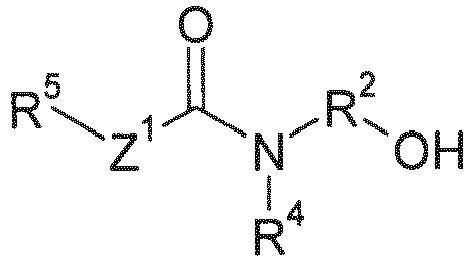
- 0 *C(N(*)*O)=O Chemical compound *C(N(*)*O)=O 0.000 description 1
Classifications
-
- C—CHEMISTRY; METALLURGY
- C07—ORGANIC CHEMISTRY
- C07D—HETEROCYCLIC COMPOUNDS
- C07D231/00—Heterocyclic compounds containing 1,2-diazole or hydrogenated 1,2-diazole rings
- C07D231/02—Heterocyclic compounds containing 1,2-diazole or hydrogenated 1,2-diazole rings not condensed with other rings
- C07D231/06—Heterocyclic compounds containing 1,2-diazole or hydrogenated 1,2-diazole rings not condensed with other rings having one double bond between ring members or between a ring member and a non-ring member
- C07D231/08—Heterocyclic compounds containing 1,2-diazole or hydrogenated 1,2-diazole rings not condensed with other rings having one double bond between ring members or between a ring member and a non-ring member with oxygen or sulfur atoms directly attached to ring carbon atoms
-
- C—CHEMISTRY; METALLURGY
- C08—ORGANIC MACROMOLECULAR COMPOUNDS; THEIR PREPARATION OR CHEMICAL WORKING-UP; COMPOSITIONS BASED THEREON
- C08F—MACROMOLECULAR COMPOUNDS OBTAINED BY REACTIONS ONLY INVOLVING CARBON-TO-CARBON UNSATURATED BONDS
- C08F8/00—Chemical modification by after-treatment
- C08F8/30—Introducing nitrogen atoms or nitrogen-containing groups
-
- C—CHEMISTRY; METALLURGY
- C12—BIOCHEMISTRY; BEER; SPIRITS; WINE; VINEGAR; MICROBIOLOGY; ENZYMOLOGY; MUTATION OR GENETIC ENGINEERING
- C12P—FERMENTATION OR ENZYME-USING PROCESSES TO SYNTHESISE A DESIRED CHEMICAL COMPOUND OR COMPOSITION OR TO SEPARATE OPTICAL ISOMERS FROM A RACEMIC MIXTURE
- C12P13/00—Preparation of nitrogen-containing organic compounds
- C12P13/02—Amides, e.g. chloramphenicol or polyamides; Imides or polyimides; Urethanes, i.e. compounds comprising N-C=O structural element or polyurethanes
-
- C—CHEMISTRY; METALLURGY
- C12—BIOCHEMISTRY; BEER; SPIRITS; WINE; VINEGAR; MICROBIOLOGY; ENZYMOLOGY; MUTATION OR GENETIC ENGINEERING
- C12P—FERMENTATION OR ENZYME-USING PROCESSES TO SYNTHESISE A DESIRED CHEMICAL COMPOUND OR COMPOSITION OR TO SEPARATE OPTICAL ISOMERS FROM A RACEMIC MIXTURE
- C12P17/00—Preparation of heterocyclic carbon compounds with only O, N, S, Se or Te as ring hetero atoms
- C12P17/10—Nitrogen as only ring hetero atom
Definitions
- the present invention relates to a process for the catalytic preparation of (meth) acrylates of N-hydroxyalkylated amides and their use.
- the preparation of (meth) acrylic esters is usually carried out by catalytic esterification of (meth) acrylic acid or transesterification of other (meth) acrylic acid esters with alcohols in the presence of strong acids or strong bases. Acid- or base-sensitive (meth) acrylic esters can therefore often not be produced selectively by esterification or transesterification.
- EP-A1 236 994 describes the preparation of ureido (meth) acrylates by transesterification of (meth) acrylate in the presence of titanium alcoholates or 1,3-dicarbonyl chelates of titanium, zirconium, iron or zinc.
- a disadvantage of these compounds is that the metal compounds are sensitive to moisture and therefore easily deactivate.
- traces of the catalysts remaining in the product influence any subsequent polymerization, and therefore must be removed from the product at high cost. Such removal is usually carried out by means of an aqueous wash, so that the product must then be dried.
- JP-A 62-185 059 and JP-A 62-175 448 describe the reaction of (meth) acrylates with alkylamino alcohols in the presence of alkali metal carbonates.
- JP-A 62-230755 describes the reaction of (meth) acrylates with alkylamino alcohols in the presence of alkali metal phosphates.
- the disclosure is limited to alkyl and dialkylamino alcohols and contains no reference to ureido alcohols or N-hydroxyalkylated amides.
- O-hydroxyalkylated carbamoyls are enzymatically esterified or transesterified with (meth) acrylic acid (ester). Again, it is a different reaction system than the ureido alcohols and N-hydroxyalkylated amides treated here.
- the object of the present invention was to provide a further process with which (meth) acrylates of N-hydroxyalkylated amides can be prepared in high conversions and high purities from simple starting materials.
- the synthesis should proceed under mild conditions so that products with a low color number and high purity result.
- the proportion of multiply (meth) acrylated products should be suppressed.
- a necessary catalyst should be easily separable and no further post-treatments, e.g. in the form of work-up steps, the reaction product result.
- At least one heterogeneous catalyst selected from the group consisting of inorganic phosphate salts (S), wherein the at least one inorganic phosphate salt (S) has a pKb value of not more than 7.0 and not less than 1.0 and a solubility in the reaction medium at 25 ° C of not more than 1 g / l, and enzymes (E), wherein the enzyme is selected from the group consisting of lipase from Candida antarctica B, lipase from Alcaligenes sp., Aspergillus sp., Mucor sp., Penicilium sp., Geotricum sp., Rhizopus sp., Burkholderia sp., Candida sp., Pseudomonas sp., Thermomyces sp. or porcine pancreas, esterified with (meth) acrylic acid or transesterified at least one (meth) acrylic acid ester (D
- aryl, alkyl, aryloxy, alkyloxy, heteroatoms and / or heterocycles C 2 -C 20 alkylene, for example, 1,2-ethylene, 1,2-propylene, 1,3-propylene, 1,4-butylene, 1, 6-hexylene, 2-methyl-1,3-propylene, 2-ethyl-1,3-propylene, 2,2-dimethyl-1,3-propylene, 2,2-dimethyl-1,4-butylene, optionally substituted by aryl, alkyl, aryloxy, alkyloxy, heteroatoms and / or heterocycles C 5 -C 12 cycloalkylene, for example, cyclopropylene, cyclopentylene, cyclohexylene, cyclooctylene, cyclododecylene, optionally substituted by aryl, alkyl, aryloxy, alkyloxy, heteroatoms and / or heterocycles
- C 1 -C 18 alkyl or optionally substituted by one or more oxygen and / or sulfur atoms and / or one or more substituted or unsubstituted imino groups C 2 -C 18 alkyl, for example methyl, ethyl, propyl, isopropyl, n-butyl, sec-butyl, tert -butyl, pentyl, hexyl, heptyl, octyl, 2-ethylhexyl, 2,4,4-trimethylpentyl, decyl, dodecyl, tetradecyl, hexadecyl, octadecyl, 1,1-dimethylpropyl, 1,1-dimethylbutyl , 1,1,3,3-tetramethylbutyl, benzyl, 1-phenylethyl, 2-phenylethyl, ⁇ , ⁇ -dimethylbenzyl, benzhydr
- R 1 examples of R 1 are 1,2-ethylene, 1,2-propylene, 1,1-dimethyl-1,2-ethylene, 1-hydroxymethyl-1,2-ethylene, 2-hydroxy-1,3-propylene, 1 , 3-propylene, 1,4-butylene, 1,6-hexylene, 2-methyl-1,3-propylene, 2-ethyl-1,3-propylene, 2,2-dimethyl-1,3-propylene and 2 , 2-dimethyl-1,4-butylene, 1,2-cyclopentylene, 1,3-cyclopentylene, 1,2-cyclohexylene, 1,3-cyclohexylene and ortho-phenylene preferred are 1,2-ethylene, 1,2-propylene, 1,3-propylene, Particularly preferred are 1,2-ethylene and 1,2-propylene and most preferred is 1,2-ethylene.
- R 2 examples are 1,2-ethylene, 1,2-propylene, 1,1-dimethyl-1,2-ethylene, 1-hydroxymethyl-1,2-ethylene, 2-hydroxy-1,3-propylene, 1 , 3-propylene, 1,4-butylene, 1,6-hexylene, 2-methyl-1,3-propylene, 2-ethyl-1,3-propylene, 2,2-dimethyl-1,3-propylene and 2,2-dimethyl-1,4-butylene, 1,2-cyclopentylene, 1,3-cyclopentylene, 1,2-cyclohexylene, 1,3-cyclohexylene and ortho-phenylene preferred are 1,2-ethylene, 1,2-propylene, 1,3-propylene, Particularly preferred are 1,2-ethylene and 1,2-propylene and most preferred is 1,2-ethylene.
- R 3 and R 5 are independently hydrogen or C 1 -C 4 -alkyl, which in the context of this document for methyl, ethyl, iso -propyl, n-propyl, n-butyl, iso -butyl, sec- butyl or tert- butyl, preferably represents hydrogen, methyl, ethyl, n-propyl and n-butyl, particularly preferably hydrogen, methyl, ethyl and n-butyl and very particularly preferably hydrogen, methyl and ethyl and in particular hydrogen.
- R 3 and R 5 may together represent 1,4-butylene, 1,5-pentylene or 3-oxa-1,5-pentylene.
- R 4 are hydrogen, methyl, ethyl, iso -propyl, n-propyl, n-butyl, iso -butyl, sec -butyl, tert -butyl, n-hexyl, n-heptyl, n-octyl, n-decyl , n-dodecyl, n-tetradecyl, n-hexadecyl, n-octadecyl, n-eicosyl, 2-ethylhexyl, cyclopentyl, cyclohexyl, cyclooctyl, cyclododecyl, phenyl, naphthyl or benzyl.
- Z 1 is preferably O or NR 3 , more preferably NR 3 .
- the ring-shaped alcohols (C) are preferred over the open-chain alcohols (O).
- Preferred individuals (C) are 2'-hydroxyethyl ethyleneurea, 3'-hydroxypropyl ethyleneurea, 2'-hydroxypropyl ethyleneurea, 2'-hydroxyethyl-1,3-propyleneurea, 2'-hydroxypropyl-1,3-propyleneurea, 3 '-Hydroxypropyl-1,3-propyleneurea, 2'-hydroxyethyl-1,2-propyleneurea, 2'-hydroxypropyl-1,2-propyleneurea, 3'-hydroxypropyl-1,2-propyleneurea, 1- (2'-hydroxy -ethyl) -imidazolidine-2,4-dione, 1- (2'-hydroxy-ethyl) -dihydro-pyrimidine-2,4-dione or 3- (2-hydroxy-ethyl) -oxazolidin-2-one.
- Preferred individuals (O) are N- (2-hydroxyethyl) urea, N- (2-hydroxypropyl) urea, N- (3-hydroxypropyl) urea, N ', N'-dimethyl-N- (2-hydroxyethyl) urea, N ', N'-dimethyl-N- (2-hydroxypropyl) urea, N', N'-dimethyl-N- (3-hydroxypropyl) urea, N ', N'-diethyl-N- (2-hydroxyethyl) urea , N ', N'-diethyl-N- (2-hydroxypropyl) urea, N', N'-diethyl-N- (3-hydroxypropyl) urea, N ', N'-di-n-butyl-N- ( 2-hydroxyethyl) urea, N ', N'-di-n-butyl-N- (2-hydroxypropyl) urea and
- step c) the esterification is carried out with (meth) acrylic acid or preferably the transesterification of the alcohol (C) or (O) with at least one, preferably a (meth) acrylate (D) in the presence of at least one heterogeneous catalyst selected from the group from inorganic phosphate salts (S) and lipases (E) selected from the group consisting of Candida antarctica B, lipase from Alcaligenes sp., Aspergillus sp., Mucor sp., Penicilium sp., Geotricum sp., Rhizopus sp., Burkholderia sp., Candida sp., Pseudomonas sp., Thermomyces sp. or porcine pancreas.
- a heterogeneous catalyst selected from the group from inorganic phosphate salts (S) and lipases (E) selected from the group consisting of Candida antarctica B,
- Compounds (D) may be (meth) acrylic acid or esters of (meth) acrylic acid with a saturated alcohol, preferably saturated C 1 -C 10 -alkyl esters of (meth) acrylic acid, particularly preferably saturated C 1 -C 4 -alkyl esters of (meth ) acrylic acid.
- Examples of compounds (D) are (meth) acrylic acid methyl, ethyl, n-butyl, iso- butyl, - tert -butyl, n-octyl and 2-ethylhexyl, 1,2-ethylene glycol di and mono (meth) acrylate, 1,4-butanediol di and mono (meth) acrylate, 1,6-hexanediol di and mono (meth) acrylate, trimethylolpropane tri (meth) acrylate and pentaerythritol tetra (meth) acrylate ,
- (meth) acrylic acid methyl, ethyl, n-butyl and 2-ethylhexyl esters particularly preference is given to (meth) acrylic acid methyl, ethyl, n-butyl and 2-ethylhexyl esters, very particular preference to methyl (meth) acrylates, ethyl and n-butyl esters, in particular (meth) acrylic acid methyl and ethyl ester and especially (meth) acrylic acid methyl ester.
- Inorganic salts (S) which can be used according to the invention are those which have a pK B value of not more than 7.0, preferably not more than 6.1, and more preferably not more than 4.0. At the same time, the pK B value should not be less than 1.0, preferably not less than 1.5, and particularly preferably not less than 1.6.
- heterogeneous catalysts are those which have a solubility in the reaction medium at 25 ° C. of not more than 1 g / l, preferably not more than 0.5 g / l and more preferably not more than 0.25 g / l.
- the inorganic salt preferably has at least one anion which (PO 4 3- ), means.
- Phosphate is also to be understood as the condensation products, such as, for example, diphosphates, triphosphates and polyphosphates.
- the inorganic salt preferably has at least one cation selected from the group consisting of alkali metals, alkaline earth metals, ammonium, cerium, iron, manganese, chromium, molybdenum, cobalt, nickel or zinc.
- alkali metals Preference is given to alkali metals and particular preference to lithium, sodium or potassium.
- Particularly preferred inorganic salts are Li 3 PO 4 , K 3 PO 4 , Na 3 PO 4 , and their hydrates, very particularly preferably K 3 PO 4 .
- K 3 PO 4 can be used according to the invention in anhydrous form and as tri-, hepta- or nonahydrate.
- the esterified or transesterified by an inorganic salt is generally carried out at 50 to 140 ° C, preferably at 50 to 100 ° C, more preferably at 60 to 90 ° C and most preferably at 60 to 80 ° C.
- the reaction can be carried out under a slight vacuum, for example from 300 hPa to atmospheric pressure, if the water released in the esterification or the low-boiling alcohol formed during the transesterification, if appropriate as an azeotrope, should be distilled off.
- the molar ratio between (meth) acrylic acid or (meth) acrylic acid ester and alcohol (C) or (D) is generally 2-6: 1 mol / mol, preferably 2-3, in the case of the transesterification or transesterification catalyzed by an inorganic salt , 5: 1 mol / mol and more preferably 2.5-3.0: 1 mol / mol.
- the reaction time in the case of the inorganic salt catalyzed esterification or transesterification is generally 30 minutes to 24 hours, preferably 45 minutes to 18 hours, more preferably 3 to 12 hours and most preferably 5 to 10 hours.
- the content of inorganic salts in the reaction medium is generally in the range of about 0.01 to 5 mol%, preferably 0.1 to 1.8 and more preferably 0.3 to 1.5 mol%, based on the sum of the components used (C) or (O).
- oxygen-containing gases s.u.
- the products having a color number below 500 APHA, preferably below 200 and particularly preferably below 150 are generally obtained.
- Enzymes (E) which can be used according to the invention are selected, for example, from the group consisting of lipase from Candida antarctica B, lipase from Alcaligenes sp., Aspergillus sp., Mucor sp., Penicilium sp., Geotricum sp., Rhizopus sp., Burkholderia sp. Candida sp., Pseudomonas sp., Thermomyces sp. or porcine pancreas.
- the enzymatic esterification or transesterification with a (meth) acrylate is generally carried out at 20 to 100 ° C, preferably 20 to 80 ° C, more preferably 30 to 70 ° C, most preferably 40 to 60 ° C.
- the upper limit of the temperature is of course the boiling point of the solvent or the alcohol released in a transesterification.
- the reaction can be carried out under a slight vacuum, for example from 300 hPa to atmospheric pressure, if the water released in the esterification or the low-boiling alcohol formed during the transesterification, if appropriate as an azeotrope, should be distilled off.
- the enzyme content in the reaction medium is generally in the range of about 0.1 to 10 wt .-%, based on the sum of the components used (C) or (O) and (D).
- the molar ratio between (meth) acrylic acid or (meth) acrylic acid ester and alcohol (C) or (D) is in the enzymatically catalyzed esterification or transesterification usually 1 - 50: 1 mol / mol, preferably 5 - 20: 1 mol / mol.
- the reaction time in the enzymatically catalyzed esterification or transesterification is generally 6 hours to 3 days, preferably 8 hours to 2 days and particularly preferably 12 to 24 hours.
- the reaction time is adjusted so that the conversion of all alcohol-containing hydroxy functions is at least 70%, preferably at least 80, particularly preferably at least 90, very particularly preferably at least 95% and in particular at least 97%.
- the enzymatically catalyzed reaction can optionally also be carried out in the absence of stabilizers (see above), preferably it is carried out in the presence of at least one stabilizer.
- reaction products obtainable in the enzymatically catalyzed reaction generally have a color number of less than 100 APHA, preferably less than 80 APHA.
- reaction parameters apply to both the enzymatic and the inorganic salts catalyzed reaction.
- the reaction can take place in organic solvents or mixtures thereof or without the addition of solvents.
- the batches are generally substantially anhydrous (i.e., below 10, preferably below 5, more preferably below 1, and most preferably below 0.5 percent by weight water content).
- the approaches are largely free of primary and secondary alcohols, i. below 10, preferably below 5, more preferably below 1 and most preferably below 0.5% by weight alcohol content.
- Suitable organic solvents are those known for this purpose, for example tertiary monools, such as C 3 -C 6 -alcohols, preferably tert-butanol, tert-amyl alcohol, pyridine, poly-C 1 -C 4 -alkylene glycol-C 1 -C 4 - alkyl ethers, preferably polyethylene glycol di-C 1 -C 4 -alkyl ethers, such as, for example, 1,2-dimethoxyethane, diethylene glycol dimethyl ether, polyethylene glycol dimethyl ether 500, C 1 -C 4 -alkylene carbonates, in particular propylene carbonate, acetic acid C 3 -C 6 -alkyl esters, in particular acetic acid tert -butyl ester, THF, toluene, 1,3-dioxolane, acetone, isobutyl methyl ketone, ethyl methyl ketone,
- the reaction is carried out in the (meth) acrylic acid ester used as starting material.
- the reaction is carried out in such a manner that the product (C) or (O) is obtained after completion of the reaction as about 10 to 80 wt% solution in the (meth) acrylic acid ester used as starting material, in particular as 20 bis 50% by weight solution.
- the educts are either dissolved, suspended as solids or in emulsion in the reaction medium before.
- the initial concentration of reactants is in the range of about 0.1 to 20 mol / l, more preferably 0.15 to 10 mol / l or 0.2 to 5 mol / l.
- the reaction can be carried out continuously, for example in a tubular reactor or in a stirred reactor cascade, or discontinuously.
- the reaction can be carried out in all reactors suitable for such a reaction. Such reactors are known to the person skilled in the art.
- the reaction preferably takes place in a stirred tank reactor or a fixed bed reactor.
- any method can be used. Special stirring devices are not required.
- the mixing can be carried out, for example, by feeding in a gas, preferably an oxygen-containing gas (see below).
- the reaction medium may be monophase or polyphase and the reactants are dissolved, suspended or emulsified therein, optionally together with the molecular sieve and added to start the reaction, and optionally one or more times in the course of the reaction, with the enzyme preparation.
- the temperature is adjusted to the desired value during the reaction and, if desired, can be increased or decreased during the course of the reaction.
- the fixed bed reactor is preferably equipped with immobilized enzymes, the reaction mixture being pumped through a column filled with the enzyme. It is also possible to carry out the reaction in a fluidized bed, wherein the enzyme is used immobilized on a support.
- the reaction mixture can be pumped continuously through the column, with the flow rate, the residence time and thus the desired conversion is controllable. It is also possible to pump the reaction mixture through a column in the circulation, wherein the liberated alcohol can be distilled off simultaneously under vacuum.
- the removal of water in the case of esterification or alcohols which are released in a transesterification of the alkyl (meth) acrylates is carried out continuously or stepwise in a conventional manner, for example by vacuum, azeotropic removal, Stripping, absorption, pervaporation and diffusion across membranes or extraction.
- the stripping can be carried out, for example, by passing an oxygen-containing gas, preferably an air or air-nitrogen mixture, through the reaction mixture, optionally in addition to a distillation.
- an oxygen-containing gas preferably an air or air-nitrogen mixture
- molecular sieves or zeolites for absorption, molecular sieves or zeolites (pore size, for example, in the range of about 3-10 angstroms) are preferred, separation by distillation or by use of suitable semipermeable membranes.
- the separated mixture of alkyl (meth) acrylate and the underlying alcohol which often forms an azeotrope, fed directly into a plant for the preparation of the alkyl (meth) acrylate, where it in an esterification with (meth ) to recycle acrylic acid.
- reaction mixture obtainable from c) can be reused without further purification or, if necessary, purified in a further step d).
- step d only the heterogeneous catalyst used is separated off from the reaction mixture and the reaction product is separated off from any organic solvent used.
- a separation from the heterogeneous catalyst is usually carried out by filtration, electro-filtration, absorption, centrifugation or decantation.
- the separated heterogeneous catalyst can then be used for further reactions.
- the separation from the organic solvent is usually carried out by distillation, rectification or solid reaction products by filtration.
- a chromatography can also be carried out.
- step d only the heterogeneous catalyst and the optionally used solvent are separated in step d).
- reaction conditions in the inventive especially in the enzymatic esterification or transesterification are mild. Due to the low temperatures and other mild conditions, the formation of by-products in step c) is avoided, which may otherwise be derived, for example, from chemical catalysts or unwanted radical polymerization of the (meth) acrylate used, which can otherwise only be prevented by adding stabilizers .
- additional stabilizer may be added to at least the (meth) acrylate or the reaction mixture (eg, hydroquinone monomethyl ether, phenothiazine, phenols, e.g.
- 2-tert-butyl-4-methylphenol, 6-tert-butyl-2,4-dimethyl-phenol or N-oxyls such as 4-hydroxy-2,2,6,6-tetramethyl-piperidine-N-oxyl , 4-oxo-2,2,6,6-tetramethylpiperidine-N-oxyl or Uvinul® 4040P from BASF Aktiengesellschaft, for example in amounts of from 50 to 2000 ppm.
- the esterification or transesterification is advantageously carried out in the presence of an oxygen-containing gas, preferably air or air-nitrogen mixtures.
- the inventively used heterogeneous catalyst can be easily removed from the final product, by the present invention low solubility of the heterogeneous catalyst in the reaction medium remain at most negligible traces of the catalyst in the product. As a result, a simple filtration or decantation usually suffices for working up the reaction product; complicated washes, neutralizations and the like for separating off the catalyst can be dispensed with by the process according to the invention.
- the catalysts used according to the invention show a low tendency to side reactions.
- the inorganic salts are sufficiently basic to catalyze an esterification or transesterification but not too basic to catalyze side reactions such as the aforementioned Michael reaction, so that by the inventive method, the proportion of Michael adducts compared to the prior art known reactions can be significantly reduced.
- reaction under the reaction conditions according to the invention is very selective, it is generally less than 10%, preferably less than 5% by-products (based on the conversion).
- Typical by-products of the reaction of compounds (C) and (O) in which Z 1 is NH with (meth) acrylic acid or (meth) acrylic acid esters are the (meth) acrylamide linked via this nitrogen atom, the Michael adduct linked via this nitrogen atom , the Michael adduct linked via the free hydroxy group, as well as Products resulting from an intra- or intermolecular cleavage of the group R 5 -Z 1 from the compounds (C) or (O), which in turn can then be esterified or transesterified.
- a particular advantage of the catalysts of the invention is that the proportion of multiply, ie at least twice (meth) acrylated products could be pushed back. Such products are difficult to separate from the mono (meth) acrylated desired product. Since the desired product is to be used as monomer or reactive diluent (see below), a content of multiply (meth) acrylated product is undesirable because such products lead to crosslinks that can unpredictably increase the molecular weight of the products in polymerizations.
- the (meth) acrylates of N-hydroxyalkylated amides prepared according to the invention are used, for example, as monomers or comonomers in the preparation of dispersions, for example acrylic dispersions, as reactive diluents, for example in radiation-curable coating compositions or in paints, preferably in exterior paints, and in dispersions for use in the paper sector ,
- the apparatus consisted of a 500mL four necked round bottom flask with air inlet tube, separation column, sampling point and internal temperature probe. The mixture was stirred with a magnetic stirrer at 300 rpm.
- the separation column used was a 20 cm Vigreux column with Raschig rings (5 ⁇ 5 mm). On the separation column, a column head with reflux regulator and Liebig condenser was placed and could be operated in all experiments without deposits of polymer.
- a homogeneous sample was prepared by dissolving any precipitate by adding 10 ml of 1,4-dioxane.
- the conversion of HEEH to the methacrylate was determined by gas chromatography using the above GC method.
Landscapes
- Chemical & Material Sciences (AREA)
- Organic Chemistry (AREA)
- Wood Science & Technology (AREA)
- Zoology (AREA)
- Life Sciences & Earth Sciences (AREA)
- Engineering & Computer Science (AREA)
- General Chemical & Material Sciences (AREA)
- Health & Medical Sciences (AREA)
- Chemical Kinetics & Catalysis (AREA)
- General Engineering & Computer Science (AREA)
- Microbiology (AREA)
- Biotechnology (AREA)
- Biochemistry (AREA)
- Bioinformatics & Cheminformatics (AREA)
- General Health & Medical Sciences (AREA)
- Genetics & Genomics (AREA)
- Polymers & Plastics (AREA)
- Medicinal Chemistry (AREA)
- Organic Low-Molecular-Weight Compounds And Preparation Thereof (AREA)
- Preparation Of Compounds By Using Micro-Organisms (AREA)
- Low-Molecular Organic Synthesis Reactions Using Catalysts (AREA)
Claims (5)
- Procédé pour la préparation de (méth)acrylates d'amides N-hydroxyalkylés, dans lequel des amides cycliques, N-hydroxyalkylés (C),

 Z1 signifie oxygène, soufre, phosphore non substitué ou substitué ou azote monosubstitué ou non substitué (N-R3) ,R1 et R2 signifient, indépendamment, C2-C20-alkylène, C5-C12-cycloalkylène, C6-C12-arylène; ou C2-C20-alkylène interrompu par un ou plusieurs atomes d'oxygène et/ou de soufre et/ou par un ou plusieurs groupes imino substitués ou non substitués et/ou par un ou plusieurs groupes cycloalkyle, - (CO) -, -O(CO)O-, -(NH)(CO)O-, -O(CO)(NH)-, -O(CO)- ou -(CO)O-, les radicaux mentionnés pouvant être à chaque fois substitués par aryle, alkyle, aryloxy, alkyloxy, des hétéroatomes et/ou des hétérocycles ou R2-OH signifie un groupe de formule -[Xi]k-H,R3, R4 et R5 signifient, indépendamment les uns des autres, hydrogène, C1-C18-alkyle ; C2-C18-alkyle, C2-C18-alcényle, C6-C12-aryle, C5-C12-cycloalkyle le cas échéant interrompu par un ou plusieurs atomes d'oxygène et/ou de soufre et/ou un ou plusieurs groupes imino substitués ou non substitués ; ou un hétérocycle de cinq à six chaînons, présentant des atomes d'oxygène, d'azote et/ou de soufre, les radicaux mentionnés pouvant à chaque fois être substitués par aryle, alkyle, aryloxy, alkyloxy, des hétéroatomes et/ou des hétérocycles, R3 et R5 pouvant également former ensemble un cycle de cinq à douze chaînons, à condition que, dans le cas où Z1 = 0, R5 représente uniquement C1-C18-alkyle, C6-C12-aryle ou C5-C12-cycloalkyle non substitué,k vaut un nombre de 1 à 50 etXi pour chaque i = 1 à k, peut être choisi, indépendamment, dans le groupe formé par -CH2-CH2-O-, -CH2-CH2-N(H)-, -CH2-CH2-CH2-N(H)-, -CH2-CH(NH2)-, -CH2-CH(NHCHO)-, -CH2-CH(OH3)-O-, CH(CH3)-CH2-O-, -CH2-C(-CH3)2-O-, -C(CH3)2-CH2-O-, -CH2-CH2-CH2-O-, -CH2-CH2-CH2-CH2-O-, -CH2-CHVin-O-, CHVin-CH2-O-, -CH2-CHPh-O- et -CHPh-OH2-O-, où Ph représente phényle et Vin représente vinyle,en présence d'au moins un catalyseur hétérogène, choisi dans le groupe constitué par les sels de phosphate inorganiques (S), ledit au moins un sel de phosphate inorganique (S) présentant une valeur pKB qui n'est pas supérieure à 7,0 et pas inférieure à 1,0 ainsi qu'une solubilité dans le mélange réactionnel à 25°C qui n'est pas supérieure à 1 g/l, et d'enzymes (E), l'enzyme étant choisie dans le groupe constitué par la lipase de Candida antarctica B, la lipase d'Alcaligenes sp., d'Aspergillus sp., de Mucor sp., de Penicilium sp., de Geotricum sp., de Rhizopus sp., de Burkholderia sp., de Candida sp., de Pseudomonas sp., de Thermomyces sp. ou de pancréas de porc, sont estérifiés avec de l'acide (méth)acrylique ou transestérifiés avec au moins un ester de l'acide (méth) acrylique (D).
 - Procédé selon la revendication 1, caractérisé en ce que Z1 représente un azote non substitué ou monosubstitué (N-R3) .
- Procédé selon l'une quelconque des revendications précédentes, caractérisé en ce que le sel de phosphate inorganique présente au moins un cation choisi dans le groupe constitué par les métaux alcalins, les métaux alcalino-terreux, l'ammonium, le cérium, le fer, le manganèse, le chrome, le molybdène, le cobalt, le nickel ou le zinc.
- Procédé selon l'une quelconque des revendications précédentes, caractérisé en ce que le sel de phosphate inorganique est choisi dans le groupe constitué par Li3PO4, K3PO4, Na3PO4 ainsi que leurs hydrates.
- Procédé selon l'une quelconque des revendications précédentes, caractérisé en ce que la réaction est réalisée de manière telle que le produit (C) ou (0), après la fin de la réaction, est obtenu sous forme d'une solution à environ 10-80% en poids dans l'ester de l'acide (méth)acrylique utilisé comme produit de départ.
Applications Claiming Priority (3)
| Application Number | Priority Date | Filing Date | Title |
|---|---|---|---|
| DE102004036930A DE102004036930A1 (de) | 2004-07-29 | 2004-07-29 | Katalysiertes Verfahren zur Herstellung von(Meth)acrylaten von N-hydroxyalkylierten Amiden |
| US67966505P | 2005-05-11 | 2005-05-11 | |
| PCT/EP2005/007576 WO2006012980A1 (fr) | 2004-07-29 | 2005-07-13 | Procede de production catalytique de (meth)acrylates d'amides n-hydroxyalkyles |
Publications (2)
| Publication Number | Publication Date |
|---|---|
| EP1773760A1 EP1773760A1 (fr) | 2007-04-18 |
| EP1773760B1 true EP1773760B1 (fr) | 2017-01-11 |
Family
ID=36001420
Family Applications (1)
| Application Number | Title | Priority Date | Filing Date |
|---|---|---|---|
| EP05774614.1A Expired - Lifetime EP1773760B1 (fr) | 2004-07-29 | 2005-07-13 | Procede de production catalytique de (meth)acrylates d'amides n-hydroxyalkyles |
Country Status (7)
| Country | Link |
|---|---|
| US (3) | US7816485B2 (fr) |
| EP (1) | EP1773760B1 (fr) |
| CN (1) | CN1993316B (fr) |
| DE (1) | DE102004036930A1 (fr) |
| SG (1) | SG188834A1 (fr) |
| WO (1) | WO2006012980A1 (fr) |
| ZA (1) | ZA200701703B (fr) |
Families Citing this family (16)
| Publication number | Priority date | Publication date | Assignee | Title |
|---|---|---|---|---|
| US8026374B2 (en) * | 2007-02-15 | 2011-09-27 | Basf Se | Process for preparing (meth)acrylic esters of N-hydroxyalkylated imidazoles |
| KR101440654B1 (ko) * | 2007-02-15 | 2014-09-19 | 바스프 에스이 | N-히드록시알킬화 락탐의 (메트)아크릴산 에스테르의 촉매적 제조 방법 |
| DE102009002632A1 (de) * | 2009-04-24 | 2010-10-28 | Basf Se | Verfahren zur Herstellung von (Meth)acrylsäureestern von Polyalkoxylgruppen enthaltenden Alkoholen |
| FR2949779B1 (fr) | 2009-09-07 | 2011-09-09 | Arkema France | Procede de preparation de (meth)acrylates d'alkylimidazolidone |
| US20120077977A1 (en) * | 2010-09-23 | 2012-03-29 | Basf Se | Process for preparing (meth)acrylic esters of n,n-substituted amino alcohols |
| CN103635462B (zh) * | 2011-07-06 | 2016-09-14 | 巴斯夫欧洲公司 | 制备(甲基)丙烯酸酯的方法 |
| US9150673B2 (en) | 2011-07-06 | 2015-10-06 | Basf Se | Process for preparing (meth)acrylic esters |
| DE202013008304U1 (de) | 2013-09-20 | 2013-11-25 | Basf Se | Härtbare Beschichtung hergestellt mit einem aus Ureido-funktionalisierten (Meth)acrylaten aufgebauten Copolymer |
| DE102014202963A1 (de) * | 2014-02-18 | 2015-08-20 | Basf Se | Verfahren zur Herstellung von (Meth)acrylsäureestern von Polyalkoxygruppen enthaltenden Alkoholen |
| WO2016071052A1 (fr) | 2014-11-05 | 2016-05-12 | Basf Se | Procédé de préparation de (méth)acrylates d'alkyle en c8 à c22 |
| DE202015000811U1 (de) | 2015-02-02 | 2015-02-16 | Basf Se | Härtbare Zusammensetzung enthaltend Alkylaminoalkylalkoxy(meth)acrylate |
| DE202015000812U1 (de) | 2015-02-02 | 2015-02-25 | Basf Se | Öl-basierte Bohrflüssigkeit enthaltend Copolymere aus Styrol, Alkylaminoalkylalkoxy(meth)acrylaten und (Meth)acrylsäure |
| DE202015000809U1 (de) | 2015-02-02 | 2015-02-16 | Basf Se | Copolymere enthaltend Alkylaminoalkylalkoxy(meth)acrylate und deren Verwendung zur Wasserbehandlung |
| CN108368020A (zh) | 2015-12-15 | 2018-08-03 | 巴斯夫欧洲公司 | 羟基二苯甲酮聚乙二醇醚(甲基)丙烯酸酯的制备方法 |
| SG11201900007VA (en) | 2016-08-05 | 2019-02-27 | Basf Se | Macromonomers containing polyisobutene groups, and homopolymers or copolymers thereof |
| JP7126059B2 (ja) * | 2018-03-28 | 2022-08-26 | パナソニックIpマネジメント株式会社 | シャッター、送風装置 |
Citations (1)
| Publication number | Priority date | Publication date | Assignee | Title |
|---|---|---|---|---|
| EP0263749A1 (fr) * | 1986-10-02 | 1988-04-13 | Societe Nationale Des Poudres Et Explosifs | Procédé de fabrication de revêtements par radioréticulation |
Family Cites Families (9)
| Publication number | Priority date | Publication date | Assignee | Title |
|---|---|---|---|---|
| US2871223A (en) | 1954-11-01 | 1959-01-27 | Rohm & Haas | Polymers, copolymers, and processes for preparing them |
| JPS62175448A (ja) * | 1986-01-28 | 1987-08-01 | Mitsui Toatsu Chem Inc | アクリル酸またはメタクリル酸のアルキルアミノアルキルエステルの製造方法 |
| JPH0651663B2 (ja) * | 1986-02-10 | 1994-07-06 | 三井東圧化学株式会社 | アクリル酸またはメタクリル酸のアルキルアミノアルキルエステルの製造方法 |
| US4777265A (en) | 1986-03-11 | 1988-10-11 | Basf Aktiengesellschaft | Preparation of acrylates and methacrylates |
| JPH0651664B2 (ja) * | 1986-04-01 | 1994-07-06 | 三井東圧化学株式会社 | アクリル酸またはメタクリル酸のアルキルアミノアルキルエステルの製造方法 |
| DE4301673C2 (de) * | 1993-01-22 | 2002-07-11 | Roehm Gmbh | Umesterungsverfahren zur Herstellung von endständig Stickstoffheterocyclussubstituiertem (Meth)acrylsäureester |
| DE19850541C1 (de) | 1998-11-03 | 2000-06-15 | Goldschmidt Ag Th | Verfahren zur Herstellung von Acrysäureestern und/oder Methacrylsäureestern von Polyoxyalkylenen und deren Verwendung |
| AU2128002A (en) * | 2001-03-16 | 2002-09-19 | Rohm And Haas Company | Transesterification process |
| DE10257094A1 (de) | 2002-12-05 | 2004-06-24 | Basf Ag | Enzymatische Herstellung urethangruppenhaltiger (Meth)acrylsäureester |
-
2004
- 2004-07-29 DE DE102004036930A patent/DE102004036930A1/de not_active Withdrawn
-
2005
- 2005-06-30 US US11/169,763 patent/US7816485B2/en not_active Expired - Fee Related
- 2005-07-13 WO PCT/EP2005/007576 patent/WO2006012980A1/fr not_active Ceased
- 2005-07-13 SG SG2013015276A patent/SG188834A1/en unknown
- 2005-07-13 EP EP05774614.1A patent/EP1773760B1/fr not_active Expired - Lifetime
- 2005-07-13 CN CN2005800255847A patent/CN1993316B/zh not_active Expired - Fee Related
-
2007
- 2007-02-27 ZA ZA200701703A patent/ZA200701703B/xx unknown
-
2010
- 2010-07-16 US US12/838,081 patent/US7993886B2/en not_active Expired - Fee Related
-
2011
- 2011-03-25 US US13/071,687 patent/US8263371B2/en not_active Expired - Lifetime
Patent Citations (1)
| Publication number | Priority date | Publication date | Assignee | Title |
|---|---|---|---|---|
| EP0263749A1 (fr) * | 1986-10-02 | 1988-04-13 | Societe Nationale Des Poudres Et Explosifs | Procédé de fabrication de revêtements par radioréticulation |
Non-Patent Citations (1)
| Title |
|---|
| DERANGO R ET AL: "THE LIPASE-CATALYZED SYNTHESIS OF CARBAMOYLOXYETHYL METHACRYLATE", BIOTECHNOLOGY LETTERS, SPRINGER NETHERLANDS, NL, vol. 16, no. 3, 1 March 1994 (1994-03-01), pages 241 - 246, XP009026932, ISSN: 0141-5492, DOI: 10.1007/BF00134619 * |
Also Published As
| Publication number | Publication date |
|---|---|
| DE102004036930A1 (de) | 2006-03-23 |
| EP1773760A1 (fr) | 2007-04-18 |
| US8263371B2 (en) | 2012-09-11 |
| US20110171697A1 (en) | 2011-07-14 |
| US7816485B2 (en) | 2010-10-19 |
| ZA200701703B (en) | 2008-08-27 |
| US20100285542A1 (en) | 2010-11-11 |
| CN1993316A (zh) | 2007-07-04 |
| US7993886B2 (en) | 2011-08-09 |
| US20060036063A1 (en) | 2006-02-16 |
| SG188834A1 (en) | 2013-04-30 |
| CN1993316B (zh) | 2011-07-20 |
| WO2006012980A1 (fr) | 2006-02-09 |
Similar Documents
| Publication | Publication Date | Title |
|---|---|---|
| EP1773760B1 (fr) | Procede de production catalytique de (meth)acrylates d'amides n-hydroxyalkyles | |
| EP2729451B1 (fr) | Procede de production d'esters d'acide (méth)acrylique | |
| EP0236994A1 (fr) | Procédé de préparation d'esters de l'acide acrylique et de l'acide méthacrylique | |
| EP1945602B1 (fr) | Procede catalyse par l hydrogene de fabrication de (meth)acrylates a partir de lactames n-hydroxyalkyles | |
| EP1490326B1 (fr) | Procede de production d'esters d'acide (meth)acrylique | |
| EP2430071A1 (fr) | Procédés de fabrication continue d'esters d'acides (méth)acryliques contenant des groupes uréthane | |
| US9150673B2 (en) | Process for preparing (meth)acrylic esters | |
| EP1913146A1 (fr) | Production enzymatique d'esters d'acide (meth)acrylique | |
| DE69016838T2 (de) | Verfahren zur Herstellung von organischen Estern. | |
| JP4956428B2 (ja) | N−ヒドロキシアルキル化アミドから(メタ)アクリレートを製造する接触法 | |
| DE102008043810A1 (de) | Verfahren zur Herstellung von (Meth)acrylsäureestern von Prenol und Isoprenol | |
| EP2121559B1 (fr) | Procédé catalytique pour la préparation d'esters d'acide (méth)acrylique à partir de lactames n-hydroxyalkylés | |
| EP2121595A1 (fr) | Procédé catalytique de production d'esters d'acide (méth)acrylique de lactames n-hydroxyalkylés | |
| WO2008098886A2 (fr) | Procédé de production d'esters d'acide (méth)acrylique d'imidazoles n-hydroxyalkylés |
Legal Events
| Date | Code | Title | Description |
|---|---|---|---|
| PUAI | Public reference made under article 153(3) epc to a published international application that has entered the european phase |
Free format text: ORIGINAL CODE: 0009012 |
|
| 17P | Request for examination filed |
Effective date: 20070228 |
|
| AK | Designated contracting states |
Kind code of ref document: A1 Designated state(s): AT BE BG CH CY CZ DE DK EE ES FI FR GB GR HU IE IS IT LI LT LU LV MC NL PL PT RO SE SI SK TR |
|
| DAX | Request for extension of the european patent (deleted) | ||
| RAP1 | Party data changed (applicant data changed or rights of an application transferred) |
Owner name: BASF SE |
|
| 17Q | First examination report despatched |
Effective date: 20080908 |
|
| REG | Reference to a national code |
Ref country code: DE Ref legal event code: R079 Ref document number: 502005015493 Country of ref document: DE Free format text: PREVIOUS MAIN CLASS: C07C0273000000 Ipc: C08F0008300000 |
|
| GRAP | Despatch of communication of intention to grant a patent |
Free format text: ORIGINAL CODE: EPIDOSNIGR1 |
|
| RIC1 | Information provided on ipc code assigned before grant |
Ipc: C07D 231/08 20060101ALI20160801BHEP Ipc: C12P 17/10 20060101ALI20160801BHEP Ipc: C12P 13/02 20060101ALI20160801BHEP Ipc: C08F 8/30 20060101AFI20160801BHEP |
|
| INTG | Intention to grant announced |
Effective date: 20160831 |
|
| GRAS | Grant fee paid |
Free format text: ORIGINAL CODE: EPIDOSNIGR3 |
|
| GRAA | (expected) grant |
Free format text: ORIGINAL CODE: 0009210 |
|
| AK | Designated contracting states |
Kind code of ref document: B1 Designated state(s): AT BE BG CH CY CZ DE DK EE ES FI FR GB GR HU IE IS IT LI LT LU LV MC NL PL PT RO SE SI SK TR |
|
| REG | Reference to a national code |
Ref country code: GB Ref legal event code: FG4D Free format text: NOT ENGLISH |
|
| REG | Reference to a national code |
Ref country code: CH Ref legal event code: EP |
|
| REG | Reference to a national code |
Ref country code: AT Ref legal event code: REF Ref document number: 861195 Country of ref document: AT Kind code of ref document: T Effective date: 20170115 |
|
| REG | Reference to a national code |
Ref country code: IE Ref legal event code: FG4D Free format text: LANGUAGE OF EP DOCUMENT: GERMAN |
|
| REG | Reference to a national code |
Ref country code: DE Ref legal event code: R096 Ref document number: 502005015493 Country of ref document: DE |
|
| REG | Reference to a national code |
Ref country code: LT Ref legal event code: MG4D |
|
| REG | Reference to a national code |
Ref country code: NL Ref legal event code: MP Effective date: 20170111 |
|
| PG25 | Lapsed in a contracting state [announced via postgrant information from national office to epo] |
Ref country code: NL Free format text: LAPSE BECAUSE OF FAILURE TO SUBMIT A TRANSLATION OF THE DESCRIPTION OR TO PAY THE FEE WITHIN THE PRESCRIBED TIME-LIMIT Effective date: 20170111 |
|
| REG | Reference to a national code |
Ref country code: FR Ref legal event code: PLFP Year of fee payment: 13 |
|
| PG25 | Lapsed in a contracting state [announced via postgrant information from national office to epo] |
Ref country code: FI Free format text: LAPSE BECAUSE OF FAILURE TO SUBMIT A TRANSLATION OF THE DESCRIPTION OR TO PAY THE FEE WITHIN THE PRESCRIBED TIME-LIMIT Effective date: 20170111 Ref country code: GR Free format text: LAPSE BECAUSE OF FAILURE TO SUBMIT A TRANSLATION OF THE DESCRIPTION OR TO PAY THE FEE WITHIN THE PRESCRIBED TIME-LIMIT Effective date: 20170412 Ref country code: LT Free format text: LAPSE BECAUSE OF FAILURE TO SUBMIT A TRANSLATION OF THE DESCRIPTION OR TO PAY THE FEE WITHIN THE PRESCRIBED TIME-LIMIT Effective date: 20170111 Ref country code: IS Free format text: LAPSE BECAUSE OF FAILURE TO SUBMIT A TRANSLATION OF THE DESCRIPTION OR TO PAY THE FEE WITHIN THE PRESCRIBED TIME-LIMIT Effective date: 20170511 |
|
| PG25 | Lapsed in a contracting state [announced via postgrant information from national office to epo] |
Ref country code: ES Free format text: LAPSE BECAUSE OF FAILURE TO SUBMIT A TRANSLATION OF THE DESCRIPTION OR TO PAY THE FEE WITHIN THE PRESCRIBED TIME-LIMIT Effective date: 20170111 Ref country code: PL Free format text: LAPSE BECAUSE OF FAILURE TO SUBMIT A TRANSLATION OF THE DESCRIPTION OR TO PAY THE FEE WITHIN THE PRESCRIBED TIME-LIMIT Effective date: 20170111 Ref country code: LV Free format text: LAPSE BECAUSE OF FAILURE TO SUBMIT A TRANSLATION OF THE DESCRIPTION OR TO PAY THE FEE WITHIN THE PRESCRIBED TIME-LIMIT Effective date: 20170111 Ref country code: BG Free format text: LAPSE BECAUSE OF FAILURE TO SUBMIT A TRANSLATION OF THE DESCRIPTION OR TO PAY THE FEE WITHIN THE PRESCRIBED TIME-LIMIT Effective date: 20170411 Ref country code: PT Free format text: LAPSE BECAUSE OF FAILURE TO SUBMIT A TRANSLATION OF THE DESCRIPTION OR TO PAY THE FEE WITHIN THE PRESCRIBED TIME-LIMIT Effective date: 20170511 Ref country code: SE Free format text: LAPSE BECAUSE OF FAILURE TO SUBMIT A TRANSLATION OF THE DESCRIPTION OR TO PAY THE FEE WITHIN THE PRESCRIBED TIME-LIMIT Effective date: 20170111 |
|
| REG | Reference to a national code |
Ref country code: DE Ref legal event code: R097 Ref document number: 502005015493 Country of ref document: DE |
|
| PG25 | Lapsed in a contracting state [announced via postgrant information from national office to epo] |
Ref country code: RO Free format text: LAPSE BECAUSE OF FAILURE TO SUBMIT A TRANSLATION OF THE DESCRIPTION OR TO PAY THE FEE WITHIN THE PRESCRIBED TIME-LIMIT Effective date: 20170111 Ref country code: IT Free format text: LAPSE BECAUSE OF FAILURE TO SUBMIT A TRANSLATION OF THE DESCRIPTION OR TO PAY THE FEE WITHIN THE PRESCRIBED TIME-LIMIT Effective date: 20170111 Ref country code: SK Free format text: LAPSE BECAUSE OF FAILURE TO SUBMIT A TRANSLATION OF THE DESCRIPTION OR TO PAY THE FEE WITHIN THE PRESCRIBED TIME-LIMIT Effective date: 20170111 Ref country code: EE Free format text: LAPSE BECAUSE OF FAILURE TO SUBMIT A TRANSLATION OF THE DESCRIPTION OR TO PAY THE FEE WITHIN THE PRESCRIBED TIME-LIMIT Effective date: 20170111 |
|
| PLBE | No opposition filed within time limit |
Free format text: ORIGINAL CODE: 0009261 |
|
| STAA | Information on the status of an ep patent application or granted ep patent |
Free format text: STATUS: NO OPPOSITION FILED WITHIN TIME LIMIT |
|
| PG25 | Lapsed in a contracting state [announced via postgrant information from national office to epo] |
Ref country code: DK Free format text: LAPSE BECAUSE OF FAILURE TO SUBMIT A TRANSLATION OF THE DESCRIPTION OR TO PAY THE FEE WITHIN THE PRESCRIBED TIME-LIMIT Effective date: 20170111 |
|
| 26N | No opposition filed |
Effective date: 20171012 |
|
| PG25 | Lapsed in a contracting state [announced via postgrant information from national office to epo] |
Ref country code: SI Free format text: LAPSE BECAUSE OF FAILURE TO SUBMIT A TRANSLATION OF THE DESCRIPTION OR TO PAY THE FEE WITHIN THE PRESCRIBED TIME-LIMIT Effective date: 20170111 |
|
| REG | Reference to a national code |
Ref country code: CH Ref legal event code: PL |
|
| GBPC | Gb: european patent ceased through non-payment of renewal fee |
Effective date: 20170713 |
|
| REG | Reference to a national code |
Ref country code: IE Ref legal event code: MM4A |
|
| PG25 | Lapsed in a contracting state [announced via postgrant information from national office to epo] |
Ref country code: CH Free format text: LAPSE BECAUSE OF NON-PAYMENT OF DUE FEES Effective date: 20170731 Ref country code: GB Free format text: LAPSE BECAUSE OF NON-PAYMENT OF DUE FEES Effective date: 20170713 Ref country code: IE Free format text: LAPSE BECAUSE OF NON-PAYMENT OF DUE FEES Effective date: 20170713 Ref country code: LI Free format text: LAPSE BECAUSE OF NON-PAYMENT OF DUE FEES Effective date: 20170731 |
|
| PG25 | Lapsed in a contracting state [announced via postgrant information from national office to epo] |
Ref country code: LU Free format text: LAPSE BECAUSE OF NON-PAYMENT OF DUE FEES Effective date: 20170713 |
|
| REG | Reference to a national code |
Ref country code: FR Ref legal event code: PLFP Year of fee payment: 14 |
|
| REG | Reference to a national code |
Ref country code: AT Ref legal event code: MM01 Ref document number: 861195 Country of ref document: AT Kind code of ref document: T Effective date: 20170713 |
|
| PG25 | Lapsed in a contracting state [announced via postgrant information from national office to epo] |
Ref country code: AT Free format text: LAPSE BECAUSE OF NON-PAYMENT OF DUE FEES Effective date: 20170713 |
|
| PGFP | Annual fee paid to national office [announced via postgrant information from national office to epo] |
Ref country code: CZ Payment date: 20180710 Year of fee payment: 14 Ref country code: BE Payment date: 20180725 Year of fee payment: 14 |
|
| REG | Reference to a national code |
Ref country code: BE Ref legal event code: PD Owner name: DR. FRANK HOEFER; DE Free format text: DETAILS ASSIGNMENT: CHANGE OF OWNER(S), CESSION; FORMER OWNER NAME: BASF SE Effective date: 20190410 |
|
| PG25 | Lapsed in a contracting state [announced via postgrant information from national office to epo] |
Ref country code: MC Free format text: LAPSE BECAUSE OF FAILURE TO SUBMIT A TRANSLATION OF THE DESCRIPTION OR TO PAY THE FEE WITHIN THE PRESCRIBED TIME-LIMIT Effective date: 20170111 Ref country code: HU Free format text: LAPSE BECAUSE OF FAILURE TO SUBMIT A TRANSLATION OF THE DESCRIPTION OR TO PAY THE FEE WITHIN THE PRESCRIBED TIME-LIMIT; INVALID AB INITIO Effective date: 20050713 |
|
| PG25 | Lapsed in a contracting state [announced via postgrant information from national office to epo] |
Ref country code: CY Free format text: LAPSE BECAUSE OF NON-PAYMENT OF DUE FEES Effective date: 20170111 |
|
| PG25 | Lapsed in a contracting state [announced via postgrant information from national office to epo] |
Ref country code: CZ Free format text: LAPSE BECAUSE OF NON-PAYMENT OF DUE FEES Effective date: 20190713 |
|
| PG25 | Lapsed in a contracting state [announced via postgrant information from national office to epo] |
Ref country code: TR Free format text: LAPSE BECAUSE OF FAILURE TO SUBMIT A TRANSLATION OF THE DESCRIPTION OR TO PAY THE FEE WITHIN THE PRESCRIBED TIME-LIMIT Effective date: 20170111 |
|
| REG | Reference to a national code |
Ref country code: BE Ref legal event code: MM Effective date: 20190731 |
|
| PG25 | Lapsed in a contracting state [announced via postgrant information from national office to epo] |
Ref country code: BE Free format text: LAPSE BECAUSE OF NON-PAYMENT OF DUE FEES Effective date: 20190731 |
|
| PGFP | Annual fee paid to national office [announced via postgrant information from national office to epo] |
Ref country code: FR Payment date: 20210726 Year of fee payment: 17 |
|
| PG25 | Lapsed in a contracting state [announced via postgrant information from national office to epo] |
Ref country code: FR Free format text: LAPSE BECAUSE OF NON-PAYMENT OF DUE FEES Effective date: 20220731 |
|
| PGFP | Annual fee paid to national office [announced via postgrant information from national office to epo] |
Ref country code: DE Payment date: 20240730 Year of fee payment: 20 |
|
| REG | Reference to a national code |
Ref country code: DE Ref legal event code: R071 Ref document number: 502005015493 Country of ref document: DE |