EP1774063B1 - System und verfahren zur elektrolytischen herstellung von kupferpulver in einer durchflusselektrolysezelle - Google Patents
System und verfahren zur elektrolytischen herstellung von kupferpulver in einer durchflusselektrolysezelle Download PDFInfo
- Publication number
- EP1774063B1 EP1774063B1 EP05771663A EP05771663A EP1774063B1 EP 1774063 B1 EP1774063 B1 EP 1774063B1 EP 05771663 A EP05771663 A EP 05771663A EP 05771663 A EP05771663 A EP 05771663A EP 1774063 B1 EP1774063 B1 EP 1774063B1
- Authority
- EP
- European Patent Office
- Prior art keywords
- copper powder
- electrowinning
- copper
- electrolyte
- stream
- Prior art date
- Legal status (The legal status is an assumption and is not a legal conclusion. Google has not performed a legal analysis and makes no representation as to the accuracy of the status listed.)
- Expired - Lifetime
Links
Images

Classifications
-
- C—CHEMISTRY; METALLURGY
- C25—ELECTROLYTIC OR ELECTROPHORETIC PROCESSES; APPARATUS THEREFOR
- C25C—PROCESSES FOR THE ELECTROLYTIC PRODUCTION, RECOVERY OR REFINING OF METALS; APPARATUS THEREFOR
- C25C5/00—Electrolytic production, recovery or refining of metal powders or porous metal masses
- C25C5/02—Electrolytic production, recovery or refining of metal powders or porous metal masses from solutions
-
- C—CHEMISTRY; METALLURGY
- C25—ELECTROLYTIC OR ELECTROPHORETIC PROCESSES; APPARATUS THEREFOR
- C25C—PROCESSES FOR THE ELECTROLYTIC PRODUCTION, RECOVERY OR REFINING OF METALS; APPARATUS THEREFOR
- C25C1/00—Electrolytic production, recovery or refining of metals by electrolysis of solutions
- C25C1/12—Electrolytic production, recovery or refining of metals by electrolysis of solutions of copper
Definitions
- This invention relates to a method for producing metal powder using electrowinning.
- this invention relates to a method for producing a copper powder product using conventional electrowinning chemistry in a flow-through electrowinning cell.
- Copper powder production has the potential, however, of being a continuous or semi-continuous process, so harvesting may be performed on a substantially continuous basis, therefore reducing the amount of "work-in-process" inventory as compared to conventional copper cathode production facilities. Also, there is potential for operating copper electrowinning processes at higher current densities when producing copper powder than with conventional electrowinning processes that produce copper cathode sheets, capital costs for the electrowinning cell equipment may be less on a per unit of production basis, and it also may be possible to lower operating costs with such processes. It is also possible to electrowin copper effectively from solutions containing lower concentrations of copper than using conventional electrowinning at acceptable efficiencies.
- copper powder exhibits superior melting characteristics over copper cathode sheets and copper powder may be used in a wider variety of products and applications than can conventional copper cathode sheets. For example, it may be possible to directly form rods, shapes, and other copper and copper alloy products from copper powder. Copper powder can also be melted directly or briquetted prior to melting and conventional rod production.
- copper powder may be produced and harvested using conventional electrowinning chemistry (i . e ., oxygen evolution at the anode) and/or direct electrowinning (i.e ., electrowinning copper from copper-containing solution without the use of solvent extraction techniques).
- conventional electrowinning chemistry i . e ., oxygen evolution at the anode
- direct electrowinning i.e ., electrowinning copper from copper-containing solution without the use of solvent extraction techniques.
- a process for producing copper powder includes the steps of (i) electrowinning copper powder from a copper-containing solution to produce a slurry stream containing copper powder particles and electrolyte; (ii) optionally, separating at least a portion of the electrolyte from the copper powder particles in the slurry stream; (iii) optionally, conditioning the slurry stream to adjust the pH level of the stream; (iv) optionally, stabilizing at least a portion of the copper powder particles; (v) removing the bulk of the liquid from the copper powder particles; and (vi) optionally, drying the copper powder particles originally present in the slurry stream to produce a final copper powder product.
- a process for producing copper powder includes the steps of (i) electrowinning copper powder from a copper-containing solution to produce a slurry stream containing copper powder particles and electrolyte; (ii) optionally, separating at least a portion of the electrolyte from the copper powder particles in the slurry stream; (iii) optionally, separating one or more coarse copper powder particle size distributions in the slurry stream from one or more finer copper powder particle size distributions in the slurry stream in one or more size classification stages; (iv) optionally, conditioning the slurry stream to adjust the pH level of the stream and/or to stabilize the copper powder particles; (v) removing the bulk of the liquid from the copper powder particles; (vi) optionally, drying the copper powder particles originally present in the slurry stream to produce a dry copper powder stream; (vii) optionally, separating one or more coarse copper powder particle size distributions in the dry copper powder stream from one or more finer copper powder particle size distributions in the dry copper
- the process for electrowinning copper powder from a copper-containing solution are configured to optimize copper powder particle size and/or size distribution, to optimize cell operating voltage, cell current density, and overall power requirements, to maximize the ease of harvesting copper powder from the cathode, and/or to optimize copper concentration in the lean electrolyte stream leaving the electrowinning operation.
- process stages and operating parameters are designed to optimize copper powder quality, particularly with regard to the level of surface oxidation of the copper powder particles, and, optionally, the particle size distribution and physical properties of the final copper powder product(s).
- various embodiments of the present invention preferably decrease the number of required processing steps between introduction of a copper-containing solution and providing one or more final, saleable copper powder products to optimize economic efficiency.
- various aspects of the present invention enable enhancements in process ergonomics and process safety while achieving improved process economics.
- the present invention exhibits significant advancements over prior art processes, particularly with regard to product quality and process efficiency. Moreover, existing copper recovery processes that utilize conventional electrowinning processes may, in many instances, be retrofitted to exploit the many commercial benefits the present invention provides.
- a process for producing copper powder includes the steps of: (i) electrowinning copper powder from a copper-containing solution to produce a slurry stream containing copper powder particles and electrolyte; (ii) optionally, separating at least a portion of the electrolyte from the copper powder particles in the slurry stream; (iii) conditioning the slurry stream; (iv) optionally, separating the bulk of the liquid from the copper powder particles; and (v) optionally, drying the copper powder particles originally present in the slurry stream to produce a final, stable copper powder product.
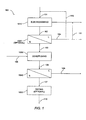
- copper powder process 100 comprises an electrowinning stage 1010 in which copper powder is electrowon from a copper-containing solution 101 to produce a copper powder slurry stream 102.
- various embodiments of the present invention may be successfully employed to produce high quality copper powder from copper-containing solutions using conventional electrowinning chemistry (i.e., oxygen evolution at the anode) following the use of solvent extraction and/or other methods for concentration of copper in solution, such as ion exchange, ion selective membrane technology, solution recirculation, evaporation, and other methods, direct electrowinning (i.e., electrowinning copper from copper-containing solution without the use of solvent extraction techniques or without the use of other methods for concentration of copper in solution, such as ion exchange, ion selective membrane technology, solution recirculation, evaporation, and other methods), and alternative anode reaction electrowinning chemistry (i.e., oxidation of ferrous ion to ferric ion at the anode).
- conventional electrowinning chemistry i.e., oxygen evolution at the anode
- direct electrowinning i.e., electrowinning copper from copper-containing solution without the use of solvent extraction techniques or without the use of other methods for concentration of copper in solution, such
- So-called conventional copper electrowinning chemistry and electrowinning apparatus are known in the art.
- Conventional electrowinning operations typically operate at current densities in the range of about 220 to about 400 Amps per square meter of active cathode (20-35 A/ft 2 ), and most typically between about 300 and about 350 A/m 2 (28-32 A/ft 2 ).
- Using additional electrolyte circulation and/or air injection into the cell allows higher current densities to be achieved (e.g., 400-500 A/m 2 ).
- An electrowinning apparatus comprises multiple electrowinning cells configured in series or otherwise electrically connected, each comprising a series of electrodes alternating anodes and cathodes.
- Each electrowinning cell or portion of an electrowinning cell can comprise between about 4 and about 80 anodes and between about 4 and about 80 cathodes.
- each electrowinning cell or portion of an electrowinning cell comprises from about 15 to about 40 anodes and about 16 to about 41 cathodes.
- any number of anodes and/or cathodes may be utilized.
- Each electrowinning cell or portions of each electrowinning cell may preferably be configured with a base portion having a collecting configuration, such as, for example, a conical-shaped or trench-shaped base portion, which collects the copper powder product harvested from the cathodes for removal from the electrowinning cell.
- a collecting configuration such as, for example, a conical-shaped or trench-shaped base portion, which collects the copper powder product harvested from the cathodes for removal from the electrowinning cell.
- the term “cathode” refers to a complete positive electrode assembly (typically connected to a single bar).
- the term “cathode” is used to refer to the group of thin rods, and not to a single rod.
- a copper-containing solution 101 enters the electrowinning apparatus, preferably from one end, and flows through the apparatus (and thus past the electrodes), during which copper is electrowon from the solution to form copper powder.
- a copper powder slurry stream 102 which comprises the copper powder product and electrolyte collects in the base portion of the apparatus and is thereafter removed, while a lean electrolyte stream 108 exits the apparatus from a side or top portion of the apparatus, preferably from an area generally opposite the entry point of the copper-containing solution to the apparatus.
- the lean electrolyte exiting the electrowinning apparatus may be subjected to filtration to remove suspended copper particles before being recycled to the electrowinning apparatus, utilized in other processing areas, or disposed of.
- the rich electrolyte entering the electrowinning apparatus may be subjected to filtration prior to electrowinning to remove any undesirable solid and/or liquid impurities (including organic liquid impurities).
- the degree of filtration desired generally will be determined by the purity needs of the final copper powder product (in the case of filtration prior to electrowinning), the needs of other processing operations, and/or the amount of solid and/or liquid impurities present in the stream(s).
- a flow-through anode is incorporated into the cell.
- flow-through anode refers to any anode configured to enable electrolyte to pass through it. While fluid flow from an electrolyte flow manifold provides electrolyte movement, a flow-through anode allows the electrolyte in the electrochemical cell to flow through the anode during the electrowinning process. Any now known or hereafter devised flow-through anode may be utilized in accordance with various aspects of the present invention.
- Possible configurations include, but are not limited to, metal, metal wool, metal fabric, other suitable conductive nonmetallic materials (e.g., carbon materials), an expanded porous metal structure, metal mesh, expanded metal mesh, corrugated metal mesh, multiple metal strips, multiple metal wires or rods, woven wire cloth, perforated metal sheets, and the like, or combinations thereof.
- suitable anode configurations are not limited to planar configurations, but may include any suitable multiplanar geometric configuration.
- Anodes employed in conventional electrowinning operations typically comprise lead or a lead alloy, such as, for example, Pb-Sn-Ca.
- a lead alloy such as, for example, Pb-Sn-Ca.
- One significant disadvantage of using such anodes is that, during the electrowinning operation, small amounts of lead are released from the surface of the anode and ultimately cause the generation of undesirable sediments, "sludges," particulates suspended in the electrolyte, other corrosion products, or other physical degradation products in the electrochemical cell and contamination of the copper product.
- copper produced in operations employing a lead-containing anode typically comprises lead contaminant at a level of from about 0.5 ppm to about 15 ppm.
- the anode is substantially lead-free.
- the anode can be formed of one of the so-called "valve” metals, including titanium (Ti), tantalum (Ta), zirconium (Zr), or niobium (Nb).
- the anode may also be formed of other metals, such as nickel (Ni), or a metal alloy (e.g., a nickel-chrome alloy), intermetallic mixture, or a ceramic or cermet containing one or more valve metals.
- titanium may be alloyed with nickel, cobalt (Co), iron (Fe), manganese (Mn), or copper (Cu) to form a suitable anode.
- titanium may be clad upon copper or aluminum to form a suitable anode.
- the anode comprises titanium, because, among other things, titanium is rugged and corrosion-resistant. Titanium anodes, for example, when used in accordance with various embodiments of the present invention, potentially have useful lives of up to fifteen years or more.
- the anode may also optionally comprise any electrochemically active coating.
- exemplary coatings include those provided from platinum, ruthenium, iridium, or other Group VIII metals, Group VIII metal oxides, or compounds comprising Group VIII metals, and oxides and compounds of titanium, molybdenum, tantalum, and/or mixtures and combinations thereof.
- Ruthenium oxide and iridium oxide are two preferred compounds for use as an electrochemically active coating on titanium anodes.
- the anode may comprise a titanium mesh (or other metal, metal alloy, intermetallic mixture, or ceramic or cermet as set forth above) upon which a coating comprising carbon, graphite, a mixture of carbon and graphite, a precious metal oxide, or a spinel-type coating is applied.
- the anode comprises a titanium mesh with a coating comprised of a mixture of carbon black powder and graphite powder.
- the anode may comprise a carbon composite or a metal-graphite sintered material.
- the anode may be formed of a carbon composite material, graphite rods, graphite-carbon coated metallic mesh and the like.
- a metal in the metallic mesh or metal-graphite sintered exemplary embodiment is described herein and shown by example using titanium; however, any metal may be used.
- a wire mesh may be welded to the conductor rods, wherein the wire mesh and conductor rods may comprise materials as described above for anodes.
- the wire mesh may comprise a woven wire screen with 32 x 32 strads/cm 2 (80 by 80 strands per square inch), however various mesh configurations may be used, such as, for example, 12 x 12 strads/cm 2 (30 by 30 strands per square inch). Moreover, various regular and irregular geometric mesh configurations may be used.
- a flow-through anode may comprise a plurality of vertically-suspended metal or metal alloy rods, or metal or metal alloy rods fitted with graphite tubes or rings.
- the hanger bar to which the anode body is attached may comprise copper or a suitably conductive copper alloy, aluminum, or other suitable conductive material.
- the cathode in the electrowinning apparatus is configured to allow flow of electrolyte through the cathode.
- a flow-through cathode is incorporated into the electrowinning apparatus.
- the term "flow-through cathode” refers to any cathode configured to enable electrolyte to pass through it. While fluid flow from an electrolyte flow manifold provides electrolyte movement, a flow-through cathode allows the electrolyte in the electrochemical cell to flow through the cathode during the electrowinning process.
- Various flow-through cathode configurations may be suitable, including: (1) multiple parallel metal wires, thin rods, including hexagonal rods or other geometries, (2) multiple parallel metal strips either aligned with electrolyte flow or inclined at an angle to flow direction, (3) metal mesh, (4) expanded porous metal structure, (5) metal wool or fabric, and/or (6) conductive polymers.
- the cathode may be formed of copper, copper alloy, titanium, aluminum, or any other metal or combination of metals and/or other materials.
- the surface finish of the cathode (e.g., whether polished or unpolished) may affects the harvestability of the copper powder. Polishing or other surface finishes, surface coatings, surface oxidation layer(s), or any other suitable barrier layer may advantageously be employed to enhance harvestability. Alternatively, unpolished surfaces may also be utilized.
- the cathode may be configured in any manner now known or hereafter devised by the skilled artisan.
- All or substantially all of the total surface area of the portion of the cathode that is immersed in the electrolyte during operation of the electrochemical cell is referred to herein, and generally in the literature, as the "active" surface area of the cathode. This is the portion of the cathode onto which copper powder is formed during electrowinning.
- the anodes and cathodes in the electrowinning cell may be spaced evenly across the cell, and may be maintained at as close an interelectrode spacing as possible to optimize power consumption and mass transfer while minimizing electrical short-circuiting of current between the electrodes.
- electrowinning cells may exhibit anode/cathode spacing of from about 1-3cm (0.5 inch) to about 10cm (4 inches) and preferably less than about 5cm (2 inches). Electrowinning cells may exhibit anode/cathode spacing of about or less than about 3.8 cm (1.5 inches.) As used herein, "anode/cathode spacing" is measured from the centerline of an anode hanger bar to the centerline of the adjacent cathode hanger bar.
- any electrolyte pumping, circulation, or agitation system capable of maintaining satisfactory flow and circulation of electrolyte between the electrodes in an electrochemical cell such that the process specifications described herein are practical may be used in accordance with various embodiments of the invention.
- the electrolyte flow rate is maintained at a level of from about 4l/min/m 2 (0.1 gallons per minute per square foot) of active cathode to about 30.6/min/m 2 (0.75 gallons per minute per square foot) of active cathode, and preferably at a level of from about 8 (0.2) to about 12 l/min/m 2 (0.3) (gallons per minute per square foot) of active cathode.
- the optimal operable electrolyte flow rate useful in accordance with the present invention will depend upon the specific configuration of the process apparatus.
- electrolyte movement within the cell may be augmented by agitation, such as through the use of mechanical agitation and/or gas/solution injection devices, to enhance mass transfer.
- overall cell voltage of from about 1.7 to about 2.0 V.
- the mechanism for optimizing cell voltage within the electrowinning cell will vary in accordance with various exemplary aspects and embodiments of the present invention.
- the overall cell voltage achievable is dependent upon a number of other interrelated factors, including electrode spacing, the configuration and materials of construction of the electrodes, acid concentration and copper concentration in the electrolyte, current density, electrolyte temperature, and, to a smaller extent, the nature and amount of any additives to the electrowinning process (such as, for example, flocculants, surfactants, and the like).
- the present inventors have recognized that independent control of anode and cathode current densities, together with managing voltage overpotentials, can be utilized to enable effective control of overall cell voltage and current efficiency.
- the configuration of the electrowinning cell hardware including, but not limited to, the ratio of cathode surface area to anode surface area, can be modified in accordance with the present invention to optimize cell operating conditions, current efficiency, and overall cell efficiency.
- the operating current density of the electrowinning cell affects the morphology of the copper powder product and directly affects the production rate of copper powder within the cell. In general, higher current density decreases the bulk density and particle size of the copper powder and increases surface area of the copper powder, while lower current density increases the bulk density of copper product (sometimes resulting in cathode copper if too low, which generally is undesirable).
- the production rate of copper powder by an electrowinning cell is approximately proportional to the current applied to that cell-a cell operating at, say, 1111 A/m 2 (100 A/ft 2 ) of active cathode produces approximately five times as much copper powder in a given time as a cell operating at 222A/m 2 (20 A/ft 2 ) of active cathode, all other operating conditions, including active cathode area, remaining constant.
- the current-carrying capacity of the cell furniture is, however, one limiting factor.
- the electrolyte flow rate through the cell may need to be adjusted so as not to deplete the available copper in the electrolyte for electrowinning.
- a cell operating at a high current density may have a higher power demand than a cell operating at a low current density, and as such, economics also plays a role in the choice of operating parameters and optimization of a particular process.
- the operating current density of the electrowinning apparatus ranges from about 111 (10) to about 2222 A/m 2 (200 A/ft 2 ) of active cathode, and preferably is on the order of from about 999 (90) to about 1111 A/m 2 (100 A/ft 2 ) of active cathode.
- the mechanism for optimizing operating current density within the electrowinning cell will vary in accordance with various exemplary aspects and embodiments of the present invention.
- the temperature of the electrolyte in the electrowinning cell is maintained from about 32°C (90°F) to about 60°C (140°F).
- the operating temperature of the electrolyte in the electrowinning cell may be controlled through any one or more of a variety of means well known in the art, including, for example, heat exchange, an immersion heating element, an in-line heating device (e.g ., a heat exchanger), or the like, preferably coupled with one or more feedback temperature control means for efficient process control.
- the acid concentration in the electrolyte for electrowinning may be maintained at a level of from about 5 to about 250 grams of acid per liter of electrolyte.
- the acid concentration in the electrolyte is advantageously maintained at a level of from about 150 to about 205 grams of acid per liter of electrolyte, and preferably on the order of about 190 grams of acid per liter of electrolyte, depending upon the upstream process.
- the copper concentration in the electrolyte for electrowinning may advantageously be maintained at a level of from about 5 to about 40 grams of copper per liter of electrolyte.
- the copper concentration may be maintained at a level of from about 10 g/L to about 30 g/L, and preferably, the copper concentration may be maintained at a level of about 15 g/L.
- various aspects of the present invention may be beneficially applied to processes employing copper concentrations above and/or below these levels, with lower copper concentration levels of from about 0.5 to about 5 g/L and upper copper concentration levels of from about 40 g/L to about 50 g/L being applied in some cases.
- any number of mechanisms may be utilized to harvest the copper powder product from the cathode in accordance with various aspects of the present invention.
- the optimal harvesting mechanism will depend largely on a number of interrelated factors, primarily current density, copper concentration in the electrolyte, electrolyte flow rate, and electrolyte temperature. Other contributing factors include the level of mixing within the electrowinning apparatus, the frequency and duration of the harvesting method, and the presence and amount of any process additives (such as, for example, flocculant, surfactants, and the like).
- In situ harvesting configurations may be desirable to minimize the need to remove and handle cathodes to facilitate the removal of copper powder from the electrowinning cell.
- in situ harvesting configurations may advantageously permit the use of fixed electrode cell designs. As such, any number of mechanisms and configurations may be utilized.
- Examples of possible harvesting mechanisms include vibration (e.g ., one or more vibration and/or impact devices affixed to one or more cathodes to displace copper powder from the cathode surface at predetermined time intervals), a pulse flow system (e.g ., electrolyte flow rate increased dramatically for a short time to displace copper powder from the cathode surface), use of a pulsed power supply to the cell, use of ultrasonic waves, and use of other mechanical displacement means to remove copper powder from the cathode surface, such as intermittent or continuous air bubbles.
- vibration e.g ., one or more vibration and/or impact devices affixed to one or more cathodes to displace copper powder from the cathode surface at predetermined time intervals
- a pulse flow system e.g ., electrolyte flow rate increased dramatically for a short time to displace copper powder from the cathode surface
- use of a pulsed power supply to the cell use of ultrasonic waves, and use of other mechanical displacement
- Fine copper powder that is carried through the cell with the electrolyte may be removed via a suitable filtration, sedimentation, or other fines removal/recovery system.
- copper powder slurry stream 102 from electrowinning stage 1010 optionally is subjected to solid/liquid separation (step 1020) to reduce the amount of electrolyte in stream 102.
- Optional solid/liquid separation stage 1020 may comprise any apparatus now known or hereafter developed for separating at least a portion of the electrolyte (stream 104) from the copper powder in copper powder slurry stream 102, such as, for example, a clarifier, a spiral classifier, other screw-type devices, a countercurrent decantation (CCD) circuit, a thickener, a filter, a conveyor-type device, a gravity separation device, or other suitable apparatus.
- the solid/liquid separation apparatus chosen will enable separation of electrolyte from the copper powder while preventing exposure of the copper powder to air, which can cause rapid surface oxidation of the copper powder particles.
- At least a portion of electrolyte stream 104 leaving solid/liquid separation stage 1020 may be recycled to the electrowinning cell (stream 112) and/or may be combined with lean electrolyte stream 108 (stream 111).
- copper powder slurry stream 102 from electrowinning stage 1010 has a solids content of from about 5 percent by weight to about 30 percent by weight.
- the solids content of copper powder slurry stream 102 from electrowinning stage 1010 is largely dependent upon the copper powder harvesting method chosen in electrowinning stage 1010.
- solid/liquid separation stage 1020 when used, is configured to produce a concentrated copper powder slurry stream 103 that has a solids content of at least about 20, and preferably greater than about 30 percent by weight, for example, in the range of about 60 to about 80 percent by weight or more depending upon the bulk density and morphology of the copper powder.
- High solids content may be advantageous, particularly if coarse or granular copper powder is harvested.
- conditioning stage 1030 is configured to (i) adjust of the pH of concentrated copper powder slurry stream 103, (ii) stabilize the surface of the copper powder particles to prevent surface oxidation, and/or (iii) further reduce the amount of excess liquid in the copper powder slurry stream to form a moist copper powder product. Adjustment of the pH of concentrated copper powder slurry stream 103 and stabilization of the surface of the copper powder particles in copper powder slurry stream 103 is facilitated by the addition of one or more conditioning agents 105 to conditioning stage 1030.
- Conditioning stage 1030 comprises any apparatus now known or hereafter developed capable of achieving the above objectives, and, in particular, capable of treating substantially all surfaces of the copper particles reasonably equally with conditioning agents 105.
- conditioning stage 1030 comprises use of a centrifuge. Exemplary processing parameters for conditioning stage 1030 are discussed hereinbelow in connection with another embodiment of the present invention.
- a dewatering stage 1040 be employed to enable a bulk of the liquid in copper powder stream 106 to be separated from the bulk of the copper powder as economically as possible.
- a centrifuge, a filter, or other suitable solid/liquid separation apparatus may be used.
- this separation may be accomplished during and/or in connection with conditioning the copper powder slurry in conditioning stage 1030, such as in connection with conditioning stage 1030 when use of a centrifugal conditioning step is carried out.
- additional dewatering may be desired to yield a copper powder product that is useable for future processing without additional conditioning and/or processing (e.g., drying).
- drying stage 1050 comprises any apparatus now known or hereafter developed capable of drying the copper powder sufficiently for packaging as a final product and/or for transfer to downstream process and for downstream processing steps for formation of alternative copper products.
- drying stage 1050 may comprise a flash dryer, a cyclone, a dry sintering apparatus, a conveyor belt dryer, and/or other suitable apparatus.
- the excess heat from the melting process may be used beneficially to dry the copper powder product.
- a process for producing copper powder includes the steps of (i) electrowinning copper powder from a copper-containing solution to produce a slurry stream containing copper powder particles and electrolyte; (ii) optionally, separating at least a portion of the electrolyte from the copper powder particles in the slurry stream; (iii) optionally, separating one or more coarse copper powder particle size distributions in the slurry stream from one or more finer copper powder particle size distributions in the slurry stream in one or more size classification stages; (iv) conditioning the slurry stream; (v) optionally, separating at least a portion of the bulk of the liquid from the copper powder particles; (vi) optionally, drying the copper powder particles in the slurry stream to produce a dry copper powder stream; (vii) optionally, separating one or more coarse copper powder particle size distributions in the dry copper powder stream from one or more finer copper powder particle size distributions in the dry copper powder stream in one or more size classification stages; and (vii)
- copper powder process 200 exemplifies various aspects of another embodiment of the present invention.
- a copper-containing solution 201 is provided to an electrowinning stage 2010.
- Electrowinning stage 2010 is configured to produce a copper powder slurry stream 203, which comprises copper powder and an electrolyte, and a lean electrolyte stream 202.
- Lean electrolyte stream 202 may be recycled to upstream processing operations (such as, for example, an upstream leaching operation used to produce copper-containing solution 201), used in other processing operations, or impounded or disposed of.
- upstream processing operations such as, for example, an upstream leaching operation used to produce copper-containing solution 201
- the excess heat from the melting process may be used beneficially to dry the said copper product.
- copper powder slurry stream 203 then optionally undergoes solid/liquid separation in solid/liquid separation (or "dewatering") stage 2020, which may, as described above in connection with FIG. 1 , comprise any apparatus now known or hereafter developed for separating at least a portion of the bulk electrolyte (stream 204) from the copper powder in copper powder slurry stream 203, such as, for example, a clarifier, a spiral classifier, a screw-type device, a countercurrent decantation (CCD) circuit, a thickener, a filter, a gravitational separator device, a conveyor-type device, or other suitable apparatus.
- a clarifier e.g., a clarifier, a spiral classifier, a screw-type device, a countercurrent decantation (CCD) circuit, a thickener, a filter, a gravitational separator device, a conveyor-type device, or other suitable apparatus.
- CCD countercurrent decantation
- Such an advantageous bulk liquid removal step may yield a copper powder product that is useable for future processing without additional conditioning and/or processing.
- semi-continuous copper powder harvesting within the electrowinning cell is advantageously matched with batch downstream processing (i.e ., dewatering and conditioning) such that copper powder product is more continuously recovered.
- batch downstream processing i.e ., dewatering and conditioning
- multiple solid/liquid separation devices may be employed in connection with a conditioning stage, and as such, downstream solid/liquid separation may be eliminated.
- the resulting concentrated copper powder slurry from optional solid/liquid separation stage 2020 may be collected in a copper powder slurry tank 2030.
- Copper powder slurry tank 2030 is configured to hold the concentrated copper slurry and to maintain homogeneity of the slurry through mixing, agitation, or other means.
- process water 215 and/or a pH-adjusting agent 216 such as, for example, ammonium hydroxide
- slurry tank 2030 is configured such that the copper powder slurry is not exposed to air during storage and/or treatment, as such exposure may, as described above, detrimentally affect the surface integrity of the copper powder particles.
- slurry stream 206 may, optionally, undergo a size classification stage 2040.
- the objective of size classification stage 2040 is to separate coarser copper powder particles from finer copper powder particles in the slurry stream, in accordance with specifications for the desired final copper powder product.
- the objective of size classification stage 2040 is to separate coarser copper powder particles from finer copper powder particles in the slurry stream, in accordance with specifications for the desired final copper powder product.
- the final copper powder product is to be used for extruding copper shapes or other products, such as by direct rotary extrusion
- a slurry stream comprising finer copper powder particles is preferred, whereas if the final copper powder product is to be melted for rod or other product formation, relatively coarse copper powder particles may be preferable.
- the term “coarse” describes copper powder particles larger than about 150 microns (in the range of about plus 100 mesh).
- fine is used herein to describe copper powder particles smaller than about 45 microns (in the range of about minus 325 mesh). Particles between
- size classification When size classification is desired, it may be carried out at any suitable stage in the copper powder production process, the suitability of any stage being dependent upon a variety of factors, including the size of the copper powder particles leaving the electrowinning stage, the configuration and materials of construction of the size classification apparatus, and other engineering and economic process considerations.
- size classification when utilized, size classification may be conducted on the slurry stream leaving the electrowinning cell, the optional slurry tank (prior to conditioning), and/or on the copper powder product stream. Such processing may allow for stabilization of fine particles and different treatment of coarser particles.
- the different particle size distributions, or, if desired, various mixtures thereof may be processed further, as will now be discussed.
- slurry stream 207 (or slurry stream 206, if size classification is not utilized) is subjected to an optional conditioning operation 2050 to condition the copper powder and/or the solution in preparation for dewatering and optional drying.
- conditioning operation 2050 when used, may be performed in conjunction with a dewatering operation 2060.
- optional conditioning operation 2050 may include washing, pH adjustment, removal of impurities, stabilization, and/or other conditioning operations.
- the copper slurry may be contacted with a washing agent 208 and/or a stabilizing agent 209.
- Washing agent 208 can comprise any liquid material, water, ammonium hydroxide, and/or mixtures thereof.
- washing agent 208 may include additional materials, such as, for example, surfactants, soaps, and the like.
- washing agent 208 may be heated prior to washing, which may enhance impurity removal.
- Stabilizing agent 209 may be any agent suitable for preventing surface oxidation of the copper powder particles (which oxidation may diminish the value and/or quality of the copper powder product and/or may negatively impact downstream operations or applications).
- stabilizing agent 209 comprises an organic surfactant in combination with a stabilizer.
- the organic surfactant may be used to lower the surface tension of the stabilizer and thus enable the stabilizer to coat all facets of the copper powder particles.
- the stabilizer on the other hand, preferably is the "active" agent that coats the particles and prevents oxidation, thus providing a suitable shelf life to the copper powder product and enabling transfer of the copper powder in an otherwise oxidizing atmosphere (i.e., air).
- Some suitable stabilizers include, for example, 1,2,3-Benzotriazole (BTA), animal glue, fish glue, soaps, and the like.
- a stabilization agent may be unnecessary, such as when the copper powder product is intended to be processed immediately after production (by melting and casting, for example) or when an oxidized copper product is desired.
- other methods of preventing surface oxidation of the copper powder particles during processing may reduce or eliminate the need for a stabilization agent, such as, for example, use of a charged fluidized bed or use of nitrogen blanketing during one or more stages of copper powder handling. If it is desirable to store the copper powder product for an extended period of time, however, then a stabilizing agent may be desired.
- a dewatering stage 2060 be employed to enable a bulk of the liquid in copper powder stream 211 to be separated from the bulk of the copper powder as economically as possible.
- a centrifuge, a filter, or other suitable solid/liquid separation apparatus may be used.
- this separation may be accomplished during or in connection with conditioning the copper powder slurry, such as in connection with optional conditioning operation 2050.
- Such an advantageous dewatering step may yield a copper powder product that is useable for future processing without additional conditioning and/or processing (e.g ., drying).
- a dewatering stage 2060 is utilized to draw as much liquid from copper powder slurry 211 as possible, producing a moist copper powder stream 212.
- Moist copper powder stream 212 may then be subjected to an optional drying stage 2070 to produce a final copper powder product stream 213.
- Optional drying stage 2070 comprises any apparatus now known or hereafter developed capable of drying the copper powder sufficiently for packaging as a final product and/or for shipping to downstream process and for downstream processing steps for formation of alternative copper products.
- drying stage 2070 may comprise a flash dryer, a fluid bed dryer, a rotary dryer, a cyclone, a dry sintering apparatus, a conveyor belt dryer, and/or other suitable apparatus for direct or indirect drying.
- optional drying stage 2070 comprises a flash dryer that enables rapid drying of the copper powder particles without disturbing the integrity of the stabilizer coating on the copper powder particles.
- moist copper powder stream 212 is contacted with sufficient hot air for a period of time sufficient to reduce the moisture content of the copper powder particles.
- the final moisture content of the copper powder product stream 213 may vary, depending upon the nature of any downstream processing of the copper powder (through, for example, size classification, packaging, direct forming of copper shapes and rods, casting, briquetting, and the like). In this regard, in certain applications, significant moisture content may be retained without deleteriously impacting subsequent processing.
- copper powder product stream 213 may optionally undergo size classification in size classification stage 2080 to achieve a desired particle size distribution in the final copper powder product 214.
- the final copper powder product 214 may then be sent to a packaging operation 2090-for example, a bagging operation-or may be subjected to further processing 2095 to change the character of the final copper product.
Landscapes
- Chemical & Material Sciences (AREA)
- Engineering & Computer Science (AREA)
- Chemical Kinetics & Catalysis (AREA)
- Electrochemistry (AREA)
- Materials Engineering (AREA)
- Metallurgy (AREA)
- Organic Chemistry (AREA)
- Electrolytic Production Of Metals (AREA)
- Manufacture Of Metal Powder And Suspensions Thereof (AREA)
- Manufacture And Refinement Of Metals (AREA)
Claims (12)
- Verfahren zum Herstellen von Kupferpulver durch elektrolytische Gewinnung, wobei das Verfahren die folgenden Schritte umfasst:Einführen einer kupferhaltigen Lösung in eine Durchflusselektrolysezelle; undelektrolytisches Gewinnen von Kupferpulver aus der kupferhaltigen Lösung, um einen Aufschlämmungsstrom, welcher Kupferpulverteilchen und ein Elektrolyt enthält, zu erzeugen, wobei der Schritt des elektrolytischen Gewinnens von Kupferpulver ein Herstellen von Sauerstoffgas bei einer Anode und ein Bilden von Kupferpulver bei einer Katode umfasst und dadurch gekennzeichnet, dass die Katode eine Durchflusskatode ist, so dass die kupferhaltige Lösung durch die Katode fließt, und dadurch, dass die Anode eine Durchflussanode ist, so dass die kupferhaltige Lösung während des Verfahrens der elektrolytischen Gewinnung durch die Anode fließt, wobei die Fließgeschwindigkeit der kupferhaltigen Lösung in dem Bereich von 0,0679 l/m2.s
(0,1 Gallonen/min./Quadratfuß) bis 0,51 l/m2·s (0,75 Gallonen/min./Quadratfuß) aktiver Katode ist und die Temperatur des Elektrolyts in dem Bereich von 32,2 °C (90 °F) bis 60°C (140 °F) ist, um ein Aufrechterhalten der Zellspannung der Elektrolysezelle bei einer Gesamtzellspannung von etwa 1,7 V bis etwa 2,0 V und gleichzeitig ein Aufrechterhalten der Stromdichte der Elektrolysezelle von etwa 111 bis etwa 2222 Ampere pro Quadratmeter aktiver Katode zu ermöglichen. - Verfahren nach Anspruch 1, welches weiter den Schritt eines Trennens zumindest eines Teils des Elektrolyts von den Kupferpulverteilchen in dem Aufschlämmungsstrom umfasst.
- Verfahren nach Anspruch 1, welches weiter den Schritt eines Aufbereitens zumindest eines Teils des Aufschlämmungsstroms zum Entfernen von Fremdkörpern und/oder Unreinheiten, welche in dem verbleibenden mitgerissenen Elektrolyt vorhanden sind, umfasst.
- Verfahren nach Anspruch 2, welches weiter den Schritt eines Aufbereitens zumindest eines Teils des Aufschlämmungsstroms umfasst.
- Verfahren nach Anspruch 4, wobei der Schritt des Aufbereitens zumindest eines Teils des Aufschlämmungsstroms ein Stabilisieren zumindest eines Teils des Aufschlämmungsstroms umfasst.
- Verfahren nach Anspruch 5, welches weiter zum Herstellen eines Kupferpulverprodukts den Schritt eines Trocknens der Kupferpulverteilchen, welche ursprünglich in dem Aufschlämmungsstrom vorhanden waren, umfasst.
- Verfahren nach Anspruch 1, welches weiter den Schritt eines Unterziehens des Kupferpulverprodukts einer Größenklassifizierung, einem Verpacken, einem direkten Formen, einem Gießen, einem Briquettieren, einer Extrusion und/oder einem Schmelzen umfasst.
- Verfahren nach Anspruch 8, welches weiter den Schritt eines Trennens zumindest eines Teils der groben Kupferpulverteilchen in dem Aufschlämmungsstrom von zumindest einem Teil der feinen Kupferpulverteilchen in dem Aufschlämmungsstrom in einer Größenklassifizierungsstufe umfasst.
- Verfahren nach Anspruch 1, welches weiter den Schritt eines Waschens zumindest eines Teils des Aufschlämmungsstroms umfasst.
- Verfahren nach Anspruch 4, wobei der Schritt des Aufbereitens ein Inkontaktbringen zumindest eines Teils der Aufschlämmung mit einem Stabilisierungsmittel umfasst.
- Verfahren nach Anspruch 4, wobei der Schritt des Aufbereitens ein Inkontaktbringen zumindest eines Teils der Aufschlämmung mit einem organischen Oberflächenbehandlungsmittel und einem Stabilisierungsmittel umfasst.
- Verfahren nach Anspruch 1, welches weiter die folgenden Schritte umfasst:Waschen zumindest eines Teils der Kupferpulverteilchen in dem Aufschlämmungsstrom, um einen Abfalllösungsstrom herzustellen, und Trennen zumindest eines Teils des Abfalllösungsstroms von den Kupferpulverteilchen.
Applications Claiming Priority (4)
| Application Number | Priority Date | Filing Date | Title |
|---|---|---|---|
| US59088304P | 2004-07-22 | 2004-07-22 | |
| US59088204P | 2004-07-22 | 2004-07-22 | |
| US11/160,911 US7378010B2 (en) | 2004-07-22 | 2005-07-14 | System and method for producing copper powder by electrowinning in a flow-through electrowinning cell |
| PCT/US2005/025158 WO2006020022A2 (en) | 2004-07-22 | 2005-07-15 | System and method for producing copper powder by electrowinning in a flow-through electrowinning cell |
Publications (2)
| Publication Number | Publication Date |
|---|---|
| EP1774063A2 EP1774063A2 (de) | 2007-04-18 |
| EP1774063B1 true EP1774063B1 (de) | 2011-03-23 |
Family
ID=35655969
Family Applications (1)
| Application Number | Title | Priority Date | Filing Date |
|---|---|---|---|
| EP05771663A Expired - Lifetime EP1774063B1 (de) | 2004-07-22 | 2005-07-15 | System und verfahren zur elektrolytischen herstellung von kupferpulver in einer durchflusselektrolysezelle |
Country Status (14)
| Country | Link |
|---|---|
| US (3) | US7378010B2 (de) |
| EP (1) | EP1774063B1 (de) |
| JP (2) | JP4723579B2 (de) |
| CN (1) | CN101035928B (de) |
| AP (1) | AP2211A (de) |
| AT (1) | ATE503041T1 (de) |
| AU (1) | AU2005274991B2 (de) |
| BR (1) | BRPI0513705A (de) |
| CA (1) | CA2574863C (de) |
| DE (1) | DE602005027077D1 (de) |
| EA (1) | EA200700275A1 (de) |
| MX (1) | MX2007000832A (de) |
| WO (1) | WO2006020022A2 (de) |
| ZA (1) | ZA200700852B (de) |
Families Citing this family (30)
| Publication number | Priority date | Publication date | Assignee | Title |
|---|---|---|---|---|
| US7378011B2 (en) * | 2003-07-28 | 2008-05-27 | Phelps Dodge Corporation | Method and apparatus for electrowinning copper using the ferrous/ferric anode reaction |
| US20060021880A1 (en) * | 2004-06-22 | 2006-02-02 | Sandoval Scot P | Method and apparatus for electrowinning copper using the ferrous/ferric anode reaction and a flow-through anode |
| US7452455B2 (en) * | 2004-07-22 | 2008-11-18 | Phelps Dodge Corporation | System and method for producing metal powder by electrowinning |
| US7378010B2 (en) * | 2004-07-22 | 2008-05-27 | Phelps Dodge Corporation | System and method for producing copper powder by electrowinning in a flow-through electrowinning cell |
| AP1924A (en) | 2004-10-29 | 2008-12-05 | Phelps Dodge Corp | Process for multiple stage direct electrowinning of copper |
| JP5143495B2 (ja) * | 2007-08-03 | 2013-02-13 | Dowaメタルマイン株式会社 | 銅溶解液の製造方法及び銅の製造方法 |
| AU2009291470B2 (en) | 2008-09-15 | 2015-06-18 | Epcm Services Ltd. | Electrode washing method and system |
| PL212865B1 (pl) * | 2009-03-20 | 2012-12-31 | Inst Chemii Przemyslowej Im Prof Ignacego Moscickiego | Sposób otrzymywania proszków i nanoproszków miedzi z elektrolitów przemyslowych, takze odpadowych |
| US8038855B2 (en) * | 2009-04-29 | 2011-10-18 | Freeport-Mcmoran Corporation | Anode structure for copper electrowinning |
| JP5013438B2 (ja) * | 2009-12-08 | 2012-08-29 | 学校法人同志社 | 金属の電解採取用陽極および電解採取方法 |
| US20150053574A1 (en) * | 2012-06-08 | 2015-02-26 | The Doshisha | Metal electrowinning anode and electrowinning method |
| FI124812B (fi) * | 2010-01-29 | 2015-01-30 | Outotec Oyj | Menetelmä ja laitteisto metallipulverin valmistamiseksi |
| US9783900B2 (en) * | 2010-08-11 | 2017-10-10 | Outotec (Finland) Oy | Apparatus for use in electrorefining and electrowinning |
| CN102041392A (zh) * | 2010-12-31 | 2011-05-04 | 上海大学 | 从铜-钢背双金属废料中湿法回收铜的方法 |
| US9150974B2 (en) | 2011-02-16 | 2015-10-06 | Freeport Minerals Corporation | Anode assembly, system including the assembly, and method of using same |
| US9011669B2 (en) | 2012-09-17 | 2015-04-21 | Blue Planet Strategies, L.L.C. | Apparatus and method for electrochemical modification of liquids |
| US9605353B2 (en) | 2011-05-27 | 2017-03-28 | Blue Planet Strategies, L.L.C. | Apparatus and method for advanced electrochemical modification of liquids |
| JP5852238B2 (ja) | 2011-07-08 | 2016-02-03 | インスティテュート・オブ・ケミカル・テクノロジーInstitute of Chemical Technology | CU−Cl熱化学サイクルを用いる水素製造で用いられる電気化学セル |
| JP2014077188A (ja) * | 2012-10-12 | 2014-05-01 | Sumitomo Electric Ind Ltd | アルミニウム粉末の製造方法及び製造装置並びにアルミニウム粉末 |
| CN102978667B (zh) * | 2012-10-25 | 2016-06-22 | 烟台大学 | 一种电沉积制备纳米铜粉的方法 |
| CN103866352A (zh) * | 2012-12-17 | 2014-06-18 | 重庆华浩冶炼有限公司 | 一种电解铜粉的生产方法 |
| CN103194772A (zh) * | 2013-04-11 | 2013-07-10 | 佛山市中国地质大学研究院 | 一种制备镍金属管状纳米阵列的电化学方法 |
| CN103397349B (zh) * | 2013-08-09 | 2016-06-22 | 北京科技大学 | 一种氨性条件下二维羽毛状铜粉的制备方法 |
| CN104357881B (zh) * | 2014-11-21 | 2017-11-28 | 刘晓鹏 | 一种基于全密封选择性粉体电解装置的电解系统 |
| US10633751B2 (en) | 2014-11-28 | 2020-04-28 | Proter S.P.A. | Direct electrowinning process with leaching solution |
| PE20180808A1 (es) | 2015-07-06 | 2018-05-09 | Sherritt Int Corporation | Recuperacion de cobre de una alimentacion de proceso que contiene arsenico |
| US10236526B2 (en) | 2016-02-25 | 2019-03-19 | Calera Corporation | On-line monitoring of process/system |
| US20180245226A1 (en) * | 2017-02-24 | 2018-08-30 | Calera Corporation | Monitoring condition of electrochemical cells |
| WO2018187855A1 (en) | 2017-04-14 | 2018-10-18 | Sherritt International Corporation | Low acidity, low solids pressure oxidative leaching of sulphidic feeds |
| US10793959B2 (en) | 2017-06-19 | 2020-10-06 | Kyung Mo Yang | Method for production of metal article of manufacture and uses thereof |
Citations (1)
| Publication number | Priority date | Publication date | Assignee | Title |
|---|---|---|---|---|
| US20050023151A1 (en) * | 2003-07-28 | 2005-02-03 | Sandoval Scot Philip | Method and apparatus for electrowinning copper using the ferrous/ferric anode reaction |
Family Cites Families (83)
| Publication number | Priority date | Publication date | Assignee | Title |
|---|---|---|---|---|
| US2792342A (en) * | 1956-01-26 | 1957-05-14 | Phelps Dodge Corp | Electrowinning of copper |
| US3262870A (en) * | 1961-08-31 | 1966-07-26 | Powdered Metals Corp | Process for the extraction of copper |
| US3616277A (en) * | 1968-07-26 | 1971-10-26 | Kennecott Copper Corp | Method for the electrodeposition of copper powder |
| US3876516A (en) * | 1973-02-14 | 1975-04-08 | Continental Oil Co | Copper electrowinning process |
| US3887396A (en) * | 1973-11-15 | 1975-06-03 | Us Energy | Modular electrochemical cell |
| US3915834A (en) * | 1974-04-01 | 1975-10-28 | Kennecott Copper Corp | Electrowinning cell having an anode with no more than one-half the active surface area of the cathode |
| US3956086A (en) * | 1974-05-17 | 1976-05-11 | Cjb Development Limited | Electrolytic cells |
| US3972795A (en) | 1974-09-11 | 1976-08-03 | Hazen Research, Inc. | Axial flow electrolytic cell |
| FR2314900A1 (fr) * | 1975-06-18 | 1977-01-14 | Niso Ste Civile Etud Rech | Procede et installation de traitement des solutions de decapage de metaux |
| SU589290A1 (ru) | 1976-05-24 | 1978-01-25 | Уральский Ордена Трудового Красного Знамени Политехнический Институт Имени С.М.Кирова | Пластинчатый катод дл электролитического получени металлических порошков |
| SU715900A1 (ru) | 1978-01-05 | 1980-02-15 | Уральский Научно-Исследовательский И Проектный Институт Медной Промышленности | Способ сушки медных порошков |
| US4278521A (en) * | 1978-05-30 | 1981-07-14 | Dechema | Electrochemical cell |
| US4219401A (en) * | 1978-08-07 | 1980-08-26 | The D-H Titanium Company | Metal electrowinning feed cathode |
| US4226685A (en) * | 1978-10-23 | 1980-10-07 | Kennecott Copper Corporation | Electrolytic treatment of plating wastes |
| US4318789A (en) * | 1979-08-20 | 1982-03-09 | Kennecott Corporation | Electrochemical removal of heavy metals such as chromium from dilute wastewater streams using flow through porous electrodes |
| US4292160A (en) * | 1979-08-20 | 1981-09-29 | Kennecott Corporation | Apparatus for electrochemical removal of heavy metals such as chromium from dilute wastewater streams using flow-through porous electrodes |
| US4272339A (en) * | 1980-03-10 | 1981-06-09 | Knight Bill J | Process for electrowinning of metals |
| US4373654A (en) * | 1980-11-28 | 1983-02-15 | Rsr Corporation | Method of manufacturing electrowinning anode |
| US4436601A (en) * | 1981-07-24 | 1984-03-13 | Diamond Shamrock Corporation | Metal removal process |
| US4399020A (en) * | 1981-07-24 | 1983-08-16 | Diamond Shamrock Corporation | Device for waste water treatment |
| SU1090760A1 (ru) | 1981-09-01 | 1984-05-07 | Уральский Ордена Трудового Красного Знамени Научно-Исследовательский И Проектный Институт Медной Промышленности "Унипромедь" | Способ получени медного порошка |
| US4515672A (en) * | 1981-11-09 | 1985-05-07 | Eltech Systems Corporation | Reticulate electrode and cell for recovery of metal ions |
| US4556469A (en) * | 1981-11-12 | 1985-12-03 | General Electric Environmental Services, Inc. | Electrolytic reactor for cleaning wastewater |
| US4445990A (en) * | 1981-11-12 | 1984-05-01 | General Electric Company | Electrolytic reactor for cleaning wastewater |
| US4680100A (en) * | 1982-03-16 | 1987-07-14 | American Cyanamid Company | Electrochemical cells and electrodes therefor |
| SU1243907A1 (ru) | 1983-03-03 | 1986-07-15 | Уральский ордена Трудового Красного Знамени политехнический институт им.С.М.Кирова | Способ получени медного порошка электролизом |
| SU1183566A1 (ru) | 1983-06-13 | 1985-10-07 | Уральский ордена Трудового Красного Знамени политехнический институт им.С.М.Кирова | Электролит дл получени металлических порошков |
| DE3474841D1 (en) | 1983-06-24 | 1988-12-01 | American Cyanamid Co | Electrodes, electro-chemical cells containing said electrodes, and process for forming and utilizing such electrodes |
| US4762603A (en) * | 1983-06-24 | 1988-08-09 | American Cyanamid Company | Process for forming electrodes |
| US4560453A (en) * | 1985-03-28 | 1985-12-24 | Exxon Research And Engineering Co. | Efficient, safe method for decoppering copper refinery electrolyte |
| ES8609513A1 (es) | 1985-06-21 | 1986-09-01 | Hermana Tezanos Enrique | Nuevo diseno de catodo para beneficio electroquimico de me- tales |
| US4715934A (en) * | 1985-11-18 | 1987-12-29 | Lth Associates | Process and apparatus for separating metals from solutions |
| SU1346697A1 (ru) | 1985-12-30 | 1987-10-23 | Уральский политехнический институт им.С.М.Кирова | Способ получени медного порошка электролизом |
| SU1418349A1 (ru) | 1986-04-23 | 1988-08-23 | Уральский политехнический институт им.С.М.Кирова | Электролит дл получени медного порошка электролизом |
| US4789450A (en) * | 1986-12-16 | 1988-12-06 | Bateman Engineering (International) Limited | Electrolytic cell |
| US4834850A (en) * | 1987-07-27 | 1989-05-30 | Eltech Systems Corporation | Efficient electrolytic precious metal recovery system |
| SU1537711A1 (ru) | 1987-12-15 | 1990-01-23 | Уральский политехнический институт им.С.М.Кирова | Способ получени медного порошка электролизом |
| US4863580A (en) * | 1988-08-10 | 1989-09-05 | Epner R L | Waste metal extraction apparatus |
| US4960500A (en) * | 1988-08-10 | 1990-10-02 | Epner R L | Waste metal extraction apparatus |
| JPH07502B2 (ja) | 1989-03-01 | 1995-01-11 | 同和鉱業株式会社 | 非酸化物系セラミックスのメタライズ方法 |
| SU1708939A1 (ru) | 1989-06-14 | 1992-01-30 | Уральский политехнический институт им.С.М.Кирова | Способ получени медного порошка |
| US5006216A (en) * | 1989-12-07 | 1991-04-09 | Eltech Systems Corporation | Metal removal apparatus |
| SU1813806A1 (ru) | 1990-03-06 | 1993-05-07 | N Proizv Ob Edinenie Armtsvetm | Способ получения медного порошка |
| DE4008684C1 (de) * | 1990-03-17 | 1991-02-07 | Heraeus Elektroden Gmbh, 6450 Hanau, De | |
| US5292412A (en) * | 1990-04-12 | 1994-03-08 | Eltech Systems Corporation | Removal of mercury from waste streams |
| US5133843A (en) * | 1990-09-10 | 1992-07-28 | The Dow Chemical Company | Method for the recovery of metals from the membrane of electrochemical cells |
| DE69111078T2 (de) * | 1990-11-28 | 1996-01-11 | Moltech Invent S.A., Luxemburg/Luxembourg | Elektrodenzusammenstellung und multimonopolare zellen für die aluminiumelektrogewinnung. |
| FR2672061B1 (fr) * | 1991-01-28 | 1993-10-15 | Metaleurop Sa | Procede d'obtention d'une poudre fine de cadmium dendritique et poudre obtenue par le procede. |
| US5882502A (en) * | 1992-04-01 | 1999-03-16 | Rmg Services Pty Ltd. | Electrochemical system and method |
| WO1994024334A1 (en) * | 1993-04-19 | 1994-10-27 | Magma Copper Company | Process for making copper metal powder, copper oxides and copper foil |
| US5670033A (en) | 1993-04-19 | 1997-09-23 | Electrocopper Products Limited | Process for making copper metal powder, copper oxides and copper foil |
| US5454917A (en) * | 1993-09-03 | 1995-10-03 | Cognis, Inc. | Apparatus and process for recovering metal from an aqueous solution |
| GB9318794D0 (en) * | 1993-09-10 | 1993-10-27 | Ea Tech Ltd | A high surface area cell for the recovery of metals from dilute solutions |
| US5725752A (en) * | 1993-10-22 | 1998-03-10 | Ea Technology Ltd. | Electrokinetic decontamination of land |
| US5492608A (en) * | 1994-03-14 | 1996-02-20 | The United States Of America As Represented By The Secretary Of The Interior | Electrolyte circulation manifold for copper electrowinning cells which use the ferrous/ferric anode reaction |
| US5783050A (en) * | 1995-05-04 | 1998-07-21 | Eltech Systems Corporation | Electrode for electrochemical cell |
| US5622615A (en) * | 1996-01-04 | 1997-04-22 | The University Of British Columbia | Process for electrowinning of copper matte |
| US5705048A (en) * | 1996-03-27 | 1998-01-06 | Oxley Research, Inc. | Apparatus and a process for regenerating a CUCl2 etchant |
| US5770037A (en) * | 1996-11-21 | 1998-06-23 | Konica Corporation | Water processing method |
| US5837122A (en) * | 1997-04-21 | 1998-11-17 | The Scientific Ecology Group, Inc. | Electrowinning electrode, cell and process |
| US6017428A (en) * | 1997-07-16 | 2000-01-25 | Summit Valley Equipment And Engineering, Inc. | Electrowinning cell |
| DE19731616A1 (de) | 1997-07-23 | 1999-01-28 | Henry Prof Dr Bergmann | Verfahren und Zelleneinheit zur Entfernung von Inhaltstoffen aus Elektrolyten |
| US6086691A (en) * | 1997-08-04 | 2000-07-11 | Lehockey; Edward M. | Metallurgical process for manufacturing electrowinning lead alloy electrodes |
| CA2256929C (en) * | 1997-12-28 | 2008-02-12 | Kemix (Proprietary) Limited | Electrowinning cell |
| US6113758A (en) * | 1998-07-30 | 2000-09-05 | Moltech Invent S.A. | Porous non-carbon metal-based anodes for aluminium production cells |
| US6036839A (en) * | 1998-02-04 | 2000-03-14 | Electrocopper Products Limited | Low density high surface area copper powder and electrodeposition process for making same |
| KR20010034837A (ko) * | 1998-05-06 | 2001-04-25 | 엘테크 시스템스 코포레이션 | 메시 표면을 가진 레드 전극 구조체 |
| US6139705A (en) * | 1998-05-06 | 2000-10-31 | Eltech Systems Corporation | Lead electrode |
| US6149797A (en) * | 1998-10-27 | 2000-11-21 | Eastman Kodak Company | Method of metal recovery using electrochemical cell |
| US6086733A (en) * | 1998-10-27 | 2000-07-11 | Eastman Kodak Company | Electrochemical cell for metal recovery |
| AU2395600A (en) | 1999-01-21 | 2000-08-07 | Ga-Tek Inc. | Process for recovering copper from a high acid mixed metal solution |
| US6402930B1 (en) * | 1999-05-27 | 2002-06-11 | De Nora Elettrodi S.P.A. | Process for the electrolysis of technical-grade hydrochloric acid contaminated with organic substances using oxygen-consuming cathodes |
| US6451183B1 (en) * | 1999-08-11 | 2002-09-17 | Electrometals Technologies Limited | Method and apparatus for electrowinning powder metal from solution |
| RU2169443C1 (ru) | 1999-12-15 | 2001-06-20 | Камский политехнический институт | Способ получения электролитного электрического разряда и устройство для его осуществления |
| FR2810681A1 (fr) | 2000-06-27 | 2001-12-28 | Claude Andre Bedjai | Procede de recuperation de metal precieux or par un nouveau systeme d'electrolyse inversee |
| US6398939B1 (en) * | 2001-03-09 | 2002-06-04 | Phelps Dodge Corporation | Method and apparatus for controlling flow in an electrodeposition process |
| US20040168909A1 (en) * | 2003-02-28 | 2004-09-02 | Larson Arden L. | Three-dimensional flow-through electrode and electrochemical cell |
| US7494580B2 (en) * | 2003-07-28 | 2009-02-24 | Phelps Dodge Corporation | System and method for producing copper powder by electrowinning using the ferrous/ferric anode reaction |
| US20060021880A1 (en) * | 2004-06-22 | 2006-02-02 | Sandoval Scot P | Method and apparatus for electrowinning copper using the ferrous/ferric anode reaction and a flow-through anode |
| US7368049B2 (en) * | 2004-06-22 | 2008-05-06 | Phelps Dodge Corporation | Method and apparatus for electrowinning copper using the ferrous/ferric anode reaction and a flow-through anode |
| US7393438B2 (en) * | 2004-07-22 | 2008-07-01 | Phelps Dodge Corporation | Apparatus for producing metal powder by electrowinning |
| US7452455B2 (en) * | 2004-07-22 | 2008-11-18 | Phelps Dodge Corporation | System and method for producing metal powder by electrowinning |
| US7378010B2 (en) * | 2004-07-22 | 2008-05-27 | Phelps Dodge Corporation | System and method for producing copper powder by electrowinning in a flow-through electrowinning cell |
-
2005
- 2005-07-14 US US11/160,911 patent/US7378010B2/en not_active Expired - Fee Related
- 2005-07-15 EA EA200700275A patent/EA200700275A1/ru unknown
- 2005-07-15 BR BRPI0513705-5A patent/BRPI0513705A/pt not_active IP Right Cessation
- 2005-07-15 AT AT05771663T patent/ATE503041T1/de not_active IP Right Cessation
- 2005-07-15 DE DE602005027077T patent/DE602005027077D1/de not_active Expired - Lifetime
- 2005-07-15 CA CA2574863A patent/CA2574863C/en not_active Expired - Fee Related
- 2005-07-15 CN CN2005800310469A patent/CN101035928B/zh not_active Expired - Fee Related
- 2005-07-15 JP JP2007522587A patent/JP4723579B2/ja not_active Expired - Fee Related
- 2005-07-15 EP EP05771663A patent/EP1774063B1/de not_active Expired - Lifetime
- 2005-07-15 AU AU2005274991A patent/AU2005274991B2/en not_active Ceased
- 2005-07-15 MX MX2007000832A patent/MX2007000832A/es active IP Right Grant
- 2005-07-15 AP AP2007003917A patent/AP2211A/xx active
- 2005-07-15 WO PCT/US2005/025158 patent/WO2006020022A2/en not_active Ceased
-
2007
- 2007-01-30 ZA ZA200700852A patent/ZA200700852B/xx unknown
-
2008
- 2008-05-23 US US12/126,559 patent/US7736486B2/en not_active Expired - Fee Related
-
2010
- 2010-05-07 JP JP2010107769A patent/JP2010163698A/ja not_active Withdrawn
- 2010-05-18 US US12/782,003 patent/US8016983B2/en not_active Expired - Fee Related
Patent Citations (1)
| Publication number | Priority date | Publication date | Assignee | Title |
|---|---|---|---|---|
| US20050023151A1 (en) * | 2003-07-28 | 2005-02-03 | Sandoval Scot Philip | Method and apparatus for electrowinning copper using the ferrous/ferric anode reaction |
Also Published As
| Publication number | Publication date |
|---|---|
| EA200700275A1 (ru) | 2007-08-31 |
| JP4723579B2 (ja) | 2011-07-13 |
| AP2211A (en) | 2011-02-28 |
| BRPI0513705A (pt) | 2008-05-13 |
| US7736486B2 (en) | 2010-06-15 |
| JP2010163698A (ja) | 2010-07-29 |
| CA2574863A1 (en) | 2006-02-23 |
| US20060016696A1 (en) | 2006-01-26 |
| US20100224484A1 (en) | 2010-09-09 |
| EP1774063A2 (de) | 2007-04-18 |
| CN101035928A (zh) | 2007-09-12 |
| ATE503041T1 (de) | 2011-04-15 |
| US20080217185A1 (en) | 2008-09-11 |
| DE602005027077D1 (de) | 2011-05-05 |
| WO2006020022A3 (en) | 2007-05-10 |
| CN101035928B (zh) | 2012-03-07 |
| AU2005274991A1 (en) | 2006-02-23 |
| AU2005274991B2 (en) | 2008-12-18 |
| WO2006020022A2 (en) | 2006-02-23 |
| US8016983B2 (en) | 2011-09-13 |
| CA2574863C (en) | 2010-06-22 |
| AP2007003917A0 (en) | 2007-02-28 |
| US7378010B2 (en) | 2008-05-27 |
| MX2007000832A (es) | 2007-04-17 |
| JP2008507626A (ja) | 2008-03-13 |
| ZA200700852B (en) | 2008-09-25 |
Similar Documents
| Publication | Publication Date | Title |
|---|---|---|
| US7736486B2 (en) | System and method for producing copper power by electrowinning in a flow-through electrowinning cell | |
| US7736476B2 (en) | System and method for producing metal powder by electrowinning | |
| US7736475B2 (en) | System and method for producing copper powder by electrowinning using the ferrous/ferric anode reaction | |
| US7591934B2 (en) | Apparatus for producing metal powder by electrowinning | |
| US3981787A (en) | Electrochemical circulating bed cell | |
| US7494580B2 (en) | System and method for producing copper powder by electrowinning using the ferrous/ferric anode reaction | |
| JPH11506808A (ja) | 銅マットの電解採取方法 | |
| US20130153435A1 (en) | High surface area cathode assembly, system including the assembly, and method of using same | |
| US3721611A (en) | Process for the production of metals | |
| JP2002327289A (ja) | 銅微粉製造方法 | |
| US4670116A (en) | Purifying mixed-cation electrolyte | |
| JP2000309893A (ja) | 銅の電解精製方法 |
Legal Events
| Date | Code | Title | Description |
|---|---|---|---|
| PUAI | Public reference made under article 153(3) epc to a published international application that has entered the european phase |
Free format text: ORIGINAL CODE: 0009012 |
|
| 17P | Request for examination filed |
Effective date: 20070122 |
|
| AK | Designated contracting states |
Kind code of ref document: A2 Designated state(s): AT BE BG CH CY CZ DE DK EE ES FI FR GB GR HU IE IS IT LI LT LU LV MC NL PL PT RO SE SI SK TR |
|
| AX | Request for extension of the european patent |
Extension state: AL BA HR MK YU |
|
| R17D | Deferred search report published (corrected) |
Effective date: 20070510 |
|
| DAX | Request for extension of the european patent (deleted) | ||
| 17Q | First examination report despatched |
Effective date: 20071109 |
|
| RAP1 | Party data changed (applicant data changed or rights of an application transferred) |
Owner name: FREEPORT-MCMORAN CORPORATION |
|
| GRAP | Despatch of communication of intention to grant a patent |
Free format text: ORIGINAL CODE: EPIDOSNIGR1 |
|
| GRAS | Grant fee paid |
Free format text: ORIGINAL CODE: EPIDOSNIGR3 |
|
| GRAA | (expected) grant |
Free format text: ORIGINAL CODE: 0009210 |
|
| AK | Designated contracting states |
Kind code of ref document: B1 Designated state(s): AT BE BG CH CY CZ DE DK EE ES FI FR GB GR HU IE IS IT LI LT LU LV MC NL PL PT RO SE SI SK TR |
|
| REG | Reference to a national code |
Ref country code: GB Ref legal event code: FG4D |
|
| REG | Reference to a national code |
Ref country code: CH Ref legal event code: EP Ref country code: CH Ref legal event code: NV Representative=s name: LEMAN CONSULTING S.A. |
|
| REG | Reference to a national code |
Ref country code: IE Ref legal event code: FG4D |
|
| REF | Corresponds to: |
Ref document number: 602005027077 Country of ref document: DE Date of ref document: 20110505 Kind code of ref document: P |
|
| REG | Reference to a national code |
Ref country code: DE Ref legal event code: R096 Ref document number: 602005027077 Country of ref document: DE Effective date: 20110505 |
|
| REG | Reference to a national code |
Ref country code: NL Ref legal event code: VDEP Effective date: 20110323 |
|
| PG25 | Lapsed in a contracting state [announced via postgrant information from national office to epo] |
Ref country code: SE Free format text: LAPSE BECAUSE OF FAILURE TO SUBMIT A TRANSLATION OF THE DESCRIPTION OR TO PAY THE FEE WITHIN THE PRESCRIBED TIME-LIMIT Effective date: 20110323 Ref country code: LV Free format text: LAPSE BECAUSE OF FAILURE TO SUBMIT A TRANSLATION OF THE DESCRIPTION OR TO PAY THE FEE WITHIN THE PRESCRIBED TIME-LIMIT Effective date: 20110323 Ref country code: GR Free format text: LAPSE BECAUSE OF FAILURE TO SUBMIT A TRANSLATION OF THE DESCRIPTION OR TO PAY THE FEE WITHIN THE PRESCRIBED TIME-LIMIT Effective date: 20110624 Ref country code: LT Free format text: LAPSE BECAUSE OF FAILURE TO SUBMIT A TRANSLATION OF THE DESCRIPTION OR TO PAY THE FEE WITHIN THE PRESCRIBED TIME-LIMIT Effective date: 20110323 |
|
| LTIE | Lt: invalidation of european patent or patent extension |
Effective date: 20110323 |
|
| PG25 | Lapsed in a contracting state [announced via postgrant information from national office to epo] |
Ref country code: SI Free format text: LAPSE BECAUSE OF FAILURE TO SUBMIT A TRANSLATION OF THE DESCRIPTION OR TO PAY THE FEE WITHIN THE PRESCRIBED TIME-LIMIT Effective date: 20110323 Ref country code: BG Free format text: LAPSE BECAUSE OF FAILURE TO SUBMIT A TRANSLATION OF THE DESCRIPTION OR TO PAY THE FEE WITHIN THE PRESCRIBED TIME-LIMIT Effective date: 20110623 Ref country code: FI Free format text: LAPSE BECAUSE OF FAILURE TO SUBMIT A TRANSLATION OF THE DESCRIPTION OR TO PAY THE FEE WITHIN THE PRESCRIBED TIME-LIMIT Effective date: 20110323 Ref country code: CY Free format text: LAPSE BECAUSE OF FAILURE TO SUBMIT A TRANSLATION OF THE DESCRIPTION OR TO PAY THE FEE WITHIN THE PRESCRIBED TIME-LIMIT Effective date: 20110323 Ref country code: AT Free format text: LAPSE BECAUSE OF FAILURE TO SUBMIT A TRANSLATION OF THE DESCRIPTION OR TO PAY THE FEE WITHIN THE PRESCRIBED TIME-LIMIT Effective date: 20110323 |
|
| PGFP | Annual fee paid to national office [announced via postgrant information from national office to epo] |
Ref country code: LU Payment date: 20110725 Year of fee payment: 7 |
|
| PG25 | Lapsed in a contracting state [announced via postgrant information from national office to epo] |
Ref country code: BE Free format text: LAPSE BECAUSE OF FAILURE TO SUBMIT A TRANSLATION OF THE DESCRIPTION OR TO PAY THE FEE WITHIN THE PRESCRIBED TIME-LIMIT Effective date: 20110323 |
|
| PG25 | Lapsed in a contracting state [announced via postgrant information from national office to epo] |
Ref country code: PT Free format text: LAPSE BECAUSE OF FAILURE TO SUBMIT A TRANSLATION OF THE DESCRIPTION OR TO PAY THE FEE WITHIN THE PRESCRIBED TIME-LIMIT Effective date: 20110725 Ref country code: EE Free format text: LAPSE BECAUSE OF FAILURE TO SUBMIT A TRANSLATION OF THE DESCRIPTION OR TO PAY THE FEE WITHIN THE PRESCRIBED TIME-LIMIT Effective date: 20110323 |
|
| PGFP | Annual fee paid to national office [announced via postgrant information from national office to epo] |
Ref country code: FR Payment date: 20110729 Year of fee payment: 7 Ref country code: MC Payment date: 20110722 Year of fee payment: 7 Ref country code: CH Payment date: 20110725 Year of fee payment: 7 |
|
| PG25 | Lapsed in a contracting state [announced via postgrant information from national office to epo] |
Ref country code: IS Free format text: LAPSE BECAUSE OF FAILURE TO SUBMIT A TRANSLATION OF THE DESCRIPTION OR TO PAY THE FEE WITHIN THE PRESCRIBED TIME-LIMIT Effective date: 20110723 Ref country code: CZ Free format text: LAPSE BECAUSE OF FAILURE TO SUBMIT A TRANSLATION OF THE DESCRIPTION OR TO PAY THE FEE WITHIN THE PRESCRIBED TIME-LIMIT Effective date: 20110323 Ref country code: SK Free format text: LAPSE BECAUSE OF FAILURE TO SUBMIT A TRANSLATION OF THE DESCRIPTION OR TO PAY THE FEE WITHIN THE PRESCRIBED TIME-LIMIT Effective date: 20110323 Ref country code: ES Free format text: LAPSE BECAUSE OF FAILURE TO SUBMIT A TRANSLATION OF THE DESCRIPTION OR TO PAY THE FEE WITHIN THE PRESCRIBED TIME-LIMIT Effective date: 20110704 Ref country code: RO Free format text: LAPSE BECAUSE OF FAILURE TO SUBMIT A TRANSLATION OF THE DESCRIPTION OR TO PAY THE FEE WITHIN THE PRESCRIBED TIME-LIMIT Effective date: 20110323 |
|
| PGFP | Annual fee paid to national office [announced via postgrant information from national office to epo] |
Ref country code: DE Payment date: 20110722 Year of fee payment: 7 Ref country code: GB Payment date: 20110728 Year of fee payment: 7 |
|
| PG25 | Lapsed in a contracting state [announced via postgrant information from national office to epo] |
Ref country code: NL Free format text: LAPSE BECAUSE OF FAILURE TO SUBMIT A TRANSLATION OF THE DESCRIPTION OR TO PAY THE FEE WITHIN THE PRESCRIBED TIME-LIMIT Effective date: 20110323 |
|
| PLBE | No opposition filed within time limit |
Free format text: ORIGINAL CODE: 0009261 |
|
| STAA | Information on the status of an ep patent application or granted ep patent |
Free format text: STATUS: NO OPPOSITION FILED WITHIN TIME LIMIT |
|
| 26N | No opposition filed |
Effective date: 20111227 |
|
| PG25 | Lapsed in a contracting state [announced via postgrant information from national office to epo] |
Ref country code: PL Free format text: LAPSE BECAUSE OF FAILURE TO SUBMIT A TRANSLATION OF THE DESCRIPTION OR TO PAY THE FEE WITHIN THE PRESCRIBED TIME-LIMIT Effective date: 20110323 Ref country code: DK Free format text: LAPSE BECAUSE OF FAILURE TO SUBMIT A TRANSLATION OF THE DESCRIPTION OR TO PAY THE FEE WITHIN THE PRESCRIBED TIME-LIMIT Effective date: 20110323 |
|
| REG | Reference to a national code |
Ref country code: DE Ref legal event code: R097 Ref document number: 602005027077 Country of ref document: DE Effective date: 20111227 |
|
| REG | Reference to a national code |
Ref country code: IE Ref legal event code: MM4A |
|
| PG25 | Lapsed in a contracting state [announced via postgrant information from national office to epo] |
Ref country code: IT Free format text: LAPSE BECAUSE OF FAILURE TO SUBMIT A TRANSLATION OF THE DESCRIPTION OR TO PAY THE FEE WITHIN THE PRESCRIBED TIME-LIMIT Effective date: 20110323 |
|
| PG25 | Lapsed in a contracting state [announced via postgrant information from national office to epo] |
Ref country code: IE Free format text: LAPSE BECAUSE OF NON-PAYMENT OF DUE FEES Effective date: 20110715 |
|
| PG25 | Lapsed in a contracting state [announced via postgrant information from national office to epo] |
Ref country code: MC Free format text: LAPSE BECAUSE OF NON-PAYMENT OF DUE FEES Effective date: 20120731 |
|
| REG | Reference to a national code |
Ref country code: CH Ref legal event code: PL |
|
| GBPC | Gb: european patent ceased through non-payment of renewal fee |
Effective date: 20120715 |
|
| REG | Reference to a national code |
Ref country code: FR Ref legal event code: ST Effective date: 20130329 |
|
| PG25 | Lapsed in a contracting state [announced via postgrant information from national office to epo] |
Ref country code: DE Free format text: LAPSE BECAUSE OF NON-PAYMENT OF DUE FEES Effective date: 20130201 Ref country code: CH Free format text: LAPSE BECAUSE OF NON-PAYMENT OF DUE FEES Effective date: 20120731 Ref country code: FR Free format text: LAPSE BECAUSE OF NON-PAYMENT OF DUE FEES Effective date: 20120731 Ref country code: GB Free format text: LAPSE BECAUSE OF NON-PAYMENT OF DUE FEES Effective date: 20120715 Ref country code: LI Free format text: LAPSE BECAUSE OF NON-PAYMENT OF DUE FEES Effective date: 20120731 |
|
| REG | Reference to a national code |
Ref country code: DE Ref legal event code: R119 Ref document number: 602005027077 Country of ref document: DE Effective date: 20130201 |
|
| PG25 | Lapsed in a contracting state [announced via postgrant information from national office to epo] |
Ref country code: TR Free format text: LAPSE BECAUSE OF FAILURE TO SUBMIT A TRANSLATION OF THE DESCRIPTION OR TO PAY THE FEE WITHIN THE PRESCRIBED TIME-LIMIT Effective date: 20110323 |
|
| PG25 | Lapsed in a contracting state [announced via postgrant information from national office to epo] |
Ref country code: HU Free format text: LAPSE BECAUSE OF FAILURE TO SUBMIT A TRANSLATION OF THE DESCRIPTION OR TO PAY THE FEE WITHIN THE PRESCRIBED TIME-LIMIT Effective date: 20110323 |
|
| PG25 | Lapsed in a contracting state [announced via postgrant information from national office to epo] |
Ref country code: LU Free format text: LAPSE BECAUSE OF NON-PAYMENT OF DUE FEES Effective date: 20120715 |