EP1775122B1 - Wiederverschliessbare, einfach zu öffnende Folien mit aufreissbarer, interner Zwischenschicht und daraus hergestellte Artikel - Google Patents
Wiederverschliessbare, einfach zu öffnende Folien mit aufreissbarer, interner Zwischenschicht und daraus hergestellte Artikel Download PDFInfo
- Publication number
- EP1775122B1 EP1775122B1 EP06018936.2A EP06018936A EP1775122B1 EP 1775122 B1 EP1775122 B1 EP 1775122B1 EP 06018936 A EP06018936 A EP 06018936A EP 1775122 B1 EP1775122 B1 EP 1775122B1
- Authority
- EP
- European Patent Office
- Prior art keywords
- film
- layer
- film according
- copolymer
- polymer
- Prior art date
- Legal status (The legal status is an assumption and is not a legal conclusion. Google has not performed a legal analysis and makes no representation as to the accuracy of the status listed.)
- Active
Links
Images



Classifications
-
- B—PERFORMING OPERATIONS; TRANSPORTING
- B32—LAYERED PRODUCTS
- B32B—LAYERED PRODUCTS, i.e. PRODUCTS BUILT-UP OF STRATA OF FLAT OR NON-FLAT, e.g. CELLULAR OR HONEYCOMB, FORM
- B32B7/00—Layered products characterised by the relation between layers; Layered products characterised by the relative orientation of features between layers, or by the relative values of a measurable parameter between layers, i.e. products comprising layers having different physical, chemical or physicochemical properties; Layered products characterised by the interconnection of layers
- B32B7/04—Interconnection of layers
- B32B7/06—Interconnection of layers permitting easy separation
-
- B—PERFORMING OPERATIONS; TRANSPORTING
- B32—LAYERED PRODUCTS
- B32B—LAYERED PRODUCTS, i.e. PRODUCTS BUILT-UP OF STRATA OF FLAT OR NON-FLAT, e.g. CELLULAR OR HONEYCOMB, FORM
- B32B27/00—Layered products comprising a layer of synthetic resin
- B32B27/06—Layered products comprising a layer of synthetic resin as the main or only constituent of a layer, which is next to another layer of the same or of a different material
- B32B27/08—Layered products comprising a layer of synthetic resin as the main or only constituent of a layer, which is next to another layer of the same or of a different material of synthetic resin
-
- B—PERFORMING OPERATIONS; TRANSPORTING
- B32—LAYERED PRODUCTS
- B32B—LAYERED PRODUCTS, i.e. PRODUCTS BUILT-UP OF STRATA OF FLAT OR NON-FLAT, e.g. CELLULAR OR HONEYCOMB, FORM
- B32B27/00—Layered products comprising a layer of synthetic resin
- B32B27/30—Layered products comprising a layer of synthetic resin comprising vinyl (co)polymers; comprising acrylic (co)polymers
- B32B27/302—Layered products comprising a layer of synthetic resin comprising vinyl (co)polymers; comprising acrylic (co)polymers comprising aromatic vinyl (co)polymers, e.g. styrenic (co)polymers
-
- B—PERFORMING OPERATIONS; TRANSPORTING
- B32—LAYERED PRODUCTS
- B32B—LAYERED PRODUCTS, i.e. PRODUCTS BUILT-UP OF STRATA OF FLAT OR NON-FLAT, e.g. CELLULAR OR HONEYCOMB, FORM
- B32B27/00—Layered products comprising a layer of synthetic resin
- B32B27/30—Layered products comprising a layer of synthetic resin comprising vinyl (co)polymers; comprising acrylic (co)polymers
- B32B27/306—Layered products comprising a layer of synthetic resin comprising vinyl (co)polymers; comprising acrylic (co)polymers comprising vinyl acetate or vinyl alcohol (co)polymers
-
- B—PERFORMING OPERATIONS; TRANSPORTING
- B32—LAYERED PRODUCTS
- B32B—LAYERED PRODUCTS, i.e. PRODUCTS BUILT-UP OF STRATA OF FLAT OR NON-FLAT, e.g. CELLULAR OR HONEYCOMB, FORM
- B32B27/00—Layered products comprising a layer of synthetic resin
- B32B27/32—Layered products comprising a layer of synthetic resin comprising polyolefins
-
- B—PERFORMING OPERATIONS; TRANSPORTING
- B32—LAYERED PRODUCTS
- B32B—LAYERED PRODUCTS, i.e. PRODUCTS BUILT-UP OF STRATA OF FLAT OR NON-FLAT, e.g. CELLULAR OR HONEYCOMB, FORM
- B32B27/00—Layered products comprising a layer of synthetic resin
- B32B27/34—Layered products comprising a layer of synthetic resin comprising polyamides
-
- B—PERFORMING OPERATIONS; TRANSPORTING
- B32—LAYERED PRODUCTS
- B32B—LAYERED PRODUCTS, i.e. PRODUCTS BUILT-UP OF STRATA OF FLAT OR NON-FLAT, e.g. CELLULAR OR HONEYCOMB, FORM
- B32B27/00—Layered products comprising a layer of synthetic resin
- B32B27/36—Layered products comprising a layer of synthetic resin comprising polyesters
-
- B—PERFORMING OPERATIONS; TRANSPORTING
- B32—LAYERED PRODUCTS
- B32B—LAYERED PRODUCTS, i.e. PRODUCTS BUILT-UP OF STRATA OF FLAT OR NON-FLAT, e.g. CELLULAR OR HONEYCOMB, FORM
- B32B7/00—Layered products characterised by the relation between layers; Layered products characterised by the relative orientation of features between layers, or by the relative values of a measurable parameter between layers, i.e. products comprising layers having different physical, chemical or physicochemical properties; Layered products characterised by the interconnection of layers
- B32B7/04—Interconnection of layers
- B32B7/10—Interconnection of layers at least one layer having inter-reactive properties
-
- B—PERFORMING OPERATIONS; TRANSPORTING
- B32—LAYERED PRODUCTS
- B32B—LAYERED PRODUCTS, i.e. PRODUCTS BUILT-UP OF STRATA OF FLAT OR NON-FLAT, e.g. CELLULAR OR HONEYCOMB, FORM
- B32B7/00—Layered products characterised by the relation between layers; Layered products characterised by the relative orientation of features between layers, or by the relative values of a measurable parameter between layers, i.e. products comprising layers having different physical, chemical or physicochemical properties; Layered products characterised by the interconnection of layers
- B32B7/04—Interconnection of layers
- B32B7/12—Interconnection of layers using interposed adhesives or interposed materials with bonding properties
-
- B—PERFORMING OPERATIONS; TRANSPORTING
- B32—LAYERED PRODUCTS
- B32B—LAYERED PRODUCTS, i.e. PRODUCTS BUILT-UP OF STRATA OF FLAT OR NON-FLAT, e.g. CELLULAR OR HONEYCOMB, FORM
- B32B2329/00—Polyvinylalcohols, polyvinylethers, polyvinylaldehydes, polyvinylketones or polyvinylketals
- B32B2329/04—Polyvinylalcohol
-
- B—PERFORMING OPERATIONS; TRANSPORTING
- B32—LAYERED PRODUCTS
- B32B—LAYERED PRODUCTS, i.e. PRODUCTS BUILT-UP OF STRATA OF FLAT OR NON-FLAT, e.g. CELLULAR OR HONEYCOMB, FORM
- B32B2367/00—Polyesters, e.g. PET, i.e. polyethylene terephthalate
-
- B—PERFORMING OPERATIONS; TRANSPORTING
- B32—LAYERED PRODUCTS
- B32B—LAYERED PRODUCTS, i.e. PRODUCTS BUILT-UP OF STRATA OF FLAT OR NON-FLAT, e.g. CELLULAR OR HONEYCOMB, FORM
- B32B2439/00—Containers; Receptacles
-
- B—PERFORMING OPERATIONS; TRANSPORTING
- B32—LAYERED PRODUCTS
- B32B—LAYERED PRODUCTS, i.e. PRODUCTS BUILT-UP OF STRATA OF FLAT OR NON-FLAT, e.g. CELLULAR OR HONEYCOMB, FORM
- B32B2553/00—Packaging equipment or accessories not otherwise provided for
-
- Y—GENERAL TAGGING OF NEW TECHNOLOGICAL DEVELOPMENTS; GENERAL TAGGING OF CROSS-SECTIONAL TECHNOLOGIES SPANNING OVER SEVERAL SECTIONS OF THE IPC; TECHNICAL SUBJECTS COVERED BY FORMER USPC CROSS-REFERENCE ART COLLECTIONS [XRACs] AND DIGESTS
- Y10—TECHNICAL SUBJECTS COVERED BY FORMER USPC
- Y10T—TECHNICAL SUBJECTS COVERED BY FORMER US CLASSIFICATION
- Y10T428/00—Stock material or miscellaneous articles
- Y10T428/13—Hollow or container type article [e.g., tube, vase, etc.]
- Y10T428/1352—Polymer or resin containing [i.e., natural or synthetic]
-
- Y—GENERAL TAGGING OF NEW TECHNOLOGICAL DEVELOPMENTS; GENERAL TAGGING OF CROSS-SECTIONAL TECHNOLOGIES SPANNING OVER SEVERAL SECTIONS OF THE IPC; TECHNICAL SUBJECTS COVERED BY FORMER USPC CROSS-REFERENCE ART COLLECTIONS [XRACs] AND DIGESTS
- Y10—TECHNICAL SUBJECTS COVERED BY FORMER USPC
- Y10T—TECHNICAL SUBJECTS COVERED BY FORMER US CLASSIFICATION
- Y10T428/00—Stock material or miscellaneous articles
- Y10T428/14—Layer or component removable to expose adhesive
-
- Y—GENERAL TAGGING OF NEW TECHNOLOGICAL DEVELOPMENTS; GENERAL TAGGING OF CROSS-SECTIONAL TECHNOLOGIES SPANNING OVER SEVERAL SECTIONS OF THE IPC; TECHNICAL SUBJECTS COVERED BY FORMER USPC CROSS-REFERENCE ART COLLECTIONS [XRACs] AND DIGESTS
- Y10—TECHNICAL SUBJECTS COVERED BY FORMER USPC
- Y10T—TECHNICAL SUBJECTS COVERED BY FORMER US CLASSIFICATION
- Y10T428/00—Stock material or miscellaneous articles
- Y10T428/14—Layer or component removable to expose adhesive
- Y10T428/1452—Polymer derived only from ethylenically unsaturated monomer
-
- Y—GENERAL TAGGING OF NEW TECHNOLOGICAL DEVELOPMENTS; GENERAL TAGGING OF CROSS-SECTIONAL TECHNOLOGIES SPANNING OVER SEVERAL SECTIONS OF THE IPC; TECHNICAL SUBJECTS COVERED BY FORMER USPC CROSS-REFERENCE ART COLLECTIONS [XRACs] AND DIGESTS
- Y10—TECHNICAL SUBJECTS COVERED BY FORMER USPC
- Y10T—TECHNICAL SUBJECTS COVERED BY FORMER US CLASSIFICATION
- Y10T428/00—Stock material or miscellaneous articles
- Y10T428/14—Layer or component removable to expose adhesive
- Y10T428/1471—Protective layer
-
- Y—GENERAL TAGGING OF NEW TECHNOLOGICAL DEVELOPMENTS; GENERAL TAGGING OF CROSS-SECTIONAL TECHNOLOGIES SPANNING OVER SEVERAL SECTIONS OF THE IPC; TECHNICAL SUBJECTS COVERED BY FORMER USPC CROSS-REFERENCE ART COLLECTIONS [XRACs] AND DIGESTS
- Y10—TECHNICAL SUBJECTS COVERED BY FORMER USPC
- Y10T—TECHNICAL SUBJECTS COVERED BY FORMER US CLASSIFICATION
- Y10T428/00—Stock material or miscellaneous articles
- Y10T428/14—Layer or component removable to expose adhesive
- Y10T428/1476—Release layer
-
- Y—GENERAL TAGGING OF NEW TECHNOLOGICAL DEVELOPMENTS; GENERAL TAGGING OF CROSS-SECTIONAL TECHNOLOGIES SPANNING OVER SEVERAL SECTIONS OF THE IPC; TECHNICAL SUBJECTS COVERED BY FORMER USPC CROSS-REFERENCE ART COLLECTIONS [XRACs] AND DIGESTS
- Y10—TECHNICAL SUBJECTS COVERED BY FORMER USPC
- Y10T—TECHNICAL SUBJECTS COVERED BY FORMER US CLASSIFICATION
- Y10T428/00—Stock material or miscellaneous articles
- Y10T428/14—Layer or component removable to expose adhesive
- Y10T428/1481—Dissimilar adhesives
-
- Y—GENERAL TAGGING OF NEW TECHNOLOGICAL DEVELOPMENTS; GENERAL TAGGING OF CROSS-SECTIONAL TECHNOLOGIES SPANNING OVER SEVERAL SECTIONS OF THE IPC; TECHNICAL SUBJECTS COVERED BY FORMER USPC CROSS-REFERENCE ART COLLECTIONS [XRACs] AND DIGESTS
- Y10—TECHNICAL SUBJECTS COVERED BY FORMER USPC
- Y10T—TECHNICAL SUBJECTS COVERED BY FORMER US CLASSIFICATION
- Y10T428/00—Stock material or miscellaneous articles
- Y10T428/14—Layer or component removable to expose adhesive
- Y10T428/149—Sectional layer removable
-
- Y—GENERAL TAGGING OF NEW TECHNOLOGICAL DEVELOPMENTS; GENERAL TAGGING OF CROSS-SECTIONAL TECHNOLOGIES SPANNING OVER SEVERAL SECTIONS OF THE IPC; TECHNICAL SUBJECTS COVERED BY FORMER USPC CROSS-REFERENCE ART COLLECTIONS [XRACs] AND DIGESTS
- Y10—TECHNICAL SUBJECTS COVERED BY FORMER USPC
- Y10T—TECHNICAL SUBJECTS COVERED BY FORMER US CLASSIFICATION
- Y10T428/00—Stock material or miscellaneous articles
- Y10T428/14—Layer or component removable to expose adhesive
- Y10T428/149—Sectional layer removable
- Y10T428/1495—Adhesive is on removable layer
-
- Y—GENERAL TAGGING OF NEW TECHNOLOGICAL DEVELOPMENTS; GENERAL TAGGING OF CROSS-SECTIONAL TECHNOLOGIES SPANNING OVER SEVERAL SECTIONS OF THE IPC; TECHNICAL SUBJECTS COVERED BY FORMER USPC CROSS-REFERENCE ART COLLECTIONS [XRACs] AND DIGESTS
- Y10—TECHNICAL SUBJECTS COVERED BY FORMER USPC
- Y10T—TECHNICAL SUBJECTS COVERED BY FORMER US CLASSIFICATION
- Y10T428/00—Stock material or miscellaneous articles
- Y10T428/28—Web or sheet containing structurally defined element or component and having an adhesive outermost layer
- Y10T428/2852—Adhesive compositions
-
- Y—GENERAL TAGGING OF NEW TECHNOLOGICAL DEVELOPMENTS; GENERAL TAGGING OF CROSS-SECTIONAL TECHNOLOGIES SPANNING OVER SEVERAL SECTIONS OF THE IPC; TECHNICAL SUBJECTS COVERED BY FORMER USPC CROSS-REFERENCE ART COLLECTIONS [XRACs] AND DIGESTS
- Y10—TECHNICAL SUBJECTS COVERED BY FORMER USPC
- Y10T—TECHNICAL SUBJECTS COVERED BY FORMER US CLASSIFICATION
- Y10T428/00—Stock material or miscellaneous articles
- Y10T428/28—Web or sheet containing structurally defined element or component and having an adhesive outermost layer
- Y10T428/2852—Adhesive compositions
- Y10T428/2878—Adhesive compositions including addition polymer from unsaturated monomer
Definitions
- the present invention generally relates to multilayer films for packaging applications, and particularly, to multilayer thermoplastic films for flexible packages which have both an easy-open and a reclosable feature.
- Flexible packages which combine an easy-open feature with reclosability provide consumers with a convenient means to open a package without the use of scissors, knives or other cutting implements, and a reliable manner to re-close the package as often as needed.
- EP 1 582 341 A1 refers to a multilayer film which may be produced by blown-film coextrusion and has a carrier layer and a surface layer connected by a layer of a pressure-sensitive hot-melt adhesive.
- the surface layer and the carrier layer are made from polyethylene.
- the surface layer comprises an effective amount of low density copolymer from ethylene and a polyolefine with at least three carbon atoms.
- the copolymer has an increased linearity compared to low density polyethylene and a density of 0.910 g/cm 3 in order to increase the adhesion between the hot-melt adhesive and the surface layer, which hot-melt adhesive sticks to the surface layer when diving the film.
- thermoplastic film having an easy-open feature and reclosability without the additional processing steps and associated cost as mentioned in the prior art.
- the present invention provides a peelable resealable multilayer film as defined in independent claim 1; further, advantageous embodiments are subject-matter of the respective independent claims.
- a packaging article as defined in independent claim 20 said packaging article having at least one member comprising a peelable resealable multilayer film of the present invention.
- the present invention thus provides - according to a first aspect of the present invention - a peelable resealable multilayer film comprising at least a first thermoplastic layer, a second thermoplastic layer and a third thermoplastic layer;
- said first layer comprises a homopolymer or copolymer selected from the group consisting of polyolefin, ionomer and blends thereof; wherein said second layer is in direct contact with and bonded to both said first and third layers; wherein said second layer comprises a tacky pressure-sensitive adhesive; wherein said third layer comprises a polymer having a glass transition temperature of at least 5 °C as measured in accordance with ASTM D-3418 test method; and wherein said bond between said second and third layers comprises a peelable resealable interface having a first interfacial peel strength "A" and a second interfacial peel strength "B" such that the value of A is less than 3500 gram-force/inch (1350 newton/meter) as measured in accordance with ASTM F-904 test method when peeled from a second thermoplastic film to which said film has been heat-sealed, and the value of B is at least 330 gram-force/inch (127 newton/meter) as measured in accordance with
- the present invention provides peelable resealable multilayer films comprising at least a first polymer layer, a second polymer layer, a third polymer layer such that the second layer is in direct contact with and bonded to the first and third layers.
- the films according to the present invention may be considered "peelable" when the bond between two interior film layers comprises a peelable resealable interface adapted to separate by application of pulling or peeling force exerted away from the film which has been heat-sealed to a second thermoplastic film.
- the force required to separate the interface may be dependent upon the chemical composition of each of the two interior film layers, i.e., the chemical similarities or dissimilarities of each film layer, or both the chemical composition and thickness of each interior film layer.
- the films according to the present invention may also be considered “resealable" when the bond between the two interior layers forms an interface adapted to reseal after separation.
- the force required to "reseal” the interface is proportional to the manual pressure exerted on the film.
- the peelable resealable interface of the films, according to the present invention may include a first interfacial peel strength and a second interfacial peel strength.
- the present disclosure is directed to peelable resealable multilayer films which include at least a first polymer layer and a second polymer layer of pressure-sensitive adhesive in direct contact with and bonded to both the first and third layers.
- the bond formed between the second and third layers includes a peelable resealable interface having a first interfacial peel strength "A" and a second interfacial peel strength "B".
- the peelable resealable interface is adapted to remain secure and unbroken during package fabrication, distribution and storage, and yet may be easily and repeatedly separated and rejoined.
- the peelable resealable interface includes a first interfacial peel strength, A, having a value of less than 3500 gram-force/inch (1350 newton/meter) as measured in accordance with ASTM F-904-98 test method when the films of the present invention are peeled from a second thermoplastic film to which the film has been heat-sealed.
- the second interfacial peel strength, B has a value of at least 330 gram-force/inch (127 newton/meter) and, preferably, at least 400 gram-force/inch (154 newton/meter) as measured in accordance with ASTM F-904-988 test method when the films are peeled from and re-adhered to a second film.
- the first interfacial peel strength, A, and the second interfacial peel strength, B are such that the relative values of A and B satisfy the relationship A ⁇ B.
- the present invention provides peelable resealable multilayer films comprising at least a first polymer layer of a material selected from the group consisting of polyolefin, ionomer or blends thereof, a second polymer layer of tacky pressure-sensitive adhesive, and a third polymer layer having a glass transition temperature of at least 5 °C. such that the bond formed between the second and third layers includes a peelable resealable interface.
- the films of the present invention comprise a first polymer layer of a homopolymer or copolymer selected from the group consisting of polyolefin, ionomer or blends thereof, and more preferably, ionomer, polyethylene, polypropylene, polybutylene or blends thereof.
- the films of the present invention may comprise a second polymer layer of a pressure-sensitive adhesive comprising a tackifier first component any an elastomer second component of Styrene/rubber copolymer.
- the films of the present invention may comprise a third polymer layer which includes a material selected from the group consisting of ethylene/vinyl alcohol copolymer, polyester, polyketone, polystyrene, acrylic ester-based polymer, cyclic olefin copolymers, methylpentene homopolymer or copolymer, polyamide, and blends thereof,
- the films of the present invention may include a first polymer layer, a second polymer layer and a third polymer layer as described hereinabove and further comprise a fourth polymer layer comprising an anhydride-modified polyolefin, and a fifth polymer layer comprising a material selected from the group consisting of polyolefin, polyester, polyamide and blends thereof.
- the present invention provides peelable resealable packages formed of a multilayer thermoplastic film structure as set forth above in connection with the first aspect of the invention.
- the films may be thermoformable or non-thermoformable such that they may be suitable for use as a lidding portion, a semi-rigid or rigid preformed tray portion, or both the lidding and tray portions of a container.
- Films according to the present invention may form peelable reclosable packages or a portion thereof by heat sealing together two exterior film surfaces of a single film, the exterior surface of the one film to an exterior surface of a second compositionally identical film, or the exterior surface of one film to the exterior surface of a compositionally different thermoplastic film.
- film is use in the generic to include plastic web, regardless of whether it is a film or sheet.
- thermoplastic refers to a polymer or polymer mixture that softens when exposed to heat and then returns to its original condition when cooled to room temperature.
- thermoplastic materials include, but are not limited to, synthetic polymers such as polyolefins, polyesters, polyamides, polystyrenes, and the like.
- Thermoplastic materials may also include any synthetic polymer that is cross-linked by either radiation or chemical reaction during the manufacturing or post manufacturing process operation.
- the term "polymer” refers to a material which is the product of a polymerization or copolymerization reaction of natural, synthetic, or natural and synthetic monomers and/or comonomers, and is inclusive of homopolymers, copolymers, terpolymers, etc.
- the layers of a film of the present invention may comprise a single polymer, a mixture of a single polymer and non-polymeric material, a combination of two or more polymer materials blended together, or a mixture of a blend of two or more polymer materials and non-polymeric material. It will be noted that many polymers may be synthesized by the mutual reaction of complementary monomers. It will also be noted that some polymers are obtained by the chemical modification of other polymers such that the structure of the macromolecules that constitute the resulting polymer can be thought of as having been formed by the homopolymerization of a hypothetical monomer.
- copolymer refers to a polymer product obtained by the polymerization reaction or copolymerization of at least two monomer species. Copolymer may also be referred to as bipolymers. The term “copolymer” is also inclusive of the polymerization reaction of three, four or more monomer species having reaction products referred to terpolymers, quaterpolymers, etc. As used herein, a copolymer identified in terms of a plurality of monomers, e.g., ethylene/propylene copolymer, refers to a copolymer in which either monomer may copolymerize in a higher weight or molar percent than the other monomer or monomers.
- copolymer refers to those copolymers where the first listed comonomer is polymerized in a higher weight percent than the second listed comonomer.
- polyolefin refers to homopolymers and copolymers having a methylene linkage between monomer units which may be formed by any method known to a person of ordinary skill in the art.
- An example of a polyolefin includes polyethylene (PE) which includes, but is not limited to, low-density polyethylene (LDPE), linear low-density polyethylene (LLDPE), very low-density polyethylene (VLDPE), ultra low-density polyethylene (ULDPE), medium-density polyethylene (MDPE), high-density polyethylene (HDPE), ultra high-density polyethylene (UHDPE), and polyethylenes comprising ethylene/ ⁇ -olefin copolymers (E/AO).
- PE polyethylene
- LLDPE linear low-density polyethylene
- VLDPE very low-density polyethylene
- ULDPE ultra low-density polyethylene
- MDPE medium-density polyethylene
- HDPE high-density polyethylene
- ethylene/ ⁇ -olefin copolymers are copolymers of ethylene with one or more ⁇ -olefins (alpha-olefins) such as butene-1, hexene-1, octene-1, or the like as a comonomer.
- ⁇ -olefins alpha-olefins
- polyolefin examples include cyclic olefin copolymers (COC), ethylene/propylene copolymers (PEP), polypropylene (PP), propylene/ethylene copolymer (PPE), polyisoprene, polybutylene (PB), polybutene-1, poly-3-methylbutene-1, poly-4-methylpentene-1, and propylene/ ⁇ -olefins (P/AO) which are copolymers of propylene with one or more ⁇ -olefins (alpha-olefins) such as butene-1, hexene-1, octene-1, or the like as a comonomer.
- COC cyclic olefin copolymers
- PEP ethylene/propylene copolymers
- PP polypropylene
- PPE propylene/ethylene copolymer
- PB polybutene-1
- poly-3-methylbutene-1 poly-4-methylpentene
- Exemplary of commercially available polyethylenes suitable for use in the present invention include, but are not limited to, the linear low-density polyethylene family of resins supplied by ExxonMobil Chemical Company, Houston, Texas, U.S.A.
- a particularly suitable grade includes, but is not limited to, for example, ExxonMobil ESCORENE ® LLDPE LL1001.32 having a melt index of 1.0 dg/min., a density of 0.918 g/cm 3 , and a melting point of 121 °C.
- An example of a commercially available polypropylene suitable for use in the present invention is sold under the trademark BP Amoco ACCLEAR ® 6219 from Innovene, Chicago, Illinois, U.S.A.
- Exemplary of commercially available cyclic olefin copolymers suitable for use in the present invention include, but are not limited to, the TOPAS ® family of resins, e.g., TOPAS ® 8007 grade having a glass transition temperature of 80 °C., a tensile strength of 9600 psi, and a tensile modulus of 377,000 psi, which is supplied by Celanese-Ticona, Summit, New Jersey, U.S.A.
- modified polyolefin refers to a chemical derivative of a polyolefin, e.g., a polyolefin having any form of anhydride functionality, such as anhydride of maleic acid, crotonic acid, citraconic acid, itaconic acid, fumaric acid, etc., whether grafted onto a polymer, copolymerized with a polymer, or blended with one or more polymers.
- anhydride functionality such as anhydride of maleic acid, crotonic acid, citraconic acid, itaconic acid, fumaric acid, etc.
- Exemplary of commercially available anhydride-modified polyolefins suitable for use in the present invention include, but are not limited to, the BYNEL ® family of resins, e.g., BYNEL ® 41E687 grade having melt index of 1.7 dg/min. (at 190 °C.), a density of 0.91 g/cm 3 , a melting point of 119 °C., which is supplied by du Pont de Nemours and Company, Wilmington, Delaware, U.S.A.
- ionomer refers to an ionic copolymer formed from an olefin and an ethylenically unsaturated monocarboxylic acid having the carboxylic acid moieties partially neutralized by a metal ion.
- Suitable metal ions may include, but are not limited to, potassium, lithium, caesium, nickel, zinc and preferably sodium.
- Suitable carboxylic acid comonomers may include, but are not limited to, ethylene/methacrylic acid, methylene succinic acid, maleic anhydride, vinyl acetate/methacrylic acid, methyl/methacrylate/methacrylic acid, styrene/methacrylic acid and combinations thereof.
- Useful ionomer resins may include an olefinic content of at least 50 % (mol.) based upon the copolymer and a carboxylic acid content of between 5-25 % (mol.) based upon the copolymer.
- Useful ionomers are also described in U.S. Patent No. 3,355,319 to Rees , which is incorporated herein by reference in its entirety.
- Exemplary of commercially available ionomers suitable for use in the present invention include, but are not limited to, the SURLYN ® family of resins, e.g., SURLYN ® 1601 grade having a density of 0.940 g/cm 3 , a melt flow index of 1.30 dg/min. (at 190 °C.), a Vicat softening point of 73.9 °C., which is supplied by du Pont de Nemours and Company, Wilmington, Delaware, U.S.A.
- glass transition temperature means the temperature at which a polymer changes from an amorphous glassy state to a rubbery state, and in the transition region, various properties such as an elastic modulus, an expansion coefficient, a heat content, a refractive index, a dielectric constant, and so forth, are changed.
- the glass transition temperature can be measured from the change of these properties, but more definitely, this can be evaluated by a known method by using differential scanning calorimetry (DSC) or dynamic mechanical analysis (DMA).
- DSC differential scanning calorimetry
- DMA dynamic mechanical analysis
- ASTM D-3417 test method which is incorporated herein by reference.
- ASTM E-1640-04 test method may be used to determine the glass transition temperature by dynamic mechanical analysis, the disclosure of which is incorporated herein by reference.
- the terms "coextruded” or “coextrusion” refer to the process of extruding two or more polymer materials through a single die with two or more orifices arranged so that the extrudates merge and weld together into a laminar structure before chilling, i.e., quenching.
- the films according to the present invention may be fabricated by any coextrusion method known to a person of ordinary skill in the art which may be include, but is not limited to, for example, blown film coextrusion, slot cast coextrusion, and extrusion coating, preferably, slot cast and single-bubble blown film, and more preferably, single-bubble blown film.
- the phrase “interior film layer,” as applied to film of the present invention, refers to any film layer having both its principal surfaces directly adhered to another layer of the film.
- the phrase “exterior film layer” refers to any film layer having less than two of its principal surfaces directly adhered to another layer of the film
- the phrase "direct contact and bonded" as applied to film layers of the present invention defines a subject film layer having face-to-face contact to another film layer (presumably, over their entire planar surfaces).
- heat-seal refers to both a film layer which is heat sealable to itself or other thermoplastic film layer, and the formation of a fusion bond between two polymer surfaces by conventional indirect heating means. It will be appreciated that conventional indirect heating generates sufficient heat on at least one film contact surface for conduction to the contiguous film contact surface such that the formation of a bond interface therebetween is achieved without loss of the film integrity.
- ethylene/vinyl alcohol copolymer refers to hydrolyzed copolymers of ethylene and vinyl acetate monomers.
- Ethylene/vinyl alcohol copolymers can be represented by the general formula: [(CH 2 -CH 2 ) m -(CH 2 -CH(OH)) n ].
- Exemplary of commercially available ethylene/vinyl alcohol copolymers suitable for use in the present invention include, but are not limited to, the SOARNOL ® family of resins, e,g., SOARNOL ® ET3803 grade having a reported bulk density of 0.64-0.74 g/cm 3 , a relative density of 1.13-1.22 g/cm 3 , a melting point of 164-188° C., which may be obtained from The Nippon Synthetic Chemical Industry Company, Ltd. (Nippon Gohsei), Osaka, Japan.
- SOARNOL ® ET3803 grade having a reported bulk density of 0.64-0.74 g/cm 3 , a relative density of 1.13-1.22 g/cm 3 , a melting point of 164-188° C.
- polyester refers to homopolymers or copolymers having an ester linkage between monomer units which may be formed, for example, by condensation polymerization reactions between a dicarboxylic acid and a diol.
- the dicarboxylic acid may be linear or aliphatic, i.e., lactic acid, oxalic acid, maleic acid, succinic acid, glutaric acid, adipic acid, pimelic acid, suberic acid, azelaic acid, sebacic acid, and the like; or may be aromatic or alkyl substituted aromatic, i.e., various isomers of phthalic acid, such as paraphthalic acid (or terephthalic acid), isophthalic acid and naphthalic acid.
- alkyl substituted aromatic acids include the various isomers of dimethylphthalic acid, such as dimethylisophthalic acid, dimethylorthophthalic acid, dimethylterephthalic acid, the various isomers of diethylphthalic acid, such as diethylisophthalic acid, diethylorthophthalic acid, the various isomers of dimethylnaphthalic acid, such as 2,6-dimethylnaphthalic acid and 2,5-dimethylnaphthalic acid, and the various isomers of diethylnaphthalic acid.
- the glycols may be straight-chained or branched.
- polyalkyl terephthalates are aromatic esters having a benzene ring with ester linkages at the 1,4-carbons of the benzene ring as compared to polyalkyl isophthalate, where two ester linkages are present at the 1,3-carbons of the benzene ring.
- polyalkyl naphthalate are aromatic esters having two fused benzene rings where the two ester linkages may be present at the 2,3-carbons or the 1,6-carbons.
- Exemplary of commercially available polyethylene terephthalates suitable for use in the present invention include, but are not limited to, the EASTAPAK ® , EASTPAK ® and EASTAR ® families of resins which are all supplied from Eastman Chemical Company, Kingsport, Tennessee, U.S.A.
- EASTAR ® polyethylene terephthalate is EASTAR ® 6763 polyethylene terephthalate copolymer, which is a copolymer formed from terephthalic acid, ethylene glycol and cyclohexane dimethanol, and has glass transition temperature of 80 °C., a tensile modulus of 300,000 psi, a flexural modulus of 300,000 psi, and a reported density of about 1.27 g/cm 3 .
- polyamide refers to homopolymers or copolymers having an amide linkage between monomer units which may be formed by any method known to those skilled in the art.
- Useful polyamide homopolymers include nylon 6 (polycaprolactam), nylon 11 (polyundecanolactam), nylon 12 (polyauryllactam), and the like.
- nylon 4;2 polytetramethylene ethylenediamide
- nylon 4,6 polytetramethylene adipamide
- nylon 6,6 polyhexamethylene adipamide
- nylon 6,9 polyhexamethylene azelamide
- nylon 6,10 polyhexamethylene sebacamide
- nylon 6,12 polyhexamethylene dodecanediamide
- nylon 7,7 polyheptamethylene pimelamide
- nylon 8,8 polyoctamethylene suberamide
- nylon 9,9 polynonamethylene azelamide
- nylon 10,9 polydecamethylene azelamide
- nylon 12,12 polydodecamethylene dodecanediamide
- Useful polyamide copolymers include nylon 6,6/6 copolymer (polyhexamethylene adipamide/caprolactam copolymer), nylon 6,6/9 copolymer (polyhexamethylene adipamide/ azelaiamide copolymer), nylon 6/6,6 copolymer (polycaprolactam/hexamethylene adipamide copolymer), nylon 6,2/6,2 copolymer (polyhexamethylene ethylenediamide/hexamethylene ethylenediamide copolymer), nylon 6,6/6,9/6 copolymer (polyhexamethylene adipamide/hexamethylene azelaiamide/caprolactam copolymer), as well as other nylons which are not particularly delineated here.
- Exemplary of even more suitable polyamides include nylon 4,I, nylon 6,1, nylon 6,6/6I copolymer, nylon 6,6/6T copolymer, MXD6 (poly-m-xylylene adipamide), nylon 6T/6I copolymer, nylon 6/MXDT/I copolymer, nylon MXDI, poly-p-xylylene adipamide, polyhexamethylene terephthalamide, polydodecamethylene terephthalamide and the like.
- the generic source-based nomenclature convention is used to name the hereinabove nylon polymers and copolymers. See “ Generic Source-Based Nomenclature for Polymers," Pure Applied Chemistry, Vol. 73, No. 9, pp.
- Exemplary of commercially available polyamides suitable for use in the present invention include, but are not limited to, the ULTRAMID ® family of resins supplied by BASF, Mount Olive, New Jersey, U.S.A. and ZYTEL ® family of resins provided by du Pont de Nemours and Company, Wilmington, Delaware, U.S.A.
- a particularly suitable grade of the ULTRAMID ® polyamide includes ULTRAMID ® B36 nylon 6 having a glass transition temperature of 127 °C., a density of 1.13 g/cm 3 , and tensile strength (at yield) of 131,000 psi.
- acrylic ester refers to acrylate-functional homopolymers and copolymers which can be represented by the general formula: [C(R)(C(O)OCH 3 )CH 2 ] n where R is an alkyl group, such as, but not limited to, for example, methyl, ethyl, butyl and 2-ethylhexyl.
- R is an alkyl group, such as, but not limited to, for example, methyl, ethyl, butyl and 2-ethylhexyl.
- Exemplary of commercially available acrylic ester-based polymer suitable for use in the present invention include, but are not limited to, the PERSPEX ® family of resins having tensile strength of at least 7800 psi, a flexural modulus of at least 400,000 psi which are supplied by Lucite International, Ltd., Victoria, U.K.
- polyketone refers to homopolymers and copolymers having at least one ketone linkage between monomer units which may be formed by any method known to those skilled in the art.
- Exemplary of formerly commercially available polyketones suitable for use in the present invention include, but are not limited to, the CAR-ILON ® family of resins having a flexural modulus of about 240,000 psi which are supplied by Shell Chemical Company, Houston, Texas, U.S.A.
- methylpentene refers to polyolefin homopolymers and copolymers derived from 4-methylpentene-1. These polymers can be represented by the general formula: [CH(CH 2 (CH 3 ) 2 -CH 2 ] n .
- exemplary of commercially available methylpentene suitable for use in the present invention include, but are not limited to, the TPX ® family of resins which are supplied by Mitsui Petrochemical Industries, Ltd., Tokyo, Japan.
- polystyrene refers to homopolymers and copolymers having at least one styrene monomer (benzene, i.e., C 6 H 5 , having an ethylene substituent) linkage within the repeating backbone of the polymer.
- Polystyrene may be formed by any method known to those skilled in the art.
- Suitable polystyrene include, for example, but are not limited to, oriented polystyrene (OPS) film and resins, i.e., polystyrene (PS), syndiotactic polystyrene (SPS), acrylonitrile-butadiene-styrene (ABS), styrene-acrylonitrile (SAN), ethylene/styrene copolymers, styrene/acrylic copolymers, styrene block copolymers (SBC), and the like.
- OPS oriented polystyrene
- PS polystyrene
- SPS syndiotactic polystyrene
- ABS acrylonitrile-butadiene-styrene
- SAN styrene-acrylonitrile
- ethylene/styrene copolymers styrene/acrylic copolymers
- SBC st
- Exemplary of commercially available polystyrenes suitable for use in the present invention include, but are not limited to, POLYSTYRENE ® 535 having a tensile modulus of 430,000, a flexural modulus of 450,000 which is supplied by Total Petrochemicals USA, Inc., Houston, Texas, U.S.A.
- tacky pressure-sensitive adhesive refers to adhesives which may be used to affix the surface of one film layer to the surface of another film layer with application of manual pressure.
- the tacky pressure-sensitive adhesive may also allow one surface to be removed and/or repositioned from the other surface.
- Pressure-sensitive adhesives may include a combination of a tackifier first component and an elastomer second component of rubber, acrylic, silicone, or blends thereof. These pressure-sensitive adhesives are known in the art and are described in U.S. Patent Nos. 4,673,601 and 5,089,320 , which are incorporated herein by reference in their entireties.
- the pressure-sensitive adhesive may comprises both a tackifier and an elastomer of styrene/rubber copolymer.
- a particular suitable tacky pressure-sensitive adhesive for use in the present invention includes, but is not limited to, for example, a material having a density of 0.96 g/cm 3 which is sold under the product name FINDLEY ® M3156 from Bostik Findley, Inc., Wauwatosa, Wisconsin, U.S.A.
- styrene/rubber copolymer refers to block copolymers including di-block, tri-block, radial block, multi-block and mixtures thereof of styrene and rubber.
- Suitable rubber segment of styrene/rubber copolymers may include, but are not limited to, butadiene, isoprene, butylene, ethylenebutylene, propylene, ethylene-propylene, ethylene and blends thereof.
- Exemplary styrene/rubber copolymers which are commercially available include styrene/rubber copolymers sold under the trademark KRATON ® by Kraton Polymers, Houston, Texas, U.S.A.
- tackifier is generally an adhesive additive which serves to modify the rheological properties of the final adhesive. Specifically, a tackifier resin is used to improve the tack of the adhesive composition. As used herein, the term “tack” refers to the "stickiness" of the adhesive or its resistance to removal or deformation from a substrate.
- the tackifier may comprise any suitable material, preferably, a hydrocarbon resin material or mixtures thereof.
- Exemplary tackifiers are ESCOREZ ® 1102, ESCOREZ ® 1304, ES-COREZ ® 1315, available from ExxonMobil Chemical Company, Houston, Texas, U.S.A.; WINGTAK ® resins available from Sartomer Company, Inc., Exton, Pennsylvania, U.S.A.; PICCOTAC ® 1100 and POLYPALE ® 100 available from Eastman Chemicals, Kingsport, Tennessee, U.S.A.
- peel strength refers to the force required to separate at least a portion of the interface between two adjoining interior film layers of the present invention when the film has been sealed to a second thermoplastic film.
- the peel strength may depend on the chemical similarity or dissimilarity of the two film layers and their individual thickness. Peel strength may also be affected by the composition and thickness of adjacent film layers which are ruptured during the separation of the interface. Peel strength may still further be affected by environmental conditions during film fabrication, the packaging process and whether there has been an initial separation of the interface and the number of times the interface has been separated and resealed.
- peel strengths were determined in accordance with ASTM F-904 test method and included a modification to the test procedure.
- the modification entailed preparing test specimens by heat-sealing the surface of the subject film along its entire length to a second thermoplastic film with an end-portion of the subject film unsealed to the second film. With the test specimens prepared in this manner, the unsealed end-portion of the subject film was then peeled from the second film at an angle of at 180° relative to the second film.
- FIG. 1 a peelable resealable multilayer film 10 having a first polymer layer 11, a second polymer layer 12 of pressure-sensitive adhesive, and a third polymer layer 13.
- second polymer layer 12 is in direct contact and bonded to both first polymer layer 11 and third layer 13.
- the bond formed between polymer layers 12 and 13 creates a peelable resealable interface 100 therebetween.
- the force required to separate peelable resealable interface 100 may vary depending upon the individual chemical composition and thickness of both second and third polymer layers 12 and 13.
- peelable resealable interface 100 may be formed by bonding second polymer layer 12 of pressure-sensitive adhesive to a third polymer layer 13, preferably, when a third polymer layer 13 comprises a material having a glass transition temperature of at least 5 °C., and more preferably, when a third polymer layer 13 comprises a material having a glass transition temperature of at least 5 °C. which is selected from the group consisting of ethylene/vinyl alcohol copolymer, polyester, polyketone, polystyrene, acrylic ester polymer, cyclic olefin copolymers, methylpentene copolymers, polyamide, and blends thereof.
- first polymer layer 11 may comprise any material which bonds to second polymer layer 12 and provides an interface therebetween exhibiting a peel strength which is greater than peelable resealable interface 100.
- first polymer layer 11 comprises a homopolymer or copolymer selected from the group consisting of polyolefin, ionomer or blends thereof, and preferably, ionomer, polyethylene, polypropylene, polybutylene or blends thereof, and is bonded to second polymer layer 12 of a pressure-sensitive adhesive
- the interface formed therebetween may have a peel strength which is greater than peelable resealable interface 100.
- film 10 may be formed as a unitary three-layer film structure or a three-layer substructure of a film having 4-7 or more film layers. It will be still further appreciated that film 10 may be formed be coextrusion of three separate polymer layers using either cast slot or blown film coextrusion methods.
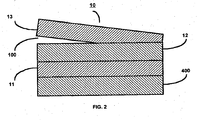
- peelable resealable multilayer film 10 is shown heat-sealed to a second thermoplastic film 400 and partially separated from film 400.
- FIG. 2 also illustrates peelable resealable interface 100 (see FIG. 1 ) in the partially open state.
- the film 10 may seal to itself or a second thermoplastic film structure by any chemical, thermal, or surface modification technique known to those skilled in the art.
- the force required for separating the interface between film 10 and second thermoplastic film 400 is greater than the force required for separating peelable resealable interface 100.
- the force required for separating peelable resealable interface 100 may be weaker after the interface 100 is initially separated and resealed to itself.
- FIG. 3 there is shown a five-layer peelable resealable multilayer film 20 having first polymer layer 21, second polymer layer 22, third polymer layer 23, fourth polymer layer 24, and fifth polymer layer 25.
- First, second and third polymer layers 21, 22 and 23 correspond to and may be selected according to the disclosure of the first through third polymer layers 11-13 of multilayer film 10 above.
- Fourth polymer layer 24 may comprise any suitable resin which will adhere third polymer layer 13 to fifth polymer layer 25.
- fourth polymer layer 24 includes an adhesive and more preferably, an anhydride-modified polyolefin.
- Fifth polymer layer 25 may comprise any polymer resin which can function as an exterior film layer, and preferably, is a material selected from the group consisting of polyolefin, polyester, polyamide and blends thereof.
- FIG. 3 also illustrates peelable resealable interface 200 in the closed state, with interface 200 being formed by the bond between polymer layers 22 and 23. Peelable resealable interface 200 may have the same interfacial peel strengths as peelable resealable interface 100 of film 10 in FIG. 2 .
- film 20 may be formed by coextrusion of five separate polymer layers using either slot cast or blown film coextrusion methods, preferably single-bubble blown film coextrusion methods. It will be also appreciated by those skilled in the art that film 20 may be alternatively formed by coextrusion of seven polymer layers as described in film 30, hereinbelow.
- FIG. 4 there is shown a seven-layer peelable resealable multilayer film 30 having first polymer layer 31, second polymer layer 32, third polymer layer 33, fourth polymer layer 34, and fifth polymer layer 35, a sixth polymer layer 36, and a seventh polymer layer 37.
- First, third, fourth, fifth and seventh polymer layers 31, 33, 34, and 37 of film 30 may correspond to and be selected according to the disclosure of the first, second, third, fourth and fifth polymer layers 21, 22, 23, 24 and 25 of multilayer film 20 (see FIG. 3 ), respectively.
- second polymer layer 32 may have an identical chemical composition as that of third polymer layer 33, and be disposed between first and third polymer layers 31 and 33.
- Sixth polymer layer 36 may have an identical chemical composition as that of seventh polymer layer 37 and be disposed between fifth and seventh polymer layers 35 and 37.
- polymer layer 32 is in direct contact with and bonded to polymer layer 33
- polymer layer 36 is in direct contact with and bonded to polymer layer 37.
- peelable resealable interface 300 which forms by the bond between second polymer layer 32 and third polymer layer 33.
- peelable resealable interface 300 may have interfacial peel strengths as that described for peelable resealable interfaces 100 of films 10 (see FIG. 2 ) and 200 of film 20 (see FIG. 3 ).
- film 30 may be formed by coextrusion of seven separate polymer layers using either slot cast or blown film coextrusion methods, preferably single-bubble blown film coextrusion methods.
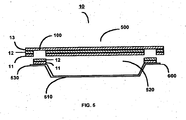
- FIG. 5 there is shown film 10 (see FIG. 1 ) in the form of a packaging lid 500 removed from a container 510.
- Container 510 may be formed from a second thermoplastic film 600 and may include a top opening 520 and a substantially flat peripheral rim 530 around the opening 520.
- film 10 may be heat-sealed and bonded to film 600 around the circumference of rim 530 and conform to the shape of opening 520.
- first and second polymer layers 11 and 12 remain sealed to container 510 in the area of the rim 530, and fractures such that the peel failure propagates internally from the interface between first polymer layer 11 and second film 600 to interface 100 (see FIGS. 1 and 2 ).
- multilayer films 10, 20 and 30 are non-oriented films such that each film has a heat shrinkage value of less than about 5 % at 90 °C., more preferably less than about 2 % at 90 °C. as measured in accordance with ASTM D-2732-96 test method.
- Heat shrinkage test is defined to be values obtained by measuring unrestrained shrink at 90 °C. for five seconds. Four test specimens are cut to 10 cm. in the machine direction by 10 cm. in the transverse direction. Each specimen is completely immersed for 5 seconds in a 90 °C. water bath (or other specified non-reactive liquid). The distance between the ends of the shrunken specimen is measured. The difference in the measured distance for the shrunken specimen and the original 10 cm.
- the machine direction shrinkage for the four specimens is averaged for the machine direction shrinkage value of the given film sample, and the transverse direction shrinkage for the four specimens is averaged for the transverse direction shrinkage value.
- additives such as slip or anti-block agents, pigments and other processing aids
- slip or anti-block agents such as slip or anti-block agents, pigments and other processing aids
- pigments and other processing aids can be included in any of the layers in the peelable resealable multilayer films 10, 20 and 30 or in any layers further added to the structure which may be formed into a flexible film.
- additives may also be included in any of the layers discussed above in connection with peelable resealable multilayer film structures 10, 20 and 30 illustrated in FIGS. 1-5 .
- the single-bubble blown film apparatus includes a multi-manifold annular die head for blown bubble film through which the film composition is forced and formed into a cylindrical tube or bubble.
- the bubble is immediately quenched, e.g., via cooled water bath, solid surface and/or air, and then ultimately collapsed and formed into a film.
- Example 2 the resins were coextruded in the following structural relationship in accordance with FIG. 4 .
- the film layers were identical in chemical composition and weight as described in Example 1, but with the following exceptions:
- Example 3 the resins were coextruded in the following structural relationship in accordance with FIG. 4 .
- the film layers were identical in chemical composition and weight as described in Example 2, but with the following exceptions:
- Example 4 the resins were coextruded in the following structural relationship in accordance with FIG. 4 .
- the film layers were identical in chemical composition and weight as described in Example 2, but with the following exceptions:
- Example 5 the resins were coextruded in the following structural relationship in accordance with FIG. 4 .
- the film layers were identical in chemical composition and weight as described in Example 2, but with the following exceptions:
- Example 6 the resins were coextruded in the following structural relationship in accordance with FIG. 4 .
- the film layers were identical in chemical composition and weight as described in Example 2, but with the following exceptions:
- Multilayer film 30 described above in Examples 1-6 was formed via a coextrusion process.
- the film was formed by combining different streams of melt-plastified polymers into a single structure by slot or flat cast or blown bubble coextrusion.
- the flat die or slot cast process includes extruding polymer streams through a flat or slot die onto a chilled roll and subsequently winding the film onto a core to form a roll of film for further processing.
- streams of melt-plastified polymers are forced through an annular die having a central mandrel to form a tubular extrudate.
- the tubular extrudate is preferably expanded to a desired wall thickness by a volume of air or other gas entering the hollow interior of the extrudate via the mandrel, and then rapidly cooled or quenched by any of various methods known to those of skill in the art.
- the peelable resealable multilayer film of the present invention may vary in thickness of between 0.5-10 mil.
- Table 1 illustrates peel strengths of the peelable resealable interfacial formed between Layer 33 and Layer 34 for films described in Examples 1-6.
- the peel strengths were measured by heat-sealing Layer 31 of the films in Examples 1-6 to a second thermoplastic film of polyethylene at a temperature of about 149 °C, under a pressure of 30 psi and dwell time of one second, All peel strengths were determined in accordance to ASTM F-904 test method as described herein.
- the initial peel strength is identified as the "1 st " peel strength and indicates the peak and average values.
- Peel strengths measured after the first film was separated from and re-adhered to the second film are identified as “2 nd ", "3 rd “ and “4 th " peel strength, respectively, and indicate the peak and average values.
- TABLE 1 Film Structure 1st Peel Strength Peak/Average (gram-force/inch) 2 nd Peel Strength Peak/Average (gram-force/inch 3 rd Peel Strength Peak/Average (gram-force/inch 4 th Peel Strength Peak/Average (gram-force/inch Example 1 2101/1471 856/743 711/604 620/529
- Example 2 2548/1598 771/668 651/525 571/481
Landscapes
- Laminated Bodies (AREA)
- Packages (AREA)
Claims (20)
- Abziehbare wiederverschließbare Mehrschichtfolie, aufweisend:mindestens eine erste thermoplastische Schicht, eine zweite thermoplastische Schicht und eine dritte thermoplastische Schicht;wobei die erste Schicht ein Homopolymer oder Copolymer aufweist, ausgewählt aus der Gruppe von Polyolefinen, lonomeren und deren Mischungen;wobei die zweite Schicht sowohl mit der ersten als auch mit der dritten Schicht in direktem Kontakt steht und verbunden ist; wobei die zweite Schicht einen klebrigen Haftkleber aufweist;wobei die dritte Schicht ein Polymer mit einer Glasübergangstemperatur von mindestens 5 °C, bestimmt gemäß der Testmethode nach ASTM D-3418, aufweist; undwobei die Verbindung bzw. Verklebung zwischen der zweiten und dritten Schicht eine abziehbare wiederversiegelbare Grenzschicht umfasst, aufweisend eine erste Schälfestigkeit (Abziehfestigkeit) "A" und eine zweite Schälfestigkeit (Abziehfestigkeit) "B" derart, dass der Wert von A weniger als 3.500 Gramm-Pond/Inch (1.350 Newton/Meter), bestimmt gemäß der Testmethode nach ASTM F-904 beim Abziehen von einer zweiten thermoplastischen Folie, an welcher die Folie heißversiegelt ist, beträgt und der Wert von B wenigstens 330 Gramm-Pond/Inch (127 Newton/Meter), bestimmt gemäß der Testmethode nach ASTM F-904, beim Abziehen und erneutem Versiegeln mit dem zweiten Film beträgt; wobei die relativen Werte von A und B das Verhältnis bzw. die Bedingung A ≥ B erfüllen.
- Folie gemäß Anspruch 1, wobei die Folie entweder durch Schlitzdüsengieß- oder Blascoextrusion coextrudiert ist.
- Folie gemäß Anspruch 1 oder 2, wobei das Polyolefin ein Homopolymer oder Copolymer, ausgewählt aus der Gruppe von Polyethylen, Polypropylen, Polybutylen und deren Mischungen, aufweist.
- Folie gemäß Anspruch 1 oder 2, wobei die erste Schicht ein Ionomer oder dessen Mischung aufweist.
- Folie gemäß einem der Ansprüche 1 bis 4, wobei die Verbindung bzw. Verklebung zwischen der ersten und zweiten Schicht eine Schälfestigkeit (Abziehfestigkeit) von mindestens 1.350 Newton/Meter (3.500 Gramm-Pond/Inch), bestimmt gemäß der Testmethode nach ASTM F-904, beim Abziehen von einer zweiten thermoplastischen Folie, an welcher die Folie heißversiegelt ist, aufweist.
- Folie gemäß einem der Ansprüche 1 bis 5, wobei der Wert von B mindestens 154 Newton/Meter (400 Gramm-Pond/Inch), bestimmt gemäß ASTM F-904, beträgt.
- Folie gemäß einem der Ansprüche 1 bis 6, wobei die erste Schicht eine äußere Folienschicht ist.
- Folie gemäß einem der Ansprüche 1 bis 7, wobei der klebrige Haftklebstoff eine klebende erste Komponente und eine elastische zweite Komponente von Styrol/Kautschuk-Copolymer aufweist.
- Folie gemäß einem der Ansprüche 1 bis 8, wobei die dritte Schicht ein Ethylen/Vinyl-Alkohol-Copolymer oder dessen Mischungen aufweist.
- Folie gemäß einem der Ansprüche 1 bis 9, wobei die dritte Schicht Polyester aufweist.
- Folie gemäß einem der Ansprüche 1 bis 9, wobei die dritte Schicht Polyamid aufweist.
- Folie gemäß einem der Ansprüche 1 bis 9, wobei die dritte Schicht Polystyrol aufweist.
- Folie gemäß einem der Ansprüche 1 bis 9, wobei die dritte Schicht Polyketon aufweist.
- Folie gemäß einem der Ansprüche 1 bis 9, wobei die dritte Schicht ein Acrylesterbasiertes Polymer aufweist.
- Folie gemäß einem der Ansprüche 1 bis 9, wobei die dritte Schicht ein Methylpenten-Homopolymer oder -Copolymer aufweist.
- Folie gemäß einem der Ansprüche 1 bis 9, wobei die dritte Schicht ein Cyclo-Olefin-Copolymer aufweist.
- Folie gemäß einem der Ansprüche 1 bis 16, wobei die Folie weiterhin eine vierte Polymerschicht, aufweisend ein Anhydrid-modifiziertes Polyolefin, aufweist.
- Folie gemäß Anspruch 17, wobei die Folie weiterhin eine fünfte Polymerschicht, aufweisend ein Material, ausgewählt aus der Gruppe von Polyolefin, Polyester, Polyamid und deren Mischungen, aufweist.
- Folie gemäß einem der Ansprüche 1 bis 18, wobei die Folie einen Wärmeschrumpfwert von weniger als ungefähr 5 % in Maschinenrichtung bei 90 °C und von weniger als ungefähr 5 % in Querrichtung bei 90 °C aufweist, bestimmt gemäß der Testmethode nach ASTM D-2732-96.
- Verpackungsartikel, welcher mindestens ein Element umfasst, aufweisend eine abziehbare wiederversiegelbare Mehrschichtfolie, wie in einem der Ansprüche 1 bis 19 definiert.
Applications Claiming Priority (1)
| Application Number | Priority Date | Filing Date | Title |
|---|---|---|---|
| US11/247,923 US7927679B2 (en) | 2005-10-11 | 2005-10-11 | Easy-open reclosable films having an interior frangible interface and articles made therefrom |
Publications (4)
| Publication Number | Publication Date |
|---|---|
| EP1775122A2 EP1775122A2 (de) | 2007-04-18 |
| EP1775122A3 EP1775122A3 (de) | 2009-07-29 |
| EP1775122B1 true EP1775122B1 (de) | 2014-09-03 |
| EP1775122B2 EP1775122B2 (de) | 2021-10-06 |
Family
ID=37603140
Family Applications (1)
| Application Number | Title | Priority Date | Filing Date |
|---|---|---|---|
| EP06018936.2A Active EP1775122B2 (de) | 2005-10-11 | 2006-09-11 | Wiederverschliessbare, einfach zu öffnende Folien mit aufreissbarer, interner Zwischenschicht und daraus hergestellte Artikel |
Country Status (3)
| Country | Link |
|---|---|
| US (4) | US7927679B2 (de) |
| EP (1) | EP1775122B2 (de) |
| BR (1) | BRPI0604245B1 (de) |
Cited By (3)
| Publication number | Priority date | Publication date | Assignee | Title |
|---|---|---|---|---|
| KR20130086526A (ko) * | 2010-03-31 | 2013-08-02 | 애버리 데니슨 코포레이션 | 가열 밀봉 패키징용의 재밀봉가능한 라미네이트 |
| US11260624B2 (en) | 2015-12-29 | 2022-03-01 | Danapak Flexibles A/S | Method for providing an extreme chemical resistant film, a film and laminate obtainable therefrom |
| US11325350B2 (en) | 2018-08-08 | 2022-05-10 | Danapak Flexibles A/S | Films and laminates for use in packaging reactive compounds |
Families Citing this family (53)
| Publication number | Priority date | Publication date | Assignee | Title |
|---|---|---|---|---|
| AU2003247735B2 (en) | 2002-06-26 | 2010-03-11 | Avery Dennison Corporation | Oriented films comprising polypropylene / olefin elastomer blends |
| US7927679B2 (en) * | 2005-10-11 | 2011-04-19 | Curwood, Inc. | Easy-open reclosable films having an interior frangible interface and articles made therefrom |
| ES2398725T3 (es) | 2006-06-14 | 2013-03-21 | Avery Dennison Corporation | Material para etiquetas orientado en la dirección longitudinal que se puede conformar y cortar con troquel y etiquetas y proceso para su preparación |
| BRPI0713492A2 (pt) | 2006-06-20 | 2012-01-24 | Avery Dennison Corp | filme polimérico de multi-camadas para rotulagem de adesivos de derretimento a quente e etiqueta e rótulo dos mesmos |
| CN102744946A (zh) * | 2006-06-27 | 2012-10-24 | 出光统一科技株式会社 | 层叠带、包装体以及层叠带的制造方法 |
| US8091323B2 (en) * | 2006-12-22 | 2012-01-10 | Kraft Foods Global Brands Llc | Resealable film structure |
| US20080260305A1 (en) * | 2007-04-20 | 2008-10-23 | Shah Gautam P | Easy-open/reclosable bag and package |
| US20090098257A1 (en) * | 2007-10-11 | 2009-04-16 | Flaherty Robert C | Self-venting microwavable packaging film; package using the film; and, methods |
| US8945702B2 (en) * | 2007-10-31 | 2015-02-03 | Bemis Company, Inc. | Barrier packaging webs having metallized non-oriented film |
| US20100098814A1 (en) * | 2007-12-31 | 2010-04-22 | Printpack Illinois, Inc. | Flexible Package With Stress Riser Opening |
| US7681732B2 (en) | 2008-01-11 | 2010-03-23 | Cryovac, Inc. | Laminated lidstock |
| KR20110104051A (ko) | 2008-12-19 | 2011-09-21 | 쓰리엠 이노베이티브 프로퍼티즈 컴파니 | 접착 용품의 제조 방법 |
| US20100239796A1 (en) * | 2009-03-23 | 2010-09-23 | Gagne Joseph Donald | Lap sealable laminate and packaging made therefrom |
| EP2414257B1 (de) | 2009-03-31 | 2016-06-01 | Avery Dennison Corporation | Wiederverschliessbares laminat für eine heissversiegelte verpackung |
| US20100323134A1 (en) * | 2009-06-23 | 2010-12-23 | Appleton Papers Inc. | Laminate with Aroma Burst |
| CN102596567B (zh) | 2009-09-11 | 2016-02-24 | 艾利丹尼森公司 | 用于热密封包装的可再密封层压材料 |
| US10710773B2 (en) | 2009-09-11 | 2020-07-14 | Avery Dennison Corporation | Resealable laminate for heat sealed packaging |
| PL2576383T3 (pl) | 2010-05-25 | 2017-08-31 | Avery Dennison Corporation | Pojemnik z zabezpieczeniem przeciwnaruszeniowym |
| SG182382A1 (en) * | 2010-06-02 | 2012-08-30 | Mitsui Chemicals Tohcello Inc | Sheet for protecting surface of semiconductor wafer, semiconductor device manufacturing method and semiconductor wafer protection method using sheet |
| EP2544894B1 (de) * | 2010-09-13 | 2020-10-28 | Avery Dennison Corporation | Wiederverschliessbares laminat für heissiegelverpackung |
| EP2630211B1 (de) | 2010-10-21 | 2016-05-18 | Basell Poliolefine Italia S.r.l. | Haftkleber mit buten-1-copolymeren |
| US8684217B2 (en) | 2010-12-17 | 2014-04-01 | Curwood, Inc. | Easy-open package |
| US8979370B2 (en) | 2011-01-28 | 2015-03-17 | Cryovac, Inc. | Easy open and reclosable package with discrete laminate with die-cut |
| US9211976B2 (en) | 2011-02-16 | 2015-12-15 | Andrew W. Moehlenbrock | Easy open and reclosable package with discrete laminate, with die-cut, anchored to second side panel |
| US8905638B2 (en) | 2011-02-16 | 2014-12-09 | Cryovac, Inc. | Easy open and reclosable package with die-cut web, and discrete strip anchored to second side panel |
| ITMI20111498A1 (it) * | 2011-08-05 | 2013-02-06 | Ind Termoplastica Pavese S P A | Film coestruso autoadesivo e richiudibile nei confronti del film di chiusura, atto a realizzare un contenitore per alimenti e relativo processo di realizzazione del contenitore |
| US9617048B2 (en) | 2011-12-02 | 2017-04-11 | The Hillshire Brands Company | Peelable and resealable packaging |
| EP2790918A1 (de) * | 2011-12-15 | 2014-10-22 | Windmöller & Hölscher KG | Folienprodukt für die verpackung von produkten in gesiegelten folienverpackungen |
| GB2503738A (en) * | 2012-07-06 | 2014-01-08 | Parkside Flexibles Europ Ltd | Laminate for forming a package |
| US9676532B2 (en) | 2012-08-15 | 2017-06-13 | Avery Dennison Corporation | Packaging reclosure label for high alcohol content products |
| US20140065397A1 (en) | 2012-08-28 | 2014-03-06 | 3M Innovative Properties Company | Coextruded polymer film configured for successive irreversible delamination |
| GB201216087D0 (en) * | 2012-09-10 | 2012-10-24 | Parkside Flexibles Europ Ltd | Laminate closures |
| US8541081B1 (en) | 2012-10-15 | 2013-09-24 | Cryovac, Inc. | Easy-open, reclosable package |
| DE102012020533B4 (de) * | 2012-10-19 | 2017-10-12 | Wipak Walsrode Gmbh & Co. Kg | Eine wiederverschließbare Verpackung |
| US8746490B2 (en) | 2012-11-06 | 2014-06-10 | Sonoco Development, Inc. | Resealable package film |
| ES2625837T3 (es) * | 2013-04-18 | 2017-07-20 | Dow Global Technologies Llc | Películas que contienen formulaciones adhesivas extrusionables |
| KR20140142026A (ko) * | 2013-06-03 | 2014-12-11 | 삼성디스플레이 주식회사 | 기판 합착용 하부 필름, 기판 밀봉체 및 이들을 이용한 유기 발광 표시 장치의 제조 방법 |
| US20150202847A1 (en) | 2014-01-17 | 2015-07-23 | 3M Innovative Properties Company | Successively peelable coextruded polymer film with extended uv stability |
| MX385628B (es) * | 2014-04-03 | 2025-03-18 | Printpack Illinois Inc | Laminas de termoformado y recipientes termoformados preparados a partir de estas. |
| JP2017520642A (ja) | 2014-06-02 | 2017-07-27 | アベリー・デニソン・コーポレイションAvery Dennison Corporation | 耐スカッフ性、透明性、及び順応性が改善されたフィルム |
| GB201410148D0 (en) * | 2014-06-08 | 2014-07-23 | Tadbik Ltd | Multi-layer web |
| WO2016057046A1 (en) | 2014-10-10 | 2016-04-14 | Bemis Company, Inc. | Snap close peel reseal package |
| RU2688856C2 (ru) * | 2015-02-16 | 2019-05-22 | Интерконтинентал Грейт Брендс Ллк | Многослойная пленка и пленочная упаковка, выполненная с возможностью повторного закрывания |
| WO2016171647A1 (en) * | 2015-04-20 | 2016-10-27 | Bemis Company, Inc. | Peelable/resealable package with absorbent strip |
| AR104645A1 (es) | 2015-05-29 | 2017-08-02 | Dow Global Technologies Llc | Composición adhesiva para película de múltiples capas que puede volver a cerrarse |
| MX2019001249A (es) | 2016-08-15 | 2019-04-25 | Intercontinental Great Brands Llc | Pelicula de capas multiples y empaque de pelicula que puede volver a cerrarse. |
| CN109641428A (zh) * | 2016-08-15 | 2019-04-16 | 洲际大品牌有限责任公司 | 多层膜和可重新闭合的膜包装 |
| EP3634867A4 (de) | 2017-06-05 | 2020-12-30 | Bemis Company, Inc. | Flexible, wiederverschliessbare verpackungen |
| US11285695B2 (en) * | 2017-06-06 | 2022-03-29 | Avery Dennison Corporation | Packaging container with reclosable lid and label |
| TWI781221B (zh) | 2017-09-22 | 2022-10-21 | 美商陶氏全球科技有限責任公司 | 用於可再閉合包裝之組合物及多層膜 |
| FR3075092B1 (fr) * | 2017-12-19 | 2019-12-27 | Bostik Sa | Film multicouche incluant un polymere fluore et son utilisation pour un emballage refermable |
| US20200172715A1 (en) | 2018-11-30 | 2020-06-04 | Exxonmobil Chemical Patents Inc. | Blends of Cyclic Olefin Copolymers and Films Prepared Therefrom |
| WO2021024109A1 (en) | 2019-08-02 | 2021-02-11 | 3M Innovative Properties Company | Multilayer film with integrally formed liner |
Family Cites Families (42)
| Publication number | Priority date | Publication date | Assignee | Title |
|---|---|---|---|---|
| US4382513A (en) | 1981-02-06 | 1983-05-10 | W. R. Grace & Co., Cryovac Div. | Packages having readily peelable seals |
| DE3416755A1 (de) * | 1984-05-07 | 1985-11-07 | Nyffeler, Corti AG, Kirchberg | Kalt- oder heisssiegelbare mehrschichtfolie fuer wiederverschliessbare verpackungen |
| US4700531A (en) * | 1984-07-20 | 1987-10-20 | American Can Company | Method of forming a package having strong seals and a modified ply-separation opening |
| US4704314A (en) * | 1984-07-20 | 1987-11-03 | American Can Company | Film and package having strong seals and a modified ply-separation opening |
| US4615926A (en) * | 1984-07-20 | 1986-10-07 | American Can Company | Film and package having strong seals and a modified ply-separation opening |
| US4944409A (en) * | 1988-02-10 | 1990-07-31 | Curwood, Inc. | Easy open package |
| US5089320A (en) * | 1989-01-09 | 1992-02-18 | James River Ii, Inc. | Resealable packaging material |
| EP0453509A4 (en) † | 1989-01-09 | 1992-03-18 | James River Ii, Inc. | Resealable packaging material |
| US5445838A (en) * | 1990-04-05 | 1995-08-29 | Oscar Mayer Foods Corporation | Peelable and resealable package for thinly sliced meats and the like |
| US5063644A (en) | 1991-03-22 | 1991-11-12 | Mobil Oil Corporation | Foldable zipper slider with compression-type latch |
| JPH06285662A (ja) † | 1993-04-07 | 1994-10-11 | Fanuc Ltd | レーザ加工装置及びレーザ加工方法 |
| US5301394A (en) | 1993-07-29 | 1994-04-12 | Mobil Oil Corporation | Plastic reclosable fastener with slider detent lock for locking slider in closed position |
| US5442837A (en) * | 1994-06-20 | 1995-08-22 | Mobil Oil Corporation | Integrated end stops for zipper slider |
| US5882789A (en) * | 1995-06-07 | 1999-03-16 | Pechiney Recherche | Packaging material for forming an easy-opening reclosable packaging material and package |
| DE19545729A1 (de) * | 1995-12-08 | 1997-06-12 | Henkel Kgaa | Bleich- und Waschmittel mit enzymatischem Bleichsystem |
| DE19607870A1 (de) † | 1996-03-01 | 1997-09-04 | Bayer Ag | Wachs enthaltende thermoplastisch verarbeitbare Polyurethane |
| WO1998005567A1 (en) * | 1996-08-07 | 1998-02-12 | Tenneco Packaging Inc. | Reclosable package with tamper evident feature |
| SE514836C2 (sv) † | 1997-02-03 | 2001-04-30 | Tetra Laval Holdings & Finance | Förpackningslaminat med goda barriäregenskaper mot gaser, sätt att framställa förpackningslaminatet samt av förpackningslaminatet framställda förpackningsbehållare |
| FR2778362B1 (fr) * | 1998-05-05 | 2000-07-28 | Flexico France Sarl | Procede de realisation de sachets comportant des profiles de fermeture actionnes par curseur |
| FR2780037B1 (fr) | 1998-06-17 | 2000-09-08 | Flexico France Sarl | Sachet comprenant des profiles de fermeture complementaires actionnes par curseur |
| US6286999B1 (en) | 1999-05-11 | 2001-09-11 | Pactiv Corporation | Tamper-evident reclosable bag |
| FR2793724B1 (fr) † | 1999-05-21 | 2001-06-29 | Soplaril Sa | Structure multicouche susceptible d'etre obtenue par refermeture de la bulle de coextrusion |
| US6499878B1 (en) | 1999-12-21 | 2002-12-31 | Pactiv Corporation | Reclosable packages with barrier properties |
| US6467956B1 (en) * | 2000-04-05 | 2002-10-22 | Reynolds Consumer Products, Inc. | Tamper evident package having slider device, and methods |
| DE60128101T2 (de) | 2000-07-31 | 2008-01-03 | Reynolds Consumer Products Inc. | Schieber, verpackung und verfahren zur montage |
| US6409384B1 (en) * | 2000-08-10 | 2002-06-25 | Pactiv Corporation | Zipper slider with grab tab |
| US6616333B2 (en) | 2000-09-22 | 2003-09-09 | Kraft Foods Holdings, Inc. | Fastener closure arrangement for flexible packages |
| FR2816953B1 (fr) * | 2000-11-17 | 2006-11-03 | Soplaril Sa | Nouvelle composition collante |
| US6679027B2 (en) | 2000-11-29 | 2004-01-20 | Reynolds Consumer Products, Inc. | Resealable closure mechanism having a slider device and methods |
| FR2817502B1 (fr) † | 2000-12-06 | 2003-02-28 | Pechiney Emballage Flexible Eu | Materiau d'operculage pelable et refermable |
| FR2820751B1 (fr) * | 2001-02-09 | 2005-01-14 | Bostik Findley | Adhesifs thermofusibles auto-adhesifs extrudables a chaud et leur utilisation dans les films multicouches |
| US6527444B1 (en) * | 2001-06-15 | 2003-03-04 | Reynolds Consumer Products, Inc. | Tamper-evident bag having zipper-protective cover and methods |
| US6893672B2 (en) | 2001-09-07 | 2005-05-17 | Pechiney Emballage Flexible Europe | Peelable film and packaging made therefrom |
| JP2004083094A (ja) † | 2002-08-28 | 2004-03-18 | Dainippon Ink & Chem Inc | 容器の蓋材および再封性包装容器 |
| JP2004122374A (ja) † | 2002-09-30 | 2004-04-22 | Dainippon Ink & Chem Inc | テープ |
| US7314669B2 (en) * | 2003-02-05 | 2008-01-01 | Pechiney Emballage Flexible Europe | Easy peel film structures |
| US7288316B2 (en) † | 2003-11-21 | 2007-10-30 | Topas Advanced Polymers, Inc. | Cycloolefin copolymer heat sealable films |
| EP1582342A1 (de) † | 2004-03-30 | 2005-10-05 | Stanipac AG | Mehrschichtige Folie |
| EP1582341A1 (de) | 2004-03-30 | 2005-10-05 | Stanipac AG | Mehrschichtige Folie |
| US7422782B2 (en) * | 2005-02-01 | 2008-09-09 | Curwood, Inc. | Peelable/resealable packaging film |
| DE102005035979A1 (de) † | 2005-07-28 | 2007-02-01 | Basf Ag | Siegelbares Laminat für wiederverschliessbare Verpackung |
| US7927679B2 (en) * | 2005-10-11 | 2011-04-19 | Curwood, Inc. | Easy-open reclosable films having an interior frangible interface and articles made therefrom |
-
2005
- 2005-10-11 US US11/247,923 patent/US7927679B2/en active Active
-
2006
- 2006-09-11 EP EP06018936.2A patent/EP1775122B2/de active Active
- 2006-10-10 BR BRPI0604245A patent/BRPI0604245B1/pt active IP Right Grant
-
2011
- 2011-02-07 US US13/021,855 patent/US8283011B2/en not_active Expired - Lifetime
- 2011-02-07 US US13/021,815 patent/US8283010B2/en not_active Expired - Lifetime
- 2011-03-08 US US13/043,177 patent/US8329276B2/en not_active Expired - Lifetime
Cited By (6)
| Publication number | Priority date | Publication date | Assignee | Title |
|---|---|---|---|---|
| KR20130086526A (ko) * | 2010-03-31 | 2013-08-02 | 애버리 데니슨 코포레이션 | 가열 밀봉 패키징용의 재밀봉가능한 라미네이트 |
| US11260624B2 (en) | 2015-12-29 | 2022-03-01 | Danapak Flexibles A/S | Method for providing an extreme chemical resistant film, a film and laminate obtainable therefrom |
| US11376814B2 (en) | 2015-12-29 | 2022-07-05 | Danapak Flexibles A/S | Method for providing an extreme chemical resistant film, a film and laminate obtainable therefrom |
| US12122139B2 (en) | 2015-12-29 | 2024-10-22 | Adapa Flexibles Denmark Slagelse A/S | Method for providing an extreme chemical resistant film, a film and laminate obtainable therefrom |
| US11325350B2 (en) | 2018-08-08 | 2022-05-10 | Danapak Flexibles A/S | Films and laminates for use in packaging reactive compounds |
| US12285925B2 (en) | 2018-08-08 | 2025-04-29 | Adapa Flexibles Denmark Slagelse A/S | Films and laminates for use in packaging reactive compounds |
Also Published As
| Publication number | Publication date |
|---|---|
| US20110123743A1 (en) | 2011-05-26 |
| US7927679B2 (en) | 2011-04-19 |
| US20110162993A1 (en) | 2011-07-07 |
| EP1775122A2 (de) | 2007-04-18 |
| BRPI0604245B1 (pt) | 2017-04-25 |
| US8283010B2 (en) | 2012-10-09 |
| US20070082161A1 (en) | 2007-04-12 |
| US8329276B2 (en) | 2012-12-11 |
| BRPI0604245A (pt) | 2007-08-21 |
| EP1775122B2 (de) | 2021-10-06 |
| US8283011B2 (en) | 2012-10-09 |
| EP1775122A3 (de) | 2009-07-29 |
| US20110123742A1 (en) | 2011-05-26 |
Similar Documents
| Publication | Publication Date | Title |
|---|---|---|
| EP1775122B1 (de) | Wiederverschliessbare, einfach zu öffnende Folien mit aufreissbarer, interner Zwischenschicht und daraus hergestellte Artikel | |
| US7422782B2 (en) | Peelable/resealable packaging film | |
| US8684217B2 (en) | Easy-open package | |
| JP6211517B2 (ja) | 再閉鎖可能な包装用の多層フィルム | |
| EP1749655B1 (de) | Coextrudierte Mehrschichtfolien mit geringen Bindungskräften zwischen zwei Schichten | |
| EP2027997A2 (de) | Verpackungslaminate und daraus gefertigte Artikel | |
| US8574694B2 (en) | Packaging sheet with improved cutting properties | |
| EP1704997B1 (de) | Verpackungslaminate und daraus hergestellte Artikel | |
| JP2007253395A (ja) | 再封機能付き多層フィルム及びこれを用いた再封可能な包装体 | |
| EP1642707B1 (de) | Verpackungsschichtstoff mit Antiblockteilchen | |
| JP2019151351A (ja) | 包装体 | |
| EP2599822B1 (de) | Verpackungsfolie mit verbesserten Schneideeingenschaften | |
| US11752747B2 (en) | Sealant film, laminate film, and packaging material | |
| MXPA06001315A (en) | Peelable/resealable packaging film |
Legal Events
| Date | Code | Title | Description |
|---|---|---|---|
| PUAI | Public reference made under article 153(3) epc to a published international application that has entered the european phase |
Free format text: ORIGINAL CODE: 0009012 |
|
| AK | Designated contracting states |
Kind code of ref document: A2 Designated state(s): AT BE BG CH CY CZ DE DK EE ES FI FR GB GR HU IE IS IT LI LT LU LV MC NL PL PT RO SE SI SK TR |
|
| AX | Request for extension of the european patent |
Extension state: AL BA HR MK YU |
|
| PUAL | Search report despatched |
Free format text: ORIGINAL CODE: 0009013 |
|
| AK | Designated contracting states |
Kind code of ref document: A3 Designated state(s): AT BE BG CH CY CZ DE DK EE ES FI FR GB GR HU IE IS IT LI LT LU LV MC NL PL PT RO SE SI SK TR |
|
| AX | Request for extension of the european patent |
Extension state: AL BA HR MK RS |
|
| RIC1 | Information provided on ipc code assigned before grant |
Ipc: B32B 7/10 20060101ALI20090624BHEP Ipc: B32B 27/32 20060101AFI20070116BHEP |
|
| 17P | Request for examination filed |
Effective date: 20090814 |
|
| 17Q | First examination report despatched |
Effective date: 20090930 |
|
| AKX | Designation fees paid |
Designated state(s): AT BE BG CH CY CZ DE DK EE ES FI FR GB GR HU IE IS IT LI LT LU LV MC NL PL PT RO SE SI SK TR |
|
| GRAP | Despatch of communication of intention to grant a patent |
Free format text: ORIGINAL CODE: EPIDOSNIGR1 |
|
| INTG | Intention to grant announced |
Effective date: 20140429 |
|
| GRAS | Grant fee paid |
Free format text: ORIGINAL CODE: EPIDOSNIGR3 |
|
| GRAP | Despatch of communication of intention to grant a patent |
Free format text: ORIGINAL CODE: EPIDOSNIGR1 |
|
| GRAA | (expected) grant |
Free format text: ORIGINAL CODE: 0009210 |
|
| INTG | Intention to grant announced |
Effective date: 20140723 |
|
| AK | Designated contracting states |
Kind code of ref document: B1 Designated state(s): AT BE BG CH CY CZ DE DK EE ES FI FR GB GR HU IE IS IT LI LT LU LV MC NL PL PT RO SE SI SK TR |
|
| REG | Reference to a national code |
Ref country code: GB Ref legal event code: FG4D |
|
| REG | Reference to a national code |
Ref country code: CH Ref legal event code: EP Ref country code: AT Ref legal event code: REF Ref document number: 685333 Country of ref document: AT Kind code of ref document: T Effective date: 20140915 |
|
| REG | Reference to a national code |
Ref country code: IE Ref legal event code: FG4D |
|
| REG | Reference to a national code |
Ref country code: DE Ref legal event code: R096 Ref document number: 602006042902 Country of ref document: DE Effective date: 20141016 |
|
| REG | Reference to a national code |
Ref country code: AT Ref legal event code: MK05 Ref document number: 685333 Country of ref document: AT Kind code of ref document: T Effective date: 20140903 |
|
| PG25 | Lapsed in a contracting state [announced via postgrant information from national office to epo] |
Ref country code: ES Free format text: LAPSE BECAUSE OF FAILURE TO SUBMIT A TRANSLATION OF THE DESCRIPTION OR TO PAY THE FEE WITHIN THE PRESCRIBED TIME-LIMIT Effective date: 20140903 Ref country code: GR Free format text: LAPSE BECAUSE OF FAILURE TO SUBMIT A TRANSLATION OF THE DESCRIPTION OR TO PAY THE FEE WITHIN THE PRESCRIBED TIME-LIMIT Effective date: 20141204 Ref country code: FI Free format text: LAPSE BECAUSE OF FAILURE TO SUBMIT A TRANSLATION OF THE DESCRIPTION OR TO PAY THE FEE WITHIN THE PRESCRIBED TIME-LIMIT Effective date: 20140903 Ref country code: SE Free format text: LAPSE BECAUSE OF FAILURE TO SUBMIT A TRANSLATION OF THE DESCRIPTION OR TO PAY THE FEE WITHIN THE PRESCRIBED TIME-LIMIT Effective date: 20140903 Ref country code: LT Free format text: LAPSE BECAUSE OF FAILURE TO SUBMIT A TRANSLATION OF THE DESCRIPTION OR TO PAY THE FEE WITHIN THE PRESCRIBED TIME-LIMIT Effective date: 20140903 |
|
| REG | Reference to a national code |
Ref country code: NL Ref legal event code: VDEP Effective date: 20140903 |
|
| REG | Reference to a national code |
Ref country code: LT Ref legal event code: MG4D |
|
| PG25 | Lapsed in a contracting state [announced via postgrant information from national office to epo] |
Ref country code: LV Free format text: LAPSE BECAUSE OF FAILURE TO SUBMIT A TRANSLATION OF THE DESCRIPTION OR TO PAY THE FEE WITHIN THE PRESCRIBED TIME-LIMIT Effective date: 20140903 Ref country code: CY Free format text: LAPSE BECAUSE OF FAILURE TO SUBMIT A TRANSLATION OF THE DESCRIPTION OR TO PAY THE FEE WITHIN THE PRESCRIBED TIME-LIMIT Effective date: 20140903 Ref country code: AT Free format text: LAPSE BECAUSE OF FAILURE TO SUBMIT A TRANSLATION OF THE DESCRIPTION OR TO PAY THE FEE WITHIN THE PRESCRIBED TIME-LIMIT Effective date: 20140903 |
|
| PG25 | Lapsed in a contracting state [announced via postgrant information from national office to epo] |
Ref country code: NL Free format text: LAPSE BECAUSE OF FAILURE TO SUBMIT A TRANSLATION OF THE DESCRIPTION OR TO PAY THE FEE WITHIN THE PRESCRIBED TIME-LIMIT Effective date: 20140903 |
|
| PG25 | Lapsed in a contracting state [announced via postgrant information from national office to epo] |
Ref country code: RO Free format text: LAPSE BECAUSE OF FAILURE TO SUBMIT A TRANSLATION OF THE DESCRIPTION OR TO PAY THE FEE WITHIN THE PRESCRIBED TIME-LIMIT Effective date: 20140903 Ref country code: IS Free format text: LAPSE BECAUSE OF FAILURE TO SUBMIT A TRANSLATION OF THE DESCRIPTION OR TO PAY THE FEE WITHIN THE PRESCRIBED TIME-LIMIT Effective date: 20150103 Ref country code: CZ Free format text: LAPSE BECAUSE OF FAILURE TO SUBMIT A TRANSLATION OF THE DESCRIPTION OR TO PAY THE FEE WITHIN THE PRESCRIBED TIME-LIMIT Effective date: 20140903 Ref country code: EE Free format text: LAPSE BECAUSE OF FAILURE TO SUBMIT A TRANSLATION OF THE DESCRIPTION OR TO PAY THE FEE WITHIN THE PRESCRIBED TIME-LIMIT Effective date: 20140903 Ref country code: PT Free format text: LAPSE BECAUSE OF FAILURE TO SUBMIT A TRANSLATION OF THE DESCRIPTION OR TO PAY THE FEE WITHIN THE PRESCRIBED TIME-LIMIT Effective date: 20150105 Ref country code: SK Free format text: LAPSE BECAUSE OF FAILURE TO SUBMIT A TRANSLATION OF THE DESCRIPTION OR TO PAY THE FEE WITHIN THE PRESCRIBED TIME-LIMIT Effective date: 20140903 |
|
| REG | Reference to a national code |
Ref country code: CH Ref legal event code: PL |
|
| PG25 | Lapsed in a contracting state [announced via postgrant information from national office to epo] |
Ref country code: PL Free format text: LAPSE BECAUSE OF FAILURE TO SUBMIT A TRANSLATION OF THE DESCRIPTION OR TO PAY THE FEE WITHIN THE PRESCRIBED TIME-LIMIT Effective date: 20140903 |
|
| REG | Reference to a national code |
Ref country code: DE Ref legal event code: R026 Ref document number: 602006042902 Country of ref document: DE |
|
| PLBI | Opposition filed |
Free format text: ORIGINAL CODE: 0009260 |
|
| PLBI | Opposition filed |
Free format text: ORIGINAL CODE: 0009260 |
|
| REG | Reference to a national code |
Ref country code: IE Ref legal event code: MM4A |
|
| PG25 | Lapsed in a contracting state [announced via postgrant information from national office to epo] |
Ref country code: BE Free format text: LAPSE BECAUSE OF NON-PAYMENT OF DUE FEES Effective date: 20140930 Ref country code: MC Free format text: LAPSE BECAUSE OF FAILURE TO SUBMIT A TRANSLATION OF THE DESCRIPTION OR TO PAY THE FEE WITHIN THE PRESCRIBED TIME-LIMIT Effective date: 20140903 |
|
| 26 | Opposition filed |
Opponent name: CRYOVAC, INC. Effective date: 20150601 |
|
| PLAX | Notice of opposition and request to file observation + time limit sent |
Free format text: ORIGINAL CODE: EPIDOSNOBS2 |
|
| 26 | Opposition filed |
Opponent name: HENKEL AG & CO. KGAA Effective date: 20150603 |
|
| PG25 | Lapsed in a contracting state [announced via postgrant information from national office to epo] |
Ref country code: DK Free format text: LAPSE BECAUSE OF FAILURE TO SUBMIT A TRANSLATION OF THE DESCRIPTION OR TO PAY THE FEE WITHIN THE PRESCRIBED TIME-LIMIT Effective date: 20140903 Ref country code: LI Free format text: LAPSE BECAUSE OF NON-PAYMENT OF DUE FEES Effective date: 20140930 Ref country code: CH Free format text: LAPSE BECAUSE OF NON-PAYMENT OF DUE FEES Effective date: 20140930 |
|
| REG | Reference to a national code |
Ref country code: FR Ref legal event code: ST Effective date: 20150710 |
|
| PG25 | Lapsed in a contracting state [announced via postgrant information from national office to epo] |
Ref country code: IT Free format text: LAPSE BECAUSE OF FAILURE TO SUBMIT A TRANSLATION OF THE DESCRIPTION OR TO PAY THE FEE WITHIN THE PRESCRIBED TIME-LIMIT Effective date: 20140903 Ref country code: IE Free format text: LAPSE BECAUSE OF NON-PAYMENT OF DUE FEES Effective date: 20140911 |
|
| PLAF | Information modified related to communication of a notice of opposition and request to file observations + time limit |
Free format text: ORIGINAL CODE: EPIDOSCOBS2 |
|
| PG25 | Lapsed in a contracting state [announced via postgrant information from national office to epo] |
Ref country code: FR Free format text: LAPSE BECAUSE OF NON-PAYMENT OF DUE FEES Effective date: 20141103 Ref country code: SI Free format text: LAPSE BECAUSE OF FAILURE TO SUBMIT A TRANSLATION OF THE DESCRIPTION OR TO PAY THE FEE WITHIN THE PRESCRIBED TIME-LIMIT Effective date: 20140903 |
|
| PLAF | Information modified related to communication of a notice of opposition and request to file observations + time limit |
Free format text: ORIGINAL CODE: EPIDOSCOBS2 |
|
| PLBB | Reply of patent proprietor to notice(s) of opposition received |
Free format text: ORIGINAL CODE: EPIDOSNOBS3 |
|
| PLAB | Opposition data, opponent's data or that of the opponent's representative modified |
Free format text: ORIGINAL CODE: 0009299OPPO |
|
| R26 | Opposition filed (corrected) |
Opponent name: HENKEL AG & CO. KGAA Effective date: 20150603 |
|
| PG25 | Lapsed in a contracting state [announced via postgrant information from national office to epo] |
Ref country code: BG Free format text: LAPSE BECAUSE OF FAILURE TO SUBMIT A TRANSLATION OF THE DESCRIPTION OR TO PAY THE FEE WITHIN THE PRESCRIBED TIME-LIMIT Effective date: 20140903 |
|
| PG25 | Lapsed in a contracting state [announced via postgrant information from national office to epo] |
Ref country code: TR Free format text: LAPSE BECAUSE OF FAILURE TO SUBMIT A TRANSLATION OF THE DESCRIPTION OR TO PAY THE FEE WITHIN THE PRESCRIBED TIME-LIMIT Effective date: 20140903 Ref country code: LU Free format text: LAPSE BECAUSE OF NON-PAYMENT OF DUE FEES Effective date: 20140911 Ref country code: HU Free format text: LAPSE BECAUSE OF FAILURE TO SUBMIT A TRANSLATION OF THE DESCRIPTION OR TO PAY THE FEE WITHIN THE PRESCRIBED TIME-LIMIT; INVALID AB INITIO Effective date: 20060911 Ref country code: BE Free format text: LAPSE BECAUSE OF FAILURE TO SUBMIT A TRANSLATION OF THE DESCRIPTION OR TO PAY THE FEE WITHIN THE PRESCRIBED TIME-LIMIT Effective date: 20140903 |
|
| PLAB | Opposition data, opponent's data or that of the opponent's representative modified |
Free format text: ORIGINAL CODE: 0009299OPPO |
|
| R26 | Opposition filed (corrected) |
Opponent name: HENKEL AG & CO. KGAA Effective date: 20150603 |
|
| PLAB | Opposition data, opponent's data or that of the opponent's representative modified |
Free format text: ORIGINAL CODE: 0009299OPPO |
|
| R26 | Opposition filed (corrected) |
Opponent name: CRYOVAC, INC. Effective date: 20150601 |
|
| APBM | Appeal reference recorded |
Free format text: ORIGINAL CODE: EPIDOSNREFNO |
|
| APBP | Date of receipt of notice of appeal recorded |
Free format text: ORIGINAL CODE: EPIDOSNNOA2O |
|
| APAH | Appeal reference modified |
Free format text: ORIGINAL CODE: EPIDOSCREFNO |
|
| APBQ | Date of receipt of statement of grounds of appeal recorded |
Free format text: ORIGINAL CODE: EPIDOSNNOA3O |
|
| PLAB | Opposition data, opponent's data or that of the opponent's representative modified |
Free format text: ORIGINAL CODE: 0009299OPPO |
|
| R26 | Opposition filed (corrected) |
Opponent name: HENKEL AG & CO. KGAA Effective date: 20150603 |
|
| APAH | Appeal reference modified |
Free format text: ORIGINAL CODE: EPIDOSCREFNO |
|
| PLAB | Opposition data, opponent's data or that of the opponent's representative modified |
Free format text: ORIGINAL CODE: 0009299OPPO |
|
| R26 | Opposition filed (corrected) |
Opponent name: HENKEL AG & CO. KGAA Effective date: 20150603 |
|
| PLAB | Opposition data, opponent's data or that of the opponent's representative modified |
Free format text: ORIGINAL CODE: 0009299OPPO |
|
| R26 | Opposition filed (corrected) |
Opponent name: HENKEL AG & CO. KGAA Effective date: 20150603 |
|
| APBU | Appeal procedure closed |
Free format text: ORIGINAL CODE: EPIDOSNNOA9O |
|
| PUAH | Patent maintained in amended form |
Free format text: ORIGINAL CODE: 0009272 |
|
| STAA | Information on the status of an ep patent application or granted ep patent |
Free format text: STATUS: PATENT MAINTAINED AS AMENDED |
|
| 27A | Patent maintained in amended form |
Effective date: 20211006 |
|
| AK | Designated contracting states |
Kind code of ref document: B2 Designated state(s): AT BE BG CH CY CZ DE DK EE ES FI FR GB GR HU IE IS IT LI LT LU LV MC NL PL PT RO SE SI SK TR |
|
| REG | Reference to a national code |
Ref country code: DE Ref legal event code: R102 Ref document number: 602006042902 Country of ref document: DE |
|
| PGFP | Annual fee paid to national office [announced via postgrant information from national office to epo] |
Ref country code: DE Payment date: 20250929 Year of fee payment: 20 |
|
| PGFP | Annual fee paid to national office [announced via postgrant information from national office to epo] |
Ref country code: GB Payment date: 20250929 Year of fee payment: 20 |