EP1776342B1 - Herstellungsverfahren für carboxamid-pyridin-derivate als zwischenprodukte bei der synthese von nk-1-rezeptor-antagonisten - Google Patents
Herstellungsverfahren für carboxamid-pyridin-derivate als zwischenprodukte bei der synthese von nk-1-rezeptor-antagonisten Download PDFInfo
- Publication number
- EP1776342B1 EP1776342B1 EP05770094A EP05770094A EP1776342B1 EP 1776342 B1 EP1776342 B1 EP 1776342B1 EP 05770094 A EP05770094 A EP 05770094A EP 05770094 A EP05770094 A EP 05770094A EP 1776342 B1 EP1776342 B1 EP 1776342B1
- Authority
- EP
- European Patent Office
- Prior art keywords
- formula
- compound
- alkyl
- process according
- methyl
- Prior art date
- Legal status (The legal status is an assumption and is not a legal conclusion. Google has not performed a legal analysis and makes no representation as to the accuracy of the status listed.)
- Expired - Lifetime
Links
- 0 **(*)c(nc1)cc(C2=C=CCC=C2)c1C(*)=O Chemical compound **(*)c(nc1)cc(C2=C=CCC=C2)c1C(*)=O 0.000 description 13
- ZJVYOVDSOZMWFU-UHFFFAOYSA-O NC(C[n+]1ccccc1)=O Chemical compound NC(C[n+]1ccccc1)=O ZJVYOVDSOZMWFU-UHFFFAOYSA-O 0.000 description 1
Classifications
-
- C—CHEMISTRY; METALLURGY
- C07—ORGANIC CHEMISTRY
- C07D—HETEROCYCLIC COMPOUNDS
- C07D213/00—Heterocyclic compounds containing six-membered rings, not condensed with other rings, with one nitrogen atom as the only ring hetero atom and three or more double bonds between ring members or between ring members and non-ring members
- C07D213/02—Heterocyclic compounds containing six-membered rings, not condensed with other rings, with one nitrogen atom as the only ring hetero atom and three or more double bonds between ring members or between ring members and non-ring members having three double bonds between ring members or between ring members and non-ring members
- C07D213/04—Heterocyclic compounds containing six-membered rings, not condensed with other rings, with one nitrogen atom as the only ring hetero atom and three or more double bonds between ring members or between ring members and non-ring members having three double bonds between ring members or between ring members and non-ring members having no bond between the ring nitrogen atom and a non-ring member or having only hydrogen or carbon atoms directly attached to the ring nitrogen atom
- C07D213/06—Heterocyclic compounds containing six-membered rings, not condensed with other rings, with one nitrogen atom as the only ring hetero atom and three or more double bonds between ring members or between ring members and non-ring members having three double bonds between ring members or between ring members and non-ring members having no bond between the ring nitrogen atom and a non-ring member or having only hydrogen or carbon atoms directly attached to the ring nitrogen atom containing only hydrogen and carbon atoms in addition to the ring nitrogen atom
- C07D213/127—Preparation from compounds containing pyridine rings
-
- C—CHEMISTRY; METALLURGY
- C07—ORGANIC CHEMISTRY
- C07D—HETEROCYCLIC COMPOUNDS
- C07D213/00—Heterocyclic compounds containing six-membered rings, not condensed with other rings, with one nitrogen atom as the only ring hetero atom and three or more double bonds between ring members or between ring members and non-ring members
- C07D213/02—Heterocyclic compounds containing six-membered rings, not condensed with other rings, with one nitrogen atom as the only ring hetero atom and three or more double bonds between ring members or between ring members and non-ring members having three double bonds between ring members or between ring members and non-ring members
- C07D213/04—Heterocyclic compounds containing six-membered rings, not condensed with other rings, with one nitrogen atom as the only ring hetero atom and three or more double bonds between ring members or between ring members and non-ring members having three double bonds between ring members or between ring members and non-ring members having no bond between the ring nitrogen atom and a non-ring member or having only hydrogen or carbon atoms directly attached to the ring nitrogen atom
- C07D213/60—Heterocyclic compounds containing six-membered rings, not condensed with other rings, with one nitrogen atom as the only ring hetero atom and three or more double bonds between ring members or between ring members and non-ring members having three double bonds between ring members or between ring members and non-ring members having no bond between the ring nitrogen atom and a non-ring member or having only hydrogen or carbon atoms directly attached to the ring nitrogen atom with hetero atoms or with carbon atoms having three bonds to hetero atoms with at the most one bond to halogen, e.g. ester or nitrile radicals, directly attached to ring carbon atoms
- C07D213/78—Carbon atoms having three bonds to hetero atoms, with at the most one bond to halogen, e.g. ester or nitrile radicals
- C07D213/81—Amides; Imides
-
- C—CHEMISTRY; METALLURGY
- C07—ORGANIC CHEMISTRY
- C07D—HETEROCYCLIC COMPOUNDS
- C07D213/00—Heterocyclic compounds containing six-membered rings, not condensed with other rings, with one nitrogen atom as the only ring hetero atom and three or more double bonds between ring members or between ring members and non-ring members
- C07D213/02—Heterocyclic compounds containing six-membered rings, not condensed with other rings, with one nitrogen atom as the only ring hetero atom and three or more double bonds between ring members or between ring members and non-ring members having three double bonds between ring members or between ring members and non-ring members
- C07D213/04—Heterocyclic compounds containing six-membered rings, not condensed with other rings, with one nitrogen atom as the only ring hetero atom and three or more double bonds between ring members or between ring members and non-ring members having three double bonds between ring members or between ring members and non-ring members having no bond between the ring nitrogen atom and a non-ring member or having only hydrogen or carbon atoms directly attached to the ring nitrogen atom
- C07D213/60—Heterocyclic compounds containing six-membered rings, not condensed with other rings, with one nitrogen atom as the only ring hetero atom and three or more double bonds between ring members or between ring members and non-ring members having three double bonds between ring members or between ring members and non-ring members having no bond between the ring nitrogen atom and a non-ring member or having only hydrogen or carbon atoms directly attached to the ring nitrogen atom with hetero atoms or with carbon atoms having three bonds to hetero atoms with at the most one bond to halogen, e.g. ester or nitrile radicals, directly attached to ring carbon atoms
- C07D213/78—Carbon atoms having three bonds to hetero atoms, with at the most one bond to halogen, e.g. ester or nitrile radicals
- C07D213/81—Amides; Imides
- C07D213/82—Amides; Imides in position 3
-
- C—CHEMISTRY; METALLURGY
- C07—ORGANIC CHEMISTRY
- C07D—HETEROCYCLIC COMPOUNDS
- C07D213/00—Heterocyclic compounds containing six-membered rings, not condensed with other rings, with one nitrogen atom as the only ring hetero atom and three or more double bonds between ring members or between ring members and non-ring members
- C07D213/02—Heterocyclic compounds containing six-membered rings, not condensed with other rings, with one nitrogen atom as the only ring hetero atom and three or more double bonds between ring members or between ring members and non-ring members having three double bonds between ring members or between ring members and non-ring members
- C07D213/04—Heterocyclic compounds containing six-membered rings, not condensed with other rings, with one nitrogen atom as the only ring hetero atom and three or more double bonds between ring members or between ring members and non-ring members having three double bonds between ring members or between ring members and non-ring members having no bond between the ring nitrogen atom and a non-ring member or having only hydrogen or carbon atoms directly attached to the ring nitrogen atom
- C07D213/60—Heterocyclic compounds containing six-membered rings, not condensed with other rings, with one nitrogen atom as the only ring hetero atom and three or more double bonds between ring members or between ring members and non-ring members having three double bonds between ring members or between ring members and non-ring members having no bond between the ring nitrogen atom and a non-ring member or having only hydrogen or carbon atoms directly attached to the ring nitrogen atom with hetero atoms or with carbon atoms having three bonds to hetero atoms with at the most one bond to halogen, e.g. ester or nitrile radicals, directly attached to ring carbon atoms
- C07D213/78—Carbon atoms having three bonds to hetero atoms, with at the most one bond to halogen, e.g. ester or nitrile radicals
- C07D213/84—Nitriles
- C07D213/85—Nitriles in position 3
-
- C—CHEMISTRY; METALLURGY
- C07—ORGANIC CHEMISTRY
- C07D—HETEROCYCLIC COMPOUNDS
- C07D401/00—Heterocyclic compounds containing two or more hetero rings, having nitrogen atoms as the only ring hetero atoms, at least one ring being a six-membered ring with only one nitrogen atom
- C07D401/02—Heterocyclic compounds containing two or more hetero rings, having nitrogen atoms as the only ring hetero atoms, at least one ring being a six-membered ring with only one nitrogen atom containing two hetero rings
- C07D401/04—Heterocyclic compounds containing two or more hetero rings, having nitrogen atoms as the only ring hetero atoms, at least one ring being a six-membered ring with only one nitrogen atom containing two hetero rings directly linked by a ring-member-to-ring-member bond
-
- C—CHEMISTRY; METALLURGY
- C07—ORGANIC CHEMISTRY
- C07D—HETEROCYCLIC COMPOUNDS
- C07D417/00—Heterocyclic compounds containing two or more hetero rings, at least one ring having nitrogen and sulfur atoms as the only ring hetero atoms, not provided for by group C07D415/00
- C07D417/02—Heterocyclic compounds containing two or more hetero rings, at least one ring having nitrogen and sulfur atoms as the only ring hetero atoms, not provided for by group C07D415/00 containing two hetero rings
- C07D417/04—Heterocyclic compounds containing two or more hetero rings, at least one ring having nitrogen and sulfur atoms as the only ring hetero atoms, not provided for by group C07D415/00 containing two hetero rings directly linked by a ring-member-to-ring-member bond
Definitions
- the present invention provides a process for preparing a carboxamide pyridine compound of the formula: where
- the carboxamide pyridine compounds of Formula I are useful intermediates in the preparation of Neurokinin-1 receptor antagonists, encompassed by Formula II.
- the tachykinin neuropeptide substance P is a naturally occurring undecapeptide that stimulates contractile action on extravascular smooth muscle tissue upon binding with the receptor Neurokinin 1 (NK-1).
- NK-1 receptors inhibit the central nervous system (CNS) and peripheral tissues of humans.
- CNS central nervous system
- the interactions of substance P and NK-1 are frequently associated with inflammatory conditions, such as migraine, rheumatoid arthritis, asthma and inflammatory bowel disease.
- the modulation of Parkinson's disease and other disorders of the CNS and mediation of the emetic reflex are attributed to substance P/NK-1 contact.
- NK-1 antagonists inhibit the interaction of substance P and NK-1 receptor site. These antagonists have previously been utilized for treatment of pain, headache, migraine, Alzheimer's disease, multiple sclerosis, attenuation of morphine withdrawal, cardiovascular changes, edema, chronic inflammatory disease, asthma/bronchial hyperactivity, allergic rhinitis, inflammatory diseases of the gut, ocular injuries and ocular inflammatory disease. Such compounds are also believed to be useful in the treatment of various psychological disorders, including disorders of the CNS, as well as treatment of motion sickness, inducement of vomiting and reduction of cisplatin-induced emesis. See Stout, S.C., et al., Annu. Rev. Pharmacol. Toxicol. (2001) 41, 877 .
- NK-1 antagonists of formula II require functionalization of a 2,5-disubstituted pyridine.
- One of the current methods for producing N-[6-(4-morpholinyl)-3-pyridinyl]pivalamide from 2-chloro-5-nitropyridine involves displacement of the chloro group with morpholine, reduction of the nitro group and acylation of the resulting amine by a pivaloyl group, such as pivaloyl chloride or pivaloyl anhydride.
- Another process for producing pyridine ring system based NK-1 receptor agonist utilizes Hoffman rearrangement reaction of a nicotinamide compound.
- microbial oxidation of nicotinic acid is used to produce 6-hydroxynicotinic acid, which is then converted to 6-chloronicotinic acid.
- the carboxylic acid group is then converted to a tert -butylamide group by converting the carboxylic acid to an acid chloride and reacting the acid chloride with tert -butylamine.
- the resulting pyridine compound is then reacted with o- tolylmagnesium chloride, followed by an oxidation of the resulting product to produce a 4-(o-tolyl)substituted pyridine compound.
- the overall yield of this process is often low, and requires an excess amount of o -tolylmagnesium chloride.
- an oxidation reaction is required to regenerate the pyridine ring system. Removal of the tert -butyl group followed by Hoffman rearrangement of the amide group results in a formation of an isocyanate which is then trapped with methanol to yield a carbamate.
- the overall production cost of this process is high due to use of expensive starting materials. And furthermore, the overall production efficiency of this process is low due to variability in the success of the Grignard reaction.
- pyridine compounds include the Hantzsch, Kröhnke and Guareschi-Thorpe syntheses.
- Preparation of pyridine compounds via the Guareschi-Thorpe synthesis uses cyanoacetamide and an arylacetate (e.g., ethyl benzoylacetate) as starting materials, described in US 4,182,887 . This process results in a low yield (42%) of 2,6-dihydroxy-3-cyano-4-phenylpyridine with bezoylacetate and still a lower yield when an aryl group is ortho-substituted.
- arylacetate e.g., ethyl benzoylacetate
- Trans -4-Aryl-3-cyano-6-ox-5-pyridino-1,4,5,6-tetrahydropyridin-2-olates can also be prepared by reaction of a pyridinium salt, an aromatic aldehyde and ethyl cyanoacetate in the presence of a base, described in Shestopalov, A.M., et al. Synthesis (1991) 402 ; Shestopalov, A.M., et al. Khim. Geterotsikl. Soedin. (1990) 363 ; and Litvinov, V.P., Shestopalov, A.M. Zh. Org. Khim. (1997) 33, 975 .
- NK-1 antagonist pyridine derivative of formula II is an amide of the formula:
- This acetamide compound can be obtained in good yield by the reaction of 2-chloroacetamide with pyridine, described in Katritzky, A.F., et al. J.C.S. Perkins I (1981) 1180-1185 .
- Hydrolysis of a nicotinonitrile to a nicotinamide compound can be achieved using a variety of reagents, including sulfuric acid, aqueous hydroxide, basic hydrogen peroxide or potassium trimethylsilanolate, as described in Miyamoto, T., et al. Het. Chem. (1987) 24, 1333 ; Salem, M., et al. Heterocycles (2000) 53, 1129 ; Humphries, M., Ramsden, C., Sythesis (1999) 985 ; Merchant, K., Tet. Lett. (2000) 41, 3747 .
- the present invention provides processes for preparing a variety of intermediates that can be used to synthesize carboxamide pyridine compounds of Formula I.
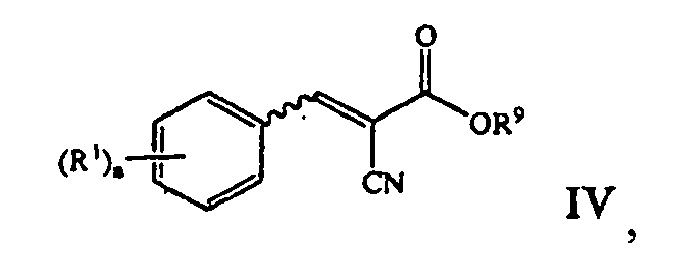
- methods of the present invention include reacting a pyridinium salt of the formula: with an ⁇ -cyano- ⁇ -aryl acrylate compound of the formula: to produce a pyridinium zwitter ionic compound of the formula: where X is halide, R 9 is lower alkyl, a, and R 1 are those defined herein.
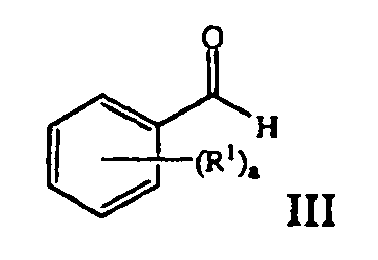
- the ⁇ -cyano- ⁇ -aryl acrylate compound of Formula IV can be prepared by reacting a benzaldehyde compound of the formula: with an ⁇ -cyanoester compound of the formula: in the presence of a base, where a, R 1 , R 9 are those defined herein.
- the ⁇ -cyano- ⁇ -aryl acrylate compound of Formula IV can be prepared separately (i.e., in a separate step or process) or it can be prepared in situ.
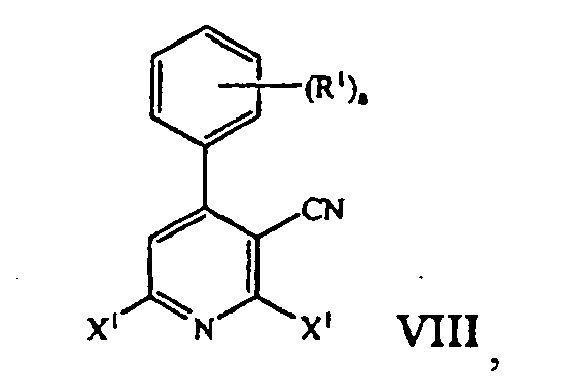
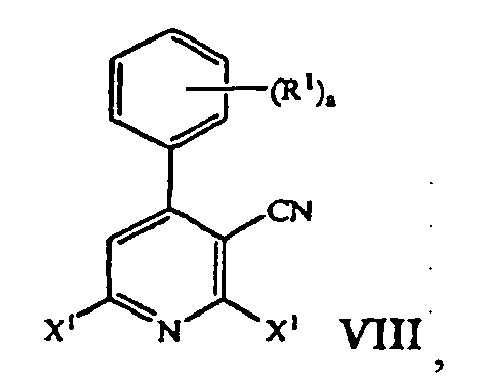
- the pyridinium zwitter ionic compound of Formula VII is treated with a reagent selected from POCl 3 , PBr 3 , and (F 3 CSO 2 ) 2 O to form a cyanopyridine compound of formula: where X 1 is halogen or trifluoromethanesufonate; and R 1 and a are those defined herein.
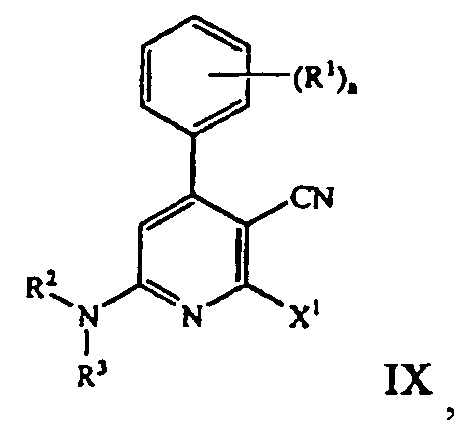
- Regioselective amination of the cyanopyridine compound of formula VIII with an amine compound of the formula HNR 2 R 3 then provides a tetra-substituted pyridine compound of the formula: where a, R 1 , R 2 , R 3 and X 1 are those defined herein.
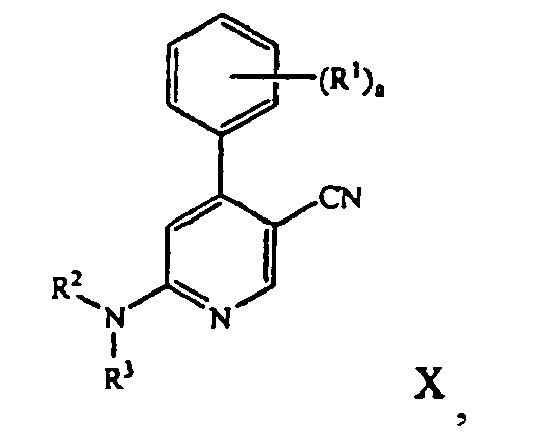
- Methods of the present invention can also include hydrogenating the tetra-substituted pyridine compound of Formula IX in the presence of a hydrogenation catalyst to form a tri-substituted pyridine compound of the formula: where a, R 1 , R 2 , and R 3 are those defined herein.
- methods of the present invention can further include hydrolyzing the tri-substituted pyridine compound of Formula X to form the carboxamide compound of Formula I.
- acyl activating group refers to a group which facilitates transfer of an acyl group to an amine or a hydroxy functional group.
- exemplary acyl activation groups include, but are not limited to, halides (such as chlorides as in acid chlorides), anhydrides, and thioesters.
- Other acyl activating groups are well known to one skilled in the art and can be found, among others, in Smith and March, Advanced Organic Chemistry, 5th ed., John Wiley & Sons, New York, NY, 2001 and Harrison and Harrison et al., Compendium of Synthetic Organic Methods, Vols. 1-8 (John Wiley and Sons, 1971-1996 ).
- Alkylene means a saturated linear saturated divalent hydrocarbon moiety of one to twelve carbon atoms or a branched saturated divalent hydrocarbon moiety of three to twelve carbon atoms.
- exemplary alkylene, groups include, but are not limited to, methylene, ethylene, propylene, butylene, pentylene, and the like.
- Aralkyl means a moiety of the formula -R b R c where R b is an alkylene group and R c is an aryl group.
- exemplary aralkyl groups include, but are not limited to, benzyl, phenylethyl, 3-(3-chlorophenyl)-2-methylpentyl, and the like, with benzyl being the preferred aralkyl group.
- lower alkyl means a straight- or branched-chain alkyl group containing from 1-7 carbon atoms, for example, methyl, ethyl, propyl, isopropyl, n-butyl, i-butyl, t-butyl, and the like.
- Preferred lower alkyl groups are groups with 1-4 carbon atoms.
- lower alkoxy means a group wherein the alkyl residues are as defined above, and which is attached via oxygen atom.
- halogen and “halide” are used interchangeably herein and means chlorine, iodine, fluorine or bromine.
- cycloalkyl means a saturated carbocyclic group, containing 3-6 carbon atoms.
- aryl means an unsaturated aromatic ring, preferreably phenyl.
- Heterocyclyl means an aromatic or non-aromatic cyclic moiety having one or more ring heteroatoms, preferably one or two, each of which is independently selected from N, O, S(O) m (where m is 0,1 or 2) with the remaining ring atoms being C.
- exemplary heterocyclyl groups include, but are not limited to, morpholinyl, thiomorpholinyl, 1,1-dioxo-1 ⁇ 6 -thiomorpholinyl, piperidinyl, piperazinyl and the like.
- Heterocyclylalkyl means a moiety of the formula -R d -R e , where R d is alkylene and R e is heterocyclyl as defined herein.
- N-heterocyclyl refers to a heterocyclyl moiety as defined above, comprising at least one nitrogen ring atom with the understanding that the point of attachment of N-heterocyclyl moiety is through the ring nitrogen atom.
- 5 or 6 membered heterocyclyl refers to a heterocyclyl moiety having 5 or 6 ring atoms.
- exemplary 5 or 6 membered heterocyclyl moieties include pyridinyl, pyridimidinyl, oxadiazolyl, triazolyl, tetrazolyl, thiazolyl, thienyl, furyl, pyranyl, pyrrolyl, imidazolyl, pyrazolyl, isothiazolyl, piperazinyl, or piperidyl.
- Hydroxylalkyl refers to an alkyl, preferably lower alkyl, moiety as defined herein that is substituted with one or more hydroxyl group, provided that no two carbon atom contains more than one hydroxyl group.
- a hydroxylalkyl moiety is of the formula -R 8 -OH (where R 8 is alkylene, i.e., where the hydroxyl group is attached to the terminal carbon atom).
- One aspect of the present invention provides a process for preparing an amino-substituted cyanopyridine compound of the formula: by reacting a pyridinium salt of the formula: with an ⁇ -cyano- ⁇ -aryl acrylate compound of the formula: to produce a pyridinium zwitter ionic compound of the formula: where
- the pyridinium zwitter ionic compound of Formula VII is then reacted with a reagent selected from POCl 3 , PBr 3 , (F 3 CSO 2 ) 2 O, and other similar reagents known to one skilled in the art, to form a cyanopyridine compound of the formula: and the cyanopyridine compound of formula VIII is reacted with an amine compound of the formula HNR 2 R 3 to form a tetra-substituted pyridine compound of the formula: which is then hydrogenated in the presence of a hydrogenation catalyst to form the amino-substituted cyanopyridine compound of the Formula X, where a, R 1 , R 2 , and R 3 are those defined herein, and each X 1 is independently halide or trifluoromethanesufonate. Preferably, both X 1 are of the same moiety.
- the ⁇ -cyano- ⁇ -aryl acrylate compound of Formula IV can be prepared by reacting a benzaldehyde compound of the formula: with an ⁇ -cyanoester compound of the formula: in the presence of a base, wherein a, R 1 , and R 9 are those defined herein. Moreover, the ⁇ -cyano- ⁇ -aryl acrylate compound of Formula IV can be prepared and separated prior to use or it can be is prepared and used in situ.
- aminopyridine compounds of Formula II which are known Neurokinin-1 receptor antagonist
- Preparation of the aminopyridine compounds of Formula II can be achieved by one of several processes illustrated below. It should be appreciated that the preparation of the aminopyridine compounds of Formula II from the carboxamide pyridine compound of Formula I discussed below are only illustrative and the scope of the present invention is not limited to such processes.
- aminopyridine compounds of Formula II can be prepared from the carboxamide pyridine compound of Formula I by:
- a compound of Formula I can be reacted with an oxidizing agent and hydrolyzed with water rather than R 13 -OH to produce a diaminopyridine compound of the formula:
- This diaminopyridine of Formula XIIIA can then be further derivatized using similar processes and/or reactions as those described in reference to compounds of Formula XIII to produce corresponding compounds of Formula II.
- Some aminopyridine compounds of formulas II can be prepared from the diaminopyridine compound of Formula XIIIA by alkylating with an aralkyl compound of the formula: to produce the aminopyridine compounds of formulas II where X a is -N(H)-CH 2 -, L is a leaving group, and R 10a , R 10b , R 11 , and n are those defined herein.
- aminopyridine compounds of Formula II can be prepared from the carboxamide pyridine compound of Formula I by:
- X a is -CH 2 N(H)- or -N(H)-CH 2 - in compounds of Formula II
- the amino group of X a can be further alkylated to produce a substituted X a group, where X a is -CH 2 N(R 14a )- or -N(R 14a )-CH 2 -, where R 14a is C 3-6 cycloalkyl, aralkyl or lower alkyl.
- this alkylation can be achieved with a corresponding R 14a -X b , where R 14a those defined above and X b is a leaving group.
- a reductive amination reaction can also be used to substitute the amino group with R 14a group.
- a reductive amination involves reacting the amino group X a (where X a is -CH 2 N(H)- or -N(H)-CH 2 -) with an R 14a group having a carbonyl group (i.e., a corresponding R 14a carbonyl compound) in the presence of a reducing agent, such as sodium borohydride or other similar reducing agent.
- a reducing agent such as sodium borohydride or other similar reducing agent.
- the corresponding R 14a carbonyl compound refers to a compound having a carbonyl group within the R 14a moiety such that the reductive amination provided substitution of R 14a group. Reductive amination reaction is also disclosed in Smith and March, Advanced Organic Chemistry, 5th ed ., and Harrison and Harrison et al., Compendium of Synthetic Organic Methods, Vols. 1-8 .
- R 14a is an aralkyl or a lower alkyl
- X c is an acyl activating group such as halide or ester (i.e., -OR 16 , where R 16 is an alkyl or other hydrocarbon moiety) and reduction with a suitable reducing agent such as LiAlBH 4 .
- suitable reducing agent such as LiAlBH 4
- suitable reducing agents are well known to one skilled in the art as disclosed by Smith and March in Advanced Organic Chemistry, 5th ed .
- some aminopyridine compounds of Formula II can be prepared from the carboxamide pyridine compound of Formula I by reacting the carboxamide pyridine compound of Formula I with an aralkyl compound of the formula: in the presence of a base to produce the aminopyridine compound of Formula II, where n, R 10a R 10b , R 11 , and L are those defined herein.
- aminopyridine compounds of Formula II can be prepared including, but not limited to:
- Processes of the present invention overcome many of the disadvantages of the conventional synthetic methods by eliminating the need for expensive starting materials and avoiding use of a Grignard reaction.
- the overall process for preparation of compounds of formula I is shown in Scheme I.
- reacting a compound of formula VI with a compound of formula IV is typically carried out in the presence of an organic solvent, such as ether, ketone, toluene or alcohol, preferably methanol.
- an organic solvent such as ether, ketone, toluene or alcohol, preferably methanol.
- the reaction is carried out in the presence of a base, preferably an organic base, such as triethylamine.
- Typical reaction conditions include refluxing the reaction mixture for about one minute, then allowing the mixture to cool to about 20 °C to about 50 °C, preferably about 25 °C. After cooling, the reaction mixture is stirred for about 1 to 100 hours, typically about 66 hours. Filtration of the reaction mixture and air drying the solid then affords a pyridinium zwitter ionic compound of Formula VII.
- Compound of Formula IV can be generated separated prior to its reaction with the pyridinium salt of formula VI or it can be generated in situ.
- the pyridinium zwitter ionic compound of Formula VII can be produced by reacting a pyridinium salt of formula VI with a benzaldehyde compound of formula III in the presence of an ⁇ -cyanoester compound of the formula: where R 9 is as defined herein.
- the reaction is carried out in the presence of an alcohol, such as a lower alkyl alcohol, cycloalkyl alcohol, preferably isopropanol.
- the reaction is carried out in an organic solvent such as ether, ketone, toluene, alcohol (preferably methanol), or a mixture thereof.
- the reaction mixture includes an organic base, such as triethylamine.
- Typical reaction time is about 2 to 48 hours, generally about 24 hours. Suitable reaction temperature ranges from about 20°C to 33 °C, often about 25 °C to 30°C.
- a cyanopyridine compound of formula VIII reacting the pyridinium zwitter ionic compound of formula VII with a reagent selected from POCl 3 , PBr 3 , and (F 3 CSO 2 ) 2 O yields a cyanopyridine compound of formula VIII.
- Typical reaction conditions include heating the mixture to about 105°C for approximately 72 hours. The mixture is then cooled to approximately 20 °C to 33 °C, preferably 20°C to 25 °C and diluted with an organic solvent, such as methylene chloride. The resulting mixture is then placed in an ice bath and stirred for about 10 minutes. Aqueous work up followed by concentration of the organic layer then affords the cyanopyridine compound of formula VIII.
- the cyanopyridine compound of formula VIII is then reacted with an amine compound of the formula HNR 2 R 3 to form a tetra-substituted pyridine compound of formula IX.
- Displacement of one of the X 1 moiety with the amine compound of the formula HNR 2 R 3 is typically preformed in an alcoholic solvent, such as methanol.
- the reaction temperature is generally kept at about 0 °C to 25 °C, preferably 18 °C. If necessary, an ice-water bath can be used to control the reaction temperature.
- the amine compound of the formula HNR 2 R 3 is morpholine, which is added to the reaction mixture at a temperature of about 18 °C to 33°C, preferably 18 °C to 22 °C. Morpholine is typically added slowly to the reaction mixture, e.g., addition time of about 10 to 60 minutes, preferably 45 minutes. The resulting mixture is stirred at about 20 °C to 33 °C, preferably 20 °C to 25 °C, for approximately 48 hours.
- Hydrogenation of the tetra-substituted pyridine compound of formula IX in the presence of a hydrogenation catalyst then affords an amino-substituted cyanopyridine compound of formula X.
- the hydrogenation reaction is carried out in the presence of a base, preferably an organic base, such as triethylamine.
- the hydrogenation reaction temperature generally ranges from about 25 °C to 45 °C, preferably 20 °C to 25 °C.
- a variety of hydrogenation catalysts are suitable for reducing the tetra-substituted pyridine compound of formula IX.
- Preferred hydrogenation catalysts are transition metal based, preferably palladium metal based.
- a particularly useful hydrogenation catalyst is Pd(OH) 2 or 20% palladium hydroxide on carbon (Pearlman's catalyst).
- the hydrogenation reaction mixture includes an organic solvent, such as methanol.
- the reaction mixture is typically stirred under a high pressure of hydrogen atmosphere, typically at about 30 psi of hydrogen or higher, more generally about 40 psi of hydrogen or higher.
- the hydrogenation reaction is carried out at about 48.0 to 48.3 psi of hydrogen.
- the reaction time ranges from about 2 to 42 hours, often about 21 hours.
- the amino-substituted cyanopyridine compound of formula X is then hydrolyzed to provide a carboxamide pyridine compound of formula I.
- Hydrolysis of the nitrile function group of formula X can be achieved in a basic or, preferably, in an acidic medium.
- Exemplary acids that are useful in hydrolysis of the nitrile function group include, but are not limited to, H 2 SO 4 , HCl and acetic acid, with H 2 SO 4 being the typical acid used in hydrolysis.
- Hydrolysis can be carried out in the presence or absence of an organic solvent.
- Typical hydrolysis reaction is carried out at a temperature in the range of about 50°C to 140 °C, preferably about 60°C to 90 °C.
- the reaction time generally ranges from approximately 2 to 22 hours, preferably 12 hours.
- Scheme I shows various reactions in a particular sequence
- Scheme I is only an illustrative example.
- One skilled in the art having the present disclosure can readily recognize that some of the reaction sequences can be changed, eliminated or combined. Therefore, the scope of present invention includes all suitable variations to Scheme I reaction sequences.
- Scheme I illustrates a reaction sequence involving substitution of one of the X 1 moiety of compound of formula VIII with an amine compound of the formula HNR 2 R 3 , followed by hydrogenation of compound of formula IX, then hydrolysis of the cyano group of compound of formula X to produce the carboxamide pyridine compound of formula I.
- variations of reaction sequences illustrated in Scheme I are also readily apparent to those skilled in the art having the disclosure of the present invention.
- hydrolysis of the cyano group can be achieved prior to the reduction, i.e., hydrogenolysis, reaction.
- each R 1 is independently lower alkyl, alkoxy, halogen, cyano, or alkyamino; X 1 is halogen; and R 2 and R 3 together with the nitrogen atom to which they are attached to form optionally substituted N-heterocyclyl.
- each R 1 is independently lower alkyl, alkoxy, halogen, cyano and alkylamino;
- X 1 is chloro; and R 2 and R 3 together with the nitrogen atom to which they are attached to form morpholin-4-yl, 4-methyl-piperazin-1-yl, or 1,1-dioxothiomopholin-4-yl.
- Another embodiment of the present invention provides various compounds that can be produced by one or more reaction disclosed herein, such compounds include, but are not limited to, methyl 2-cyano-3- (2-methylphenyl) -2-propenoate, 1-(2-amino)-2-oxoethylpyridinium chloride, 5'-cyano-1'-2',3',4'-tetrahydro-6'-hydroxy-4'-(2-methylphenyl)-2'-oxo-1,3'-bipyridium, zwitter ion, 3-cyano-2,-6-dichloro-4-(2-methylphenyl)pyridine, 2-chloro-3-cyano-4-(2-methylphenyl)-6-(4-morpholinyl)pyridine, 5-cyano-4-(2-methylphenyl)-2-(4-morpholinyl)pyridine, 4-(2-methylphenyl)-6-(4-morpholinyl)-3-pyridinecarboxamide, 2-chloro-4-(2-methylphenyl)
- aminopyridine compound of Formula II including, but not limited to: N-(3,5-bis-trifluoromethyl-benzyl)-N-methyl-6-[methyl-(2-morpholin-4-yl-ethyl)-amino]-4-o-tolyl-nicotinamide, N-(3,5-bis-trifluoromethyl-benzyl)-N-methyl-6-morpholin-4yl-4-o-tolyl-nicotinamide, N-(3,5-bis-trifluoromethyl-benzyl)-N-methyl-6-thiomorpholin-4-yl-4-o-tolyl-nicotinamide, N-(3,5-bis-trifluoromethyl-benzyl)-N-methyl-6-(1-oxo-1 ⁇ 6 -4-thiomorpholin-4-yl)-4-o-tolyl-nicotinamide, N-(3,5-Bis-trifluoromethyl-benzyl)-6-(1,1-d
- Ammonium chloride (100 g of 15.9% aqueous solution) was added over 5 minutes at 15-20 °C. The solution was concentrated by fractional distillation (597 mL collected at 50-61 °C). The distillation pot layers were separated. The aqueous layer was extracted three times with 25 mL of methyl tert-butyl ether (i.e., MTBE). The organic layers were combined, washed with 50 mL of brine, dried (MgSO 4 ), filtered, and fractionally distilled (b.p. 54-62 °C) to yield 59.3 g of yellow oil. The oil was fractionally distilled (b.p. 60-62 °C at 1.6-2.0 mmHg of pressure) to afford 28.041 g (68.4%) of a colorless oil.
- MTBE methyl tert-butyl ether
- a 100-mL, 2-necked round bottom flask equipped with a reflux condenser was charged with 1.726 g (10.0 mmol) of the pyridinium salt (i.e., 1-(2-amino)-2-oxoethylpyridinium chloride, see Example 3 or 4), 2.012 g (10.0 mmol) of methyl 2-cyano-3-(2-methylphenyl)-2-propenoate (see Example 2), 20 mL of methanol, and triethylamine (1.55 mL, 1.11 g,1.10 equiv). The mixture was refluxed for 1 minute then allowed to cool to 25 °C and stirred for 66 hours.
- the pyridinium salt i.e., 1-(2-amino)-2-oxoethylpyridinium chloride, see Example 3 or 4
- 2.012 g (10.0 mmol) of methyl 2-cyano-3-(2-methylphenyl)-2-propenoate
- the addition funnel was charged with 153.3 mL (111.3 g, 1.1 mol) of triehtylamine and was added to the reaction mixture over a period of 20 minutes at 20-25 °C. The resulting mixture was stirred at 25-30 °C for 24 hours. The precipitate was filtered, washed successively with 500 mL of methanol, 500 mL of toluene and 500 mL of hexanes, and dried to afford 285.10 g (93.4%) of 1',2',3',4'-tetrahydro-5'-cyano-6'-hydroxy-4'(2-methylphenyl)-2'-oxo-1,3'-bipyridinium, zwitter ion as a bright yellow solid.
- the addition funnel was charged with 153.3 mL (111.3 g,1.1 mol) of triethylamine and was added to the reaction mixture over a period of 24 minutes at 20-25 °C. The resulting mixture was stirred at 25-30 °C for 24 hours.
- the addition funnel was charged with 31.1 mL (22.6 g, 223 mmol) triethylamine and was added to the reaction mixture over 11 min at 170 rpm and 20-25 °C (intermittent ice-water bath). The resulting mixture was stirred at 25-30 °C for 24 h.
- the precipitate was suction filtered using a 600 mL coarse sintered glass funnel.
- the precipitate was washed successively with 100 mL of 25 °C methanol, 100 mL of 25 °C toluene, and 100 mL of 25 °C hexanes.
- the solid was then air dried 3.5 h at 25 °C to afford 60.69 g (92.6%) of bright yellow solid, m.p.
- the reaction mixture was cooled to 25 °C and diluted with 75 mL of methylene chloride. The solution was transferred onto 350 g of ice. Additional methylene chloride (25 mL) was used to aid the transfer. The resulting mixture was stirred for 1 hour. The layers were separated, and the aqueous layer was extracted twice with 25 mL of methylene chloride and twice with 50 mL of toluene. The extracts were combined, dried (5.0 g Na 2 SO 4 ), and filtered through 15 g of Filtrol ® on a 60-mL coarse sintered glass funnel. The flask and the solid were washed with 50 mL of toluene. The combined mother liquors were concentrated to afford 28.70 g (83.3%) of 3-cyano-2,6-dichloro-4-(2-methylphenyl)pyridine as a near colorless solid (LC assay 100.7 wt %).
- the reaction mixture was cooled to 25 °C, diluted with 200 mL of methylene chloride, transferred using additional 25 mL of methylene chloride onto 450 g of ice, and stirred until all the ice melted.
- the layers were separated, and the aqueous layer was extracted successively twice with 25 mL of methylene chloride and twice with 125 mL of toluene.
- the combined extracts were filtered through 15 g of Filtrol ® on a 60-mL coarse sintered glass funnel. The flask and the solid were washed with 100 mL of toluene.
- the combined mother liquors were concentrated to afford 39.70 g (83.0%) of near colorless solid.
- Oxone ® (56.18 g, 91.4 mmol) was added to a solution of 2-chloro-3-cyano-4-(4-fluoro-2-methylphenyl)-6-(thiomorpholino)pyridine (26.54 g, 76.3 mmol) in 200 mL of NMP in a 1000-mL, 3-necked flask (equipped with a teflon paddle stirrer, septum with teflon-coated thermocouple, dry N 2 adapter). The mixture was stirred at 25 °C for 20 hours, and diluted with 800 mL of water. The resulting mixture was stirred at 25 °C for 30 minutes.
Landscapes
- Chemical & Material Sciences (AREA)
- Organic Chemistry (AREA)
- Pyridine Compounds (AREA)
- Low-Molecular Organic Synthesis Reactions Using Catalysts (AREA)
- Catalysts (AREA)
- Pharmaceuticals Containing Other Organic And Inorganic Compounds (AREA)
- Plural Heterocyclic Compounds (AREA)
Claims (32)
- Verfahren zur Herstellung einer Carboxamidpyridinverbindung der Formel:
 (a) das Umsetzen eines Pyridiniumsalzes der Formel:
 (b) das Umsetzen der zwitterionischen Pyridiniumverbindung mit einem Reagens, ausgewählt aus der Gruppe, bestehend aus POCl3, PBr3 und (F3CSO2)2O unter Bildung einer Cyanopyridinverbindung der Formel:
 (c) das Umsetzen der Cyanopyridinverbindung der Formel VIII mit einer Aminverbindung der Formel HNR2R3 unter Bildung einer tetra-substituierten Pyridinverbindung der Formel:
 (d) das Hydrieren der tetra-substituierten Pyridinverbindung der Formel IX in Gegenwart eines Hydrierungskatalysators unter Bildung einer tri-substituierten Pyridinverbindung der Formel:
 (e) das Hydrolysieren der tri-substituierten Pyridinverbindung unter Bildung der Carboxamidverbindung der Formel I umfasst,wobeijeder R1 unabhängig C1-7Alkyl, C1-7-Alkoxy, Halogen, Cyano oder C1-7Alkylamino ist;a eine ganze Zahl von 0 bis 2 ist;R2 Wasserstoff, C3-6-Cycloalkyl, Aralkyl, C1-7-Alkyl, Hydroxy-C1-7-alkyl, -S(O)2-C1-7-Alkyl, -S(O)2-Ar1, gegebenenfalls substituiertes N-Hetero- cyclyl-C1-7alkyl, -C(=O)R3, wobei Ar1 Phenyl ist, ist;R3 Wasserstoff, C3-6-Cycloalkyl, Aralkyl oder C1-7-Alkyl ist;oder R2 und R3 zusammen mit dem Stickstoffatom, an das sie gebunden sind, gegebenen- falls substituiertes N-Heterocyclyl bilden;oder R2 und R3 zusammen =C(R5)-R6-NR7R8 bilden;
wobeiR5 C1-7-Alkyl oder Wasserstoff ist;R6 C1-2-Alkylen oder eine Bindung ist undjeder von R7 und R8 unabhängig Wasserstoff, C3-6-Cycloalkyl, Aralkyl oder C1-7-Alkyl ist;R9 C1-7-Alkyl ist;X1 ein Halogenid oder Trifluormethansulfonat ist undX ein Halogenid ist. - Verfahren nach Anspruch 1, wobei die α-Cyano-β-phenylacrylatverbindung der Formel IV durch Umsetzen einer Benzaldehydverbindung der Formel:

- Verfahren nach Anspruch 2, wobei die α-Cyano-β-phenylacrylatverbindung der Formel IV in situ hergestellt wird.
- Verfahren nach Anspruch 2, wobei die Base Morpholin ist.
- Verfahren nach Anspruch 2, wobei der Schritt des Herstellens der α-Cyanoesterverbindung das Durchführen der Reaktion in einem alkoholischen Lösungsmittel umfasst.
- Verfahren nach Anspruch 5, wobei das alkoholische Lösungsmittel Isopropanol, Methanol oder ein Gemisch davon umfasst.
- Verfahren nach Anspruch 2, wobei die Reaktionstemperatur des Herstellungsschrittes der α-Cyanoesterverbindung in dem Bereich von 20 °C bis 33 °C liegt.
- Verfahren nach Anspruch 1, wobei die Reaktionsbedingungen für den Schritt der Herstellung der zwitterionischen Pyridiniumverbindung ein Reaktionslösungsmittel und die Gegenwart einer organischen Base umfassen.
- Verfahren nach Anspruch 8, wobei das Reaktionslösungsmittel Ether, Keton, Toluol, einen Alkohol oder ein Gemisch davon umfasst.
- Verfahren nach Anspruch 9, wobei der Alkohol Methanol ist.
- Verfahren nach Anspruch 8, wobei die organische Base Triethylamin ist.
- Verfahren nach Anspruch 1, wobei X1 Chlorid ist.
- Verfahren nach Anspruch 12, wobei das Reagens zur Herstellung der Cyanopyridinverbindung Phosphor(V)-oxidchlorid ist.
- Verfahren nach Anspruch 1, wobei die Aminverbindung aus der Gruppe ausgewählt ist, bestehend aus Morpholin, 1-Methylpiperazin und Thiomorpholin.
- Verfahren nach Anspruch 14, wobei die Aminverbindung Morpholin ist.
- Verfahren nach Anspruch 1, wobei der Hydrierungskatalysator Pd(OH)2 ist.
- Verfahren nach Anspruch 1, wobei der Hydrolysierungsschritt das Kontaktieren der tri-substituierten Pyridinverbindung mit einer Säure umfasst.
- Verfahren nach Anspruch 17, wobei die Säure aus der Gruppe ausgewählt ist, bestehend aus H2SO4, HCl und Essigsäure.
- Verfahren nach Anspruch 18, wobei die Säure H2SO4 ist.
- Verfahren nach Anspruch 1, wobei jeder von R1 unabhängig C1-7-Alkyl, C1-7-Alkoxy, Halogen, Cyano oder C1-7-Alkylamino ist.
- Verfahren nach Anspruch 20, wobei R2 und R3 zusammen mit dem Stickstoffatom, an das sie gebunden sind, gegebenenfalls substituiertes N-Heterocyclyl bilden.
- Verfahren nach Anspruch 21, wobei R2 und R3 zusammen mit dem Stickstoffatom, an das sie gebunden sind, Morpholin-4-yl, 4-Methyl-piperazin-1-yl oder 1,1-Dioxothiomorpholin-4-yl bilden.
- Verfahren nach Anspruch 1, wobei die Carboxamidpyridinverbindung:4-(2-Methylphenyl)-6-(4-morpholinyl)-3-pyridincarboxamid;4-(4-Fluor-2-methylphenyl)-6-(1,1-dioxo-thiomorpholin-4-yl)pyridin-3-carboxamid oder4-(2-Methylphenyl)-6-(4-methylpiperazinyl)-3-pyridincaboxamid ist.
- Verfahren zur Herstellung einer Aminopyridinverbindung der Formel:
 (a) das Umsetzen eines Pyridiniumsalzes der Formel:

 (b) das Umsetzen der zwitterionischen Pyridiniumverbindung mit einem Reagens, ausgewählt aus der Gruppe, bestehend aus POCl3, PBr3 und (F3CSO2)2O unter Bildung einer Cyanopyridinverbindung der Formel:
 (c) das Umsetzen der Cyanopyridinverbindung der Formel VIII mit einer Aminverbindung der Formel HNR2R3 unter Bildung einer tetra-substituierten Pyridinverbindung der Formel:
 (d) das Hydrieren der tetra-substituierten Pyridinverbindung der Formel IX in Gegenwart eines Hydrierungskatalysators unter Bildung einer tri-substituierten Pyridinverbindung der Formel:
 (e) das Hydrolysieren der tri-substituierten Pyridinverbindung unter Bildung der Carboxamidpyridinverbindung der Formel:
 (f)umfasst, wobei(i)(a) das Kontaktieren der Carboxamidpyridinverbindung der Formel I mit einem Oxidationsmittel in Gegenwart eines Alkohols der Formel R13-OH, wodurch eine Carbamatpyridinverbindung der Formel:
 (b) das Reduzieren der Carbamatpyridinverbindung der Formel XII mit einem Reduktionsmittel, wodurch eine Diaminopyridinverbindung der Formel:
 (c) das Umsetzen der Diaminopyridinverbindung der Formel XIII mit einer Carbonylverbindung der Formel:
 (d) gegebenenfalls das Umsetzen der Aminopyridinverbindung der Formel II, worin Xa -N(CH3)C(=O)- ist, mit einem zweiten Reduktionsmittel, wodurch die Aminopyridinverbindung der Formel II, worin Xa -N(CH3)-CH2- ist, hergestellt wird; oder(ii)(a) das Kontaktieren der Carboxamidpyridinverbindung der Formel I mit einem Reduktionsmittel, wodurch eine Alkylamino-substituierte Pyridinverbindung der Formel:
 (b) das Umsetzen der Alkylamino-substituierten Pyridinverbindung der Formel XV mit einer Aralkylverbindung der Formel:
 (iii) das Umsetzen der Carboxamidpyridinverbindung der Formel I mit einer Aralkylverbindung der Formel:
 jeder R1 unabhängig C1-7-Alkyl, C1-7-Alkoxy, Halogen, Cyano oder C1-7-Alkylamino ist;a eine ganze Zahl von 0 bis 2;R2 Wasserstoff, C3-6-Cycloalkyl, Aralkyl, C1-7-Alkyl, Hydroxy-C1-7-alkyl, -S(O)2-C1-7-Alkyl, -S(O)2-Ar1, gegebenenfalls substituiertes N-Hetero- cyclyl-C1-7-alkyl, -C(=O)R3, wobei Ar1 Phenyl ist, ist;R3 Wasserstoff, C3-6-Cycloalkyl, Aralkyl oder C1-7-Alkyl ist;oder R2 und R3 zusammen mit dem Stickstoffatom, an das sie gebunden sind, gegebenen- falls substituiertes N-Heterocyclyl bilden;oder R2 und R3 zusammen =C(R5)-R6-NR7R8 bilden; wobei
R5 C1-7-Alkyl oder Wasserstoff ist;
R6 C1-12-Alkylen oder eine Bindung ist und
jeder von R7 und R8 unabhängig Wasserstoff, C3-6-Cycloalkyl, Aralkyl oder C1-7-Alkyl ist;R9 C1-7-Alkyl ist;jeder von R10a und R10b unabhängig Wasserstoff oder C1-7-Alkyl ist, oder R10a und R10b zu- sammen mit dem Kohlenstoffatom, an das sie gebunden sind, eine C3-6- Cycloalkylgruppe bilden;L eine Austrittsgruppe ist;jeder R11 unabhängig ein Halogenid, Trifluormethyl, C1-7-Alkoxy oder Cyano ist, oder zwei Komponenten R11 eine Komponente der Formel -CRw=CRx-CRy=CRz- ist, wobei jeder von Rw, Rx, Ry und Rz unabhängig Wasserstoff, C1-7-Alkyl oder C1-7-Alkoxy ist, mit der Maßgabe, dass min- destens zwei von Rw, Rx, Ry und Rz Wasserstoff sind;R13 C1-7-Alkyl ist;n eine ganze Zahl von 0 bis 5 ist;Y C1-7-Alkoxid oder eine Acylaktivierungsgruppe ist;Xa -C(=O)N(R14)-, -R16-N(R14)-, -N(R14)C(=O)- oder -N(R14)-R16- ist, wobei
R14 Wasserstoff, C3-6-Cycloalkyl, Aralkyl oder C1-7-Alkyl ist und
R16 C1-12-Alkylen ist; undX1 ein Halogenid oder Trifluormethansulfonat ist undX ein Halogenid ist. - Verfahren nach Anspruch 24, wobei die Aminopyridinverbindung der Formel II:N-(3,5-Bis-trifluormethyl-benzyl)-N-methyl-6-[methyl-(2-morpholin-4-yl-ethyl)-amino]-4-o-tolyl-nicotinamid;N-(3,5-Bis-trifluormethyl-benzyl)-N-methyl-6-morpholin-4-yl-4-o-tolyl-nicotinamid;N-(3,5-Bis-trifluormethyl-benzyl)-N-methyl-6-thiomorpholin-4-yl-4-o-tolyl-nicotinamid;N-(3,5-Bis-trifluormethyl-benzyl)-N-methyl-6-(1-oxo-1λ6-4-thiomorpholin-4-yl)-4-o-tolyl-nicotinamid;N-(3,5-Bis-trifluormethyl-benzyl)-6-(1,1-dioxo-1λ6-6-thiomorpholm-4-yl)-N-methyl-4-o-tolyl-nicotinamid;N-(3,5-Bis-trifluormethyl-benzyl)-N-methyl-6-piperazin-1-yl-4-o-tolyl-nicotinamid;N-(3,5-Bis-trifluormethyl-benzyl)-6-[4-(2-hydroxy-ethyl)-piperazin-1-yl)]-N-methyl-4-o-tolyl-nicotinamid;2-(3,5-Bis-trifluormethyl-phenyl)-N-[6-(4-methyl-piperazin-1-yl)-4-O-tolyl-pyridin-3-yl]-N-methyl-isobutyramid;2-(3,5-Bis-trifluormethyl-phenyl)-N-(6-morpholin-4-yl-4-o-tolyl-pyridin-3-yl)-N-methyl-isobutyramid;2-(3,5-Bis-trifluormethyl-phenyl)-N-[4-(4-fluor-2-methyl-phenyl)-6-(4-methyl-piperazin-1-yl)-pyridin-3-yl]-N-methyl-isobutyramid;2-(3,5-Bis-trifluormethyl-phenyl)-N-[4-(2-chlor-phenyl)-pyridin-3-yl]-N-methyl-isobutyr-amid;2-(3,5-Bis-trifluormethyl-phenyl)-N-methyl-N-(4-o-tolyl-pyridin-3-yl)-isobutyramid;2-(3,5-Bis-trifluormethyl-phenyl)-N-methyl-N-[6-(4-pyridin-2-yl-piperazin-1-yl)-4-o-tolyl-pyridin-3-yl)-isobutyramid;2-(3,5-Bis-trifluormethyl-phenyl)-N-(6-morpholin-4-yl-4-o-tolyl-pyridin-3-yl)-isobutyramid;2-(3,5-Bis-trifluormethyl-phenyl)-N-[4-(2-chlor-phenyl)-6-dimethylamino-pyridin-3-yl]-isobutyramid;2-(3,5-Bis-trifluormethyl-phenyl)-N-methyl-N-(6-piperazin-1-yl-4-o-tolyl-pyridin-3-yl)-isobutyramid oder2-(3,5-Bis-trifluormethyl-phenyl)-N-[6-(1,1-dioxo-1λ6-thiomorpholin-4-yl)-4-o-tolyl-pyridin-3-yl]-N-methyl-isobutyramid ist.
- Verfahren zur Herstellung einer Amino-substituierten Cyanopyridinverbindung der Formel:
 (a) das Umsetzen eines Pyridiniumsalzes der Formel:

 (b) das Umsetzen der zwitterionischen Pyridiniumverbindung mit einem Reagens, ausgewählt aus der Gruppe, bestehend aus POCl3, PBr3 und (F3CSO2)2O, unter Bildung einer Cyanopyridinverbindung der Formel:
 (c) das Umsetzen der Cyanopyridinverbindung der Formel VIII mit einer Aminverbindung der Formel HNR2R3 unter Bildung einer tetra-substituierten Pyridinverbindung der Formel:
 (d) die Hydrierung der tetra-substituierten Pyridinverbindung der Formel IX in Gegenwart eines Hydrierungskatalysators unter Bildung der Amino-substituierten Cyanopyridinverbindungumfasst, wobeijeder R1 unabhängig C1-7-Alkyl, C1-7-Alkoxy, Halogen, Cyano oder C1-7-Alkylamino ist;a eine ganze Zahl von 0 bis 2 ist;R2 Wasserstoff, C3-6-Cycloalkyl, Aralkyl, C1-7-Alkyl, Hydroxy-C1-7-alkyl, -S(O)2-C1-7-Alkyl, -S(O)2-Ar1, gegebenenfalls substituiertes N-Hetero- cyclyl-C1-7-alkyl, -C(=O)R3, wobei Ar1 Phenyl ist, ist;R3 Wasserstoff, C3-6-Cycloalkyl, Aralkyl oder C1-7Alkyl ist;oder R2 und R3 zusammen mit dem Stickstoffatom, an das sie gebunden sind, gegebenen- falls substituiertes N-Heterocyclyl bilden;oder R2 und R3 zusammen =C(R5)-R6-NR7R8 bilden;
wobei
R5 C1-7-Alkyl oder Wasserstoff ist;
R6 C1-12-Alkylen oder eine Bindung ist und
jeder von R7 und R8 unabhängig Wasserstoff, C3-6-Cycloalkyl, Aralkyl oder C1-7-Alkyl ist;R9 C1-7-Alkyl ist;X ein Halogenid ist undX1 ein Halogenid oder Trifluormethansulfonat ist. - Verfahren nach Anspruch 26, wobei die α-Cyano-β-phenylacrylatverbindung der Formel IV durch Umsetzen einer Benzaldehydverbindung der Formel


- Verfahren nach Anspruch 26, wobei die α-Cyano-β-phenylacrylatverbindung der Formel IV in situ hergestellt wird.
- Verfahren nach Anspruch 26, wobei die Base Morpholin ist.
- Verfahren nach Anspruch 26, wobei der Schritt der Herstellung der α-Cyanoesterverbindung das Durchführen der Reaktion in einem alkoholischen Lösungsmittel umfasst.
- Verfahren nach Anspruch 30, wobei das alkoholische Lösungsmittel Isopropanol, Methanol oder ein Gemisch davon umfasst.
- Verfahren nach Anspruch 26, wobei die Amino-substituierte Cyanopyridinverbindung:5-Cyano-4-(2-methylphenyl)-2-(4-morpholinyl)pyridin oder5-Cyano-4-(2-methylphenyl)-2-(-4-methylpiperazinyl)pyridin ist.
Applications Claiming Priority (3)
| Application Number | Priority Date | Filing Date | Title |
|---|---|---|---|
| US58577904P | 2004-07-06 | 2004-07-06 | |
| US65573105P | 2005-02-23 | 2005-02-23 | |
| PCT/EP2005/006919 WO2006002860A1 (en) | 2004-07-06 | 2005-06-28 | Process for preparing carboxamide pyridine derivatives used as intermediates in the synthesis of nk-1 receptor antagonists |
Publications (2)
| Publication Number | Publication Date |
|---|---|
| EP1776342A1 EP1776342A1 (de) | 2007-04-25 |
| EP1776342B1 true EP1776342B1 (de) | 2011-03-02 |
Family
ID=35058532
Family Applications (1)
| Application Number | Title | Priority Date | Filing Date |
|---|---|---|---|
| EP05770094A Expired - Lifetime EP1776342B1 (de) | 2004-07-06 | 2005-06-28 | Herstellungsverfahren für carboxamid-pyridin-derivate als zwischenprodukte bei der synthese von nk-1-rezeptor-antagonisten |
Country Status (11)
| Country | Link |
|---|---|
| US (1) | US7384939B2 (de) |
| EP (1) | EP1776342B1 (de) |
| JP (1) | JP4580426B2 (de) |
| CN (1) | CN1984891B (de) |
| AT (1) | ATE500224T1 (de) |
| CA (1) | CA2572645C (de) |
| DE (1) | DE602005026669D1 (de) |
| IL (1) | IL180312A (de) |
| MX (1) | MX2007000198A (de) |
| TW (1) | TWI305531B (de) |
| WO (1) | WO2006002860A1 (de) |
Cited By (4)
| Publication number | Priority date | Publication date | Assignee | Title |
|---|---|---|---|---|
| EP4385497A1 (de) | 2022-12-12 | 2024-06-19 | Alfred E. Tiefenbacher (GmbH & Co. KG) | Antioxidansfreie festdosiskombination aus netupitant und palonosetron |
| EP4385500A1 (de) | 2022-12-12 | 2024-06-19 | Alfred E. Tiefenbacher (GmbH & Co. KG) | Festdosiskombination mit netupitant und palonosetron |
| WO2024126408A1 (en) | 2022-12-12 | 2024-06-20 | Alfred E. Tiefenbacher (Gmbh & Co. Kg) | Antioxidant-free fixed dose combination of netupitant and palonosetron |
| WO2024126398A1 (en) | 2022-12-12 | 2024-06-20 | Alfred E. Tiefenbacher (Gmbh & Co. Kg) | Fixed dose combination comprising netupitant and palonosetron |
Families Citing this family (6)
| Publication number | Priority date | Publication date | Assignee | Title |
|---|---|---|---|---|
| CN1984891B (zh) | 2004-07-06 | 2012-08-08 | 弗·哈夫曼-拉罗切有限公司 | 用作合成nk-1受体拮抗剂的中间体的甲酰胺吡啶衍生物的制备方法 |
| GB0808747D0 (en) | 2008-05-14 | 2008-06-18 | Glaxo Wellcome Mfg Pte Ltd | Novel compounds |
| CN102516164B (zh) * | 2011-12-09 | 2013-09-04 | 中国科学院成都生物研究所 | 1,2-二芳基-5-取代吡啶盐化合物及其制备方法和用途 |
| CN103965893B (zh) * | 2014-05-27 | 2015-07-15 | 北京理工大学 | 一种基于邻氨基吡啶腈化合物的金离子荧光探针及其制备方法 |
| CN106892864A (zh) * | 2015-12-21 | 2017-06-27 | 上海科胜药物研发有限公司 | 一种奈妥皮坦游离碱的晶型a及其制备方法 |
| CN114181142B (zh) * | 2021-12-31 | 2023-10-20 | 浙江工业大学 | 一种6-(4-甲基哌嗪-1-基)-4-邻甲苯基烟酰胺的合成方法 |
Family Cites Families (19)
| Publication number | Priority date | Publication date | Assignee | Title |
|---|---|---|---|---|
| DE2260827C3 (de) * | 1972-12-13 | 1980-11-13 | Basf Ag, 6700 Ludwigshafen | 2,6-Diaminopyridine, Verfahren zu ihrer Herstellung und ihre Verwendung als Kupplungskomponenten für Azofarbstoffe |
| US4061642A (en) * | 1972-06-22 | 1977-12-06 | Cassella Farbwerke Mainkur Ag | 2,4,6-Trisubstituted-3-pyridine carboxamides |
| DE2643753A1 (de) * | 1976-09-29 | 1978-04-06 | Thomae Gmbh Dr K | Neue 1h-pyrazolo eckige klammer auf 3,4-b eckige klammer zu pyridine |
| EP1394150B1 (de) * | 1999-02-24 | 2011-01-19 | F. Hoffmann-La Roche AG | 4-Phenylpyridinderivate und deren Verwendung als NK-1 Rezeptorantagonisten |
| US6303790B1 (en) | 1999-11-29 | 2001-10-16 | Hoffman-La Roche Inc. | Process for the preparation of pyridine derivatives |
| PT1103545E (pt) | 1999-11-29 | 2004-03-31 | Hoffmann La Roche | 2-(3,5-bis-trifluorometil-fenil)-n-metil-n-(6-morfolin-4-il-4-o-totil-piridin-3-il)-isobutiramida |
| PT1303490E (pt) | 2000-07-14 | 2008-09-04 | Hoffmann La Roche | Óxidos de aminas como pró-fármacos de antagonistas dosreceptores nk1, de derivados de 4-fenil-piridina |
| TWI287003B (en) | 2000-07-24 | 2007-09-21 | Hoffmann La Roche | 4-phenyl-pyridine derivatives |
| TWI259180B (en) * | 2000-08-08 | 2006-08-01 | Hoffmann La Roche | 4-Phenyl-pyridine derivatives |
| MXPA03005169A (es) | 2000-12-14 | 2003-09-22 | Hoffmann La Roche | Matriz lipidica auto-emulsificante. |
| US6531597B2 (en) | 2001-02-13 | 2003-03-11 | Hoffmann-La Roche Inc. | Process for preparation of 2-phenyl acetic acid derivatives |
| ATE323531T1 (de) | 2001-04-23 | 2006-05-15 | Hoffmann La Roche | Verwendung von nk-1-rezeptorantagonisten gegen benigne prostatahyperplasie |
| US20030083345A1 (en) | 2001-07-10 | 2003-05-01 | Torsten Hoffmann | Method of treatment and/or prevention of brain, spinal or nerve injury |
| US6849624B2 (en) | 2001-07-31 | 2005-02-01 | Hoffmann-La Roche Inc. | Aromatic and heteroaromatic substituted amides |
| EP1472377A2 (de) | 2002-01-31 | 2004-11-03 | F. Hoffmann-La Roche Ag | Genetische polymorphismen im präprotachykinin-gen |
| ATE366576T1 (de) | 2003-01-31 | 2007-08-15 | Hoffmann La Roche | Neue kristallmodifikation von 2-(3,5-bis- trifluormethyl-phenyl)-n-6-(1,1-dioxo-1lamda-6- |
| TWI280239B (en) * | 2003-07-15 | 2007-05-01 | Hoffmann La Roche | Process for preparation of pyridine derivatives |
| CN1984891B (zh) | 2004-07-06 | 2012-08-08 | 弗·哈夫曼-拉罗切有限公司 | 用作合成nk-1受体拮抗剂的中间体的甲酰胺吡啶衍生物的制备方法 |
| CA2602445C (en) | 2005-03-23 | 2013-08-20 | F.Hoffmann-La Roche Ag | Metabolites for nk-i antagonists for emesis |
-
2005
- 2005-06-28 CN CN200580023101XA patent/CN1984891B/zh not_active Expired - Lifetime
- 2005-06-28 DE DE602005026669T patent/DE602005026669D1/de not_active Expired - Lifetime
- 2005-06-28 MX MX2007000198A patent/MX2007000198A/es active IP Right Grant
- 2005-06-28 EP EP05770094A patent/EP1776342B1/de not_active Expired - Lifetime
- 2005-06-28 AT AT05770094T patent/ATE500224T1/de active
- 2005-06-28 CA CA2572645A patent/CA2572645C/en not_active Expired - Lifetime
- 2005-06-28 JP JP2007519671A patent/JP4580426B2/ja not_active Expired - Lifetime
- 2005-06-28 WO PCT/EP2005/006919 patent/WO2006002860A1/en not_active Ceased
- 2005-07-05 US US11/175,799 patent/US7384939B2/en not_active Expired - Lifetime
- 2005-07-05 TW TW094122651A patent/TWI305531B/zh not_active IP Right Cessation
-
2006
- 2006-12-25 IL IL180312A patent/IL180312A/en active IP Right Grant
Cited By (4)
| Publication number | Priority date | Publication date | Assignee | Title |
|---|---|---|---|---|
| EP4385497A1 (de) | 2022-12-12 | 2024-06-19 | Alfred E. Tiefenbacher (GmbH & Co. KG) | Antioxidansfreie festdosiskombination aus netupitant und palonosetron |
| EP4385500A1 (de) | 2022-12-12 | 2024-06-19 | Alfred E. Tiefenbacher (GmbH & Co. KG) | Festdosiskombination mit netupitant und palonosetron |
| WO2024126408A1 (en) | 2022-12-12 | 2024-06-20 | Alfred E. Tiefenbacher (Gmbh & Co. Kg) | Antioxidant-free fixed dose combination of netupitant and palonosetron |
| WO2024126398A1 (en) | 2022-12-12 | 2024-06-20 | Alfred E. Tiefenbacher (Gmbh & Co. Kg) | Fixed dose combination comprising netupitant and palonosetron |
Also Published As
| Publication number | Publication date |
|---|---|
| US7384939B2 (en) | 2008-06-10 |
| JP4580426B2 (ja) | 2010-11-10 |
| CA2572645A1 (en) | 2006-01-12 |
| IL180312A (en) | 2011-10-31 |
| EP1776342A1 (de) | 2007-04-25 |
| US20060014959A1 (en) | 2006-01-19 |
| WO2006002860A1 (en) | 2006-01-12 |
| DE602005026669D1 (de) | 2011-04-14 |
| TWI305531B (en) | 2009-01-21 |
| CA2572645C (en) | 2011-01-18 |
| ATE500224T1 (de) | 2011-03-15 |
| JP2008505859A (ja) | 2008-02-28 |
| CN1984891B (zh) | 2012-08-08 |
| MX2007000198A (es) | 2007-03-15 |
| IL180312A0 (en) | 2007-06-03 |
| CN1984891A (zh) | 2007-06-20 |
| TW200606153A (en) | 2006-02-16 |
Similar Documents
| Publication | Publication Date | Title |
|---|---|---|
| AU2002212118B2 (en) | 4-phenyl-pyridine derivatives as neurokinin-1 receptor antagonists | |
| JP5837573B2 (ja) | ピコリンアミド及びピリミジン‐4‐カルボキサミド化合物、その製造方法及びそれを含む医薬組成物 | |
| JP5285603B2 (ja) | ヒスタミンh3受容体のモジュレーターとしての置換ピリジルアミド化合物 | |
| EP1656351B1 (de) | Verfahren zur herstellung von 4-aryl-nicotinamidderivaten | |
| NZ567936A (en) | Novel vanilloid receptor ligands and their use for producing medicaments | |
| EP1776342B1 (de) | Herstellungsverfahren für carboxamid-pyridin-derivate als zwischenprodukte bei der synthese von nk-1-rezeptor-antagonisten | |
| KR20130016244A (ko) | 단백질 키나아제의 억제제 | |
| AU2007238755A1 (en) | Pyridyl amide T-type calcium channel antagonists | |
| NZ337698A (en) | Nicotinamide derivatives for selective inhibition of phosphodiesterase type 4 (PDE4) and the production of tumour necrosis factor (TNF) useful for the treatment of respiratory, rheumatoid and allergic diseases | |
| ZA200605522B (en) | Derivatives of 1 piperazine and 1 homopiperazine carboxylates preparation method thereof and use of same as inhibitors of the faah enzyme | |
| KR100881240B1 (ko) | Nk-1 수용체 길항제의 합성에 있어서 중간체로서사용되는 카르복스아미드 피리딘 유도체의 제조 방법 | |
| ES2359722T3 (es) | Proceso de obtención de derivados de piridina-carboxamida como compuestos intermedios para la síntesis de antagonistas de receptores de nk1. | |
| Harrington et al. | Research and development of an efficient process for the construction of the 2, 4, 5-substituted pyridines of NK-1 receptor antagonists | |
| US4843163A (en) | Certain 3-(2-phenethyl)-1-carbamoyloxypyridinium halide intermediates | |
| US4954632A (en) | Process for preparing intermediates for azatidine | |
| KR100501865B1 (ko) | 포스포디에스테라제iv억제제로서유용한삼치환된페닐유도체 | |
| HK1164881A (en) | Process for the preparation of a 2-ethylaminopyridine derivative |
Legal Events
| Date | Code | Title | Description |
|---|---|---|---|
| PUAI | Public reference made under article 153(3) epc to a published international application that has entered the european phase |
Free format text: ORIGINAL CODE: 0009012 |
|
| 17P | Request for examination filed |
Effective date: 20070206 |
|
| AK | Designated contracting states |
Kind code of ref document: A1 Designated state(s): AT BE BG CH CY CZ DE DK EE ES FI FR GB GR HU IE IS IT LI LT LU MC NL PL PT RO SE SI SK TR |
|
| DAX | Request for extension of the european patent (deleted) | ||
| 17Q | First examination report despatched |
Effective date: 20080311 |
|
| GRAP | Despatch of communication of intention to grant a patent |
Free format text: ORIGINAL CODE: EPIDOSNIGR1 |
|
| GRAS | Grant fee paid |
Free format text: ORIGINAL CODE: EPIDOSNIGR3 |
|
| GRAA | (expected) grant |
Free format text: ORIGINAL CODE: 0009210 |
|
| AK | Designated contracting states |
Kind code of ref document: B1 Designated state(s): AT BE BG CH CY CZ DE DK EE ES FI FR GB GR HU IE IS IT LI LT LU MC NL PL PT RO SE SI SK TR |
|
| REG | Reference to a national code |
Ref country code: GB Ref legal event code: FG4D |
|
| REG | Reference to a national code |
Ref country code: CH Ref legal event code: EP |
|
| REG | Reference to a national code |
Ref country code: IE Ref legal event code: FG4D |
|
| REF | Corresponds to: |
Ref document number: 602005026669 Country of ref document: DE Date of ref document: 20110414 Kind code of ref document: P |
|
| REG | Reference to a national code |
Ref country code: DE Ref legal event code: R096 Ref document number: 602005026669 Country of ref document: DE Effective date: 20110414 |
|
| REG | Reference to a national code |
Ref country code: ES Ref legal event code: FG2A Ref document number: 2359722 Country of ref document: ES Kind code of ref document: T3 Effective date: 20110526 |
|
| REG | Reference to a national code |
Ref country code: SE Ref legal event code: TRGR |
|
| REG | Reference to a national code |
Ref country code: NL Ref legal event code: T3 |
|
| PG25 | Lapsed in a contracting state [announced via postgrant information from national office to epo] |
Ref country code: LT Free format text: LAPSE BECAUSE OF FAILURE TO SUBMIT A TRANSLATION OF THE DESCRIPTION OR TO PAY THE FEE WITHIN THE PRESCRIBED TIME-LIMIT Effective date: 20110302 Ref country code: GR Free format text: LAPSE BECAUSE OF FAILURE TO SUBMIT A TRANSLATION OF THE DESCRIPTION OR TO PAY THE FEE WITHIN THE PRESCRIBED TIME-LIMIT Effective date: 20110603 |
|
| LTIE | Lt: invalidation of european patent or patent extension |
Effective date: 20110302 |
|
| REG | Reference to a national code |
Ref country code: HU Ref legal event code: AG4A Ref document number: E010796 Country of ref document: HU |
|
| PG25 | Lapsed in a contracting state [announced via postgrant information from national office to epo] |
Ref country code: CY Free format text: LAPSE BECAUSE OF FAILURE TO SUBMIT A TRANSLATION OF THE DESCRIPTION OR TO PAY THE FEE WITHIN THE PRESCRIBED TIME-LIMIT Effective date: 20110302 Ref country code: BG Free format text: LAPSE BECAUSE OF FAILURE TO SUBMIT A TRANSLATION OF THE DESCRIPTION OR TO PAY THE FEE WITHIN THE PRESCRIBED TIME-LIMIT Effective date: 20110602 Ref country code: SI Free format text: LAPSE BECAUSE OF FAILURE TO SUBMIT A TRANSLATION OF THE DESCRIPTION OR TO PAY THE FEE WITHIN THE PRESCRIBED TIME-LIMIT Effective date: 20110302 |
|
| PG25 | Lapsed in a contracting state [announced via postgrant information from national office to epo] |
Ref country code: PT Free format text: LAPSE BECAUSE OF FAILURE TO SUBMIT A TRANSLATION OF THE DESCRIPTION OR TO PAY THE FEE WITHIN THE PRESCRIBED TIME-LIMIT Effective date: 20110704 Ref country code: EE Free format text: LAPSE BECAUSE OF FAILURE TO SUBMIT A TRANSLATION OF THE DESCRIPTION OR TO PAY THE FEE WITHIN THE PRESCRIBED TIME-LIMIT Effective date: 20110302 |
|
| PG25 | Lapsed in a contracting state [announced via postgrant information from national office to epo] |
Ref country code: IS Free format text: LAPSE BECAUSE OF FAILURE TO SUBMIT A TRANSLATION OF THE DESCRIPTION OR TO PAY THE FEE WITHIN THE PRESCRIBED TIME-LIMIT Effective date: 20110702 Ref country code: SK Free format text: LAPSE BECAUSE OF FAILURE TO SUBMIT A TRANSLATION OF THE DESCRIPTION OR TO PAY THE FEE WITHIN THE PRESCRIBED TIME-LIMIT Effective date: 20110302 Ref country code: CZ Free format text: LAPSE BECAUSE OF FAILURE TO SUBMIT A TRANSLATION OF THE DESCRIPTION OR TO PAY THE FEE WITHIN THE PRESCRIBED TIME-LIMIT Effective date: 20110302 Ref country code: RO Free format text: LAPSE BECAUSE OF FAILURE TO SUBMIT A TRANSLATION OF THE DESCRIPTION OR TO PAY THE FEE WITHIN THE PRESCRIBED TIME-LIMIT Effective date: 20110302 |
|
| PLBE | No opposition filed within time limit |
Free format text: ORIGINAL CODE: 0009261 |
|
| STAA | Information on the status of an ep patent application or granted ep patent |
Free format text: STATUS: NO OPPOSITION FILED WITHIN TIME LIMIT |
|
| 26N | No opposition filed |
Effective date: 20111205 |
|
| PG25 | Lapsed in a contracting state [announced via postgrant information from national office to epo] |
Ref country code: PL Free format text: LAPSE BECAUSE OF FAILURE TO SUBMIT A TRANSLATION OF THE DESCRIPTION OR TO PAY THE FEE WITHIN THE PRESCRIBED TIME-LIMIT Effective date: 20110302 Ref country code: DK Free format text: LAPSE BECAUSE OF FAILURE TO SUBMIT A TRANSLATION OF THE DESCRIPTION OR TO PAY THE FEE WITHIN THE PRESCRIBED TIME-LIMIT Effective date: 20110302 |
|
| REG | Reference to a national code |
Ref country code: DE Ref legal event code: R097 Ref document number: 602005026669 Country of ref document: DE Effective date: 20111205 |
|
| PG25 | Lapsed in a contracting state [announced via postgrant information from national office to epo] |
Ref country code: MC Free format text: LAPSE BECAUSE OF NON-PAYMENT OF DUE FEES Effective date: 20110630 |
|
| PG25 | Lapsed in a contracting state [announced via postgrant information from national office to epo] |
Ref country code: LU Free format text: LAPSE BECAUSE OF NON-PAYMENT OF DUE FEES Effective date: 20110628 |
|
| PG25 | Lapsed in a contracting state [announced via postgrant information from national office to epo] |
Ref country code: TR Free format text: LAPSE BECAUSE OF FAILURE TO SUBMIT A TRANSLATION OF THE DESCRIPTION OR TO PAY THE FEE WITHIN THE PRESCRIBED TIME-LIMIT Effective date: 20110302 |
|
| REG | Reference to a national code |
Ref country code: FR Ref legal event code: PLFP Year of fee payment: 12 |
|
| REG | Reference to a national code |
Ref country code: FR Ref legal event code: PLFP Year of fee payment: 13 |
|
| REG | Reference to a national code |
Ref country code: FR Ref legal event code: PLFP Year of fee payment: 14 |
|
| REG | Reference to a national code |
Ref country code: DE Ref legal event code: R082 Ref document number: 602005026669 Country of ref document: DE Representative=s name: KRAUS & LEDERER PARTGMBB, DE |
|
| PGFP | Annual fee paid to national office [announced via postgrant information from national office to epo] |
Ref country code: NL Payment date: 20240521 Year of fee payment: 20 |
|
| PGFP | Annual fee paid to national office [announced via postgrant information from national office to epo] |
Ref country code: IE Payment date: 20240523 Year of fee payment: 20 |
|
| PGFP | Annual fee paid to national office [announced via postgrant information from national office to epo] |
Ref country code: GB Payment date: 20240521 Year of fee payment: 20 |
|
| PGFP | Annual fee paid to national office [announced via postgrant information from national office to epo] |
Ref country code: DE Payment date: 20240521 Year of fee payment: 20 |
|
| PGFP | Annual fee paid to national office [announced via postgrant information from national office to epo] |
Ref country code: AT Payment date: 20240523 Year of fee payment: 20 |
|
| PGFP | Annual fee paid to national office [announced via postgrant information from national office to epo] |
Ref country code: IT Payment date: 20240522 Year of fee payment: 20 Ref country code: FR Payment date: 20240522 Year of fee payment: 20 Ref country code: FI Payment date: 20240521 Year of fee payment: 20 |
|
| PGFP | Annual fee paid to national office [announced via postgrant information from national office to epo] |
Ref country code: SE Payment date: 20240521 Year of fee payment: 20 Ref country code: HU Payment date: 20240604 Year of fee payment: 20 Ref country code: BE Payment date: 20240521 Year of fee payment: 20 |
|
| PGFP | Annual fee paid to national office [announced via postgrant information from national office to epo] |
Ref country code: CH Payment date: 20240701 Year of fee payment: 20 Ref country code: ES Payment date: 20240701 Year of fee payment: 20 |
|
| REG | Reference to a national code |
Ref country code: DE Ref legal event code: R071 Ref document number: 602005026669 Country of ref document: DE |
|
| REG | Reference to a national code |
Ref country code: CH Ref legal event code: PL |
|
| REG | Reference to a national code |
Ref country code: NL Ref legal event code: MK Effective date: 20250627 |
|
| REG | Reference to a national code |
Ref country code: ES Ref legal event code: FD2A Effective date: 20250704 |
|
| PG25 | Lapsed in a contracting state [announced via postgrant information from national office to epo] |
Ref country code: GB Free format text: LAPSE BECAUSE OF EXPIRATION OF PROTECTION Effective date: 20250627 Ref country code: ES Free format text: LAPSE BECAUSE OF EXPIRATION OF PROTECTION Effective date: 20250629 |
|
| REG | Reference to a national code |
Ref country code: CH Ref legal event code: PL |
|
| REG | Reference to a national code |
Ref country code: GB Ref legal event code: PE20 Expiry date: 20250627 |
|
| REG | Reference to a national code |
Ref country code: SE Ref legal event code: EUG |
|
| REG | Reference to a national code |
Ref country code: IE Ref legal event code: MK9A |
|
| REG | Reference to a national code |
Ref country code: BE Ref legal event code: MK Effective date: 20250628 |
|
| PG25 | Lapsed in a contracting state [announced via postgrant information from national office to epo] |
Ref country code: IE Free format text: LAPSE BECAUSE OF EXPIRATION OF PROTECTION Effective date: 20250628 |