EP1777920A2 - Ein Mobilendgerät - Google Patents
Ein Mobilendgerät Download PDFInfo
- Publication number
- EP1777920A2 EP1777920A2 EP06021953A EP06021953A EP1777920A2 EP 1777920 A2 EP1777920 A2 EP 1777920A2 EP 06021953 A EP06021953 A EP 06021953A EP 06021953 A EP06021953 A EP 06021953A EP 1777920 A2 EP1777920 A2 EP 1777920A2
- Authority
- EP
- European Patent Office
- Prior art keywords
- cover
- main body
- mobile terminal
- display
- keys
- Prior art date
- Legal status (The legal status is an assumption and is not a legal conclusion. Google has not performed a legal analysis and makes no representation as to the accuracy of the status listed.)
- Withdrawn
Links
- 230000008859 change Effects 0.000 claims description 20
- 230000005484 gravity Effects 0.000 claims description 16
- 230000001419 dependent effect Effects 0.000 claims description 8
- 238000001514 detection method Methods 0.000 claims description 7
- 230000004044 response Effects 0.000 claims description 6
- 230000006870 function Effects 0.000 description 30
- 238000010295 mobile communication Methods 0.000 description 11
- 238000004891 communication Methods 0.000 description 5
- 230000004048 modification Effects 0.000 description 3
- 238000012986 modification Methods 0.000 description 3
- 241001422033 Thestylus Species 0.000 description 2
- 230000008901 benefit Effects 0.000 description 2
- 238000005516 engineering process Methods 0.000 description 2
- 210000004905 finger nail Anatomy 0.000 description 2
- 239000003086 colorant Substances 0.000 description 1
- 239000004973 liquid crystal related substance Substances 0.000 description 1
- 230000000007 visual effect Effects 0.000 description 1
Images






Classifications
-
- H—ELECTRICITY
- H04—ELECTRIC COMMUNICATION TECHNIQUE
- H04M—TELEPHONIC COMMUNICATION
- H04M1/00—Substation equipment, e.g. for use by subscribers
- H04M1/02—Constructional features of telephone sets
- H04M1/0202—Portable telephone sets, e.g. cordless phones, mobile phones or bar type handsets
- H04M1/0206—Portable telephones comprising a plurality of mechanically joined movable body parts, e.g. hinged housings
- H04M1/0208—Portable telephones comprising a plurality of mechanically joined movable body parts, e.g. hinged housings characterized by the relative motions of the body parts
- H04M1/0225—Rotatable telephones, i.e. the body parts pivoting to an open position around an axis perpendicular to the plane they define in closed position
- H04M1/0233—Including a rotatable display body part
-
- H—ELECTRICITY
- H04—ELECTRIC COMMUNICATION TECHNIQUE
- H04B—TRANSMISSION
- H04B1/00—Details of transmission systems, not covered by a single one of groups H04B3/00 - H04B13/00; Details of transmission systems not characterised by the medium used for transmission
- H04B1/38—Transceivers, i.e. devices in which transmitter and receiver form a structural unit and in which at least one part is used for functions of transmitting and receiving
-
- H—ELECTRICITY
- H04—ELECTRIC COMMUNICATION TECHNIQUE
- H04M—TELEPHONIC COMMUNICATION
- H04M1/00—Substation equipment, e.g. for use by subscribers
- H04M1/02—Constructional features of telephone sets
- H04M1/0202—Portable telephone sets, e.g. cordless phones, mobile phones or bar type handsets
- H04M1/0206—Portable telephones comprising a plurality of mechanically joined movable body parts, e.g. hinged housings
- H04M1/0208—Portable telephones comprising a plurality of mechanically joined movable body parts, e.g. hinged housings characterized by the relative motions of the body parts
- H04M1/0235—Slidable or telescopic telephones, i.e. with a relative translation movement of the body parts; Telephones using a combination of translation and other relative motions of the body parts
-
- H—ELECTRICITY
- H04—ELECTRIC COMMUNICATION TECHNIQUE
- H04M—TELEPHONIC COMMUNICATION
- H04M2250/00—Details of telephonic subscriber devices
- H04M2250/22—Details of telephonic subscriber devices including a touch pad, a touch sensor or a touch detector
Definitions
- the present invention relates generally to a mobile terminal. More particularly, embodiments of the invention relate to a mobile terminal having an adjustable cover portion.
- Mobile communications terminals such as mobile phones, personal digital assistants (PDAs), smart handheld devices, MP3 players and the like, have become an indispensable part of our daily lives.
- Mobile communication terminal technology has undergone tremendous advancement in recent years. One notable advancement is the decrease in the size of mobile communication terminals. Many mobile communication terminals are now small enough to be clipped to a belt or other article of clothing or to be stored in a pocket, briefcase, or purse.
- Many mobile communication terminals include telecommunication functionality. Some mobile communication terminals also provide calendar, contact/address book, and/or email functionality to their users. Increasingly, additional functions such as a music player, a digital camera, a television, a camcorder, a video game player, and/or wireless internet access are also provided. As mobile communication terminals incorporate an increasing number of components and functions, it has become necessary to increase the number of corresponding menus and controls in order to operate each component or function. This increase in menus and controls has led to an increasingly complicated control and menu structure in mobile communication terminals.
- a handheld wireless telephone includes a digital display formed in a cover portion of the phone.
- the cover portion is rotatable such that the display can be oriented in a "landscape" viewing position with respect to a main body of the telephone. This provides the user with the ability to view, and otherwise interact with, content displayed by the wireless telephone.
- this "rotating" form factor in a mobile communication terminal can present several difficulties. For example, where a rotatable cover portion is longer than it is wide, a space on the main body that is exposed when the cover is rotated 90 degrees may be underutilized. At the same time, where the cover includes a display and the horizontal-to-vertical dimension ratio is fixed for images and/or text to be displayed on the display, the images or text may not be displayed appropriately before or after the display is rotated. In addition, where a rotatable cover portion includes input keys with orientation-dependent markings, such as arrows, users may become confused as to the function of each input key as the cover portion is rotated from one orientation to another.
- a mobile communications terminal that utilizes a rotatable display/cover portion that can be easily rotated with respect to the main body portion of the terminal and thereby provide an enhanced user interface for the terminal.
- the rotation would be accomplished in a manner that does not obstruct or otherwise impair the functionality of the main body portion.
- the function and/or orientation of any input or control keys on the rotatable portion should be maintained in a manner so as to not cause confusion to a user.
- embodiments of the present invention are directed to a mobile terminal having an adjustable cover portion that can be easily reoriented to provide, for example, an enhanced user interface.
- embodiments of the present invention provide a cover portion that can be rotated with respect to the main body portion and thereby provide, for example, a "landscape" display orientation on a corresponding display.
- the rotation is provided in a manner such that the corresponding display correctly displays text and/or images that have a fixed horizontal-to-vertical dimension ratio before and after the display is rotated.
- example embodiments modify the function of orientation-dependent input keys included on a rotatable portion depending on the orientation in order to make the function of each input key less confusing to the user of the mobile terminal.
- a mobile terminal in one example embodiment of the present invention, includes a main body and a cover portion coupled to the main body.
- the cover is configured to first slide along a longitudinal axis of the main body and to then rotate with respect to the main body.
- a touch input device such as a touch pad or a touch screen, is also formed on the main body. The touch input device is exposed after the cover is slid and then rotated.
- a mobile terminal in another example embodiment, includes a main body and a cover.
- the cover is coupled to the main body, and includes a display.
- the cover is adapted to slide along a longitudinal axis of the main body and to rotate with respect to the main body, thereby presenting the display in a landscape, or other predetermined visual orientation.
- one or more input or control keys are also formed on the cover. At least one of the multi-keys can be configured to perform a different function depending on the relative rotation between the cover and the main body.
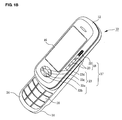
- Figures 1A - 1C are perspective views illustrating an example of a mobile terminal having an adjustable cover portion having an integrated display
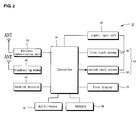
- Figure 2 discloses a schematic representation of an example system architecture of the example mobile terminal of Figures 1A - 1C;
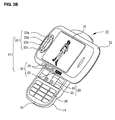
- Figures 3A - 3C disclose an image displayed on a first display of the example mobile terminal of Figures 1A - 1C in various rotational positions;
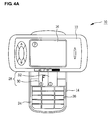
- Figures 4A and 4B show yet another example embodiment providing handwritten character input on a second touch screen and corresponding display of the input text on the display of the communication terminal in different rotational positions;
- Figure 5 discloses another example mobile terminal having an adjustable cover with an integrated display and control keys
- Figure 6 discloses a schematic representation of an example system architecture of the example mobile terminal of Figure 5.
- embodiments of the present invention relate to a mobile terminal - such as a wireless telephone, PDA and the like - that is equipped with an adjustable cover.
- the adjustable cover includes an integrated display for displaying text and/or images, and may also include control keys for interacting with various functions provided by the terminal. Adjustability of the cover allows a user to place the display and/or control keys in a more convenient orientation so as to improve the usability of the communications terminal.
- the example mobile terminal 10 includes a cover 12 and a main body 14.
- the cover 12 and the main body 14 are each generally rectangular shaped, although various other shapes are possible.
- the cover 12 includes a first display 16 formed on the front surface of the cover 12.
- the cover 12 also includes a plurality of multi-keys 17 formed on the sides and front surface of the cover 12.
- the cover 12 is adjustable with respect to the main body portion.
- the cover is slidably coupled to the main body 14 such that the cover 12 may be slid along a longitudinal axis of the main body 14 between a closed position, as disclosed in Figure 1A, to an open position, as disclosed in Figure 1B.
- the cover 12 is pivotally coupled to the main body 14 such that the cover 12 may be rotated with respect to the main body 14 between a first position, as disclosed in Figure 1B, and a "landscape” orientation position, as disclosed in Figure 1C.
- a first position as disclosed in Figure 1B
- a "landscape” orientation position as disclosed in Figure 1C.
- the cover 12 and the main body 14 substantially form a "T" shape.
- the display 16 provides a "landscape" orientation to the user.
- the first display 16 can present various menu screens of the mobile terminal 10 to the user.
- the first display 16 can present various images to the user, such as moving images or still images.
- the first display 16 can be implemented using various display devices including, but not limited to, a Liquid Crystal Display (“LCD”), an Organic Light Emitting Diode (“OLED”) display, or a Light Emitting Diode (“LED”) display.
- LCD Liquid Crystal Display
- OLED Organic Light Emitting Diode
- LED Light Emitting Diode
- the first display 16 has a generally rectangular shape, although other shapes are possible.
- the horizontal-to-vertical dimension ratio of the first display 16 is less than one when the cover 12 is in the closed position or the open position, as disclosed in Figures 1 A and 1B, respectively. However, when the cover 12 is in the landscape position, as disclosed in Figure 1C, the horizontal-to-vertical dimension ratio of first display 16 is greater than one. Accordingly, images having a fixed horizontal-to-vertical dimension ratio can be automatically resized when the cover 12 is rotated so that the images display properly regardless of the orientation of the first display 16.
- a desirable horizontal-to-vertical dimension ratio for the first display 16 may be determined depending on the type of images to be displayed. For example, in the case of digital broadcasting images received via a broadcasting network, a desirable horizontal-to-vertical dimension ratio of first display 16 may be "16:9", which is suitable for high definition broadcasting images.
- the example mobile terminal 10 includes a system architecture that enables the mobile terminal 10 to perform its various functions. With reference now to Figure 2, an example system architecture of the mobile terminal 10 is disclosed.
- the mobile terminal 10 includes a controller 34, a wireless communication unit 36, a broadcasting modem 38, a memory 39 and a location detector 40.
- the controller 34 is configured to store data in the memory 39.
- the data may be received via the wireless communication unit 36 or the broadcasting modem 38.
- the controller 34 is configured to present image data stored in the memory 39 as one or more images on the first display 16.
- the controller 34 may also present audio data stored in the memory 39 as sounds on one or more speakers (not shown) integrated into, or connected to, the mobile terminal 10.
- the controller 34 is configured to present any data input through the touch-screen function of the second display 24 as one or more images on the first display 16 or sounds on the one or more speakers.
- the location detector 40 can be a gravity sensing device or a gyro-sensing device which detects a rotation angle of the cover 12 with respect to the direction of gravity or with respect to a longitudinal axis of the main body 14 when the cover 12 is rotated with respect to the main body 14 and/or with respect to the direction of gravity.
- the location detector 40 can then provide the rotation angle to the controller 34.
- the location detector 40 may determine that the rotation angle of the cover 12 with respect to the main body 14 is "0" degrees when the cover 12 is in the closed or open positions disclosed in Figures 1A and 1B, respectively.
- the location detector 40 may determine that the rotation angle of the cover 12 with respect to the main body 14 is "90" degrees when the cover 12 is in the landscape position disclosed in Figure 1C.
- the controller 34 is configured to continuously present images on the first display 16 in an upright position with respect to the direction of gravity or with respect to the main body 14 even when the cover 12 is in the landscape position, as disclosed in Figure 1C.
- the first display 16 thereby presents images to a user in a constant orientation regardless of the orientation of the display 16 with respect to the direction of gravity or with respect to the main body 14.
- an example image is displayed on the first display 16 according to the rotation of the cover 12 of the example mobile terminal 10.
- the first display 16 displays moving images or still images in an upright position with respect to the direction of gravity.
- the direction of the digital broadcasting images can be maintained in an upright position with respect to the direction of gravity even if the cover 12 is rotated with respect to the main body 14. Maintaining images displayed on the first display 16 in an upright position with respect to the direction of gravity or with respect to the main body 14, regardless of the position of the display 16, can prevent users from feeling confused at the time of viewing the images.
- the multi-keys formed on the cover 12 include side-keys 18 and navigation keys 23, which are formed on the front surface of the cover 12. As disclosed in Figures 1A and 1B, when the cover 12 is in the closed or open positions, and before the cover 12 is rotated into the landscape position, the side-keys 18 are located to the right of the first display 16, and the navigation keys 23 are located on the front surface of the cover 12 beneath the first display 16.
- the side-keys 18 include key buttons 20 for generating input commands in response to a user pressing the key buttons 20.
- the side-keys 18 also include a jog dial 22 for generating an input command in response to a user rotating the jog dial 22. Markings which represent recognized functions, for example volume increase or decrease, are indicated on the key buttons 20.
- the key buttons 20 perform recognized functions related to their respective markings.
- the jog dial 22 has a plurality of protrusions on the circumference thereof in order to facilitate rotation. The jog dial 22 may be used for mode switching upon selection of modes.
- the navigation keys 23 include 4-way (up, down, left and right) navigation keys 23a, 23b, 23c and 23d concentrically located in an oval shape. Selection of the left and right navigation keys 23a and 23c can, for example, cause a cursor presented on the first display 16 to move to the left and to the right, respectively. Selection of the up and down navigation keys 23b and 23d can, for example, cause a cursor presented on the first display to move up and move down, respectively. As described above, each of the four navigation keys 23a, 23b, 23c and 23d performs a recognized function associated with an up/down and left/right key arrangement.
- Figure 1C discloses the cover 12 after having been rotated to the landscape position. After the cover 12 has been rotated to the landscape position, the key buttons 20 and the jog dial 22 of the side keys 18 are no longer located to the right of the first display 16, but are instead located beneath the first display 16. Similarly, after the cover 12 has been rotated to the landscape position, the navigation keys 23 are no longer located beneath the first display 16, but are instead located to the left of the first display 16.
- the orientation of the markings on the key buttons 20 are also changed. Since these markings signify a different function depending on their orientation, they can be said to be "orientation-dependent.”
- the functionality of the key buttons 20 can be configured to automatically change in response to a change in the orientation of the markings on the key buttons 20. This change in functionality can correspond to the change in orientation of the markings on the key buttons 20. For example, instead of the functionality of raising and lowering music, discussed above in connection with the markings, the key buttons 20 with the markings can be automatically reconfigured to move a cursor presented on the first display 16 to the left and to the right, respectively.
- the four navigation keys 23a, 23b, 23c and 23d are also rotated to a new position.
- the formerly left, down, right and up navigation keys 23a, 23b, 23c and 23d are changed to up, left, down, and right navigation keys 23a, 23b, 23c and 23d, respectively. Therefore, using the cursor moving example discussed above, the navigation key 23a can automatically change from moving the cursor left to moving the cursor up, and the navigation key 23c can automatically change from moving the cursor right to moving the cursor down.
- Each of the four navigation keys 23a, 23b, 23c and 23d could also automatically change menu shifting functionality corresponding to the change in orientation of each key.
- the significance of the markings on the keys 23a and 23c is orientation-dependent.
- the functionality of the side-keys 18 can also be configured to automatically change.
- the side-keys 18 can change function after the cover 12 is placed in the open position. This change in function can go from, for example, and volume raising and lowering function to channel switching function between a current channel and a previous channel and a current channel and a subsequent channel.
- the jog dial 22, which rotates in upward and downward directions when the cover 12 is in the open position can take over the function of raising and lowering the volume of the digital broadcasting.
- the function of the multi-keys 17 can be modified depending on the orientation of the first display 16 with respect to the main body 14 and/or the direction of gravity. This modification of functionality based on orientation can make the function of each input key less confusing to a user of the mobile terminal 10 regardless of the current orientation of each input key.
- a second display 24 can also be provided.
- the second display 24 is configured to present various images such as, but not limited to, menu screens, moving images or still images.
- the second display 24 includes a first touch screen 26 in which touches to buttons are detectable and a second touch screen 28 in which handwriting using, for example, a stylus or fingernail (not shown) is detectable.
- the first touch screen 26 is formed on the lower portion of the second display 24, and the second touch screen 28 is formed on the upper portion of the second display 24.
- the first touch screen 26 is exposed when the cover 12 is slid along the main body 14 from the closed position, as disclosed in Figure 1A, to the open position, as disclosed in Figure 1B.
- the second touch screen 28 is exposed when the cover 12 is rotated from the open position to the landscape position.
- the second touch screen 28 is formed proximate to the point at which the cover 12 and the main body 14 intersect each other when the cover 12 is in the landscape position.
- the second touch screen 28 includes a dedicated alphabetic region 30 configured to detect the handwritten input of alphabetic characters.
- the second touch screen 28 also includes a dedicated numeric region 32 configured to detect the handwritten input of numerical characters.
- a user can input alphabetic characters and numerical characters into the mobile terminal 10 by tracing characters on the dedicated alphabetic region 30 and the dedicated numeric region 32.
- the dedicated alphabetic region 30 and numeric region 32 are only given as examples, and the second touch screen 28 can be configured to receive as input other types of characters, for example, any number of foreign language characters as well as various symbols.
- the second touch screen 28 can also be divided into a single dedication region, or more than two dedicated regions.
- the first touch screen 26 and the second touch screen 28 are configured to transfer button signals and writing signals, respectively, to the controller 34 via a signal input unit 42.
- the controller 34 then provides the memory 39 with control signals corresponding to the button signals and the writing signals.
- the memory 39 then stores data corresponding to the button signals and the writing signals.
- the dedicated alphabetic region 30 and the dedicated numerical region 32 of the second touch screen 28 can be configured to have relatively quick and accurate writing detection when a writing detection mode is selected on the mobile terminal 10.
- the writing detection mode may be automatically selected when the cover 12 is rotated from the open position, as disclosed in Figure 1B, to the landscape position, as disclosed in Figure 1C, 3B, 4A and 4B.
- the writing detection mode can involve the dedication of increased system resources within the mobile terminal 10 to the second touch screen 28 in order to improve the speed and accuracy of handwriting detection. Later, when the cover 12 is rotated back to the open position, as disclosed in Figure 1B, the increased system resources that were dedicated to the second touch screen 28 can be reassigned to other functions of the mobile terminal 10.
- Figures 4A and 4B disclose an example alphabetic character and numeric character that are traced on the second touch screen 28 and then displayed on the first display 16.
- An alphabetic character for example, "F"
- the controller 34 determines which alphabetical character is identical to or most similar to the character traced using the stylus pen from among a list of alphabetical characters stored in the memory 39.
- the controller 34 retrieves the most closely matched alphabetical character from the memory 39 and sends it to the first display 16 where it is presented to the user.
- a numerical character for example, "6" is traced on the dedicated numeric region 32 using, for example, a stylus pen.
- the controller 34 determines which numerical character is identical to or most similar to the numerical character traced using the stylus pen from among a list of numerical characters stored in the memory 39.
- the controller 34 retrieves the most closely matched numerical character from the memory 39 and sends it to the first display 16 where it is presented to the user.
- the example mobile terminal 10 disclosed in Figures 1A-4B effectively utilizes the space on the main body 14 that is exposed when the cover 12 is rotated 90 degrees to the landscape position. Specifically, this exposed space is occupied by the second touch screen 28 which is configured to receive input from a user.
- the automatic switching to a writing detection mode when the cover 12 is rotated into the landscape position can result in increased speed and accuracy of the recognition of characters input into the second touch screen 28 by the user.
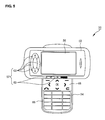
- Figure 5 discloses another example mobile terminal 50.
- the mobile terminal includes a slidable and rotatable cover 52 and a main body 54.
- the cover 52 is coupled to the main body 54 and adapted to slide along a longitudinal axis of the main body and to rotate with respect to the main body 54.
- the cover 52 includes a first display 56 formed on the front surface thereof, and a plurality of multi-keys 57 formed on two sides thereof.
- the multi-keys 57 includes a plurality of navigation keys 63 and key buttons 60. These keys on the cover 52 are substantially equal to navigation keys 23 and the key buttons 20 disclosed in Figures 1A - 1C.
- the main body 54 also includes a key pad 66 and a touch pad 68.
- the key pad 66 is exposed after the cover 52 is slid longitudinally along the main body 54, and the touch pad 68 is exposed after the cover 52 is rotated 90 degrees to a landscape position.
- the touch pad 68 is formed proximate to the point at which the cover 52 and the main body 54 intersect each other when the cover 52 is in the landscape position.
- the touch pad 68 comprises one or more touch buttons.
- the buttons of the touch pad 68 can be configured to light up when exposed or when touched. For example, the buttons of the touch pad 68 may glow red when exposed or touched.
- the touch pad 68 is configured with sensors that are sensitive to touch. The buttons of the touch pad can detect the touch of a user's finger, for example.
- the example mobile terminal 50 includes a system architecture that enables the mobile terminal 50 to perform its various functions.
- the mobile terminal 50 includes a controller 74, a wireless communication unit 76, a broadcasting modem 78, a memory 79, a location detector 80, and a signal input unit 82, each of which is similar in function to the corresponding components disclosed in connection with the mobile terminal 10 in Figure 2.
- the system architecture of the mobile terminal 50 also includes the first display 56, the key pad 66, and the touch pad 68, as described above.
- the touch pad 68 is configured to allow a user to navigate menus and access other functions of the mobile terminal 50 after the cover 52 is placed in the landscape position.
- the touch pad 68 may be used to select a digital broadcasting signal that is subsequently received through the broadcasting modem 78.
- the touch buttons of the touch pad 68 may be used to change the channel being received by the broadcasting modem 78.
- the touch buttons may also be used, for example, to change the volume up or down, change the broadcasting channel to the previous channel, or pre-set the broadcasting channels to be received by the broadcasting modem 78.
- example embodiments of the present invention have been described with reference to the Figures, the present invention is not limited to the examples disclosed in the Figures.
- the mobile terminal disclosed in the Figures is a mobile telephone
- example embodiments of the present invention may be mobile terminals that do not include telephone functionality.
- example embodiments of the invention may be mobile terminals that are dedicated primarily to the functionality of, for example, an MP3 player or other media player. Any mobile terminal that includes a slidable and rotatable cover can benefit from at least some of the example aspects of the invention disclosed herein.
- touch input device are disclosed as either touch screens or touch pads, other types of touch input devices may be used.
- touch input devices may be configured to detect input from other than a stylus or finger/fingernail.
- Other types of input include, but are not limited to, physical, electrical, magnetic, and thermal input.
- the cover is configured to be slid in an upward direction with respect to the main body
- the cover may instead be configured to be slid in a downward direction with respect to the main body.
- the cover may be configured to be rotated without first being slid either up or down.
- the cover may be configured to be rotated before being slid up or down.
- the touch screens as well as the multi-keys may be appropriately repositioned on the mobile terminal.
- the first display has been described as an image device formed of light-emitting elements and configured to display only images, the first display may instead be a touch screen, or a combination touch screen and image device.
- each of the above-described displays could include multiple displays that may or may not function independently from one another.
- the first display may be configured to display images in a non-upright position with respect to gravity.
- the orientation of images presented on the first display may be independent of gravity and/or fixed with respect to another point of reference, such as the orientation of the main body.
- the first display may be configured to vary the direction of a displayed imaged depending on the type of image being displayed.
- the second display 24 includes the button touch screen 26 and the handwriting touch screen 28, the second display may include only the handwriting touch screen 28 which is exposed through the sliding and rotation of the cover 12.
- a numeral keypad may be formed at the location of the button touch screen 26 and be configured to perform the same function as the button touch screen 26.
- the side-keys of multi-keys are formed on the left side of the cover when the cover is in the closed position, and the side-keys include key buttons and the jog dial
- the present invention is not limited to the specific locations, shapes, and types of keys or buttons.
- other input devices such as a jog shuttle may be included.
- the multi-keys may also include other orientation-dependent markings, such as different shapes or colors, than those disclosed above that can similarly signify a different meaning and function depending on the orientation of the cover.
- a display device such as a LCD, may be embedded in the surface of the multi-keys and be configured to change the appearance of the markings in response to the rotation of the cover in order, for example, to maintain the orientation of the marking constant despite a changed orientation of the cover.
Landscapes
- Engineering & Computer Science (AREA)
- Signal Processing (AREA)
- Computer Networks & Wireless Communication (AREA)
- Telephone Set Structure (AREA)
- Position Input By Displaying (AREA)
- Telephone Function (AREA)
- Casings For Electric Apparatus (AREA)
- Input From Keyboards Or The Like (AREA)
- User Interface Of Digital Computer (AREA)
Applications Claiming Priority (1)
| Application Number | Priority Date | Filing Date | Title |
|---|---|---|---|
| KR1020050099369A KR100784542B1 (ko) | 2005-10-20 | 2005-10-20 | 면접촉 축회전 이동통신단말기 |
Publications (2)
| Publication Number | Publication Date |
|---|---|
| EP1777920A2 true EP1777920A2 (de) | 2007-04-25 |
| EP1777920A3 EP1777920A3 (de) | 2012-08-08 |
Family
ID=37663175
Family Applications (1)
| Application Number | Title | Priority Date | Filing Date |
|---|---|---|---|
| EP06021953A Withdrawn EP1777920A3 (de) | 2005-10-20 | 2006-10-19 | Ein Mobilendgerät |
Country Status (5)
| Country | Link |
|---|---|
| US (1) | US20070093281A1 (de) |
| EP (1) | EP1777920A3 (de) |
| JP (1) | JP2007116712A (de) |
| KR (1) | KR100784542B1 (de) |
| CN (1) | CN1953472A (de) |
Cited By (3)
| Publication number | Priority date | Publication date | Assignee | Title |
|---|---|---|---|---|
| WO2008145266A3 (en) * | 2007-05-29 | 2009-03-05 | Nokia Corp | Pivot display |
| JP2012100159A (ja) * | 2010-11-04 | 2012-05-24 | Sharp Corp | 映像表示装置,テレビジョン受像機 |
| GB2535430B (en) * | 2014-11-24 | 2018-12-05 | New Dawn Innovations Ltd | An audio playing apparatus with a rotatable control console including a display |
Families Citing this family (50)
| Publication number | Priority date | Publication date | Assignee | Title |
|---|---|---|---|---|
| US10728381B2 (en) * | 1999-06-04 | 2020-07-28 | Raman K. Rao | Reconfigurable mobile device interfaces supporting authenticated high quality video, audio, TV and multimedia services |
| KR20040051827A (ko) * | 2002-12-13 | 2004-06-19 | 백성수 | 은을 함유한 헤어젤 조성물 및 그 제조방법 및 그 헤어젤 |
| US9030497B2 (en) * | 2005-06-30 | 2015-05-12 | Nec Display Solutions, Ltd. | Display device and arrangement method of OSD switches |
| US8920343B2 (en) | 2006-03-23 | 2014-12-30 | Michael Edward Sabatino | Apparatus for acquiring and processing of physiological auditory signals |
| KR100803784B1 (ko) * | 2006-11-24 | 2008-02-15 | 삼성전자주식회사 | 슬라이딩/스윙 모듈 및 그를 구비하는 휴대용 단말기 |
| KR100782075B1 (ko) * | 2006-12-01 | 2007-12-04 | 삼성전자주식회사 | 휴대 단말에서 화면 전환 장치 및 방법 |
| US7970444B2 (en) * | 2007-02-28 | 2011-06-28 | Sony Ericsson Mobile Communications Ab | Pivoting mobile terminal |
| US20080268901A1 (en) * | 2007-03-05 | 2008-10-30 | Ivan Miramontes | Slider twister phone |
| CN102883043B (zh) * | 2007-03-16 | 2014-10-22 | 日本电气株式会社 | 移动终端装置、功能启动方法及其程序 |
| USD584727S1 (en) * | 2007-05-15 | 2009-01-13 | Compal Electronics, Inc. | Portable electronic device |
| USD585445S1 (en) * | 2007-05-15 | 2009-01-27 | Compal Electronics, Inc. | Portable electronic device |
| JP4990974B2 (ja) * | 2007-07-10 | 2012-08-01 | シャープ株式会社 | 無線通信機 |
| US20090219250A1 (en) * | 2008-02-29 | 2009-09-03 | Ure Michael J | Interface with and communication between mobile electronic devices |
| JP2009055312A (ja) * | 2007-08-27 | 2009-03-12 | Toshiba Corp | 電子機器 |
| KR101385747B1 (ko) | 2007-09-21 | 2014-04-21 | 삼성전자주식회사 | 전자 종이 표시 유니트 및 이를 갖는 이동 통신 단말기 |
| WO2009048038A1 (ja) | 2007-10-11 | 2009-04-16 | Nec Corporation | 携帯型情報処理端末 |
| US20090149192A1 (en) * | 2007-12-05 | 2009-06-11 | Sandra Vargas | Device Locate Service |
| EP2228976A4 (de) * | 2007-12-27 | 2013-02-27 | Nec Corp | Tragbares endgerät |
| CA126547S (en) * | 2008-02-08 | 2009-05-01 | Toshiba Kk | Portable information terminal |
| CN101645719A (zh) * | 2008-08-07 | 2010-02-10 | 深圳富泰宏精密工业有限公司 | 便携式个人终端及其图标设定方法 |
| WO2010024361A1 (ja) * | 2008-08-27 | 2010-03-04 | 日本電気株式会社 | スライド機構及びスライド装置 |
| US20100238984A1 (en) * | 2009-03-19 | 2010-09-23 | Motorola, Inc. | Spatial Information Feedback in Wireless Communication Systems |
| US8244317B2 (en) * | 2009-06-08 | 2012-08-14 | Motorola Mobility Llc | Indicator shelf for portable electronic device |
| US9002354B2 (en) * | 2009-06-12 | 2015-04-07 | Google Technology Holdings, LLC | Interference control, SINR optimization and signaling enhancements to improve the performance of OTDOA measurements |
| US20110085588A1 (en) * | 2009-10-09 | 2011-04-14 | Motorola-Mobility, Inc. | Method for precoding based on antenna grouping |
| CN102131354A (zh) * | 2010-01-20 | 2011-07-20 | 和硕联合科技股份有限公司 | 手持式电子装置 |
| TR201001561A2 (tr) * | 2010-03-02 | 2011-02-21 | Vemus Endüstri̇yel Elektroni̇k Sanayi̇ Ve Ti̇caret Li̇mi̇ted Şi̇rketi̇ | Dört yönlü elektronik kilit. |
| US8884745B2 (en) | 2010-04-23 | 2014-11-11 | Echostar Technologies L.L.C. | Twist remote control with keyboard |
| US8509338B2 (en) | 2010-05-05 | 2013-08-13 | Motorola Mobility Llc | Method and precoder information feedback in multi-antenna wireless communication systems |
| US9203489B2 (en) | 2010-05-05 | 2015-12-01 | Google Technology Holdings LLC | Method and precoder information feedback in multi-antenna wireless communication systems |
| EP2387212B1 (de) * | 2010-05-10 | 2013-01-23 | Research In Motion Limited | Tragbare elektronische Kommunikationsvorrichtung mit Schiebeanzeige |
| USD628983S1 (en) * | 2010-07-28 | 2010-12-14 | Echostar Technologies L.L.C. | Twistable remote control |
| US8537658B2 (en) | 2010-08-16 | 2013-09-17 | Motorola Mobility Llc | Method of codebook design and precoder feedback in wireless communication systems |
| US8723890B2 (en) | 2010-12-23 | 2014-05-13 | Blackberry Limited | Handheld electronic device having sliding display and position configurable camera |
| KR20130009595A (ko) | 2011-07-14 | 2013-01-23 | 삼성전자주식회사 | 디스플레이 장치 및 방법 |
| US10114477B2 (en) | 2011-07-14 | 2018-10-30 | Samsung Electronics Co., Ltd. | Display device and method thereof |
| WO2013105443A1 (ja) * | 2012-01-13 | 2013-07-18 | ソニー株式会社 | 情報処理装置及び情報処理方法、並びにコンピューター・プログラム |
| CN103383619A (zh) * | 2012-05-02 | 2013-11-06 | 北京网秦天下科技有限公司 | 一种在移动设备中显示对象的方法和装置 |
| US9813262B2 (en) | 2012-12-03 | 2017-11-07 | Google Technology Holdings LLC | Method and apparatus for selectively transmitting data using spatial diversity |
| US9591508B2 (en) | 2012-12-20 | 2017-03-07 | Google Technology Holdings LLC | Methods and apparatus for transmitting data between different peer-to-peer communication groups |
| US9979531B2 (en) | 2013-01-03 | 2018-05-22 | Google Technology Holdings LLC | Method and apparatus for tuning a communication device for multi band operation |
| US10229697B2 (en) | 2013-03-12 | 2019-03-12 | Google Technology Holdings LLC | Apparatus and method for beamforming to obtain voice and noise signals |
| US9386542B2 (en) | 2013-09-19 | 2016-07-05 | Google Technology Holdings, LLC | Method and apparatus for estimating transmit power of a wireless device |
| US9549290B2 (en) | 2013-12-19 | 2017-01-17 | Google Technology Holdings LLC | Method and apparatus for determining direction information for a wireless device |
| US9491007B2 (en) | 2014-04-28 | 2016-11-08 | Google Technology Holdings LLC | Apparatus and method for antenna matching |
| US10643580B2 (en) * | 2014-05-30 | 2020-05-05 | Guangzhou Ucweb Computer Technology Co., Ltd. | Method and device for switching playing mode of a mobile terminal, storage medium and program |
| US9478847B2 (en) | 2014-06-02 | 2016-10-25 | Google Technology Holdings LLC | Antenna system and method of assembly for a wearable electronic device |
| KR20160071922A (ko) * | 2014-12-12 | 2016-06-22 | 삼성전자주식회사 | 전자 장치 및 전자 장치의 디스플레이 방법 |
| CN108965529A (zh) * | 2018-07-23 | 2018-12-07 | Oppo广东移动通信有限公司 | 电子装置 |
| US12099044B2 (en) * | 2022-01-18 | 2024-09-24 | Radiant Innovation Inc. | Portable electronic device for use in different orientations |
Citations (2)
| Publication number | Priority date | Publication date | Assignee | Title |
|---|---|---|---|---|
| WO2005034487A1 (en) | 2003-09-29 | 2005-04-14 | Danger, Inc. | Multipurpose data input/output and display configurations for a data processing apparatus |
| US20050091431A1 (en) | 2003-10-23 | 2005-04-28 | Robert Olodort | Portable communication devices |
Family Cites Families (24)
| Publication number | Priority date | Publication date | Assignee | Title |
|---|---|---|---|---|
| US5719936A (en) * | 1995-03-07 | 1998-02-17 | Siemens Aktiengesellschaft | Communication device for mobile operation having a telephone and notebook with display |
| JP3920945B2 (ja) * | 1996-05-22 | 2007-05-30 | ソニー株式会社 | 表示装置、地図表示装置、表示方法、地図表示方法 |
| US6747568B1 (en) * | 1997-12-19 | 2004-06-08 | Thomson Licensing S.A. | Remote control code search method and apparatus |
| JPH11196397A (ja) * | 1997-12-26 | 1999-07-21 | Canon Inc | 表示装置及び通信システム |
| US6567101B1 (en) * | 1999-10-13 | 2003-05-20 | Gateway, Inc. | System and method utilizing motion input for manipulating a display of data |
| US7500917B2 (en) * | 2000-02-22 | 2009-03-10 | Creative Kingdoms, Llc | Magical wand and interactive play experience |
| KR100365797B1 (ko) * | 2000-08-19 | 2002-12-26 | 삼성전자 주식회사 | 슬라이딩 타입 휴대용 단말기 |
| JP2003174495A (ja) * | 2001-09-28 | 2003-06-20 | Nec Corp | 折り畳み式携帯情報端末 |
| WO2003050665A1 (en) * | 2001-12-06 | 2003-06-19 | Rast Associates, Llc | Articulated, rotatable expandable and contractive keyboard device |
| JP4120249B2 (ja) * | 2002-03-28 | 2008-07-16 | 日本電気株式会社 | 携帯端末装置 |
| JP4193411B2 (ja) * | 2002-04-26 | 2008-12-10 | 日本電気株式会社 | 携帯電話機 |
| JP4061473B2 (ja) * | 2002-04-26 | 2008-03-19 | 日本電気株式会社 | 折り畳み型携帯電話機 |
| KR100472429B1 (ko) * | 2002-10-18 | 2005-03-10 | 삼성전자주식회사 | 휴대용 무선단말기의 키패드 어셈블리 및 그 제어방법 |
| JP4010975B2 (ja) * | 2003-04-07 | 2007-11-21 | ソニー・エリクソン・モバイルコミュニケーションズ株式会社 | 携帯通信端末装置 |
| JP4192024B2 (ja) * | 2003-04-17 | 2008-12-03 | 加藤電機株式会社 | 携帯端末用取付装置 |
| JP2004363892A (ja) * | 2003-06-04 | 2004-12-24 | Canon Inc | 携帯機器 |
| US7050767B2 (en) * | 2003-07-07 | 2006-05-23 | Sony Ericsson Mobile Communications, Ab | Mobile computing devices having rotationally exposed user interface devices |
| US7529571B2 (en) * | 2003-09-03 | 2009-05-05 | Samsung Electronics Co., Ltd. | Sliding/hinge apparatus for sliding/rotating type mobile terminals |
| JP4236546B2 (ja) * | 2003-09-18 | 2009-03-11 | パナソニック株式会社 | 携帯電話機 |
| TWM249125U (en) * | 2003-11-03 | 2004-11-01 | High Tech Comp Corp | Handheld electronic device |
| US7092246B2 (en) * | 2003-11-18 | 2006-08-15 | Kabushiki Kaisha Toshiba | Apparatus for connecting a display to a body case of an electronic device |
| GB0402637D0 (en) * | 2004-02-06 | 2004-03-10 | Nokia Corp | Mobile telecommunications apparatus |
| US20060007139A1 (en) * | 2004-06-03 | 2006-01-12 | Ong Dee N | Device and method for configuring a user operated screen controller |
| EP2375703B1 (de) * | 2010-04-12 | 2014-07-30 | BlackBerry Limited | Tragbare elektronische Kommunikationsvorrichtung mit berührungsempfindlicher Anzeige |
-
2005
- 2005-10-20 KR KR1020050099369A patent/KR100784542B1/ko not_active Expired - Fee Related
-
2006
- 2006-10-18 US US11/550,699 patent/US20070093281A1/en not_active Abandoned
- 2006-10-19 EP EP06021953A patent/EP1777920A3/de not_active Withdrawn
- 2006-10-20 CN CNA2006101371023A patent/CN1953472A/zh active Pending
- 2006-10-20 JP JP2006286529A patent/JP2007116712A/ja active Pending
Patent Citations (2)
| Publication number | Priority date | Publication date | Assignee | Title |
|---|---|---|---|---|
| WO2005034487A1 (en) | 2003-09-29 | 2005-04-14 | Danger, Inc. | Multipurpose data input/output and display configurations for a data processing apparatus |
| US20050091431A1 (en) | 2003-10-23 | 2005-04-28 | Robert Olodort | Portable communication devices |
Non-Patent Citations (1)
| Title |
|---|
| "Handbook for Palm (TM) Tungsten (TM) T2 Handheld Copyright Disclaimer and Limitation of Liability", 31 December 2003 (2003-12-31), XP055157631, Retrieved from the Internet <URL:http://pdf.textfiles.com/manuals/PDA/PalmOne Tungsten T2 Handheld.pdf> [retrieved on 20141209] * |
Cited By (3)
| Publication number | Priority date | Publication date | Assignee | Title |
|---|---|---|---|---|
| WO2008145266A3 (en) * | 2007-05-29 | 2009-03-05 | Nokia Corp | Pivot display |
| JP2012100159A (ja) * | 2010-11-04 | 2012-05-24 | Sharp Corp | 映像表示装置,テレビジョン受像機 |
| GB2535430B (en) * | 2014-11-24 | 2018-12-05 | New Dawn Innovations Ltd | An audio playing apparatus with a rotatable control console including a display |
Also Published As
| Publication number | Publication date |
|---|---|
| EP1777920A3 (de) | 2012-08-08 |
| KR100784542B1 (ko) | 2007-12-11 |
| KR20070043287A (ko) | 2007-04-25 |
| JP2007116712A (ja) | 2007-05-10 |
| CN1953472A (zh) | 2007-04-25 |
| US20070093281A1 (en) | 2007-04-26 |
Similar Documents
| Publication | Publication Date | Title |
|---|---|---|
| US20070093281A1 (en) | Mobile terminal | |
| US8739053B2 (en) | Electronic device capable of transferring object between two display units and controlling method thereof | |
| KR101510738B1 (ko) | 휴대단말의 대기화면 구성 방법 및 장치 | |
| US20210165449A1 (en) | Electronic device having display and surrounding touch sensitive surfaces for user interface and control | |
| CN101650634B (zh) | 显示设备和显示方法 | |
| KR101012300B1 (ko) | 터치스크린을 구비한 휴대 단말기의 사용자 인터페이스장치 및 그 방법 | |
| US9826077B2 (en) | Apparatus and method for unlocking a locking mode of portable terminal | |
| KR20220024386A (ko) | 뱅글 타입의 모바일 디바이스와 그 제어 방법 및 ui 표시 방법 | |
| US8009146B2 (en) | Method, apparatus and computer program product for facilitating data entry via a touchscreen | |
| US7783789B2 (en) | Apparatus with programmable touch screen and method thereof | |
| US20100011291A1 (en) | User interface, device and method for a physically flexible device | |
| US20090249203A1 (en) | User interface device, computer program, and its recording medium | |
| US8140126B2 (en) | Mobile terminal and control method thereof | |
| US20100088597A1 (en) | Method and apparatus for configuring idle screen of portable terminal | |
| US20050223340A1 (en) | Method of navigating in application views, electronic device, graphical user interface and computer program product | |
| EP2360563A1 (de) | Typische Auswahlhinweise für Symbole | |
| WO2006036069A1 (en) | Information processing system and method | |
| KR20070085631A (ko) | 사용자 대화형 영상 인터페이스를 갖춘 휴대용 전자 장치 | |
| JP2000278391A (ja) | 背面手書き入力機能を有する携帯電話機 | |
| WO2005008444A2 (en) | System and method for a portbale multimedia client | |
| KR20100003850A (ko) | 터치 스크린을 구비한 휴대 단말기 및 그 휴대 단말기에서터치를 이용한 키 입력 방법 | |
| CN111443842A (zh) | 控制电子设备的方法及电子设备 | |
| JP2014157578A (ja) | タッチパネル装置、タッチパネル装置の制御方法及びプログラム | |
| CN104360813A (zh) | 一种显示设备及其信息处理方法 | |
| JP5173001B2 (ja) | 情報処理装置、画面表示方法、制御プログラムおよび記録媒体 |
Legal Events
| Date | Code | Title | Description |
|---|---|---|---|
| PUAI | Public reference made under article 153(3) epc to a published international application that has entered the european phase |
Free format text: ORIGINAL CODE: 0009012 |
|
| AK | Designated contracting states |
Kind code of ref document: A2 Designated state(s): AT BE BG CH CY CZ DE DK EE ES FI FR GB GR HU IE IS IT LI LT LU LV MC NL PL PT RO SE SI SK TR |
|
| AX | Request for extension of the european patent |
Extension state: AL BA HR MK YU |
|
| RAP1 | Party data changed (applicant data changed or rights of an application transferred) |
Owner name: LG ELECTRONICS INC. |
|
| RIC1 | Information provided on ipc code assigned before grant |
Ipc: H04M 1/02 20060101AFI20120223BHEP |
|
| PUAL | Search report despatched |
Free format text: ORIGINAL CODE: 0009013 |
|
| AK | Designated contracting states |
Kind code of ref document: A3 Designated state(s): AT BE BG CH CY CZ DE DK EE ES FI FR GB GR HU IE IS IT LI LT LU LV MC NL PL PT RO SE SI SK TR |
|
| AX | Request for extension of the european patent |
Extension state: AL BA HR MK RS |
|
| RIC1 | Information provided on ipc code assigned before grant |
Ipc: H04M 1/02 20060101AFI20120702BHEP |
|
| 17P | Request for examination filed |
Effective date: 20130208 |
|
| AKX | Designation fees paid |
Designated state(s): AT BE BG CH CY CZ DE DK EE ES FI FR GB GR HU IE IS IT LI LT LU LV MC NL PL PT RO SE SI SK TR |
|
| 17Q | First examination report despatched |
Effective date: 20130408 |
|
| STAA | Information on the status of an ep patent application or granted ep patent |
Free format text: STATUS: THE APPLICATION IS DEEMED TO BE WITHDRAWN |
|
| 18D | Application deemed to be withdrawn |
Effective date: 20150630 |