EP1777983B1 - Méthode pour améliorer la transmission d'applications IP à durée critique - Google Patents
Méthode pour améliorer la transmission d'applications IP à durée critique Download PDFInfo
- Publication number
- EP1777983B1 EP1777983B1 EP06019021A EP06019021A EP1777983B1 EP 1777983 B1 EP1777983 B1 EP 1777983B1 EP 06019021 A EP06019021 A EP 06019021A EP 06019021 A EP06019021 A EP 06019021A EP 1777983 B1 EP1777983 B1 EP 1777983B1
- Authority
- EP
- European Patent Office
- Prior art keywords
- voip
- exclusive
- connection
- access
- applications
- Prior art date
- Legal status (The legal status is an assumption and is not a legal conclusion. Google has not performed a legal analysis and makes no representation as to the accuracy of the status listed.)
- Active
Links
- 238000000034 method Methods 0.000 title claims description 10
- 230000005540 biological transmission Effects 0.000 title claims description 8
- 238000005516 engineering process Methods 0.000 claims description 19
- 238000011144 upstream manufacturing Methods 0.000 claims description 2
- 239000010949 copper Substances 0.000 description 8
- RYGMFSIKBFXOCR-UHFFFAOYSA-N Copper Chemical compound [Cu] RYGMFSIKBFXOCR-UHFFFAOYSA-N 0.000 description 6
- 229910052802 copper Inorganic materials 0.000 description 6
- 230000002596 correlated effect Effects 0.000 description 2
- 230000002349 favourable effect Effects 0.000 description 2
- 238000000926 separation method Methods 0.000 description 2
- 239000012141 concentrate Substances 0.000 description 1
- 230000000875 corresponding effect Effects 0.000 description 1
- 230000006735 deficit Effects 0.000 description 1
- 238000010586 diagram Methods 0.000 description 1
- 239000000835 fiber Substances 0.000 description 1
- 230000007246 mechanism Effects 0.000 description 1
Images

Classifications
-
- H—ELECTRICITY
- H04—ELECTRIC COMMUNICATION TECHNIQUE
- H04Q—SELECTING
- H04Q11/00—Selecting arrangements for multiplex systems
- H04Q11/04—Selecting arrangements for multiplex systems for time-division multiplexing
- H04Q11/0428—Integrated services digital network, i.e. systems for transmission of different types of digitised signals, e.g. speech, data, telecentral, television signals
- H04Q11/0435—Details
- H04Q11/0457—Connection protocols
-
- H—ELECTRICITY
- H04—ELECTRIC COMMUNICATION TECHNIQUE
- H04L—TRANSMISSION OF DIGITAL INFORMATION, e.g. TELEGRAPHIC COMMUNICATION
- H04L12/00—Data switching networks
- H04L12/54—Store-and-forward switching systems
- H04L12/56—Packet switching systems
- H04L12/5691—Access to open networks; Ingress point selection, e.g. ISP selection
- H04L12/5692—Selection among different networks
-
- H—ELECTRICITY
- H04—ELECTRIC COMMUNICATION TECHNIQUE
- H04M—TELEPHONIC COMMUNICATION
- H04M11/00—Telephonic communication systems specially adapted for combination with other electrical systems
- H04M11/06—Simultaneous speech and data transmission, e.g. telegraphic transmission over the same conductors
- H04M11/062—Simultaneous speech and data transmission, e.g. telegraphic transmission over the same conductors using different frequency bands for speech and other data
-
- H—ELECTRICITY
- H04—ELECTRIC COMMUNICATION TECHNIQUE
- H04Q—SELECTING
- H04Q2213/00—Indexing scheme relating to selecting arrangements in general and for multiplex systems
- H04Q2213/13034—A/D conversion, code compression/expansion
-
- H—ELECTRICITY
- H04—ELECTRIC COMMUNICATION TECHNIQUE
- H04Q—SELECTING
- H04Q2213/00—Indexing scheme relating to selecting arrangements in general and for multiplex systems
- H04Q2213/13039—Asymmetrical two-way transmission, e.g. ADSL, HDSL
-
- H—ELECTRICITY
- H04—ELECTRIC COMMUNICATION TECHNIQUE
- H04Q—SELECTING
- H04Q2213/00—Indexing scheme relating to selecting arrangements in general and for multiplex systems
- H04Q2213/13095—PIN / Access code, authentication
-
- H—ELECTRICITY
- H04—ELECTRIC COMMUNICATION TECHNIQUE
- H04Q—SELECTING
- H04Q2213/00—Indexing scheme relating to selecting arrangements in general and for multiplex systems
- H04Q2213/13164—Traffic (registration, measurement,...)
-
- H—ELECTRICITY
- H04—ELECTRIC COMMUNICATION TECHNIQUE
- H04Q—SELECTING
- H04Q2213/00—Indexing scheme relating to selecting arrangements in general and for multiplex systems
- H04Q2213/13166—Fault prevention
-
- H—ELECTRICITY
- H04—ELECTRIC COMMUNICATION TECHNIQUE
- H04Q—SELECTING
- H04Q2213/00—Indexing scheme relating to selecting arrangements in general and for multiplex systems
- H04Q2213/13199—Modem, modulation
-
- H—ELECTRICITY
- H04—ELECTRIC COMMUNICATION TECHNIQUE
- H04Q—SELECTING
- H04Q2213/00—Indexing scheme relating to selecting arrangements in general and for multiplex systems
- H04Q2213/13209—ISDN
-
- H—ELECTRICITY
- H04—ELECTRIC COMMUNICATION TECHNIQUE
- H04Q—SELECTING
- H04Q2213/00—Indexing scheme relating to selecting arrangements in general and for multiplex systems
- H04Q2213/13216—Code signals, frame structure
-
- H—ELECTRICITY
- H04—ELECTRIC COMMUNICATION TECHNIQUE
- H04Q—SELECTING
- H04Q2213/00—Indexing scheme relating to selecting arrangements in general and for multiplex systems
- H04Q2213/13352—Self-routing networks, real-time routing
-
- H—ELECTRICITY
- H04—ELECTRIC COMMUNICATION TECHNIQUE
- H04Q—SELECTING
- H04Q2213/00—Indexing scheme relating to selecting arrangements in general and for multiplex systems
- H04Q2213/13376—Information service, downloading of information, 0800/0900 services
-
- H—ELECTRICITY
- H04—ELECTRIC COMMUNICATION TECHNIQUE
- H04Q—SELECTING
- H04Q2213/00—Indexing scheme relating to selecting arrangements in general and for multiplex systems
- H04Q2213/13389—LAN, internet
-
- H—ELECTRICITY
- H04—ELECTRIC COMMUNICATION TECHNIQUE
- H04Q—SELECTING
- H04Q2213/00—Indexing scheme relating to selecting arrangements in general and for multiplex systems
- H04Q2213/13395—Permanent channel, leased line
Definitions
- the invention relates to the field of xDSL technology and is directed to the better utilization of connections between DSL subscribers and service providers for the transmission of time-critical IP applications.
- Conventional telephone networks (PSTN / ISDN) operate worldwide on copper low frequency band links (excluding fiber optic delivery systems).
- a two-wire data connection is used exclusively for the ISDN service. Due to increasing data demands, increasingly faster connections with high data throughput are required by the telecommunications operators. This happens in particular through the DSL technology (digital subscriber line technology). In this technology, two converters are needed, with one converter of the central office and one converter assigned to the subscriber.
- the DSL technology uses the fact that the conventional analog telephone traffic in the copper cable occupies only frequencies up to 4 kHz.
- frequencies up to 1.1MHz and higher can be achieved on copper lines.
- DSL variant xDSL
- a feature of these solutions is based on the fact that the frequency ranges splitted according to an xDSL variant and occupied with different applications simultaneously on an existing telephone line or ISDN basic connection via only one copper two-wire line (Cu two-wire line) can be operated.
- Cu two-wire line For the separation of the narrowband signal (telephone) from the broadband signal / DSL signal (Internet) a splitter is used.
- the frequency band in which ISDN-based voice signals or analog voice signals of the PSTN are transmitted reaches up to 120 kHz.
- xDSL applications are always operated over the frequency band of conventional telephone access networks.
- XDSL applications typically transport IP connections. These broadband IP connections do not differ according to the current state of the art between quality-critical or non-quality-critical applications.
- simple analogue connections operated in a frequency range of 0.3-3.4 kHz the frequency range above 20 kHz can be used for xDSL applications.
- the frequency range is from 80 kHz and for ISDN in conjunction with the line code 4B3T, the frequency range from 120 kHz can be used for xDSL applications.
- Line codes are designed to modify digital signals to suit long-line transmission.
- POTS Plain Old Telephone System
- the frequency range reserved for xDSL technology which in the best case starts at 20 kHz, is very far-critical because the physical attenuation of the Cu pair is less favorable than in the low-frequency range.
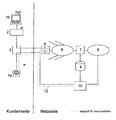
- Asymmetric Digital Subscriber Line is currently the most common connection technology in Germany ( Fig. 1 ) designated.
- Asymmetric means that the available data rates are different in the sending and receiving direction, and in the receiving direction of the customer considerably larger than in the transmission direction.
- the previously installed ADSL equipment technology uses for DSL applications only frequency ranges that are above the for ISDN basic access used frequency range of 130 kHz. This means that all ISDN services as well as analogue services can be used by the taker at the same time as the Internet connection. Both services can be transmitted in parallel.
- Fig.1 are separated by a customer-arranged frequency splitter 3, the low and the high frequency band (ISDN / PSTN frequency band and ADSL frequency band).
- PSTN connection an analogue connection
- ISDN connection customer end device 1
- Both types of connection have in common that they are operated in the form of individual connections directly to the exchange and the customer in each case an exclusive telephone channel is available.
- the upper frequency range for ADSL application is operated on the customer side via a DSL modem 2, which is connected on the network side (exchange) with a DSLAM 4 (Digital Subscriber Line Access Multiplexer).
- DSLAM 4 enables a scalable and thus economical connection of broadband services over the existing telephone network (narrowband).
- a DSLAM 4 has the task of concentrating several ADSL customers 1-n on a modem bank to share the total bandwidth.
- the IP-based data of the DSLAMs 4 are routed via a concentrator network 6 and a downstream broadband IP access router 7 to the IP access network 8.
- the concentrator network 6 concentrates the data streams of several customers 1-n of the DSLAM 4.
- Customers of an ADSL connection, DSL customer terminal 1b thus share the existing total bandwidth up to the IP.
- ISDN / PSTN customers are connected to the exchange exclusively to a port of the exchange and do not share a shared bandwidth until then.
- the prior art described above is based on the fact that the IP traffic of ADSL customers is always kept in a shared medium "shared medium", whereby several customers have to share the existing IP access bandwidth.
- this has the disadvantage that in time-critical IP applications, such as e.g. VoIP (Voice over IP) or Streaming Media (Video on Demand) u. a.
- VoIP Voice over IP
- Streaming Media Video on Demand
- Customers can not be guaranteed guaranteed IP access bandwidth for their applications.
- the available IP Acessbandbreite therefore always depends on the respective traffic volume in the access network.
- the object of the invention is to develop a solution for time-critical IP traffic, which is characterized by the provision of a guaranteed access bandwidth, with the possibility should exist that the IP-Acesstician can be set much further away from the customer location than it is at conventional xDSL applications with DSLAM is possible.
- the invention makes use of the fact that, in the lower frequency band (telephone), due to the physical conditions (more favorable attenuation values), significantly greater ranges between subscriber and carrier equipment can be achieved than in the higher frequency band in which xDSL applications are realized.
- the invention is based on the lower frequency range used in the context of the prior art xDSL technology for PSTN / ISDN applications, exclusively for high-quality and time-critical IP applications, such as VoIP (Voice over Internet Protocol), video streaming To use Video on Demand, Internet Radio or Internet TV.
- VoIP Voice over Internet Protocol
- video streaming To use Video on Demand Internet Radio or Internet TV.
- Fig. 1 shows a block diagram of the prior art for an ADSL application.
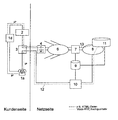
- Fig.2 a first possible embodiment of the invention is shown.
- Fig. 3 shows another possible embodiment of the invention.
- This frequency range is used according to the invention for high-quality and time-critical IP traffic. Since the cable routing from the VoIP device 1a via an exclusive VoIP connection 12 customer-selectively without a concentrator network for VoIP or streaming services is used, the customer can be provided a guaranteed access bandwidth to the nearest IP access point of the carrier.
- This IP access point may also be farther from the customer location than a DSLAM 4 due to the much lower attenuation values of the lower frequency range of the copper pair.
- the exclusive VoIP connection 12 between customer and IP access point is permanently maintained in this solution and not separated by a forced separation of the telecommunications provider.
- RTP Real Time Protocol
- the IP streams are to be correlated again by suitable application servers of the service providers, which can be correlated by conventional IP-usual identification mechanisms (radius login, LDAP directories and single sign ON etc.) can be guaranteed.
- the customer's terminal must generate both an exclusive bandwidth-protected connection to an IP access point for the VoIP streams (RTP) of the IP carrier may as well as simultaneously make an IP connection over the concentrator network of the IP access network for the HTML content described in the prior art via an ADSL modem or a connection of a modem-integrated terminal of the customer.
- Fig. 3 In contrast to Fig. 2 In this case, the two-way IP connections are combined on an application server 11.
- the application server 11 has the task in the customer direction to transport the RTP streams over the low frequency band, and the time-critical IP streams over the conventional access technology.
- Voice signals are then transmitted via the exclusive modem connection and the HTML content is transmitted over the ADSL connection ( Figure 3 ).
- a VoIP terminal 1a is connected via a splitter 3, which is connected via an exclusive VoIP connection 12 to an exclusive Access modem bank 10.
- the exclusive VoIP IP connection between the VoIP terminal 1a and the exclusive IP Access Modem Bank 10 is configured as a permanent connection.
- each customer is exclusively assigned a modem during a connection.
- the exclusive IP access modem bank 10 is connected to a broadband IP access router 7 via a customer database 9, which handles the authentication of the respective customer.
- the application server 11 which is connected to the customer database 9, has access via the IP access network 8 to the IP access router 7 and to the exclusive IP access modem bank 10, so that it is able to provide in the customer direction the Transport RTP currents over the low frequency band and the non-time critical IP currents via the conventional access technology.
- An expedient embodiment of the solution is to integrate the upstream modem in the VoIP customer terminal 1a.
Landscapes
- Engineering & Computer Science (AREA)
- Computer Networks & Wireless Communication (AREA)
- Signal Processing (AREA)
- Telephonic Communication Services (AREA)
Claims (7)
- Procédé d'amélioration de la transmission d'applications IP critiques en termes de temps en utilisant la technologie xDSL,
caractérisé en ce que, tout en conservant la technologie xDSL pour les applications xDSL dans la gamme de fréquence supérieure, on fournit au client, dans la gamme de fréquence inférieure, séparée par un séparateur (3), une connexion VoIP (12) exclusive associée à un terminal client VoIP (1a) pour accéder à des applications de haute qualité et critiques en termes de temps, telles que VoIP ou radio sur internet. - Procédé selon la revendication 1, caractérisé en ce que les flux de données VoIP passant par la connexion VoIP (12) exclusive et les flux de données IP passant par la connexion IP classique non exclusive sont regroupés et connectés à au moins une application par l'intermédiaire d'un serveur d'application (11) disposé côté réseau.
- Procédé selon la revendication 1, caractérisé en ce que les flux de données VoIP passant par la connexion VoIP (12) exclusive et les flux de données IP passant par la connexion IP classique non exclusive sont regroupés au niveau du terminal client VoIP (1a) côté client et visualisés pour le client.
- Dispositif pour améliorer la transmission d'applications IP critiques en termes de temps en utilisant la technologie xDSL,
caractérisé en ce qu'un terminal client VoIP (1a) est affecté au client d'une connexion xDSL dans la gamme de fréquence inférieure destinée à la communication vocale classique, par l'intermédiaire d'un séparateur de fréquence, en ce qu'il est relié, via une connexion VoIP exclusive (12), à une base de modem d'accès IP (10) exclusive, par l'intermédiaire de laquelle un modem est affecté à chaque client de manière exclusive, en ce que la base de modem d'accès IP (10) exclusive est connectée à un routeur à large bande d'accès IP (7) par l'intermédiaire d'une base de données client (9) qui assure l'authentification du client respectif, et en ce qu'une connexion passant par l'intermédiaire d'un serveur d'application (11) connecté à la base de données client (9) existe vers le routeur à large bande d'accès IP (7) et vers la base de modem d'accès IP (10) exclusive via le réseau d'accès IP (8). - Dispositif selon la revendication 4, caractérisé en ce que la connexion IP exclusive entre le terminal client VoIP (1a) et la base de modem d'accès IP (10) exclusive est configurée comme une connexion fixe.
- Dispositif selon la revendication 4, caractérisé en ce que le modem disposé en amont est intégré au terminal VoIP (1a).
- Dispositif selon la revendication 4, caractérisé en ce que le terminal client VoIP (1a) est conçu comme un ordinateur capable de gérer des flux RTP.
Priority Applications (1)
| Application Number | Priority Date | Filing Date | Title |
|---|---|---|---|
| PL06019021T PL1777983T3 (pl) | 2005-10-19 | 2006-09-12 | Sposób poprawienia transmisji aplikacji IP krytycznych pod względem czasu |
Applications Claiming Priority (1)
| Application Number | Priority Date | Filing Date | Title |
|---|---|---|---|
| DE102005050725A DE102005050725A1 (de) | 2005-10-19 | 2005-10-19 | Verfahren zur Verbesserung der Übertragung von zeitkritischen IP-Anwendungen |
Publications (2)
| Publication Number | Publication Date |
|---|---|
| EP1777983A1 EP1777983A1 (fr) | 2007-04-25 |
| EP1777983B1 true EP1777983B1 (fr) | 2013-02-13 |
Family
ID=37714467
Family Applications (1)
| Application Number | Title | Priority Date | Filing Date |
|---|---|---|---|
| EP06019021A Active EP1777983B1 (fr) | 2005-10-19 | 2006-09-12 | Méthode pour améliorer la transmission d'applications IP à durée critique |
Country Status (3)
| Country | Link |
|---|---|
| EP (1) | EP1777983B1 (fr) |
| DE (1) | DE102005050725A1 (fr) |
| PL (1) | PL1777983T3 (fr) |
Family Cites Families (4)
| Publication number | Priority date | Publication date | Assignee | Title |
|---|---|---|---|---|
| US5889856A (en) * | 1997-05-22 | 1999-03-30 | Centillium Technology Corp. | ADSL integrated line card with digital splitter and POTS CODEC without bulky analog splitter |
| US6876647B2 (en) * | 2001-04-12 | 2005-04-05 | International Business Machines Corporation | Dynamic priority adjustment in a real time streaming engine |
| US20030112966A1 (en) * | 2001-12-18 | 2003-06-19 | Bijit Halder | Method and system for implementing a reduced complexity dual rate echo canceller |
| US7400720B2 (en) * | 2004-10-05 | 2008-07-15 | Sbc Knowledge Ventures, L.P. | System and method for optimizing digital subscriber line based services |
-
2005
- 2005-10-19 DE DE102005050725A patent/DE102005050725A1/de not_active Withdrawn
-
2006
- 2006-09-12 EP EP06019021A patent/EP1777983B1/fr active Active
- 2006-09-12 PL PL06019021T patent/PL1777983T3/pl unknown
Also Published As
| Publication number | Publication date |
|---|---|
| EP1777983A1 (fr) | 2007-04-25 |
| PL1777983T3 (pl) | 2013-08-30 |
| DE102005050725A1 (de) | 2007-05-03 |
Similar Documents
| Publication | Publication Date | Title |
|---|---|---|
| EP1421767A2 (fr) | Dispositif pour fournir des annonces et des dialogues dans des reseaux de transmission par paquets | |
| EP1397020B1 (fr) | Dispositif de communication de voix et de données sur une ligne d'abonné commune | |
| EP1777983B1 (fr) | Méthode pour améliorer la transmission d'applications IP à durée critique | |
| WO2001041418A2 (fr) | Procede de transmission de donnees sur plusieurs liaisons de transmission de donnees paralleles | |
| DE10104705B4 (de) | Verfahren und Telekommunikationseinrichtung zum Übertragen von Sprach- und Allgemeindaten | |
| DE102004010991B4 (de) | Telekommunikationseinrichtung | |
| DE10126569B4 (de) | Datenübertragungsnetz | |
| DE3405011C1 (de) | Schaltungsanordnung zum Betreiben von zweiadrigen, digitalen Anschluß- und/oder Verbindungsleitungen an einer Fernmeldevermittlungsanlage | |
| EP1430668B1 (fr) | Mise a disposition flexible et economique de caracteristiques de service en matiere de transmission de la voix dans un reseau a commutation de paquets | |
| DE102005046780A1 (de) | Vorrichtung und Verfahren zum Weiterleiten von Telefondaten | |
| DE10341363A1 (de) | Teilnehmerschaltung für Kommunikationssysteme sowie Kommunikationssystem | |
| DE102004021698B4 (de) | Verfahren und Telekommunikationsanordnung zur Steuerung der Auslastung von Einwählpunkten in ein Paketvermittlungsnetz | |
| EP1790175B1 (fr) | Procede pour etablir une liaison de telecommunication specifique du reseau, avec un raccordement utilisateur appele, d'un reseau de telecommunication | |
| DE19901756A1 (de) | Verfahren zum Betrieb von Einrichtungen zur hochbitratigen Datenübertragung auf einer Teilnehmerleitung und Anordnung mit solchen Einrichtungen zur Datenübertragung | |
| EP1238527B1 (fr) | Etablissement optionnel d'une liaison par un reseau telephonique ou un reseau internet | |
| DE10247139A1 (de) | Vorrichtung und Verfahren zur Steuerung einer Authentifizierung in einem Telekommunikationsnetzwerk | |
| AT500113A1 (de) | Fernmeldeteilnehmeranschluss sowie verfahren zum betrieb desselben | |
| WO2005122477A1 (fr) | Procede pour la transmission a large bande, completant la technique xdsl, de donnees de voie de retour dans une liaison entre un serveur d'un reseau a commutation par paquets et un terminal | |
| DE102005034002A1 (de) | Verfahren zur bidirektionalen Datenübertragung | |
| EP1090497A2 (fr) | Procede pour transmettre des donnees dans la zone de raccordement d'abonne | |
| WO1998056189A2 (fr) | Procede et installation de traitement de donnees pour commutation dans un systeme de telecommunication | |
| DE10112815A1 (de) | Verfahren zum Verbessern der Übertragungsqualität zwischen Telekommunikationseinrichtungen | |
| DE10052917A1 (de) | Vorrichtung und Verfahren zum Abbau einer Verbindung zur hochbitratigen Datenübertragung | |
| DE10112803A1 (de) | Verfahren zum Verbessern der Übertrgungsqualität zwischen Telekommunikationseinrichtungen | |
| DE10062935A1 (de) | Kommunikationsnetz |
Legal Events
| Date | Code | Title | Description |
|---|---|---|---|
| PUAI | Public reference made under article 153(3) epc to a published international application that has entered the european phase |
Free format text: ORIGINAL CODE: 0009012 |
|
| AK | Designated contracting states |
Kind code of ref document: A1 Designated state(s): AT BE BG CH CY CZ DE DK EE ES FI FR GB GR HU IE IS IT LI LT LU LV MC NL PL PT RO SE SI SK TR |
|
| AX | Request for extension of the european patent |
Extension state: AL BA HR MK YU |
|
| 17P | Request for examination filed |
Effective date: 20071025 |
|
| AKX | Designation fees paid |
Designated state(s): AT BE BG CH CY CZ DE DK EE ES FI FR GB GR HU IE IS IT LI LT LU LV MC NL PL PT RO SE SI SK TR |
|
| GRAP | Despatch of communication of intention to grant a patent |
Free format text: ORIGINAL CODE: EPIDOSNIGR1 |
|
| GRAS | Grant fee paid |
Free format text: ORIGINAL CODE: EPIDOSNIGR3 |
|
| GRAA | (expected) grant |
Free format text: ORIGINAL CODE: 0009210 |
|
| AK | Designated contracting states |
Kind code of ref document: B1 Designated state(s): AT BE BG CH CY CZ DE DK EE ES FI FR GB GR HU IE IS IT LI LT LU LV MC NL PL PT RO SE SI SK TR |
|
| REG | Reference to a national code |
Ref country code: GB Ref legal event code: FG4D Free format text: NOT ENGLISH |
|
| REG | Reference to a national code |
Ref country code: AT Ref legal event code: REF Ref document number: 597038 Country of ref document: AT Kind code of ref document: T Effective date: 20130215 |
|
| REG | Reference to a national code |
Ref country code: IE Ref legal event code: FG4D Free format text: LANGUAGE OF EP DOCUMENT: GERMAN |
|
| REG | Reference to a national code |
Ref country code: DE Ref legal event code: R096 Ref document number: 502006012482 Country of ref document: DE Effective date: 20130411 |
|
| REG | Reference to a national code |
Ref country code: NL Ref legal event code: VDEP Effective date: 20130213 |
|
| REG | Reference to a national code |
Ref country code: LT Ref legal event code: MG4D |
|
| PG25 | Lapsed in a contracting state [announced via postgrant information from national office to epo] |
Ref country code: SE Free format text: LAPSE BECAUSE OF FAILURE TO SUBMIT A TRANSLATION OF THE DESCRIPTION OR TO PAY THE FEE WITHIN THE PRESCRIBED TIME-LIMIT Effective date: 20130213 Ref country code: IS Free format text: LAPSE BECAUSE OF FAILURE TO SUBMIT A TRANSLATION OF THE DESCRIPTION OR TO PAY THE FEE WITHIN THE PRESCRIBED TIME-LIMIT Effective date: 20130613 Ref country code: LT Free format text: LAPSE BECAUSE OF FAILURE TO SUBMIT A TRANSLATION OF THE DESCRIPTION OR TO PAY THE FEE WITHIN THE PRESCRIBED TIME-LIMIT Effective date: 20130213 Ref country code: ES Free format text: LAPSE BECAUSE OF FAILURE TO SUBMIT A TRANSLATION OF THE DESCRIPTION OR TO PAY THE FEE WITHIN THE PRESCRIBED TIME-LIMIT Effective date: 20130524 Ref country code: BG Free format text: LAPSE BECAUSE OF FAILURE TO SUBMIT A TRANSLATION OF THE DESCRIPTION OR TO PAY THE FEE WITHIN THE PRESCRIBED TIME-LIMIT Effective date: 20130513 |
|
| PG25 | Lapsed in a contracting state [announced via postgrant information from national office to epo] |
Ref country code: SI Free format text: LAPSE BECAUSE OF FAILURE TO SUBMIT A TRANSLATION OF THE DESCRIPTION OR TO PAY THE FEE WITHIN THE PRESCRIBED TIME-LIMIT Effective date: 20130213 Ref country code: PT Free format text: LAPSE BECAUSE OF FAILURE TO SUBMIT A TRANSLATION OF THE DESCRIPTION OR TO PAY THE FEE WITHIN THE PRESCRIBED TIME-LIMIT Effective date: 20130613 Ref country code: LV Free format text: LAPSE BECAUSE OF FAILURE TO SUBMIT A TRANSLATION OF THE DESCRIPTION OR TO PAY THE FEE WITHIN THE PRESCRIBED TIME-LIMIT Effective date: 20130213 Ref country code: FI Free format text: LAPSE BECAUSE OF FAILURE TO SUBMIT A TRANSLATION OF THE DESCRIPTION OR TO PAY THE FEE WITHIN THE PRESCRIBED TIME-LIMIT Effective date: 20130213 |
|
| REG | Reference to a national code |
Ref country code: PL Ref legal event code: T3 Ref country code: GR Ref legal event code: EP Ref document number: 20130400910 Country of ref document: GR Effective date: 20130614 |
|
| PG25 | Lapsed in a contracting state [announced via postgrant information from national office to epo] |
Ref country code: EE Free format text: LAPSE BECAUSE OF FAILURE TO SUBMIT A TRANSLATION OF THE DESCRIPTION OR TO PAY THE FEE WITHIN THE PRESCRIBED TIME-LIMIT Effective date: 20130213 Ref country code: RO Free format text: LAPSE BECAUSE OF FAILURE TO SUBMIT A TRANSLATION OF THE DESCRIPTION OR TO PAY THE FEE WITHIN THE PRESCRIBED TIME-LIMIT Effective date: 20130213 Ref country code: NL Free format text: LAPSE BECAUSE OF FAILURE TO SUBMIT A TRANSLATION OF THE DESCRIPTION OR TO PAY THE FEE WITHIN THE PRESCRIBED TIME-LIMIT Effective date: 20130213 Ref country code: DK Free format text: LAPSE BECAUSE OF FAILURE TO SUBMIT A TRANSLATION OF THE DESCRIPTION OR TO PAY THE FEE WITHIN THE PRESCRIBED TIME-LIMIT Effective date: 20130213 Ref country code: SK Free format text: LAPSE BECAUSE OF FAILURE TO SUBMIT A TRANSLATION OF THE DESCRIPTION OR TO PAY THE FEE WITHIN THE PRESCRIBED TIME-LIMIT Effective date: 20130213 |
|
| PLBE | No opposition filed within time limit |
Free format text: ORIGINAL CODE: 0009261 |
|
| STAA | Information on the status of an ep patent application or granted ep patent |
Free format text: STATUS: NO OPPOSITION FILED WITHIN TIME LIMIT |
|
| REG | Reference to a national code |
Ref country code: HU Ref legal event code: AG4A Ref document number: E017895 Country of ref document: HU |
|
| PG25 | Lapsed in a contracting state [announced via postgrant information from national office to epo] |
Ref country code: IT Free format text: LAPSE BECAUSE OF FAILURE TO SUBMIT A TRANSLATION OF THE DESCRIPTION OR TO PAY THE FEE WITHIN THE PRESCRIBED TIME-LIMIT Effective date: 20130213 |
|
| 26N | No opposition filed |
Effective date: 20131114 |
|
| REG | Reference to a national code |
Ref country code: DE Ref legal event code: R097 Ref document number: 502006012482 Country of ref document: DE Effective date: 20131114 |
|
| BERE | Be: lapsed |
Owner name: DEUTSCHE TELEKOM A.G. Effective date: 20130930 |
|
| PG25 | Lapsed in a contracting state [announced via postgrant information from national office to epo] |
Ref country code: MC Free format text: LAPSE BECAUSE OF FAILURE TO SUBMIT A TRANSLATION OF THE DESCRIPTION OR TO PAY THE FEE WITHIN THE PRESCRIBED TIME-LIMIT Effective date: 20130213 |
|
| REG | Reference to a national code |
Ref country code: CH Ref legal event code: PL |
|
| GBPC | Gb: european patent ceased through non-payment of renewal fee |
Effective date: 20130912 |
|
| REG | Reference to a national code |
Ref country code: FR Ref legal event code: ST Effective date: 20140530 |
|
| REG | Reference to a national code |
Ref country code: IE Ref legal event code: MM4A |
|
| PG25 | Lapsed in a contracting state [announced via postgrant information from national office to epo] |
Ref country code: GB Free format text: LAPSE BECAUSE OF NON-PAYMENT OF DUE FEES Effective date: 20130912 Ref country code: LI Free format text: LAPSE BECAUSE OF NON-PAYMENT OF DUE FEES Effective date: 20130930 Ref country code: IE Free format text: LAPSE BECAUSE OF NON-PAYMENT OF DUE FEES Effective date: 20130912 Ref country code: BE Free format text: LAPSE BECAUSE OF NON-PAYMENT OF DUE FEES Effective date: 20130930 Ref country code: CH Free format text: LAPSE BECAUSE OF NON-PAYMENT OF DUE FEES Effective date: 20130930 |
|
| PG25 | Lapsed in a contracting state [announced via postgrant information from national office to epo] |
Ref country code: FR Free format text: LAPSE BECAUSE OF NON-PAYMENT OF DUE FEES Effective date: 20130930 |
|
| REG | Reference to a national code |
Ref country code: AT Ref legal event code: MM01 Ref document number: 597038 Country of ref document: AT Kind code of ref document: T Effective date: 20130912 |
|
| PG25 | Lapsed in a contracting state [announced via postgrant information from national office to epo] |
Ref country code: AT Free format text: LAPSE BECAUSE OF NON-PAYMENT OF DUE FEES Effective date: 20130912 |
|
| PG25 | Lapsed in a contracting state [announced via postgrant information from national office to epo] |
Ref country code: TR Free format text: LAPSE BECAUSE OF FAILURE TO SUBMIT A TRANSLATION OF THE DESCRIPTION OR TO PAY THE FEE WITHIN THE PRESCRIBED TIME-LIMIT Effective date: 20130213 Ref country code: CY Free format text: LAPSE BECAUSE OF FAILURE TO SUBMIT A TRANSLATION OF THE DESCRIPTION OR TO PAY THE FEE WITHIN THE PRESCRIBED TIME-LIMIT Effective date: 20130213 |
|
| PG25 | Lapsed in a contracting state [announced via postgrant information from national office to epo] |
Ref country code: LU Free format text: LAPSE BECAUSE OF NON-PAYMENT OF DUE FEES Effective date: 20130912 |
|
| PGFP | Annual fee paid to national office [announced via postgrant information from national office to epo] |
Ref country code: DE Payment date: 20240919 Year of fee payment: 19 |
|
| PGFP | Annual fee paid to national office [announced via postgrant information from national office to epo] |
Ref country code: GR Payment date: 20240918 Year of fee payment: 19 |
|
| PGFP | Annual fee paid to national office [announced via postgrant information from national office to epo] |
Ref country code: CZ Payment date: 20240830 Year of fee payment: 19 |
|
| PGFP | Annual fee paid to national office [announced via postgrant information from national office to epo] |
Ref country code: PL Payment date: 20240830 Year of fee payment: 19 |
|
| PGFP | Annual fee paid to national office [announced via postgrant information from national office to epo] |
Ref country code: HU Payment date: 20240905 Year of fee payment: 19 |