EP1780290A2 - Dispositif d'amplification d'acide nucléique - Google Patents
Dispositif d'amplification d'acide nucléique Download PDFInfo
- Publication number
- EP1780290A2 EP1780290A2 EP06022542A EP06022542A EP1780290A2 EP 1780290 A2 EP1780290 A2 EP 1780290A2 EP 06022542 A EP06022542 A EP 06022542A EP 06022542 A EP06022542 A EP 06022542A EP 1780290 A2 EP1780290 A2 EP 1780290A2
- Authority
- EP
- European Patent Office
- Prior art keywords
- modules
- duplicating
- nucleic acids
- detection
- extraction
- Prior art date
- Legal status (The legal status is an assumption and is not a legal conclusion. Google has not performed a legal analysis and makes no representation as to the accuracy of the status listed.)
- Withdrawn
Links
Images

Classifications
-
- B—PERFORMING OPERATIONS; TRANSPORTING
- B01—PHYSICAL OR CHEMICAL PROCESSES OR APPARATUS IN GENERAL
- B01L—CHEMICAL OR PHYSICAL LABORATORY APPARATUS FOR GENERAL USE
- B01L3/00—Containers or dishes for laboratory use, e.g. laboratory glassware; Droppers
- B01L3/50—Containers for the purpose of retaining a material to be analysed, e.g. test tubes
- B01L3/502—Containers for the purpose of retaining a material to be analysed, e.g. test tubes with fluid transport, e.g. in multi-compartment structures
- B01L3/5027—Containers for the purpose of retaining a material to be analysed, e.g. test tubes with fluid transport, e.g. in multi-compartment structures by integrated microfluidic structures, i.e. dimensions of channels and chambers are such that surface tension forces are important, e.g. lab-on-a-chip
-
- B—PERFORMING OPERATIONS; TRANSPORTING
- B01—PHYSICAL OR CHEMICAL PROCESSES OR APPARATUS IN GENERAL
- B01L—CHEMICAL OR PHYSICAL LABORATORY APPARATUS FOR GENERAL USE
- B01L7/00—Heating or cooling apparatus; Heat insulating devices
- B01L7/52—Heating or cooling apparatus; Heat insulating devices with provision for submitting samples to a predetermined sequence of different temperatures, e.g. for treating nucleic acid samples
-
- B—PERFORMING OPERATIONS; TRANSPORTING
- B01—PHYSICAL OR CHEMICAL PROCESSES OR APPARATUS IN GENERAL
- B01L—CHEMICAL OR PHYSICAL LABORATORY APPARATUS FOR GENERAL USE
- B01L2200/00—Solutions for specific problems relating to chemical or physical laboratory apparatus
- B01L2200/06—Fluid handling related problems
- B01L2200/0684—Venting, avoiding backpressure, avoid gas bubbles
-
- B—PERFORMING OPERATIONS; TRANSPORTING
- B01—PHYSICAL OR CHEMICAL PROCESSES OR APPARATUS IN GENERAL
- B01L—CHEMICAL OR PHYSICAL LABORATORY APPARATUS FOR GENERAL USE
- B01L2200/00—Solutions for specific problems relating to chemical or physical laboratory apparatus
- B01L2200/10—Integrating sample preparation and analysis in single entity, e.g. lab-on-a-chip concept
-
- B—PERFORMING OPERATIONS; TRANSPORTING
- B01—PHYSICAL OR CHEMICAL PROCESSES OR APPARATUS IN GENERAL
- B01L—CHEMICAL OR PHYSICAL LABORATORY APPARATUS FOR GENERAL USE
- B01L2200/00—Solutions for specific problems relating to chemical or physical laboratory apparatus
- B01L2200/14—Process control and prevention of errors
- B01L2200/143—Quality control, feedback systems
- B01L2200/147—Employing temperature sensors
-
- B—PERFORMING OPERATIONS; TRANSPORTING
- B01—PHYSICAL OR CHEMICAL PROCESSES OR APPARATUS IN GENERAL
- B01L—CHEMICAL OR PHYSICAL LABORATORY APPARATUS FOR GENERAL USE
- B01L2300/00—Additional constructional details
- B01L2300/08—Geometry, shape and general structure
- B01L2300/0809—Geometry, shape and general structure rectangular shaped
- B01L2300/0816—Cards, e.g. flat sample carriers usually with flow in two horizontal directions
-
- B—PERFORMING OPERATIONS; TRANSPORTING
- B01—PHYSICAL OR CHEMICAL PROCESSES OR APPARATUS IN GENERAL
- B01L—CHEMICAL OR PHYSICAL LABORATORY APPARATUS FOR GENERAL USE
- B01L2300/00—Additional constructional details
- B01L2300/08—Geometry, shape and general structure
- B01L2300/0861—Configuration of multiple channels and/or chambers in a single devices
- B01L2300/087—Multiple sequential chambers
-
- B—PERFORMING OPERATIONS; TRANSPORTING
- B01—PHYSICAL OR CHEMICAL PROCESSES OR APPARATUS IN GENERAL
- B01L—CHEMICAL OR PHYSICAL LABORATORY APPARATUS FOR GENERAL USE
- B01L2300/00—Additional constructional details
- B01L2300/18—Means for temperature control
- B01L2300/1805—Conductive heating, heat from thermostatted solids is conducted to receptacles, e.g. heating plates, blocks
- B01L2300/1822—Conductive heating, heat from thermostatted solids is conducted to receptacles, e.g. heating plates, blocks using Peltier elements
-
- B—PERFORMING OPERATIONS; TRANSPORTING
- B01—PHYSICAL OR CHEMICAL PROCESSES OR APPARATUS IN GENERAL
- B01L—CHEMICAL OR PHYSICAL LABORATORY APPARATUS FOR GENERAL USE
- B01L2300/00—Additional constructional details
- B01L2300/18—Means for temperature control
- B01L2300/1883—Means for temperature control using thermal insulation
-
- B—PERFORMING OPERATIONS; TRANSPORTING
- B01—PHYSICAL OR CHEMICAL PROCESSES OR APPARATUS IN GENERAL
- B01L—CHEMICAL OR PHYSICAL LABORATORY APPARATUS FOR GENERAL USE
- B01L2400/00—Moving or stopping fluids
- B01L2400/04—Moving fluids with specific forces or mechanical means
- B01L2400/0403—Moving fluids with specific forces or mechanical means specific forces
- B01L2400/0406—Moving fluids with specific forces or mechanical means specific forces capillary forces
-
- B—PERFORMING OPERATIONS; TRANSPORTING
- B01—PHYSICAL OR CHEMICAL PROCESSES OR APPARATUS IN GENERAL
- B01L—CHEMICAL OR PHYSICAL LABORATORY APPARATUS FOR GENERAL USE
- B01L2400/00—Moving or stopping fluids
- B01L2400/04—Moving fluids with specific forces or mechanical means
- B01L2400/0403—Moving fluids with specific forces or mechanical means specific forces
- B01L2400/0433—Moving fluids with specific forces or mechanical means specific forces vibrational forces
- B01L2400/0439—Moving fluids with specific forces or mechanical means specific forces vibrational forces ultrasonic vibrations, vibrating piezo elements
-
- B—PERFORMING OPERATIONS; TRANSPORTING
- B01—PHYSICAL OR CHEMICAL PROCESSES OR APPARATUS IN GENERAL
- B01L—CHEMICAL OR PHYSICAL LABORATORY APPARATUS FOR GENERAL USE
- B01L2400/00—Moving or stopping fluids
- B01L2400/04—Moving fluids with specific forces or mechanical means
- B01L2400/0475—Moving fluids with specific forces or mechanical means specific mechanical means and fluid pressure
- B01L2400/0487—Moving fluids with specific forces or mechanical means specific mechanical means and fluid pressure fluid pressure, pneumatics
-
- B—PERFORMING OPERATIONS; TRANSPORTING
- B01—PHYSICAL OR CHEMICAL PROCESSES OR APPARATUS IN GENERAL
- B01L—CHEMICAL OR PHYSICAL LABORATORY APPARATUS FOR GENERAL USE
- B01L3/00—Containers or dishes for laboratory use, e.g. laboratory glassware; Droppers
- B01L3/50—Containers for the purpose of retaining a material to be analysed, e.g. test tubes
- B01L3/502—Containers for the purpose of retaining a material to be analysed, e.g. test tubes with fluid transport, e.g. in multi-compartment structures
- B01L3/5025—Containers for the purpose of retaining a material to be analysed, e.g. test tubes with fluid transport, e.g. in multi-compartment structures for parallel transport of multiple samples
Definitions
- the present invention relates to a device or an array for the amplification and detection of target substances, in particular of nucleic acids from a biological material or a sample.
- nucleic acids plays an important role, e.g. in forensic analysis, in cancer research or in food diagnostics.
- the aim is to detect certain nucleic acids that make up e.g. a criminal culpability that implies disposition for a hereditary disease or the genetic modification of a food.
- Conventional methods for the detection of certain nucleic acids are well known, e.g. Gel or capillary electrophoresis, Southern blot, immunoassays or hybridization with labeled nucleic acid probes.
- cartridges, electrophoresis chambers o. ⁇ ., And the corresponding devices are used to read these devices.
- each transfer step therefore leads to material and time losses and, on the other hand, entails the risk of contamination with foreign nucleic acids.
- said functional units are miniaturized in the form of an array in such a way that they can fit on a small carrier ("lab on a chip").
- the individual reaction chambers are connected via miniaturized channels, and the reaction fluids are transported from one chamber to the next by means of suitable micropumps and valves as well as via the capillary force (microfluidics).
- micropumps and valves as well as via the capillary force (microfluidics).
- microfluidics capillary force
- Such chips or cartridges are arranged in special adapted equipment, which the necessary control and operating units, eg. As pumps and heating and cooling elements, etc., and the reactions, detections, etc. control and evaluate.
- thermocyclers (Schnegaß & Köhler 2001, Rev. Mol. Biotechnol. 82; 101 ) are presented such "labs on a chip”.
- PCR a method for PCR
- the authors describe a chip having a meandering channel, under which heating elements of different temperature are arranged in an ordered arrangement. When the reaction liquid is pumped through the channel at a suitable rate, it passes through the temperature cycles required for the PCR to proceed, and the nucleic acids are amplified.
- the multiplication factor depends exponentially on the number of thermocycles, the multiplication factor is already defined in such a "lab on a chip". Therefore, such chips are not very variable and therefore unusable for various uses.
- these devices known from the prior art are usually designed for the parallel examination of many samples on one and the same nucleic acid.
- 96 food samples of various origin can be examined simultaneously in parallel for the presence of a specific gene, eg. B. on an anti-biotic resistance gene, which suggests a genetic modification.
- Object of the present invention is to provide an apparatus for amplification and detection of nucleic acids from a biological material or a sample that does not have the aforementioned disadvantages and with the particular by means of a trial order in one operation a plurality of different target substances, such.
- B. nucleic acids, eg. B. can be detected by different infectious agents. This object is achieved with the features of present claim 1.
- a device in the form of an array for duplicating and detecting target molecules from a biological material or a sample which has at least two duplicating modules and at least two detection modules, wherein the duplicating modules are respectively tempered via a temperature control unit to be controlled individually, and wherein the duplicating and detection modules are arranged on a component.
- the component is integrally formed.
- the device or chip according to the invention is expediently adapted to be accommodated in a control and / or operating unit (base unit), this unit having the control, in particular temperature control, pumping and detection elements necessary for the operation of the device. These elements can be controlled by means of a computer.
- Such a device makes it possible to test a single sample simultaneously on a plurality of target substances, in particular nucleic acids. Associated with this is an enormous gain in speed over conventional methods, which makes it possible to increase the throughput of a laboratory and thus intensive screening work, such as. in epidemiology or cancer diagnostics are required to accelerate.
- each amplification module associated with each individually controlled tempering can be performed in each duplicating module for the respective target reaction or the respective target material to be detected individually adjustable sequence of duration, temperature and number of cycles, and so for a target to be detected and each for this purpose Optimize the amplification enzymes and denaturing conditions used in each case without interfering with parallel processes.
- Preferred targets are nucleic acids.
- the control can be done in a simple manner via a programmable PC.
- a corresponding multiplex reproduction can also be performed. These are typically limited to 3-4 target sequences.
- the device may be designed to detect bacteria.
- the device also has at least one module for extracting nucleic acids, which is arranged on the same common component.
- the number of replication and detection modules is the same, and the number of extraction modules is less than or equal to the number of duplicating modules.
- two or more modules for the extraction of nucleic acids are arranged on the common component.
- a different extraction method can be chosen in each extraction module to exclude artifacts by a less suitable method, or different samples or materials can be simultaneously extracted and analyzed.
- nucleic acids to be amplified may also be useful to separately extract them to be amplified and only then to introduce them into the device. This is e.g. the case when it is a very solid sample, for the extraction of mechanical force is required, or if the material to be examined contains very few nucleic acids, so that the extracted nucleic acid must first be enriched by using a large amount of material or sample.
- the common component, the extraction module, the duplicating module and / or the detection module are predominantly or entirely made of a polymer material.
- Suitable polymer materials are polyamides, polycarbonates, PMMA, polysulfones, polyether ketones, polyesters, polyethylene, PET, a cycloolefinic polymer (COC) such as. B. TOPAS, polyacetates, polymethanes.
- the detection unit may consist of a second material which is particularly suitable for a detection radiation used.
- thermocycles worked off during the amplification step in non-isothermal amplification processes
- the component may be wholly or partially made of an inorganic material such. As metal, silicon, ceramic and / or glass.
- the individual modules have reaction chambers, which via microchannels with a cross-sectional area of particularly ⁇ 1 mm 2 or with cross sections of about 0.005 or 0.007 mm 2 to about 1 mm 2 or 0.8 mm 2 , through which the biological material, the sample, the extracted nucleic acids or the amplification products are transported.
- the chambers consist for example of depressions in the common component.
- the channels may have any cross-section and be configured, for example, quadrangular, circular or U-shaped.
- these channels have a diameter of 0.1 to 1 mm, in particular a diameter of 0.2 to 0.8 or 0.4 to 0.6 mm.
- these values relate to the average diameter which corresponds approximately to the diameter of an equally large circular cross-section.
- Such structures can be produced depending on the material used by injection molding, micro injection molding, molding, embossing, etching, photolithography, micro sandblasting, lasers or laminate of films with and without recesses.
- the liquid is transported by suitable pumps and valves as well as by capillary forces from one module to the next or from one reaction chamber to the next.
- the wetting properties of the channels are specifically influenced.
- the surface at the exit of a chamber may be made hydrophobic in order to prevent leakage of reaction liquid during a reaction.
- the channels are formed closed at the top. This feature is required to prevent excessive evaporation of the reaction liquid, but carries the risk of blistering, which would lead to interruption of the flow.
- the channels are designed to be open at the top and covered with a liquid-impermeable, but gas-permeable structure. This may be e.g. to act a film that is made of PTFE, for example.
- control unit and / or the device according to the invention has at least two temperature sensors. These are for example the Associated with duplicating modules and allow the control and control of the temperature control units.
- the common component can be inserted into the control / operator unit (base unit), in which the temperature control units and / or temperature sensors are also arranged.
- the base unit may moreover be e.g. have one or more ultrasonic sources, pumps for microfluidics, valves or optical detectors such as cameras or photomultipliers and photodiodes as a single detector or in array form.
- This embodiment is particularly advantageous because it allows the use of inexpensive manufactured disposable components, in particular of polymer, since the mentioned functionalities such Temperleitersöen, temperature sensors, ultrasonic generating units or drives for stirrers, but also pumps for microfluidics or valves in the Base device remain.
- the temperature control unit of the duplication module comprises a Peltier element.
- Peltier elements are easy to control and allow fast and accurate generation of a desired temperature. Moreover, they are able to generate both heat and cold.
- an extremely rapid tempering ie heating and / or cooling, can be achieved. In this way, a further acceleration of the respective investigation is made possible.
- the Peltier elements are not integrated in the device or polymer cartridge.
- a nucleic acid amplification reaction can be carried out in the amplification module.
- This may be e.g. PCR (polymerase chain reaction), rtPCR (reverse transcription PCR), real-time PCR (real-time PCR), NASBA (nucleic acid sequence-based amplification), LCR (ligase chain reaction), RCA (rolling circle amplification), or SDA Act (beach displacement amplification).
- the device according to the invention has a device for dispensing primers, mononucleotides and / or one or more polymerases. This can also be arranged both on the common component as well as on the base unit.
- the invention therefore also relates to a reaction kit containing these Subs-dance together with inventive device.
- the temperature sensors are thermocouples, thermoresistors, silicon sensors, PTC or NTC elements or platinum sensors (PT 100, PT 1000).
- the temperature sensors may be elements of chromogenic polymers whose color changes as a function of the temperature.
- a photodetector may include a photodiode or a camera. Such measurements can also be carried out as a reflection measurement or as a transmission measurement.
- the temperature sensors may be particulate elements which are added to the reaction liquid and their optical properties, such as change their transmission, color, fluorescence or phosphorescence as a function of the temperature.
- the extraction takes place in the extraction module by chemical means. This can e.g. done by enzymatic digestion and / or by conventional precipitation methods.
- the extraction in the extraction module takes place by means of ultrasound. Using a suitable frequency and power cell walls and membranes are disrupted so that the nucleic acids can escape from the cell interior.
- Ultrasound can also be used for mixing the reaction liquid in one of the modules. However, other frequencies and benefits may be considered.
- the extraction in the extraction module and / or the mixing in one of the modules can be effected by stirring.
- Decisive here are the shear forces that can be adjusted accordingly by selecting a suitable speed or a suitable stirrer.
- a variant of this embodiment is the extraction or mixing by means of magnetic particles which are set in motion by an externally applied rotating magnetic field.
- magnetic particles which are set in motion by an externally applied rotating magnetic field.
- it can be e.g. to act the well-known stir-fry, but also to magnetic microparticles.
- the magnetic drive is arranged in the base unit.
- the outlet channel of the extraction module has a cross-section which is smaller than that of the magnetic particles, or the magnetic particles are used whose cross-section is greater than that of the outlet channel. In this way, the particles used for stirring or extraction are prevented from being transported further.
- the chambers of the extraction and / or the duplicating modules are surrounded by recesses in the material of the component.
- These recesses may be formed in particular in the form of channels closed at the top and on the one hand serve to thermally insulate the chambers and thus to accelerate the processing of the thermocycles. On the other hand, the thermal insulation stresses in Material reduced due to different temperatures. Finally, these recesses can also serve the acoustic insulation of the chambers. This, for example, increases the efficiency of using ultrasound to mix or extract the nucleic acids.
- the recesses z. B. be closed by means of a cover to channels. They are usually filled with air, gas or a liquid or have a vacuum. But it can also be provided that the temperature of the chambers takes place via these channels. In this case, e.g. cold or warm liquids are led into the channels.
- the base unit is configured to provide the cold and warm fluids.
- a rapid temperature change of the duplicating modules can be achieved.
- the detection module is integrated in the duplicating module. In this way it is possible to follow the progress of the duplication reaction in real time.
- the corresponding methods are known as online PCR or real-time PCR.
- the detection of the duplication products takes place, for example. by means of FRET (fluorescence resonance energy transfer) or by quenching of fluorescence molecules.
- FRET fluorescence resonance energy transfer
- the detection can also be carried out by measuring an electrical current or voltage, which is generated by a suitable electrochemical reaction.
- the detection of the amplified nucleic acids in the detection module by means of electrophoresis, Southern blot, immunoassay or hybridization with labeled nucleic acid probes.
- electrochemical or mass-sensitive detectors such as a quartz crystal or a surface acoustic wave device are provided for detecting the amplified nucleic acids, which have a capture nucleic acid on their surface.
- the biological material is preferably material selected from the group consisting of blood, serum, cerebrospinal fluid, urine, sputum, stool, plant material and tissue samples.
- Areas of application are here e.g. forensics, medical diagnostics or genetic analysis.
- the sample is preferably a sample from the group consisting of water, liquid foods, solid foods, baby food, soil samples, and air samples. Areas of application are here e.g. the environmental, the water or the food analysis, in particular the analysis of genetically modified food.
- Fig. 1 shows a schematic representation of the device according to the invention with order, duplication and detection units.
- Fig. 2 shows a schematic representation of an analysis chip according to the invention with extraction and duplication unit.
- Fig. 3 shows a cross section through such a device according to the invention.
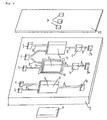
- FIG. 4 shows an exemplary representation of a device according to the invention.
- the device according to the invention has one or more inlets or application devices (1) for different liquids obtained from a sample with already extracted targets to be detected, in particular nucleic acids. These are then directed to 4 different Nukleinvielvieltasktistshimen (4) in which they are multiplied under different conditions with respect to enzymes, temperature and cycle length and then detected in the detector (5). In this case, the nucleic acid extraction is performed outside the device according to the invention.
- the chip polymer component additionally contains a disruption device (2), in particular nucleic acid extraction unit.
- a disruption device (2) in particular nucleic acid extraction unit.
- the extraction process itself can be carried out by means of stirring and / or ultrasound or by application by means of sudden pressure relief. Also chemically induced processes, eg. B. by pH change are possible.
- tiny amounts of a single sample completely different conditions in the extraction units (2) treated and the extracts thus obtained on different duplicating units (4) are passed, where they individually and specifically in each unit at different temperature, cycle time and Enzyme be duplicated.
- the device according to the invention comprises a polymer base member (9), which is one or more multi-storey.
- a polymer base member (9) which is one or more multi-storey.
- microchannels (8) are arranged, in which the respective extraction or amplification reactions are carried out.
- the device is closed by means of a cover (11).
- a temperature sensor (7) is arranged, on the opposite side of a temperature control unit (6), in particular Peltier element opposite.
- an ultrasound head (not shown) or another component such as a stirrer may be arranged which mixes and / or dissolves the reaction medium present in the reaction space or channel (8) .
- an insulating space (10) can be arranged, which isolates a lateral spread of the temperature to further reaction units (not shown).
- the space can also be formed as a channel and serve by applying by means of a gas or fluid of the temperature.
- the cover (11) as Liquid-tight and gas-permeable film may be formed.
- FIG. 4 A further exemplary representation of a device according to the invention which serves for the duplication and detection of target substances is shown in FIG. 4.
- the device comprises the polymer base member (9) and the cover (11).
- the polymer basic component (9) has two inlets (1), three further inlets (3), three duplication units or modules (4), two separate detection modules (5) and three outlets (14).
- the inlets (1) and the further inlets (3) are connected to the three replication modules (4) by means of microchannels (8).
- the three duplicating modules (4) are connected to the three outlets (14) by means of microchannels (8).
- two of the three replication modules (4) are each coupled to two of the three outlets (14) via a respective detection module (5).
- Insulating spaces (10), which are formed as recesses, are arranged around one of the three replication modules (4).
- a third of the three duplicating modules (4) already comprises the associated detection module (5).
- Each of the three replication modules (4) is associated with a temperature control unit (6), each comprising a Peltier element. For reasons of clarity, only one temperature control unit (6) is shown.
- each of the three replication modules (4) is also assigned a temperature sensor.
- a not shown operating unit comprises the temperature sensors and the temperature control units (6). Both are arranged in an operating phase on the polymer base member (9) and the cover (11), in particular pressed.
- the cover (11) is shown separately from the polymer base member (9) for ease of illustration. It is fixedly and durably arranged in the manufacture of the device on the polymer base member (9).
- the cover (11) at least partially contains a polymer material that is transparent at the wavelength of the optical detection method used. If, for example, a fluorescence method is used as the detection method, the coverage at the excitation wavelength and at the wavelength of the fluorescence radiation emitted by the detection modules (5) is permeable.
- the polymer base member (9) also comprises a polymer material.
- the liquid extracted from a sample with extracted targets is supplied via the inlets (1) to the polymer base member (9).
- the substances necessary for the duplication are supplied to the polymer basic component (9).
- the liquids with the targets and the substances used for the duplication are fed to the three replication modules (4).
- the nucleic acid to be amplified is multiplied by means of temperature cycles generated by the three temperature control units (6). In two of the three amplification modules (4), the nucleic acid produced is fed to two detection modules (5) and detected there by means of fluorescence methods.
- the cover (11) serves to guide the liquids and prevents evaporation of the liquids. Next prevented it penetration of particles and other interfering substances during transport into the recesses of the polymer base member (9).
- the cover (11) is designed so that it can be easily opened at the inlets (1), the other inlets (3) and the outlets (14). The opening can be done for example by piercing the cover (11).
- a plurality of nucleic acids can be duplicated and detected simultaneously and in parallel from one sample.
- the temperature cycles for the duplication in the three duplicating modules (4) may be different, since each duplicating module (4) is assigned its own tempering unit (6).
- extraction modules are connected between the inlets 1 and the duplicating modules (4).
- the detection modules (5) comprise electrochemical detectors.
- the electrochemical detectors comprise an array of electrodes.
Landscapes
- Chemical & Material Sciences (AREA)
- Health & Medical Sciences (AREA)
- Clinical Laboratory Science (AREA)
- Chemical Kinetics & Catalysis (AREA)
- General Health & Medical Sciences (AREA)
- Biochemistry (AREA)
- Molecular Biology (AREA)
- Life Sciences & Earth Sciences (AREA)
- Dispersion Chemistry (AREA)
- Analytical Chemistry (AREA)
- Hematology (AREA)
- Measuring Or Testing Involving Enzymes Or Micro-Organisms (AREA)
- Apparatus Associated With Microorganisms And Enzymes (AREA)
Applications Claiming Priority (1)
| Application Number | Priority Date | Filing Date | Title |
|---|---|---|---|
| DE200510051850 DE102005051850A1 (de) | 2005-10-28 | 2005-10-28 | Vorrichtung zur Vervielfältigung und Detektion von Nukleinsäuren |
Publications (2)
| Publication Number | Publication Date |
|---|---|
| EP1780290A2 true EP1780290A2 (fr) | 2007-05-02 |
| EP1780290A3 EP1780290A3 (fr) | 2008-06-11 |
Family
ID=37667468
Family Applications (1)
| Application Number | Title | Priority Date | Filing Date |
|---|---|---|---|
| EP06022542A Withdrawn EP1780290A3 (fr) | 2005-10-28 | 2006-10-27 | Dispositif d'amplification d'acide nucléique |
Country Status (2)
| Country | Link |
|---|---|
| EP (1) | EP1780290A3 (fr) |
| DE (1) | DE102005051850A1 (fr) |
Cited By (25)
| Publication number | Priority date | Publication date | Assignee | Title |
|---|---|---|---|---|
| WO2008101043A1 (fr) * | 2007-02-15 | 2008-08-21 | Honeywell International Inc. | Dispositif de microréseau en temps réel, et procédés en rapport avec celui-ci |
| DE102008025992A1 (de) * | 2008-05-30 | 2009-12-03 | Siemens Healthcare Diagnostics Gmbh | Titerplatte, Leseeinrichtung hierfür und Verfahren zur Detektion eines Analyten, sowie deren Verwendung |
| EP2375238A1 (fr) * | 2010-04-01 | 2011-10-12 | Hach Lange GmbH | Appareil d'analyse de liquide |
| EP3178558A3 (fr) * | 2007-07-13 | 2017-10-25 | Handylab, Inc. | Appareil intégré permettant d'effectuer l'extraction d'acides nucléiques et des tests diagnostiques sur de multiples échantillons biologiques |
| US10065185B2 (en) | 2007-07-13 | 2018-09-04 | Handylab, Inc. | Microfluidic cartridge |
| US10071376B2 (en) | 2007-07-13 | 2018-09-11 | Handylab, Inc. | Integrated apparatus for performing nucleic acid extraction and diagnostic testing on multiple biological samples |
| US10076754B2 (en) | 2011-09-30 | 2018-09-18 | Becton, Dickinson And Company | Unitized reagent strip |
| US10100302B2 (en) | 2007-07-13 | 2018-10-16 | Handylab, Inc. | Polynucleotide capture materials, and methods of using same |
| USD831843S1 (en) | 2011-09-30 | 2018-10-23 | Becton, Dickinson And Company | Single piece reagent holder |
| US10139012B2 (en) | 2007-07-13 | 2018-11-27 | Handylab, Inc. | Integrated heater and magnetic separator |
| US10179910B2 (en) | 2007-07-13 | 2019-01-15 | Handylab, Inc. | Rack for sample tubes and reagent holders |
| US10234474B2 (en) | 2007-07-13 | 2019-03-19 | Handylab, Inc. | Automated pipetting apparatus having a combined liquid pump and pipette head system |
| CN110004141A (zh) * | 2017-12-26 | 2019-07-12 | 台达电子工业股份有限公司 | 核酸萃取方法及其萃取卡匣 |
| US10351901B2 (en) | 2001-03-28 | 2019-07-16 | Handylab, Inc. | Systems and methods for thermal actuation of microfluidic devices |
| US10364456B2 (en) | 2004-05-03 | 2019-07-30 | Handylab, Inc. | Method for processing polynucleotide-containing samples |
| US10571935B2 (en) | 2001-03-28 | 2020-02-25 | Handylab, Inc. | Methods and systems for control of general purpose microfluidic devices |
| US10695764B2 (en) | 2006-03-24 | 2020-06-30 | Handylab, Inc. | Fluorescence detector for microfluidic diagnostic system |
| US10710069B2 (en) | 2006-11-14 | 2020-07-14 | Handylab, Inc. | Microfluidic valve and method of making same |
| US10731201B2 (en) | 2003-07-31 | 2020-08-04 | Handylab, Inc. | Processing particle-containing samples |
| US10781482B2 (en) | 2011-04-15 | 2020-09-22 | Becton, Dickinson And Company | Scanning real-time microfluidic thermocycler and methods for synchronized thermocycling and scanning optical detection |
| US10799862B2 (en) | 2006-03-24 | 2020-10-13 | Handylab, Inc. | Integrated system for processing microfluidic samples, and method of using same |
| US10822644B2 (en) | 2012-02-03 | 2020-11-03 | Becton, Dickinson And Company | External files for distribution of molecular diagnostic tests and determination of compatibility between tests |
| US10900066B2 (en) | 2006-03-24 | 2021-01-26 | Handylab, Inc. | Microfluidic system for amplifying and detecting polynucleotides in parallel |
| US11453906B2 (en) | 2011-11-04 | 2022-09-27 | Handylab, Inc. | Multiplexed diagnostic detection apparatus and methods |
| US11806718B2 (en) | 2006-03-24 | 2023-11-07 | Handylab, Inc. | Fluorescence detector for microfluidic diagnostic system |
Families Citing this family (1)
| Publication number | Priority date | Publication date | Assignee | Title |
|---|---|---|---|---|
| DE102006002258B4 (de) * | 2006-01-17 | 2008-08-21 | Siemens Ag | Modul zur Aufbereitung einer biologischen Probe, Biochip-Satz und Verwendung des Moduls |
Family Cites Families (8)
| Publication number | Priority date | Publication date | Assignee | Title |
|---|---|---|---|---|
| US5585069A (en) * | 1994-11-10 | 1996-12-17 | David Sarnoff Research Center, Inc. | Partitioned microelectronic and fluidic device array for clinical diagnostics and chemical synthesis |
| US5985651A (en) * | 1996-06-17 | 1999-11-16 | The Board Of Trustees Of The Leland Stanford Junior University | Thermocycling apparatus and method |
| US7188001B2 (en) * | 1998-03-23 | 2007-03-06 | Cepheid | System and method for temperature control |
| US6699713B2 (en) * | 2000-01-04 | 2004-03-02 | The Regents Of The University Of California | Polymerase chain reaction system |
| US20040043479A1 (en) * | 2000-12-11 | 2004-03-04 | Briscoe Cynthia G. | Multilayerd microfluidic devices for analyte reactions |
| US6692700B2 (en) * | 2001-02-14 | 2004-02-17 | Handylab, Inc. | Heat-reduction methods and systems related to microfluidic devices |
| AU2003297214A1 (en) * | 2002-12-16 | 2004-07-22 | Cytodiscovery, Inc. | Microfluidic system with integrated permeable membrane |
| US7799557B2 (en) * | 2003-12-10 | 2010-09-21 | Samsung Electronics Co., Ltd. | Polymerase chain reaction (PCR) module and multiple PCR system using the same |
-
2005
- 2005-10-28 DE DE200510051850 patent/DE102005051850A1/de not_active Withdrawn
-
2006
- 2006-10-27 EP EP06022542A patent/EP1780290A3/fr not_active Withdrawn
Cited By (68)
| Publication number | Priority date | Publication date | Assignee | Title |
|---|---|---|---|---|
| US10619191B2 (en) | 2001-03-28 | 2020-04-14 | Handylab, Inc. | Systems and methods for thermal actuation of microfluidic devices |
| US10571935B2 (en) | 2001-03-28 | 2020-02-25 | Handylab, Inc. | Methods and systems for control of general purpose microfluidic devices |
| US10351901B2 (en) | 2001-03-28 | 2019-07-16 | Handylab, Inc. | Systems and methods for thermal actuation of microfluidic devices |
| US11078523B2 (en) | 2003-07-31 | 2021-08-03 | Handylab, Inc. | Processing particle-containing samples |
| US10731201B2 (en) | 2003-07-31 | 2020-08-04 | Handylab, Inc. | Processing particle-containing samples |
| US10865437B2 (en) | 2003-07-31 | 2020-12-15 | Handylab, Inc. | Processing particle-containing samples |
| US12139745B2 (en) | 2003-07-31 | 2024-11-12 | Handylab, Inc. | Processing particle-containing samples |
| US10604788B2 (en) | 2004-05-03 | 2020-03-31 | Handylab, Inc. | System for processing polynucleotide-containing samples |
| US10494663B1 (en) | 2004-05-03 | 2019-12-03 | Handylab, Inc. | Method for processing polynucleotide-containing samples |
| US10443088B1 (en) | 2004-05-03 | 2019-10-15 | Handylab, Inc. | Method for processing polynucleotide-containing samples |
| US11441171B2 (en) | 2004-05-03 | 2022-09-13 | Handylab, Inc. | Method for processing polynucleotide-containing samples |
| US10364456B2 (en) | 2004-05-03 | 2019-07-30 | Handylab, Inc. | Method for processing polynucleotide-containing samples |
| US11666903B2 (en) | 2006-03-24 | 2023-06-06 | Handylab, Inc. | Integrated system for processing microfluidic samples, and method of using same |
| US10843188B2 (en) | 2006-03-24 | 2020-11-24 | Handylab, Inc. | Integrated system for processing microfluidic samples, and method of using the same |
| US10913061B2 (en) | 2006-03-24 | 2021-02-09 | Handylab, Inc. | Integrated system for processing microfluidic samples, and method of using the same |
| US11141734B2 (en) | 2006-03-24 | 2021-10-12 | Handylab, Inc. | Fluorescence detector for microfluidic diagnostic system |
| US11142785B2 (en) | 2006-03-24 | 2021-10-12 | Handylab, Inc. | Microfluidic system for amplifying and detecting polynucleotides in parallel |
| US10821436B2 (en) | 2006-03-24 | 2020-11-03 | Handylab, Inc. | Integrated system for processing microfluidic samples, and method of using the same |
| US11806718B2 (en) | 2006-03-24 | 2023-11-07 | Handylab, Inc. | Fluorescence detector for microfluidic diagnostic system |
| US11959126B2 (en) | 2006-03-24 | 2024-04-16 | Handylab, Inc. | Microfluidic system for amplifying and detecting polynucleotides in parallel |
| US10900066B2 (en) | 2006-03-24 | 2021-01-26 | Handylab, Inc. | Microfluidic system for amplifying and detecting polynucleotides in parallel |
| US10799862B2 (en) | 2006-03-24 | 2020-10-13 | Handylab, Inc. | Integrated system for processing microfluidic samples, and method of using same |
| US10821446B1 (en) | 2006-03-24 | 2020-11-03 | Handylab, Inc. | Fluorescence detector for microfluidic diagnostic system |
| US12162007B2 (en) | 2006-03-24 | 2024-12-10 | Handylab, Inc. | Integrated system for processing microfluidic samples, and method of using same |
| US10857535B2 (en) | 2006-03-24 | 2020-12-08 | Handylab, Inc. | Integrated system for processing microfluidic samples, and method of using same |
| US11085069B2 (en) | 2006-03-24 | 2021-08-10 | Handylab, Inc. | Microfluidic system for amplifying and detecting polynucleotides in parallel |
| US10695764B2 (en) | 2006-03-24 | 2020-06-30 | Handylab, Inc. | Fluorescence detector for microfluidic diagnostic system |
| US12458972B2 (en) | 2006-03-24 | 2025-11-04 | Handylab, Inc. | Fluorescence detector for microfluidic diagnostic system |
| US10710069B2 (en) | 2006-11-14 | 2020-07-14 | Handylab, Inc. | Microfluidic valve and method of making same |
| US12128405B2 (en) | 2006-11-14 | 2024-10-29 | Handylab, Inc. | Microfluidic valve and method of making same |
| US12030050B2 (en) | 2006-11-14 | 2024-07-09 | Handylab, Inc. | Microfluidic cartridge and method of making same |
| WO2008101043A1 (fr) * | 2007-02-15 | 2008-08-21 | Honeywell International Inc. | Dispositif de microréseau en temps réel, et procédés en rapport avec celui-ci |
| US10844368B2 (en) | 2007-07-13 | 2020-11-24 | Handylab, Inc. | Diagnostic apparatus to extract nucleic acids including a magnetic assembly and a heater assembly |
| US11266987B2 (en) | 2007-07-13 | 2022-03-08 | Handylab, Inc. | Microfluidic cartridge |
| US12397295B2 (en) | 2007-07-13 | 2025-08-26 | Handylab, Inc. | Integrated apparatus for performing nucleic acid extraction and diagnostic testing on multiple biological samples |
| US10717085B2 (en) | 2007-07-13 | 2020-07-21 | Handylab, Inc. | Integrated apparatus for performing nucleic acid extraction and diagnostic testing on multiple biological samples |
| US10632466B1 (en) | 2007-07-13 | 2020-04-28 | Handylab, Inc. | Integrated apparatus for performing nucleic acid extraction and diagnostic testing on multiple biological samples |
| US10625261B2 (en) | 2007-07-13 | 2020-04-21 | Handylab, Inc. | Integrated apparatus for performing nucleic acid extraction and diagnostic testing on multiple biological samples |
| US12128402B2 (en) | 2007-07-13 | 2024-10-29 | Handylab, Inc. | Microfluidic cartridge |
| US10625262B2 (en) | 2007-07-13 | 2020-04-21 | Handylab, Inc. | Integrated apparatus for performing nucleic acid extraction and diagnostic testing on multiple biological samples |
| US10875022B2 (en) | 2007-07-13 | 2020-12-29 | Handylab, Inc. | Integrated apparatus for performing nucleic acid extraction and diagnostic testing on multiple biological samples |
| US10590410B2 (en) | 2007-07-13 | 2020-03-17 | Handylab, Inc. | Polynucleotide capture materials, and methods of using same |
| EP3178558A3 (fr) * | 2007-07-13 | 2017-10-25 | Handylab, Inc. | Appareil intégré permettant d'effectuer l'extraction d'acides nucléiques et des tests diagnostiques sur de multiples échantillons biologiques |
| US11060082B2 (en) | 2007-07-13 | 2021-07-13 | Handy Lab, Inc. | Polynucleotide capture materials, and systems using same |
| US10234474B2 (en) | 2007-07-13 | 2019-03-19 | Handylab, Inc. | Automated pipetting apparatus having a combined liquid pump and pipette head system |
| US10179910B2 (en) | 2007-07-13 | 2019-01-15 | Handylab, Inc. | Rack for sample tubes and reagent holders |
| US10139012B2 (en) | 2007-07-13 | 2018-11-27 | Handylab, Inc. | Integrated heater and magnetic separator |
| US10065185B2 (en) | 2007-07-13 | 2018-09-04 | Handylab, Inc. | Microfluidic cartridge |
| US11254927B2 (en) | 2007-07-13 | 2022-02-22 | Handylab, Inc. | Polynucleotide capture materials, and systems using same |
| US11845081B2 (en) | 2007-07-13 | 2023-12-19 | Handylab, Inc. | Integrated apparatus for performing nucleic acid extraction and diagnostic testing on multiple biological samples |
| EP3144065B1 (fr) * | 2007-07-13 | 2022-03-30 | Handylab, Inc. | Appareil intégré permettant d'effectuer l'extraction d'acides nucléiques et des tests diagnostiques sur de multiples échantillons biologiques |
| US10100302B2 (en) | 2007-07-13 | 2018-10-16 | Handylab, Inc. | Polynucleotide capture materials, and methods of using same |
| US10071376B2 (en) | 2007-07-13 | 2018-09-11 | Handylab, Inc. | Integrated apparatus for performing nucleic acid extraction and diagnostic testing on multiple biological samples |
| US11466263B2 (en) | 2007-07-13 | 2022-10-11 | Handylab, Inc. | Diagnostic apparatus to extract nucleic acids including a magnetic assembly and a heater assembly |
| US11549959B2 (en) | 2007-07-13 | 2023-01-10 | Handylab, Inc. | Automated pipetting apparatus having a combined liquid pump and pipette head system |
| US8383393B2 (en) | 2008-05-30 | 2013-02-26 | Siemens Aktiengesellschaft | Titer plate, reading device therefor and method for detecting an analyte, and use thereof |
| DE102008025992A1 (de) * | 2008-05-30 | 2009-12-03 | Siemens Healthcare Diagnostics Gmbh | Titerplatte, Leseeinrichtung hierfür und Verfahren zur Detektion eines Analyten, sowie deren Verwendung |
| DE102008025992B4 (de) * | 2008-05-30 | 2011-01-27 | Siemens Healthcare Diagnostics Gmbh | Titerplatte und Verfahren zur Detektion eines Analyten |
| EP2375238A1 (fr) * | 2010-04-01 | 2011-10-12 | Hach Lange GmbH | Appareil d'analyse de liquide |
| US10781482B2 (en) | 2011-04-15 | 2020-09-22 | Becton, Dickinson And Company | Scanning real-time microfluidic thermocycler and methods for synchronized thermocycling and scanning optical detection |
| US11788127B2 (en) | 2011-04-15 | 2023-10-17 | Becton, Dickinson And Company | Scanning real-time microfluidic thermocycler and methods for synchronized thermocycling and scanning optical detection |
| USD1029291S1 (en) | 2011-09-30 | 2024-05-28 | Becton, Dickinson And Company | Single piece reagent holder |
| USD905269S1 (en) | 2011-09-30 | 2020-12-15 | Becton, Dickinson And Company | Single piece reagent holder |
| USD831843S1 (en) | 2011-09-30 | 2018-10-23 | Becton, Dickinson And Company | Single piece reagent holder |
| US10076754B2 (en) | 2011-09-30 | 2018-09-18 | Becton, Dickinson And Company | Unitized reagent strip |
| US11453906B2 (en) | 2011-11-04 | 2022-09-27 | Handylab, Inc. | Multiplexed diagnostic detection apparatus and methods |
| US10822644B2 (en) | 2012-02-03 | 2020-11-03 | Becton, Dickinson And Company | External files for distribution of molecular diagnostic tests and determination of compatibility between tests |
| CN110004141A (zh) * | 2017-12-26 | 2019-07-12 | 台达电子工业股份有限公司 | 核酸萃取方法及其萃取卡匣 |
Also Published As
| Publication number | Publication date |
|---|---|
| DE102005051850A1 (de) | 2007-05-03 |
| EP1780290A3 (fr) | 2008-06-11 |
Similar Documents
| Publication | Publication Date | Title |
|---|---|---|
| EP1780290A2 (fr) | Dispositif d'amplification d'acide nucléique | |
| DE69322774T2 (de) | Polynukleotide amplifikationsanalyse mit einer mikrofabrizierten vorrichtung | |
| DE60029582T2 (de) | Patrone zum durchführen einer chemischen reaktion | |
| DE69700499T2 (de) | Vorrichtung und verfahren zum nachweis mehrerer analyten | |
| EP1761641B1 (fr) | Dispositif et procede pour de detecter des interactions moleculaires | |
| DE69634175T2 (de) | Auf silikon basierende mantelvorrichtungen für chemische reaktionen | |
| DE60014676T2 (de) | Vorrichtung und verfahren zur analyse flüssiger proben | |
| DE60014967T2 (de) | Vorrichtung zur durchführung von wärmetauschenden chemischen reaktionen | |
| DE60021077T2 (de) | Vorrichtung und verfahren zur probenabgabe | |
| DE602005002773T2 (de) | Verfahren zur Nukleinsäure-Analyse, Vorrichtung zur Nukleinsäure-Analyse und Scheibe für eine Nukleinsäure-Analyse | |
| DE69904043T2 (de) | Mehrkanaliges optisches detektionssystem | |
| GB2502409A (en) | Droplet based assay system | |
| EP3143119B1 (fr) | Procédé et dispositif pour traiter un échantillon de matière biologique et systeme d'analyse d'un échantillon de matière biologique | |
| Bembnowicz et al. | Preliminary studies on LTCC based PCR microreactor | |
| Sundberg et al. | Solution-phase DNA mutation scanning and SNP genotyping by nanoliter melting analysis | |
| WO2018086903A1 (fr) | Dispositif microfluidique et procédé d'analyse d'échantillons | |
| EP2754494A1 (fr) | Cartouche, centrifuge pour cette cartouche et procédé | |
| EP1251946A1 (fr) | Melangeur a force capillaire | |
| DE102006053451B4 (de) | Mikrofluidische Plattform zur Temperierung von Substanzen und/oder zur Durchführung von zu temperierenden Reaktionen | |
| EP1856495A1 (fr) | Procede de mesure de temperature dans un canal microfluidique de dispositif microfluidique | |
| EP2894456A1 (fr) | Système microfluidique et procédé de préparation et d'analyse d'un échantillon contenant des cellules d'un matériau biologique | |
| DE10339996A1 (de) | Analyseverfahren, Analysevorrichtung und Analysechip zur Analyse von Reagenzien | |
| DE102019202790A1 (de) | Mikrofluidische Vorrichtung zur Prozessierung von Flüssigkeiten | |
| EP1510254A2 (fr) | dispositif et procédé de détection d'un analyte dans un fluide | |
| KR20240031479A (ko) | 분자 진단용 카트리지 |
Legal Events
| Date | Code | Title | Description |
|---|---|---|---|
| PUAI | Public reference made under article 153(3) epc to a published international application that has entered the european phase |
Free format text: ORIGINAL CODE: 0009012 |
|
| AK | Designated contracting states |
Kind code of ref document: A2 Designated state(s): AT BE BG CH CY CZ DE DK EE ES FI FR GB GR HU IE IS IT LI LT LU LV MC NL PL PT RO SE SI SK TR |
|
| AX | Request for extension of the european patent |
Extension state: AL BA HR MK YU |
|
| PUAL | Search report despatched |
Free format text: ORIGINAL CODE: 0009013 |
|
| AK | Designated contracting states |
Kind code of ref document: A3 Designated state(s): AT BE BG CH CY CZ DE DK EE ES FI FR GB GR HU IE IS IT LI LT LU LV MC NL PL PT RO SE SI SK TR |
|
| AX | Request for extension of the european patent |
Extension state: AL BA HR MK RS |
|
| 17P | Request for examination filed |
Effective date: 20081211 |
|
| AKX | Designation fees paid |
Designated state(s): DE FR GB |
|
| 17Q | First examination report despatched |
Effective date: 20090123 |
|
| STAA | Information on the status of an ep patent application or granted ep patent |
Free format text: STATUS: THE APPLICATION IS DEEMED TO BE WITHDRAWN |
|
| 18D | Application deemed to be withdrawn |
Effective date: 20090804 |