EP1780955A1 - Procédé de surveillance et dispositif de traitement d'un flux de données à haut débit - Google Patents
Procédé de surveillance et dispositif de traitement d'un flux de données à haut débit Download PDFInfo
- Publication number
- EP1780955A1 EP1780955A1 EP05023580A EP05023580A EP1780955A1 EP 1780955 A1 EP1780955 A1 EP 1780955A1 EP 05023580 A EP05023580 A EP 05023580A EP 05023580 A EP05023580 A EP 05023580A EP 1780955 A1 EP1780955 A1 EP 1780955A1
- Authority
- EP
- European Patent Office
- Prior art keywords
- data
- hurst parameter
- packets
- crossing
- estimation
- Prior art date
- Legal status (The legal status is an assumption and is not a legal conclusion. Google has not performed a legal analysis and makes no representation as to the accuracy of the status listed.)
- Withdrawn
Links
- 238000000034 method Methods 0.000 title claims abstract description 90
- 238000012545 processing Methods 0.000 title claims abstract description 48
- 238000012544 monitoring process Methods 0.000 title claims abstract description 26
- 230000008569 process Effects 0.000 claims abstract description 27
- 239000000872 buffer Substances 0.000 claims description 35
- 238000004458 analytical method Methods 0.000 claims description 27
- 230000005540 biological transmission Effects 0.000 claims description 6
- 238000003909 pattern recognition Methods 0.000 claims description 5
- 238000013473 artificial intelligence Methods 0.000 claims description 3
- 238000005516 engineering process Methods 0.000 claims description 3
- 230000001960 triggered effect Effects 0.000 claims description 3
- 238000009877 rendering Methods 0.000 claims description 2
- 238000004364 calculation method Methods 0.000 description 21
- 230000002776 aggregation Effects 0.000 description 20
- 238000004220 aggregation Methods 0.000 description 20
- 238000013459 approach Methods 0.000 description 10
- 238000005259 measurement Methods 0.000 description 10
- 230000007246 mechanism Effects 0.000 description 8
- 230000008859 change Effects 0.000 description 7
- 238000013500 data storage Methods 0.000 description 6
- 230000001788 irregular Effects 0.000 description 6
- 230000006399 behavior Effects 0.000 description 5
- 230000009471 action Effects 0.000 description 4
- 230000006855 networking Effects 0.000 description 4
- 230000003287 optical effect Effects 0.000 description 4
- 238000005070 sampling Methods 0.000 description 4
- 230000003139 buffering effect Effects 0.000 description 3
- 238000004422 calculation algorithm Methods 0.000 description 3
- 238000010586 diagram Methods 0.000 description 3
- 230000032683 aging Effects 0.000 description 2
- 230000003466 anti-cipated effect Effects 0.000 description 2
- 230000008901 benefit Effects 0.000 description 2
- 210000004556 brain Anatomy 0.000 description 2
- 238000010276 construction Methods 0.000 description 2
- 230000008030 elimination Effects 0.000 description 2
- 238000003379 elimination reaction Methods 0.000 description 2
- 230000036541 health Effects 0.000 description 2
- 238000012986 modification Methods 0.000 description 2
- 230000004048 modification Effects 0.000 description 2
- 230000002265 prevention Effects 0.000 description 2
- 230000009467 reduction Effects 0.000 description 2
- 230000003068 static effect Effects 0.000 description 2
- 238000012360 testing method Methods 0.000 description 2
- 238000004454 trace mineral analysis Methods 0.000 description 2
- 238000001712 DNA sequencing Methods 0.000 description 1
- 238000003491 array Methods 0.000 description 1
- 230000031018 biological processes and functions Effects 0.000 description 1
- 230000015556 catabolic process Effects 0.000 description 1
- 238000006243 chemical reaction Methods 0.000 description 1
- 230000006378 damage Effects 0.000 description 1
- 238000013480 data collection Methods 0.000 description 1
- 238000006731 degradation reaction Methods 0.000 description 1
- 230000001419 dependent effect Effects 0.000 description 1
- 238000001514 detection method Methods 0.000 description 1
- 238000003745 diagnosis Methods 0.000 description 1
- 230000003467 diminishing effect Effects 0.000 description 1
- 230000000694 effects Effects 0.000 description 1
- 238000011156 evaluation Methods 0.000 description 1
- 238000002474 experimental method Methods 0.000 description 1
- 238000000605 extraction Methods 0.000 description 1
- 230000006872 improvement Effects 0.000 description 1
- 238000007726 management method Methods 0.000 description 1
- 230000005649 non-markovian process Effects 0.000 description 1
- 230000002035 prolonged effect Effects 0.000 description 1
- 230000004044 response Effects 0.000 description 1
- 238000004088 simulation Methods 0.000 description 1
- 238000000528 statistical test Methods 0.000 description 1
- 230000035882 stress Effects 0.000 description 1
- 230000002123 temporal effect Effects 0.000 description 1
- 230000009466 transformation Effects 0.000 description 1
- 238000010792 warming Methods 0.000 description 1
Images




Classifications
-
- H—ELECTRICITY
- H04—ELECTRIC COMMUNICATION TECHNIQUE
- H04L—TRANSMISSION OF DIGITAL INFORMATION, e.g. TELEGRAPHIC COMMUNICATION
- H04L47/00—Traffic control in data switching networks
- H04L47/10—Flow control; Congestion control
-
- H—ELECTRICITY
- H04—ELECTRIC COMMUNICATION TECHNIQUE
- H04L—TRANSMISSION OF DIGITAL INFORMATION, e.g. TELEGRAPHIC COMMUNICATION
- H04L41/00—Arrangements for maintenance, administration or management of data switching networks, e.g. of packet switching networks
- H04L41/14—Network analysis or design
- H04L41/142—Network analysis or design using statistical or mathematical methods
-
- H—ELECTRICITY
- H04—ELECTRIC COMMUNICATION TECHNIQUE
- H04L—TRANSMISSION OF DIGITAL INFORMATION, e.g. TELEGRAPHIC COMMUNICATION
- H04L43/00—Arrangements for monitoring or testing data switching networks
- H04L43/08—Monitoring or testing based on specific metrics, e.g. QoS, energy consumption or environmental parameters
-
- H—ELECTRICITY
- H04—ELECTRIC COMMUNICATION TECHNIQUE
- H04L—TRANSMISSION OF DIGITAL INFORMATION, e.g. TELEGRAPHIC COMMUNICATION
- H04L47/00—Traffic control in data switching networks
- H04L47/10—Flow control; Congestion control
- H04L47/11—Identifying congestion
-
- H—ELECTRICITY
- H04—ELECTRIC COMMUNICATION TECHNIQUE
- H04L—TRANSMISSION OF DIGITAL INFORMATION, e.g. TELEGRAPHIC COMMUNICATION
- H04L47/00—Traffic control in data switching networks
- H04L47/10—Flow control; Congestion control
- H04L47/24—Traffic characterised by specific attributes, e.g. priority or QoS
- H04L47/2441—Traffic characterised by specific attributes, e.g. priority or QoS relying on flow classification, e.g. using integrated services [IntServ]
Definitions
- the present invention relates to a monitoring method as well as an apparatus (network element) of processing of a data stream that is sequentially inputted at a high rate/flow in an element where said processing is executed.
- the present invention will be basically illustrated in the field of networking for example in a telecommunication network wherein a heavy loaded traffic of data to be processed can arise e.g. in a network element like a switch or a router.
- the matter of the present invention can be applied to more than the field of networking.
- the main technical problem addressed by the disclosed invention is the lack of real-time and reliable means of estimating a level of self-similarity in an arbitrary data series, which may be obtained from a plethora of events (telecommunication data flows, cardiograms and other medical phenomena graphs, fractal data and images, artificial intelligence and knowledge engineering processes, shape pattern recognition algorithms, biological processes, stock market price analysis etc.).
- self-similarity embedded within a data flows that is for example inputted in a network element at a high rate or flow (load), may be observed at a vast number of available time scales (from milliseconds to hours and even days, months) and results in difficulties when estimating for example a required buffer size to store the necessary data to compute the degree of self-similarity of the process with an acceptable level of confidence.
- non self-similar traffic may introduce instability into the network, and this event requires a reliable monitoring.
- a lack of self-similarity assessment and self-similarity aware applications in the control layer, in the particular case of the network structure results in the degradation of service quality and in increased complexity to provide realistic SLA (Service Level Agreements).
- introduction of FSAN (Full Service Access Networks) regime is expected to increase the problems with self-similar data flows, since more heavy-tailed data sources will be present and aggregated at various levels, leading to congestion management problems.
- a Hurst parameter is one of the metrics used to assess the degree of self-similarity of a data series/stream.
- the use of the Hurst parameter as a measuring means for self-similarity has been well described in " M. Roughan, D. Veitch, P. Abry, Real-Time Estimation of the Parameters of Long-Range Dependence", IEEE/ACM Transactions on networking, Vol. 8, No. 4, August 2000 .
- an on-line version of the Abry-veitch wavelet-based estimator of the Hurst parameter is presented, wherein an implementation for data traffic control in a network from 10 until 155 Mb/s is possible. In this order of rating, this method can be employed under so-called real-time conditions. For growing data rates e.g.
- this method requires however a further implementation of hardware and prototyping since common computers (used in this paper) do not allow for a precise time measurement under 1ms.
- this limit does not satisfy for "very high" real-time conditions.
- This paper claims to be real time, though the Hurst parameter is not calculated for each arriving packet, but rather for a packet aggregate, containing a predefined number of individual packets, or packets sampled at a predefined sampling rate. It includes a reference to 1:1000 aggregation ratio, so that a method to work packet-by-packet is not allowed.
- AV requires an analysis phase (wavelet transformation costs 1,8 s for 1000 data elements) prior to the estimation of the Hurst parameter which also costs 4,8 s for 1000 points.
- wavelets based method are relative heavy in terms of computation, even if an approximated wavelet transform is typically used, like a Fourier Transform. It can produce good results as far as a set of boundary conditions are met, namely the number of samples in an observation window, sample values etc.
- this method does not base on more generic principles, requiring nothing more than simple arithmetic operations to do reach the same target.
- this method requires significant memory resources due to wavelet transform operations and data storage at each new estimation of the Hurst parameter.
- a highly optimized hardware is required to implement this monitoring method for the estimation of self-similarity - it needs hardware implemented wavelet filters.
- the state-of-the-art discloses as well further (non wavelet based) estimators for providing a Hurst parameter:
- estimators R/S, VT, WHI, WAV (Abry-Veitch), DFA and EBP operate unfortunately in a retrospective manner, meaning that a whole examined data series/stream must be available in order to estimate the value of the Hurst parameter. That observation is true for all above-mentioned self-similarity estimators, since their application requires a complete data series to examine it at various aggregation scales and estimate the variations in the aggregated sequence values, autocorrelation or variance over data.
- the lack of real-time means for estimation of the Hurst parameter value and common application of retrospective methods of data trace analysis means that the information about the current self-similarity ratio of the observed data sequence can be established only with a certain delay. Such a delay is unacceptable for high-speed data networks, where a feedback loop imposed by the network control layer should have the capacity to respond to variations in the congestion level within milliseconds from their occurrence.
- Hurst parameter estimators are thus more suitable for academic studies of the data flows rather than for industrial application in the network control equipment like optical networking.
- self-similarity issues are not limited to the telecommunication domain as also previously said, since their presence has been discovered in a plethora of other telecommunication unrelated fields.
- Self-similar and fractal analysis of aging and health cycles in the field of medical sciences as well as high frequency analysis of heart rate and brain waves prove that a fast method of Hurst parameter estimation might become a critical issue in the coming years, eventually being its immediate field of application.
- Application of the disclosed method in the already digitalized equipments for heart and brain analysis, probing the changes in the self-similar nature of physiologic patterns in real time, may open new doors to patient monitoring and diagnosis.
- Growing applications of fractal image coding techniques and face / voice recognition methods also require application of self-similarity detection procedures, though none is currently available.
- the present invention could be applied for a plethora of other telecommunication unrelated fields, like at least all of those cited above wherein self-similarities have a significant role in order to achieve a optimum in the processing of data.
- the Hurst estimation uses no transform but only a set of previous statistics and a current value, thus the computing for the estimation is extremely simplified as well as accelerated in comparison to all methods mentioned in the state-of-the-art.
- nA extremely short Hurst parameter estimation time of 1ms can be achieved, since a known wavelet based method necessitates 4,8s (and 1,8s for the prior analysis phasel).
- a performance ratio of about 500 for the estimation is hence provided for a 1:1000 aggregated sample.
- the new Hurst parameter calculation method is hence advantageously simply performed with statistical means like a pre-calculated statistics value, based on said mean value of the previous stored aggregated sample - or its variance - and the number of samples. By this way the whole sampled points do not have to be re-computed.
- the only new value is the current sampled data point, so that the estimation of a new value of Hurst parameter is providing such that a complete trace of whole incoming data is avoided.
- the processing element can also perform a data traffic control for said incoming data by a limited traffic capacity. Hence, a sudden overload or overflow of incoming data can be predicted and avoided.
- the element can have different functionalities on the incoming data that are non-exhaustively an acquisition of said incoming data, an analysis of said incoming data, a rendering/computing of said incoming data, etc.
- incoming data can be telecommunication data, medical data or images, financial data, fractal data or images, artificial intelligence data or knowledge engineering processes, pattern recognition data, weather data, geological data, geographical data, spatial data etc.
- domain of application or use of the method is not restricted to the telecommunication field.
- a network element with traffic estimation means according to the monitoring method is presented and comprises basically:
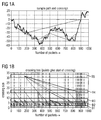
- Figure 1 shows above a first graph - part (a) - of a sample path and crossing points obtained by a typical EBP-estimator and by the modified mEBP-estimator for a data trace of 1000 aggregated samples and below a second graph - part (b) - with a crossing tree structure obtained by a typical EBP-estimator and by the modified mEBP-estimator for the same data trace.
- the principle for providing a crossing tree with crossing points from a sample path is already described in the state-of-the-art according to the paper of Owen Daffyd Jones and Yuan Shen.
- the horizontal axe of both graphs designates the number of packets (between 0 and 1000) that are received in a processing element.
- a horizontal calculation regime equal to retrospective Hurst parameter estimation as obtained in a commonly used EBP-estimation is represented by mean of boxes B1, B2, B3, B4, B5 that indicates the sampling resolution (for example about 2ms inter-arrival time for the first box B1) of the sample path and crossings. It is relevant to notify that the density of crossing points in the first box B1 is considerably higher than the one in a box with upper level.
- a further horizontal calculation regime employed in mEBP-estimation is represented by means of the dashed vertical lines (for clarity, calculation points for third levels and above were depicted). More information on both graphs is given in the following text.
- the employed estimator can be an effective means of evaluating the Hurst parameter value in real-time using cost-effective hardware, already present in the network control units.
- a set of simple modifications to the original EBP estimator allows for its application for real-time calculation of the Hurst parameter of the desired process (such as for example, a traffic flow).
- the employed modifications to the original EBP estimator include the following elements:
- the whole calculation of sample path in data traffic, crossing tree, crossing points, crossing size can be implemented in a software program (for example as a routine in a C++ code that manages the data traffic flow of a network element and predicts an overload of data through monitoring of the calculated Hurst parameter with the mEBP-estimator).
- This program can be executed in a common computing apparatus like a PC. By mean of such a program, more technical effects can be monitored, for example the temperature of a processor means used in a router element. The monitoring of the data traffic is hence not the single application of the invention.
- Hurst parameter estimator requires a series of parameters for proper operation, namely:
- the previously presented procedure once completed, returns a vector (STL template container) with 3 data fields, representing lower confidence interval, actual value and upper confidence interval for the estimated Hurst parameter. Providing that the second Boolean flag is set to true, calculation data is also stored in the binary files, saved in the current program directory.
- the above implementation of the mEBP Hurst parameter was examined on a series of data traces obtained from a server (NLANR), covering the period of 1 whole month (February 2005).
- the collected data set consist of 28 days worth of network data traces collected at the measurement point in Memphis. Each day featured 8 data traces, except for the 2nd of February, when only 5 data traces were collected, giving in total 221 separate data samples, including in total 41.359.662 data packets in the known ".tsh" format.
- Data traces were collected at random moments of the day to illustrate varying traffic conditions thus detailed analysis of the Hurst parameter estimator is possible, since it is expected that daily and monthly fluctuations in the value of the Hurst parameter should be observed.
- the proposed mEBP estimator can be very similar to wavelet transform estimators in terms of the precision of the evaluated Hurst parameter value.
- the estimated Hurst parameter value fluctuates highly at daily and monthly time scales, ranging from 0.98687 to 0.86094 (25.186% variation for the expected 0.5 - 1 Hurst parameter scale).
- the average Hurst parameter value for the mEBP estimator equals to 0.9328, with the standard deviation of 0.026 and variance of 0.000691.
- the observed fluctuations in the measured Hurst parameter value result from varying traffic conditions in the given data collection point. It was anticipated that there would be at least slight variations in the Hurst parameter value at the monthly scale. Daily scale fluctuations indicate high precision of the proposed mEBP-estimator for Hurst parameter.
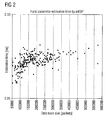
- the calculation time for the proposed mEBP-estimator was measured, when performing data trace parsing on a PIV 2.8 GHz PC computer, running under Windows XP SP2 operating system. No other application was running at the simulation time, and thus the results obtained are expected to be free of any estimation errors according figure 2, wherein the modified mEBP-estimator exhibits an average estimation time (Y-axis) of approximated 0.02835 ms (processing time was aggregated for all examined data packets (X-axis) and then averaged), with the standard deviation of 0.005 and variance of 2.5345E-05.
- the mEBP-estimator processing time exhibits a slight exponential character though the relation is not that strong and the difference between the minimum and the maximum value is estimated at 0.028ms.
- Increase in the processing time might be mainly attributed to the increasing number of crossing tree levels that can be constructed on the sampled data stream - along with the increase in the size of the examined data stream, the probability of reaching the top level of a constructed crossing tree increases significantly, thereby leading to an increase of the processing time. It is expected though that the average processing time for the examined method does not exceed a single millisecond, even for very long data traces (in excess of 1E6 data packets), providing that only the first 5 crossing tree levels are calculated (see figure 1(b)). Estimation of higher crossing tree levels only makes sense when comparing the value of the Hurst parameter at different detail levels, to assess the stability of the given examined data trace.
- Each data trace had its Hurst parameter H estimated for the all of the following methods: Rescaled Statistics RS, Variance Time VT, Embedded Branching Processes EBP and modified mEBP. whittle-based estimators WHI due to their numerical instability and unsuitability for non-Markovian processes were not considered during examination.
- the RS Hurst parameter estimator was calculated for the maximum aggregation range of 2000 packets, since larger aggregation scales do not result in increased H estimation precision and lead to unnecessary processing effort.
- the VT estimator was calculated for the maximum aggregation level of 10 (1024 packets), since deeper aggregation caused excessive processing without increase in the estimation precision of Hurst parameter H.
- the EBP estimator was calculated for crossing tree levels ranging from 1 to 5 - higher levels of the crossing trees again add to calculation complexity without adding precision to Hurst parameter estimation.
- the modified mEBP-estimator was processed along with the input traces and crossing tree structure for levels 1 to 5 was estimated. The same observation as for original EBP applies here.
- Figure 3 depicts the relation between the length of the estimation process (expressed in ms as the time between the beginning and the end of the estimation process for the given estimator) and the aggregation scale.
- the examined aggregation scales ranged from 100 to 30000 packets for the RS estimator and from 7 to 15 for the VT estimator (equivalent to 128 to 32748 packets).
- Figure 4 depicts the relation between the estimated value of the Hurst parameter H and the aggregation scale for RS and VT methods.
- Low aggregation scales for the RS estimator result in overestimation of the Hurst parameter, though increasing the aggregation scale does not lead to curve saturation, and for longer data traces (in excess of 1e6 packets), the estimated Hurst parameter value drops continuously along with the increase in the aggregation scale.
- the VT estimator exhibits overestimation of the Hurst parameter for low aggregation scales while decrease in the aggregation level results in a rapid drop in the value of the estimated Hurst parameter.
- VT curve degrades much faster than the RS estimator curve, though the VT estimation time reaches some point of equilibrium around 1ms, while the RS estimation time rises exponentially to reach approximately 5 s for a 3E4 packet data trace.
- the utilized aggregation scales for both RS and VT estimators were selected at 2000 and 10 (1024) packets, respectively, based on the approximated estimation time.
- the employed RS and VT estimators were then applied, along with the EBP and mEBP, to the collected 221 data traces from NLANR server, including the total amount of 41.359.662 data packets.
- the Hurst parameters values estimated for the examined traces are depicted in Figure 5.
- the RS and VT estimators as expected, over-estimated or under-estimated the Hurst parameter value, respectively.
- Such a behaviour of the Hurst parameter estimators was expected, since the VT method is typically considered to be efficient in detecting self-similarity in the examined trace, while it is inefficient in estimating the Hurst parameter value, both in terms of the processing time required to complete the calculation cycle as well as the estimation error.
- the VT estimated Hurst parameter for all examined 221 data traces oscillates around the average value of 0.7576 (variance 2.443E-06, standard deviation of 0.00156), not indicating any radical value fluctuations for such a long examination range. It is expected that the self-similarity rate for data traces collected over such a long period of time and during various periods of the day should exhibit more radical variations in the Hurst parameter value.
- the RS estimator - again utilized more often to detect the self-similarity in the examined data trace overestimates the Hurst parameter value, which oscillates around the average value of 0.9963 (variance 6.523E-07, standard deviation 0.00081).
- the EBP estimator as described in the state-of-the-art, is very similar to wavelet transform estimators in terms of the precision of the evaluated Hurst parameter value. This fluctuates highly at daily and monthly time scales, ranging from 0.98687 to 0.86094 (25.186% variation for the allowed 0.5 - 1 Hurst parameter scale).
- the average Hurst parameter value for the EBP estimator equals to 0.9328, with the standard deviation of 0.026 and variance of 0.000691.
- the variance for the EBP estimation of the Hurst parameter is over 283 times greater than the respective parameter for the RS estimator and 1016 times greater the same parameter estimated for the VT method. That illustrates the visible advantages of the EBP over RS and VT estimators.
- the proposed mEBP estimator since it is based on the original EBP method, exhibits exactly the same performance parameters in terms of Hurst parameter estimation quality.
- the curves for mEBP and EBP on figure 5 are superimposed and numerical values indicate compliance to 7 decimal digits. Therefore, in terms of the quality of the Hurst parameter estimation, the mEBP and EBP methods are indistinguishable.
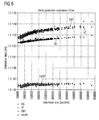
- the next chart, illustrated by figure 6, exhibits the estimation time (in ms) measured for particular estimation processes versus the processed size of the data trace size (expressed in the number of packets). Since the data trace format (".tsh") consists of fixed-size packet headers with no payload, the processing time of any trace for any method is assumed to be I/O operation dependent and constant for all examined methods. Apart from the modified mEBP-estimator, all other estimators RS, VT, EBP were calculated once the whole data trace was processed and stored in the computer memory. No packet processing time needs therefore to be included in the considerations. In case of the mEBP estimator, the processing time is equal to average calculation time necessary to estimate the Hurst parameter value for a particular data point.
- the minimum and the maximum processing times for the mEBP were equal to 0 and 1ms, respectively.
- a more detailed timer is required.
- the RS estimator features almost linear increase in the estimation time (from 172 to 922 ms) for the examined set of data traces (data trace size varies from 53132 to 573643 packets - more than 1 order of magnitude variation).
- the VT estimator with the fixed maximum aggregation level of 10 (1024 packets) along with the original EBP estimator feature a weak logarithmic character of their respective curves.
- the VT curve has a weaker logarithmic property, starting from 516 ms for 53132 packet threshold and breaching the 1s processing time for data trace size of 1E4 packets.
- the maximum observed processing time occurs for 573643 packets and is estimated at 5.687 s.
- the EBP estimator starting from 437ms for 53132 packet threshold, breaches the 1s processing time around the same value as the VT method (1E4 packets).
- its maximum processing time for 573643 packets is estimated at 17.969 s, which is almost 3 times longer than the respective value for the VT estimator. It turns out therefore that the EBP estimator is the slowest of the examined classical estimators, thus the RS method seems to exhibit relatively better performance with under-single second processing time.
- the modified mEBP-estimator exhibits a 4 orders of magnitude improvement in the Hurst parameter estimation time (when compared with the RS estimator), since its average estimation time is approximated at 0.02835ms (processing time was aggregated for all examined data packets and then averaged), with the standard deviation of 0.005 and variance of 2.5345E-05.
- the mEBP-estimator processing time also exhibits a slight exponential character though the relation is not that strong and the difference between the minimum and the maximum value is estimated at 0.028ms. It is therefore clear that Hurst parameter estimation using the mEBP method is the quickest available solution, featuring both an excellent processing speed as well as very good estimation precision.
- Figure 7 represents a module of a network element with an implementation of at least one mEBP-estimator according to the monitoring method of the present invention. It can be implemented in an application of mEBP Real-Time Hurst Parameter Estimator for traffic classification and buffer overflow protection machine concept for Passive Optical Networks xPONs.
- transmitted data are forwarding in a memory buffer 7 depending on a priority class like for priority according to standard IEEE 802.1p.
- the quality of data traffic or processing can be estimated in a Hurst parameter mEBP-estimator 1, 3, in which at least one of following crossing levels can be used: source-destination address pairs with byte count; source-destination address pairs with packet count; packet size; packet size with byte count; packets inter-arrival time; channel byte load; channel packet load; protocols in packets.
- an overflow protection mechanism of one or more memory buffers 7 can be implemented such that instead of dropping packets only when the buffer 7 is already under overflow condition, it is possible to counteract the current network load conditions by predicting the approaching instability situation, in which the buffer will simply stop accepting new packets due to overflow.
- Such prediction mechanism is based on the following measurements of incoming traffic: average data rate for the given data stream (as for standard network calculus); Hurst parameter value describing the predictability of the traffic (new approach to traffic measurement, based on application of real-time Hurst parameter measurement); total amount of free memory in the buffer space associated with the given traffic class / priority / stream.
- a buffer overflow protection mechanism can be described as following:
- the schematic of the module has the following functionality:
- the initial set of dimensions the applicant proposes to monitor are:
- Channel Packet Load metrics the amount of packets entering a given network point within an appropriately selected time window, typically of a few milliseconds, is measured.
- the principle of a sample measurement taken on monitored traces has already presented in the above description. It is observable that a short period of low load is always followed by a period of high load (bursty). This phenomena is also known as "escape to the average", meaning that in a well defined series of data, if one is well above the average, another one will be well below as to compensate.
- the value estimated by our mEBP method can be used to forecast the value of the Hurst parameter for the incoming traffic.
- We then some actions are taken in order to forecast the bursty traffic periods when non-burst situations occur, for instance, by manipulating network equipment buffers.
- Some basic statistics are also needed, like for instance the current occupancy level of the channel, in terms of both Byte and Packet loads (we call these O BL and O PL ), and also some average of the last inter-arrival times (A IA ).
- the depth of these statistics is to be defined accordingly with the nature and characteristic of the sampling frequency of the data traffic, and also with the depth intended to the estimation of the Hurst parameter, as defined better in its ID.
- a decision table may be established on which the buffer overflow prevention algorithm can be built.
- actions can be defined in order to, for example, perform an early send of buffered packets, reshape the buffer space, or even drop some of the incoming packets (additional criteria may be needed here).
- Figure 8 shows a block diagram with a network equipment receiving input data "Input traffic", transmitting output data "output traffic".
- the block diagram includes also three mEBP-estimators “mEBP calc” which receive their data from a "packet feature extraction” module.
- This module is responsible for feeding the "mEBP calc” machines with accurate data retrieved from the data packets, which have previously been replicated by the Splitter module at the input data "Input traffic”.
- a "LOGIC” module receives the output from the three "mEBP calc” machines and from the status of the network equipment, and sends a control command to the network equipment. Note that we don't make any assumption about the nature or format of the data packets (these can be electrical or optical).
Landscapes
- Engineering & Computer Science (AREA)
- Computer Networks & Wireless Communication (AREA)
- Signal Processing (AREA)
- Environmental & Geological Engineering (AREA)
- Physics & Mathematics (AREA)
- Algebra (AREA)
- General Physics & Mathematics (AREA)
- Mathematical Analysis (AREA)
- Mathematical Optimization (AREA)
- Mathematical Physics (AREA)
- Probability & Statistics with Applications (AREA)
- Pure & Applied Mathematics (AREA)
- Data Exchanges In Wide-Area Networks (AREA)
Priority Applications (1)
| Application Number | Priority Date | Filing Date | Title |
|---|---|---|---|
| EP05023580A EP1780955A1 (fr) | 2005-10-28 | 2005-10-28 | Procédé de surveillance et dispositif de traitement d'un flux de données à haut débit |
Applications Claiming Priority (1)
| Application Number | Priority Date | Filing Date | Title |
|---|---|---|---|
| EP05023580A EP1780955A1 (fr) | 2005-10-28 | 2005-10-28 | Procédé de surveillance et dispositif de traitement d'un flux de données à haut débit |
Publications (1)
| Publication Number | Publication Date |
|---|---|
| EP1780955A1 true EP1780955A1 (fr) | 2007-05-02 |
Family
ID=35365745
Family Applications (1)
| Application Number | Title | Priority Date | Filing Date |
|---|---|---|---|
| EP05023580A Withdrawn EP1780955A1 (fr) | 2005-10-28 | 2005-10-28 | Procédé de surveillance et dispositif de traitement d'un flux de données à haut débit |
Country Status (1)
| Country | Link |
|---|---|
| EP (1) | EP1780955A1 (fr) |
Cited By (9)
| Publication number | Priority date | Publication date | Assignee | Title |
|---|---|---|---|---|
| EP1983687A1 (fr) * | 2007-04-20 | 2008-10-22 | Nokia Siemens Networks Oy | Procédé pour évaluer le degré d'autosimilarité et estimateur associé |
| LT5869B (lt) | 2011-12-05 | 2012-09-25 | Å iaulių universitetas | Kompiuterių tinklo srauto analizės realiu laiku būdas |
| WO2016123126A1 (fr) * | 2015-01-29 | 2016-08-04 | Signalfx, Inc. | Traitement en temps réel de flux de données reçus en provenance de logiciel instrumenté |
| US9760353B2 (en) | 2014-12-19 | 2017-09-12 | Signalfx, Inc. | Dynamically changing input data streams processed by data stream language programs |
| US9804951B2 (en) | 2014-10-08 | 2017-10-31 | Signalfx, Inc. | Quantization of data streams of instrumented software |
| CN110795524A (zh) * | 2019-10-31 | 2020-02-14 | 北京东软望海科技有限公司 | 主数据映射处理方法、装置、计算机设备及存储介质 |
| CN114006826A (zh) * | 2022-01-04 | 2022-02-01 | 南京信息工程大学 | 一种融合流量特征的网络流量预测方法 |
| CN116994416A (zh) * | 2023-09-26 | 2023-11-03 | 无锡市明通动力工业有限公司 | 基于人工智能的风机运行故障预警方法及系统 |
| CN121285275A (zh) * | 2025-12-03 | 2026-01-06 | 上海朋熙半导体有限公司 | 半导体工艺改进效果分析方法、系统、设备及介质 |
Citations (3)
| Publication number | Priority date | Publication date | Assignee | Title |
|---|---|---|---|---|
| WO1999040703A1 (fr) * | 1998-02-06 | 1999-08-12 | Ericsson Australia Pty. Ltd. | Estimation en temps reel de parametres grande distance |
| US6608815B1 (en) * | 1999-08-05 | 2003-08-19 | Spacebridge Networks Corporation | Method and apparatus for connection admission control in cell or packet-based networks |
| US20040257999A1 (en) * | 2001-11-16 | 2004-12-23 | Macisaac Gary | Method and system for detecting and disabling sources of network packet flooding |
-
2005
- 2005-10-28 EP EP05023580A patent/EP1780955A1/fr not_active Withdrawn
Patent Citations (3)
| Publication number | Priority date | Publication date | Assignee | Title |
|---|---|---|---|---|
| WO1999040703A1 (fr) * | 1998-02-06 | 1999-08-12 | Ericsson Australia Pty. Ltd. | Estimation en temps reel de parametres grande distance |
| US6608815B1 (en) * | 1999-08-05 | 2003-08-19 | Spacebridge Networks Corporation | Method and apparatus for connection admission control in cell or packet-based networks |
| US20040257999A1 (en) * | 2001-11-16 | 2004-12-23 | Macisaac Gary | Method and system for detecting and disabling sources of network packet flooding |
Non-Patent Citations (3)
| Title |
|---|
| HAGIWARA T ET AL: "High-speed calculation method of the hurst parameter based on real traffic", LOCAL COMPUTER NETWORKS, 2000. LCN 2000. PROCEEDINGS. 25TH ANNUAL IEEE CONFERENCE ON NOVEMBER 8-10, 2000, PISCATAWAY, NJ, USA,IEEE, 8 November 2000 (2000-11-08), pages 662 - 669, XP010527502, ISBN: 0-7695-0912-6 * |
| OWEN DAFYDD JONES, YUAN SHEN: "Estimating the Hurst Index of a Self-Similar Process via the Crossing Tree", IEEE SIGNAL PROCESSING LETTERS, vol. 11, no. 4, April 2004 (2004-04-01), XP002355960, Retrieved from the Internet <URL:http://ieeexplore.ieee.org/iel5/97/28544/01275501.pdf?tp=&arnumber=1275501&isnumber=28544> [retrieved on 20051124] * |
| ROUGHAN M ET AL: "ON-LINE ESTIMATION OF THE PARAMETERS OF LONG-RANGE DEPENDENCE", IEEE GLOBECOM 1998. GLOBECOM '98. THE BRIDGE TO GLOBAL INTEGRATION. SYDNEY, NOV. 8 - 12, 1998, IEEE GLOBAL TELECOMMUNICATIONS CONFERENCE, NEW YORK, NY : IEEE, US, vol. VOL. 6, 1998, pages 3716 - 3721, XP000805318, ISBN: 0-7803-4985-7 * |
Cited By (25)
| Publication number | Priority date | Publication date | Assignee | Title |
|---|---|---|---|---|
| EP1983687A1 (fr) * | 2007-04-20 | 2008-10-22 | Nokia Siemens Networks Oy | Procédé pour évaluer le degré d'autosimilarité et estimateur associé |
| LT5869B (lt) | 2011-12-05 | 2012-09-25 | Å iaulių universitetas | Kompiuterių tinklo srauto analizės realiu laiku būdas |
| US10394693B2 (en) | 2014-10-08 | 2019-08-27 | Signalfx, Inc. | Quantization of data streams of instrumented software |
| US12455809B1 (en) | 2014-10-08 | 2025-10-28 | Cisco Technology, Inc. | Real-time reporting based on instrumentation of software |
| US9804951B2 (en) | 2014-10-08 | 2017-10-31 | Signalfx, Inc. | Quantization of data streams of instrumented software |
| US11010278B2 (en) | 2014-10-08 | 2021-05-18 | Splunk Inc. | Real-time reporting based on instrumentation of software |
| US9846632B2 (en) | 2014-10-08 | 2017-12-19 | Signalfx, Inc. | Real-time reporting based on instrumentation of software |
| US10437705B2 (en) | 2014-10-08 | 2019-10-08 | Signalfx, Inc. | Real-time reporting based on instrumentation of software |
| US11733982B1 (en) | 2014-12-19 | 2023-08-22 | Splunk Inc. | Dynamically changing input data streams processed by data stream language programs |
| US9760353B2 (en) | 2014-12-19 | 2017-09-12 | Signalfx, Inc. | Dynamically changing input data streams processed by data stream language programs |
| US10409568B2 (en) | 2014-12-19 | 2019-09-10 | Signalfx, Inc. | Representing result data streams based on execution of data stream language programs |
| US9846574B2 (en) | 2014-12-19 | 2017-12-19 | Signalfx, Inc. | Representing result data streams based on execution of data stream language programs |
| US12039307B1 (en) | 2014-12-19 | 2024-07-16 | Splunk Inc. | Dynamically changing input data streams processed by data stream language programs |
| US10949180B2 (en) | 2014-12-19 | 2021-03-16 | Splunk Inc. | Dynamically changing input data streams processed by data stream language programs |
| US9804830B2 (en) | 2014-12-19 | 2017-10-31 | Signalfx, Inc. | Anomaly detection using a data stream processing language for analyzing instrumented software |
| US11928046B1 (en) | 2015-01-29 | 2024-03-12 | Splunk Inc. | Real-time processing of data streams received from instrumented software |
| US10394692B2 (en) | 2015-01-29 | 2019-08-27 | Signalfx, Inc. | Real-time processing of data streams received from instrumented software |
| WO2016123126A1 (fr) * | 2015-01-29 | 2016-08-04 | Signalfx, Inc. | Traitement en temps réel de flux de données reçus en provenance de logiciel instrumenté |
| CN110795524B (zh) * | 2019-10-31 | 2022-07-05 | 望海康信(北京)科技股份公司 | 主数据映射处理方法、装置、计算机设备及存储介质 |
| CN110795524A (zh) * | 2019-10-31 | 2020-02-14 | 北京东软望海科技有限公司 | 主数据映射处理方法、装置、计算机设备及存储介质 |
| CN114006826B (zh) * | 2022-01-04 | 2022-04-22 | 南京信息工程大学 | 一种融合流量特征的网络流量预测方法 |
| CN114006826A (zh) * | 2022-01-04 | 2022-02-01 | 南京信息工程大学 | 一种融合流量特征的网络流量预测方法 |
| CN116994416A (zh) * | 2023-09-26 | 2023-11-03 | 无锡市明通动力工业有限公司 | 基于人工智能的风机运行故障预警方法及系统 |
| CN116994416B (zh) * | 2023-09-26 | 2023-12-08 | 无锡市明通动力工业有限公司 | 基于人工智能的风机运行故障预警方法及系统 |
| CN121285275A (zh) * | 2025-12-03 | 2026-01-06 | 上海朋熙半导体有限公司 | 半导体工艺改进效果分析方法、系统、设备及介质 |
Similar Documents
| Publication | Publication Date | Title |
|---|---|---|
| CN114513470B (zh) | 网络流量控制方法、装置、设备及计算机可读存储介质 | |
| EP1780955A1 (fr) | Procédé de surveillance et dispositif de traitement d'un flux de données à haut débit | |
| Yao¹ | Internet traffic: periodicity, tail behavior, and performance implications | |
| Liu et al. | Statistical modeling and performance analysis of multi-scale traffic | |
| Domańska et al. | The drop-from-front strategy in AQM | |
| WO2008052583A1 (fr) | Procédé de surveillance et appareil de traitement d'un flux de données avec un taux/flux élevé | |
| Xu et al. | ARED: a novel adaptive congestion controller | |
| Melo et al. | Envelope process and computation of the equivalent bandwidth of multifractal flows | |
| Hei et al. | Model-based end-to-end available bandwidth inference using queueing analysis | |
| Papadopoulos et al. | Efficient identification of uncongested Internet links for topology downscaling | |
| Cavusoglu et al. | Estimation of available bandwidth share by tracking unknown cross-traffic with adaptive extended Kalman filter | |
| Feng et al. | A new framework for network flow queuing delay prediction based on stream computing | |
| Mitchell et al. | Correlation properties of the token leaky bucket departure process | |
| Carofiglio et al. | Beyond fluid models: Modelling TCP mice in IP networks under non-stationary random traffic | |
| Yegenoglu et al. | A model for representing wide area Internet packet behavior | |
| Domanska et al. | Implementation of modified AQM mechanisms in IP routers | |
| Dshalalow et al. | Hybrid queueing systems with hysteretic bilevel control policies | |
| Carlsson et al. | Multifractal products of stochastic processes: Fluid flow analysis | |
| JP2012023687A (ja) | トラヒック変動量推定装置、トラヒック管理装置、トラヒック分配装置、及び方法 | |
| CN112187498B (zh) | 旁路保护方法及其装置、系统和深度报文检测dpi系统 | |
| Ostrowsky et al. | A traffic model for udp flows | |
| Hang et al. | Investigating the impact of bursty traffic on Hoeffding Tree Algorithm in stream mining over internet | |
| Lin et al. | Detection of Fractal Breakdowns by the Novel Real-Time Pattern Detection Model (Enhanced-RTPD+ Holder Exponent) for Web Applications | |
| Mendes et al. | Impact of Traffic Sampling on LRD Estimation | |
| Ramirez-Velarde et al. | Modelling Extreme Uncertainty: Queues with Pareto Inter-arrival Times and Pareto Service Times |
Legal Events
| Date | Code | Title | Description |
|---|---|---|---|
| PUAI | Public reference made under article 153(3) epc to a published international application that has entered the european phase |
Free format text: ORIGINAL CODE: 0009012 |
|
| AK | Designated contracting states |
Kind code of ref document: A1 Designated state(s): AT BE BG CH CY CZ DE DK EE ES FI FR GB GR HU IE IS IT LI LT LU LV MC NL PL PT RO SE SI SK TR |
|
| AX | Request for extension of the european patent |
Extension state: AL BA HR MK YU |
|
| STAA | Information on the status of an ep patent application or granted ep patent |
Free format text: STATUS: THE APPLICATION HAS BEEN WITHDRAWN |
|
| 18W | Application withdrawn |
Effective date: 20070514 |