EP1782652B1 - Communication video dans des reseaux mobiles - Google Patents
Communication video dans des reseaux mobiles Download PDFInfo
- Publication number
- EP1782652B1 EP1782652B1 EP05772436.1A EP05772436A EP1782652B1 EP 1782652 B1 EP1782652 B1 EP 1782652B1 EP 05772436 A EP05772436 A EP 05772436A EP 1782652 B1 EP1782652 B1 EP 1782652B1
- Authority
- EP
- European Patent Office
- Prior art keywords
- radio channel
- quality
- channel portion
- mobile station
- video
- Prior art date
- Legal status (The legal status is an assumption and is not a legal conclusion. Google has not performed a legal analysis and makes no representation as to the accuracy of the status listed.)
- Expired - Lifetime
Links
Images


Classifications
-
- H—ELECTRICITY
- H04—ELECTRIC COMMUNICATION TECHNIQUE
- H04W—WIRELESS COMMUNICATION NETWORKS
- H04W76/00—Connection management
- H04W76/10—Connection setup
- H04W76/15—Setup of multiple wireless link connections
-
- H—ELECTRICITY
- H04—ELECTRIC COMMUNICATION TECHNIQUE
- H04W—WIRELESS COMMUNICATION NETWORKS
- H04W4/00—Services specially adapted for wireless communication networks; Facilities therefor
- H04W4/06—Selective distribution of broadcast services, e.g. multimedia broadcast multicast service [MBMS]; Services to user groups; One-way selective calling services
-
- H—ELECTRICITY
- H04—ELECTRIC COMMUNICATION TECHNIQUE
- H04B—TRANSMISSION
- H04B17/00—Monitoring; Testing
Definitions
- the present invention generally relates to video-communication in mobile telephony networks.
- Mobile telephony networks have initially been conceived for allowing voice communications, in a way similar to the Public Switched Telephone Networks, shortly PSTNs, but between mobile users.
- the mobile telephony networks have experienced and are experiencing an enormous spread, especially after the introduction of second generation mobile networks, and particularly of digital mobile networks, such as those conforming to the GSM ("Global System for Mobile communications") standard, and to the corresponding systems adopted in the United States and in Japan.
- GSM Global System for Mobile communications
- the second generation mobile networks are circuit switched networks; this greatly limits the bandwidth that can be allocated for a given user, especially in mobile networks of the second generation.
- data communications networks such as computer networks and, among these, the Internet, adopt packet switched schemes, that allow much higher data transfer rates.
- the GPRS General Packet Radio Service
- the GPRS is a digital mobile telephony technology compatible with the GSM networks (actually, it is built on the existing GSM network architecture) that allows data transfer at a higher speed than that allowed by the pure GSM.
- the GPRS can be seen as an add-on to the GSM, that supports and enables packet data communication.
- third generation wireless communications systems such as those conforming to the standard UMTS (“Universal Mobile Telecommunication System") are more promising in terms of data transfer speed, the GPRS may represent a prompt solution to improve the data exchange capability in existing GSM networks.
- Short Messaging System Short Messaging System
- MMS Multimedia Messaging System
- EP 1 298 945 discloses performing a communication in a mobile communication network and the monitoring of the quality of the radio channel are used to adjust parameters of the data transmitted.
- the data that is transmitted is not video data.
- WO03/063495 discloses two mobile devices that communicate video.
- the available bit rate is used in order to adapt the video encoding used between the mobile devices.
- a problem that may arise on a packet-switched bearer used for transmission of a video from a mobile station is the possible variation of the maximum available throughput on the packet-switched bearer. This may cause unacceptable reception of the transmitted video in some situations, leading to an overall unsatisfactory perception of a video-communication or combinational service.
- the Applicant has noticed that if the network resources are properly sized it can be assumed that the available bandwidth practically depends only on the radio quality conditions.
- a mechanism is thus introduced in the mobile station, aimed at the monitoring of the radio channel quality of the packet-switched connection. Based on the result of the monitoring, at least one parameter related to the quality of the video (e.g. the coding rate) is adjusted at the mobile station.
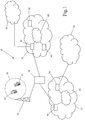
- FIG. 1 shows an exemplary mobile communications network 20, providing mobile telephony services according to the UMTS standard. It is noticed that a mobile network providing mobile telephony services according to the GSM/GPRS standard has a very similar structure to the mobile network of Figure 1 .
- the mobile network 20 supports both circuit-switched and packet-switched communications, and includes a circuit-switched network 35 and a packet-switched network 51.
- Mobile stations 12, 14 e.g. cellular telephones, personal digital assistants, etc.
- BTSs base transmitter stations
- Each base transmitter station 32 provides service in a corresponding geographical area 30, generally known as cell.
- the mobile network 20 provides service to a number of cells and to a number of mobile stations much higher than those shown for exemplary purposes in Figure 1 .
- Multiple base transmitter stations 32 are connected to a base station (or radio network) controller (BSC, or RNC) 34, which manages the allocation and de-allocation of radio resources and controls handovers of mobile stations from one base transmitter station to another.
- BSC radio network controller
- RNC radio network controller
- a base station controller and its associated base transmitter stations may be referred to as a base station subsystem (BSS).
- BSS base station subsystem
- the BSC 34 is connected to a mobile switching center (MSC) 36 in the circuit-switched network 35, through which circuit-switched connections are set up within the network 20 and/or with other networks 38, such as a Public Switched Telephone Network (PSTN), Integrated Services Digital Network (ISDN), etc..
- MSC mobile switching center
- PSTN Public Switched Telephone Network
- ISDN Integrated Services Digital Network
- a plurality of BSCs such as the BSC 34 shown in Figure 2 , is connected to a single MSC, and the network includes a plurality of MSCs.
- the generic MSC 36 is also connected via a signaling network 40 (e.g. a Signaling System Number 7, or SS7, network) to a Home Location Register (HLR) 42, and to a Visitor Location Register (VLR) 44.
- the VLR 44 includes a database containing the information about all the mobile stations currently located in a corresponding location or service area, including subscriber information (typically temporary subscriber information) needed by the MSC to provide services in the circuit-switched network 35 to the mobile stations in its service area.
- subscriber information typically temporary subscriber information
- the corresponding VLR 44 requests and receives data about the mobile station from the mobile's HLR and stores the same.
- the visiting mobile station is involved in a call, the VLR 44 already has the information needed for call setup.
- the HLR 42 comprises a database that stores and manages subscriptions of the users of the mobile network 20, such as the users owning the mobile stations 12, 14.
- the HLR contains permanent subscriber data, such as the mobile station ISDN number (MSISDN), which uniquely identifies the mobile telephone subscription in the PSTN numbering plan, and an international mobile subscriber identity (IMSI), which is a unique identity allocated to each subscriber and used for signaling in the mobile networks. All network-related subscriber information is related to the IMSI.
- MSISDN mobile station ISDN number
- IMSI international mobile subscriber identity
- the HLR 42 also contains, in a so-called "profile", a list of services which a mobile subscriber is authorized to use along with a current subscriber location number corresponding to the address of the VLR currently serving the mobile subscriber.
- Each BSC 34 also connects to the packet-switched network 51 at a Serving GPRS Support Node (SGSN) 50, responsible for the delivery of packets to the mobile stations within its service area.
- SGSN Serving GPRS Support Node
- GGSN gateway GPRS support node
- IP data network 56 The term “external” has to be understood as meaning a general purpose data network providing IP services (e.g.
- SGSN nodes 50 and GGSN nodes 54 are connected with each other by an intra-PLMN IP backbone 52.
- IP Internet protocol
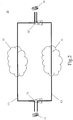
- the exemplary mobile network 20 of Figure 1 supports embodiments of mobile video-communication services according to the invention, the implementation of which is schematically shown in Figure 2 .
- a first user owning the first mobile station 12 places a voice call to a second user owning the second mobile station 14.
- the first mobile station 12 is camping under a BTS 32
- the second mobile station 14 is camping under a BTS 32', which may be the same BTS under which the first mobile station is camping or a different one.
- the voice call is established as a circuit-based connection, so that it is routed by the circuit-switched network 35 of the mobile network 20 in a first bidirectional connection C1.
- a second connection C2 is established between the mobile stations 12, 14 for supporting a video component to be exchanged between them.
- the second connection C2 may be a unidirectional or a bidirectional connection between the first mobile station 12 and the second mobile station 14.
- the second connection C2 is established as a packet-based connection, so that it is routed by the packed-switched network 51 of the mobile network 20.
- a throughput of at least 10 kbit/s should be preferably available, more preferably of at least 20 kbit/s, in order to allow transmission of a video having an acceptable quality.
- the establishment of the first and of the second connections C1, C2 may be controlled by suitable software installed on the mobile stations 12, 14.
- Preferred embodiments may provide that the packet-switched connection C2 between the mobile stations 12, 14 is established based on an acknowledgement of the establishment of the circuit-switched connection C1. In practice, this may be accomplished by causing, at the mobile stations 12, 14, the opening of a PDP (Packet Data Protocol) context towards a GGSN when an acknowledgement of the established circuit-switched connection C1 is received by the mobile station 12, 14 from the circuit-switched network (both in case of outgoing and incoming call).
- PDP Packet Data Protocol
- the establishment of the packet-switched connection C2 may practically correspond to the establishment of a peer-to-peer session between the mobile stations 12, 14, in which the two mobile stations exchange with each other the addresses assigned thereof from the packet-switched network 51 (typically their IP addresses).
- a network apparatus could be used for managing the exchange of the network addresses. More particularly, in preferred embodiments it may be provided that each mobile station 12, 14 sends a signaling message to the network apparatus, including its network address and the telephone number of the other party.
- the network apparatus is adapted to obtain, for example from an Access Point Node (APN), the network addresses corresponding to the received telephone numbers, and matches these addresses with those received directly from the mobile stations 12, 14.
- APN Access Point Node
- the network apparatus then enables the exchange of the network addresses between the two mobile stations (for example by sending to at least one of the mobile stations, e.g. the mobile station 12, a signaling message including the network address of the other mobile station 14), i.e. the peer-to-peer session.
- Alternative embodiments may take advantage of the infrastructure of the packet-switched network 51 for setting up a peer-to-peer session between the mobile stations 12, 14, without the need of a dedicated network apparatus.
- the IMS (IP Multimedia Subsystem) infrastructure may be advantageously exploited in order to allow the mutual reaching of the mobile stations 12, 14 in the packet-switched network 51.
- a “mediator” network apparatus could be adapted for managing the communication between the mobile stations 12, 14, so that the mobile stations 12, 14 communicate with each other in the packet-switched network 51 through the mediator network apparatus.
- the mobile station software could also include a suitable MMI (Man-to-Machine Interface) being adapted to assist the user of the video-communication service in the video transmission.
- MMI Man-to-Machine Interface
- a "Send" icon could be made available once the mobile station is made aware of the fact that packet-switched connection C2 has been set-up.
- a corresponding soft-key on the keyboard of the mobile station once pressed, enables the transmission of a video (taken in real-time from a video-camera incorporated in the mobile station, or stored in a memory area of the mobile station) to the other party, exploiting the packet-switched connection C2.
- a "Stop” icon could also be made available for enabling the user to stop the video transmission.
- Known protocols e.g. of the IP suite, could be used for sending the video.
- RTP/RTCP Real-time Transport Protocol/RTP Control Protocol
- the connections C1 and C2 may be exemplarily established by exploiting the DTM (Dual Transfer Mode) technology.
- each of the connections C1 and C2 may use one timeslot on the uplink and one timeslot on the downlink.
- class 5 or class 9 mobile phones allowing availability of at least one timeslot per direction on the packet-based connection C2 can be used.
- Reasonable throughputs per timeslot obtainable on the packet connection for the video component using the EDGE (Enhanced Data rates for GSM Evolution) technology, are in the range from 10 to 40 kbit/s, sufficient for supporting a video transmission having a good or at least an acceptable quality. Higher throughputs could be obtained with a higher quality radio channel.
- a standard GSM connection can be used (half rate or full rate), or a higher speed ECSD (Enhanced Circuit Switched Data) connection.
- the connection C1 (dedicated to the voice component) may exemplarily established as a 12.2 kbit/s circuit-switched radio access bearer (RAB), allowing a throughput of 12.2 kbit/s on both the uplink and the downlink channel
- the connection C2 (dedicated to the video component) may be exemplarily established as a 64 kbit/s packet-switched RAB, allowing a throughput of 64 kbit/s on both the uplink and the downlink channel.
- RAB radio access bearer
- a 3G network allows, especially in the packet-switched domain, an available higher throughput than that allowed by a GPRS or EDGE network.
- a video component having a higher quality may be, generally, transmitted on the dedicated connection C2.
- the available throughput can significantly change as a function of the radio conditions, and/or of the level of congestion of the network.
- the network resources are properly sized, and/or the packet-switched network is configured so as to give an adequate priority to the video-communication service, it can be assumed that the available throughput practically depends only on the radio quality conditions.
- the throughput fluctuations due to the radio channel quality conditions may vary very rapidly, in particular if at least one of the mobile stations 12, 14 is changing its geographical position. This may have a strong impact on the quality of the video transmitted on the packet-switched connection C2.
- the invention provides for a monitoring of the radio communication channel used for establishing the end-to-end connections between the first and the second mobile stations 12, 14. While the voice component may take advantage of QoS monitored circuit-based connection C1, the second connection C2 may be a best effort (i.e. with no native QoS monitoring) transport channel: a mechanism is introduced, at the mobile station 12, 14, adapted for adjusting at least one parameter related to the quality of the video component (e.g.
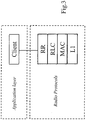
- a suitable software program running at the application layer of the mobile station may interact with the lower layers, especially the RRC, the RLC/MAC and the physical layer, as schematically shown in figure 3 , in order to monitor the radio channel quality.
- figure 3 shows the application protocols, the radio protocols and a related point of inter-working.
- the radio protocols block the three main radio protocols - RR (Radio Resource) RLC (Radio Link Control) and MAC (Medium Access Control) - and the Layer 1 (L1) - or physical layer - are shown.
- the RR protocol exists only on the signaling plane and is responsible for the management of radio resources;
- the RLC is the protocol layer that takes care of retransmissions over the radio interface for those blocks that were received erroneously, both at the mobile station side and at the network side.
- the MAC layer is responsible for implementing mechanisms for the sharing of different resources and channels among different users.
- the physical layer is the protocol layer that implements the functionality of transmission and reception of data over the radio channel.
- the RR protocol in conjunction with the physical layer (L1), takes care of the execution and reporting to the network of the radio measurements.
- L1 physical layer
- the quality of the radio channel (e.g. of the downlink channel) of the packet-switched connection is continuously monitored (typically at predefined time periods) by the mobile stations 12, 14. Based on the result of the monitoring, a parameter related to the quality (e.g. the coding rate) of the video component to be transmitted/received is adjusted at the mobile stations 12, 14. Threshold-based mechanisms may be exploited, in which the video quality is increased when the radio channel quality is higher than (or equal to) the threshold, or reduced when the radio channel quality is lower than (or equal to) the threshold. Exchange of signaling messages between the mobile station 12 and the mobile station 14 may be provided, in order to allow a correct adjustment of the video quality at both ends of the communication.
- a parameter related to the quality e.g. the coding rate
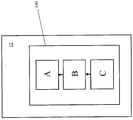
- a controlling module 140 may be included in the generic mobile station 12, as schematically shown in figure 4 .
- the controlling module may comprise three main functional blocks.
- the first block (block A) is adapted to the coding and decoding of the video part. Additionally, it may be also adapted to the coding and decoding of the voice component.
- the third block (block C) is adapted to monitor the radio quality of the downlink path associated to the mobile station.
- the second block (block B) is adapted to filter the measurements taken as an input from the third block C, in order to determine which coding rate can be chosen coherently with the current radio conditions. Block B then forwards such information to block A, which sets its coding/decoding rate accordingly.
- Available metrics for measuring the radio channel quality in block C may be, for example, the C/I (i.e. the signal to interference ratio), and/or the BLER (Block Error Ratio, i.e. the ratio of the blocks received with errors versus the total number of received blocks), and/or the RSSI (Received Signal Strength Indicator, i.e. the overall power in the frequency band measured at the receiver of the mobile station), and/or the radio throughput on the uplink or downlink (i.e. the number of blocks transmitted/received in a predetermined time at the radio levels, e.g., at the RLC level).
- Other metrics, available in a GSM/GPRS context may comprise one or more among the following:
- Still other metrics available in a UMTS context, may comprise one or more among the following:
- a suitable metrics for evaluating the radio channel quality may be chosen in dependence of many factors, such as the mobile station model, the operating system used by the mobile station software, etc..
- block B may use an averaging window in order to filter the raw measurement samples received by block C.
- the resulting average value AVG may be compared with predetermined thresholds, which values can be also selected depending on the nature of the chosen metric.
- the status determined by block B affects the video quality generated and transmitted by the coding portion included in block A, quickly reducing the generated video bandwidth in case of a radio channel's quality drop, and/or increasing the same in the opposite case.
- the decision to raise the video bandwidth should be taken also taking into account the radio channel status of the mobile station of the other party, by sharing the radio channel metric.
- this solution offers a faster video quality adjustment compared to the standard RTCP with RTT (Round Trip Time) measurement and statistics report mechanism.
- a possible implementation may adjust the coding rate of the video component according to the following rules:
- the monitoring of the radio channel and the setting of the video quality parameters may be carried out during the packet-switched connection setup and/or during the video transmission on the established packet-switched connection.
- Figure 5 exemplarily shows a diagram related to a possible implementation of a setup of a packet-switched connection between two users, User A and User B, for example owning the mobile stations 12, 14 of figure 2 , in which a setting of the video parameters is performed.
- the implementation shown in figure 5 is based on an IMS architecture and on SIP (Session Initiation Protocol) signaling messages.
- SIP Session Initiation Protocol
- the mobile station of User A sends an "INVITE" signaling message to the mobile station of User B.
- the SIP Proxy sends a "100 Trying" signaling message to the mobile station of User A, during the search of the mobile station of User B in the packet-switched network.
- the mobile station of User B answers with a "180 Ringing” signaling message, and when User B accepts the video communication session, with a "200 OK" signaling message.
- the signaling messages originated by the mobile station of User B are forwarded to the mobile station of User A by the SIP Proxy.
- the mobile station of User B evaluates its radio channel quality and selects an adequate desired video coding set of parameters, based on the radio channel quality evaluation.
- the desired video quality set can be included in extension fields of the SDP (Standard Description Protocol) of the "200 OK" message sent to the mobile station of User A, for example as a bandwidth/coding rate to be used.
- the mobile station of User A was evaluating its radio channel quality, and determining its desired video quality set accordingly.
- the mobile station of User A can properly select the bandwidth/coding rate to be used for the video transmission, taking into account of the own radio channel quality and of the radio channel quality of User B.
- An acknowledge message "ACK" is also sent by the mobile station of User A to the mobile station of User B for completing the establishment of the packet-switched connection.
- event triggered mechanisms may be exploited for the purpose of synchronization between the two mobile stations involved in the communication.
- a mobile station detects a change in the radio channel status, thanks to the monitoring and filtering blocks B and C, block A can be exploited for signaling to the other mobile station's block A the occurred change and the possibility of changing at least one of video transmission parameters.
- proprietary protocols may be implemented, or known protocols may be adapted.
- a standard feedback provided by RTP/RTCP reports can be used, by exploiting statistic fields reporting the loss percentage status, the error rate status, the jitter status, etc..
- proprietary information could also be defined and included in extension fields of the RTP/RTCP reports, the proprietary information being for example related to the metric and/or to the thresholds used.
- Application level messages may also be defined, for example for choosing the video quality level suitable for both radio link conditions.
- Signaling messages for example SIP-based signaling messages, could be exploited for the purpose, enclosing information on the metric used, and/or to the thresholds used, and/or on the available bandwidth. For example, SIP "INFO" or "re-INVITE" messages could be adapted for the purpose.
- FIG. 6 shows an exemplary mobile station, e.g. a mobile telephone 12 adapted for carrying out a video-communication service according to the invention.
- the mobile telephone 12 comprises a transmit/receive antenna 121, a radio frequency transceiver 122, a packet module 123, an encoder/decoder 124, a loudspeaker 125, a video-camera 126, a microphone 127, a display 128, a keyboard 129, a central processing unit (CPU) 130 with an associated memory 131, a monitoring unit 132.
- the mobile telephone 12 may be typically associated with a removable subscriber identity module (SIM), not shown in Figure 6 , via electrical contacts.
- SIM subscriber identity module
- the antenna 121 and the radio-frequency transceiver 122 conventionally allow communication to/from the BTSs of the mobile network.
- the loudspeaker 125 and the microphone 127 conventionally transform an electrical signal corresponding to the speech component of the communication in a speech signal audible to a user owning the mobile station 12, and viceversa.
- the keyboard 129 conventionally allows the user to manually interact with the mobile telephone, in order to send commands for, e.g., a choice from a menu of different options, or from a softkey, or for selection of a phone number, etc.
- the display 128 may be, for example, a liquid crystal display (LCD), and is conventionally capable of displaying still and video images.
- LCD liquid crystal display
- the video-camera 126 for example a CCD (Charge-Coupled Device) camera, is conventionally capable of picking still and/or video images.
- the packet module 123 conventionally includes a packetiser/depacketiser, and a buffer store, for the packing/unpacking of the data packets from the radio blocks respectively received from or to be sent to the network, via the radio-frequency transceiver 122 and the antenna 121.
- the CPU 130 supervisions the activities of the various modules included in the mobile station 12.
- the memory 131 associated with the CPU 130, includes software programs implementing procedures and protocols needed for properly managing the communication, including the establishing of the packet-switched and of the circuit-switched connections, and/or the video transmission, and/or the adapting of the video transmission to the radio channel quality status, and/or the synchronization of the video communication with another generic party.
- the monitoring unit 132 associated with the CPU 130 and with the transceiver 122, allows a monitoring of the quality of the radio channel, making available information to be used by the software included in the telephone memory 131 for determining the video parameters, as explained above.
- the encoder/decoder unit 124 is connected to the loudspeaker 125, to the microphone 127, to the display 128, to the video-camera 126, and manages the proper coding/encoding of video and voice components of the video-communication, under the control of the CPU 130 and its associated memory 131. While in Figure 6 the encoder/decoder unit 124 has been shown as a separate entity, it may be realized as a particular software program stored within the memory 131. Moreover, the encoder/decoder unit 124 may perform the adjustment of the parameters of the video to be transmitted on the packet-switched connection, as discussed above.
- Figure 7 schematically shows a possible implementation of an encoding/decoding unit 124 adapted to be used in a mobile station 12 such as that shown in Figure 6 .
- the encoding/decoding unit 124 comprises an encoder/decoder (or codec) 1241, in which a proper coding rate is applied to a voice component 1271, originated from the microphone 127 (see Figure 6 ), and to a video component 1261, originated from the video-camera 126 (see Figure 6 ).
- Figure 7 shows the voice and video fluxes entering the codec 1241 as separate: however, a single communication flux, comprising both the video and the voice component, may be also inputted/outputted to/by the codec 1241.
- the codec 1241 outputs two separate coded streams, a first one 1272 for the voice component and a second one 1262 for the video component.
- An adjuster 1243 may interact with the codec 1241, in order to adjust the quality (e.g. of the coding rate) of the communication streams. This particularly applies for the coding of the video stream component 1262.
- the adjustment of the coding rate (or of any other parameter related to the quality of the communication streams) may be based on data 1301 related to the quality of the radio communication channel, as discussed above. Such data 1301 may be made available, for example, by the CPU 130 (see Figure 6 ), that may command and supervision the monitoring of the radio channel.
- a plurality of codec such as the codec 1241 of Figure 7 , may be provided, each of which being adapted to work at a respective coding rate.
- the adjuster 1243 may select the proper codec (i.e. the proper coding rate) based on data 1301.
- the voice and video streams 1272, 1262, outputted from the codec 1241, are then sent towards the radio-frequency transceiver 122, possibly via the packet module (for the video component) 123 (see Figure 7 ), for transmission on the separate connections C1 and C2 (see Figure 2 ).
- the behavior of the encoding/decoding unit 124 during reception from the separate connections C1 and C2 may be inherited from Figure 7 , simply by reversing the orientation of the arrows representing the separate video and audio streams (1261, 1271, 1262, 1272).
- proper decoding of the audio and video components is performed at the codec 1241, possibly with the aid of the adjuster 1243 for the adjustment of, e.g., the coding rate for the decoding.
- the audio and video components are then forwarded, respectively, to the loudspeaker 125 and to the display 128 (see Figure 6 ), in order to be played.
Landscapes
- Engineering & Computer Science (AREA)
- Computer Networks & Wireless Communication (AREA)
- Signal Processing (AREA)
- Multimedia (AREA)
- Physics & Mathematics (AREA)
- Electromagnetism (AREA)
- Mobile Radio Communication Systems (AREA)
- Telephonic Communication Services (AREA)
- Two-Way Televisions, Distribution Of Moving Picture Or The Like (AREA)
Claims (17)
- Procédé de mise en œuvre d'une communication entre un premier utilisateur et un second utilisateur dans un réseau de communication mobile, le premier utilisateur et le second utilisateur étant dotés de première et seconde stations mobiles respectives, le procédé comprenant les étapes ci-dessous consistant à :- établir une connexion à commutation de paquets entre ladite première station mobile et ladite seconde station mobile, la connexion à commutation de paquets comprenant au moins une partie de canal radio ;- transmettre une vidéo, de ladite première station mobile à ladite seconde station mobile, sur ladite connexion à commutation de paquets ;- surveiller une qualité de ladite au moins une partie de canal radio ;- ajuster au moins un paramètre connexe à ladite vidéo, sur la base d'un résultat de ladite étape de surveillance de la qualité de ladite partie de canal radio ;dans lequel à la fois ladite étape de surveillance et ladite étape d'ajustement sont mises en œuvre au niveau de la première station mobile ou de ladite seconde station mobile, et dans lequel :- ladite au moins une partie de canal radio comprend une première partie de canal radio entre la première station mobile et une première station émettrice de base associée ;- l'étape de surveillance de la qualité de ladite partie de canal radio comprend une étape de surveillance d'une qualité de ladite première partie de canal radio mise en œuvre par ladite première station mobile ;- le procédé comprend en outre l'étape consistant à déterminer une première largeur de bande disponible sur la première partie de canal radio, sur la base de ladite surveillance de la qualité de ladite première partie de canal radio ;- ladite étape d'ajustement d'au moins un paramètre connexe à ladite vidéo sur la base d'un résultat de ladite étape de surveillance de la qualité de ladite partie de canal radio comprend l'étape consistant à ajuster ledit au moins un paramètre en fonction de ladite première largeur de bande disponible ;- ladite au moins une partie de canal radio comprend en outre une seconde partie de canal radio entre la seconde station mobile et une seconde station émettrice de base associée ;- l'étape de surveillance de la qualité de ladite partie de canal radio comprend une étape de surveillance de la qualité de ladite seconde partie de canal radio mise en œuvre par ladite seconde station mobile ;- le procédé comprend en outre l'étape consistant à déterminer une seconde largeur de bande disponible sur la seconde partie de canal radio, sur la base de ladite étape de surveillance de la qualité de ladite seconde partie de canal radio ; et- l'étape d'ajustement d'au moins un paramètre connexe à ladite vidéo sur la base d'un résultat de ladite étape de surveillance de la qualité de ladite partie de canal radio comprend l'étape consistant à ajuster ledit au moins un paramètre sur la base d'une correspondance entre la première largeur de bande disponible et la seconde largeur de bande disponible.
- Procédé selon la revendication 1, dans lequel l'étape de surveillance de la qualité de ladite partie de canal radio comprend l'étape consistant à déterminer si la qualité de partie de canal radio est supérieure à un premier seuil prédéterminé.
- Procédé selon l'une quelconque des revendications 1 à 2, dans lequel une métrique représentative de la qualité de partie de canal radio est basée sur au moins l'un des éléments ci-après, à savoir : un rapport « signal sur brouillage » ; un taux d'erreurs sur les blocs ; une puissance globale intrabande ; un débit radio ; une intensité de signal reçu ; un taux d'erreurs sur les bits ; un niveau de puissance associé à un canal pilote ; une densité spectrale d'énergie associée à un canal pilote ; une charge d'une cellule dudit réseau de communication mobile.
- Procédé selon la revendication 2, dans lequel ladite étape d'ajustement dudit au moins un paramètre connexe à ladite composante vidéo comprend l'étape consistant à sélectionner un taux de codage plus élevé si ladite qualité de partie de canal radio est supérieure audit premier seuil prédéterminé.
- Procédé selon l'une quelconque des revendications 1 à 4, dans lequel l'étape de surveillance de ladite qualité de partie de canal radio comprend l'étape consistant à déterminer si ladite qualité est inférieure à un second seuil prédéterminé.
- Procédé selon les revendications 2 et 5, dans lequel ledit premier seuil est supérieur audit second seuil.
- Procédé selon la revendication 6, dans lequel l'étape d'ajustement dudit paramètre connexe à ladite composante vidéo comprend l'étape consistant à générer une pluralité d'images fixes si ladite qualité de partie de canal radio est inférieure audit second seuil prédéterminé.
- Procédé selon l'une quelconque des revendications 1 à 7, dans lequel ladite étape de transmission de ladite vidéo est mise en œuvre à un taux de codage d'au moins 10 kbit/s.
- Procédé selon la revendication 8, dans laquelle ledit taux de codage est égal à au moins 20 kbit/s.
- Procédé selon l'une quelconque des revendications 1 à 9, comprenant en outre l'étape consistant à établir une connexion à commutation de circuits entre ladite première station mobile et ladite seconde station mobile.
- Procédé selon la revendication 10, dans lequel l'étape d'établissement de ladite connexion à commutation de paquets est initiée sur la base d'une réception, au niveau de la première station mobile ou de la seconde station mobile, d'un accusé de réception de l'établissement de ladite connexion à commutation de circuits.
- Procédé selon l'une quelconque des revendications 1 à 11, dans lequel l'établissement de ladite connexion à commutation de paquets comprend un échange de messages de signalisation entre la première station mobile et la seconde station mobile.
- Procédé selon la revendication 12, dans lequel lesdits messages de signalisation comprennent un premier message de signalisation envoyé de la première station mobile vers la seconde station mobile.
- Procédé selon la revendication 13, dans lequel l'étape de détermination de la première largeur de bande disponible est mise en œuvre après une transmission dudit premier message de signalisation à partir de ladite première station mobile.
- Procédé selon la revendication 13, dans lequel l'étape de détermination de la seconde largeur de bande disponible est mise en œuvre après une réception dudit premier message de signalisation au niveau de ladite seconde station mobile.
- Procédé selon l'une quelconque des revendications 12 à 15, dans lequel lesdits messages de signalisation comprennent un second message de signalisation envoyé de la seconde station mobile à la première station mobile, subséquemment à une réception dudit premier message de signalisation par ladite seconde station mobile.
- Procédé selon les revendications 15 et 16, dans lequel ledit second message de signalisation transporte des informations connexes à ladite seconde largeur de bande disponible.
Priority Applications (1)
| Application Number | Priority Date | Filing Date | Title |
|---|---|---|---|
| EP05772436.1A EP1782652B1 (fr) | 2004-07-27 | 2005-07-25 | Communication video dans des reseaux mobiles |
Applications Claiming Priority (3)
| Application Number | Priority Date | Filing Date | Title |
|---|---|---|---|
| PCT/EP2004/008381 WO2006010373A1 (fr) | 2004-07-27 | 2004-07-27 | Videocommunication dans des reseaux mobiles |
| EP05772436.1A EP1782652B1 (fr) | 2004-07-27 | 2005-07-25 | Communication video dans des reseaux mobiles |
| PCT/EP2005/008071 WO2006010583A1 (fr) | 2004-07-27 | 2005-07-25 | Communication video dans des reseaux mobiles |
Publications (2)
| Publication Number | Publication Date |
|---|---|
| EP1782652A1 EP1782652A1 (fr) | 2007-05-09 |
| EP1782652B1 true EP1782652B1 (fr) | 2021-01-27 |
Family
ID=34958312
Family Applications (2)
| Application Number | Title | Priority Date | Filing Date |
|---|---|---|---|
| EP04763518.0A Expired - Lifetime EP1774816B1 (fr) | 2004-07-27 | 2004-07-27 | Videocommunication dans des reseaux mobiles |
| EP05772436.1A Expired - Lifetime EP1782652B1 (fr) | 2004-07-27 | 2005-07-25 | Communication video dans des reseaux mobiles |
Family Applications Before (1)
| Application Number | Title | Priority Date | Filing Date |
|---|---|---|---|
| EP04763518.0A Expired - Lifetime EP1774816B1 (fr) | 2004-07-27 | 2004-07-27 | Videocommunication dans des reseaux mobiles |
Country Status (8)
| Country | Link |
|---|---|
| US (2) | US8149264B2 (fr) |
| EP (2) | EP1774816B1 (fr) |
| KR (1) | KR101277334B1 (fr) |
| CN (1) | CN101019459B (fr) |
| AR (1) | AR050009A1 (fr) |
| BR (2) | BRPI0418974A8 (fr) |
| ES (1) | ES2759365T3 (fr) |
| WO (2) | WO2006010373A1 (fr) |
Families Citing this family (62)
| Publication number | Priority date | Publication date | Assignee | Title |
|---|---|---|---|---|
| US20140071818A1 (en) * | 2004-07-16 | 2014-03-13 | Virginia Innovation Sciences, Inc. | Method and system for efficient communication |
| ES2759365T3 (es) | 2004-07-27 | 2020-05-08 | Telecom Italia Spa | Comunicación por vídeo en redes móviles |
| KR100663223B1 (ko) * | 2005-04-27 | 2007-01-02 | 삼성전자주식회사 | 화상 통신용 데이터의 선택적 저장이 가능한 이동 통신단말기 및 그 분리 저장 방법 |
| US20070094691A1 (en) * | 2005-10-24 | 2007-04-26 | Gazdzinski Robert F | Method and apparatus for on-demand content transmission and control over networks |
| US20070196802A1 (en) * | 2006-02-21 | 2007-08-23 | Nokia Corporation | Visually Enhanced Personal Music Broadcast |
| KR100801002B1 (ko) * | 2006-06-05 | 2008-02-11 | 삼성전자주식회사 | 무선 네트워크 상에서 멀티미디어 데이터를 전송/재생하는방법, 및 그 방법을 이용한 무선 기기 |
| TWI367457B (en) * | 2006-07-03 | 2012-07-01 | Nippon Telegraph & Telephone | Image processing method and apparatus, image processing program, and storage medium for storing the program |
| US8738103B2 (en) | 2006-07-18 | 2014-05-27 | Fractus, S.A. | Multiple-body-configuration multimedia and smartphone multifunction wireless devices |
| KR100800748B1 (ko) | 2006-07-28 | 2008-02-01 | 삼성전자주식회사 | 블루투스를 이용한 동영상 스트림 전송 장치 및 방법 |
| US8910223B2 (en) | 2006-10-25 | 2014-12-09 | Nokia Coporation | Layered coded streaming control for unicast/MBMS interaction |
| KR20080106759A (ko) * | 2007-06-04 | 2008-12-09 | 삼성전자주식회사 | 영상신호처리장치, 디스플레이장치 및 영상신호처리방법 |
| GB0712386D0 (en) | 2007-06-26 | 2007-08-01 | Samsung Electronics Co Ltd | Enabling ue access domain selection for terminated speech/video calls |
| US8358705B2 (en) * | 2007-07-05 | 2013-01-22 | Coherent Logix, Incorporated | Transmission of multimedia streams to mobile devices with uncoded transport tunneling |
| US10848811B2 (en) | 2007-07-05 | 2020-11-24 | Coherent Logix, Incorporated | Control information for a wirelessly-transmitted data stream |
| US8332896B2 (en) | 2007-07-05 | 2012-12-11 | Coherent Logix, Incorporated | Transmission of multimedia streams to mobile devices with cross stream association |
| CN101904149B (zh) * | 2007-07-05 | 2015-09-09 | 相干逻辑公司 | 用于在移动设备上接收和呈现视听流的方法、设备和系统 |
| US20090019469A1 (en) * | 2007-07-11 | 2009-01-15 | Telefonaktiebolaget Lm Ericsson (Publ) | Dynamic update of channel filtering information in iptv systems |
| KR20090008529A (ko) * | 2007-07-18 | 2009-01-22 | 삼성전자주식회사 | 이동통신 시스템에서 서비스 품질을 선택하기 위한 장치 및방법 |
| WO2009026955A1 (fr) | 2007-08-28 | 2009-03-05 | Lsi Corporation | Transmission de données sur un réseau de télécommunications mobiles |
| CN101453689B (zh) * | 2007-11-30 | 2010-12-01 | 中国移动通信集团公司 | 电路域通话期间触发分组域连接的方法、设备及系统 |
| EP2439904B1 (fr) | 2008-06-07 | 2014-01-15 | Coherent Logix Incorporated | Transmission et réception d'informations de contrôle à utiliser avec des flux multimédia |
| US20110176427A1 (en) * | 2008-06-25 | 2011-07-21 | Yangcheng Huang | Monitoring Performance of Telecommunications Network |
| KR101123118B1 (ko) * | 2008-07-11 | 2012-03-20 | 삼성전자주식회사 | 동시대기 휴대 단말기의 화상 통화 장치 및 방법 |
| JP5276406B2 (ja) * | 2008-10-08 | 2013-08-28 | 富士通株式会社 | 内線接続方法及び経路選択装置 |
| CN101415236B (zh) * | 2008-11-25 | 2010-12-29 | 中兴通讯股份有限公司 | 可视通话业务的自适应调节方法以及可视移动终端 |
| US20100151850A1 (en) * | 2008-12-15 | 2010-06-17 | At&T Corp. | System and Method for Adapting Mobile Applications |
| US8380790B2 (en) * | 2008-12-15 | 2013-02-19 | Microsoft Corporation | Video conference rate matching |
| US8289901B2 (en) * | 2009-03-17 | 2012-10-16 | Cisco Technology, Inc. | Pinning and cascading avoidance in dynamic channel assignment for wireless LANS |
| KR101030436B1 (ko) * | 2009-07-09 | 2011-04-20 | (주)엔스퍼트 | 네트워크 환경에 따른 해상도와 크기 변경을 위한 VoIP어댑터, 시스템 및 방법 |
| JP5635252B2 (ja) * | 2009-10-22 | 2014-12-03 | オリンパス株式会社 | 画像送信装置、画像通信システム、画像送信方法、およびプログラム |
| JP5576098B2 (ja) * | 2009-11-17 | 2014-08-20 | 京セラ株式会社 | 無線通信システム、無線端末、無線基地局、及び情報収集方法 |
| CN102656933A (zh) * | 2009-12-24 | 2012-09-05 | 英特尔公司 | 基于无线通信链路反馈来管理编码器输出速率的方法、装置和系统 |
| US8081604B2 (en) * | 2010-02-22 | 2011-12-20 | Htc Corporation | Method and apparatus for handling SRVCC in an inter radio access technology handover |
| JP5509931B2 (ja) * | 2010-03-02 | 2014-06-04 | ソニー株式会社 | 送信装置、データ送信方法、および通信システム |
| CN102271351A (zh) * | 2010-06-04 | 2011-12-07 | 江苏锐合技术有限公司 | 一种改善视频传输效率的方法 |
| US8947492B2 (en) | 2010-06-18 | 2015-02-03 | Microsoft Corporation | Combining multiple bit rate and scalable video coding |
| US8723913B2 (en) | 2010-10-07 | 2014-05-13 | T-Mobile Usa, Inc. | Rate adaptation for video calling |
| GB201104591D0 (en) | 2010-10-18 | 2011-05-04 | Data Connection Ltd | Data communication |
| GB201104558D0 (en) | 2010-10-18 | 2011-05-04 | Data Connection Ltd | Data communication |
| GB2500130B (en) | 2010-10-18 | 2018-03-21 | Metaswitch Networks Ltd | Data communication |
| GB201104602D0 (en) | 2010-10-18 | 2011-05-04 | Data Connection Ltd | Data communication |
| WO2012072144A1 (fr) * | 2010-12-03 | 2012-06-07 | Nokia Siemens Networks Oy | Procédé pour faciliter une communication entre des dispositifs |
| GB201104613D0 (en) | 2010-12-14 | 2011-05-04 | Data Connection Ltd | Data communication |
| US8595705B2 (en) * | 2010-12-16 | 2013-11-26 | Tangome, Inc. | Instrumented application in a mobile device environment |
| WO2012110804A1 (fr) | 2011-02-14 | 2012-08-23 | Metaswitch Networks Ltd | Télécommunication avec une communication de données associée |
| US8856213B2 (en) | 2011-08-11 | 2014-10-07 | Verizon Patent And Licensing Inc. | Provisioning a moderated data service using a syndicated radio access network (RAN) |
| US9191413B2 (en) * | 2011-11-01 | 2015-11-17 | T-Mobile Usa, Inc. | Synchronizing video and audio over heterogeneous transports |
| CN103166940B (zh) * | 2011-12-16 | 2017-03-22 | 中国移动通信集团公司 | 服务质量动态协商及优化方法和装置 |
| CN103188168B (zh) * | 2011-12-31 | 2016-01-27 | 中国移动通信集团公司 | 一种QoS优化方法和设备 |
| US10075876B2 (en) * | 2012-05-07 | 2018-09-11 | Intel Deutschland Gmbh | Method and apparatus for host-controlled packet data suppression |
| US9035993B2 (en) * | 2012-08-02 | 2015-05-19 | Verizon Patent And Licensing Inc. | Method and system for bypassing an anchor point |
| CN103856465A (zh) * | 2012-12-05 | 2014-06-11 | 中国电信股份有限公司 | 可视电话业务的建立处理方法和系统 |
| US9407874B2 (en) * | 2013-04-30 | 2016-08-02 | Esurance Insurance Services, Inc. | Remote claims adjuster |
| JP2014229985A (ja) * | 2013-05-20 | 2014-12-08 | 富士通株式会社 | 通信システム、通信制御方法、移動局、及び、制御装置 |
| CN104684103B (zh) * | 2013-11-28 | 2019-04-09 | 中国电信股份有限公司 | 用于建立直传通信连接的方法、装置和系统 |
| US9204092B2 (en) * | 2013-12-30 | 2015-12-01 | Telefonaktiebolaget L M Ericsson (Publ) | Internet protocol video telephony with carrier grade voice |
| US20160100329A1 (en) * | 2014-10-03 | 2016-04-07 | Qualcomm Incorporated | Techniques for dynamically adjusting the streaming of media content from a wireless device |
| CN104270685B (zh) * | 2014-10-17 | 2018-03-27 | 阿纳克斯(苏州)轨道系统有限公司 | 一种有轨电车中多媒体信号的传输方法 |
| US10681416B2 (en) * | 2015-02-04 | 2020-06-09 | Nippon Telegraph And Telephone Corporation | Quality-of-experience optimization system, quality-of-experience optimization apparatus, recommend request apparatus, quality-of-experience optimization method, recommend request method, and program |
| US10306654B2 (en) * | 2015-04-09 | 2019-05-28 | Altiostar Networks, Inc. | Application intelligence controller |
| KR102397023B1 (ko) * | 2018-03-08 | 2022-05-16 | 삼성전자주식회사 | 채널 상황에 기반한 코덱 제어 방법 및 전자 장치 |
| US12047529B2 (en) | 2020-08-24 | 2024-07-23 | Motorola Solutions, Inc. | Method and apparatus for identifying a fake video call |
Citations (2)
| Publication number | Priority date | Publication date | Assignee | Title |
|---|---|---|---|---|
| WO2003063495A2 (fr) * | 2002-01-24 | 2003-07-31 | Motorola Inc | Communication video evolutive |
| US20040091068A1 (en) * | 1998-08-07 | 2004-05-13 | Matti Jokimies | Method and apparatus for controlling encoding of a digital video signal according to monitored parameters of a radio frequency communication signal |
Family Cites Families (40)
| Publication number | Priority date | Publication date | Assignee | Title |
|---|---|---|---|---|
| DE4329010A1 (de) * | 1993-08-28 | 1995-03-02 | Sel Alcatel Ag | Funksystem |
| FR2718906B1 (fr) | 1994-04-13 | 1996-05-24 | Alcatel Mobile Comm France | Procédé d'adaptation de l'interface air, dans un système de radiocommunication avec des mobiles, station de base, station mobile et mode de transmission correspondants. |
| JPH09233231A (ja) * | 1996-02-20 | 1997-09-05 | Internatl Business Mach Corp <Ibm> | データ伝送方法及び装置 |
| US6026097A (en) * | 1997-03-13 | 2000-02-15 | 8 X 8, Inc. | Data processor having controlled scalable input data source and method thereof |
| US6215827B1 (en) * | 1997-08-25 | 2001-04-10 | Lucent Technologies, Inc. | System and method for measuring channel quality information in a communication system |
| US6608832B2 (en) * | 1997-09-25 | 2003-08-19 | Telefonaktiebolaget Lm Ericsson | Common access between a mobile communications network and an external network with selectable packet-switched and circuit-switched and circuit-switched services |
| KR100658293B1 (ko) * | 1998-04-03 | 2006-12-14 | 텔레폰악티에볼라겟엘엠에릭슨(펍) | 범용 이동 전화 시스템에서 유연한 무선 액세스 및 자원할당 |
| ES2214356T3 (es) * | 1998-04-17 | 2004-09-16 | Matsushita Electric Industrial Co., Ltd. | Dispositivo de comunicacion por radio y metodo para controlar la velocidad de transmision. |
| FI105972B (fi) * | 1998-10-01 | 2000-10-31 | Nokia Networks Oy | Älyverkkopalvelut pakettivälitteisessä verkossa |
| US6618363B1 (en) * | 1998-10-09 | 2003-09-09 | Microsoft Corporation | Method for adapting video packet generation and transmission rates to available resources in a communications network |
| AUPP990199A0 (en) * | 1999-04-22 | 1999-05-13 | Griffith University | Wireless video surveillance system |
| DE69938466D1 (de) * | 1999-06-30 | 2008-05-15 | Nokia Siemens Networks Oy | Verfahren und vorrichtung zur handhabung von multimedia anrufen |
| US6771964B1 (en) * | 1999-09-24 | 2004-08-03 | Nokia Networks | Handover between wireless telecommunication networks/systems |
| JP4074036B2 (ja) | 1999-09-29 | 2008-04-09 | 株式会社東芝 | 無線通信端末 |
| US20030012217A1 (en) * | 1999-10-29 | 2003-01-16 | Christoffer Andersson | Channel-type switching to a common channel based on common channel load |
| US6961384B2 (en) | 1999-12-22 | 2005-11-01 | General Instrument Corporation | Still picture processing for MPEG-2 video |
| US7046678B2 (en) * | 2000-02-18 | 2006-05-16 | At & T Corp. | Channel efficiency based packet scheduling for interactive data in cellular networks |
| KR100341823B1 (ko) * | 2000-02-21 | 2002-06-26 | 윤덕용 | 유무선 영상 통신시스템에서의 비트에러확률 기준값설정방법 |
| GB0011913D0 (en) * | 2000-05-17 | 2000-07-05 | Nokia Networks Oy | Connections in a communication system |
| DE10035041B4 (de) * | 2000-07-19 | 2006-07-13 | Robert Bosch Gmbh | Verfahren zur Einstellung von Sendeparametern von einem Sender für digitale Rundfunksignale |
| ES2186531B1 (es) * | 2001-04-19 | 2005-03-16 | Diseño De Sistemas En Silicio, S.A. | Procedimiento de acceso multiple y multiple transmision de datos para un sistema multiusuario de transmision digital de datos punto a multipunto sobre red electrica. |
| US20020174434A1 (en) * | 2001-05-18 | 2002-11-21 | Tsu-Chang Lee | Virtual broadband communication through bundling of a group of circuit switching and packet switching channels |
| US7145919B2 (en) | 2001-06-01 | 2006-12-05 | Telefonaktienbolaget Lm Ericsson (Publ) | Method and apparatus for transporting different classes of data bits in a payload over a radio interface |
| US7567575B2 (en) * | 2001-09-07 | 2009-07-28 | At&T Corp. | Personalized multimedia services using a mobile service platform |
| US8014305B1 (en) * | 2001-09-07 | 2011-09-06 | Qualcomm Atheros, Inc. | Wireless LAN using transmission monitoring |
| EP1298945A1 (fr) | 2001-10-01 | 2003-04-02 | BRITISH TELECOMMUNICATIONS public limited company | Procédé de commander la livraison de données et gestion de sessions dans un système de télécommunication |
| AU2002251398A1 (en) * | 2002-04-03 | 2003-10-13 | Nokia Corporation | Enabling a content provider initiated content delivery via a specific radio access network |
| KR100837351B1 (ko) * | 2002-04-06 | 2008-06-12 | 엘지전자 주식회사 | 이동통신 시스템의 무선링크 파라미터 갱신 방법 |
| EP1370101A1 (fr) | 2002-06-04 | 2003-12-10 | Telefonaktiebolaget L M Ericsson (Publ) | Méthode pour traiter des connexions multiples dans un terminal |
| CN100421499C (zh) * | 2002-10-23 | 2008-09-24 | 诺基亚公司 | 移动通信系统中的无线电资源控制方法、无线电通信系统以及网络单元 |
| RU2367116C2 (ru) | 2002-11-14 | 2009-09-10 | Квэлкомм Инкорпорейтед | Формирование скорости беспроводной связи |
| MY141897A (en) * | 2002-11-26 | 2010-07-16 | Interdigital Tech Corp | Outer loop power control for wireless communication systems |
| WO2004066104A2 (fr) * | 2003-01-23 | 2004-08-05 | Flarion Technologies, Inc. | Procedes et appareil d'obtention d'une diversite de transmissions dans un systeme de communication sans fil a acces multiple |
| US7161957B2 (en) * | 2003-02-10 | 2007-01-09 | Thomson Licensing | Video packets over a wireless link under varying delay and bandwidth conditions |
| US7295549B2 (en) * | 2003-02-14 | 2007-11-13 | Ntt Docomo, Inc. | Source and channel rate adaptation for VoIP |
| AU2003292527A1 (en) * | 2003-11-17 | 2005-06-06 | Telecom Italia S.P.A. | Quality of service monitoring architecture, related method, network and computer program product |
| US7310499B2 (en) * | 2004-02-17 | 2007-12-18 | Telefonktiebolaget Lm Ericsson (Publ) | Method, apparatus and system for handling unreliable feedback information in a wireless network |
| US7596119B2 (en) * | 2004-02-27 | 2009-09-29 | Research In Motion Limited | Method and system for wireless channel selection by a mobile device |
| US7197327B2 (en) * | 2004-03-10 | 2007-03-27 | Interdigital Technology Corporation | Adjustment of target signal-to-interference in outer loop power control for wireless communication systems |
| ES2759365T3 (es) | 2004-07-27 | 2020-05-08 | Telecom Italia Spa | Comunicación por vídeo en redes móviles |
-
2004
- 2004-07-27 ES ES04763518T patent/ES2759365T3/es not_active Expired - Lifetime
- 2004-07-27 WO PCT/EP2004/008381 patent/WO2006010373A1/fr not_active Ceased
- 2004-07-27 EP EP04763518.0A patent/EP1774816B1/fr not_active Expired - Lifetime
- 2004-07-27 BR BRPI0418974A patent/BRPI0418974A8/pt not_active Application Discontinuation
- 2004-07-27 US US11/658,449 patent/US8149264B2/en active Active
-
2005
- 2005-07-22 AR ARP050103037A patent/AR050009A1/es active IP Right Grant
- 2005-07-25 CN CN2005800308384A patent/CN101019459B/zh not_active Expired - Lifetime
- 2005-07-25 KR KR1020077002007A patent/KR101277334B1/ko not_active Expired - Lifetime
- 2005-07-25 BR BRPI0513835-3A patent/BRPI0513835B1/pt active IP Right Grant
- 2005-07-25 WO PCT/EP2005/008071 patent/WO2006010583A1/fr not_active Ceased
- 2005-07-25 EP EP05772436.1A patent/EP1782652B1/fr not_active Expired - Lifetime
- 2005-07-25 US US11/658,579 patent/US8964575B2/en active Active
Patent Citations (2)
| Publication number | Priority date | Publication date | Assignee | Title |
|---|---|---|---|---|
| US20040091068A1 (en) * | 1998-08-07 | 2004-05-13 | Matti Jokimies | Method and apparatus for controlling encoding of a digital video signal according to monitored parameters of a radio frequency communication signal |
| WO2003063495A2 (fr) * | 2002-01-24 | 2003-07-31 | Motorola Inc | Communication video evolutive |
Also Published As
| Publication number | Publication date |
|---|---|
| BRPI0513835B1 (pt) | 2020-11-03 |
| EP1774816A1 (fr) | 2007-04-18 |
| BRPI0513835A (pt) | 2008-05-20 |
| EP1774816B1 (fr) | 2019-09-11 |
| EP1782652A1 (fr) | 2007-05-09 |
| US8149264B2 (en) | 2012-04-03 |
| BRPI0513835A8 (pt) | 2018-01-02 |
| BRPI0418974A (pt) | 2007-12-11 |
| CN101019459A (zh) | 2007-08-15 |
| CN101019459B (zh) | 2010-12-08 |
| BRPI0418974A8 (pt) | 2017-12-26 |
| KR101277334B1 (ko) | 2013-06-20 |
| AR050009A1 (es) | 2006-09-20 |
| KR20070042537A (ko) | 2007-04-23 |
| WO2006010373A1 (fr) | 2006-02-02 |
| US20080309748A1 (en) | 2008-12-18 |
| US20080320526A1 (en) | 2008-12-25 |
| US8964575B2 (en) | 2015-02-24 |
| WO2006010583A1 (fr) | 2006-02-02 |
| ES2759365T3 (es) | 2020-05-08 |
Similar Documents
| Publication | Publication Date | Title |
|---|---|---|
| EP1782652B1 (fr) | Communication video dans des reseaux mobiles | |
| CN100493223C (zh) | 自适应多速率分组语音编码模式调整方法及基站控制器 | |
| US8798627B2 (en) | Apparatus and method of handoff between wireless networks | |
| CN100586099C (zh) | 用于无线网络中的服务管理的流服务质量的快速信令方法 | |
| KR100576390B1 (ko) | 모드 선택 과정을 제공하는 통신 시스템 및 방법 | |
| US20050064821A1 (en) | Alternative service management | |
| US20050180338A1 (en) | Swapping voice and video calls | |
| TWI531258B (zh) | 在無線網路系統內最佳化資料傳輸之方法及相關無線網路系統 | |
| US10206146B2 (en) | Techniques for handout of an active session from a first network to a second network | |
| CN106804049B (zh) | 一种异系统切换方法及装置 | |
| US20060256752A1 (en) | System and method for call handoff from packet data wireless network to circuit switched wireless network | |
| US20060245368A1 (en) | Verification of a communication path between networks | |
| US8179884B1 (en) | System and method for asymmetric communications and control in a wireless wide area network | |
| JP2007536782A (ja) | 非同期網と同期網との間のサービス切替のための移動通信システム及びその方法 | |
| KR100912629B1 (ko) | 제1 및 제2 무선접속망들과 함께 동작 가능한 이동 단말의시스템간 핸드오버 | |
| Om et al. | ANANA, IKPONGAKARASE J PG/MENGR/14/68105 | |
| HK1156459B (en) | Method, base station controller and base station subsystem for monitoring quality of service | |
| HK1156459A1 (en) | Method, base station controller and base station subsystem for monitoring quality of service |
Legal Events
| Date | Code | Title | Description |
|---|---|---|---|
| PUAI | Public reference made under article 153(3) epc to a published international application that has entered the european phase |
Free format text: ORIGINAL CODE: 0009012 |
|
| 17P | Request for examination filed |
Effective date: 20070127 |
|
| AK | Designated contracting states |
Kind code of ref document: A1 Designated state(s): AT BE BG CH CY CZ DE DK EE ES FI FR GB GR HU IE IS IT LI LT LU LV MC NL PL PT RO SE SI SK TR |
|
| 17Q | First examination report despatched |
Effective date: 20070524 |
|
| DAX | Request for extension of the european patent (deleted) | ||
| RAP1 | Party data changed (applicant data changed or rights of an application transferred) |
Owner name: TELECOM ITALIA S.P.A. |
|
| STAA | Information on the status of an ep patent application or granted ep patent |
Free format text: STATUS: EXAMINATION IS IN PROGRESS |
|
| REG | Reference to a national code |
Ref country code: DE Ref legal event code: R079 Ref document number: 602005057121 Country of ref document: DE Free format text: PREVIOUS MAIN CLASS: H04Q0007380000 Ipc: H04W0076150000 |
|
| GRAJ | Information related to disapproval of communication of intention to grant by the applicant or resumption of examination proceedings by the epo deleted |
Free format text: ORIGINAL CODE: EPIDOSDIGR1 |
|
| STAA | Information on the status of an ep patent application or granted ep patent |
Free format text: STATUS: GRANT OF PATENT IS INTENDED |
|
| GRAP | Despatch of communication of intention to grant a patent |
Free format text: ORIGINAL CODE: EPIDOSNIGR1 |
|
| RIC1 | Information provided on ipc code assigned before grant |
Ipc: H04W 76/15 20180101AFI20201012BHEP |
|
| INTG | Intention to grant announced |
Effective date: 20201117 |
|
| GRAS | Grant fee paid |
Free format text: ORIGINAL CODE: EPIDOSNIGR3 |
|
| GRAA | (expected) grant |
Free format text: ORIGINAL CODE: 0009210 |
|
| STAA | Information on the status of an ep patent application or granted ep patent |
Free format text: STATUS: THE PATENT HAS BEEN GRANTED |
|
| REG | Reference to a national code |
Ref country code: DE Ref legal event code: R081 Ref document number: 602005057121 Country of ref document: DE Owner name: TELECOM ITALIA S.P.A., IT Free format text: FORMER OWNER: TELECOM ITALIA S.P.A., MAILAND/MILANO, IT |
|
| AK | Designated contracting states |
Kind code of ref document: B1 Designated state(s): AT BE BG CH CY CZ DE DK EE ES FI FR GB GR HU IE IS IT LI LT LU LV MC NL PL PT RO SE SI SK TR |
|
| REG | Reference to a national code |
Ref country code: GB Ref legal event code: FG4D |
|
| REG | Reference to a national code |
Ref country code: CH Ref legal event code: EP |
|
| REG | Reference to a national code |
Ref country code: AT Ref legal event code: REF Ref document number: 1360150 Country of ref document: AT Kind code of ref document: T Effective date: 20210215 |
|
| REG | Reference to a national code |
Ref country code: IE Ref legal event code: FG4D |
|
| REG | Reference to a national code |
Ref country code: DE Ref legal event code: R096 Ref document number: 602005057121 Country of ref document: DE |
|
| REG | Reference to a national code |
Ref country code: NL Ref legal event code: MP Effective date: 20210127 |
|
| REG | Reference to a national code |
Ref country code: LT Ref legal event code: MG9D |
|
| REG | Reference to a national code |
Ref country code: AT Ref legal event code: MK05 Ref document number: 1360150 Country of ref document: AT Kind code of ref document: T Effective date: 20210127 |
|
| PG25 | Lapsed in a contracting state [announced via postgrant information from national office to epo] |
Ref country code: PT Free format text: LAPSE BECAUSE OF FAILURE TO SUBMIT A TRANSLATION OF THE DESCRIPTION OR TO PAY THE FEE WITHIN THE PRESCRIBED TIME-LIMIT Effective date: 20210527 Ref country code: NL Free format text: LAPSE BECAUSE OF FAILURE TO SUBMIT A TRANSLATION OF THE DESCRIPTION OR TO PAY THE FEE WITHIN THE PRESCRIBED TIME-LIMIT Effective date: 20210127 Ref country code: BG Free format text: LAPSE BECAUSE OF FAILURE TO SUBMIT A TRANSLATION OF THE DESCRIPTION OR TO PAY THE FEE WITHIN THE PRESCRIBED TIME-LIMIT Effective date: 20210427 Ref country code: GR Free format text: LAPSE BECAUSE OF FAILURE TO SUBMIT A TRANSLATION OF THE DESCRIPTION OR TO PAY THE FEE WITHIN THE PRESCRIBED TIME-LIMIT Effective date: 20210428 Ref country code: FI Free format text: LAPSE BECAUSE OF FAILURE TO SUBMIT A TRANSLATION OF THE DESCRIPTION OR TO PAY THE FEE WITHIN THE PRESCRIBED TIME-LIMIT Effective date: 20210127 Ref country code: LT Free format text: LAPSE BECAUSE OF FAILURE TO SUBMIT A TRANSLATION OF THE DESCRIPTION OR TO PAY THE FEE WITHIN THE PRESCRIBED TIME-LIMIT Effective date: 20210127 |
|
| PG25 | Lapsed in a contracting state [announced via postgrant information from national office to epo] |
Ref country code: AT Free format text: LAPSE BECAUSE OF FAILURE TO SUBMIT A TRANSLATION OF THE DESCRIPTION OR TO PAY THE FEE WITHIN THE PRESCRIBED TIME-LIMIT Effective date: 20210127 Ref country code: LV Free format text: LAPSE BECAUSE OF FAILURE TO SUBMIT A TRANSLATION OF THE DESCRIPTION OR TO PAY THE FEE WITHIN THE PRESCRIBED TIME-LIMIT Effective date: 20210127 Ref country code: PL Free format text: LAPSE BECAUSE OF FAILURE TO SUBMIT A TRANSLATION OF THE DESCRIPTION OR TO PAY THE FEE WITHIN THE PRESCRIBED TIME-LIMIT Effective date: 20210127 Ref country code: SE Free format text: LAPSE BECAUSE OF FAILURE TO SUBMIT A TRANSLATION OF THE DESCRIPTION OR TO PAY THE FEE WITHIN THE PRESCRIBED TIME-LIMIT Effective date: 20210127 |
|
| PG25 | Lapsed in a contracting state [announced via postgrant information from national office to epo] |
Ref country code: IS Free format text: LAPSE BECAUSE OF FAILURE TO SUBMIT A TRANSLATION OF THE DESCRIPTION OR TO PAY THE FEE WITHIN THE PRESCRIBED TIME-LIMIT Effective date: 20210527 |
|
| REG | Reference to a national code |
Ref country code: DE Ref legal event code: R097 Ref document number: 602005057121 Country of ref document: DE |
|
| PG25 | Lapsed in a contracting state [announced via postgrant information from national office to epo] |
Ref country code: EE Free format text: LAPSE BECAUSE OF FAILURE TO SUBMIT A TRANSLATION OF THE DESCRIPTION OR TO PAY THE FEE WITHIN THE PRESCRIBED TIME-LIMIT Effective date: 20210127 Ref country code: CZ Free format text: LAPSE BECAUSE OF FAILURE TO SUBMIT A TRANSLATION OF THE DESCRIPTION OR TO PAY THE FEE WITHIN THE PRESCRIBED TIME-LIMIT Effective date: 20210127 |
|
| PG25 | Lapsed in a contracting state [announced via postgrant information from national office to epo] |
Ref country code: SK Free format text: LAPSE BECAUSE OF FAILURE TO SUBMIT A TRANSLATION OF THE DESCRIPTION OR TO PAY THE FEE WITHIN THE PRESCRIBED TIME-LIMIT Effective date: 20210127 Ref country code: ES Free format text: LAPSE BECAUSE OF FAILURE TO SUBMIT A TRANSLATION OF THE DESCRIPTION OR TO PAY THE FEE WITHIN THE PRESCRIBED TIME-LIMIT Effective date: 20210127 Ref country code: DK Free format text: LAPSE BECAUSE OF FAILURE TO SUBMIT A TRANSLATION OF THE DESCRIPTION OR TO PAY THE FEE WITHIN THE PRESCRIBED TIME-LIMIT Effective date: 20210127 Ref country code: RO Free format text: LAPSE BECAUSE OF FAILURE TO SUBMIT A TRANSLATION OF THE DESCRIPTION OR TO PAY THE FEE WITHIN THE PRESCRIBED TIME-LIMIT Effective date: 20210127 |
|
| PLBE | No opposition filed within time limit |
Free format text: ORIGINAL CODE: 0009261 |
|
| STAA | Information on the status of an ep patent application or granted ep patent |
Free format text: STATUS: NO OPPOSITION FILED WITHIN TIME LIMIT |
|
| 26N | No opposition filed |
Effective date: 20211028 |
|
| PG25 | Lapsed in a contracting state [announced via postgrant information from national office to epo] |
Ref country code: SI Free format text: LAPSE BECAUSE OF FAILURE TO SUBMIT A TRANSLATION OF THE DESCRIPTION OR TO PAY THE FEE WITHIN THE PRESCRIBED TIME-LIMIT Effective date: 20210127 |
|
| REG | Reference to a national code |
Ref country code: CH Ref legal event code: PL |
|
| PG25 | Lapsed in a contracting state [announced via postgrant information from national office to epo] |
Ref country code: MC Free format text: LAPSE BECAUSE OF FAILURE TO SUBMIT A TRANSLATION OF THE DESCRIPTION OR TO PAY THE FEE WITHIN THE PRESCRIBED TIME-LIMIT Effective date: 20210127 |
|
| REG | Reference to a national code |
Ref country code: BE Ref legal event code: MM Effective date: 20210731 |
|
| PG25 | Lapsed in a contracting state [announced via postgrant information from national office to epo] |
Ref country code: LI Free format text: LAPSE BECAUSE OF NON-PAYMENT OF DUE FEES Effective date: 20210731 Ref country code: CH Free format text: LAPSE BECAUSE OF NON-PAYMENT OF DUE FEES Effective date: 20210731 |
|
| PG25 | Lapsed in a contracting state [announced via postgrant information from national office to epo] |
Ref country code: IS Free format text: LAPSE BECAUSE OF FAILURE TO SUBMIT A TRANSLATION OF THE DESCRIPTION OR TO PAY THE FEE WITHIN THE PRESCRIBED TIME-LIMIT Effective date: 20210527 Ref country code: LU Free format text: LAPSE BECAUSE OF NON-PAYMENT OF DUE FEES Effective date: 20210725 |
|
| PG25 | Lapsed in a contracting state [announced via postgrant information from national office to epo] |
Ref country code: IE Free format text: LAPSE BECAUSE OF NON-PAYMENT OF DUE FEES Effective date: 20210725 Ref country code: BE Free format text: LAPSE BECAUSE OF NON-PAYMENT OF DUE FEES Effective date: 20210731 |
|
| PG25 | Lapsed in a contracting state [announced via postgrant information from national office to epo] |
Ref country code: HU Free format text: LAPSE BECAUSE OF FAILURE TO SUBMIT A TRANSLATION OF THE DESCRIPTION OR TO PAY THE FEE WITHIN THE PRESCRIBED TIME-LIMIT; INVALID AB INITIO Effective date: 20050725 Ref country code: CY Free format text: LAPSE BECAUSE OF FAILURE TO SUBMIT A TRANSLATION OF THE DESCRIPTION OR TO PAY THE FEE WITHIN THE PRESCRIBED TIME-LIMIT Effective date: 20210127 |
|
| P01 | Opt-out of the competence of the unified patent court (upc) registered |
Effective date: 20230529 |
|
| P02 | Opt-out of the competence of the unified patent court (upc) changed |
Effective date: 20230603 |
|
| PG25 | Lapsed in a contracting state [announced via postgrant information from national office to epo] |
Ref country code: TR Free format text: LAPSE BECAUSE OF FAILURE TO SUBMIT A TRANSLATION OF THE DESCRIPTION OR TO PAY THE FEE WITHIN THE PRESCRIBED TIME-LIMIT Effective date: 20210127 |
|
| PGFP | Annual fee paid to national office [announced via postgrant information from national office to epo] |
Ref country code: DE Payment date: 20240719 Year of fee payment: 20 |
|
| PGFP | Annual fee paid to national office [announced via postgrant information from national office to epo] |
Ref country code: GB Payment date: 20240722 Year of fee payment: 20 |
|
| PGFP | Annual fee paid to national office [announced via postgrant information from national office to epo] |
Ref country code: FR Payment date: 20240723 Year of fee payment: 20 |
|
| PGFP | Annual fee paid to national office [announced via postgrant information from national office to epo] |
Ref country code: IT Payment date: 20240731 Year of fee payment: 20 |
|
| REG | Reference to a national code |
Ref country code: DE Ref legal event code: R071 Ref document number: 602005057121 Country of ref document: DE |
|
| REG | Reference to a national code |
Ref country code: GB Ref legal event code: PE20 Expiry date: 20250724 |