EP1783739A2 - Datenansteuerungsschaltung und Elektrolumineszenzanzeige damit - Google Patents
Datenansteuerungsschaltung und Elektrolumineszenzanzeige damit Download PDFInfo
- Publication number
- EP1783739A2 EP1783739A2 EP06255725A EP06255725A EP1783739A2 EP 1783739 A2 EP1783739 A2 EP 1783739A2 EP 06255725 A EP06255725 A EP 06255725A EP 06255725 A EP06255725 A EP 06255725A EP 1783739 A2 EP1783739 A2 EP 1783739A2
- Authority
- EP
- European Patent Office
- Prior art keywords
- data
- driving circuit
- signals
- stage
- node
- Prior art date
- Legal status (The legal status is an assumption and is not a legal conclusion. Google has not performed a legal analysis and makes no representation as to the accuracy of the status listed.)
- Granted
Links
Images




Classifications
-
- G—PHYSICS
- G09—EDUCATION; CRYPTOGRAPHY; DISPLAY; ADVERTISING; SEALS
- G09G—ARRANGEMENTS OR CIRCUITS FOR CONTROL OF INDICATING DEVICES USING STATIC MEANS TO PRESENT VARIABLE INFORMATION
- G09G3/00—Control arrangements or circuits, of interest only in connection with visual indicators other than cathode-ray tubes
- G09G3/20—Control arrangements or circuits, of interest only in connection with visual indicators other than cathode-ray tubes for presentation of an assembly of a number of characters, e.g. a page, by composing the assembly by combination of individual elements arranged in a matrix no fixed position being assigned to or needed to be assigned to the individual characters or partial characters
- G09G3/22—Control arrangements or circuits, of interest only in connection with visual indicators other than cathode-ray tubes for presentation of an assembly of a number of characters, e.g. a page, by composing the assembly by combination of individual elements arranged in a matrix no fixed position being assigned to or needed to be assigned to the individual characters or partial characters using controlled light sources
- G09G3/30—Control arrangements or circuits, of interest only in connection with visual indicators other than cathode-ray tubes for presentation of an assembly of a number of characters, e.g. a page, by composing the assembly by combination of individual elements arranged in a matrix no fixed position being assigned to or needed to be assigned to the individual characters or partial characters using controlled light sources using electroluminescent panels
-
- G—PHYSICS
- G09—EDUCATION; CRYPTOGRAPHY; DISPLAY; ADVERTISING; SEALS
- G09G—ARRANGEMENTS OR CIRCUITS FOR CONTROL OF INDICATING DEVICES USING STATIC MEANS TO PRESENT VARIABLE INFORMATION
- G09G3/00—Control arrangements or circuits, of interest only in connection with visual indicators other than cathode-ray tubes
- G09G3/20—Control arrangements or circuits, of interest only in connection with visual indicators other than cathode-ray tubes for presentation of an assembly of a number of characters, e.g. a page, by composing the assembly by combination of individual elements arranged in a matrix no fixed position being assigned to or needed to be assigned to the individual characters or partial characters
- G09G3/22—Control arrangements or circuits, of interest only in connection with visual indicators other than cathode-ray tubes for presentation of an assembly of a number of characters, e.g. a page, by composing the assembly by combination of individual elements arranged in a matrix no fixed position being assigned to or needed to be assigned to the individual characters or partial characters using controlled light sources
- G09G3/30—Control arrangements or circuits, of interest only in connection with visual indicators other than cathode-ray tubes for presentation of an assembly of a number of characters, e.g. a page, by composing the assembly by combination of individual elements arranged in a matrix no fixed position being assigned to or needed to be assigned to the individual characters or partial characters using controlled light sources using electroluminescent panels
- G09G3/32—Control arrangements or circuits, of interest only in connection with visual indicators other than cathode-ray tubes for presentation of an assembly of a number of characters, e.g. a page, by composing the assembly by combination of individual elements arranged in a matrix no fixed position being assigned to or needed to be assigned to the individual characters or partial characters using controlled light sources using electroluminescent panels semiconductive, e.g. using light-emitting diodes [LED]
- G09G3/3208—Control arrangements or circuits, of interest only in connection with visual indicators other than cathode-ray tubes for presentation of an assembly of a number of characters, e.g. a page, by composing the assembly by combination of individual elements arranged in a matrix no fixed position being assigned to or needed to be assigned to the individual characters or partial characters using controlled light sources using electroluminescent panels semiconductive, e.g. using light-emitting diodes [LED] organic, e.g. using organic light-emitting diodes [OLED]
- G09G3/3275—Details of drivers for data electrodes
-
- G—PHYSICS
- G09—EDUCATION; CRYPTOGRAPHY; DISPLAY; ADVERTISING; SEALS
- G09G—ARRANGEMENTS OR CIRCUITS FOR CONTROL OF INDICATING DEVICES USING STATIC MEANS TO PRESENT VARIABLE INFORMATION
- G09G3/00—Control arrangements or circuits, of interest only in connection with visual indicators other than cathode-ray tubes
- G09G3/20—Control arrangements or circuits, of interest only in connection with visual indicators other than cathode-ray tubes for presentation of an assembly of a number of characters, e.g. a page, by composing the assembly by combination of individual elements arranged in a matrix no fixed position being assigned to or needed to be assigned to the individual characters or partial characters
-
- G—PHYSICS
- G11—INFORMATION STORAGE
- G11C—STATIC STORES
- G11C19/00—Digital stores in which the information is moved stepwise, e.g. shift registers
- G11C19/18—Digital stores in which the information is moved stepwise, e.g. shift registers using capacitors as main elements of the stages
- G11C19/182—Digital stores in which the information is moved stepwise, e.g. shift registers using capacitors as main elements of the stages in combination with semiconductor elements, e.g. bipolar transistors, diodes
- G11C19/184—Digital stores in which the information is moved stepwise, e.g. shift registers using capacitors as main elements of the stages in combination with semiconductor elements, e.g. bipolar transistors, diodes with field-effect transistors, e.g. MOS-FET
-
- G—PHYSICS
- G11—INFORMATION STORAGE
- G11C—STATIC STORES
- G11C19/00—Digital stores in which the information is moved stepwise, e.g. shift registers
- G11C19/28—Digital stores in which the information is moved stepwise, e.g. shift registers using semiconductor elements
-
- G—PHYSICS
- G09—EDUCATION; CRYPTOGRAPHY; DISPLAY; ADVERTISING; SEALS
- G09G—ARRANGEMENTS OR CIRCUITS FOR CONTROL OF INDICATING DEVICES USING STATIC MEANS TO PRESENT VARIABLE INFORMATION
- G09G2310/00—Command of the display device
- G09G2310/02—Addressing, scanning or driving the display screen or processing steps related thereto
- G09G2310/0264—Details of driving circuits
- G09G2310/027—Details of drivers for data electrodes, the drivers handling digital grey scale data, e.g. use of D/A converters
-
- G—PHYSICS
- G09—EDUCATION; CRYPTOGRAPHY; DISPLAY; ADVERTISING; SEALS
- G09G—ARRANGEMENTS OR CIRCUITS FOR CONTROL OF INDICATING DEVICES USING STATIC MEANS TO PRESENT VARIABLE INFORMATION
- G09G2310/00—Command of the display device
- G09G2310/02—Addressing, scanning or driving the display screen or processing steps related thereto
- G09G2310/0264—Details of driving circuits
- G09G2310/0286—Details of a shift registers arranged for use in a driving circuit
-
- G—PHYSICS
- G09—EDUCATION; CRYPTOGRAPHY; DISPLAY; ADVERTISING; SEALS
- G09G—ARRANGEMENTS OR CIRCUITS FOR CONTROL OF INDICATING DEVICES USING STATIC MEANS TO PRESENT VARIABLE INFORMATION
- G09G2330/00—Aspects of power supply; Aspects of display protection and defect management
- G09G2330/02—Details of power systems and of start or stop of display operation
- G09G2330/021—Power management, e.g. power saving
Definitions
- the present invention relates to a driving circuit for driving active matrix displays. More particularly, the present invention relates to a data driving circuit that applies a data signal to an electroluminescent display. The present invention also relates to an electroluminescent display.
- Active matrix displays such as an electroluminescent display, may include a pixel array arranged in the form of a matrix composed of cross points between the data lines and the scan lines, i.e., a matrix pixel unit. That is, the data lines may constitute vertical lines (i.e., column lines) of the matrix pixel unit and the scan lines may constitute horizontal lines (i.e., row lines) of the matrix pixel unit.
- the data driving circuit may supply data signals into the matrix pixel unit at a predetermined time.
- FIG. 1 illustrates a block diagram of an exemplary configuration of a data driving circuit.
- a data driving circuit may include a shift register 10, a latch unit 20 and a D/A converter 30.
- the shift register 10 may receive a start pulse (/CLK) and a clock (CLK) signal to generate a plurality of shift signals.
- the shift signals may be generated sequentially and transmitted to a latch unit 20.
- the latch unit 20 may receive data signals, e.g., video data, and the shift signals.
- a sampling latch may receive the data signals in series and may output the shift signals in parallel. Accordingly, a row of data signals may be simultaneously applied to a row of pixel units (not illustrated).
- the D/A converter unit 30 may convert data signals, output as digital data signals from the latch unit 20, into analog data signals.
- the D/A converter unit 30 then may output the analog data signals to a pixel unit (not illustrated).
- the digital data signals converted into the analog data signals may be used to display colors according to a grey level ratio.
- FIG. 2 illustrates an exemplary configuration of a shift register, which may be used in the data driving circuit illustrated in FIG. 1.
- the shift register may use a master-slave flip/flop arrangement.
- the shift register may receive and output signals when the clock is at a low level; the shift register may not output signals when the clock is at a high level.
- a problem may exist because the inverters may output a static current when its input is at a low level. Also, the static current may be generated in half of the inverters inside the flip/flop. Therefore, the overall power consumption of the circuit may be increased since the number of inverters receiving a high-level input in the flip/flop may be the same as the number of inverters receiving a low level input.
- a high level output voltage may be calculated by accounting for the voltage and a resistance that may exist between a supply voltage potential and ground, and the low level output voltage may be higher than a threshold voltage of a transistor, as illustrated in FIG. 2.
- the high level input voltage received at every stage may vary according to property deviations of the transistors. Therefore, the circuit may operate erroneously due to these level variations generated at the high level.
- a low-level deviation of the output voltage may be represented by an ON resistance deviation of input transistors in the inverters illustrated in the circuit of FIG. 2, which may increase a high-level deviation of the input voltage.
- Transistors, for example, that may be employed in an electroluminescent display may make the above problems even worse due to the substantial property deviations that may exist.
- an inverter may charge an output port by allowing a current to flow through an input transistor to the output port.
- the output port may discharge by allowing a current to flow from the output port to a load transistor. Accordingly, a source-gate voltage of the load transistor may be gradually reduced when the output port is being charged. Therefore, the discharge current may fluctuate and the efficiency of the discharge may be deteriorated.
- the present invention sets out to provide a data driving circuit and an electroluminescent display employing the same, which substantially overcome one or more of the above described problems arising from the limitations and disadvantages of the related art.
- a data driving circuit as set out in Claim 1.
- Preferred features of this aspect are set out in Claims 2 to 14.
- Embodiments of the present invention provide a data driving circuit that is capable of reducing a power consumption by removing paths through which a static current may flow, and switching an output voltage at the range from a positive power supply voltage to a negative power supply voltage using a bootstrap technique, since the shift register may include a plurality of PMOS or NMOS transistors and a capacitor, and may be operated by 2-phase clock signals.
- an electroluminescent display as set out in Claim 15.
- FIG. 1 is a block diagram of a data driving circuit
- FIG. 2 is a shift register that may be used in the data driving circuit illustrated in FIG. 1;
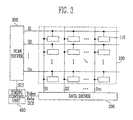
- FIG. 3 illustrates an electroluminescent display according to an embodiment of the present invention
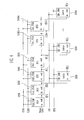
- FIG. 4 illustrates a data driving circuit for use by the electroluminescent display illustrated in FIG. 3, in accordance with the invention
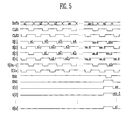
- FIG. 5 is a timing diagram illustrating operation of the data driving circuit illustrated in FIG. 4;
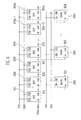
- FIG. 6 illustrates a further data driving circuit for use by the electroluminescent display illustrated in FIG. 3, in accordance with the invention
- FIG. 7 is a timing diagram illustrating operation of the data driving circuit illustrated in FIG. 6;
- FIG. 8 is a circuit diagram of a first stage for use in the data driving circuits illustrated in FIG. 4 and FIG. 6, in accordance with the invention.
- FIG. 9 is a circuit diagram of a second stage for use in the data driving circuits illustrated in FIG. 4 and FIG. 6, in accordance with the invention.
- FIG. 10 is a circuit diagram of a further first stage for use in the data driving circuits illustrated in FIG. 4 and FIG. 6, in accordance with the invention.
- FIG. 11 is a circuit diagram of a further second stage for use in the data driving circuits illustrated in FIG. 4 and FIG. 6, in accordance with the invention.
- FIG. 12 is a timing diagram illustrating operation of the data driving circuit illustrated in FIG. 4, in which the first and second stages illustrated in FIG. 10 and FIG. 11 are used;
- FIG. 13 is a timing diagram illustrating operation of the data driving circuit illustrated in FIG. 6, in which the first and second stages illustrated in FIG. 10 and FIG. 11 are used.
- FIG. 3 illustrates an organic light-emitting display (OLED) according to the present invention.
- OLED organic light-emitting display
- an OLED is considered a particular type of an electroluminescent display and should not limit the scope of this invention. Rather, the OLED is being presented as an example of an electroluminescent display for the purposes of illustration and discussion only. Furthermore, the OLED itself is exemplary in nature and the discussion herein should not limit the implementation of such a display, including components utilized, operations performed and connections thereto. Referring to FIG.
- the OLED has a pixel unit 100, including a plurality of pixels 110 connected with scan lines S 1 to Sn and data lines D1 to Dm, a data driving circuit 200 for driving the data lines D1 to Dm, a scan driving circuit 300 for driving the scan lines S1 to Sn, and a timing control unit 400 for controlling the scan driving circuit 300 and the data driving circuit 200.
- the pixel unit 100 is adapted to receive a first power supply (ELVDD) and a second power supply (ELVSS) from an external source (not illustrated), so as to supply the power to each of pixels 110.
- Each of the pixels 110 receiving the first power supply (ELVDD) and the second power supply (ELVSS) can then generate a light corresponding to data signals by controlling a current flowing from the first power supply (ELVDD) to the second power supply (ELVSS) via, for example, a light-emitting diode (not illustrated), that corresponds to the data signals.
- the data driving circuit 200 is adapted to receive data-driving control signals (DCS) from the timing control unit 400.
- the data driving circuit 200 receiving the data-driving control signals (DCS) can then generate data signals, and supply the generated data signals to data lines D1 to Dm so that they may be synchronized with the scan signals.
- the data driving circuit 200 includes a plurality of switching elements.
- the switching elements may or may not be all the same type.
- the switching elements may be realized by PMOS transistors, NMOS transistors or other suitable components, either exclusively, respectively or combinations thereof.
- the scan driving circuit 300 is adapted to receive scan-driving control signals (SCS) from the timing control unit 400.
- the scan driving circuit 300 receiving the scan-driving control signals (SCS) can then generate scan signals and sequentially supply the generated scan signals to scan lines S 1 to Sn. That is, the scan driving circuit 300 can operate to sequentially generate scan signals and supply the generated scan signals to a pixel unit 100 which may then drive a plurality of the pixels.
- the timing control unit 400 is adapted to generate data-driving control signals (DCS) and scan-driving control signals (SCS) to correspond to synchronizing signals supplied from an external source (not illustrated).
- DCS data-driving control signals
- SCS scan-driving control signals
- the timing control unit 400 may also supply DATA, which may be generated from an external source (not illustrated), to the data driving circuit 200.
- FIG. 4 illustrates a data driving circuit for use with the exemplary OLED illustrated in FIG. 3, according to an embodiment of the present invention.
- this data driving circuit should not be limited to use in the OLED of FIG. 3. Rather, this data driving circuit may be used with other electroluminescent displays.
- the data driving circuit 200 includes a shift register and a latch unit.
- the shift register includes a plurality of first stages 2101 to 2102n, and each of the first stages can be operated by a first clock (CLK1) and a second clock (CLK2), and then the first stage 2101 can output a 1 st carrier wave (s[1]) and can transmit the 1 st carrier wave (s[1]) to a 2 nd first stage 2102, Data signals (for example, video data) can be output with the 1 st carrier wave (s[1]).
- CLK1 first clock
- CLK2 second clock
- the 2 nd first stage 2102 can receive the 1 st carrier wave, and then can transmit the 2 nd carrier wave to a 3 rd first stage and a 1 st second stage 2201, and then the 3 rd first stage can transmit a 3 rd carrier wave to the 4 th first stage 2104. That is, the even-numbered first stages 2102, 2104...2102n-2, 2102n can transmit carrier waves to the adjacent first stages (the odd-numbered first stage 2103, 2105...2102n-3, 2102n-1) and the second stages.
- the latch unit includes a plurality of the second stages 2201 to 220n, and each of the second stages can be operated by a first enable signal (EN1), a second enable signal (EN2) which can be supplied by first and second enable signal generators.
- the plurality of the second stages 2201 to 220n are connected to output lines of the even-numbered first stages 2102, 2104...2102n-2, 2102n to receive data signal (al to an) transmitted from the even-numbered first stages 2102, 2104...2102n-2, 2102n to the carrier waves (s2, s4,...s2n-2,s2n). Accordingly, the number of second stages 2201 to 220n is half the number of the first stages 2101 to 2102n.
- each of the second stages can simultaneously output the data signals (for example, video data) based on the first enable signal (EN1) and the second enable signal (EN2). Accordingly, the data signals (for example, video data) can be input in series to a plurality of the first stages 2101 to 2102n and can be output in parallel by a plurality of the second stages 2201 to 220n.
- FIG. 5 is a timing diagram illustrating the operation of the data driving circuit shown in FIG. 4.
- the first clock CLK1 is a pulse that is periodically generated and has a longer high period and a shorter low period.
- the second clock (CLK2) is a similar pulse that is delayed for a predetermined period compared to the first clock (CLK1).
- the carrier wave (s1) outputs from the 1 st first stage 2101 are generated with the same periodicity as the first clock (CLK1), and the carrier wave (s1) outputs the 1 st data (a1) when the signal is at a low level.
- the 1 st first stage 2101 receives the input data serially, and continues to sequentially output a n-th data of the 1 st data (a1) over the carrier wave (s[1]).
- the 2 nd first stage 2102 receives the 1 st carrier wave from the 1 st first stage 2101, and then outputs the 2 nd carrier wave (s2). Therefore, the 2 nd carrier wave (s2) outputs the 1 st data (a1) after the 1 st data (a1) is delayed for a predetermined time compared to the 1 st carrier wave (s1), and sequentially outputs the data from the 1 st data (a1) to the n th data (an).
- the n th carrier wave (sn) outputs the data from the 1 st data (a1) to the n th data (an).
- the first and second enable signals (EN1, EN2) are input at a point that the 1 st data (a1) to n th data (an) are output over the n th carrier wave (sn) of the 1 st carrier wave (s1), and then output simultaneously by a plurality of the second stages 2201 to 220n.
- FIG. 6 illustrates a schematic of another data driving circuit that may be used with the OLED illustrated in FIG. 3, according to an embodiment of the present invention.
- the data driving circuit should not be limited for use with the OLED of FIG. 3. Rather, this data driving circuit may be used with other electroluminescent displays.
- the data driving circuit 200 includes a shift register and a latch unit.
- the shift register includes a plurality of first stages 2101 to 2102n, and each of the first stages is operated by the first clock (CLK1) and the second clock (CLK2).
- the first stage 2101 outputs the 1 st carrier wave (s1) and transmits the 1 st carrier wave (s1) to the 2 nd first stage 2102 and the 1 st second stage 2201.
- Data signals for example, video data
- the 2 nd first stage 2102 receives the 1 st carrier wave (s1) and transmits the 2 nd carrier wave to a 3 rd first stage 2103, and then the 3 rd first stage 2103 transmits a 3 rd carrier wave (s3) to the 4 th first stage and the 2 nd second stage 2202. That is, the odd-numbered first stages 2001, 2003...2002n-3, 2002n-1 transmit carrier waves to the adjacent first stages (the even-numbered first stage 2002, 2004...2002n-2, 2002n) and the second stages.
- the latch unit includes a plurality of the second stages 2201 to 220n, and each of the second stages is operated by a first enable signal (EN1) and a second enable signal (EN2).
- the plurality of the second stages 2201 to 220n are connected to output lines of the odd-numbered first stages 2001, 2003...2002n-3, 2002n-1 to receive data signals (a1 to an) transmitted from the odd-numbered first stages 2001, 2003...2002n-3, 2002n-1. Accordingly, a plurality of the second stages 2201 to 220n have half the number of the plurality of the first stages 2101 to 2102n.
- each of the second stages simultaneously outputs the data signals (for example, video data) based on the first enable signal (EN1) and the second enable signal (EN2). Accordingly, the data signals (for example, video data) are input in series to a plurality of the first stages 2101 to 2102n and are output in parallel by a plurality of the second stages 2201 to 220n.
- FIG. 7 illustrates a timing diagram of an operation of the data driving circuit illustrated in FIG. 6.
- the first clock CLK1 is a pulse that is periodically generated and has a longer high period and a shorter low period.
- the second clock (CLK2) is a pulse delayed for a predetermined period compared to the first clock (CLK1) pulse.
- the carrier wave (s1) output from the 1 st first stage 2101 is generated with the same periodicity as the first clock (CLK1), and the carrier wave (s1) outputs data (a1) when the signal is at a low level.
- the carrier wave (s1) continues to sequentially output a n th data in the 1 st data (a1).
- the 2 nd first stage 2102 receives the 1 st carrier wave (s1) from the 1 st first stage and outputs the 2 nd carrier wave (s2).
- the 2 nd carrier wave (s2) outputs the 1 st data (a1) after the 1 st data (a1) is delayed for a predetermined time as compared to the 1 st carrier wave (s[1]), and sequentially outputs the data from the 1 st data (a1) to the n th data (an).
- the nth first stage 2102n outputs the n th carrier wave (sn).
- the first and second enable signals (EN1, EN2) are input at a point that the 1 st data (a1) to n th data (an) are output over the n th carrier wave (sn) of the 1 st carrier wave (s1), and then are simultaneously output by a plurality of the second stages 2201 to 220n.
- FIG. 8 illustrates a circuit diagram of a first stage that may be used in the data driving circuits illustrated in FIG. 4 and FIG. 6, according to an embodiment of the present invention.
- FIG. 9 illustrates a circuit diagram of a second stage that may be used in the data driving circuits illustrated in FIG. 4 and FIG. 6, according to an embodiment of the present invention.
- the first and second stages may have the same configuration, except that the first stage receives a first clock signal (CLK1) and a second clock signal (CLK2), while the second stage receives a first enable signal (EN1) and a second enable signal (EN2).
- CLK1 first clock signal
- CLK2 second clock signal
- EN1 first enable signal
- EN2 second enable signal
- the first stage and the second stage can be realized by PMOS transistors and capacitors.
- other implementations without PMOS transistors and capacitors can be realized.
- first stage and the second stage are connected in the same manner, as discussed above, the first stage and second stage will be described referring to the connection of the first stage only.
- a source is connected to an input terminal (IN), a drain is connected to a first node (N1) and a gate is connected to the second clock (CLK2).
- a source is connected to a first clock (CLK1)
- a drain is connected to a second node (N2)
- a gate is connected to the first node (N1).
- a source is connected to a third node (N3)
- a drain is connected to a second power supply (VSS)
- a gate is connected to the second clock (CLK2).
- a source is connected to a second clock (CLK2), a drain is connected to the third node (N3), and a gate is connected to the first node (N1).
- a source is connected to a first power supply (VDD), a drain is connected to an output terminal (OUT), and a gate is connected to the third node (N3).
- a capacitor (C1) a first electrode is connected to the first node (N1), and a second electrode is connected to the second node (N2).
- the second node (N2) is also connected to the output terminal (OUT). Accordingly, the data signals input through the input terminal (IN) are stored in the capacitor (C1), and then are output through the output terminal (OUT) after a predetermined time.
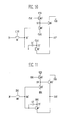
- FIG. 10 illustrates a circuit diagram of another first stage that may be used in the data driving circuits illustrated in FIG. 4 and FIG. 6.
- FIG. 11 illustrates a circuit diagram of another second stage.
- the first and second stages are realized by NMOS transistors and capacitors. Again, other implementations of the first and second stages can be realized.
- the first stage is operated after receiving the first clock signal and the second clock signal
- the second stage is operated after receiving the first enable signal and the second enable signal.
- FIG. 12 illustrates a timing diagram of an exemplary operation of the data driving circuit illustrated in FIG. 4, in which the first and second stages illustrated in FIG. 10 and FIG. 11 are used.
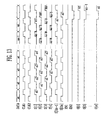
- FIG. 13 illustrates a timing diagram of an exemplary operation of the data driving circuit illustrated in FIG. 6, in which the first and second stages illustrated in FIG. 10 and FIG. 11 are used.
- waveforms of signals input/output in the first and second stage are realized by NMOS transistors. The signals are reversed, and then input into the first and second stages to operate the data driving circuit, as illustrated in FIG. 6.
- a description of FIG. 12 and FIG. 13 is identical to that of FIG. 7.
- the data driving circuit has advantages in that it reduces power consumption by removing paths through which a static current may flow, minimizes a leakage current since the output port is not recharged when a high-level output may be put through the data driving circuit, and also increases an operation rate by minimizing reduction of the current that discharges the output port since the bootstrap is operated when a low-level output is put through the data driving circuit.
Landscapes
- Engineering & Computer Science (AREA)
- Physics & Mathematics (AREA)
- Computer Hardware Design (AREA)
- General Physics & Mathematics (AREA)
- Theoretical Computer Science (AREA)
- Microelectronics & Electronic Packaging (AREA)
- Power Engineering (AREA)
- Control Of Indicators Other Than Cathode Ray Tubes (AREA)
- Electroluminescent Light Sources (AREA)
- Control Of El Displays (AREA)
- Shift Register Type Memory (AREA)
Applications Claiming Priority (1)
| Application Number | Priority Date | Filing Date | Title |
|---|---|---|---|
| KR1020050106171A KR100762690B1 (ko) | 2005-11-07 | 2005-11-07 | 데이터구동회로와 이를 이용한 유기발광표시장치 |
Publications (3)
| Publication Number | Publication Date |
|---|---|
| EP1783739A2 true EP1783739A2 (de) | 2007-05-09 |
| EP1783739A3 EP1783739A3 (de) | 2008-12-24 |
| EP1783739B1 EP1783739B1 (de) | 2013-09-11 |
Family
ID=37602957
Family Applications (1)
| Application Number | Title | Priority Date | Filing Date |
|---|---|---|---|
| EP06255725.1A Not-in-force EP1783739B1 (de) | 2005-11-07 | 2006-11-07 | Datenansteuerungsschaltung und Elektrolumineszenzanzeige damit |
Country Status (5)
| Country | Link |
|---|---|
| US (1) | US7982704B2 (de) |
| EP (1) | EP1783739B1 (de) |
| JP (1) | JP5150812B2 (de) |
| KR (1) | KR100762690B1 (de) |
| CN (1) | CN100565640C (de) |
Cited By (2)
| Publication number | Priority date | Publication date | Assignee | Title |
|---|---|---|---|---|
| US7982704B2 (en) | 2005-11-07 | 2011-07-19 | Samsung Mobile Display Co., Ltd. | Data driving circuit and electroluminescent display using the same |
| CN115798398A (zh) * | 2022-01-04 | 2023-03-14 | 北京集创北方科技股份有限公司 | 显示驱动系统及显示面板 |
Families Citing this family (20)
| Publication number | Priority date | Publication date | Assignee | Title |
|---|---|---|---|---|
| KR101352114B1 (ko) * | 2007-07-04 | 2014-01-14 | 엘지디스플레이 주식회사 | 평판 표시 장치 |
| JP2009211732A (ja) * | 2008-02-29 | 2009-09-17 | Eastman Kodak Co | シフトレジスタ回路および表示装置 |
| KR100941843B1 (ko) * | 2008-04-14 | 2010-02-11 | 삼성모바일디스플레이주식회사 | 인버터 및 이를 구비한 표시장치 |
| TWI406234B (zh) * | 2008-05-07 | 2013-08-21 | Au Optronics Corp | 基於具資料寫入同步控制機制之雙源極驅動電路的液晶顯示裝置及相關驅動方法 |
| KR101721639B1 (ko) | 2010-10-28 | 2017-03-31 | 삼성디스플레이 주식회사 | 주사 구동 장치 및 이를 포함하는 표시 장치 |
| KR101881853B1 (ko) * | 2012-02-29 | 2018-07-26 | 삼성디스플레이 주식회사 | 에미션 구동 유닛, 에미션 구동부 및 이를 포함하는 유기 발광 표시 장치 |
| CN102682692B (zh) * | 2012-05-21 | 2014-11-05 | 京东方科技集团股份有限公司 | 移位寄存器、驱动装置及显示器 |
| US9171514B2 (en) * | 2012-09-03 | 2015-10-27 | Samsung Electronics Co., Ltd. | Source driver, method thereof, and apparatuses having the same |
| CN103151010B (zh) * | 2013-02-27 | 2014-12-10 | 京东方科技集团股份有限公司 | 一种移位寄存器和显示装置 |
| CN103198866B (zh) * | 2013-03-06 | 2015-08-05 | 京东方科技集团股份有限公司 | 移位寄存器、栅极驱动电路、阵列基板以及显示装置 |
| CN104751769A (zh) * | 2013-12-25 | 2015-07-01 | 昆山工研院新型平板显示技术中心有限公司 | 扫描驱动器及使用该扫描驱动器的有机发光显示器 |
| TWI520117B (zh) * | 2014-02-07 | 2016-02-01 | 友達光電股份有限公司 | 位移控制單元 |
| CN104157252B (zh) * | 2014-07-29 | 2017-01-18 | 京东方科技集团股份有限公司 | 一种移位寄存器、栅极驱动电路及显示装置 |
| CN104167175B (zh) * | 2014-08-06 | 2016-08-31 | 上海和辉光电有限公司 | 有机发光显示器 |
| CN104751816B (zh) * | 2015-03-31 | 2017-08-15 | 深圳市华星光电技术有限公司 | 移位寄存器电路 |
| CN105185411B (zh) * | 2015-06-30 | 2019-03-26 | 上海天马有机发光显示技术有限公司 | 一种移位寄存器及其驱动方法 |
| JP6539567B2 (ja) * | 2015-10-30 | 2019-07-03 | 株式会社ジャパンディスプレイ | 表示装置 |
| CN105957556A (zh) * | 2016-05-11 | 2016-09-21 | 京东方科技集团股份有限公司 | 移位寄存器单元、栅极驱动电路及其驱动方法、显示装置 |
| CN107103870A (zh) * | 2017-06-27 | 2017-08-29 | 上海天马有机发光显示技术有限公司 | 移位寄存单元、其驱动方法及显示面板 |
| US11521542B2 (en) * | 2019-11-20 | 2022-12-06 | Novatek Microelectronics Corp. | Method for display driver system and display driver system |
Family Cites Families (14)
| Publication number | Priority date | Publication date | Assignee | Title |
|---|---|---|---|---|
| KR100430099B1 (ko) | 1999-03-02 | 2004-05-03 | 엘지.필립스 엘시디 주식회사 | 쉬프트 레지스터 회로 |
| JP3713401B2 (ja) | 1999-03-18 | 2005-11-09 | 株式会社東芝 | チャージポンプ回路 |
| JP2001083923A (ja) * | 1999-07-12 | 2001-03-30 | Semiconductor Energy Lab Co Ltd | デジタルドライバおよび表示装置 |
| TW523730B (en) * | 1999-07-12 | 2003-03-11 | Semiconductor Energy Lab | Digital driver and display device |
| KR100563826B1 (ko) * | 1999-08-21 | 2006-04-17 | 엘지.필립스 엘시디 주식회사 | 액정표시장치의 데이타구동회로 |
| JP2004153444A (ja) | 2002-10-29 | 2004-05-27 | Renesas Technology Corp | チョッパ型コンパレータ |
| KR100700177B1 (ko) * | 2002-12-18 | 2007-03-27 | 엘지.필립스 엘시디 주식회사 | 유기전계발광소자의 저전력 구동방법 |
| JP2005235311A (ja) * | 2004-02-19 | 2005-09-02 | Olympus Corp | 信号伝送回路 |
| KR101030528B1 (ko) * | 2004-05-27 | 2011-04-26 | 엘지디스플레이 주식회사 | 쉬프트 레지스터 및 이를 사용한 액정표시장치 |
| KR100729099B1 (ko) * | 2005-09-20 | 2007-06-14 | 삼성에스디아이 주식회사 | 주사 구동회로와 이를 이용한 유기 전계발광 장치 |
| KR100658284B1 (ko) * | 2005-09-30 | 2006-12-14 | 삼성에스디아이 주식회사 | 주사 구동회로와 이를 이용한 유기 전계발광 장치 |
| KR100762690B1 (ko) | 2005-11-07 | 2007-10-01 | 삼성에스디아이 주식회사 | 데이터구동회로와 이를 이용한 유기발광표시장치 |
| KR100719670B1 (ko) * | 2006-04-06 | 2007-05-18 | 삼성에스디아이 주식회사 | 데이터 구동부 및 이를 이용한 유기 전계발광 표시장치 |
| KR100748321B1 (ko) * | 2006-04-06 | 2007-08-09 | 삼성에스디아이 주식회사 | 주사 구동회로와 이를 이용한 유기 전계발광 표시장치 |
-
2005
- 2005-11-07 KR KR1020050106171A patent/KR100762690B1/ko not_active Expired - Fee Related
-
2006
- 2006-06-07 JP JP2006158771A patent/JP5150812B2/ja not_active Expired - Fee Related
- 2006-11-06 US US11/593,006 patent/US7982704B2/en not_active Expired - Fee Related
- 2006-11-07 EP EP06255725.1A patent/EP1783739B1/de not_active Not-in-force
- 2006-11-07 CN CNB2006100644199A patent/CN100565640C/zh not_active Expired - Fee Related
Cited By (2)
| Publication number | Priority date | Publication date | Assignee | Title |
|---|---|---|---|---|
| US7982704B2 (en) | 2005-11-07 | 2011-07-19 | Samsung Mobile Display Co., Ltd. | Data driving circuit and electroluminescent display using the same |
| CN115798398A (zh) * | 2022-01-04 | 2023-03-14 | 北京集创北方科技股份有限公司 | 显示驱动系统及显示面板 |
Also Published As
| Publication number | Publication date |
|---|---|
| KR100762690B1 (ko) | 2007-10-01 |
| US7982704B2 (en) | 2011-07-19 |
| EP1783739B1 (de) | 2013-09-11 |
| EP1783739A3 (de) | 2008-12-24 |
| CN101013556A (zh) | 2007-08-08 |
| CN100565640C (zh) | 2009-12-02 |
| JP2007133358A (ja) | 2007-05-31 |
| JP5150812B2 (ja) | 2013-02-27 |
| US20070103389A1 (en) | 2007-05-10 |
| KR20070049005A (ko) | 2007-05-10 |
Similar Documents
| Publication | Publication Date | Title |
|---|---|---|
| EP1783739B1 (de) | Datenansteuerungsschaltung und Elektrolumineszenzanzeige damit | |
| EP1847983B1 (de) | Zeilentreiberschaltung und organische lichtemittierende Anzeige damit | |
| KR100729099B1 (ko) | 주사 구동회로와 이를 이용한 유기 전계발광 장치 | |
| KR100658269B1 (ko) | 주사 구동회로와 이를 이용한 유기 전계발광 장치 | |
| US20240013725A1 (en) | Gate Driver and Organic Light Emitting Display Device Including the Same | |
| US7663593B2 (en) | Level shift circuit and shift register and display device | |
| CN108597438A (zh) | 移位寄存器单元、栅极驱动电路及其驱动方法、显示装置 | |
| CN110176217A (zh) | 移位寄存器单元及其驱动方法、栅极驱动电路及显示装置 | |
| US8836631B2 (en) | Scan driving circuit with a shift register and electroluminescent display using the same | |
| US7639217B2 (en) | Scan driving circuit and organic light emitting display device using the same | |
| US7656194B2 (en) | Shift register circuit | |
| EP1848000B1 (de) | Zeilentreiberschaltung und zugehörige organische lichtemittierende Anzeige | |
| KR100658270B1 (ko) | 주사 구동회로와 이를 이용한 유기 전계발광 장치 | |
| KR100662983B1 (ko) | 주사 구동회로와 이를 이용한 유기 전계발광 장치 |
Legal Events
| Date | Code | Title | Description |
|---|---|---|---|
| PUAI | Public reference made under article 153(3) epc to a published international application that has entered the european phase |
Free format text: ORIGINAL CODE: 0009012 |
|
| 17P | Request for examination filed |
Effective date: 20061110 |
|
| AK | Designated contracting states |
Kind code of ref document: A2 Designated state(s): AT BE BG CH CY CZ DE DK EE ES FI FR GB GR HU IE IS IT LI LT LU LV MC NL PL PT RO SE SI SK TR |
|
| AX | Request for extension of the european patent |
Extension state: AL BA HR MK YU |
|
| PUAL | Search report despatched |
Free format text: ORIGINAL CODE: 0009013 |
|
| AK | Designated contracting states |
Kind code of ref document: A3 Designated state(s): AT BE BG CH CY CZ DE DK EE ES FI FR GB GR HU IE IS IT LI LT LU LV MC NL PL PT RO SE SI SK TR |
|
| AX | Request for extension of the european patent |
Extension state: AL BA HR MK RS |
|
| RAP1 | Party data changed (applicant data changed or rights of an application transferred) |
Owner name: SAMSUNG MOBILE DISPLAY CO., LTD. |
|
| AKX | Designation fees paid |
Designated state(s): DE FR GB |
|
| 17Q | First examination report despatched |
Effective date: 20091012 |
|
| GRAP | Despatch of communication of intention to grant a patent |
Free format text: ORIGINAL CODE: EPIDOSNIGR1 |
|
| RAP1 | Party data changed (applicant data changed or rights of an application transferred) |
Owner name: SAMSUNG DISPLAY CO., LTD. |
|
| GRAP | Despatch of communication of intention to grant a patent |
Free format text: ORIGINAL CODE: EPIDOSNIGR1 |
|
| INTG | Intention to grant announced |
Effective date: 20130703 |
|
| GRAS | Grant fee paid |
Free format text: ORIGINAL CODE: EPIDOSNIGR3 |
|
| GRAA | (expected) grant |
Free format text: ORIGINAL CODE: 0009210 |
|
| AK | Designated contracting states |
Kind code of ref document: B1 Designated state(s): DE FR GB |
|
| REG | Reference to a national code |
Ref country code: GB Ref legal event code: FG4D |
|
| REG | Reference to a national code |
Ref country code: DE Ref legal event code: R096 Ref document number: 602006038334 Country of ref document: DE Effective date: 20131107 |
|
| REG | Reference to a national code |
Ref country code: DE Ref legal event code: R097 Ref document number: 602006038334 Country of ref document: DE |
|
| PLBE | No opposition filed within time limit |
Free format text: ORIGINAL CODE: 0009261 |
|
| STAA | Information on the status of an ep patent application or granted ep patent |
Free format text: STATUS: NO OPPOSITION FILED WITHIN TIME LIMIT |
|
| 26N | No opposition filed |
Effective date: 20140612 |
|
| REG | Reference to a national code |
Ref country code: DE Ref legal event code: R097 Ref document number: 602006038334 Country of ref document: DE Effective date: 20140612 |
|
| REG | Reference to a national code |
Ref country code: FR Ref legal event code: PLFP Year of fee payment: 10 |
|
| PGFP | Annual fee paid to national office [announced via postgrant information from national office to epo] |
Ref country code: GB Payment date: 20151026 Year of fee payment: 10 Ref country code: DE Payment date: 20151028 Year of fee payment: 10 |
|
| PGFP | Annual fee paid to national office [announced via postgrant information from national office to epo] |
Ref country code: FR Payment date: 20151026 Year of fee payment: 10 |
|
| REG | Reference to a national code |
Ref country code: DE Ref legal event code: R119 Ref document number: 602006038334 Country of ref document: DE |
|
| GBPC | Gb: european patent ceased through non-payment of renewal fee |
Effective date: 20161107 |
|
| REG | Reference to a national code |
Ref country code: FR Ref legal event code: ST Effective date: 20170731 |
|
| PG25 | Lapsed in a contracting state [announced via postgrant information from national office to epo] |
Ref country code: FR Free format text: LAPSE BECAUSE OF NON-PAYMENT OF DUE FEES Effective date: 20161130 |
|
| PG25 | Lapsed in a contracting state [announced via postgrant information from national office to epo] |
Ref country code: GB Free format text: LAPSE BECAUSE OF NON-PAYMENT OF DUE FEES Effective date: 20161107 Ref country code: DE Free format text: LAPSE BECAUSE OF NON-PAYMENT OF DUE FEES Effective date: 20170601 |