EP1783748A1 - Deposition of enhanced seed layer using tantalum alloy based sputter target - Google Patents
Deposition of enhanced seed layer using tantalum alloy based sputter target Download PDFInfo
- Publication number
- EP1783748A1 EP1783748A1 EP06251476A EP06251476A EP1783748A1 EP 1783748 A1 EP1783748 A1 EP 1783748A1 EP 06251476 A EP06251476 A EP 06251476A EP 06251476 A EP06251476 A EP 06251476A EP 1783748 A1 EP1783748 A1 EP 1783748A1
- Authority
- EP
- European Patent Office
- Prior art keywords
- alloying element
- tantalum
- sputter target
- seedlayer
- underlayer
- Prior art date
- Legal status (The legal status is an assumption and is not a legal conclusion. Google has not performed a legal analysis and makes no representation as to the accuracy of the status listed.)
- Withdrawn
Links
Images



Classifications
-
- A—HUMAN NECESSITIES
- A47—FURNITURE; DOMESTIC ARTICLES OR APPLIANCES; COFFEE MILLS; SPICE MILLS; SUCTION CLEANERS IN GENERAL
- A47C—CHAIRS; SOFAS; BEDS
- A47C9/00—Stools for specified purposes
-
- G—PHYSICS
- G11—INFORMATION STORAGE
- G11B—INFORMATION STORAGE BASED ON RELATIVE MOVEMENT BETWEEN RECORD CARRIER AND TRANSDUCER
- G11B5/00—Recording by magnetisation or demagnetisation of a record carrier; Reproducing by magnetic means; Record carriers therefor
- G11B5/84—Processes or apparatus specially adapted for manufacturing record carriers
- G11B5/8404—Processes or apparatus specially adapted for manufacturing record carriers manufacturing base layers
-
- A—HUMAN NECESSITIES
- A47—FURNITURE; DOMESTIC ARTICLES OR APPLIANCES; COFFEE MILLS; SPICE MILLS; SUCTION CLEANERS IN GENERAL
- A47C—CHAIRS; SOFAS; BEDS
- A47C7/00—Parts, details, or accessories of chairs or stools
- A47C7/002—Chair or stool bases
- A47C7/006—Chair or stool bases with castors
-
- A—HUMAN NECESSITIES
- A47—FURNITURE; DOMESTIC ARTICLES OR APPLIANCES; COFFEE MILLS; SPICE MILLS; SUCTION CLEANERS IN GENERAL
- A47C—CHAIRS; SOFAS; BEDS
- A47C7/00—Parts, details, or accessories of chairs or stools
- A47C7/36—Supports for the head or the back
- A47C7/40—Supports for the head or the back for the back
-
- A—HUMAN NECESSITIES
- A47—FURNITURE; DOMESTIC ARTICLES OR APPLIANCES; COFFEE MILLS; SPICE MILLS; SUCTION CLEANERS IN GENERAL
- A47C—CHAIRS; SOFAS; BEDS
- A47C7/00—Parts, details, or accessories of chairs or stools
- A47C7/62—Accessories for chairs
-
- A—HUMAN NECESSITIES
- A47—FURNITURE; DOMESTIC ARTICLES OR APPLIANCES; COFFEE MILLS; SPICE MILLS; SUCTION CLEANERS IN GENERAL
- A47C—CHAIRS; SOFAS; BEDS
- A47C7/00—Parts, details, or accessories of chairs or stools
- A47C7/62—Accessories for chairs
- A47C7/66—Means to protect against weather
-
- C—CHEMISTRY; METALLURGY
- C23—COATING METALLIC MATERIAL; COATING MATERIAL WITH METALLIC MATERIAL; CHEMICAL SURFACE TREATMENT; DIFFUSION TREATMENT OF METALLIC MATERIAL; COATING BY VACUUM EVAPORATION, BY SPUTTERING, BY ION IMPLANTATION OR BY CHEMICAL VAPOUR DEPOSITION, IN GENERAL; INHIBITING CORROSION OF METALLIC MATERIAL OR INCRUSTATION IN GENERAL
- C23C—COATING METALLIC MATERIAL; COATING MATERIAL WITH METALLIC MATERIAL; SURFACE TREATMENT OF METALLIC MATERIAL BY DIFFUSION INTO THE SURFACE, BY CHEMICAL CONVERSION OR SUBSTITUTION; COATING BY VACUUM EVAPORATION, BY SPUTTERING, BY ION IMPLANTATION OR BY CHEMICAL VAPOUR DEPOSITION, IN GENERAL
- C23C14/00—Coating by vacuum evaporation, by sputtering or by ion implantation of the coating forming material
- C23C14/22—Coating by vacuum evaporation, by sputtering or by ion implantation of the coating forming material characterised by the process of coating
- C23C14/34—Sputtering
- C23C14/3407—Cathode assembly for sputtering apparatus, e.g. Target
- C23C14/3414—Metallurgical or chemical aspects of target preparation, e.g. casting, powder metallurgy
-
- G—PHYSICS
- G11—INFORMATION STORAGE
- G11B—INFORMATION STORAGE BASED ON RELATIVE MOVEMENT BETWEEN RECORD CARRIER AND TRANSDUCER
- G11B5/00—Recording by magnetisation or demagnetisation of a record carrier; Reproducing by magnetic means; Record carriers therefor
- G11B5/62—Record carriers characterised by the selection of the material
- G11B5/73—Base layers, i.e. all non-magnetic layers lying under a lowermost magnetic recording layer, e.g. including any non-magnetic layer in between a first magnetic recording layer and either an underlying substrate or a soft magnetic underlayer
- G11B5/7368—Non-polymeric layer under the lowermost magnetic recording layer
- G11B5/7379—Seed layer, e.g. at least one non-magnetic layer is specifically adapted as a seed or seeding layer
-
- G—PHYSICS
- G11—INFORMATION STORAGE
- G11B—INFORMATION STORAGE BASED ON RELATIVE MOVEMENT BETWEEN RECORD CARRIER AND TRANSDUCER
- G11B5/00—Recording by magnetisation or demagnetisation of a record carrier; Reproducing by magnetic means; Record carriers therefor
- G11B5/84—Processes or apparatus specially adapted for manufacturing record carriers
- G11B5/851—Coating a support with a magnetic layer by sputtering
Definitions
- the present invention generally relates to sputter targets and, more particularly, relates to the deposition of a seedlayer for a magnetic recording medium used for perpendicular magnetic recording (“PMR") applications, where the seedlayer provides for grain size refinement and reduced lattice mis-fit for a subsequently deposited underlayer and/or granular magnetic layer, and where the seedlayer is deposited using a tantalum (Ta) alloy based sputter target.
- PMR perpendicular magnetic recording
- the process of direct current ("DC") magnetron sputtering is widely used in a variety of fields to provide thin film material deposition of a precisely controlled thickness and within narrow atomic fraction tolerances on a substrate, for example to coat semiconductors and/or to form films on surfaces of magnetic recording media.
- a racetrack-shaped magnetic field is applied to the sputter target by placing magnets on the backside surface of the target. Electrons are trapped near the sputtering target, improving argon ion production and increasing the sputtering rate. Ions within this plasma collide with a surface of the sputter target causing the sputter target to emit atoms from the sputter target surface.
- the voltage difference between the cathodic sputter target and an anodic substrate that is to be coated causes the emitted atoms to form the desired film on the surface of the substrate.
- thermal stability should be high, and media noise performance should be low.
- One approach to realizing the essential thermal stability and media noise requirements in PMR media is to provide a granular magnetic media with magnetic domains having high magnetocrystalline anisotropy (K u ), and to adequately encapsulate a fine grain microstructure in a structurally, magnetically and electrically insulating matrix.
- K u magnetocrystalline anisotropy
- PMR requires a much finer grain microstructure with adequate grain-to grain segregation and negligible cross-talk between the magnetic domains, in order to achieve low media noise performance and high thermal stability.
- the present invention is a sputter target, where the sputter target is comprised of tantalum (Ta) and an alloying element.
- the solubility of the alloying element in a body centered cubic tantalum (Ta) phase does not exceed 10 atomic percent at room temperature, and the alloying element has a mass susceptibility of less than or equal to 1.5 ⁇ 10 - 7 ⁇ m 3 kg .
- the present invention is a sputter target, where the sputter target is comprised of tantalum (Ta) and an alloying element.
- the solubility of the alloying element in a body centered cubic tantalum (Ta) phase does not exceed 10 atomic percent at room temperature, and the alloying element has a mass susceptibility of less than or equal to 1.5 ⁇ 10 - 7 ⁇ m 3 kg , is soluble in tantalum (Ta) at temperatures higher than room temperature, and has an atomic radius smaller than 1.47 ⁇ .
- the present invention is a sputter target for triatron configuration sputtering, including a first region comprised of tantalum (Ta) and a second region comprised of an alloying element.
- the solubility of the alloying element in a body centered cubic tantalum (Ta) phase does not exceed 10 atomic percent at room temperature, and the alloying element has a mass susceptibility of less than or equal to 1.5 ⁇ 10 - 7 ⁇ m 3 kg .
- the present invention is a sputter target for triatron configuration sputtering, including a first region comprised of tantalum (Ta) and a second region comprised of an alloying element.
- the solubility of the alloying element in a body centered cubic tantalum (Ta) phase does not exceed 10 atomic percent at room temperature, and the alloying element has a mass susceptibility of less than or equal to 1.5 ⁇ 10 - 7 ⁇ m 3 kg , is soluble in tantalum (Ta) at temperatures higher than room temperature, and has an atomic radius smaller than 1.47 ⁇ .
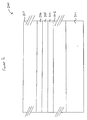
- Figure 1 depicts a typical thin film stack for conventional PMR media
- Figure 3 is an X-ray diffraction ("XRD") spectrum of a tantalum (Ta) film, which demonstrates that the present invention is capable of enhancing the crystallinity of a subsequently deposited the HCP underlayer, while reducing lattice mis-fit;
- XRD X-ray diffraction
- Figure 5 is a flowchart depicting a method for manufacturing a magnetic recording medium, according to a second embodiment of the present invention.
- the present invention provides for the reduction of the lattice mis-fit between the seedlayer and underlayer by alloying the tantalum (Ta) alloy based seed layer with elements soluble in tantalum (Ta) at room temperature and temperatures elevated from room temperature, so that residual stresses at the interface are minimized and crystallinity is enhanced.
- crystalline tantalum (Ta) alloy based seedlayer a similar effect is realized by the underlayer if the underlayer is subsequently deposited epitaxially on top of the reduced grain size, crystalline tantalum (Ta) alloy based seedlayer.
- Substantially pure tantalum (Ta) is alloyed with an alloying element which acts as grain size refiner in the crystalline tantalum (Ta) alloy based seedlayer film.
- the alloying element is non-magnetic or weakly magnetic in nature, with a mass susceptibility of less than or equal to 1.5 ⁇ 10 - 7 ⁇ m 3 kg .
- Table 1 below, provides a list of alloying elements which can be alloyed with tantalum (Ta) to form an enhanced alloy which provides for grain size reduction in the seedlayer film, although other elements which meet these characteristics may also be used as well.
- Table 1 Alloying elements which provide for grain size reduction in the seedlayer film.
- the alloying element can be added in high atomic percentages, such as 50% in the tantalum (Ta) based alloy, although higher or lower atomic percentages can also be used, such as 1%, 5%, 15-25%, or 40-50%.
- the alloying element can also be added in excess of its maximum solubility limit, at room temperature or higher temperatures. "Higher” than room temperature or “elevated” over room temperature means any temperature over room temperature, which is ordinarily considered approximately 20-23 °C, or 68-73 °F. Example temperatures which would be higher than or elevated over room temperature would be 25 °C, 100 °C, 1000 °C, 2500 °C, or 5000 °C.
- the alloying element in the tantalum (Ta)-alloy based has some solid solubility in tantalum (Ta) at room temperature or at elevated temperatures, so that the alloying element forms a substitutional solid solution with tantalum (Ta) and affects its in-plane, a-lattice parameter. Additionally, the alloying element is non-magnetic or weakly-magnetic in nature, with a mass susceptibility of less than or equal to 1.5 ⁇ 10 - 7 ⁇ m 3 kg . Since the in-plane lattice parameter for tantalum (Ta) is higher than that of ruthenium (Ru), the alloying element has an atomic radius smaller than that of 1.47 ⁇ , which is the atomic radius of tantalum (Ta).
- the alloying element in the tantalum (Ta) alloy based seedlayer is added within the solubility range or in excess of the alloying element's high solubility limit for room temperature or above, in tantalum (Ta).
- Magnetic recording medium 200 also includes underlayer 205 deposited over seedlayer 204, and magnetic data-storing granular layer 206 deposited over underlayer 205.
- Magnetic recording medium 200 also includes layer 207, which includes one or more layers such as a carbon (C) overcoat or a lubricant layers, although in alternate aspects layer 207 is omitted.
- C carbon
- Underlayer 205 is comprised of ruthenium (Ru) or a ruthenium (Ru)-based alloy, although other base metals typically used in the art may be used in conjunction with or instead of ruthenium (Ru).
- Ru ruthenium
- Ru ruthenium
- Ru ruthenium
- Ru ruthenium
- other base metals typically used in the art may be used in conjunction with or instead of ruthenium (Ru).
- nickel (Ni), terbium (Tb) or titanium (Ti) could also be used as an underlayer, as could any material with a HCP structure at room temperature.
- the solubility of the alloying element in a body centered cubic tantalum (Ta) phase does not exceed 10 atomic percent at room temperature, and the alloying element has a mass susceptibility of less than or equal to 1.5 ⁇ 10 -7 m 3 kg .
- Elements which meet these parameters and which could be used as the alloying element include, but are not limited to, boron (B), carbon (C), aluminum (Al), silicon (Si), titanium (Ti), vanadium (V), manganese (Mn), chromium (Cr), zirconium (Zr), niobium (Nb), molybdenum (Mo), ytterbium (Yb), lutetium (Lu), hafnium (Hf), bismuth (Bi), and tungsten (W).
- B boron
- C carbon
- Al aluminum
- Ti titanium
- V vanadium
- Mn manganese
- Cr chromium
- Zr zirconium
- niobium Nb
- Mo molybdenum
- Yb lutetium
- hafnium hafnium
- Bi bismuth
- W tungsten
- substantially pure tantalum (Ta) is alloyed with an alloying element, which acts as grain size refiner in the crystalline tantalum (Ta) alloy based seedlayer film. Since the alloying element has little or no solubility in the BCC tantalum (Ta) phase at room temperature, the alloying element forms the amorphous grain boundary in the tantalum (Ta) alloy based seedlayer film and aids in grain size reduction by confining further grain growth during processing.
- the alloying element is soluble in tantalum (Ta) at room temperature or at elevated temperatures, has a mass susceptibility of less than or equal to 1.5 ⁇ 10 - 7 ⁇ m 3 kg , and has an atomic radius smaller than 1.47 ⁇ .
- Elements which meet these parameters and which could be used as the alloying element include, but are not limited to boron (B), carbon (C), aluminum (Al), silicon (Si), chromium (Cr), ruthenium (Ru), rhodium (Rh), rhenium (Re), iridium (Ir) and platinum (Pt).
- Other alloying elements which meet the above criteria can be used as well, in conjunction with or instead of these listed elements.
- lattice mis-fit between the seedlayer and underlayer is reduced by alloying the tantalum (Ta)-based seed layer, so that residual stresses at the interface are minimized and crystallinity is enhanced.
- the alloying element in the tantalum (Ta)-alloy based has some solid solubility in tantalum (Ta) at room temperature or at elevated temperatures, so that the alloying element forms a substitutional solid solution with tantalum (Ta) and affects its in-plane, a-lattice parameter.
- the solubility of the alloying element in a body centered cubic tantalum (Ta) phase does not exceed 10 atomic percent at room temperature, and the alloying element has a mass susceptibility of less than or equal to 1.5 ⁇ 10 - 7 ⁇ m 3 kg , is soluble in tantalum (Ta) at temperatures higher than room temperature, and has an atomic radius smaller than 1.47 ⁇ .
- Elements which meet these parameters and which could be used as the alloying element include, but are not limited to boron (B), carbon (C), aluminum (Al), silicon(Si), platinum (Pt), and chromium (Cr).
- Other alloying elements which meet the above criteria can be used as well, in conjunction with or instead of these listed elements.
- This particular aspect benefits from both the grain refinement and reduction of lattice mis-fit, as described in more detail above. Specifically, by utilizing an alloying element which forms an amorphous grain boundary in the tantalum (Ta) alloy based seedlayer film, and which enhances crystallinity, a tantalum (Ta) alloy is provided which acts as both a grain refiner for subsequently deposited layers, and lattice mis-fit reducer for the elimination of residual interface stresses.
- the first seedlayer, the first underlayer and/or the first magnetic data-storing granular layer are sputtered using a co-sputtering assembly or process, or using a triatron.
- the co-sputtering process uses multiple independent sputter targets with independent power supplies which are contemporaneously positioned within the vacuum chamber controlled the uniformity of the sputtered surface by selectively sputtering one or more of the multiple sputter targets.
- the present invention relates tantalum (Ta) alloy based seedlayers which are deposited in conjunction with an underlayer and/or a magnetic data-storing granular media layer, in magnetic media stacks used for PMR.
- the present invention provides for grain refinement of the underlayer by epitaxially depositing an underlayer on a tantalum (Ta) alloy based crystalline seedlayer, where the allying element of the tantalum (Ta) alloy acts as a grain size refined by forming an amorphous grain boundary region and confining further grain size growth, due to its limited solubility or insolubility in tantalum (Ta) at room temperature.
- seedlayer grain size is refined, and perpendicular anisotropy in magnetic media stacks which include a CoPt(Cr)(B) oxide containing magnetic data-storing granular media layer and/or a HCP-based underlayer is correspondingly increased since the subsequently deposited layers are formed over the enhanced, crystalline seedlayer.
- the crystalline seedlayer minimizes the potential for lattice mismatch with HCP underlayers.
- the alloying element has the propensity to remain in the tantalum (Ta) lattice by forming a solid solution, thereby affecting the in-plane (a-lattice) parameter of tantalum (Ta).
- SNR signal-to-noise ratio
- K u for the PMR media stack are improved.
- the strong (0002) orientation in the ruthenium (Ru) or ruthenium (Ru) alloy based underlayer also promotes strong (0002) texture growth in the granular magnetic recording layer.
- substantially pure tantalum (Ta) and ruthenium (Ru) films have a lattice mis-fit of approximately 5.6%. Alloying tantalum (Ta) with an alloying element which is soluble in tantalum (Ta) substantially eliminates this 5.6% mis-fit.
- Figure 5 is a flowchart depicting a method for manufacturing a magnetic recording medium, according to a second embodiment of the present invention.
- the method of manufacturing a magnetic recording medium includes the step of sputtering at least a first seedlayer over a substrate from a first sputter target, where the first sputter target is comprised of tantalum (Ta) and an alloying element.
- the method also includes the steps of sputtering at least a first underlayer over the first seedlayer from a second sputter target, and sputtering at least a first magnetic data-storing granular layer over the first underlayer from a third sputter target.
- Elements which meet these parameters and which could be used as the alloying element include, but are not limited to boron (B), carbon (C), aluminum (Al), silicon (Si), titanium (Ti), vanadium (V), manganese (Mn), chromium (Cr), zirconium (Zr), niobium (Nb), molybdenum (Mo), ytterbium (Yb), lutetium (Lu), hafnium (Hf), bismuth (Bi), and tungsten (W).
- the solubility of the alloying element in a body centered cubic tantalum (Ta) phase does not exceed 10 atomic percent at room temperature, and the alloying element has a mass susceptibility of less than or equal to 1.5 ⁇ 10 - 7 ⁇ m 3 kg , is soluble in tantalum (Ta) at temperatures higher than room temperature, and has an atomic radius smaller than 1.47 ⁇ .
- Elements which meet these parameters and which could be used as the alloying element include, but are not limited to boron (B), carbon (C), aluminum (Al), silicon(Si), platinum (Pt), and chromium (Cr).
- At least a first underlayer is sputtered over the first seedlayer from a second sputter target (step S504).
- the first underlayer is comprised of ruthenium (Ru) or a ruthenium (Ru)-based alloy, although in alternate aspects other elements typically used in the art can be substituted for or used in conjunction with ruthenium (Ru), such as nickel (Ni) or titanium (Ti).
- the first underlayer is co-sputtered with the seedlayer, although seedlayer could also be sputtered separately.
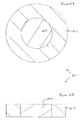
- Figures 6A and 6B depict a top view and a cross-section view of a sputter target for a triatron configuration, respectively, according to a third embodiment of the present invention.
- the sputter target for triatron configuration sputtering includes a first region comprised of tantalum (Ta) and a second region comprised of an alloying element.
- triatron configuration co-sputtering uses a single sputter target with multiple independent composition regions. This single triatron sputter target would have an region comprised solely of tantalum (Ta) and a region comprised solely of X 1 , where both regions would be co-sputtered simultaneously to deposit an Ta- X 1 thin film.
- sputter target 601 for triatron configuration sputtering includes first region 602 comprised of tantalum (Ta), and second region 604 comprised of an alloying element.
- first region 602 is illustrated as an outside annulus and second region 604 is illustrated as an inner circle, the respective positions can be reversed in alternate aspects, or different shapes or divisions could be used altogether.
- the alloying element is soluble in tantalum (Ta) at room temperature or at elevated temperatures, has a mass susceptibility of less than or equal to 1.5 ⁇ 10 - 7 ⁇ m 3 kg , and has an atomic radius smaller than 1.47 ⁇ , where possible alloying elements include (but are not limited to) boron (B), carbon (C), silicon (Si), aluminum (Al), chromium (Cr), ruthenium (Ru), rhodium (Rh), rhenium (Re), iridium (Ir) and platinum (Pt).
- alloying elements include (but are not limited to) boron (B), carbon (C), silicon (Si), aluminum (Al), chromium (Cr), ruthenium (Ru), rhodium (Rh), rhenium (Re), iridium (Ir) and platinum (Pt).
- the solubility of the alloying element in a body centered cubic tantalum (Ta) phase does not exceed 10 atomic percent at room temperature, and the alloying element has a mass susceptibility of less than or equal to 1.5 ⁇ 10 - 7 ⁇ m 3 kg , is soluble in tantalum (Ta) at temperatures higher than room temperature, and has an atomic radius smaller than 1.47 ⁇ , where possible alloying elements include (but are not limited to) boron (B), carbon (C), silicon (Si), aluminum (Al), and chromium (Cr).
- the present invention is a sputter target, where the sputter target is comprised of tantalum (Ta) and an alloying element.
- the solubility of the alloying element in a body centered cubic tantalum (Ta) phase does not exceed 10 atomic percent at room temperature, and the alloying element has a mass susceptibility of less than or equal to 1.5 ⁇ 10 - 7 ⁇ m 3 kg , where possible alloying elements include (but are not limited to) boron (B), carbon (C), titanium (Ti), vanadium (V), manganese (Mn), chromium (Cr), zirconium (Zr), niobium (Nb), molybdenum (Mo), ytterbium (Yb), lutetium (Lu), hafnium (Hf), bismuth (Bi), and tungsten (W).
- the alloying element is soluble in tantalum (Ta) at room temperature or at elevated temperatures, has a mass susceptibility of less than or equal to 1.5 ⁇ 10 - 7 ⁇ m 3 kg , and has an atomic radius smaller than 1.47 ⁇ , where possible alloying elements include (but are not limited to) boron (B), carbon (C), chromium (Cr), ruthenium (Ru), rhodium (Rh), rhenium (Re), iridium (Ir) and platinum (Pt).
- alloying elements include (but are not limited to) boron (B), carbon (C), chromium (Cr), ruthenium (Ru), rhodium (Rh), rhenium (Re), iridium (Ir) and platinum (Pt).
- the solubility of the alloying element in a body centered cubic tantalum (Ta) phase does not exceed 10 atomic percent at room temperature, and the alloying element has a mass susceptibility of less than or equal to 1.5 ⁇ 10 - 7 ⁇ m 3 kg , is soluble in tantalum (Ta) at temperatures higher than room temperature, and has an atomic radius smaller than 1.47 ⁇ , where possible elements include (but are not limited to boron (B), carbon (C), platinum (Pt), and chromium (Cr).
- sputter targets of tantalum (Ta) based alloys can be used to produce crystalline tantalum (Ta) alloy based seedlayers with refined grain size, refining the grain size of the crystalline underlayer and promoting the subsequently epitaxially deposited granular magnetic layer.
- the present invention provides an additional approach to alloy the tantalum (Ta) alloy based seedlayer, reducing the lattice mis-fit between the tantalum (Ta) alloy based seedlayer and the underlayer, beneficially affecting the crystallinity of the underlayer.
- Each of these benefits enhances SNR and increases perpendicular anisotropy in the media stacks used for PMR.
Landscapes
- Chemical & Material Sciences (AREA)
- Engineering & Computer Science (AREA)
- Chemical Kinetics & Catalysis (AREA)
- Materials Engineering (AREA)
- Mechanical Engineering (AREA)
- Metallurgy (AREA)
- Organic Chemistry (AREA)
- Manufacturing & Machinery (AREA)
- Manufacturing Of Magnetic Record Carriers (AREA)
- Physical Vapour Deposition (AREA)
- Magnetic Record Carriers (AREA)
Applications Claiming Priority (1)
| Application Number | Priority Date | Filing Date | Title |
|---|---|---|---|
| US11/264,137 US20070099032A1 (en) | 2005-11-02 | 2005-11-02 | Deposition of enhanced seed layer using tantalum alloy based sputter target |
Publications (1)
| Publication Number | Publication Date |
|---|---|
| EP1783748A1 true EP1783748A1 (en) | 2007-05-09 |
Family
ID=36627336
Family Applications (1)
| Application Number | Title | Priority Date | Filing Date |
|---|---|---|---|
| EP06251476A Withdrawn EP1783748A1 (en) | 2005-11-02 | 2006-03-20 | Deposition of enhanced seed layer using tantalum alloy based sputter target |
Country Status (8)
| Country | Link |
|---|---|
| US (1) | US20070099032A1 (cs) |
| EP (1) | EP1783748A1 (cs) |
| JP (1) | JP2007128630A (cs) |
| KR (1) | KR20070047678A (cs) |
| CN (1) | CN1959813A (cs) |
| CZ (1) | CZ2006127A3 (cs) |
| SG (2) | SG134338A1 (cs) |
| TW (1) | TW200718794A (cs) |
Cited By (1)
| Publication number | Priority date | Publication date | Assignee | Title |
|---|---|---|---|---|
| AT18385U1 (de) * | 2024-02-07 | 2024-12-15 | Plansee Composite Mat Gmbh | Ta-Al Targets |
Families Citing this family (13)
| Publication number | Priority date | Publication date | Assignee | Title |
|---|---|---|---|---|
| JP5227634B2 (ja) * | 2008-03-28 | 2013-07-03 | ダブリュディ・メディア・シンガポール・プライベートリミテッド | 垂直磁気記録媒体及び垂直磁気記録媒体の製造方法 |
| JP2009116932A (ja) * | 2007-11-02 | 2009-05-28 | Hoya Corp | 垂直磁気記録媒体 |
| JP5105594B2 (ja) * | 2007-10-15 | 2012-12-26 | ダブリュディ・メディア・シンガポール・プライベートリミテッド | 垂直磁気記録媒体 |
| US9159351B2 (en) * | 2007-10-15 | 2015-10-13 | Wd Media (Singapore) Pte. Ltd | Perpendicular magnetic recording medium and method of manufacturing the same |
| JP2011076682A (ja) * | 2009-09-30 | 2011-04-14 | Wd Media Singapore Pte Ltd | 垂直磁気記録媒体 |
| KR20130008089A (ko) | 2010-08-09 | 2013-01-21 | 제이엑스 닛코 닛세키 킨조쿠 가부시키가이샤 | 탄탈 스퍼터링 타깃 |
| JP7258275B2 (ja) * | 2019-05-09 | 2023-04-17 | 株式会社レゾナック | 磁気記録媒体および磁気記録再生装置 |
| WO2021014760A1 (ja) * | 2019-07-23 | 2021-01-28 | Jx金属株式会社 | 非磁性層形成用スパッタリングターゲット部材 |
| CN111945121A (zh) * | 2020-08-06 | 2020-11-17 | 宁波江丰电子材料股份有限公司 | 一种钽铝合金溅射靶材及其制备方法 |
| CN112111714B (zh) * | 2020-09-16 | 2023-08-15 | 宁波江丰电子材料股份有限公司 | 一种钽铝合金溅射靶材的制备方法 |
| CN112725675B (zh) * | 2020-12-23 | 2021-11-09 | 苏州希镝瑞新材料科技有限公司 | 一种镝/铽靶的制造方法 |
| CN114015995B (zh) * | 2021-11-10 | 2023-09-22 | 中国人民解放军军事科学院国防科技创新研究院 | 一种Nb-Ta-W多主元合金薄膜及其制备方法 |
| CN120464968B (zh) * | 2025-07-10 | 2025-09-12 | 东南大学苏州医疗器械研究院 | 一种基于低温磁控溅射对钽涂层物相的调控方法及其应用 |
Citations (23)
| Publication number | Priority date | Publication date | Assignee | Title |
|---|---|---|---|---|
| US5536585A (en) * | 1993-03-10 | 1996-07-16 | Hitachi, Ltd. | Magnetic recording medium and fabrication method therefor |
| US5700593A (en) * | 1993-06-23 | 1997-12-23 | Kubota Corporation | Metal thin film magnetic recording medium and manufacturing method thereof |
| US5849386A (en) * | 1996-04-26 | 1998-12-15 | Hmt Technology Corporation | Magnetic recording medium having a prelayer |
| US20010016272A1 (en) * | 2000-02-09 | 2001-08-23 | Xiaoping Bian | Onset layer for thin film disk with CoPtCrB alloy |
| US6497799B1 (en) * | 2000-04-14 | 2002-12-24 | Seagate Technology Llc | Method and apparatus for sputter deposition of multilayer films |
| EP1293969A1 (en) * | 2001-09-14 | 2003-03-19 | Fuji Photo Film Co., Ltd. | Magnetic recording medium |
| EP1378893A1 (en) * | 2002-07-05 | 2004-01-07 | Hitachi, Ltd. | Perpendicular magnetic recording media |
| US20040038083A1 (en) * | 2002-08-26 | 2004-02-26 | Hitachi, Ltd. | Perpendicular magnetic recording media |
| US6737172B1 (en) * | 2000-12-07 | 2004-05-18 | Seagate Technology Llc | Multi-layered anti-ferromagnetically coupled magnetic media |
| US6740397B1 (en) * | 2000-05-24 | 2004-05-25 | Seagate Technology Llc | Subseedlayers for magnetic recording media |
| US6777112B1 (en) * | 2000-10-10 | 2004-08-17 | Seagate Technology Llc | Stabilized recording media including coupled discontinuous and continuous magnetic layers |
| US20040202843A1 (en) * | 2002-01-15 | 2004-10-14 | Fuji Photo Film Co., Ltd. | Magnetic recording medium |
| US20040214049A1 (en) * | 2003-04-23 | 2004-10-28 | Hitachi Global Storage Technologies Japan, Ltd. | Magnetic recording medium |
| US20040234818A1 (en) * | 2003-05-20 | 2004-11-25 | Kiwamu Tanahashi | Perpendicular magnetic recording medium, manufacturing process of the same, and magnetic storage apparatus using the same |
| US20040233565A1 (en) * | 2003-05-22 | 2004-11-25 | Reiko Arai | Perpendicular magnetic recording medium and magnetic recording/reproducing apparatus |
| US6828036B1 (en) * | 2001-08-21 | 2004-12-07 | Seagate Technology Llc | Anti-ferromagnetically coupled magnetic media with combined interlayer + first magnetic layer |
| US6852426B1 (en) * | 2001-12-20 | 2005-02-08 | Seagate Technology Llc | Hybrid anti-ferromagnetically coupled and laminated magnetic media |
| US20050042479A1 (en) * | 2001-11-27 | 2005-02-24 | Hitachi, Ltd. | Perpendicular magnetic recording media |
| US6878460B1 (en) * | 2002-11-07 | 2005-04-12 | Seagate Technology Llc | Thin-film magnetic recording media with dual intermediate layer structure for increased coercivity |
| US20050142389A1 (en) * | 2003-12-24 | 2005-06-30 | Hitachi Global Storage Technologies Netherlands, B.V. | Magnetic recording medium |
| US20050142390A1 (en) * | 2003-01-15 | 2005-06-30 | Fujitsu Limited | Magnetic recording medium and magnetic storage apparatus |
| US20060269799A1 (en) * | 2005-05-24 | 2006-11-30 | Do Hoa V | Perpendicular magnetic recording disk with improved recording layer having high oxygen content |
| US20070037016A1 (en) * | 2005-08-12 | 2007-02-15 | Do Hoa V | Perpendicular magnetic recording disk with recording layer containing selected metal oxides and formed on a reduced-thickness exchange-break layer |
Family Cites Families (23)
| Publication number | Priority date | Publication date | Assignee | Title |
|---|---|---|---|---|
| US677112A (en) * | 1900-01-17 | 1901-06-25 | American Card Clothing Company | Card-clothing. |
| JP3665221B2 (ja) * | 1999-03-18 | 2005-06-29 | 株式会社日立グローバルストレージテクノロジーズ | 面内磁気記録媒体及び磁気記憶装置 |
| JP2002190108A (ja) * | 2000-10-13 | 2002-07-05 | Fuji Electric Co Ltd | 磁気記録媒体およびその製造方法 |
| US6699600B2 (en) * | 2001-02-28 | 2004-03-02 | Showa Denko K.K. | Magnetic recording medium, method of manufacture therefor, and apparatus for magnetic recording and reproducing recordings |
| SG115476A1 (en) * | 2001-05-23 | 2005-10-28 | Showa Denko Kk | Magnetic recording medium, method of manufacturing therefor and magnetic replay apparatus |
| US20040018390A1 (en) * | 2001-07-31 | 2004-01-29 | Fuji Electric, Co., Ltd. | Perpendicular magnetic recording medium and method of manufacturing the same |
| US20030049498A1 (en) * | 2001-07-31 | 2003-03-13 | Manabu Shimosato | Perpendicular magnetic recording medium and method of manufacturing the same |
| US6682826B2 (en) * | 2001-08-01 | 2004-01-27 | Showa Denko K.K. | Magnetic recording medium, method of manufacturing therefor, and magnetic read/write apparatus |
| US7138196B2 (en) * | 2001-11-09 | 2006-11-21 | Maxtor Corporation | Layered thin-film media for perpendicular magnetic recording |
| US20030091888A1 (en) * | 2001-11-15 | 2003-05-15 | Goggin Christopher M. | High-density, wireless fuel cell power unit |
| JP2003157516A (ja) * | 2001-11-22 | 2003-05-30 | Toshiba Corp | 垂直磁気記録媒体および磁気記録装置 |
| JP4019703B2 (ja) * | 2001-12-07 | 2007-12-12 | 富士電機デバイステクノロジー株式会社 | 垂直磁気記録媒体およびその製造方法 |
| US6908689B1 (en) * | 2001-12-20 | 2005-06-21 | Seagate Technology Llc | Ruthenium-aluminum underlayer for magnetic recording media |
| JP2004030767A (ja) * | 2002-06-25 | 2004-01-29 | Toshiba Corp | 垂直磁気記録媒体および磁気記録装置 |
| CN1620686A (zh) * | 2002-09-06 | 2005-05-25 | 富士通株式会社 | 磁记录介质和磁存储装置 |
| JP2004303375A (ja) * | 2003-03-31 | 2004-10-28 | Toshiba Corp | 垂直磁気記録媒体、及び磁気記録再生装置 |
| US7235314B2 (en) * | 2004-03-11 | 2007-06-26 | Seagate Technology Llc | Inter layers for perpendicular recording media |
| US7201977B2 (en) * | 2004-03-23 | 2007-04-10 | Seagate Technology Llc | Anti-ferromagnetically coupled granular-continuous magnetic recording media |
| JP2005276364A (ja) * | 2004-03-25 | 2005-10-06 | Toshiba Corp | 磁気記録媒体及びその製造法、並びにそれを用いた磁気記録再生装置 |
| JP4585214B2 (ja) * | 2004-03-25 | 2010-11-24 | 株式会社東芝 | 磁気記録媒体及びそれを用いた磁気記録再生装置 |
| JP4874526B2 (ja) * | 2004-03-25 | 2012-02-15 | 株式会社東芝 | 磁気記録媒体及び磁気記録媒体の製造法、並びに磁気記録再生装置 |
| JP2005353256A (ja) * | 2004-05-13 | 2005-12-22 | Fujitsu Ltd | 垂直磁気記録媒体およびその製造方法、磁気記憶装置 |
| US7494726B2 (en) * | 2004-07-07 | 2009-02-24 | Fuji Electric Device Technology Co., Ltd. | Perpendicular magnetic recording medium, method of manufacturing same, and magnetic recording device |
-
2005
- 2005-11-02 US US11/264,137 patent/US20070099032A1/en not_active Abandoned
-
2006
- 2006-02-14 SG SG200705541-1A patent/SG134338A1/en unknown
- 2006-02-14 SG SG200600962-5A patent/SG131821A1/en unknown
- 2006-02-23 TW TW095106133A patent/TW200718794A/zh unknown
- 2006-02-27 CZ CZ20060127A patent/CZ2006127A3/cs unknown
- 2006-03-10 KR KR1020060022565A patent/KR20070047678A/ko not_active Ceased
- 2006-03-16 CN CNA2006100717166A patent/CN1959813A/zh active Pending
- 2006-03-20 EP EP06251476A patent/EP1783748A1/en not_active Withdrawn
- 2006-04-18 JP JP2006114504A patent/JP2007128630A/ja active Pending
Patent Citations (24)
| Publication number | Priority date | Publication date | Assignee | Title |
|---|---|---|---|---|
| US5536585A (en) * | 1993-03-10 | 1996-07-16 | Hitachi, Ltd. | Magnetic recording medium and fabrication method therefor |
| US5700593A (en) * | 1993-06-23 | 1997-12-23 | Kubota Corporation | Metal thin film magnetic recording medium and manufacturing method thereof |
| US5849386A (en) * | 1996-04-26 | 1998-12-15 | Hmt Technology Corporation | Magnetic recording medium having a prelayer |
| US20010016272A1 (en) * | 2000-02-09 | 2001-08-23 | Xiaoping Bian | Onset layer for thin film disk with CoPtCrB alloy |
| US6497799B1 (en) * | 2000-04-14 | 2002-12-24 | Seagate Technology Llc | Method and apparatus for sputter deposition of multilayer films |
| US6740397B1 (en) * | 2000-05-24 | 2004-05-25 | Seagate Technology Llc | Subseedlayers for magnetic recording media |
| US6777112B1 (en) * | 2000-10-10 | 2004-08-17 | Seagate Technology Llc | Stabilized recording media including coupled discontinuous and continuous magnetic layers |
| US6737172B1 (en) * | 2000-12-07 | 2004-05-18 | Seagate Technology Llc | Multi-layered anti-ferromagnetically coupled magnetic media |
| US6828036B1 (en) * | 2001-08-21 | 2004-12-07 | Seagate Technology Llc | Anti-ferromagnetically coupled magnetic media with combined interlayer + first magnetic layer |
| US20040197606A1 (en) * | 2001-09-14 | 2004-10-07 | Fuji Photo Film Co., Ltd. | Magnetic recording medium including a magnetic layer containing a nonmagnetic oxide |
| EP1293969A1 (en) * | 2001-09-14 | 2003-03-19 | Fuji Photo Film Co., Ltd. | Magnetic recording medium |
| US20050042479A1 (en) * | 2001-11-27 | 2005-02-24 | Hitachi, Ltd. | Perpendicular magnetic recording media |
| US6852426B1 (en) * | 2001-12-20 | 2005-02-08 | Seagate Technology Llc | Hybrid anti-ferromagnetically coupled and laminated magnetic media |
| US20040202843A1 (en) * | 2002-01-15 | 2004-10-14 | Fuji Photo Film Co., Ltd. | Magnetic recording medium |
| EP1378893A1 (en) * | 2002-07-05 | 2004-01-07 | Hitachi, Ltd. | Perpendicular magnetic recording media |
| US20040038083A1 (en) * | 2002-08-26 | 2004-02-26 | Hitachi, Ltd. | Perpendicular magnetic recording media |
| US6878460B1 (en) * | 2002-11-07 | 2005-04-12 | Seagate Technology Llc | Thin-film magnetic recording media with dual intermediate layer structure for increased coercivity |
| US20050142390A1 (en) * | 2003-01-15 | 2005-06-30 | Fujitsu Limited | Magnetic recording medium and magnetic storage apparatus |
| US20040214049A1 (en) * | 2003-04-23 | 2004-10-28 | Hitachi Global Storage Technologies Japan, Ltd. | Magnetic recording medium |
| US20040234818A1 (en) * | 2003-05-20 | 2004-11-25 | Kiwamu Tanahashi | Perpendicular magnetic recording medium, manufacturing process of the same, and magnetic storage apparatus using the same |
| US20040233565A1 (en) * | 2003-05-22 | 2004-11-25 | Reiko Arai | Perpendicular magnetic recording medium and magnetic recording/reproducing apparatus |
| US20050142389A1 (en) * | 2003-12-24 | 2005-06-30 | Hitachi Global Storage Technologies Netherlands, B.V. | Magnetic recording medium |
| US20060269799A1 (en) * | 2005-05-24 | 2006-11-30 | Do Hoa V | Perpendicular magnetic recording disk with improved recording layer having high oxygen content |
| US20070037016A1 (en) * | 2005-08-12 | 2007-02-15 | Do Hoa V | Perpendicular magnetic recording disk with recording layer containing selected metal oxides and formed on a reduced-thickness exchange-break layer |
Cited By (1)
| Publication number | Priority date | Publication date | Assignee | Title |
|---|---|---|---|---|
| AT18385U1 (de) * | 2024-02-07 | 2024-12-15 | Plansee Composite Mat Gmbh | Ta-Al Targets |
Also Published As
| Publication number | Publication date |
|---|---|
| KR20070047678A (ko) | 2007-05-07 |
| SG134338A1 (en) | 2007-08-29 |
| CZ2006127A3 (cs) | 2007-05-09 |
| CN1959813A (zh) | 2007-05-09 |
| JP2007128630A (ja) | 2007-05-24 |
| SG131821A1 (en) | 2007-05-28 |
| US20070099032A1 (en) | 2007-05-03 |
| TW200718794A (en) | 2007-05-16 |
Similar Documents
| Publication | Publication Date | Title |
|---|---|---|
| EP1930884A1 (en) | Ni-X, NI-Y, and NI-X-Y alloys with or without oxides as sputter targets for perpendicular magnetic recording | |
| US20090120237A1 (en) | Enhanced formulation of cobalt alloy matrix compositions | |
| EP1736968B1 (en) | Enhanced oxygen non-stoichiometry compensation for thin films | |
| EP1783748A1 (en) | Deposition of enhanced seed layer using tantalum alloy based sputter target | |
| US6620531B1 (en) | Magnetic recording media with oxidized seedlayer for reduced grain size and reduced grain size distribution | |
| US20040185307A1 (en) | Perpendicular magnetic recording medium and method for manufacturing the same | |
| US7645363B2 (en) | Manufacturing of magnetic recording medium | |
| EP1717337A2 (en) | Enhanced multi-component oxide-containing sputter target alloy compositions | |
| EP1734513A1 (en) | Enhanced oxide-containing sputter target alloy compositions | |
| JP3236171B2 (ja) | 軟磁性多層膜 | |
| JP5981564B2 (ja) | 磁気記録媒体及びその製造方法 | |
| HK1099902A (en) | Deposition of enhanced seed layer using tantalum alloy based sputter target | |
| TWI719803B (zh) | 高垂直磁異向性之垂直磁性記錄媒體及提升其垂直磁異向性的方法 | |
| US6756136B1 (en) | Chromium-alloy seedlayers for recording media | |
| JPH06215941A (ja) | 磁気記録媒体、磁気記録膜形成用ターゲツト及び磁気記録膜形成法 | |
| US20080268292A1 (en) | Hexagonal close-packed ceramic seedlayers for perpendicular magnetic recording media | |
| HK1091235B (en) | Enhanced formulation of cobalt alloy matrix compositions | |
| HK1094275A (en) | Enhanced oxide-containing sputter target alloy compositions | |
| HK1091236A (en) | Enhanced multi-component oxide-containing sputter target alloy compositions | |
| HK1094833B (en) | Enhanced oxygen non-stoichiometry compensation for thin films |
Legal Events
| Date | Code | Title | Description |
|---|---|---|---|
| PUAI | Public reference made under article 153(3) epc to a published international application that has entered the european phase |
Free format text: ORIGINAL CODE: 0009012 |
|
| AK | Designated contracting states |
Kind code of ref document: A1 Designated state(s): AT BE BG CH CY CZ DE DK EE ES FI FR GB GR HU IE IS IT LI LT LU LV MC NL PL PT RO SE SI SK TR |
|
| AX | Request for extension of the european patent |
Extension state: AL BA HR MK YU |
|
| 17P | Request for examination filed |
Effective date: 20070621 |
|
| REG | Reference to a national code |
Ref country code: HK Ref legal event code: DE Ref document number: 1099902 Country of ref document: HK |
|
| 17Q | First examination report despatched |
Effective date: 20070727 |
|
| AKX | Designation fees paid |
Designated state(s): AT BE BG CH CY CZ DE DK EE ES FI FR GB GR HU IE IS IT LI LT LU LV MC NL PL PT RO SE SI SK TR |
|
| STAA | Information on the status of an ep patent application or granted ep patent |
Free format text: STATUS: THE APPLICATION IS DEEMED TO BE WITHDRAWN |
|
| 18D | Application deemed to be withdrawn |
Effective date: 20081001 |
|
| REG | Reference to a national code |
Ref country code: HK Ref legal event code: WD Ref document number: 1099902 Country of ref document: HK |