EP1783942A1 - Codage de contrôle de parité de faible densité pour systèmes de communication de multiplexage par répartition en fréquences orthogonales - Google Patents
Codage de contrôle de parité de faible densité pour systèmes de communication de multiplexage par répartition en fréquences orthogonales Download PDFInfo
- Publication number
- EP1783942A1 EP1783942A1 EP05292370A EP05292370A EP1783942A1 EP 1783942 A1 EP1783942 A1 EP 1783942A1 EP 05292370 A EP05292370 A EP 05292370A EP 05292370 A EP05292370 A EP 05292370A EP 1783942 A1 EP1783942 A1 EP 1783942A1
- Authority
- EP
- European Patent Office
- Prior art keywords
- symbols
- ldpc
- subcarriers
- ofdm
- mapping
- Prior art date
- Legal status (The legal status is an assumption and is not a legal conclusion. Google has not performed a legal analysis and makes no representation as to the accuracy of the status listed.)
- Withdrawn
Links
- 238000013507 mapping Methods 0.000 claims abstract description 125
- 230000004044 response Effects 0.000 claims abstract description 27
- 238000000034 method Methods 0.000 claims description 17
- 230000001788 irregular Effects 0.000 claims description 7
- 230000009897 systematic effect Effects 0.000 claims description 5
- 238000004891 communication Methods 0.000 description 21
- 239000013598 vector Substances 0.000 description 19
- 239000011159 matrix material Substances 0.000 description 18
- 239000000969 carrier Substances 0.000 description 15
- 238000005457 optimization Methods 0.000 description 7
- 238000013459 approach Methods 0.000 description 6
- 238000004422 calculation algorithm Methods 0.000 description 6
- 230000005540 biological transmission Effects 0.000 description 5
- 238000009826 distribution Methods 0.000 description 5
- 238000004364 calculation method Methods 0.000 description 3
- 238000004088 simulation Methods 0.000 description 3
- 101710094396 Hexon protein Proteins 0.000 description 2
- 125000004122 cyclic group Chemical group 0.000 description 2
- 238000013461 design Methods 0.000 description 2
- 230000006855 networking Effects 0.000 description 2
- 230000010363 phase shift Effects 0.000 description 2
- 230000010267 cellular communication Effects 0.000 description 1
- 230000007423 decrease Effects 0.000 description 1
- 230000000694 effects Effects 0.000 description 1
- 230000002708 enhancing effect Effects 0.000 description 1
- 238000005562 fading Methods 0.000 description 1
- 230000006870 function Effects 0.000 description 1
- 238000009828 non-uniform distribution Methods 0.000 description 1
- 230000008520 organization Effects 0.000 description 1
- 230000008569 process Effects 0.000 description 1
- 238000012545 processing Methods 0.000 description 1
- 230000009467 reduction Effects 0.000 description 1
- 238000011160 research Methods 0.000 description 1
- 238000012552 review Methods 0.000 description 1
- 230000011664 signaling Effects 0.000 description 1
- 238000001228 spectrum Methods 0.000 description 1
- 238000012549 training Methods 0.000 description 1
Images




Classifications
-
- H—ELECTRICITY
- H04—ELECTRIC COMMUNICATION TECHNIQUE
- H04L—TRANSMISSION OF DIGITAL INFORMATION, e.g. TELEGRAPHIC COMMUNICATION
- H04L1/00—Arrangements for detecting or preventing errors in the information received
- H04L1/004—Arrangements for detecting or preventing errors in the information received by using forward error control
- H04L1/0056—Systems characterized by the type of code used
- H04L1/0057—Block codes
-
- H—ELECTRICITY
- H04—ELECTRIC COMMUNICATION TECHNIQUE
- H04L—TRANSMISSION OF DIGITAL INFORMATION, e.g. TELEGRAPHIC COMMUNICATION
- H04L1/00—Arrangements for detecting or preventing errors in the information received
- H04L1/0001—Systems modifying transmission characteristics according to link quality, e.g. power backoff
- H04L1/0006—Systems modifying transmission characteristics according to link quality, e.g. power backoff by adapting the transmission format
-
- H—ELECTRICITY
- H04—ELECTRIC COMMUNICATION TECHNIQUE
- H04L—TRANSMISSION OF DIGITAL INFORMATION, e.g. TELEGRAPHIC COMMUNICATION
- H04L1/00—Arrangements for detecting or preventing errors in the information received
- H04L1/0001—Systems modifying transmission characteristics according to link quality, e.g. power backoff
- H04L1/0015—Systems modifying transmission characteristics according to link quality, e.g. power backoff characterised by the adaptation strategy
-
- H—ELECTRICITY
- H04—ELECTRIC COMMUNICATION TECHNIQUE
- H04L—TRANSMISSION OF DIGITAL INFORMATION, e.g. TELEGRAPHIC COMMUNICATION
- H04L1/00—Arrangements for detecting or preventing errors in the information received
- H04L1/004—Arrangements for detecting or preventing errors in the information received by using forward error control
- H04L1/0041—Arrangements at the transmitter end
-
- H—ELECTRICITY
- H04—ELECTRIC COMMUNICATION TECHNIQUE
- H04L—TRANSMISSION OF DIGITAL INFORMATION, e.g. TELEGRAPHIC COMMUNICATION
- H04L1/00—Arrangements for detecting or preventing errors in the information received
- H04L1/004—Arrangements for detecting or preventing errors in the information received by using forward error control
- H04L1/0045—Arrangements at the receiver end
-
- H—ELECTRICITY
- H04—ELECTRIC COMMUNICATION TECHNIQUE
- H04L—TRANSMISSION OF DIGITAL INFORMATION, e.g. TELEGRAPHIC COMMUNICATION
- H04L5/00—Arrangements affording multiple use of the transmission path
- H04L5/003—Arrangements for allocating sub-channels of the transmission path
- H04L5/0044—Allocation of payload; Allocation of data channels, e.g. PDSCH or PUSCH
- H04L5/0046—Determination of the number of bits transmitted on different sub-channels
-
- H—ELECTRICITY
- H04—ELECTRIC COMMUNICATION TECHNIQUE
- H04L—TRANSMISSION OF DIGITAL INFORMATION, e.g. TELEGRAPHIC COMMUNICATION
- H04L5/00—Arrangements affording multiple use of the transmission path
- H04L5/003—Arrangements for allocating sub-channels of the transmission path
- H04L5/0058—Allocation criteria
- H04L5/006—Quality of the received signal, e.g. BER, SNR, water filling
-
- H—ELECTRICITY
- H04—ELECTRIC COMMUNICATION TECHNIQUE
- H04L—TRANSMISSION OF DIGITAL INFORMATION, e.g. TELEGRAPHIC COMMUNICATION
- H04L1/00—Arrangements for detecting or preventing errors in the information received
- H04L2001/0098—Unequal error protection
-
- H—ELECTRICITY
- H04—ELECTRIC COMMUNICATION TECHNIQUE
- H04L—TRANSMISSION OF DIGITAL INFORMATION, e.g. TELEGRAPHIC COMMUNICATION
- H04L5/00—Arrangements affording multiple use of the transmission path
- H04L5/0001—Arrangements for dividing the transmission path
- H04L5/0003—Two-dimensional division
- H04L5/0005—Time-frequency
- H04L5/0007—Time-frequency the frequencies being orthogonal, e.g. OFDM(A) or DMT
Definitions
- the invention relates to Low-Density Parity Check (LDPC) coding for Orthogonal Frequency Division Multiplex (OFDM) systems and in particular, but not exclusively, to OFDM based Wireless Local Area Networks (WLANs).
- LDPC Low-Density Parity Check
- OFDM Orthogonal Frequency Division Multiplex
- WLANs Wireless Local Area Networks
- IEEE 802.11n TM a high-speed WLAN standard known as IEEE 802.11n TM .
- the IEEE 802.11n TM standard comprises Wireles LAN Medium Access Control (MAC) and Physical Layer (PHY) Specifications aimed at enhancing WLANs to provide higher effective data throughputs.
- IEEE 802.11n TM is expected to operate in the 5GHz frequency spectrum and promises data rates of around 100Mbps and above on top of the MAC layer. 802.11n TM will use many techniques which are similar to the earlier developed IEEE 801.11a TM and IEEE 801.11g TM standards.
- the standard is to a large extent compatible with many of the characteristics of the earlier standards thereby allowing reuse of techniques and circuitry developed for these.
- IEEE 801.11a TM and IEEE 801.11g TM 802.11n TM will use Orthogonal Frequency Division Multiplex (OFDM) modulation for transmission over the air interface.
- OFDM Orthogonal Frequency Division Multiplex
- LDPC Low-Density Parity Check
- LDPC codes have been found to provide particularly advantageous performance in many scenarios.
- a very high error rate reduction can be achieved for reasonable encoding and decoding complexity leading to LDPC being particularly suitable for high performance systems.
- LDPC codes are commonly designed and evaluated considering channel models of rather theoretical merit such as the AWGN (Additive-White Gaussian Noise) channel or the Rayleigh fading channel.
- AWGN Additional-White Gaussian Noise
- this approach tends to be suboptimal and result in suboptimum performance for practical channels. In particular, it tends to result in suboptimal performance for OFDM transmissions using frequency selective channels.
- an improved communication system would be advantageous and in particular an OFDM system allowing an improved usage of LDPC codes would be advantageous.
- the Invention seeks to preferably mitigate, alleviate or eliminate one or more of the above mentioned disadvantages singly or in any combination.
- an(Orthognal Frequency Domain Multiplex) OFDM transmitter for transmitting data in OFDM symbols comprising a plurality of subcarriers
- the OFDM transmitter comprising: means for generating a Low-Density Parity Check (LDPC) codeword; mapping means for mapping symbols of the LDPC codeword to the plurality of subcarriers in response to a channel estimate of a propagation channel between the OFDM transmitter and a receiver and a variable node degree for each of the symbols; and means for transmitting the OFDM symbols to the receiver over the propagation channel.
- LDPC Low-Density Parity Check
- the inventors have realised that improved performance can be achieved by assigning symbols of an LDPC codeword to subcarriers of OFDM symbols taking into account the current channel conditions and the variable node degree of the individual LDPC symbols.
- the variable node degree of an LDPC symbol corresponds to the number of ones in the column of the coding matrix.
- the invention may in particular allow an improved performance and a reduced error rate for a given signal to noise ratio (SNR).
- SNR signal to noise ratio
- the symbols of the LDPC codeword may for example be mapped onto Binary Phase Shift Keying (BPSK) or Quaternary Phase Shift Keying (QPSK) subcarrier symbols.
- BPSK Binary Phase Shift Keying
- QPSK Quaternary Phase Shift Keying
- the mapping means is arranged to map LDPC data symbols to subcarriers having higher estimated channel quality and to map LDPC redundancy symbols to subcarriers having lower estimated channel quality.
- any suitable measure of channel quality may be used and the LDPC data symbols may be mapped to subcarriers for which this measure is higher than for the subcarriers to which the LDPC redundancy symbols are mapped.
- the mapping may be such that the LDPC data symbols are biased towards subcarriers having higher channel quality measures and/or that LDPC redundancy symbols are biased towards subcarriers having lower channel quality measures.
- the channel quality measure may for example be a gain (or inverse attenuation) for the individual subcarriers.
- the mapping means is arranged to map LDPC symbols having lower variable node degrees to subcarriers having higher estimated channel quality and to map LDPC symbols having higher variable node degrees to subcarriers having lower estimated channel quality.
- mapping may be such that LDPC symbols having a lower variable node degree are biased towards subcarriers having a higher channel quality measure and LDPC symbols having a higher variable node degree than this are biased towards subcarriers having a lower channel quality measure.
- the mapping means may alternatively be arranged to map LDPC symbols having higher variable node degrees to subcarriers having higher estimated channel quality and to map LDPC symbols having lower variable node degrees to subcarriers having lower estimated channel quality.
- mapping may be such that LDPC symbols having a higher variable node degree are biased towards subcarriers having a higher channel quality measure and LDPC symbols having a lower variable node degree than this are biased towards subcarriers having a lower channel quality measure.
- the mapping means is further arranged to cyclically shift the mapping between the LDPC symbols and the subcarriers.
- the mapping means may first assign the LDPC symbols having lower variable node degrees to subcarriers having higher estimated channel quality and the LDPC symbols having higher variable node degrees to subcarriers having lower estimated channel quality, and may subsequently cyclically shift the resulting allocation resulting in some LDPC symbols having lower variable node degrees are allocated to subcarriers having lower estimated channel quality. This may improve performance in some scenarios.
- the channel estimate comprises individual subcarrier channel coefficients for the subcarriers.
- This may allow an accurate and improved mapping that reflects the current channel conditions for the individual subcarriers. This may lead to improved performance and may in particular allow an improved ratio between the error rate and the SNR.
- the mapping means is arranged to map the LDPC symbols in response to an absolute value of the subcarrier channel coefficients.
- the absolute value of the channel coefficients may provide a low complexity yet highly accurate indication of the channel quality for each subcarrier.
- the absolute value of the subcarrier channel coefficients may provide an accurate indication of the gain and thus the attenuation experienced for each individual subcarrier.
- the mapping means comprises: means for dividing the subcarriers into a first set of subcarriers and a second set of subcarriers, the first set of subcarriers having channel estimates indicative of a higher channel quality than the channel estimates of the second set of subcarriers; and means for mapping LDPC data symbols to the first set of subcarriers and LDPC redundancy symbols to the second set of subcarriers.
- the mapping means further comprises means for mapping the LDPC data symbols to the first set of subcarriers such that LDPC data symbols having lower variable node degrees are mapped to subcarriers having channel estimates indicative of a higher channel quality than for subcarriers for LDPC data symbols having higher variable node degrees.
- This may provide a practical, low complexity and/or efficient mapping of subcarriers resulting in improved performance.
- it may provide a practical means of mapping LDPC symbols to subcarriers such that improved performance for the specific channel conditions is achieved.
- the mapping means further comprises means for mapping the LDPC redundancy symbols to the first set of subcarriers such that LDPC redundancy symbols having lower variable node degrees are mapped to subcarriers having channel estimates indicative of a higher channel quality than for subcarriers for LDPC redundancy symbols having higher variable node degrees.
- This may provide a practical, low complexity and/or efficient mapping of subcarriers resulting in improved performance.
- it may provide a practical means of mapping LDPC symbols to subcarriers such that improved performance for the specific channel conditions is achieved.
- the mapping means is arranged to map the LDPC codeword to a plurality of OFDM symbols.
- the combined subcarriers of the different OFDM symbols may be considered as a common pool of subcarriers to which the OFDM symbols can be mapped according to the channel estimates and the variable node degrees. This may provide improved performance and may in particular allow an improved ratio between the error rate and the SNR.
- the OFDM transmitter further comprises means for communicating mapping information of the mapping of the LDPC symbols to the subcarriers to the receiver.
- the LDPC codeword is an irregular systematic codeword.
- the transmitter is arranged to transmit the OFDM symbols from a plurality of antennas and the mapping means is arranged to map the LDPC symbols in response to different channel estimates for different antennas of the plurality of antennas.
- the OFDM transmitter may specifically be a Multiple In - Multiple Out (MIMO)transmitter.
- MIMO Multiple In - Multiple Out
- the OFDM transmitter is arranged to operate in accordance with the Technical Specifications for a Wireless Local Area Network (WLAN).
- WLAN Wireless Local Area Network
- the invention may allow improved performance for a WLAN.
- the WLAN is an IEEE802.11n WLAN.
- the invention may allow improved performance for an IEEE 802.11n WLAN and may be compatible with the technical specifications and/or requirements for such a system.
- the OFDM transmitter further comprises: means for receiving propagation characteristics for the propagation channel from the receiver; and means for generating the channel estimate in response to the propagation characteristics.
- This may allow improved performance and may in particular provide for an accurate mapping of LDPC symbols for the current channel conditions.
- a closed system can be implemented leading to low complexity and efficient performance.
- the OFDM transmitter of any previous further comprises: means for determining propagation characteristics in response to a signal received from the receiver; and means for generating the channel estimate in response to the propagation characteristics.
- the OFDM transmitter may determine the channel estimate in response to a channel estimate of a reverse propagation channel from the receiver to the OFDM transmitter.
- the OFDM transmitter may specifically exploit reciprocity between the propagation channel from the OFDM transmitter to the receiver and the reverse propagation channel from the receiver to the OFDM transmitter.
- the two propagation channels may be using the same frequency band, for example in a time divided arrangement.
- an OFDM receiver for receiving data in OFDM symbols comprising a plurality of subcarriers
- the OFDM receiver comprising: means for receiving the OFDM symbols from a transmitter over a propagation channel; and means for generating a Low-Density Parity Check (LDPC) codeword from at least one received OFDM symbols; wherein the means for generating the LDPC codeword comprises means for mapping the plurality of subcarriers to symbols of the LDPC codeword in response to a channel estimate of the propagation channel and a variable node degree for the symbols.
- LDPC Low-Density Parity Check
- the OFDM receiver further comprises: means for estimating propagation characteristics of the propagation channel in response to a signal received from the transmitter; and means for generating the channel estimate in response to the propagation characteristics.
- the OFDM receiver may locally determine a channel estimate for the propagation channel and assume this channel estimate to be the same channel estimate as was used by the mapping in the OFDM transmitter. This may reduce the overhead of the communication between the OFDM transmitter and the OFDM receiver and may specifically obviate or reduce the requirement for explicit signalling of information of the mapping used by the OFDM transmitter. Thus, the OFDM transmitter may not comprise means for communicating mapping information of the mapping of the data symbols of the LDPC codeword to the subcarriers to the receiver.
- the OFDM receiver further comprises means for generating a mapping between the subcarriers and the symbols of the LDPC codeword; and means for transmitting the mapping to the transmitter.
- the OFDM transmitter may comprise means for receiving mapping information for subcarriers and symbols of the LDPC codeword from the OFDM receiver and the mapping means may use this mapping information in the mapping.
- mapping information may be indicated by an indication of a specific predetermined mapping scheme.
- a method of transmitting data in OFDM (Orthognal Frequency Domain Multiplex) symbols comprising a plurality of subcarriers comprising: generating a Low-Density Parity Check (LDPC) codeword; mapping symbols of the LDPC codeword to the plurality of subcarriers in response to a channel estimate of a propagation channel between the OFDM transmitter and a receiver and a variable node degree for the symbols; and transmitting the OFDM symbols to the receiver over the propagation channel.
- LDPC Low-Density Parity Check
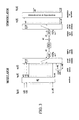
- FIG. 1 illustrates an OFDM transmitter in accordance with some embodiments of the invention.
- the OFDM transmitter comprises a data source 101 which provides user data to be transmitted over the air interface.
- the data source 101 may be any external or internal data source.
- the data source 101 is coupled to an LDPC processor 103 which is arranged to apply LDPC error correcting coding to the user data received from the data source 101.
- the LDPC processor 103 generates a number of LDPC codewords which are to be transmitted in the OFDM symbols.
- the person skilled in the art will be familiar with LDPC coding and it will be appreciated that any suitable method or algorithm for performing the LDPC coding may be used.
- the LDPC codeword is an irregular and systematic codeword.
- An irregular LDPC codeword is a codeword wherein at least some of the symbols have different node degrees (i.e. are included in a different number of parity check equations).
- a systematic LDPC codeword is a codeword wherein at least some of the original user data symbols are directly included in the parity check equations.
- the LDPC processor 103 is coupled to a mapping processor 105 which is fed the LDPC codewords.
- the mapping processor 105 is arranged to map the individual data symbols of the LDPC codeword to specific subcarriers of the OFDM symbols which are transmitted over the air interface.
- the mapping processor 105 is coupled to an OFDM Radio Frequency (RF) transmitter 107 which transmits the OFDM symbols over the air interface to one a more receivers.
- RF Radio Frequency
- the OFDM RF transmitter 107 is arranged to transmit in accordance with the technical specifications for IEEE802.11n.
- the OFDM transmitter 100 furthermore comprises a channel estimator 109 which is coupled to the OFDM RF transmitter 107 and the mapping processor 105.
- the channel estimator 109 is arranged to generate a channel estimate of the propagation channel between the OFDM transmitter 100 and the receiver. Specifically, the channel estimator 109 generates individual sub channel estimates for each of the subcarriers of the OFDM symbols in the form of a channel coefficient for the carrier. Thus, a complex data symbol transmitted from the OFDM transmitter 100 will be received as a complex symbol corresponding to the transmitted symbol multiplied by the channel coefficient for the subcarrier.
- the mapping processor 105 does not simply perform a pseudo-random and/or predetermined mapping between LDPC symbols and OFDM subcarriers. Rather, the mapping processor 105 is arranged to map the symbols of the LDPC codeword to the plurality of subcarriers in response to both a channel estimate of the propagation channel between the OFDM transmitter and a receiver as well as in response to the variable node degree for the individual symbols.
- variable node degree is the number of connections leaving from a data node (i.e. variable node degree of the "i"th data bit corresponds to the number of 1s in the "i"th column of the LDPC matrix (often called "H matrix").
- a check node degree of the "i"th check equation corresponds to the number of 1s in the "i"th row of the LDPC matrix (often called "H matrix").
- the mapping processor 105 is arranged to map the LDPC symbols to subcarriers such that the symbols which have a higher effect on the decoding performance are mapped to subcarriers for which the channel estimate indicates that a higher quality channel is present.
- the channel estimator 109 can generate a single channel coefficient for each of the subcarriers of the OFDM symbols. The absolute value of this channel coefficient can then be obtained and used as an indication of the estimated gain and thus attenuation for the transmissions in this specific subcarrier. Hence, the absolute value of the channel coefficients of the individual subcarriers provides a good indication of the quality of the propagation channel for that subcarrier.
- a signal to noise ratio can be determined for each subcarrier and an increasing channel quality can be considered to be indicated by an increasing signal to noise ratio.
- the channel estimator 109 feeds the mapping processor 105 a channel quality indication for each subcarrier in the form of the gain measure determined as the absolute value of the estimated channel coefficient
- the mapping processor 105 then proceeds to map the symbols of the LDPC codeword to the different subcarriers taking this channel quality indication into account.
- mapping processor 105 is arranged to map the LDPC symbols such that LDPC data symbols are allocated to subcarriers having higher channel quality indications then the LDPC redundancy symbols.
- the codeword comprises the original user data to be transmitted as well as a number of redundancy symbols which are determined by the LDPC processor 103 such that the parity checks equals zero.
- the mapping processor 105 can first select the N subcarriers with the best channel quality indications (e.g. with the highest absolute value of the channel coefficients) and can map the N data symbols to these subcarriers. It can then select the M subcarriers having the next highest channel quality indications and map the M redundancy symbols to these.
- the mapping processor 105 is arranged to bias the mapping of LDPC data symbols towards subcarriers having better channel quality indications and to bias the mapping of LDPC redundancy symbols towards subcarriers having worse channel quality indications.
- the mapping processor 105 furthermore maps the LDPC symbols of the LDPC codeword in response to the variable node degree of the individual symbol.
- the variable node degree corresponds to the number of ones in the column of the LDPC encoding matrix for this specific symbol of the codeword. This is equivalent to the number of parity checks in which the individual symbol is included.
- the mapping processor 105 maps the symbols such that the LDPC symbols with lower variable node degrees are biased towards the subcarriers having better channel quality indications (e.g. the higher absolute values of the channel coefficients). For example, if the LDPC codeword comprises K symbols having a variable node degree of X, and L symbols having a variable node degree of Y where X ⁇ Y, the mapping processor 105 can first select the K subcarriers having the highest channel quality indication and map the K symbols with variable node degree of X to these. It can then proceed to select the next L subcarriers and map the L symbols with variable node degree of Y to these.
- the mapping processor 105 first maps the symbols depending on the type of symbol (e.g. whether it is a data/redundancy symbol) and then maps depending on the variable node degree.
- the mapping processor 105 first divides the subcarriers into a first set of N subcarriers and a second set of M subcarriers where the first set of subcarriers have channel estimates indicative of a higher channel quality than the channel estimates of the second set of subcarriers.
- the LDPC data symbols are then allocated to the N subcarriers of the first set and the LDPC redundancy symbols are allocated to the M subcarriers of the second set.
- the mapping processor 105 then maps the symbols of the set to the subcarriers depending on the variable node degree of the symbols. For example, the LDPC data symbols of the first set can be ordered in accordance with the variable node degree and the symbols having the lowest variable node degree are mapped to the subcarriers having the highest channel quality indication. The symbols having the next lowest variable node degree are then mapped to the unallocated subcarriers having the highest channel quality indication and so on. The same approach can then be applied to the redundancy symbols of the second set.
- the OFDM transmitter 100 of FIG. 1 provides a low complexity yet highly efficient mapping of LDPC codeword symbols to individual subcarriers such that the performance for the specific channel conditions currently experienced can be optimised resulting in reduced error rates and improved performance of the communication system as a whole.
- FIG. 2 illustrates an OFDM receiver 200 in accordance with some embodiments of the invention.
- the OFDM receiver 200 is arranged to receive the communication from the OFDM transmitter 100.
- the OFDM receiver 200 comprises an OFDM RF receiver 201 which receives the OFDM symbols from the OFDM transmitter 100.
- the OFDM RF receiver 201 is coupled to a receive mapping processor 203 which is arranged to perform the inverse mapping by the OFDM transmitter 100.
- the receive mapping processor 203 maps the subcarriers of the received OFDM symbols to the appropriate places in the LDPC codeword.
- the OFDM RF receiver 201 is furthermore coupled to a received channel estimator 207 which generates channel estimate information corresponding to that used by the mapping processor 105 of the OFDM transmitter 100.
- the received channel estimator 209 generates an absolute value of estimated channel coefficients for the individual subcarriers of the propagation channel from the OFDM transmitter 100 to the OFDM receiver 200.
- the LDPC codeword generated by the receive mapping processor 203 is then fed to an LDPC decoder 205 which performs LDPC decoding in accordance with any suitable algorithm or method.
- Various algorithms for LDPC decoding are well known to the person skilled in the art and will not be described further herein.
- a low complexity receiver is provided which is arranged to perform the inverse operations of the described techniques for the OFDM transmitter 100.
- the system may operate in a closed loop configuration wherein the OFDM receiver 200 generates channel estimates for the individual subcarriers of the received OFDM symbols from the transmitter 100.
- the OFDM receiver 200 can determine the channel coefficients for the propagation channel from the OFDM transmitter 100 to the OFDM receiver 200 in response to known data embedded in the OFDM symbols (i.e. from training data).
- the OFDM receiver 200 further comprise transmitter means which are arranged to transmit the determined channel coefficients back to the OFDM transmitter 100. This will provide for a low complexity and robust way of determining the channel estimates for the propagation channel as well as automatically ensuring that the same channel information is used for both the transmit and receive mapping.
- the OFDM transmitter 100 independently determines suitable channel estimates and transmits explicit mapping information to the OFDM receiver 200.
- the OFDM receiver 200 can then use this mapping information as the channel estimates that are used to control the mapping performed by the receive mapping processor 203.
- the OFDM transmitter 100 can transmit e.g. the actual channel coefficients used for the mapping process or can transmit other information that allows the receiver to perform the inverse mapping.
- the mapping information may be an explicit indication of which LDPC symbols are allocated to which subcarriers and this information can be directly used by the receive mapping processor 203.
- the channel estimates used by the receive mapping processor 203 need not be explicit channel estimates but can be indirect indications of the mapping (and thus channel estimates) used by the mapping processor 105 of the OFDM transmitter 100.
- the OFDM transmitter 100 and/or the OFDM receiver 200 can exploit reciprocity between propagation channels from the OFDM transmitter 100 to the OFDM receiver 200 and from the OFDM receiver 200 to the OFDM transmitter 100.
- the OFDM transmitter 100 can be part of a first transceiver communicating with a second transceiver comprising the OFDM receiver 200 using a time division duplex scheme wherein the two transceivers take turns in transmitting to the other transceiver.
- the propagation channels in the two directions are reciprocal and thus the two transceivers can determine propagation characteristics and channel estimates from the signals received from the other transceiver. These locally determined estimates can then be used for both the transmit and receive mapping of the individual transceiver.
- the receiver 200 can comprise means for determining the mapping information which is to be used by the transmitter. This, information can then be transmitted back to the transmitter 100 where it can be applied by the mapping processor 105.
- the communication of the mapping information can be achieved by an indication of a selected mapping scheme out of a number of predetermined mapping schemes. This, a limited number of predefined mappings can be used where the receiver 200 can simply select the most appropriate mapping scheme.
- the LDPC codewords can be mapped to a plurality of OFDM symbols.
- an LDPC codeword can comprise 2N symbols where N is the number of subcarriers of each OFDM symbol used for user data communication.
- the mapping processor 105 can map the 2N symbols to two OFDM symbols. This mapping can be such that the 2N effective subcarriers of the two OFDM symbols are considered as a single homogenous pool of subcarriers to which the mapping processor 105 can freely map the LDPC symbols.
- the LDPC data symbols can be mapped to the best subcarriers across the two symbols and the redundancy symbols can be mapped to the worst subcarriers across the two symbols.
- the system is applicable to systems using multiple transmit and receive transmitters. Such systems are generally known as Multiple In Multiple Out (MIMO) systems.
- MIMO Multiple In Multiple Out
- the mapping processor 105 can map the LDPC symbols to the subcarriers of the different antennas depending on the individual channel estimate for the individual antenna.
- the OFDM system is designed such that the postfix duration exceeds the channel memory L ⁇ D.
- C ISI ( P ) and C IBI ( P ) be respectively the Toeplitz inferior and superior triangular matrices of first column: [ c 0 ,c 1 ,...,c L , 0 , ⁇ , 0] T and first row [0, ⁇ ,0, c L ,...,c 1 ].
- the user data transmitted by the OFDM symbols are coded by an LDPC code.
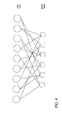
- This representation helps to identify cycles of length v which is a path comprising v edges closing back on itself.
- An important code design parameter is the girth of a graph: it defines the minimum cycle length of a graph and should be as large as possible (note that the optimization of LDPC codes is typically performed under the local tree assumption, i.e. the girth is assumed to be large enough such that the sub-graph forms a tree and the incoming messages to every node are therefore independent).
- t c,max (t r,max ) is the maximum variable node degree of data nodes (check nodes).
- x 1 p ⁇ r
- x - 1 are the output messages of variable node where x is the bit value of the corresponding node.
- x ′ 1 p ⁇ r ′
- x ′ - 1 where x' is the bit value of the variable node arriving from the check node and r' contains all information available to a check node up to the present iteration.
- x' is the bit value of the variable node arriving from the check node and r' contains all information available to a check node up to the present iteration.
- the u messages are then recalculated based on the so-called tanh rule [ref.: J. Hagenauer, E. Offer, and L. Papke. Iterative decoding of binary block and convolutional codes. IEEE Transactions on Information Theory, 42:429-445, 1996 and C. R. Hartmann and L. D. Rudolph. An optimum symbol-by-symbol decoding rule for linear codes.
- the upper algorithm maps the redundancy bits onto the sub-carriers with the greatest attenuation by the propagation channel.
- the data bits are mapped onto the subcarriers with the smallest attenuation by the propagation channel.
- the nodes with the highest variable node degree are attributed to the weakest carriers within the sub-set and the nodes with the lowest variable node degree are attributed to the strongest carriers within the sub-set. This is illustrated in FIG.
- the corresponding assignment of code-word bits to carriers can be communicated from the transmitter to the receiver in order to enable the receiver to decode the data.
- Simulations have confirmed that the described approach can provide substantial performance improvements over conventional systems. Specifically, simulations have been performed for an IEEE802.11n system showing that a performance improved of around 1.5 dB can be achieved as illustrated in FIG. 5
- Theorem C .1 ⁇ - 1 1 - 1 2 ⁇ 1 - ⁇ ⁇ m u 0 c k + ⁇ + 1 - ⁇ ⁇ m u 0 c k - ⁇ j - 1 ⁇ ⁇ - 1 1 - 1 - ⁇ m u 0 c k j - 1 for ⁇ > 0 and m u 0 c k > 0.
- ⁇ k ⁇ 2 if carrier k carries 2 ⁇ data bits 1 if carrier k carries 1 ⁇ data bits 0 if carrier k carries 2 ⁇ redundancy bits
- the mapping relating the OFDM carriers to the LDPC code-words can be cyclically shifted. This may be particularly suitable for situations wherein significantly varying channel coefficients are experienced.
- point v) "Defining ( ⁇ ) F as an operator that reads a vector in inverse order " will be modified in the following way: Instead of using the pointer vector " u w K Data F " directly a cyclically shifted version (cyclically shifted by any number z ⁇ (1,..., K -1)) is used. Thus " u w K Data F " can be replaced by a vector whose first element is the zth element of u w K Data F (i.e.
- u w K Data F z ) , followed by u w K Data F z + 1 , ... , u w K Data F K - 1 , u w K Data F 0 , u w K Data F 1 , ... , u w K Data F z - 1 .
- a corresponding permutation is performed on the redundancy pointer vector u w Z Red F too.
- the optimum z can be found by empirical means and specifically by trial and error using different values of z.
- mapping controller 105 mapping LDPC symbols having higher variable node degrees to subcarriers having higher estimated channel quality and mapping LDPC symbols having lower variable node degrees to subcarriers having lower estimated channel quality.
- the inverse order to that proposed above is used which can be achieved by not applying the flip operator (i.e. the "() F " operator in the above algorithm.
- the invention can be implemented in any suitable form including hardware, software, firmware or any combination of these.
- the invention may optionally be implemented at least partly as computer software running on one or more data processors and/or digital signal processors.
- the elements and components of an embodiment of the invention may be physically, functionally and logically implemented in any suitable way. Indeed the functionality may be implemented in a single unit, in a plurality of units or as part of other functional units. As such, the invention may be implemented in a single unit or may be physically and functionally distributed between different units and processors.
Landscapes
- Engineering & Computer Science (AREA)
- Signal Processing (AREA)
- Computer Networks & Wireless Communication (AREA)
- Quality & Reliability (AREA)
- Mobile Radio Communication Systems (AREA)
Priority Applications (1)
| Application Number | Priority Date | Filing Date | Title |
|---|---|---|---|
| EP05292370A EP1783942A1 (fr) | 2005-11-08 | 2005-11-08 | Codage de contrôle de parité de faible densité pour systèmes de communication de multiplexage par répartition en fréquences orthogonales |
Applications Claiming Priority (1)
| Application Number | Priority Date | Filing Date | Title |
|---|---|---|---|
| EP05292370A EP1783942A1 (fr) | 2005-11-08 | 2005-11-08 | Codage de contrôle de parité de faible densité pour systèmes de communication de multiplexage par répartition en fréquences orthogonales |
Publications (1)
| Publication Number | Publication Date |
|---|---|
| EP1783942A1 true EP1783942A1 (fr) | 2007-05-09 |
Family
ID=35768638
Family Applications (1)
| Application Number | Title | Priority Date | Filing Date |
|---|---|---|---|
| EP05292370A Withdrawn EP1783942A1 (fr) | 2005-11-08 | 2005-11-08 | Codage de contrôle de parité de faible densité pour systèmes de communication de multiplexage par répartition en fréquences orthogonales |
Country Status (1)
| Country | Link |
|---|---|
| EP (1) | EP1783942A1 (fr) |
Cited By (3)
| Publication number | Priority date | Publication date | Assignee | Title |
|---|---|---|---|---|
| WO2009084926A1 (fr) * | 2008-01-03 | 2009-07-09 | Lg Electronics Inc. | Procédé de mappage de symbole pour le codage par répétition de canaux |
| RU2506705C2 (ru) * | 2008-01-25 | 2014-02-10 | Эл Джи Электроникс Инк. | Устройство для передачи и приема сигнала и способ передачи и приема сигнала |
| WO2024261050A1 (fr) * | 2023-06-22 | 2024-12-26 | Orange | Procédé et dispositif de transmission d'une trame de données en ofdm |
Citations (2)
| Publication number | Priority date | Publication date | Assignee | Title |
|---|---|---|---|---|
| US20030203721A1 (en) * | 2002-04-25 | 2003-10-30 | Raytheon Company | Adaptive air interface waveform |
| US20050034053A1 (en) * | 2003-08-08 | 2005-02-10 | Jacobsen Eric A. | Adaptive bit loading with low density parity check forward error correction |
-
2005
- 2005-11-08 EP EP05292370A patent/EP1783942A1/fr not_active Withdrawn
Patent Citations (2)
| Publication number | Priority date | Publication date | Assignee | Title |
|---|---|---|---|---|
| US20030203721A1 (en) * | 2002-04-25 | 2003-10-30 | Raytheon Company | Adaptive air interface waveform |
| US20050034053A1 (en) * | 2003-08-08 | 2005-02-10 | Jacobsen Eric A. | Adaptive bit loading with low density parity check forward error correction |
Non-Patent Citations (1)
| Title |
|---|
| YOSHIMOCHI N ET AL: "LDPC coded unitary space-time modulated OFDM system in broadband mobile channel", ELECTRONICS LETTERS, IEE STEVENAGE, GB, vol. 39, no. 13, 26 June 2003 (2003-06-26), pages 994 - 995, XP006020567, ISSN: 0013-5194 * |
Cited By (15)
| Publication number | Priority date | Publication date | Assignee | Title |
|---|---|---|---|---|
| US9386567B2 (en) | 2008-01-03 | 2016-07-05 | Optis Cellular Technology, Llc | Symbol mapping method for repetition channel coding |
| US8391405B2 (en) | 2008-01-03 | 2013-03-05 | Lg Electronics Inc. | Symbol mapping method for repetition channel coding |
| US11356982B2 (en) | 2008-01-03 | 2022-06-07 | Optis Cellular Technology, Llc | Symbol mapping method for repetition channel coding |
| WO2009084926A1 (fr) * | 2008-01-03 | 2009-07-09 | Lg Electronics Inc. | Procédé de mappage de symbole pour le codage par répétition de canaux |
| KR101387534B1 (ko) * | 2008-01-03 | 2014-04-21 | 엘지전자 주식회사 | 반복 채널 코딩을 위한 심볼 매핑 방법 |
| US8787492B2 (en) | 2008-01-03 | 2014-07-22 | Lg Electronics Inc. | Symbol mapping method for repetition channel coding |
| US9967864B2 (en) | 2008-01-03 | 2018-05-08 | Optis Cellular Technology, Llc | Symbol mapping method for repetition channel coding |
| US9706531B2 (en) | 2008-01-03 | 2017-07-11 | Optis Cellular Technology, Llc | Symbol mapping method for repetition channel coding |
| US8694875B2 (en) | 2008-01-25 | 2014-04-08 | Lg Electronics Inc. | Apparatus for transmitting and receiving a signal and method of transmitting and receiving a signal |
| US9300327B2 (en) | 2008-01-25 | 2016-03-29 | Lg Electronics Inc. | Apparatus for transmitting and receiving a signal and method of transmitting and receiving a signal |
| US9847795B2 (en) | 2008-01-25 | 2017-12-19 | Lg Electronics Inc. | Apparatus for transmitting and receiving a signal and method of transmitting and receiving a signal |
| US9043687B2 (en) | 2008-01-25 | 2015-05-26 | Lg Electronics Inc. | Apparatus for transmitting and receiving a signal and method of transmitting and receiving a signal |
| RU2506705C2 (ru) * | 2008-01-25 | 2014-02-10 | Эл Джи Электроникс Инк. | Устройство для передачи и приема сигнала и способ передачи и приема сигнала |
| WO2024261050A1 (fr) * | 2023-06-22 | 2024-12-26 | Orange | Procédé et dispositif de transmission d'une trame de données en ofdm |
| FR3150379A1 (fr) * | 2023-06-22 | 2024-12-27 | Orange | Procédé et dispositif de transmission d’une trame de données en OFDM |
Similar Documents
| Publication | Publication Date | Title |
|---|---|---|
| US10097205B2 (en) | Transmission device, reception device, transmission method, and reception method for suppressing the degrading of decoding performance due to combinations of eliminations at the bit level | |
| US7581159B2 (en) | Simplified decoding using structured and punctured LDPC codes | |
| US7668248B2 (en) | High-performance LDPC coding for digital communications in a multiple-input, multiple-output environment | |
| US7668224B2 (en) | Encoding for digital communications in a multiple-input, multiple-output environment | |
| US12155475B2 (en) | Method and apparatus for encoding/decoding channel in communication or broadcasting system | |
| US7376173B2 (en) | Unambiguously encoding and decoding signals for wireless channels | |
| US8423871B2 (en) | Transmitting device and transmitting method | |
| US20110320920A1 (en) | Coding apparatus, receiving apparatus, wireless communication system, puncturing pattern selecting method and program thereof | |
| KR20130020893A (ko) | 네트워크 코딩을 사용하는 ofdm 시스템에서 피크 전력 대 평균 전력비, 큐빅 메트릭 및 블록 에러율을 줄이는 방법 | |
| KR20210030848A (ko) | 통신 또는 방송 시스템에서 데이터 복호화 방법 및 장치 | |
| KR20190017594A (ko) | 통신 또는 방송 시스템에서 채널 부호화/복호화 방법 및 장치 | |
| Barzegar et al. | Channel Coding for Multi‐Carrier Wireless Partial Duplex | |
| US11258554B1 (en) | Method and apparatus for sequentially detecting and decoding sparse code multiple access signal for multiple users | |
| Peng et al. | WLC45-2: Application of nonbinary LDPC codes for communication over fading channels using higher order modulations | |
| EP1783942A1 (fr) | Codage de contrôle de parité de faible densité pour systèmes de communication de multiplexage par répartition en fréquences orthogonales | |
| US20080008231A1 (en) | Communications system | |
| Al-Rawi et al. | An iterative receiver for coded OFDM systems over time-varying wireless channels | |
| Yin | Error performance of coded AFDM systems in doubly selective channels | |
| KR20190017600A (ko) | 통신시스템에서 효율적인 데이터 송수신 방법 및 장치 | |
| Muck et al. | Reconfigurable low density parity check (LDPC) code interleaving for SIO and MIMO OFDM systems | |
| Kahveci | Performance analysis of zigzag-coded modulation scheme for WiMAX systems | |
| Dziwoki et al. | Subchannel ordering scheme for LDPC-coded OFDM transmission over selective channels | |
| Raut et al. | Performance Improvement of WIMAX with FEC Zigzag Code Using MIMO Technique | |
| Healy et al. | Study of Structured Root-LDPC Codes and PEG Techniques for Block-Fading Channels | |
| Che et al. | Performance of Low Density Parity Check Code Applied in WiBro System |
Legal Events
| Date | Code | Title | Description |
|---|---|---|---|
| PUAI | Public reference made under article 153(3) epc to a published international application that has entered the european phase |
Free format text: ORIGINAL CODE: 0009012 |
|
| AK | Designated contracting states |
Kind code of ref document: A1 Designated state(s): AT BE BG CH CY CZ DE DK EE ES FI FR GB GR HU IE IS IT LI LT LU LV MC NL PL PT RO SE SI SK TR |
|
| AX | Request for extension of the european patent |
Extension state: AL BA HR MK YU |
|
| 17P | Request for examination filed |
Effective date: 20071109 |
|
| 17Q | First examination report despatched |
Effective date: 20071217 |
|
| AKX | Designation fees paid |
Designated state(s): AT BE BG CH CY CZ DE DK EE ES FI FR GB GR HU IE IS IT LI LT LU LV MC NL PL PT RO SE SI SK TR |
|
| STAA | Information on the status of an ep patent application or granted ep patent |
Free format text: STATUS: THE APPLICATION IS DEEMED TO BE WITHDRAWN |
|
| 18D | Application deemed to be withdrawn |
Effective date: 20080429 |