EP1785272B1 - Panneau léger et méthode pour sa fabrication - Google Patents
Panneau léger et méthode pour sa fabrication Download PDFInfo
- Publication number
- EP1785272B1 EP1785272B1 EP05020836A EP05020836A EP1785272B1 EP 1785272 B1 EP1785272 B1 EP 1785272B1 EP 05020836 A EP05020836 A EP 05020836A EP 05020836 A EP05020836 A EP 05020836A EP 1785272 B1 EP1785272 B1 EP 1785272B1
- Authority
- EP
- European Patent Office
- Prior art keywords
- rod
- building board
- attachment surface
- light building
- board according
- Prior art date
- Legal status (The legal status is an assumption and is not a legal conclusion. Google has not performed a legal analysis and makes no representation as to the accuracy of the status listed.)
- Expired - Lifetime
Links
Images



Classifications
-
- B—PERFORMING OPERATIONS; TRANSPORTING
- B29—WORKING OF PLASTICS; WORKING OF SUBSTANCES IN A PLASTIC STATE IN GENERAL
- B29C—SHAPING OR JOINING OF PLASTICS; SHAPING OF MATERIAL IN A PLASTIC STATE, NOT OTHERWISE PROVIDED FOR; AFTER-TREATMENT OF THE SHAPED PRODUCTS, e.g. REPAIRING
- B29C67/00—Shaping techniques not covered by groups B29C39/00 - B29C65/00, B29C70/00 or B29C73/00
- B29C67/0044—Shaping techniques not covered by groups B29C39/00 - B29C65/00, B29C70/00 or B29C73/00 for shaping edges or extremities
-
- B—PERFORMING OPERATIONS; TRANSPORTING
- B32—LAYERED PRODUCTS
- B32B—LAYERED PRODUCTS, i.e. PRODUCTS BUILT-UP OF STRATA OF FLAT OR NON-FLAT, e.g. CELLULAR OR HONEYCOMB, FORM
- B32B7/00—Layered products characterised by the relation between layers; Layered products characterised by the relative orientation of features between layers, or by the relative values of a measurable parameter between layers, i.e. products comprising layers having different physical, chemical or physicochemical properties; Layered products characterised by the interconnection of layers
- B32B7/04—Interconnection of layers
- B32B7/12—Interconnection of layers using interposed adhesives or interposed materials with bonding properties
-
- B—PERFORMING OPERATIONS; TRANSPORTING
- B32—LAYERED PRODUCTS
- B32B—LAYERED PRODUCTS, i.e. PRODUCTS BUILT-UP OF STRATA OF FLAT OR NON-FLAT, e.g. CELLULAR OR HONEYCOMB, FORM
- B32B3/00—Layered products comprising a layer with external or internal discontinuities or unevennesses, or a layer of non-planar shape; Layered products comprising a layer having particular features of form
- B32B3/02—Layered products comprising a layer with external or internal discontinuities or unevennesses, or a layer of non-planar shape; Layered products comprising a layer having particular features of form characterised by features of form at particular places, e.g. in edge regions
- B32B3/08—Layered products comprising a layer with external or internal discontinuities or unevennesses, or a layer of non-planar shape; Layered products comprising a layer having particular features of form characterised by features of form at particular places, e.g. in edge regions characterised by added members at particular parts
-
- B—PERFORMING OPERATIONS; TRANSPORTING
- B32—LAYERED PRODUCTS
- B32B—LAYERED PRODUCTS, i.e. PRODUCTS BUILT-UP OF STRATA OF FLAT OR NON-FLAT, e.g. CELLULAR OR HONEYCOMB, FORM
- B32B3/00—Layered products comprising a layer with external or internal discontinuities or unevennesses, or a layer of non-planar shape; Layered products comprising a layer having particular features of form
- B32B3/10—Layered products comprising a layer with external or internal discontinuities or unevennesses, or a layer of non-planar shape; Layered products comprising a layer having particular features of form characterised by a discontinuous layer, i.e. formed of separate pieces of material
- B32B3/12—Layered products comprising a layer with external or internal discontinuities or unevennesses, or a layer of non-planar shape; Layered products comprising a layer having particular features of form characterised by a discontinuous layer, i.e. formed of separate pieces of material characterised by a layer of regularly- arranged cells, e.g. a honeycomb structure
-
- E—FIXED CONSTRUCTIONS
- E04—BUILDING
- E04C—STRUCTURAL ELEMENTS; BUILDING MATERIALS
- E04C2/00—Building elements of relatively thin form for the construction of parts of buildings, e.g. sheet materials, slabs, or panels
- E04C2/30—Building elements of relatively thin form for the construction of parts of buildings, e.g. sheet materials, slabs, or panels characterised by the shape or structure
- E04C2/34—Building elements of relatively thin form for the construction of parts of buildings, e.g. sheet materials, slabs, or panels characterised by the shape or structure composed of two or more spaced sheet-like parts
- E04C2/36—Building elements of relatively thin form for the construction of parts of buildings, e.g. sheet materials, slabs, or panels characterised by the shape or structure composed of two or more spaced sheet-like parts spaced apart by transversely-placed strip material, e.g. honeycomb panels
- E04C2/365—Building elements of relatively thin form for the construction of parts of buildings, e.g. sheet materials, slabs, or panels characterised by the shape or structure composed of two or more spaced sheet-like parts spaced apart by transversely-placed strip material, e.g. honeycomb panels by honeycomb structures
-
- E—FIXED CONSTRUCTIONS
- E04—BUILDING
- E04C—STRUCTURAL ELEMENTS; BUILDING MATERIALS
- E04C2/00—Building elements of relatively thin form for the construction of parts of buildings, e.g. sheet materials, slabs, or panels
- E04C2/30—Building elements of relatively thin form for the construction of parts of buildings, e.g. sheet materials, slabs, or panels characterised by the shape or structure
- E04C2/38—Building elements of relatively thin form for the construction of parts of buildings, e.g. sheet materials, slabs, or panels characterised by the shape or structure with attached ribs, flanges, or the like, e.g. framed panels
- E04C2/386—Building elements of relatively thin form for the construction of parts of buildings, e.g. sheet materials, slabs, or panels characterised by the shape or structure with attached ribs, flanges, or the like, e.g. framed panels with a frame of unreconstituted or laminated wood
-
- B—PERFORMING OPERATIONS; TRANSPORTING
- B29—WORKING OF PLASTICS; WORKING OF SUBSTANCES IN A PLASTIC STATE IN GENERAL
- B29C—SHAPING OR JOINING OF PLASTICS; SHAPING OF MATERIAL IN A PLASTIC STATE, NOT OTHERWISE PROVIDED FOR; AFTER-TREATMENT OF THE SHAPED PRODUCTS, e.g. REPAIRING
- B29C65/00—Joining or sealing of preformed parts, e.g. welding of plastics materials; Apparatus therefor
- B29C65/48—Joining or sealing of preformed parts, e.g. welding of plastics materials; Apparatus therefor using adhesives, i.e. using supplementary joining material; solvent bonding
-
- B—PERFORMING OPERATIONS; TRANSPORTING
- B29—WORKING OF PLASTICS; WORKING OF SUBSTANCES IN A PLASTIC STATE IN GENERAL
- B29C—SHAPING OR JOINING OF PLASTICS; SHAPING OF MATERIAL IN A PLASTIC STATE, NOT OTHERWISE PROVIDED FOR; AFTER-TREATMENT OF THE SHAPED PRODUCTS, e.g. REPAIRING
- B29C65/00—Joining or sealing of preformed parts, e.g. welding of plastics materials; Apparatus therefor
- B29C65/56—Joining or sealing of preformed parts, e.g. welding of plastics materials; Apparatus therefor using mechanical means or mechanical connections, e.g. form-fits
-
- B—PERFORMING OPERATIONS; TRANSPORTING
- B29—WORKING OF PLASTICS; WORKING OF SUBSTANCES IN A PLASTIC STATE IN GENERAL
- B29C—SHAPING OR JOINING OF PLASTICS; SHAPING OF MATERIAL IN A PLASTIC STATE, NOT OTHERWISE PROVIDED FOR; AFTER-TREATMENT OF THE SHAPED PRODUCTS, e.g. REPAIRING
- B29C65/00—Joining or sealing of preformed parts, e.g. welding of plastics materials; Apparatus therefor
- B29C65/56—Joining or sealing of preformed parts, e.g. welding of plastics materials; Apparatus therefor using mechanical means or mechanical connections, e.g. form-fits
- B29C65/565—Joining or sealing of preformed parts, e.g. welding of plastics materials; Apparatus therefor using mechanical means or mechanical connections, e.g. form-fits involving interference fits, e.g. force-fits or press-fits
-
- B—PERFORMING OPERATIONS; TRANSPORTING
- B29—WORKING OF PLASTICS; WORKING OF SUBSTANCES IN A PLASTIC STATE IN GENERAL
- B29C—SHAPING OR JOINING OF PLASTICS; SHAPING OF MATERIAL IN A PLASTIC STATE, NOT OTHERWISE PROVIDED FOR; AFTER-TREATMENT OF THE SHAPED PRODUCTS, e.g. REPAIRING
- B29C66/00—General aspects of processes or apparatus for joining preformed parts
- B29C66/50—General aspects of joining tubular articles; General aspects of joining long products, i.e. bars or profiled elements; General aspects of joining single elements to tubular articles, hollow articles or bars; General aspects of joining several hollow-preforms to form hollow or tubular articles
- B29C66/51—Joining tubular articles, profiled elements or bars; Joining single elements to tubular articles, hollow articles or bars; Joining several hollow-preforms to form hollow or tubular articles
- B29C66/53—Joining single elements to tubular articles, hollow articles or bars
- B29C66/534—Joining single elements to open ends of tubular or hollow articles or to the ends of bars
- B29C66/5346—Joining single elements to open ends of tubular or hollow articles or to the ends of bars said single elements being substantially flat
-
- B—PERFORMING OPERATIONS; TRANSPORTING
- B29—WORKING OF PLASTICS; WORKING OF SUBSTANCES IN A PLASTIC STATE IN GENERAL
- B29C—SHAPING OR JOINING OF PLASTICS; SHAPING OF MATERIAL IN A PLASTIC STATE, NOT OTHERWISE PROVIDED FOR; AFTER-TREATMENT OF THE SHAPED PRODUCTS, e.g. REPAIRING
- B29C66/00—General aspects of processes or apparatus for joining preformed parts
- B29C66/70—General aspects of processes or apparatus for joining preformed parts characterised by the composition, physical properties or the structure of the material of the parts to be joined; Joining with non-plastics material
- B29C66/72—General aspects of processes or apparatus for joining preformed parts characterised by the composition, physical properties or the structure of the material of the parts to be joined; Joining with non-plastics material characterised by the structure of the material of the parts to be joined
- B29C66/725—General aspects of processes or apparatus for joining preformed parts characterised by the composition, physical properties or the structure of the material of the parts to be joined; Joining with non-plastics material characterised by the structure of the material of the parts to be joined being hollow-walled or honeycombs
- B29C66/7254—General aspects of processes or apparatus for joining preformed parts characterised by the composition, physical properties or the structure of the material of the parts to be joined; Joining with non-plastics material characterised by the structure of the material of the parts to be joined being hollow-walled or honeycombs honeycomb structures
-
- B—PERFORMING OPERATIONS; TRANSPORTING
- B29—WORKING OF PLASTICS; WORKING OF SUBSTANCES IN A PLASTIC STATE IN GENERAL
- B29L—INDEXING SCHEME ASSOCIATED WITH SUBCLASS B29C, RELATING TO PARTICULAR ARTICLES
- B29L2007/00—Flat articles, e.g. films or sheets
- B29L2007/002—Panels; Plates; Sheets
-
- B—PERFORMING OPERATIONS; TRANSPORTING
- B32—LAYERED PRODUCTS
- B32B—LAYERED PRODUCTS, i.e. PRODUCTS BUILT-UP OF STRATA OF FLAT OR NON-FLAT, e.g. CELLULAR OR HONEYCOMB, FORM
- B32B2305/00—Condition, form or state of the layers or laminate
- B32B2305/02—Cellular or porous
- B32B2305/024—Honeycomb
-
- B—PERFORMING OPERATIONS; TRANSPORTING
- B32—LAYERED PRODUCTS
- B32B—LAYERED PRODUCTS, i.e. PRODUCTS BUILT-UP OF STRATA OF FLAT OR NON-FLAT, e.g. CELLULAR OR HONEYCOMB, FORM
- B32B2607/00—Walls, panels
Definitions
- the invention relates to a lightweight board with a plate-shaped workpiece having two thin-walled cover layers and at least one arranged between the cover layers and bonded thereto core layer with lower density, preferably made of lightweight filler, and a method for processing a lightweight board.
- Lightweight panels of the type mentioned are used for example for the production of room doors, furniture elements, panel elements or the like.
- the thin-walled cover layers usually consist of a veneer, plastic or metal plate layer of low wall thickness, which is adhered to the outside of the core layer of lightweight filler.
- the invention is based on the idea to improve the quality and uniformity of the glue joint between the thin-walled cover layers and the rod-shaped element, which may be formed, for example, as a frame latch.
- the invention provides that in a generic method, the recess is introduced into the workpiece such that the attachment surface has at least one recess.
- the inventors have surprisingly found that the provision of at least one recess in a mounting surface significantly improves the uniformity of the glue distribution in the region of the attachment surface, resulting in a significantly better connection between the cover layers and the respective rod-shaped element (in particular frame tie).
- a lightweight board with significantly increased stability and durability.
- the dimensional accuracy of the lightweight board can be improved because the glue can at least partially dodge into the at least one depression and thus hardly affects the fit between bars and cover layers.
- the at least one recess in the context of the present invention may additionally be provided in the respective rod-shaped element in such a way that it faces the corresponding attachment surface. It is also conceivable in the context of the present invention that the rod-shaped element has a tapered cross section, wherein the narrower side of the cross section is arranged on the inside of the recess. In this way, very different cavities between the rod-shaped element and the respective cover layers for receiving and distributing the adhesive can be created in order to achieve or enhance the abovementioned advantages.
- adhesive is provided in the at least one depression.
- the at least one depression serves in this way as an adhesive reservoir, through which the adhesive is coated with adhesive when inserting a rod-shaped element into the respective recess, so that a uniform distribution of the adhesive results.
- the at least one recess can be provided in the context of the present invention in various ways. According to a development of the present invention, however, it is provided that the at least one recess comprises at least one longitudinal groove which extends continuously or discontinuously in the longitudinal direction of the rod-shaped element. This ensures that the rod-shaped element is adequately provided with adhesive along its entire length, so that the stability and durability of the manufactured lightweight board can be further increased.
- the at least one depression in the direction of insertion of the rod-shaped element is provided with an increasing depth and preferably thereafter with a decreasing depth.
- the attachment surface adjacent to the free edge of the workpiece and / or adjacent to the core layer a Has area that is free of depressions. At this recess-free area, the respective rod-shaped element can lie flat, so that it is held stable and results in an intimate connection.
- the attachment surface is formed such that it rests from the region of the at least one recess with little play on the rod-shaped element. This results in a particularly stable and durable lightweight board when the mounting surface rests against the rod-shaped element in a press fit.
- the plate-shaped workpieces serving as starting material from the outset in a desired size.
- a particularly economical method is obtained if the plate-shaped workpieces are pre-produced large format according to a development of the present invention, and then the respective plate-shaped workpieces are sawn out with the desired size from the large-sized plate-shaped workpiece.
- the present invention provides a lightweight board having the features of claim 10, which has a very high stability and durability by providing at least one recess in a mounting surface.
- Advantageous embodiments of this lightweight board are defined in claims 11 to 17, wherein reference may be made to the above statements with regard to the advantages and effects achieved thereby.
- the basic structure of a known lightweight panel 1, on which the present invention is based, is in Fig. 4 schematically shown in a perspective view.
- the lightweight board 1 comprises two thin-walled cover layers 3, 5, which may consist for example of wood, wood substitutes, plastic, metal or other suitable materials.
- the cover layers can also be designed in multiple layers.
- a core layer 7 is arranged with a lower density, preferably made of lightweight filler material and bonded to the cover layers.
- the core layer 7 has a honeycomb structure in the present embodiment, and will have a high void content in most applications, although the present invention is not limited thereto. Rather, the core layer can also consist of a same or similar material as the cover layers and only have a lower density. Under this condition, an integral training of cover layers and core layer is possible.
- each frame bolt 9' for example, made of wood, wood substitutes, plastic, metal or the like and are connected to the thin-walled cover layers 3, 5 via an adhesive.
- the present invention is particularly concerned with the formation of the connections of the bars 9 'with the thin-walled cover layers 3, 5 in the region of an attachment surface.
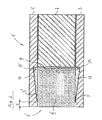
- a first preferred embodiment of the present invention is disclosed in Fig. 1 schematically shown in a sectional view.
- lightweight panel 1 is based on in Fig. 4 shown lightweight board, so that a repeated description of the same components is dispensed with and only the differences from the prior art are worked out.
- the thin-walled cover layers 3, 5 on its inner side in each case an attachment surface 3 ', 5', which is provided with the respective latch 9 'to be connected via an adhesive 13.
- the longitudinal grooves 15 ' are provided in the present embodiment, which in the longitudinal direction of the bolt 9' (ie perpendicular to the plane in FIG Fig. 1 ).
- the longitudinal grooves 15 ' may be formed continuously or discontinuously. Between or adjacent to the longitudinal grooves 15 'depressions 15 are provided which have a smaller depth than the longitudinal grooves 15'.
- only the area of the attachment surfaces 3 ', 5' marked X has no depressions 15 or 15 '.
- the region X is designed such that it bears against the latch 9 ', preferably in a press fit.
- an adhesive 13 is provided, which may be, for example, an EVA, PVAc or PU adhesive.
- a plate-shaped workpiece which comprises two thin-walled cover layers 3, 5 and a core layer 7 of light filler material arranged between them and bonded thereto.
- This plate-shaped workpiece can on the one hand be manufactured from the outset with the desired dimensions, or can be sawn out of a large-sized workpiece with the desired dimensions.
- a recess 9 is introduced into a narrow surface 1 'or into all narrow surfaces 1' of the plate-shaped workpiece, for example by milling.
- the recess 9 extends both into the core layer 7 and into the two thin-walled cover layers 3, 5 and is provided such that the attachment surfaces 3 ', 5' are each provided with the recesses 15 and longitudinal grooves 15 '.
- the adhesive 13 is provided at least in the longitudinal grooves 15 ', which serve as "adhesive reservoir" in the present embodiment, to then introduce the respective latch 9' in the recess 9, in Fig. 1 in one direction from left to right.
- the surface of the bolt 9 ' sweeps along the adhesive 13, which is provided at least in the longitudinal grooves 15'.
- the surface of the bolt 9 ' is coated with the adhesive 13, so that a uniform adhesive distribution between the bolt 9 and the thin-walled cover layers 3, 5 in the region of the attachment surface 3', 5 'results.
- FIG. 2 A second preferred embodiment of the lightweight building panel 1 according to the invention is shown in FIG Fig. 2 also shown in a partial sectional view.
- the embodiment shown differs from that in FIG Fig. 1
- these are formed by being wedge-shaped with an increasing depth in the direction of insertion of the bolt 9 ', and the present invention is not limited to a wedge shape and various shapes with continuously or discontinuously increasing depth are possible.
- the recesses 15 in Fig. 2 (and also in the following Fig. 3 ) is shown greatly exaggerated.
- the recesses 15 extend from an area X, which is free of depressions and is provided to a likewise recess-free surface of the Riegel's 9 'lie, with little play, especially in the press fit.
- the depressions 15 in the present embodiment are substantially completely filled with adhesive, although in the context of the present invention they may also be only partially filled with adhesive.
- the adhesive provided in the depressions 15 results in not only a uniform, but also a form-locking adhesive connection between the latch 9 'and the thin-walled cover layers 3, 5.
- the recess-free region X which preferably provides an interference fit with the latch 9' is formed, that the bolt 9 'assumes a well-defined position even before the curing of the adhesive 15, and thus contributes to an increased stability of the lightweight panel 1 according to the invention.
- FIG. 3 A third embodiment of the present invention is disclosed in Fig. 3 shown in a partial sectional view.
- the embodiment shown differs from that in FIG Fig. 2 shown embodiment in that the recesses 15 in the direction of insertion of the bolt 9 ', ie from left to right in Fig. 3 , initially provided with an increasing depth and thereafter with a decreasing depth. This reduces the amount of adhesive required without appreciably affecting the bond and form-fitting properties.
- a further recess-free region X is provided which adjoins the core layer 7 (on the right in FIG Fig.
- the bolt 9 ' is held particularly stable, both before and after the curing of the adhesive 15. It is particularly preferred that the bolt 9' has a fit Y, which is tuned to that the bolt press-fits against the areas X of the cover layers 3, 5.
- a recess may be provided in the respective latch 9 'corresponding to the corresponding attachment surface 3', 5 '. is facing and can achieve the same effects as described above.
- the respective bars 9 ' may also have a tapered cross section, wherein the narrower side of the cross section is arranged in this case on the inside of the recess 9.
Landscapes
- Engineering & Computer Science (AREA)
- Architecture (AREA)
- Civil Engineering (AREA)
- Structural Engineering (AREA)
- Mechanical Engineering (AREA)
- Laminated Bodies (AREA)
- Finishing Walls (AREA)
Claims (17)
- Procédé de fabrication d'un panneau léger (1), comprenant les étapes consistant à :fournir une pièce d'oeuvre en forme de plaque, comprenant deux couches de couverture (3, 5) à paroi mince et au moins une couche de noyau (7), disposée entre les couches de couverture et collée à celles-ci, la couche de noyau ayant une masse volumique plus faible et étant réalisée de préférence en un matériau de remplissage léger,ménager un évidement (9) dans une face étroite (1') de la pièce d'oeuvre en forme de plaque, l'évidement pénétrant dans la au moins une couche de noyau (7) et dans au moins une couche de couverture (3, 5) à paroi mince, faisant qu'une face d'application (3', 5'), pour le montage d'un élément (9') en forme de barre, est définie sur au moins une couche de couverture (3, 5) à paroi mince,prévoir un moyen d'adhésion (13) sur la au moins une face d'application (3', 5'),insérer l'élément (9') en forme de barre dans l'évidement (9), de manière qu'il soit relié à la pièce d'oeuvre en forme de plaque, dans la zone de la face d'application (3', 5'), par l'intermédiaire du moyen d'adhésion (13),caractérisé en ce quel'évidement (9) est inséré dans la pièce d'oeuvre, de manière que la face d'application (3', 5') présente au moins une cavité (15, 15').
- Procédé de fabrication d'un panneau léger selon la revendication 1, caractérisé en ce qu'au moins une cavité, tournée vers la face d'application, est ménagée dans l'élément en forme de barre.
- Procédé de fabrication d'un panneau léger selon la revendication 1 ou 2, caractérisé en ce qu'un moyen d'adhésion (13) est prévu dans la au moins une cavité (15, 15').
- Procédé de fabrication d'un panneau léger selon l'une des revendications précédentes, caractérisé en ce que la au moins une cavité comprend au moins une rainure longitudinale (15'), s'étendant, de façon continue ou discontinue, dans la direction longitudinale de l'élément (9') en forme de barre.
- Procédé de fabrication d'un panneau léger selon l'une des revendications précédentes, caractérisé en ce que la au moins une cavité (15) est prévue avec une profondeur allant en augmentant en évoluant dans la direction de l'insertion de l'élément (9') en forme de barre, et, de préférence, avec une profondeur qui diminue ensuite.
- Procédé de fabrication d'un panneau léger selon l'une des revendications précédentes, caractérisé en ce que la face d'application (3', 5') présente, au voisinage du bord libre de la pièce d'oeuvre et/ou au voisinage de la couche de noyau (7), une zone (X) exempte de cavités.
- Procédé de fabrication d'un panneau léger selon l'une des revendications précédentes, caractérisé en ce que la face d'application (3', 5') est prévue de manière que, hormis dans la zone de la au moins une cavité, elle appuie avec un faible jeu, en particulier dans un ajustement avec serrage, sur l'élément (9') en forme de barre.
- Procédé de fabrication d'un panneau léger selon l'une des revendications précédentes, caractérisé en ce que la pièce d'oeuvre en forme de plaque est fournie en l'extrayant par sciage, à partir d'une pièce d'oeuvre en forme de plaque de grand format.
- Procédé de fabrication d'un panneau léger selon l'une des revendications précédentes, caractérisé en ce que l'élément en forme de barre présente une section transversale allant en s'effilant, le côté plus étroit de la section transversale étant disposé sur la face intérieure de l'évidement (9).
- Panneau léger (1) avec une pièce d'oeuvre en forme de plaque, présentant deux couches de couverture (3, 5) à paroi mince et au moins une couche de noyau (7), disposée entre les couches de couverture et collée à celles-ci, la couche de noyau ayant une masse volumique plus faible et étant réalisée de préférence en un matériau de remplissage léger,
un évidement (9) étant ménagé dans une face étroite (1') de la pièce d'oeuvre en forme de plaque, l'évidement pénétrant dans la au moins une couche de noyau (7) et dans au moins une couche de couverture (3, 5) à paroi mince, faisant qu'une face d'application (3', 5'), pour le montage d'un élément (9') en forme de barre, est définie sur au moins une couche de couverture (3, 5) à paroi mince,
un moyen d'adhésion (13) est appliqué sur la au moins une face d'application (3', 5'),
un élément (9') en forme de barre est prévu dans l'évidement (9), de manière qu'il soit relié à la pièce d'oeuvre en forme de plaque, dans la zone de la face d'application (3', 5'), par l'intermédiaire du moyen d'adhésion (13),
caractérisé en ce que
la face d'application (3', 5') prévue dans l'évidement (9) présente au moins une cavité (15, 15'). - Panneau léger selon la revendication 10, caractérisé en ce qu'au moins une cavité, tournée vers la face d'application, est ménagée dans l'élément en forme de barre.
- Panneau léger selon la revendication 10 ou 11, caractérisé en ce qu'un moyen d'adhésion (13) est prévu dans la au moins une cavité (15, 15')
- Panneau léger selon l'une des revendications 10 à 12, caractérisé en ce que la au moins une cavité comprend au moins une rainure longitudinale (15'), s'étendant, de façon continue ou discontinue, dans la direction longitudinale de l'élément (9') en forme de barre.
- Panneau léger selon l'une des revendications 10 à 13, caractérisé en ce que la au moins une cavité (15) est prévue avec une profondeur allant en augmentant en évoluant dans la direction de l'insertion de l'élément (9') en forme de barre, et, de préférence, avec une profondeur qui diminue ensuite.
- Panneau léger selon l'une des revendications 10 à 14, caractérisé en ce que la face d'application (3', 5') présente, au voisinage du bord libre de la pièce d'oeuvre et/ou au voisinage de la couche de noyau (7), une zone (X) exempte de cavités.
- Panneau léger selon l'une des revendications 10 à 15, caractérisé en ce que la face d'application (3', 5') est prévue de manière que, hormis dans la zone de la au moins une cavité (15), elle appuie avec un faible jeu, en particulier dans un ajustement avec serrage, sur l'élément (9') en forme de barre.
- Panneau léger selon l'une des revendications 10 à 16, caractérisé en ce que l'élément en forme de barre présente une section transversale allant en s'effilant, le côté plus étroit de la section transversale étant disposé sur la face intérieure de l'évidement (9).
Priority Applications (4)
| Application Number | Priority Date | Filing Date | Title |
|---|---|---|---|
| PL05020836T PL1785272T3 (pl) | 2005-09-23 | 2005-09-23 | Lekka płyta budowlana i sposób obróbki lekkiej płyty budowlanej |
| ES05020836T ES2318396T3 (es) | 2005-09-23 | 2005-09-23 | Placa de construccion ligera y procedimiento para la elaboracion de una placa de construccion ligera. |
| DE502005006486T DE502005006486D1 (de) | 2005-09-23 | 2005-09-23 | Leichtbauplatte und Verfahren zum Verarbeiten einer Leichtbauplatte |
| EP05020836A EP1785272B1 (fr) | 2005-09-23 | 2005-09-23 | Panneau léger et méthode pour sa fabrication |
Applications Claiming Priority (1)
| Application Number | Priority Date | Filing Date | Title |
|---|---|---|---|
| EP05020836A EP1785272B1 (fr) | 2005-09-23 | 2005-09-23 | Panneau léger et méthode pour sa fabrication |
Publications (2)
| Publication Number | Publication Date |
|---|---|
| EP1785272A1 EP1785272A1 (fr) | 2007-05-16 |
| EP1785272B1 true EP1785272B1 (fr) | 2009-01-14 |
Family
ID=35788518
Family Applications (1)
| Application Number | Title | Priority Date | Filing Date |
|---|---|---|---|
| EP05020836A Expired - Lifetime EP1785272B1 (fr) | 2005-09-23 | 2005-09-23 | Panneau léger et méthode pour sa fabrication |
Country Status (4)
| Country | Link |
|---|---|
| EP (1) | EP1785272B1 (fr) |
| DE (1) | DE502005006486D1 (fr) |
| ES (1) | ES2318396T3 (fr) |
| PL (1) | PL1785272T3 (fr) |
Families Citing this family (3)
| Publication number | Priority date | Publication date | Assignee | Title |
|---|---|---|---|---|
| WO2009040863A1 (fr) * | 2007-09-19 | 2009-04-02 | Valter Naldi | Panneau, système et procédé de fabrication correspondants |
| DE102013208121A1 (de) * | 2013-05-03 | 2014-11-06 | Homag Holzbearbeitungssysteme Gmbh | Stützkantenverbund |
| AT525069B1 (de) * | 2021-08-24 | 2022-12-15 | Brodnik Mag Gerhard | Individualisierung von Selbstbaumöbeln |
Family Cites Families (6)
| Publication number | Priority date | Publication date | Assignee | Title |
|---|---|---|---|---|
| DE3015267A1 (de) * | 1980-04-21 | 1981-10-22 | Implast Pladeskradderi A/S, Hadsund Synd | Feuchtigkeitssperrende profilkantleiste |
| EP0584041A1 (fr) * | 1992-08-06 | 1994-02-23 | Ciba-Geigy Ag | Profile de recouvrement pour chant de panneau |
| US5527411A (en) * | 1995-03-31 | 1996-06-18 | Owens-Corning Fiberglas Technology, Inc. | Insulating modular panels incorporating vacuum insulation panels and methods for manufacturing |
| EP0846069B1 (fr) * | 1995-08-25 | 2001-06-13 | Alusuisse Airex AG | Profiles pour elements composites se presentant sous forme de plaques |
| GB2371075B (en) * | 2001-01-11 | 2003-03-19 | Polymer Engineering Ltd | Doors |
| US6777691B2 (en) * | 2001-06-29 | 2004-08-17 | Eastman Kodak Company | Storage phosphor cassette |
-
2005
- 2005-09-23 ES ES05020836T patent/ES2318396T3/es not_active Expired - Lifetime
- 2005-09-23 DE DE502005006486T patent/DE502005006486D1/de not_active Expired - Lifetime
- 2005-09-23 EP EP05020836A patent/EP1785272B1/fr not_active Expired - Lifetime
- 2005-09-23 PL PL05020836T patent/PL1785272T3/pl unknown
Also Published As
| Publication number | Publication date |
|---|---|
| EP1785272A1 (fr) | 2007-05-16 |
| DE502005006486D1 (de) | 2009-03-05 |
| ES2318396T3 (es) | 2009-05-01 |
| PL1785272T3 (pl) | 2009-06-30 |
Similar Documents
| Publication | Publication Date | Title |
|---|---|---|
| DE10313055B4 (de) | Verfahren und Vorrichtung zur Herstellung einer Leichtbauplatte | |
| EP2834526A1 (fr) | Panneau de construction léger, système d'assemblage et procédé de fabrication d'un système d'assemblage | |
| EP1563970B1 (fr) | Procédé de fabrication de panneaux en bois ou matériaux de substitution du bois et panneau ainsi obtenu | |
| EP2051848B1 (fr) | Panneau structural léger | |
| EP1593795B1 (fr) | Procédé et appareillage pour fabriquer des éléments plans, en particulier des éléments de plancher | |
| DE3919514C2 (fr) | ||
| EP2468495A1 (fr) | Plaque en sandwich renforcée sur la zone périphérique, élément de renforcement et procédé de fabrication d'une plaque en sandwich renforcée sur la zone périphérique | |
| EP0724061A2 (fr) | Elément de raccord | |
| DE102010030310A1 (de) | Verbundprofil und Verfahren zur Herstellung eines Verstärkungselementes für ein Verbundprofil | |
| DE2339796A1 (de) | Aus einem nicht steigfaehigen gemisch von faserstoffen und bindemitteln gepressten profilkoerpern zusammengesetztes bauelement | |
| EP2525010A1 (fr) | Panneau de construction léger, procédé de fabrication et dispositif de fabrication | |
| EP1785272A1 (fr) | Panneau léger et méthode pour sa fabrication | |
| DE3924835C1 (en) | Forming curve in fibre-board - involves cutting deep grooves on inside of curve, bending and then gluing ends of ribs together | |
| DE102017106922A1 (de) | Verleimkörper zum Verleimen einer Leichtbauplatte | |
| DE102005023065A1 (de) | Leichtbauplatte | |
| WO2021239769A1 (fr) | Panneau fonctionnel asymétrique | |
| DE3237640C2 (de) | Türblatt | |
| AT401083B (de) | Türzarge aus einem einteiligen ebenflächigen holzzuschnitt | |
| EP3020546B1 (fr) | Piece moulee de construction legere en sandwich et son procede de fabrication | |
| EP3382212A1 (fr) | Corps d'encollage destiné à encollage d'une plaque légère | |
| DE4041161A1 (de) | Verbindungsvorrichtung fuer eine sprossenkonstruktion und verfahren zur herstellung einer sprossenkonstruktion mit dieser verbindungsvorrichtung | |
| EP2840194B1 (fr) | Élément en bois composite et procédé de fabrication | |
| DE1500643B1 (de) | Holzverbinder fuer ueberlappende Holzbauteile | |
| DE9102189U1 (de) | Verbindungsvorrichtung für eine Sprossenkonstruktion | |
| EP1095197A1 (fr) | Panneau de montage rapide et de decoffrage et procede permettant de le dresser et procede et dispositif permettant de le produire |
Legal Events
| Date | Code | Title | Description |
|---|---|---|---|
| PUAI | Public reference made under article 153(3) epc to a published international application that has entered the european phase |
Free format text: ORIGINAL CODE: 0009012 |
|
| 17P | Request for examination filed |
Effective date: 20060508 |
|
| AK | Designated contracting states |
Kind code of ref document: A1 Designated state(s): AT BE BG CH CY CZ DE DK EE ES FI FR GB GR HU IE IS IT LI LT LU LV MC NL PL PT RO SE SI SK TR |
|
| AX | Request for extension of the european patent |
Extension state: AL BA HR MK YU |
|
| AKX | Designation fees paid |
Designated state(s): DE ES FR IT PL |
|
| GRAP | Despatch of communication of intention to grant a patent |
Free format text: ORIGINAL CODE: EPIDOSNIGR1 |
|
| GRAS | Grant fee paid |
Free format text: ORIGINAL CODE: EPIDOSNIGR3 |
|
| GRAA | (expected) grant |
Free format text: ORIGINAL CODE: 0009210 |
|
| AK | Designated contracting states |
Kind code of ref document: B1 Designated state(s): DE ES FR IT PL |
|
| REF | Corresponds to: |
Ref document number: 502005006486 Country of ref document: DE Date of ref document: 20090305 Kind code of ref document: P |
|
| REG | Reference to a national code |
Ref country code: ES Ref legal event code: FG2A Ref document number: 2318396 Country of ref document: ES Kind code of ref document: T3 |
|
| REG | Reference to a national code |
Ref country code: PL Ref legal event code: T3 |
|
| PLBE | No opposition filed within time limit |
Free format text: ORIGINAL CODE: 0009261 |
|
| STAA | Information on the status of an ep patent application or granted ep patent |
Free format text: STATUS: NO OPPOSITION FILED WITHIN TIME LIMIT |
|
| 26N | No opposition filed |
Effective date: 20091015 |
|
| PG25 | Lapsed in a contracting state [announced via postgrant information from national office to epo] |
Ref country code: IT Free format text: LAPSE BECAUSE OF NON-PAYMENT OF DUE FEES Effective date: 20090923 |
|
| PGRI | Patent reinstated in contracting state [announced from national office to epo] |
Ref country code: IT Effective date: 20110616 |
|
| REG | Reference to a national code |
Ref country code: FR Ref legal event code: PLFP Year of fee payment: 11 |
|
| PGFP | Annual fee paid to national office [announced via postgrant information from national office to epo] |
Ref country code: DE Payment date: 20150918 Year of fee payment: 11 Ref country code: ES Payment date: 20150831 Year of fee payment: 11 |
|
| PGFP | Annual fee paid to national office [announced via postgrant information from national office to epo] |
Ref country code: PL Payment date: 20150803 Year of fee payment: 11 Ref country code: FR Payment date: 20150630 Year of fee payment: 11 |
|
| PGFP | Annual fee paid to national office [announced via postgrant information from national office to epo] |
Ref country code: IT Payment date: 20150918 Year of fee payment: 11 |
|
| REG | Reference to a national code |
Ref country code: DE Ref legal event code: R119 Ref document number: 502005006486 Country of ref document: DE |
|
| REG | Reference to a national code |
Ref country code: FR Ref legal event code: ST Effective date: 20170531 |
|
| PG25 | Lapsed in a contracting state [announced via postgrant information from national office to epo] |
Ref country code: DE Free format text: LAPSE BECAUSE OF NON-PAYMENT OF DUE FEES Effective date: 20170401 Ref country code: FR Free format text: LAPSE BECAUSE OF NON-PAYMENT OF DUE FEES Effective date: 20160930 |
|
| PG25 | Lapsed in a contracting state [announced via postgrant information from national office to epo] |
Ref country code: IT Free format text: LAPSE BECAUSE OF NON-PAYMENT OF DUE FEES Effective date: 20160923 |
|
| PG25 | Lapsed in a contracting state [announced via postgrant information from national office to epo] |
Ref country code: PL Free format text: LAPSE BECAUSE OF NON-PAYMENT OF DUE FEES Effective date: 20160923 |
|
| PG25 | Lapsed in a contracting state [announced via postgrant information from national office to epo] |
Ref country code: ES Free format text: LAPSE BECAUSE OF NON-PAYMENT OF DUE FEES Effective date: 20160924 |
|
| REG | Reference to a national code |
Ref country code: ES Ref legal event code: FD2A Effective date: 20181127 |