EP1785987A2 - Support de stockage de données holographique - Google Patents
Support de stockage de données holographique Download PDFInfo
- Publication number
- EP1785987A2 EP1785987A2 EP06300931A EP06300931A EP1785987A2 EP 1785987 A2 EP1785987 A2 EP 1785987A2 EP 06300931 A EP06300931 A EP 06300931A EP 06300931 A EP06300931 A EP 06300931A EP 1785987 A2 EP1785987 A2 EP 1785987A2
- Authority
- EP
- European Patent Office
- Prior art keywords
- data
- type
- storage medium
- holographic storage
- pages
- Prior art date
- Legal status (The legal status is an assumption and is not a legal conclusion. Google has not performed a legal analysis and makes no representation as to the accuracy of the status listed.)
- Granted
Links
Images
Classifications
-
- G—PHYSICS
- G11—INFORMATION STORAGE
- G11B—INFORMATION STORAGE BASED ON RELATIVE MOVEMENT BETWEEN RECORD CARRIER AND TRANSDUCER
- G11B7/00—Recording or reproducing by optical means, e.g. recording using a thermal beam of optical radiation by modifying optical properties or the physical structure, reproducing using an optical beam at lower power by sensing optical properties; Record carriers therefor
- G11B7/004—Recording, reproducing or erasing methods; Read, write or erase circuits therefor
- G11B7/0065—Recording, reproducing or erasing by using optical interference patterns, e.g. holograms
-
- G—PHYSICS
- G11—INFORMATION STORAGE
- G11B—INFORMATION STORAGE BASED ON RELATIVE MOVEMENT BETWEEN RECORD CARRIER AND TRANSDUCER
- G11B7/00—Recording or reproducing by optical means, e.g. recording using a thermal beam of optical radiation by modifying optical properties or the physical structure, reproducing using an optical beam at lower power by sensing optical properties; Record carriers therefor
- G11B7/007—Arrangement of the information on the record carrier, e.g. form of tracks, actual track shape, e.g. wobbled, or cross-section, e.g. v-shaped; Sequential information structures, e.g. sectoring or header formats within a track
- G11B7/00772—Arrangement of the information on the record carrier, e.g. form of tracks, actual track shape, e.g. wobbled, or cross-section, e.g. v-shaped; Sequential information structures, e.g. sectoring or header formats within a track on record carriers storing information in the form of optical interference patterns, e.g. holograms
Definitions
- the present invention relates to an holographic storage medium, where data are stored as data pages having a plurality of pixels within a pixel array, and to a device for reading from and/or writing to such a holographic storage medium.
- the information is recorded in form of interference patterns inside the volume of the recording medium.
- the information is arranged in the form of binary data pages, which is usually realized by a modulation of a laser beam using a spatial light modulator (SLM), i.e. an array of light modulating pixels.
- SLM spatial light modulator
- This laser beam is systematically scanned over the surface of the recording medium, e.g. a rotating holographic disk having a recording layer or a holographic storage card.
- the increase of the storage density up to 100bits/ ⁇ m2 is due to the use of the third dimension, i.e. not only a plane surface is used for carrying the information, but a volume in the recording layer.
- the data are arranged in the form of data pages containing a plurality of bits, e.g. 100 or more bits.
- Recovered data pages are usually analyzed using a CCD array having the same or a larger number of pixels as the SLM. Due to the high parallelism of data readout, high data transfer rates of up to 10Gbits/s and more are achievable.
- One problem encountered in holographic recording systems is cross talk from adjacent recorded holograms. The suppression of cross talk between different holograms depends on the field angle. Large cross talk leads to a low signal-to-noise ration (SNR).
- the shift distance of shift-multiplexed holographic memory systems has to be selected according to the minimum signal to reference beam angle to avoid excessive cross-talk from the corresponding part of the data page.
- this leads to a loss in data density in other parts of the data page, as described by Steckmann et al., Appl. Opt. 40, 3387-3394 (2001) .
- Another example for a position dependent SNR is given by Curtis et al., J. Opt. Soc. Am. A 10 2547-2550 (1993) .
- Orlov et al., Appl. Opt., 43, 4902-4914 (2004) describe the design and implementation of a high-data rate, high capacity digital holographic storage disk system.
- the data density per hologram is described as the ratio of the number of recorded data pixels divided by the storage location area.
- the data storage density is affected by different parameters of the system set up and the storing method. The most influencing parameters are the material of the storage medium itself, the material thickness of the storage medium, and the wavelength of the light beam, as smaller focus geometries are achievable for shorter wavelengths.
- the amount of SLM-to-CCD pixel misdetection due to imaging distortions and aberrations has to be within very narrow boundaries, e.g. less than 0,2 pixel or better.
- This detection precision, along with a high numerical aperture (NA), puts stringent requirements on the quality of the imaging optics.
- the imaging at large field angles e.g. by objective systems with a high NA, is not as good as at small field angles. Consequently, the image is affected by optical aberrations, which increase with the increase of the field angle. This causes the SNR to depend on the field angle.
- the suppression of cross talk between different adjacent pixels on the CCD depends on the field angle.
- the pixel size has to be selected according to the maximum permissible cross talk, which is in general determined by the pixels with large field angle. However, this leads to a loss in data density in other parts of the data page. Therefore, the storage capacity of holographic storage systems is limited by the lowest SNR in the image plane.
- the limitation of the storage density in holographic storage systems is given in particular by the pixel size in the border area of the data page.
- the aberrations in the optical elements within the objectives cause distortions in the optical field, and the SNR decreases in the image of the light beam in outer areas.
- the achievable density of data storage is limited by the quality of the optical components. This leads to the problem that on the one hand cheap and low quality optical components are not suitable to be used in pickup systems to read out high density data arrays, while on the other hand expensive and high-performance optical components are usually not employed in standard consumer electronics. Therefore, holographic storage media having very high density data arrays are not reliably readable by said standard consumer electronics.
- the data pages in the storage medium feature at least two different data types, whereas a first type of data is stored in an inner part of the data pages and at least a second type of data is stored in an outer part of the data pages, the second type of data being stored with a pixel size equal to or less than the pixel size of the first type of data.
- a corresponding method for storing data as data pages on a holographic storage medium has the steps of:
- the storage medium features the possibility to store more information on a recording medium that is to be read by high quality devices, but still allows for lower quality devices with a reduced optical performance the playback of data with a limited content.
- a multi system holographic recording medium is proposed.
- This medium is provided with holograms that contain at least two types of data.
- a first type of data is generated from the inner part of the pixel array, while a second type of data is generated from the outer part of the pixel array.
- the first type of data is readable and/or writable by devices using high quality optical components as well as devices using low quality optical components.
- the second type of data is readable and/or writable only by the more expensive high quality devices.
- Optical devices with a high performance achieve a high SNR and allow to read out data, which are assigned in the inner as well as in the outer part of the data pages. These devices may be expensive and may be applied in high grade playback electronics or in electronics, which are applied in a professional equipment.
- Optical devices with a low performance achieve a lower SNR and allow to read out data only from the inner part of the data page corresponding to small field angles. This type of data may carry standard information for playback, limited resolution of a movie or weaker error correction, etc.
- the pixel array may feature a greater size compared to standard sized pixel arrays, whereby the outer area of the data pages is readable by high performance optical devices, whereas the inner part of the data page is at least partly readable by standard optical devices.
- a device for reading from and/or writing to a holographic storage medium includes means to check the recording quality of the data page, in order to read out only the inner part of the data page or alternatively the inner and the outer part of the data page.
- the device evaluates if only the first type of data or the first and the second type of data may be replayed. This evaluation may be performed by a special information, which is generated in the second type of data.
- the device If the device is able to read out the special information, the device performs playback of the second type of data in addition to the first type of data, and if the device may not read out the special information contained in the second type of data, it can only playback the first type of data.
- the device may include strong error correction means, in order to read out the second type of data in the outer part of the data page.
- data storage media which are only intended for the playback using high preformed optical components, may be differentiated by the error correction means.
- Systems including weak error correction means are not suitable to read out the data content stored in the outer part of the data page.
- Devices having low quality optical means perform a distinction between first and second type of data, whereas the second type of data is not detected.
- the second type of data does not appear for these devices, which can be understood as "grey areas".
- the second type of data is encoded using a different error correction method.
- This error correction algorithm allows for correction of a higher error rate, though it thus results in a lower data rate.
- devices with a lower quality detection system may be able to reproduce the second type of data provided they are equipped with decoders for both error correction algorithms.
- a further advantage is that the overall data rate provided via the first and the second type of data is higher than the one that usually would be reached by only a single type of data area, even if it was larger than the area used according to the invention for the first type of data.
- the distinction of at least two different parts within the data pages in the storage medium may be used for the storage of two different movies, whereas the first type of data includes a first movie and the second type of data includes a second movie.
- high quality devices would allow to play back add-on material in order to give the user an added value such as a sophisticated user interface.
- the stored data may include audio data or any different kind of data.
- Another feature may be envisaged in the differentiation of the resolution, e.g. in a movie, whereas the first type of data features a standard resolution and the second type of data features a high density resolution.
- a movie may be read out in two different qualities, whereas the resolution of the data content like a movie is low, when the performance of the device is low, and whereas the resolution is high, when the performance of the device is high. This requires that normal and high density parts of the movie are separated before recording, and that the HD-data playback device is able to combine both parts, whereas regarding the resolution less capacity is required for storing of second type of data.
- first type of data which includes most significant data
- second type of data which includes least significant data.
- high quality devices would be able to reproduce highest quality.
- Low price devices would be able to reproduce acceptable quality, as missing information from second type data is nearly not audible and visible, respectively, by a standard equipment.
- the first type of data includes encrypted data and the second type of data includes decrypted data.
- This distinction would allow the producing of recording media, that are playable only on high quality devices. In the case of a mixture of both qualities, high quality devices would give the user an advantage regarding additional movie parts being stored in an encrypted form.
- the first type of data may feature a weak error correction coding and the second type of data may feature a strong error correction coding.
- strong and weak error correction coding a reproduction of the second type of data is even possible by low quality devices, as an increase of the error rate in the outer region of the detector array due to a low SNR is compensated by a stronger correction coding.
- the different correction coding is applicable for the combination of any of the above mentioned distinction between the at least two types of data.
- holographic data storage digital data are stored by recording the interference pattern produced by the superposition of two coherent laser beams.
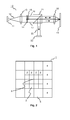
- a schematic illustration of a holographic storage system 10 is shown in Fig. 1.
- a source 11 of coherent light e.g. a laser diode, emits a light beam 12, which is collimated by a collimating lens 13.
- the light beam 12 is then divided into two separate light beams 16, 17.
- the division of the light beam 3 is achieved using a beam splitter 14.
- a spatial light modulator (SLM) 15 modulates one of the two beams, the so called "object beam" 16, to imprint a 2-dimensional data pattern, i.e. a pixel array.
- SLM spatial light modulator
- Both the object beam 16 and the further beam, the so called “reference beam” 17 are focused into a holographic recording medium 19, e.g. a holographic disk, by an objective lens 18. At the intersection of the object beam 16 and the reference beam 17 an interference pattern appears, which is recorded in a photo-sensitive layer of the holographic recording medium 19.
- the stored data are retrieved from the holographic recording medium 19 by illuminating a recorded hologram with the reference beam 17 only.
- the reference beam 17 is diffracted by the hologram structure and produces a copy of the original object beam 16, the reconstructed object beam 20.
- This reconstructed object beam 20 is collimated by the objective lens 18 and directed onto a 2-dimensional array detector 22, e.g. a CCD-array, by a further beam splitter 21.
- the array detector 22 allows to reconstruct the recorded data.
- Fig. 2 shows a schematic view of a pixel array 1 of a data page, which features an inner part 3 and an outer part 5 surrounding the inner part 3.
- the pixel array 1 is made of a square shape.
- the outer part 5 corresponds to a high field angle of a reading and/or writing device, while the inner part of the pixel array 1 corresponds to a low field angle.
- the optical axis of the whole pick up system falls into the center 6.
- a first type of data 2 is stored, whereas in the outer part 5 a second type of data 4 is stored.
- the inner and outer parts 3,5 of the data page are indicated as square fields, in order to illustrate the position of the data areas.
- first type of data 2 and second type of data 4 are shown as having different size, they may well have the same size as the inventive distinction allows high quality devices to also access outer parts 5, that are not of increased size compared to the inner part 3. Even a smaller size for the fields of the outer part 5 is possible here.
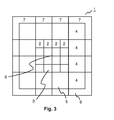
- Fig. 3 depicts a schematic view of a pixel array 1, which features a third type of data 7 located in an additional part 8 surrounding the outer part 5 of the pixel array 1 in Fig. 1.
- the pixel array 1 has a greater size compared to standard sized pixel arrays 1.
- the outer area of the data page is only readable by very high performance optical devices, whereas the inner part 3 and the outer part 5 -to be regarded as a medium part in the embodiment of Fig. 2- of the pixel array 1 is at least partly readable by standard optical devices.
- the additional part 8 requires very high performed optical devices to read out the third type of data 7.
Landscapes
- Optical Recording Or Reproduction (AREA)
- Holo Graphy (AREA)
Priority Applications (1)
| Application Number | Priority Date | Filing Date | Title |
|---|---|---|---|
| EP20060300931 EP1785987B1 (fr) | 2005-10-13 | 2006-09-06 | Support holographique de stockage de données |
Applications Claiming Priority (2)
| Application Number | Priority Date | Filing Date | Title |
|---|---|---|---|
| EP05109542A EP1775723A1 (fr) | 2005-10-13 | 2005-10-13 | Support de stockage de données holographiques |
| EP20060300931 EP1785987B1 (fr) | 2005-10-13 | 2006-09-06 | Support holographique de stockage de données |
Publications (3)
| Publication Number | Publication Date |
|---|---|
| EP1785987A2 true EP1785987A2 (fr) | 2007-05-16 |
| EP1785987A3 EP1785987A3 (fr) | 2009-02-18 |
| EP1785987B1 EP1785987B1 (fr) | 2011-07-27 |
Family
ID=37946049
Family Applications (1)
| Application Number | Title | Priority Date | Filing Date |
|---|---|---|---|
| EP20060300931 Not-in-force EP1785987B1 (fr) | 2005-10-13 | 2006-09-06 | Support holographique de stockage de données |
Country Status (1)
| Country | Link |
|---|---|
| EP (1) | EP1785987B1 (fr) |
Cited By (1)
| Publication number | Priority date | Publication date | Assignee | Title |
|---|---|---|---|---|
| EP2136366A2 (fr) | 2008-06-20 | 2009-12-23 | Hitachi Ltd. | Appareil d'enregistrement d'informations optiques, procédé d'enregistrement d'informations optiques, appareil de reproduction/enregistrement d'informations optiques et procédé de reproduction/enregistrement d'informations optiques |
Families Citing this family (1)
| Publication number | Priority date | Publication date | Assignee | Title |
|---|---|---|---|---|
| WO2023047145A1 (fr) | 2021-09-23 | 2023-03-30 | Lakatos Imre | Procédé, produit de programme informatique et support lisible par ordinateur pour créer un hologramme |
Family Cites Families (6)
| Publication number | Priority date | Publication date | Assignee | Title |
|---|---|---|---|---|
| US5777760A (en) * | 1996-05-10 | 1998-07-07 | Quantum Corporation | Position feedback system for volume holographic storage media |
| US5838650A (en) * | 1996-06-26 | 1998-11-17 | Lucent Technologies Inc. | Image quality compensation method and apparatus for holographic data storage system |
| US20030128324A1 (en) * | 2001-11-27 | 2003-07-10 | Woods Daniel D. | Pixel size enhancements |
| KR100420005B1 (ko) * | 2002-03-28 | 2004-03-02 | 주식회사 대우일렉트로닉스 | 홀로그래픽 디지털 저장 및 재생 시스템과 데이터코딩/디코딩 방법 |
| AU2003291519A1 (en) * | 2002-12-03 | 2004-06-23 | Thomson Licensing S.A. | Hybrid scalable encoder, method, and media for standard-definition and high-definition video formats on a single-disc |
| JP2005251241A (ja) * | 2004-03-01 | 2005-09-15 | Tdk Corp | ホログラム検索方法及びホログラフィック記録再生装置 |
-
2006
- 2006-09-06 EP EP20060300931 patent/EP1785987B1/fr not_active Not-in-force
Cited By (5)
| Publication number | Priority date | Publication date | Assignee | Title |
|---|---|---|---|---|
| EP2136366A2 (fr) | 2008-06-20 | 2009-12-23 | Hitachi Ltd. | Appareil d'enregistrement d'informations optiques, procédé d'enregistrement d'informations optiques, appareil de reproduction/enregistrement d'informations optiques et procédé de reproduction/enregistrement d'informations optiques |
| EP2136366A3 (fr) * | 2008-06-20 | 2010-03-03 | Hitachi Ltd. | Appareil d'enregistrement d'informations optiques, procédé d'enregistrement d'informations optiques, appareil de reproduction/enregistrement d'informations optiques et procédé de reproduction/enregistrement d'informations optiques |
| US8159923B2 (en) | 2008-06-20 | 2012-04-17 | Hitachi, Ltd. | Optical information recording apparatus, optical information recording method, optical information reproducing apparatus and optical information reproducing method |
| US8379500B2 (en) | 2008-06-20 | 2013-02-19 | Hitachi, Ltd. | Optical information recording apparatus, optical information recording method, optical information reproducing apparatus and optical information reproducing method |
| US8760988B2 (en) | 2008-06-20 | 2014-06-24 | Hitachi, Ltd. | Optical information recording apparatus, optical information recording method, optical information reproducing apparatus and optical information reproducing method |
Also Published As
| Publication number | Publication date |
|---|---|
| EP1785987B1 (fr) | 2011-07-27 |
| EP1785987A3 (fr) | 2009-02-18 |
Similar Documents
| Publication | Publication Date | Title |
|---|---|---|
| JP3452113B2 (ja) | 光情報記録装置および方法、光情報再生装置および方法ならびに光情報記録媒体 | |
| US4310916A (en) | Optical record carrier and apparatus for reading it | |
| US7755820B2 (en) | Two-dimensional modulation method for hologram recording and hologram apparatus with encoder for driving SLM displaying boundary portion | |
| US7990594B2 (en) | Phase mask for holographic data storage | |
| US7656771B2 (en) | Optical pickup and optical disc drive | |
| US7483191B2 (en) | Holographic recording method, holographic memory reproduction method, holographic recording apparatus, and holographic memory reproduction apparatus | |
| GB2034097A (en) | Optically readable record carrier | |
| JP3812608B2 (ja) | 光情報記録装置および方法、光情報再生装置および方法ならびに光情報記録媒体 | |
| CN100530372C (zh) | 光盘记录设备,光盘记录设备的控制方法以及光盘记录方法 | |
| GB2320793A (en) | Optical pickup device | |
| EP1775723A1 (fr) | Support de stockage de données holographiques | |
| CN100378815C (zh) | 二维受光元件阵列和全息光信息再生装置 | |
| EP1785987B1 (fr) | Support holographique de stockage de données | |
| US8284469B2 (en) | Apparatus for reading from and/or writing to holographic storage media | |
| US8072660B2 (en) | Hologram recording apparatus and hologram reconstruction apparatus | |
| US7525706B2 (en) | Data page pixel shaping for holographic recording | |
| US8116185B2 (en) | Holographic storage medium with integrated phase mask | |
| US20090161518A1 (en) | Holographic recording medium and pickup for this medium | |
| EP1703501B1 (fr) | Mise en forme des pixels d'une page de données pour un enregistrement holographique | |
| EP1837871B1 (fr) | Système et méthode de stockage de données holographique | |
| US20090129233A1 (en) | Shift-insensitive storage of information in page oriented optical data storage systems | |
| KR100676871B1 (ko) | 광정보 검출장치, 이를 이용한 광정보 검출방법 | |
| KR20080112730A (ko) | 기록매체, 기록매체 기록방법 및 기록장치와 기록매체재생방법 및 재생장치 |
Legal Events
| Date | Code | Title | Description |
|---|---|---|---|
| PUAI | Public reference made under article 153(3) epc to a published international application that has entered the european phase |
Free format text: ORIGINAL CODE: 0009012 |
|
| AK | Designated contracting states |
Kind code of ref document: A2 Designated state(s): AT BE BG CH CY CZ DE DK EE ES FI FR GB GR HU IE IS IT LI LT LU LV MC NL PL PT RO SE SI SK TR |
|
| AX | Request for extension of the european patent |
Extension state: AL BA HR MK YU |
|
| PUAL | Search report despatched |
Free format text: ORIGINAL CODE: 0009013 |
|
| AK | Designated contracting states |
Kind code of ref document: A3 Designated state(s): AT BE BG CH CY CZ DE DK EE ES FI FR GB GR HU IE IS IT LI LT LU LV MC NL PL PT RO SE SI SK TR |
|
| AX | Request for extension of the european patent |
Extension state: AL BA HR MK RS |
|
| 17P | Request for examination filed |
Effective date: 20090817 |
|
| AKX | Designation fees paid |
Designated state(s): DE FR GB |
|
| RAP1 | Party data changed (applicant data changed or rights of an application transferred) |
Owner name: THOMSON LICENSING SA |
|
| GRAP | Despatch of communication of intention to grant a patent |
Free format text: ORIGINAL CODE: EPIDOSNIGR1 |
|
| GRAS | Grant fee paid |
Free format text: ORIGINAL CODE: EPIDOSNIGR3 |
|
| GRAA | (expected) grant |
Free format text: ORIGINAL CODE: 0009210 |
|
| AK | Designated contracting states |
Kind code of ref document: B1 Designated state(s): DE FR GB |
|
| REG | Reference to a national code |
Ref country code: GB Ref legal event code: FG4D |
|
| REG | Reference to a national code |
Ref country code: GB Ref legal event code: 746 Effective date: 20110808 |
|
| REG | Reference to a national code |
Ref country code: DE Ref legal event code: R096 Ref document number: 602006023297 Country of ref document: DE Effective date: 20110915 |
|
| PLBE | No opposition filed within time limit |
Free format text: ORIGINAL CODE: 0009261 |
|
| STAA | Information on the status of an ep patent application or granted ep patent |
Free format text: STATUS: NO OPPOSITION FILED WITHIN TIME LIMIT |
|
| 26N | No opposition filed |
Effective date: 20120502 |
|
| REG | Reference to a national code |
Ref country code: DE Ref legal event code: R097 Ref document number: 602006023297 Country of ref document: DE Effective date: 20120502 |
|
| PGFP | Annual fee paid to national office [announced via postgrant information from national office to epo] |
Ref country code: FR Payment date: 20121008 Year of fee payment: 7 |
|
| REG | Reference to a national code |
Ref country code: FR Ref legal event code: ST Effective date: 20140530 |
|
| PG25 | Lapsed in a contracting state [announced via postgrant information from national office to epo] |
Ref country code: FR Free format text: LAPSE BECAUSE OF NON-PAYMENT OF DUE FEES Effective date: 20130930 |
|
| PGFP | Annual fee paid to national office [announced via postgrant information from national office to epo] |
Ref country code: GB Payment date: 20150924 Year of fee payment: 10 Ref country code: DE Payment date: 20150924 Year of fee payment: 10 |
|
| REG | Reference to a national code |
Ref country code: DE Ref legal event code: R119 Ref document number: 602006023297 Country of ref document: DE |
|
| GBPC | Gb: european patent ceased through non-payment of renewal fee |
Effective date: 20160906 |
|
| PG25 | Lapsed in a contracting state [announced via postgrant information from national office to epo] |
Ref country code: GB Free format text: LAPSE BECAUSE OF NON-PAYMENT OF DUE FEES Effective date: 20160906 Ref country code: DE Free format text: LAPSE BECAUSE OF NON-PAYMENT OF DUE FEES Effective date: 20170401 |